PART 2: A Five-Pound Mother Cat Stopped Four Lanes of Traffic for Her Baby—What I Saw Next Still Haunts Me
PART 2
I remember the sound changing first.
People think highways are loud because of engines.
That is only part of it.
A busy interstate has a constant pressure to it—the deep rolling sound of tires, engines changing speed, wind moving around trucks, horns, brakes, vibrations coming through the pavement.
When those four lanes slowed, that pressure began disappearing.
One vehicle stopped.
Then another.
Brake lights stacked behind the delivery truck until red stretched into the distance.
Later, we estimated the backup reached nearly two miles.
At the time, I barely noticed.
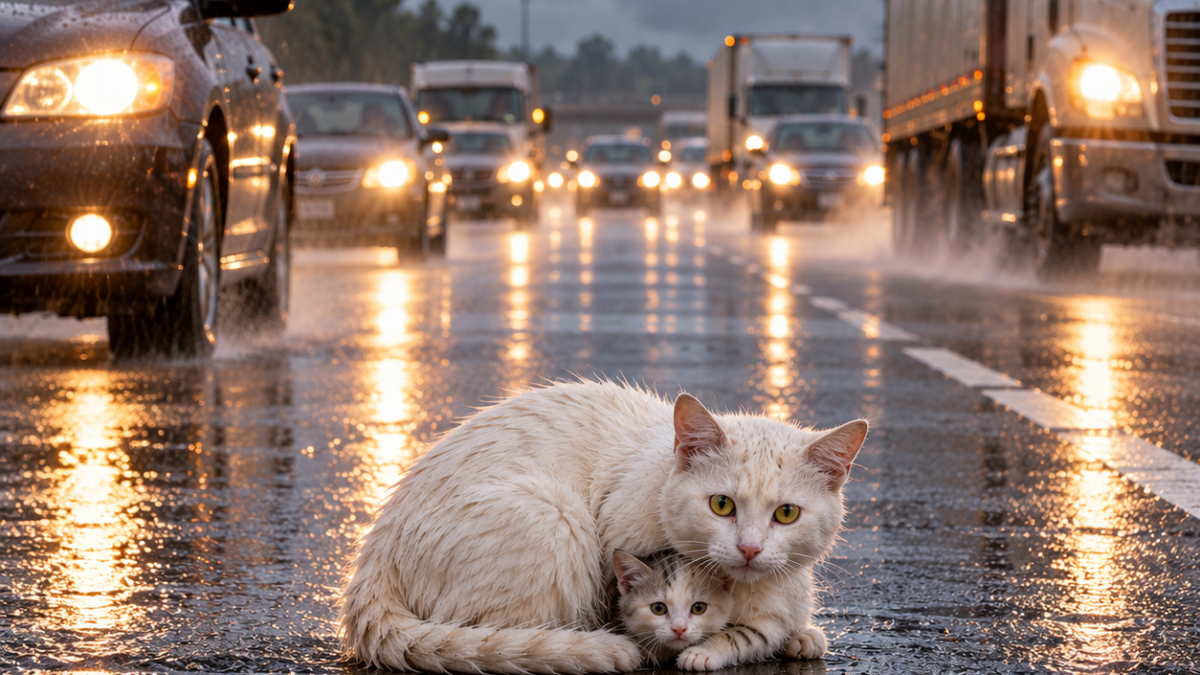
All I saw was the little calico in the road.
And all I could think was:
Stay there.
Just a little longer.
The delivery driver had positioned his truck as a barrier between the animals and the traffic approaching from behind.
It was a bread truck, long enough to cover a significant section of the roadway.
The driver had used the biggest thing he had available to protect the smallest thing on the highway.
I pulled my cruiser into position and activated everything I had.
Lights.
Hazards.
Radio.
Other units were approaching.
The interstate was becoming controlled, but there is always a dangerous transition period when some drivers understand and others do not.
I watched mirrors.
Watched lanes.
Watched the cat.
The driver climbed out.
For a second, I wanted to tell him to stay inside.
Roadways are unpredictable even when traffic appears stopped.
But he moved carefully.
He did not run.
He did not rush toward the cat.
He looked once toward the line of vehicles, then back toward the tiny shape on the pavement.
I started walking from my side.
By the time we reached the center lanes, I could finally see the mother clearly.
She was young.
Smaller than I had expected.
Her calico coat was dusty.
Her paws were dirty.
Her eyes were wide.
The kitten was completely hidden beneath her except for the smallest glimpse of fur.
The driver stopped several feet away.
“So that’s what everybody was avoiding,” he said quietly.
His voice sounded different from how people usually sound during highway incidents.
No frustration.
No anger.
Mostly disbelief.
I nodded.
“She’s covering something.”
He crouched.
The mother lifted her head.
Her ears moved back.
But she did not leave.
The driver moved closer.
“Easy,” he whispered.
She watched him.
I have spent much of my career reading behavior.
Human behavior.
Driver behavior.
The small choices people make before they do something dangerous or unpredictable.
Animals are different.
Still, I knew what I was seeing.
That cat was terrified.
Not aggressive.
Not looking for confrontation.
Terrified.
But fear was not stronger than the reason she had remained.
Her baby was beneath her.
The driver extended a hand slowly.
The cat tightened around the kitten.
He stopped.
“That’s not going to work.”
“What?”
“She’s not giving it up.”
I crouched a few feet away.
He tried to see beneath her without forcing her to move.
She pulled her legs closer.
Then he looked at me.
“I think I’m going to have to lift both.”
I nodded.
“Slow.”
He slid his hands carefully beneath the little mother.
She resisted—not violently, but with determination.
Her whole body seemed to say the same thing.
The kitten stays with me.
So he did exactly what she required.
He lifted them together.
Mother and baby.
One bundle.
For the first time in what we later understood had been approximately eleven terrifying minutes, that little family left the traffic lane.
I remember exhaling.
I had not realized I was holding my breath.
The mother remained wrapped around the kitten as the driver carried them.
Even off the roadway, she still would not loosen her hold.
Later, he described it better than I could.
She had already made her decision.
Whatever reached that spot would reach her first.
Even the person trying to save her had to accept that decision.
We moved them to safety.
Only then could we begin understanding what had happened.
The kitten was alive.
That was the first miracle.
And once professionals examined the little one, we learned something even harder to believe.
There appeared to be no serious injury.
I remember staring at the kitten when I heard that.
No major wound.
No obvious damage.
After all those vehicles.
After all that noise.
After being stranded in the middle of an interstate.
The baby had survived beneath its mother.
The mother had done exactly what she had set out to do.
She had protected it.
But there was another problem.
The mother had not appeared from nowhere.
Cats living outdoors often hide their kittens in places people never notice.
Brush.
Drainage areas.
Abandoned structures.
Thick vegetation.
And there was brush in the interstate median.
If she had one kitten in the roadway, there was a good chance there were others nearby.
That thought changed the entire rescue.
We could not simply remove the two animals and reopen traffic.
Not yet.
I looked toward the median.
The driver did too.
“You think there are more?”
“I think we need to check.”
He nodded immediately.
No complaint about his delivery schedule.
No question about how long this was taking.
He had already turned a forty-foot truck sideways across rush-hour traffic for a cat.
At that point, I suppose his morning was committed.
Other officers helped secure the area while we searched.
The brush was thicker than it appeared from the road.
Cars had been passing beside that strip of land every day.
Thousands of people.
Maybe tens of thousands.
Almost nobody would have known there was a mother raising babies just yards away.
That thought has stayed with me.
How much life exists beside us without ever being noticed?
How many small struggles happen beyond a guardrail while we drive past thinking only about where we need to be?
We moved carefully.
Then someone called out.
One kitten.
Alive.
Hidden deep in the brush.
Then another.
And another.
Three more.
Four babies total.
Suddenly everything made sense.
The mother had been moving them.
One at a time.
Maybe their hiding place no longer felt safe.
Maybe noise or another animal had disturbed them.
Maybe something in her instincts simply told her they had to leave.
We would never know.
But at some point in the early morning, before traffic reached its full intensity, that tiny mother had begun carrying her kittens across the interstate.
Imagine the scale of that problem from her perspective.
A highway was not a road.
It was an enormous open space filled with noise and movement.
She had no carrier.
No vehicle.
No human help.
No safe crossing.
Just her mouth, her paws, and four babies depending entirely on her.
She had apparently managed part of the journey.
Then one kitten slipped.
By the time she turned back, traffic had grown.
And she faced a choice.
Run.
Or stay.
She stayed.
When the three other kittens were brought out of the brush, something in the mother changed.
She was still frightened.
Still watchful.
But for the first time, all four babies were together.
I remember seeing them near her.
Tiny bodies pressing close.
She lowered her head toward them.
There are moments in police work when you are expected to remain professionally detached.
You have a job.
Secure the scene.
Protect people.
Document what happened.
Restore traffic flow.
Move to the next call.
But I had been on the job twenty-two years, and I was old enough to admit that some scenes get through the uniform.
This was one of them.
The mother looked exhausted.
Her paws were dirty from the road.
She needed water.
She needed quiet.
Yet even after what she had endured, she kept checking the kittens.
One.
Two.
Three.
Four.
All there.
Traffic eventually began moving again.
Drivers accelerated.
The backup slowly cleared.
People returned to their schedules.
For most of them, the morning probably became normal again before lunch.
Mine did not.
At the clinic, veterinarians estimated the mother was only around eighteen months old.
Barely more than a kitten herself.
She weighed approximately five pounds.
That detail bothered me.
Five pounds.
I had seen trucks on that highway carrying tens of thousands of pounds.
I had seen horse trailers.
Commercial vehicles.
SUVs.
Heavy equipment.
And the thing that finally stopped four lanes was five pounds of frightened determination.
The staff named her Lane.
I thought it fit perfectly.
Her kitten remained close.
So did the other three.
When someone attempted routine handling, Lane became tense if she thought one of the kittens was being taken too far away.
Nobody blamed her.
After the morning she had experienced, separation was the last thing she needed.
The clinic staff adapted.
They kept the family together as much as possible.
Water.
Food.
Warm bedding.
Quiet.
The simplest things can look extraordinary after fear.
I watched Lane drink.
She paused between sips to look toward the kittens.
They were safe.
But she did not know that safety could last.
That takes time.
Animals living outdoors learn not to trust good conditions too quickly.
Food disappears.
Shelter changes.
People come and go.
Danger returns.
Lane had spent her short life reacting to uncertainty.
Now, for the first time, people were trying to give her something predictable.
The driver stayed longer than anyone expected.
Eventually, I asked him, “Don’t you have deliveries?”
He looked at his phone.
Then at Lane.
“Yeah.”
“You’re probably going to have some explaining to do.”
“Probably.”
He sounded worried for the first time.
Not about the cat.
About his job.
I understood.
Compassion does not erase mortgages.
People still have responsibilities.
He had used a company vehicle to stop traffic.
He had delayed a route.
He had become involved in an incident that was already attracting attention.
There would be reports.
Questions.
Possibly complaints.
He rubbed the back of his neck.
“I just couldn’t drive past.”
I looked at him.
“You shouldn’t have.”
He laughed nervously.
“My boss may disagree.”
I glanced toward Lane.
“She had eleven minutes in traffic because everybody kept trying to move around her.”
Then I looked back at him.
“You stopped.”
He said nothing.
I continued.
“That matters.”
He nodded once.
Later, when highway-camera footage was reviewed, the full story became even clearer.
At 6:52 that morning, Lane had lowered her body over the kitten.
The cameras showed traffic approaching.
Swerving.
Moving past.
At one point, a large horse trailer passed close enough that the rush of air flattened her fur.
She remained in place.
Watching that footage from the safety of an office was somehow worse than seeing part of the event in person.
When you are responding, you are busy.
You act.
You communicate.
You make decisions.
Video removes that.
You just watch.
And when we watched Lane, we saw exactly how long she had been there.
Eleven minutes.
People sometimes hear “eleven minutes” and think it sounds short.
Set a timer sometime.
Sit still for eleven minutes.
Now imagine every second contains noise, wind, headlights, movement and danger you cannot understand.
Lane did not know a patrol unit was coming.
She did not know a bread truck would eventually stop traffic.
She did not know cameras were watching.
She had no expectation of rescue.
That made her decision more powerful.
She was not waiting for help.
She simply refused to leave her baby.
At one point in the footage, one vehicle moved toward her lane.
Lane lowered herself further.
That image stayed with me.
Not because it was dramatic.
Because it was instinct stripped down to its simplest form.
There was no strategy beyond:
Cover the baby.
Stay.
When we released part of the footage publicly, the reaction was immediate.
Drivers who had been on the interstate that morning began commenting.
Some had not known what caused the backup.
A few admitted they had been frustrated.
One person wrote that they had originally thought Lane was debris.
Then the little shape moved its head.
That sentence spread quickly.
I thought it captured the morning perfectly.
We spend so much of our lives labeling things before we understand them.
Debris.
Delay.
Problem.
Obstacle.
Traffic.
Then we look closer.
And suddenly there is a life inside the thing that was inconveniencing us.
A mother.
A baby.
Fear.
Love.
The public reaction grew.
People wanted updates.
Was the kitten okay?
What happened to the mother?
Were there more babies?
Where were they going?
Then came another surprise.
The bread company employing the driver learned the full story.
I admit I wondered how they would react.
Businesses have schedules.
Routes.
Insurance.
Policies.
A forty-foot company truck had been placed sideways across an interstate.
No manager enjoys receiving that sentence without context.
The driver later told me he had prepared himself for a serious meeting.
He walked in believing he might be disciplined.
Possibly worse.
Instead, his employer had seen the footage.
They understood why he had stopped.
The company gave him a paid week off.
Then they agreed to cover veterinary expenses for Lane and all four kittens.
When I heard that, I smiled.
Not because anybody had “won.”
Because it felt like the right kind of answer.
A man had risked being late because five tiny animals mattered.
His employer decided that compassion would not become something he regretted.
That matters too.
There is a quiet message hidden inside decisions like that.
When people do the decent thing, we can punish the disruption.
Or we can recognize why the disruption happened.
The bread company chose recognition.
And the public loved them for it.
The driver became known in reports simply as the man in the bread truck.
People praised him.
He disliked that.
Whenever someone called him heroic, he tried to redirect attention toward Lane.
“She’s the one who stayed in the road,” he told me once.
“All I did was park a truck.”
I shook my head.
“You know that isn’t all you did.”
He smiled.
“But it sounds better.”
The truth was that both parts mattered.
Lane could protect her kitten with her body.
But she could not stop four lanes of vehicles.
The driver could stop traffic.
But he would never have known to do it if Lane had not stayed.
One act of love met one act of kindness.
That intersection changed everything.
Within six days, rescue organizations had received roughly four hundred adoption applications connected to Lane and her kittens.
Four hundred.
I remember someone at the shelter telling me the number, and I made them repeat it.
“These cats?”
They laughed.
“Yes, Sergeant. These cats.”
I thought about the brush beside the interstate.
Days earlier, almost nobody knew they existed.
Now hundreds of people wanted to offer them homes.
That is another strange thing about rescue stories.
One moment can turn invisibility into overwhelming attention.
The challenge becomes choosing carefully.
Popularity is not the same as suitability.
A viral animal still needs a stable home.
Responsible care.
Veterinary support.
Patience.
Lane especially needed someone who understood that she had spent much of her life surviving without people.
She could not be treated like a celebrity.
She needed to be allowed to become a cat again.
The shelter staff reviewed applications.
Families sent photos.
Descriptions of homes.
Experience with animals.
References.
It seemed almost certain that Lane and the kittens would eventually be placed with carefully selected adopters.
Then the bread-truck driver returned.
He did not come alone.
His wife was with him.
And their eight-year-old daughter.
I happened to be visiting that day.
Part of my job was finished by then, but I had become attached to the outcome.
I wanted to see where the family went.
The little girl approached the enclosure slowly.
Lane watched her.
The kittens had already changed.
Warmth and regular meals do that quickly.
They were more active.
Curious.
Tiny heads turning toward movement.
The girl crouched.
She did not push her fingers through the enclosure.
Did not squeal.
Did not ask to hold them immediately.
She simply sat.
Her father stood behind her.
“That’s the one?” she asked.
He nodded.
“The mama?”
“Yeah.”
“The one from the road?”
“Yeah.”
She looked at Lane for a long moment.
Then at the kittens.
I watched her father’s face.
He was trying not to show emotion.
His daughter had only heard the story.
He had lived it.
He had stood in the lane and lifted that mother while she refused to uncover her baby.
The girl turned.
“Are they going somewhere else?”
Her father hesitated.
“That was the plan.”
She frowned.
“Why?”
“There are lots of people who want them.”
“All of them?”
“Lots.”
She thought about that.
Then she looked back at Lane.
And said something none of us in the room forgot.
“She stopped the whole highway. We can share the couch.”
There are sentences adults spend paragraphs trying to express.
Children sometimes do it in nine words.
Her father looked at his wife.
His wife looked at him.
I knew the decision before either spoke.
The driver who had stopped his truck for Lane did not want his part of the story to end at the highway.
His family decided to bring her home.
And they wanted the kittens too.
I looked at him.
“All of them?”
He gave me an exhausted smile.
“Apparently we have a very large couch.”
His daughter corrected him.
“We have two couches.”
He laughed.
“Problem solved.”
That became the ending people wanted.
But bringing animals home is not the same as completing a fairy tale.
Lane still had to adjust.
The kittens needed routine veterinary care.
The family needed supplies.
Separate safe spaces.
Food.
Litter.
Time.
Patience.
The driver understood that.
He had already learned one important fact about Lane.
She decided the pace.
The first days at the house were quiet.
Lane stayed close to her kittens.
She explored mostly when the house settled.
The little girl wanted desperately to pet her, but her parents explained that love sometimes meant waiting.
So she waited.
She sat several feet away.
Read books.
Talked softly.
Put treats down and moved back.
Never chased.
Never cornered.
Lane watched.
Over time, distance became smaller.
Not all at once.
A few inches here.
A step there.
One evening, the driver sent me a picture.
Lane was lying beneath a table.
His daughter was sitting nearby doing homework.
Neither was touching the other.
The message beneath the photograph read:
**Progress.**
I knew exactly what he meant.
Trust does not always arrive with a dramatic moment.
Sometimes trust is an animal choosing not to leave the room.
The kittens adapted faster.
They raced through the house.
Climbed furniture.
Turned cardboard boxes into fortresses.
Discovered curtains.
Their new family learned quickly that four young cats could create more chaos than a busy delivery route.
The driver called me one afternoon.
“I have a complaint.”
“What happened?”
“They destroyed a roll of paper towels.”
“Call local authorities.”
“I thought I was.”
“I’m highway patrol.”
“Close enough.”
I laughed.
“How’s Lane?”
His voice changed.
Softer.
“She slept on the couch last night.”
“The couch?”
“The famous couch.”
“Did your daughter see?”
“She fell asleep waiting.”
“Probably for the best.”
“Lane stayed twenty minutes.”
That was the victory.
Not publicity.
Not four hundred applications.
Twenty quiet minutes on a couch.
A homeless mother that had once slept in brush beside an interstate had decided a human home was safe enough to close her eyes.
Months passed.
The story faded from headlines.
New stories replaced it.
That always happens.
But for those of us who had been there, Lane never became yesterday’s news.
I kept one photograph.
It came from highway footage.
The image was not especially beautiful.
Four lanes.
Stopped traffic.
A bread truck sideways across the interstate.
Flashing lights.
And near the center, almost too small to notice, Lane.
People who visited my office sometimes asked about it.
“What’s that?”
I would tell them.
Most assumed I kept the photograph because of the blocked interstate.
They were wrong.
I kept it because of scale.
Look at the photograph from a distance and the largest thing is the truck.
Look at it as an officer and you notice traffic control.
Look at it as a commuter and you notice the delay.
But once you know the story, your eye goes to the smallest figure.
Five pounds.
That is what stopped the morning.
Not physically.
Lane could not stop traffic herself.
But her refusal to leave forced people to make choices around her.
Some swerved.
Some slowed.
One driver stopped.
Then we stopped everyone else.
Her courage created the moment.
Human kindness completed it.
I was asked many times what impressed me most.
People expected me to say the mother covering her kitten.
That was part of it.
But another part stayed with me.
The driver had a choice too.
He could have continued.
He was operating a large commercial vehicle.
Stopping was inconvenient.
Blocking lanes created responsibility.
He had deliveries waiting.
A company schedule.
Probably customers wondering where their bread was.
Still, he looked at that small shape on the roadway and decided a schedule could survive being interrupted.
A kitten might not.
Years in law enforcement teach you that people reveal themselves through small decisions.
Not speeches.
Decisions.
Somebody returns a wallet no one saw them find.
Someone slows for a stranded driver in the rain.
A neighbor checks on an older person during extreme weather.
A delivery driver sees something tiny in traffic and says:
Not today.
You’re not facing this alone.
That was his decision.
And in a strange way, it mirrored Lane’s.
Lane told her kitten:
I stay.
The driver told Lane:
Then I’ll stop too.
Maybe that is why the story moved people.
It was not only about a cat.
It was about two beings who could have chosen self-preservation or convenience and instead chose responsibility for someone smaller.
There was no villain.
People asked me later whether I was angry at the drivers who had passed Lane.
I was not.
Most of them did what drivers are trained to do.
Avoid an obstruction.
Do not suddenly stop in high-speed traffic.
Do not run into active lanes.
Many probably never understood what they were seeing.
You cannot judge somebody for failing to solve a situation they have not understood.
And I always emphasized this when speaking publicly.
The lesson was not to jump into highway traffic.
That can create an even larger emergency.
Call for help.
Alert authorities.
Slow only when safe.
Let trained responders secure the area.
The bread-truck driver happened to be operating a vehicle large enough to create a barrier and responded in a way that helped us control the scene.
The goal is compassion with judgment.
Not reckless bravery.
Lane herself had no such choice.
She was already trapped.
Her world had narrowed to one kitten beneath her.
So she used the only protection she possessed.
Herself.
That fact hit me differently after I became a grandfather.
Years after the rescue, I was holding my granddaughter while she slept.
She was tiny.
Warm.
Completely dependent.
I looked down at her and thought unexpectedly of Lane.
Different species.
Different world.
Yet something ancient connects parents protecting young.
Lane did not understand interstate traffic laws.
She did not understand velocity.
She did not understand that thousands of pounds of metal were moving around her.
But she understood:
Baby.
Danger.
Stay.
Sometimes intelligence creates complicated solutions.
Love can create very simple ones.
Stay.
Cover.
Protect.
When Lane and her kittens had been in their new home for several months, the driver invited me over.
I hesitated.
Police officers do not normally make social visits to animals from old calls.
But this was not a normal call.
His daughter answered the door.
“She’s here!”
I laughed.
“Who?”
“Lane.”
“I assumed Lane lived here.”
“No. Here.”
She pointed.
Lane was on the couch.
Not under it.
Not behind furniture.
On the couch.
She looked toward me.
Her body became slightly tense.
I stopped moving.
The girl whispered, “She doesn’t know you anymore.”
“That might be a good thing.”
“Why?”
“Last time she saw me, she was having a pretty bad morning.”
The girl thought about that.
Then nodded seriously.
“Don’t scare her.”
“Yes, ma’am.”
I sat across the room.
Lane stayed.
Her kittens—larger now—appeared one after another.
One climbed onto the back of the couch.
Another chased something invisible beneath a chair.
The third tried to investigate my shoes.
The fourth remained beside the girl’s mother.
The delivery driver entered carrying coffee.
“Recognize anybody?”
“The kittens grew.”
“They eat like they’re trying to bankrupt me.”
His daughter protested.
“They’re growing.”
“So is my grocery bill.”
Lane watched us.
Then the little girl sat carefully at one end of the couch.
She did not touch the cat.
A few minutes later, Lane stood.
My eyes followed her.
She moved toward the child.
Slowly.
Then she lay back down.
Closer.
Not touching.
But closer.
The girl looked at me with huge eyes.
She whispered, “Did you see?”
I nodded.
She whispered even more quietly.
“She likes me.”
I could have explained that cats are complicated.
That proximity does not necessarily equal human-style affection.
That trust takes many forms.
None of that was necessary.
“Yes,” I said.
“I think she does.”
The driver stood behind his daughter.
He looked at Lane.
Then at me.
For a few seconds, we were back on the interstate.
I could see it in his expression.
He remembered the dirt on her paws.
The noise.
The way she tightened around her baby.
Now the same cat was choosing to rest near his child.
There are forms of justice that happen in courtrooms.
I’ve seen many.
There are also quieter forms.
Lane had been born into uncertainty.
No guaranteed food.
No permanent shelter.
No person watching for her.
Then one morning, the world nearly became impossibly dangerous.
And yet the final chapter was a warm couch.
That felt like justice.
The driver had worried his decision might cost him at work.
Instead, his employer rewarded him and paid the family’s veterinary expenses.
That felt like justice too.
Drivers had spent eleven minutes frustrated by a delay they did not understand.
Then thousands saw the reason and responded with compassion.
Another kind of justice.
Nobody needed revenge.
Reality delivered something better.
Vindication.
Every minute of that delay had mattered.
Every flashing brake light.
Every stopped vehicle.
Every delivery made late.
The inconvenience disappeared.
The lives remained.
I remember telling the driver that.
He shrugged.
“I still had a couple customers mad at me.”
“What did you tell them?”
He smiled.
“That the bread arrived. Eventually.”
“And?”
“One guy said he’d forgive me if I brought a picture of the cat next time.”
“Did you?”
“Of course.”
“Then you’re a better public-relations officer than I am.”
His daughter interrupted.
“He put Lane’s picture in the truck.”
I looked at him.
“You did?”
He looked embarrassed.
“Maybe.”
The girl ran to another room and returned holding a printed photograph.
Lane with her kittens.
Safe.
He apparently kept a copy near the dashboard.
Not where it blocked visibility.
Just somewhere he could see it.
A reminder.
I understood why.
People sometimes need proof that stopping was worth it.
Years later, when life became routine again, Lane still provided that proof.
He would have thousands of ordinary delivery days.
But only one morning when he had turned his truck sideways for a five-pound mother.
I had thousands of calls during my career.
But only one where the obstruction turned out to be love refusing to move.
That became the phrase I used privately.
Love refusing to move.
Because that was what Lane had done.
She could not defeat traffic.
She could not understand the danger.
She could not carry the kitten away once the road became too busy.
So she turned herself into the only shelter available.
Her own body.
People sometimes imagine courage means the absence of fear.
After twenty-two years in law enforcement, I can tell you that is almost never true.
The courageous people I met were often frightened.
They simply decided something else mattered more.
Lane was frightened.
Everything in her posture showed it.
Her eyes.
Her flattened body.
Her refusal to uncover the kitten even when help arrived.
Fear was there.
Love was simply stronger.
When I eventually retired from active patrol, I cleaned out my office.
Old commendations.
Reports I no longer needed.
Photographs from community events.
A coffee mug somebody had given me.
Several younger officers helped carry boxes.
One of them noticed the Lane photograph.
“I know this one.”
“You do?”
“My wife showed me that video years ago.”
I smiled.
“Small world.”
He picked up the frame.
“You were there?”
“I was.”
“No way.”
“Unfortunately, I was much younger.”
He laughed.
Then he studied the image.
“That’s the cat?”
I pointed.
“Right there.”
He leaned closer.
“She’s tiny.”
“That’s the point.”
He looked again at the miles of stopped traffic.
“This whole thing because of her?”
“Because of her baby.”
He was quiet.
Then asked:
“What happened to them?”
That was always my favorite question.
Because the answer was good.
“All went home with the driver.”
“All of them?”
“Mother and four.”
“That guy must’ve lost his mind.”
“His daughter had two couches.”
He looked confused.
I laughed.
“Long story.”
I put the photograph into my personal box.
It hangs in my home now.
Occasionally, visitors ask.
My grandchildren know the story.
They call Lane “Grandpa’s highway cat,” although she was never mine.
One afternoon, my oldest grandson asked:
“Did she know she stopped the highway?”
“No.”
“Did she know people were helping?”
“Probably not at first.”
“Did she know she was famous?”
I laughed.
“Definitely not.”
He stared at the picture.
“Then why did she do it?”
“For her kitten.”
“Even if nobody saw?”
“Especially if nobody saw.”
That answer surprised me as I said it.
Because it captured something that public attention can obscure.
Lane’s action mattered before anybody filmed it.
Before social media.
Before news crews.
Before four hundred applications.
Before the bread company made its generous decision.
Before anyone named her.
The moral value of what happened did not come from being witnessed.
Had no camera recorded the scene, she would still have been a mother refusing to abandon her baby.
Had the story never gone viral, the driver’s choice would still have been compassionate.
Goodness is not made real by an audience.
The audience simply gets lucky enough to see it.
I wish more viral stories remembered that.
We become fascinated with numbers.
Views.
Shares.
Comments.
Applications.
Miles of traffic.
But the actual story of Lane came down to units much smaller.
One mother.
One kitten.
One driver.
One decision.
Then another decision.
Then another.
The mother stayed.
The driver stopped.
Officers secured the road.
Rescuers searched the brush.
Veterinarians treated the family.
A company supported its employee.
A family opened its home.
None of those decisions alone created the ending.
Together they did.
That is how most meaningful things happen.
Not through one giant heroic moment.
Through several people refusing to walk away from the part they can handle.
The sergeant secures traffic.
The driver creates a barrier.
The veterinarian checks the animals.
The shelter handles placement.
The child makes room on the couch.
Everyone carries one piece.
That is why I always resisted when reporters tried to identify one hero.
Lane was heroic in the only way she knew.
The driver acted courageously and compassionately.
But the ending required a chain of care.
Break one link and the story could have been different.
What if no driver had reported the obstruction?
What if traffic had continued?
What if the bread truck had kept moving?
What if responders had rescued the mother and one kitten but never searched the median?
What if the clinic separated them unnecessarily?
What if the driver’s employer had decided compassion deserved punishment?
Instead, at every stage, somebody chose care.
That is rare enough to celebrate.
I kept in touch with the driver occasionally.
Not often.
Our lives were busy.
Years later, he called unexpectedly.
“Sergeant?”
“Nobody’s called me that since retirement unless I’m in trouble.”
He laughed.
“You got a minute?”
“For you, sure.”
He told me Lane had become an older cat.
Gray had begun appearing around parts of her coat.
She moved more slowly.
The kittens were adults.
Not all still living in the same household by then—some family arrangements had evolved as the cats matured—but each remained cared for within the extended family network.
Lane stayed with him.
Of course she did.
“She still sleep on the couch?” I asked.
“Every night.”
“The couch your daughter offered?”
“Same one.”
“How old is your daughter now?”
He told me.
I almost dropped the phone.
Years had gone faster than I realized.
“Does she remember saying it?”
“She claims she doesn’t.”
“You tell her?”
“All the time.”
“Good.”
He became quiet.
Then said, “I drove that road today.”
“The interstate?”
“Yeah.”
“Still there.”
“Very funny.”
He paused.
“I kept thinking about how close I came to being too late.”
I knew that thought.
It visits people after rescues.
We focus on the happy ending, then years later the mind wanders toward the alternate version.
What if?
What if?
What if?
I had learned not to stay there.
“But you weren’t,” I said.
“I know.”
“You stopped.”
“Yeah.”
“That’s the story.”
Silence.
Then he said, “She changed our whole family.”
“I believe it.”
“My daughter volunteers with animals now.”
I smiled.
“There you go.”
“Started because of Lane.”
Maybe that was Lane’s final ripple.
The kitten she protected survived.
The three kittens in the brush survived.
Lane got a home.
But the story kept moving outward.
A child grew up understanding that vulnerable animals mattered.
Drivers learned what had been behind the morning delay.
A company showed that humane choices and professional responsibility did not have to be enemies.
Millions of people saw a frightened stray not as an inconvenience but as a mother.
That matters.
Language matters.
“Stray” can sound disposable.
“Obstacle” can sound removable.
“Traffic delay” can sound pointless.
Then you add context.
Mother.
Baby.
Protection.
Rescue.
Home.
The facts have not changed.
Our understanding has.
That is why I tell people to look closer.
Not only at animals.
At life.
Much of what frustrates us makes more sense once we understand what is beneath it.
A stopped car might contain somebody having a medical problem.
A frightened dog might be lost rather than aggressive.
A quiet person might be carrying a burden invisible to everyone around them.
A traffic jam might exist because five pounds of life are trying to protect something even smaller.
Look closer before deciding what something is.
Lane taught me that.
Near the end of my career, a rookie officer once complained about being sent to what he called “another stupid animal call.”
Nothing serious had happened.
A dog was loose near a roadway.
We helped contain it and locate the owner.
On the drive back, he said:
“I don’t get why people call highway patrol for this.”
I looked at him.
“Because the animal is on a highway.”
“You know what I mean.”
I did.
He thought some calls mattered more than others.
Every young officer learns perspective eventually.
I pointed through the windshield.
“You ever hear about Lane?”
“The highway cat?”
“Yeah.”
“Of course.”
“I responded.”
He looked at me.
“You did?”
“Yep.”
His attitude changed immediately.
I almost laughed.
I told him part of the story.
Then I said:
“You never know which little call is going to become the one somebody remembers forever.”
He nodded.
After that, I noticed he complained less about animal calls.
Maybe coincidence.
Maybe not.
That is the kind of “revenge” I prefer.
Not hurting somebody who was wrong.
Watching experience quietly correct them.
Lane defeated indifference without knowing it existed.
The driver answered skepticism by giving her a home.
The company answered the possibility of punishment with a paid week and veterinary support.
The public answered one morning of inconvenience with hundreds of offers to help.
Every cynical interpretation lost.
Not because someone attacked it.
Because the ending was too good to argue with.
The highway reopened.
The deliveries continued.
The world did not collapse because people stopped for eleven minutes.
That fact seems simple.
Yet it means something.
We often act as though kindness is expensive.
Sometimes it is.
Care can require money.
Time.
Responsibility.
Sacrifice.
But sometimes kindness costs eleven minutes.
A delayed route.
A phone call.
A small change in plans.
And what does that purchase?
In Lane’s case:
Five lives.
A mother and four babies.
A home.
A child’s future connection to animals.
A photograph that still teaches people years later.
Eleven minutes seems like a bargain.
Of course, no one standing in traffic knew that yet.
That is the problem with compassion.
You often pay before you know the return.
You stop without knowing whether it matters.
You call for help without knowing the outcome.
You foster an animal without knowing whether it will trust you.
You spend time on someone without knowing whether they will remember.
Goodness offers no receipt.
No guaranteed return.
Lane stayed without a guarantee.
The driver stopped without one.
That is what made the story honest.
When people ask me what happened to the kitten from the road, I usually correct them.
“Which kitten?”
They forget there were four.
The baby beneath Lane became the symbol.
But three more lives were waiting in the median.
That detail matters.
Had we focused only on the dramatic image, we might have rescued two and missed three.
Emotion gets attention.
Follow-through completes the work.
That applies far beyond animal rescue.
A dramatic moment can make you care.
Responsibility asks:
What else needs to be done?
The bread-truck driver saved the immediate pair from the active lanes.
Responders still had to search.
The clinic still had to provide care.
The family still had years of responsibility ahead.
A happy ending is usually labor wearing a beautiful disguise.
Lane’s life after rescue was not perfect because cameras stopped rolling.
There were adjustment periods.
Veterinary appointments.
Kittens requiring normal care.
Training humans not to overwhelm a formerly homeless cat.
Costs.
Mess.
Scratched furniture, probably.
Interrupted sleep, definitely.
The driver once joked that stopping an interstate had been easier than convincing four young cats not to climb everything in his house.
I believed him.
But none of those ordinary difficulties weakened the story.
They strengthened it.
A home is not a magical place where problems disappear.
It is where problems stop being faced alone.
That was what Lane had lacked before.
She had handled every danger herself.
Find food.
Find shelter.
Protect kittens.
Move kittens.
Cross a highway.
After rescue, the burden changed.
Humans carried some of it.
Food arrived.
Doors closed safely.
Veterinary care was available.
The couch remained.
She could sleep.
Maybe that is the clearest definition of rescue I know.
Not saving someone once.
Creating conditions where they no longer have to save themselves every day.
The older I get, the more important that distinction becomes.
Lane survived the highway because she was courageous.
But courage should not have to become a permanent lifestyle.
Nobody should have to be brave every second.
Eventually, every frightened creature deserves somewhere it can stop being brave.
For Lane, that place became a house with an eight-year-old girl and two couches.
I think about that line often.
“We can share the couch.”
It sounds cute.
It was cute.
But underneath it was something larger.
The girl understood home as abundance.
Not luxury.
Room.
There is room.
That is one of the kindest ideas a person can offer.
There is room for you here.
You do not have to stay in the brush.
You do not have to cross traffic.
You do not have to protect your babies alone.
There is room.
Years later, the daughter visited my home with her father.
She was nearly grown.
Lane’s photograph was still on my wall.
She stopped in front of it.
“Dad tells everybody I said the couch thing.”
“You did.”
“I was eight.”
“It was a good line.”
She covered her face.
“So embarrassing.”
Her father laughed.
“It’s famous.”
“It shouldn’t be.”
I looked at her.
“You know why people remember it?”
“Because it’s cute?”
“Partly.”
She lowered her hands.
“Because you said in one sentence what all of us adults were trying to figure out.”
She looked at the photo.
“I barely remember that day.”
“That’s okay.”
“I remember Lane at home.”
“That’s better.”
She smiled.
Then told me she was studying in a field connected to animal care.
I looked at her father.
He raised his eyebrows as if to say:
See?
There it was again.
The highway still moving through people’s lives years after traffic had cleared.
Lane never knew.
That might be my favorite part.
She never knew she became a symbol.
Never knew about hundreds of applications.
Never knew a bread company paid bills because of her.
Never knew officers kept photographs.
Never knew people argued online about courage and motherhood.
She knew food.
Warmth.
Her kittens.
A girl.
A couch.
Maybe that was enough.
Probably more than enough.
Animals have an advantage humans struggle to find.
They do not need the story about their lives to be impressive.
They need the life itself to be safe.
We are the ones who create meaning.
Lane simply lived.
She protected.
She recovered.
She trusted.
She grew older.
That simplicity makes the ending stronger.
If I could return to that morning knowing everything I know now, I wonder whether I would experience it differently.
Probably.
I would see the home waiting in the distance.
The couch.
The little girl.
The food bowls.
The veterinary appointments.
The adult kittens.
The driver’s photo near his dashboard.
But at 6:52 a.m., none of that existed yet.
That is why the moment matters.
Nobody knew the ending.
They chose kindness anyway.
People love to behave well when they can see the reward.
Real character appears when the reward is invisible.
The bread driver did not know anyone would praise him.
He feared trouble.
Lane certainly did not know survival was coming.
They acted from something simpler.
Protect.
Stop.
Help.
And then the future opened.
On some mornings, I still drive outside Nashville.
Retirement gives you strange freedom.
No radio.
No call list.
No cruiser.
Just an old man in traffic trying not to complain about traffic.
When I pass stretches of interstate that look similar to Lane’s road, I notice the median brush.
I wonder what is living there.
Birds.
Rabbits.
Cats.
Things hidden from us.
I slow my thoughts if not the car.
I pay attention.
Lane changed that.
She made the roadside visible.
Before that call, brush was scenery.
Afterward, I knew entire families could be living ten yards beyond the guardrail.
You cannot rescue every animal.
That is another truth people need.
Compassion must survive reality.
There are limits.
Resources.
Safety.
Wildlife considerations.
Legal responsibilities.
Sometimes the most humane action is calling trained professionals rather than intervening directly.
But “I can’t save everything” should never become “therefore nothing matters.”
That is lazy arithmetic.
One life matters to the life living it.
One kitten was the entire world beneath Lane’s body.
Three more were the entire world waiting in the brush.
She did not calculate whether saving one was statistically meaningful.
She covered the baby she could reach.
Humans can learn from that without becoming reckless.
Help what is in front of you when you safely can.
Call someone when you cannot.
Do not confuse your inability to solve the whole world with permission to ignore the small part asking for you.
That was Lane’s lesson.
One morning.
One road.
One little family.
The older officer who helped clean out my office once joked:
“You know they’ll probably remember you for a cat instead of twenty-two years of police work.”
I looked at the photograph.
“Could be worse.”
He laughed.
I meant it.
I had worked major collisions.
Serious investigations.
Storm emergencies.
Dangerous situations.
I had done things I believed mattered greatly.
But if some people remembered me only as the sergeant who responded when a five-pound mother stopped the interstate, I could live with that.
Because I learned something there too.
Authority stops traffic with lights, barriers and laws.
Lane stopped it another way.
She made the cost of continuing impossible to ignore.
Once the bread driver truly saw her, he could not keep going.
Once we understood what was underneath her, we could not treat her as debris.
Once the public saw the footage, many could no longer treat the delay as meaningless.
Understanding transformed inconvenience into compassion.
That transformation is powerful.
Maybe more powerful than enforcement.
You can order people to stop.
But if you help them understand why, sometimes they carry the lesson with them long after they are free to move.
I saw that in the hundreds of messages.
People wrote about their own rescued animals.
Cats found beneath cars.
Dogs beside highways.
Birds caught near fences.
Small acts.
Nothing dramatic enough for national news.
That was good.
Kindness should not require dramatic circumstances.
Lane’s story was extraordinary.
Its lesson was ordinary.
Notice.
Care.
Respond safely.
Make room.
Years after the footage was released, someone asked whether I thought Lane understood that the driver saved her.
I considered it.
“I don’t know.”
Cats do not write statements.
“But I know she eventually understood his house was safe.”
“That counts.”
It did.
Trust does not need a historical explanation.
Lane did not need to remember the truck and connect it logically to the couch.
She just needed a present where she no longer feared the next moment.
The driver sent me one final photograph of her when she was much older.
She was curled on the same couch.
Sunlight across her coat.
Her eyes closed.
No kittens beneath her.
No road.
No traffic.
No emergency.
Just sleep.
He wrote:
**She finally learned she doesn’t have to guard everybody all the time.**
That message broke something open in me.
The famous image showed Lane protecting.
The final image showed Lane resting.
I think the second was more beautiful.
Courage saved her baby.
Safety gave her permission to stop needing courage.
That is the ending I want people to remember.
Not the highway.
The rest.
A tiny mother did something extraordinary because she had no better option.
Then people gave her better options.
That is what rescue should do.
We should not romanticize suffering because it produces inspiring stories.
The goal is fewer animals needing to become heroic to survive.
Lane’s courage was beautiful.
The fact she eventually no longer needed it was better.
Whenever people describe her as brave, I agree.
But I add:
She should never have had to be.
That is the tension inside every rescue story.
We celebrate survival while wishing survival had never been so difficult.
We praise courage while working toward a world where vulnerable lives need less of it.
Lane’s story reached so many people because both truths existed at once.
She was fragile and powerful.
Terrified and determined.
Homeless and deeply devoted.
Five pounds against an interstate.
She had nothing resembling control.
Yet her refusal to abandon one kitten ultimately changed the behavior of thousands of pounds of traffic.
That contradiction stays with people.
Small does not always mean powerless.
Power does not always look like force.
Sometimes power is simply refusing to leave.
I have thought about the phrase “mother’s instinct.”
It sounds almost automatic.
Too easy.
As if what Lane did requires no recognition because instinct explains everything.
Maybe biology helped drive her behavior.
Of course it did.
But naming a mechanism does not make an act less moving.
Humans are biologically wired for many things.
We still recognize devotion when we see it.
Lane’s instinct became visible as action.
Stay.
Cover.
Endure.
And because it became visible, humans responded.
The bread driver built the first wall of safety with his truck.
We expanded it.
The clinic completed it.
The home made it permanent.
A sequence of shelters.
Her body.
A truck.
Patrol vehicles.
A clinic.
A house.
A couch.
That is the entire story in one progression.
From the smallest possible shelter to one she could finally trust.
I sometimes tell that sequence to school groups.
Children understand immediately.
Adults often complicate things.
A child hears:
The mama protected her baby, then people protected the mama.
Exactly.
That is it.
Protection passed outward.
Lane shielded the kitten.
The driver shielded Lane.
Officers shielded the driver and traffic.
Veterinarians shielded the family’s health.
The adopter’s home shielded their future.
Care expands.
That is another lesson worth keeping.
We do not always have to be the final solution.
Sometimes we protect something long enough for the next layer of help to arrive.
Lane could not provide veterinary care.
The driver could not permanently manage an interstate scene.
I could not personally adopt every animal from every call.
But each of us could carry the situation to the next safe place.
That is enough.
One safe step.
Then another.
Then another.
Until the emergency becomes a life.
That morning began with dispatch calling about an obstruction.
It ended with a family.
Even after decades, I still find that remarkable.
An obstruction.
That was the first label.
A traffic obstruction.
Technically accurate.
Completely inadequate.
If there is one thing twenty-two years of service taught me, it is that the first description is rarely the whole story.
Suspicious vehicle.
Disturbance.
Debris.
Stray.
Delay.
We use short labels because radios require them.
Life does not.
Life is always more detailed.
Lane was an obstruction.
She was also a mother.
The kitten was an object in the lane.
It was also a life she was willing to protect with everything available to her.
The bread truck was blocking traffic.
It was also a shield.
The two-mile backup was an inconvenience.
It was also proof that thousands of strangers could be stopped long enough for five lives to receive another chance.
Labels matter less once you look closely.
So look closely.
That is what I tell my grandchildren.
That is what I tell young officers.
That is what I tell anyone who asks about the photograph.
Look closely.
You might think you see traffic.
Look again.
There is a truck.
Look again.
There is a tiny shape.
Look again.
There is a baby underneath.
Look again.
There is a mother refusing to leave.
And behind everything visible is a future nobody can see yet.
Four kittens growing up.
A mother sleeping on a couch.
A child choosing animal care.
A driver remembering the day he stopped.
An old sergeant still telling the story.
All hidden inside one moment on asphalt.
That is why I never call those eleven minutes lost time.
We did not lose eleven minutes.
We invested them.
Traffic paid eleven minutes.
Five animals received years.
You will never convince me that was a bad exchange.
People sometimes want dramatic justice at the end of a story.
They want someone who complained about the delay to be embarrassed.
They want a cruel person punished.
They want a villain defeated.
Lane’s story never needed one.
The world itself had been harsh enough.
The satisfying answer was not revenge.
It was reversal.
A cat nobody knew existed became the most protected animal on the highway.
A driver who feared getting in trouble was rewarded.
A homeless family received hundreds of offers.
A mother living in roadside brush ended up owning a couch.
Rush-hour traffic, built around urgency, was forced to slow down for something that could not hurry.
That reversal is better than revenge.
No one had to lose for Lane to win.
And she did win.
Not because she became famous.
Because she eventually became ordinary.
That may sound strange.
But think about it.
Ordinary is a gift after survival.
Ordinary breakfast.
Ordinary naps.
Ordinary veterinary visits.
Ordinary annoyance when food is late.
Ordinary sunlight on a couch.
Ordinary aging.
No emergency.
No camera.
No applause.
Just life.
That is the best ending rescue can give.
The viral story ends.
The animal keeps living.
Years afterward, I asked the driver whether Lane still reacted to loud traffic sounds.
He said sometimes.
A motorcycle outside could make her lift her head sharply.
A sudden horn might send her beneath furniture.
Less often as she aged.
“But she always comes back out,” he said.
That mattered.
Healing does not erase history.
It creates somewhere safe to return after history echoes.
Lane remembered something in her body even if we could never know exactly what.
But now fear was temporary.
She had a home waiting when it passed.
That difference is everything.
I often imagine her final perspective—not literally, because we cannot know what animals think, but emotionally.
For a long time, danger meant:
Handle it yourself.
By the end, danger meant:
Run toward home.
That is transformation.
Not changing who Lane was.
Giving her somewhere to belong.
If I could place two photographs side by side for every person who sees this story, I would choose the highway image and the couch image.
First:
A five-pound calico flattened against asphalt, baby beneath her, four lanes moving around her.
Second:
The same cat years later, asleep in sunlight.
Between those photographs is the entire purpose of compassion.
Move someone from survival to rest.
Everything else is detail.
The uniforms.
The truck.
The cameras.
The news.
The applications.
The attention.
Important, yes.
But means to that end.
Rest.
Safety.
Home.
On the morning Lane stopped the interstate, I believed my job was to get traffic moving again.
Technically, it was.
But another job came first.
Make sure the smallest people—or in this case, the smallest lives—were not crushed by everyone’s hurry.
That is a responsibility bigger than traffic control.
Modern life worships motion.
Faster delivery.
Faster travel.
Faster replies.
Faster everything.
Roads exist because we are always trying to get somewhere else.
Lane created a contradiction in the middle of that system.
She could not move.
Her baby could not move.
So everyone else had to.
Then everyone else had to stop.
For eleven minutes, urgency lost.
Care won.
Then the highway reopened.
Nobody’s life ended because breakfast was late.
Nobody’s future disappeared because a delivery arrived later than expected.
But five lives might have disappeared if nobody had stopped.
That comparison simplifies things.
Whenever I get impatient in traffic now, I remember it.
Maybe there is a reason ahead that I cannot see.
Maybe not.
But anger rarely moves traffic faster.
Lane improved my driving after retirement.
I suppose she improved many things.
The last time I saw the bread driver in person, his daughter was grown.
We stood outside an animal-related community event.
He looked older.
So did I.
“You ever think about that morning?” I asked.
“Every time I’m late.”
I laughed.
“Seriously?”
“Yeah.”
“What do you think?”
He smiled.
“Could be worse. At least there’s no cat in lane two.”
I shook his hand.
Then he became serious.
“I’d stop again.”
“I know.”
“Even knowing everything?”
“Especially knowing everything.”
He nodded.
There was nothing else to say.
That is what good decisions become with time.
Not things you brag about.
Things you would choose again.
I would choose again too.
Slow the traffic.
Search the brush.
Release the footage.
Tell the story.
Keep the photograph.
All of it.
Because somewhere out there, another person may encounter something small that the rest of the world is rushing past.
Maybe they remember Lane.
Maybe they do not run into danger.
Maybe they call for help.
Maybe they create space.
Maybe they simply refuse to look away.
That is enough.
We do not need thousands of heroic people.
We need ordinary people who notice.
The bread-truck driver noticed.
Officers noticed.
Veterinarians noticed.
A little girl noticed there was room on the couch.
And because enough people noticed, Lane no longer had to carry kittens across an interstate.
When I look at the old photograph now, I do not see a traffic incident.
I see a chain reaction.
One mother refused to abandon her baby.
One driver refused to ignore the mother.
Then an entire highway changed around them.
That is how kindness often works.
It begins smaller than anyone thinks matters.
Then it forces the world nearby to rearrange itself.
Lane was barely five pounds.
She could not stop a city.
She could not call dispatch.
She could not activate hazard lights.
She could not explain her problem.
She could only stay.
So she stayed.
And because she stayed, someone saw.
Because someone saw, someone stopped.
Because someone stopped, we arrived.
Because we arrived, we searched.
Because we searched, four kittens were reunited.
Because the family survived, hundreds of people offered homes.
Because one driver cared, Lane found her permanent family.
And because a little girl had enough wisdom to say there was room, a cat who had once slept beside interstate traffic spent the rest of her life knowing what a couch felt like.
That is the ending.
Not revenge.
Not punishment.
Something much better.
A world that had nearly passed Lane by was eventually forced to see her.
And once people truly saw her, they could not pretend she did not matter.
I have spent a career around flashing lights.
But when I remember that morning, the brightest image is not a patrol car.
It is a tiny calico shape in the middle of gray pavement.
Still.
Protective.
Terrified.
Unmoving.
A mother with almost nothing.
No home.
No guarantee of food.
No human family.
No control over the enormous machines around her.
Only a baby underneath her and one decision left to make.
Leave.
Or stay.
She stayed.
For eleven minutes, that was enough.
Then a bread truck appeared.
Then help.
Then safety.
Then four kittens.
Then a clinic.
Then four hundred applications.
Then a little girl.
Then a couch.
Sometimes people ask me whether one small act can really change anything.
I point to the photograph.
Five pounds.
Four lanes.
Two miles of stopped traffic.
Five lives carried into safety.
One family changed forever.
My answer is always the same.
Look closer.
Small does not mean insignificant.
And love does not have to be powerful enough to control the whole world.
Sometimes it only has to be powerful enough to refuse to leave the one life directly beneath it.
Lane never knew how many people she moved.
She only knew her baby needed her.
Maybe that is why her story still matters.
There was no performance in it.
No desire for attention.
No expectation of reward.
Just love doing the only thing it knew how to do.
Stay.
Protect.
Wait for help that might never come.
Fortunately, that morning, help did come.
And when it arrived, it found a five-pound mother still exactly where she had decided to be.
Beside her baby.
Years later, she would sleep on a couch under a safe roof, surrounded by the family of the man who stopped for her.
That is the picture I prefer to carry.
Not Lane surrounded by traffic.
Lane after traffic no longer mattered.
Warm.
Fed.
Safe.
Able to close her eyes.
Because courage may have saved that kitten on the interstate.
But kindness gave its mother something even more precious afterward.
The freedom to finally stop being brave.

