HOA THR3W A GRAND OPENING ON MY PRIVATE LAKE—11 MINUTES AFTER THE RIBBON CUT, THE WATER STARTED DISAPPEARING
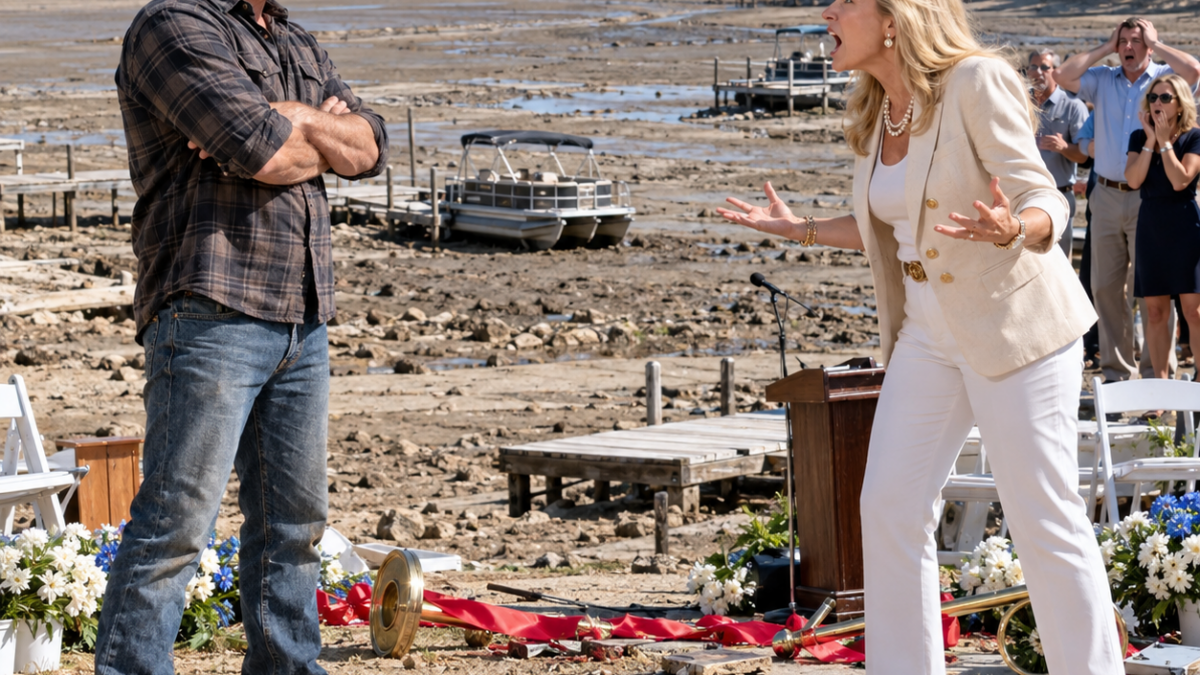
PART 2:
The crowd applauded.
From my porch, three hundred yards south, it sounded strangely distant.
I had binoculars in one hand and coffee in the other.
Beside me sat a four-inch-thick legal binder.
I didn’t need to open it.
I knew what was inside.
Fourteen months of photographs.
A certified property survey.
A twenty-two-page water-rights report.
Ruth Callaway’s permit-compliance assessment.
The original 1991 easement.
Vivian’s grant application.
Her press releases.
Printouts of every social media post in which she had called Harrow Lake “our lake,” “public water,” or “community-owned shoreline.”
And a copy of the civil complaint Leonard had filed that morning.
Across the lake, Vivian handed the giant scissors to one of her board members.
County Commissioner Douglas Hale shook her hand.
The television camera stayed on them.
Families began moving toward the new pavilion.
Children ran toward the shoreline.
A couple carried a kayak from the parking lot toward the boat ramp.
Everything looked perfect.
That was what made what happened next so powerful.
Nothing exploded.
No alarms sounded.
There was no wave.
No shouting.
The lake simply kept doing what water does when a dam gate is open.
It moved.
At 10:14, I saw the camera operator turn away from the pavilion.
She aimed toward the boat launch.
I lowered my binoculars.
“Here we go,” I whispered.
Nobody heard me.
At 10:16, a woman near the shoreline looked at the ground beside her shoes.
Then she pointed.
Her friend looked down.
Both women turned toward the water.
At 10:18, the change became impossible to ignore.
A pale strip of lakebed appeared along the entire northern shore.
The water had retreated from the lower section of the concrete boat ramp.
The family carrying the kayak stopped halfway down.
The father stared at the mud.
The mother looked toward the center of the lake as though the missing water might somehow be hiding there.
More people noticed.
Conversations died one by one.
A few children kept running.
Then their parents called them back.
Within ninety seconds, almost everyone was facing the lake.
Three hundred fourteen people.
A county commissioner.
Seven HOA board members.
A television crew.
And Vivian Marsh.
All watching eighteen inches of exposed lakebed widen beneath the park she had just declared a public community resource.
I raised the binoculars again.
Vivian wasn’t smiling anymore.
She was standing at the pavilion steps.
The ceremonial scissors were still in her hand.
One of her board members leaned close and said something.
Vivian shook her head.
Commissioner Hale walked toward the shoreline.
He looked at the ramp.
Then toward the southern end of the lake.
Toward my dam.
I couldn’t hear what anyone was saying.
I didn’t need to.
Dr. James Harrell’s hydrology map had predicted the scene almost exactly.
At full release, Harrow Lake dropped roughly one inch every twelve minutes under those summer conditions.
The eastern section of the new recreation area had a particular slope.
As the primary waterline receded, redirected shallow flow collected near three picnic-table footings.
Vivian had designed her grand opening around a fixed water level.
But there was nothing in her legal authority that required me to maintain that level.
Nothing.
The 1991 easement said the opposite.
My water-management rights were expressly superior to public recreational use.
I could operate the dam without giving the grantee notice.
Without asking consent.
And without becoming liable merely because somebody had decided to build infrastructure that depended on the water staying exactly where they wanted it.
Leonard had read that clause to me two years earlier.
I remembered the conversation clearly.
“It’s unusually strong,” he’d said.
“How strong?”
“If they build a dock based on today’s water level and you lower the lake tomorrow, that’s their problem.”
“What if they build an entire park?”
Leonard had paused.
“Then it’s a much more expensive version of their problem.”
Now I was watching that expensive problem become visible.
The camera operator never stopped filming.
That mattered.
Vivian had invited the news.
She had wanted cameras there because she believed the grand opening would be the crowning achievement of her six years as HOA president.
She had written speeches.
Coordinated the county commissioner.
Ordered banners.
Arranged parking volunteers.
Sent media releases.
Promoted the event across the county.
She had built an audience for her own contradiction.
And Leonard had made sure we did nothing to interfere with that.
Not until the ribbon was cut.
Not until she made the statement on camera.
“This lake has always belonged to the community.”
Not until three hundred fourteen witnesses heard it.
Then the lake answered for me.
Two years earlier, I hadn’t even known Vivian personally.
I’d seen her around.
Ridgecrest sat beyond the northern and eastern buffer land.
Large houses.
Landscaped entrances.
Clubhouse.
Private streets.
People there had used Harrow Lake for years under the old easement.
I had never minded.
The easement predated my ownership.
The conservation trust that owned the lake before me had granted it in 1991.
When I bought the lake in 1998, the title report disclosed the easement.
I read the summary.
Seasonal shoreline recreation.
Public access.
Nonmotorized use.
Nothing about it bothered me.
I wasn’t interested in being the old man who chased kids away from a lake with a fishing rod in one hand and a deed in the other.
People generally respected the property.
They picked up after themselves.
They stayed away from the dam.
If I needed to lower the lake for maintenance, I did.
Nobody complained.
Then the county discontinued direct parks maintenance in 2003 and assigned administrative oversight of the access area to Ridgecrest HOA.
That was where the misunderstanding began.
Administrative oversight.
Those two words changed over time.
One board interpreted them as managing signs.
Another interpreted them as mowing.
Another put out trash barrels.
Nobody objected.
Then Vivian became president.
And administrative oversight slowly transformed, in her mind, into control.
Control became stewardship.
Stewardship became authority.
Authority became ownership.
By the time her planning notice reached my mailbox, she wasn’t describing an easement anymore.
She was describing a public park.
On a public lake.
I remember sitting at my kitchen table after Leonard called with the original document.
“You’re certain?”
“Harmon, this is not a close case.”
He read the key sentence again.
The rights granted were recreational only.
They did not include construction.
Permanent installation.
Infrastructure development.
Commercial use.
Exclusive occupation.
Then he read the water-management clause.
My dam.
My gates.
My discretion.
I rubbed my forehead.
“Vivian can’t possibly have read this.”
Leonard said, “That would be my assumption.”
“So we send her a copy.”
“No.”
That answer bothered me more the second time than the first.
“Leonard.”
“Yes?”
“They could spend a lot of money.”
“I know.”
“Community money.”
“Yes.”
“You’re suggesting we knowingly let them do that.”
“I am suggesting we do not interrupt another party while they are creating a complete record of their own unauthorized activity.”
“That sounds like something only an attorney would say.”
“It probably is.”
I stood and walked to the kitchen window.
The northern shore was untouched then.
Grass.
Low shrubs.
Mature oaks.
A narrow footpath.
No pavilion.
No concrete.
No parking area.
“What if I stop it now?”
“You’ll probably win.”
“Probably?”
“They’ll revise the project. Maybe claim they misunderstood. Maybe seek permission. Maybe challenge interpretation. Maybe ask the county to modify the easement.”
“And if I don’t?”
“Every permanent structure becomes evidence.”
I stayed quiet.
Leonard continued.
“Every dollar they spend after relying on an easement that expressly denies construction authority becomes evidence.”
“It’s still my shoreline they’re tearing up.”
“I understand.”
“No, you don’t.”
He was silent.
I looked at the lake.
That place mattered to me.
Not because I wanted complete solitude.
If I did, I never would have bought property with a recreational easement.
It mattered because engineering had taught me to respect systems that worked.
Harrow Lake worked.
Shoreline plants held soil.
Trees shaded the banks.
The dam controlled seasonal level.
People used the water lightly.
The arrangement had balance.
Vivian’s plan wasn’t balance.
It was development.
A 2,400-square-foot pavilion.
Pavement.
Concrete.
Forty-two picnic tables.
A boat launch.
Electrical conduit.
Parking.
Signage.
She wanted to transform a narrow recreational easement into a destination.
And she hadn’t asked the owner of the lake.
I asked Leonard one final question.
“If I let this happen, can we make them restore everything?”
“If that’s what you want.”
That answer mattered.
I sat down again.
“Then we document.”
I began that afternoon.
My old engineering logbook had followed the dam since 1998.
Every seasonal adjustment.
Every inspection.
Every maintenance date.
Every gate movement.
Water level.
Weather.
Mechanical condition.
I opened to a fresh page.
Planning notice received from Ridgecrest HOA.
Proposed recreation development on northern shore.
1991 easement reviewed by counsel.
Construction authority absent.
Water-management rights confirmed.
Documentation initiated.
No contact with HOA.
Then I found my camera.
Construction didn’t begin immediately.
For months, nothing changed.
That almost made the strategy harder.
I could see notices on Ridgecrest’s community board when I drove past.
I heard secondhand about budget discussions.
Then Vivian applied for the county beautification grant.
Leonard obtained the public record.
Forty-five thousand dollars requested.
Project description:
A public waterfront park developed on publicly accessible lake property.
Ownership status:
Public recreational easement administered by Ridgecrest HOA.
She didn’t technically write “Ridgecrest HOA owns Harrow Lake.”
She did something more careful.
She described the legal status in a way that made private ownership disappear.
Leonard called me.
“This is useful.”
“For what?”
“Misrepresentation.”
“Is it fraud?”
“I’m not using that word yet.”
“You just sounded disappointed.”
“I don’t get excited about criminal exposure.”
“You sounded a little excited.”
“I was professionally interested.”
That was Leonard’s version of excitement.
The county approved the grant.
Construction started the following March.
At 7:20 one morning, I heard diesel engines.
The first excavator moved down the north access road.
I carried my coffee and camera onto the porch.
Then I watched part of the shoreline I had owned for twenty-five years disappear under a bucket.
That was the first day I questioned whether Leonard’s strategy had been worth it.
The contractor cleared vegetation.
Sedge grass.
Shrubs.
Part of the natural bank.
It happened efficiently.
Professionally.
That’s what made it harder.
The crew wasn’t sneaking onto the property.
They believed they were building an authorized civic project.
They had drawings.
Schedules.
Invoices.
Safety vests.
To them, the legal question had already been answered by the client.
I photographed every stage.
Then I wrote the date in my log.
I did the same the next day.
And the next.
Ruth Callaway called me in week four.
Ruth lived along the eastern shore.
She had retired from county planning after twenty-four years.
She was one of those people who couldn’t look at construction without mentally asking where the permit file was.
Her first words were:
“The boat ramp is wrong.”
“Structurally?”
“Legally.”
“What do you mean?”
“I pulled the old easement plat.”
I sat down.
“The footing appears outside the easement.”
“How far?”
“I don’t trust my field estimate enough to give you a litigation number.”
That was Ruth.
Twenty-four years in county planning had trained uncertainty out of her vocabulary unless she could quantify it.
“But?”
“But it’s not close.”
I called Leonard.
He already had surveyor David Park scheduled.
David came out after the footing was poured.
He used the recorded monuments and a total station.
He measured everything.
Then he called Leonard.
Leonard called me.
“Four feet seven inches.”
“Outside?”
“Entirely.”
“So the ramp isn’t merely prohibited permanent construction inside the easement.”
“No.”
“It’s on land where they don’t have any easement at all.”
“Exactly.”
I walked down after the crew left that evening.
Fresh concrete sloped into my lake.
Perfect finish.
Clean edges.
It probably cost tens of thousands.
I stood there with my hands in my pockets.
For a moment, I imagined taking a sledgehammer to it.
Then I imagined Vivian calling the sheriff.
Then I imagined explaining why I had destroyed evidence.
I went home.
Took three photographs.
Made another log entry.
And waited.
The pavilion rose next.
Beautiful structure.
I hated admitting that.
Heavy cedar posts.
Exposed beams.
Shake roof.
Open sides framing the lake.
If somebody had come to me with a proper plan and asked permission, I might have agreed to something smaller.
Maybe.
But every beam reminded me of the same fact.
Nobody had asked.
By summer, the paved trail stretched along the bank.
Forty-two picnic tables arrived on a flatbed.
Eleven of their concrete footings ended up beyond the easement boundary according to David’s final measurements.
Electrical conduit was installed.
Signs went up.
HARROW LAKE PUBLIC RECREATION AREA.
A RIDGECREST HOA COMMUNITY PROJECT.
Then came the dedication plaque.
DEVELOPED FOR THE COMMUNITY.
Vivian Marsh’s name appeared beneath it.
I photographed that too.
Ruth kept checking permits.
Building permit?
None.
Shoreline disturbance?
None.
Water-body impact authorization?
None.
Electrical?
None.
State environmental notification?
Nothing.
One afternoon she came to my house with a manila envelope.
Seven pages.
Signed.
Credentialed.
Organized exactly like a formal county planning review.
I read the conclusion twice.
In twenty-four years, she had never encountered a project of comparable scale with a more complete absence of permit compliance.
I looked up.
“You didn’t soften it.”
“You didn’t ask me to.”
“Would you testify to this?”
“Yes.”
“Against people you’ve lived near for years?”
She didn’t answer immediately.
Then she said, “I’d testify to the document.”
That was why I trusted her.
Not because she disliked Vivian.
She didn’t.
Not because she wanted the HOA punished.
She didn’t.
She cared about process.
The same way I cared about engineering.
The same way Leonard cared about documents.
A structure either met specification or it didn’t.
A permit existed or it didn’t.
An easement granted construction rights or it didn’t.
People could argue emotion all day.
The line stayed where the survey put it.
Vivian’s public campaign intensified as construction neared completion.
Every few weeks Leonard mailed me another printout.
OUR LAKE.
PUBLIC WATERFRONT.
COMMUNITY-OWNED SHORELINE.
A GIFT TO THE COUNTY.
I called him after one envelope.
“Does she actually believe this?”
“I don’t know.”
“Could somebody repeat something enough that they forget it’s false?”
“Absolutely.”
“Does that matter legally?”
“Sometimes.”
“Does it matter here?”
“Not as much as the documents.”
Then the newspaper ran her press release.
Ridgecrest HOA Transforms Harrow Lake Into Premier County Recreation Destination.
I read the piece at breakfast.
There was a photograph of the pavilion.
A quote from Vivian:
“This lake has always belonged to the community. We’re simply making that real.”
I folded the paper.
That sentence bothered me.
Not because I needed recognition.
I had never asked for a plaque.
But she had rewritten ownership publicly.
My name had disappeared from my own lake.
The conservation trust had granted the public limited recreational access because it wanted neighbors to enjoy the water.
That generosity had somehow been converted into the claim that the water had always belonged to the people using it.
It was the same mistake I’ve watched people make with shared roads, informal parking, paths across farms, and handshake agreements.
Permission becomes expectation.
Expectation becomes entitlement.
Entitlement becomes ownership in people’s minds.
Then somebody produces a deed.
And everyone acts surprised.
Leonard told me not to respond publicly.
“Not one letter to the editor?”
“No.”
“She just called my lake public.”
“I saw.”
“You don’t find that irritating?”
“I find it useful.”
“There’s that word again.”
“She keeps documenting the representation.”
“While I sit here.”
“Yes.”
I looked toward the northern shore.
The pavilion was almost complete.
“One day I’m going to hire a lawyer with less patience.”
“No, you won’t.”
Unfortunately, he was right.
Dr. James Harrell became the final piece.
Leonard hired him to analyze my water rights and the hydrological effects of gate operation.
James had spent years working with private dam owners and municipal water systems.
He came to my property three times.
First to inspect the dam.
Then to study the shoreline geometry.
Then to measure drawdown behavior.
He reviewed my nineteen years of operational logs.
At the end of his second visit, we stood inside the control house.
He ran one finger over the old panel.
“You’ve maintained this well.”
“I’ve had it almost twenty years.”
“That doesn’t always mean maintained well.”
“I’m an engineer.”
“That also doesn’t always mean maintained well.”
I laughed.
Fair point.
He asked about the recreation area.
“What do you want to know?”
“What happens at full release.”
“In general?”
“At the grand opening.”
He looked at me.
“So that part isn’t theoretical.”
“No.”
James glanced toward the gate mechanism.
“How long before the event?”
“Leonard is talking about four hours.”
He took out a notebook.
We spent nearly an hour discussing inflow.
Seasonal groundwater.
Surface area.
Discharge.
Shoreline slope.
Eastern flow pattern.
When his report arrived weeks later, it was twenty-two pages.
The conclusion was almost embarrassingly precise.
At full release under average late-June conditions, approximately one inch of lake-level reduction every twelve minutes.
Four hours would produce roughly eighteen to twenty inches.
He mapped what that meant.
Boat ramp lower section exposed.
Mud visible.
Recession along the north bank.
Redirected shallow water near the eastern picnic-table area.
I laid the color map on my kitchen table.
It looked like a forecast.
Leonard called.
“Well?”
“He modeled it.”
“Accurately?”
“Very.”
“Then we know the timing.”
There was a pause.
“Are you still comfortable doing this?”
That surprised me.
“You’ve been telling me to wait for nearly two years.”
“I’ve been advising you on the legal case. I’m asking you as the person who will turn the valve.”
I looked at the report.
“What I’m doing is legal.”
“Yes.”
“The lake needs periodic operational testing anyway.”
“Yes.”
“No one will be endangered.”
“Correct, assuming the crowd remains outside restricted dam areas.”
“The drawdown is gradual.”
“Yes.”
“And Vivian built a park dependent on a water level she has no right to require.”
“Yes.”
I closed the report.
“Then I’m comfortable.”
Leonard was quiet.
“Good.”
Six days before the grand opening, he called.
“The complaint is ready.”
“Finally.”
“Forty-seven pages.”
“You couldn’t make it shorter?”
“I could have made it longer.”
“Of course you could.”
“Eleven exhibits.”
“What are we asking for?”
“Declaratory relief regarding ownership and easement scope. Removal and restoration for direct trespass. Injunctive relief. Damages. Fees where available. Permit-related remedies. Corrective relief regarding public representations.”
“The grant?”
“County handles its own money. We’ve documented the application.”
“Attorney General?”
“They decide whether they care.”
“And Vivian?”
“She gets served.”
“When?”
Leonard paused.
“After the ribbon.”
I looked across the lake.
The banner supports were already being installed.
“Publicly?”
“She invited a public audience.”
“That wasn’t my question.”
“Yes.”
I rubbed my jaw.
“Leonard.”
“Harmon.”
“This is cold.”
“No.”
He waited.
“Cold would be destroying the park without giving them a legal path forward. This is evidence delivered at the moment the evidence is most difficult to deny.”
I didn’t answer.
He continued.
“You’ve spent two years watching your property be publicly mischaracterized. Vivian has invited the county commissioner and a news crew to celebrate that characterization. I see no legal or ethical reason she is entitled to a private correction after demanding public credit.”
I looked at the dam.
“What time?”
“Six.”
“Ribbon at ten?”
“Ten-oh-seven, according to their published program.”
“Full release?”
“James recommends 6:00 to 6:10.”
I wrote it in the logbook.
GATES — 6:00 A.M. SATURDAY.
Then I slept better than I expected.
At 5:30 on Saturday morning, I woke before the alarm.
The house was quiet.
I brewed coffee.
Filled the thermos.
Opened my logbook.
Grand opening.
Northern shore.
Ridgecrest HOA.
Full release planned.
Expected drawdown eighteen to twenty inches.
Process server confirmed.
Complaint filed.
I checked the clock.
5:58.
I picked up my keys.
The walk to the control house took four minutes.
The sky was gray-blue before sunrise.
Birds had started moving in the cedar break.
The lake was almost black.
I unlocked the steel door.
Inside, everything smelled the way it always did.
Concrete.
Hydraulic oil.
Metal.
Cool damp air.
I checked the gauges.
Normal.
Checked valve position.
Normal.
Checked the release system.
Ready.
6:07.
My hand rested on the control.
For nearly two years, everything had existed in documents.
Surveys.
Letters.
Applications.
Reports.
Photographs.
Now it came down to one physical action.
Turn the valve.
I did.
The hydraulic system groaned.
The primary spillway opened.
Water changed tone beneath the structure.
There is a particular sound a dam makes when release increases.
Deep.
Heavy.
Continuous.
You don’t hear water moving.
You feel volume.
I stood there thirty seconds.
Nothing failed.
Nothing shook.
Everything operated exactly as designed.
Then I closed the control-house door.
Locked it.
Walked home.
And poured coffee.
By 7:30, the lake had dropped about four inches.
By 8:15, eight.
By nine, cars were lining the access road.
I watched through binoculars.
Families.
Coolers.
Folding chairs.
Children.
An orange-vested volunteer directing parking.
Then the news van.
Then Commissioner Hale’s sedan.
Then Vivian.
Navy blazer.
Perfect hair.
Moving through the crowd like a person for whom every detail had finally arrived at the moment it was designed to support.
For an instant, I almost felt sorry for her.
Then I remembered the grant application.
Public lake.
I remembered the boat ramp on my fee-simple property.
I remembered the excavator clearing shoreline vegetation.
I remembered two years of never receiving one request for permission.
The sympathy passed.
At 10:02, Vivian stepped to the ribbon.
At 10:07, she cut it.
At 10:18, nobody was applauding anymore.
At 10:24, I saw Commissioner Hale speaking to one of the board members.
The commissioner pointed south.
Toward the dam.
The board member shook his head.
Then Vivian walked over.
Even from three hundred yards away, I could see the urgency in her movement.
Hale said something.
Vivian answered.
He said something else.
She looked toward my property.
Her head stopped moving.
That was when I knew somebody had finally mentioned me.
At 10:31, a gray-jacketed man entered the park.
The process server.
Leonard had chosen somebody experienced enough not to make theater out of it.
He didn’t wave papers.
Didn’t announce anything.
Didn’t push through people.
He simply walked toward Vivian.
The camera operator noticed him.
Of course she did.
She had already recognized the grand opening wasn’t the story anymore.
The camera tracked him.
10:33.
He reached Vivian.
Confirmed her identity.
Handed her the envelope.
She looked down.
The first page had my name at the top.
HARMON WELD, Plaintiff.
RIDGECREST HOA and associated defendants.
I saw Vivian turn one page.
Then another.
She looked at the lake.
Then toward my dam.
Then back to the complaint.
Commissioner Hale stepped closer.
Vivian said something to him.
He did not look reassured.
The process server walked away.
I lowered the binoculars.
Two years.
That was the moment it landed.
Not when she received the planning notice.
There hadn’t been one.
Not when the first excavator arrived.
Not when the grant was approved.
Not when the pavilion was framed.
Not when the newspaper repeated her claim.
Not even when the water moved.
It landed when Vivian held forty-seven pages explaining exactly how every piece fit together.
The deed.
The easement.
The survey.
The permits.
The grant.
The dam.
Her own statements.
And because she had invited television cameras, hundreds of witnesses watched her read it.
I poured the last of my coffee.
I didn’t smile.
I didn’t need to.
The regional news crew left around two.
At 6:04 that evening, I watched the segment from my kitchen.
It began beautifully.
Wide shot.
Ribbon.
Applause.
Sunlight on the lake.
Vivian smiling.
Commissioner Hale beside her.
For four seconds, it was the story she intended.
Then the editor cut to the boat ramp.
The water visibly withdrawing.
No music.
No dramatic narration.
It didn’t need any.
The footage showed people gradually noticing.
Children.
Parents.
The woman at the shoreline.
The kayak family.
The widening pale band of exposed lakebed.
Then Vivian.
Then the process server.
Then the envelope.
Then her face as she read it.
The final shot was my gate.
PRIVATE PROPERTY.
HARMON WELD, OWNER.
The anchor explained that Harrow Lake was privately owned.
That the 1991 easement allowed public recreation but, according to the complaint, expressly prohibited permanent construction.
That the boat ramp had allegedly been built outside the easement entirely.
Then came the part I hadn’t expected.
The station had contacted the county.
A preliminary inquiry had already begun regarding the forty-five-thousand-dollar beautification grant.
I leaned back.
The segment ended.
I turned off the television.
The kitchen became quiet.
For two years I had imagined what victory might feel like.
Satisfaction.
Relief.
Maybe anger finally disappearing.
Instead I felt tired.
Not bad.
Just emptied out.
A long calculation had reached its answer.
That was all.
I washed my coffee cup.
Checked the dam logs.
Then went to bed.
By morning, the clip had spread everywhere.
I didn’t watch it again.
Leonard did.
He called Sunday afternoon.
“Three hundred forty thousand views.”
“Why do you know that?”
“Because evidence now has analytics.”
“I don’t care.”
“I know.”
“Does it matter?”
“Public pressure matters to boards.”
“I thought lawyers only cared about documents.”
“We care about whatever makes opposing counsel return phone calls.”
By Monday, the clip had crossed half a million views.
Then the county issued its statement.
Return the $45,000 beautification grant pending review.
Accuracy of grant applications taken seriously.
No further comment.
I read the statement once.
Set it down.
Then Leonard called.
“Faster than expected.”
“What?”
“The county.”
“Are they angry?”
“They are institutionally concerned.”
“That’s lawyer language for angry?”
“Very.”
Tuesday afternoon brought the Attorney General’s inquiry.
Now the matter was no longer just my property lawsuit.
The state wanted to know why an application for public money had described privately owned lake property the way it had.
Vivian retained a criminal defense attorney.
When Leonard told me, I didn’t celebrate.
That was beyond my case.
I wanted my shoreline restored.
I wanted the title respected.
I wanted the easement interpreted correctly.
If Vivian had created another problem through her grant application, that belonged to her and the state.
Still, the appearance of a second lawyer changed the HOA.
Board members began hiring their own counsel.
People who had voted for the project started asking what exactly they had been told before the vote.
Who had read the easement?
Who had verified permits?
Who had certified ownership status?
Those questions should have been asked before the first shovel hit dirt.
Now everyone wanted answers.
The emergency board meeting happened Wednesday night.
I did not attend.
Ruth did.
She called me afterward.
“You would’ve hated it.”
“Why?”
“Too much talking.”
“Then yes.”
She told me seven board members were present.
Vivian arrived with two attorneys.
That alone changed the room.
Four board members had consulted personal lawyers.
Nobody wanted to be the person who casually approved another motion.
At 7:08, a courier delivered Leonard’s settlement summary.
Twelve pages.
Plain language.
No theatrics.
What the easement allowed.
What it prohibited.
Where the ramp sat.
Which permits were missing.
What the grant application said.
What my deed said.
What my water rights said.
And one handwritten note from Leonard:
Mr. Harmon Weld is available for settlement discussion whenever the board is prepared to have one.
No further direct contact.
Ruth told me the board read in silence.
“How long?”
“Long enough to become uncomfortable.”
“And Vivian?”
“She didn’t take a copy at first.”
“Why?”
“Ask Vivian.”
“What happened after?”
“Her attorney took one.”
“Of course.”
Ruth paused.
“Harmon?”
“Yes?”
“They know.”
I sat back.
“Know what?”
“That this isn’t defensible.”
That was different from losing.
People can lose and still believe they are right.
People can blame the judge.
The lawyer.
The system.
A technicality.
But sitting at a table with your own documents in front of you is harder.
Especially when the errors are not subtle.
Permanent construction prohibited.
Permanent construction built.
Direct trespass measured.
Permits absent.
Private lake called public.
Owner never consulted.
A person can explain one mistake.
Maybe two.
Seven or eight start becoming a pattern.
Vivian lasted eleven more days.
Then she resigned.
Sunday morning.
One paragraph.
She needed to focus on her personal legal situation.
She thanked residents for the opportunity to serve.
She did not mention me.
I was grateful for that.
I had heard my name enough.
Gerald Tate became interim president.
I knew almost nothing about him.
Leonard did.
“Retired municipal attorney.”
“That sounds promising.”
“Very.”
“Why wasn’t he involved earlier?”
“Board member, but apparently not central to the project.”
“Did he vote for it?”
“Yes.”
“Then he’s not innocent.”
“I didn’t say he was.”
“What are you saying?”
“He’s reading.”
That turned out to matter.
Gerald didn’t call me.
He didn’t send an apology.
He didn’t issue a public statement blaming Vivian.
He spent weeks reading.
The easement.
My deed.
David’s survey.
Ruth’s permit analysis.
James Harrell’s hydrology report.
Vivian’s grant application.
Press releases.
Board records.
Then he called Leonard.
His message was simple.
The board was not seeking to contest the recorded boundaries.
They weren’t contesting the construction restrictions.
They weren’t contesting my dam rights.
They wanted to fix what had been done incorrectly and prevent it from happening again.
Leonard called me within the hour.
“Do you believe him?” I asked.
“Yes.”
“That quickly?”
“He didn’t ask what he could get away with.”
“What did he ask?”
“How to make it correct.”
That was the first thing anybody from Ridgecrest had said in two years that changed my anger.
Not “How do we keep the park?”
Not “What can Harmon be pressured to accept?”
Not “Can we challenge the deed?”
Not “Can we sue over the water?”
How do we make it correct?
I walked to the dam that afternoon.
The gate was still running above normal summer release.
The lake remained lower than its usual level.
Nothing required me to restore it before settlement.
But I stood in the control house thinking about Gerald’s question.
The park had already failed publicly.
The ownership issue was no longer hidden.
The county knew.
The state knew.
The board knew.
Vivian had resigned.
Continuing the drawdown would prove nothing new.
So I returned the gates to standard summer management position.
No cameras.
No announcement.
No audience.
The hydraulic system closed slowly.
The discharge softened.
I stood there until the gauges stabilized.
Then I walked home.
Over the next two days, Harrow Lake rose.
The pale band of exposed lakebed narrowed.
Water returned to the lower section of the boat ramp.
The picnic tables dried.
The shoreline looked normal again.
A few people online claimed the HOA had “forced” me to refill it.
I almost responded.
Leonard stopped me.
“You don’t argue with strangers about your own gate settings.”
“It’s irritating.”
“That’s why they do it.”
He was right.
Again.
I hated that.
The settlement conference began three weeks later.
Leonard brought the four-inch binder.
He placed it on the table.
Never opened it.
By then everyone had copies of everything important.
Gerald sat opposite us.
He had the HOA’s land-use counsel beside him.
Ruth attended for the permit-compliance issues.
The county sent Patricia Song to deal with the grant.
First morning, Gerald began.
“Mr. Weld, before we discuss terms, I want to say something on behalf of the current board.”
Leonard glanced at me.
I nodded.
Gerald continued.
“The project should not have proceeded under the 1991 easement as written.”
No hedging.
“The HOA should have verified construction authority.”
Still no hedging.
“We should have verified permits.”
I watched him.
“We should have confirmed the location of the boat launch against the recorded boundary before concrete was poured.”
Ruth’s expression didn’t change.
“The board also should not have allowed any public communication to describe ownership in a manner inconsistent with the recorded deed.”
Gerald folded his hands.
“I voted for the project.”
That caught me.
“I did not personally review the underlying easement before voting.”
He paused.
“That was a failure of governance on my part.”
No one spoke.
Then he said:
“I cannot correct the vote. I can help correct the result.”
I looked at Leonard.
He looked back.
That was enough.
We negotiated.
My first instinct had been removal.
All of it.
Pavilion.
Trail.
Tables.
Ramp.
Restore the shoreline.
Put it back.
That would have been the cleanest legal result.
Leonard never told me otherwise.
The easement prohibited permanent construction.
The structures violated it.
I had every basis to insist they go.
Then Ruth asked a question during a break.
“If the pavilion disappears, what does that restore?”
“My shoreline.”
“Physically?”
“Yes.”
She looked at me.
“The vegetation is already disturbed.”
“I know.”
“The pavilion footprint is inside the easement area.”
“Yes.”
“The public already has lawful recreational access there.”
“Yes.”
“And you don’t object to recreation.”
“No.”
“So is the structure itself the problem?”
I didn’t answer immediately.
“The problem is nobody asked.”
“That’s a different problem.”
I looked through the conference-room window.
Ruth continued.
“The boat ramp is different.”
“Because it’s outside the easement.”
“Exactly. Direct trespass. Remove it.”
“And the pavilion?”
“I’m not telling you what to do.”
“You’re doing a good imitation.”
She smiled.
“I spent twenty-four years reviewing bad projects. Sometimes removing everything fixes the legal violation and creates a worse practical outcome.”
“You think I should let them keep it.”
“I think you should decide what result you actually want.”
That stayed with me.
What did I want?
Not humiliation.
Vivian already had enough.
Not money.
I had enough.
Not isolation.
The public had enjoyed shoreline access for decades and I had never objected.
What I wanted was control restored to the document.
Ask first.
Get permission.
Pull permits.
Respect the boundary.
Call the lake private because it was.
Operate the recreational access within the rights actually granted.
That could be done without tearing down every picnic table.
By the second day, my position changed.
The ramp had to go.
No compromise.
It sat entirely outside the easement on land where Ridgecrest had zero rights.
Gerald agreed.
“Removed and shoreline restored.”
“HOA pays.”
“Yes.”
“David Park supervises restoration.”
Gerald looked at counsel.
Then nodded.
“Yes.”
The pavilion, trail, and tables were more complicated.
Leonard proposed a revised access agreement.
The structures would remain only because I gave written consent.
Not because the 1991 easement had somehow authorized them.
The agreement would say that explicitly.
Any future addition required my advance written approval.
Not a notice after the fact.
Approval before construction.
Annual certification that no unapproved structures had been added.
The precise easement boundary would be recorded with a new boundary-clarification instrument.
No future board would be able to rely on an informal map.
Gerald agreed.
Then came the county.
Patricia Song had one non-negotiable issue.
“Grant repayment.”
Gerald nodded.
“Forty-five thousand.”
“Plus applicable interest.”
He wrote it down.
“Within thirty days?”
“Yes.”
“And correction?”
Patricia opened her folder.
“The county commissioner’s office needs a written clarification that Harrow Lake is privately owned.”
“Agreed.”
“The affiliate as well.”
Gerald sighed.
“Agreed.”
“Publicly accessible under a limited easement is not the same thing as publicly owned.”
“I understand.”
Patricia looked at him.
“I need the correction to show that you understand.”
He nodded.
“Draft the language.”
She did.
By day three, we had an outline.
It took another ten days to convert that outline into a final settlement.
I read every word.
Of course I did.
The first provision was boundary clarification.
David Park’s certified survey would become the reference.
The twenty-foot recreational easement.
My fee-simple boundary.
The dam property.
The lakebed.
Everything mapped.
Recorded permanently.
No green brochure.
No HOA interpretation.
No community memory.
Survey.
Coordinates.
County record.
The second provision removed the boat ramp.
Full removal.
Concrete broken out.
Debris hauled away.
Lakebed restored.
Bank revegetated.
David would supervise.
Ridgecrest would pay.
The third provision legitimized the useful parts of the park.
Pavilion.
Trail.
Picnic tables.
Not retroactively under the old easement.
Under a new agreement signed by me.
That distinction mattered.
A lot.
I wasn’t conceding that Vivian had been right.
I was choosing, as owner, to permit something now that nobody had bothered asking me to permit before.
The new agreement preserved public recreational access.
It also made the authority structure impossible to misunderstand.
No new permanent structure without my written consent.
No new shoreline disturbance without appropriate permitting.
Annual notification.
No representation of lake ownership inconsistent with my deed.
The fourth provision dealt with the county.
Return the $45,000.
Interest.
Cooperate with the Attorney General.
Public correction.
Gerald signed for Ridgecrest.
Patricia signed the county portions.
I signed last.
Leonard watched me read the final page.
“You’ve read that paragraph three times.”
“Twice.”
“It’s the third.”
I looked up.
“I pay you too much to count.”
“You pay me to notice details.”
“Then let me notice mine.”
I finished reading.
Then signed.
Capped the pen.
Gerald stood.
I did too.
He offered his hand.
I shook it.
“Thank you,” he said.
“For what?”
“For not insisting we remove everything.”
“I almost did.”
“I know.”
“Ruth talked me out of being stupid.”
From the other side of the table Ruth said, “I did no such thing.”
Gerald smiled.
For the first time in two years, a conversation involving Ridgecrest HOA felt normal.
I shook Leonard’s hand.
He looked at me.
“Done.”
“Almost.”
“What now?”
“Coffee.”
He nodded.
“That sounds appropriate.”
The boat ramp came out first.
I watched from the opposite shore.
This time, the equipment didn’t bother me.
Permits were posted.
Contractors had authorization.
David Park was there with the survey.
Ruth had reviewed the restoration plan.
Concrete broke under the excavator bucket.
The same physical act that would have infuriated me two years earlier now felt different.
Permission changes the meaning of work.
The ramp disappeared in sections.
Crews removed the base.
Regraded the disturbed lakebed.
Placed native material.
Restored the bank.
Revegetated.
David measured the completed work.
Then sent Leonard certification.
Direct trespass corrected.
Simple sentence.
Expensive lesson.
The pavilion stayed.
So did the path.
So did most of the tables.
The dedication plaque did not.
Gerald called me about that.
“The board voted to remove Vivian’s plaque.”
“That’s your decision.”
“We’re replacing it.”
“With what?”
He read me the proposed text.
HARROW LAKE RECREATION AREA
PUBLIC RECREATIONAL ACCESS PROVIDED UNDER AGREEMENT WITH THE PRIVATE PROPERTY OWNER.
PLEASE RESPECT THE SHORELINE, WATER, AND RECORDED BOUNDARIES.
No politician’s name.
No HOA president.
No “gift to the county.”
I approved it.
A week later, the new plaque went up.
I walked over early one morning.
No ceremony.
Two fishermen were already near the bank.
One recognized me.
“You’re Harmon.”
“Yes.”
He looked nervous.
“Are we allowed to be here?”
I almost laughed.
“Yes.”
“Still?”
“Yes.”
“After everything?”
“The easement never disappeared.”
He nodded toward the pavilion.
“I figured you’d close it all.”
“I could’ve pushed for that.”
“Why didn’t you?”
I looked at the lake.
“Because you fishing here was never the problem.”
He smiled.
“Appreciate it.”
I walked home.
That exchange did more for me than the television segment ever had.
The county received its money back.
The public correction ran.
Short.
Dry.
Accurate.
Harrow Lake was privately owned by Harmon Weld.
Public recreational access existed under a recorded easement and subsequent agreement.
Ridgecrest HOA administered access but did not own the lake, lakebed, or dam.
I clipped the correction.
Put it in the binder.
Then closed the binder.
I didn’t know what the Attorney General eventually said to Vivian privately.
The source of my dispute didn’t require me to know.
I knew the state had opened its inquiry.
I knew she had hired counsel.
I knew she had resigned.
After that, her legal situation was hers.
I heard rumors.
Everyone did.
Some said criminal charges were coming.
Others said there would only be administrative consequences.
Another neighbor claimed Vivian was moving.
Someone else said she was staying.
I stopped asking.
That surprised people.
One man at the feed store asked:
“Don’t you want to see her punished?”
“She lost the project.”
“Yeah.”
“She lost the presidency.”
“Yeah.”
“The county got its money back.”
“True.”
“My ownership is recorded more clearly than before.”
He nodded.
“The ramp is gone.”
“Right.”
“The remaining park operates under my permission.”
He waited.
“What exactly am I supposed to keep wanting?”
He thought about that.
“Fair point.”
Revenge can become a second occupation if you aren’t careful.
I was retired.
I didn’t need one.
That summer, Harrow Lake settled back into its ordinary rhythm.
Kayaks.
Fishing lines.
Children at the shore.
Quiet mornings.
Evening birds.
The pavilion turned out to be useful.
I had to admit that.
On hot afternoons, older residents sat in the shade.
Families ate lunch.
People watched thunderstorms roll over distant hills.
The walking path was popular.
Because the construction had already happened and the legal problem was corrected, keeping it made sense.
That was the part some people misunderstood when they heard the story.
They expected me to hate the park.
I didn’t.
I hated that it had been built without authority.
There’s a difference.
If Vivian had knocked on my door two years earlier and said:
“Harmon, the community wants a shaded pavilion and an improved trail. The easement doesn’t allow construction. Would you be willing to discuss an amendment?”
We might have negotiated.
Maybe not the boat ramp.
Probably not forty-two tables.
Certainly not a $340,000 project exactly as designed.
But something?
Likely.
Instead she assumed.
Then she advertised the assumption as fact.
Then she spent other people’s money on it.
Then she accepted public money by describing the property in a way that left the private owner out.
Then she invited television cameras to celebrate.
That sequence is why the response had to be more than a quiet letter.
Leonard understood that before I did.
He once explained it over coffee after settlement.
“If we’d sent Vivian a cease-and-desist on day one, what would have happened?”
“She would’ve called you.”
“Yes.”
“And?”
“We would have negotiated.”
“Probably.”
“She would’ve revised the park.”
“Yes.”
“Maybe spent fifty thousand instead of three hundred forty.”
“Yes.”
“Maybe never applied for the county grant.”
“Yes.”
“No news footage.”
“Correct.”
“No state inquiry.”
“Likely.”
I looked at him.
“You’re saying you let her make the consequences bigger.”
“I let her make her own decisions without giving her free legal advice.”
I frowned.
“That sounds colder when you say it after the fact.”
Leonard drank his coffee.
“Harmon, you weren’t obligated to rescue an organization from reading its own easement.”
“No.”
“You weren’t obligated to explain your deed to them.”
“No.”
“You weren’t obligated to warn them that the water level they were designing around was controlled by somebody else.”
“No.”
“They had counsel.”
“Yes.”
“They had public money.”
“Yes.”
“They had contractors.”
“Yes.”
“They had fourteen months.”
I sighed.
“I know.”
He put down his cup.
“The part you’re still uncomfortable with is that you watched.”
That was exactly it.
“Yes.”
He nodded.
“That’s because you’re an engineer.”
“What does that have to do with it?”
“Engineers fix mistakes before failure.”
“Good engineers do.”
“Lawyers sometimes need the mistake to become visible before anybody believes it exists.”
I hated how much sense that made.
Months later, Ruth and I walked the northern shore.
Native grasses had begun filling the restored ramp location.
You could still see disturbed soil if you knew where to look.
She pointed.
“Another season and you’ll barely know concrete was there.”
“Good.”
We continued along the trail.
A woman pushed a stroller.
Two teenagers carried fishing poles.
An elderly couple sat under the pavilion.
Ruth said, “Worth it?”
“What?”
“Keeping this.”
I looked around.
“Yes.”
“Even after everything?”
“Especially after everything.”
She smiled.
“That’s a more mature answer than I expected.”
“I’m sixty-two.”
“Age and maturity have only a casual relationship.”
“Speaking from experience?”
“Extensive.”
We stopped where the old dedication plaque had been.
The replacement plaque was simpler.
More accurate.
Ruth read it.
“Private property owner.”
“Clear enough?”
“For most humans.”
“And HOA presidents?”
She glanced at me.
“Maybe we engrave the deed book and page number too.”
I laughed.
It felt good.
For two years, I had stopped laughing about the lake.
I hadn’t noticed until then.
The first anniversary of the grand opening arrived the following June.
There was no ceremony.
Thank God.
I woke early.
Made coffee.
Walked to the dam.
Opened the logbook.
The entry from one year earlier was still there.
6:07 a.m.
Full release.
Grand opening.
I ran my finger beneath the line.
Then turned the page.
Routine inspection.
Gate mechanism normal.
Seasonal level normal.
No action required.
That was all I wrote.
No symbolism.
No anniversary note.
No victory statement.
Just the kind of entry I had made for nineteen years before Vivian’s project ever existed.
I closed the book.
Outside, Harrow Lake was full.
Morning mist floated near the western edge.
A kayak moved slowly across the center.
From the northern shore came faint voices.
Somebody was setting up breakfast under the pavilion.
I walked up toward my porch.
Halfway there, I stopped.
The memory came back unexpectedly.
Vivian at the ribbon.
Navy blazer.
Scissors raised.
“This lake has always belonged to the community.”
For a long time, that sentence made me angry.
Now it didn’t.
Maybe because the answer had been recorded properly.
Ownership wasn’t a matter of who said the strongest sentence into a microphone.
It wasn’t decided by a ribbon.
It wasn’t decided by social media repetition.
It wasn’t decided by how many picnic tables you installed.
It was decided by documents.
By boundaries.
By rights.
And once those things were respected, there was plenty of room for generosity.
That was the part Vivian never understood.
A privately owned lake could still be enjoyed by a community.
A community could benefit from land it didn’t own.
Access didn’t require ownership.
Cooperation didn’t require pretending boundaries didn’t exist.
In fact, the boundaries were what made cooperation possible.
Because everyone finally knew who could say yes.
And who needed to ask.
Later that summer, Gerald Tate came by my house.
No lawyers.
No board meeting.
Just Gerald.
He carried a folder.
I looked at it.
“You know you’re allowed to visit without paperwork.”
“Old habits.”
“What is it?”
“The annual infrastructure certification.”
I stared at him.
“You brought it personally?”
“I was walking the trail.”
He handed it over.
No unauthorized construction.
No new shoreline disturbance.
No changes to pavilion footprint.
No additional electrical work.
Maintenance only.
Signed by the board.
I flipped through it.
“Everything okay?”
“Yes.”
He looked toward the lake.
“We replaced two damaged rail sections.”
“Same footprint?”
“Yes.”
“No concrete?”
“No.”
“Then fine.”
He smiled.
“This is much easier.”
“What?”
“Asking.”
I nodded.
“Usually is.”
He hesitated.
“Harmon, I’ve wanted to ask you something.”
“Go ahead.”
“Why didn’t you stop us?”
I knew exactly what he meant.
“Before construction?”
“Yes.”
I took a seat on the porch.
Gerald remained standing until I pointed at the other chair.
He sat.
“Leonard advised against it.”
“I know.”
“You’ve spoken to him?”
“At length.”
“Then you know his reasoning.”
“I want yours.”
I thought about that.
“At first, I wanted to stop it.”
“Why didn’t you ignore Leonard?”
“Because the planning notice bothered me more than the construction plan.”
“How?”
“It didn’t mention me.”
Gerald waited.
“I owned the lake. The dam. The lakebed. The shoreline buffer. Yet the notice treated ownership as irrelevant.”
I looked across the water.
“If I’d stopped the project with a lawyer’s letter, Vivian would’ve changed a few words, moved something, maybe asked for a permit, maybe challenged us. The underlying belief would’ve survived.”
“That the HOA controlled the lake.”
“Yes.”
Gerald nodded.
“So you wanted the belief exposed.”
“I wanted it impossible to repeat.”
“Was the grand opening necessary?”
“No.”
That answer surprised him.
I continued.
“It wasn’t necessary for me.”
He waited.
“It became necessary because Vivian made it the public proof of her claim.”
Gerald looked toward the north shore.
“She built the stage.”
“Yes.”
“And you used it.”
“Yes.”
He sat quietly.
Finally he said, “That’s ruthless.”
“Maybe.”
“Do you regret it?”
I looked at him.
“Do you think the next Ridgecrest president will call Harrow Lake community-owned?”
He laughed.
“No.”
“Then no.”
A few minutes later, a little boy came along the shoreline with his father.
They stopped near my property line.
The boy pointed toward the dam.
“Is that the place where the water disappeared?”
His father looked embarrassed.
“Sorry.”
I smiled.
“Yes.”
The boy’s eyes widened.
“Did you make it disappear?”
“I lowered it.”
“Why?”
His father said, “Evan.”
“What?”
“Don’t interrogate the man.”
I laughed.
“It’s okay.”
The boy looked at me, waiting.
I tried to decide how to explain two years of easement law to an eight-year-old.
“Have you ever borrowed something?”
“My cousin’s bike.”
“Did borrowing it make it yours?”
“No.”
“What if you borrowed it every summer?”
He thought.
“Still his.”
“What if you painted it?”
His father laughed.
The boy frowned.
“Still his.”
“What if you built a basket on it?”
“Still his.”
I pointed toward the lake.
“That’s basically what happened.”
He looked across the water.
“They borrowed the lake?”
“Sort of.”
“And forgot it wasn’t theirs?”
“Exactly.”
The boy nodded as if this made perfect sense.
Then asked:
“Why’d the water come back?”
That question was better.
“Because they remembered.”
Gerald looked at me.
I shrugged.
Eight-year-olds deserve simple answers.
The father thanked me.
They continued toward the pavilion.
Gerald watched them leave.
“That’s better than the legal summary.”
“Don’t tell Leonard.”
By fall, the story had faded outside the county.
That’s what stories do.
For a few days, everyone had an opinion.
People who had never seen Harrow Lake argued online about dam law.
Some called me a hero.
Others called me petty.
Some thought I should have drained the lake permanently.
Others thought I should have donated it to the county.
A few appeared convinced I had somehow opened a valve and emptied nineteen acres of water in eleven minutes, which was physically absurd but apparently made a better headline.
I stopped reading comments after the first day.
Real life was quieter.
The lake returned.
The ramp disappeared.
The grass regrew.
People kept fishing.
Ridgecrest elected a permanent board.
Gerald remained involved but refused the presidency after the interim term.
“I’ve had enough excitement,” he told me.
I understood.
The new president was a woman named Marianne Cole.
Her first official communication to me was an email.
Mr. Weld,
The board is considering replacing three deteriorated picnic tables within the existing approved footprint.
Before taking any action, we are requesting written confirmation that replacement in kind is permitted under the revised access agreement.
I read it twice.
Then forwarded it to Leonard with one sentence.
Look at this.
He replied:
Civilization advances.
I approved the replacements.
No lawsuit.
No television.
No process server.
Nobody invited the commissioner.
It took thirty seconds.
One evening near the end of October, I sat on the porch as the sun dropped behind the trees.
The pavilion roof caught the last orange light.
For years before Vivian, the northern bank had been almost completely natural.
Part of me still missed that.
You don’t undo construction completely.
Even when the legal dispute ends well.
A paved trail is still a paved trail.
A pavilion still changes the view.
I had accepted that.
Not every victory restores the world to what existed before the conflict.
Sometimes it gives you a better set of rules for what exists afterward.
That was enough.
I thought about Vivian occasionally.
Not with anger anymore.
Mostly with curiosity.
How does a competent person get that far into a mistake?
She wasn’t stupid.
That was important.
People like to imagine only stupid people make catastrophic decisions.
Vivian had organized a $340,000 project.
Managed contractors.
Raised assessments.
Secured a grant.
Coordinated county officials.
Ran media outreach.
Brought three hundred fourteen people to a ribbon cutting.
She was capable.
Her problem was different.
She had stopped testing the assumption underneath all that capability.
The lake is ours.
Once she accepted that sentence, everything built above it seemed logical.
Of course the HOA could develop the shoreline.
Of course it could apply for public money.
Of course it could describe itself as steward.
Of course it could invite the county.
Of course it could call the project public.
All because the first sentence had never been checked.
Engineering failures often work the same way.
A bad load assumption enters the calculation.
Every equation afterward can be mathematically perfect.
The structure still fails.
That was Vivian’s park.
Beautiful execution.
Bad foundation.
The following spring, I received a letter from the county.
Not a violation.
Not a legal notice.
A request.
They wanted permission to install a small educational sign near the pavilion explaining the ecology of private lakes with public recreational easements.
I laughed for a full minute.
Then I called Patricia Song.
“You’re serious?”
“Unfortunately.”
“You want to explain easements to tourists?”
“Not in detail.”
“I was going to say you’ll need a larger sign.”
She laughed.
“The focus is shoreline ecology and respectful access.”
“Ownership mentioned?”
“Yes.”
“How?”
She read the proposed text.
Harrow Lake is privately owned. Public access to portions of the shoreline is provided through recorded recreational agreements. Visitors are asked to remain within designated areas and respect all posted boundaries.
I thought about it.
“Send the design.”
“You’re not saying no?”
“No.”
“Progress.”
“Don’t push it.”
The sign went up that June.
Small.
Tasteful.
Almost hidden near the trailhead.
I liked it.
Not because my name was on it.
It wasn’t.
It didn’t need to be.
Private ownership.
Public access.
Respect boundaries.
That was the whole story in eight words.
On the second anniversary of the grand opening, the pavilion hosted a retirement picnic for Ruth.
She had been retired for years already, but the county planning department finally convinced her to stop volunteering on an advisory commission.
Gerald invited me.
I almost declined.
Then Ruth called.
“You’re coming.”
“That sounds less like an invitation.”
“It is.”
“Do I have to bring anything?”
“Yourself.”
“That seems insufficient.”
“Bring coffee.”
So I did.
There were maybe forty people.
Former county employees.
Neighbors.
Ridgecrest residents.
Family.
A few officials.
No giant scissors.
I checked.
Ruth stood near the pavilion while people told stories about her twenty-four years of telling developers their applications were missing page seven.
Someone gave her a framed copy of an old permit checklist.
She laughed harder than anybody.
Afterward, we sat near the water.
She looked toward where the boat ramp used to be.
“You know what I like most?”
“What?”
“You can barely see it.”
The restored area had grown in.
Native grass.
Young plants.
Bank contour softened by two seasons.
She was right.
You had to know exactly where the concrete had been.
“I thought you’d say the permit sign.”
“That too.”
A family walked past.
A little girl carried a fishing pole twice her height.
Ruth smiled.
“This turned out all right.”
I looked at the pavilion.
“Yes.”
“You sound surprised.”
“I am.”
“Why?”
“Two years ago I wanted everything removed.”
“I remember.”
“You thought I was being emotional.”
“You were.”
“Engineers are not emotional.”
Ruth laughed so loudly people turned.
When she recovered, she said:
“You opened a dam at dawn so a lake would visibly recede during a ribbon cutting on live television.”
“Regional television.”
“Oh, excuse me.”
“It matters.”
“You timed hydrology as revenge.”
“It was evidence.”
She stared at me.
Then we both laughed.
Maybe she was right.
Maybe it was revenge.
But if so, it was the kind I could live with.
Nobody got hurt.
Nothing was secretly sabotaged.
I operated my own dam under rights written into my deed and the easement.
The result exposed something that had already been false.
That was the part I never regretted.
As evening approached, families left the retirement picnic.
I walked the trail back toward the southern boundary.
The lake was calm.
I stopped at a point where the pavilion, shoreline, and dam were all visible at once.
Three parts of the story.
Vivian’s structure.
My water.
The boundary between them.
For years I had thought of property ownership as a quiet thing.
You paid taxes.
Maintained what you owned.
Read your deed.
Fixed fences.
Kept records.
Maybe argued with a neighbor once every decade.
Vivian taught me that ownership could become public very quickly when somebody else decided to narrate it for you.
She had told the county Harrow Lake belonged to the community.
I never issued a competing press release.
I didn’t stand at her ceremony and shout.
I didn’t interrupt her speech.
I didn’t demand a microphone.
I let her finish.
Then I let the lake move.
That image became the truth people remembered.
Not because water decides title.
It doesn’t.
The deed did that.
But the water made everyone ask the question they should have asked two years earlier.
Who controls this lake?
Once they asked that, the documents answered everything else.
I still keep the four-inch binder.
It’s in the bottom drawer of my study.
The spine reads:
HARROW LAKE — RIDGECREST.
Inside are the photographs.
Surveys.
Reports.
Grant documents.
News transcripts.
Settlement.
Recorded boundary clarification.
Revised access agreement.
Restoration certification.
I haven’t opened it in months.
Beside it is the green dam log.
That one I use constantly.
The difference between those two objects says everything.
The binder was conflict.
The logbook is stewardship.
One records what people argued about.
The other records what the lake actually needs.
Gate inspection.
Water level.
Seasonal drawdown.
Rainfall.
Maintenance.
No headlines.
No viral video.
Just responsibility.
That was always the job.
One November afternoon, Leonard stopped by.
He had been nearby for another case.
I made coffee.
We sat on the porch.
He looked toward the pavilion.
“Still standing.”
“You sound disappointed.”
“I billed a lot of hours proving it shouldn’t be.”
“And then billed more hours writing the agreement that allowed it to stay.”
“Law is a beautiful profession.”
“For lawyers.”
He smiled.
After a while he asked:
“If the planning notice arrived today, knowing everything you know now, would you do it the same way?”
That was harder than I expected.
“Wait two years?”
“Yes.”
“Watch them build?”
“Yes.”
“Open the gates?”
“Yes.”
“Process server?”
“Yes.”
I looked across the lake.
“I’d probably stop them earlier.”
Leonard raised an eyebrow.
“Really?”
“Maybe.”
“Why?”
“Because I know how much community money got wasted.”
“That’s generous.”
“Don’t sound surprised.”
“I’ve represented you too long.”
I ignored that.
“But,” I added, “if Vivian ignored the easement after being warned?”
“Yes?”
“Then I’d still open the gates.”
Leonard smiled.
“There he is.”
The truth was, I had changed too.
At the beginning, every unauthorized board drove me deeper into the fight.
By the end, I could separate Vivian from Ridgecrest.
The HOA was not one person.
Three hundred fourteen people at a grand opening weren’t trespass conspirators.
The county commissioner wasn’t secretly stealing my lake.
The news crew wasn’t an enemy.
Even the contractor wasn’t.
Most people involved believed somebody responsible had verified the legal foundation.
That’s how institutional mistakes grow.
Everyone trusts the person before them.
The contractor trusts the client.
The grant reviewer trusts the application.
The commissioner trusts staff.
Residents trust the board.
The board trusts the president.
Then suddenly everybody is standing beside a lake that’s disappearing and wondering who was supposed to read page two.
The answer is:
Several people.
That’s why the settlement mattered more to me than Vivian resigning.
It changed the system.
Recorded boundary.
Written consent.
Annual review.
Accurate public description.
Grant correction.
Those things outlast personalities.
Vivian could leave.
Another president could arrive.
The documents remained.
That was the victory.
Three years after the ribbon cutting, I stood at the dam just before sunset.
Routine inspection.
Nothing dramatic.
I checked the gate mechanism.
Lubrication good.
Hydraulic pressure normal.
Emergency release functional.
Then I opened the gate slightly for a scheduled seasonal adjustment.
The water changed tone below me.
I smiled.
Same sound.
Different day.
Nobody on the northern shore panicked.
Nobody called a reporter.
Nobody accused me of destroying a public park.
Because now the rules were understood.
The revised access agreement explicitly reminded users that lake levels could change at any time due to private dam operations.
Signs near the shore warned that water levels were variable.
The pavilion had been designed afterward with that reality in mind.
People adapted.
Funny how easy that becomes once ownership isn’t being treated as an inconvenience.
I returned the gate to position.
Made the log entry.
Then walked outside.
Across the lake, lights under the pavilion roof had come on.
A family was having dinner at one of the picnic tables.
A man stood near the bank casting a fishing line.
Two kayaks crossed slowly through the evening light.
All of them were using my lake.
And I was perfectly happy about it.
That’s the detail people never expect.
They hear the story and think the ending must be me sitting alone behind fences.
No public access.
No pavilion.
No neighbors.
A private lake guarded like a fortress.
That would have been a loss.
The conservation trust that granted the 1991 easement had understood something important.
People protect places they learn to love.
Public enjoyment and private ownership can coexist.
They just require honesty.
Vivian’s mistake wasn’t wanting people to enjoy Harrow Lake.
I wanted that too.
Her mistake was deciding that enjoying something meant she could control it.
Then telling everyone else the same thing.
That was the line.
I walked back toward my house slowly.
The sun dropped lower.
Gold stretched across the water.
For a moment, the lake looked exactly as it had the evening before the planning notice arrived.
No legal dispute visible.
No lawsuit.
No news clip.
No county inquiry.
Water doesn’t remember embarrassment.
It doesn’t care who won a hearing.
It doesn’t know what a grant application says.
It moves according to elevation, pressure, gravity, inflow, release.
Maybe that’s why I trusted it more than people during those two years.
Water doesn’t pretend.
Open a gate and it leaves.
Close it and, if inflow permits, it returns.
Simple.
At the porch, I sat down.
The old binoculars were still on the table.
I picked them up.
Looked toward the pavilion.
A little boy was standing beside the new plaque.
His father seemed to be reading it aloud.
The boy pointed toward the dam.
The father pointed too.
I imagined the conversation.
That’s the private dam.
This is public access.
The lake belongs to someone else.
We’re allowed to enjoy it.
Simple.
No one had to feel diminished by that.
A person doesn’t lose dignity because something belongs to someone else.
You respect it.
That’s all.
The last time I saw Vivian Marsh was accidental.
Grocery store.
About four years after the grand opening.
She was near the produce section.
I almost didn’t recognize her.
Different hair.
No navy blazer.
No board binder.
She saw me.
We both stopped.
For a second, neither of us moved.
Then she said:
“Harmon.”
“Vivian.”
I expected awkwardness.
Maybe anger.
She looked tired more than anything.
“I heard the park’s doing well.”
“It is.”
“The pavilion?”
“Still there.”
She nodded.
“And the ramp?”
“Gone.”
“I know.”
Silence.
People moved around us with carts.
Finally she said:
“I was wrong.”
Four years earlier, I would’ve had plenty to say.
I would’ve mentioned the easement.
The grant.
The permits.
The survey.
The boat ramp.
The statement on camera.
Now none of that seemed useful.
“Yes,” I said.
She looked down.
“I really believed we had the authority.”
“I know.”
“That doesn’t excuse it.”
“No.”
She nodded.
“I should have read the entire easement.”
“Yes.”
“I should have called you.”
“Yes.”
A faint smile.
“You could say something besides yes.”
“What would help?”
She thought about that.
“Probably nothing.”
“Then yes is efficient.”
She laughed.
Small.
Surprised.
For the first time, I could imagine the woman she had been before Harrow Lake became her legacy project.
She looked toward the front of the store.
“I saw the new plaque last summer.”
“Good.”
“It’s better.”
“Than yours?”
She winced.
“Fair.”
I immediately regretted it.
But she nodded.
“Yes. Better than mine.”
There was nothing left to fight about.
She said goodbye.
I did too.
Then we went different directions.
No dramatic apology.
No handshake.
No forgiveness speech.
Just two people who once spent years on opposite sides of a lake dispute standing beside tomatoes and understanding that the dispute was over.
That felt appropriate.
That evening, I returned home before sunset.
I made coffee even though it was too late for coffee.
Old habits.
I carried it to the porch.
Harrow Lake was calm.
The pavilion roof appeared between the trees.
Someone was walking the trail.
The restored former ramp area had become almost indistinguishable from the surrounding bank.
I thought about Vivian saying she had been wrong.
It didn’t change the past.
But it closed something.
Maybe that was enough.
I opened the dam log.
There were hundreds of entries after the famous one now.
Routine entries had buried it.
Rain.
Maintenance.
Summer level.
Winter drawdown.
Gate inspection.
Spring runoff.
All the ordinary work of owning a lake.
I flipped backward until I found the page.
June.
6:07 a.m.
Full release.
Grand opening.
I smiled.
Then closed the book.
People still sometimes tell the story as though I made nineteen acres of water vanish in eleven minutes.
I didn’t.
Physics isn’t that theatrical.
I opened the gates four hours before Vivian cut the ribbon.
The lake had been dropping quietly the entire time her volunteers parked cars.
While the news crew set up.
While Commissioner Hale arrived.
While families found picnic tables.
While Vivian checked her speech.
The change became obvious eleven minutes after the ribbon.
That’s what made the moment work.
For four hours, reality had already been moving beneath the celebration.
Nobody noticed because they were looking where Vivian told them to look.
At the pavilion.
At the banner.
At the cameras.
At the scissors.
Then the shoreline moved.
And everybody looked at the water.
That’s when the truth entered the event.
Not because I shouted it.
Because Vivian had built her entire public story around something she couldn’t control.
The lake.
My lake.
If I learned anything from those two years, it wasn’t that revenge is satisfying.
Sometimes it is.
I’d be lying if I said I felt nothing when the camera captured Vivian reading that complaint.
I had watched her contractors alter my shoreline.
I had watched her call my lake public.
I had watched a grant application erase private ownership.
So yes.
There was satisfaction.
But satisfaction fades quickly.
What remains is whatever you build after the conflict.
We built a better agreement.
That mattered.
The illegal ramp disappeared.
The useful pavilion stayed.
The county recovered its money.
The public record got corrected.
Residents kept access.
I kept control.
And nobody had to pretend those things were mutually exclusive.
That’s why I consider the ending a good one.
Not because Vivian lost.
Because the lake didn’t.
Late that summer, Ridgecrest held another community event under the pavilion.
No ribbon.
No commissioner.
No television crew.
Just neighbors.
Gerald invited me.
I said no at first.
Then Marianne called.
“You should come.”
“Why?”
“Because it’s your lake.”
“That sounds dangerously close to accurate language.”
She laughed.
“Exactly.”
So I went.
Maybe seventy people.
Food.
Music.
Children.
Someone handed me a plate.
Nobody asked me to speak.
Perfect.
I sat at a picnic table with Ruth.
A man approached.
“I’ve lived in Ridgecrest twenty-two years.”
“That’s a long time.”
“I always thought the HOA owned this.”
“You weren’t alone.”
He shook his head.
“Never checked.”
“Most people don’t read title documents for recreation areas.”
“I do now.”
Ruth laughed.
“That’s Harmon’s real legacy. A county full of people reading deeds.”
“Could be worse.”
The man looked toward the lake.
“Thanks for keeping it open.”
I nodded.
“Take care of it.”
“We will.”
That was all I ever wanted.
Later, as the sun went down, people began packing up.
They cleaned every table.
Picked up trash.
A teenager walked the shoreline collecting plastic cups.
Someone checked the trail.
By dusk, the park was nearly empty.
I stood under the pavilion.
The timber posts had weathered slightly.
The cedar roof had darkened.
It was a good structure.
I put my palm against one post.
Two years earlier I had viewed it as evidence.
Now it was simply a pavilion.
That was progress too.
I walked home around the lake instead of taking the road.
The shoreline path existed because of a document signed in 1991.
A document Vivian had misunderstood.
A document Leonard had read carefully.
A document that nearly destroyed one project and ultimately made a better one possible.
Three pages.
That’s what always struck me.
Hundreds of thousands of dollars.
Two years.
Lawyers.
Surveyors.
Engineers.
A state inquiry.
A county grant.
Half a million online views.
All because people failed to read three pages carefully enough.
Page one told them where they could go.
Page two told them what they could do.
Page three told them what they could never control.
The lake.
The dam.
The water.
Mine.
That night, I reached my porch and looked back.
The pavilion lights were off.
The northern shoreline was dark.
Harrow Lake reflected the moon.
No audience.
No applause.
No cameras.
Exactly how I liked it.
I thought about that Saturday one final time.
At 6:07 a.m., I turned a valve.
At 10:07, Vivian cut a ribbon.
At 10:18, three hundred fourteen people realized something was wrong.
At 10:33, a process server handed her forty-seven pages explaining why.
That sequence became the headline.
But it wasn’t the victory.
The victory came later.
When Gerald called and asked how to make things correct.
When I closed the gates and let the lake rise before anybody forced me.
When we sat at a table and converted assumption into permission.
When the illegal ramp came out.
When the new boundary went into the county record.
When the public correction said what should have been said from the beginning.
Private lake.
Public recreational access.
Those two truths could live together.
They always could.
Vivian just had to lose everything she thought she controlled before everyone finally understood the difference.
I went inside.
Behind me, Harrow Lake held the moonlight.
Nineteen acres.
Private.
Quiet.
Still shared with people who respected what sharing actually meant.
And that, after all the noise, was the ending I wanted.

