HOA Sent Cops to My $10M Inherited Farm—Then Their President’s Fake 1985 Easement Exposed His Entire Land-Stealing Scheme
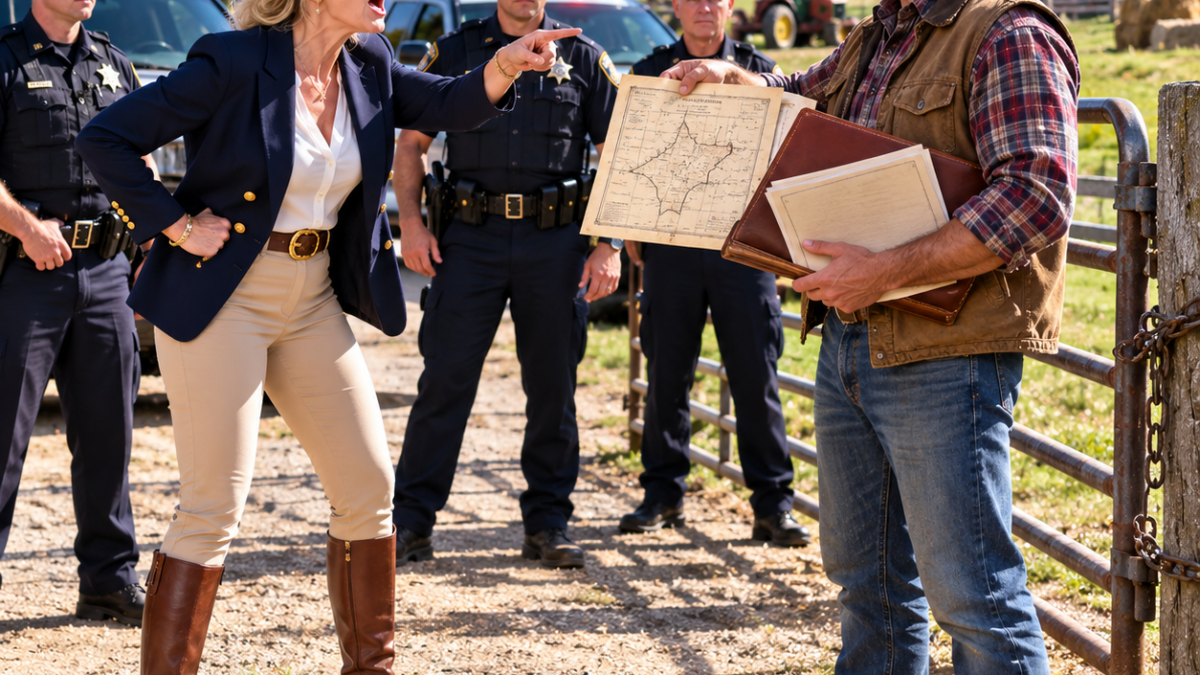
PART 2
Three days after Deputy Martinez left, the fifth complaint arrived.
This time it was Deputy Williams.
6:47 in the morning.
I opened the door carrying a folder because by then I had stopped treating these visits like misunderstandings.
“Mr. Daniels?”
“I know why you’re here.”
Williams looked almost apologetic.
“We received another complaint from Meadowbrook.”
“Richard Voss?”
“The HOA.”
“Same thing.”
He did not disagree.
I handed him the folder.
Inside was my deed, survey, tax record, grandmother’s ownership history, estate-transfer documents, and copies of the previous police contacts.
Williams stood beside his cruiser reading.
Finally he said, “Sir, why does this keep happening?”
That was the first deputy who asked the correct question.
“Because Richard Voss wants this property.”
I told him about the $500,000 offer.
Then the $9.2 million appraisal.
Then Hartman.
Then the timing.
Williams looked back toward my soybean fields.
“He offered you five hundred thousand for this?”
“Yes.”
“And after you refused, complaints started.”
“Two weeks later.”
He closed the folder.
“You want to file something from your side?”
“Yes.”
“For what?”
“False reports. Harassment. Whatever Sergeant Ramirez thinks applies.”
Williams wrote it down.
“I’ll send it up.”
“How many more calls before the sheriff’s office starts treating him like the problem instead of me?”
He paused.
“That’s a fair question.”
I watched him drive away.
Then I added the fifth incident to my timeline.
I had spent fifteen years in corporate finance before burnout convinced me that spreadsheets in glass towers were not the life I wanted.
One useful thing survived that career.
I knew how to follow patterns.
Numbers rarely confess directly.
They repeat.
So I stopped researching only what Richard was doing to me.
I started researching what Richard had done before me.
Voss Development Group had acquired eleven agricultural parcels around the future interchange corridor between 2020 and 2024.
Every one purchased below market.
Several dramatically below market.
Eight sellers were older farmers.
Three were heirs handling inherited land.
That did not prove wrongdoing.
But it was enough to start calling people.
Martin Kowalski answered first.
He had sold Richard eighty-three acres in 2023.
I knew Martin from childhood.
Not well, but enough that he remembered Grandma.
“Jake Daniels?”
“Dorothy’s grandson.”
“How’s that farm?”
“That’s actually why I’m calling.”
When I mentioned Richard, Martin became quiet.
“I don’t want trouble.”
“I think trouble already found me.”
I explained the police calls.
The lowball offer.
Martin exhaled hard.
“That son of a bitch.”
Then his story came out.
Burn-barrel complaints.
Fire-marshal inspections.
A $2,500 fine.
Septic complaint.
Eighteen-thousand-dollar replacement.
Code enforcement over two old tractors.
Four months of inspections.
Roughly thirty-five thousand dollars in costs.
And through all of it, Richard kept appearing.
“How you holding up, Martin?”
“Still sure you don’t want to sell?”
“County giving you trouble?”
Then another complaint.
Eventually Martin sold eighty-three acres to Voss Development for $3.2 million.
Market value was approximately $5.8 million.
“I couldn’t keep fighting,” he said. “My wife was done. Every two weeks it was something else.”
“Do you believe Richard filed the complaints?”
“I know he did.”
“Can you prove it?”
Silence.
“No.”
That was how Richard survived.
Pressure without fingerprints.
I called Sandra Hewitt next.
She had inherited 112 acres from her father.
Appraised around $7.4 million.
Richard offered $2.1 million.
She refused.
Two weeks later, anonymous complaint for illegal dumping.
Then grading violations.
Then old barns.
Assessments.
Fines.
Demolition.
Almost thirty thousand dollars in expenses.
Richard returned with another offer.
$2.5 million.
Sandra accepted.
“I hated signing,” she told me. “But I had no idea when the next inspector would show up.”
“Did Richard mention the problems?”
“Every time he called.”
The pattern was no longer abstract.
Offer.
Refusal.
Complaint.
Inspection.
Expense.
More pressure.
Lower-value sale.
I pulled lawsuits next.
A farmer claiming intimidation.
An estate executor claiming title interference.
A neighboring owner alleging repeated trespass.
Dismissed.
Settled.
Quiet.
Richard had built a business model out of exhausting people.
Monday afternoon, Sergeant Ramirez asked me to come to the sheriff’s office.
He was around fifty.
Gray hair.
Tired expression.
The sort of man who had listened to too many neighbors swear the other neighbor was definitely the criminal.
He spread the five complaint reports across the conference table.
“I reviewed your deed.”
“And?”
“Your ownership is clear.”
“Thank you.”
“These complaints are false.”
“So arrest Richard.”
Ramirez shook his head.
“Slow down.”
“He knows they’re false.”
“I believe that may be true.”
“May?”
“Belief isn’t proof.”
I gave him the files on Martin and Sandra.
The lawsuits.
Richard’s acquisitions.
Ramirez spent nearly twenty minutes reading.
When he finished, he leaned back.
“This is troubling.”
“That’s one word.”
“But the previous complaints against the other landowners were anonymous.”
“Yes.”
“The ones against you were submitted through the HOA.”
“Richard is president.”
“He can claim he believed the HOA had a legitimate property concern.”
“He offered to buy my land before the complaints started.”
“That helps show motive. It doesn’t prove knowing falsehood by itself.”
“What would?”
Ramirez looked at me.
“Discovery.”
“Civil lawsuit.”
“Yes.”
He leaned forward.
“If you file, your attorney can subpoena emails, communications, records. Richard may be careful, but people who run schemes for years usually start believing they’re too smart to document them.”
“You think he left a trail?”
“Everyone leaves a trail.”
I called Paul from the parking lot.
“File.”
He asked one question.
“You sure?”
“Yes.”
We filed claims based on harassment, abuse of process, tortious interference with my property rights, and related misconduct.
Paul requested expedited discovery.
He warned me it could cost twenty thousand to get started.
Possibly sixty thousand if we went deep.
Richard was betting I would hear those numbers and quit.
I told Paul:
“Do it.”
The sixth complaint came eight days later.
Not from a deputy.
From county planning and zoning.
Officer Patricia Marsh arrived carrying a folder.
“We received a complaint alleging you blocked a historic pedestrian easement.”
“There is no easement.”
“The HOA submitted documentation.”
That sentence changed everything.
She handed me two photocopied pages.
COMMUNITY ACCESS AGREEMENT.
Dated 1985.
The document claimed Dorothy Daniels had granted a permanent pedestrian easement across the northern boundary for future Meadowbrook residents.
I read it once.
Then again.
“This is fake.”
Marsh kept her voice neutral.
“I can’t determine authenticity.”
“Meadowbrook wasn’t built until 2023.”
“The document says future development.”
“My grandmother never signed this.”
At the bottom sat a signature pretending to be hers.
Dorothy Daniels.
Except it was not Grandma’s hand.
I knew her signature.
Looping D.
Sharp descending tail.
Consistent slant.
This looked blocky and hesitant.
I pulled her will up on my phone.
“Look.”
Marsh compared them.
Her face changed slightly.
“I understand your concern.”
“This isn’t concern. This is forgery.”
“My role is code compliance.”
“When did they file this?”
“Yesterday.”
Eight days after my counter complaint.
Eight days after Richard knew the sheriff’s office was looking at his pattern.
He had escalated from false accusations to paper.
Paul reacted immediately.
“Send me the document.”
Ten minutes later, he called back.
“Jake.”
“Yes?”
“This is serious.”
“I know.”
“No. This is the first thing that can directly cloud title.”
That was exactly what Richard wanted.
If the county recorded the easement, even temporarily, Hartman would freeze negotiations.
Banks would hesitate.
Lenders hate uncertainty.
Developers hate unresolved access rights.
And Richard would come back.
I could already hear him.
Title problems, Jake.
I’m still willing to take the risk.
Maybe seven hundred fifty thousand.
Maybe one million.
Paul filed an emergency motion to prevent recording.
Then hired Dr. Laura Simmons, a forensic document examiner.
Eight thousand dollars.
I authorized it.
The local newspaper made things worse before court made them better.
GREEDY HEIR BLOCKS COMMUNITY ACCESS.
That was not the exact headline in every version, but it might as well have been.
Richard told reporters the easement had existed for nearly forty years.
He said families had long used the trail.
There was no trail.
No worn path.
No gate.
No evidence.
Just soybeans and a barbed-wire boundary fence.
The article said I could not be reached for comment.
Except nobody had called my number.
When I confronted reporter Emily Tran, she checked the contact listed on the complaint.
One digit wrong.
Richard’s filing had sent reporters to a false number.
I gave Emily my statement.
“The easement is forged.”
She went quiet.
Then asked:
“Can you prove that?”
“We’re going to.”
The emergency hearing was scheduled for October 30.
The night before, Paul called.
His voice was different.
Almost excited.
“Jake, I have the subpoenaed HOA file.”
“And?”
“You need to sit down.”
“I’m sitting.”
“The easement file still has metadata.”
My stomach tightened.
“What metadata?”
“Creation date.”
I waited.
“September 28.”
Silence.
Not 1985.
September 28, 2025.
Three weeks before it was submitted.
Created in Microsoft Word.
Filename:
easement_draft_final.docx.
Author:
Richard Voss.
I stood from the chair without realizing it.
“He created it.”
“On his personal computer.”
“Can we prove that in court?”
“We already did.”
Paul had a digital-forensics report.
Dr. Simmons had completed the signature analysis too.
She compared fifteen genuine Dorothy Daniels signatures.
Will.
Tax records.
Bank documents.
Property filings.
Her conclusion:
Forgery.
I walked outside after hanging up.
The soybean fields were black under the night sky.
For months Richard had behaved like I was the one who needed to prove something.
Prove my deed.
Prove my ownership.
Prove my boundary.
Tomorrow, he would have to answer one question.
Why did a document dated 1985 originate on his computer three weeks ago?
The hearing lasted forty-three minutes.
Judge Patricia Holbrook presided.
Paul submitted the handwriting analysis.
Then the metadata.
Judge Holbrook read quietly.
Richard’s attorney, David Chen, had not known.
You could see it.
She looked at him.
“Counselor, your client represented this as a 1985 instrument.”
“Yes, Your Honor.”
“The metadata says September 28, 2025.”
Chen swallowed.
“I was not aware of that discrepancy.”
Judge Holbrook’s expression hardened.
“That is not a discrepancy.”
Silence.
“That is potentially fraud.”
Then she granted our motion.
The county could not record the easement.
My title remained clear.
Costs awarded.
And the document was referred to the district attorney.
Richard sat behind his lawyer looking pale.
For the first time, I saw fear on his face.
Outside the courtroom, Paul shook my hand.
“You won.”
“The easement.”
“Yes.”
“Richard?”
Paul glanced back at the courthouse doors.
“Richard just got much bigger problems.”
I wanted to believe it was over.
It wasn’t.
Four days later, I walked my northern field and found six-foot chain-link fencing cutting across my property.
Not on the boundary.
Inside it.
Far inside.
I called surveyor Tom Brennan.
Two hours later, his equipment confirmed what my eyes already knew.
197 feet south of my actual line.
The fence enclosed 4.2 acres that belonged to me.
“This isn’t an accidental miss,” Tom said.
“I know.”
“Who owns north of you?”
“Check.”
He did.
A newly formed company.
Meadowbrook Properties Holdings LLC.
Formed October 4.
Purchased twenty-two adjoining acres October 9.
Registered agent and sole member:
Richard Voss.
He created an LLC after my harassment complaint, bought the neighboring tract, then put a fence almost two hundred feet inside my property.
Paul sounded almost cheerful when I called.
“How is this good?”
“Because physical trespass photographs beautifully.”
“I’m glad you’re enjoying yourself.”
“I’m a property lawyer.”
He amended the complaint.
Trespass.
Interference.
Punitive damages.
Emergency injunction.
Richard argued it was a boundary mistake.
Judge Holbrook had already seen his fake easement.
She was not impressed.
“This is not presently supported as a good-faith dispute,” she said.
Discovery continued.
Richard fought the subpoenas.
Paul asked for communications.
Richard’s attorney called the requests invasive.
Judge Holbrook ordered production.
November 29, at nine at night, Paul called.
“Come here.”
“What happened?”
“Just come.”
Three banker’s boxes covered his conference table.
Emails.
Financial files.
Property acquisitions.
HOA messages.
Paul handed me the first email.
June 2.
Richard to Meadowbrook board member Mark Hastings.
Daniels refused the $500,000 offer. Time to apply pressure. I’ll file trespassing complaints through the HOA to create a paper trail. We make enough noise, he’ll sell cheap to avoid the headache. Worked with Kowalski and Hewitt. Should work here.
I read it again.
Slowly.
“He wrote this.”
“Yes.”
“He named Martin.”
“And Sandra.”
Next email.
September 27.
Richard again.
Daniels filed a harassment complaint with the sheriff. We need to cloud his title. I’m drafting an easement document backdated to 1985. Submit it to the county as an HOA complaint. If the easement gets recorded, Daniels’ property becomes unsellable. He’ll have to settle with me.
I stopped.
The room felt unusually quiet.
Paul pushed another sheet across the table.
October 6.
Richard to Jennifer Cole, vice president of Voss Development.
Bought the northwest parcel through Meadowbrook Properties LLC. Installing fence next week to claim four acres of Daniels’ land. If he fights it, we’ll settle and I’ll offer $1.5 million for all forty-seven acres. Still seven million under market. If he doesn’t fight, we just stole four acres worth eight hundred thousand.
I looked at Paul.
“Is he insane?”
“No.”
“He literally wrote ‘we just stole four acres.’”
“Confidence makes people careless.”
The fourth email made it worse.
Richard to his own attorney before the easement hearing.
If the easement gets tossed, don’t worry. I’ve got a backup plan. Fence goes up this week. Daniels will be buried in legal fees by Christmas. He’ll sell.
Paul sat opposite me.
“I’ve practiced twenty-two years.”
“And?”
“I have never seen a defendant document intent this cleanly.”
“What happens now?”
“We ask for summary judgment.”
“No trial?”
“Why would we need one? His own emails prove motive, plan, execution, and pattern.”
“What about Martin and Sandra?”
“They’re part of the pattern now.”
Paul requested declarations.
Martin agreed.
Sandra agreed.
Both were done being quiet.
That mattered more than I expected.
Richard’s system had relied on isolation.
Each farmer thinking:
This is happening only to me.
Once we compared stories, his advantage collapsed.
Paul’s summary-judgment motion ran forty-seven pages.
Fence survey.
Forged document.
Metadata.
Signature analysis.
False complaints.
Richard’s emails.
Kowalski.
Hewitt.
Below-market acquisitions.
Attorney fees.
The request:
$500,000 punitive damages.
$68,000 fees and costs.
Fence removal.
Permanent injunction.
No more complaints.
No more interference.
No more using county agencies against my property.
The hearing was December 20.
Richard sat across the aisle wearing the same sort of charcoal suit he had worn when he first offered me half a million dollars.
Six months earlier, he had walked into Grandma’s farmhouse believing I was a tired heir sitting on land I did not understand.
Now his emails were projected on a courtroom wall.
Paul read the first one aloud.
“We make enough noise, he’ll sell cheap.”
Then:
“Worked with Kowalski and Hewitt.”
Then:
“I’m drafting an easement document backdated to 1985.”
Then:
“If he doesn’t fight, we just stole four acres.”
There are moments when a courtroom becomes so quiet that the silence itself feels like evidence.
That was one.
David Chen tried.
I almost felt sorry for him.
“The emails reflect poor judgment.”
Judge Holbrook looked up.
“Poor judgment?”
“Yes, Your Honor, but—”
“Your client wrote that he intended to backdate an easement.”
“He may have been recreating—”
“No.”
She pointed to the exhibit.
“He used the word backdated.”
Then the fence.
Chen argued survey mistake.
Judge Holbrook asked:
“Why does his email say he is installing it to ‘claim four acres of Daniels’ land’?”
No answer.
She reviewed Martin’s statement.
Sandra’s.
Then looked directly at Richard.
“Mr. Voss, this was not a boundary disagreement.”
Richard did not move.
“You used the HOA presidency and county processes as financial weapons.”
Still nothing.
“You forged a document.”
His lawyer shifted.
“You installed a fence on property you knew you did not own.”
Richard’s face had gone gray.
“You targeted landowners because you believed legal expense and government pressure would exhaust them.”
Then she granted summary judgment.
Every count.
Punitive damages:
$500,000.
Attorney fees and costs:
$68,000.
Total:
$568,000.
Fence removed within thirty days.
Failure:
$1,000 per day.
Permanent injunction.
No false complaints.
No county interference.
No contact aimed at disrupting my property rights.
And she referred the pattern to prosecutors.
Paul turned to me.
“You got him.”
My hands were shaking.
I had imagined victory feeling explosive.
Instead, I felt tired.
Six months of waking up wondering what Richard would invent next.
Six months of deputy cars.
County inspections.
Headlines.
Lawyers.
A dead woman’s forged signature.
Steel fence on my soybeans.
Now a judge had put it into plain language.
This was deliberate.
I drove home with the judgment on the passenger seat.
Parked.
Did not get out immediately.
The farmhouse windows looked warm against the December afternoon.
I could almost picture Grandma behind one.
She had never been sentimental about property.
She believed land mattered because somebody worked it.
Paid taxes.
Fixed fences.
Managed seasons.
Protected it.
When she handed me tractor keys at twelve, she did not say:
One day this will be worth ten million dollars.
She said:
“Don’t hit the irrigation pipe.”
That was Grandma.
I walked inside.
Set Judge Holbrook’s order beside her deed.
Then made coffee.
The fence stayed up until January.
Richard missed the deadline by two days.
Judge Holbrook added $2,000.
January 8, a crew arrived.
I stood near the original northern boundary while they removed the chain-link fence section by section.
No television.
No cheering.
Truck.
Tools.
Metal rattling onto a flatbed.
Two hours later, the four acres looked like themselves again.
Soybeans.
Open ground.
Old barbed wire at the actual line.
Tom’s survey pins where they had always been.
Paul called.
“Notice of appeal.”
“Richard?”
“Trying to reduce punitive damages.”
“Will it work?”
“Not likely.”
Then he told me Martin and Sandra had filed restitution claims.
Martin:
$2.6 million.
Sandra:
$5.3 million.
Difference between forced sale price and fair value.
Nearly eight million combined.
That was when Richard’s private problem became an avalanche.
Meadowbrook’s HOA held an emergency meeting January 15.
Residents removed him.
Six to one.
Their insurer concluded his false reports and forged easement were outside legitimate HOA authority.
Keeping him in leadership would threaten coverage.
Richard resigned by email shortly before the meeting.
No apology.
No explanation.
Just gone.
A Meadowbrook resident named Tom Evans called me.
“People here are furious.”
“At me?”
“Not anymore.”
He laughed without humor.
“Richard used our HOA name to run his development scam.”
“That’s what the evidence says.”
“We thought you were the problem.”
“I know.”
“Some of us owe you an apology.”
“You owe yourselves better records.”
Tom was quiet.
“That sounds like something your lawyer would say.”
“My grandmother.”
The criminal charges arrived January 22.
Forgery.
Fraud.
False reporting.
Theft by deception related to the property-acquisition scheme.
Paul called.
“DA is treating it as white-collar fraud now.”
“How far back?”
“Potentially ten years.”
“They’ll look at the other purchases.”
“Yes.”
Richard had spent years betting no single victim could expose the whole system.
Now one discovery order had opened every drawer.
By mid-February, I made a decision that surprised even me.
I decided to sell Grandma’s land.
Not because Richard had won.
Because he had lost.
For months I had refused to sell while he was pressuring me because any sale under harassment would have felt like surrender.
But with my title clean and the injunction entered, the choice belonged to me again.
That distinction changed everything.
Hartman and Associates came back.
Laura Hartman met me at a coffee shop.
“Our offer is $9.8 million.”
I looked at her.
“You offered eight before.”
“Market moved. Title is now judicially confirmed. Rezoning is complete.”
“What are you building?”
“Mixed-use corridor. Retail. Offices. Light industrial. Roughly three hundred permanent jobs when fully occupied.”
I stirred my coffee.
“Why didn’t you stay in the fight earlier?”
Laura answered honestly.
“Because lenders wouldn’t finance through title uncertainty.”
“The fake easement worked.”
“Temporarily.”
“Exactly what Richard wanted.”
“Yes.”
She did not pretend otherwise.
That honesty mattered.
I thought about Grandma.
Selling was not betraying her.
Being forced to sell would have been.
Choosing what happened to the land was the thing I had fought to preserve.
“I have one condition.”
Laura waited.
“The main road.”
“What about it?”
“Dorothy Daniels Drive.”
She smiled.
“Your grandmother?”
“Yes.”
“Done.”
No negotiation.
Closing date March 15.
The Gazette ran another article.
This time I answered the phone.
HARASSMENT VICTIM SELLS LAND FOR $9.8 MILLION.
The story finally included both halves.
Richard’s scheme.
My title.
Hartman’s project.
The jobs.
Grandma.
A few people online still found reasons to be angry.
People always do.
But I no longer cared.
March 1, Paul called.
“Richard wants to pay your judgment voluntarily.”
“How much?”
“Full amount.”
“Deadline?”
“He wants March thirty-first.”
“No.”
Paul laughed.
“What do you want?”
“March twentieth.”
“Reason?”
“I’m tired of his deadlines becoming my problem.”
“And if he misses?”
“Asset seizure.”
The wire arrived March 18.
$570,000 including the contempt addition.
Paul’s awarded legal fees were accounted for.
My portion transferred.
Then Judge Holbrook granted Martin’s restitution.
$2.6 million.
Two days later, Sandra:
$5.3 million.
Richard owed $7.9 million to the two people he had believed would never be able to prove what he did.
When he asked for more time, Judge Holbrook denied it.
He had profited from systematic pressure.
Now the properties that profited from that pressure could be sold to repay the victims.
Liens hit eleven Voss Development parcels.
Two hundred forty acres.
Public auction scheduled June 1.
But before that came my closing.
March 15.
Paul’s office.
Same conference room where we had reviewed Richard’s emails months earlier.
Laura Hartman signed.
I signed.
The wire hit.
$9,823,000.
I stared at the banking confirmation.
Grandma bought the land for $18,000.
Not because she was some visionary speculator.
She needed farmland.
Forty-eight years later, one of the most aggressively pursued pieces of land in Monroe County sold for almost ten million dollars.
After tax, fees, and closing expenses, the amount I would actually keep was far lower.
Still life-changing.
I drove back to the farmhouse one last time.
Construction would not start for months.
So the farm still looked like the farm.
Soybean stubble.
Gravel road.
Old equipment shed.
The porch.
I unlocked the front door.
Walked room to room.
Kitchen.
Living room.
Grandma’s bedroom.
The small back room where Grandpa kept tax files.
I remembered being twelve and eating sandwiches at the kitchen counter after learning to drive the tractor.
I remembered Grandma standing at the sink.
I remembered Grandpa cursing weather forecasts.
All the ordinary moments that make property become home before money ever becomes relevant.
I went outside.
Sat on the porch.
Paul called.
“You okay?”
“Yes.”
“Feel rich?”
“No.”
“What do you feel?”
I looked across the forty-seven acres.
“Finished.”
He understood.
On March 18, Richard’s judgment payment cleared.
Between the land sale and judgment, gross recovery exceeded ten million dollars.
That headline wrote itself.
Richard offered $500,000.
I walked away with more than $10 million in sale proceeds and civil recovery.
But even that was not the ending.
On April 2, Martin and Sandra placed liens against every remaining Voss property.
On April 15, Judge Holbrook authorized forced sale.
June 1, twenty-three registered bidders gathered at the county courthouse.
I did not attend.
Paul did.
He called that afternoon.
“It’s over.”
“How much?”
“Eight-point-four million gross.”
“All eleven?”
“All.”
“Martin?”
“Paid his $2.6 million.”
“Sandra?”
“$5.3 million.”
I closed my eyes.
“And Richard?”
“Voss Development is being dissolved.”
“What about criminal court?”
“Plea agreement finalized.”
Richard pled guilty to forgery and fraud.
Other charges were dropped under the agreement.
Prosecutors recommended roughly four years in state prison, substantial fines, and a permanent ban from the real-estate-development industry.
I sat on the porch of the smaller house I had bought outside Charlottesville.
Two acres.
Workshop.
Garden.
Quiet.
Everything I had originally wanted when I left corporate finance.
Richard had once told me that holding land was expensive.
Taxes.
Maintenance.
Risk.
He was right about one thing.
Ownership does require work.
What he misunderstood was that I was willing to do it.
The case kept expanding.
Helen Briggs came forward.
Seventy-four years old.
Sixty-three acres.
Eight months of anonymous complaints before she sold to Richard for $1.8 million.
Later value:
$4.2 million.
David Morton.
Forty-eight acres.
Inspection pressure.
Sold for $1.1 million.
Value:
$3.1 million.
Grace Chen.
Inherited seventy-one acres.
Richard convinced her supposed wetland restrictions made the land nearly undevelopable.
They did not.
She sold for $900,000.
Value:
$2.8 million.
More lawyers.
More claims.
Then the state attorney general opened a broader investigation.
The final investigative record described a decade-long pattern involving numerous victims and millions in gains from distressed acquisitions.
The same architecture again and again.
Identify vulnerable owner.
Make low offer.
Apply pressure.
Anonymous complaint.
Inspection.
Fine.
Title problem.
Exhaustion.
Return with offer.
Buy.
Profit.
Richard had not built a real-estate empire only by developing land.
He had built part of it by manufacturing desperation.
The attorney general’s settlement required additional restitution from whatever assets remained.
His licenses were surrendered.
His industry future was finished.
By September, the Gazette ran another headline.
DISGRACED DEVELOPER SENTENCED TO FOUR YEARS — VICTIMS RECOVER MILLIONS.
Martin gave them a quote.
“Richard stole my family’s farm. Money doesn’t give me those years back.”
That line stayed with me.
Because Martin was right.
Justice is not restoration in the literal sense.
Sandra did not get back the moment she signed away her father’s land.
Helen did not get back months of believing county inspectors were randomly targeting her.
Money could not reverse those things.
What it could do was name what happened honestly.
The Gazette quoted me too.
“Richard thought he could bully me into selling my grandmother’s land for $500,000. Instead, I sold it for $9.8 million, won a $570,000 judgment, and helped expose the pattern.”
Then I said the part I actually cared about.
“I’m glad I fought. I wish more people had been able to.”
I framed the article.
Not because I wanted Richard’s face on my wall.
His photograph was on another page.
I framed the section with Grandma’s name.
Beside it:
A copy of her deed.
My judgment.
Not trophies.
Proof.
By October 2026, I was financially independent.
After taxes, expenses, and investment decisions, I had enough to never return to corporate finance.
I bought a small woodworking setup.
Built shelves badly at first.
Then better.
Read.
Hiked.
Traveled.
A month in New Zealand.
Two weeks in Scotland.
Came home because I missed my own coffee.
Then I created something Grandma would probably have pretended not to be emotional about.
The Dorothy Daniels Memorial Scholarship.
For rural students.
Community college.
Agriculture.
Trades.
Engineering.
Business.
Kids from places where inherited land, family farms, and working property were part of life.
I also put money into legal-assistance resources supporting farmers facing coercive development pressure.
Paul asked why.
“You already won.”
“That’s why.”
“What does that mean?”
“I could afford you.”
He smiled.
“I’m expensive.”
“Painfully.”
“Thank you.”
“Martin couldn’t.”
Paul stopped smiling.
Exactly.
The difference between my story and Martin’s was not that I loved my family land more.
It was not that I was braver.
It was not that I understood property rights better.
I had money.
Enough to say yes when Paul said:
Twenty thousand.
Thirty thousand.
Handwriting expert: eight thousand.
Litigation might reach sixty.
Do it.
That was a privilege.
Richard had deliberately selected people he thought did not have it.
That realization changed the way I told the story afterward.
People liked to say I defeated a bully.
True.
But bullies rarely choose targets randomly.
They calculate cost.
Richard’s mistake was miscalculating mine.
In late November, Hartman invited me to the groundbreaking.
I almost declined.
Then Laura sent me a photograph.
A road sign covered by black fabric.
I knew what it was.
So I went.
The old farm barely looked like itself.
Grading equipment.
Survey stakes.
Construction trailers.
Future roads.
Dozens of people.
County officials.
Contractors.
Business owners.
Laura stood at a temporary podium.
“This project will ultimately support more than three hundred jobs.”
Applause.
Then she talked about the land.
The dispute.
The court case.
I grew uncomfortable when she called me courageous.
I had never thought of it that way.
Then she said:
“But we also promised Mr. Daniels that the history of this property would not disappear under the development.”
She turned.
Two workers removed the covering.
DOROTHY DANIELS DRIVE.
I forgot everybody else for a moment.
Just saw Grandma’s name.
White letters on green.
Nothing fancy.
Exactly the sort of sign she would have driven past without mentioning.
I walked toward it afterward.
Touched the metal post.
Laura came beside me.
“She’d like it?”
“No.”
Laura looked worried.
Then I smiled.
“She’d complain her name was too big.”
Laura laughed.
“What would she want instead?”
“Probably for everybody to get back to work.”
That was Grandma.
Work first.
Sentiment later.
If later arrived.
I stood there imagining the old field beneath the future road.
Grandpa’s tractor passing where delivery trucks would someday drive.
Grandma walking fence lines where offices would rise.
The land was changing.
That did not erase what it had been.
It meant the next chapter was happening by choice.
Mine.
Not Richard’s.
That was the victory.
I drove home near sunset.
For nearly an hour, I thought about the first time Richard entered the farmhouse.
His suit.
His Mercedes.
His certainty.
Five hundred thousand.
Thirty-day close.
You should reconsider.
He thought price was the only question.
It never was.
Control was the question.
He wanted to decide what happened to land he did not own.
First with pressure.
Then cops.
Then forged paper.
Then steel fencing.
He misunderstood me because he misunderstood ownership.
A deed is not valuable only because somebody might pay millions for it.
It is valuable because it gives the owner the right to say:
No.
No to half a million.
No to false HOA claims.
No to fake historic easements.
No to fences placed 197 feet inside the line.
And later:
Yes.
Yes to $9.8 million.
Yes to three hundred jobs.
Yes to Dorothy Daniels Drive.
The entire fight had been about keeping that decision mine.
Months after the groundbreaking, Deputy Martinez saw me at a diner.
The same deputy from the fourth call.
He approached my table.
“Mr. Daniels?”
“Deputy.”
“Not deputy anymore. Promoted.”
“Congratulations.”
He smiled.
Then:
“I remember that morning.”
“So do I.”
“I felt ridiculous asking you to prove you belonged on your own farm.”
“You were responding to a call.”
“I know. Still.”
He sat across from me for a minute.
“Ramirez showed us the emails later.”
“The discovery emails?”
“Training material now.”
That surprised me.
“What do they teach?”
“Patterns.”
I nodded.
“Repeat complaints can be evidence too.”
“Exactly.”
He shook his head.
“Voss figured he could use us as part of the pressure.”
“He did.”
“Sorry.”
“You stopped when you saw the deed.”
“That doesn’t make five visits okay.”
“No.”
He looked relieved that I did not pretend otherwise.
Then he said:
“We changed how repeated property complaints get flagged.”
That mattered.
Maybe more than an apology.
If the same caller repeatedly accused the same owner after multiple reports confirmed title, supervisors now reviewed the history before sending another routine response.
One scheme had created a procedural change.
Good.
Richard’s system had depended on government offices behaving like isolated machines.
Each inspector saw one complaint.
Each deputy saw one dispatch.
Each clerk saw one filing.
Nobody saw the whole pattern.
Once the pattern became visible, the scheme looked obvious.
That is what evidence does.
It connects events people were encouraged to see separately.
The first anniversary of Judge Holbrook’s ruling passed quietly.
I almost forgot the date.
Paul texted:
One year since summary judgment.
I wrote back:
Send me a bill for remembering.
He responded:
Already did.
I laughed.
Then spent the afternoon in my workshop.
Peace, it turned out, was less dramatic than winning.
Better too.
No cruisers.
No certified letters.
No midnight emails.
No checking the mailbox for another county notice.
No wondering whether somebody had put another false document into the public record.
No walking fence lines expecting to find Richard’s next move.
For months after the case ended, I still felt a small surge of tension whenever a vehicle slowed near my driveway.
That took time to disappear.
People rarely talk about that part of prolonged disputes.
Winning does not immediately tell your nervous system the threat is gone.
Your lawyer can say:
Permanent injunction.
Your brain says:
What if?
Your bank can say:
Funds cleared.
Your body still wakes at three.
Eventually it stopped.
That was when I realized peace had finally arrived.
Martin visited once.
He wanted to see Dorothy Daniels Drive.
We drove over.
Construction had advanced.
Road base down.
Utilities going in.
Martin stood beside the sign.
“Your grandma would’ve liked this.”
“She would’ve complained about traffic.”
“Probably.”
He looked across the development.
“My dad’s land is part of one of Voss’s auction parcels now.”
“How do you feel?”
He shrugged.
“Strange.”
“You ever think about buying it back?”
“Can’t.”
“I’m sorry.”
He shook his head.
“Don’t be.”
Then:
“I got the restitution.”
“I know.”
“Paid off the house.”
“Good.”
“Set money aside for my grandkids.”
“Better.”
He went quiet.
“Still wish I’d fought.”
I did not tell him he should have.
That would have been cruel.
“You fought as long as you could.”
“Not like you.”
“You had thirty-five thousand dollars in surprise expenses before you understood the pattern.”
He stared at the road.
“I thought every complaint was independent.”
“That was the trick.”
“Yes.”
Then he said:
“You know what Sandra told me?”
“What?”
“Richard’s biggest mistake wasn’t going after you.”
“What was?”
“Putting it in email.”
I laughed.
“That helped.”
Martin laughed too.
For the first time since I had called him, he sounded like a man who was not ashamed of selling.
That mattered.
Richard had depended on victims blaming themselves.
Should have been stronger.
Should have fought.
Should have known.
The shame belonged somewhere else.
One afternoon I found Grandma’s old farm notebook in a box.
Not legal records.
Crop notes.
Seed varieties.
Fuel.
Rainfall.
Equipment repair.
Grandma’s handwriting.
On one page she had written:
North field drainage holding after heavy rain. Check ditch before planting.
Nothing profound.
But I sat there holding the page for ten minutes.
Land ownership had always been paperwork and work together.
Deeds and drainage.
Taxes and tractors.
Boundaries and weather.
Richard only saw valuation.
$9.2 million.
$500,000 offer.
$8 million potential profit.
Grandma saw soil.
That difference explained why the final check never felt like the center of the story.
Yes, the money changed my life.
But it was not what made the land valuable to me.
If that had been all, I would have taken Hartman’s first offer before Richard ever appeared.
I fought because Richard tried to convert my choice into his leverage.
After enough time passed, Emily Tran—the reporter who had published the first easement story—called again.
“I’m working on a piece about coercive land acquisition.”
“Better phone number this time?”
She laughed awkwardly.
“Yes.”
“What do you need?”
“What would you tell property owners who think something similar is happening?”
I thought about that.
“Don’t assume every complaint is separate.”
“Anything else?”
“Get copies.”
“Of?”
“Everything.”
Police report.
Code complaint.
Permit notice.
Survey.
Deed.
Email.
Letter.
Dates.
Names.
“What if they can’t afford a lawyer?”
“Find legal aid early.”
I told her about the farmland-preservation donation.
The scholarship.
The difference resources had made.
Then she asked:
“Did you ever want revenge?”
“Of course.”
That surprised her.
“You did?”
“I’m human.”
“What stopped you?”
“Paul.”
She laughed.
“Seriously?”
“Mostly evidence.”
I explained.
Revenge wants you to act before the record is ready.
Evidence rewards patience.
If I had cut Richard’s fence myself, he might have made me the trespasser in the next headline.
Instead, I surveyed it.
Photographed it.
Filed.
If I had screamed at deputies, he could have described me as unstable.
Instead, I took names.
Report numbers.
If I had attacked him online, he could have said it was a personality conflict.
Instead, discovery found:
We make enough noise, he’ll sell cheap.
Those words did more damage to Richard than anything I could have shouted.
Emily’s article used one line from me:
“Anger made me want to react. Documentation gave me somewhere to aim it.”
Paul called when it ran.
“That’s actually good.”
“I’m occasionally useful.”
“Don’t get arrogant.”
“Says the lawyer.”
Years will eventually erase most of the details.
People in Monroe County will remember fragments.
The developer who forged an easement.
The farmer’s grandson.
The multimillion-dollar land sale.
Dorothy Daniels Drive.
Maybe somebody will tell it wrong.
Stories change.
County records do not.
My deed.
Judge Holbrook’s orders.
The metadata report.
The survey.
The emails.
Those remain.
That matters to me.
One day, long after nobody remembers why the road is called Dorothy Daniels Drive, somebody might search the property history.
They will find Grandma’s name.
$18,000.
Then mine.
Inheritance.
Then Hartman.
$9.823 million.
They might never know the six months between those entries nearly broke me.
That is fine.
Records do not have to carry emotion to carry truth.
On the second anniversary of the sale, Laura Hartman sent me a photograph.
The first phase had opened.
Businesses.
Traffic.
Workers.
Dorothy Daniels Drive signs at both entrances.
Under one photograph she wrote:
Over 300 jobs on site now.
I printed it.
Put it beside Grandma’s old farm notebook.
Farm on one side.
Development on the other.
Same ground.
Different era.
There was no sadness in that.
Only continuity.
Richard had once offered me $500,000 because he believed land belonged most naturally to whoever had the leverage to take it.
Grandma would have hated that.
She believed possession came with duty.
You work.
You pay.
You repair.
You protect.
Then when it is time, you decide what comes next.
That is what I did.
I eventually visited Richard exactly once after sentencing.
Not prison.
I had no interest in that.
I attended a restitution hearing involving one later victim because Paul asked whether I would support her.
Helen Briggs.
Seventy-four.
She sat two rows in front of me.
Small woman.
Silver hair.
Hands folded tightly.
Her attorney described eight months of complaints before she sold.
Unsafe barns.
Drainage.
Code.
Richard’s representatives appearing repeatedly with offers.
She had believed the government was telling her she could no longer manage her own property.
That part hurt to hear.
After the hearing, she turned.
“Jake?”
“Yes.”
She hugged me.
I had never met her.
“Thank you.”
“For what?”
“For not selling.”
I did not know how to answer.
Eventually I said:
“I almost did.”
She stepped back.
“Really?”
“Not to Richard. But there were nights I wanted the whole thing gone.”
“Then why didn’t you?”
“Grandma.”
That was only partly true.
Grandma.
Anger.
Paul.
Money.
Stubbornness.
Evidence.
All of it.
Helen smiled.
“Mine was my husband’s.”
“I know.”
“I couldn’t keep it.”
“You didn’t fail.”
She looked at me.
I repeated it.
“You did not fail.”
Richard did.
That distinction belonged to every person he had pressured.
I wished somebody had told Martin sooner.
Sandra.
Helen.
David.
Grace.
The people whose names never became headlines.
By the time the broader settlement finished, victims had recovered millions.
Not everything.
Never everything.
Richard’s assets had limits.
But enough of the money moved backward that his business model ended with the people he exploited taking priority over his remaining wealth.
That felt closer to justice than watching his prison sentence.
Prison punished.
Restitution repaired.
Both mattered.
But if you ask which mattered more to me, it was seeing Martin receive the difference Richard had pressured out of him.
Richard eventually left prison older, broke, and barred from the business.
At least that was the path his sentence set.
I did not follow him.
I stopped searching his name.
That was another kind of freedom.
For months, Richard had occupied part of every day.
What did he file?
Who did he call?
What is he planning?
Did he appeal?
Did he pay?
When is the hearing?
What did discovery show?
Eventually I realized justice was complete only when I no longer needed to know what Richard Voss was doing.
The land was gone from me too, technically.
Sold.
Developed.
But it did not feel stolen.
That was the difference choice made.
I visit Dorothy Daniels Drive once or twice a year.
Sometimes deliberately.
Sometimes because I am passing nearby.
The farmhouse is gone now.
Hartman preserved a few pieces of old timber at my request.
Laura had one section incorporated into a small public pavilion near the main office complex.
A plaque mentions the Daniels family farm.
Not dramatic.
Just history.
The first time I saw it, I ran my hand across an old beam and found a nail hole I thought I recognized from the porch framing.
Maybe imagination.
Did not matter.
A family cannot freeze property forever just because memory lives there.
What we can do is make sure change happens honestly.
At fair value.
With consent.
That was what Richard refused to understand.
The last time I drove Dorothy Daniels Drive, I pulled over near the sign and sat with the engine running.
People passed.
Delivery truck.
Two office workers.
Landscaping crew.
Nobody knew me.
Nobody needed to.
Grandma’s name was enough.
I thought about the morning Deputy Martinez stood on my porch.
“Do you have permission to be here?”
At the time, the question felt insulting.
Years later, I almost appreciate the irony.
Permission.
Richard built his entire scheme around pretending other people needed his permission to own what already belonged to them.
Permission from the HOA.
Permission from inspectors.
Permission from developers.
Permission to keep land.
Permission to refuse his offer.
But ownership was not his to grant.
The deed had already answered.
Grandma bought forty-seven acres in 1977.
She held them.
She left them to me.
I defended them.
Then I sold them for the price I chose, to the buyer I chose, on the terms I chose.
That was the whole victory.
Not making Richard poor.
Not seeing his company auctioned.
Not the $570,000 judgment.
Not even the $9.8 million sale.
Choice.
He tried to take mine.
The court gave it back.
Evidence protected it.
And when I finally signed the Hartman closing papers, nobody had a gun to my head, a code officer at my door, a fake easement in the county office, or a fence across my soybeans.
Just a pen.
A contract.
A fair number.
And Grandma’s name written into the future.
Richard Voss once told me holding land I could not develop would become expensive.
He was right about expense.
He spent millions learning the wrong lesson.
The value of land is not determined by who can create the most pressure around it.
It is determined by title, market, use, and the owner’s right to decide.
He tried police reports.
I kept the reports.
He tried a forged easement.
The metadata remembered.
He tried a fence.
The survey measured it.
He tried to hide behind an HOA.
Discovery found his emails.
He tried to exhaust me with legal fees.
The judge ordered him to reimburse them.
He tried to buy forty-seven acres for $500,000.
They sold for $9.823 million.
And the road running through the development carries the name of the woman whose signature he thought he could forge.
Dorothy Daniels.
That is the ending I keep.
Not Richard in court.
Not Richard losing his properties.
Not Richard going to prison.
Grandma’s name on that sign.
Because when all the noise was gone, that was what the fight had always been about.
Making sure the people who built something honestly were remembered longer than the man who tried to steal it.
The day after the groundbreaking ceremony, I woke before sunrise in the little house outside Charlottesville and stood in my kitchen holding a cup of coffee while the hills turned from black to gray beyond the window. For almost a year, every morning had started with some version of the same question: What did Richard do now? Another complaint? Another county letter? Another lawyer calling? Another filing? Another attempt to create a problem where none existed? That morning, for the first time in longer than I could remember, there was nothing waiting for me. No deputy at the door. No certified envelope. No voicemail from Paul. No new accusation from Meadowbrook. Just silence, coffee, and two acres of land that belonged to me because I had chosen to buy it, not because someone had cornered me into taking it.
I should have felt triumphant.
Instead, I felt tired.
Not physically tired. Something deeper. The kind of exhaustion that settles into you after months of staying ready for the next blow, even after everyone tells you the fight is over.
The money was there. The judgment had been paid. Hartman had closed on Grandma’s farm for $9.823 million. Richard’s properties had been auctioned. Martin and Sandra had been paid. Voss Development was being dissolved. Richard had pleaded guilty to forgery and fraud and was headed to prison. The road through the new development would carry my grandmother’s name.
Everything that had once seemed uncertain had become documented fact.
Still, part of me expected the phone to ring.
It did around nine.
Paul.
I almost laughed when I saw his name.
“Tell me Richard didn’t buy another LLC from prison.”
Paul laughed.
“No. Nothing like that.”
“Then why are you ruining my morning?”
“I thought you’d want to know the final numbers from the auction.”
I walked out onto the porch.
“Go ahead.”
“All eleven Voss Development parcels sold. Total gross proceeds were about $8.4 million.”
“And Martin?”
“Paid in full. $2.6 million.”
“Sandra?”
“Paid in full. $5.3 million.”
I closed my eyes.
Those numbers meant more to me than my own judgment.
Because Richard had not simply tried to steal from me.
He had already succeeded with them.
Martin had spent forty years watching his father’s farm become part of his own identity, only to be worn down by inspections, fines, and constant pressure until selling felt like the only way to make the harassment stop. Sandra had inherited her father’s land and had been buried under complaints and compliance costs until Richard’s lowball offer started looking less like exploitation and more like escape.
Now, for the first time, someone had officially put a dollar figure on what had been taken from them.
“Did Martin say anything?” I asked.
Paul was quiet for a moment.
“He called me yesterday. Said the money helps.”
“But?”
“He said money doesn’t give him the farm back.”
I looked across my two acres.
“No.”
“It doesn’t.”
Paul continued.
“Richard’s remaining proceeds are going toward legal fees and criminal fines. His company is effectively finished.”
“And the criminal case?”
“Plea is finalized. Four years. Forgery and fraud. Permanent ban from the real estate business.”
I leaned against the porch rail.
Four years.
Months earlier, I thought hearing that number would feel like revenge.
It didn’t.
It felt like accounting.
Richard had spent years turning other people’s fear into profit. He had treated county agencies like tools, HOA authority like private leverage, and landowners like numbers on a spreadsheet. He had believed the only question was how much pressure someone could survive before they signed.
Now a judge had put another number beside his name.
Four years.
Not because I hated him.
Because evidence had finally caught up.
After Paul and I hung up, I stayed outside for a while.
The silence bothered me less than it had the day before.
Maybe peace takes practice.
A week later, Martin called.
“I’m coming through Charlottesville.”
“You need somewhere to stay?”
“No. Just thought I’d stop.”
He arrived around lunch in an old pickup that looked like it had survived three administrations and at least one argument with a tree.
We sat on my porch.
He looked around.
“This suits you.”
“It’s small.”
“That’s why it suits you.”
I laughed.
He took a long drink of iced tea.
Then he said:
“The money came.”
“I heard.”
“All of it.”
“I’m glad.”
He looked down at his hands.
“I paid off the mortgage on the house.”
“Good.”
“Set something aside for the grandkids.”
“Better.”
He nodded.
Then the silence changed.
“You ever think about what would’ve happened if you sold to him?”
“All the time.”
“For five hundred thousand?”
“No.”
“Any price?”
I thought about it.
“If Richard had come to me with a real market offer before the harassment started, maybe.”
Martin looked surprised.
“Really?”
“Grandma didn’t leave me the farm with instructions that I could never sell.”
“Then why fight so hard?”
“Because I wanted the decision to be mine.”
That answer sat between us.
Martin looked toward the road.
“That’s what he took from me.”
“What?”
“The feeling that I decided.”
I said nothing.
“He made every week expensive. Every phone call. Every inspector. Every fine. By the time he came back with the offer, I wasn’t thinking about price anymore. I just wanted it to stop.”
I knew exactly what he meant.
“That’s why the scheme worked.”
Martin nodded.
Then he said something I never forgot.
“He didn’t buy land cheap. He bought people tired.”
That was it.
The entire business model in seven words.
Richard found owners who could be exhausted.
Older farmers.
Widows.
Executors managing inherited land.
People with limited cash.
People who believed every government complaint had to be answered individually.
People who did not yet know the complaints were connected.
Richard’s genius, if you could call it that, was not legal sophistication.
It was fragmentation.
One inspector saw a septic issue.
One deputy saw a trespassing complaint.
One zoning officer saw a grading dispute.
One reporter saw an HOA disagreement.
One landowner saw a string of bad luck.
Only Richard saw the whole machine.
Until we did.
That was why discovery destroyed him.
It connected everything.
The first police complaint.
The $500,000 offer.
The fake easement.
The fence.
Martin.
Sandra.
And his own words.
Make enough noise, he’ll sell cheap.
Months later, those emails were being used in training sessions at the sheriff’s office. Sergeant Ramirez told me they had changed the way repeated property complaints were handled. If the same complainant kept calling against the same landowner after ownership had already been verified, supervisors now reviewed the history before treating the next call like an isolated dispute.
That meant something to me.
Because I remembered Deputy Martinez standing on Grandma’s porch asking whether I had permission to be there.
He had not done anything wrong.
But the system Richard exploited had been too willing to start over every time.
Another complaint.
Another deputy.
Another request for proof.
The burden kept landing on the same person.
Me.
After the case, at least some of that changed.
The state attorney general’s investigation widened too.
Three more landowners came forward.
Helen Briggs was seventy-four.
Her husband had died years earlier, leaving her sixty-three acres they had maintained together. Richard offered to buy. She declined. Then came anonymous complaints about unsafe barns, drainage, and structural conditions.
Eight months later, exhausted and convinced the county was preparing to condemn parts of the property, Helen sold to Richard for $1.8 million.
The land was later valued around $4.2 million.
David Morton was a retired teacher.
Forty-eight acres.
Illegal grading complaint.
County inspection.
Delays.
Pressure.
He sold for $1.1 million.
Value closer to $3.1 million.
Grace Chen was handling inherited farmland after a death in the family. Richard convinced her that wetland restrictions made the property practically impossible to develop.
They didn’t.
She sold seventy-one acres for $900,000.
Value around $2.8 million.
Each story was slightly different.
The structure was the same.
Pressure.
Confusion.
Reduced confidence.
Discounted sale.
By August, the attorney general’s office had documented a pattern stretching over roughly a decade and involving numerous victims.
The estimated gains connected to those pressured transactions were enormous.
Richard’s scheme had not been one bad deal.
It was a business practice.
When the AG settlement was announced, some of Richard’s remaining personal assets went toward additional restitution. It did not make every victim whole. There simply was not enough left.
That bothered me.
Justice sounds clean from a distance.
It rarely is.
There are always limits.
Assets.
Time.
Statutes.
Evidence.
Some people recovered everything the court recognized.
Others got fractions.
Helen received enough to stabilize her finances, but not enough to recreate the property she had lost.
David got compensation but no way to reclaim the years of worry.
Grace got money, but the land had already moved on.
Richard went to prison.
The company disappeared.
His licenses were gone.
Still, some damage remained permanent.
That realization changed the way I felt about my own outcome.
I had been lucky.
Not in the sense that Richard targeted me.
There was nothing lucky about that.
I was lucky because I had resources when he did.
When Paul said:
“This might cost sixty thousand dollars.”
I could say:
“Do it.”
When the handwriting expert cost eight thousand:
“Do it.”
When we needed a new survey:
“Do it.”
When discovery became expensive:
“Keep going.”
Martin had not been able to say that.
Sandra had eventually reached her limit.
Richard counted on that.
I stopped thinking of myself as tougher than them.
I was better positioned.
That difference mattered.
It was why I eventually put $100,000 into legal assistance for farmers facing coercive development pressure.
Paul asked me about it one afternoon.
“You sure you want that much tied up in a legal-aid fund?”
“Yes.”
“You could invest it.”
“I have enough.”
He smiled.
“That’s a dangerous sentence.”
“I mean it.”
Then I told him what Martin had said.
“He bought people tired.”
Paul became quiet.
“That’s good.”
“It’s horrible.”
“I mean the phrase.”
“I know.”
We structured the donation so landowners facing suspicious complaint patterns could at least get an early title review, initial legal consultation, and help organizing records before things spiraled.
Maybe someone would call a lawyer after the first strange complaint instead of the twentieth.
Maybe that would be enough.
I also created the Dorothy Daniels Memorial Scholarship.
Fifty thousand dollars a year, structured to continue long after I was gone.
Rural students.
Agriculture.
Engineering.
Business.
Trades.
Property law if somebody was strange enough to choose it.
Grandma would have hated the attention.
I could hear her.
“You put my name on what?”
“A scholarship.”
“Why?”
“Because students need money.”
“Then give them money. Why do they need my name?”
That would have been her exact reaction.
Which was precisely why I used it.
She spent most of her life doing things without caring whether anybody remembered.
I wanted somebody to remember.
Not because the land sold for millions.
Because she held it long enough for that value to exist.
There is a difference.
The groundbreaking ceremony made that real in a way the bank balance never did.
When Hartman pulled the covering away from the street sign and I saw DOROTHY DANIELS DRIVE, I stopped hearing the crowd.
For one second, I was twelve again.
Grandma in work boots.
Grandpa leaning against a tractor.
Soybean dust.
Hot August air.
A water jug on the tailgate.
The future road cut through ground where I had once stalled a tractor and blamed the machine.
Grandma had known immediately.
“You forgot the clutch.”
“I did not.”
“You did.”
“The tractor died.”
“Because you forgot the clutch.”
She never let me win that argument.
Standing at the groundbreaking decades later, I almost laughed thinking about it.
Laura Hartman came beside me.
“You okay?”
“Yeah.”
“You got quiet.”
“Just remembering something.”
“What?”
“My grandmother teaching me to drive a tractor.”
Laura looked at the construction site.
“Right here?”
“Close.”
“She ever think this land would become all this?”
“No.”
“How do you know?”
“Because Grandma thought predicting twenty years ahead was a good way to avoid doing today’s work.”
Laura smiled.
“That sounds wise.”
“It sounded annoying when I was twelve.”
We stood beside the sign.
Construction crews moved in the background.
Future tenants talked with local officials.
Everything was becoming something new.
I had worried selling would feel like losing.
It didn’t.
Losing is when the choice is taken.
Selling on your own terms is different.
I signed because I wanted to.
At a price I accepted.
With a buyer who negotiated openly.
With my title clean.
No deputy on the porch.
No fake easement.
No fence claiming four acres.
No developer telling me I had to act quickly before everything became worthless.
Just an agreement.
That was the part Richard never understood.
He thought winning meant owning the land.
I thought winning meant owning the decision.
About a month after the ceremony, I received a letter from a Meadowbrook resident.
Handwritten.
Her name was Anne.
She had lived in the subdivision during the dispute and admitted she had believed Richard.
She wrote that she had shared posts calling me greedy.
Had told neighbors I was trying to erase public access.
Then she attended the board meeting after the emails were released.
She saw the fake easement metadata.
Read the messages.
Saw Richard writing that he wanted to cloud my title.
Her final paragraph said:
“I thought you were attacking our community. I understand now that our president was using our community to attack you. I am sorry.”
I kept that letter.
Not because I needed the apology.
Because it captured another part of Richard’s damage.
He turned neighbors into weapons without telling them they were being used.
The HOA residents were not all villains.
Most had no idea.
They believed the man who chaired their board.
He told them their rights were under attack.
They reacted.
That is how manipulation works best.
People fight hardest when they think they are defending something good.
After Richard was removed, Meadowbrook changed its bylaws.
Major property claims involving outside landowners required independent legal review.
Complaints involving title disputes required documentation before the HOA could contact law enforcement.
Board presidents could not unilaterally submit property instruments on behalf of the association.
Nothing glamorous.
Governance.
That was another outcome I respected.
The community had been embarrassed.
Instead of pretending nothing happened, they changed procedure.
By October, I had settled into a life that would have sounded impossible the year before.
Retired at forty-three.
Financially independent.
Small house.
Workshop.
Garden.
I traveled.
A month in New Zealand.
Two weeks in Scotland.
I came home with photographs, books, and the realization that no hotel coffee in the world was worth what hotels charged for it.
I spent more time woodworking.
My first dining table leaned slightly.
I told visitors it was intentional.
Nobody believed me.
Eventually I got better.
Peace became ordinary.
That was the most surprising part.
I had thought peace would feel like celebration.
It felt like routine.
Wake.
Coffee.
Walk.
Read.
Work in the shop.
Dinner.
Sleep.
No legal emergency.
No title search.
No reporters.
No sheriff’s cruiser.
Ordinary became luxury.
One evening Paul visited.
He stood in the workshop inspecting a cabinet I was building.
“Door’s crooked.”
“Leave.”
“It is.”
“You bill by the hour and still came here to insult my cabinetry.”
“Professional obligation.”
We sat outside afterward.
He asked:
“Do you miss the farm?”
“Yes.”
“Regret selling?”
“No.”
“That’s complicated.”
“Most true things are.”
I told him I missed the farmhouse.
The fields.
The way the property looked after harvest.
Grandma’s kitchen.
But I did not miss feeling responsible for freezing time.
Land does not honor a family by never changing.
It honors them when the next change happens honestly.
Hartman’s project would create jobs.
Businesses.
A tax base.
Opportunity.
And Grandma’s name stayed with it.
That was enough.
Paul asked:
“You ever think Richard accidentally made you richer?”
I laughed.
“Don’t give him credit.”
“I’m serious.”
“Market made the land valuable.”
“His lawsuit cleared title permanently.”
“After he clouded it.”
“Fair.”
“His judgment added money.”
“After costing me money.”
“Also fair.”
I looked toward the hills.
“Richard didn’t create the outcome. He tried to steal it.”
Paul nodded.
“Important distinction.”
“Very.”
People sometimes told the story as though Richard’s harassment somehow produced my fortune.
It didn’t.
Grandma’s land had become valuable because the highway corridor changed the market.
The $9.8 million came from a legitimate buyer.
My $570,000 judgment compensated for wrongdoing.
Richard’s role was not to make me rich.
His role was to try to prevent me from receiving fair value.
That was why Dorothy Daniels Drive mattered more than any headline saying I had “won millions.”
The road reminded me where the value started.
Not with Richard.
With Grandma.
Years later, I still kept three documents together in my home office.
Her original deed copy.
Judge Holbrook’s judgment.
The newspaper article showing Dorothy Daniels Drive.
Beginning.
Fight.
Outcome.
The forged easement stayed in Paul’s file.
I did not want it on my wall.
One day, a young law student contacted me through the scholarship foundation.
She was researching property coercion.
We met for coffee.
She asked:
“What was the single piece of evidence that won the case?”
I almost said the metadata.
That was certainly dramatic.
But I thought longer.
“There wasn’t one.”
“But the fake easement—”
“Important.”
“The emails?”
“More important.”
“The survey?”
“Necessary.”
“So what won it?”
“The sequence.”
She frowned.
I explained.
A forged document by itself might be called one reckless act.
A fence might be called a boundary mistake.
Police complaints might be called HOA confusion.
A lowball offer might be ordinary negotiation.
Anonymous complaints against other owners might look unrelated.
Put them together in time, and they become intent.
Offer.
Refusal.
Complaints.
Title cloud.
Fence.
Second offer.
Emails describing the strategy.
That sequence was the case.
Richard lost because evidence connected what he needed everyone to view separately.
The student wrote that down.
Then asked:
“What would you tell someone going through it now?”
“Start a timeline immediately.”
“Even before hiring a lawyer?”
“Especially then.”
Names.
Dates.
Copies.
Photos.
Record numbers.
Save emails.
Do not rely on memory.
Do not assume the next complaint has nothing to do with the last one.
Do not destroy something installed on your property without talking to counsel first.
Do not post angry threats online.
And if somebody keeps telling you it would all be easier if you just sold to them, write that down too.
She smiled.
“You sound like Paul.”
“That is deeply offensive.”
She laughed.
I paid for the coffee.
Before leaving she said:
“Your grandmother would be proud.”
I almost corrected her.
How could she know?
Then I stopped.
Maybe she would.
Not because I made ten million dollars.
Grandma did not measure people that way.
Maybe she would have been proud that I did not let fear make the decision.
That I kept records.
That I protected what she gave me until I could decide what came next.
That I attached her name to the future instead of letting Richard erase her history with a forged signature.
That thought stayed with me.
On the third anniversary of the closing, I drove back to Monroe County without telling anyone.
No ceremony.
No invitation.
Just me.
Dorothy Daniels Drive was fully open.
Cars everywhere.
Retail buildings operating.
Offices occupied.
Delivery trucks.
Landscaping matured.
I pulled into a parking area and walked until I found a place near the old farmhouse location.
Nothing recognizable remained except terrain.
For a moment, I tried to align memory with development.
Kitchen should have been somewhere near the landscaped median.
Barn farther south.
Soybean field beneath an office parking lot.
I expected grief.
Instead I felt grateful.
The land had done its job.
It supported Grandma and Grandpa.
Then it supported me.
Now it supported hundreds of other families through jobs and businesses.
Land does not have to stay the same to remain part of a family’s story.
I walked back toward the road sign.
Dorothy Daniels Drive.
A young woman pulled up beside me and lowered her window.
“Sir, do you know where Building C is?”
I pointed.
“Second light, right side.”
“Thanks.”
She drove away.
She had no idea who I was.
No idea who Dorothy was.
That made me smile.
Legacy does not require recognition every time someone passes your name.
Sometimes it is enough that the name remains.
I touched the signpost once.
Then walked back to my truck.
On the drive home, I thought about Richard less than I expected.
That may be the most complete victory I ever got.
Not his sentence.
Not his bankruptcy.
Not the auction.
Not the judgment.
The ability to remember Grandma’s land without remembering Richard first.
For too long, he had inserted himself into everything.
Every field carried the memory of a deputy.
Every boundary reminded me of the fence.
Every deed reminded me of the forged easement.
Eventually those associations faded.
The farm became Grandma’s again in memory.
Summer.
Tractor.
Soybeans.
Kitchen table.
That was how it deserved to remain.
Richard Voss believed that people with enough money and influence could rewrite reality by creating pressure around it.
He had done it successfully for years.
But pressure is not proof.
A forged easement is not an easement.
A false complaint is not ownership.
A fence is not a boundary.
An HOA title is not authority over land outside the HOA.
And a desperate seller is not evidence that the buyer acted fairly.
Evidence corrected all of that.
The deed.
The survey.
The metadata.
The emails.
The bank records.
The declarations.
The sequence.
Richard spent years relying on people being too tired, too scared, or too isolated to connect the pieces.
I happened to have enough resources to connect them.
Once connected, the scheme collapsed.
His company disappeared.
His land was auctioned.
His victims recovered millions.
He lost his licenses.
He went to prison.
And the forty-seven acres he tried to buy for $500,000 sold for $9.823 million to somebody who asked instead of threatened.
That number made headlines.
But the number I remember most is still eighteen thousand.
What Grandma paid in 1977.
Eighteen thousand dollars.
Forty-seven acres.
A farmhouse.
Fields.
A life.
Everything that came later grew from that.
The last time I opened her old farm notebook, I found a short entry near the back.
Nothing about inheritance.
Nothing about legacy.
Just:
Fence repaired north side. Rain expected Thursday. Beans look good.
I laughed out loud.
That was Grandma.
No speeches.
No grand lessons.
Fix the fence.
Watch the weather.
Beans look good.
I closed the notebook and set it beside the framed photograph of Dorothy Daniels Drive.
If she had been standing beside me, I think she would have looked at the sign once, nodded, and asked whether I had finished the cabinet in my workshop.
Maybe that is why the ending feels right.
Richard wanted the story to end with me exhausted enough to sign whatever he put in front of me.
Instead, it ended quietly.
A clear title.
A fair sale.
A paid judgment.
Restitution for people he had harmed.
A prison sentence based on evidence.
A scholarship carrying Grandma’s name.
Legal help for the next farmer who gets a strange complaint after refusing a developer.
And a road through Monroe County named after the woman whose signature Richard thought he could counterfeit.
He forged Dorothy Daniels once on paper.
I made sure the county wrote her name correctly in steel.
That was enough.
[END OF FULL STORY]

