HOA President Sent a Crew to Cut Power to My House—Then She Learned Who Owned Every Line Feeding Her Neighborhood
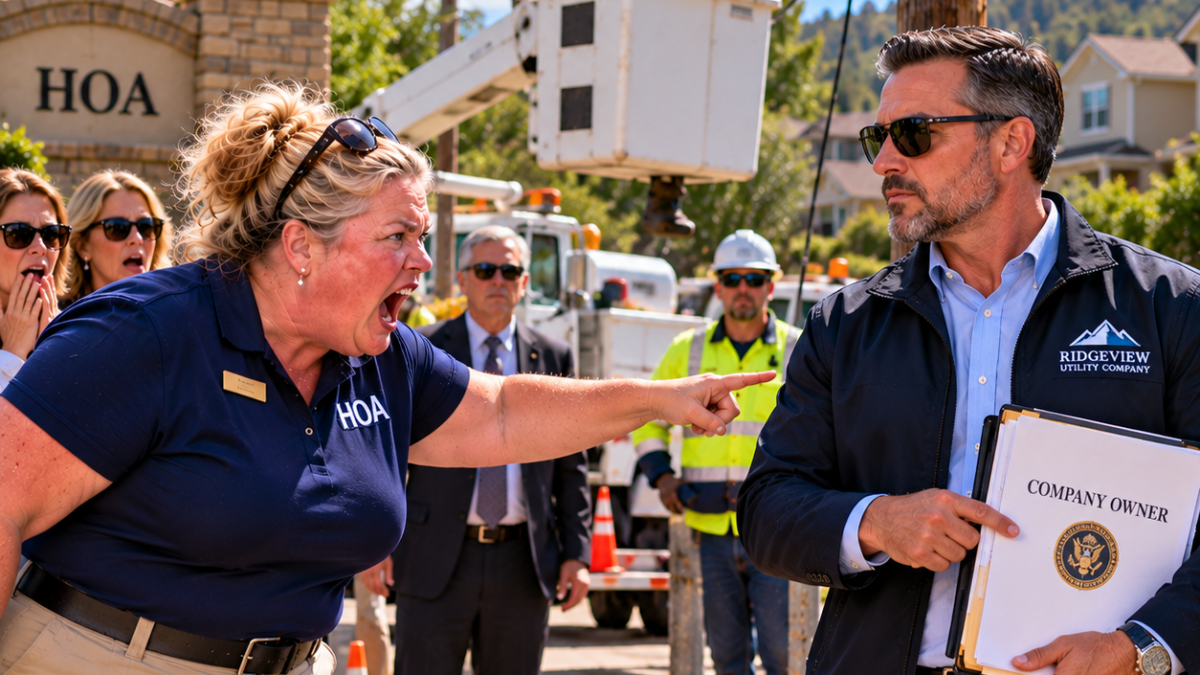
The HOA president stood beside an open utility trench in front of my house, pointed at the underground electrical conduit feeding my property, and ordered a contractor to cut it while my wife watched from the porch and half the street slowly gathered behind their mailboxes.
What Sandra Pierce did not understand was that the transformer beside her, the conduit beneath her shoes, and every distribution line carrying electricity into Ridgeline Estates belonged to the utility company I had spent twenty years building—and one careless move would not merely darken my house.
When I saw a worker standing over exposed utility equipment with Sandra waving an HOA document like a court order, I realized this had stopped being a ridiculous argument about my garage and had become the kind of mistake that could expose far more than the petty fines she had spent months trying to use against me.
My name is Derek Sandborn, and six months earlier my wife, Claire, and I had moved into Ridgeline Estates because we wanted the opposite of drama.
Mountain air.
A decent school district.
A quiet street.
Neighbors who waved.
I deliberately did not tell anyone much about my work.
I was the majority owner and CEO of Cascade Summit Power, a regional utility company serving a large part of the county, including Ridgeline Estates.
But at home, I wanted to be Derek.
Not the utility executive.
Not the guy people called when their transformer made a strange sound.
Just another husband taking out trash on Thursday morning.
That worked until Sandra Pierce noticed my garage.
I had installed an EV charger and a compact residential backup-energy system connected through properly permitted equipment. Part of the setup also allowed me to monitor certain company systems securely when I worked from home.
Nothing exotic.
Nothing commercial.
Everything had been inspected.
Sandra saw it differently.
She arrived one October morning carrying a clipboard and photographing the garage from my driveway.
“Can I help you?”
She pointed.
“What is that?”
“Residential energy equipment.”
“This neighborhood prohibits commercial installations.”
“It isn’t commercial.”
“You operate a business from here?”
“No.”
She kept taking photographs.
“Then why do you need industrial equipment?”
“It isn’t industrial.”
She smiled without warmth.
“We’ll determine that.”
Two days later, a violation notice appeared on my door.
UNAUTHORIZED COMMERCIAL UTILITY EQUIPMENT.
REMOVE IMMEDIATELY.
I emailed the board.
I attached permit records.
Inspection confirmations.
Manufacturer documentation.
Sandra replied with one sentence.
RULES APPLY TO EVERYONE. NO EXCEPTIONS.
I could have ended the argument right there by telling her exactly who I was.
I didn’t.
Partly because I hated using my job title to win neighborhood disputes.
Partly because I genuinely believed any reasonable board would eventually read the documents.
That assumption cost me.
The fines began at fifty dollars a day.
Then one hundred.
Then five hundred.
Board treasurer Linda Marsh objected during a meeting.
According to minutes I later obtained, she asked whether anyone had actually confirmed that my equipment violated the covenants.
Sandra answered:
“He thinks the rules don’t apply to him. We need to make an example.”
By the third week, my daily fines had climbed again.
I paid every assessment under protest while preserving my right to challenge them.
That seemed to make Sandra even angrier.
Money was supposed to pressure me.
Instead, it created a paper trail.
Then Claire noticed unfamiliar trucks near our mailbox two mornings in a row.
I dismissed it.
I shouldn’t have.
On Thursday evening, Sandra called an emergency board vote without ordinary homeowner notice and obtained approval to “remove unauthorized utility infrastructure associated with the Sandborn property.”
The next morning, a local contractor named Bobby Finch arrived with two workers.
He had a document on HOA letterhead.
Orange cones went down.
A small excavation began near the utility easement.
I was on a video call when Claire texted me a photograph.
The moment I saw the transformer identification plate, my chair went backward.
That transformer did not feed only our house.
It served dozens of homes on the block.
And the crew digging beside it had no authorization from Cascade Summit Power.
I called our operations center while grabbing my keys.
“Lock out any nonutility work around transformer R-17 and dispatch a safety crew.”
Then I drove home.
When I turned onto my street, I saw Sandra standing beside the trench.
Bobby’s crew had exposed part of the utility conduit.
Sandra saw my truck.
She smiled.
“Maybe now,” she said as I approached, “you’ll finally learn to respect this association.”
I looked past her at the open excavation.
Then at Bobby.
“Stop.”
Sandra folded her arms.
“No.”
I kept my eyes on the crew.
“That equipment does not belong to the HOA.”
Sandra’s smile widened.
“Remove the line.”
And that was when I finally told her the one fact she had never bothered to investigate.
PART 2
“Bobby,” I said, keeping my voice level, “put the tools down and step away from the conduit.”
He did not move immediately.
Neither did the two men beside him.
Sandra turned toward me with the expression of somebody who had spent weeks waiting for exactly this moment.
“You don’t give orders to my contractors.”
“They’re working around live utility infrastructure.”
“They’re removing an unauthorized line.”
“No.”
I pointed toward the transformer.
“They’re excavating inside a utility easement around equipment your HOA does not own.”
Sandra gave a short laugh.
“Everything under this street falls under association maintenance authority.”
“That is not how utility easements work.”
“It’s common property.”
“The pavement may be maintained by the association. The electrical system is not.”
Bobby slowly lowered the tool in his hand.
“Mrs. Pierce.”
Sandra spun toward him.
“What?”
“I asked you yesterday if the utility signed off.”
“And I told you the board approved it.”
“That isn’t the same thing.”
“It is for this job.”
“No, ma’am.”
Something about Bobby’s tone made Sandra angry.
She was accustomed to people becoming less certain when she spoke more confidently.
He was moving in the opposite direction.
I stepped closer but stayed outside the trench.
“Bobby, who told you this was abandoned service?”
He looked at Sandra.
“She said the line had been installed by the homeowner without permission.”
I stared at her.
“You told them I buried my own utility service?”
“I told them you installed unapproved infrastructure.”
“That conduit predates my purchase of this house.”
Her expression flickered.
Only briefly.
Then:
“You added commercial equipment.”
“Inside my garage.”
“Connected to the line.”
“Like every electrical device in every house on this street.”
A couple neighbors laughed quietly.
More people had come outside.
Phones appeared.
I hated that.
Not because I was afraid of being recorded.
Because once neighbors start filming, people sometimes begin performing instead of thinking.
Sandra noticed the audience too.
Her posture straightened.
“I have a valid board authorization.”
She held up the paper.
“You have an HOA vote.”
“Yes.”
“That does not authorize excavation of regulated utility equipment.”
“This property is governed by Ridgeline.”
“Your covenants do not supersede utility ownership.”
She turned to Bobby.
“Continue.”
He shook his head.
“I’m stopping.”
“I hired you.”
“And I’m stopping.”
“You’ll be in breach of contract.”
“Better than hitting something I’m not supposed to hit.”
Good man.
Sandra’s face reddened.
She reached toward the equipment he had set down.
I stepped between her and the trench without touching her.
“Do not go into that excavation.”
She stared at me.
“Move.”
“No.”
“You are obstructing HOA work.”
“I am preventing an unqualified person from approaching exposed electrical infrastructure.”
“You are not an electrician.”
That was almost funny.
Almost.
“I didn’t say I was.”
“You think because you bought one fancy backup battery you understand the grid?”
I looked toward the transformer identification plate.
CASCADE SUMMIT POWER.
Black letters on brushed metal.
I had seen that plate design approved in a conference room eight years earlier.
My company.
My crews.
My easements.
My liability.
My responsibility.
I finally said:
“Sandra, I own Cascade Summit Power.”
She blinked.
Then laughed.
Actually laughed.
A sharp, incredulous sound.
“Of course you do.”
“I do.”
“Sure.”
“Call the number on the transformer.”
She stared.
“Or look up the company.”
“You expect me to believe you own the county power company?”
“Not the entire county.”
A neighbor behind me coughed to hide a laugh.
Sandra looked around.
That made it worse.
She thought I was humiliating her intentionally.
I wasn’t.
I wanted everyone ten feet farther away.
I looked at Bobby.
“Back your crew away from the trench.”
He nodded.
“Already doing it.”
His workers moved.
Sandra’s voice rose.
“No. I authorized this.”
Bobby answered:
“And now I’m unauthorized.”
“By who?”
I held up my phone.
“Cascade Summit operations control.”
Sandra stared at the company logo on my screen.
Then at me.
“You work there.”
“I own a controlling share and run the company.”
“That does not give you special HOA privileges.”
“No.”
I pointed toward the garage.
“And I have never asked for any.”
“Then remove the equipment.”
“No.”
“Why?”
“Because it is legal.”
“That is your opinion.”
“It is the county inspector’s opinion too.”
“Your company probably influenced them.”
There are moments when you realize an argument has stopped being about evidence.
This was one.
I could have shown her permits again.
Inspection reports.
Engineering documents.
Board correspondence.
None of it mattered.
Sandra’s real problem was not the charger.
It was that I had refused to yield.
The fines had failed.
The letters had failed.
The threat of a lien had failed after my attorney challenged it.
So she escalated.
She had decided the utility line itself was leverage.
And that was where her need for control collided with something more serious than an HOA rulebook.
A white Cascade Summit truck turned onto the street.
Then another.
Sandra’s expression changed.
My operations director, Marcus Hill, stepped from the first vehicle wearing a hard hat and company vest.
Two safety technicians followed.
Marcus looked at me.
Then the trench.
Then Bobby’s tools.
His face went blank in the way experienced utility people react when anger would be less useful than procedure.
“Everybody away from the excavation.”
Sandra crossed her arms.
“I’m the HOA president.”
Marcus looked at her.
“Congratulations.”
A few neighbors laughed.
He didn’t smile.
“This area is temporarily controlled as a utility safety scene.”
“You can’t take over HOA property.”
Marcus pointed toward the easement.
“We can secure our infrastructure.”
She looked at me.
“You planned this.”
“I saw the trench thirty minutes ago.”
Marcus asked:
“Who excavated?”
Bobby raised his hand.
“My crew.”
“Utility locate?”
Bobby looked uncomfortable.
“I was given this.”
He handed over Sandra’s HOA authorization.
Marcus read it once.
Then handed it back.
“This is not a utility locate.”
“I understand that now.”
“Did you contact the state notification system before digging?”
Bobby’s face told me enough.
“I thought the association handled it.”
Marcus closed his eyes for a second.
Then nodded.
“Okay.”
No shouting.
No insults.
Just documentation.
“We’ll need names and company information.”
“You’ll have it.”
Sandra stepped forward.
“His work was authorized.”
Marcus looked at her.
“By Cascade Summit?”
“By Ridgeline Estates.”
“Then no.”
She turned toward me.
“This is retaliation.”
I almost said something sarcastic.
Claire’s voice stopped me.
“Derek.”
She stood on the porch.
Arms folded.
Worried.
Not angry.
That changed me immediately.
I walked to her.
“You okay?”
“Are they going to lose power?”
“No.”
“You sure?”
“Yes.”
“What if they damaged something?”
“We’ll test everything.”
She looked toward Sandra.
“I told you those trucks were strange.”
“I know.”
“You said they were probably landscaping.”
“I know.”
She gave me the married-person look that says I will remember this failure forever.
Fair.
The sheriff arrived twelve minutes later.
Deputy Alan Cortez.
I knew the name but had never met him.
He parked behind the utility trucks and approached Marcus first.
Good instinct.
“What happened?”
Marcus explained neutrally.
Unlicensed excavation near energized utility infrastructure.
No known outage.
No injury.
Work stopped before contact.
Utility now inspecting.
Then Sandra interrupted.
“The homeowner is violating our covenants.”
Cortez looked at her.
“That’s why you were digging near a transformer?”
“We were removing unauthorized service.”
“Who told you it was unauthorized?”
“The board determined it.”
Marcus said:
“The electrical service is Cascade Summit property.”
Sandra snapped:
“He installed illegal equipment.”
Cortez looked at me.
“Mr. Sandborn?”
“My garage equipment is permitted and inspected.”
Sandra said:
“By his own people.”
“County inspection,” I answered.
“Documentation?”
“Inside.”
Cortez nodded.
“I’d like copies.”
“Of course.”
Sandra held up the board paper.
“We had authority.”
Cortez took it.
Read.
“Who drafted this?”
“Our association.”
“It says removal of unauthorized utility lines.”
“Yes.”
“Which utility confirmed the line was unauthorized?”
Silence.
Cortez looked toward Marcus.
“Did your company?”
“No.”
“Did the county?”
“No.”
“Any court order?”
Sandra’s face tightened.
“No court order is required for HOA enforcement.”
Cortez looked back at the excavation.
“Maybe not for sending a fine.”
He pointed.
“But cutting utility infrastructure is a different question.”
She tried to speak.
He held up one hand.
“I’m not deciding your HOA dispute.”
Then he looked at Bobby.
“I need your statement too.”
Bobby nodded.
“I’m cooperating.”
Sandra stared at him.
“You work for me.”
Bobby answered:
“I worked for the association.”
Past tense.
That landed.
Our compliance counsel arrived forty-five minutes later.
Grace Holloway.
If Sandra had disliked me, she was going to hate Grace.
Grace was polite in a way that made careless people feel increasingly uncomfortable.
She carried three folders.
One for Cortez.
One for the utility safety investigator.
One for herself.
She opened the first on the hood of the patrol car.
“Recorded utility easement.”
Next.
“Cascade Summit ownership schedule for transformer R-17 and associated primary and secondary distribution equipment.”
Next.
“County inspection and permit record for the Sandborn residential backup unit and EV charging equipment.”
Next.
“Ridgeline subdivision utility agreement, recorded fourteen years before the current HOA board.”
Sandra stared at the pages.
Grace said:
“The HOA owns none of this equipment.”
Sandra folded her arms.
“The association maintains the street.”
“Yes.”
“Therefore we control access beneath it.”
“No.”
Grace did not raise her voice.
“The road-maintenance obligation and utility easement are separate interests.”
Sandra looked at Cortez.
“This is legal technicality.”
Grace answered:
“Most property rights are.”
That was the first time Claire smiled all morning.
Cortez examined the documents.
Then the trench.
Then Bobby’s statement.
Then the board authorization.
“Mrs. Pierce, did you tell Mr. Finch the line belonged to the homeowner?”
Sandra said:
“I told him it was unauthorized.”
“That’s not my question.”
“I believed it was unauthorized.”
“Did you tell him Cascade Summit had approved removal?”
She hesitated.
Bobby spoke quietly.
“She told me utility approval was handled.”
Sandra turned.
“I said approval was handled.”
“Yes.”
“Not that Cascade Summit approved it.”
“You knew what I thought you meant.”
“Your assumption is not my responsibility.”
Bobby stared at her.
That was the moment he stopped protecting himself from her anger.
“I asked you three times.”
Neighbors heard.
Phones recorded.
Sandra realized it.
Her voice became colder.
“I will discuss your contract later.”
“No, ma’am.”
Bobby took off his work gloves.
“You won’t.”
He put them in his truck.
Cortez asked Sandra to remain while he contacted a supervisor and utility enforcement officer.
That did not mean instant arrest.
I want to be clear about that.
The story got exaggerated later.
Some people said federal agents arrived because Sandra touched a transformer.
They didn’t.
Some said I ordered Cascade Summit to shut off every house until she apologized.
Absolutely not.
I would never use a regulated utility to punish customers over a private HOA dispute.
That would have made me worse than the person I was fighting.
What happened was slower.
And, for Sandra, much harder to escape.
The utility safety team documented everything.
Unauthorized excavation.
Failure to coordinate with the utility.
Improper work inside the easement.
Potentially hazardous exposure of infrastructure.
The sheriff documented the statements.
Grace notified our regulatory compliance office.
Bobby voluntarily supplied texts and emails from Sandra.
That was where the situation expanded.
One message read:
REMOVE SANDBORN SERVICE FRIDAY BEFORE HE CAN FILE ANOTHER APPEAL.
Another:
BOARD HAS AUTHORITY. DO NOT CONTACT UTILITY. THEY WILL ONLY DELAY.
I read that sentence twice.
Do not contact utility.
Now intent looked different.
Not confusion.
Not a contractor forgetting procedure.
Sandra had specifically told him not to contact the company that owned the line.
Grace looked at me.
“Do not say anything.”
“I wasn’t.”
“You were about to.”
I hated how every lawyer in my life knew that.
Cortez asked Sandra:
“Why did you instruct the contractor not to contact Cascade Summit?”
“I didn’t want bureaucratic delay.”
“Were you aware the equipment might belong to Cascade Summit?”
“All electrical lines belong to some utility.”
That was another answer she probably wished she could retrieve.
Grace wrote it down.
Sandra noticed.
“What are you doing?”
“Taking notes.”
“On me?”
“Yes.”
“I want an attorney.”
Cortez nodded immediately.
“That is your right.”
From that point forward, substantive questioning stopped.
Correctly.
The utility crew temporarily covered and secured the excavation.
No service was interrupted.
Nobody was injured.
That mattered more than anything else.
Sandra left after being advised that the matter would be referred for review.
Not in handcuffs that day.
Again, reality is less immediate than neighborhood gossip.
But the investigation had begun.
Claire and I went inside after nearly four hours.
The birthday cake from a neighbor—yes, someone had apparently brought cake during the entire scene—sat untouched on the counter.
I stared at it.
Claire poured coffee.
“You were going to let this keep going.”
“What?”
“The HOA thing.”
“I was challenging the fines.”
“You paid them for weeks.”
“Under protest.”
“You could’ve told them who you were.”
“I didn’t want my job to matter.”
She leaned against the counter.
“It mattered anyway.”
I knew.
That was the part bothering me.
I had been proud of being treated like an ordinary homeowner.
I wanted to prove the HOA’s rules had limits regardless of whether I owned Cascade Summit.
But somewhere along the way, I let Sandra escalate because I wanted to see how far she would go.
That was not noble.
It was curiosity mixed with stubbornness.
And it had nearly put three contractors beside dangerous infrastructure they did not understand.
Claire saw it on my face.
“You’re blaming yourself.”
“A little.”
“Why?”
“I knew she was escalating.”
“You didn’t know she would hire people to dig near a transformer.”
“No.”
“You told the board the equipment was legal.”
“Yes.”
“You sent permits.”
“Yes.”
“You hired counsel.”
“Yes.”
“Then stop pretending you were supposed to predict insanity.”
I looked at her.
“She isn’t insane.”
“Fine.”
Claire lifted her coffee.
“Stop pretending you were supposed to predict extremely aggressive stupidity.”
Better.
I laughed.
Then the laughter disappeared.
“What if Bobby hadn’t stopped?”
Claire’s expression changed.
“We don’t need to finish that sentence.”
She was right.
The next morning, Cascade Summit’s internal report landed in my inbox.
I recused myself from disciplinary and claim decisions related to the HOA.
That mattered.
I was both the affected homeowner and owner of the utility.
I did not want anyone saying I used company power to settle personal scores.
Marcus agreed.
Grace insisted.
An independent compliance executive took over.
Cascade Summit filed a formal claim against Ridgeline Estates for unauthorized excavation, safety response costs, restoration of the easement area, and associated compliance work.
The association’s insurer asked for documents.
Then more documents.
Then the emergency board vote.
That was where the board’s problems multiplied.
The meeting had not followed ordinary notice procedures.
The resolution described the utility service as “homeowner-installed.”
No utility verification.
No engineer.
No locate request.
No county review.
Linda Marsh had voted no.
And she had put her concerns in writing.
I met Linda three days later.
She came to my house carrying a binder.
“I should have stopped it.”
“You voted against it.”
“I should have done more.”
“What?”
“Called the utility myself.”
“You didn’t know I owned it.”
“That doesn’t matter.”
She sat at our dining table.
“I knew we were talking about cutting power to someone’s house.”
Her voice shook.
“I told Sandra we had no business doing that.”
“What did she say?”
Linda looked at me.
“‘It’s my association. I decide what crosses lines here.’”
I remembered that phrase from the source meeting minutes later.
At the time, Linda had thought Sandra was just being arrogant.
After the trench, it sounded almost prophetic.
“What’s in the binder?”
“Board records.”
“Can you legally give these to me?”
“I’m allowed to provide them to association counsel and investigators.”
“Then don’t give them to me.”
She looked surprised.
“I want to help.”
“You can.”
I slid the binder back.
“Give them to your attorney.”
Then to Grace if counsel approves.
Linda nodded slowly.
“You really aren’t trying to destroy the HOA.”
“No.”
She laughed bitterly.
“Half the neighborhood thinks you’re about to shut off our electricity.”
That angered me.
“Who said that?”
“Sandra.”
Of course.
I sat back.
“What exactly?”
“She sent a message saying Cascade Summit was threatening service because of your dispute.”
I stood.
“Show me.”
Linda pulled out her phone.
RIDGELINE RESIDENT ALERT:
Due to retaliatory actions by homeowner Derek Sandborn and his utility company, Ridgeline may face power interruptions. The board is working to protect community service.
I read it twice.
Then a third time.
That was the first moment I became truly furious.
Not because she attacked me.
Because she frightened customers.
Older residents with medical equipment.
Families.
People who might believe their electricity had become a bargaining chip.
I called Grace.
She answered:
“Tell me you did not shut anything off.”
“No.”
“Good.”
“Sandra told residents we might.”
Pause.
“Send it.”
I did.
Grace’s voice changed.
“That needs immediate correction.”
Within an hour, Cascade Summit issued a customer communication.
Short.
Neutral.
Ridgeline Estates remained in normal service status.
No residential disconnection was planned or threatened in relation to any HOA dispute.
Utility service decisions would continue under ordinary law, tariff, safety, and regulatory requirements.
No mention of Sandra.
No attack.
Just facts.
That email calmed residents.
It also destroyed her narrative.
Sandra had claimed I might weaponize the grid.
My company publicly promised the opposite.
The next HOA meeting was unlike anything Ridgeline had seen.
Standing room only.
I attended with Claire and Grace.
Not as utility owner.
As homeowners.
Sandra sat at the center of the board table.
Linda beside her.
Two board members who had voted for the excavation sat with their eyes down.
A fourth seat was empty.
That member had resigned that morning.
Sandra opened:
“This association is under attack.”
Groans.
She continued.
“A powerful corporate executive has used his company to intimidate a volunteer community board.”
I looked at Grace.
She whispered:
“Do not.”
“I know.”
Sandra pointed toward me.
“Mr. Sandborn hid his identity.”
I almost laughed.
Was I required to introduce myself as CEO to get trash pickup?
“He moved into our neighborhood under false pretenses.”
Claire’s hand tightened around mine.
That line hurt her.
We had moved because she wanted mountains.
Because after twelve years in the city, she wanted quiet.
Nothing about our home was a corporate scheme.
Linda interrupted.
“Stop.”
Sandra turned.
“Excuse me?”
Linda’s microphone was already on.
“Derek did not hide anything the board had a right to know.”
Applause started.
Sandra struck the gavel.
“Order.”
Linda continued.
“He submitted permits.”
“Inspections.”
“Equipment documents.”
“We ignored them.”
Sandra glared.
“You voted on the enforcement actions.”
“I voted for the initial fine based on what we were told.”
Linda looked toward the residents.
“I was wrong.”
That sentence changed the room.
People respect admissions more than defenses.
She continued.
“When Sandra proposed removing the utility line, I voted no.”
Sandra snapped:
“You are disclosing executive-session business.”
Linda looked at association counsel.
The attorney answered:
“Certain facts have already become part of the insurer and safety investigation.”
Sandra’s face hardened.
Linda continued carefully.
“I warned the board we were exceeding our authority.”
“Three directors voted to proceed.”
“Yesterday I reviewed the contractor communications.”
Her voice tightened.
“The contractor was instructed not to contact Cascade Summit before excavation.”
Residents erupted.
Sandra struck the gavel repeatedly.
“Order.”
One homeowner stood.
“My mother uses oxygen equipment at night. Did you really tell us Derek might shut off our power?”
Sandra answered:
“I warned residents of a potential risk.”
“Was there a risk?”
She hesitated.
Grace stood.
“If I may clarify one narrow point.”
The association attorney nodded.
Grace said:
“Cascade Summit never threatened neighborhood service.”
“Never planned retaliatory disconnection.”
“And will not use utility service as leverage in a private governance dispute.”
The homeowner sat.
Sandra turned toward me.
“How convenient.”
I finally spoke.
“Which part?”
“That your company now plays hero.”
“I would have preferred my company never hear your name.”
Some laughter.
Sandra’s eyes narrowed.
“You paid fines for weeks despite supposedly knowing they were invalid.”
“Yes.”
“Why?”
“I challenged them through your process.”
“You could have told us who you were.”
“I shouldn’t need to own the power company for you to read a permit.”
That landed harder than I expected.
The room went quiet.
I continued.
“If I were a teacher, mechanic, nurse, retiree, or anybody else on this street, those documents would still have been valid.”
“If I didn’t own Cascade Summit, your board still would not have the right to hire a contractor to alter utility equipment.”
“That is the problem.”
Not my job title.
“Your process.”
Nobody spoke for several seconds.
Then Bobby Finch walked in.
I had not known he would attend.
Sandra’s face changed.
He stood near the back.
“I’d like to say something.”
Association counsel asked whether he had his own attorney.
“Yes.”
A man beside him raised a hand.
Good.
Bobby continued only after counsel confirmed he could speak about limited facts.
“I was wrong to start excavation without independent utility verification.”
No excuses.
“I relied on the association paperwork.”
“That was my mistake.”
“But I asked President Pierce if Cascade Summit had approved the work.”
He held up printed messages.
“She told me approval had been handled and instructed me not to contact the utility because it would delay enforcement.”
Sandra shook her head.
“That is not what those texts mean.”
Bobby’s lawyer sat him down before the argument could grow.
The two directors who had voted with Sandra looked sick.
One, Greg Hollis, spoke.
“I thought we were removing an illegal homeowner extension.”
I looked at him.
“Because Sandra told us that.”
Sandra snapped:
“You reviewed the resolution.”
“Yes.”
“But I relied on your description.”
“You are responsible for your vote.”
Greg nodded.
“You’re right.”
That surprised everyone.
“I am.”
He looked toward the residents.
“And I’m resigning tonight.”
Silence.
Then the second director spoke.
“I’m not resigning.”
Sandra visibly relaxed.
He continued.
“But I move that Sandra Pierce be suspended from presidential authority pending completion of the utility, insurer, and law-enforcement reviews.”
Her head whipped toward him.
“What?”
Linda immediately said:
“Second.”
The clubhouse erupted.
Sandra stood.
“You cannot do this.”
Association counsel leaned toward her.
“They can make the motion.”
“I’m president.”
“Not above the bylaws.”
The vote passed.
Three to one.
Sandra voted against.
For the first time since we moved to Ridgeline, she sat at the table without control of the meeting.
Linda became acting president.
Her first action:
All fines against our property were suspended for independent review.
Second:
No contractor could perform utility-related work without direct utility authorization.
Third:
The board would cooperate fully with investigations.
Sandra gathered her papers.
She looked at me.
“You’re enjoying this.”
“No.”
“You expect me to believe that?”
“I’d rather be home.”
“Then why are you here?”
Claire answered before I could.
“Because you brought it to our house.”
The room went silent.
Sandra looked at her.
Claire almost never spoke at HOA meetings.
That made it stronger.
“You photographed our garage.”
“You fined us.”
“You sent trucks to our mailbox.”
“You hired people to dig beside our power line.”
“And then you told our neighbors my husband might turn their electricity off.”
Claire’s voice shook slightly.
Not fear.
Anger.
“We moved here because I wanted somewhere peaceful.”
Sandra had no answer.
Claire sat.
I squeezed her hand.
That was the emotional center of the entire fight for me.
Not owning Cascade Summit.
Not catching Sandra wrong.
Claire had wanted a home.
Sandra had turned it into a battlefield over equipment she never bothered to understand.
The investigations took months.
That part never gets told correctly.
No dramatic courtroom the next morning.
No instant prison sentence.
No utility company shutting down the HOA clubhouse.
Real accountability comes through reports.
Interviews.
Insurance coverage letters.
Contract documents.
Recorded easements.
Board minutes.
Safety regulations.
Emails.
Texts.
County codes.
Boring paperwork with consequences attached.
Bobby cooperated fully.
His company received safety citations and retraining requirements related to excavation procedures.
Because he had stopped work before physical contact with the electrical equipment and because investigators found he had been materially misled about authorization, prosecutors did not pursue the most serious theories against him.
He still paid a price.
Insurance increased.
A major customer dropped him.
His reputation took a hit.
He came to see me six months later.
We met at Cascade Summit’s operations yard.
“Mr. Sandborn.”
“Derek.”
He nodded.
“I wanted to thank you.”
“For what?”
“Stopping us.”
I looked at him.
“You stopped.”
“Eventually.”
“You made the decision before Sandra touched anything.”
“Because you said you owned the company.”
“No.”
I shook my head.
“You stopped because you knew something was wrong.”
He looked toward the bucket trucks.
“I should’ve known earlier.”
“Yes.”
He accepted that.
“I almost put my guys in danger because I trusted a piece of HOA letterhead.”
“That’s the lesson.”
He nodded.
“Never again.”
I believed him.
Cascade Summit’s claim against the HOA became complicated.
The association’s insurer denied part of the claim initially, arguing the board’s conduct fell outside covered ordinary governance activity.
That terrified residents.
They suddenly faced possible special assessments for legal and restoration costs.
Linda called me.
“Can we talk?”
We met in our kitchen.
Claire joined.
Grace joined by video.
Linda looked exhausted.
“If insurance doesn’t cover this, residents get hit.”
“I know.”
“Some of them are furious at you.”
“I know.”
“They think because you own Cascade Summit you can make the claim disappear.”
“I can’t.”
“You control the company.”
“Which is why I recused myself.”
She rubbed her forehead.
“Can the company settle?”
“Probably.”
“How?”
“Through independent management and counsel.”
“Will you ask?”
Grace interrupted from the laptop.
“Derek should not pressure his own company to waive valid safety claims for personal reasons.”
Linda looked embarrassed.
“I’m sorry.”
“No,” I said. “It’s fair to ask.”
I thought about the neighbors.
The woman whose mother used oxygen equipment.
Kids.
Retirees.
People who had never voted on my power line.
“Grace, can management consider a structured settlement?”
“They already can.”
“Restoration and direct costs?”
“Yes.”
“Safety training?”
“Yes.”
“Governance reforms?”
“If relevant to resolving the risk.”
“Punitive-type amounts?”
“That would depend on legal claims.”
I nodded.
“Then let them negotiate.”
That was what happened.
Cascade Summit did not forgive everything.
It should not have.
The safety response cost money.
The excavation needed restoration.
Compliance investigation cost money.
There had been real risk.
But the final settlement avoided crushing the neighborhood with an enormous special assessment.
Ridgeline paid direct costs over time.
The HOA adopted strict utility-work procedures.
Contractors required direct confirmation from the relevant utility.
Board authority over common areas was rewritten more carefully.
That felt like a better outcome than bankrupting three hundred neighbors.
Sandra’s individual legal situation continued separately.
The sheriff’s report and utility investigation focused on her authorization of work around regulated electrical infrastructure and statements to the contractor.
The source story later described it as “criminal vandalism” and “federal infrastructure crime.”
Reality was more precise.
The conduct was referred under state utility-tampering, property-damage, and reckless-safety statutes, with regulators also reviewing violations connected to unauthorized excavation.
Prosecutors decided what fit.
Not me.
Sandra ultimately entered a negotiated plea on reduced state charges tied to unauthorized tampering-related conduct and reckless endangerment.
She received probation, a significant fine, restitution obligations associated with portions of the damage and response, and community-service requirements.
The HOA removed her permanently from leadership.
Under the association’s settlement and governance reforms, she could not hold board office there again.
I heard later that some statewide organization also barred her from a volunteer leadership program.
That part never mattered to me.
The important thing was that she no longer had the ability to authorize another trench because somebody’s charger irritated her.
Ridgeline elected Linda president.
She hated the title.
That was one reason she was good at it.
Her first official email said:
Our job is to manage the association, not manage each other’s lives.
I printed it.
Claire put it on the refrigerator.
Sandra’s old rules began disappearing.
Not all.
Some were useful.
Parking restrictions.
Snow-clearing rules.
Fire-lane access.
Exterior maintenance standards.
But enforcement became boring.
Notice.
Evidence.
Opportunity to respond.
Independent review.
No personal campaigns.
Exactly how it should have been.
My garage equipment remained.
No changes.
The county inspector returned after all the drama because Linda wanted a completely independent verification.
He spent forty minutes checking.
Then said:
“It’s fine.”
Linda looked at me.
“All of that for ‘it’s fine.’”
“Basically.”
She laughed until she cried.
The old fines were voided.
Every dollar I had paid was refunded with interest under the association settlement.
Claire opened the check.
“You made money.”
“I lost more in attorney time.”
“Don’t ruin this.”
She held the refund.
“What do we do with it?”
“Dinner?”
“It’s a lot of dinner.”
We ended up donating part to the volunteer mountain rescue team and using the rest to replace our back deck.
Sandra would probably have needed approval.
Linda sent me a text:
Deck permit approved. Please resist urge to build substation.
I replied:
NO PROMISES.
Life became quiet again.
For a while.
Then winter hit.
A heavy ice storm came through the mountains.
Trees bent.
Lines came down across the county.
Cascade Summit crews worked thirty-six hours straight.
Ridgeline lost power at 2:14 a.m.
Not because of me.
Because a tree took down a feeder miles away.
I was at the operations center when Linda called.
“Before you say anything, I know this isn’t retaliation.”
I laughed despite exhaustion.
“Thank you.”
“Estimated restoration?”
“Several hours.”
“We have older residents.”
“We know.”
“Warming center?”
“County is opening one at the high school.”
“What about medical customers?”
“Our priority list and emergency services are coordinating.”
“You sound like a recording.”
“I haven’t slept.”
“Right.”
Then she said:
“Derek?”
“Yes?”
“I’m sorry.”
“For what?”
“For what Sandra said.”
I leaned back in my chair.
“You didn’t say it.”
“No, but the neighborhood believed it for a few hours.”
“I know.”
“And now I understand how ugly it was to make people think their power depended on an HOA argument.”
I looked through the control room glass at operators coordinating field crews.
“Electricity has to be boring.”
“What?”
“Reliable.”
“Impersonal.”
“You pay your bill, we follow the rules, crews maintain the system.”
“Who you vote for on your HOA board should have nothing to do with whether your lights come on.”
Linda was quiet.
“Exactly.”
Ridgeline’s power returned at 7:46 that morning.
Claire texted me a picture of our kitchen lights.
Caption:
LOOK WHAT THE POWER GUY DID.
I replied:
I HATE YOU.
She sent a heart.
That storm changed how Ridgeline saw my job.
Not because I personally restored them.
I didn’t.
A line crew did.
Dispatchers.
Engineers.
Tree crews.
Substation operators.
People whose names residents would never know.
That was something I made a point of telling everyone.
I owned the company.
I did not create the electricity with my hands.
Ownership was responsibility.
Not magic.
Not authority to punish.
That distinction became important when people started calling me “the guy who owns their power.”
I corrected them constantly.
“The company serves you.”
Not:
“I control your power.”
Words matter.
Sandra had built her entire presidency around the opposite idea.
If she controlled the board, she believed she controlled the neighborhood.
She confused leadership with ownership.
Then she confused ownership with permission.
That chain of mistakes led directly to a trench.
One summer evening, almost a year after the incident, I was watering plants when a moving truck stopped at Sandra’s former house.
She had sold it.
I had not seen her in months.
Claire came outside.
“She’s gone?”
“Looks like.”
“You happy?”
I thought.
“Relieved.”
“That’s different.”
“Yes.”
Sandra’s downfall had never given me the satisfaction I expected.
Maybe because the closest we came to a true disaster was too real.
The image stayed with me.
Bobby standing near exposed conduit.
Sandra insisting.
Neighbors filming.
Claire on the porch.
I could not turn that memory into entertainment.
Nobody should have been near that line.
Nobody should have been placed in that position because a board president wanted to prove authority.
Two years passed.
Ridgeline became one of Cascade Summit’s pilot neighborhoods for a voluntary grid-resilience program.
That idea did not come from me.
Marcus proposed it.
I objected at first.
“Conflict.”
He said:
“They volunteered before they knew the pilot locations.”
“Still looks weird.”
“Then stay out.”
He loved telling the owner to stay out.
The program helped homeowners install approved smart panels, batteries, and EV load controls with proper permitting.
The exact kind of technology Sandra had once called illegal commercial equipment.
Linda sent me the brochure.
Full circle?
I responded:
DO NOT START.
She started.
At the neighborhood launch meeting, a resident raised his hand.
“So Derek’s weird garage was legal?”
Marcus answered:
“Yes.”
“How legal?”
“Completely.”
Someone laughed.
Another:
“Could we have saved ourselves two years of drama by asking the county?”
Marcus said:
“Yes.”
That became the unofficial Ridgeline motto.
Ask first.
One neighbor had it printed on a coffee mug for Linda.
She used it at every board meeting.
ASK FIRST.
Beautiful.
Bobby Finch eventually became an approved contractor for several non-electrical projects in Ridgeline again.
That surprised some people.
Linda asked what I thought.
“Not my decision.”
“Would you object?”
“No.”
“Really?”
“He made a bad judgment.”
“He also stopped.”
“And cooperated.”
“People should be allowed to learn.”
Bobby never accepted utility-adjacent work again without formal verification.
Good.
Years later, he told Claire at a neighborhood picnic:
“Your husband scared ten years off my life.”
She answered:
“Only ten?”
I married well.
Sandra appealed some HOA-related restrictions but eventually stopped fighting.
I received one letter from her.
Not through lawyers.
Personal.
It sat unopened on my desk for two days.
Claire finally asked:
“You’re going to read it?”
“Maybe.”
“You’ve stared at it six times.”
“Research.”
“Open it.”
I did.
Derek,
I have spent a long time thinking about the day at your house. I believed I was enforcing rules that protected the community. I also believed that if I allowed one homeowner to disregard me publicly, every rule would become optional.
I understand now that those are not the same thing.
I should have verified the utility ownership.
I should have accepted the permits you provided.
I should never have authorized work around the line.
I should never have told residents you might use the utility against them.
I am sorry to Claire.
I am sorry to the contractor crew.
And I am sorry to you.
I do not expect an answer.
—Sandra
I read it twice.
Claire asked:
“Well?”
“She apologized.”
“For real?”
“Looks like.”
“You going to respond?”
“I don’t know.”
“Do you forgive her?”
That took longer.
“I don’t know.”
Claire nodded.
“That’s allowed.”
I eventually wrote back.
Sandra,
I received your letter.
Thank you for acknowledging what happened.
The most important thing to me is that nobody was hurt and that Ridgeline now has safeguards preventing anything like it from happening again.
I wish you well.
—Derek
Nothing more.
No friendship.
No dramatic closure.
Just enough.
By my tenth year in Ridgeline, almost nobody remembered the original garage violation.
New residents knew the story in fragments.
Apparently one version had me flipping a giant master switch that darkened Sandra’s house while leaving everybody else powered.
Never happened.
Another had Sandra physically cutting a live wire and sparks flying across the street.
Also never happened.
One teenager told my daughter that I had a secret power station beneath our basement.
I liked that one.
The real story was less spectacular and more important.
Nobody lost power.
Nobody was injured.
A contractor stopped before making a catastrophic mistake.
The utility responded.
The deputy asked questions.
Documents exposed the limits of HOA authority.
The board changed.
That is a better ending than sparks.
My daughter, Emily, was fifteen when we moved into Ridgeline.
By the time she left for college, she had heard the story enough times to hate it.
At dinner before she moved into her dorm, she said:
“Dad?”
“Yes?”
“If my dorm RA tells me my laptop charger is unauthorized, are you going to buy the university?”
Claire nearly choked.
“No.”
“You sure?”
“I’ll consider options.”
“Dad.”
“Kidding.”
She smiled.
Then became serious.
“I’m glad Mom texted you that picture.”
“So am I.”
“What if she hadn’t?”
The question stayed with me.
Maybe Bobby would have dug farther.
Maybe he would have stopped anyway.
Maybe a locator would have arrived.
Maybe nothing would have happened.
Or maybe the outcome would have been worse.
“Your mom notices things.”
Emily nodded.
“She noticed you.”
“Unfortunately.”
Claire threw a napkin at me.
The trench disappeared long ago.
Street repaired.
Grass regrown.
No visible scar.
But every time I walked past transformer R-17, I remembered.
Eventually Cascade Summit replaced it during a planned system upgrade.
Marcus called.
“Want the old ID plate?”
“Why?”
“Souvenir.”
“No.”
“You sure?”
“Yes.”
He sent it to my office anyway.
It sits in a drawer.
Not on a wall.
I never wanted a trophy from that day.
The best proof that we won was that the equipment became boring again.
People drove past it.
Kids rode bikes around it.
Neighbors planted flowers nearby.
Nobody thought about who owned the transformer.
Exactly as utility infrastructure should be.
Linda remained president for four years.
Then refused another term.
Her farewell board meeting was held in the clubhouse.
Claire made me attend.
Linda gave a short speech.
“I took this job because nobody else wanted it after the Pierce disaster.”
Everyone laughed.
“Under my administration, we achieved several historic accomplishments.”
She held up her fingers.
“One: nobody dug up a power line.”
Applause.
“Two: nobody tried to annex Derek’s garage.”
More laughter.
“Three: we learned that calling an attorney before doing something stupid is cheaper than calling one afterward.”
The association lawyer clapped hardest.
Then Linda became serious.
“A community association has real responsibilities.”
“Property maintenance.”
“Shared finances.”
“Safety.”
“Enforcing valid covenants fairly.”
“But a title does not make us experts in electricity, law, engineering, medicine, or our neighbors’ lives.”
She looked toward me.
“Derek taught us that.”
I shook my head.
“No.”
She smiled.
“Sandra taught us.”
That was more accurate.
After the meeting, Linda handed the gavel to the new president.
A quiet accountant named Steven Park.
His first words:
“I don’t want this.”
Perfect.
Ridgeline prospered under boring leadership.
Property values rose.
Roads got repaired.
Snow got plowed.
The pool remained annoying and expensive.
People argued about garbage bins.
Normal HOA life.
My company continued supplying power.
Quietly.
Reliably.
Sometimes an outage happened.
Storm.
Vehicle collision.
Wildlife.
Equipment failure.
Nobody blamed the board.
Nobody blamed me personally.
Crews fixed it.
That separation between personal authority and institutional responsibility mattered more to me as I got older.
Cascade Summit grew.
I stepped back from daily operations.
Marcus eventually became CEO.
At the announcement ceremony, he said:
“Derek taught me that owning a company and operating it are not the same thing.”
I whispered to Claire:
“That sounds insulting.”
“It is.”
Marcus continued:
“He was good at knowing when professionals should make the call.”
Claire coughed loudly.
I glared.
After retiring from daily management, I spent more time at home.
One morning, I opened the garage.
Same backup system.
Newer EV charger.
Everything still legal.
Steven Park walked past with his dog.
He stopped.
“Commercial power plant?”
“Absolutely.”
“Violation notice coming.”
“Cut my line and see what happens.”
He laughed.
That joke could only exist because everybody knew it was a joke.
Trust had returned.
That took years.
The final strange chapter came when Ridgeline needed to replace underground street lighting.
Steven invited Cascade Summit and several contractors to a coordination meeting.
I attended only because I happened to be home and Claire volunteered me without permission.
The project manager spread maps across the clubhouse table.
Utility routes.
Communication lines.
Gas.
Water.
Lighting.
Every easement marked.
Steven pointed.
“We verify before excavation.”
Linda, who attended for entertainment, raised her mug.
ASK FIRST.
Everyone laughed.
Then the project manager pointed to the exact section near my house.
“This is the area where the previous incident occurred?”
“Yes,” Steven said.
The room quieted slightly.
He continued.
“That event is why our bylaws now require third-party utility verification before any common-area excavation.”
The manager nodded.
“Good rule.”
I looked around.
That was legacy.
Not Sandra’s arrest.
Not fines.
Not my company logo.
A boring sentence in a bylaw requiring someone to make a phone call before digging.
Sometimes that is what justice looks like after the emotion burns off.
A safer procedure.
A clearer boundary.
A record future people can follow.
Years later, Claire and I sat on our back deck during an evening storm.
Mountain lightning flashed far away.
Ridgeline lights glowed along the slope.
House after house.
Windows.
Porches.
Streetlamps.
Every one connected to a system I had helped build.
Claire looked toward the neighborhood.
“Do you ever think about shutting them all off?”
I stared at her.
She smiled.
“Kidding.”
“That joke could get me investigated.”
“You’re retired.”
“Still.”
She rested her head on my shoulder.
“You know what I remember?”
“What?”
“Your face when I sent the trench picture.”
“I was calm.”
“You went white.”
“I was assessing.”
“You ran out of your office without shoes.”
I looked down.
“I had shoes.”
“One untied.”
“That’s still shoes.”
She laughed.
Then became quiet.
“I was scared.”
“I know.”
“I didn’t understand what they were digging near.”
“I did.”
“That was worse.”
“Yes.”
A storm gust moved through the trees.
Lights stayed on.
“Do you regret not telling Sandra who you were sooner?”
That question had followed me for years.
“At first, yes.”
“Now?”
I thought.
“No.”
“Why?”
“Because my identity shouldn’t have been the reason she stopped.”
Claire nodded.
“She should have stopped because she didn’t own the line.”
“Yes.”
“Because the permits were valid.”
“Yes.”
“Because a board vote isn’t a utility authorization.”
“Yes.”
“Because digging near electrical infrastructure without proper clearance is stupid.”
“Very.”
She smiled.
“So maybe you had a point.”
“Please repeat that.”
“No.”
I looked across Ridgeline.
That was the real ending.
If Sandra had backed down only because she learned I owned Cascade Summit, nothing would have changed.
The next homeowner without a powerful title could have faced the same abuse.
What mattered was that the board learned the limits applied regardless of who stood on the other side.
A retired teacher’s permit deserved the same respect as mine.
A nurse.
Mechanic.
Widow.
Young couple.
Anyone.
The rules either restrain power consistently or they are not rules at all.
Lightning flashed again.
A few seconds later, thunder rolled over the ridge.
No outage.
Claire finished her coffee.
I stayed outside.
Somewhere down the street, a transformer hummed quietly.
Not dramatic.
Not threatening.
Just doing its job.
Exactly the way power should work.
[END OF STORY]

