HOA President Called Me a Squatter at Her Public Land Dedication—Then the Mayor Unfolded the Deed to My 4,800 Acres
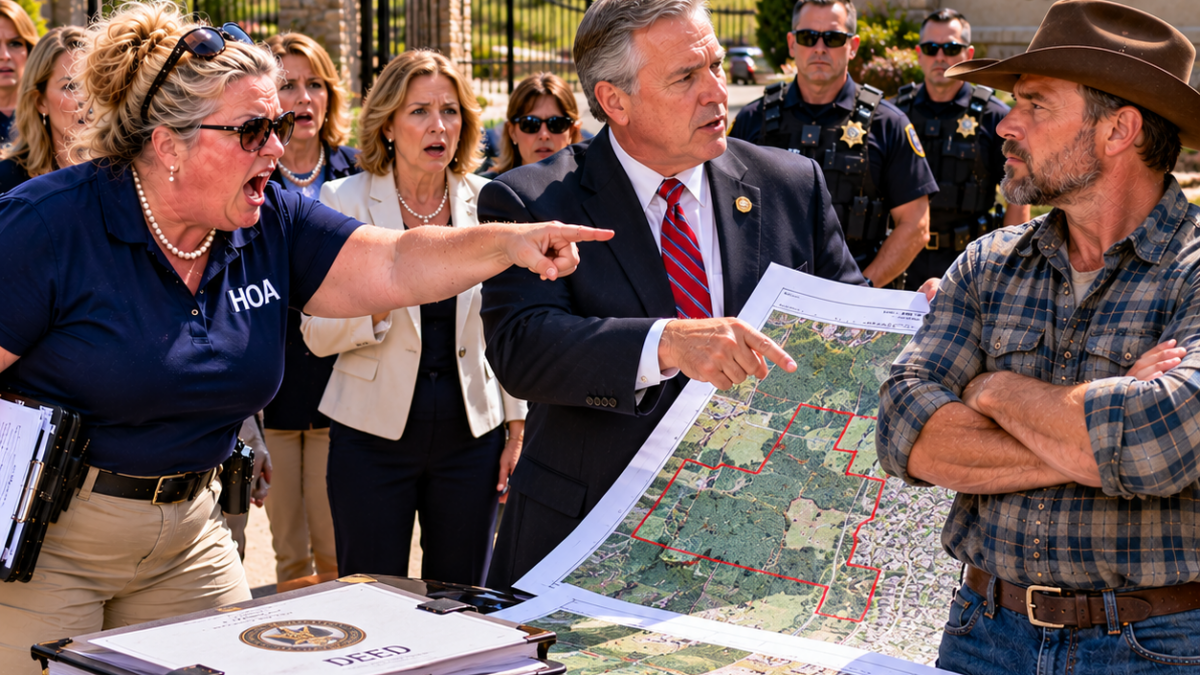
The HOA president pointed at me in front of two hundred neighbors, a sheriff’s deputy, and three local reporters and shouted that I was an illegal squatter who had thirty seconds to leave the lakeside land my grandfather had owned since before her subdivision existed.
Behind her stood a twelve-foot map covered by a bright yellow boundary line claiming 4,800 acres of lake, forest, trails, and hills as new HOA “open space,” while the deputy beside her quietly asked for the court order she had somehow forgotten to obtain before announcing my eviction to the entire community.
I didn’t argue, because Mayor Steven Lel had just stepped out of the crowd carrying a thick brown folder containing something Gwen Pritchard had spent six months making absolutely certain nobody would ever bother to look for.
My name is Jack Donovan, and the cabin beside Blue Pine Lake was the only place in my life where silence ever felt like company.
My grandfather, Elias Donovan, built it himself.
When I was a kid, we sat on the dock before sunrise and watched mist rise from the lake.
He used to say, “Jack, real land is quiet. The loud ones usually own nothing.”
I thought it was just one of Grandpa’s strange sayings.
I understood it years later.
In 1987, he sold 612 acres to a developer.
That parcel became Silver Crest Estates, a neat subdivision of roughly three hundred homes tucked between the lake and the lower ridge.
Grandpa kept everything else.
The lakefront around my cabin.
The forest.
The hills.
Old logging trails.
Meadows.
Nearly 4,800 acres held through our family trust.
When he died in 2009, I inherited responsibility for the land.
I never put up giant signs announcing ownership.
I paid the taxes.
Maintained bridges.
Cleared deadfall.
Kept the old trails safe.
For years, Silver Crest residents treated me like the quiet neighbor who lived in the cabin beyond the trees.
Then Gwen Pritchard became HOA president.
Within weeks, cameras appeared near community roads.
New violation notices went out.
People got warnings for wind chimes, mailbox paint, and trucks parked overnight.
Then one Monday morning, I found a pink paper taped to my cabin door.
UNAUTHORIZED STRUCTURE ON HOA PROPERTY.
VACATE WITHIN 30 DAYS.
I actually laughed.
Then I drove to the clubhouse.
Gwen barely looked up from her laptop.
“Your cabin isn’t listed in our property registry.”
“It was built before Silver Crest existed.”
“That doesn’t make it legal.”
“My family owns this parcel.”
She pushed a fine notice toward me.
“Our records show otherwise.”
That should have been my first warning.
Instead, I assumed she was simply overconfident.
Over the next two weeks, I received fines for my dock, my fence, my woodshed, and the stack of firewood behind the cabin.
Then somebody installed a steel gate across the Lake Trail my grandfather had built forty years earlier.
That night, my seventy-four-year-old neighbor, Dolores Meer, knocked on my door carrying an apple pie and looking frightened.
“Jack,” she whispered, “I’ve seen survey crews near your property after dark.”
At sunrise, I walked the eastern boundary.
Pink flags stood everywhere.
Dozens.
Someone was measuring my land.
Two days later, Gwen came to my porch with HOA treasurer Martin Keller.
She held out a purchase agreement.
“We’re prepared to be generous.”
The offer was $40,000.
For a lakefront cabin.
And the land beneath it.
I handed it back.
“No, thank you.”
Her smile disappeared.
“Then you’re a squatter.”
Martin looked at the ground.
Gwen leaned closer.
“And we’ll treat you like one.”
The next morning, orange flyers appeared throughout Silver Crest.
SQUATTER ALERT.
My name.
My photograph.
A warning that I was occupying community property without authorization.
That evening, Dolores called again.
“I took a picture inside the clubhouse.”
She sent it.
A giant map covered the wall.
Across the top:
SILVER CREST RESERVE — HOA OPEN SPACE.
At the bottom:
4,800 ACRES.
I stared at that number until my hands went cold.
Because 4,800 acres wasn’t an estimate.
It was the exact size of the Donovan family land surrounding Silver Crest.
And suddenly I understood why Gwen had been trying so hard to remove one quiet man from one old cabin.
PART 2
I drove home without turning on the radio.
Dolores’s photograph sat open on my phone in the cup holder, the glowing screen throwing that number at me every time I glanced down.
4,800 acres.
Not 4,700.
Not “approximately five thousand.”
Exactly 4,800.
That number existed in only a few places.
Our trust documents.
County tax records.
My grandfather’s survey.
And the old deed package locked inside a fireproof safe I had not opened in years.
By the time I reached the cabin, the sun was dropping behind Blue Pine Lake.
I went directly to the small office Grandpa had built onto the back of the house.
The safe sat beneath his old rolltop desk.
Gray steel.
Two combination dials.
One sticky hinge.
Grandpa hated banks almost as much as he hated people who wore loafers in the woods.
He stored everything important himself.
I entered the combination.
The door opened with a metallic pop.
Inside were tax receipts, survey maps, trust papers, and a brown envelope marked:
DONOVAN LAND — ORIGINALS.
I carried it to the kitchen table.
For the next three hours, I read.
The oldest document was a land patent chain that went back far enough to make my eyes hurt.
Then came later county deeds.
Then the trust.
Then the 1987 sale.
That one mattered.
My grandfather, Elias Donovan, had sold exactly 612 acres to North Ridge Development Company.
The legal description was long and painfully specific.
Survey markers.
Bearings.
Distances.
Parcel corners.
The deed also reserved rights connected to lake access, old trails, and the road system crossing portions of the remaining Donovan acreage.
I found a hand-drawn map Grandpa had made.
Silver Crest sat in the middle like a postage stamp.
Around it:
Donovan land.
Lake.
Forest.
Hills.
Meadows.
Ridges.
I stared at Gwen’s photo on my phone.
Her yellow HOA line followed almost exactly the outer boundary of my grandfather’s remaining property.
Somebody had not guessed.
Somebody had copied.
I called a land attorney at 8:12 the next morning.
Hannah Brooks had represented ranchers, timber owners, and rural families for twenty-five years.
She answered after her assistant told her I had a possible title dispute involving several thousand acres.
Apparently that gets a lawyer’s attention.
Her office was forty minutes away.
I arrived carrying Grandpa’s brown envelope in a waterproof document case.
Hannah was in her early fifties, wore reading glasses on a chain, and had the unnerving habit of staying completely silent while reading something important.
She read the 1987 deed.
Then the trust.
Then tax records.
Then the photograph of Gwen’s map.
Then she started over.
Two hours passed.
Finally, she took off her glasses.
“Jack.”
“That tone doesn’t sound good.”
“It depends which side of this dispute you’re on.”
“I’m hoping mine.”
She tapped the deed.
“You don’t have a squatter problem.”
I waited.
She slid Gwen’s map toward me.
“They do.”
I stared at her.
“You’re sure?”
“I’m sure your grandfather sold 612 acres.”
“What about the rest?”
“Based on what you’ve brought me, the Donovan trust retained title.”
“All of it?”
“Potentially all 4,800 acres shown outside that conveyance.”
I sat back.
Then laughed once.
Not because it was funny.
Because Gwen had taped an eviction notice to my door while standing on land I owned.
Hannah held up a hand.
“Don’t celebrate yet.”
“Why?”
“Because I want certified title records.”
“I want a current survey.”
“I want to know exactly what Silver Crest has recorded.”
“And I especially want to know where Gwen got that 4,800-acre map.”
I nodded.
“What do we do?”
“Quietly.”
That was not the answer I expected.
“She publicly called me a squatter.”
“I know.”
“She posted flyers.”
“I know.”
“She locked my trail.”
“I know.”
“And you want quiet?”
Hannah leaned forward.
“Yes.”
“Why?”
“Because if she is simply wrong, we correct her.”
“And if she isn’t simply wrong?”
Her eyes dropped to the map.
“Then I want her to keep talking.”
That sentence turned out to be one of the smartest things anyone said during the entire fight.
Hannah hired a licensed surveyor named Paul Seard.
Paul was sixty-three, sunburned, and happier talking to satellites than people.
He met me at the cabin with a GPS rover and two assistants.
“Show me what you think you own.”
I pointed at the hills.
He looked at me.
“That helpful, huh?”
I handed him Grandpa’s survey.
Paul smiled.
“Better.”
For two days, they walked boundaries.
Old markers.
Iron pins.
Stone monuments.
Creek crossings.
Road centerlines.
GPS coordinates.
At one point, we hiked three miles through timber to reach a stone corner marker Grandpa had shown me when I was twelve.
Paul scraped moss away.
Chiseled numbers emerged.
He checked the old survey.
Then his receiver.
“Still here.”
I felt something move in my chest.
Grandpa had touched that stone.
So had his father.
Now Paul was verifying it with satellites.
Time changes tools.
Not necessarily truth.
By the end of the second day, Paul spread a modern map across my kitchen table.
Silver Crest sat in the center.
612 acres.
Around it, almost like a horseshoe that closed near the lake:
Donovan Family Trust.
4,800 acres.
My cabin was unquestionably inside the Donovan tract.
So were the old trails.
Most of Blue Pine Lake’s undeveloped shoreline.
The forest.
Two hills Silver Crest advertised as “community scenic reserve.”
And, to my surprise, portions of the entrance road.
I pointed.
“What’s that?”
Paul looked.
“Road corridor.”
“Silver Crest uses that.”
“Yes.”
“Do I own it?”
“The underlying land appears to be yours, subject to recorded easement.”
“What kind?”
“Need Hannah to interpret.”
I called her.
She was already at the county recorder.
“Jack.”
“What?”
“We found something.”
I drove directly there.
Hannah stood at a table with three certified record books and a county clerk.
She pointed at a filing.
Corrected Plat — Silver Crest Estates.
Date:
2022.
The map expanded Silver Crest’s boundaries dramatically.
Thousands of acres.
My land.
The document contained a notation:
CONSENT OF ADJOINING LANDOWNER.
Elias Donovan.
My grandfather.
I stopped breathing.
“What?”
Hannah pointed at the signature.
“Is that his?”
It looked like Grandpa’s name.
Close.
But the problem was not the handwriting.
It was the year.
2022.
Grandpa died in 2009.
I looked at Hannah.
“He was dead thirteen years.”
“I know.”
The clerk looked uncomfortable.
“Could this be referencing an older consent?”
Hannah shook her head.
“The notary block is dated 2022.”
I leaned over.
Notary seal.
Witness line.
Elias Donovan.
2022.
My grandfather had been buried beside my grandmother for thirteen years.
I felt anger rise hard and fast.
Hannah touched the document.
“Jack.”
“She forged this.”
“We don’t know who created it yet.”
“His signature is on a 2022 document.”
“Yes.”
“He was dead.”
“Yes.”
“So somebody forged it.”
“Somebody may have submitted a document containing a fraudulent signature.”
I stared at her.
“You lawyers could make fire sound damp.”
“Language matters.”
She lowered her voice.
“And right now, we are building evidence, not slogans.”
That was difficult.
Necessary.
Hannah obtained certified copies.
Then we traced the filing.
Submitted through a title-recording service.
Supporting packet provided by Silver Crest Community Association.
Authorized contact:
Gwen Pritchard.
My hands tightened.
Hannah noticed.
“That still doesn’t prove she created it.”
“She submitted it.”
“Yes.”
“Knowing my grandfather was dead?”
“Can we prove she knew?”
“She called me Jack Donovan.”
“Jack.”
I exhaled.
“Right.”
Facts.
Not guesses.
The title package became worse the deeper we went.
Silver Crest had used the corrected plat in planning documents for what it called:
SILVER CREST RESERVE.
The 4,800 acres on Dolores’s photo were being represented internally as HOA-controlled open space.
Then Hannah discovered a development proposal.
Not publicly filed yet.
But referenced in board minutes.
Reserve Enhancement Study.
Potential mixed residential expansion.
Potential commercial village.
Additional homes.
A lodge.
Retail.
A private recreation complex.
The man I had seen in the gray suit after the HOA meeting had not been a random visitor.
His name was Preston Vale.
Vice president of a development company from two states away.
The plan was not merely to call my forest HOA open space.
They intended to leverage control of the land for future expansion.
That raised another issue.
The main Silver Crest entrance road crossed a narrow strip of my land under a 1987 easement Grandpa had granted when he sold the subdivision parcel.
Hannah read it at my kitchen table.
“Residential access.”
“What does that mean?”
“It means what it says.”
“Existing subdivision residents, guests, service vehicles.”
“And expansion?”
“Depends.”
She read another paragraph.
Then smiled.
“What?”
“Your grandfather was careful.”
She turned the page.
The easement allowed access “for residential use associated with the 612-acre conveyed subdivision parcel.”
It expressly excluded unrelated commercial development without new written consent.
I stared.
“So if Gwen turns my land into shops and eight hundred homes…”
“They cannot automatically use your existing road easement to serve it.”
“What happens?”
“Potentially they need new access rights.”
“From me.”
“Yes.”
I laughed.
Hannah didn’t.
“This is leverage, Jack.”
“I know.”
“No.”
She pointed at me.
“Leverage is not revenge.”
I stopped.
“If you start threatening to close roads used by innocent homeowners, we go from a clean title case to chaos.”
“I wasn’t going to.”
“You thought about it.”
Maybe.
She knew.
“People live there,” she continued. “They bought homes in good faith.”
“My fight is with Gwen.”
“Good.”
“Then keep it there.”
I looked toward Silver Crest through the trees.
Three hundred households.
Dolores.
Families.
Retirees.
Kids.
People who had nothing to do with Gwen’s map.
“I don’t want their houses.”
“Then say that every time anyone asks.”
That became important later.
Hannah prepared a sealed complaint package for the district attorney’s office regarding the questionable 2022 filing.
She attached:
Grandpa’s death certificate.
Certified 1987 deed.
Trust documents.
2022 corrected plat.
Submission records.
Paul’s survey.
Tax history.
She also sent a courtesy summary to the mayor because the town had participated in road and infrastructure planning affecting Silver Crest.
I had not expected the mayor himself to call.
He did.
“Jack Donovan?”
“Yes.”
“Steven Lel.”
It took me a second.
“The mayor?”
“That’s the job they gave me.”
“I didn’t vote for you.”
He laughed.
“That makes two of us.”
Then his voice changed.
“I knew Elias.”
“My grandfather?”
“Very well.”
I sat down.
Grandpa rarely talked about local politics.
“He helped negotiate the original Silver Crest development.”
“I know.”
“He donated trail access to the town for years.”
“He did?”
“Temporary recreational license.”
I had seen those papers but never understood their importance.
Mayor Lel continued.
“Your grandfather was stubborn.”
“Accurate.”
“And generous.”
“Also accurate.”
“He made one thing very clear when Silver Crest was approved.”
“What?”
“The Donovan land stayed Donovan land.”
I looked at the lake.
“Somebody forgot.”
“No.”
The mayor’s voice hardened.
“Somebody may have decided nobody would check.”
Silence.
Then:
“Silver Crest has an open-space dedication ceremony Saturday.”
I knew.
Gwen had advertised it everywhere.
She planned to unveil the “reserve” officially.
“Come.”
“I don’t think I’m invited.”
“I’m inviting you.”
“Why?”
“Bring your documents.”
I heard papers moving on his end.
“Jack, if she is going to publicly represent private land as community property, she should do it in front of records that say otherwise.”
That sounded like Hannah’s strategy.
Let Gwen keep talking.
“Will the district attorney be there?”
“I can’t promise what their office will do.”
“Sheriff?”
“They were already invited for crowd traffic.”
“I don’t want a spectacle.”
Mayor Lel was quiet.
“Neither did your grandfather.”
“And yet?”
“And yet sometimes people build stages for themselves.”
That Friday, I received another certified notice.
TRESPASS REMOVAL.
SATURDAY — 12:00 P.M.
Silver Crest Community Association intended to remove my “unauthorized occupancy” from community land.
It was signed:
Gwen Pritchard, President.
I drove straight to Hannah’s office.
She read it.
Then smiled.
Not a happy smile.
A lawyer smile.
“This is useful.”
“You people are strange.”
“She is giving us a written statement that she claims ownership.”
“She’s threatening eviction.”
“Without a court order.”
“Yes.”
“Can she?”
“No.”
“That answer could’ve come faster.”
Hannah slipped the notice into a folder.
“Bring a copy tomorrow.”
“I was planning to frame it.”
“Later.”
That night, I sat alone on Grandpa’s dock.
Blue Pine Lake was nearly still.
A loon called somewhere across the water.
The cabin lights reflected behind me.
I thought about tearing Gwen’s gate out.
About posting NO TRESPASSING signs across every trail Silver Crest residents enjoyed.
About hiring bulldozers to block the access lane running over my land.
All stupid ideas.
Emotion likes dramatic answers.
Property law likes documents.
Grandpa would have chosen documents.
I could almost hear him.
Real land is quiet.
The loud ones usually own nothing.
“Hope you’re right,” I whispered.
Saturday morning arrived bright and cold.
By ten, Silver Crest’s open field beside the clubhouse looked like a campaign rally.
Folding chairs.
Coffee table.
Local reporters.
Sheriff’s cruiser.
Board members.
A projection screen.
And Gwen’s giant easel map.
Yellow boundary:
4,800 acres.
I wore Grandpa’s old brown jacket.
Not for drama.
It was cold.
Hannah carried a leather case.
Paul brought his survey maps.
Mayor Lel arrived separately.
I saw Dolores near the back.
She looked terrified until she noticed me.
Then she smiled.
Gwen stood near the microphone wearing a red blazer.
Of course.
Martin Keller stayed beside her.
He looked pale.
The gray-suited developer, Preston Vale, stood near a black SUV.
Gwen began at eleven-thirty.
“Today marks an exciting new chapter for Silver Crest.”
Applause.
Not everyone.
Enough.
“For years, our residents have enjoyed access to the beautiful natural land surrounding our neighborhood.”
True.
Mostly because Grandpa allowed it.
“Today we formally recognize that land as Silver Crest Reserve.”
False.
She gestured toward the map.
“The reserve protects 4,800 acres from neglect, unauthorized occupation, and misuse.”
Unauthorized occupation.
There it was.
She looked at me.
Phones rose.
Gwen continued.
“For too long, one individual has claimed private rights over land that belongs to this community.”
Murmurs.
I crossed my arms.
Hannah whispered:
“Do nothing.”
“I’m doing nothing.”
“You’re smiling.”
“Can’t help that.”
Gwen pointed.
“Jack Donovan.”
Here we go.
She turned toward Deputy Miguel Ortiz.
“Deputy, this man has been notified repeatedly that he is occupying HOA property without authorization.”
Ortiz looked uncomfortable.
Gwen raised her voice.
“He is a squatter.”
Someone gasped.
Several phones shifted toward me.
Dolores shook her head.
Gwen continued.
“He has refused fines.”
“Refused notices.”
“Refused lawful removal.”
Then she pointed toward my cabin’s location on her map.
“Today that ends.”
Deputy Ortiz stepped forward.
“Ma’am, do you have a court order for removal?”
Gwen blinked.
“I’m president of the association.”
“I understand.”
“The land belongs to Silver Crest.”
“I understand that’s your position.”
“He was served notice.”
“Do you have an eviction order or writ?”
Gwen’s face tightened.
“This is not a rental.”
“Then what legal process are you asking me to enforce?”
A murmur rolled through the crowd.
Gwen clearly had not expected that question.
She lifted a binder.
“Ownership documents.”
Ortiz held out his hand.
“I’ll look.”
She hesitated.
Then gave it to him.
I stepped forward one pace.
Hannah allowed it.
“Mrs. Pritchard.”
Gwen turned.
“Stay where you are.”
“I just have one question.”
“You have no standing here.”
“How many acres are on your map?”
Her expression changed to triumph.
“Four thousand eight hundred.”
I nodded.
“Funny.”
“What?”
“I own 4,800 acres.”
For a second, nobody moved.
Then a man laughed.
Another voice said:
“What?”
Gwen laughed loudest.
“You own a cabin.”
“And everything around your 612 acres.”
Her smile vanished.
“Prove it.”
I looked toward Mayor Lel.
He stepped forward carrying a thick brown folder.
“I can help with that.”
The crowd turned.
Gwen stared.
“Mayor?”
“Good morning, Gwen.”
“This is HOA business.”
“Your map affects land records and town infrastructure.”
He opened the folder.
“These are certified county records.”
Gwen stepped toward him.
“That isn’t necessary.”
He kept going.
“Federal land patent chain.”
“Donovan family trust.”
“Tax records.”
“Recorded 1987 conveyance from Elias Donovan to North Ridge Development.”
He looked toward the crowd.
“That deed conveyed 612 acres.”
People turned toward Gwen’s giant map.
Mayor Lel pointed at Silver Crest’s original boundary.
“Silver Crest Estates is located on those 612 acres.”
Then he moved his hand around the yellow line surrounding the forest, lake, and hills.
“The land outside that conveyed parcel remains titled through the Donovan family trust, subject to specific recorded easements.”
Silence.
Someone whispered:
“All of it?”
Paul Seard stepped forward.
“Current certified survey confirms approximately 4,800 acres.”
Gwen’s face changed.
Not yet fear.
Disbelief.
“No.”
She looked at the map.
“That’s wrong.”
Hannah walked forward.
“Which document is wrong?”
Gwen turned on her.
“Who are you?”
“Hannah Brooks.”
“Mr. Donovan’s attorney.”
Gwen’s eyes narrowed.
Hannah held up the 2022 plat.
“Your association filed this corrected plat.”
Gwen recovered slightly.
“Yes.”
“It shows expanded HOA control.”
“Correct.”
“It also contains consent from Elias Donovan.”
“Correct.”
Hannah waited.
Then:
“Elias Donovan died in 2009.”
The field went completely silent.
No whispers.
No chairs.
Nothing.
Gwen stared.
Hannah continued.
“This document contains a notarization dated 2022.”
Somebody near the front said:
“Oh my God.”
Martin Keller took one slow step away from Gwen.
She noticed.
“Martin.”
He stopped.
Hannah did not accuse her personally.
Smart.
Instead she said:
“The district attorney’s office has received certified records regarding the filing and will determine responsibility.”
Gwen turned to the mayor.
“This is political.”
Mayor Lel looked almost offended.
“Your association invited me.”
“You’re taking his side.”
“I’m reading a deed.”
Preston Vale began moving toward his SUV.
Deputy Ortiz noticed.
“Sir.”
Vale stopped.
“I have a meeting.”
“Name?”
“Preston Vale.”
“Please remain available for a few questions.”
“I’m not part of this dispute.”
Hannah spoke:
“Your company’s name appears in Silver Crest expansion planning.”
Every phone in the field swung toward him.
Vale’s jaw tightened.
Gwen snapped:
“This is confidential development planning.”
Wrong sentence.
Residents erupted.
“Development?”
“What development?”
“You said preserve!”
“What are they building?”
Gwen struck the podium.
“Everyone calm down.”
Nobody did.
Paul connected his laptop to the projection system.
A satellite map appeared.
Original Silver Crest boundary:
612 acres.
Donovan land:
4,800.
Then colored overlays showed the entrance road.
Clubhouse well.
Trail system.
Small utility corridors.
Several crossed my property under limited easements.
Paul explained:
“The entrance roadway serves Silver Crest under a recorded residential access easement.”
Gwen seized on that.
“Exactly.”
Hannah answered:
“Residential.”
“So?”
“It does not automatically authorize access for unrelated commercial expansion across Mr. Donovan’s surrounding land.”
The crowd shifted again.
A resident yelled:
“What commercial expansion?”
Gwen looked toward Vale.
Vale looked at the ground.
Dolores stood.
I had never seen Dolores confront anyone.
Her voice shook.
“Gwen.”
Everyone quieted.
“You told us this land was being protected.”
“It is.”
“From who?”
Gwen pointed at me.
“Him.”
Dolores stared.
“Jack has let us walk those trails for fifteen years.”
No response.
“He fixed the bridge after the flood.”
No response.
“He cleared fallen trees.”
She held up her phone.
“And your map calls his land HOA property.”
Gwen’s voice hardened.
“Dolores, sit down.”
That was a mistake.
Dolores straightened.
“No.”
People applauded.
Gwen’s face flushed.
“This meeting is becoming disorderly.”
Deputy Ortiz said:
“Ma’am, I recommend lowering the temperature.”
“You need to remove him.”
She pointed at me again.
“I’ve shown documents.”
“You’ve shown allegations.”
“The HOA plat—”
“Is under review.”
Ortiz looked toward Hannah.
“Counsel says the signature on the corrected filing belongs to a deceased person.”
Gwen’s voice rose.
“I did not create that signature.”
Hannah nodded.
“Nobody here has said you did.”
Another mistake.
Because Gwen added:
“I was told to use the updated plat.”
“By whom?” Hannah asked.
Silence.
Gwen looked toward Martin.
He backed another step away.
“Martin?”
“I didn’t prepare it.”
“You approved it.”
“I approved submitting what you said legal had cleared.”
Her face sharpened.
“Do not do this.”
Martin swallowed.
“I asked for the original.”
“You told me it was in archives.”
The crowd erupted again.
Hannah watched without interrupting.
That was exactly why she wanted Gwen to keep building her case publicly.
Every defensive answer produced another witness.
Another contradiction.
Another document request.
Then Deputy Ortiz’s phone rang.
He answered.
Moved away.
Returned three minutes later.
His demeanor changed.
“Mrs. Pritchard.”
“What now?”
“The district attorney’s office is requesting that involved parties preserve all records related to the 2022 plat and proposed expansion.”
“We already preserve records.”
“Good.”
“They are also sending an investigator.”
Gwen folded her arms.
“Am I being arrested?”
“Not by me based solely on what has happened here.”
That was legally sensible.
Real investigations need evidence.
Not applause.
But Gwen appeared to hear something different.
Victory.
She smiled.
“Then this performance is over.”
Hannah spoke:
“One more thing.”
Gwen glared.
Hannah held up the final notice I received Friday.
TRESPASS REMOVAL.
“You signed this?”
“Yes.”
“Knowing Mr. Donovan disputed your title?”
“He has no valid title.”
Mayor Lel lifted the certified deed.
“We just established otherwise.”
“You established your opinion.”
“It’s a recorded deed.”
Someone laughed.
Gwen pointed at me.
“He has been using community resources without paying dues for years.”
I stared at her.
“My cabin has never been part of Silver Crest.”
“You use the entrance road.”
“The public approach road?”
“The trail network.”
“My trails.”
“The lake.”
“My family owns most of the undeveloped shoreline.”
That silenced her.
I stepped forward.
Hannah didn’t stop me.
I looked toward the residents.
“I want everyone here to hear this clearly.”
The field quieted.
“I am not trying to take your homes.”
Several people visibly relaxed.
“Your 612-acre subdivision remains your community.”
“I’m not blocking your families from getting home.”
“I’m not closing the road today.”
“I’m not putting gates across your neighborhood.”
I pointed toward Gwen’s map.
“But the lake, forest, hills, and trails outside your original deed do not become HOA property because somebody drew a yellow line around them.”
I looked at Gwen.
“My grandfather sold what he agreed to sell.”
“Nothing more.”
The crowd stayed quiet.
“And if your board wants access, trails, easements, or agreements with my land, there is a simple way to get them.”
I waited.
“Ask.”
That word changed the whole atmosphere.
For six months, Gwen had framed me as hostile.
A squatter.
An obstacle.
An outsider.
One word exposed the absurdity.
Ask.
That was all she had refused to do.
Preston Vale tried again to leave.
This time, a district attorney’s investigator had just arrived in an unmarked sedan.
She introduced herself to Deputy Ortiz.
Spoke briefly.
Then approached Vale.
“Mr. Vale, we’d like to speak with you regarding documents connected to Silver Crest Reserve.”
His attorney was apparently not present.
He did the smart thing.
“I’ll cooperate through counsel.”
“Fine.”
No dramatic chase.
No tackle.
No spectacle.
He stayed long enough to provide identification and contact information.
Gwen was furious that nobody had hauled me away.
She turned toward the crowd.
“This community deserves leaders who protect its future.”
Mrs. Dobbins—a woman I barely knew—called out:
“Not by stealing Jack’s.”
Applause erupted.
Gwen grabbed her binder.
“I’m ending this event.”
Mayor Lel looked at the giant map.
“Probably wise.”
She marched toward the clubhouse.
Nobody followed except her attorney and one board member.
Martin stayed behind.
That told everyone something.
He approached Hannah.
“I need a lawyer.”
She answered:
“Yes.”
“Not you.”
“Definitely not me.”
He looked at me.
“Jack.”
I said nothing.
“I didn’t know about the signature.”
“Then tell investigators.”
“I knew about the expansion.”
“That’s different.”
“I thought Gwen had a purchase path.”
“She offered me forty thousand dollars.”
Martin closed his eyes.
“I told her that was ridiculous.”
“You still came to my porch.”
“I know.”
“Why?”
He looked toward the clubhouse.
“Because saying no to Gwen was exhausting.”
That was not enough.
But it sounded true.
“What was Vale offering?”
Martin hesitated.
Hannah said:
“Don’t answer without counsel.”
Good lawyer.
Even for someone on the other side.
Martin nodded.
“I’ll talk through mine.”
Then walked away.
The field slowly emptied.
Some residents approached me.
Most apologized.
A few looked angry.
Not at me.
At themselves.
One man said:
“We voted for the reserve.”
“You voted based on what you were told.”
“Still.”
Another woman said:
“My kids hike your trail.”
“I know.”
“You’re going to close it?”
“No.”
“Why not?”
I thought of Grandpa.
“Because they weren’t the ones who put my name on a squatter flyer.”
Dolores hugged me.
Then slapped my arm.
“What?”
“You waited six months to tell me you own half the valley?”
“I don’t own half.”
“Four thousand eight hundred acres.”
“It sounds worse when you say it.”
“You let me bring you pie like you were some poor lonely hermit.”
“I am a lonely hermit.”
She laughed.
Then cried.
I hugged her.
“You did good.”
“I took one picture.”
“That one picture changed the case.”
She looked proud.
“Then I’m taking more.”
“Maybe ask first.”
The first official fallout arrived Monday.
Silver Crest’s board suspended Gwen pending an independent records investigation.
She refused to resign.
Three board members demanded an audit.
Two wanted to wait.
Residents flooded meetings.
The orange “Squatter Alert” flyers became evidence in my civil claim because they publicly accused me of unlawful occupation while the association possessed conflicting title information.
Hannah filed for declaratory relief confirming boundaries and challenging the corrected plat.
We did not sue every homeowner.
We did not threaten their houses.
The defendant was the association and involved entities tied to the disputed filing.
That distinction mattered.
My mailbox filled with letters anyway.
Some supportive.
Some angry.
One said:
GO BACK TO YOUR CABIN.
I already was.
Another:
THANK YOU FOR NOT CLOSING THE TRAILS.
That one I kept.
The district attorney’s investigation moved slowly.
Digital records had to be collected properly.
Notary history.
File metadata.
Email servers.
Board packets.
Developer communications.
People wanted instant justice.
Hannah kept reminding me:
“Real cases are boring in the middle.”
She was right.
But boring did not mean uneventful.
Three weeks after the dedication, Dolores called.
“Jack.”
“What?”
“There are trucks at the trail gate.”
I drove over.
A private contractor was removing Gwen’s steel gate.
Alan Mercer, a temporary board officer, stood nearby.
He looked embarrassed.
“We voted.”
“To remove it?”
“Yes.”
“Why?”
“Because we confirmed the Lake Trail isn’t HOA-owned.”
I nodded.
“Good.”
He looked at me.
“Would you consider letting residents keep using it?”
“It was open before.”
“So yes?”
“Keep it clean.”
“Of course.”
“No motorized vehicles.”
“Agreed.”
“Emergency closure rights if there’s fire danger.”
“Reasonable.”
He smiled.
“That easy?”
“That easy.”
He looked toward the clubhouse.
“We could’ve avoided a lot.”
“Yes.”
The gate came down.
Dolores walked through first.
She had brought apple pie again.
Naturally.
We sat at a picnic table beside the lake.
“Your grandfather would be happy.”
“Maybe.”
“He’d be angry too.”
“Definitely.”
She looked at the water.
“Did he really own all this?”
“The trust does.”
“That’s not what I mean.”
I understood.
“Yeah.”
“Did he ever act like it?”
“No.”
“That’s why nobody knew.”
“He liked it that way.”
Dolores smiled.
“Real land is quiet?”
I stared.
“How do you know that?”
“He told me once.”
“When?”
“Twenty years ago.”
I laughed.
“Apparently he only had one line.”
“It was a good line.”
The development deal came apart next.
Preston Vale’s company announced it was suspending all Silver Crest expansion activity pending title clarification.
Then emails surfaced through legal discovery.
Hannah called me into her office.
“Sit.”
“I hate when you say that.”
“Sit.”
She placed printed emails on the desk.
From Gwen to Vale.
The earliest dated nearly four years earlier.
Subject:
Donovan Parcel Strategy.
I read.
Gwen had described the surrounding acreage as:
underutilized.
poorly monitored.
potentially recoverable through plat correction and adverse association use.
My stomach tightened.
Next email:
Cabin occupant may resist.
Then:
We need clean control before phase expansion.
Then:
If he refuses buyout, pursue HOA enforcement pressure.
I stopped.
“What does ‘clean control’ mean?”
“Let’s keep reading.”
Later email:
Corrected plat should resolve boundary ambiguity.
Another:
Once Donovan structure is removed, reserve dedication gives us stronger public narrative.
There.
Not merely confusion.
Strategy.
Public narrative.
The reserve ceremony had never been about protecting trees.
It was about making ownership look settled before a development project became public.
I read another.
Vale wrote:
Need confirmation that access easement supports commercial/residential expansion.
Gwen:
Legal issue manageable once title consolidated.
Vale:
Get cabin out first.
That sentence appeared exactly as the source documents later quoted.
Get cabin out first.
My home had become a problem on a spreadsheet.
I sat back.
Hannah watched me.
“You okay?”
“No.”
“Want a break?”
“No.”
I kept reading.
There were discussions of projected lots.
Approximately eight hundred additional residential units in stages.
A commercial cluster near the highway.
Recreation facilities.
Private lake amenities.
Projected values in the tens of millions.
My grandfather’s forest had been turned into colored blocks.
I felt sick.
Not because development is evil.
Silver Crest itself existed because Grandpa sold land.
He believed towns grow.
People need homes.
But he negotiated.
He chose the 612 acres.
He retained the rest deliberately.
That choice mattered.
Gwen’s plan treated his decision as an inconvenience that could be corrected after his death.
Hannah said:
“Now you understand why we didn’t confront her immediately.”
I nodded.
“If we had, she would’ve called it a mistake.”
“Exactly.”
“Instead she held a public dedication.”
“Using the disputed map.”
“Sent me eviction notices.”
“Yes.”
“Put out squatter flyers.”
“Yes.”
“Talked about expansion.”
“Yes.”
I rubbed my face.
“She built the evidence herself.”
“Much of it.”
That was our payback.
Not a trap.
Not revenge in the childish sense.
We simply stopped protecting Gwen from the consequences of her own certainty.
The civil hearing on the corrected plat came two months later.
The courtroom was packed.
Silver Crest residents filled the back rows.
Gwen attended with two attorneys.
Preston Vale had separate counsel.
Martin Keller had entered a cooperation agreement with investigators in exchange for truthful testimony and consideration regarding his role in association filings.
He looked ten years older.
Hannah presented the title chain.
Simple first.
1987 deed.
612 acres sold.
Remaining acreage retained.
Tax payments.
Trust continuity.
Current survey.
Then the 2022 corrected plat.
The judge asked:
“Who is Elias Donovan?”
“My grandfather.”
“Date of death?”
“June 4, 2009.”
The judge looked at the plat.
“Notarization?”
“August 2022.”
Silence.
Even though everyone knew, seeing a judge read the dates changed the room.
Gwen’s attorney argued the signature might have been reproduced from earlier consent documents incorporated by reference.
Hannah responded:
“Then the filing should identify the original instrument.”
It did not.
“Does any original consent exist?”
None had been produced.
“Did Elias Donovan authorize a 2022 expansion thirteen years after his death?”
Impossible.
The judge did not decide criminal responsibility.
That belonged elsewhere.
But for title purposes, the corrected plat could not override the valid deed chain based on unsupported consent.
The court entered interim relief recognizing the Donovan trust’s ownership while litigation over associated damages and recording conduct continued.
Gwen walked out without looking at me.
Reporters surrounded Hannah.
She gave one sentence.
“The land records say what they say.”
That was all.
I loved her for it.
The board finally forced a recall vote.
Gwen fought.
She mailed a letter to every household.
She said I intended to:
close the entrance road.
charge residents tolls.
ban trail access.
restrict the lake.
devalue homes.
Sue individual families.
None of those things were true.
I called Alan Mercer.
“Why is she telling people this?”
“Fear.”
“I’ve publicly said the opposite.”
“I know.”
“Are people believing her?”
“Some.”
That bothered me.
So I attended the recall meeting.
Standing room only.
Gwen spoke for twenty minutes.
Her main argument:
Even if technical title issues favored me, Silver Crest had functionally treated the surrounding land as part of its community landscape for decades.
She said my enforcement of ownership threatened neighborhood stability.
There was truth buried inside the manipulation.
Residents had used trails for years.
Walked lake edges.
Held picnics.
Watched sunsets.
Their memories were real too.
I understood that.
When my turn came, I walked to the microphone.
“I’m going to make this simple.”
I held up a map.
“Your homes are here.”
612 acres.
“They’re yours.”
Applause.
I pointed around them.
“This is Donovan land.”
Silence.
“You’ve walked it for years.”
“Most of you respected it.”
“You picked up trash.”
“Called when trees fell.”
“Helped search when a boy got lost near the ridge.”
“I remember.”
I looked toward Gwen.
“I am not angry that you enjoyed the land.”
Then back to residents.
“I am angry that your president tried to turn permission into ownership.”
That distinction landed.
“My grandfather let people use trails.”
“That did not give anyone the right to sign his name thirteen years after he died.”
No one moved.
“I’m not closing your road.”
“I’m not charging your children to walk to the lake.”
“I’m not taking homes.”
“I’m not fighting you.”
I pointed toward Gwen.
“I’m fighting paperwork that says my grandfather agreed to something he physically could not have agreed to.”
The room went silent.
Then Dolores stood.
She had no microphone.
She did not need one.
“Vote.”
The recall passed with 81 percent.
Gwen was removed.
She left before results were formally announced.
No applause from me.
I felt relief.
Not triumph.
Because leadership was only part of the problem.
The documents remained.
The development contract remained.
The civil claims remained.
The criminal investigation remained.
And Silver Crest still depended on easements across my land.
That was where the next fight began.
Preston Vale’s company sent me an offer.
Not forty thousand.
Fourteen million dollars for selected portions of the 4,800 acres.
Hannah read it.
“Serious offer.”
I looked at her.
“You think I should sell?”
“I think my job is to tell you what the paper says.”
“What does it say?”
“Enough money to change your life.”
“My life is fine.”
“Then don’t sell.”
I looked toward Grandpa’s lake.
“Would he?”
“Your grandfather sold 612 acres once.”
“That’s not an answer.”
“No.”
Hannah closed the contract.
“You aren’t Elias.”
That mattered.
I did not need to make Grandpa’s decision.
I needed to make mine.
I rejected the proposal.
Vale increased it.
I rejected again.
They offered partnership.
No.
Conservation-development compromise.
Maybe one day.
Not with them.
Not while the title case remained tied to the scheme.
The entrance-road easement became leverage anyway.
Vale’s planned project relied heavily on Silver Crest’s existing entrance.
Hannah notified the developer formally:
The 1987 easement did not authorize new commercial expansion across Donovan lands.
Any future project would require negotiated rights.
No threats.
No gates.
No theatrics.
Just one letter.
The development financing disappeared within weeks.
Banks dislike uncertain access.
That felt more satisfying than shouting ever could.
Meanwhile, the district attorney’s investigation reached the corrected plat.
Digital forensics found several versions of the document on Silver Crest’s internal server.
One draft contained no Donovan signature.
Another contained a scanned signature image.
Another contained the completed notary block.
Metadata alone did not prove who personally altered each version.
But email attachments mattered.
A version containing the signature had been sent from Gwen’s association account to the recording coordinator.
Investigators also found communications with Vale discussing the corrected boundary before filing.
Gwen’s defense argued staff handled document preparation and she relied on information provided by consultants.
That was a legitimate defense to investigate.
Then Martin Keller testified.
He had been treasurer.
He admitted Gwen presented the corrected plat to the board as already legally approved.
He said he asked:
“Did Jack sign?”
Gwen allegedly answered:
“His family already consented years ago. Legal cleaned it up.”
Martin did not challenge it.
He regretted that.
The notary became another problem.
The seal belonged to a real notary.
She denied notarizing Elias Donovan’s signature in 2022.
Obviously.
She also produced her journal.
No transaction.
The seal image appeared to have been copied from another HOA document.
That moved the matter beyond sloppy filing.
The district attorney eventually announced charges tied to fraudulent record submission and conspiracy allegations against Gwen and another participant in the document process.
I was careful with how I spoke publicly.
Charges are accusations until resolved.
Hannah drilled that into me.
When reporters asked:
“Did Gwen forge the signature?”
I answered:
“A false signature appeared on a recorded document. Investigators and the court determine individual responsibility.”
Boring.
Accurate.
Gwen eventually entered a plea agreement resolving fraud and record-related charges after portions of the evidence were litigated.
She received restitution obligations, probationary and other legal consequences consistent with the plea, and was permanently gone from Silver Crest leadership.
The exact sentence mattered less to me than the corrected county record.
The false plat was removed from legal effect.
My grandfather’s legitimate deed controlled again.
That was the piece I cared about.
Preston Vale’s company abandoned the 800-home expansion.
The planned commercial village disappeared.
The giant yellow Silver Crest Reserve map vanished from the clubhouse.
Dolores asked if I wanted it.
“Why?”
“Frame it.”
“No.”
“Bonfire?”
“Hannah would kill us.”
“Fair.”
Martin Keller resigned.
He later apologized to residents publicly.
“I knew enough to ask harder questions,” he said. “I did not ask them because disagreeing was uncomfortable.”
That was one of the most honest apologies I heard.
Some residents forgave him.
Some didn’t.
Both responses were reasonable.
Then came the part everyone expected me to use for revenge.
I owned the underlying land beneath sections of the entrance road.
I owned trail corridors.
The clubhouse well crossed a limited utility easement touching Donovan property.
Legally, I had negotiating power.
A lot.
People asked:
“Are you going to close the road?”
“No.”
“Charge tolls?”
“No.”
“Shut off the well?”
“No.”
“Lock the Lake Trail?”
“No.”
“Then what are you going to do?”
Fix it.
That confused people.
But my grandfather had never wanted a fortress around the lake.
He wanted clear boundaries and decent neighbors.
So Hannah drafted new agreements.
The residential entrance easement was clarified and modernized.
No ambiguity.
Existing Silver Crest residents retained permanent lawful access.
Emergency vehicles protected.
Service vehicles protected.
No toll.
No surprise termination.
Commercial expansion outside the original 612 acres would still require separate negotiation.
That was fair.
The trail agreement changed too.
Instead of informal permission that could become another ownership dispute decades later, we created a recorded recreational license.
Silver Crest residents could use designated trails.
Walking.
Running.
Bicycles in certain areas.
No motorized vehicles.
No development rights.
No ownership claim.
I retained closure authority for fire danger, maintenance, environmental protection, or emergencies.
Dolores read it.
“Very official.”
“Yes.”
“Your grandfather would hate all these pages.”
“He should’ve written more pages.”
She laughed.
The lake access was clarified separately.
Residents could use designated shoreline areas already traditionally accessed.
No transfer of ownership.
No automatic expansion.
No development without agreement.
Everything Gwen could have asked for honestly, we formalized after she was gone.
That was the irony.
Silver Crest ended up with more secure access than it had before.
They just didn’t own my land.
Alan Mercer became interim HOA president.
His first visit to my cabin was awkward.
He stood on the porch holding a folder.
I opened the door.
“No.”
He blinked.
“I haven’t asked anything.”
“You’re HOA president holding paperwork.”
“It’s an apology.”
“That’s different.”
I let him in.
The letter was handwritten.
Not by a lawyer.
Silver Crest Community Association apologizes for false public statements describing Jack Donovan as a squatter and for enforcement actions taken against property outside association authority.
Simple.
He signed.
The whole board signed.
“I appreciate it.”
Alan nodded toward the safe.
“Four thousand eight hundred acres.”
“Yes.”
“How did none of us know?”
“You never needed to.”
“Gwen did.”
“She could’ve checked county records.”
He looked embarrassed.
“So could we.”
“That too.”
“What do you want from the HOA now?”
“Nothing.”
“That makes me nervous.”
I laughed.
“Pay your bills.”
“Follow your bylaws.”
“Stop putting notices on my cabin.”
“That’s it?”
“And remove the camera pointed at Lake Trail.”
He winced.
“I’ll handle that today.”
Good.
Silver Crest’s reputation recovered faster than I expected.
That surprised me.
For months, I assumed the scandal would destroy property values.
There was a short dip.
Then something strange happened.
The new trail agreement and conservation boundaries became selling points.
Residents could honestly advertise:
Protected access to thousands of acres of privately conserved forest by recorded agreement.
Not:
We own 4,800 acres.
Truth was enough.
Better, actually.
The neighborhood became quieter.
Board meetings became boring.
I attended one a year just to enjoy it.
Mailbox colors.
Pool repairs.
Snow removal.
Budget.
Nothing involving dead men signing deeds.
Beautiful.
Dolores became chair of a new community-land liaison committee.
That title made her insufferable.
She came to my cabin with a clipboard.
“Mr. Donovan.”
“Go home.”
“I’m conducting official business.”
“You brought pie.”
“Official pie.”
“What do you need?”
“Trail bridge inspection Saturday.”
“Already fixed.”
“You fixed it without committee approval?”
“My bridge.”
She narrowed her eyes.
“We need boundaries.”
“I have 4,800 acres worth.”
She hit me with the clipboard.
I loved her.
The first spring after the settlement, I reopened an old overlook trail Grandpa had closed years earlier after a landslide.
Paul Seard helped mark the safe route.
Silver Crest volunteers cleared brush.
Teenagers hauled branches.
Alan brought water.
Dolores supervised everyone while doing almost nothing.
At the top, you could see the entire valley.
Silver Crest below.
Blue Pine Lake.
My cabin almost hidden among trees.
The forest stretching beyond.
A boy standing beside his father asked:
“Mr. Donovan, is all this yours?”
I looked at the hills.
“On paper.”
He frowned.
“What does that mean?”
“It means I’m responsible for it.”
His father smiled.
The boy asked:
“Can you build anything you want?”
“No.”
“Why not?”
“County rules.”
“Trees.”
“Water.”
“Money.”
“Common sense.”
He considered that.
“Can you build a castle?”
“Probably not.”
Dolores shouted from behind us:
“He already lives like a hermit king.”
The kid loved that.
For the next year, every child in Silver Crest called me King Jack.
I blamed Dolores.
The legal settlement with the HOA included damages tied to defamatory flyers, improper enforcement, and costs of correcting the title issue.
It was meaningful money.
Not enough to matter compared with the land value.
Enough to cover legal fees, surveying, trail restoration, and record corrections.
Hannah suggested I use some of it for a proper land-management plan.
I resisted.
Then agreed.
We hired a forester.
Wildlife biologist.
Trail specialist.
Lake consultant.
Grandpa had managed the land by instinct.
I had mostly copied him.
The professionals found problems.
Invasive plants.
Erosion.
A culvert failing near the western ridge.
Overgrown fire corridors.
Owning 4,800 acres sounds romantic until someone hands you a thirty-seven-page maintenance schedule.
I called Hannah.
“I want to give the land back.”
“Too late.”
“You take it.”
“I bill too much.”
Fair.
The biggest decision came two years later.
A conservation organization offered to purchase development rights over a large portion of the property.
Not ownership.
Development rights.
The land would remain Donovan land, but major future subdivision development would be permanently limited.
I sat on Grandpa’s dock with the proposal.
That was complicated.
I had refused Vale because I hated how they tried to acquire control.
But someday I would die.
No children of my own.
The trust would pass to my sister’s family.
What if the next generation wanted to sell?
Was it fair for me to limit them?
I talked to Hannah.
Paul.
Mayor Lel.
Dolores.
Finally, my niece Emily.
She was twenty-eight and likely future trustee.
I handed her the plan.
“Read.”
She did.
Two weeks later, we sat at the cabin.
“You want to conserve 3,600 acres.”
“Yes.”
“What about the rest?”
“Cabin zone.”
“Working forest.”
“Potential limited development near highway if future family needs it.”
“Silver Crest stays untouched?”
“They already own their 612.”
She nodded.
“You’re worried I’ll sell everything.”
“I’m worried somebody will offer your children more money than they’ve ever imagined.”
“That will happen.”
“Yes.”
Emily looked toward the lake.
“What would Grandpa Elias do?”
I laughed.
“He’d tell us to stop asking dead people to make current decisions.”
“Fair.”
“What do you think?”
She read the first page again.
“Protect most.”
“Keep flexibility on some.”
“Exactly.”
“Do it.”
We did.
Not because Gwen almost stole the land.
Because her attempt forced me to finally ask what I wanted the land to become after me.
The answer was not:
Nothing changes forever.
Land changes.
Forests change.
Towns change.
Families change.
I simply wanted future change to require real consent.
Not a copied signature.
Not a clever plat.
Not a yellow line on an easel.
Consent.
That became the central rule.
Years after Gwen, Mayor Lel retired.
At his final public reception, he found me near the coffee.
“Jack.”
“Mayor.”
“Not for much longer.”
“Congratulations.”
“You realize you caused the strangest Saturday of my career.”
“You brought the folder.”
“You brought the deed.”
“Grandpa brought the deed.”
He laughed.
“Elias would’ve enjoyed Gwen’s face.”
“I think so.”
Then he became serious.
“You know what he would’ve liked more?”
“What?”
“That you didn’t punish the residents.”
I looked toward Dolores across the room.
“No reason to.”
“There was every emotional reason.”
“Not a legal one.”
“More importantly, not a decent one.”
He raised his cup.
“To quiet land.”
I smiled.
“To people who read deeds.”
He laughed.
“Even better.”
Hannah retired a few years later.
I gave her a framed copy of Gwen’s “Squatter Alert” flyer.
She stared.
“You kept this?”
“Evidence.”
“The case ended years ago.”
“Sentimental evidence.”
She laughed.
“I’m putting this in my office.”
“You’re retiring.”
“My home office.”
“Your husband is going to hate me.”
“He already does.”
She turned serious.
“Jack, you handled this better than most clients.”
“Because you threatened me constantly.”
“Correct.”
“What would most people have done?”
“Closed the road.”
“Posted guards.”
“Threatened everyone.”
“Possibly made legally reckless statements online.”
“That sounds fun.”
“It isn’t.”
She tapped the framed flyer.
“You won because the documents were stronger than the anger.”
Grandpa again.
Truth is louder than shouting.
I never told Hannah that.
She probably would have billed me.
Silver Crest eventually installed a small informational sign near the trailhead.
DONOVAN CONSERVATION TRAILS
PRIVATE LAND — COMMUNITY ACCESS BY AGREEMENT
PLEASE RESPECT CLOSURES AND STAY ON MARKED TRAILS
No yellow 4,800-acre HOA line.
No claims.
Just truth.
The first time I saw it, I stood there longer than necessary.
Dolores arrived behind me.
“You’re crying.”
“No.”
“You are.”
“Dust.”
“In a forest?”
“Lots of dust.”
She handed me pie.
Apple.
Always apple.
“Gwen would hate this sign.”
I looked at her.
“Stop talking about Gwen.”
“Why?”
“Because she doesn’t own this moment either.”
Dolores went quiet.
Then smiled.
“Your grandfather would like that.”
Maybe.
Gwen became less important with time.
That surprised me.
During the fight, she occupied my thoughts constantly.
What is she filing?
Who is she meeting?
What is Vale planning?
Will she block my road?
Will someone touch the cabin?
Then the case ended.
The plat was corrected.
The board changed.
Vale left.
The roads remained open.
Trails were protected.
And Gwen became what most antagonists eventually become if you’re lucky:
Someone you stop thinking about.
I saw her once more.
Almost seven years after the dedication.
Hardware store.
She was standing near gardening supplies.
I nearly walked past.
She said:
“Jack.”
I stopped.
“Gwen.”
She looked older.
So did I.
For a few seconds, neither spoke.
Then she said:
“I heard you put most of the land into conservation.”
“Development-right restrictions.”
“That sounds like you.”
“What does that mean?”
“Stubborn.”
“Fair.”
She looked down.
“I was wrong.”
No explanation.
I waited.
“About your land.”
“Yes.”
“About you.”
Maybe.
She continued.
“I thought the community needed to grow or it would decline.”
“That was your decision to argue.”
“I know.”
“I thought the reserve plan would raise values.”
“Probably.”
“I thought you were one man standing in the way of three hundred families.”
I looked at her.
“And?”
“I stopped seeing that you were one of the families.”
That was unexpectedly honest.
“You still could’ve asked.”
She nodded.
“I know.”
“Why didn’t you?”
She looked toward a rack of garden hoses.
“Because I was afraid you’d say no.”
There it was.
Not greed alone.
Not power alone.
Fear of no.
Some people hear no and negotiate.
Others hear it as humiliation.
Gwen had spent years trying to turn my no into something she could overrule.
“Then we would’ve talked.”
“I didn’t believe that.”
“That was your mistake.”
“Yes.”
She looked at me.
“I’m sorry about the flyers.”
“Thank you.”
“And your grandfather’s signature.”
I waited.
She did not claim responsibility beyond what her legal case established.
She simply said:
“I should have stopped that process the moment I knew the records weren’t clean.”
That was enough.
“You should have.”
She nodded.
Then walked away.
No reconciliation.
No friendship.
No dramatic forgiveness.
Just two older people standing in a hardware store with history between them.
I never saw her again.
Dolores died the following winter.
That loss hurt more than I expected.
Her daughter called me.
Dolores had left something for me.
I went to the house.
On the table sat a pie dish.
Her daughter laughed.
“She knew.”
Inside the dish was an envelope.
Jack,
You were never a hermit. You were just waiting for people worth opening the gate for.
Keep the trail open when you can.
Close it when you must.
And stop pretending you don’t like apple pie.
—Dolores
I sat at her kitchen table and cried.
No dust excuse.
At the memorial, half of Silver Crest attended.
We placed a small bench beside Lake Trail.
DOLORES MEER
GOOD NEIGHBOR
BAD AT MINDING HER OWN BUSINESS
Her daughter approved.
Dolores would have loved it.
The trail stayed open.
Children who had never met Gwen grew up using it.
They knew me as the old man at the cabin.
Some still called me King Jack.
One day, a teenager asked:
“Is it true the HOA tried to steal your entire forest?”
I considered the question.
“Not exactly.”
“That’s what my dad says.”
“Your dad likes drama.”
“What happened?”
I pointed toward Silver Crest.
“Some people decided a map mattered more than a deed.”
“Who won?”
“The deed.”
“That’s boring.”
“Most important things are.”
He rode away on his bike.
I smiled.
Maybe the story would become legend anyway.
People simplify.
HOA Karen.
Squatter.
Mayor.
4,800 acres.
Fake deed.
Downfall.
Those pieces are true enough.
But the part I remembered most was quieter.
Grandpa’s safe opening.
The smell of old paper.
Paul scraping moss off a survey stone.
Dolores whispering at my door.
Mayor Lel reading the 1987 deed.
Residents’ faces when I said I wouldn’t take their homes.
A trail gate being removed.
A child walking across land his parents once thought their HOA owned.
Those moments mattered more than Gwen being led away for questioning or losing her presidency.
Eventually, I understood why.
Winning property disputes is not about making the other side lose more than you.
It is about ending with your rights intact without becoming the thing you fought.
Gwen believed ownership was power.
I learned ownership was responsibility.
She looked at 4,800 acres and saw 800 future lots.
I looked at them and saw water that needed protection.
Trees that could burn.
Bridges that could fail.
Trails people loved.
Taxes.
Survey lines.
Wildlife habitat.
A cabin roof that leaked every third winter.
Responsibility is less glamorous than power.
It lasts longer.
On the tenth anniversary of the public dedication, Silver Crest invited me to a community picnic.
I said no.
Alan called.
“Jack.”
“No.”
“You don’t know what I’m asking.”
“Picnic.”
“How?”
“Dolores trained me.”
“Come.”
“Why?”
“We’re unveiling something.”
“That sentence caused trouble last time.”
He laughed.
“Fair.”
I went.
The field looked almost exactly as it had ten years earlier.
Folding tables.
Families.
Sheriff’s vehicle for community outreach.
A map on an easel.
I stopped.
Alan saw my face.
“Relax.”
“Bad memories.”
He pulled the cover off.
The map showed Silver Crest’s 612 acres.
Nothing more.
Around it, the Donovan conservation lands were labeled separately.
Recorded access trails shown with dashed lines.
No ownership confusion.
No fantasy boundary.
At the bottom:
GOOD BOUNDARIES MAKE GOOD NEIGHBORS.
I laughed.
“That’s terrible.”
“We voted.”
“Of course you did.”
Mayor Lel, now retired, stood in the crowd.
Hannah too.
Paul Seard.
Emily.
Dolores’s daughter.
Deputy Ortiz, now sergeant.
Everyone older.
Everyone calmer.
Alan handed me a microphone.
“No.”
“Yes.”
“I hate speeches.”
“Say five words.”
I looked at the map.
Then at the Silver Crest homes beyond the field.
Then the forest.
Lake.
Hills.
Grandpa’s land.
My responsibility.
I said:
“Read the deed before the map.”
People laughed.
I handed the microphone back.
Five words.
Almost.
That evening, after the picnic ended, I walked home by the Lake Trail.
The sun dropped behind the ridge.
A family passed me.
The little girl said:
“Hi, Mr. Donovan.”
“Hi.”
“Is this your forest?”
Her mother looked embarrassed.
“Sweetheart—”
“It’s okay.”
I looked at the girl.
“My family takes care of it.”
She considered that.
“So can we walk here?”
“Yes.”
“Why?”
“Because trails are better when people use them respectfully.”
She nodded as if this made perfect sense.
Children often understand what adults turn into lawsuits.
I continued to the cabin.
At the dock, I sat where Grandpa used to sit.
Blue Pine Lake turned gold.
The hills beyond Silver Crest were dark with pine.
No yellow lines.
No stage.
No cameras.
No shouting.
Just land.
Quiet.
I thought about the day Gwen stood in that field and called me a squatter.
She had been absolutely certain.
That was the dangerous part.
Not ignorance.
Certainty without verification.
She had a map.
A title.
A board.
A developer.
An audience.
She thought all those things combined were stronger than one old deed sitting in a safe.
They weren’t.
Because paper does not become weak simply because nobody looks at it for years.
A boundary does not move because someone draws a brighter line.
A dead man does not sign a new consent because a development plan needs him to.
And a quiet owner does not become a squatter because the loudest person in the room says so.
I could almost hear Grandpa beside me.
Real land is quiet.
The loud ones usually own nothing.
I smiled.
“You were almost right.”
The lake moved softly against the dock.
Silver Crest lights came on one by one.
Families settling in.
People heading home along a road crossing land my grandfather had once agreed to share.
I had rewritten that easement so nobody living there would have to wonder whether I might close it in anger.
I had kept the trail open.
Protected most of the forest.
Preserved room for future generations to make some decisions of their own.
That felt like a better answer than revenge.
Gwen tried to use ownership to push me out.
In the end, proving ownership gave me the chance to let people stay connected.
The cabin light glowed behind me.
Grandpa’s brown jacket hung inside.
His deed was no longer hidden in the safe.
Certified copies existed with the county, Hannah’s successor, the trust, and Emily.
No future Donovan would have to discover 4,800 acres because an HOA president taped a pink notice to the door.
I stayed on the dock until the first stars appeared.
Then I looked across the lake toward the little community sitting safely on the 612 acres Grandpa actually sold.
Not one acre more.
Not one acre less.
Exactly as the deed had said all along.
[END OF STORY]

