HOA President Called 911 When I Shut Off My Own Ranch Water—Then the Deputies Asked Who Really Owned the Pipeline
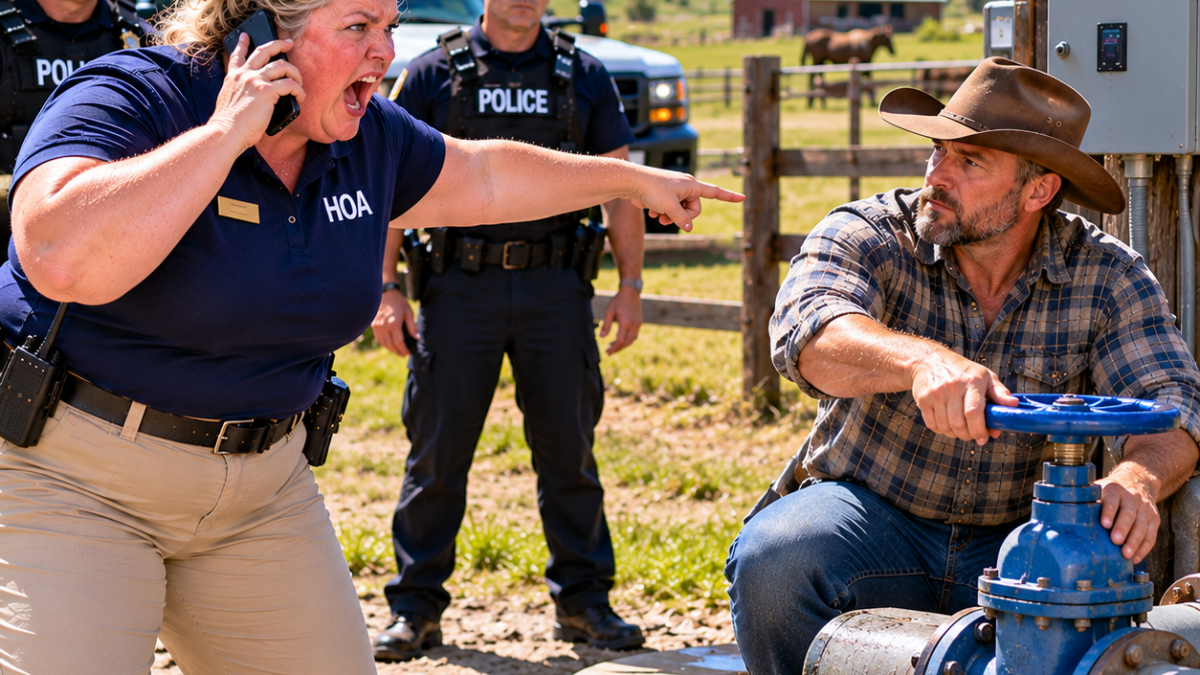
The HOA president called 911 because I shut one valve on a water line buried entirely inside my ranch, then stood at my gate demanding deputies force me to turn it back on before the decorative lake behind her clubhouse started dropping.
What she apparently forgot was that the pipeline had been on Morgan land for three generations, the county could not find a permanent easement giving her neighborhood rights to it, and the only document she carried to prove otherwise was already raising questions nobody on her board wanted answered.
By the time the first deputy unfolded my survey across the hood of his cruiser and calmly asked Victoria Sterling who legally owned the pipe beneath his boots, I realized her emergency call had just dragged an old temporary agreement, years of HOA fees, and one very strange county record into the same investigation.
My name is Caleb Morgan, and Caliterra Creek Ranch has belonged to my family longer than Calder Creek Estates has existed.
My grandfather bought the original acreage when most of the valley was cattle pasture.
My father expanded it.
I inherited it.
The subdivision went up on our eastern boundary decades later.
For years, we got along.
Then Victoria Sterling became HOA president.
Victoria liked rules.
Fence height.
Mailbox color.
Exterior lights.
Parking.
Landscaping.
She also liked speaking as if the entire valley answered to her board.
My ranch did not.
That distinction became important six months before the 911 call, when my cattle pond began dropping for no obvious reason.
At first I blamed the dry season.
Then a pump.
Then a leak.
I hired a technician and spent three days tracing my private water system.
That was how we found the branch.
A buried line split from my ranch pipeline near the eastern fence, passed through a meter I had never installed, and continued toward the HOA’s decorative lake.
I stood over that junction staring at water I paid to pump disappearing toward a neighborhood amenity I had never agreed to supply.
Victoria arrived after I called her.
She did not look surprised.
“The association has maintained that connection for years,” she said.
“Maintaining something doesn’t mean you own it.”
“You cannot interfere with community infrastructure.”
I unfolded my survey.
“This pipe is inside my ranch.”
She glanced at the paper for maybe two seconds.
Then looked at me.
“You need to understand how this community operates, Mr. Morgan.”
That was when the problem stopped feeling accidental.
I spent the evening going through old ranch files.
Surveys.
Well records.
Pipeline maps.
County documents.
No permanent HOA water easement.
Then I found a photocopy attached to an old maintenance folder.
WATER ACCESS AGREEMENT.
The signature page was missing.
Worse, someone had written a date across the top in blue ink.
The date came from a year before Calder Creek Estates was even built.
The next morning, I requested a county inspection.
Ethan Cole arrived with a meter reader and clipboard.
He followed the line.
Photographed the junction.
Recorded the unauthorized meter’s serial number.
Then stopped beside a small metal tag fixed to the pipe.
“This number belongs to an old county project.”
“What project?”
“I’ll have to pull the file.”
“Is this meter legal?”
He looked toward the expensive houses beyond my fence.
“It isn’t on the inspection record I have.”
By lunch, Victoria knew Ethan had been there.
She drove to my gate.
“You called the county?”
“Yes.”
“You had no right to interfere with our water.”
“My water.”
Her jaw tightened.
“You’ll regret turning this into a county matter.”
After she left, I made a decision.
I isolated only the disputed branch.
My ranch supply remained open.
No homes lost drinking water.
Nobody was placed in danger.
I turned one steel valve until the wheel stopped moving.
The branch pipe went quiet.
Across the fence, the decorative lake stopped receiving flow.
Twenty minutes later, Victoria returned with a phone pressed to her ear.
“I need an officer here immediately,” she told the dispatcher. “A man is deliberately shutting down our community water system.”
I stared at her through my gate.
Then she used the word emergency.
And that was when I knew she had made the argument much bigger than the water itself.
PART 2
Victoria kept talking to the dispatcher as if volume could substitute for documentation.
“Yes, he is refusing to cooperate.”
Pause.
“No, the water is not flowing.”
Another pause.
“What do you mean which homes?”
Her eyes flicked toward me.
That was the first question she had not prepared for.
The line I had shut did not feed homes.
It fed the decorative lake.
Calder Creek had municipal domestic water through an entirely separate system.
The branch crossing my ranch was an old utility connection tied to irrigation and lake circulation.
Victoria knew that.
The dispatcher apparently did not.
“No homes are without drinking water,” Victoria finally admitted.
Then she added quickly:
“But this is community infrastructure, and he has no authority to touch it.”
I rested both hands on the top rail of my gate.
“You called 911 over your lake?”
She covered the microphone.
“It is not my lake.”
“You know what I mean.”
“You shut down HOA property.”
“The valve is on my land.”
“It serves Calder Creek.”
“That does not answer who owns it.”
Her eyes narrowed.
“You always do this.”
“Do what?”
“Turn everything into a confrontation.”
I almost laughed.
“You came to my ranch after calling 911.”
“You created the emergency.”
“No.”
I pointed toward the lake roofs visible beyond the trees.
“I stopped supplying water through a disputed private line while the county checks the records.”
“Same thing.”
It wasn’t.
And twenty minutes later, that distinction became the center of everything.
Two sheriff’s vehicles came down the ranch road.
No sirens.
No theatrical rush.
Just dust lifting behind tires.
Sheriff Daniel Brooks stepped from the first cruiser.
I knew Daniel casually.
We had met at county livestock meetings.
He was the kind of lawman who looked more interested in facts than personalities.
Deputy Lena Price got out of the second vehicle.
No relation to Victoria.
Daniel walked toward the gate.
Victoria spoke first.
Of course she did.
“Sheriff, thank God.”
Daniel raised one hand.
“Ma’am, give me a second.”
“He shut off our water.”
“Which water?”
“The community supply.”
I said:
“Decorative lake branch.”
Victoria turned.
“It is infrastructure.”
Daniel looked at me.
“Caleb, what exactly did you do?”
“I closed one valve on my private pipeline.”
“Any residences affected?”
“No.”
“Livestock?”
“My ranch line remains open.”
“Fire suppression?”
“No connection that I’m aware of.”
Daniel looked toward Victoria.
“Any fire system connected?”
“No, but that’s not the point.”
“Actually, that would be a pretty important point.”
She stopped.
Daniel approached the junction with me.
I showed him the valve.
Pipeline.
Meter.
Fence boundary.
Property markers.
Then my survey.
He unfolded it across his cruiser hood.
Victoria stood opposite us.
Daniel traced the parcel line.
“This junction is inside Morgan’s property.”
“The HOA has water rights,” she said.
“Recorded where?”
“We have an agreement.”
“Good.”
Daniel held out his hand.
“Let me see it.”
Victoria hesitated.
Just long enough for me to notice.
She walked to her SUV and returned with a folder.
Maintenance invoices.
Lake-service contracts.
Meter inspections.
Copies of HOA budget pages.
Then the same incomplete water agreement I had found.
Daniel read it.
“Where’s the signature page?”
“The original is archived.”
“Where?”
“Our association records.”
“Do you have it?”
“Not with me.”
Daniel looked at the photocopy.
“Is this recorded with the county?”
“Yes.”
Deputy Price opened her laptop.
Daniel asked:
“Book and page?”
Victoria blinked.
“What?”
“Recording number.”
“I’d have to get that.”
“So right now you don’t have a recorded easement with you.”
“We’ve used the system for years.”
“That wasn’t my question.”
Her voice sharpened.
“Sheriff, this man has deliberately shut down a utility residents pay for.”
Daniel looked toward me.
“Residents pay for this?”
Victoria answered before I could.
“Yes.”
“Through what?”
“Infrastructure assessments.”
“How much?”
“That isn’t relevant.”
“It became relevant when you called law enforcement saying he interfered with a community utility.”
Victoria looked at me like I had somehow orchestrated the questions.
I hadn’t.
That was the thing she never understood.
Once you call authorities, you do not control what they verify.
Daniel asked again:
“Who owns the pipeline?”
“The association maintains it.”
“That is not ownership.”
“We have legal water rights.”
“Show me the recorded easement.”
“I told you, the original paperwork is archived.”
Daniel turned to Deputy Price.
“Can you check county index references from here?”
She nodded.
“Give me a few minutes.”
Victoria folded her arms.
“This is ridiculous.”
Daniel remained calm.
“Ma’am, you asked for an officer.”
“Yes, because he created an emergency.”
“I’m investigating what you reported.”
Her jaw tightened.
That was when my phone rang.
Ethan Cole.
County inspector.
I answered on speaker after asking whether he was comfortable with Daniel listening.
“Sheriff’s here,” I told him.
“Good.”
“What did you find?”
Ethan sounded less relaxed than he had the day before.
“I found the original county project file.”
Victoria’s head came up.
“What file?”
I held up one finger.
Ethan continued.
“The meter tag corresponds to a temporary construction-water connection from when Calder Creek’s stormwater facilities were being built.”
“How old?”
“Just over twelve years.”
“Temporary?”
“Yes.”
Victoria interrupted.
“That was converted later.”
Ethan stopped.
“Who is that?”
“Victoria Sterling.”
There was a pause.
“HOA president?”
“Yes.”
Ethan said carefully:
“Ms. Sterling, I have not found a final permanent easement in the county index.”
Victoria stepped closer to the phone.
“There was an amendment.”
“I found an attachment referencing permanent access.”
“Exactly.”
“But the attachment is missing the approval reference normally associated with a permanent conversion.”
Nobody spoke.
Daniel looked at me.
Then Victoria.
Ethan continued.
“The original work order required shutoff after construction and a final inspection.”
“Was that done?” I asked.
“There’s no completed signoff in the file.”
Daniel said:
“Ethan, Daniel Brooks.”
“Sheriff.”
“Can you send my office copies through proper channels?”
“I can send the public portions today. The rest needs records review.”
“Do that.”
Victoria shook her head.
“This is paperwork confusion.”
Daniel looked at her.
“Could be.”
“The county approved us verbally.”
Daniel took out his notebook.
“You just told me there was an amendment.”
“There was.”
“And now you’re saying there was verbal approval.”
“Both.”
He wrote.
Victoria noticed.
“What are you writing?”
“Your explanation.”
That was the moment she began digging the hole deeper.
First:
The HOA owned the system.
Then:
They had permanent rights.
Then:
The agreement was archived.
Then:
The county verbally approved it.
Then:
The previous ranch owner had consented.
Then:
Maintenance created rights.
Each explanation might have meant something in a proper legal context.
Together, offered within ten minutes, they sounded like someone searching for the answer she hoped would end the conversation.
Daniel did not accuse her of anything.
He simply kept asking for supporting records.
That was more effective.
Residents started gathering near the HOA lake before Daniel finished.
Apparently somebody had posted about the water stoppage.
A woman named Sandra Whitmore walked over from the subdivision entrance.
“Victoria?”
Victoria turned.
“Go home, Sandra.”
“Why isn’t the lake filling?”
“It’s being handled.”
Sandra saw Daniel.
“Sheriff, is something wrong with our water?”
“Domestic water?”
“Yes.”
“No issue reported.”
She looked relieved.
Then confused.
“We pay an infrastructure fee every month.”
Daniel glanced at Victoria.
“For this line?”
Sandra answered:
“That’s what we were told.”
Another resident came over.
Then two more.
One man said:
“Victoria always called that our community water line.”
A woman asked:
“Do we not own it?”
Victoria snapped:
“Please stop speculating.”
Nobody had been speculating until she said that.
I watched the residents’ expressions shift.
This was no longer rancher versus HOA president.
They wanted the same thing I did.
Proof.
Daniel finally said:
“Caleb, based on what I see, I am not ordering you to reopen the disputed branch.”
Victoria exploded.
“You can’t do that.”
“I’m not deciding ownership.”
“You’re allowing him to damage our property.”
“I’m telling you I do not have a court order, recorded easement, or clear evidence establishing that this valve belongs to your association.”
“He’s depriving residents of water.”
“No homes lack potable water.”
“That’s beside the point.”
Daniel looked at her.
“No, ma’am. When 911 is called about a water emergency, it is exactly the point.”
Victoria went silent.
I expected satisfaction.
Instead, I felt uneasy.
Because I could see the problem growing.
Residents had been paying fees.
The county file was incomplete.
Someone had installed a meter not shown in Ethan’s inspection record.
And Victoria had known enough about the arrangement to become angry the moment a county employee appeared.
That did not prove wrongdoing.
But it made one old voicemail sound different.
Two months earlier, after my first complaint, Victoria had left me a message.
Caleb, the water arrangement must remain unchanged until the next HOA audit. Do not interfere with any infrastructure before then.
At the time, I thought she was bullying me.
Now the words until the next audit felt strange.
I played the voicemail for Daniel.
He listened twice.
“Any more?”
“Several.”
“Preserve the originals.”
“I will.”
“Don’t edit them.”
“I know.”
Victoria laughed bitterly.
“So now every voicemail is evidence?”
Daniel looked at her.
“I didn’t say evidence of a crime.”
“Then why are you treating me like a suspect?”
“I’m not.”
“You’re taking his side.”
“No.”
Daniel closed his notebook.
“I’m documenting the complaint you called us to investigate.”
That sentence followed Victoria for months.
She had called the sheriff to force me to turn a valve.
Instead, she had created the first formal timeline containing all her explanations.
By late afternoon, Ethan had emailed preliminary county records.
Temporary water supply.
Construction support.
Stormwater-facility work.
Required shutoff.
Final inspection not completed.
The original authorization did not say:
Permanent HOA water source.
It definitely did not say:
Decorative lake.
Daniel left without arresting anyone.
That disappointed residents who expected television.
It relieved me.
I did not want drama.
I wanted my cattle pond to stop disappearing.
Before leaving, Daniel said:
“Keep your ranch supply safe.”
“I will.”
“Don’t touch anything else related to the disputed branch.”
“Understood.”
“If Victoria or anyone enters the property without permission, call the non-emergency line unless there’s an actual emergency.”
Victoria heard that.
Her face hardened.
“You’re warning him about us?”
Daniel answered:
“I’m warning everybody.”
He looked at me too.
“Everybody.”
Fair.
The next morning, my cattle pond level had stabilized.
That should have been the satisfying part.
Instead, I woke thinking about the residents.
Sandra Whitmore.
The older couple asking about their infrastructure fee.
The man who thought the pipeline was community property.
They had paid money based on something they believed was settled.
Maybe the HOA had a lawful right hidden somewhere.
Maybe this was a filing error.
Maybe the county lost documents.
Maybe the ranch’s previous owner—my father—had made an agreement without telling me.
Except Dad had been meticulous.
He had taught me to save receipts for fence staples.
He would not have granted permanent water rights to hundreds of homes without preserving the document.
I drove to his old workshop.
Dad had died eight years earlier.
I had not cleaned everything out.
His steel filing cabinet still sat against the wall.
WELL.
FENCES.
CATTLE.
TAX.
EQUIPMENT.
PIPELINE.
I opened the pipeline drawer.
Maintenance records.
Pump specifications.
Hand-drawn maps.
Then a yellow legal pad.
Dad’s handwriting.
Calder Creek temporary construction tap.
County approved 90 days extension.
HOA asking to continue until lake earthwork finished.
No permanent agreement.
Need lawyer before anything long term.
I sat on the workshop floor.
Dad knew.
He had been approached.
And he had never agreed.
The next page contained a name.
Gordon Vale.
Development manager.
Not Victoria.
This predated her presidency.
Then:
Victoria Sterling — landscaping committee asked about lake use. Told her temporary only.
I read that line three times.
Victoria knew about the temporary nature years before she became president.
At least Dad believed he told her.
That was not proof by itself.
But it was another piece.
I called Daniel.
He asked me to photograph the pages and preserve the original notebook.
Then I called my attorney.
Her name was Rachel Kim.
Rachel had handled an agricultural-access dispute for me years earlier.
When I explained the situation, she said:
“Let me summarize.”
“Go ahead.”
“Private ranch pipeline.”
“Yes.”
“HOA branch installed through a temporary county construction project.”
“Looks that way.”
“No recorded permanent easement currently found.”
“Correct.”
“HOA has been charging residents infrastructure fees related at least partly to the system.”
“Yes.”
“You closed only the disputed branch.”
“Yes.”
“Domestic residential water unaffected.”
“Yes.”
“HOA president called 911.”
“Yes.”
“And told the sheriff the association owns the line.”
“Yes.”
Rachel sighed.
“Caleb.”
“What?”
“You attract complicated people.”
“I raise cattle.”
“Apparently they’re easier.”
“What do I do?”
“Nothing dramatic.”
“Everyone keeps telling me that.”
“Because you keep sounding disappointed.”
“I’m not.”
“You are.”
She told me to gather records.
Property title.
Pipeline installation.
Well permits.
Dad’s notebook.
All correspondence.
Utility bills.
Meter photographs.
County inspection notes.
Then she asked:
“Have you calculated how much water went through that branch?”
“No.”
“Do that.”
I called the technician who found it.
We pulled historical pump data.
The meter itself held readings.
If reliable, the HOA lake had consumed a staggering amount of my water over years.
Not enough to bankrupt me.
Enough to matter during dry seasons.
Enough to explain the pond.
Enough to affect pumping costs.
Enough that a permanent uncompensated right would have been significant.
I stared at the estimated gallons.
“You sure?”
The technician nodded.
“Meter’s old, so we’d need calibration before treating this as exact.”
“But directionally?”
“They’ve been taking a lot.”
Taking.
I corrected him.
“Using.”
Until ownership was legally determined, language mattered.
Rachel would have been proud.
Victoria called an emergency HOA meeting that evening.
I did not plan to attend.
Then Sandra knocked on my gate.
“You should come.”
“It’s your association.”
“This is about your pipe.”
“It’s also about your fees.”
“That’s why.”
I looked toward the subdivision.
“What is she telling people?”
“That you sabotaged a public utility.”
I laughed.
Sandra didn’t.
“She says she’ll have the connection reopened within forty-eight hours.”
“How?”
“Court order, apparently.”
“Has she filed?”
“I don’t know.”
“You see the problem.”
“Yes.”
That answer convinced me.
The Calder Creek clubhouse was packed.
I had attended exactly one meeting there before.
Years ago.
Dad had gone with me because the HOA wanted to change fence screening near our boundary.
Victoria was still landscaping-chair Victoria then.
Now she sat at the center of the board table.
President.
Perfect white jacket.
Silver earrings.
A stack of papers aligned in front of her.
She opened:
“As many of you know, Mr. Morgan has intentionally interrupted a long-standing community utility.”
Murmurs.
I sat in the back.
She continued.
“The association is taking immediate action to restore service.”
A resident raised her hand.
“Service to what?”
“The lake and associated infrastructure.”
“So our homes aren’t affected?”
“No.”
A man said:
“Then why did you tell the neighborhood there was a water emergency?”
Victoria’s mouth tightened.
“The lake is part of our stormwater and amenity system.”
That was partially true.
But the disputed branch was not necessarily required for stormwater function.
Another resident:
“Do we have an easement?”
Victoria shuffled papers.
“Yes.”
“Can we see it?”
“The original is being retrieved from archives.”
I watched people exchange looks.
Sandra stood.
“Sheriff Brooks said yesterday there was no recorded permanent easement available.”
Victoria replied:
“The sheriff is not a water-rights attorney.”
True.
Then Melissa Grant stood.
I knew Melissa by sight.
Early sixties.
She had served on the landscaping committee years earlier.
“I have a question.”
Victoria looked annoyed before Melissa asked it.
“Go ahead.”
“Wasn’t the connection temporary?”
The room changed.
Victoria stopped moving.
Melissa held a folder.
“When Calder Creek was being built, I was on the committee.”
“That was years ago.”
“Yes.”
“I still have the emails.”
Victoria stared.
“What emails?”
“One from Gordon Vale.”
The name from Dad’s notebook.
Melissa read:
Temporary ranch connection remains authorized only through construction period. Long-term lake supply will require separate legal agreement with Morgan parcel owner and county review.
Silence.
Victoria leaned toward her microphone.
“That was preliminary.”
Melissa opened another page.
“This one is from you.”
My heart kicked.
Victoria went still.
Melissa read:
Do not bill homeowners separately for ranch-water connection until permanent authorization is completed.
Someone behind me whispered:
“Oh.”
Melissa looked at Victoria.
“This came from your email address when you chaired landscaping.”
Victoria’s voice became colder.
“I don’t remember a twelve-year-old email.”
“Neither did I.”
Melissa closed the folder.
“Until yesterday.”
She offered copies to the board.
Victoria did not reach for them.
Alan Mercer, the vice president, did.
He read the first.
Then the second.
He looked at Victoria.
“You knew it was temporary?”
“I knew it began as temporary.”
“Then when was it made permanent?”
“That is what county records are clarifying.”
A resident shouted:
“So why have we paid for it?”
Victoria struck the gavel.
“Order.”
Another:
“How much have we paid?”
“Order.”
Another:
“What does the infrastructure fee cover?”
Victoria’s voice rose.
“These questions are helping Mr. Morgan attack this association.”
That was a terrible thing to say.
The room became quieter.
Not supportive.
Suspicious.
Sandra stood again.
“Caleb didn’t send me my HOA bill.”
Several people laughed.
Victoria glared.
I stayed seated.
She wanted me standing.
Wanted a fight.
I gave her nothing.
Alan Mercer asked:
“President Sterling, has the board ever voted to classify this pipeline as a permanent association asset?”
“Yes.”
“When?”
“I would have to check minutes.”
“Then check.”
“I am not going to conduct an audit at this meeting.”
“Maybe we should.”
That was the first visible crack in her control.
Victoria adjourned early.
People did not leave.
They gathered in groups.
Melissa found me near the door.
“I’m sorry.”
“For what?”
“I had those emails.”
“You didn’t know they mattered.”
“I remember asking about the fee years later.”
“What happened?”
“Victoria said the county issue had been resolved.”
“Did she show you anything?”
“No.”
Melissa looked embarrassed.
“I believed her.”
“Most people did.”
“You didn’t.”
“I had cattle running low on water.”
Different motivation.
Different visibility.
We exchanged contact information.
The next morning, Daniel returned to the ranch.
Not because of another 911 call.
Because the sheriff’s office had questions.
Victoria had called authorities again after the meeting, demanding action against me for interfering with infrastructure.
Daniel looked tired.
“She called again?”
“Yes.”
“What did you tell her?”
“That ownership remains under review.”
He pulled a notebook.
“Then she told us something new.”
I waited.
“She said the HOA has continued collecting infrastructure charges because residents were promised uninterrupted water service.”
I frowned.
“Why does that matter?”
“Depends who made the promise.”
Daniel sat on the tailgate of his cruiser.
“She said the board had contractual obligations.”
“Contract with who?”
“Wouldn’t tell us.”
“That’s useful.”
“Very.”
He looked toward the pipeline.
“We are not saying she committed a crime.”
“I know.”
“But the financial side is now being reviewed separately from the property dispute.”
“That sounds bigger.”
“It may be.”
Daniel stood.
“I need you to keep doing exactly what you’re doing.”
“Nothing?”
“Pretty much.”
“I’m excellent at nothing.”
“I doubt that.”
County review accelerated.
Ethan retrieved the original work order.
The temporary connection was clear.
Approved to support construction of stormwater facilities while the development’s permanent infrastructure was incomplete.
Expiration date.
Required closure.
Final inspection.
No completed closure form.
Then came the strange attachment.
PERMANENT WATER ACCESS ACKNOWLEDGMENT.
Typed.
Dated later.
Referenced the Morgan parcel.
No signature from Dad.
No recording stamp.
No county approval number.
No supporting board packet.
No clear author.
Ethan would not call it forged.
Daniel would not call it forged.
Rachel definitely would not let me call it forged.
“Unverified,” she said.
“Suspicious.”
“Unverified.”
“Questionable.”
“Unverified.”
“You’re boring.”
“You’re not paying me to be exciting.”
Fair.
Digital records eventually showed the attachment had entered a scanned county project file several years after the original construction.
How?
That became a formal question.
The county launched an administrative review.
The HOA hired outside counsel.
Residents demanded an audit.
Victoria started sending letters.
I received one too.
CEASE AND DESIST — UNLAWFUL INTERFERENCE WITH COMMUNITY WATER INFRASTRUCTURE.
Rachel read it.
“Good.”
“Good?”
“They put their position in writing.”
“Do we respond?”
“Yes.”
Her response was eleven pages.
Mine would have been two words.
Probably why she was the attorney.
The HOA’s auditor started with the infrastructure fee.
Residents had paid it for years.
Part supported legitimate lake maintenance.
Pumps.
Aeration.
Landscaping.
Meter service.
Pipe repairs.
Some expenses were real.
That mattered.
This was not a case where every dollar disappeared.
Reality is usually less convenient.
But the audit also found billing descriptions repeatedly referred to:
Permanent water access.
Association-owned supply line.
Recorded water right.
The documentation did not currently support those statements.
Victoria had signed several annual budget certifications containing similar language.
Again:
Not automatic proof of intentional fraud.
But she could no longer say she knew nothing about how the system was represented.
Alan Mercer called me one evening.
“Can we talk?”
“About?”
“Alternative supply.”
That caught my attention.
“What alternative?”
“The HOA is considering connecting the lake to the municipal reclaimed-water network.”
“Good.”
“It costs money.”
“Not my problem.”
“I know.”
Silence.
Then:
“I actually mean that.”
That surprised me.
Alan continued.
“Caleb, I think we handled this wrong.”
“We?”
“The board.”
“Yes.”
“I joined two years ago.”
“Still board.”
“I know.”
He sounded exhausted.
“What do you want from me?”
“Nothing.”
“Then why call?”
“To tell you we are not asking you to reopen the branch while the legal review continues.”
That was the first reasonable thing I heard from Calder Creek leadership in months.
“Thank you.”
“I’m going to regret this.”
“Why?”
“Victoria doesn’t know I called.”
I smiled.
“Then you probably are.”
The HOA began exploring alternatives.
Victoria fought it.
At the next board meeting, she argued reconnecting to my ranch was cheaper.
Alan asked:
“Cheaper for who?”
“For homeowners.”
“Because Caleb pays the pumping cost?”
Silence.
That question shifted the entire discussion.
For years, the arrangement had been discussed as if water simply existed in a pipe.
It didn’t.
Electricity pumped it.
Equipment maintained it.
My well capacity supported it.
My ranch absorbed the draw.
The HOA had paid for portions of branch maintenance.
But it had not paid the full cost of producing the water.
Residents began asking how much that amounted to.
Rachel retained a water-systems consultant.
He estimated usage.
Pumping cost.
Wear.
Lost ranch availability.
Historical value.
The number was not life-changing.
It was large enough to destroy the myth that the HOA’s lake water had been “free.”
Victoria’s public strategy changed.
She stopped saying the HOA owned the pipeline.
Started saying it possessed an established usage right.
Rachel asked:
“Recorded?”
No.
“Prescriptive?”
Complicated.
“Permission?”
Disputed.
“Temporary project authority?”
Yes.
Permanent?
Still unsupported.
The county’s archive review finally identified the person who scanned the permanent-access attachment.
A private records contractor.
Not Victoria.
That disappointed some residents who wanted a simple villain.
The contractor had digitized documents delivered by Calder Creek during a records reconciliation project several years earlier.
Who gave the contractor the attachment?
Records showed the file came from an HOA administrative packet.
Signed cover letter:
Victoria Sterling.
She had been vice president then.
The letter did not say:
Please falsify county records.
It said:
Please add enclosed historical documents to the Calder Creek infrastructure file.
Rachel read it twice.
“So she submitted it.”
“Yes.”
“Does that prove she created it?”
“No.”
“Does it prove she represented it as historical support?”
“Yes.”
That distinction became central.
Investigators searched older HOA files.
They found earlier versions of the same attachment.
One had a footer:
DRAFT — PENDING OWNER APPROVAL.
The version sent to the records contractor no longer contained that footer.
Now we had a real problem.
Who removed it?
Metadata became relevant.
The HOA’s server backups held an edited copy.
Last modified under a shared administrative account.
Not enough to identify a person conclusively.
Victoria had access.
So did the property manager.
So did two administrative employees.
No one could honestly say yet who altered it.
Residents did not care about that nuance at first.
They saw:
DRAFT — PENDING OWNER APPROVAL.
Then:
Permanent Water Access Acknowledgment.
Same document.
Different footer.
Their questions became louder.
The audit found another issue.
Infrastructure fees had increased twice after Victoria became president.
Board packets described the increases as necessary to maintain “community-owned water assets.”
Yet outside counsel had warned the board three years earlier that permanent water rights connected to my ranch remained undocumented.
That memo existed.
Victoria received it.
Alan had not been on the board then.
Melissa found it in an old email archive.
The sentence that mattered:
Until a recorded easement or executed agreement is obtained from the Morgan parcel owner, the association should avoid representing the ranch connection as a permanent association-owned utility.
Victoria had received that warning.
Two months later, the fee schedule went out using exactly that representation.
Rachel put the memo down.
“That is difficult for her.”
I almost smiled.
“Can I say fraudulent now?”
“No.”
“Still boring.”
“Yes.”
The board called an emergency meeting.
This time, residents filled not only the clubhouse but the patio outside.
Victoria sat at the center.
Alan beside her.
Three other directors.
Outside counsel.
Independent auditor.
County representative.
Daniel attended only as an observer because financial investigators were reviewing portions of the records.
I sat with Rachel.
Melissa sat on my other side.
Sandra behind us.
Victoria opened with:
“This community has become the victim of a coordinated attempt to undermine its infrastructure.”
Groans.
Alan closed his eyes.
She continued.
“The ranch owner has weaponized a historical documentation gap.”
Rachel whispered:
“Do not laugh.”
“I wasn’t.”
“You were about to.”
The independent auditor presented.
Calm.
Dry.
Devastating.
Residents had been billed for legitimate lake maintenance.
Yes.
But descriptions of ownership and permanent water entitlement were unsupported by currently verified title records.
Several financial disclosures should have been more precise.
The board had received legal notice years earlier that permanent access remained unresolved.
The association had continued relying on the ranch connection without completing that legal process.
Then the auditor displayed the two attachment versions.
DRAFT — PENDING OWNER APPROVAL.
Later copy:
No footer.
Murmurs filled the room.
Victoria said:
“I did not alter that file.”
The auditor answered:
“I have not said you did.”
“Then why display it?”
“Because the association submitted the later version as historical support for permanent access.”
“Under a prior board.”
The auditor turned a page.
“The cover letter was signed by you.”
The room went silent.
Victoria’s face hardened.
“As vice president. Administrative submission.”
Melissa raised her hand.
The moderator recognized her.
“Did you know Caleb’s father had never approved the draft?”
Victoria responded:
“I understood the arrangement had been resolved.”
“By what document?”
“We have been over this.”
“No.”
Melissa’s voice stayed calm.
“We’ve been told for years that the document existed.”
“Where is it?”
Victoria struck the table.
“Enough.”
Wrong move.
Residents began calling out.
“Answer her.”
“Show the easement.”
“Why were we billed?”
“Who told us the pipe was ours?”
Alan raised his microphone.
“Everyone please—”
Victoria turned toward him.
“You’re letting them turn this into a spectacle.”
Alan looked at her for a long moment.
Then said:
“No.”
She stared.
“I’m letting homeowners ask about their money.”
That was the moment her control ended.
Not when the sheriff arrived.
Not when I shut the valve.
Not when the county found the temporary work order.
When her own vice president publicly refused to protect her from questions.
Victoria looked around.
For years, people lowered their voices when she spoke.
That night, nobody did.
She turned to me.
“You wanted this.”
I stood only because Rachel nodded that it was time.
“No.”
“Yes, you did.”
“I wanted my water line investigated.”
“You shut off a community resource.”
“I shut off a disputed branch on my ranch.”
“You knew residents would be angry.”
“I expected them to be.”
“You knew this would damage the board.”
“I didn’t know what was in your files.”
Her eyes flashed.
“You have spent months trying to humiliate me.”
That angered me.
But I kept my voice low.
“Victoria, you called 911.”
Silence.
“You brought the sheriff to my gate.”
“You told him the HOA owned the pipeline.”
“You gave him your documents.”
“You told residents you had permanent rights.”
“You called the authorities again.”
I gestured toward the auditor’s screen.
“I didn’t create any of that.”
The room remained quiet.
“I turned one valve.”
Then I sat down.
Sandra whispered behind me:
“That was better than yelling.”
Rachel said:
“Much.”
The board voted that night to place Victoria on administrative suspension pending completion of the independent audit and county review.
Three to one.
Victoria voted against.
Obviously.
Alan became acting president.
His first statement:
“We will not reopen the ranch connection without a verified lawful agreement.”
Applause.
I didn’t clap.
There was still too much unresolved.
Victoria left through the front door.
No dramatic arrest.
No screaming.
No handcuffs.
Just dozens of neighbors watching the person who had once controlled every meeting walk alone across the parking lot.
I thought I would enjoy it.
I didn’t.
Maybe because this was never really about her.
My cattle were drinking normally again.
The pond level recovered.
That mattered.
The neighborhood still needed a legal lake supply.
That mattered too.
Alan called the next morning.
“We’re moving forward with reclaimed water.”
“How long?”
“Three months.”
“What happens to the lake until then?”
“Lower level.”
“Fish?”
“We’re bringing in temporary lawful supply if needed.”
“Good.”
“Can we leave the existing branch physically in place until county review is complete?”
“Ask Rachel.”
He laughed.
“Right.”
That was how adults should have handled it from day one.
Documents.
Permission.
Negotiation.
Not assumption.
The county eventually completed its review.
The original authorization was temporary.
The permanent-access attachment was not accepted as proof of a completed easement.
No recorded permanent water right in favor of Calder Creek was found.
The branch could not simply be treated as HOA property.
That conclusion settled the property question.
The financial question took longer.
The independent audit calculated years of infrastructure fees.
Again, not all improper.
Residents had received real services.
Lake maintenance.
Pumps.
Landscaping.
Repairs.
But billing language had overstated the HOA’s ownership position.
The board agreed to refund or credit a portion of certain water-access charges that could not be properly supported.
That cost the association money.
Not enough to bankrupt it.
Enough that homeowners noticed.
Alan held a meeting specifically about it.
“No one likes paying twice for a mistake,” he told residents. “But pretending the mistake didn’t happen would cost more.”
That was leadership.
Boring.
Responsible.
I respected him for it.
Victoria fought her removal.
Her attorney argued she had relied on prior management and believed the water arrangement was permanent.
Some of that may have been true.
The investigation never established that she personally created the questionable attachment.
That mattered.
What it did establish through board records, emails, and her own signed submissions was that she knew permanent rights had remained unresolved far longer than she admitted publicly.
The association recall vote focused on governance, not criminal guilt.
Homeowners did not need to prove a crime to decide they no longer trusted their president.
Seventy-four percent voted to remove her.
Alan became president through a special election.
Melissa joined the board.
Sandra refused.
Smart woman.
The sheriff’s office eventually closed the original 911 complaint against me without charges.
That almost felt anticlimactic.
Daniel stopped by the ranch.
“Your criminal empire is over.”
“Damn.”
He smiled.
“You did the right thing by isolating only the disputed branch.”
“I had a lawyer make me sound smarter afterward.”
“Usually how it works.”
“What about Victoria’s calls?”
“Those were documented.”
“Anything happening?”
“Some statements were inaccurate, but prosecutors decide whether any criminal charge is appropriate based on intent and statute.”
I nodded.
“Fair.”
“You sound disappointed.”
“You and Rachel talk too much.”
Daniel laughed.
“Your real win isn’t a criminal case.”
“What is?”
He looked toward the cattle pond.
“Your water’s staying where it belongs.”
He was right.
Civil negotiations followed.
Rachel demanded compensation for historical water use, pumping expense, pipeline impacts, and legal fees.
The HOA disputed parts.
Experts argued about meter reliability.
Old maintenance responsibilities.
Periods when my father may have knowingly allowed temporary use.
There was no clean number.
Settlement took seven months.
Eventually, Calder Creek agreed to compensate the ranch for a negotiated portion of historical supply costs and expenses, contribute to restoration of the affected pipeline area, and formally disclaim any permanent easement over the branch.
In return, I released certain disputed historical claims.
The amount was substantial enough to matter.
Not some fantasy jackpot.
Enough to replace an aging ranch pump, repair fencing I had postponed, cover attorney fees, and restore a reserve fund I had drained while fighting.
More important was the recorded document.
One page.
Clear.
No permanent HOA water easement.
No implied right to the private ranch supply.
Any future connection required a new written agreement.
Signed.
Recorded.
Compensated.
Reviewed.
Rachel handed me the final copy.
“This is the thing your father should’ve had.”
I looked at it.
“He tried.”
“I know.”
“He wrote everything down.”
“Good man.”
“He hated lawyers.”
“Less good.”
I laughed.
Then went to Dad’s workshop.
His yellow legal pad still sat in a plastic sleeve.
Temporary only.
Need lawyer before anything long term.
I placed the new recorded agreement beside it.
“Took a while,” I said aloud.
The empty workshop gave no answer.
I imagined Dad saying:
Should’ve called the lawyer sooner.
He would have been right.
Calder Creek’s reclaimed-water connection came online that summer.
The lake recovered.
Residents survived the terrible tragedy of having slightly lower decorative water for four months.
Sandra sent me a photograph when the new line started flowing.
Caption:
LOOK. LEGAL WATER.
I replied:
FRAME IT.
She did.
I wish I were joking.
The relationship between the ranch and subdivision slowly changed.
Not instantly.
Some residents blamed me for higher dues.
One man stopped me at the feed store.
“You cost us a fortune.”
I looked at him.
“How?”
“Lawyers.”
“Your board hired those.”
“Refund credits.”
“Your board approved unsupported billing.”
“New reclaimed-water line.”
“That belongs to you.”
He frowned.
“You could have just left the valve open.”
“Yes.”
That was the first time I answered so simply.
I could have.
I could have continued losing water.
I could have watched my cattle pond shrink.
I could have paid to pump a neighborhood lake.
I could have accepted Victoria’s claim because challenging it was expensive.
I could have.
That did not mean I should have.
“I didn’t create the documentation problem,” I told him.
He looked away.
“No.”
“I exposed it.”
He sighed.
“Still costs us.”
“I know.”
That mattered too.
HOA misconduct does not magically punish only the president.
Ordinary homeowners often inherit the financial consequences.
That is why oversight matters before things go wrong.
“I’m sorry your dues went up,” I said.
He seemed surprised.
“You are?”
“Yes.”
“I’m not sorry I protected the ranch.”
He nodded slowly.
“Fair enough.”
Months later, the same man bought hay from me.
Life is strange.
Victoria sold her Calder Creek house the following year.
I heard she moved closer to her daughter.
No dramatic downfall.
No public scene.
No need for one.
Her presidency ended.
Her influence ended.
The documents she had insisted were beyond question were questioned.
That was enough.
Before leaving, she requested a meeting with me.
Rachel advised against meeting alone.
We met in her office.
Victoria looked different without the president’s chair behind her.
Still polished.
Still controlled.
But tired.
She began:
“I never intended to take water from your cattle.”
“I know.”
That surprised her.
“You do?”
“Yes.”
“You wanted the lake full.”
“I believed the arrangement was legal.”
“Maybe.”
Her mouth tightened.
“You still think I lied.”
“I think you knew there were unresolved questions.”
She looked down.
“I knew the paperwork was messy.”
“Not the same thing.”
“No.”
“You told people it was settled.”
“I thought it had become settled through use.”
“That’s what lawyers are for.”
A faint smile.
“You always hated me.”
“No.”
She looked up.
“I hated being ordered around.”
“Same difference.”
“No.”
I leaned back.
“If you had come to my gate six months ago and said, ‘Caleb, we discovered this old line. We don’t have a clear easement. Can we negotiate?’ this whole thing would have looked different.”
“The board would never have paid what you wanted.”
“You never asked what I wanted.”
Silence.
I continued.
“My father allowed temporary construction water.”
“He helped your neighborhood get built.”
“The ranch and Calder Creek lived beside each other for years.”
“This didn’t have to become a war.”
Victoria looked toward the window.
“I thought if I admitted uncertainty, everyone would lose confidence.”
There.
That was the most honest thing she ever said to me.
“You thought leadership meant never saying you didn’t know.”
She didn’t answer.
“That’s what broke it.”
Her eyes became wet.
She blinked the emotion away.
“I lost friends.”
“I’m sorry.”
She looked almost offended.
“You’re sorry?”
“Yes.”
“I don’t need pity.”
“It isn’t pity.”
“What is it?”
“Understanding that consequences can still hurt even when we caused them.”
She stared at me for a long time.
Then stood.
At the door she said:
“I should not have called 911.”
“No.”
“That was stupid.”
“Yes.”
She almost smiled.
“Still impossible.”
“I’ve heard.”
Then she left.
That was the last time we spoke.
The ranch returned to normal.
Normal on a working ranch means nothing is actually normal.
Fence down.
Calf sick.
Pump alarm.
Tractor battery dead.
Water trough overflowing.
Rain when you don’t want it.
No rain when you desperately do.
Those problems felt good.
Honest problems.
The cattle pond remained full enough through the dry season.
I stopped checking the level every morning.
Then started again because ranchers are apparently incapable of leaving functioning systems alone.
One evening, I found my daughter Emma standing by the disputed valve.
She was thirty-one, worked in agricultural lending, and had inherited my father’s ability to ask uncomfortable questions.
“So this is the famous valve.”
“Famous?”
“Half the county knows.”
“Wonderful.”
She crouched.
“It’s smaller than I expected.”
“What did you expect?”
“A giant red wheel with sirens.”
I pointed.
“That little wheel caused eight months of legal bills.”
She laughed.
Then noticed the old meter.
“You leaving it?”
“For now.”
“Why?”
“Reminder.”
“Of Victoria?”
“No.”
“Of what?”
I thought.
“Read the paperwork before you inherit the problem.”
Emma nodded.
“You’re getting philosophical.”
“I’m getting old.”
“Same thing.”
She stood.
“What are you doing with the ranch long-term?”
I looked at her.
“Is this a business conversation?”
“Yes.”
“Then I’m going inside.”
“Dad.”
I laughed.
But the question stayed.
For three generations, Morgan land passed with assumptions.
Dad knew the pipeline issue.
I didn’t.
Grandpa probably knew things Dad never did.
Family history becomes dangerous when nobody writes it down properly.
So I hired Rachel again.
She was delighted.
“Estate planning?”
“Don’t sound so happy.”
“I bill hourly.”
We mapped every utility.
Every easement.
Every access road.
Every grazing right.
Every recorded agreement.
We created a ranch binder.
Physical.
Digital.
Copies for Emma and my son Luke.
The disputed branch received a bright red tab.
NO HOA RIGHTS — SEE RECORDED AGREEMENT.
Rachel looked at it.
“Subtle.”
“I learned from you.”
“No, you didn’t.”
The old questionable attachment remained in the file too.
Marked:
UNVERIFIED HISTORICAL DOCUMENT — NO PERMANENT EASEMENT ESTABLISHED.
I wanted future Morgans to understand both the problem and the resolution.
Calder Creek changed governance too.
Annual financial statements became more detailed.
Infrastructure descriptions had to identify whether assets were owned, leased, licensed, or merely maintained.
That sounds painfully boring.
It is.
It also prevents exactly the kind of confusion that led Victoria to my gate.
New president Alan Mercer invited me to speak at a water-planning meeting.
I declined.
He invited me again.
“No.”
“Why?”
“I’m not joining your HOA.”
“I didn’t ask.”
“It always starts with a meeting.”
He laughed.
Eventually, I attended.
County water planners explained reclaimed supply.
Usage limits.
Emergency reserves.
Drought planning.
Residents asked smarter questions than they had a year earlier.
Sandra raised her hand.
“Who owns the new pipeline?”
The room laughed.
The planner answered:
“The municipal reclaimed-water authority owns the main. Calder Creek owns the internal distribution after this point, subject to the recorded service agreement.”
Sandra nodded.
“Can we see it?”
Alan held up a binder.
“Already posted online.”
More laughter.
I liked that.
Questions had become normal.
No one treated verification as disrespect.
Afterward, Melissa approached me.
“I kept thinking about those old emails.”
“Why?”
“I almost deleted them years ago.”
“But you didn’t.”
“No.”
“Good.”
“What if I had?”
“The county still had records.”
“Eventually.”
She looked toward the lake.
“I used to think keeping emails was clutter.”
“It is.”
“So?”
“Sometimes useful clutter.”
She laughed.
Then became serious.
“I’m glad you shut the valve.”
“So am I.”
“What if Victoria had never called 911?”
That stopped me.
I looked toward the ranch.
Maybe the county review would still have found the temporary agreement.
Maybe.
But slowly.
Privately.
Victoria’s call put the sheriff at my gate.
Her claims became written in an official report.
Residents saw what she said.
The missing easement became impossible to dismiss as me being difficult.
One emergency call connected property.
County records.
Fees.
Old emails.
The audit.
Her attempt to gain authority created scrutiny.
“Yes,” I said.
“She exposed the problem herself.”
Melissa smiled.
“Exactly.”
A year after the valve incident, Calder Creek held its summer picnic.
Alan invited ranch families.
I almost said no.
Emma said:
“You have to go.”
“Why?”
“Because I want to see the lake you almost destroyed.”
“I did not destroy it.”
“Legend says otherwise.”
“Your legend is wrong.”
We went.
The lake looked better than before.
Reclaimed-water fountain.
Native grasses around the edge.
Lower pumping cost, according to Alan.
Kids played near the pavilion.
No one yelled about pipelines.
Sandra handed me a drink.
“To the water thief.”
“Careful.”
“Too soon?”
“A year.”
“So no.”
Melissa joined.
“Victoria would hate this.”
“What?”
“Caleb at an HOA picnic.”
I looked around.
“I hate this.”
They laughed.
Alan gave a short speech.
He thanked the water district.
County staff.
Residents.
Then:
“And our neighbor Caleb Morgan, who forced us to ask questions we should have asked ourselves.”
I shook my head.
Emma clapped louder on purpose.
Traitor.
Alan continued:
“Calder Creek does not own the Morgan ranch pipeline.”
People laughed.
Good.
“We have our own lawful water supply now.”
Applause.
“And our infrastructure fee has been rewritten so everyone knows exactly what it funds.”
More applause.
Boring victory.
My favorite kind.
Then he said:
“We also owe Caleb an apology.”
I looked at him.
No.
He ignored me.
“This community treated a neighboring ranch’s private resource as if continued use automatically created ownership.”
“We were wrong.”
Simple.
No excuses.
No speech about past misunderstandings.
“We were wrong.”
That mattered.
Afterward, an older resident approached.
“I’ve lived here fifteen years.”
“Nice.”
“I thought that pipeline belonged to us.”
“Most did.”
“Victoria told us it did.”
“I know.”
“She wasn’t wrong about everything.”
“I know.”
He seemed surprised again.
“She got the road resurfaced.”
“Good.”
“She fixed the pool finances.”
“Also good.”
“She was good at getting things done.”
“I believe you.”
He sighed.
“Then she got too used to nobody questioning how.”
That was probably the best summary of Victoria Sterling I ever heard.
Competent people can become dangerous when competence convinces them procedure is optional.
Her downfall did not come because she was incapable.
It came because she thought capability entitled her to certainty.
The following summer was brutally dry.
Our worst in years.
Cattle pond dropped.
But this time, I knew every gallon leaving the ranch.
No hidden branch.
No mystery meter.
We rationed irrigation.
Moved cattle between pastures.
Bought hay early.
Hard season.
Honest numbers.
Late August, Alan called.
“Need anything?”
“Rain.”
“I’m HOA president, not God.”
“Then useless.”
He laughed.
“I mean water.”
“No.”
“We have reclaimed capacity.”
“For cattle?”
“Probably not legally.”
“Then definitely no.”
“I can ask.”
“No need.”
A week later, a tanker arrived.
Private donation from several Calder Creek residents.
Potable livestock water purchased from an approved agricultural supplier.
I called Alan.
“What is this?”
“Not HOA funds.”
“I didn’t ask for it.”
“I know.”
“Who paid?”
“Residents.”
“Why?”
“Because neighbors do things.”
I hated how much that moved me.
Sandra had organized it.
Melissa too.
The older man from the picnic.
Even people who once blamed me for higher dues.
I tried to reimburse them.
They refused.
So I hosted a barbecue after the first good rain.
Cattle nearby.
Calder Creek families on my ranch.
No membership form.
No HOA rules.
Alan looked at my old mailbox.
“That thing really is ugly.”
“Leave.”
“Noncompliant.”
“Get off my ranch.”
He laughed.
That was when I knew the conflict was truly over.
Not when the county issued its findings.
Not when Victoria lost the presidency.
Not when Rachel recorded the agreement.
When a sitting HOA president could joke about my mailbox and I knew he was actually joking.
Years passed.
Emma eventually took over more ranch operations.
Luke returned from Colorado and handled equipment.
I slowed down.
Not gracefully.
Dad would have laughed.
One morning, Emma called me to the east fence.
The old branch line was being removed.
Calder Creek had no need for it anymore.
“What do you want to do with the meter?”
She asked.
I looked at the rusted device.
The thing that started everything.
“Keep it.”
“Why?”
“Workshop.”
“Dad.”
“It’s history.”
“It’s junk.”
“History often is.”
We mounted it on the workshop wall.
Below it, Emma made a small brass plate.
THE VALVE THAT CALLED 911.
I hated it.
Everyone else loved it.
Rachel came by once and took a picture.
“If that appears online, you’re fired.”
“I’m your lawyer.”
“Then I’ll fire myself.”
Daniel Brooks retired.
At his retirement barbecue, he saw me.
“Water criminal.”
“Former sheriff.”
“You still shutting down utilities?”
“Only on Tuesdays.”
He shook my hand.
“You know, that was one of the strangest 911 complaints of my career.”
“Really?”
“No.”
“Good.”
“But one of the few where the caller basically created the investigation she didn’t want.”
There it was again.
That was the irony people remembered.
Victoria wanted police pressure.
She wanted a deputy to stand at my valve and say:
Open it.
Instead, Daniel asked:
Who owns it?
That question changed everything.
I asked him:
“Did you know that first day something was wrong?”
“No.”
“Nothing?”
“I knew both sides were speaking too confidently.”
“What does that mean?”
“You had a survey.”
“She had invoices.”
“You said private.”
“She said community.”
“When people argue ownership, the badge doesn’t magically answer title questions.”
“So you asked for records.”
“Exactly.”
He lifted his drink.
“Boring police work.”
“Best kind.”
“Usually.”
Victoria never faced some dramatic decades-long prison sentence.
The source stories people told later exaggerated that.
Reality was quieter.
The county corrected the infrastructure file.
The questionable attachment was marked as unsupported and not proof of permanent access.
The HOA settled financial and governance issues.
Homeowners received credits.
Victoria lost office and reputation.
The board reformed.
That was enough.
There were separate administrative and legal consequences related to representations in HOA records, but I never turned them into a trophy.
My ranch did not become safer because she suffered more.
It became safer because the paperwork finally matched reality.
That lesson mattered when I got older.
People love endings where the antagonist loses everything.
House.
Money.
Friends.
Freedom.
It feels clean.
Life rarely gives clean endings.
Victoria lost control.
But she still had family.
A future.
A chance to become someone not defined by an HOA presidency.
I hope she did.
That does not erase what happened.
Forgiveness and erasure are different things.
I forgave enough to stop thinking about her.
I never forgot the documents.
That is why the binder stayed updated.
Caliterra Creek Ranch eventually entered its fourth generation.
My grandson Mason was twelve when I first showed him the meter.
He read the brass plate.
“Grandpa, why did a valve call 911?”
“It didn’t.”
“Then the sign lies.”
“It summarizes.”
“Mom says summarizing is lying with permission.”
“Your mother talks too much.”
He stared at the meter.
“What happened?”
I told him.
Not the dramatic version.
Water disappeared.
We traced it.
Documents were unclear.
I closed the branch.
HOA president called police.
Police asked questions.
Questions revealed bigger problems.
He listened.
Then asked:
“Why didn’t you just tell them they couldn’t have the water?”
“I did.”
“What did they say?”
“That I didn’t understand how their community operated.”
Mason frowned.
“But it was your ranch.”
“Yes.”
“So they were dumb.”
I laughed.
“Not exactly.”
“What then?”
“They stopped checking whether the thing they believed was still true.”
He thought about that.
“Is that dumb?”
“Sometimes.”
He pointed toward the new ranch binder.
“That why Mom makes me read deeds?”
“Yes.”
“She’s evil.”
“Also yes.”
Emma shouted from outside:
“I heard that.”
Mason ran.
I stayed in the workshop.
The old meter hung on the wall.
Dad’s notebook sat behind glass nearby.
Temporary only.
Need lawyer before anything long term.
Then the final recorded agreement.
Three generations of one water problem reduced to paper.
Outside, cattle moved toward a trough.
Water filled it from the ranch line.
No hidden meter.
No branch feeding a lake.
No mystery.
I walked outside.
Beyond the east fence, Calder Creek’s lake caught the afternoon sun.
It still existed.
Still beautiful.
Still full.
Just not with water taken through an unresolved connection on my land.
Sandra lived there.
Melissa too.
Alan had moved away.
New board president was a woman named Jasmine Patel.
I met her once.
She came to my gate with a folder.
That made me nervous.
“Mr. Morgan?”
“Yes.”
“I’m new HOA president.”
“My condolences.”
She laughed.
“I wanted to introduce myself.”
“Okay.”
“And give you our updated boundary-contact policy.”
I stared.
“You people have a policy for talking to me?”
“It basically says we don’t claim anything on your land without written verification.”
I took the folder.
“I like this policy.”
“So do I.”
She pointed toward the old branch area.
“I also wanted to ask about drainage maintenance near the fence.”
“Ask?”
“Yes.”
“Not demand?”
“No.”
“Are you sure you’re HOA president?”
She laughed again.
We walked the boundary.
Talked.
Agreed.
No lawyer.
No sheriff.
No 911 call.
Imagine that.
That evening, I sat on the porch as the sun dropped behind the ranch.
Emma brought coffee.
“You like Jasmine?”
“She asks questions.”
“High praise.”
“She also brought documents.”
“Romance.”
“Stop.”
We watched cattle move across the pasture.
Then the sprinkler near the barn kicked on.
Water arced across dry grass.
I thought about that Tuesday years earlier.
Steel valve.
Victoria at the gate.
Phone pressed to her ear.
Her certainty.
I had expected angry calls when I shut off the branch.
I expected maybe a civil demand.
I never expected her to call 911.
And I certainly never expected that call to become the reason residents finally looked at their own records.
But that was what happened.
The call she intended as pressure created documentation.
The documentation created questions.
The questions created an audit.
The audit created reform.
And the ranch got its water back.
Not because I outsmarted everyone.
Not because police “took my side.”
Not because Victoria was some cartoon villain.
Because once everyone stopped relying on what they had always been told and started checking the actual records, the truth became difficult to avoid.
The original connection was temporary.
The permanent right was never properly completed.
Residents had been billed under descriptions that overstated the HOA’s ownership.
The branch crossed my land.
And closing it forced people to finally distinguish maintenance from ownership.
Use from permission.
Assumption from law.
I finished my coffee.
Across the valley, Calder Creek’s fountain turned on.
Their own water.
Their own line.
Their own responsibility.
Emma noticed me watching.
“You miss the drama?”
“No.”
“Liar.”
“Absolutely not.”
She smiled.
“Dad?”
“What?”
“If someone connects to our pipeline again…”
“Yes?”
“You calling 911?”
I looked at her.
“No.”
“Good.”
“I’m calling Rachel first.”
She laughed.
That was probably the smartest thing anyone in the Morgan family learned from the whole mess.
The sun disappeared.
The cattle trough valve clicked shut automatically when the tank filled.
A tiny mechanical sound.
Nothing dramatic.
Just water stopping exactly where it was supposed to stop.
And after everything that one valve had started, I could not imagine a better ending.
[END OF STORY]

