HOA President Called 911 on Me in My Own Driveway—Then the Responding Officers Recognized My Badge
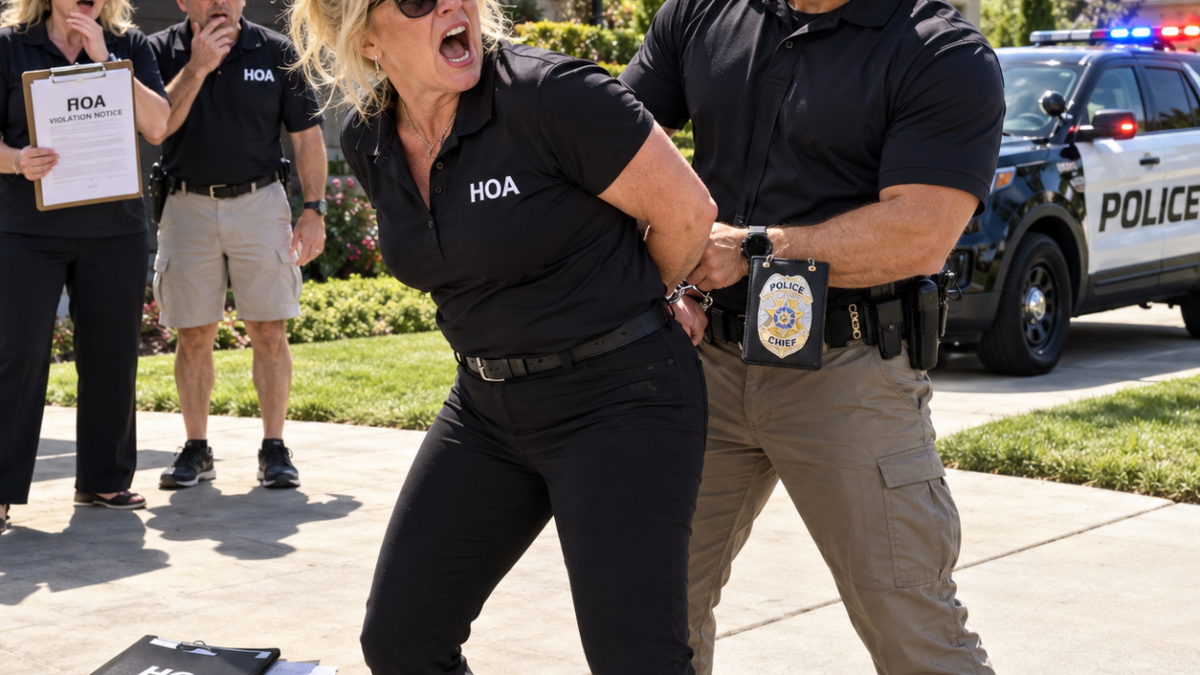
Eleven minutes after I parked in the driveway of the house I had just bought, three patrol cars were racing toward my street because the HOA president had called 911 and accused me of impersonating a police officer, and by the time the first cruiser turned the corner she was sitting on my concrete staring at the badge wallet she had tried to pull from my neck.
I thought the strangest part of that evening would be watching my own officers arrive to investigate their newly appointed police chief, but one word from the dispatcher—“again”—followed by a message that flashed across the HOA president’s phone told me this was not the first false emergency call connected to Cedar Hollow Estates.
What I discovered over the next hour would make the confrontation in my driveway look small, because hidden behind violation notices, nuisance clauses, discounted home sales, and one frightened dispatcher’s private list was a pattern that had already pushed families out of houses they had spent decades paying for.
My name is Travis Landry.
Three weeks earlier, I had been sworn in as police chief of Harland Creek after twenty years in uniform.
I had spent most of my adult life wearing some version of a badge, answering calls, sitting through budget hearings, attending funerals, working holidays, and learning how quickly a normal day could become somebody else’s worst one.
When I accepted the chief’s job, I wanted one thing outside work.
Normal.
So I bought a modest two-story house in Cedar Hollow Estates.
The previous owner had been an elderly widower who had died, and his estate wanted a fast sale. The price was lower than I expected for the neighborhood, but the inspection was clean and the title work looked ordinary.
I thought I had gotten lucky.
That evening I drove over with groceries in the city-issued black Challenger assigned to me because I was on call around the clock.
It looked like a civilian muscle car.
That was intentional.
Behind the grille were two compact emergency lights that were almost invisible when turned off.
I had never activated them anywhere near Cedar Hollow.
I parked, stepped out, and reached into the passenger seat for a grocery bag.
Then I heard heels clicking across my driveway.
A woman stopped three feet away.
White blazer.
White pants.
Pearl earrings.
Clipboard.
The kind of smile that looked practiced rather than friendly.
“Whitney Ashgrove,” she said. “President of the Cedar Hollow Homeowners Association.”
“Travis Landry.”
She looked past me at the Challenger.
“That vehicle cannot remain here.”
I assumed she was joking.
“It’s my driveway.”
“Rule 14.3 prohibits modified vehicles.”
“It’s registered and street legal.”
She pointed at the grille.
“And those hidden emergency lights are illegal.”
That got my attention.
I hadn’t turned them on.
They weren’t obvious unless someone knew exactly where to look.
“How did you know those lights were there?”
For half a second, her eyes moved away.
Then she lifted her chin.
“I don’t have to answer questions.”
“No, ma’am. You don’t.”
“But I do have a phone.”
She pulled it out.
I watched her dial three numbers I knew better than my own birthday.
9-1-1.
Her voice changed the instant the dispatcher answered.
Soft.
Shaky.
Afraid.
“There’s a man in a black muscle car with emergency lights hidden in the grille. I think he’s pretending to be a police officer. I’m scared.”
I almost laughed.
Then I remembered she was creating a real emergency record.
I opened my driver’s door and turned up the police radio.
Dispatcher Carla Benson’s voice came through.
“All units, respond to 22 Larkspur Lane. Report of possible police impersonation. Caller Whitney Ashgrove.”
Then came a pause.
Carla’s next word was quiet.
Almost under her breath.
“Again?”
My attention snapped toward the radio.
Again.
Doors opened along the street.
Neighbors stepped onto lawns with phones.
Whitney raised both arms.
“Everybody stay back. We don’t know if he’s dangerous.”
I remained still.
A chief who loses his temper in front of thirty cameras creates his own problem.
Whitney mistook my silence for fear.
“Not so confident now?”
Then she reached for my keys.
I pulled my hand back.
“Ma’am, don’t touch me.”
She grabbed anyway.
Her other hand caught the cord around my neck and pulled.
At the end of that cord was my badge wallet.
“Let go.”
She pulled harder.
I stepped backward.
Her heel twisted.
She lost balance and went down onto the driveway.
I never pushed her.
Half the neighborhood had just recorded that fact.
I crouched several feet away, opened the badge wallet, and held it where she could see.
“Whitney, my name is Travis Landry.”
Her eyes fixed on the gold shield.
“I’m the chief of police.”
The color left her face.
And behind us, the first cruiser turned onto Larkspur Lane.
[END OF FACEBOOK OPENING]
PART 2
Sergeant Paul Mercado was driving the first patrol car.
I recognized the unit number before I could see his face.
He stopped behind my Challenger, opened his door, and stepped out with one hand near his radio.
Officer Daniel Rios pulled in behind him.
Then a third cruiser.
Mercado looked at Whitney.
Then me.
Then the badge still open in my hand.
His entire expression changed.
“Chief?”
Whitney’s head snapped toward him.
For several seconds, nobody said anything.
Then she pointed at me from where she was still sitting on the driveway.
“He attacked me.”
Mercado looked at me.
I closed my badge wallet.
“She grabbed my keys and badge cord. She lost her balance.”
“That is a lie!” Whitney shouted. “He threw me down.”
A quiet voice came from the sidewalk.
“No, he didn’t.”
Mrs. Miriam Dawson from two houses down stood there holding her phone.
“I recorded the whole thing.”
Another neighbor lifted his phone.
“So did I.”
Then another.
Whitney looked around.
For the first time, her confidence became something closer to panic.
“She’s hurt,” I told Mercado. “Have EMS check her.”
He nodded.
Then I added:
“And call county.”
Mercado frowned.
“County sheriff?”
“Yes.”
“You want them to take over?”
“I’m a victim and a witness now.”
That mattered.
The easiest thing in the world would have been to start giving orders.
I was chief.
These were my officers.
Whitney had just grabbed me, taken my keys, yanked my badge cord, and apparently made a false emergency call.
But that was exactly why I needed to stop being chief for the next few minutes.
If I directed her arrest, questioning, evidence collection, or charging decisions, every lawyer she hired later would have a legitimate question about independence.
“Call Sheriff Ellis,” I said. “Tell him I need outside handling from this point forward.”
Mercado nodded.
Whitney laughed bitterly.
“Oh, now you’re trying to make this look official.”
I looked at her.
“It already is.”
Rios retrieved my keys from the driveway.
He placed them on the hood of my car rather than handing them directly to me.
Good procedure.
Mercado began speaking with witnesses separately.
Another officer photographed the driveway.
Whitney’s phone lay several feet away where it had fallen when she went down.
Nobody touched it immediately.
Then the screen illuminated.
I was standing close enough to see the preview without moving.
**Neil P:**
**Did you get the third call logged? We need it before Friday.**
I felt something inside me shift.
Not because I knew what it meant.
Because I didn’t.
Third call.
Before Friday.
Mercado saw my face.
“What?”
I pointed without approaching.
“Message preview.”
He looked.
Then his expression changed too.
“Don’t touch it,” I said.
“I know.”
He called Rios over.
They photographed the screen as it appeared in plain view.
Then the phone was collected and secured as evidence pending whatever legal process an outside investigator considered appropriate.
Whitney saw what they were doing.
“That’s my private phone.”
Mercado said:
“It’s being preserved. Nobody is searching it right now.”
“You need a warrant.”
“Yes, ma’am.”
That answer seemed to unsettle her more than an argument would have.
She had expected power to look like somebody ignoring rules because they were angry.
Instead, everyone slowed down.
Documented.
Separated witnesses.
Preserved evidence.
Called outside jurisdiction.
That kind of procedure is boring until someone desperately needs it to be fair.
EMS checked Whitney’s ankle.
Sprain.
No major injury.
Thirty minutes later, Sheriff Robert Ellis arrived with two deputies.
He was sixty-one, built like a retired linebacker, and had known me professionally for more than a decade.
He walked straight toward me.
“Travis.”
“Bob.”
“You okay?”
“Yes.”
“Then from now on, you’re just Travis.”
“Exactly.”
He turned to Mercado.
“Brief me.”
I stepped away.
That was harder than it sounds.
Chiefs are trained by repetition to move toward information.
Now I had to stand on my own lawn while somebody else managed the scene.
Claire would later tell me that was the most uncomfortable she had ever seen me.
She wasn’t there that evening.
She was still finishing the move from our temporary apartment and planned to join me that weekend.
In hindsight, I was grateful.
I didn’t want her first memory of the house to be patrol lights against the siding.
While Ellis interviewed witnesses, an elderly woman approached me from across the street.
She was thin, silver-haired, using a cane with a carved wooden handle.
I had seen her earlier standing behind the crowd.
She stopped several feet away.
“Chief?”
“Travis tonight.”
She nodded.
“My name is Ruth Ellery.”
“Nice to meet you.”
She looked at Whitney, now talking to a county deputy.
Then at me.
“She did the same thing to me.”
I felt my shoulders tighten.
“Same thing how?”
“Called the police.”
“How many times?”
Ruth swallowed.
“Four.”
“Why?”
“Once because my nephew stayed overnight.”
I waited.
“Once because my landscaper’s truck was parked outside too long.”
“What were the others?”
Her hand tightened around the cane.
“One said somebody was trying my back door.”
“Was somebody?”
“No.”
“The fourth?”
She looked down.
“Suspicious activity.”
“What activity?”
“I was carrying boxes to my car.”
I stared.
“When was this?”
“Last winter.”
“Did you still live here?”
“Yes.”
Something about the wording bothered me.
“Still?”
Her eyes filled.
“I sold in March.”
I looked across the street.
“Which house?”
She pointed to a gray colonial three doors down.
“I lived there thirty-two years.”
“Why did you sell?”
Whitney’s voice rose in the background.
Ruth flinched.
Not dramatically.
Reflexively.
That told me more than anything.
“Mrs. Ellery?”
She took a breath.
“After the third police call, the HOA said my house was a nuisance property.”
I stared at her.
“What does that mean?”
“Section Nine.”
Her voice had become almost embarrassed.
“Three police calls in twelve months. Five hundred dollars a day until corrective action.”
I knew nuisance ordinances.
I knew municipal abatement law.
What she was describing did not sound like anything I had ever heard from a homeowners association.
“How long did they fine you?”
“Four months.”
My stomach tightened.
“Five hundred a day?”
“Yes.”
“That’s sixty thousand dollars.”
“I stopped counting.”
“What happened?”
“They recorded a lien.”
“Then?”
“My husband died six years ago.”
She wiped her cheek.
“I had his pension and our retirement savings. I used most of it fighting them.”
I didn’t know what to say.
“They kept telling me court would cost more.”
“Who?”
“Whitney.”
“Anyone else?”
“The treasurer.”
The message preview came back to me.
Neil P.
“What’s the treasurer’s name?”
“Neil Packard.”
There it was.
“Mrs. Ellery, who bought your house?”
She closed her eyes.
“Packard Home Buyers.”
I felt the evening rearrange itself.
Not proof.
Not yet.
But enough connections to change the question.
This wasn’t simply:
Why did Whitney call 911 on me?
Now it was:
Why was the HOA president generating police calls that triggered a financial penalty tied to homes later purchased by a company sharing the treasurer’s name?
“What did they pay?”
Ruth’s voice became small.
“Two hundred forty thousand.”
“What was the home worth?”
She looked at the gray colonial.
“My realtor said around four hundred.”
Sixty cents on the dollar.
Almost exactly.
I asked:
“Why are you here tonight?”
“I’m staying with my daughter nearby.”
“No, why did you come onto this street?”
“I heard sirens.”
She looked toward Whitney.
“I thought someone else was losing their home.”
That sentence followed me for years.
Eventually Sheriff Ellis came over.
“Travis.”
I looked at Ruth.
“Would you be willing to speak with Sheriff Ellis?”
She hesitated.
Then nodded.
I introduced them.
Ellis listened.
Asked basic questions.
Took no leap.
No dramatic accusation.
But I could see what he was thinking.
He asked Ruth whether she had documents.
“All of them.”
“Don’t throw anything away.”
“I won’t.”
Whitney was taken to the county station for formal processing and interview based on the independent investigation into the driveway incident.
I did not cuff her.
I did not ride in the cruiser.
I followed separately after giving my own recorded statement.
As she was placed in the back of the county unit, she leaned toward the open door.
“My husband is Councilman Ashgrove.”
Ellis said:
“I know.”
“He’ll have your job.”
Ellis smiled faintly.
“I’m elected.”
Whitney stopped talking.
At 8:47 that evening, my phone buzzed.
Dispatcher Carla Benson.
**Chief, come see this in person. Please.**
I called Ellis first.
He was interviewing witnesses.
“Bob, Carla Benson says she has something.”
“The dispatcher?”
“Yes.”
“About tonight?”
“Probably more.”
“Do not go alone.”
“I wasn’t planning to.”
He sent Deputy Rios.
Technically Rios worked for me.
But once we arrived at the dispatch center, I told him clearly:
“You’re here as witness. Anything Carla gives us gets preserved and transferred to county or state.”
“Understood.”
The 911 center sat beneath the municipal building.
Dim lights.
Rows of monitors.
Headsets.
The strange calm of people trained to hear panic without absorbing all of it.
Carla was fifty, maybe fifty-one.
I had known her for years but never well.
She looked exhausted.
“Chief.”
“Carla.”
She glanced at Rios.
“He okay?”
“He’s documenting.”
She nodded.
Then turned her monitor toward us.
“I’ve been tracking Whitney Ashgrove’s calls for eighteen months.”
“Officially?”
“No.”
That was not the answer I wanted.
Carla saw it.
“I didn’t change anything. I didn’t delete anything. I made my own list from calls I dispatched.”
“Why?”
“Because they started feeling wrong.”
She opened a spreadsheet.
Fourteen calls.
Nine addresses.
Dates.
Caller.
Reported reason.
Disposition.
Most were low-level suspicious-person complaints.
A car parked too long.
A stranger at a door.
Possible trespass.
Unusual activity.
Nothing dramatic by itself.
That was the strength of it.
Ordinary enough to be dismissed.
Then I saw ages.
Seventy-six.
Sixty-nine.
Eighty-two.
Single mother.
Widower.
Retired couple.
Ruth Ellery.
I scrolled.
“Why these nine?”
“Whitney called all of them.”
“Every call?”
“Sometimes her. Sometimes an HOA ‘security volunteer.’”
“Any crimes confirmed?”
“Almost none.”
“Almost?”
“One call involved an actual stolen package.”
“Any arrests?”
“No.”
“Charges?”
“No.”
Carla pointed toward another column.
“Now look at the addresses.”
Six had a second notation.
**SOLD**
“Sold to who?”
She opened county property data she had printed.
Packard Home Buyers LLC.
One.
Two.
Three.
Four.
Five.
Six.
Rios stopped writing.
“Carla.”
“I know.”
I asked:
“When did you first notice?”
“Ruth.”
“Why?”
“Four calls.”
“And?”
“She cried when an officer responded the last time.”
Carla looked down.
“She kept saying she wasn’t doing anything.”
“Did you report the pattern?”
“To who?”
“Supervisor?”
“I mentioned repeated HOA calls.”
“What did they say?”
“That if the calls met dispatch criteria, we dispatch.”
Fair.
“Internal affairs?”
“No.”
“Why?”
Her eyes filled.
“Councilman Ashgrove sits on the public-safety committee.”
There it was.
Fear.
Not necessarily evidence he was involved.
But enough power to make someone hesitate.
“I didn’t know who I could trust.”
“You could’ve come to me.”
“You were here three weeks.”
That shut me up.
She continued.
“I started the list before you were hired.”
“Why text tonight?”
“Because of your address.”
My attention sharpened.
“What about it?”
She scrolled to the bottom.
22 Larkspur Lane.
My house.
Two prior calls.
Dates from before I owned it.
**VACANT PROPERTY — SUSPICIOUS ACTIVITY**
**VACANT PROPERTY — POSSIBLE TRESPASS**
Both callers associated with Cedar Hollow HOA.
My pulse slowed.
That happens when I get angry.
Some people heat up.
I get quieter.
“That makes tonight three.”
Carla nodded.
“Exactly.”
I remembered Ruth.
Section Nine.
Three police calls.
“Nuisance clause.”
Carla looked confused.
I explained.
Rios swore under his breath.
I looked at him.
“Sorry, Chief.”
“Understandable.”
I pulled out the Cedar Hollow rule book from my bag.
I had taken it from the welcome packet.
Section 9.4.
There it was.
**Any property generating three or more documented law-enforcement responses within a twelve-month period may be designated a Nuisance Property by majority vote of the board.**
Then:
**Daily compliance assessment: up to $500.**
Then:
**Unpaid assessments may result in lien enforcement as permitted by governing documents and law.**
That wasn’t automatically illegal.
A badly written rule is not a conspiracy.
But combined with the property pattern, it became something investigators had to examine.
I called Sheriff Ellis.
Then I called the one person I trusted who had authority completely outside my department and Cedar Hollow politics.
Alan Farrow.
State investigations bureau.
We had worked together years earlier.
He answered on the first ring.
“Landry.”
“Alan.”
“What happened?”
“I need you in Harland Creek.”
“Tonight?”
“Yes.”
“Department problem?”
“No.”
“Political?”
“Possibly.”
He sighed.
“That’s worse.”
“I have a dispatcher’s pattern log, possible false 911 calls, HOA nuisance penalties, and six distressed home sales to a company connected to the HOA treasurer.”
Silence.
“How long have you been sitting on this?”
I checked the clock.
“About four hours.”
“Good.”
“You sound disappointed.”
“I was afraid you’d say four months.”
He arrived before eleven.
No lights.
No drama.
Dark sedan.
Briefcase.
He walked into the dispatch center and looked at the spreadsheet.
Then at me.
“You are not investigating this.”
“I know.”
“You are not accessing evidence.”
“I know.”
“You are not calling witnesses.”
“I know.”
“You’re going home.”
“That one I don’t know.”
Alan stared.
“Travis.”
“Fine.”
He sat with Carla for nearly two hours.
County investigators handled Whitney’s phone.
State investigators began coordinating the broader financial and public-record inquiry.
Nobody opened Whitney’s device because I was angry.
They sought judicial authorization based on evidence.
That distinction mattered.
By 9:40 the next morning, Judge Hall had approved a warrant narrowly authorizing review of communications tied to the suspected false-call and property scheme.
Alan called me to the state field office.
Not police headquarters.
Neutral ground.
Whitney’s phone contained thousands of messages.
Most irrelevant.
Family.
Shopping.
Board chatter.
Complaints.
Then investigators found the thread with Neil Packard.
Two years.
Not every message was criminal.
But enough were devastating.
**Neil:**
Three logs and clause triggers, then we buy at 60 cents.
**Whitney:**
Ruth is fighting.
**Neil:**
Let her. Daily fees do the work.
Another thread:
**Whitney:**
Old man on Juniper still won’t sell.
**Neil:**
Need one more documented response.
Then my address.
Weeks before I closed.
**Neil:**
Larkspur estate finally under contract?
**Whitney:**
New buyer. Black Challenger came by twice.
I stared.
She had seen me during inspections.
That explained the emergency lights.
She had watched the car before I moved.
Another message:
**Whitney:**
He parks that ugly thing again, I’ll make call three myself.
Then:
**Neil:**
Perfect. Three logs before Friday meeting.
And finally:
**Neil:**
Split stays 60/40.
**Whitney:**
You get 60. I’m not doing calls for less than 40.
I put the printout down.
For a long time, nobody spoke.
Alan said:
“You okay?”
“No.”
“Good answer.”
“She knew.”
“Yes.”
“Before I moved.”
“Yes.”
“My house was selected.”
“It appears that way.”
“Why?”
“Distressed estate sale. Fast acquisition potential.”
I looked at him.
“She expected to fine me into a lien.”
“That’s one working theory.”
“And Packard buys.”
“Likely, if supported by full evidence.”
“What happened to the previous owner?”
“Natural death.”
“I know.”
“His estate wasn’t involved.”
I was relieved.
One boundary remained intact.
This scheme exploited people.
It had not created the death that put my house on the market.
Alan continued.
“Packard Home Buyers has purchased six Cedar Hollow homes in three years.”
“At discount.”
“Average around sixty-five percent of estimated market value.”
“How many later resold?”
“Five.”
“Profit?”
“Substantial.”
“Whitney received money?”
“We’re tracing.”
I pointed at the sixty-forty text.
“That seems clear.”
“It indicates an arrangement.”
“Alan.”
“You know how this works.”
I did.
Texts are powerful.
Bank records are better.
We needed both.
At 5:30 the next morning, investigators served a search warrant at the HOA office.
I was not on the entry team.
That part of the original story people later told wrong.
They imagined the police chief personally kicking down his HOA office door.
I was nowhere near it.
Alan later showed me body-camera footage after it became part of the case.
A light was on inside before dawn.
Neil Packard stood beside an industrial shredder.
He was feeding documents into it.
Officer Rios—temporarily assigned as liaison under state direction—entered with the warrant team.
“Step away from the shredder.”
Neil froze.
Papers still in his hands.
“Now.”
He released them.
Investigators stopped the machine.
Recovered intact files.
Shredded material.
Computer drives.
External storage.
Bank statements.
Deeds.
Fine ledgers.
Auction records.
One handwritten ledger contained nine names.
Nine addresses.
Target values.
Estimated equity.
Proposed acquisition price.
Police-call count.
Ruth Ellery’s name was third.
Mine was ninth.
Beside mine:
**Estate purchase. High equity. New owner unknown. Trigger quickly.**
I read that line three times.
I had not moved into a neighborhood.
I had walked into a pipeline.
City Attorney Monica Sandoval stood in the evidence room while Alan reviewed the first batch.
She looked at the ledger.
Then said quietly:
“This isn’t community enforcement.”
Alan looked at her.
She continued.
“It’s acquisition pressure dressed up as HOA compliance.”
That phrase eventually appeared in reporting.
For me, the emotional center remained Ruth.
I visited her at her daughter’s house after state investigators had interviewed her.
Not as chief.
As Travis.
She sat at the kitchen table with a cardboard banker’s box.
Inside:
Violation notices.
Certified letters.
Photographs.
Bank statements.
The contract selling her home.
Her husband’s old tax records.
She placed one HOA notice in front of me.
**NUISANCE PROPERTY DESIGNATION**
Three police responses.
Daily fine:
$500.
She pointed.
“That was the day I stopped sleeping.”
“What happened?”
“I thought somebody would take me to jail.”
“For HOA fines?”
“I didn’t understand.”
Her voice broke.
“Whitney said the police calls proved I was unsafe.”
I felt sick.
“She told you that?”
“She said buyers wouldn’t want a nuisance house.”
“And Packard?”
“He came two weeks later.”
“Neil personally?”
“Yes.”
“What did he say?”
“That he could solve everything.”
“How?”
“He’d buy the house and assume the dispute.”
I closed my eyes.
“How much?”
“First offer was two hundred twenty.”
“What did you say?”
“No.”
“Then?”
“The fines kept growing.”
“How long?”
“Another month.”
“Second offer?”
“Two forty.”
She nodded.
“I took it.”
“Did the HOA release the lien as part of sale?”
“Yes.”
“To Packard.”
“Yes.”
“And did Packard pay the full claimed amount?”
Ruth looked confused.
“I don’t know.”
Investigators did.
He didn’t.
Internal HOA records showed many of the fines were “administratively adjusted” immediately after Packard Home Buyers acquired targeted properties.
The leverage disappeared once ownership transferred.
That was one of the clearest pieces of evidence.
Ruth stared at me when I explained what investigators had found.
“So it was never about nuisance.”
“No.”
Her lips trembled.
“My husband built the back deck.”
I didn’t know what to say.
“We planted the maple together.”
She wiped her eyes.
“I thought I lost the house because I was weak.”
“No.”
“I gave in.”
“You were pressured.”
“I still signed.”
“Yes.”
She looked at me sharply.
I continued.
“But signing under pressure doesn’t make what they did honorable.”
She sat quietly.
Then:
“Can I get it back?”
That question was harder than any warrant.
“I don’t know.”
She nodded.
“Thank you for not lying.”
The investigation expanded.
Nine households.
Six sales.
Three families had resisted long enough to keep their homes but lost significant savings to fines and legal expenses.
Two had moved out of state.
One homeowner had died after selling.
His children became witnesses.
Another was a single mother named Jenna Torres.
Her story made the scheme impossible to dismiss as targeting only elderly residents.
Jenna worked nights at a hospital.
Whitney made repeated calls about “unattended children” because Jenna’s sixteen-year-old son sometimes arrived home before she did.
Police responded.
No crime.
Then a noise complaint.
Then “suspicious vehicle” when Jenna’s brother picked up the kids.
Three calls.
Nuisance designation.
Fines.
Packard offer.
Jenna refused.
She borrowed money.
Fought.
Kept the house.
But spent nearly $38,000.
When I met her, she did not cry.
She was furious.
“I told every officer I wasn’t doing anything.”
“I know.”
“They kept saying they had to respond.”
“They did.”
“I know that too.”
She looked at me.
“That’s what made it perfect.”
“What?”
“Whitney didn’t need cops to agree with her.”
Exactly.
She only needed a dispatch record.
The clause counted responses.
Not confirmed crimes.
Not citations.
Not arrests.
A call became a financial event.
That design was the heart of the scheme.
The city immediately reviewed how dispatch data could be referenced by private associations.
We couldn’t stop citizens from calling 911.
We could improve documentation.
Repeated unfounded calls from the same complainant could be flagged for supervisory review.
False-report statutes already existed.
Training improved.
But I resisted creating a system where dispatchers hesitated to send officers to genuine emergencies because a caller had a history.
That balance mattered.
Carla Benson was terrified she would be disciplined for keeping the private spreadsheet.
I called her into my office after state investigators finished with her.
She sat rigidly.
“Am I in trouble?”
“For keeping a personal list on city equipment?”
“It was in my private drive.”
“Were any records altered?”
“No.”
“Deleted?”
“No.”
“Calls delayed?”
“Never.”
“Did your list help identify a pattern?”
“Yes.”
I leaned back.
“Then you’re not being punished for noticing.”
She started crying.
I handed her tissues.
“I should have said something earlier.”
“To who?”
“I don’t know.”
“That was the problem.”
Her eyes met mine.
I continued.
“We’re fixing that.”
We established an internal integrity channel for dispatchers and patrol staff to report suspected patterns involving politically connected complainants without routing the concern through anyone who might have a conflict.
Carla became part of the design.
She hated the attention.
Good.
People who enjoy being called heroes make me nervous.
Councilman Robert Ashgrove—Whitney’s husband—became a major question.
Everyone assumed he had to be involved.
Evidence did not initially show that.
That was uncomfortable for people who wanted a neat story.
He had influence.
He sat on the public-safety committee.
Whitney invoked his name.
But investigators found no message directing the calls.
No payment to him.
No evidence he had participated in Packard Home Buyers.
He had benefited socially from Whitney’s status.
He had also ignored warning signs.
But ignorance and conspiracy are different things.
When the scandal became public, Robert held a press conference.
I did not attend.
He announced temporary leave from committee assignments pending independent review.
Weeks later, he requested a meeting with me.
I brought Monica Sandoval.
He brought counsel.
He looked ten years older.
“I didn’t know.”
I believed that he believed it.
“That’s for investigators to determine.”
“They cleared me financially.”
“So far.”
He winced.
Fair.
“She used my name.”
“Yes.”
“To threaten people.”
“Yes.”
“I thought that was just Whitney being Whitney.”
That sentence bothered me.
“What does that mean?”
He rubbed his forehead.
“Forceful.”
“Controlling?”
“Yes.”
“And you thought that was harmless.”
“I thought HOA politics were ridiculous.”
“For Ruth Ellery, they weren’t.”
His eyes dropped.
“I know.”
“Jenna Torres?”
“I know.”
“My house?”
“I know.”
Silence.
Then he said:
“I should resign.”
“From council?”
“Yes.”
“That’s your decision.”
“I want you to tell me.”
“No.”
He looked surprised.
“Why?”
“Because I’m the police chief investigating fallout connected to your wife. I am not deciding your political future.”
Monica almost smiled.
Robert nodded.
He eventually chose not to seek reelection.
Not because I ordered it.
Because public trust had collapsed.
That was consequence enough.
Whitney’s interrogation was handled by state investigators.
I watched part of the recorded interview later under proper case access.
Alan sat across from her.
He placed several printed messages on the table.
She read them.
At first, she denied context.
“They’re jokes.”
Then:
“Neil handled finances.”
Then:
“The nuisance clause existed before me.”
All technically possible.
Then Alan slid the sixty-forty message across.
Whitney’s hand began shaking.
**You get 60. I’m not doing calls for less than 40.**
Alan waited.
Silence is one of the best investigative tools when used properly.
Whitney finally said:
“I wanted the neighborhood stable.”
Alan did not rescue her.
She continued.
“Some houses were neglected.”
Still silence.
“Older owners couldn’t maintain them.”
Nothing.
“Neil said if they sold quickly, we could bring in families who would invest.”
Alan asked:
“So you generated police calls?”
“I reported concerns.”
“Concerns that you knew would trigger Section Nine?”
She stared at the table.
“Sometimes.”
“Did you receive money from Packard?”
No answer.
“Did you receive forty percent?”
She started crying.
That wasn’t confession by itself.
The bank records were.
Investigators traced payments through a consulting entity controlled by Whitney.
Not every property generated the same split.
But enough money followed the acquisitions to support the fraud case.
Neil Packard’s records were worse.
He had spreadsheets.
Projected resale margins.
Target profiles.
Police-call thresholds.
Lien estimates.
He treated families like distressed inventory.
The coldness of it affected me more than Whitney’s emotional justifications.
One spreadsheet column read:
**RESISTANCE FACTOR**
Ruth: Low after lien.
Jenna: High.
Mr. Calvin Woods: Moderate.
Me:
Unknown.
That almost made me laugh.
Almost.
Neil had looked at my house before knowing anything about me.
He saw equity.
Vacant estate property.
A new owner not yet integrated into the neighborhood.
Opportunity.
Whitney saw my car.
Disliked it.
Then realized the third call could be manufactured immediately.
My Challenger wasn’t the reason for the scheme.
It was the excuse.
That distinction mattered.
Cedar Hollow’s board collapsed within two weeks.
Two members resigned after investigators discovered they had signed nuisance-property designations without reviewing underlying police reports.
A third stayed temporarily to maintain administrative continuity but surrendered enforcement authority.
The HOA hired outside management.
Section Nine was suspended.
Then repealed.
Every outstanding nuisance fine was frozen.
An independent forensic accounting began.
Neighbors who had spent years avoiding one another suddenly gathered in driveways comparing documents.
That was how more evidence surfaced.
Whitney had relied on isolation.
One homeowner knew about a noise complaint.
Another about a lien.
Another about Packard.
Nobody knew the sequence repeated.
Once they talked, the system became obvious.
Jenna Torres organized the first neighborhood meeting after Whitney’s removal.
I attended only because she invited me as a resident.
Not as chief.
She stood in front of forty people.
“No board titles tonight.”
Someone asked:
“What about Travis?”
She pointed at me.
“He’s just the guy with the ugly car.”
Everyone laughed.
I laughed too.
That was the first time Cedar Hollow felt like a neighborhood.
Ruth sat in the front row.
Her daughter beside her.
Halfway through, Ruth raised her hand.
“I want my house back.”
The room became quiet.
Jenna looked at me.
I shook my head slightly.
Not mine to promise.
Ruth continued.
“I know that sounds foolish.”
“No,” Jenna said.
“It doesn’t.”
Packard Home Buyers still owned the property.
The state had frozen certain assets connected to the alleged scheme.
That meant no sale without authorization.
Ruth’s attorneys pursued rescission and damages.
Months of litigation followed.
Not a miracle.
Not one dramatic courtroom speech.
Appraisals.
Contracts.
Evidence of pressure.
Lien records.
Financial tracing.
Eventually a settlement structure allowed Ruth to repurchase the home at the distressed sale price, with damages and restitution addressing part of what she had lost.
When her lawyer called me, I sat alone in my office.
“Is it final?”
“Final.”
I closed my eyes.
“Can I tell her?”
“She already knows.”
Of course.
The day Ruth returned to 18 Hawthorne Court, I stood across the street with Claire.
By then Claire had fully moved in.
She knew the entire story.
Probably better than I did emotionally.
Ruth arrived in her daughter’s car.
Dozens of neighbors lined the lawn.
No banners.
No news cameras at Ruth’s request.
Just people.
Jenna.
Carla.
Mercado.
Rios in civilian clothes.
Even Sheriff Ellis.
Ruth stepped out slowly.
Her cane touched the pavement.
She looked at the house.
Then stopped.
The maple tree she and her husband planted was still there.
A little larger.
She touched the trunk.
That was when she started crying.
Nobody applauded immediately.
It would have felt wrong.
Then Ruth opened the front door.
Turned.
And smiled.
Someone began clapping.
Others joined.
Quietly at first.
Then louder.
Claire took my hand.
“You okay?”
“No.”
“Good.”
I laughed through tears.
“You sound like Alan.”
“That’s unfortunate.”
The criminal cases took longer.
Whitney eventually entered a guilty plea to conspiracy-related fraud offenses and false-report conduct.
Neil Packard received the most serious sentence because evidence showed he had designed and financially driven much of the acquisition structure.
Packard Home Buyers was dismantled through state action and civil proceedings.
Assets were used toward restitution where legally available.
Not every victim got everything back.
That part matters.
A satisfying story is not the same as a perfect world.
Mr. Calvin Woods had moved to Arizona.
He refused to return.
His words to me were simple.
“I don’t want the house. I want the years back.”
Nobody could give him that.
Another couple recovered money but said Cedar Hollow no longer felt like home.
Jenna stayed.
Ruth returned.
Different people needed different endings.
The city also had to examine itself.
Fourteen calls from one HOA president.
Nine addresses.
Repeated unfounded complaints.
Why had nobody connected them?
Because police systems are built around incidents.
Tuesday’s suspicious vehicle.
Friday’s possible trespass.
Next month’s welfare concern.
Each call gets resolved.
Officers clear.
Life moves.
Patterns hide in separate boxes.
Carla saw the boxes together.
We created better supervisory analytics for repeated calls involving the same complainant and address clusters.
Not to presume wrongdoing.
To ask questions earlier.
A pattern alert never replaces evidence.
It simply tells someone:
Look.
That word became important to me.
Look.
Carla looked.
Ruth spoke.
Neighbors recorded.
Alan followed money.
Sheriff Ellis kept my department out of the conflict.
Monica separated political noise from evidence.
No single badge solved Cedar Hollow.
Mine least of all.
That realization changed how I led the department.
Before Cedar Hollow, I believed professionalism was mostly about staying calm and following procedure.
Afterward, I understood something else.
Professional systems need safe ways for ordinary employees to say:
Something feels wrong.
Carla had spent eighteen months seeing a pattern.
She did not trust the structure enough to raise it.
That was a leadership failure even though I had been chief only three weeks.
So I owned the fix.
Six months later, Carla stood in my office holding a commendation certificate.
She looked annoyed.
“I told you I don’t want this.”
“I know.”
“Then why?”
“Because the city gives recognition for exceptional service.”
“I made a spreadsheet.”
“You identified a pattern affecting nine households.”
“I was nosy.”
“Useful quality in dispatch.”
She glared.
“Are there cameras?”
“No.”
“Press?”
“No.”
“Good.”
I handed it to her.
She read the citation.
Her eyes became wet.
“Chief.”
“Yes?”
“I almost deleted the list.”
“Why?”
“I thought I was being paranoid.”
I sat.
“What stopped you?”
“Ruth.”
She looked down.
“When she called after selling her house, she asked if police would keep coming to wherever she moved.”
That sentence hurt.
Carla continued.
“I realized she thought the police were part of what happened to her.”
I had no answer.
Because from Ruth’s perspective, we had been.
Not knowingly.
Not corruptly.
But every cruiser arriving gave Whitney another line in her ledger.
Systems can be used by people who understand their rules well enough.
That is why systems have to review themselves.
Councilman Ashgrove eventually left office at the end of his term.
He and Whitney divorced during the legal proceedings.
I heard that through public reporting.
I never asked for details.
Her family consequences were not part of my job.
Neil lost his company.
His professional licenses and financial future changed drastically.
Again, those were consequences of evidence and court action, not something I personally arranged.
I stayed in Cedar Hollow.
That surprised people.
One reporter asked:
“Why live in the neighborhood after all this?”
“Because I bought a house.”
“But emotionally?”
I looked down Larkspur Lane.
Kids on scooters.
Garden hoses.
A man washing a truck.
Ruth tending flowers at her restored home.
“Because Whitney doesn’t get to decide where everybody lives.”
I didn’t realize how much I believed that until I said it.
Claire and I married two years later.
Small ceremony.
Ruth came.
Carla.
Mercado.
Alan complained about having to wear a tie.
Jenna gave Claire a potted maple sapling as a wedding gift.
“For the yard,” she said.
Claire planted it near our fence.
Not too close.
I had learned enough about neighborhood property disputes.
The black Challenger remained my assigned vehicle for several more years.
At first, neighbors joked every time I parked.
“Careful, Travis. Modified vehicle.”
Or:
“Should we call 911?”
The jokes could have bothered me.
Instead, they helped.
Fear becomes smaller when ordinary people can laugh near it without pretending it never happened.
One afternoon, a new resident approached while I was unloading groceries.
He pointed at the hidden grille lights.
“Are those legal?”
I smiled.
“Yes.”
“You sure?”
“Very.”
Ruth, gardening across the street, shouted:
“Don’t ask the HOA!”
He looked confused.
I laughed so hard I nearly dropped the milk.
Cedar Hollow eventually rewrote its governing documents.
No nuisance designation based solely on calls for police service.
Verified conduct required.
Due process.
Written notice.
Independent appeal.
Conflict-of-interest disclosure.
Limits on daily fines.
Clear foreclosure protections consistent with state law.
No board officer or related entity could purchase distressed property subject to active association enforcement without extensive disclosure and independent review.
The documents became longer.
Residents complained.
Jenna said:
“Good. If somebody wants power, make them read.”
The new HOA president was a retired nurse named Margaret Cole.
She hated being called president.
“Call me Margaret.”
At her first annual meeting she opened with:
“If anyone here creates a secret home-buying company, please resign before dessert.”
Even Ruth laughed.
The neighborhood had changed.
Not into something perfect.
Into something watchful.
That was healthier.
One evening, three years after the original call, I sat on Ruth’s back deck.
The same deck her husband built.
She poured iced tea.
“You know what I thought when you showed me your badge?”
“What?”
“That Whitney had finally picked the wrong person.”
I smiled.
“A lot of people say that.”
“They’re wrong.”
“Yes.”
“She picked the wrong people before you.”
I looked at her.
Ruth continued.
“We just didn’t have anyone listening.”
That was it.
She hadn’t picked the wrong target because I was police chief.
She had picked wrong every time.
Ruth was wronged.
Jenna was wronged.
Calvin was wronged.
The only difference was that when she reached me, enough pieces finally connected.
Badge.
Dispatcher.
Witnesses.
Text preview.
Records.
Money trail.
The story broke open.
I asked Ruth:
“Do you regret selling?”
She stared into the yard.
“Yes.”
Then:
“No.”
I waited.
“I regret that they made me feel I had to.”
She looked at the maple tree.
“But if I hadn’t sold, maybe nobody would’ve understood what they were doing.”
“That doesn’t make it your responsibility.”
“I know.”
“Good.”
“I’m eighty-three, Travis. You don’t need to explain guilt to me.”
Fair.
She sipped her tea.
“Besides, I’m back.”
She smiled.
“That’s enough.”
Years later, when I left the chief’s office, Carla gave me a framed copy of something.
Not my badge.
Not a department photograph.
Her original private spreadsheet.
Names redacted except where victims had consented.
At the bottom she had added one line:
**LOOK AGAIN.**
I hung it in my home office.
Beside it, I keep a photograph of Ruth standing at her front door the day she returned.
Those two objects remind me what the badge cannot do.
A badge can authorize.
It can identify.
It can compel lawful action within strict limits.
It cannot create courage in a dispatcher who is afraid to speak.
It cannot make a neighbor press record.
It cannot force a widow to tell a painful story.
It cannot replace evidence.
And it should never be used as personal revenge.
That last lesson mattered because I had every emotional reason to hate Whitney.
She came onto my property.
Tried to take my keys.
Pulled my badge cord.
Called 911 with a false story.
Helped target my home before I even moved in.
If authority existed simply to reward anger, I had plenty.
But that would have made me a smaller version of her.
Whitney treated institutional power as a personal weapon.
HOA rules.
Police calls.
Liens.
Her husband’s name.
Everything became leverage.
The only response worth having was the opposite.
Outside investigators.
Warrants.
Independent evidence.
Recorded procedure.
No shortcuts.
A month after my retirement, Claire and I were sitting on our front porch when a black sedan slowed near the house.
Not suspicious.
Just a teenager learning to drive.
His mother was gripping the dashboard.
Ruth waved from across the street.
Claire looked at me.
“Miss the job?”
“Some days.”
“Miss being chief?”
“No.”
“You answered too fast.”
I smiled.
“I miss the people.”
“Not the title?”
“No.”
She pointed toward the Challenger.
By then I owned a civilian one.
Same model.
No hidden lights.
“You kept the ugly car.”
“It’s beautiful.”
“Whitney would disagree.”
“Whitney disagreed with many things.”
Claire laughed.
The sun dropped behind Cedar Hollow.
Porch lights came on.
Ruth’s maple leaves moved in the breeze.
Somewhere down the block, a dog barked.
No sirens.
No phones held up.
No clipboard.
Just a street.
Normal.
The thing I had wanted from the beginning.
Before we went inside, Claire asked:
“Do you ever think about that first night?”
“Sometimes.”
“What part?”
Not Whitney hitting the concrete.
Not Mercado saying “Chief.”
Not even the message on her phone.
I thought about Carla’s voice over the radio.
**Again?**
One quiet word.
That was the first crack.
The moment the story stopped being about me.
I looked across at Ruth’s house.
“It was never really my driveway.”
Claire understood.
She took my hand.
We went inside.
And outside, the neighborhood stayed quiet—not because one powerful person controlled it, but because enough ordinary people had finally learned to stop looking away.
[END OF STORY]

