HOA Karen Called 911 When I Said I Wasn’t Under Their HOA—Then the Officer Learned I Owned Their Roads, Pool, Gate, and Community Center
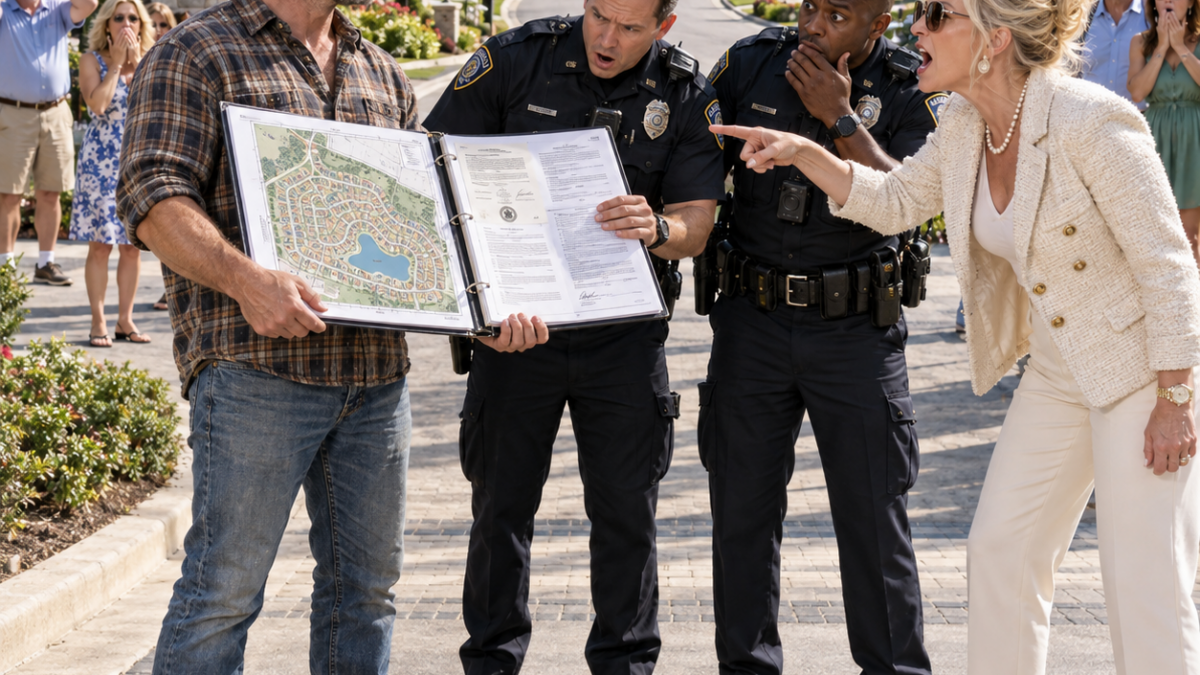
The HOA architectural chair stopped me during my morning dog walk, handed me three violation notices, and told me I had thirty days to repaint my mailbox and front door to colors her board approved.
When I calmly told her my home had never been subject to her HOA, she called the police and asked an officer to document my “refusal to comply.”
She had no idea the deed she refused to pull would show something far more embarrassing than my exemption—her HOA had spent six years renovating a pool, resurfacing roads, expanding a community center, and upgrading an entrance gate that legally belonged to me.
My name is Raymond Oay.
The dog walking beside me that morning was Archie, my seven-year-old Rhodesian Ridgeback.
Archie had walked Brierwood Court every morning at 7:15 for almost his entire life and had much stronger opinions about grass verges than I ever had about HOA paint colors.
It was a cool Tuesday morning in March.
Bradford pears were blooming along the east side of the street.
I was passing 14 Brierwood Court when Patrice Lemon stepped off her porch carrying a clipboard.
I knew Patrice.
She had served as architectural review chair for four years.
She knew my name.
She did not actually know who I was.
“Mr. Oay,” she said. “I’ve been meaning to catch you. I have some compliance items for your property.”
“Go ahead.”
She read them in order.
My front lawn edging was irregular.
My mailbox post was charcoal gray, a color not on the approved exterior palette.
My front door was deep navy instead of one of the HOA’s approved reds, neutrals, or greens.
She delivered each violation with the practiced tone of someone who had done this many times.
I let her finish.
Then I said:
“I’m not under your HOA.”
Her clipboard lowered slightly.
“Every property on Brierwood Court is subject to the Brierwood Commons CC&Rs.”
“No.”
“Your address is inside the development.”
“My lot is on the subdivision map. Read the notation attached to Lot One.”
She frowned.
“The CC&R map clearly—”
“Pull my deed from the county recorder. It’s public. Takes about four minutes.”
I shortened Archie’s leash.
“Have a good morning, Ms. Lemon.”
Then I walked home.
At 9:52 a.m., Patrice called the municipal non-emergency line.
I know the exact time because the officer later showed me the dispatch record.
Her complaint described a resident at Lot One who was refusing to recognize HOA authority and claiming an exemption from community covenants.
At 11:40, Officer Daniels knocked on my door.
I invited him inside.
We sat at my kitchen table.
He explained why he had come.
Then I walked into my office and returned with a folder.
First document:
My title certificate.
Lot One, Brierwood Commons.
Buried inside the original 1998 declaration was a two-line exclusion specifically carving Lot One out of HOA covenant jurisdiction.
Daniels read it.
Then I placed another document in front of him.
The 2018 acquisition deed for the Raymond Oay Land Investment Trust.
Attached was the bankruptcy asset schedule I had purchased eight years earlier.
Pool facility.
Community center.
Entrance parcels.
Gate infrastructure.
And 3.8 miles of private roads.
Everything in Brierwood Commons except the individually owned residential lots.
Daniels leaned closer.
Read the asset schedule again.
Then slowly looked up at me.
“Sir…”
He placed the papers down carefully.
“You own the whole neighborhood?”
“The infrastructure,” I said. “The homeowners own their houses and lots. My trust owns everything in between.”
“The roads?”
“Yes.”
“The pool?”
“Yes.”
“The community center?”
“Yes.”
“The entrance gate?”
“Yes.”
He looked toward my front window.
“And your house isn’t subject to the HOA?”
“Never has been.”
For several seconds, Officer Daniels said nothing.
Then he asked:
“Is there anything you want me to tell the HOA?”
I thought about six years of board decisions.
The $340,000 pool renovation.
The $180,000 road resurfacing.
The $156,000 community-center expansion.
The $95,000 gate upgrade.
$771,000 of homeowner money spent improving property the HOA did not own.
Then I thought about my charcoal-gray mailbox.
“Tell them,” I said, “to read their license agreement.”
That afternoon, I called my attorney.
When I told Grace what had happened, she went quiet.
Then she said five words.
“Raymond, this is the moment.”
And I knew she was right.
Because the police call had not started the real problem.
It had simply given me the perfect reason to stop waiting.
PART 2:
Grace Limb had been my property attorney since 2016.
She read title documents the way some people read crime novels—slowly, suspiciously, and with the assumption that the important detail was probably buried somewhere nobody else had bothered to look.
She had structured my 2018 acquisition.
She had drafted the HOA license agreement.
She had conducted the audit that first exposed the unauthorized capital projects.
So when I called her that afternoon and said the architectural review chair had sent a police officer to my house over my mailbox post, there was a silence on the other end that lasted longer than usual.
“Start from the beginning,” she said.
I did.
Patrice.
Three violations.
Lawn edging.
Mailbox color.
Front door.
My statement that I wasn’t under the HOA.
Her refusal to believe it.
The police call.
Officer Daniels at my kitchen table.
The deed.
The asset schedule.
Then the question:
Do you own the whole neighborhood?
Grace exhaled.
“What did you tell the officer?”
“The infrastructure.”
“All of it?”
“Pool, roads, community center, gate.”
“And Patrice?”
“He asked what he should tell the HOA.”
“What did you say?”
“Read the license agreement.”
Grace laughed once.
Not because any of this was funny.
Because after three years of patient documentation, the absurdity had finally become impossible to ignore.
“This is the moment,” she said.
“I’ve been patient for three years.”
“I know.”
“Four capital projects.”
“I know.”
“Seven hundred seventy-one thousand dollars.”
“I know.”
“Eighteen months since your 2023 letter.”
“I know.”
“And they sent a cop to my house over a mailbox color.”
“That part is going to be difficult for them to explain.”
I looked out my front window.
My mailbox post stood where it had stood for four years.
Charcoal gray.
The same color Patrice had decided could justify involving law enforcement.
“File everything.”
Grace became quiet.
“Everything?”
“All four projects.”
“Yes.”
“License breach.”
“Yes.”
“Assessment collections.”
“Yes.”
“Whatever the Attorney General’s office will look at.”
“That changes the pressure significantly.”
“I know.”
“You want the termination clause included?”
“Yes.”
“Raymond.”
“I’m not closing the roads.”
“I know you’re not.”
“But they don’t.”
There was another pause.
Then Grace said:
“I’ll have the formal notice ready Thursday.”
“Make it fourteen pages.”
“You’re specifying page count now?”
“I want them to understand exactly what they’ve been standing on.”
She understood.
“Thursday.”
That evening, I took Archie on our normal route.
Same time.
Same direction.
Same Bradford pears.
I passed Patrice’s house.
Her car sat in the driveway.
Lights glowed through the front windows.
I had no idea whether Officer Daniels had already called her back.
No idea whether she understood that the resident she had tried to document for HOA enforcement legally owned the street she used to reach her own house.
Archie stopped at one of his favorite grass verges.
I waited.
Then we continued.
Past the pool.
My pool facility.
Past the community center.
My building.
Past the entrance gate.
My entrance parcel.
Along private roads titled to my trust since 2018.
For six years, Brierwood Commons HOA had been operating as though none of that were true.
Not maliciously at first.
That distinction matters.
Property disputes become easy to dramatize after the fact.
Someone owns something.
Someone else acts as though they own it.
Everyone wants a villain.
Reality was more uncomfortable.
The HOA had inherited a mistake.
Then allowed the mistake to harden into institutional truth.
The original developer, Hargrove Development Group, had built Brierwood Commons in 1997.
Three hundred forty residential lots.
Private roads.
Community center.
Pool.
Entrance infrastructure.
Standard suburban development.
But Hargrove had separated two things most residents assumed were the same.
Governance.
Ownership.
The HOA governed the houses.
Hargrove’s separate company—Brierwood Commons Infrastructure LLC—owned the physical infrastructure.
Roads.
Pool.
Community center.
Entrance parcels.
Common areas.
That structure was not unusual for the period.
Developers often retained infrastructure assets as a revenue stream.
The HOA could use them under agreement.
The developer still owned them.
That arrangement continued for twenty years.
Then Hargrove collapsed.
By 2017, the company had overextended itself across several unrelated projects.
Chapter 7 bankruptcy followed.
The bankruptcy trustee began liquidating assets.
One Tuesday in February 2018, a listing appeared on a professional bankruptcy monitoring service I subscribed to.
Brierwood Commons Infrastructure LLC.
Asset package.
Asking price:
$2.3 million.
I read the schedule.
Pool facility.
Community center.
Entrance.
3.8 miles of private roads.
Landscaped common parcels.
I drove Brierwood Commons that weekend.
Walked the infrastructure.
Pulled the plat.
Then called Grace Monday morning.
“I want to buy it.”
She asked the obvious question.
“What are you going to do about the HOA?”
“License agreement.”
“Exactly.”
That agreement became my condition for closing.
Without it, the legal relationship would have been a mess from day one.
Was the HOA trespassing every time residents drove home?
Could they use the pool?
Could they hold meetings at the community center?
Who paid maintenance?
What improvements could they make?
Grace spent two weeks drafting the document.
Eleven pages.
Recorded April 3, 2018.
The same day my acquisition deed recorded.
The agreement was intentionally fair.
The HOA retained full use.
Residents kept driving the roads.
Families kept swimming in the pool.
The community center continued operating.
The entrance gate stayed open to residents and guests.
Nothing about covenant enforcement changed.
The HOA could still tell homeowners what color shutters they could have.
It simply could not alter property it did not own without asking the owner.
That rule appeared in Section Six.
No capital improvement.
No structural modification.
No permanent installation.
Nothing over $5,000 changing the condition of a trust-titled parcel without my prior written consent.
The process was simple.
Submit proposal.
Review.
Improvement agreement.
Approval.
Then construction.
Walt Grover, the HOA president at the time, signed it personally.
Grace remembered the call.
He had asked three questions.
The important one:
“What counts as capital improvement instead of routine maintenance?”
Grace answered:
“Repainting a fence is maintenance. Building an addition is capital improvement. Anything over five thousand dollars changing the condition of the parcel requires written approval.”
Walt said:
“Understood.”
Then signed.
For three years, the arrangement worked.
Then Walt moved to Savannah in June 2021.
He did not leave behind a useful institutional record.
That one omission created nearly everything that followed.
He did not put the license agreement into the board orientation materials.
Did not add it to an officer handbook.
Did not create an annual checklist.
Did not apparently brief his successor in a meaningful way.
His resignation letter thanked the community.
Recommended new leadership.
Nothing about the fact that the HOA did not own the roads, pool, community center, or entrance.
Knowledge walked out the door with him.
The next board inherited assumptions.
The board after that inherited those assumptions.
Then another.
Then another.
Four boards.
Fourteen individual board members over the years.
Not one pulled the recorded instrument.
Not one asked the foundational question:
Who owns the physical assets we are spending money on?
The first big project was the pool.
The facility was aging.
Pump system old.
Deck cracking.
Landscaping tired.
Residents complained.
In January 2021, the board proposed a major renovation.
Budget:
$340,000.
One thousand dollars per household.
Special assessment.
Three hundred forty homeowners paid it.
The board approved unanimously.
Nobody asked who owned the pool parcel.
Why would they?
People had been swimming there since 1999.
Board members had attended parties there.
Children learned to swim there.
Everyone called it “the HOA pool.”
Human beings confuse use with ownership constantly.
The contractor’s permit application listed the owner as Brierwood Commons HOA.
The county accepted it.
Permit departments generally do not perform independent title searches on every project.
Construction began.
New deck.
New equipment.
Landscaping.
Finished.
Three hundred forty thousand dollars invested into a parcel owned by my trust.
Nobody told me.
I lived roughly four hundred feet away.
Then came the roads.
By 2022, years of traffic had worn the internal network.
The HOA collected bids.
Approved a paving contract.
$180,000.
Phase one.
2.4 miles.
Entrance approach.
Main loop.
Again, board minutes called them “HOA roads.”
They were not.
They had never been.
First Hargrove infrastructure.
Then bankruptcy assets.
Then mine.
But nobody checked.
They resurfaced them.
Another $180,000.
Then came the project that got my attention.
Community center expansion.
I saw concrete forms during my morning walk in April 2023.
North side of the building.
Contractor trailer nearby.
I went home.
Called Grace.
“Something’s being built on my community center.”
She pulled the permit.
Fourteen hundred square feet.
New meeting room.
Expanded kitchen.
Contract value:
$156,000.
Permit owner listed again as Brierwood Commons HOA.
Grace did not call the board informally.
She wrote.
July 14, 2023.
Six pages.
Precise.
License agreement.
Recording information.
Section Six quoted in full.
Pool renovation identified as violation.
Road resurfacing identified.
Community center identified as current unauthorized construction.
Immediate halt requested.
Written response within twenty-one days.
The HOA attorney, Hershel Dow, responded three days late.
One paragraph.
Received.
Under review.
Further response later.
That fuller response never came.
Construction continued.
I watched it every morning.
Framing.
Roof.
Cladding.
Windows.
Four months after Grace told them in writing that the project required my approval, they completed it anyway.
I called Grace when I saw workers packing up.
She already knew.
Final inspection had posted.
November 19.
“They finished it,” she said.
“I know.”
“After notice.”
“Yes.”
“This changes the case.”
“I know.”
“Raymond, the first projects were institutional ignorance.”
“I agree.”
“This one isn’t.”
“I know.”
“What do you want me to do?”
“Keep watching.”
“Why?”
“I want the full picture.”
The full picture arrived two months later.
Entrance gate upgrade.
Approved in November 2023.
Installed January 2024.
Cost:
$95,000.
New automated hardware.
Keypad.
Fob system.
Lighting.
Permanent infrastructure.
On my entrance parcel.
Three months after Grace’s written notice.
That was the fourth project.
Total:
$771,000.
The first three could at least be explained partly through ignorance.
The fourth could not.
By then, some board members had discussed Grace’s letter in email.
We later obtained those messages.
Lynette Pharaoh wrote to Derek Anston:
Did you read the letter from the trust attorney? It says we need written consent for capital projects on HOA common areas. We might have a problem with the community center.
Derek replied:
I forwarded it to Craig and Hershel. Craig said legal is handling it. I’d assume we’re fine or they’d tell us to stop.
That phrase became the poison in the system.
Legal is handling it.
Once someone says that, people feel permitted to stop thinking.
At the next board meeting, Lynette asked what Grace’s claims meant.
Craig Weston, board president, said counsel was reviewing.
Derek asked whether construction should pause.
Craig said:
“No. We proceed as planned.”
That sentence mattered.
Because once a board receives written notice that it may be building on someone else’s property, continuing is no longer simply an inherited misunderstanding.
It becomes a decision.
Then they approved another project.
That is why I waited.
Patience in property disputes is often more powerful than immediate reaction.
Facts improve with time.
Documents accumulate.
People explain themselves in emails.
Minutes memorialize decisions.
Money moves.
Assumptions become provable conduct.
By March 2026, I had everything.
Then Patrice Lemon stepped off her porch and told me my mailbox was the wrong color.
She could not possibly have known the chain reaction she was about to trigger.
Neither did I.
But when Officer Daniels sat at my kitchen table and asked whether I owned the entire neighborhood, I understood that waiting had reached its natural end.
Thursday morning, Grace called.
“I have the full chain.”
“Start at the beginning.”
She walked me through twenty-six years.
Hargrove development.
1998 declarations.
Lot One exclusion.
Infrastructure company.
2017 bankruptcy.
2018 acquisition.
Recorded license.
2021 Walt leaves.
2021 pool renovation.
2022 road resurfacing.
2023 community center.
2024 gate.
2026 police call.
Then she asked:
“Do you understand the termination clause?”
“I understand Section Nine.”
“Three material breaches are enough.”
“We have four.”
“Yes.”
“And thirty days’ notice.”
“Yes.”
“Then put it in.”
“Raymond, if the license terminates, residents lose contractual access to the roads.”
“I know.”
“They lose pool rights.”
“I know.”
“Community center.”
“I know.”
“Gate.”
“I know.”
“You’re not actually going to shut everything.”
“No.”
Grace was silent.
Then:
“But they don’t know that yet.”
“Correct.”
There is a difference between threatening harm and stating a contractual consequence.
I was not going to barricade three hundred forty families inside a neighborhood.
That would have been reckless.
It would have punished homeowners for board failures.
But their board needed to understand what the license actually did.
For six years, they had treated it like forgotten paperwork.
It was the legal instrument allowing the community to use almost everything outside the individual residential lots.
The notice went out Thursday.
Fourteen pages.
Seven separate certified envelopes.
One to every board member personally.
I wanted each signature.
No hiding inside collective responsibility.
No:
I thought someone else read it.
Page one:
Ownership.
Acquisition deed.
Asset schedule.
Trust.
Recording information.
Pages two through four:
License agreement.
Section Six highlighted.
Exhibit B.
Improvement procedure.
Pages five through ten:
Each capital project.
Approval date.
Cost.
Parcel.
Owner.
Permit.
Absence of written consent.
Pool:
$340,000.
Roads:
$180,000.
Community center:
$156,000.
Gate:
$95,000.
Pages eleven through thirteen:
Demand for full accounting of every dollar spent on my property since 2018.
Landscaping.
Utilities.
Insurance.
Maintenance.
Everything.
Page fourteen:
Section Nine.
Material breach.
Thirty-day termination warning.
Grace also recorded a formal notice of claim.
That meant the dispute could no longer live quietly inside HOA email.
Any lender.
Buyer.
Refinance.
Title search.
It would appear.
The postal carrier delivered the seven envelopes Friday morning.
I watched from my front window.
One stop.
Signature.
Another.
Signature.
Seven homes.
Seven board members.
Seven copies of the same reality.
Emergency meeting that evening.
I was not there.
I didn’t need to be.
Hershel Dow attended.
Craig Weston brought a personal attorney without telling the others beforehand.
That detail interested Grace immediately.
“Craig is separating himself.”
“Why?”
“He thinks his interests may not align with the board.”
Patrice arrived with the fourteen-page notice highlighted.
Twelve passages marked.
According to someone at the meeting, she was the first board member to speak.
“I need someone to explain who Raymond Oay actually is.”
Not who I was socially.
Not the man with Archie.
Not the neighbor with the gray mailbox.
Who I was legally in relation to the development.
Hershel opened his laptop.
Pulled the county recorder.
Pool parcel.
Owner:
Raymond Oay Land Investment Trust.
Community center parcel.
Same.
Road parcels.
Same.
Entrance parcel.
Same.
Eleven seconds.
That was all it took.
Six years of institutional assumptions collapsed in eleven seconds.
Someone asked:
“Why didn’t anyone tell us?”
The room apparently went quiet.
Lynette looked at Craig.
Craig looked at the table.
Hershel closed his laptop.
Then said:
“We need to talk about the 2023 letter.”
The thirty-day deadline reorganized the entire conversation.
A newer board member named Terrence Okafor asked the question everyone else was thinking.
“If he terminates the license, can he really close the roads?”
Hershel pulled up Section Nine.
“The roads are privately owned.”
“Yes.”
“The license gives residents access.”
“Yes.”
“If the license terminates…”
“That access terminates.”
Terrence asked:
“Then how do people get to their houses?”
Hershel answered:
“That is the question Mr. Oay would like resolved before day thirty.”
The next morning, Patrice knocked on my door.
No clipboard.
No violation notices.
Archie was stretched across a warm patch of kitchen floor.
He lifted his head.
Decided Patrice was not worth standing for.
Put it back down.
I opened the door.
“Mr. Oay.”
She stopped.
Then tried again.
“Raymond.”
I waited.
“I wanted to talk about the call.”
“The police?”
“Yes.”
She explained.
She hadn’t understood the ownership structure.
She believed she was doing her job.
She believed Lot One was subject to the rules.
She regretted bringing law enforcement to my home.
I let her say everything.
Then:
“You called the police because I told you my property wasn’t subject to your HOA.”
“Yes.”
“You were wrong.”
“Yes.”
“You weren’t wrong because you didn’t know who I was.”
She looked confused.
“You were wrong because you never checked.”
She nodded slowly.
“That’s the problem we’re fixing.”
“I understand.”
“No. Not just between you and me.”
I gestured toward the development.
“Every board member who approved construction without verifying ownership.”
She swallowed.
“Every homeowner who paid assessments believing the HOA owned what it was improving.”
“Yes.”
“The answer isn’t an apology over my mailbox.”
She looked at me.
“What is it?”
“The negotiation.”
She hesitated.
Then asked the question beneath everything.
“Are you going to close the roads?”
I looked past her.
A car pulled from a driveway farther down Brierwood Court.
Turned.
Drove across trust-owned pavement toward the entrance.
A family going somewhere on Saturday morning.
They had not approved the gate project.
They had not ignored Grace’s letter.
Most of them had probably never seen the 2018 agreement.
“Go to your board meeting,” I said.
“Have your lawyer call Grace.”
“Raymond—”
“Have them call.”
I closed the door.
Then called Grace.
“Patrice was here.”
“I know.”
“How?”
“Hershel called before she arrived.”
“Of course.”
“He wants a principal meeting Monday.”
“Termination clock?”
“Still running.”
“Good.”
“He asked if the notice was firm.”
“What did you say?”
“That Section Nine says what Section Nine says.”
I smiled.
“What do you want settlement to look like?” she asked.
I had thought about that.
The money mattered.
$771,000 spent without consent mattered.
Fair license value mattered.
Permanent modifications mattered.
But the real failure had been institutional memory.
Walt Grover knew.
Then he left.
And suddenly the truth vanished from the board’s mental model even though it remained recorded at the courthouse.
“I want the amended license recorded before money changes hands.”
“Agreed.”
“I want every future board member forced to read it.”
“Annual acknowledgment?”
“Yes.”
“Orientation requirement?”
“Yes.”
“Ownership summary?”
“Yes.”
“No more knowledge living in one president’s head.”
“I’ll write it.”
“And Grace?”
“Yes?”
“I want every future title search to surface this immediately.”
“It will.”
The Monday meeting lasted four hours.
Grace and I sat on one side.
Hershel.
Craig’s personal attorney, Frank Sutter.
Terrence.
Lynette.
The first challenge was insurance.
The board had directors-and-officers coverage.
But would the policy cover actions after written notice?
Maybe not.
That difference became important immediately.
The pool and road projects happened before Grace’s July 2023 letter.
Negligence.
Failure of institutional knowledge.
Potentially insurable.
Community center completion and gate approval happened after the board had been warned.
Different problem.
Frank was there because Craig’s personal exposure had become real.
Hershel wanted two weeks for insurance review.
Grace gave him ten days.
Then filed in nine.
Superior court.
Four counts.
Count One:
Breach of license agreement.
Simple.
Recorded instrument.
Clear consent requirement.
Four projects.
No approvals.
Count Two:
Unjust enrichment.
Three hundred forty households paid for capital improvements that enhanced assets belonging to my trust.
The benefit attached permanently to my property.
Count Three:
Trespass by permanent improvement.
Fourteen hundred square feet added to my community center.
Permanent gate system embedded in my entrance parcel.
No consent.
Count Four:
Declaratory relief.
The most important one to me.
I wanted a court declaration confirming the trust’s ownership rights and the HOA’s limitations so that no future board could repeat the same ignorance.
Then came numbers.
Unauthorized-project restitution:
$771,000.
Retroactive fair-market license compensation:
Initially $890,000.
Trust asset modification damages:
$340,000.
Punitive demand:
$1.4 million.
Total initial exposure:
More than $3.4 million plus attorney fees.
The punitive figure required careful justification.
Grace did not pretend everything had been willful.
Pool and road:
Before notice.
Institutional negligence.
Community center and gate:
After notice.
That was different.
Grace’s July 2023 letter had said:
Stop.
The board completed one project anyway.
Then approved another.
That sequence created the punitive argument.
Notice.
Acknowledgment.
Continue.
New project.
No further legal conclusion required.
The HOA’s insurance carrier sent a reservation letter seven days later.
Pre-notice conduct might be covered.
Post-notice conduct potentially excluded as intentional or knowing.
Craig’s personal attorney started making calls.
Meanwhile, Grace referred the assessment issue to the North Carolina Attorney General’s consumer-protection office.
That increased the temperature.
Three hundred forty households had received assessment notices describing improvements to “HOA common area facilities.”
But the HOA did not own those facilities.
The $1,000 pool assessment had raised $340,000.
Homeowners paid believing the board was improving community-owned property.
It wasn’t.
Intentional deception was not required for the state to investigate unfair or deceptive practices.
Eighteen days after the referral, the AG’s office opened a formal inquiry.
Assessment records requested.
Project communications requested.
Hershel called Grace.
“The AG contacted us.”
“I know.”
“You referred it?”
“Yes.”
“How many fronts are you running?”
Grace’s answer was simple.
“As many as the facts support.”
That was why I hired her.
The next turn came from Craig.
He offered cooperation.
A full written account of what happened after the July 2023 letter.
In exchange, he wanted consideration on personal punitive exposure.
I told Grace:
“Let him write.”
“Whatever he says becomes part of the record.”
“Exactly.”
His statement was eleven pages.
Carefully written.
Prepared after days with his own litigator.
It confirmed the chain.
Grace’s letter arrived.
Craig read it.
Forwarded it to Hershel.
Asked:
“How serious is this?”
Hershel replied with a preliminary assessment.
Application of the license agreement to the projects was, in his view, subject to reasonable dispute.
Continue while counsel reviewed.
Craig treated that as permission.
At the August board meeting, Lynette asked.
Derek asked.
Craig said:
“Legal is reviewing it.”
He did not explain Hershel’s actual assessment.
Community center completed.
No follow-up.
Gate approved.
No follow-up.
Frank’s position became:
Craig relied on counsel.
Hershel’s position was likely to become:
My preliminary view was never authorization to ignore the issue forever.
They began pointing toward each other.
That usually means settlement.
No lawyer wants a jury watching two professionals explain why the other one bears responsibility for unauthorized construction clearly visible in public records.
Week two.
HOA offer:
$1.2 million.
Grace rejected.
By week four, the real dispute narrowed.
Restitution largely accepted.
Retroactive license compensation converging.
The fight centered on punitive exposure.
Grace had reduced her license number to $720,000 as a negotiating concession.
Punitive component:
$875,000.
HOA:
$600,000.
Then, Friday of week five, Craig’s lawyer called.
Craig would personally contribute:
$275,000.
HOA carrier would cover:
$600,000.
The carrier had reconsidered the post-notice exclusion after Craig framed the decision as reliance on counsel.
That completed the punitive number.
Final settlement:
$771,000 restitution.
$720,000 retroactive license compensation.
$340,000 asset modification damages.
$875,000 punitive component.
Total:
$2.706 million.
Two million seven hundred six thousand dollars.
But I told Grace the same thing I had said at the beginning.
“Do not move the money until the new agreement is recorded.”
She didn’t.
The amended agreement was twenty-two pages.
It left one principle unchanged.
The HOA could use everything.
That had never been the fight.
Residents kept their roads.
Pool.
Community center.
Gate.
Common areas.
Their daily lives continued.
But Section Six became impossible to misunderstand.
Any expenditure above $5,000 altering trust property required advance written proposal.
Thirty-day review.
Written approval or rejection.
No contractor engagement before consent.
Not:
Legal is reviewing it.
Not:
We assumed the facility was ours.
Not:
Nobody told the new president.
Written.
Documented.
Then came a new annual review requirement.
At the first board meeting every calendar year, the full license agreement had to be reviewed.
Each board member signed acknowledgment.
Every year.
A new board-orientation section required incoming members to receive:
The original license.
The amendment.
A one-page ownership summary.
Then sign acknowledgment within thirty days.
No more institutional memory depending on one Walt Grover remembering to tell the next person.
Knowledge became structural.
The annual license fee also changed.
Eighty-five dollars per household.
Three hundred forty homes.
Adjusted with the consumer price index.
A real commercial license replacing the below-market grandfathered arrangement.
The amended agreement recorded Wednesday.
Attached to every trust parcel.
Any future title search would show it.
That was when I authorized the financial settlement to complete.
The money mattered.
The document mattered more.
One week after residents learned the settlement terms, they petitioned to remove Craig Weston.
Emergency membership meeting.
I did not attend.
I didn’t need to.
The vote was:
287 to 18.
Craig sat in the back of the community center.
My community center.
The one carrying the fourteen-hundred-square-foot addition his board completed after being warned.
When the result was announced, he stood.
Collected his papers.
Left without speaking.
Six years on the board.
Pool renovation.
Road resurfacing.
Community center.
Gate.
Three million dollars in potential exposure reduced to a $2.706 million settlement.
Residents had paid attention.
Patrice resigned the week the settlement was signed.
Two sentences.
No explanation.
She had spent four years as architectural review chair.
Approved colors.
Mailbox rules.
Doors.
Exterior compliance.
Then one Tuesday she called police on a man whose front lot was excluded from the covenants and whose trust owned almost every piece of infrastructure the HOA depended on.
Some people joked that my mailbox caused the settlement.
It didn’t.
The mailbox revealed it.
The real causes were older.
A forgotten license.
A board that inherited assumptions.
A president who left without transferring knowledge.
A lawyer who left a serious letter “under review.”
A board that heard “legal is handling it” and stopped asking questions.
Then a decision to keep building after notice.
The mailbox simply provided the final absurd moment that made waiting pointless.
Terrence Okafor became interim chair.
One of the first things the new board did was follow the annual review requirement early.
Full agreement.
Read into minutes.
Every member signed.
Their next major action was an apology.
Not from Patrice.
From the board.
HOA letterhead.
Signed by all five incoming directors.
Terrence brought it personally.
Thursday afternoon.
He knocked.
I opened.
He handed me the envelope.
“From the board.”
I took it.
“And from me personally.”
I shook his hand.
“Thank you.”
He glanced toward the street while walking back.
Then at my mailbox.
Charcoal gray.
He smiled slightly.
Said nothing.
That was wise.
Life settled.
The roads never closed.
The pool stayed open.
The community center continued hosting book clubs and meetings.
The entrance gate kept working.
Three hundred forty families kept going to work.
Taking children to school.
Ordering deliveries.
Living ordinary lives.
There was no dramatic barricade.
No chains across roads.
No guards at the pool.
No revenge against residents.
Because residents were never my target.
The problem was governance without ownership awareness.
Once fixed, the system could function normally.
Then Carol Peton crossed the street one Saturday morning in April.
Carol lived directly across from me.
High-school biology teacher.
Nine years in Brierwood Commons.
Reasonable person.
One of the neighbors I had spoken with most often during my eleven years there.
We had never discussed what I owned.
Why would we?
Normal neighbors do not introduce themselves by reciting asset schedules.
Archie lay on the porch in sunlight.
Carol stopped at the steps.
“Raymond?”
“Morning.”
“I’ve been meaning to come over since the notice went out.”
“All right.”
“Is it actually true?”
“Which part?”
“That you’ve owned the roads and the pool and the community center since 2018?”
“Yes.”
“And the gate?”
“Yes.”
“And the common land?”
“Yes.”
She looked down Brierwood Court.
The road curved toward the interior.
Past the community center.
Pool.
Cul-de-sacs.
All infrastructure on trust parcels.
“You never told anyone.”
“The deed did.”
“That is such a lawyer answer.”
“I’m not a lawyer.”
“Worse. Investor.”
I laughed.
She looked thoughtful.
“We paid a thousand dollars for that pool renovation.”
“I know.”
“So we improved your property.”
“Yes.”
“That must have felt incredible.”
“No.”
She looked surprised.
“Why not?”
“Because I would have preferred they ask.”
“But the facility is more valuable now.”
“Yes.”
“The roads are better.”
“Yes.”
“The community center is bigger.”
“Yes.”
“Then what was the harm?”
That was a fair question.
“Control.”
She waited.
“Ownership isn’t only about whether a change increases value.”
I pointed toward my house.
“If someone came while you were at work and added a bedroom to your house without asking you, and it increased your property value, would that make it acceptable?”
“No.”
“Why?”
“Because it’s my house.”
“Exactly.”
She nodded.
“The improvement isn’t the only issue.”
“No.”
“The right to decide.”
“Yes.”
That was what every board had forgotten.
They believed beneficial expenditure justified itself.
New pool.
Better roads.
Bigger center.
Modern gate.
All improvements.
But ownership includes the right to say yes before someone changes what you own.
Even if the change is useful.
Especially when the change is permanent.
Carol looked toward my mailbox.
“So that’s why you kept it gray.”
“What?”
“The mailbox.”
“No.”
She waited.
I smiled.
“I just like it.”
For a second she stared at me.
Then she laughed.
A real laugh.
The kind that arrives when a story carrying years of legal tension finally lands on something small enough to be human.
She shook her head.
“All of that because of a gray mailbox.”
“No.”
“What then?”
“All of that because nobody read the documents.”
She looked down the street again.
“That sounds less funny.”
“It is.”
She said goodbye.
Walked across Brierwood Court.
My road.
Back to her home.
Archie never opened his eyes.
I watched her go.
The development was quiet.
Gate operational.
Roads maintained.
Pool preparing to open for the season.
Community center scheduled for Thursday book club.
Everything functioned exactly as it had before.
One difference.
Everybody now knew whose land they were standing on.
That mattered more than people think.
Property law is full of situations where visible reality and legal reality separate.
You see a neighborhood road and assume the HOA owns it.
You see a pool with the community name on the sign and assume the HOA owns it.
You attend meetings in a community center and assume the HOA owns it.
You pay dues for landscaping and assume the common parcels belong to the association.
Usually, those assumptions are correct.
Usually.
But ownership does not arise from how something looks.
It arises from title.
I had bought Brierwood Commons infrastructure because somebody read a bankruptcy schedule.
The asset was public.
Available.
The HOA could theoretically have bid.
Another investor could have bid.
I did.
Then I documented the relationship carefully because I never wanted uncertainty.
The irony was that I did everything necessary to prevent exactly the dispute that happened.
Recorded deed.
Recorded license.
Clear capital-improvement threshold.
Annual use rights.
Everything.
Yet documents solve nothing if nobody reads them.
That was the deeper failure.
The board did not lack information.
The information sat in the county records for eight years.
It lacked curiosity.
That is harder to fix.
After the settlement, Terrence tried.
The first annual review meeting lasted nearly two hours.
Every board member received the agreement in advance.
They read Section Six aloud.
Section Seven.
Section Eight.
Section Twelve.
Ownership summary.
Road parcels.
Amenity parcels.
Entrance infrastructure.
Someone asked whether routine pothole repairs needed my approval.
No.
Routine maintenance under threshold.
Someone asked about replacement of a failed pool pump.
Depends on cost and whether it changed infrastructure.
Someone asked about landscaping.
Routine seasonal work, no.
Permanent redesign above $5,000, yes.
Good questions.
The kind Walt had asked in 2018.
Difference:
Now the answers lived in minutes.
Not memory.
Terrence sent Grace a copy of the signed acknowledgments.
She forwarded them.
Subject line:
Institutional memory achieved.
I called her.
“You seem pleased.”
“I am.”
“More than about the settlement?”
“Almost.”
“Why?”
“Because the next board can’t say nobody told them.”
That was her favorite kind of resolution.
One with fewer future billable hours.
The Attorney General inquiry eventually closed after the HOA implemented disclosures, governance changes, and the financial settlement.
Homeowners received full accounting.
Every project.
Every dollar.
Every parcel.
Some were furious.
Others were embarrassed they had never questioned what “HOA common property” actually meant.
Several blamed Craig.
Some blamed Hershel.
Some blamed Walt for failing to transfer knowledge.
A few blamed me for waiting.
I understood that criticism.
Could I have confronted the board in 2021 when the pool renovation started?
Yes.
Could I have stopped the road project?
Probably.
Could I have sued immediately when I saw the community-center forms?
Certainly.
Why didn’t I?
Partly because I wanted a full factual record.
Partly because property litigation is expensive and unpleasant.
Partly because every improvement was actually useful.
Mostly because I kept believing the HOA would eventually read Grace’s letter and correct course.
That was my mistake.
Patience works only while the other side is still capable of using time productively.
Once a board has written notice and continues anyway, patience can become permission in their own minds.
I should have acted sooner after July 2023.
I admit that.
But by March 2026, the situation was clear enough that no one could hide behind misunderstanding.
The mailbox incident just supplied the final punctuation.
Months later, I saw Officer Daniels again.
Coffee shop.
He recognized me.
“Mr. Oay.”
“Officer.”
“How’s the HOA?”
“Educated.”
He laughed.
“I heard something happened.”
“Settlement.”
“Big?”
“Enough.”
He shook his head.
“I still think about that asset schedule.”
“So do they.”
“I thought I was coming to tell somebody to work out a neighbor disagreement.”
“You did.”
“Then you handed me a deed saying you owned the street my cruiser was parked on.”
“That was accurate.”
“I called dispatch afterward.”
“I assumed.”
“My sergeant asked me twice if I was reading it correctly.”
“You were.”
“He asked whether the HOA knew.”
“I told you what to tell them.”
“Read the license.”
“Yes.”
He smiled.
“They probably wish they had.”
“Yes.”
That conversation made me think again about law enforcement and civil disputes.
Patrice had called the police because she wanted authority confirmed.
That instinct is common.
When someone resists your authority, bring in someone with more authority.
But police cannot manufacture HOA jurisdiction.
A uniform cannot alter a deed.
Officer Daniels did the most useful thing possible.
He read.
Then declined to pretend the dispute was something it wasn’t.
That restraint prevented the morning from becoming uglier.
I appreciated him for it.
Craig Weston’s $275,000 personal contribution became a lesson throughout Brierwood Commons.
Not because residents enjoyed his loss.
Most didn’t.
But board service stopped feeling casual.
People running for future positions began asking for governance training.
Terrence invited Grace to speak at one orientation.
She declined.
Then charged them for a formal seminar instead.
I teased her.
“You turned my lawsuit into continuing education.”
“Professionalism has a price.”
She walked new board members through one principle.
An HOA has powers.
Those powers come from documents.
Declarations.
Bylaws.
Recorded easements.
Licenses.
Statutes.
Contracts.
Not vibes.
Not habit.
Not “we’ve always done it this way.”
Not a clipboard.
Not unanimous board votes over land the board does not own.
You begin with authority.
Then act.
Never reverse the order.
That sentence appeared in later board orientation materials.
BEGIN WITH AUTHORITY.
THEN ACT.
I liked that.
The annual fee became routine.
$85 per household, adjusted.
One payment each January.
The first year, some residents complained.
Why are we paying Raymond for roads we already maintain?
Terrence explained.
Because maintenance and ownership are different.
Why pay for pool access when dues already fund the pool?
Because dues fund operations; the license pays for the legal right to use the facility.
Why did nobody tell us before?
That question ended most discussions.
The new fee was not punishment.
It replaced an unrealistically low grandfathered amount.
It acknowledged market use.
Three hundred forty households.
Pool.
Community center.
Nearly four miles of roads.
Gate.
Common grounds.
The number per household was modest.
The legal clarity was substantial.
I remained responsible for ownership-level matters.
The HOA handled day-to-day community operations.
The arrangement became what I had intended in 2018.
Use without ambiguity.
Management without false ownership.
One year after the settlement, the HOA wanted to redesign the pool landscaping.
Cost:
$34,000.
In the old system, they would have voted.
Signed contractor.
Started.
Not anymore.
Proposal arrived in my email.
Site plan.
Plants.
Irrigation.
Budget.
Insurance.
Construction dates.
Exactly according to Section Six.
Grace looked at it.
No title problem.
No structural issue.
I approved.
Written agreement.
Project completed.
Nothing dramatic happened.
That was the point.
Several months later, the community center needed roof work.
Routine replacement.
Estimate:
$48,000.
Because cost exceeded threshold and involved structural components, board submitted.
Approved.
Everything simple.
The board gradually learned that requesting consent was not humiliation.
It was administration.
I did not reject reasonable projects just to prove I could.
That would have defeated the entire purpose.
The agreement protected my decision-making authority.
It did not require me to be difficult.
Patrice kept her house for a while after resigning.
I still saw her sometimes.
Morning walks.
She no longer carried a clipboard.
At first conversations were awkward.
Then less so.
One morning she was trimming roses.
Archie stopped near the edge of her yard.
She looked at him.
“Still investigating my grass?”
“He’s consistent.”
“More consistent than our board.”
I looked at her.
She smiled faintly.
I smiled back.
That was enough.
I had no interest in humiliating her forever.
She made a bad call.
A very bad one.
But the settlement was not punishment for Patrice.
It was the accumulated result of six years.
She just struck the match beside a room that had been filling with gas.
Eventually, she apologized again.
This time not for the police call.
For something else.
“I spent four years telling people what they could change on their houses.”
“Yes.”
“I never once asked who owned our own facilities.”
“Yes.”
“That’s embarrassing.”
“It should be.”
She nodded.
“But useful.”
“How?”
“You won’t make that mistake twice.”
“No.”
I believed her.
The bankruptcy acquisition itself became local real-estate gossip.
People asked why I had purchased infrastructure rather than houses.
My answer was straightforward.
Yield.
The package was underpriced because the bankruptcy estate needed liquidity and because infrastructure holdings are unattractive to ordinary residential investors.
No kitchen renovations.
No flipping.
No emotional buyers.
Just land and facilities under contract.
Stable users.
Low turnover.
Long-term license value.
The investment had always been rational.
What I had not expected was to become the invisible landlord of an entire community’s physical skeleton.
That is essentially what I was.
Not their homes.
Not their lives.
Not their rules.
The bones beneath the place.
Roads.
Amenities.
Entrance.
That distinction protected everyone.
When the media eventually heard about the settlement, a local reporter called.
“You own an entire neighborhood?”
“No.”
“But the lawsuit says—”
“I own infrastructure.”
“So homeowners don’t own the roads?”
“No.”
“The HOA doesn’t?”
“No.”
“Pool?”
“My trust.”
“Community center?”
“My trust.”
“Gate?”
“My trust.”
“Common parcels?”
“My trust.”
He paused.
“So you kind of own the neighborhood.”
“No.”
I repeated it because precision matters.
“The homeowners own the neighborhood in every sense that matters to their homes. My trust owns the common infrastructure.”
“Less dramatic headline.”
“More accurate.”
He laughed.
I declined an interview.
I had no interest in becoming Internet content.
Ironically, I imagine Patrice’s mailbox story would have done very well.
The financial settlement remained mostly inside investment accounts.
Some went toward capital reserves for the trust properties.
Road drainage.
Pool structural contingencies.
Community-center mechanical systems.
Entrance maintenance.
If I was going to own the infrastructure long-term, the settlement should strengthen it.
Grace approved of that.
“Responsible.”
“Disappointed?”
“A little.”
“You wanted me to buy something stupid?”
“Convertible.”
“I own roads.”
“You could drive it on them.”
I kept my current car.
Archie preferred the back seat anyway.
The strongest emotional moment came unexpectedly about two years later.
Not court.
Not settlement signing.
Not Craig’s removal.
A little girl fell off her bicycle on Brierwood Court.
Scraped her knee badly.
I was outside.
Her father was thirty yards behind.
I reached her first.
Picked up the bike.
Helped her sit on the curb.
She cried.
Archie stood beside her until her father arrived.
Normal neighborhood moment.
Her father thanked me.
Then joked:
“Good thing the road owner was available.”
I smiled.
“Road didn’t do it.”
“She hit your pavement.”
“County-grade asphalt doesn’t admit liability.”
He laughed.
Then helped his daughter home.
I stood there thinking about the absurdity of legal conflict.
For months, documents had treated Brierwood Commons as parcels, interests, access rights, damages, asset schedules.
But communities are not paperwork.
They are people falling off bicycles.
Walking dogs.
Borrowing ladders.
Arguing about parking.
Swimming in summer.
Going to book club.
My objective had never been to disrupt that.
The law existed so the human activity could continue on a stable foundation.
That was what the board forgot.
They treated ownership as a technical nuisance.
But accurate ownership is what makes ordinary life secure.
The next major refinancing inside Brierwood Commons showed how much had changed.
One homeowner on Brierwood Court refinanced.
Title search pulled the amended license immediately.
Lender asked questions.
HOA produced annual acknowledgment.
Trust produced confirmation.
No surprise.
No delay beyond normal review.
The homeowner later thanked Terrence for keeping the records organized.
That pleased me more than he understood.
The agreement had moved from crisis document to routine title item.
Exactly where it belonged.
Craig eventually sold his home.
I saw the moving truck.
Funny symmetry.
He loaded boxes into a vehicle on a road titled to my trust.
No confrontation.
No final speech.
No revenge scene.
He left.
The development remained.
People often think satisfying endings require the antagonist to lose everything.
I don’t.
Craig lost his board position.
Paid $275,000 personally.
Watched residents vote 287 to 18 to remove him.
That was consequence enough.
Patrice resigned.
That was consequence enough.
Hershel had to explain his legal advice.
Insurance carriers had to pay.
The HOA had to return value, compensate the trust, and reform governance.
That was consequence enough.
Nothing would have improved by making them suffer theatrically.
The record was corrected.
That is what matters in property disputes.
I still walk Archie every morning.
Older now.
Slower.
He spends more time sniffing fewer places.
I understand that.
Brierwood Court changes with seasons.
Bradford pears bloom.
Drop white petals.
Summer comes.
Pool opens.
Children walk down the sidewalk carrying towels.
Cars pass.
Gate opens.
Community center lights come on.
Everything ordinary.
Some mornings I pass Patrice’s old house.
New owners now.
They received their board-orientation disclosures before closing.
They know Lot One is excluded.
They know trust ownership.
They know road license.
They know entrance parcel.
They know the pool isn’t HOA-owned.
Information travels differently now.
That was the real achievement.
The truth no longer depends on me explaining it.
The documents explain themselves.
Walt’s mistake was never signing the agreement.
He did that correctly.
His mistake was allowing critical institutional knowledge to remain personal.
When he moved to Savannah, the community forgot.
The amended agreement fixed that.
Annual reading.
New-member acknowledgment.
Recorded ownership summary.
Future-proofing.
If I die tomorrow, nothing disappears.
Trust documents remain.
License remains.
Board obligations remain.
A future president cannot honestly say:
“I didn’t know.”
That is the best kind of legal work.
Work that remains useful after everyone who negotiated it is gone.
Sometimes I think about Officer Daniels asking:
“You own the whole neighborhood?”
The answer was technically no.
But I understood why he asked.
The asset schedule was startling.
Nearly every physical feature he could see from my kitchen except houses and private lots belonged to the trust.
The road beneath his patrol car.
The pool behind the trees.
The entrance gate he had driven through.
The community center used for board meetings.
Everything.
But ownership never made me president.
It never gave me the right to tell Carol what color her mailbox should be.
That belonged to the HOA through the CC&Rs.
And the HOA’s covenant authority never made it landowner.
That belonged to me through title.
Two systems.
Different powers.
The entire conflict occurred because one system forgot the other existed.
If Patrice had pulled my deed when I suggested it, the police call never happens.
If Craig had pulled the license in July 2023, the gate project never gets approved.
If Hershel had pushed harder, perhaps the center construction stops.
If Walt had created onboarding records, maybe none of it happens.
If the board had asked one foundational question—
What do we actually own?—
they could have saved millions.
That is the line I remember.
Not Patrice’s apology.
Not Craig’s vote.
Not Grace’s settlement number.
What do we actually own?
Every HOA should know.
Every business should know.
Every family should know.
Assumptions work until money, conflict, or death requires proof.
Then only documents matter.
One spring morning, Carol crossed the street again.
Archie was asleep in the same sunny porch spot.
She held a coffee mug.
“No emergency.”
“Good start.”
“I heard the board approved the pool landscaping.”
“They asked.”
“And you said yes.”
“They followed the agreement.”
She nodded.
“So all this works now.”
“Yes.”
“No lawsuits?”
“Not today.”
“No police?”
“Hopefully not over paint.”
She looked at the mailbox.
Still charcoal gray.
“You’re never changing that, are you?”
“I might someday.”
Her eyebrows rose.
“To what?”
“Charcoal gray.”
She laughed again.
Archie opened one eye this time.
Then closed it.
I looked down Brierwood Court.
A school bus turned inside.
The gate recognized it.
A landscaping truck waited behind.
Two residents walked dogs near the pool.
Someone entered the community center carrying folding signs for an event.
Three hundred forty households.
One functioning neighborhood.
Same roads.
Same amenities.
Same people.
But a very different foundation.
The board now understood what it governed.
The trust understood what it licensed.
Residents understood where their dues went.
Future projects followed consent procedures.
Title searches told the truth.
That is a satisfying ending.
Not because I got $2.706 million.
Not because the HOA chair who called police resigned.
Not because Craig wrote a $275,000 personal check.
Not because 287 homeowners voted him out.
The satisfying part was simpler.
Six years of assumptions ended.
One recorded agreement replaced them with clarity.
Patrice had once stood in front of me with a clipboard and said every property on Brierwood Court answered to her HOA.
She was wrong.
Then Officer Daniels sat at my kitchen table and read two pieces of paper.
One showed my home was excluded.
The other showed my trust owned nearly everything the HOA had been treating as its own.
That day, the balance of power changed.
But I didn’t use that power to shut anyone out.
I used it to make everyone finally read what had been recorded since 2018.
The roads stayed open.
The pool stayed full.
The community center stayed busy.
The gate stayed working.
The only thing that changed permanently was ignorance.
And outside my front door, after lawsuits, settlements, insurance fights, board resignations, title filings, and millions of dollars moving across legal accounts, one small object remained exactly where the entire story began.
My mailbox.
Same post.
Same charcoal-gray paint.
Still not on Patrice Lemon’s approved palette.
Still outside her jurisdiction.
Still mine.
And I never repainted it.
Not because I wanted revenge.
I just liked the color.

