HOA Fined Me Over Snow Tracks — I Parked the Plow and Their Only Road Disappeared
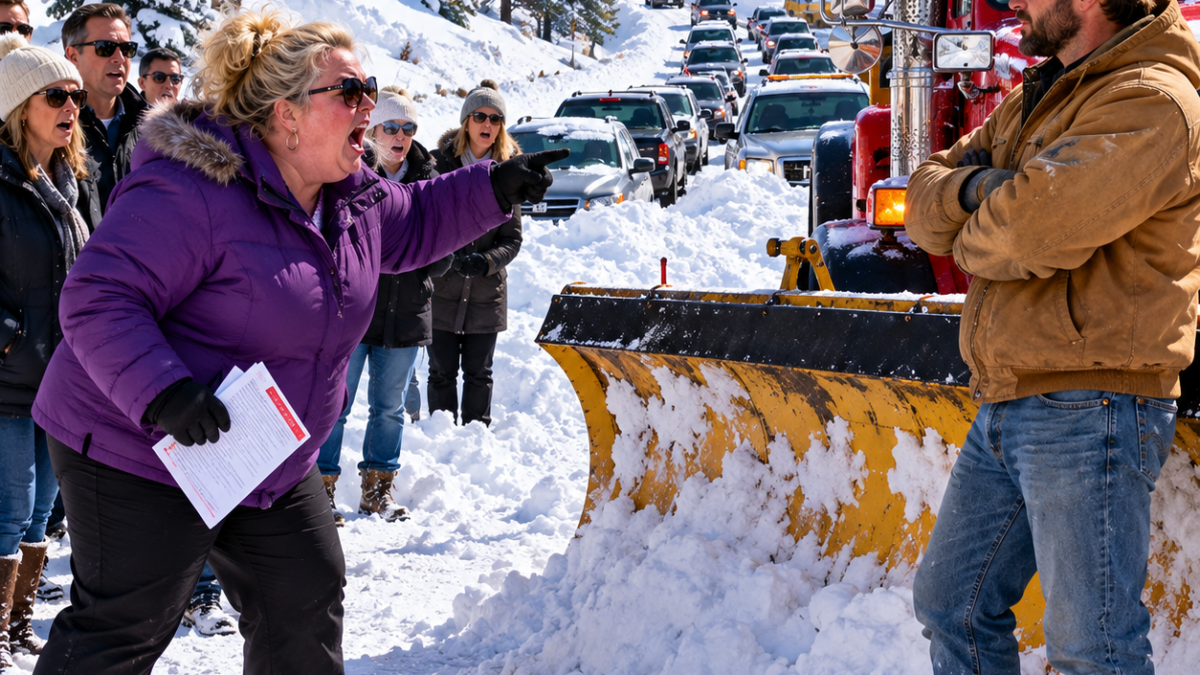
PART 2
I barely slept that night.
Not because I was afraid of Brad.
Because anger makes sleep difficult.
Every time I closed my eyes, I saw that steel fence stretched across Red Mesa Road.
My road.
My easement.
My uncle’s agreement.
Thirty-eight years of uninterrupted access reduced to a developer standing in dust telling me I should be grateful for $2.3 million.
At six the next morning, I made coffee, opened my laptop, and started researching Sunset Ridge Estates.
If Brad wanted a property fight, I intended to know exactly what property he had put at risk.
Morrison Development had been operating since 2004.
Fourteen subdivisions.
More than eight hundred homes.
Sunset Ridge alone contained 120 houses ranging from around $600,000 to nearly $900,000.
Rough average?
About $700,000.
That put gross sales somewhere around $84 million.
Suddenly Brad’s interest in my ranch made sense.
Eighty-five acres immediately beside his subdivision.
Senior water rights.
Enough land for a second phase.
Another hundred homes, maybe more.
He wasn’t trying to buy a ranch.
He was trying to buy his next $80 million project for less than half market value.
And when I said no, he decided to manufacture a weakness.
Access.
At nine that morning, I drove the forty-mile mountain detour into Flagstaff and walked into the Coconino County Planning and Zoning Office.
“I need the entire file for Sunset Ridge Estates.”
The clerk looked over her glasses.
“Entire?”
“Entire.”
Three thick binders arrived twenty minutes later.
Site plans.
Traffic studies.
Environmental reports.
Water documentation.
Subdivision approvals.
Drainage plans.
Then I found the fire marshal documents.
County code required any subdivision with more than one hundred homes to maintain at least two emergency access points.
Primary entrance:
State Highway 89.
Secondary:
Old Fire Road.
I traced the line on the map.
Straight through my ranch.
My pulse slowed.
Then I found the original condition of approval.
Secondary emergency access approved contingent upon written agreement with Raymond Chen, owner of parcel 22A.
My uncle.
The next page contained the agreement.
Signed March 12, 2022.
Only weeks before Uncle Raymond died.
Sunset Ridge received emergency access across the old fire road.
Emergency use only.
No routine traffic.
Ownership remained with the ranch.
Maintenance obligations were on the development.
Then I saw my uncle’s handwriting in the margin.
Key remains with property owner.
I read that line three times.
The key.
I drove home.
Went to the north boundary.
The old fire road was still there, two tire tracks disappearing through high-desert scrub.
At the property line stood the gate.
Twelve-foot steel frame.
Industrial padlock.
A weathered sign:
EMERGENCY ACCESS ONLY.
I pulled the key from my pocket.
Uncle Raymond had kept dozens of keys in his desk when he died.
Tractor.
Barn.
Water pump.
Storage shed.
One had a fading paper label wrapped around it.
FIRE GATE.
I inserted it.
Turned.
Click.
The lock opened perfectly.
I pushed the gate.
It swung wide.
Beyond it, the old fire road continued eight miles toward County Road 7.
That road represented the only emergency escape route for 120 homes if their main subdivision entrance became unusable during wildfire, flood, accident, or evacuation.
Brad controlled my primary access.
But I controlled his legally required secondary access.
I called Miguel Rodriguez.
Miguel had handled Uncle Raymond’s estate and knew county property law better than anyone I trusted.
“Brad fenced off Red Mesa Road.”
“What?”
I explained everything.
Then I told him about the fire gate.
He became very quiet.
“Sarah.”
“Yes?”
“Are you telling me the man who blocked your recorded easement just built a fence against the person controlling his subdivision’s secondary emergency exit?”
“Apparently.”
Miguel started laughing.
Not politely.
Actually laughing.
“What?”
“That may be the dumbest development decision I’ve heard all year.”
“Can I revoke access?”
“Slow down.”
His keyboard clicked.
“The emergency agreement is limited. You own the land. You control the gate. But public safety matters.”
“I’m not going to block firefighters during a real emergency.”
“Good. Never do that.”
“I want Brad to remove my fence.”
“That’s different.”
Miguel kept reading.
“Sunset Ridge must maintain two functional emergency exits.”
“And if it doesn’t?”
“Fire-code noncompliance.”
“What happens?”
“County notices. Insurance issues. Potential occupancy restrictions in extreme circumstances.”
I leaned against my truck.
“All because of this gate?”
“All because Brad built 120 houses without securing stronger permanent rights.”
“Can he build another exit?”
“Eventually.”
“How long?”
“Permitting alone could take months.”
“And Brad blocked my road three days before an annual inspection?”
Miguel paused.
“What inspection?”
I had found it on the county calendar.
October 2.
Six days away.
Miguel laughed again.
“You’re thinking about waiting.”
“Yes.”
“Sarah, I can seek an emergency injunction against his fence now.”
“I know.”
“But?”
“I want Brad to understand what he did.”
Miguel sighed.
“This is why attorneys drink.”
“You’re welcome.”
For the next six days, I did nothing dramatic.
I drove the mountain route.
Bought feed.
Took a calf to the vet.
Checked water troughs.
Fixed fencing.
Brad’s steel barrier remained across my easement.
He did not call.
Neither did I.
October 2 arrived clear and cold.
I was repairing a trough when a white county fire vehicle moved along Old Fire Road.
I watched from across the pasture.
Deputy Fire Marshal Tom Browning.
I didn’t follow.
At 11:47 my phone rang.
“Ms. Chen?”
“Yes.”
“Deputy Fire Marshal Browning. I’m inspecting Sunset Ridge’s emergency egress.”
“All right.”
“I’m at the gate on your property.”
I waited.
“It’s locked.”
“Yes.”
“Do you have the key?”
“Yes.”
“Can you meet me and open it?”
“What happens if you can’t inspect the route?”
Pause.
“The subdivision can’t pass its annual emergency-egress compliance inspection.”
“And who is responsible for maintaining compliance?”
“The subdivision and HOA.”
“Deputy Browning, I want to be clear about something.”
“All right.”
“If there is a wildfire, evacuation, flood, or real emergency, I will immediately open this gate.”
“Understood.”
“But Brad Morrison illegally fenced across my recorded access road six days ago.”
Another pause.
“I’m not transferring routine control of my gate to the same HOA that is currently preventing me from using my own legal easement.”
“I understand there’s a dispute.”
“It isn’t really a dispute. My easement is recorded.”
“I can’t adjudicate property rights.”
“I know.”
“Can you open the gate for inspection?”
“No.”
Silence.
Then he said, “I’ll note your position.”
“Please also note that I will cooperate during an actual emergency.”
“I will.”
The next day Miguel called.
“Report is online.”
“What does it say?”
He read it.
The gate itself was operational.
But the HOA did not possess access.
Secondary egress was therefore considered unavailable for compliance purposes.
Sunset Ridge was issued a notice.
Thirty days.
Restore compliant emergency access.
Insurance carriers would be notified.
I sat down.
“Brad knows?”
“Now he does.”
The first homeowner called me October 8.
Tom Wynn.
I knew him vaguely from a county meeting.
“Sarah, can I ask you something?”
“Sure.”
“Our insurance company sent us a letter.”
I already knew.
“Fire-code problem?”
“Yes.”
“Emergency gate?”
“Yes.”
He paused.
“Do you really have the key?”
“Yes.”
“Can’t you just give them a copy?”
“I could.”
“Then why won’t you?”
“Did Brad tell you about the fence?”
“What fence?”
That told me everything.
“He built an eight-foot steel barrier across my recorded ranch easement.”
Silence.
“What?”
“Six days before the fire inspection.”
“Why?”
“He wants my ranch.”
Tom sounded stunned.
“He blocked you out?”
“He tried.”
“And now you won’t give him the emergency key.”
“Correct.”
“Sarah, people could lose insurance.”
“I know.”
“Families have mortgages.”
“I know.”
“This could destroy property values.”
“I know.”
“So why—”
“Tom.”
I kept my voice calm.
“I did not build 120 homes dependent on emergency access across somebody else’s ranch.”
Nothing.
“I did not block that ranch owner’s legal road.”
Nothing.
“I did not threaten to keep the road blocked until she sold for half value.”
Tom exhaled.
“Brad did.”
“Yes.”
The emergency HOA meeting happened the next night.
Tom called afterward.
“It was insane.”
“How many?”
“Ninety-three residents.”
“What did Brad say?”
“Blamed you.”
“Of course.”
“He said you’re retaliating because he offered to buy the ranch.”
I laughed.
“Did he mention blocking my easement?”
“No.”
“Shocking.”
“Then Karen Wu stood up.”
“Who?”
“Retired attorney. Lives on Mesa View.”
“What did she say?”
“She brought county records.”
I smiled.
“She told everyone your easement was recorded in 1987.”
Good.
“She said Brad’s fence appeared to be illegal.”
Better.
“Then someone asked why he would block your road when our entire subdivision depended on your gate.”
I sat back.
“What did Brad say?”
“Started talking about subdivision security.”
“Of course.”
“People were furious.”
Tom lowered his voice.
“There was a motion to remove him.”
“Result?”
“Eighty-seven yes. Twelve no.”
That surprised me.
“He lost presidency?”
“Pretty much. Technical transition isn’t finished yet, but he’s done.”
At 9:43 that night, Brad called.
“Sarah.”
“Brad.”
“We need to discuss the fire gate.”
“Oh?”
“Enough.”
“Enough what?”
“This game.”
I laughed once.
“You put an eight-foot fence across my road.”
“This is a public safety matter now.”
“It became one when you built 120 houses relying on a gate you don’t control.”
“You need to provide us the key.”
“No.”
“Sarah, stop being childish.”
“Remove my fence.”
“We can discuss that separately.”
“No.”
His voice rose.
“People are going to lose insurance!”
“Remove my fence.”
“Home values could collapse!”
“Remove my fence.”
“You cannot hold 120 families hostage because you’re angry at me.”
I gripped the phone.
“You keep saying families because you want me to feel guilty for consequences you created.”
He said nothing.
“What do you want?”
There it was.
My turn.
“Fence removed.”
“Anything else?”
“Compensation.”
He laughed bitterly.
“For what?”
“Fuel.”
“Come on.”
“Forty-mile detours.”
“That’s your choice.”
“Legal consultation.”
“You didn’t need a lawyer.”
“Damage to my ranch operations.”
“No.”
“Fifteen thousand.”
“You’re insane.”
“Written apology.”
“What?”
“Admit you intentionally blocked my recorded easement.”
“You’re extorting me.”
“No.”
I looked across the pasture toward the old fire road.
“You offered me $2.3 million for property appraised at $4.8 million.”
Silence.
“I refused.”
Nothing.
“Three months later, you blocked the only normal road to my ranch.”
“Sarah—”
“You wanted leverage.”
I lowered my voice.
“Now you understand what leverage feels like.”
He hung up.
Four days later I received a legal letter.
Sunset Ridge’s attorney demanded gate access.
Public safety.
Emergency necessity.
Potential damages.
Miguel read it and laughed.
Again.
“Why do you always enjoy their letters?”
“Because every page costs Brad money.”
Miguel responded formally.
Emergency access during an actual emergency?
Sarah would cooperate.
Routine transfer of gate control?
Not required under the agreement.
Meanwhile, Brad’s fence remained an unlawful obstruction of Sarah’s recorded easement.
The law firm stopped writing.
Brad next complained to the county.
Assistant County Attorney Linda Marsh called.
I explained everything.
She pulled the records.
Two days later she returned my call.
“Ms. Chen, your recorded access easement appears valid.”
“Thank you.”
“The fence obstructing it appears inconsistent with that easement.”
“Thank you.”
“As for the fire gate, the HOA’s duty is to maintain compliant egress. You are not currently violating county code simply because you retain control of a gate on your land.”
“So the county won’t force me to transfer a key?”
“No.”
“If there is an emergency—”
“I open it.”
“Exactly.”
Brad’s second tactic failed.
So he sent residents.
Fifteen people appeared at my ranch October 21.
Three trucks.
Two SUVs.
I met them outside.
A man introduced himself.
“Derek Paulson.”
“All right.”
“We represent homeowners.”
“Did Brad send you?”
“We’re here because our insurance is being canceled.”
I crossed my arms.
“Then you should speak to the person who caused the compliance failure.”
“You have the key.”
“Correct.”
“Give it to us.”
“No.”
A woman stepped forward.
“Do you have children?”
“No.”
“I do.”
She pointed toward Sunset Ridge.
“If there’s a wildfire and our kids can’t escape—”
“I will open the gate during an actual emergency.”
“What if you aren’t home?”
“Then maybe Brad should have secured permanent emergency access before selling 120 houses.”
Derek interrupted.
“This is exactly the attitude people are angry about.”
“Which attitude?”
“You’re making innocent families pay for your dispute.”
I looked at him.
“Did Brad tell you why he blocked my road?”
Silence.
“Did he tell you he offered half market value for my ranch?”
No answer.
“Did he tell you he threatened that the easement might somehow become ‘complicated’ if I didn’t sell?”
One woman looked at Derek.
He looked away.
“You’re standing on the porch of the person he tried to pressure.”
I held up my phone.
“And this conversation is being recorded.”
Nobody moved.
“The solution is simple.”
I counted with my fingers.
“Remove the illegal barrier.”
“One.”
“Pay damages.”
“Two.”
“Written acknowledgment.”
“Three.”
“Then we negotiate emergency access properly.”
Derek lowered his voice.
“How much?”
“Fifteen thousand.”
One man scoffed.
“For a key?”
“No.”
I looked directly at him.
“For what Brad already cost me.”
They eventually left.
But pressure inside Sunset Ridge was rising.
Two home sales collapsed.
Then a third.
One house listed for $750,000 received an offer $70,000 lower because the buyer wanted compensation for the insurance uncertainty.
People who once thought Brad was protecting them began calculating what his pride was costing them.
Another emergency HOA meeting occurred October 23.
Ninety residents.
Arguments.
Shouting.
Half wanted to sue Brad personally.
Half wanted to pay me immediately.
Karen Wu reportedly stood and asked one question:
“Why are we negotiating against Sarah when Brad is the one who blocked Sarah’s legal road?”
That shifted the room.
Brad still refused.
On October 25, he called again.
“Five days.”
“I know.”
“The insurance deadline.”
“I know.”
“Lower the demand.”
“No.”
“Twelve thousand.”
“No.”
“Sarah.”
“Remove the fence.”
“I can remove it.”
“Pay fifteen.”
“Ten.”
“Fifteen.”
“You’re enjoying this.”
“No.”
“Yes, you are.”
I thought about the forty-mile road.
The dust.
The fuel.
The vet trip.
His threat.
“You mistook patience for weakness.”
“Don’t give me philosophy.”
“Then don’t call.”
“Sarah, I swear to God—”
“What?”
He stopped.
I waited.
Nothing.
“Good night, Brad.”
He had one reasonable move left.
Remove the fence.
Accept responsibility.
Negotiate.
Instead, he chose the move that destroyed whatever credibility he still possessed.
He came onto my property and cut the fire-gate lock.
I discovered it October 27.
The original lock lay in the dirt.
Clean cut.
Bolt cutters.
A new brass industrial lock hung in its place.
I picked up Uncle Raymond’s broken lock.
For several seconds I couldn’t speak.
Then I called the sheriff.
Deputy Jason Miller arrived forty minutes later.
He photographed everything.
“Any idea who did it?”
“Brad Morrison.”
“Proof?”
“Motive.”
“That isn’t proof.”
“I understand.”
“Anybody else need access?”
“Only his HOA.”
Jason studied the new lock.
“This is still your gate?”
“Yes.”
“Your property?”
“Yes.”
“Original lock yours?”
“Yes.”
“This could be criminal mischief and trespass.”
“I want a report.”
“You want the new lock removed?”
“No.”
He looked surprised.
“No?”
“No.”
“Why?”
“Because I want it exactly where Brad put it.”
He frowned.
“For evidence?”
“And because I’m installing another gate fifty feet inside my boundary.”
The deputy stared at me.
“This is escalating.”
“Brad cut a lock on my property.”
“I know.”
“I’m not cutting his.”
“No.”
“I’m building on my own land.”
That afternoon, I called Paul Hernandez.
Paul had built ranch fencing for me before.
“I need a gate.”
“What kind?”
“Heavy.”
“How heavy?”
“Twelve feet. Steel. Concrete footings.”
“Lock?”
“Industrial.”
“How many keys?”
“One copy for me initially.”
He paused.
“This wouldn’t happen to be related to Sunset Ridge?”
“Yes.”
“Thought so.”
“Can you install in two days?”
“Yes.”
“Do it.”
October 29, the second gate went in.
Black powder-coated steel.
Four-foot concrete footings.
Industrial lock.
Fifty feet inside my property.
Sign:
PRIVATE PROPERTY.
EMERGENCY ACCESS BY AGREEMENT ONLY.
UNAUTHORIZED ENTRY PROHIBITED.
The total cost was about $8,000.
That afternoon, the fire marshal returned.
Brad had apparently proudly supplied a key to the first gate.
Browning opened it.
Drove fifty feet.
Found mine.
Locked.
He called the HOA manager.
I heard the story later.
“There’s another gate.”
“What?”
“Second gate.”
“Where?”
“Inside Ms. Chen’s property.”
“We don’t have a key.”
“I gathered that.”
“But the first gate opens.”
“The first gate now opens into another locked gate.”
Silence.
“So are we compliant?”
“No.”
“We fixed the first gate.”
“You changed a lock.”
“We have access now.”
“No. You have access to fifty feet of someone else’s fire road.”
The report remained unchanged.
Noncompliant.
Original deadline remained.
Insurance notices went final October 30.
120 households.
Cancellation effective November 1.
Tom called.
“People are losing it.”
“I imagine.”
“Three more sales died.”
“Brad can fix it.”
“He’s telling people you’re responsible.”
“He also told me my easement might disappear.”
“I know.”
“Then nothing has changed.”
Brad filed an emergency court motion.
That finally put everything in front of a judge.
November 1.
Coconino County Superior Court.
Judge Barbara Hensley.
Miguel sat beside me.
Brad sat opposite with attorney Claire Hobbs.
Judge Hensley read both motions.
Then removed her glasses.
“This is a mess.”
Nobody disagreed.
She looked at Brad’s lawyer.
“You want me to compel a private property owner to provide access to a gate on her land.”
Claire stood.
“Your Honor, public safety requires—”
“Does your client hold a recorded easement?”
“We have a historical emergency access agreement.”
“Recorded?”
“No.”
“Permanent?”
“Not expressly.”
“Key ownership?”
“Retained by the property owner.”
The judge looked down.
“So your developer constructed a 120-home subdivision dependent upon emergency access rights he did not secure permanently.”
Claire hesitated.
“The prior owner cooperated.”
“The prior owner is deceased.”
“Yes.”
“And the successor owner?”
“Ms. Chen.”
“Who controls the gate?”
“Ms. Chen.”
Judge Hensley nodded.
Then looked at Miguel.
“And your counter-motion?”
Miguel stood.
“Brad Morrison is asking this court to compel access through my client’s property while his HOA is physically obstructing my client’s recorded perpetual easement.”
The judge looked up sharply.
“Excuse me?”
Miguel handed over the county record.
“1987.”
She read.
Then photographs.
Steel fence.
Survey pins.
Signs.
Brad’s face changed.
Judge Hensley looked at him.
“Mr. Morrison, did you authorize this fence?”
He glanced at Claire.
She stood.
“The HOA installed a security barrier on its property.”
“Across a recorded easement?”
“The extent of the easement was disputed.”
Judge Hensley looked at the legal description.
“It doesn’t look terribly disputed here.”
Nobody spoke.
She continued.
“Mr. Morrison, did you subsequently enter Ms. Chen’s property and cut the lock from her fire gate?”
Claire immediately said, “We dispute characterization.”
Judge Hensley lifted the police report.
“There was no wildfire.”
“No.”
“No flood.”
“No evacuation.”
“No.”
“No declared emergency.”
“No.”
“So someone entered private property, destroyed a lock, and substituted another lock because your subdivision needed non-emergency regulatory access.”
Claire hesitated.
“That is substantially correct.”
Judge Hensley leaned back.
Then said the sentence Brad deserved to hear.
“This is breathtaking hypocrisy.”
The courtroom went completely still.
“You ask this court to force Ms. Chen to honor your desired access across her land while you deliberately obstruct her recorded access across yours.”
Brad looked at the table.
Judge Hensley issued her ruling.
The fence blocking Red Mesa Road had to be removed within forty-eight hours.
Failure:
$1,000 per day.
My recorded easement restored.
Brad’s emergency motion to compel surrender of my gate key:
Denied.
If Sunset Ridge wanted durable emergency access, the HOA needed to negotiate and record proper rights.
Then she looked directly at Brad.
“You constructed a subdivision relying on legal rights you did not adequately secure.”
Brad didn’t move.
“That failure is not Ms. Chen’s obligation to repair for free.”
Gavel.
Done.
Outside, Miguel smiled.
“You won.”
“Not yet.”
“You got your road back.”
“Subdivision still doesn’t have access.”
“True.”
“What happens to families?”
“New HOA negotiates.”
“And Brad?”
Miguel glanced toward the courthouse doors.
“He’s about to learn what 120 angry homeowners look like.”
Brad removed the fence exactly forty-eight hours later.
Two flatbeds.
Work crew.
Backhoe.
Steel posts pulled.
Chain link rolled.
Signs removed.
That afternoon I drove Red Mesa Road.
Twelve minutes.
Ranch to highway.
After weeks of washboard mountain roads, ordinary asphalt felt luxurious.
I drove slowly.
Not because I needed to.
Because I wanted to appreciate it.
Uncle Raymond’s easement.
Still valid.
Still mine.
Brad had tried to erase thirty-eight years of recorded rights with one afternoon of fencing.
A judge erased his fence in two days.
But Sunset Ridge remained uninsured.
The second gate stayed locked.
The HOA called another emergency meeting.
118 homeowners attended.
Brad didn’t.
He emailed his resignation one hour before the meeting.
Effective immediately.
No apology.
No explanation.
Karen Wu became president.
The next morning she called me.
“Sarah Chen?”
“Yes.”
“Karen Wu.”
“I know.”
“I’d like to meet.”
“When?”
“This afternoon.”
“My ranch.”
“I’ll be there.”
She arrived alone in a white Toyota.
No entourage.
No lawyer.
No threats.
That impressed me immediately.
We sat on the porch.
“Ms. Chen, I want to start with an apology.”
I waited.
“What Brad did was wrong.”
That was the first time anyone from Sunset Ridge had simply said it.
“He blocked a recorded easement.”
“Yes.”
“He entered my property.”
“Yes.”
“He cut my lock.”
“Yes.”
“And residents suffered because of it.”
“Yes.”
Karen nodded.
“The board accepts that.”
I felt tension leave my shoulders.
Not all.
Some.
“What do you want?”
“Our families need insurance restored.”
“I know.”
“We need emergency access.”
“I know.”
“What are your terms?”
No arguments.
No performance.
Just terms.
“Twenty-five thousand dollars.”
Karen wrote it down.
“Written HOA apology acknowledging obstruction of my easement.”
Writing.
“Recorded emergency-access easement.”
Writing.
“Emergency use only.”
Writing.
“HOA maintains the fire road.”
Writing.
“HOA responsible for damages.”
Writing.
“Violation can trigger remedies under the agreement.”
Writing.
“And Brad Morrison is permanently banned from entering my land.”
Karen finally looked up.
“I suspect nobody will object to that one.”
I almost smiled.
“Anything else?”
“No.”
She studied the paper.
“These are fair.”
“Good.”
“I expected more.”
“I’m not trying to destroy Sunset Ridge.”
“Some people think you are.”
“Then some people aren’t paying attention.”
Karen closed the notebook.
“Payment within forty-eight hours?”
“Yes.”
“Documents within a week?”
“Yes.”
“Key after execution?”
“Yes.”
She extended her hand.
“Deal.”
I shook it.
That was all negotiation should have required from the beginning.
The HOA approved unanimously.
$25,000 arrived November 7.
The agreement was drafted.
Miguel reviewed it.
Emergency access only.
Road maintenance by HOA.
Liability provisions.
Recorded easement.
Brad banned.
I signed.
November 10, the document went into county records.
That afternoon, Karen and I met beside the second gate.
I held out a key.
“This is controlled access.”
“Understood.”
“Emergency use.”
“Yes.”
“Quarterly testing is fine with notice.”
“Agreed.”
“Lose the key?”
“We call you.”
“Good.”
She accepted it.
For a moment we stood in silence.
Then Karen said, “On behalf of 120 families, thank you.”
“You didn’t need to thank me.”
“Yes, I did.”
“You apologized.”
“We should have done that earlier.”
“You negotiated honestly.”
“So did you.”
I looked toward the fire road.
“That’s all Brad had to do.”
Two days later, Deputy Fire Marshal Browning reinspected.
First gate.
Open.
Second gate.
Key worked.
Road clear.
County Road 7 accessible.
His report:
COMPLIANT.
Insurance policies were reinstated November 15.
120 families got their coverage back.
Some collapsed sales restarted.
Property values stabilized.
Tom called.
“People are relieved.”
“Good.”
“They know you could have demanded more.”
“I didn’t want more.”
“You had them.”
“I had Brad.”
“There’s a difference?”
“Yes.”
That distinction mattered to me.
Sunset Ridge residents had trusted a developer.
Brad had weaponized their safety.
I wanted compensation for what he did.
I did not want families losing homes because he was arrogant.
Once Brad was gone and Karen came to me fairly, the fight was over.
For me.
Not for him.
Thirty-seven homeowners sued Brad personally.
Failed transactions.
Temporary value losses.
Insurance disruption.
Moving expenses.
Emotional distress.
Total claims approached $840,000.
Brad settled months later for roughly $310,000.
County fines piled on.
Legal bills.
Lost contracts.
Municipalities began backing away from Morrison Development.
Nobody wanted the developer whose personal land dispute nearly rendered 120 homes uninsurable.
His reputation collapsed faster than his company.
By the following spring, Morrison Development was effectively finished.
Brad left Coconino County.
People told me he lost hundreds of thousands.
I never calculated every dollar.
I didn’t need to.
He had offered me $2.3 million because he assumed a woman operating an isolated ranch would panic if access became difficult.
Instead, his attempt to steal leverage revealed how little control he actually had.
I never sold.
Red Mesa Ranch survived.
More than survived.
The $25,000 settlement covered detour costs, legal fees, and part of the new gate.
My cattle operation grew.
Then I expanded the ranch tours I had occasionally hosted.
Saturday mornings.
Visitors from Phoenix.
Families.
Corporate groups.
Farm-to-table dinners twice a month.
People loved it.
Within eighteen months, agritourism was grossing around $180,000 annually in addition to the cattle operation.
The ranch Brad had called impractical became more profitable.
And its appraisal rose.
$5.4 million.
Then another developer called.
Marcus Chen.
No relation.
“Ms. Chen, I’d like to make an offer.”
“For?”
“Full eighty-five acres.”
“No.”
“You haven’t heard the number.”
“I’m listening.”
“$5.8 million.”
I looked across my pasture.
Nearly six million dollars.
Enough to sell.
Move.
Travel.
Never repair another fence.
Never wake before sunrise to check cattle.
“Thank you.”
“So you’ll consider?”
“No.”
He laughed softly.
“Fair enough.”
“Why call if you know the Brad story?”
“Because I learned from it.”
“That’s promising.”
“I did title research before calling.”
“Better.”
“I checked your easement.”
“Good.”
“Water rights.”
“Very good.”
“And I have no intention of blocking any roads.”
I laughed.
“Excellent business model.”
“Apparently.”
He became serious.
“If you ever decide to sell, I’ll negotiate fairly.”
“That’s all anybody ever had to do.”
After he hung up, I walked to the north gate.
Both gates still stood.
The first one had evolved into part of Sunset Ridge’s controlled emergency-access system.
The second remained on my land.
My gate.
My ownership.
The HOA possessed an emergency key under a recorded agreement.
I kept the original.
Uncle Raymond’s old key sat in my desk now.
The broken lock Brad had cut sat beside it.
I couldn’t bring myself to throw either away.
One represented inheritance.
The other represented arrogance.
Karen Wu occasionally stopped by.
Eighteen months after everything ended, she brought wine.
“What’s this?”
“Peace offering.”
“We’ve been peaceful for a year.”
“Exactly.”
She sat on my porch.
“Sunset Ridge just reached twelve months with no major HOA dispute.”
“Congratulations.”
“We thought you’d appreciate the milestone.”
“I do.”
“Property values recovered.”
“Good.”
“Six homes sold above asking.”
“Good.”
“Gate tested quarterly.”
“Also good.”
She looked toward my pasture.
“Can I ask you something?”
“Sure.”
“Do you ever feel guilty about Brad?”
“No.”
No hesitation.
Karen raised an eyebrow.
“He lost his company.”
“Yes.”
“Hundreds of thousands.”
“Yes.”
“Reputation.”
“Yes.”
“Still no?”
“No.”
“Why?”
I leaned back.
“Brad came to my porch and offered $2.3 million for land worth $4.8 million.”
Karen nodded.
“I said no.”
“Yes.”
“He could have gone home.”
“Yes.”
“Instead he waited three months and blocked my only normal access road.”
She listened.
“He called me afterward and used that obstruction to reopen his purchase offer.”
“Yes.”
“He cut a lock on my private gate.”
“Yes.”
“He went to court asking the judge to force me to give him rights he had never secured.”
“Yes.”
I looked at her.
“Which one of those choices did I make for him?”
None.
Karen nodded.
“Exactly.”
Sunset Ridge changed after Brad.
Board meetings became boring.
Budgets transparent.
Contracts reviewed.
Minutes posted.
No secret pressure campaigns.
No developer controlling the HOA.
No threats.
Residents maintained the fire road.
Nobody used it casually.
Nobody drove across my ranch to save five minutes.
And because everyone understood the agreement, there was never another fight over that gate.
That was the irony.
Clear legal rights create less conflict than vague assumptions.
Brad believed owning more money and influence gave him greater leverage.
But leverage isn’t wealth.
It isn’t size.
It isn’t status.
It isn’t who has the largest truck.
Leverage is control over something essential.
Brad controlled my normal access temporarily.
I still had a forty-mile detour.
Painful.
Expensive.
Inconvenient.
But possible.
I controlled his legally required second evacuation route.
Without it, 120 houses became a fire-code problem.
Then an insurance problem.
Then a mortgage problem.
Then a resale problem.
He thought I was trapped.
He had never bothered examining the cage he had built around himself.
One evening, years after the dispute, I sat in Uncle Raymond’s old office.
I opened a drawer.
Inside were his keys.
Some I still didn’t recognize.
Rusty shed keys.
Old truck keys.
Storage locks.
A brass key to a pump house we had replaced.
Then the small steel key labeled in his handwriting.
FIRE GATE.
I held it.
Uncle Raymond never knew what that key would eventually do.
He had granted emergency access because he was a decent neighbor.
He probably assumed Sunset Ridge residents might one day need that road during wildfire.
He never imagined a developer would use the subdivision as leverage against his niece.
But Raymond had been careful.
The agreement said emergency only.
The gate remained his.
The key remained his.
When the ranch passed to me, the responsibility passed too.
That was the real inheritance.
Not simply property.
Boundaries.
Rights.
Responsibilities.
The wisdom to put agreements in writing.
Brad had ignored that principle.
He treated cooperation like surrender.
Permission like ownership.
Access like control.
He thought because Uncle Raymond had allowed emergency passage, Sunset Ridge was somehow entitled to the road forever on whatever terms Brad wanted.
A judge corrected him.
The county corrected him.
His residents corrected him.
Eventually his bank account corrected him.
I sometimes wondered what would have happened if I had accepted his offer that first morning.
$2.3 million.
Cash.
Thirty days.
Maybe Brad would have bulldozed the ranch.
Phase Two.
Another hundred houses.
The old barns gone.
Cattle shipped.
Creek rerouted.
Maybe the eighty-five acres would have produced another $80 million in home sales.
Brad probably saw all that when he stood on my porch.
I saw Uncle Raymond.
That was why we could never agree on value.
Brad saw units.
I saw inheritance.
He saw acreage.
I saw mornings feeding calves.
He saw senior water rights as development assets.
I remembered Raymond teaching me how to check well pressure.
He saw the old fire road as infrastructure.
I remembered riding it as a child.
Money can value land.
It cannot explain why somebody refuses to sell it.
Years later, Sunset Ridge invited me to its wildfire-preparedness meeting.
That made me laugh.
Karen insisted.
“You’re technically part of our emergency route.”
“Only technically?”
“Very technically.”
The fire marshal demonstrated evacuation procedures.
Residents learned which roads to use.
Gate procedures.
Emergency communications.
Then Browning pointed toward the northern evacuation map.
“This route crosses private ranch property.”
He looked at the audience.
“It exists because the property owner has granted limited emergency access.”
Not because the subdivision owns it.
Not because Brad built it.
Because I granted it.
Browning continued.
“This access is for evacuation and emergency response only.”
Nobody complained.
Nobody shouted that the road belonged to the community.
Everyone understood.
Afterward, a homeowner approached me.
Derek Paulson.
The man who once came to my ranch demanding the key.
He looked embarrassed.
“Sarah.”
“Derek.”
“I owe you an apology.”
“You don’t have to.”
“I do.”
He looked toward Karen.
“Brad told us you were trying to destroy Sunset Ridge.”
“I remember.”
“I believed him.”
“I remember that too.”
“I came to your house.”
“Fifteen people.”
“Yeah.”
“Three trucks, two SUVs.”
“You really remember everything.”
“Property disputes improve memory.”
He smiled.
“I thought you were holding our families hostage.”
“And now?”
“Brad was using us.”
I said nothing.
“He didn’t tell us he had blocked your road until Karen found the records.”
“I know.”
“If I’d known…”
“You might still have been angry.”
“Maybe.”
He nodded.
“But I would have been angry at the right person.”
That mattered.
We shook hands.
The fight had started as Sarah versus Sunset Ridge.
It ended as Sarah and Sunset Ridge versus Brad’s decisions.
That is how most power games fail.
The bully needs everyone to believe there are only two sides.
Once people see the third option—the truth—the bully loses control of the story.
One spring afternoon, wildfire crews used the gate for the first real emergency.
Lightning started a brush fire several miles north.
Nothing near the houses yet.
But winds changed.
The county issued precautionary evacuation preparation.
Fire crews requested access through Old Fire Road.
Karen called me.
“Sarah, this is real.”
“I know.”
“I’ve got the key.”
“Open both gates.”
“You’re okay with crews crossing?”
“That’s what the easement is for.”
Within twenty minutes, engines were moving through my property.
No arguments.
No fees.
No negotiation.
No hesitation.
Emergency meant emergency.
I stood beside the road as three trucks passed.
Browning was in the last one.
He slowed.
“Thanks.”
I waved him through.
Crews contained the fire by evening.
No homes burned.
No evacuation became necessary.
The gates were closed afterward.
That night, I sat on my porch thinking about Brad.
He once accused me of endangering families by refusing to surrender the key during a routine compliance dispute.
But when real danger appeared, the system worked exactly as intended.
Gate opened.
Fire crews moved.
Families stayed safe.
Because the final agreement was legal.
Clear.
Respectful.
That was all I had wanted.
My ranch continued growing.
Sixty cattle became more.
Agritourism bookings filled months ahead.
Corporate groups paid ridiculous amounts of money to spend afternoons learning basic ranch chores.
One tech executive from Phoenix tried throwing a rope and somehow caught his own boot.
I laughed until my ribs hurt.
At dinner he asked why I didn’t sell.
“You could probably get six million now.”
“Probably.”
“Why work this hard?”
I looked toward the barn.
“Because I like it.”
He seemed genuinely confused.
“That’s it?”
“That’s enough.”
Money isn’t always the answer.
Sometimes it’s simply the measurement somebody else understands.
Brad understood money.
So when the conflict came, money was part of the consequence.
But money was never why I fought.
I fought because once somebody discovers they can override your “no,” they stop asking.
First my access road.
Then maybe my water.
Then maybe development rights.
Then the ranch itself.
Boundaries exist for a reason.
Years after Brad left Arizona, I heard he was trying commercial real estate in Nevada.
I didn’t investigate.
Didn’t care.
I hoped he had learned.
For his sake.
For whoever lived beside his next project.
Karen once asked whether I wanted to know if he still owed money.
“No.”
“Really?”
“Really.”
“He owes some families.”
“That’s between them.”
“You don’t want updates?”
“No.”
“Why?”
“Because I won.”
She smiled.
“That sounds arrogant.”
“No.”
I looked over the ranch.
“Winning means not needing to think about him anymore.”
That was true.
At the height of the fight, Brad occupied my thoughts constantly.
What would he do?
Would he sue?
Would he damage something?
Would he find another way to pressure me?
Afterward?
Nothing.
A name.
A cautionary story.
The ranch was the present.
Cattle were the present.
Bookings.
Water.
Fences.
Weather.
Real life.
I eventually framed two documents inside the ranch office.
First:
The 1987 recorded access easement.
Uncle Raymond’s right to reach his remaining eighty-five acres after selling the surrounding sixty.
Second:
The 2025 emergency-access agreement negotiated with Karen Wu.
My decision to grant Sunset Ridge formal rights.
Two easements.
Opposite directions.
One gave my family access through their property.
One gave their subdivision emergency access through mine.
Balanced.
Recorded.
Mutual.
That is what Brad never understood.
Good property relationships don’t come from one side dominating the other.
They come from clear reciprocal rights.
You cross mine under this agreement.
I cross yours under that one.
Nobody gets to wake up one morning and change the bargain because they want more land.
Brad tried.
The law put him back in his lane.
Five years after the fight, a young couple touring my ranch asked about the gate.
“Why are there two?”
“Long story.”
“HOA?”
I looked at them.
“How’d you know?”
The husband laughed.
“My parents live in one.”
Fair.
I gave them the short version.
Developer blocked my road.
Forgot his emergency access crossed my ranch.
I held the key.
Eventually everybody negotiated correctly.
The wife smiled.
“So you got revenge.”
I thought about that word.
“No.”
She looked surprised.
“You didn’t?”
“Revenge would have been letting Sunset Ridge collapse.”
“But you could have.”
“Probably.”
“You didn’t.”
“No.”
“Why?”
“Because 120 families weren’t the people who blocked my road.”
She nodded slowly.
“Then what happened to Brad?”
“He paid for his choices.”
“Sounds like revenge.”
“No.”
I pointed toward the gate.
“That’s consequences.”
The distinction matters.
Revenge asks:
How much can I hurt you?
Justice asks:
What does it take to restore what you damaged?
My road restored.
My costs compensated.
My rights recognized.
Permanent terms recorded.
Brad kept off my land.
Families protected.
That was enough.
The $25,000 settlement wasn’t life-changing.
The ranch’s value was millions.
But the amount proved something.
Brad had tried to make me pay for access I already legally possessed.
Instead, the HOA paid me for emergency access it actually needed.
The reversal wasn’t about the money.
It was about who had the right to set terms.
One afternoon I found the old manila folder containing Brad’s original offer.
$2.3 million.
Thirty-day cash closing.
I read it again.
His cover letter used phrases like:
CLEAN EXIT.
REDUCED ACCESS RISK.
IMMEDIATE LIQUIDITY.
He had tried to turn my recorded easement into a psychological weakness.
I wrote one sentence across the front page before putting it back.
STILL NOT FOR SALE.
Maybe Ethan will find that file someday.
Maybe another niece or nephew.
Maybe Red Mesa Ranch will remain in my family another forty years.
I hope whoever inherits it understands something.
Uncle Raymond did not leave me simply eighty-five acres.
He left me records.
Agreements.
Water rights.
Easements.
Keys.
Knowledge.
And most importantly, the expectation that I would not trade long-term control for short-term pressure.
The day Brad put that fence across Red Mesa Road, he believed he was demonstrating power.
Eight-foot steel barrier.
Expensive installation.
HOA signs.
Developer confidence.
He wanted me to look at that fence and feel small.
For a few minutes, I did.
Then I remembered the key.
A tiny piece of metal.
Fit in my palm.
Probably worth ten dollars to replace.
Yet the subdivision behind Brad’s multimillion-dollar entrance could not satisfy its emergency plan without access to the gate it unlocked.
That’s the thing about leverage.
It often looks unimpressive.
A signature.
A deed.
A permit.
A narrow easement.
A brass key.
Power isn’t always the biggest object in the room.
Sometimes it’s the smallest thing everyone else forgot to check.
On quiet nights, I still walk to the north boundary.
The second gate stands exactly where Paul installed it.
Black steel.
Concrete footings.
Emergency-access sign.
Sunset Ridge keeps its copy of the key under controlled procedures.
Fire department knows the route.
Quarterly inspections happen without drama.
I keep the original in my pocket when I check that part of the ranch.
Not because I need to.
Habit.
I stop sometimes and look west toward Sunset Ridge.
Lights in houses.
Kids riding bicycles.
People grilling on patios.
Ordinary life.
None of those families ever wanted a war with me.
They wanted safe homes.
I wanted my ranch.
Both were possible.
Brad was the one who tried convincing everyone only one side could win.
He was wrong.
The HOA survived.
The ranch survived.
Families kept insurance.
Property values returned.
I kept ownership.
The only thing that didn’t survive was Brad’s ability to bully people.
That was an acceptable loss.
One evening, Karen drove out just before sunset.
“Inspection tomorrow.”
“I know.”
“Gate key checked.”
“Good.”
“Road graded.”
“Good.”
She smiled.
“You’re getting easier to deal with.”
“I was always easy.”
She laughed loudly.
“Sarah.”
“What?”
“You made us negotiate a $25,000 easement while 120 insurance policies were canceled.”
“After your former president blocked my road.”
“Fair.”
“Very fair.”
She handed me an envelope.
“What’s this?”
“HOA anniversary report.”
“I don’t need that.”
“Read the first page.”
I opened it.
Sunset Ridge Estates Emergency Preparedness.
Five consecutive years full compliance.
No access violations.
No insurance interruptions.
No emergency-route disputes.
I looked at her.
“Five years?”
“Five.”
“Time goes fast.”
“Not during property litigation.”
True.
She turned toward her car.
“Good night, Sarah.”
“Good night.”
Then she stopped.
“One more thing.”
“What?”
“Board voted tonight.”
“For?”
“To renew our emergency-maintenance reserve.”
“That sounds boring.”
“That’s the point.”
I smiled.
“Congratulations.”
She drove away.
I went back to the porch.
Sunset turned the desert orange.
Cattle settled near the south pasture.
Wind moved through dry grass.
Somewhere beyond the ridge, 120 families lived ordinary lives in homes Brad had once placed at risk for a land deal he couldn’t accept losing.
I thought about his words.
You’re landlocked.
No access except through my subdivision.
He had said them like a verdict.
He had been right about geography.
Wrong about ownership.
Wrong about law.
Wrong about me.
I took out the fire-gate key and placed it on the table beside my coffee.
A simple steel key.
No label anymore.
The old paper had worn away.
But I knew exactly what it opened.
More importantly, I knew what it had protected.
Not just an emergency gate.
My ability to say no.
Brad had controlled millions of dollars.
A development company.
Lawyers.
Contractors.
An HOA board.
Hundreds of acres over his career.
I controlled eighty-five acres.
One ranch.
One recorded road easement.
One emergency gate.
And one key.
He thought that made me smaller.
He was wrong.
Because the day he tried to trap me behind an eight-foot fence, he discovered the mistake arrogant people always make eventually.
They count everything they control.
They forget to count what they depend on.
Brad depended on my gate.
My land.
My permission.
And when the fight ended, I still had all three.
The fence he built was gone.
The road Uncle Raymond protected in 1987 was open.
Sunset Ridge had its legal emergency agreement.
My cattle were safe.
My business was growing.
The ranch was worth more than ever.
And Brad Morrison—the developer who once stood on the opposite side of a steel barrier telling me I would regret saying no—was gone.
I didn’t need to destroy him.
I simply refused to rescue him from the consequences of trying to destroy me.
That was enough.
I picked up the key.
Locked the ranch house.
Walked toward the pasture.
The desert was quiet.
The ranch was mine.
And this time, nobody on either side of the gate had forgotten it.
A few weeks after I watched Luke’s tires cross that decorative apron without anyone reaching for a fine template, Pinecrest Ridge held its annual winter preparedness meeting.
I wasn’t planning to attend.
I had already spent enough evenings in HOA meeting rooms for one lifetime, and retirement had taught me that a man who owns 480 acres can usually find something more useful to do than sit beneath fluorescent lights listening to people discuss reserve accounts.
Then Nora called.
“You’re going.”
“No.”
“You’re absolutely going.”
“Why?”
“Because Delia called me.”
“That sounds like conspiracy.”
“She said the board is dedicating the new emergency road program.”
“They don’t need me for that.”
“Dad.”
“What?”
“They named part of it after you.”
I closed my eyes.
“Tell them to unname it.”
She laughed.
“Too late.”
So on a Thursday evening in January, I drove to the Pinecrest community center.
The road was clear.
Luke had handled six inches before sunrise and returned after noon to widen two shaded curves where drifting had started building against the timber line.
Good work.
I noticed because I still noticed.
Retirement doesn’t erase thirty years of instinct.
It simply removes the responsibility from your shoulders.
Inside the meeting room, nearly eighty residents had gathered.
Some were people I’d known for years.
Others were new.
Families had moved in.
Homes had sold.
Children had grown.
The community that once seemed ready to tear itself apart over $400 worth of tire tracks now looked remarkably ordinary.
Delia stood at the front beside a large board displaying Pinecrest’s winter access system.
PRIMARY CONTRACTOR.
BACKUP CONTRACTOR.
EMERGENCY RESERVE.
WEATHER MONITORING.
ROAD CLOSURE PROTOCOL.
MEDICAL PRIORITY PROCEDURE.
EQUIPMENT FAILURE CONTINGENCY.
Every category had a name beside it.
Every responsibility belonged to someone.
Nothing depended on assumption anymore.
That was the part that made me smile.
Delia saw me near the back.
“You came.”
“Against my better judgment.”
Nora, sitting beside me, whispered, “Liar.”
Delia began the meeting.
She talked about snow response times.
Emergency communication.
Backup mobilization.
Resident notification.
Then she clicked to the last slide.
At the top were four words.
THE GREER CONTINUITY STANDARD.
I stared at it.
Nora elbowed me.
“I told you.”
I leaned toward her.
“I hate this.”
“You love it.”
“I absolutely do not.”
Delia smiled from the front.
“Walt, would you stand?”
“No.”
The room laughed.
She waited.
I stood.
More laughter.
Delia said, “Several years ago, Pinecrest learned an expensive lesson about infrastructure.”
Nobody needed the details.
Everyone knew them.
“We learned that reliability is not the same as entitlement.”
The room became quiet.
“We learned that a service can perform perfectly for a decade and still remain dependent on a contract, equipment, labor, and human judgment.”
She gestured toward the emergency plan.
“This system exists because we no longer assume one person will solve every problem.”
Then she looked at me.
“But it also exists because one person insisted that agreements mean what they say.”
I wasn’t comfortable with the attention.
Never had been.
Delia continued.
“The Greer Continuity Standard requires every critical HOA service to have three things: a primary agreement, a funded backup plan, and a documented succession process.”
That got my attention.
Not just snow removal.
Critical services.
Well monitoring.
Emergency generators.
Road maintenance.
Tree removal.
Drainage.
Anything the development could not safely lose overnight.
Nora leaned closer.
“You changed the whole HOA.”
I shook my head.
“A storm changed them.”
“No.”
She looked at me.
“You made them look at the storm differently.”
After the meeting, residents came over one by one.
Most said hello.
A few told stories.
One man said Luke had gotten his wife to the county highway before a scheduled chemotherapy appointment during a February storm.
Another said the emergency text system had prevented three residents from attempting the road before it was cleared.
A young mother told me she had bought her house the previous summer.
“Our realtor gave us the winter-access disclosure before we signed.”
“Good.”
“She made us initial it.”
“Even better.”
“She also told us about you.”
I sighed.
“What version?”
“The $400-fine version.”
“Of course.”
She smiled.
“My husband thought the story was exaggerated.”
“It usually is.”
“Then we found the old board minutes online.”
“That was a mistake.”
“He read all of them.”
“Definitely a mistake.”
She laughed.
Then her expression softened.
“Thank you.”
“For what?”
“For making them fix the system before we moved here.”
I looked around the room.
“That wasn’t what I set out to do.”
“I know.”
Maybe that was why it meant something.
The best consequences are sometimes the ones nobody planned.
Two winters later, Pinecrest got tested again.
Not by a board fight.
By weather.
A slow-moving mountain system stalled over the northern range and dropped more than twenty-eight inches in thirty hours.
Heaviest snowfall since I’d retired.
The weather service issued warnings on Friday.
By Saturday morning, Luke had already made two passes.
Garrett’s company activated its backup crew before the road became critical.
Two trucks.
One from each end.
Exactly the kind of redundancy Pinecrest should have had from the beginning.
At 2:10 Saturday afternoon, my phone rang.
Luke.
“Walt.”
“You stuck?”
“No.”
“Truck down?”
“No.”
“What then?”
“Ambulance coming.”
I stood.
“What happened?”
“Resident on the upper loop. Possible heart attack.”
I looked outside.
Snow still falling.
Hard.
“How’s the road?”
“Passable.”
“Second grade?”
“Packed but clean.”
“Turnaround?”
“Open.”
“County connection?”
“Garrett cleared it ten minutes ago.”
“Then why are you calling me?”
Pause.
“Habit.”
I almost laughed.
“Luke.”
“Yeah?”
“You know the road.”
“I know.”
“You trained for this.”
“I know.”
“Then do the job.”
He exhaled.
“All right.”
Twenty minutes later, I heard the ambulance climbing Pinecrest Road.
Smooth.
No spinning.
No siren until it reached the development.
Forty minutes after that, it came back down.
Later I learned the resident survived.
Fast transport mattered.
Had that same emergency happened during the nineteen-inch storm years earlier, before Pinecrest created backups, the outcome could have been very different.
That thought stayed with me.
People often remembered the famous morning as funny.
Walt sat drinking coffee.
HOA road disappeared.
$400 fine became a $3,200 emergency bill.
It made a good story.
But real infrastructure isn’t funny when it fails.
People miss work.
Children miss school.
Ambulances slow down.
Medication doesn’t arrive.
Food deliveries stop.
Home health workers can’t reach patients.
The reason I insisted on contracts and logs was never because I loved paperwork.
It was because responsibility becomes dangerous when nobody defines it.
That night, Luke stopped at my house after his final pass.
He looked exhausted.
Snow crusted his jacket.
I poured coffee.
He sat where Nora had sat during the original dispute.
“How’d you feel when the ambulance call came?”
“Like I was about to throw up.”
“Good.”
He looked surprised.
“Good?”
“Means you understood the responsibility.”
“I thought you’d say confidence.”
“Confidence comes after.”
He rubbed both hands around the coffee mug.
“I kept hearing your voice.”
“That sounds unfortunate.”
“Second grade. Don’t enter too fast. Leave room for the rear end to settle before you angle the blade.”
“Useful voice.”
“Then I remembered something else.”
“What?”
“Road first. Everything else only matters if people can get out.”
I smiled.
That was the lesson from the board member who tried directing my sequence years ago.
The incident that caused me to write the non-interference clause in the first place.
Funny how one bad instruction can eventually become good training material.
“You did fine,” I said.
Luke shook his head.
“I almost called Garrett and told him to take the whole route.”
“But you didn’t.”
“No.”
“Why?”
“Because I knew what to do.”
“Then stop saying almost.”
He looked at me.
“You really don’t make encouragement easy.”
“That’s why Nora handles emotional support.”
He laughed.
Before leaving, he stood near the framed photographs of the tire tracks.
“Still can’t believe this started all of that.”
“It didn’t.”
He looked at me.
“The fine did.”
“No.”
“Brenda?”
“No.”
“Then what?”
I pointed at the photographs.
“Assumption.”
He waited.
“Everyone assumed the road would always be clear because it had always been clear.”
I pointed toward the first photo.
“Brenda assumed she could fine the person maintaining it because service would continue anyway.”
Then toward the second.
“Residents assumed the HOA owned something it was only contracting.”
Then the window.
“Even I assumed eleven years of good service meant people understood what I was providing.”
Luke nodded slowly.
“So everybody assumed wrong.”
“Pretty much.”
“That’s depressing.”
“That’s why we write things down.”
He smiled.
“There’s the engineer again.”
The following spring, I received a letter.
Handwritten.
No return address I recognized.
Inside was one page.
Walt,
I don’t expect you to respond.
I have thought often about what happened at Pinecrest. At the time, I believed withdrawing the fine would weaken the authority of the board. I understand now that refusing to withdraw it weakened the board far more than admitting the mistake would have.
I should have read the agreement before issuing the fine.
I should have listened to Delia.
I should have taken the legal advice I received.
Most of all, I should have called you.
I am sorry.
Brenda.
I read it twice.
Then placed it on the table.
Nora was visiting that weekend.
She noticed.
“What’s that?”
I handed it to her.
She read silently.
Then looked at me.
“Well?”
“Well what?”
“Are you going to answer?”
“I don’t know.”
“You should.”
“Why?”
“Because she apologized.”
“Years late.”
“Still an apology.”
I walked to the window.
The mountain was green.
Snow season over.
“Do you think I owe her forgiveness?”
“No.”
That surprised me.
Nora continued.
“But I think you owe yourself the chance to put it down completely.”
I had thought I already had.
Maybe mostly.
Not completely.
I took a sheet of paper.
Wrote four lines.
Brenda,
Thank you for writing.
The matter has been closed for years.
I appreciate the apology.
I hope you’re well.
Walt.
Nothing dramatic.
No lecture.
No victory lap.
I mailed it Monday.
Never heard from her again.
Didn’t need to.
That letter became the final piece I hadn’t known the story needed.
The contract dispute had ended years earlier.
The resentment ended there.
By the time I turned seventy-eight, Pinecrest had gone more than a decade without another winter-access failure.
Luke had become operations manager for Garrett’s company.
He trained two younger operators on the route.
The HOA expanded its reserve.
Every new board reviewed critical service agreements during orientation.
The Greer Continuity Standard stayed in place.
I still thought the name was embarrassing.
Nobody cared.
One October morning, I drove the road slowly in my pickup.
No plow.
No inspection responsibility.
Just driving.
Leaves had turned.
Cold coming.
At the entrance, crews were repairing a few loose flagstones.
The decorative apron looked almost identical to the one that started everything.
A worker recognized me.
“Mr. Greer?”
“Yes?”
He grinned.
“We’re making sure the snow tracks survive this year.”
I shook my head.
“Very funny.”
He laughed.
I continued toward the county highway.
At the bottom of the road, I pulled over.
From there I could see nearly the entire first grade climbing toward Pinecrest.
Eleven years I had kept it open before the dispute.
Five more afterward.
Sixteen winters.
Hundreds of runs.
Thousands of miles traveled back and forth over the same mile of mountain road.
Most of them forgotten.
That’s how maintenance works.
When it’s done correctly, people forget the work because nothing goes wrong.
I used to think that was enough.
Now I knew better.
Invisible work still needs visible terms.
The road had taught Pinecrest that.
It taught me too.
I had spent most of my career believing competence spoke for itself.
Sometimes it does.
Sometimes competence performs so consistently that people stop seeing the person behind it.
Then the person has to remind them.
Not with anger.
Not with revenge.
With boundaries.
Years later, when people asked me what I would have changed, I always gave the same answer.
“I would have charged more from the beginning.”
They’d laugh.
Then I’d add:
“And I would’ve made the HOA create a backup contractor in 2014.”
That part wasn’t a joke.
Because the final lesson wasn’t that Pinecrest needed Walt Greer.
It was that Pinecrest needed a system strong enough that it didn’t have to depend entirely on Walt Greer.
That’s how I knew the fight had actually ended.
Not when Brenda resigned.
Not when the fine was voided.
Not when the escrow funded.
Not even when I parked the plow for the last time.
It ended the morning I watched another operator clear that road without me, under a contract everyone understood, backed by equipment that could take over if he failed, while residents slept through the storm without wondering whether they could reach the highway.
The road stayed open.
Nobody argued.
Nobody issued a fine.
Nobody called me.
And sitting at my kitchen table with coffee in my hand, I realized that being unnecessary was the best proof I had ever done the job right.
Outside, snow started again.
Slow flakes.
Heavy enough to accumulate by evening.
Years earlier, weather like that would have made me check fuel, hydraulics, blade pressure, and road temperature.
Now I simply watched.
At 4:30 the next morning, amber lights appeared beyond my gate.
Two plow trucks this time.
Primary.
Backup.
They climbed together toward Pinecrest Ridge.
The first cleared the center.
The second widened the shoulders.
Professional.
Prepared.
No drama.
On the return pass, the lead truck swung wide near the stone entrance.
Its rear tires crossed the decorative apron.
Two tracks.
Perfectly parallel.
I stood at my window looking at them.
Then I raised my coffee toward the road.
“Good job.”
Nobody heard me.
They didn’t need to.
The trucks continued down the mountain.
The highway connection stayed open.
Pinecrest residents began turning on kitchen lights.
Another ordinary winter morning.
Exactly the outcome all those contracts, arguments, meetings, invoices, apologies, and nineteen inches of snow had finally been trying to create.
A road nobody had to think about.
A service nobody took for granted.
And two tracks in the snow that no longer meant anything at all.

