PART 2: HOA Claims My Ranch Is ‘Community Property’ — So I Installed an Electric Fence and Made Them Pay
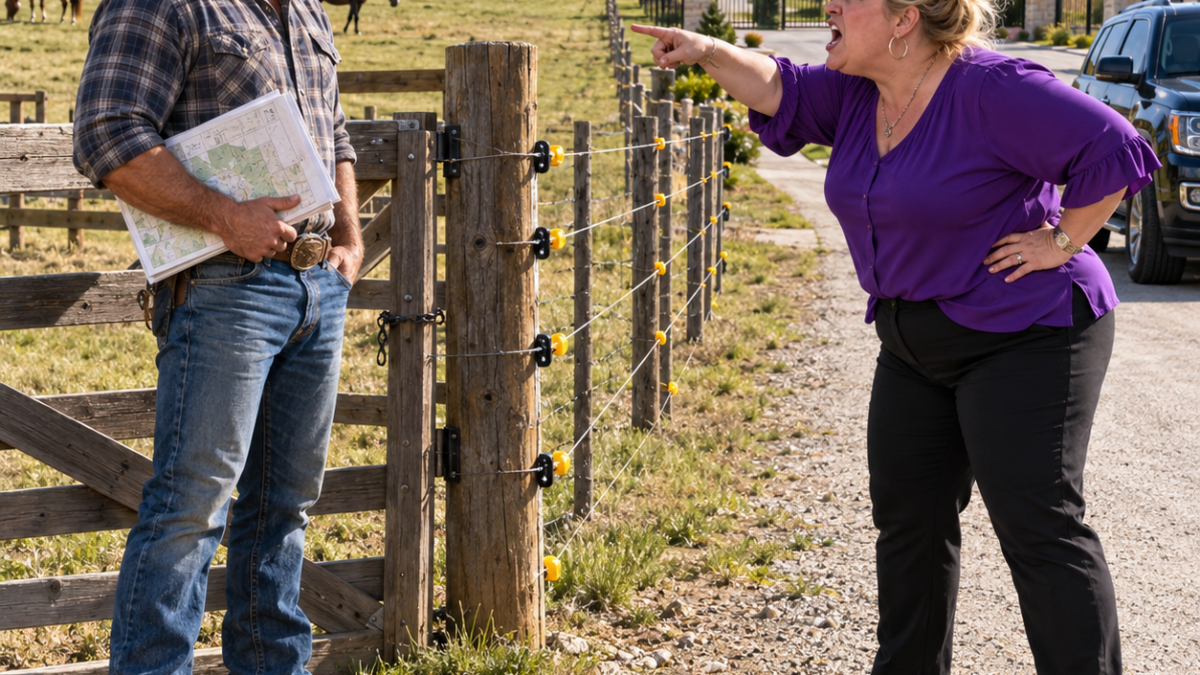
PART 2
The crowd came through my south pasture on a Saturday morning.
Thirty people.
Maybe forty.
Backpacks, water bottles, children, two dogs, and Sharon Miller walking in front like a guide at a national park.
I was servicing the tractor when I saw them.
At first, I honestly thought my eyes were playing tricks on me.
Then Sharon lifted one arm toward the creek and I heard her explaining something.
I shut down the tractor.
Silence settled over the yard.
For half a second, I looked toward Uncle Jim’s old house.
Then back toward the people spreading through his pasture.
Something inside me hardened.
I got into my truck and drove straight toward them.
Sharon didn’t stop walking until I blocked the old cattle track fifty feet ahead.
I stepped out.
“What are you doing?”
She smiled.
That smile irritated me more than anger would have.
“This is a scheduled Meadow Ridge community nature walk.”
“On my ranch.”
“On designated open space.”
“No.”
Several residents stopped behind her.
Some looked uncomfortable.
Most seemed annoyed.
Sharon folded her arms.
“These families paid premium prices for access to this land.”
“That doesn’t give them ownership.”
“It gives them expectations.”
“Expectations don’t create easements.”
Her smile disappeared.
“You’re being unreasonable.”
“I’m telling you to leave.”
A man near the back spoke.
“We were told this belongs to the subdivision.”
“It doesn’t.”
A woman said, “Then why is it on our master plan?”
“Ask the developer.”
Sharon stepped closer.
“We already discussed this at the HOA meeting.”
“No. You talked. I showed you my deed.”
“The county approved our development plan.”
“The county approving your map doesn’t transfer my land.”
“You’re not an attorney.”
“No.”
“But mine is.”
She blinked.
That was the first time I saw uncertainty.
“Everyone leaves now.”
Nobody moved.
I took out my phone.
Sharon watched me.
“Who are you calling?”
“The sheriff.”
A murmur went through the crowd.
“You’re calling police on families taking a walk?”
“I’m calling because forty people are refusing to leave private agricultural property after being asked.”
Her cheeks reddened.
“You want to humiliate us?”
“I want you off my ranch.”
The deputy arrived twenty minutes later.
His name was Keller.
He looked tired before he even stepped out.
Property disputes must do that to law enforcement.
I handed him my deed.
Sharon handed him the Meadow Ridge master plan.
He studied both.
Then looked toward the pasture.
“Mr. Cole owns this?”
“Yes.”
Sharon interrupted.
“It’s part of our approved open-space network.”
Keller looked at her.
“Do you have an easement?”
“The developer incorporated it into—”
“Ma’am, do you have an easement?”
She stopped.
“I would need our attorney to provide the documents.”
“That sounds like no.”
Her face tightened.
“It’s complicated.”
Keller handed my deed back.
“The ownership isn’t complicated.”
Then he turned toward everyone else.
“You’ve been asked to leave. Leave.”
One man muttered something.
Another woman pulled her son toward the road.
Within ten minutes, the pasture was empty.
Sharon left last.
She stopped beside my truck.
“You understand what happens if residents lose access.”
“Yes.”
“Their home values collapse.”
“That is not my responsibility.”
“It will become your responsibility.”
“No.”
“You think you can put up a fence and destroy 120 families?”
“I think I can control forty acres I own.”
Her eyes went hard.
“This is bigger than you.”
“That doesn’t make it yours.”
She walked away.
An hour later my phone rang.
It was my neighbor, Caleb Ross.
“Mason, your cows are on Highway 34.”
My stomach dropped.
“What?”
“Six of them. I’ve got traffic stopped.”
I don’t remember ending the call.
I remember throwing the truck into gear.
I remember gravel exploding beneath the tires.
And I remember coming over the rise toward Highway 34 and seeing six black cattle standing between stopped cars while a semi sat sideways across one lane.
Hazard lights flashed.
The truck driver stood near his cab.
His face had gone pale.
One cow limped.
Another had blood along her leg.
I jumped the ditch.
Caleb was already waving traffic back.
“Took me twenty minutes to keep them together.”
“How’d they get out?”
“South gate.”
I stared at the road.
The semi driver approached.
“They came right out.”
“Everybody okay?”
He nodded.
“Yeah.”
Then he looked at the nearest cow.
“If I’d been five seconds later…”
He didn’t finish.
He didn’t need to.
A forty-ton truck traveling highway speed would have destroyed more than cattle.
It took two hours to get every animal home.
When I reached the south gate, I found it open.
Not broken.
Open.
The latch had been lifted.
That evening I sat on Uncle Jim’s porch with mud on my boots and anger in my throat.
I kept seeing the semi.
Kept hearing the driver.
Five seconds.
I called my attorney.
His name was Marcus Webb.
He answered immediately.
“What happened?”
“Someone left my south gate open.”
“Accident?”
“Nature walk came through an hour earlier.”
Silence.
“Any injuries?”
“Cattle. One cut. One limping. Nobody human.”
“Thank God.”
“Marcus.”
“Yes?”
“I’m done asking nicely.”
“What are you thinking?”
“Fence.”
“You already have ranch fencing.”
“No. I mean the full property line.”
He understood.
“Survey first.”
“Already ordered.”
“Good.”
“Six-foot cattle fencing. Steel gates. Locks. Signs.”
“That’s lawful.”
“And if Meadow Ridge loses access?”
“That’s their problem.”
I looked toward the pasture.
“Good.”
The contractor arrived Monday.
Three crews.
Truckloads of fencing.
Heavy gates.
Posts.
Wire.
Concrete.
“Full forty acres?” the foreman asked.
“Every legal boundary.”
“You want access points?”
“Working gates where I need them. Everything else closed.”
“Signs?”
“Every hundred feet.”
“What do they say?”
“PRIVATE PROPERTY. WORKING RANCH. NO TRESPASSING.”
He whistled.
“Neighbor problems?”
“You could say that.”
It took four days.
By Friday afternoon, forty acres Uncle Jim had protected mostly with old agricultural fencing were now unmistakably separated from Meadow Ridge.
The new fence didn’t look hostile.
It looked permanent.
That was enough.
Saturday morning, I found people standing along the western boundary.
Families.
Children.
Residents.
Some stared through the fence at the creek.
One woman pushed a stroller toward me.
She had been crying.
“Are you Mason?”
“Yes.”
“Do you understand what you’ve done?”
I glanced at the fence.
“Yes.”
“My husband and I paid $430,000 for our house.”
I waited.
“We’re teachers.”
Her voice broke.
“We saved eight years.”
I knew where this was going.
“We bought because of this land.”
I felt anger.
But not at her.
She pointed toward the pasture.
“The brochure said forty acres.”
“I know.”
“We paid at least sixty thousand more than comparable houses because of this.”
“I know.”
“Now you’re saying none of it is ours?”
“I’m saying it never was.”
The woman stared at me.
“You could let us keep using it.”
“I run cattle here.”
“We wouldn’t bother them.”
“A toddler was inside my horse corral last week.”
“That wasn’t me.”
“I know.”
“Then why punish all of us?”
I stepped closer to the fence.
“I’m sorry someone lied to you.”
She shook her head.
“You’re the one shutting us out.”
“I’m the one whose land was used to sell your house.”
The words landed.
Her expression changed.
Behind her, twelve residents watched.
“I didn’t take your money.”
I continued quietly.
“I didn’t design your subdivision.”
“I didn’t put my ranch on your brochure.”
“I didn’t promise you creek access.”
“I didn’t charge you a premium.”
“And I’m not giving away forty acres because somebody else sold you something they never owned.”
Tears filled her eyes.
She looked toward Meadow Ridge.
Then back at me.
“So we’re just screwed?”
I hated the question.
Because underneath the entire fight were people like her.
People who hadn’t created the fraud.
People who had signed mortgages believing paperwork that looked official.
“I hope not.”
“What does that mean?”
“It means your fight should be with whoever lied.”
She laughed bitterly.
“Summit Communities is bankrupt.”
“I know.”
“Then who do we sue?”
“I don’t know.”
She turned the stroller.
Before walking away, she said, “This is going to tear our neighborhood apart.”
She was right.
That night Meadow Ridge held an emergency meeting.
David Martinez texted me from inside.
David was the title-insurance agent who had challenged Sharon during my first HOA appearance.
His first message came at 7:18.
80+ homeowners.
Then:
Sharon says fence is illegal.
Then:
Resident asks if HOA actually owns your ranch.
Then:
Sharon keeps saying county master plan.
Then:
Someone asks for easement.
Then:
No answer.
At 8:02:
Vote to sue you.
I stared at the screen.
Next message.
62 yes. 18 no.
I replied:
Tell them Marcus Webb will expect service.
Tuesday afternoon, a courier handed me a lawsuit.
Meadow Ridge Estates Homeowners Association v. Mason Cole.
Interference with easement rights.
Breach of community access agreement.
Intentional infliction of emotional distress.
They demanded removal of my fence.
A permanent recreational easement.
Legal fees.
And an emergency injunction restoring access while the lawsuit proceeded.
Marcus read it in his office.
Then took off his glasses.
“They have a problem.”
“Only one?”
“No easement.”
“I knew that.”
“No agreement.”
“Knew that too.”
“No signature from Jim.”
“Correct.”
“No deed interest.”
“Correct.”
“No consideration.”
“Correct.”
Marcus smiled.
“This is a lawsuit asking a judge to give them private property because their developer promised it to them.”
“So?”
“So I’m going to enjoy responding.”
He filed a counterclaim.
Fraud.
Trespass.
Property damage.
Declaratory judgment.
Defamation.
The cattle escape.
Our demand started at $500,000.
We also sought a restraining order keeping HOA residents off the ranch.
Then an appraiser entered the fight.
Meadow Ridge’s own lawyers hired him.
Bad idea.
The report concluded homes had sold for $50,000 to $80,000 more than comparable properties because of the promised open space.
Without access, estimated value loss could run fifteen to twenty percent.
Total community impact:
Millions.
Sharon took the report to television.
I found out when Caleb texted me a news clip.
There she was.
Standing in front of my fence.
“Our residents are devastated.”
Camera moved across my pasture.
“Children have lost access to nature.”
Another shot.
“Families purchased these homes in good faith.”
Then Sharon looked directly into the camera.
“One ranch owner has decided his personal desires matter more than an entire community.”
I almost threw my phone.
Marcus called before I could.
“Don’t respond.”
“She just accused me of destroying their neighborhood.”
“Don’t respond.”
“She’s standing in front of my fence.”
“Mason.”
“What?”
“Nothing you say tonight helps your court case.”
I hated that he was right.
The reporter called me.
I declined.
Online, people filled the silence for me.
GREEDY RANCHER.
SELFISH.
WHY DOES ONE MAN NEED 40 ACRES?
KIDS SHOULD MATTER MORE THAN COWS.
COMMUNITY MEANS SHARING.
One comment said:
SOMEONE SHOULD CUT THE FENCE DOWN.
Saturday morning, someone did.
Thirty feet of wire.
Clean cuts.
I repaired it.
Sunday morning, two more sections.
Monday, someone keyed my ranch truck at the grocery store.
Four scratches from headlight to tailgate.
Tuesday, an envelope appeared in my mailbox.
No return address.
Inside:
YOUR CATTLE AREN’T SAFE.
NEITHER ARE YOU.
LEAVE WHILE YOU CAN.
The deputy who took the report looked angry.
“We’ll patrol more.”
“That’s it?”
“What do you want me to tell you?”
“That somebody will stop this.”
“We need evidence.”
I looked toward my pasture.
“Then I’ll get evidence.”
I installed cameras.
Not one.
A network.
Gates.
Barn.
Driveway.
Fence.
Creek.
Pasture crossings.
Motion alerts came directly to my phone.
Three weeks later came the injunction hearing.
Forty Meadow Ridge residents filled the courtroom.
Sharon sat in front.
Her lawyer argued for thirty minutes.
“Families relied upon county-approved open-space designations.”
Judge Patricia Morrison interrupted.
“Where is the easement?”
The attorney shifted.
“The master plan creates—”
“That is not what I asked.”
Silence.
“Where is the recorded easement burdening Mr. Cole’s property?”
“We contend the master plan itself—”
“The master plan was submitted by Summit Communities.”
“Yes.”
“Did Summit Communities own Mr. Cole’s ranch?”
“No.”
“Did it possess an option?”
“I’m not aware.”
“Purchase agreement?”
“No.”
“Recreational easement?”
“Not formally recorded.”
“Informally?”
“We believe—”
Judge Morrison lifted a hand.
“Show me a document signed by Mason Cole or James Cole.”
Nothing.
She looked at Sharon.
Then back at counsel.
“Your developer cannot give residents rights over property it never owned.”
Several people behind me whispered.
“Motions for preliminary injunction denied.”
Sharon went pale.
Marcus leaned toward me.
“First wall just fell.”
It didn’t stop her.
The HOA doubled down.
Discovery began.
Marcus deposed Sharon.
I sat behind him.
“Mrs. Miller, when did you first learn Mr. Cole disputed HOA access?”
“When he attended the meeting.”
“And that was?”
“Approximately thirteen months ago.”
“Since that time, have you seen his deed?”
“Yes.”
“Any easement?”
“We believe—”
“Yes or no.”
“No.”
“Any agreement signed by Uncle Jim?”
“No.”
“Any sale contract?”
“No.”
“Any county instrument transferring those forty acres?”
“No.”
“Yet after learning this, you organized a forty-person nature walk?”
She shifted.
“We were protecting resident rights.”
“What rights?”
“The master plan.”
“We just established the master plan does not contain an executed easement.”
“Our attorneys believe—”
Marcus slid a document across the table.
“Your prior attorney advised your board ten months ago that access rights were uncertain and that residents should avoid entering the ranch until title was resolved.”
Sharon froze.
I looked at Marcus.
That was new to me.
He continued.
“You received this email?”
“Yes.”
“You ignored it?”
“We disagreed.”
“You led residents onto the ranch anyway?”
“Yes.”
“You later sued Mr. Cole?”
“Yes.”
Marcus leaned back.
“Thank you.”
After the deposition, David began posting title records in the Meadow Ridge residents’ group.
My deed.
Survey.
No easement.
Uncle Jim’s ownership history.
Comments exploded.
WE WERE LIED TO.
WHY DID SHARON KEEP SENDING US THERE?
ARE WE PERSONALLY LIABLE FOR TRESPASS?
WHO CHECKED ANY OF THIS?
Then David found something else.
Sharon owned three houses inside Meadow Ridge.
Her own.
Two rentals.
If the development lost its premium open-space amenity, she personally stood to lose perhaps $200,000 in equity.
I called Marcus.
“That explains part of it.”
“Part?”
“She’s protecting more than her presidency.”
Marcus sounded thoughtful.
“We keep digging.”
Then the county records gave us something much bigger.
Meadow Ridge required open space to receive approval.
Summit Communities owned only a fraction of what was needed.
Their solution?
Shade my ranch green.
Forty acres.
Enough to satisfy the county’s open-space requirement.
Without Uncle Jim’s land on the plan, Meadow Ridge might never have been approved.
I stared at the map in Marcus’s office.
“They used Jim’s ranch to get permission to build the subdivision.”
“Yes.”
“And then used it again to sell houses.”
“Yes.”
Marcus pointed at the western boundary.
“They needed the county to believe this land was available.”
“They knew Jim said no.”
“We need proof.”
The proof arrived in pieces.
But before we found the biggest one, Sharon made a mistake.
A very stupid mistake.
I was checking the south fence near sunrise when I saw a section lying open.
Not clipped strands.
A whole panel destroyed.
Bolt cutters lay in the grass.
My pulse jumped.
Then I heard cattle moving through brush.
Six animals had escaped.
Again.
Toward Highway 34.
I ran.
For the next hour I had no lawsuit.
No HOA.
No Sharon.
Only cattle.
Road.
Danger.
One heifer reached the tree line fifty yards from the highway.
I turned her with my horse just before she broke through.
By the time every animal was secure, my hands were shaking.
Not from exhaustion.
Fear.
I pulled out my phone.
Camera alert.
11:47 p.m.
I opened the recording.
Three figures approached the fence.
The first lifted bolt cutters.
Security light caught her face.
Sharon.
Beside her:
Greg Patterson.
HOA treasurer.
Flashlight in hand.
Third:
Lisa Chen.
Board member.
I watched Sharon cut my fence.
Again.
And again.
Then the three climbed through.
For twenty seconds I couldn’t move.
Then I called Marcus.
“I have her.”
“What?”
“Camera.”
“Mason, slow down.”
“Sharon. Greg. Lisa.”
“Doing what?”
“Cutting the fence.”
Silence.
“Send it.”
I sent the clip.
Marcus called back three minutes later.
“Do not post this.”
“I wasn’t going to.”
“Take the original storage device to the sheriff.”
“Already leaving.”
“This becomes criminal.”
“I know.”
“Mason.”
“Yes?”
“The civil case is effectively dead.”
That didn’t matter to me as much as it should have.
My mind was still on Highway 34.
“This isn’t about the lawsuit anymore.”
“I understand.”
“They almost put cattle on the highway again.”
“I understand.”
“Someone could die.”
“I know.”
The prosecutor moved quickly.
Criminal mischief.
Property destruction.
Trespass conspiracy.
Sharon.
Greg.
Lisa.
All three were arrested.
By afternoon, local television had security footage.
Sharon Miller.
HOA president.
Bolt cutters.
Midnight.
My fence.
The headline ran all day.
HOA PRESIDENT ARRESTED IN RANCH ACCESS DISPUTE.
Her lawyer tried the only explanation available.
“My client believed she was removing an unlawful barrier preventing residents from exercising community rights.”
The prosecutor’s public statement was shorter.
“A property dispute does not authorize vandalism.”
The HOA began collapsing.
Two board members resigned.
David Martinez called an emergency election.
Seventy-eight percent voted for him as interim president.
Two days later, he came to my ranch.
He stood outside the fence until I opened the gate.
That mattered.
“Thanks for meeting me.”
“What do you want?”
“To fix something.”
“That would be new.”
He accepted that.
We walked toward the creek.
“Most residents believed Sharon.”
“I know.”
“Some still do.”
“I know.”
“She told people you were trying to take their investment away.”
I stopped.
“I didn’t sell them the houses.”
“I know that now.”
We reached the eastern tree line.
Five acres near the creek sat apart from active cattle pasture.
I had been thinking about it.
David looked around.
“This is beautiful.”
“My aunt loved this part.”
“Would you ever consider allowing residents here?”
“Here?”
“Five acres.”
“Not forty?”
“No.”
“Daylight only.”
“Reasonable.”
“No animals off leash.”
“Fine.”
“HOA builds and maintains boundary fencing separating this from livestock.”
“Yes.”
“Residents leave the corridor, easement can be revoked.”
“Understood.”
“Recorded agreement.”
“Obviously.”
“Fair market value.”
He hesitated.
“How much?”
“Appraiser decides.”
“What about legal fees?”
“HOA pays mine.”
David winced.
“How much?”
“About thirty-five thousand so far.”
He nodded slowly.
“And your counterclaim?”
“If we settle properly, we negotiate it.”
His shoulders relaxed.
“This is the first reasonable conversation anyone has had about this land.”
“That’s because you asked.”
David looked at me.
“You know what’s crazy?”
“What?”
“If Sharon had asked you this before any of it…”
“I probably would have said yes.”
He stared.
“Seriously?”
“To five acres? Maybe.”
“For how much?”
“Fair value.”
He laughed without humor.
“So all of this happened because nobody asked.”
“No.”
I looked toward Meadow Ridge.
“All of this happened because somebody decided asking was optional.”
Then David found the financial records.
He called me three nights later.
“I need to tell you something.”
“What?”
“I’m reviewing the HOA books.”
“And?”
“There are vendor payments that don’t make sense.”
“What kind?”
“Landscaping company. Three thousand a month.”
“Okay.”
“They haven’t serviced Meadow Ridge in over a year.”
“How long did payments continue?”
“Two years.”
I sat straighter.
“Seventy-two thousand?”
“Yes.”
“Who approved them?”
“Greg.”
The HOA treasurer currently facing criminal charges.
David continued.
“There are three more vendors.”
“Real companies?”
“Some. Maybe not all.”
“How much?”
“At least one hundred fifty thousand.”
“Call a forensic accountant.”
“Already did.”
“Call Marcus.”
“Already did.”
I rubbed my forehead.
“What did I inherit?”
David laughed.
“A ranch beside the worst HOA in Colorado?”
Close enough.
The easement appraisal came back.
$250,000.
Five acres.
Recorded recreational use.
Daylight only.
HOA-maintained separation fencing.
David presented it to residents.
Per household, about $2,100.
A fraction of what people had overpaid originally.
But anger isn’t calculated rationally.
Some homeowners said yes immediately.
Others exploded.
“We already paid for forty acres!”
“Why should we pay again?”
“Make the rancher honor the plan!”
Sharon was out on bond.
And despite criminal charges, she started campaigning against the settlement.
DON’T PAY.
HE’S EXTORTING US.
WE HAVE RIGHTS.
STAND STRONG.
David replied publicly:
Our lawsuit has already failed at the injunction stage. There is no recorded easement.
Sharon posted:
DON’T GIVE UP BECAUSE OF ONE JUDGE.
The vote required seventy-five percent.
Ninety homeowners.
Result:
Sixty-eight yes.
Fifty-two no.
Settlement failed.
David called me.
“I’m sorry.”
“You didn’t vote fifty-two times.”
“She still has influence.”
“Then the offer stays.”
“You won’t lower it?”
“No.”
“People think you’ll eventually cave.”
“I won’t.”
That night I walked the fence.
I remember feeling more tired than angry.
I had given them a solution.
Five acres.
Real access.
Legal access.
Safe access.
And fifty-two people had chosen a fantasy because Sharon told them persistence could somehow create ownership.
Three mornings later, I found Bessie.
She lay beside the water trough.
Five years old.
Black Angus.
I had bottle-fed her with Uncle Jim when she was a calf.
Her daughter lay twenty feet away.
At first I knew.
Then I refused to know.
“Bessie.”
Nothing.
I dropped to my knees.
Her body was cold.
Foam dried near her mouth.
Her daughter’s legs were stiff.
I put my hand on Bessie’s neck.
Stupid gesture.
There was no pulse to find.
No warmth.
I stayed there too long.
I remembered being twenty-eight, visiting Uncle Jim from Denver.
Bessie had been tiny then.
Weak.
Her mother rejected her.
Jim put a bottle in my hand.
“Responsibility.”
“What?”
“These animals are responsibility before they’re property.”
I remembered laughing.
He hadn’t.
“You take care of them.”
I had.
Someone had killed her anyway.
The veterinarian took samples.
Next afternoon, he called.
“Mason.”
“What?”
“It was poison.”
My fingers tightened around the phone.
“What?”
“Something introduced into the trough.”
“Accidental?”
“No.”
I sat down.
“Certain?”
“Yes.”
Two cattle.
Healthy.
Gone.
Estimated monetary loss: roughly $8,000.
But that number meant nothing to me.
That evening I sat on the porch where Uncle Jim used to sit.
I wanted revenge.
Real revenge.
Not court orders.
Not money.
For the first time, I understood how property fights become violence.
You tell yourself the other side stopped being human first.
You tell yourself retaliation is justice.
You tell yourself grief gives permission.
Then I heard Uncle Jim’s voice in my head.
Responsibility before property.
I called Marcus.
“Someone poisoned them.”
He was silent.
“Two?”
“Yes.”
“Police?”
“Already called.”
“Cameras?”
“I’m going through them.”
“Mason, do not confront anyone.”
“If I find them—”
“No.”
“Marcus—”
“No.”
His voice hardened.
“You have survived this because every step you’ve taken has been legal, documented, and controlled. Don’t hand Sharon one stupid moment she can use.”
I shut my eyes.
“She killed animals I raised.”
“We don’t know who did it yet.”
“I know who created this.”
“That is not the same thing.”
I hated him for being right.
For about five minutes.
Then I checked the cameras.
2:47 a.m.
Motion.
A figure in dark clothing climbed the fence.
Male.
Carrying a plastic container.
Light clicked on near the trough.
Three seconds.
Face visible.
Then darkness.
I froze the image.
I had seen him at HOA meetings.
Usually behind Sharon.
Marcus identified him from public records and meeting footage.
Tyler Brennan.
Late twenties.
Construction worker.
Meadow Ridge renter.
Then came the detail.
His landlord was Sharon Miller.
Marcus went quiet.
“This is getting bigger.”
I stared at the frozen frame.
“I’m done playing defense.”
“What does that mean?”
“I want the ranch secure.”
“More cameras?”
“Everything.”
I hired an agricultural fencing contractor.
He recommended a professionally installed, code-compliant electric livestock perimeter along the active ranch boundary.
Clearly posted.
Designed to contain animals and deter unauthorized crossing.
The old physical fence remained.
The electric system added a second unmistakable line.
Warning signs appeared at regular intervals.
ELECTRIC LIVESTOCK FENCE.
PRIVATE PROPERTY.
NO TRESPASSING.
David called when the installation began.
“This is going to upset people.”
“So did two dead cattle.”
“I’m not arguing.”
“Good.”
“I’m just telling you.”
“Tell them not to touch it.”
“They’ll say it’s dangerous.”
“They can read.”
“Some of these people tested a fence because they thought the first one shouldn’t exist.”
“Then maybe they need better hobbies.”
Three days after installation, my fence monitor alerted.
Camera showed a teenager climbing toward the wire.
He ignored the sign.
Touched it.
Jumped backward immediately.
His father ran over.
Both stared at the warning placard.
Then left.
Next morning:
ANGRY EMAIL.
YOUR FENCE SHOCKED MY SON.
I replied:
Your son attempted to climb a clearly posted working-ranch fence. The system was professionally installed for livestock containment. Please keep him off private property.
No response.
Two weeks later came something so stupid I would have thought it fictional if cameras hadn’t recorded it.
Eight adults gathered near the western boundary.
They talked.
Pointed at signs.
Then spread out.
Apparently they wanted to “test” whether the fence was actually powered.
They touched it.
Eight adults.
Deliberately.
Every one jumped back.
One woman sat down hard from surprise.
Somebody called 911.
A deputy arrived.
Nobody was seriously hurt.
He stared at them.
“You intentionally touched an electric livestock fence marked with warning signs?”
One man tried explaining.
“We were proving it was dangerous.”
The deputy looked at the sign.
Then the fence.
Then them.
“You proved it was electric.”
David called that evening.
“I can’t defend these people.”
“Don’t.”
“Can we bring the easement back?”
“Same deal.”
“Two hundred fifty thousand.”
“Yes.”
“Legal fees.”
“Yes.”
“Boundary fence.”
“Yes.”
“You aren’t moving.”
“No.”
Second vote.
Eighty-two yes.
Thirty-eight no.
Better.
Still short of ninety.
Sharon celebrated online.
THE COMMUNITY IS STANDING STRONG.
I stared at the post.
Two dead cattle.
Criminal charges.
A failed lawsuit.
And she still described refusal to compromise as strength.
Her first trial came soon after.
Fence cutting.
Security video played.
Sharon.
Greg.
Lisa.
11:47 p.m.
Bolt cutters.
Her attorney argued she believed she was removing an unlawful obstruction.
Prosecutor asked one question.
“Mrs. Miller, when did you first see Mr. Cole’s recorded deed?”
She gave a date more than a year earlier.
“And after seeing that deed, did you obtain any court order authorizing removal of his fence?”
“No.”
“Any easement?”
“No.”
“Any signed agreement?”
“No.”
“Yet you entered at midnight carrying bolt cutters?”
She looked toward her attorney.
“Yes.”
The jury deliberated two hours.
Guilty.
Fine.
Restitution.
Probation.
Community service.
I felt almost nothing.
Not because I didn’t care.
Because I knew it wasn’t over.
That night, at 11:52, my fence alarm went off.
I opened the camera feed.
A hooded figure approached the southern boundary.
Bolt cutters in hand.
My stomach turned.
No.
Not again.
The person reached toward the fence.
Metal cutters contacted the electrified strand.
The figure jerked backward and fell.
The hood came off.
Sharon.
I stared at the screen.
Eight hours earlier a jury had convicted her of cutting my fence.
Now she was back.
With bolt cutters.
I called 911.
“Emergency?”
“Trespasser at my south boundary. She appears injured after contacting the electric livestock fence.”
“Conscious?”
“Not sure.”
“Do not approach if unsafe.”
“I’m staying at the house.”
EMTs arrived.
Then a deputy.
Sharon regained consciousness.
Minor burns.
Concussion from the fall.
The deputy viewed the footage.
Then looked at her.
“Mrs. Miller.”
She avoided his eyes.
“You were convicted today.”
Silence.
“For cutting this fence.”
Nothing.
“What are the bolt cutters for?”
Her lawyer would eventually advise her not to answer.
The footage answered enough.
Two days later Marcus called.
His tone was different.
Not excited.
Almost stunned.
“Mason.”
“What?”
“Sit down.”
“I’m sitting.”
“No, I mean actually sit.”
I lowered myself into Uncle Jim’s kitchen chair.
“What did you find?”
“Sharon was never simply an HOA president.”
I waited.
“Summit Communities LLC was formed in 2019.”
“Yes.”
“Robert Hayes owned eighty percent.”
“Okay.”
“Sharon Miller owned twenty.”
I stopped breathing for a second.
“What?”
“She invested two hundred thousand dollars.”
“No.”
“I have the formation records.”
“Sharon?”
“Yes.”
“The developer that used my ranch?”
“Yes.”
“She was a partner?”
“Yes.”
I stood anyway.
“How much did she make?”
“Preliminary records suggest around eight hundred thousand from distributions and sale profits.”
Everything rearranged itself.
Her three Meadow Ridge properties.
Her refusal to admit the easement didn’t exist.
The nature walk.
The lawsuit.
The television interview.
The vandalism.
Her terror over property values.
She wasn’t defending an HOA mistake.
She was defending her own fraud.
“She knew.”
“Mason—”
“She knew Jim refused.”
“Probably.”
“She knew Summit didn’t own the ranch.”
“Yes.”
“She knew residents had no access.”
“Yes.”
“And she kept sending them onto it.”
“Yes.”
I gripped the kitchen counter.
“She created this.”
“We need the communications before saying that publicly.”
David found them.
Emails.
March 2021.
Eight months before Meadow Ridge broke ground.
Hayes to Sharon:
County says we need more open space for approval. We’re short.
Sharon:
What about the ranch next door?
Hayes:
We don’t own it. Owner refused sale.
Sharon:
Put it on map as future acquisition. We’ll fix later. Once homes sell we’ll have leverage.
I read that line five times.
Once homes sell we’ll have leverage.
Uncle Jim had said no.
Sharon decided enough buyers, mortgages, and political pressure could eventually turn his no into yes.
Another email.
Hayes:
County may want ownership proof.
Sharon:
They want tax base. Give them long-term acquisition language. Don’t over-explain.
Marcus looked at me.
“This is fraud.”
“She designed it.”
“Yes.”
“She knew from day one.”
“Yes.”
David posted the business records in the Meadow Ridge residents’ group.
Not the confidential emails.
Only public filings.
Sharon Miller.
Twenty percent owner.
Summit Communities.
The group exploded.
Within hours:
SHE WAS THE DEVELOPER?
SHE MADE MONEY FROM OUR PURCHASES?
SHE KNEW THE RANCH WASN’T OURS?
SHE LIED TO US FOR TWO YEARS.
Recall petition.
97 signatures in one day.
Special meeting.
104 votes to remove Sharon.
16 opposed.
When David called with the result, I sat quietly.
“You there?”
“Yes.”
“She’s out.”
“Good.”
“That’s all?”
“What do you want me to say?”
“I thought you’d be celebrating.”
“I lost Bessie.”
David went quiet.
“Right.”
“Removing Sharon doesn’t bring anything back.”
“No.”
“But maybe it stops more damage.”
“That’s what I’m hoping.”
Greg’s finances came apart next.
Forensic accountants traced $152,000 through vendors tied to accounts he controlled.
Landscaping payments.
Maintenance invoices.
Consulting.
Fake work.
Greg took a plea.
Embezzlement.
Criminal mischief.
Two years.
Restitution.
Permanent ban from HOA service.
Lisa took a lesser plea.
Probation.
She had held the flashlight.
Still wrong.
But she had cooperated early.
Robert Hayes tried hiding behind Summit Communities’ bankruptcy.
Marcus went after transfers.
Related companies.
Asset movements.
Personal distributions.
The $800,000 Sharon earned.
The fraudulent master plan.
The homeowner promises.
The county application.
Civil discovery became criminal evidence.
Hayes eventually settled part of my claim for $150,000.
More importantly, he signed a statement admitting Summit had included the ranch without ownership or easement rights.
The homeowners filed a class action.
Settlement:
$1.8 million.
Not enough to make everyone whole.
But something.
Average homeowners recovered tens of thousands after fees and allocations.
The same people who once called me greedy began appearing at HOA meetings demanding accountability from the people who sold them the lie.
Then came the third easement vote.
David called before it.
“No pressure.”
“Sounds like pressure.”
“Sharon’s gone.”
“I heard.”
“Hayes admitted fraud.”
“I heard.”
“People understand now.”
“We’ll see.”
Same terms.
Five acres.
$250,000.
Recorded recreational easement.
HOA maintains fencing.
Daylight access.
Marked trail.
No crossing into livestock area.
Legal fees paid.
Automatic enforcement provisions if boundaries are repeatedly violated.
Vote:
108 yes.
12 no.
Ninety percent.
David drove out the next morning.
We signed preliminary terms at Uncle Jim’s kitchen table.
He looked exhausted.
“This could have happened two years ago.”
“Yes.”
“Five acres.”
“Yes.”
“Two hundred fifty thousand.”
“Yes.”
“Instead we spent half a million fighting over forty we never owned.”
“At least.”
He rubbed his face.
“Why didn’t Sharon just negotiate?”
“Because negotiation would have admitted she knew the forty acres weren’t hers.”
David stared at the easement map.
“I spent two years thinking she was stubborn.”
“She was trapped.”
“By her own lie.”
“Yes.”
We recorded the easement.
For the first time in Meadow Ridge history, residents possessed legal rights to part of my property.
Not because it appeared green on a developer map.
Not because somebody promised it.
Because I granted it.
On terms I accepted.
For compensation we negotiated.
That distinction meant everything.
The new boundary fence separated the five recreational acres from thirty-five active ranch acres.
The electric livestock fence remained around my working perimeter.
Residents could walk the creek trail during daylight.
They could bird-watch.
Picnic.
Sit beneath cottonwoods.
They could not enter cattle pasture.
Could not open ranch gates.
Could not approach horses.
Could not wander wherever they wanted.
And something surprising happened.
People followed the rules.
Once boundaries were real, most people respected them.
The chaos had never been caused by access itself.
It had been caused by the lie that access was unlimited and already theirs.
Sharon’s second trial came months later.
Fraud.
Conspiracy.
Financial crimes connected to the development.
The prosecution presented the emails.
The master plan.
Uncle Jim’s refusals.
Sharon’s ownership in Summit.
Her profits.
Her HOA presidency.
Her efforts to maintain the false access claim.
I sat in the gallery.
She looked different.
Thinner.
Gray at the roots.
No expensive blazer.
No controlled smile.
But when the prosecutor displayed her email—
Put it on the map as future acquisition. We’ll fix later.
—I felt no pity.
The prosecutor faced the jury.
“This was not a misunderstanding.”
Another slide.
Once homes sell we’ll have leverage.
“This was the strategy.”
Sharon’s defense attorney argued she believed Summit would eventually purchase the ranch.
Then Marcus testified about the title record.
I testified about Uncle Jim.
The prosecutor asked:
“Did your uncle ever agree to sell?”
“No.”
“Grant an easement?”
“No.”
“Did you?”
“No.”
“Were you contacted before the ranch appeared on the plan?”
“No.”
“After you inherited the ranch, did Sharon acknowledge your ownership?”
“Eventually.”
“What did she do after that?”
“She continued telling residents they had access.”
“Led groups onto the property?”
“Yes.”
“Filed suit?”
“Yes.”
“Cut the fence?”
“Yes.”
The defense objected.
Judge Morrison allowed the answer within limits.
Then the prosecution played the midnight footage.
Sharon holding bolt cutters.
The same woman who knew she had helped put my ranch on the map.
The same woman who knew no easement existed.
The jury deliberated four hours.
Guilty.
Every major count.
Sentencing took another month.
Judge Morrison looked at Sharon for a long time.
“Mrs. Miller, the court has considered your lack of prior felony record.”
Sharon stood beside counsel.
“The court has also considered the scale of the deception.”
Silence.
“You participated in a development plan using private property without permission.”
Sharon looked down.
“You profited.”
Nothing.
“You later obtained authority inside the HOA populated by the very residents affected by that deception.”
Her shoulders sagged.
“When the legitimate landowner asserted his rights, you did not disclose your conflict.”
Judge Morrison’s voice hardened.
“You used community fear to protect your own financial interest.”
Someone behind me began crying.
“You encouraged continued access.”
She glanced at her notes.
“You participated in vandalism.”
Another pause.
“And instead of correcting the original fraud, you repeatedly escalated it.”
Sentence:
Eighteen months.
Substantial fines.
Restitution.
Additional civil judgments remained.
Sharon closed her eyes.
I thought I would feel something enormous.
Triumph.
Relief.
Vindication.
Instead, I thought of Uncle Jim writing:
Developer stopped calling. Guess they gave up.
He had died believing his no had been respected.
That hurt more than anything Sharon had ever said to me.
Outside court, reporters waited.
One asked:
“Mr. Cole, do you feel justice was served?”
Marcus looked at me, ready to stop the interview.
I answered anyway.
“She had two years to tell the truth.”
Another reporter called:
“Do you forgive her?”
I turned.
“That’s not what today is about.”
“What is it about?”
“Forty acres belonging to the same family before and after somebody drew a different map.”
Then I walked away.
Settlement money changed the ranch.
Not into some luxury estate.
That would have felt wrong.
I invested in what Uncle Jim cared about.
New roof on the old barn.
Structural reinforcement.
Updated irrigation.
Replanted south pasture.
Better handling equipment.
Two additional horses.
Expanded cattle herd.
Improved troughs.
Lighting.
Security.
The ranch began producing again instead of merely surviving.
The five-acre easement income helped.
Hayes’ settlement helped.
Recovered legal fees helped.
I kept one item untouched.
Uncle Jim’s old pasture gate.
Bent.
Rust near the hinges.
White paint almost gone.
Marcus once asked why.
“Because that was where he stood when he told Summit no.”
“You know that?”
“Journal.”
I found the entry.
Robert Hayes here again. Wants easement. Told him no. Land is not subdivision amenity.
I framed a copy inside the ranch office.
Not for court.
For me.
Three years after the settlement, I was repairing equipment when I saw a family on the creek trail.
Father.
Two kids.
Eight and ten maybe.
They stayed on the designated side.
One child stopped.
Pointed toward cattle grazing beyond the boundary fence.
The father read the sign.
Nobody crossed.
Nobody opened anything.
Nobody argued.
They continued walking.
I stood beside the tractor watching them disappear into the trees.
This.
This was what I had wanted.
Not isolation.
Consent.
My phone rang.
David.
“Got news.”
“Good or bad?”
“Neutral.”
“Those are rare.”
“Sharon was released yesterday.”
I stared toward the trail.
“How long served?”
“Fourteen months.”
“She coming back?”
“No. Arizona. Sister.”
“Good.”
“License is gone permanently.”
I said nothing.
“Banned from HOA boards.”
Nothing.
“From what I hear she’s working retail.”
“That’s her business.”
David paused.
“You’re not worried?”
“It’s been over for years.”
“I thought you’d want closure.”
I looked across the ranch.
Fence intact.
Cattle quiet.
Creek trail legal.
“I already have it.”
That should have been the end.
But the scandal had grown beyond Meadow Ridge.
Marcus kept working after Sharon’s removal.
Discovery uncovered communications showing the county had approved the Summit plan without independently verifying who owned every open-space parcel.
One planner assumed legal had checked.
Legal assumed planning had checked.
The recorder assumed documents submitted were accurate.
Everybody assumed somebody else verified.
Nobody did.
Then the county reviewed other developments tied to Robert Hayes.
Three more.
Private parcels had appeared on open-space maps without permission.
More than one hundred acres.
I sat across from planning director Linda Hernandez while she showed me files.
“This is systemic.”
“How many owners know?”
“We’re notifying them.”
“And the projects?”
“Some are occupied.”
I laughed bitterly.
“You people approved subdivisions on land the developers didn’t control.”
“Yes.”
She didn’t hide behind excuses.
That made me respect her.
“What happens now?”
“We change the process.”
The county adopted new verification requirements.
Every property shown in a development plan required documented ownership or recorded easement rights.
No exceptions.
Private land required notarized confirmation from owners.
Two staff members were assigned to check title.
The policy became known locally as the Meadow Ridge Verification Rule.
Linda called me months later.
“You changed our department.”
“Sharon changed your department.”
“You exposed it.”
“I protected my ranch.”
“Same result.”
Then another developer tried.
Mountain Vista Communities.
Their proposal showed my ranch as “future preserved open space.”
Linda called before approval.
“Mason, did you agree to this?”
“No.”
“Any negotiations?”
“No.”
“Any option?”
“No.”
“I thought so.”
The application was rejected.
Three days later Mountain Vista’s lawyer called.
“Mr. Cole, there appears to be a misunderstanding.”
“No misunderstanding.”
“We were told the prior owner had shown interest in future access.”
“My uncle is dead.”
“Yes, we understand.”
“He refused the last developer.”
“We would like to discuss competitive terms.”
“No.”
“Perhaps a limited trail corridor.”
“No.”
“We’re prepared to offer—”
“No.”
Pause.
“You haven’t heard the number.”
“You haven’t heard the lesson.”
Silence.
“Remove my property from every plan.”
“We can certainly amend—”
“If I find it on another document, call Marcus Webb before calling me.”
The attorney knew the name.
Everybody in that development circle did by then.
He never called back.
I sat on the porch that evening.
Sunset turned the pasture gold.
Horses moved along the far fence.
The electric line hummed quietly.
The creek trail sat beyond the tree line.
I thought about Uncle Jim.
Property rights are not about keeping people out.
That was something Sharon never understood.
They are about the right to decide.
Yes.
No.
Maybe.
For how much.
Under what conditions.
For how long.
I had said no to forty acres.
Yes to five.
There is no contradiction in that.
The difference is consent.
Sharon believed enough people wanting something could transform wanting into ownership.
Enough mortgages.
Enough home equity.
Enough angry parents.
Enough lawyers.
Enough media.
Enough political pressure.
But majority desire does not erase somebody else’s deed.
The homeowners learned something too.
Many had been victims.
The hardest part of the story was accepting that.
For months, I had mentally divided the world into my ranch and Meadow Ridge.
Me versus them.
Then I watched families discover they had paid premiums for something fake.
Watched teachers cry at my fence.
Watched retired couples calculate lost equity.
Watched residents fight one another because admitting the truth meant admitting part of their life savings had been manipulated.
Sharon had exploited that fear.
So did Hayes.
When the truth finally became undeniable, most residents didn’t become enemies.
They became furious at the same people I was furious at.
The five-acre easement helped heal that.
One Saturday, Meadow Ridge invited me to a community picnic.
On the legal creek parcel.
I almost declined.
David called.
“You should come.”
“Why?”
“Because half the neighborhood still thinks you’re six-foot-five and carry a shotgun everywhere.”
“I’m five-eleven.”
“I know.”
“I don’t carry a shotgun everywhere.”
“I know.”
“So correct them.”
I went.
I arrived without a speech.
Without an attorney.
Without documents.
Families were already sitting beneath the cottonwoods.
Children tossed stones in the creek.
Nobody crossed the ranch boundary.
A woman approached.
The same teacher who had cried outside my new fence.
I recognized her stroller before I recognized her.
Her toddler was older now.
Walking.
She looked embarrassed.
“Mr. Cole.”
“Mason.”
“I wanted to say something.”
“You don’t have to.”
“I do.”
She looked toward the creek.
“I hated you.”
“You told me.”
“I know.”
She smiled faintly.
“Then the developer emails came out.”
I nodded.
“My husband and I got money from the class settlement.”
“I’m glad.”
“Not enough to erase everything.”
“I know.”
“But enough that we refinanced.”
“Good.”
She looked at me.
“When you said we were angry at the wrong person…”
“I probably didn’t say it that politely.”
“You didn’t.”
We both laughed.
Then she became serious.
“I’m sorry.”
“You were lied to.”
“So were you.”
“Yes.”
She looked toward the pasture.
“Your cattle safe now?”
“Mostly.”
“I heard about the two.”
That one still hurt.
“Yeah.”
“I’m sorry.”
“Thank you.”
Her son pointed through the trees.
“Cow!”
She crouched.
“Yes. But we stay on this side.”
The boy nodded.
Simple.
Boundary.
Respect.
The thing adults had spent years and hundreds of thousands of dollars learning, a three-year-old understood in five seconds.
Stay on this side.
A few months later, the local elementary school asked whether students could tour the ranch.
My first instinct was no.
Then I reconsidered.
Supervised.
Scheduled.
Teachers.
No free wandering.
I agreed.
Twenty-five children came.
I showed them cattle.
The barn.
Hay storage.
Water systems.
Fencing.
One little girl raised her hand.
“Why is your fence electric?”
“To keep animals safely where they belong.”
“Does it hurt?”
“It’s designed to make them back away.”
“Can people touch it?”
“They shouldn’t.”
“Why?”
“Because signs say not to.”
She nodded.
Again, simple.
Afterward, one teacher stayed behind.
“This ranch almost became community property?”
“No.”
She frowned.
“But that’s what the story says.”
I smiled.
“It almost got treated like community property.”
“What’s the difference?”
“It was always mine.”
That distinction mattered.
The fraud changed maps.
Marketing.
Beliefs.
Behavior.
It never changed ownership.
Five years after the first trespassing family, my nephew Ethan began spending summers with me.
Twelve years old.
Skinny.
Curious.
Would rather drive the old utility vehicle than play video games.
One evening we rode the eastern fence line.
He pointed toward Meadow Ridge.
“Did they really try stealing this?”
“Some people tried treating it like theirs.”
“But the deed said it was ours.”
“Yes.”
“So why did it take years?”
I looked at him.
“Because paperwork proves something. It doesn’t always make people accept it.”
“That’s stupid.”
“Correct.”
He grinned.
We stopped beside the old Jim gate.
“Your great-uncle refused to sell.”
“Why?”
“He loved it.”
“Is that enough?”
“It was his. He didn’t need another reason.”
Ethan considered that.
“What if they offered ten million?”
“I don’t know.”
“You’d sell?”
“I didn’t say that.”
“Twenty?”
“Keep riding.”
He laughed.
Later, sitting on the porch, he asked a more serious question.
“Why did Sharon keep fighting after she knew?”
“Money.”
“Just money?”
“No.”
“What else?”
“Pride. Fear. Reputation. Control.”
“Which was biggest?”
I thought about it.
“Fear.”
“Of prison?”
“Not at first.”
“Then what?”
“Of telling 120 families she had lied.”
Ethan kicked his boots against the porch rail.
“So she kept lying.”
“Yes.”
“Then it got worse.”
“Yes.”
He thought for a while.
“That’s dumb too.”
“Most disasters are.”
The ranch became profitable.
My herd grew.
Thirty.
Forty.
Fifty.
Eventually sixty-five cattle.
The barn Jim had worried might collapse during every heavy snow received a new roof and reinforced beams.
I installed modern irrigation.
Improved pastures.
Added equipment.
None of that made me rich.
That wasn’t why I stayed.
Some mornings I stood at the barn before sunrise listening to animals shift inside.
No traffic.
No angry calls.
No lawyers.
That was wealth enough.
David eventually stepped down as HOA president.
Three years.
Transparency policies.
Independent audits.
Realistic amenities.
The five-acre trail became one of Meadow Ridge’s strongest selling points.
Ironically, property values recovered.
Not because buyers thought they owned forty acres.
Because they knew exactly what five legal acres included.
Certainty has value.
David and I became something like friends.
Not the kind calling every week.
But he came to barbecues.
I helped him review a property purchase.
He helped when my truck broke down outside town.
One morning he sat at my kitchen table drinking coffee.
“Regrets?”
“About?”
“Five-acre easement.”
“No.”
“You wanted privacy.”
“I still have thirty-five acres.”
“Residents get creek.”
“Yes.”
“You got paid.”
“Yes.”
“We paid your lawyers.”
“Also yes.”
He laughed.
“Still hurts.”
“You sued me.”
“Fair.”
He stared out the window.
“Sharon could have done this.”
“Yes.”
“Why didn’t she?”
“You know.”
He nodded.
“Because then everybody would ask why the forty acres weren’t already ours.”
“Exactly.”
“Then they’d find Summit.”
“Yes.”
“Then her partnership.”
“Yes.”
David shook his head.
“Her whole life collapsed because she couldn’t admit one thing.”
“What?”
“That Jim told her business partner no.”
I looked toward the old gate.
“That word ruined her.”
“No.”
David corrected himself.
“She ruined herself trying to erase it.”
That was better.
One afternoon years later, I went to an agricultural supply store for fence staples.
I put bags of hardware on the counter.
The cashier looked up.
Sharon.
For a second, neither of us moved.
She looked older.
Not dramatically.
Just ordinary.
Hair shorter.
Retail vest.
No makeup.
No expensive clothes.
Her face went red.
Then she looked down.
She scanned the supplies.
Beep.
Beep.
Beep.
I could have said something.
Could have mentioned the fence.
Could have asked about Arizona.
Could have reminded her of everything.
I didn’t.
She read the total.
I paid.
She handed me the receipt without meeting my eyes.
“Thank you.”
I took it.
“Take care.”
That was all.
Outside, I loaded the truck.
I expected satisfaction.
Instead I felt tired.
That woman had once stood in front of cameras saying I was destroying an entire community.
Now she was scanning fence hardware for the man whose fence she repeatedly tried to cut.
Life had already made the point.
I didn’t need to.
I drove home.
Ethan was waiting at the barn.
“You get the staples?”
“Yep.”
“Why’d you take so long?”
“Ran into someone.”
“Who?”
“Nobody important anymore.”
We repaired the fence before dinner.
The state eventually passed stronger development-fraud legislation after cases like mine spread.
I testified once.
I hated every minute of it.
Committee room.
Microphones.
Prepared statements.
Legislators asking questions they already knew the answers to.
But I told them what happened.
“A private developer placed forty acres of land it didn’t own into an official master plan.”
One representative asked:
“How did the county not discover that?”
“Because nobody required ownership verification for every parcel.”
“Were you notified?”
“No.”
“Did you sign?”
“No.”
“Receive compensation?”
“No.”
“Grant access?”
“No.”
“Then why was the land included?”
“Because the developer needed open space to get approval.”
Another legislator asked:
“And homeowners later relied on those documents?”
“Yes.”
“Who was harmed?”
“Everyone except the people collecting profits.”
The room went quiet.
I continued.
“The buyers were harmed.”
“The county was deceived.”
“My ranch was trespassed.”
“My livestock were endangered.”
“Two animals died.”
“The HOA spent money fighting over rights it never possessed.”
“The developer profited from the false representation.”
“Property fraud doesn’t create one victim.”
The resulting law increased penalties for knowingly including private property in master plans without documented permission.
It required stronger verification.
Restitution provisions.
Criminal exposure for intentional fraud.
People congratulated me afterward.
I didn’t feel heroic.
I had wanted cows and quiet.
Instead I got hearings and statutes.
But if the changes meant another rancher never had to find toddlers inside a horse corral because an HOA brochure lied, I accepted it.
Years passed.
The electric fence became ordinary.
Not a symbol of war.
Just ranch infrastructure.
I checked it like irrigation.
Gates.
Voltage monitor.
Posts.
Signs.
Normal work.
Families walked the legal trail.
Most waved.
Some didn’t.
That was fine.
One afternoon I saw a boy near the boundary.
Maybe ten.
He stood looking at my horses.
His father approached behind him.
The boy asked:
“Can I pet them?”
The father pointed at the fence.
“No. That’s the ranch.”
“But we’re on community land.”
“This part is community access. That part belongs to Mr. Cole.”
“How come?”
“Because it’s his.”
The boy nodded.
No argument.
No crisis.
No county map.
No lawyers.
I kept walking.
When I reached the barn, I looked back once.
Uncle Jim would have liked that.
Not because the boy stayed away.
Because someone told him the truth.
Five years after the conflict began, I rode the back pasture at sunset.
Meadow Ridge homes appeared through the trees.
The five-acre easement followed the creek.
People walked quietly.
My cattle grazed on our side.
The old barn roof caught orange light.
Ethan rode fifty yards ahead.
I called him.
“Fence line.”
He corrected course.
“Sorry.”
“You’ll be checking this alone someday.”
He looked back.
“You’re not that old.”
“Didn’t say tomorrow.”
He slowed his horse.
“You really leaving me this?”
“Probably.”
“Why probably?”
“Depends how annoying you get.”
He grinned.
Then looked toward Meadow Ridge.
“Will the easement stay?”
“Yes.”
“Even when I own it?”
“It runs with the land under the recorded terms.”
“So I can’t just close it?”
“Not without legal grounds under the agreement.”
He thought about that.
“Because you said yes.”
“Exactly.”
“Jim said no.”
“Yes.”
“And they had to respect both.”
I smiled.
“Now you understand.”
Ownership isn’t getting everything you want.
It is having authority to choose what happens within the law.
Jim chose no.
I later chose yes to five acres.
Both decisions deserved respect.
Sharon never learned that until courts forced her.
The ranch remained in the family.
That was always the part that mattered.
Not the $250,000 easement payment.
Not Hayes’ settlement.
Not recovered legal fees.
Not Sharon’s sentence.
Not the headlines.
Not the electric fence.
The land.
Forty acres.
Same creek.
Same pasture.
Same eastern woods.
Same old house.
Same barn.
Still ours.
One evening I pulled Uncle Jim’s journal from the shelf.
The page was yellowed.
Developer stopped calling. Guess they gave up. Good. This land stays in the family.
I ran my thumb beneath the sentence.
“They didn’t give up, Jim.”
The house was quiet.
“But neither did I.”
Outside, cattle shifted beyond the barn.
The fence monitor showed green.
The five-acre trail gate had closed for the night.
Everything where it belonged.
My phone buzzed.
A message from David.
HOA annual report approved. No boundary issues this year.
I smiled.
NO BOUNDARY ISSUES.
Four words.
Years of litigation had been required to make four words boring.
I replied:
Good.
Then I poured coffee and stepped onto the porch.
Meadow Ridge lights glowed beyond the trees.
Once, those houses had represented everything threatening about development.
Now they were just neighbors.
Some good.
Some irritating.
Mostly ordinary.
Which was exactly what I wanted.
People occasionally ask whether installing the fence made me feel powerful.
No.
The fence did not create my ownership.
It only made the boundary visible.
The deed created the legal right.
Uncle Jim’s thirty-five years of care gave the place meaning.
The courts defended the right.
The settlement created lawful access.
The truth fixed what fraud had distorted.
The fence?
It simply said:
Here.
This side.
That side.
Respect it.
The HOA once claimed my ranch was community property.
In the end, Meadow Ridge paid $250,000 for legal access to five acres because a map could not give them what only an owner could grant.
Their former president went to prison because she tried to protect a fraud she had helped create.
Their developer paid.
Their treasurer paid.
The county rewrote its approval process.
Homeowners recovered part of what they had lost.
And I kept thirty-five working acres protected exactly the way Uncle Jim wanted.
I also kept something else.
The bolt cutters Sharon dropped beside the electric fence.
The sheriff returned them after the criminal cases ended.
I almost threw them away.
Instead, I hung them on the wall inside the barn.
Not as a trophy.
As a reminder.
Beside them is a copy of Uncle Jim’s deed.
A person once tried using those cutters to change a boundary.
The deed never moved.
That is the entire story in two objects.
Force against documentation.
Anger against ownership.
One made noise.
The other survived.
Years later, Ethan asked why I kept them.
I pointed to the cutters.
“That’s what happens when somebody thinks wanting something badly enough gives them permission.”
Then the deed.
“And that’s what decides whether they’re right.”
He looked at both.
“Which one won?”
I smiled.
“You know.”
That evening we rode toward the south pasture.
The same pasture where cattle had once escaped onto Highway 34.
The same line Sharon cut.
The same place her lie finally became criminal evidence.
Grass had grown over most of those memories.
Cattle don’t care about court cases.
Land doesn’t remember headlines.
The sunset looked exactly as it had before Meadow Ridge existed.
Ethan rode ahead.
My mare followed.
At the western boundary, the electric fence hummed.
Beyond it, a couple from Meadow Ridge walked the legal trail.
They waved.
I waved back.
Then everyone continued in the direction they were allowed to go.
No shouting.
No police.
No cameras.
No lawsuits.
No one claiming forty acres because a developer colored them green on a map.
Just neighbors.
Clear boundaries.
Mutual respect.
That was the victory.
Sharon had believed winning meant taking my land.
I learned winning meant reaching a day when nobody tried anymore.
I spent years defending a word most people underestimate.
No.
Uncle Jim said no.
I said no.
The developer ignored it.
The HOA tried to overpower it.
Sharon tried to cut through it.
Eventually the court translated it into orders, judgments, convictions, restitution, and prison time.
But it was still the same word.
No.
Later, when reasonable people finally asked instead of demanded, I gave them a different answer.
Yes.
Five acres.
Fair price.
Clear terms.
Recorded agreement.
That yes was stronger than every promise the developer had ever made because I had the right to give it.
And that is why the ending satisfied me more than revenge ever could.
The ranch remained mine.
The residents got something real.
The community recovered.
The criminals faced consequences.
The county learned.
My nephew inherited a cleaner situation than I did.
And Uncle Jim’s land stayed in the family.
Exactly as he wrote it should.

