HOA CALLED 911 ON ME FOR MOVING INTO MY LAKE HOUSE—THEN MY DEED PROVED I OWNED THEIR “COMMUNITY” LAKEFRONT
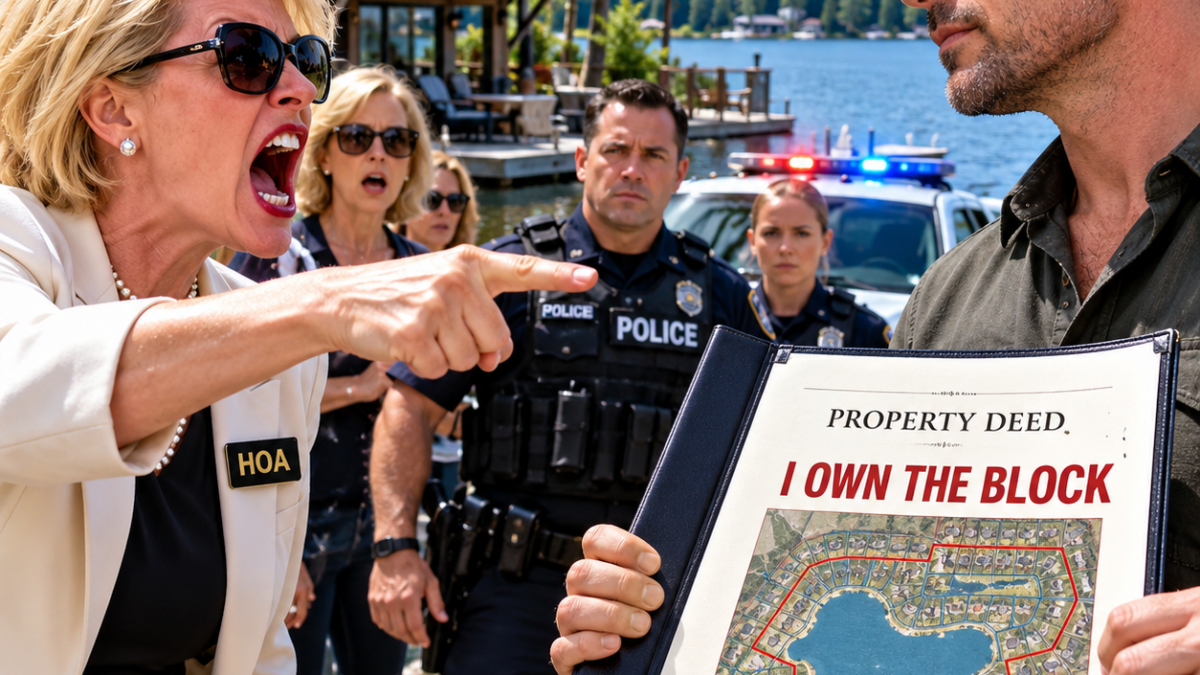
PART 2
The deputy’s name was Collins.
He looked young enough that I wondered how many HOA calls he’d already handled that week.
Probably too many.
He took my phone and enlarged the deed.
Then he glanced at the truck.
“It’s in your driveway?”
“Yes.”
Linda immediately interrupted.
“The rear portion extends toward lot four.”
Collins looked at her.
“And lot four belongs to?”
“The HOA.”
“No,” I said. “Apparently it belongs to me.”
Linda laughed.
Not loudly.
Just one short, dismissive sound.
“You bought the house.”
“I bought lots three through eight.”
The smile disappeared from her face.
Collins looked back at the deed.
“Six lots?”
“That’s what the legal description says.”
Linda shook her head.
“That’s impossible.”
I turned the phone toward her.
“Read it.”
She wouldn’t.
Instead she pointed toward the grass east of my house.
“Those parcels are designated community green space. We’ve maintained them for decades.”
Collins handed my phone back.
“Ma’am, even if there’s a boundary disagreement, this isn’t a 911 issue.”
“He is trespassing.”
“He has a deed.”
“To lot three.”
Collins sighed.
“You two may need a survey or attorneys to figure out where every boundary is, but a man unloading furniture into a house he owns is not an emergency.”
Linda’s cheeks reddened.
“We have HOA regulations.”
“Those are civil rules.”
“He’s violating them.”
“Then use your HOA process.”
Collins nodded toward me.
“Sir, finish your move.”
“Thank you.”
Then he looked at Linda.
“And please don’t use 911 for an HOA parking disagreement unless there’s an actual emergency.”
I almost felt embarrassed for her.
Almost.
Collins returned to his cruiser.
Linda stayed.
“You’ll be hearing from the board.”
“I’ll look forward to it.”
“You think this is funny?”
“No.”
I picked up another box.
“I think calling 911 on somebody for moving into a house they legally purchased was unnecessary.”
“We’ll see how unnecessary it feels when fines start accumulating.”
Then she stormed back toward the house next door.
I stood there for a few seconds.
The lake glittered beyond the trees.
My moving truck was half empty.
Cardboard boxes covered the driveway.
And somehow, less than an hour after arriving at the peaceful lake house I had dreamed about, I already had a feud with the HOA president.
I looked east.
Lot four.
Then five.
Six.
Seven.
Eight.
Five undeveloped parcels running along the water.
Grass.
Oaks.
Maples.
Shoreline.
I pulled up the deed again.
Lots 3, 4, 5, 6, 7, and 8.
Block A.
Lakeside Meadows subdivision.
There it was.
I smiled.
Linda could send whatever she wanted.
I had title.
At least, I thought that would be enough.
I underestimated her.
The first certified letter arrived three days later.
I had just finished unpacking my kitchen when I found the postal notice.
I drove into town, signed for the envelope, and opened it in the parking lot.
Lakeside Meadows Homeowners Association.
Official Notice of Violation.
Unauthorized commercial vehicle parked on community green space.
Encroachment on designated open-space property.
Failure to obtain HOA approval for moving activity.
Fine assessed.
Five hundred dollars.
I read the amount twice.
Then I laughed alone inside my truck.
Five hundred dollars.
For moving into my own house.
The letter also warned that continuing violations could produce additional fines and eventually a lien.
At the bottom was my appeal date.
April 15.
7:00 p.m.
Lakeside Meadows Community Center.
I drove home and called Tom.
“You busy Wednesday night?”
“My wife would argue I’m always busy. Why?”
“My HOA fined me.”
“You’ve lived there three days.”
“I work fast.”
“For what?”
“Moving in.”
Silence.
“Explain.”
I told him about Linda.
The police.
Lot four.
The alleged community green space.
The five-hundred-dollar fine.
When I finished, he said, “Bring your deed to the meeting.”
“I was planning to.”
“And don’t get angry.”
“Why does everybody assume I’m going to get angry?”
“Because I’ve represented you for nine years.”
Fair.
The Lakeside Meadows Community Center was exactly what you’d expect.
Vinyl siding.
Low ceiling.
Fluorescent lights.
Folding chairs.
Coffee that smelled like it had been made during the Reagan administration.
A dozen residents were scattered around the room when I arrived.
At the front sat Linda.
Beside her was Mark Stevenson, the vice president, a balding man in his early sixties who kept reorganizing a stack of papers.
Susan Garrett, the treasurer, sat on Linda’s other side.
She wore reading glasses on a chain and gave me a polite nod when I entered.
Linda didn’t.
She stared at me like I’d arrived carrying gasoline.
I took a chair in the front row.
The first thirty minutes were mundane.
Landscaping renewal.
Entrance sign repairs.
Treasurer’s report.
Then Linda straightened a folder.
“New business. Violation appeal for 123 Lakeshore Drive.”
I stood.
“That would be me.”
She motioned toward the front.
I stayed where I was.
Linda said, “Mr. Holloway was cited for parking a commercial vehicle on common property, specifically lot four.”
“It was a moving truck.”
“Commercial vehicles are prohibited.”
“I was moving into my home.”
“The purpose of the vehicle does not change its classification.”
Mark shifted uncomfortably.
I said, “And it wasn’t on HOA property.”
Linda pulled out a subdivision map.
She laid it on the table.
“This map clearly designates lot four as green space.”
I walked forward.
The map showed the lakefront lots.
Several had been shaded green by somebody.
Lots four through eight appeared to be labeled as open space or community green.
I studied it.
“What’s the recording number on this?”
Linda blinked.
“What?”
“The recording number.”
“This is the HOA map.”
“Is it the recorded plat?”
“It reflects the community’s land use.”
“That wasn’t my question.”
Her mouth tightened.
“The point is your truck crossed onto lot four.”
I looked around the room.
Then back at Linda.
“I own lot four.”
Nobody moved.
Linda stared.
“Excuse me?”
“I own lot four.”
I took my deed from a folder.
“And lot five.”
I placed it on the table.
“Lot six.”
Mark leaned forward.
“Seven.”
Susan reached for her glasses.
“And eight.”
Linda grabbed the deed before Susan could.
I pointed to the legal description.
“Lots three through eight. Six parcels.”
Susan leaned over Linda’s shoulder.
She read it once.
Then again.
“This is the probate transfer?”
“Yes.”
“Recorded?”
“Yes.”
“When?”
“Three weeks ago.”
Mark looked at me.
“So the estate sold all six?”
“Yes.”
Linda shook her head.
“No.”
Not “I don’t understand.”
Not “We need to verify.”
Just no.
“These lots belong to the community.”
I almost admired the confidence.
“Show me the deed.”
“We’ve used them for decades.”
“Show me the deed.”
“The HOA maintains them.”
“That isn’t a deed.”
“We mow them.”
“Still not a deed.”
“We hold community events there.”
“Also not a deed.”
Her voice rose.
“You can’t walk in after three weeks and claim property that’s been part of Lakeside Meadows for thirty years.”
“I didn’t walk in and claim it.”
I tapped the recorded deed.
“I bought it.”
Susan was still examining the document.
“Linda.”
“What?”
“This looks legitimate.”
Linda turned sharply.
“We need our attorney to review it.”
“Absolutely,” I said.
She glared at me.
Mark asked, “If Margaret Foster owned all six lots, why have we always considered them green space?”
“That,” I said, “is an excellent question.”
Linda closed the folder.
“Until this matter is resolved, you are not to interfere with community use.”
I laughed.
She leaned forward.
“I am serious.”
“So am I.”
“No fences.”
“Linda—”
“No construction. No signs. No restrictions on residents using the green.”
“You’re telling me I can’t use land that’s deeded to me.”
“We are protecting community assets until legal ownership is determined.”
“Legal ownership was determined at closing.”
“We disagree.”
“You haven’t even checked.”
Her face went cold.
“This board will investigate.”
Then she adjourned the meeting.
I walked outside with my deed under my arm.
The lake was black beyond the houses.
Porch lights reflected across the water.
I had bought that place expecting peace.
Instead I got into my truck and drove fifteen minutes to a bar.
Then I called Tom.
“I need you to investigate something.”
He laughed.
“I assume the meeting went well.”
“They’re claiming five of my lots belong to the HOA.”
“Do they have title?”
“Linda didn’t produce one.”
“Recorded plat?”
“She had some green-colored HOA map.”
“Brian.”
“Yeah?”
“Don’t do anything yet.”
“I wasn’t planning to.”
“That’s a lie.”
“Fine. I wasn’t planning to do anything tonight.”
“Better.”
“I want the original plat, HOA declaration, title chain, every recorded transfer, every easement, every license, every agreement involving lots four through eight.”
“I’ll look tomorrow.”
“And Tom?”
“Yes?”
“If they’re using my property, I want to know why.”
He called at ten the next morning.
“Brian.”
“You found something.”
“I found a lot.”
I sat on my deck with coffee.
“Go.”
“The subdivision was platted in 1968.”
“Okay.”
“Margaret Foster bought lots three through eight that same year.”
“All six.”
“Yes.”
“And the HOA?”
“Didn’t exist yet.”
I lowered my coffee.
“What?”
“Lakeside Meadows Homeowners Association was organized in 1975.”
“Seven years later.”
“Correct.”
“So they couldn’t have received the lots when the subdivision was created.”
“Exactly.”
He continued.
“The HOA declaration specifically identifies its common property. Entrance monument. Signage. A tot lot and playground in another block.”
“Lots four through eight?”
“Not mentioned.”
“Anywhere?”
“Nowhere.”
I looked east across the grass.
“So Linda is wrong.”
“Completely.”
“How did this happen?”
“I kept digging.”
Paper rustled.
“There are meeting minutes from the eighties referencing Margaret.”
“What do they say?”
“The neighborhood wanted to use her undeveloped lots for picnics and gatherings.”
“And?”
“They asked permission.”
I smiled.
“They asked.”
“Yes.”
“Which means they knew she owned them.”
“Yes.”
“And she said yes?”
“Apparently.”
Tom paused.
“I haven’t found the original permission letter yet. But the minutes clearly show the HOA recognized Margaret’s ownership.”
I looked toward the lake.
Decades of community use suddenly made sense.
Margaret had been generous.
People remembered the use.
They forgot the permission.
Then new residents arrived.
New boards took over.
The story changed from “Margaret lets us use those lots” to “those are our lots.”
Memory turned courtesy into entitlement.
“What now?” I asked.
“Survey first.”
“I’ll schedule one.”
“Photograph every HOA improvement on the lots.”
“Why?”
“Because if they built permanent structures on your land without permission, that matters.”
I stood.
“What structures?”
“You tell me.”
I spent the next hour walking east.
Lot four was mostly lawn.
Lot five had a wooden bench overlooking Lake Harmon.
Lot six had the surprise.
A white gazebo.
About ten feet square.
Shingled roof.
Posts set into concrete.
A plaque attached to one side.
LAKESIDE MEADOWS COMMUNITY GAZEBO
2018
BUILT WITH PRIDE BY OUR RESIDENTS
I stared at it.
They had built a permanent structure on Margaret’s property.
Then dedicated it to themselves.
Lot seven had another bench and a stone walking path.
The path continued through part of lot six.
Residents had been landscaping my property as though they owned it.
I photographed everything.
Wide shots.
Close-ups.
Plaque.
Foundation.
Path.
Bench locations.
Then I called Tom.
“There’s a gazebo.”
“How big?”
“Ten by ten.”
“Permanent?”
“Concrete footings.”
“Anything else?”
“Benches. Walking path.”
“Photograph all of it.”
“Already did.”
“Good.”
He paused.
“If Linda escalates, these become trespass issues.”
She escalated.
Of course she did.
The second violation arrived Friday.
This one was almost impressive.
Unauthorized claim to community property.
Interference with HOA operations.
Harassment of board members.
Additional fine: one thousand dollars.
Combined balance: fifteen hundred.
The letter threatened a lien.
I read it twice.
Then once more because I couldn’t quite believe somebody had typed it, printed it, signed it, and mailed it without stopping to ask whether it sounded insane.
They were fining me for claiming ownership of property I owned.
I called Tom.
“They sent another one.”
“How much?”
“A thousand.”
“For?”
“Claiming my own land.”
“That’s creative.”
“They’re threatening a lien.”
“That is less creative.”
“I want this stopped.”
“Survey is scheduled?”
“Monday.”
“I’ll prepare a demand letter.”
“No.”
“No?”
“Prepare the complaint too.”
“Brian.”
“They called the police on moving day. They fined me. I showed them my deed. They fined me again.”
“I know.”
“If they want a judge to explain ownership, let’s give them one.”
Tom was quiet.
“This could cost twenty or thirty thousand dollars before it’s finished.”
“I’m aware.”
“And you’ll be living next door to these people.”
“I bought a lake house for peace. Apparently peace requires paperwork.”
He laughed.
“Fine. Survey first. Demand letter Wednesday. If they don’t comply, we file.”
Ron Feldman arrived Monday with a three-person survey crew.
Tripods.
Total station.
GPS equipment.
Orange stakes.
For four hours they walked the property.
I stayed mostly out of the way.
By early afternoon, bright flags marked boundaries all the way along the shoreline.
Ron climbed the steps to my deck carrying a preliminary sheet.
“You’ve got exactly what your deed says.”
“Six lots?”
“Three through eight.”
“Total?”
“Twelve-point-three acres.”
“The gazebo?”
“Lot six.”
“Bench?”
“Lot five. Another on seven.”
“Walking path?”
“Crosses six and seven.”
“Any of it on HOA land?”
“No.”
He pointed toward Linda’s house farther east.
“Your eastern property boundary stops before lot nine. Everything west of that line through your house is yours.”
I stared at the stakes.
A straight chain of orange flags.
Proof planted in the ground.
“Full report by Friday?”
“You’ll have it.”
“Make it detailed.”
“Court?”
“Probably.”
Ron looked toward the gazebo.
Then toward my house.
“What happened?”
“HOA thought they owned half my property.”
He whistled.
“That’ll do it.”
Tom’s demand letter went out Wednesday.
The language was polite.
The message wasn’t.
Brian Holloway held recorded title to lots three through eight.
Recent survey confirmed approximately 12.3 acres.
The HOA had never acquired lots four through eight.
References to those parcels as community property were false.
The association was ordered to withdraw its fines.
Stop claiming ownership.
Cease unauthorized use.
Remove the gazebo, benches, and path within thirty days.
Correct statements made to residents.
If not, we would sue.
Tom called after sending it.
“That gives them an exit.”
“Think they’ll take it?”
“No.”
“Why give it?”
“Because judges like people who give idiots an exit.”
He was right.
Linda didn’t take it.
She found a bigger room.
The next evening, an email went to the entire neighborhood.
Subject:
URGENT — RESIDENT THREATENS COMMUNITY GREEN SPACE
Linda told residents a new homeowner was attempting to take five lakefront lots that the community had enjoyed for decades.
She said I wanted their gazebo removed.
Their benches gone.
Their shoreline access ended.
She claimed property values were under attack.
Then came the sentence that changed my relationship with the entire neighborhood.
We must stand together and refuse to let one investor steal our community’s land.
Investor.
Not homeowner.
Not neighbor.
Investor.
She made me sound like some developer who had appeared with bulldozers.
She called an emergency meeting for Saturday.
I forwarded the email to Tom.
His phone rang ten seconds later.
“You’re not going.”
“I’m going.”
“Brian.”
“She just told the entire neighborhood I’m stealing their park.”
“That room is going to be hostile.”
“Then they need facts.”
“You think eighty angry homeowners want title-law facts?”
“They’re getting them anyway.”
Long silence.
“Fine.”
“You don’t have to come.”
“I absolutely have to come now.”
The parking lot was full before ten Saturday morning.
Cars lined both sides of the street.
Tom and I walked in together.
The room had been designed for maybe fifty people.
There were closer to ninety.
Conversation stopped when I entered.
People stared.
Some whispered.
One woman shook her head.
A man near the aisle folded his arms.
Linda sat at the front with Mark and Susan.
Another man sat beside her.
Dark suit.
Red tie.
Briefcase.
Tom leaned toward me.
“Attorney.”
“Wonderful.”
Linda called the meeting to order.
Then she pointed toward me.
“That man is Brian Holloway.”
There are introductions.
And there are indictments.
This was the second kind.
“He recently purchased 123 Lakeshore Drive and is now claiming ownership of lots four through eight—our community green space.”
Murmurs.
“He has demanded that we remove the gazebo we built together.”
More murmurs.
“Benches.”
Someone muttered something.
“Walking paths.”
A woman near the front said, “Can he do that?”
Linda answered before anyone else could.
“We’re not going to let him.”
Applause.
Then her attorney stood.
“My name is David Brener. I represent Lakeside Meadows HOA.”
He began explaining adverse possession.
Open use.
Continuous use.
Long duration.
Improvements.
Maintenance.
Residents nodded.
It sounded persuasive.
Until he reached “hostile.”
Tom stood.
“That’s incomplete.”
Brener looked toward us.
Tom continued.
“Adverse possession requires hostile use. Use with the owner’s permission is not hostile.”
Linda’s expression hardened.
Brener said, “We disagree regarding the nature of the historic use.”
I stood.
The room reacted immediately.
Someone shouted, “Sit down.”
Another voice said, “Let him talk.”
I waited.
“My name is Brian Holloway.”
A few people laughed bitterly.
“I bought 123 Lakeshore Drive from Margaret Foster’s estate.”
A man called out, “You bought a house.”
“No.”
I held up a certified deed copy.
“I bought six lots.”
The room became quieter.
“Lots three through eight.”
Somebody yelled, “Those are our parks.”
“They were never your parks.”
That triggered shouting.
Linda banged a small gavel.
I raised my voice only enough to be heard.
“Anyone here can verify this at the county recorder’s office.”
Linda held up photographs.
“Then explain this.”
The first showed children at a birthday party beside the gazebo.
Balloons.
Cake.
Families.
Another showed an elderly couple renewing wedding vows near the lake.
Another showed a Fourth of July gathering.
Blankets spread across the grass.
Children holding sparklers.
Neighbors smiling beneath summer trees.
For the first time, I understood why this fight felt personal to people who had never met me.
Those weren’t just parcels to them.
Those lots held memories.
Linda knew exactly what she was doing.
“This is our community,” she said.
Her voice cracked at exactly the right moment.
“We built that gazebo together.”
Someone shouted, “Damn right.”
“Families have celebrated there for decades.”
Applause.
She pointed at me.
“And now he wants to take it.”
I waited until the room settled.
Then I said, “I’m not taking anything.”
A woman near the front laughed.
“I purchased land that belonged to Margaret Foster.”
Linda shook her head.
“Thirty years of community use.”
“Because Margaret allowed it.”
The room quieted.
Linda froze.
It was only a fraction of a second.
But Tom saw it too.
I continued.
“The HOA’s old meeting minutes show that the board asked Margaret Foster for permission to use those parcels.”
Brener stood.
“Historic permission, if it existed, does not necessarily—”
Tom cut him off.
“It exists.”
Brener looked at him.
“We have the meeting records.”
I continued.
“Margaret owned the land. She let neighbors enjoy it. That’s generosity. It isn’t a transfer of title.”
Linda raised the gavel.
“We’re not litigating this here.”
“You started litigating it when you told everyone I was stealing from them.”
The room erupted.
Brener stood between us verbally, if not physically.
“The HOA intends to seek judicial confirmation of its rights.”
“Good,” I said.
Linda’s eyes narrowed.
“Good?”
“Yes.”
I held up the deed.
“Let’s have a judge answer one question.”
I looked around the room.
“Do you have a deed showing the HOA owns those lots?”
Nobody answered.
Not Linda.
Not Mark.
Not Susan.
Not Brener.
Finally Linda said, “We have thirty years of possession.”
Tom replied, “With permission.”
Brener shook his head.
“We’ll let the court decide.”
Linda immediately seized on that.
“We are filing.”
The crowd applauded.
Then she announced a legal fund.
Hands went up.
People asked how much.
Where to send money.
How to stop development.
Tom touched my shoulder.
“We’re done here.”
We walked toward the exit.
Boos followed us.
A few people shouted thief.
One man near the back caught my eye.
Maybe seventy.
Gray hair.
He didn’t speak.
He just gave me the smallest nod.
That nod mattered.
It told me facts still existed somewhere inside that room.
Even if they had been drowned out by emotion.
The vandalism started that night.
Every survey stake along lots four through eight disappeared.
Thirty-six markers.
Pulled up.
Several were thrown into Lake Harmon.
My PRIVATE PROPERTY signs were ripped down.
And someone splashed red paint across the hood and windshield of my truck.
I stood in the driveway Sunday morning staring at it.
There is anger.
Then there is the moment anger goes cold.
Mine went cold.
I called the sheriff.
Deputy Collins returned.
He recognized me immediately.
“You again.”
“Unfortunately.”
He looked at the truck.
“Okay. This isn’t an HOA parking complaint.”
“No.”
He photographed the paint.
The missing signs.
The holes where stakes had been.
“Any cameras?”
“Not yet.”
“Get some.”
“Already ordered.”
“Can you prove who did it?”
“No.”
“Any threats?”
“Nothing direct.”
He nodded.
“I’ll file vandalism and criminal mischief reports, but without video or witnesses, I can’t attach a name.”
“I understand.”
He looked toward Linda’s house.
“She held that meeting yesterday?”
“Yes.”
“Doesn’t prove she did this.”
“I know.”
“I need you to hear me say that.”
“I did.”
Collins relaxed slightly.
“This thing is getting ugly.”
“It didn’t have to.”
“No argument there.”
The body shop estimated twelve hundred dollars.
I added the receipt to a folder.
Survey replacement costs.
Truck repairs.
Signs.
Attorney invoices.
Every dollar.
Every hour.
If Linda wanted a legal war, I intended to arrive with records.
Tom found the letter two weeks later.
I was in his office when he placed it in front of me.
The paper was yellowed.
The handwriting elegant.
May 1987.
Dear Lakeside Meadows HOA Board,
Thank you for your letter regarding use of the open lots adjacent to my property.
I am pleased to allow the community to continue enjoying these spaces for neighborhood gatherings and recreation.
You may use the lots for picnics, informal sports, and community events provided the areas are kept clean and no permanent structures are installed.
Warm regards,
Margaret Foster.
I read it twice.
Then I looked at Tom.
“That’s it?”
“That’s it.”
“Adverse possession?”
“Dead.”
“Completely?”
“As cleanly as I’ve seen.”
He sat opposite me.
“Adverse possession requires hostility. Margaret expressly gave permission.”
“And the gazebo?”
“Built in direct violation of that permission.”
I looked at the signature again.
Margaret had been generous.
She had shared her shoreline.
For years, the HOA understood that.
Then somebody forgot.
Then everybody forgot.
Then Linda converted forgetting into ownership.
“How did you find this?”
“In their own records.”
I laughed.
“Their own file kills their case.”
“Yes.”
“Does Linda know?”
“She will in discovery.”
“What else did you find?”
Tom leaned back.
“Original plat.”
He unfolded a blueprint.
Twelve shoreline lots.
One through twelve.
No green-space designation across my parcels.
No park.
No common ownership.
Then he produced the 1975 HOA declaration.
Common property was identified specifically.
Entrance monument.
Signage.
Tot lot in another block.
Nothing east of my house.
Nothing on lots four through eight.
“Brian, your title is about as clean as title gets.”
“So why are we still fighting?”
“Because Linda isn’t really fighting title.”
I frowned.
“What is she fighting?”
“We’ll find out.”
We filed first.
Brian Holloway v. Lakeside Meadows Homeowners Association.
Declaratory judgment.
Trespass.
Removal of unauthorized structures.
Damages.
Attorney fees where recoverable.
Injunction against interference with my property rights.
The HOA filed its adverse-possession claim.
Discovery began.
That’s when things changed.
Up until then, I thought Linda was stubborn.
Maybe arrogant.
Maybe embarrassed.
Then Tom subpoenaed board correspondence.
Emails.
Internal messages.
Financial records.
Meeting minutes.
That’s when we learned what she was actually protecting.
Her deposition was Tuesday morning.
She arrived with Brener.
Mark and Susan came too.
Tom began with easy questions.
Address.
Length of residency.
Year she became president.
Then:
“Ms. Chen, when did the HOA acquire lots four through eight?”
“They’ve always been community property.”
“What year?”
“They were part of the subdivision.”
“Do you have a deed?”
She crossed her arms.
“They’re designated green space.”
“Do you have a deed?”
“No.”
“Have you ever seen one?”
“No.”
“Did you look for one before calling 911 on Mr. Holloway?”
Brener shifted.
Linda said, “I didn’t think that was necessary.”
Tom put the original plat in front of her.
“Show me where lots four through eight are identified as common space.”
She studied the page.
“They’re not marked here.”
“Correct.”
Then the HOA declaration.
“Show me where your founding document lists those lots as HOA property.”
Another long silence.
“It doesn’t.”
“So what was your basis?”
“Thirty years of community use.”
“Use and ownership are different, aren’t they?”
Brener objected.
Tom moved on.
Then came Margaret’s letter.
Linda’s face changed when she saw it.
“Do you recognize this?”
“No.”
“It’s from your HOA’s archives.”
She read it.
Her lips pressed together.
Tom said, “Margaret Foster expressly gave the HOA permission to use her land.”
Linda said nothing.
“She prohibited permanent structures.”
Still nothing.
“Your association built a gazebo anyway.”
“We believed we owned the land by then.”
“Based on what?”
No answer.
Tom waited.
Then he changed direction.
“Where do you live?”
Linda frowned.
“487 Lakeshore Drive.”
“Lot eleven?”
“Yes.”
“Lakefront?”
“Yes.”
“Do you currently have a view across lots four through eight?”
She hesitated.
“Yes.”
“If homes were built on Mr. Holloway’s lots, would part of your lake view disappear?”
Brener leaned forward.
“Relevance.”
“Bias and financial interest.”
“Go ahead,” the court reporter noted after the attorneys agreed to preserve the objection.
Linda answered.
“Probably.”
“What would that do to your home’s market value?”
“I don’t know.”
Tom slid a printed email across the table.
I had already seen it.
Linda hadn’t seen that we had it.
Her face turned white.
Tom read the relevant sentence.
If Holloway builds those lots, half the lakefront homes lose their views. My property alone could drop fifty to seventy-five thousand dollars. We need to claim adverse possession, tie him up in court, assess fines, and make this expensive enough that he gives up or settles.
Tom looked at her.
“Did you write that?”
Linda stared at the paper.
Brener whispered to her.
Tom repeated the question.
“Did you write it?”
“Yes.”
The room felt different after that.
“Your own treasurer told you Mr. Holloway’s deed appeared valid, correct?”
Linda didn’t answer.
Tom produced another email.
Susan Garrett to Linda and Mark:
I reviewed his deed. It appears legitimate. We need to stop issuing fines and speak with counsel before this gets worse.
Then Linda’s response.
No. We fight. I’m not losing my view because some investor bought cheap land.
Tom looked at Linda.
“Your words?”
“Yes.”
“So when you told eighty homeowners that Mr. Holloway was stealing their park, you already knew your treasurer believed his deed was legitimate.”
“I believed there were other legal arguments.”
“You also had a personal financial interest in preventing development.”
“I was protecting property values for everyone.”
“But your email specifically mentions your own seventy-five-thousand-dollar loss.”
“That was an example.”
“Did you disclose that personal financial interest at the emergency community meeting?”
“No.”
“Did you tell homeowners you wanted to fine Mr. Holloway to pressure him into surrendering development rights?”
“No.”
“Did you tell them your own treasurer recommended stopping the fines?”
“No.”
Tom leaned back.
“One final question.”
Linda stared at him.
“If Mr. Holloway had agreed never to build on lots four through eight, would you have continued pursuing HOA ownership?”
Brener immediately objected.
Linda answered anyway.
“Probably not.”
Tom looked at me.
That was the moment the case stopped being about a mistaken map.
It became about leverage.
Linda knew what I owned.
And once she realized my ownership threatened the view from her own home, she decided the HOA should make ownership painful enough that I’d surrender.
She had written it down.
Not every board member followed her.
Susan resigned before trial.
But before she did, she provided the records Tom requested.
Mark became increasingly quiet.
Then residents started doing what Linda should have done from the beginning.
They checked.
Tom and Jessica Winters lived on lot nine.
They had booed me at the emergency meeting.
One evening, Jessica called.
“Mr. Holloway?”
“Yes.”
“This is Jessica Winters.”
I recognized the name.
“We owe you an apology.”
I didn’t know what to say.
She continued.
“We believed Linda.”
“Most people did.”
“We pulled the county records ourselves.”
I waited.
“You own the lots.”
“Yes.”
“My husband found Margaret Foster’s old permission letter too.”
“Yes.”
Jessica’s voice cracked slightly.
“We paid five hundred dollars into that gazebo project.”
“I know.”
“We thought it was community property.”
“I know.”
“We helped pay to build something on your land.”
“On Margaret’s at the time.”
“Without permission.”
“Correct.”
She exhaled.
“I’m sorry we called you a thief.”
That one mattered.
“Thank you.”
Her husband got on the phone.
“My name’s Tom Winters.”
“I’m aware.”
“We’re organizing a petition.”
“For what?”
“No-confidence vote against Linda.”
I leaned back.
“That’s an HOA matter.”
“She lied to us.”
“That is also an HOA matter.”
“She used our fear about losing the park to protect her own view.”
“That sounds more relevant.”
“We have forty signatures.”
“Tom, I don’t want to control your board.”
“You’re not.”
“I don’t want anyone claiming I manipulated the election.”
“Understood.”
“Then keep me out of it.”
“We will.”
Three days later, they had forty-three signatures.
Linda refused to schedule the special meeting.
Tom and Jessica cited the bylaws requiring one when more than twenty-five percent of members petitioned.
Suddenly Lakeside Meadows had two wars.
The HOA versus me.
And the residents versus their own president.
I wanted neither.
But Linda had created both.
The preliminary hearing came in June.
Judge Marilyn Torres had clearly read everything before entering the courtroom.
That became obvious almost immediately.
Brener argued that community use had continued long enough to establish rights despite Margaret’s old permission.
Judge Torres looked at him.
“Counselor, permissive use is not hostile use.”
“The community’s conduct changed over time.”
“When?”
“The installation of improvements demonstrates a claim of ownership.”
“You mean the gazebo?”
“Yes.”
“The gazebo built in violation of Mrs. Foster’s instruction prohibiting permanent structures?”
Brener paused.
“Yes, Your Honor, but—”
“That sounds more like potential trespass than proof of title.”
I looked at Tom.
He didn’t smile.
He didn’t need to.
Judge Torres continued.
“I’m not making the final title judgment today. But the adverse-possession theory fails on hostility.”
She looked directly at Brener.
“Mrs. Foster granted permission.”
Linda stood.
“Your Honor, we’ve used those lots for decades.”
Judge Torres turned.
“Ms. Chen, please sit down.”
Linda froze.
Then sat.
“Length of use does not convert permissive use into ownership merely because later residents forgot who granted the permission.”
That sentence could have ended everything.
It should have.
The HOA could have settled.
Removed the gazebo.
Apologized.
Paid reasonable costs.
Instead Linda insisted on continuing toward trial.
Tom called me outside the courthouse.
“We just won the biggest legal issue.”
“Then why am I not happy?”
“Because Linda doesn’t know when she’s lost.”
“What happens now?”
“Trial on title confirmation, trespass, structures, damages.”
“When?”
“August.”
“Fine.”
He looked at me.
“You’re getting good at saying that.”
“I’ve had practice.”
The trial began on a Tuesday.
The gallery was full.
I recognized people who had booed me in April.
Some still wouldn’t look at me.
Others nodded.
Tom and Jessica sat behind us.
The older gentleman who had silently nodded at the first meeting was there too.
Linda sat with Brener.
Mark sat nearby.
Susan did not.
Judge Torres entered at nine.
“This matter concerns lots three through eight, Lakeside Meadows subdivision.”
She looked at both tables.
“The adverse-possession claim has already been rejected. Today we address title, trespass, damages, and remedy.”
Tom stood.
“This case became complicated only because the defendants refused to accept a simple fact.”
He lifted my deed.
“Brian Holloway owns the land.”
Our first witness was Patricia Morris, a title examiner.
She walked the court through fifty-eight years of ownership.
Subdivision created.
Margaret bought all six lots in 1968.
Held them until death.
Estate transferred them to me.
No deed to the HOA.
No easement conveying ownership.
No gap.
No cloud.
No competing chain.
Tom asked, “In your professional opinion, who owns lots three through eight?”
“Brian Holloway.”
Brener tried to emphasize community reliance.
Patricia didn’t care.
Title examiners live in a world where sentiment doesn’t alter recording books.
Our second witness was the surveyor, Ron.
He established the physical boundaries.
Gazebo: lot six.
Bench: five.
Second bench: seven.
Path: six and seven.
My driveway: entirely within the parcels conveyed to me.
Linda’s original 911 claim collapsed all over again.
Then came an appraiser.
He valued the total twelve-point-three acres between $425,000 and $475,000.
Developed individually, the lakefront parcels could support homes worth substantially more.
A murmur moved through the gallery.
For years, residents had thought of that shoreline as free community lawn.
Suddenly they understood it was valuable private real estate.
Then Tom introduced Margaret’s letter.
Judge Torres read it again.
“No permanent structures,” she said.
She looked toward the defense table.
“Yet the gazebo was constructed in 2018.”
Brener argued that the later HOA believed ownership had changed.
Judge Torres asked for the deed showing that change.
He didn’t have one.
No one did.
Because it didn’t exist.
Linda testified in the afternoon.
Under Brener’s questioning, she became the community protector again.
She described Fourth of July parties.
Birthdays.
Weddings.
Neighbors donating money.
Children running through the grass.
“Did you intend to steal land from Mr. Holloway?”
“No.”
“Did you believe the HOA owned the green space?”
“Absolutely.”
“Did the community rely on that belief?”
“For decades.”
Then Tom stood.
He didn’t attack.
He documented.
“Before spending HOA money on the gazebo, did you obtain a title report?”
“No.”
“Did the board obtain one?”
“Not that I know.”
“Did you review the recorded plat?”
“No.”
“Did you verify lots four through eight appeared in the declaration as common property?”
“No.”
“You spent association money anyway.”
“We believed it was ours.”
“You collected a special assessment?”
“Yes.”
“How much?”
“Five hundred dollars per household.”
“How many households?”
“Most of the community.”
“And only part of that money went into the actual gazebo?”
“Yes.”
“Did you tell residents ownership had never been verified?”
“No.”
Then Tom displayed her emails on the courtroom screen.
Linda stared straight ahead.
My property alone could drop fifty to seventy-five thousand.
Tie him up in court.
Make it expensive.
Assess fines to pressure him.
Eventually he’ll settle.
The room behind me became absolutely silent.
Tom asked, “Is this your email?”
“Yes.”
“You knew Mr. Holloway had a recorded deed.”
“I knew he had documents.”
“Your treasurer said the deed was legitimate.”
“She isn’t a lawyer.”
“Neither are you.”
Brener objected.
Sustained.
Tom continued.
“You told residents Mr. Holloway was stealing community land.”
“I believed he was.”
“After seeing the deed?”
“I believed the HOA had rights based on historic use.”
“After your own treasurer warned you?”
“Yes.”
“After your counsel had access to the title records?”
“Yes.”
“And throughout that time, you knew development could reduce your personal property value by as much as seventy-five thousand dollars.”
“I was concerned about everyone’s values.”
“But you wrote about yours.”
“Yes.”
“Did you disclose that at the community meeting?”
“No.”
Tom stepped closer to counsel table.
“Why not?”
Linda’s voice lowered.
“I didn’t think it mattered.”
“It mattered enough to put in your private email.”
She looked at him.
Then she said something I think she immediately regretted.
“I wasn’t going to sit there while some investor came in and ruined everything.”
Tom glanced at me.
Then back at her.
“Mr. Holloway lives in the house.”
“I know.”
“He bought it to live there.”
“That’s what he says.”
“Did you have evidence otherwise?”
“No.”
“So you called him an investor because it made him easier for your neighbors to oppose.”
“No.”
“You described him as stealing land.”
“I believed—”
“You knew he had a deed.”
Silence.
“Correct?”
“Yes.”
That was enough.
Tom and Jessica testified next.
Tom Winters explained what happened after residents began checking public records.
“I believed Linda at first.”
“What changed?”
“The documents.”
“What documents?”
“The deed. The declaration. The original subdivision plat. Margaret Foster’s permission letter.”
“And your view after reading them?”
“We never owned those lots.”
Jessica testified next.
Tom asked how she felt when she discovered Linda’s private emails.
“Betrayed.”
“Why?”
“Because she told us Brian was threatening our community.”
Jessica glanced toward me.
“We were angry at him. Some of us yelled at him. I did.”
She swallowed.
“Then we found out Linda knew the real issue was partly her own view and property value.”
Brener asked, “Don’t you benefit from preserving the open lots too?”
“Yes.”
“Then you also have a financial interest.”
Jessica nodded.
“Of course.”
Brener smiled slightly.
“So you’re not neutral.”
“No.”
Then Jessica added:
“The difference is I’m admitting it.”
A few people in the gallery laughed before Judge Torres quieted them.
Brener didn’t ask another question.
Closing arguments came on the third day.
Brener no longer had adverse possession.
So he argued equity.
The community had relied on those lots for decades.
Families had memories there.
The gazebo served residents.
Removing it would be wasteful.
I had purchased property worth far more than I paid.
The court should balance strict ownership rights against longstanding expectations.
Tom stood after him.
“Your Honor, equity does not require Brian Holloway to surrender private land because other people enjoyed it.”
He placed Margaret’s letter on the lectern.
“Mrs. Foster was generous.”
Then my deed.
“The HOA mistook generosity for ownership.”
Then Linda’s email.
“And when Mr. Holloway proved the mistake, its president didn’t correct it. She decided to make ownership expensive enough that he would surrender.”
He looked toward Judge Torres.
“This court does not need to punish community memories.”
Then toward the gazebo photographs.
“But neither should it convert those memories into title.”
He sat down.
Judge Torres reviewed her notes.
Twenty minutes felt like an hour.
Then she looked up.
“The evidence regarding ownership is unambiguous.”
My chest tightened.
“Brian Holloway owns lots three through eight.”
A sound moved through the gallery.
“The HOA never acquired title.”
Linda stared down at the table.
“The association’s longstanding use originated by express permission from Margaret Foster. That permission defeats the theory of hostile possession.”
Judge Torres lifted Margaret’s letter.
“Moreover, Mrs. Foster expressly prohibited permanent structures.”
She looked at Linda.
“The gazebo violated that condition.”
Linda’s face went pale.
Then came the judgment.
My title was confirmed.
The HOA had sixty days to remove the gazebo, benches, and walking-path improvements from my property.
The association was permanently barred from representing lots four through eight as its common property.
Fifteen thousand dollars in damages.
Twenty-eight thousand dollars in attorney-fee reimbursement.
Forty-three thousand total.
Then Judge Torres addressed Linda directly.
“Ms. Chen, association officers have fiduciary responsibilities.”
Linda looked up.
“The documentary record indicates that your personal financial interest in preserving your view influenced your decision to continue litigation after substantial evidence established Mr. Holloway’s ownership.”
Linda started to speak.
Judge Torres raised a hand.
“You may disagree with the court’s conclusion. You may not interrupt it.”
Linda closed her mouth.
“You called police over private property you had not verified. You assessed fines after receiving a recorded deed. You encouraged residents to fund litigation while failing to disclose your personal financial interest.”
The judge paused.
“That is not responsible association governance.”
Then the gavel came down.
Case over.
I had won.
But the strangest thing happened.
I didn’t feel like celebrating.
I felt tired.
Months of strangers glaring at me.
Court filings.
Police reports.
Paint damage.
Depositions.
Attorney invoices.
All because one woman had refused to ask the easiest question in property law.
Who owns it?
Tom touched my shoulder.
“Brian.”
“Yeah?”
“You won everything.”
I looked toward Linda.
She was gathering papers without speaking to anyone.
“I know.”
“Try looking happy.”
“I’ll work on it.”
The neighborhood moved faster than the court order.
That Saturday, eighty-seven residents attended an emergency meeting.
This time Linda wasn’t controlling the agenda.
Tom Winters was.
The vote to remove her from office wasn’t close.
Linda lost the presidency.
A new board was elected.
Tom Winters became president.
Jessica became treasurer.
Their first official action was to comply with the judgment.
The gazebo came down the following Tuesday.
Not destroyed.
Dismantled.
Piece by piece.
The new board moved it to the HOA’s actual common property near the playground.
The benches went too.
The stone walking path was removed from my parcels.
By the end of August, the shoreline looked almost the way it must have looked when Margaret owned it.
Open grass.
Trees.
Water.
No community structures.
No signs claiming HOA ownership.
I stood where the gazebo had been.
There was only a rectangle of disturbed soil.
For months, I had imagined that moment.
I thought it would feel like revenge.
Instead it felt like a question.
What now?
I owned five undeveloped lakefront parcels in addition to my house.
I could build.
Nothing prevented me from doing it.
Five homes.
Five driveways.
Fences.
Private docks.
I could erase every open view Linda had tried so desperately to protect.
Financially, it made sense.
The land had appreciated enormously.
Developing all five lots could produce well over a million dollars in value.
I had spent my career doing exactly that kind of calculation.
Acquire.
Improve.
Sell.
Move on.
But that wasn’t why I’d bought Lake Harmon.
I bought it because after twelve years of chasing the next project, I wanted one place that didn’t have an exit strategy.
I wanted coffee on a deck.
A fishing rod.
A dock.
Quiet weekends.
I had no interest in turning my own peace into another subdivision.
Three days after the gazebo moved, Tom and Jessica Winters asked to meet me.
We met in a coffee shop.
Tom looked nervous.
“We know you won.”
“That part has been explained to me repeatedly.”
Jessica smiled.
“We also know you have every right to build.”
“Yes.”
“And the neighborhood is terrified you will.”
I leaned back.
“Linda spent months telling them I would.”
“Some of that fear stayed.”
“What are you asking?”
Tom opened a folder.
“A conservation arrangement.”
I listened.
“You keep ownership,” he said. “But certain lots remain undeveloped permanently.”
“Why would I give up development rights?”
“You don’t have to.”
“Then what’s the offer?”
Jessica leaned forward.
“We want to find one.”
I looked at them.
She continued.
“We were wrong about you.”
“Linda lied.”
“We still believed her without checking.”
“That part is yours.”
“I know.”
Her honesty mattered.
Tom said, “You fought because she tried to take away your ownership. Not because you desperately want five more houses.”
He wasn’t wrong.
“If the community recognizes that the land is yours, compensates you for some of the development value, and the agreement is voluntary…”
He paused.
“Would you consider keeping part of it green?”
I looked out the coffee-shop window.
For the first time since moving to Lake Harmon, somebody from the HOA was asking rather than telling.
That difference mattered more than they probably understood.
“I’ll think about it.”
I met with my attorney Tom Chen the next week.
“Yes,” having two Toms in the story became annoying.
Attorney Tom looked at the conservation idea.
“It can work.”
“I keep title?”
“Yes.”
“But donate or restrict development rights on selected parcels.”
“Correct.”
“Permanent?”
“If structured as a conservation easement, yes.”
“What does that mean financially?”
He ran numbers.
Potential charitable tax treatment depending on appraisal and structure.
Reduced future development value.
But preservation of the lakefront setting around my home.
“Which lots would you protect?” he asked.
“Four, five, and six.”
“Closest to your house.”
“Yes.”
“And seven and eight?”
“I keep full rights.”
He nodded.
“That makes sense.”
“Compensation?”
“The HOA can’t buy the full development value. They just lost forty-three thousand.”
“What can they afford?”
“Maybe fifty thousand.”
I thought about it.
Three lots protected.
Two retained.
All fines permanently deleted.
Public written acknowledgment that lots four through eight belonged to me.
Clear access rules.
No permanent structures without my written permission.
“That works.”
Attorney Tom smiled.
“You’ve gone soft.”
“No.”
“You could make a fortune building five houses.”
“I already made enough money building houses.”
“Then what are you buying with the difference?”
I thought about the deck.
The lake.
Kids playing under the trees.
Margaret Foster letting neighbors picnic on her land for decades.
“Quiet.”
He nodded.
“That’s expensive.”
“So were you.”
He laughed.
The new HOA board presented the proposal in September.
I attended remotely.
Tom Winters explained it.
Lots four, five, and six would remain protected open land.
The HOA and residents would receive defined access with my permission.
No claim of ownership.
No permanent structures.
Lots seven and eight remained fully mine.
The HOA would pay fifty thousand dollars as compensation toward the lost development opportunity.
All fines against me would be formally rescinded.
The board would issue a public correction stating that the previous claims of HOA ownership were false.
One board member asked the obvious question.
“Why are we paying him? He already won.”
Jessica answered.
“Because he’s giving us something.”
Silence.
“He could put houses on all five lots.”
Nobody argued with that.
“We have no legal right to stop him.”
Still silence.
“He’s offering to protect three forever.”
The board voted unanimously to put the agreement before the membership.
The community meeting drew more people than Linda’s emergency meeting.
But the mood was completely different.
No boos.
No accusations.
No speeches about theft.
People asked practical questions.
Would they still be able to walk the shoreline?
Yes, under defined rules.
Could children play there?
Yes.
Picnics?
Yes.
Could another gazebo be built?
Not without my written approval.
Could I later change my mind and build?
Not on the three protected lots once the conservation easement was recorded.
“What happens if we reject the deal?” someone asked.
Tom Winters answered.
“Brian retains every development right he has today.”
A man near the wall said, “Meaning houses.”
“Yes.”
“How many?”
“Potentially five additional lakefront homes.”
The vote wasn’t close.
The community chose the agreement.
The same people who had once shouted that I was stealing their park now voted to pay me in exchange for preserving part of my own land.
It wasn’t humiliation.
It was correction.
There’s a difference.
I wanted them to understand ownership.
I didn’t need them on their knees.
Linda wasn’t there.
After the verdict, she stopped attending community events.
She rarely left her house except for work and errands.
I heard from Jessica that Linda still insisted the court had ruled on a technicality.
That word amused me.
A deed is a technicality.
A title search is a technicality.
A property line is a technicality.
A contract is a technicality.
Until someone wants what belongs to you.
Then technicalities become boundaries.
Linda listed her house in November.
She had once written that development on my parcels might cost her fifty to seventy-five thousand dollars in value.
Ironically, I never developed the three lots that most affected her view.
But the lawsuit and neighborhood fallout had done their own damage.
Her house sat on the market for weeks.
Then months.
It eventually sold for substantially less than she had expected.
She moved out on a cold Saturday morning the following February.
I watched the moving truck from my deck.
That detail wasn’t lost on me.
The first day Linda met me, she called 911 because of my moving truck.
Now another moving truck sat in front of her house.
Nobody called the police.
Nobody fined her.
Nobody told her she had five minutes.
She loaded her belongings.
Closed the garage.
Got into her car.
And left.
I expected satisfaction.
Maybe even a sense of poetic justice.
Instead I just watched the truck disappear beyond the entrance sign.
Then I went inside and made coffee.
The fight was over.
There was no reason to keep carrying it.
The conservation easement was recorded in late October.
I went to the county recorder’s office with Tom Winters, Attorney Tom, and the final documents.
Lots four, five, and six.
Roughly seven acres.
Protected.
Forever.
I retained title.
Future owners would retain title.
But no houses.
No apartment buildings.
No commercial structures.
No surprise subdivision.
The land would stay open.
The clerk slid the documents toward me.
“You understand this binds future owners?”
“Yes.”
“You can’t simply revoke it later.”
“I understand.”
“You’re giving up valuable development rights.”
“I know.”
She smiled.
“Most property disputes I see end with somebody trying to squeeze every possible dollar from the land.”
“I already tried squeezing money from houses for twelve years.”
“So why do this?”
I looked through the recorder’s office window.
I couldn’t see Lake Harmon from there.
But I pictured it.
“Because I bought that place to stop.”
She nodded.
I signed.
Four copies.
Stamp.
Seal.
Recording number.
Done.
The seven acres Linda had tried to keep under HOA control were now protected permanently.
But there was one enormous difference.
It happened with my consent.
My signature.
My decision.
Nobody took anything from me.
I chose.
That’s what ownership meant.
The HOA’s fifty-thousand-dollar payment arrived the following week.
With the fifteen thousand in damages and twenty-eight thousand in legal reimbursement, I’d recovered ninety-three thousand dollars in cash related to the dispute.
More importantly, every fine had been removed.
The HOA issued a written correction.
Lots four through eight were privately owned.
The association had no ownership interest.
Any access to the protected parcels existed because I granted it.
That statement went to every household.
I printed a copy.
Not because I needed to gloat.
Because after the year I’d had, I liked keeping documents.
I decided to do something with lot seven.
Not a giant luxury house.
Not a spite fence.
Not a three-story structure positioned precisely to ruin somebody’s sunset.
A small guest cottage.
Nine hundred square feet.
Two bedrooms.
One bathroom.
Covered porch.
Trees preserved around it.
An architect friend helped me design it.
Rustic enough to fit the lake.
Simple enough that I didn’t feel like I was back at work.
Permits were approved.
Construction began in winter.
By spring, the cottage was finished.
The first time I sat on its porch, I could see the protected grass stretching west toward my main house.
Children were tossing a football on lot five.
Their parents walked the shoreline.
Nobody was trespassing.
The conservation agreement allowed community recreation under defined conditions.
The difference from before was invisible.
But important.
They were there because I said yes.
Not because someone had forgotten they needed permission.
Lot eight went to Tom and Jessica Winters.
Market value was higher than what I charged them.
I didn’t care.
They had stood up in a room full of neighbors and admitted they had been wrong.
Then they did the harder thing.
They helped repair the damage.
I sold them the parcel below market.
Jessica stared at the contract.
“Brian, this is too low.”
“No.”
“You could get at least twenty-five thousand more.”
“I know.”
“Then why?”
“Because the first eighty people who yelled at me were easy to remember.”
I looked at Tom.
“You two were among the first who came back and apologized.”
Jessica smiled.
“That’s worth twenty-five thousand?”
“To me.”
They built a modern lake house with wide windows and solar panels.
When they moved in, we had dinner together.
Their children ran through the same open grass where other children had played for decades.
Margaret Foster would probably have liked that.
At least I hoped so.
Months later, a local reporter called.
I almost hung up.
She said she wasn’t interested in another “HOA horror story.”
That got my attention.
“What are you interested in?”
“How a neighborhood used land for decades without owning it.”
“That’s less exciting.”
“It’s more useful.”
She interviewed Attorney Tom.
Tom Winters.
Jessica.
Ron the surveyor.
County-record staff.
She asked me one question at the end.
“What was Linda’s biggest mistake?”
I thought about it.
Not the 911 call.
Not the fine.
Not the lawsuit.
Not the gazebo.
“Assuming,” I said.
“Assuming what?”
“That using something long enough makes it yours.”
The article eventually ran under a headline about an HOA’s expensive title mistake.
Other associations in the county started reviewing their own common-property records.
Attorney Tom told me three discovered land they had been maintaining but didn’t actually own.
Unlike Lakeside Meadows, they contacted the owners.
Negotiated.
Recorded agreements.
Nobody called 911.
Nobody spent months in court.
Amazing what happens when people ask before they act.
About a month after the conservation agreement was recorded, I was building a stone fire pit near the A-frame when a sedan pulled into my driveway.
A woman stepped out.
Mid-fifties.
Business suit on a Saturday.
“Brian Holloway?”
“That’s me.”
“My name is Margaret.”
For half a second, the name caught me.
Then she said:
“Linda’s sister.”
I set down the shovel.
“What can I do for you?”
“She asked me to bring you something.”
“Why didn’t she come?”
Margaret smiled sadly.
“Because she’s embarrassed.”
“That hasn’t stopped her before.”
“And angry.”
“That sounds more familiar.”
Margaret looked toward the lake.
Then toward the open lots.
“She made a terrible mistake.”
“Yes.”
“She thought the HOA owned the property because that’s what everyone had always called it.”
“She had opportunities to correct herself.”
“I know.”
“She saw my deed.”
“I know.”
“Her own treasurer warned her.”
“I know.”
“She still tried to bury me in legal fees because she was worried about her view.”
Margaret didn’t defend her.
That made me stop.
She said, “Linda isn’t asking me to argue with you.”
“Then why are you here?”
She reached into her bag.
“Because she wrote this.”
An envelope.
My name on the front.
I opened it.
The note was handwritten.
Mr. Holloway,
You were right.
I was wrong.
The lots were yours.
I should have checked before I called 911, before issuing violations, and before continuing litigation.
I acted on assumptions instead of facts.
I allowed my concern about property values and my own home to influence decisions I made as HOA president.
I cost my neighbors money and trust.
I cannot undo that.
I will not appeal.
I will not interfere with your property again.
I am sorry for the harm I caused.
Linda.
I read it twice.
No “but.”
No explanation about safety.
No claim the court misunderstood.
No accusation about technicalities.
Just an apology.
I looked at Margaret.
“She wrote this?”
“Six drafts.”
I almost smiled.
“What does she want?”
“Nothing.”
“Nothing?”
“She knows you’re unlikely to forgive her.”
I folded the letter.
“Forgiveness isn’t really the issue.”
“What is?”
“Whether she finally understands.”
Margaret looked toward the protected lots.
“I think she does.”
I considered the note.
“I accept the apology.”
Margaret smiled.
“But?”
“I don’t pretend the damage didn’t happen.”
“Fair.”
“She turned neighbors against me. Someone vandalized my truck. She wasted HOA money. She took months that should have been peaceful.”
“I know.”
“But if she’s done fighting, I’m done too.”
Margaret nodded.
Then she looked toward lot five.
A family was walking near the lake.
“You protected it.”
“Three lots.”
“Linda’s niece plays there.”
I looked at her.
“She told me.”
Margaret hesitated.
“Thank you.”
“For what?”
“For not destroying everything just because you could.”
“I didn’t preserve it for Linda.”
“I know.”
“I preserved it because most of the people she dragged into this didn’t know the truth.”
Margaret looked at me for a long moment.
“That may be more generous than she deserves.”
“It wasn’t about what she deserved.”
She left ten minutes later.
I kept the note.
Not framed.
Not displayed.
I put it in the same file as the lawsuit.
Where it belonged.
At the end.
Two years after the verdict, Lake Harmon finally felt like home.
Not a battlefield.
Not an investment.
Home.
The guest cottage on lot seven became a modest vacation rental.
I never turned it into some giant business.
A few families during summer.
Couples on autumn weekends.
People who wanted a quiet lake.
Lot eight held Tom and Jessica’s house.
Three protected lots remained open.
And lot three held my A-frame.
The roof was new.
HVAC replaced.
Deck refinished.
Dock repaired.
All the work I had planned to do before Linda turned moving day into a title case.
One August evening, I sat on my deck with a beer.
The water was glass.
A family from the neighborhood was teaching two kids to skip stones on lot five.
One child threw straight down and soaked his own shoes.
His sister laughed so hard she fell into the grass.
I laughed too.
Tom Winters walked up carrying a six-pack.
“Thought you looked lonely.”
“I was enjoying it.”
“Then I’ll leave.”
“Put the beer down first.”
He laughed and took the chair beside me.
We watched the sunset.
After a while he asked, “Do you ever regret the fight?”
“No.”
“Not once?”
“The time.”
“What about it?”
“I regret losing months to lawyers when I bought this place to get away from work.”
“That wasn’t exactly your choice.”
“I know.”
He drank from his bottle.
“What if Linda had backed down at the first board meeting?”
“I’d probably have let the neighborhood keep using the open lots.”
“Seriously?”
“Probably.”
He stared at me.
“So the whole lawsuit changed almost nothing in practical terms.”
“Wrong.”
“What changed?”
I pointed toward the grass.
“Permission.”
He looked at me.
“Before, people used that land because they thought they owned it.”
I pointed again.
“Now they use it because the owner permits it.”
Tom nodded slowly.
“Boundaries.”
“Exactly.”
He raised his beer.
“To boundaries.”
I clinked mine against it.
“To reading deeds.”
“That too.”
The family below us waved.
We waved back.
A few minutes later, they gathered their things and headed home.
Nobody had to ask whether they were trespassing.
Nobody had to hide from a property owner.
Everything had been written down.
Everything was clear.
That’s what Linda could never understand during the fight.
The conflict wasn’t really about keeping people off my grass.
It was about the right to decide.
Margaret Foster understood that.
She owned the land and chose generosity.
The HOA accepted that generosity for so long it forgot it was a gift.
Then Linda inherited the assumption.
She tried to turn it into authority.
When I challenged her, she tried police.
Then fines.
Then threats.
Then community pressure.
Then a lawsuit.
And none of it could do what she needed.
None of it could produce a deed.
A week later, I walked the entire shoreline alone.
Lot three.
My house.
Lot four.
Protected.
Lot five.
Protected.
Lot six.
Protected.
Lot seven.
My cottage.
Lot eight.
Tom and Jessica’s home.
I stopped where the old gazebo once stood.
Grass had completely covered the bare patch.
You couldn’t tell anything had been there.
The gazebo itself still existed.
The new board had rebuilt it at the HOA’s real common area.
That felt right.
They kept their gathering place.
I kept my land.
Nobody needed to lose everything.
Linda had believed victory required one of us to be destroyed.
She was wrong about that too.
The court gave me the right to do whatever zoning allowed with my property.
I could have built walls.
Blocked views.
Developed every acre.
I could have made sure Lakeside Meadows remembered my name every time someone looked toward the water.
Instead, I chose something harder.
I stopped fighting when the fight was finished.
That might have been the most satisfying part.
Not watching Linda lose the presidency.
Not seeing her move away.
Not the forty-three-thousand-dollar judgment.
Not the fifty-thousand-dollar conservation payment.
Not even hearing Judge Torres say my title was clear.
The best part was realizing Linda no longer got to decide what kind of neighbor I became.
She tried to make me angry enough to become exactly the selfish developer she had warned everybody about.
I didn’t give her that.
I kept the land.
I protected most of the green space.
I built one modest cottage.
I sold one lot to people I trusted.
I let children keep playing by the lake.
But everything happened on terms everyone finally understood.
That was the difference.
The first morning I arrived at Lake Harmon, Linda stood in my driveway and told me I had five minutes to move my truck.
She called 911 because she believed decades of habit mattered more than the name on the deed.
Months later, a judge told her otherwise.
Years later, the result was still visible.
Not in fences.
Not in warning signs.
In the absence of them.
I could sit on my deck and watch neighbors walk across lots four, five, and six without feeling like they were taking something from me.
Because they weren’t.
They knew whose land it was.
I knew why they were there.
The agreement was clear.
The boundary was respected.
And respect accomplished what Linda’s threats never could.
Peace.
When darkness settled over the lake that evening, lights came on across the water.
Tom and Jessica’s house glowed through the trees on lot eight.
The guest cottage porch light came on farther west.
Between us, the protected lots remained dark.
Open grass.
Trees.
Shoreline.
Exactly the kind of view Margaret Foster must have loved when she bought those parcels in 1968.
I thought about her old letter.
You may continue enjoying these spaces.
Such simple language.
She hadn’t been weak.
She hadn’t surrendered ownership.
She had simply been generous.
There is a difference between generosity and entitlement.
That difference cost Lakeside Meadows tens of thousands of dollars to relearn.
It cost Linda her presidency, her reputation, and eventually her place in the neighborhood.
It cost me months of stress I never wanted.
But eventually everybody understood.
The community had memories there.
I had title.
Those two things didn’t have to destroy each other.
They only became enemies when somebody tried to pretend one erased the other.
My phone buzzed.
A message from Jessica.
Kids left a soccer ball on lot five. We’ll grab it tomorrow.
I typed back:
No rush.
Then I laughed.
The same HOA that once called 911 because my moving truck supposedly touched lot four now texted me before retrieving a child’s soccer ball.
Maybe that was excessive.
But I’d take excessive respect over confident trespassing any day.
I put my phone down.
The lake was quiet.
No police cruiser.
No angry president.
No certified violation letters waiting on the kitchen counter.
No depositions.
No courthouse.
Just the home I had wanted from the beginning.
I thought back to moving day one last time.
Linda standing with her phone.
“You own lot three.”
So certain.
So wrong.
I had owned lot three.
And four.
And five.
And six.
And seven.
And eight.
Six lakefront lots.
Twelve-point-three acres.
The whole stretch she thought her HOA controlled.
But owning the block turned out not to be the most important part.
The important part was proving I didn’t need to surrender it in order to be a good neighbor.
I could defend every boundary and still choose generosity afterward.
I could win without becoming cruel.
I could refuse to be bullied without spending the rest of my life angry.
Linda had called 911 because she thought authority came from speaking loudly enough.
The deed taught her otherwise.
The court confirmed it.
And the final arrangement taught all of us something better.
Property rights gave me the power to say no.
But once everybody finally respected that no, I was free to say yes.
The lake house was mine.
The block was mine.
The decision was mine.
And at last, the peace was mine too.

