HOA Built a 40-Foot Stage in My Backyard While I Was Away—Then Drilled Into My Late Wife’s Stone Terrace
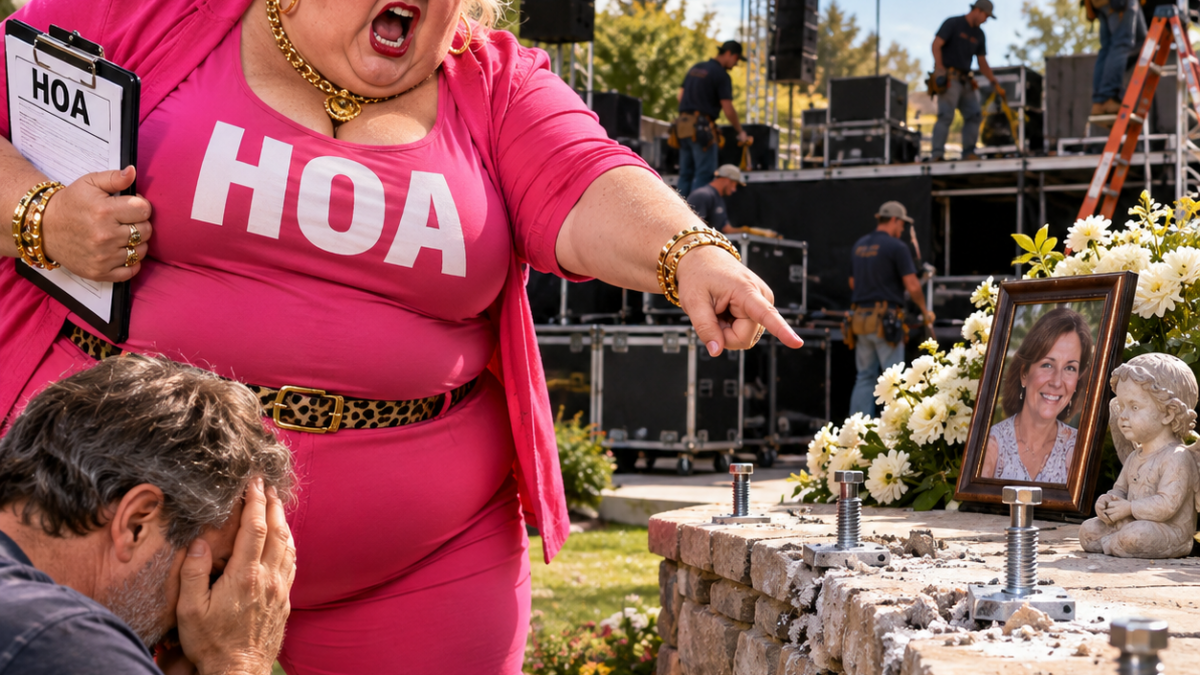
PART 2
I stood in the entry hall for perhaps thirty seconds after closing the door on Brenda.
No shouting through the glass.
No pounding.
No second confrontation.
Eventually I heard her shoes cross the porch, then the car door, then the engine.
When the sound disappeared down Ridgerest Court, I walked back to the kitchen.
The rear windows gave me a clear view of the lawn.
Empty again.
Almost.
Four round wounds remained where the concrete footings had been extracted.
The oak trees had twelve fresh screw holes in their bark.
And the terrace carried six drilled anchor holes plus a fracture that could never be made invisible.
I opened my notebook.
11:15 a.m. Brenda Colton arrived at property. Verbal confrontation at front entrance. Approximate duration four minutes. Asserted HOA ownership of removed staging equipment and threatened financial recovery.
That habit had followed me out of engineering.
When something matters, write it down while memory is fresh.
Then I called Clare Sun.
Clare had handled HOA and property litigation for sixteen years.
I had used her once before for an easement issue involving a utility contractor.
She was patient, surgical and completely unimpressed by people who relied on confidence instead of governing documents.
“What did Brenda say?” she asked.
“That I had no right to remove HOA equipment.”
“And you?”
“That I looked forward to hearing the argument in court.”
A brief pause.
“Good.”
“I thought you’d approve.”
“Don’t speak directly to her again unless necessary.”
“Understood.”
“You still have the original denial letter?”
“Yes.”
“The September 2023 one?”
“Yes.”
“And the April meeting notes?”
“In my property notebook.”
“Send everything.”
By noon, Clare had the package.
My four-page site assessment.
Two hundred forty-seven photographs.
Marcus Webb’s demolition record.
Equipment hours.
Material inventory.
The twelve screws from the oak trees.
Anchor bolts.
Stage cable sections.
My written refusal.
Contemporaneous notes from the annual meeting where I had verbally refused Brenda the first time.
Then Clare said something that would matter enormously later.
“Thomas, don’t repair anything yet.”
I looked toward the terrace.
“The cracked stone needs stabilization.”
“Make it safe, but don’t replace it.”
“Evidence.”
“Yes.”
That evening, Caitlyn called.
“Is the stage gone?”
“Yes.”
“All of it?”
“Every board.”
She went quiet.
“Mom’s terrace?”
“Still damaged.”
“Can they fix the stone?”
“Not exactly.”
“Why?”
“The quarry closed.”
Another silence.
I heard my grandchildren somewhere in the background arguing about a tablet charger.
Normal family noise.
Caitlyn finally said:
“Dad, I’m sorry.”
“You didn’t do anything.”
“I asked you to come here.”
“And I’m glad you did.”
“If you hadn’t left—”
“Stop.”
“But—”
“Caitlyn.”
She knew that tone.
“Your mother spent years trying to get me away from work long enough to see people I loved. I’m not going to turn visiting my daughter into the reason somebody else trespassed.”
She breathed out.
“Okay.”
“This is Brenda’s decision.”
“Are you angry?”
I looked through the glass at the fractured terrace.
“Yes.”
“You don’t sound angry.”
“That doesn’t mean I’m not.”
Caitlyn knew me well enough to understand.
I had always become quieter when something mattered most.
The next morning, Clare called at 8:12.
“I pulled Magnolia Ridge’s governing documents.”
“And?”
“The events committee has no authority over your property.”
“I assumed that.”
“I want you to hear the exact language.”
Paper moved on her desk.
“Article Seven, Section Three. The events committee is authorized to plan, organize and execute community social events and activities on association common property and facilities.”
“Common property.”
“Only.”
“No private lots.”
“Not one sentence granting such power.”
“Then how did Brenda convince a staging contractor to build there?”
“That is the interesting part.”
Her voice changed.
Sharper.
“Premier Stage Solutions gave me the contract.”
“They cooperated?”
“Their attorney did after I sent your ownership records.”
“And?”
“Brenda attached an authorization memo.”
I sat down.
“What memo?”
Clare read it.
“This memo confirms that the Magnolia Ridge Community Association Board of Directors has approved the use of the residential property located at 14 Ridgerest Court for the 2024 community gala event installation, subject to standard community guidelines.”
I stared across the kitchen.
“The board never approved that.”
“I know.”
“How?”
“I called all five directors.”
My hand tightened around the phone.
“All five?”
“Separately.”
“What did they say?”
“No vote.”
“No meeting?”
“No.”
“No authorization?”
“None.”
“What did they know?”
“Three had no knowledge the installation was happening at all.”
“And the other two?”
“Board president Gary Holt and Carol Sims remembered Brenda mentioning at a social gathering that she was still trying to secure your property.”
“Trying.”
“Yes.”
“Not that she had it.”
“No.”
I stood.
“So she wrote a memo saying the board approved something the board never discussed.”
“Yes.”
“And attached it to a thirty-four-thousand-dollar contract.”
“Yes.”
“And used it to get contractors onto my land.”
“Yes.”
I walked toward the rear window.
The terrace lay in morning light.
The cracked red-veined stone was visible even from inside.
“That memo changes things.”
Clare’s answer was immediate.
“Substantially.”
I didn’t ask how yet.
There was more.
Clare retained Robert Faraday, a licensed contractor with twenty-eight years in residential construction and extensive experience testifying in property-damage cases.
He arrived April 19 with a camera, measuring tape, masonry probe and no interest in anyone’s emotions.
Exactly the kind of expert I respected.
I walked him through the site.
Oak trees first.
Then the footing locations.
Then terrace.
He spent nearly forty minutes on the flagstone.
At one point he knelt beside Margaret’s cracked stone so long I wondered whether he had forgotten I was standing there.
Finally he said:
“This was hand-set.”
“Yes.”
“Who?”
“My wife.”
He looked over the whole terrace again.
“She knew what she was doing.”
Margaret would have liked him instantly.
“The joints are too consistent for casual installation,” Robert continued. “But they’re not machine-perfect. There’s judgment in the spacing.”
“She worked on the layout for weeks.”
He touched the unbroken edge of the red-veined stone.
“Whoever drilled this didn’t inspect the natural fault line.”
“Meaning?”
“You don’t drill natural stone blindly. You read it first.”
He pointed at the fracture.
“This vein told them exactly where the weakness was.”
I felt the anger again.
Not hot.
Heavy.
“So it was avoidable.”
“Likely.”
His formal assessment arrived April 22.
Three damaged flagstones.
Replacement cost using the closest comparable Tennessee material and skilled hand installation:
$18,400.
Full terrace restoration to achieve visual consistency:
$31,200.
Lawn restoration after footing extraction:
$4,800.
Arborist assessment and two years of monitoring for oak-tree damage:
$2,200.
Total documented property damage:
$38,200.
I read the report twice.
Then called Clare.
“Thirty-eight thousand two hundred.”
“Yes.”
“For a stage that was supposed to exist for one party.”
“Correct.”
“There was another issue.”
Of course there was.
“The master key.”
I knew Magnolia Ridge’s management company, Summit Property Management, held emergency access keys for certain rear gates.
Water leaks.
Utility failures.
Medical access.
That sort of thing.
My rear gate wasn’t normally locked because I lived at the end of a quiet cul-de-sac and had never imagined an HOA events chair would treat the absence of a padlock as an invitation to build infrastructure.
Clare continued.
“Summit released the key to Brenda in late March.”
“For what?”
“She requested access for HOA event preparation.”
“That isn’t an emergency.”
“No.”
“They gave it anyway?”
“Yes.”
“Did she show board approval?”
“No.”
“Written authorization?”
“No.”
“Did Summit call me?”
“No.”
I sat quietly.
“So she requested an emergency key under a non-emergency purpose.”
“Yes.”
“And Summit handed it over without checking.”
“Yes.”
“Does Summit share liability?”
“Potentially. They’re the association’s management agent.”
Then Clare told me what she intended to file.
Criminal trespass.
Property damage.
Potential fraud related to the fabricated memo.
Civil claims.
HOA institutional exposure.
Brenda’s personal exposure.
The criminal piece unsettled me.
“Clare, I want the property restored. I’m not trying to put somebody in jail over a gala.”
“I know.”
“Then why criminal?”
“Because entering private property after explicit written denial, using a key obtained under false pretenses, and authorizing permanent construction can meet criminal statutes.”
“She’ll say she thought the committee had authority.”
“She knew you said no.”
“Twice.”
“Exactly.”
I looked again at Margaret’s terrace.
“Proceed.”
The Cherokee County Sheriff’s Department acknowledged the referral on April 24.
Detective Renee Cartwright called Clare two days later.
She had read everything.
Photographs.
Refusal letters.
Contract.
Authorization memo.
Board statements.
Then she noticed the dates.
Brenda’s memo claiming board approval:
February 12, 2024.
My written refusal:
September 14, 2023.
Eight months earlier.
There was no plausible argument that she had not been told.
The detective interviewed the board.
That’s when another piece emerged.
At a February social gathering, Brenda had specifically mentioned my refusal.
Gary Holt remembered her calling it “not a final answer.”
I remember Clare telling me that over the phone.
I was standing on the terrace.
“So she told the board I had refused.”
“Yes.”
“And later wrote that the board approved using my property.”
“Yes.”
“What did Gary say when she called my refusal ‘not final’?”
“Nothing.”
“No objection?”
“No.”
“No instruction to stop?”
“No.”
“He just let it go.”
“Yes.”
I looked at Margaret’s stone.
“How does someone convince herself she’s entitled to do that?”
Clare answered after a moment.
“She stops distinguishing between wanting authority and having authority.”
That sentence explained Brenda better than anything else.
She had organized Magnolia Ridge events since 2017.
Holiday parties.
Pool openings.
Fundraisers.
Community galas.
Residents praised her.
Boards gave her budgets.
People learned that Brenda got things done.
Somewhere in those seven years, getting things done had become proof that she should be allowed to do them.
The HOA board called an emergency meeting April 29.
I didn’t attend.
Clare advised against it.
Susan Park attended for the HOA’s insurance carrier.
She reviewed the case and gave the board a blunt assessment.
Events committee authority:
Common property only.
My property:
Private.
My denial:
Written.
Access:
Emergency key misused.
Contract:
$34,000 authorized with a memo falsely claiming board approval.
Payment:
Made from HOA funds.
Property damage:
$38,200.
Susan reportedly told them:
“This is not a gray area.”
Gary Holt asked if the HOA could simply argue Brenda acted outside her authority.
Susan’s answer:
“She signed as committee chair. Summit released an HOA management key. The association paid the invoice. The HOA is involved.”
Then came the question that probably hurt the board most.
“Did anyone verify the board-approval memo before paying thirty-four thousand dollars?”
No.
The check had gone through because Brenda had always handled event logistics.
Trust again.
The invisible fuel of every preventable disaster.
On May 3, the board voted whether to remove Brenda from the events committee.
Three yes.
Two no.
Brenda was out.
She threatened to sue the HOA for wrongful removal.
Her own attorney apparently advised her that suing an association for removing her after she spent its money trespassing onto private land was strategically unhelpful.
She did not file.
Instead, she filed a cross-claim in the civil litigation asking the HOA to cover her personal liability and accusing the board of retaliating against her.
Susan Park’s reaction, as Clare later described it, was almost admiration.
“I’ve handled a lot of HOA cases.”
Pause.
“This is in the top five.”
Clare filed my civil complaint May 15.
Forty-three pages.
I didn’t ask for $10 million.
Didn’t ask for Brenda’s house.
Didn’t ask the court to destroy her life.
I asked for specific damages.
Trespass and unauthorized construction:
$75,000.
Property destruction:
$31,200.
Intentional emotional distress:
$120,000.
Punitive damages based on deliberate conduct:
$240,000.
Total demand:
$466,200 plus fees.
The emotional-distress claim was the hardest for me.
Clare asked me to write a statement.
“Don’t perform grief,” she said.
“I wouldn’t.”
“I know.”
“Then why say it?”
“Because opposing counsel will accuse us of monetizing sentiment.”
I looked at her.
“Are we?”
“No.”
“Then I don’t care what they call it.”
“Write the truth.”
That Sunday evening, I sat at the same kitchen table where Margaret had once spread her graph-paper terrace sketches.
I wrote three paragraphs.
My wife Margaret set every flagstone in that terrace by hand.
She designed it.
She sourced the material.
She spent three weekends building it with me.
She died in January 2022.
That terrace is not landscaping.
It is the last significant physical thing she made.
Brenda Colton drilled six anchor bolts into it while I was away visiting my daughter.
Three stones are cracked.
They cannot be repaired.
They can only be replaced.
Replacement is not restoration.
I sent it to Clare.
She called ten minutes later.
“I’m using it exactly as written.”
“Okay.”
“No edits.”
“Fine.”
“Thomas.”
“Yes?”
“I need you to understand this will be read in court.”
“I understand.”
“Possibly publicly.”
“I understand.”
The first hearing happened June 3 before Superior Court Judge Harold Benning.
Brenda had counterclaimed for destruction of the stage.
Thirty-four thousand dollars.
Her attorney argued I had intentionally destroyed HOA equipment.
Judge Benning read the filing.
Then looked up.
“Where is the equipment?”
The attorney hesitated.
“A demolition contractor took it.”
“Destroyed?”
“Removed.”
“Is it intact?”
“I believe substantially, yes.”
“So your client is suing Mr. Aldridge for destroying equipment that exists.”
Silence.
“He removed an unauthorized structure from his private property.”
Brenda’s attorney attempted to explain.
Judge Benning held up one hand.
“What is your actual claim?”
The answer never improved.
Counterclaim dismissed.
Then Brenda’s motions to dismiss my case.
First:
Events committee authority implied event-site preparation.
Judge Benning read the bylaws.
“Common property.”
He looked at Brenda’s attorney.
“Mr. Aldridge’s backyard is not common property.”
Motion denied.
Second:
Emotional distress shouldn’t survive because damage to stone was merely property damage.
The judge opened my statement.
Then read it aloud.
My wife Margaret set every flagstone in that terrace by hand…
The courtroom became quiet.
I sat beside Clare and stared at my hands.
When he finished, Judge Benning placed the page down.
“I am not prepared to rule that deliberate intrusion onto private property after written refusal, followed by drilling anchor points into a memorial structure created by the plaintiff’s deceased spouse, cannot as a matter of law support an emotional-distress claim.”
Motion denied.
Outside, Clare touched my shoulder.
“You okay?”
“Yes.”
“You don’t look okay.”
“I didn’t expect a stranger to read that aloud.”
“I know.”
We stood there for a moment.
Then she said:
“The case goes forward.”
The HOA did not want trial.
Its insurer didn’t either.
Susan Park and Clare negotiated through May and June.
There was no realistic defense for the institutional failures.
Summit released the master key.
HOA funds paid the invoice.
Nobody verified authorization.
The association settled June 19.
$180,000.
Funded by liability insurance.
The HOA formally acknowledged that its events committee had no authority to construct on private lots.
A governing amendment was drafted.
Future use of any homeowner’s lot required written owner consent plus formal board approval.
Clear.
Boring.
Useful.
Brenda’s personal liability remained.
The insurer refused coverage for conduct outside her authority.
Her trial date:
October.
Clare called me after the HOA settlement.
“The association is finished.”
“And Brenda?”
“Still exposed.”
“Amount?”
“Roughly two eighty-six plus fees, subject to trial.”
“She offered settlement?”
“Quietly.”
“How much?”
“Not enough.”
“I don’t care about enough.”
Clare paused.
“What do you care about?”
“She knew I said no.”
“I know.”
“She used an emergency key.”
“Yes.”
“She created fake board approval.”
“Yes.”
“She drilled into Margaret’s terrace.”
“Yes.”
I watched sunlight cross the fracture in the red-veined stone.
“I want her to explain those decisions to a jury.”
Clare was silent for a moment.
Then:
“All right.”
The offers increased.
First low.
Then moderate.
Final offer two weeks before trial:
$140,000.
Clare presented it professionally.
No pressure.
“This avoids risk.”
“I know.”
“Juries are unpredictable.”
“I know.”
“Even strong cases can surprise you.”
“I know.”
“Your answer?”
“No.”
Trial began October 14.
Four days.
Clare’s opening wasn’t theatrical.
She didn’t need drama.
She had chronology.
April 2023.
Thomas says no.
September 2023.
Thomas writes no.
February 2024.
Brenda tells board members Thomas said no.
Then writes memo claiming board authorization.
March.
Emergency master key requested.
April.
Thomas leaves Georgia.
Contractor enters.
Forty-foot stage erected.
Concrete footings poured.
Oak trees penetrated.
Stone terrace drilled.
Thomas returns.
Documents.
Removes stage.
That timeline was the case.
Brenda’s attorney tried to make it a conflict between rigid privacy and community spirit.
He called Brenda dedicated.
Enthusiastic.
Well-meaning.
He said Magnolia Ridge residents loved the annual gala.
The event raised money.
The stage was intended to be temporary.
No malicious intent.
Then Clare called Gary Holt.
“Did the board approve the Aldridge property?”
“No.”
“Was there a vote?”
“No.”
“Meeting?”
“No.”
“Did Ms. Colton know Mr. Aldridge had refused?”
“Yes.”
“How?”
“She told us.”
That hurt.
Rita Moss testified.
No authorization.
David Chandra.
No authorization.
Paul Everett.
No authorization.
Then Premier Stage Solutions produced their project manager.
He had never spoken with me.
Never seen a signed owner-consent form.
He relied on Brenda’s memo.
“Had you known the property owner had specifically refused?”
“We would not have mobilized.”
“Had you known the master key was emergency-use only?”
“We wouldn’t have entered.”
“Would you have drilled natural stone without owner approval?”
“No.”
Then Marcus Webb testified about removal.
He described how we preserved every stage element.
No unnecessary destruction.
No theft.
Everything labeled.
Stored.
Available.
The defense asked whether I could have simply called Brenda first.
Marcus looked toward me.
Then the lawyer.
“I was hired to remove unauthorized construction from the owner’s land.”
“That wasn’t my question.”
“No, sir.”
“Could Mr. Aldridge have waited?”
“He could have.”
“So removal wasn’t urgent.”
Marcus considered.
“Concrete footings had already been poured.”
“And?”
“I’m a demolition contractor.”
He shrugged.
“When a property owner says remove it, I remove it.”
The defense moved on.
Robert Faraday testified about damage.
The fracture.
Drilling.
Replacement difficulty.
Closed quarry.
Three damaged stones.
Then the emotional element.
Clare showed a photograph.
Margaret and me.
October 2009.
She was kneeling beside the terrace.
Rubber mallet in hand.
Caitlyn stood behind her wearing an oversized Georgia Tech sweatshirt, looking bored because she was twelve and Saturdays were being wasted on stone.
My chest tightened.
Clare asked:
“Who took this photograph?”
“I did.”
“What is Margaret doing?”
“Setting the north-edge stone.”
“The red-veined stone?”
“Yes.”
“Same one drilled in 2024?”
“Yes.”
Brenda looked down.
Clare asked no more.
Then I testified.
Engineering.
Retirement.
Margaret.
Cancer.
The terrace.
Brenda’s requests.
My refusals.
Portland.
Coming home.
I described sitting in the car for three minutes.
Her attorney used that.
“You were furious.”
“No.”
“You sat there because you were angry.”
“I sat there because I was deciding what to document before disturbing the site.”
“You expect the jury to believe you felt no anger?”
“I was angry.”
“Then the demolition was emotional.”
“No.”
“You called a demolition contractor within minutes.”
“Yes.”
“You never called Ms. Colton.”
“No.”
“You never called the board.”
“No.”
“You never asked whether this was a misunderstanding.”
“I had already said no twice.”
He paced.
“Wouldn’t a reasonable neighbor make one telephone call before dismantling thirty-four thousand dollars of community equipment?”
I looked at him.
“Wouldn’t a reasonable neighbor make one telephone call before pouring concrete into private property?”
There was a pause.
He changed subjects.
Then Brenda testified.
She said she never intended harm.
She believed the gala benefited everyone.
She believed board silence at the February gathering signaled informal support.
She believed my written refusal was based on concerns about event logistics that could be resolved by professional installation.
Clare stood for cross-examination.
“You received Thomas Aldridge’s September letter?”
“Yes.”
“Read the last two sentences.”
Brenda read:
“I decline the request. The property is not available for community events.”
“Where does Mr. Aldridge mention logistics?”
“He doesn’t.”
“Noise concerns?”
“No.”
“Insurance?”
“No.”
“Conditional approval?”
“No.”
“Future discussion?”
“No.”
“He said the property is not available.”
“Yes.”
“Yet in February, you told board members his refusal was not final.”
“I believed he might reconsider.”
“Did he?”
“No.”
“Did you ask?”
“No.”
“Why not?”
“We were running out of time.”
That answer mattered.
Clare let it sit.
Then:
“You wrote this authorization memo?”
“Yes.”
“The memo says the board approved using 14 Ridgerest Court.”
“Yes.”
“Did it?”
“I believed the board supported the plan.”
“That isn’t what I asked.”
Brenda shifted.
“No formal vote occurred.”
“Did any director tell you the board had approved Mr. Aldridge’s property?”
“No.”
“Why did you write that it had?”
“I was trying to move the planning process forward.”
“By stating something untrue?”
“I wouldn’t characterize it that way.”
“The statement was false.”
Brenda looked at the jury.
Then:
“Yes.”
Clare picked up the master-key record.
“You asked Summit Property Management for an emergency key.”
“I asked for the rear-gate key.”
“For a gala.”
“Yes.”
“Was there an emergency?”
“No.”
“Did you tell Summit the owner had denied permission?”
“No.”
“Why?”
“I didn’t think it was relevant.”
A juror’s eyebrows rose.
Clare continued.
“You entered while Mr. Aldridge was in Oregon?”
“Yes.”
“You knew he was away?”
“Yes.”
“How?”
“His neighbor mentioned it.”
“Did his absence make installation easier?”
Brenda hesitated.
“Yes.”
“Did you schedule work because he was absent?”
“No.”
“Then why start while he was absent?”
“We had the contractor available.”
“Convenient.”
“Yes.”
Then the terrace.
“Did you know Thomas’s late wife built it?”
“I knew she had been involved.”
“Did you know she was deceased?”
“Yes.”
“Did you authorize drilling?”
“I authorized stage installation.”
“Did you review how the stage would be anchored?”
“No.”
“Did you tell Premier not to alter the terrace?”
“No.”
“Did you seek Thomas’s permission?”
“No.”
Clare held up one of the anchor bolts.
“This was removed from Margaret Aldridge’s stonework.”
Brenda looked at it.
“Do you recognize it?”
“No.”
“That’s because you never inspected what your project did.”
Objection.
Sustained.
Clare sat down.
By closing arguments, the case felt less like a question and more like arithmetic.
Two refusals.
One fabricated memo.
One emergency key.
One unauthorized entry.
One permanent installation.
Thirty-eight thousand two hundred dollars in property damage.
One irreplaceable memory altered.
Brenda’s lawyer asked the jury not to punish enthusiasm.
Clare stood last.
“This case is not about enthusiasm.”
She pointed toward my September letter.
“No means no before a community event just as clearly as it means no anywhere else.”
Then Brenda’s memo.
“A committee chair cannot turn refusal into consent by typing a different sentence.”
Then the stage photograph.
“Community purpose is not a deed.”
Then the terrace photograph.
“And good intentions do not repair the last physical work a deceased wife left behind.”
The jury deliberated six hours.
I sat with Clare.
Didn’t pace.
Didn’t check my phone.
Caitlyn texted once.
Whatever happens, Mom knows you protected it.
I read that several times.
At 7:12 p.m., we were called back.
Verdict.
Trespass and unauthorized construction:
$75,000.
Destruction of personal property:
$31,200.
Intentional infliction of emotional distress:
$120,000.
Punitive damages:
$240,000.
Attorney fees:
$28,400.
Total against Brenda:
$494,600.
The prior $180,000 HOA settlement was credited against overlapping portions.
Net personal judgment:
$314,600.
Brenda did not react immediately.
Then her shoulders dropped.
Clare whispered:
“Done.”
Not entirely.
The criminal case had resolved separately in September.
Brenda pleaded guilty to criminal trespass.
The prosecutor dropped the false-document count under the negotiated agreement.
Misdemeanor conviction.
$4,000 fine.
Eighteen months probation.
After the civil judgment, the Magnolia Ridge board voted again on Brenda’s removal from all committee roles.
Five to zero.
Even Gary Holt and Carol Sims—who had resisted earlier—voted yes.
The ambiguity had finally become too expensive to maintain.
I didn’t attend.
There was no need.
In November, I hired stonemason Arthur Gaines.
Sixty-four.
Natural-stone specialist.
Quiet.
He arrived at nine one Tuesday morning.
Spent an hour examining the terrace.
No clipboard performance.
No speeches.
He knelt.
Touched joints.
Measured.
Studied the red-veined fracture.
Finally:
“She laid this?”
“Yes.”
“Professional?”
“Accountant.”
He smiled.
“Figures.”
“Why?”
“Accountants like alignment.”
Margaret would’ve laughed.
Arthur continued.
“She had good instincts.”
He pointed.
“See the way she widened this joint slightly because the adjacent stone wanted to run off-line?”
I nodded.
“She didn’t force it.”
“No.”
“Good masonry is knowing when material gets a vote.”
He stood.
“I can’t replace that stone.”
“I know.”
“I can replace a stone.”
“I know.”
“I want us clear.”
“We are.”
For three weeks, Arthur called quarries.
Tennessee.
North Carolina.
Suppliers.
Salvage yards.
Nothing exact.
The original quarry had closed in 2016.
The geological vein pattern wasn’t being actively cut elsewhere.
Eventually he found a warm gray stone from eastern Tennessee with faint red veining.
He brought samples.
Laid them beside Margaret’s original.
Different.
Not wildly.
But enough.
“People will see it,” Arthur said.
“Yes.”
“You okay with that?”
“No.”
He looked at me.
“Good answer.”
I almost smiled.
“What do we do?”
“We make the new stone honest.”
“Meaning?”
“We don’t pretend it’s old.”
That phrase stayed with me.
Arthur replaced three stones over two December days.
He worked on his knees.
Rubber mallet.
Level.
Slow tapping.
Exactly the rhythm Margaret had used fifteen years earlier.
I watched for a while from the kitchen.
Couldn’t stay outside.
Too many memories.
When Arthur finished, the replacements were visible.
Slightly lighter.
Less red.
The joints matched beautifully.
The surface was safe.
Continuous.
Not restored.
Tended.
That was the right word.
Caitlyn came in January.
Two weeks.
Same duration as the Portland trip that had started everything.
Her children filled the house with noise.
Shoes.
Snack wrappers.
Tiny socks somehow everywhere.
On the second Saturday, Caitlyn and I sat outside with coffee.
Cold morning.
Bare oaks.
New stones visible.
She stared at the terrace.
Then:
“Dad.”
“Yes?”
“Why didn’t you just call them first?”
I looked at her.
“Before removing the stage?”
“Yes.”
She wasn’t criticizing.
She was asking.
I took a breath.
“Because your mother built this with her hands.”
Caitlyn looked down.
“I know.”
“I watched her set every stone.”
“I remember.”
“She was there.”
“Yes.”
“And Brenda knew I said no.”
Caitlyn nodded.
“If this had been a tent?”
I considered.
“I’d probably call.”
“Folding chairs?”
“Call.”
“Temporary lights?”
“Call.”
“Stage sitting on blocks?”
“Maybe call.”
“But concrete?”
“Footings.”
“And drilling.”
“Yes.”
I looked toward the replacement stone.
“Some things don’t become negotiations after the other person has already decided your answer doesn’t matter.”
Caitlyn stayed quiet.
Then she smiled.
“Mom would’ve removed it herself.”
“Your mother would’ve called a contractor before unpacking her suitcase.”
“Exactly.”
We laughed.
That helped.
The civil judgment eventually changed Magnolia Ridge more than I expected.
Not because residents suddenly became afraid of me.
I didn’t want that.
The useful change was procedural.
Private-lot access now required:
Written owner consent.
Formal board approval.
Written scope.
Insurance confirmation.
No master-key use except documented emergency.
No committee chair could authorize construction independently.
Summit Property Management changed its key-release procedures.
Two-person verification.
Written purpose.
Board confirmation for non-emergency access—which effectively meant no non-emergency access without owner permission.
Premier Stage Solutions updated its own contracts too.
Owner authorization required directly from the deed holder for any residential site.
Good.
That was what consequences should produce.
Better systems.
For months, people stopped me during walks.
Some apologized for Brenda.
I told them there was nothing to apologize for.
Others asked:
“Did she really forge board approval?”
“She wrote approval that didn’t exist.”
“Was the stage really forty feet?”
“Yes.”
“Concrete?”
“Yes.”
“Why?”
Because people assumed a gala stage would be temporary.
They struggled with the idea of footings.
That’s why I repeated the sentence.
Concrete footings are not temporary.
One neighbor, Ellen Ruiz, said:
“She must have thought you’d eventually accept it.”
“Probably.”
“You think she wanted the lawn permanently?”
“No.”
“Then why footings?”
“Because once a person stops respecting the first boundary, later boundaries become easier to ignore.”
She thought about that.
“That’s uncomfortable.”
“Usually true things are.”
Brenda sold her Magnolia Ridge house the following summer.
I didn’t know until Gary Holt mentioned it.
“She’s moving.”
“All right.”
“Florida.”
“Okay.”
“You don’t want details?”
“No.”
That surprised him.
After a year of litigation, residents expected me to be interested in Brenda’s ruin.
I wasn’t.
She had a judgment.
Probation.
Financial consequences.
Her committee position gone.
What happened after was her life.
I wanted mine back.
That distinction mattered.
Margaret had never liked prolonged grudges.
She was perfectly capable of anger.
She simply considered resentment inefficient.
“Either fix the problem or stop feeding it,” she’d say.
So I stopped feeding it.
The $180,000 HOA settlement arrived first.
Insurance.
Then Brenda’s judgment was satisfied through negotiated payment arrangements and asset liquidation over time.
I didn’t obsess over every transaction.
Clare handled enforcement.
Some money went to legal fees.
Some to property restoration.
I set aside a substantial portion for the trees and terrace’s long-term care.
Then I did something Caitlyn loved.
I established a small education fund for my grandchildren.
When she asked why, I said:
“Your mother would’ve complained if all this nonsense produced nothing useful.”
Caitlyn laughed.
“She absolutely would.”
She was right.
Margaret had spent twenty-six years as an accountant.
She would have wanted the numbers to do something decent.
The terrace became part of our family differently after that.
Before Brenda, it was Margaret’s terrace.
After Brenda, it was still Margaret’s terrace.
But the three replacement stones told another chapter.
Not destruction.
Survival.
My grandson once asked:
“Why are those three lighter?”
I answered honestly.
“Someone damaged the originals.”
“Who?”
“A person who didn’t listen.”
“What happened?”
“They had to pay for the damage.”
He considered that with the moral clarity of an eight-year-old.
“So she learned?”
I looked toward the lawn.
“I hope so.”
“Did she say sorry?”
“No.”
“Then she didn’t learn.”
Caitlyn nearly spit out her coffee.
Children simplify what adults complicate.
Years passed.
The oak trees recovered.
Arborist monitoring found no major decline.
The small screw wounds closed gradually into bark.
You could still find them if you knew where to look.
I knew.
Of course I knew.
I inspected them every spring.
The lawn scars disappeared within a season.
The footing holes were filled.
Resodded.
By the following April, no one could identify them unless I pointed.
The fence staples were removed.
Bunting gone.
Stage remained in storage until litigation ended, then Premier Stage Solutions reclaimed the reusable sections under negotiated terms.
No one had “destroyed” their $34,000 equipment after all.
That claim looked even more absurd with time.
The HOA eventually held its community gala again.
Different venue.
A rented event lawn at a nearby country club.
Someone sent me photographs.
Two hundred people.
Temporary stage.
No private-property lawsuit.
Imagine that.
Gary invited me.
I declined.
Not out of anger.
I simply wasn’t interested.
A year later, though, I attended the annual meeting.
First time since the litigation.
Gary had stepped down as president.
Rita Moss had taken over.
She was practical.
Agenda started at seven.
Ended at eight-oh-eight.
Budget.
Pool contract.
Entrance landscaping.
Insurance.
No drama.
Near the end, Rita addressed access policy.
“Reminder: committees have no authority to enter private residential property without explicit written owner permission.”
Nobody argued.
She moved on.
I almost smiled.
Boring governance.
Beautiful thing.
Afterward, Rita stopped me.
“Thomas.”
“Yes?”
“Can I ask you something?”
“Sure.”
“Do you hate the HOA?”
“No.”
She looked surprised.
“Really?”
“I dislike unauthorized construction.”
She laughed.
“I mean after everything.”
“The HOA settled.”
“The association failed you.”
“Yes.”
“Still no?”
“An institution isn’t a person.”
She nodded.
“Brenda was acting under our name.”
“And the system let her.”
“Yes.”
“You changed the system.”
“We did.”
“Then what’s left to hate?”
Rita thought about that.
“That’s healthier than most residents.”
“I had an accountant for a wife.”
“What does that mean?”
“She disliked carrying unnecessary balances.”
Rita laughed.
Margaret would’ve approved.
One autumn, I traveled to Portland again.
This time three weeks.
No anxiety.
Before leaving, I walked the property once.
Not because I expected another stage.
Habit.
Terrace.
Trees.
Gate.
Fence.
Everything fine.
Caitlyn met me at the airport.
“You checked the backyard before leaving, didn’t you?”
“Yes.”
“Dad.”
“What?”
“Nobody is building anything.”
“That’s what people said last time.”
She rolled her eyes.
The visit was different.
I stayed present.
Grandchildren.
Zoo.
Soccer game.
School pickup.
Long dinner with Caitlyn and her husband.
One night, she asked:
“Do you think Mom would’ve liked Portland?”
“Too rainy.”
“She liked rain.”
“She liked Atlanta rain.”
“What’s the difference?”
“Atlanta rain has the decency to stop.”
Caitlyn laughed.
Then became quiet.
“Do you miss her more at home?”
“Yes.”
“Is that why you don’t travel much?”
“Partly.”
“You know the house isn’t her.”
“I know.”
“The terrace isn’t her either.”
“I know.”
“But you fought like it was.”
That wasn’t accusation.
Again, my daughter was trying to understand me.
I thought carefully.
“The terrace isn’t your mother.”
“No.”
“But it contains time I spent with her that nobody can reproduce.”
Caitlyn nodded.
“That’s different.”
“Yes.”
“When Brenda damaged it, she didn’t hurt Mom.”
“No.”
“She hurt you.”
“Yes.”
That was probably the cleanest description anyone gave the entire case.
Property cases turn emotional because objects are rarely just objects.
A ring can be metal.
A house can be lumber.
A terrace can be stone.
Until memory changes the material.
Then replacement cost stops being the whole measurement.
Courts struggle with that.
People struggle with it.
I did too.
Arthur Gaines had understood.
A replacement stone is still stone.
But replacement isn’t restoration.
By the fifth anniversary of Margaret’s death, the terrace looked older again.
New stones darkened slightly.
Weather softened the visual difference.
The replacement at the north edge still caught afternoon light differently.
I used to dislike that.
Then one day I realized I no longer wanted it invisible.
The difference proved the terrace had survived something.
So had I.
I stopped wishing the new piece looked exactly like Margaret’s.
It couldn’t.
Nothing can become what was lost.
It can only become part of what continues.
That realization affected more than the terrace.
For years after Margaret died, I kept the house almost exactly as she left it.
Her garden plan.
Her chair.
Books.
Closet.
Even a box of receipts in her office that had no reason to exist.
Maintenance had become preservation.
Preservation had slowly become freezing time.
Caitlyn never pressured me.
But after the lawsuit ended, I began changing things.
Small.
New kitchen light fixtures.
Paint in the guest room.
Converted Margaret’s office into a reading room while keeping her desk.
I planted two dogwoods.
Not because Margaret wanted them.
Because I did.
That was harder than it sounds.
Grief can convince you that choosing something new betrays the person who chose what came before.
It doesn’t.
The property was ours.
Then it became mine.
That didn’t erase her.
It made continuing possible.
Brenda’s stage fight, absurdly, became part of that transition.
She violated the place I had frozen in memory.
I defended it.
Then after defending it, I finally allowed myself to live in it again.
I never thanked Brenda for that.
Some gifts don’t require gratitude to the person who accidentally caused them.
Years later, Clare called.
We hadn’t spoken in months.
“Thomas.”
“Clare.”
“I’m giving a seminar.”
“That sounds dangerous.”
“HOA counsel training.”
“Even worse.”
“I want permission to use your case anonymously.”
“Why?”
“Private-lot access.”
“Fine.”
“And emotional-distress evidence tied to property.”
I was quiet.
“Use the facts.”
“I would.”
“Not Margaret’s name.”
“Of course.”
“Not Caitlyn.”
“No.”
“Then yes.”
Clare paused.
“For what it’s worth, your case changed how several management companies handle keys.”
“That matters more.”
“I thought you’d say that.”
Summit Property Management implemented statewide training after our settlement.
Emergency keys meant emergencies.
No committee convenience.
No “just this once.”
No assumptions.
One Summit executive wrote me an apology.
I accepted.
It was clear.
No excuses.
They had released a key they should not have released.
Policy had failed.
They fixed it.
That is how accountability should work.
Premier Stage Solutions apologized too.
Their project manager came by after the case ended.
He was younger than I expected.
Early thirties.
Nervous.
“Mr. Aldridge, I wanted to say something directly.”
I waited.
“We should have verified ownership ourselves.”
“Yes.”
“We relied on the authorization memo.”
“I know.”
“But we were drilling.”
“Yes.”
“We should have required the owner’s signature.”
“Yes.”
He looked toward the terrace.
“I didn’t know about your wife.”
“That doesn’t matter legally.”
“No.”
“It matters personally.”
He nodded.
“The crew member who drilled feels terrible.”
“He shouldn’t carry all of it.”
“He did the physical work.”
“He was following a work order.”
“He could’ve noticed the natural fracture.”
“That part is craftsmanship.”
The young man looked surprised.
I continued.
“Your company failed at authorization. The individual installer failed at stone judgment. Brenda failed at consent. Different failures.”
He nodded slowly.
“You really are an engineer.”
“So I’m told.”
We shook hands.
That conversation gave me something I hadn’t realized I wanted.
Not absolution.
Clarity.
One event can have many responsible people without everyone being equally responsible.
The HOA board failed oversight.
Summit failed key control.
Premier failed owner verification.
Installer failed masonry judgment.
Brenda created the chain.
She knew the answer was no and proceeded anyway.
That was why personal liability mattered.
Without it, everyone would have spread responsibility until it disappeared.
A neighbor once asked why I refused Brenda’s final settlement offer before trial.
“Money?”
“No.”
“Wanted a public verdict?”
“Partly.”
“Wanted revenge?”
“No.”
“Then why risk it?”
I thought about the authorization memo.
“For months, Brenda’s argument was that she had authority.”
“So?”
“A settlement would end the money dispute.”
“Yes.”
“I wanted an answer to the authority dispute.”
“The jury?”
“The record.”
He nodded.
That might sound stubborn.
Maybe it was.
But there are moments when private resolution leaves the central harm untouched.
Brenda had told the board, contractor, management company and eventually the court that her committee status made her actions reasonable.
The verdict rejected that.
Community service didn’t grant access.
Committee title didn’t grant access.
An unlocked gate didn’t grant access.
Board silence didn’t grant access.
My absence didn’t grant access.
The fact that hundreds of residents might enjoy a party did not grant access.
My answer mattered.
No.
One syllable.
That’s the center of the story.
Not the skid steer.
Not $314,600.
Not probation.
No.
I had said it once in person.
Again in writing.
Everything after happened because Brenda treated no as the opening round of negotiation rather than the end of her authority.
When I explain it that way, people understand.
Everyone has encountered someone who hears a boundary and starts searching for a way around it.
Family.
Employer.
Neighbor.
Committee.
Brenda happened to have access to a master key and community funds.
That made the consequences larger.
The underlying behavior was ordinary.
Which is exactly why boundaries matter.
Caitlyn eventually asked me whether I wanted to leave Magnolia Ridge.
“You could sell.”
“I know.”
“The property is worth a lot now.”
“I know.”
“Three acres in that area…”
“I know, Caitlyn.”
She smiled.
“Just checking.”
“I’ll leave eventually.”
“When?”
“When they carry me out.”
“Dad.”
“What?”
“Morbid.”
“Efficient.”
Margaret used to say the same thing.
We laughed.
I did update my estate plan.
That seemed wise after spending so much money proving what private property meant.
Caitlyn would inherit the house.
I included a detailed property file.
Surveys.
HOA amendments.
Access policy.
Settlement documents.
Not because I expected future conflict.
Because good records prevent future conflict.
Inside that file, I added a note.
If anyone ever asks to use the rear lawn for a community gala, the answer is still no.
Caitlyn found it while helping organize paperwork.
She laughed for five full minutes.
“I’m framing this.”
“Don’t.”
“Absolutely framing it.”
She did.
It now hangs in her home office in Portland.
Some family histories get portraits.
Ours gets property instructions.
The stage incident became less present with time.
Residents moved.
New families arrived with no idea who Brenda was.
They saw the terrace and assumed it had always looked that way.
Children climbed the oak trees.
The lawn grew.
The community gala found other venues.
Magnolia Ridge remained exactly what it had been before one events chair decided enthusiasm outranked consent.
A neighborhood.
Not evil.
Not corrupt.
Not at war.
Just people.
That’s important.
Stories about HOA disputes often turn the entire community into an enemy.
Mine wasn’t.
Most residents never knew the stage existed until after I removed it.
Many were embarrassed.
Some were angry at Brenda.
Some thought I overreacted.
That’s fine.
I didn’t need unanimity.
Private rights aren’t voted into existence by popularity.
Rita Moss once said at a meeting:
“We don’t have to agree with Thomas’s choice to remove the stage immediately. We have to understand it was his choice because it was his land.”
Exactly.
Years after the verdict, I heard Brenda had completed probation.
No violation.
Paid the fine.
Satisfied the judgment.
Moved on.
Someone asked whether that disappointed me.
Why would it?
Probation is supposed to end.
Judgments are supposed to be satisfied.
People are supposed to get to continue living after consequences.
Accountability is not eternal punishment.
She did what she did.
The system answered.
Finished.
That’s enough.
One April morning, almost exactly ten years after Margaret’s death, I sat on the terrace alone.
The red-veined replacement stone had weathered darker.
Not the same.
Never would be.
I ran my hand over the joint.
Then I remembered something Margaret had said while building the original.
A corner stone wasn’t fitting.
I wanted to cut it more aggressively.
She stopped me.
“No.”
“Why?”
“Because you’re trying to make the stone obey the drawing.”
“The drawing is the plan.”
“The stone is real.”
That had been Margaret.
Accountant who understood reality better than diagrams.
She adjusted the joint instead.
Made the plan accommodate the material.
Years later, I realized how much of my life with her worked that way.
Plans.
Cancer ignored them.
Retirement changed.
Grandchildren grew far away.
Widowhood arrived early.
Terrace cracked.
New stones entered.
The plan changes because reality gets a vote.
But one thing Margaret never confused was adaptation with surrender.
You adapt to what cannot be prevented.
You don’t surrender to someone else deciding your consent is optional.
That distinction was the entire case.
I could not prevent Margaret’s death.
I could not recreate her stone.
I could adapt.
Brenda’s stage?
Preventable.
Unauthorized.
Removable.
So I removed it.
I sometimes imagine what would have happened if I had come home one day earlier, while the stage crew was still building.
Probably boring.
I would have shown them the denial letter.
Called Premier.
They would have stopped.
Footings maybe partially poured.
Damage smaller.
No lawsuit.
No criminal case.
Brenda furious.
Eventually board discipline.
Much less drama.
I would have preferred that version.
People sometimes assume because a story ends in a large judgment that the plaintiff must be pleased events happened.
I wasn’t.
I would trade every dollar to have Margaret’s original stone unbroken.
Money compensates.
It does not reverse.
The most satisfying ending was not the verdict.
It was one winter morning when Caitlyn’s daughter—Margaret’s granddaughter—sat on the terrace coloring with sidewalk chalk.
She drew a crooked flower across one of the replacement stones.
I almost told her not to.
Then stopped.
Margaret built that terrace to be used.
Not preserved under glass.
The girl added a sun.
Blue clouds.
Purple dog that looked like a potato.
Caitlyn saw me watching.
“Don’t you dare tell her she’s ruining it.”
“I wasn’t.”
“You were thinking it.”
“I was evaluating.”
“Engineer language for thinking it.”
We laughed.
Rain washed the chalk off two days later.
The stone remained.
Tended.
Imperfect.
Continuous.
That’s how I think of the entire property now.
Not a memorial site.
A living place that contains memory.
Margaret remains there without everything needing to remain exactly as she left it.
That took me years to learn.
The stage didn’t teach me gently.
But it taught me.
At the next Magnolia Ridge gala, held at a legitimate venue, Rita sent me a photograph of the stage.
Temporary risers.
No concrete.
Weighted lighting towers.
No screws in trees.
Caption:
LOOK. NOTHING PERMANENT.
I replied:
PROGRESS.
She sent a laughing emoji.
Then:
WE HAVE WRITTEN PERMISSION TOO.
Even better.
One evening, Clare came by for dinner.
We sat outside.
She hadn’t seen the repaired terrace.
She noticed the replacement stones immediately.
“So that’s them.”
“Yes.”
“They did well.”
“Arthur did.”
“Can you live with it?”
I thought about that.
“Yes.”
She looked surprised.
“I wasn’t sure you’d ever say that.”
“Neither was I.”
We sat quietly.
Then she said:
“You were my easiest difficult client.”
“That sounds insulting.”
“It is professional admiration.”
“How?”
“You documented everything.”
“Yes.”
“You followed advice.”
“Mostly.”
“You refused every settlement I recommended.”
“There it is.”
“But you knew why.”
“Yes.”
“That makes difficult clients easier.”
I poured more coffee.
“Do you think trial was worth it?”
“As your lawyer?”
“Yes.”
“Financially, settlement would have been safer.”
“I know.”
“As a matter of record?”
She looked toward the terrace.
“Yes.”
That was enough.
Years later, if you search the county civil records, the case is still there.
Aldridge versus Colton.
Pages of filings.
Photographs.
Motions.
Orders.
Settlement.
Verdict.
Someone reading it without context might see numbers.
$34,000 stage.
$38,200 property damage.
$180,000 HOA settlement.
$314,600 personal judgment.
$4,000 criminal fine.
Eighteen months probation.
Those are the clean facts.
But they aren’t the story.
The story is Margaret kneeling on Tennessee flagstone in October 2009.
A twelve-year-old daughter handing her a level.
A red vein catching afternoon light.
A written letter saying no.
A woman deciding no wasn’t final because she wanted a beautiful gala.
A master key handed over too easily.
Concrete curing in someone else’s lawn.
A retired engineer arriving home and recognizing instantly that footings meant somebody had crossed from temporary assumption into permanent decision.
Then documentation.
Not rage.
Not violence.
Documentation.
Two hundred forty-seven photographs.
A contractor.
A lawyer.
A survey of authority.
A fabricated memo.
A courtroom.
A jury.
Then three new stones set carefully into old work.
That’s the story.
One spring afternoon, a new neighbor named Daniel stopped at my driveway.
He had moved into Magnolia Ridge months earlier.
“Mr. Aldridge?”
“Yes?”
“I heard the stage story.”
“I’m sorry.”
He laughed.
“My wife is on the events committee now.”
“That seems dangerous.”
“She wanted me to tell you something.”
“All right.”
“They’re doing a summer picnic.”
I waited.
“Not here.”
“Excellent.”
He grinned.
“Community park.”
“Even better.”
“She said to tell you there will be no concrete.”
“Now you’re just showing off.”
He left laughing.
I walked around back.
Four oak trees.
Healthy.
Lawn.
Open.
Terrace.
Three replacement stones.
Nothing else.
Exactly as it should be.
I stood on the north edge.
Afternoon sun struck the replacement stone.
It didn’t catch the light the way Margaret’s had.
I used to notice the difference first.
That day I noticed the whole terrace.
Dozens of original stones.
Thousands of joints.
Fifteen years of weather.
Children’s chalk stains faint in one corner.
A coffee-ring mark near my chair.
Life layered over memory.
The damaged stone had once felt like proof something irreplaceable was gone.
Now the repaired section felt like proof something irreplaceable could remain meaningful even after being altered.
That’s a better ending than making Brenda suffer.
Her consequences were hers.
The terrace was mine.
I chose the part I wanted to carry.
That evening Caitlyn called.
“Dad, guess what?”
“What?”
“My oldest has a school project on family history.”
“Tell him we’re boring.”
“He wants to interview you.”
“About what?”
“Mom’s terrace.”
I groaned.
“He knows about the stage case.”
“Who told him?”
“You.”
“I gave him an age-appropriate version.”
“You told him someone didn’t listen.”
“That is age-appropriate.”
“What does he want to know?”
“Why Grandma built it.”
That stopped me.
Not why Brenda damaged it.
Not how much the judgment was.
Why Margaret built it.
I looked through the window.
“I’ll talk to him.”
“Tomorrow?”
“Yes.”
“Good.”
That night, I pulled out Margaret’s original graph-paper sketches.
I still had them.
Of course I did.
Four versions.
Measurements.
Notes.
One corner crossed out.
“Too formal,” she’d written.
Another note:
Make room for chairs under oak shade.
That was why she built it.
Not as a memorial.
Not as evidence.
Not as a legal exhibit.
For chairs.
Coffee.
Family.
Shade.
I had spent years preserving the terrace because I loved her.
Now I finally understood she had built it because she expected people to live on it.
So the next morning, when my grandson called, I told him about his grandmother.
Not Brenda.
Not court.
Margaret.
How she chose the stone.
How she argued with me about joint spacing.
How she laughed when Caitlyn dropped the level.
How she moved one stone twice because afternoon light mattered to her.
He listened.
Then asked:
“Did she know it would still be there?”
“I think she hoped.”
“Will it be there when I’m old?”
“If you take care of it.”
He was quiet.
Then:
“I will.”
After the call, I sat outside.
My coffee cooled.
The neighborhood was quiet.
Somewhere beyond the trees, lawn equipment started.
A dog barked.
Normal morning.
No stage.
No lawyers.
No Brenda.
Just the place Margaret had made.
And that was when the entire fight finally became smaller than the life around it.
Brenda had been told no twice.
She used an emergency key anyway.
She fabricated board approval.
She poured concrete into private ground.
She drilled six anchors into hand-laid stone.
I removed the stage before ten the next morning.
Eighteen months later, she had a criminal trespass conviction, a $314,600 personal judgment, a $4,000 fine, eighteen months probation and no committee chairmanship.
Those facts will always be true.
But the terrace will outlast the lawsuit.
The oaks will outlast the verdict.
My grandchildren may someday sit on those replacement stones without remembering who Brenda was.
That is exactly what I want.
Because revenge ends when the other person suffers.
Restoration ends when their actions stop controlling your life.
I wanted restoration.
I got as close as anyone can.
The stone could not be made original.
The past could not be made untouched.
Margaret could not come back.
But the lawn was open.
The trees healed.
The terrace remained.
And every person in Magnolia Ridge now understood something that should never have required a lawsuit to explain:
Community benefit does not turn private land into community property.
A committee title does not outrank ownership.
An emergency key is not permission.
Silence from a board is not approval.
An unlocked gate is not consent.
And “no” does not become “yes” just because the person hearing it believes their plan is important.
I am still not a confrontational man.
I was never trying to be.
On April 17, 2024, I found unauthorized permanent construction on my land.
I documented it.
I removed it.
Then I allowed the legal system to determine responsibility.
That’s all.
The stage lasted nine days.
The lawsuit lasted eighteen months.
The lesson will last much longer.
And the stone terrace Margaret built in 2009 is still there.
Tended.
Imperfect.
Continuous.
Exactly where she put it.

