He Arrived at the Shelter Carrying His Dead Owner’s Old Blue Coat—No One Wanted the Senior Rottweiler Until a Young Woman Stopped at His Kennel and Whispered, “I Know Him”
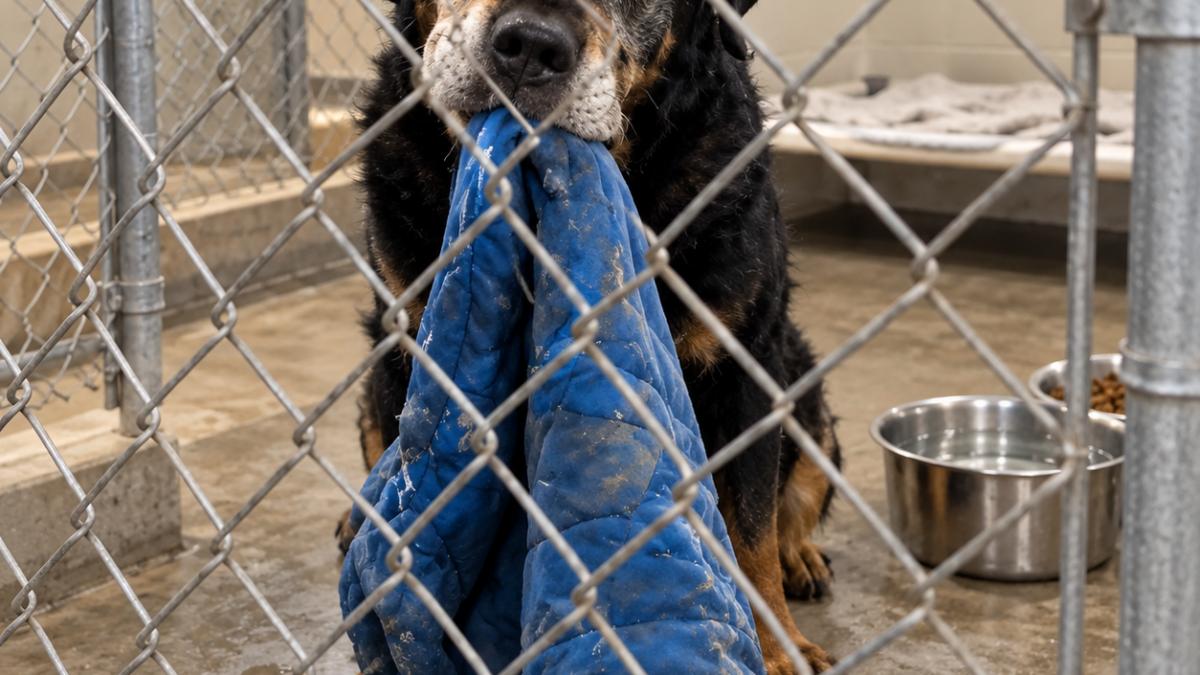
PART 2
For a few seconds, I thought I had misunderstood her.
The shelter was rarely quiet. Somewhere behind us, a terrier barked at a mop bucket. A shepherd mix rattled his stainless-steel water bowl. The front-desk printer hummed.
But all of it seemed distant.
The woman kept her hand against the kennel door.
Duke stood ten feet away, holding the blue coat in his mouth.
“You know Duke?” I asked.
Her eyes never left him.
“I knew the man who owned him.”
Something in my chest tightened.
“What was his name?”
“Arthur Bennett.”
That matched the intake paperwork.
I stepped closer.
The woman swallowed hard.
“My name is Emily Carter. I grew up across the street from Mr. Bennett.”
Duke took one slow step forward.
Emily laughed through her tears.
“He used to call him Duke of Maple Street.”
At the sound of the name, Duke’s tail moved.
Not much.
One slow sweep across the concrete.
Emily covered her mouth again.
“That’s him.”
I unlocked the outer safety gate but didn’t open Duke’s kennel yet.
Shelter dogs can behave unpredictably when faced with someone connected to their former lives, and Duke was a powerful animal despite his age.
“Tell me about him,” I said.
Emily nodded.
She crouched.
“When I was seven, my parents moved into the little yellow house across from Arthur. He was already living there. Quiet man. Kept to himself.”
She smiled faintly.
“He had this huge vegetable garden, and every morning before work he’d be outside watering tomatoes with Duke following him around.”
Duke took another step.
Emily pointed toward the coat.
“And that belonged to Arthur.”
I looked at the faded fabric.
“You’re sure?”
“I’d recognize it anywhere.”
She wiped her cheek.
“He wore that thing every fall. Blue canvas. Brown corduroy collar. One sleeve had a little white paint stain.”
I knelt beside Duke’s bedding and looked.
There it was.
Near the cuff.
A pale streak of paint.
Emily saw my expression.
“I told you.”
“How long has it been since you saw Duke?”
“Almost four years.”
Duke was now halfway across the kennel.
Emily spoke softly through the bars.
“Hey, big guy.”
His tail moved again.
“Do you remember me?”
He stopped.
His nose lifted.
Emily extended her fingers.
Duke approached until his broad muzzle nearly touched them.
He sniffed once.
Twice.
Then he froze.
What happened next is something I will never forget.
Duke dropped the blue coat.
Not carelessly.
He lowered his head and placed it at Emily’s feet on the other side of the bars.
Then he sat down.
Emily began crying so hard that she had to lower herself to the floor.
“Oh, Duke.”
I opened the kennel.
He walked out.
No excitement. No jumping.
He simply moved toward her and rested his enormous gray head against her shoulder.
Emily wrapped both arms around his neck.
For several minutes, neither moved.
I turned away because I suddenly felt as though I were watching something too private to witness.
When I looked back, Duke’s eyes were closed.
He was leaning his full weight against her.
Emily whispered something into his ear.
I couldn’t hear it.
Later, she told me what she had said.
“I’m sorry it took me so long to find you.”
When she finally stood, Duke stayed beside her.
Not behind her.
Not in front.
Beside her.
Like they had been walking together for years.
We moved into one of the small meeting rooms.
Duke carried Arthur’s coat with him.
Emily sat on the floor because he seemed more comfortable there.
I brought her coffee she barely touched.
Then she told me the rest.
Arthur Bennett had been a widower.
His wife, Margaret, had died before Emily’s family moved onto Maple Street.
They’d had no children.
Arthur worked for the electric company for more than thirty years and retired shortly after turning sixty-three.
“He wasn’t unfriendly,” Emily explained. “He was just… careful with people.”
But he loved dogs.
Especially Duke.
Arthur had adopted Duke when the dog was barely a year old.
“He’d been returned twice,” Emily said. “People said he was too big.”
Arthur apparently heard about him from someone at a veterinary clinic.
He went to meet him.
“He told my dad that Duke climbed into his truck and sat in the passenger seat before he’d even signed the paperwork.”
Emily smiled.
“Arthur always said Duke adopted him.”
When Emily was a child, Duke seemed enormous.
She was afraid of him at first.
One afternoon, she dropped her backpack near Arthur’s fence and a notebook slid underneath.
Duke picked it up.
Emily screamed.
Arthur came outside.
Instead of tearing the notebook apart, Duke carried it gently to the gate.
“He handed it back to me,” Emily said.
“After that, I started bringing him treats.”
Arthur pretended not to notice.
Soon Emily was visiting several afternoons a week.
She helped Arthur water his garden.
She threw tennis balls for Duke.
Sometimes Arthur sat on the porch in his blue coat while Duke rested at his feet.
“It became part of my childhood,” she said. “That porch. That dog. Arthur drinking coffee.”
When Emily’s father lost his job, Arthur began leaving vegetables on their porch.
Never with a note.
“He knew Dad was proud.”
When Emily’s mother had surgery, Arthur mowed their lawn for three months.
When Emily turned sixteen and bought her first terrible used car, Arthur taught her how to change the oil.
Duke sat beside them the whole time.
“He was always there,” Emily said.
Then, when Emily was twenty-eight, everything changed.
Her father accepted a job in Oregon.
The family moved almost two thousand miles away.
Emily was already living on her own, but shortly afterward she accepted a teaching position near them.
“I went to Arthur’s house the day before I left.”
She looked down at Duke.
“He was sitting on the porch wearing this coat.”
She touched the sleeve.
“Duke was beside him.”
Arthur had hugged her.
Something he almost never did.
“He said, ‘Don’t waste your whole life looking backward, kid.’”
Emily smiled painfully.
“I promised I’d visit.”
But life does what life does.
One year became two.
Emily changed jobs.
Her mother became ill.
Travel became difficult.
Then Emily learned through an old neighbor that Arthur had died.
“I tried calling the funeral home. They wouldn’t tell me anything about the dog.”
She contacted the county.
No record.
She called shelters around Maple Street.
Nothing.
What Emily didn’t know was that after Arthur’s death, one of his distant relatives had temporarily moved Duke to a property in another county while the estate was being settled.
Several months later, that relative entered assisted living.
Duke was moved again.
Then again.
Finally, he ended up with county animal control.
By the time he arrived at our shelter, the trail connecting him to Arthur’s neighborhood was nearly four years old.
Emily looked at me.
“I thought he was dead.”
Duke raised his head at the sound of her voice.
“I hated myself for not finding him.”
“You couldn’t have known.”
“I could’ve tried harder.”
I had heard that sentence from grieving people many times.
It almost never helped to argue with them.
So I said something different.
“You’re here now.”
She stared at Duke.
Then she looked at me.
“What happens to him Thursday?”
I hesitated.
“How did you know something happens Thursday?”
“I heard you talking to another employee.”
I sighed.
“He was scheduled for transfer.”
“Where?”
I explained.
Emily’s expression changed.
Not anger.
Determination.
“I want to adopt him.”
My heart lifted.
But adoption isn’t as simple as wanting a dog.
Especially a senior Rottweiler.
We needed landlord approval if applicable, veterinary references, household information, and a behavioral meeting.
“Do you rent?”
“No. I own my house.”
“Other animals?”
“One cat.”
That complicated things.
We had no reliable cat history for Duke.
“Children?”
“No.”
“Fenced yard?”
“Yes.”
“Work schedule?”
“I teach at the community college. Three days on campus, two days from home.”
Every answer was better than the last.
Still, we needed to test Duke around cats indirectly, assess prey drive, and confirm Emily understood his medical needs.
Duke already had arthritis.
Bloodwork suggested early kidney changes.
His teeth needed treatment.
He had a small mass near his shoulder that required evaluation.
Emily listened to everything.
Then she said, “What if he only has six months?”
I looked at her.
“That’s possible.”
“What if it’s three?”
“Also possible.”
She nodded.
“Then I want him for three months.”
That answer stayed with me.
Not because it was dramatic.
Because there was no hesitation.
A lot of people say they want to rescue senior dogs until the first medication schedule appears.
Until the first accident on the carpet.
Until the first emergency veterinary bill.
Until the first night they realize love does not negotiate with time.
Emily seemed to understand all of it.
We scheduled the home visit for the next morning.
Before she left that afternoon, she knelt beside Duke.
“I’m coming back.”
Duke stared at her.
Emily touched Arthur’s coat.
“You keep this safe one more night.”
She stood.
For the first time since he had arrived, Duke followed someone all the way to the shelter lobby.
When Emily disappeared through the front door, he remained there for almost a minute.
Then he picked up the coat and returned quietly to his kennel.
That night I stayed late.
I told myself I had paperwork.
That wasn’t true.
I kept thinking about Thursday.
About how close Duke had come to leaving without Emily ever knowing where he was.
Around eight, I walked through the kennel wing.
Duke was awake.
He lay on the coat.
I sat outside his kennel.
“You better not make me look stupid tomorrow,” I told him.
His eyes moved toward me.
“That cat thing? We need you to behave.”
Duke sighed.
“Excellent conversation.”
His tail tapped once against the floor.
The next morning, Emily met me at her house at nine.
It sat at the end of a quiet street lined with maple trees.
The backyard was fenced.
The gates locked securely.
Inside, the floors had several rugs for traction.
There was a large dog bed beside the fireplace.
Two stainless-steel bowls sat in the kitchen.
“You bought these yesterday?”
Emily looked embarrassed.
“I might have stopped on the way home.”
On the dog bed lay a folded blanket.
Blue.
I stared at it.
Emily noticed.
“I know he already has Arthur’s coat. I just thought maybe…”
“You’re ready.”
“I hope so.”
Then the cat appeared.
A thirteen-year-old orange tabby named Henry.
He looked at me with the exhausted judgment of an animal who had been forced to tolerate humanity too long.
“How does Henry do with dogs?”
“He grew up with my parents’ Labrador.”
“That doesn’t necessarily mean he’ll like Duke.”
“Henry doesn’t like anybody.”
As if to prove the point, Henry walked past us without acknowledgment.
We returned to the shelter.
The controlled cat assessment went surprisingly well.
Duke noticed the cat.
He watched.
His ears lifted.
Then he looked at Emily.
The cat hissed.
Duke moved backward.
I almost laughed.
“You’re afraid of cats?”
Duke sat behind Emily’s legs.
Emily grinned.
“Apparently Arthur raised a sensible dog.”
By noon, the adoption had nearly been approved.
Nearly.
That word became important.
At 12:17, our director called me into her office.
A man was sitting across from her desk.
Early fifties.
Expensive jacket.
I had never seen him before.
“This is Mr. Clayton Bennett,” our director said.
The last name hit me immediately.
“Arthur Bennett?”
“My uncle.”
Clayton looked irritated rather than emotional.
He held a folder.
“I understand you have his dog.”
My stomach tightened.
“Yes.”
“I’m here to claim him.”
Everything inside me went cold.
Under most circumstances, an established legal owner or authorized estate representative can complicate an adoption significantly.
“Why now?” I asked.
Clayton looked at me.
“Excuse me?”
“Duke has been in the system for months.”
“I didn’t know where he was.”
Neither had Emily.
But there was something different in Clayton’s tone.
He wasn’t looking toward the kennel wing.
He hadn’t asked whether Duke was healthy.
He hadn’t asked whether Duke remembered him.
He hadn’t asked anything about Duke.
Our director remained professional.
“Mr. Bennett says certain property belonging to his uncle may still be with the dog.”
The blue coat.
I understood immediately.
“You’re here for the coat.”
Clayton leaned back.
“I’m here for what belongs to my family.”
“Does Duke belong to your family?”
His jaw tightened.
“The dog was part of the estate.”
“Then why wasn’t he taken care of?”
“That’s none of your business.”
Actually, at that moment, it became very much my business.
Emily arrived fifteen minutes later.
She entered smiling.
Then she saw Clayton.
The smile disappeared.
“You.”
Clayton turned.
Recognition passed between them.
“You’re the Carter girl.”
Emily stopped beside me.
“What are you doing here?”
“Handling family matters.”
Her face hardened.
“You didn’t care about Arthur when he was alive.”
“That is not your concern.”
“Where was Duke?”
Clayton said nothing.
Emily stepped forward.
“Where was he for four years?”
Our director intervened.
“Emily.”
But Emily couldn’t stop.
“I called people. I tried to find him. You were family.”
Clayton stood.
“And you weren’t.”
That sentence landed hard.
Emily’s eyes filled with tears, but she didn’t back down.
“No. I wasn’t.”
She looked toward Duke’s kennel.
“But I showed up.”
Clayton’s expression changed.
For the first time, I saw something beneath the irritation.
Fear.
Not of Duke.
Of something else.
He looked at the blue coat lying inside the kennel.
“What’s in that coat?” I asked.
Nobody answered.
I walked toward the kennel.
Clayton moved after me.
“Don’t touch it.”
I stopped.
“Why?”
“It’s property from the estate.”
Emily stared at him.
“Arthur wore that thing for twenty years.”
Clayton said, “Exactly.”
Duke stood as we approached.
The moment Clayton came near the bars, Duke’s entire body changed.
He didn’t growl.
But he moved onto the coat.
Not beside it.
Onto it.
Protecting it.
Clayton stopped.
Emily whispered, “He remembers you.”
Clayton scoffed.
“That dog never liked me.”
Sometimes animals tell you more about a person than documents do.
Still, instinct wasn’t evidence.
We could not refuse a legal claim because Duke preferred Emily.
Our director called county counsel.
The adoption was paused.
Emily sat in the lobby afterward with her hands clasped so tightly her knuckles had gone white.
“I’m going to lose him.”
“Not necessarily.”
“He’s family.”
“So?”
“The law cares about that.”
“The law cares about paperwork.”
“That’s worse.”
I couldn’t promise anything.
So I didn’t.
Instead, I asked Emily another question.
“You knew Arthur well.”
“Yes.”
“Did he ever talk about his estate?”
She frowned.
“Not really.”
“What about the coat?”
“No.”
“Did he keep anything in it?”
Emily stared toward the kennel.
Then slowly, she said, “Keys.”
“What?”
“Arthur always kept keys in the inside pocket.”
My pulse jumped.
“What kind?”
“I don’t know. House keys. Shed key. Maybe his old truck.”
Clayton had specifically mentioned property.
Maybe he thought something had been left inside.
Our shelter had never searched the coat.
We generally check incoming items for safety, but the officer had documented the coat as a comfort object and apparently inspected it only externally.
I put on gloves.
Duke was wary when I entered.
“Easy.”
He watched me approach.
I didn’t reach for the coat.
Instead, I sat beside him.
After a minute, Emily entered.
Duke immediately relaxed.
She touched his head.
“Can Kaelen look at it?”
Duke obviously did not understand the sentence.
But when Emily lifted one edge of the coat, he didn’t resist.
I checked the pockets.
Empty.
Clayton smiled from outside the kennel.
“There. Done.”
Then my fingers felt something.
The lining near the inside breast pocket was thicker than it should have been.
I pressed gently.
Something rigid was sewn underneath.
Clayton’s face changed.
I looked at our director.
“We need a witness.”
She called county counsel again.
Within an hour, a deputy arrived.
The coat was photographed.
The stitching appeared hand-sewn and newer than the rest of the garment.
With permission from county counsel, we opened several stitches.
Inside was a flat plastic sleeve.
Inside that was an envelope.
Arthur Bennett had written across the front in black marker:
IF SOMETHING HAPPENS TO ME — ABOUT DUKE.
Emily began crying before anyone opened it.
Clayton said, “That proves nothing.”
The deputy asked him to remain quiet.
Inside the envelope were three pages.
The first was a handwritten letter.
The second was a copy of a veterinary document.
The third was a notarized statement.
Our director read the notarized page first.
Arthur had signed it eighteen months before his death.
It named a local veterinary technician, Melissa Grant, as Duke’s designated caretaker if Arthur died.
If Melissa could not take him, Duke was to be placed with “a responsible person personally familiar with his temperament and history.”
Under no circumstances, Arthur wrote, was Duke to be transferred to Clayton Bennett.
Nobody spoke.
Clayton’s face went white.
Emily looked at him.
“Why?”
Clayton stared at the floor.
The answer came from the handwritten letter.
Arthur had written it in the blunt, practical way older men sometimes write when they are trying not to sound emotional.
Clayton had repeatedly asked Arthur for money.
Arthur helped several times.
Eventually Arthur stopped.
One afternoon, Clayton came to the house angry.
Duke stood between them.
Clayton kicked at him.
Not hard enough to injure him, according to Arthur.
But hard enough.
Arthur never forgot.
Neither, apparently, did Duke.
Arthur’s letter ended with:
Duke has been more loyal to me than most people I share blood with. Whoever takes him should understand that he is not furniture, property, or an inconvenience to dispose of. His blue coat goes with him. He sleeps on it when storms bother him.
And then one final line:
If Emily Carter ever comes back to Maple Street, tell her Duke still looks toward her old house sometimes.
Emily covered her face.
Even our director turned away.
Clayton left twenty minutes later.
He threatened lawyers.
None came.
The notarized document was valid enough for county counsel to determine that Clayton had no immediate claim superseding the shelter’s lawful custody.
But another problem remained.
Melissa Grant.
We tracked her down that afternoon.
She lived in Arizona.
When I explained why I was calling, she went silent.
“Oh, God,” she whispered. “Duke is alive?”
She had moved shortly before Arthur’s death.
Arthur apparently never updated the contact information attached to the document.
Melissa had been informed years earlier that Duke had gone to a relative.
“I thought he was safe.”
I told her about Emily.
Melissa listened.
Then she asked one question.
“Does Duke remember her?”
I looked through the office window.
Emily was sitting on the floor.
Duke’s head rested in her lap.
“Yes.”
Melissa started crying.
“Then I waive everything.”
The papers were signed electronically the next morning.
Thursday.
The same Thursday Duke had been scheduled to leave for senior housing.
Instead, at 2:36 in the afternoon, Emily Carter signed his adoption contract.
I handed her the leash.
Duke stood beside her.
Then I gave her Arthur’s coat.
She looked at it.
“No.”
I was confused.
“What?”
She opened the kennel door and placed the coat on the floor.
Duke immediately picked it up.
Emily smiled through tears.
“He carried it this far.”
She touched his gray muzzle.
“He gets to carry it home.”
Duke walked out of our shelter with the blue coat held proudly between his teeth.
Every employee who was working that afternoon came to the lobby.
Nobody planned it.
They just appeared.
The receptionist.
The kennel attendants.
The veterinary assistant.
Even our director.
We watched the old Rottweiler cross the parking lot beside Emily.
Halfway to her car, Duke stopped.
He turned around.
I know dogs do not understand ceremonies.
I know people place meaning onto things animals do.
I know all of that.
But Duke stood there for several seconds looking back at us.
Then his tail moved once.
And he climbed into Emily’s car.
I thought that was the end of the story.
It wasn’t.
Three days later, Emily sent me a photograph.
Duke was asleep beside her fireplace.
Arthur’s blue coat was beneath his head.
Henry the cat sat approximately three feet away, staring at him with open suspicion.
The caption Emily sent with the photo said:
Henry has filed a formal complaint.
I laughed harder than I had in weeks.
Then came another photograph.
Duke in the backyard.
Another.
Duke asleep beside Emily’s desk while she graded papers.
Another.
Duke standing in the kitchen while Henry ate from his bowl, apparently too intimidated by a fourteen-pound cat to intervene.
But the photograph that stayed with me most arrived two weeks later.
Emily had driven Duke back to Maple Street.
Arthur’s old house had been sold.
New people lived there.
She didn’t disturb them.
She parked across the street near her childhood home.
Duke stepped from the car.
For several seconds he stood perfectly still.
Then he began walking.
Slowly.
Straight toward Arthur’s former property.
Emily followed.
He stopped at the edge of the sidewalk.
The porch had been repainted.
The garden was gone.
The old fence had been replaced.
Everything was different.
Except an enormous maple tree near the driveway.
Duke walked to it.
He sniffed around the trunk.
Then he lay down.
Emily sat beside him.
For almost an hour, they stayed there.
The new homeowner eventually came outside.
Emily apologized.
She explained.
The woman listened.
Then she disappeared into the house.
A few minutes later she returned carrying something.
A small wooden sign.
Arthur had made it years ago and nailed it inside the garden shed.
The homeowners had discovered it during renovations and kept it because they liked it.
The sign said:
DUKE’S YARD.
HUMANS ALLOWED WITH PERMISSION.
Emily sent me a picture of Duke beside it.
I printed that photograph.
For years afterward, it hung above my desk.
Winter came early that year.
Cold rain turned into sleet.
Duke’s arthritis worsened.
Emily bought ramps for the porch steps.
She placed rugs across every slippery floor.
Her veterinarian started him on medication.
He slept more.
But according to Emily, he also developed one strange new habit.
Every evening around five-thirty, shortly before she finished working, Duke would retrieve Arthur’s coat and carry it into her office.
He would place it beside her chair.
Then sit there.
The first time it happened, Emily thought he wanted to go outside.
He didn’t.
The second time, she thought he wanted food.
No.
By the fourth night, she understood.
Arthur had apparently come home from work around that same time for decades.
Maybe Duke associated the hour with waiting for someone he loved.
So Emily started closing her laptop at five-thirty.
Every day.
She would sit on the floor beside him for ten minutes.
No phone.
No television.
Just Emily, Duke, and the blue coat.
Sometimes Henry joined them.
From a safe distance, of course.
Months passed.
Then spring arrived.
Against our veterinarian’s initial expectations, Duke improved.
His kidney numbers stabilized.
The shoulder mass was benign.
Dental surgery relieved pain we hadn’t realized was affecting him.
He began gaining muscle.
One April morning, Emily sent me a video.
Duke was running.
Not fast.
Not gracefully.
Running nevertheless.
Across her backyard.
His ears bounced.
His old legs stretched.
Emily laughed behind the camera.
For three seconds, maybe four, there was nothing old about him.
He looked like the dog Arthur must have brought home years earlier.
That summer Emily began volunteering at our shelter.
She came every Saturday morning.
Duke came sometimes too.
He became strangely useful with frightened dogs.
We never put him directly into kennels with them.
He simply walked the hallway.
Young dogs that barked at everyone often became quiet when Duke passed.
Maybe it was his calmness.
Maybe his age.
Maybe animals recognize things we don’t.
One Saturday, a terrified female Rottweiler arrived after being found beneath an abandoned trailer.
She refused food.
She snapped when approached.
Emily asked if Duke could sit outside her kennel.
We tried.
Duke lowered himself on the concrete.
He didn’t look directly at her.
For twenty minutes, nothing happened.
Then the female came forward.
She sniffed through the bars.
Duke stayed still.
The following day she ate.
Three weeks later she was adopted.
Emily joked that Duke had become a counselor.
I told her his hourly rate was probably expensive.
“Two biscuits,” she said. “Nonnegotiable.”
By autumn, nearly a year had passed since his adoption.
Emily planned something.
She didn’t tell me exactly what.
She only asked whether I could come to Maple Street on a Saturday afternoon.
When I arrived, nearly twenty people were gathered outside Arthur’s old home.
Former neighbors.
Melissa Grant, who had flown in from Arizona.
Several shelter employees.
Even the current homeowners.
Emily stood beneath the maple tree.
Duke was beside her.
His blue coat rested over his back.
Not because it was cold.
Because Emily had finally repaired the torn lining.
The old coat looked almost dignified again.
Emily held the wooden DUKE’S YARD sign.
She had spoken to the homeowners.
They agreed to place a small memorial plaque beneath the maple tree.
Not for Duke.
For Arthur.
ARTHUR BENNETT
GOOD NEIGHBOR
FAITHFUL FRIEND
1928–2022
Below that:
SOME LOVE STAYS AFTER WE LEAVE.
Emily knelt.
Duke touched his nose to the plaque.
Melissa began crying.
So did I.
Afterward, while everyone talked, an elderly man approached Emily.
His name was Frank Wallace.
He had lived two streets over.
“I knew Arthur forty years,” he said.
He handed Emily an envelope.
“He asked me to hold this.”
Emily stared at him.
“Why?”
Frank shrugged.
“Arthur didn’t trust banks with sentimental things.”
Inside was a photograph.
Arthur sat on his porch wearing the blue coat.
A much younger Duke rested beside him.
Standing between them was Emily.
Maybe twelve years old.
She had forgotten the photograph existed.
On the back Arthur had written:
My two shadows.
Emily pressed the picture against her chest.
That evening, after everyone left, I watched her sit beneath the maple tree with Duke.
The sun was dropping behind the houses.
For a moment, I could almost imagine Arthur on that porch again.
Life has a strange way of closing circles.
Not perfectly.
Never perfectly.
But sometimes enough.
Duke lived through another winter.
Then another spring.
By then, he was moving slowly.
His hearing weakened.
His eyes became cloudy.
He needed help getting into the car.
But he still carried the blue coat whenever Emily packed for a trip.
He still waited beside her office at five-thirty.
He still feared Henry.
Then one October morning, almost two years after Duke walked out of our shelter, Emily called me.
I knew before I answered.
There is something about certain phone calls.
You feel them before you hear them.
“Kaelen?”
Her voice was breaking.
I sat down.
“What happened?”
“He didn’t eat breakfast.”
I closed my eyes.
Duke had been slowing for weeks.
The veterinarian had found evidence that his kidneys were failing rapidly.
Medication helped for a while.
Then it didn’t.
“Is he hurting?”
“No. I don’t think so.”
“Where is he?”
“Outside.”
I drove over.
Emily’s backyard was covered in fallen maple leaves.
Duke lay in a patch of sunlight.
The blue coat was beneath him.
Henry sat nearby.
Closer than I had ever seen him sit.
Maybe six inches away.
Duke lifted his head when I approached.
His eyes were cloudy.
But his tail moved.
Once.
I knelt.
“Hey, old man.”
He licked my hand.
Emily sat on the grass.
“I don’t know what to do.”
I knew exactly what she meant.
Not medically.
Emotionally.
“How do I decide?” she whispered.
“You don’t decide how much you love him.”
She looked at me.
“You decide whether you’re keeping him here for him or for you.”
Her face crumpled.
“I’m not ready.”
“Nobody ever is.”
Duke shifted.
Emily immediately moved closer.
He rested his head on her thigh.
The veterinarian came to the house that afternoon.
We all stayed outside.
The same October sunlight that had warmed Arthur’s porch years earlier filtered through Emily’s maple trees.
Duke was wrapped partly in the blue coat.
Emily spoke to him the entire time.
She told him about Arthur.
She told him about Maple Street.
She reminded him of the first afternoon they met.
“You stole my notebook,” she whispered.
Duke’s breathing slowed.
“You scared me half to death.”
His eyes remained on her.
“You spent your whole life taking care of people.”
Emily bent down until her forehead touched his.
“You don’t have to do that anymore.”
Duke exhaled.
A long breath.
Then another.
Then he became still.
Henry walked forward.
The cat sniffed Duke’s paw.
He sat beside him.
Emily made a sound I still hear sometimes.
Not a scream.
Something deeper.
The sound people make when love suddenly has nowhere physical left to go.
I put my arm around her.
We remained in the yard until the sun disappeared.
Later, Emily asked the veterinarian to leave Arthur’s coat.
“That stays with me.”
For several weeks afterward, the coat remained folded beside the fireplace.
Henry slept on it once.
Emily sent me a picture.
“He would be furious,” she wrote.
I answered:
Duke was terrified of Henry. He’d allow it.
Months later, Emily came to the shelter.
She looked different.
Not healed.
Grief isn’t an injury that finishes healing.
But steadier.
She carried Arthur’s blue coat.
For one terrible second, I thought she intended to donate it.
Instead, she sat in my office.
“I want to do something.”
She explained.
Duke’s adoption had taught her something she couldn’t forget.
Every week, senior dogs entered shelters.
Some had lost owners.
Some had been surrendered because medical care became expensive.
Some had simply become inconvenient.
And many visitors passed them by for the same reason people had passed Duke.
Not enough time.
Emily wanted to challenge that idea.
“What if time isn’t the point?” she asked.
I looked at the coat folded in her lap.
“What are you thinking?”
She had created a small fund.
Her savings.
A contribution from Melissa.
Donations from several Maple Street neighbors.
The fund would help cover medical expenses for people adopting senior dogs from our shelter.
Veterinary exams.
Medication.
Dental care.
Hospice consultations.
She named it the Duke and Arthur Fund.
Within the first year, it helped seventeen senior dogs find homes.
The second year, thirty-one.
One was a thirteen-year-old beagle whose owner had entered hospice.
Another was a blind shepherd.
Another was a tiny white mutt named Pepper who had been returned because she needed insulin.
Emily adopted Pepper herself.
Henry objected.
Predictably.
Pepper ignored him.
The blue coat stayed framed inside Emily’s home.
Not behind glass.
She refused.
“Arthur never treated it like something precious.”
So it hung on a wooden hook.
Below it was the photograph of Arthur, Emily, and Duke on the porch.
Years later, when our shelter renovated the senior wing, Emily helped raise enough money to build quiet rooms instead of traditional concrete kennels.
Each room had beds.
Windows.
Soft lighting.
One had a small plaque outside.
THE DUKE ROOM.
Underneath:
FOR THE ONES WHO ARE STILL WAITING.
I stood beside Emily the morning we installed it.
“You know,” I told her, “Duke would hate this.”
She laughed.
“Why?”
“He’d expect royalties.”
“Two biscuits.”
“Nonnegotiable.”
For a moment, we laughed like he was still there.
Then Emily became quiet.
“Do you think he remembered Arthur until the end?”
I looked toward the framed photograph she had brought for the room.
In it, Duke was lying beneath the maple tree on the day of Arthur’s memorial.
The blue coat was across his back.
“I think he remembered everybody who loved him.”
Emily nodded.
“Me too.”
People sometimes ask why senior dogs hold onto objects.
Blankets.
Toys.
Old collars.
Shoes.
Coats.
There are scientific explanations.
Familiar scent reduces stress.
Objects become associated with safety.
Routine helps animals cope with sudden environmental change.
All of that is true.
But whenever someone asks me about it, I think of Duke.
I think of that first rainy Monday.
An old Rottweiler entering a strange shelter after losing the person who had shaped his entire world.
Everything familiar had disappeared.
The house.
The porch.
The garden.
Arthur’s footsteps.
Arthur’s voice.
The sound of his truck.
The hand that scratched behind Duke’s ears every morning.
Everything except one faded blue coat.
So Duke carried it.
Through three counties.
Through unfamiliar homes.
Through different hands.
Into our shelter.
Night after night, he slept on it.
Visitor after visitor passed him by.
Still he kept it.
Then one Tuesday afternoon, a woman from his past stood outside his kennel.
She remembered the porch.
She remembered the garden.
She remembered Arthur.
She remembered him.
And Duke finally put the coat down.
Not because he had stopped loving the man who wore it.
Because for the first time in years, he had found someone else who understood what it meant.
That is what I remember most.
Not his death.
Not even his adoption.
That moment.
The old dog walking toward Emily.
The coat between his teeth.
His gray face lifting toward hers.
Then the way he carefully placed the last piece of his old life at her feet.
As though he had spent years carrying a message.
As though the message had finally reached the right person.
Years have passed since Duke died.
I still work with rescue animals.
I have watched thousands enter shelters and thousands leave.
Some stories stay with you longer than others.
His stayed.
Not because it was miraculous.
Because it was ordinary in the way the most important love often is.
A man adopted a dog nobody wanted.
A little girl grew up across the street.
A blue coat passed from one season of life into another.
People moved.
People died.
Years disappeared.
And somehow, against all probability, memory found its way home.
Emily still volunteers.
She has gray in her hair now.
So do I.
The Duke and Arthur Fund has helped hundreds of older animals.
Every October, Emily places the blue coat over the back of a chair beside her fireplace for one night.
She pours herself coffee.
She sets Arthur’s photograph on the table.
Then she sits quietly.
Sometimes Pepper sleeps nearby.
Sometimes another foster dog does.
And according to Emily, Henry—ancient, stubborn Henry—always comes into the room and lies beneath the coat.
Maybe he remembers Duke too.
I like to think so.
The last time I visited Maple Street, the maple tree was enormous.
Arthur’s plaque was weathered but readable.
The new homeowners had planted tomatoes beside the fence.
Near the porch stood a small wooden sign.
They had restored it.
DUKE’S YARD.
HUMANS ALLOWED WITH PERMISSION.
I stood there longer than I meant to.
Traffic moved in the distance.
Leaves scraped across the sidewalk.
For just a second, I could picture them.
Arthur on the porch in his faded blue coat.
Duke beside him.
A young Emily running across the street with a notebook under one arm.
Nothing dramatic.
Nothing heroic.
Just three lives intersecting before any of them understood how much that ordinary moment would someday matter.
And that, I eventually realized, was the lesson Duke left me.
We spend too much time measuring love by how long we get to keep it.
Ten years.
Two years.
Three months.
One last afternoon in October.
But Duke never measured love that way.
Arthur gave him years.
Emily gave him two more.
Duke gave both of them everything he had.
And when his life finally ended, nothing about that love felt unfinished.
Painful, yes.
But not unfinished.
Because the purpose of loving someone was never to keep them forever.
It was to make sure that while they were here, they knew exactly where they belonged.
Duke spent years carrying Arthur’s blue coat because it smelled like home.
In the end, he didn’t need to carry it anymore.
He had found home again.
[FACEBOOK CAPTION — 700–800 WORDS]
He had crossed three counties to reach our shelter, carrying a faded blue coat in his mouth like it was the last thing in the world he had been ordered to protect.
For weeks, people stopped at his kennel, called him beautiful, and walked away the moment they learned how old he was.
Then, two days before we were supposed to move him into permanent senior housing, a young woman saw that coat through the bars—and went completely still.
My name is Kaelen Mercer, and I had worked at the county animal shelter long enough to think I understood grief.
I was wrong.
The old Rottweiler arrived on a rainy Monday in October.
He was nearly ten years old, maybe older, with a broad chest, a gray muzzle, and the kind of tired brown eyes that made you lower your voice without knowing why.
The animal-control officer who brought him in handed me a thin file.
“Owner passed away,” he said. “No family willing to take the dog.”
I looked toward the kennel cart.
The Rottweiler wasn’t growling.
He wasn’t trembling.
He wasn’t fighting.
He was holding an old blue work coat between his teeth.
“What’s that?”
“Wouldn’t leave without it.”
Apparently, when officers had entered the small house where his owner had lived, they found the dog lying beside the man’s bed with that coat beneath his head.
Every time someone tried to remove it, he picked it up again.
So they let him keep it.
We named him Duke because that was the name written on an old veterinary receipt in the kitchen drawer.
That first night, I spread a clean blanket across his kennel floor.
Duke ignored it.
He placed the blue coat in the corner, turned in three slow circles, then lowered his massive body directly onto it.
He slept with his nose buried in one sleeve.
The next morning, he carried it outside for his walk.
At lunch, he brought it back inside.
At night, he folded himself over it again.
It became obvious that the coat wasn’t a toy.
It was his home.
Visitors noticed Duke immediately.
Rottweilers have a reputation that makes some people nervous, but Duke had an almost startling gentleness.
He would approach the bars slowly, sit down, and offer one paw.
People smiled.
Children pointed.
Adults crouched beside him and scratched his gray face.
Then they read the card.
AGE: SENIOR.
Suddenly, their voices changed.
“He’s wonderful, but we really wanted something younger.”
“I don’t know if I could handle losing a dog so soon.”
“We’re looking for one that can grow up with us.”
Nobody meant to be cruel.
But Duke always watched them leave.
And afterward, he would return to the back of his kennel and lower his head onto that blue coat.
Six weeks passed.
Then seven.
His adoption card gathered dust.
One Wednesday morning, our director called me into her office.
“We need his kennel,” she said gently.
I already knew what was coming.
The shelter worked with a retirement facility for older dogs nearly two hours away. It was safe. Quiet. Well run.
But it wasn’t a home.
“When?”
“Thursday.”
I looked through the office window toward Duke’s row.
He was asleep on the blue coat.
For some reason, that broke something inside me.
The following Tuesday afternoon, I was cleaning bowls when the lobby door opened.
A woman in her early thirties walked in alone.
She didn’t head toward the puppies like most visitors.
Instead, she moved slowly from kennel to kennel, studying each dog as though she were searching for something she couldn’t quite name.
When she reached Duke’s enclosure, she stopped.
Duke was sitting in the back corner with the blue coat hanging gently from his mouth.
The woman’s face drained of color.
Her hand rose to cover her lips.
Then her eyes filled with tears.
I hurried toward her.
“Ma’am? Are you all right?”
She didn’t answer immediately.
She just stared at Duke.
The old dog raised his head.
For the first time in weeks, his ears lifted sharply.
The woman stepped closer to the bars.
Her voice came out as barely more than a whisper.
“Oh my God.”
I looked from her to Duke.
“What is it?”
She reached one trembling hand toward the kennel.
Duke stood.
And then she said the words that changed everything.
“I know him.”
[END OF FACEBOOK CAPTION]
[FIRST COMMENT / FULL STORY CONTINUATION]
For a few seconds, I thought I had misunderstood her.
The shelter was rarely quiet. Somewhere behind us, a terrier barked at a mop bucket. A shepherd mix rattled his stainless-steel water bowl. The front-desk printer hummed.
But all of it seemed distant.
The woman kept her hand against the kennel door.
Duke stood ten feet away, holding the blue coat in his mouth.
“You know Duke?” I asked.
Her eyes never left him.
“I knew the man who owned him.”
Something in my chest tightened.
“What was his name?”
“Arthur Bennett.”
That matched the intake paperwork.
I stepped closer.
The woman swallowed hard.
“My name is Emily Carter. I grew up across the street from Mr. Bennett.”
Duke took one slow step forward.
Emily laughed through her tears.
“He used to call him Duke of Maple Street.”
At the sound of the name, Duke’s tail moved.
Not much.
One slow sweep across the concrete.
Emily covered her mouth again.
“That’s him.”
I unlocked the outer safety gate but didn’t open Duke’s kennel yet.
Shelter dogs can behave unpredictably when faced with someone connected to their former lives, and Duke was a powerful animal despite his age.
“Tell me about him,” I said.
Emily nodded.
She crouched.
“When I was seven, my parents moved into the little yellow house across from Arthur. He was already living there. Quiet man. Kept to himself.”
She smiled faintly.
“He had this huge vegetable garden, and every morning before work he’d be outside watering tomatoes with Duke following him around.”
Duke took another step.
Emily pointed toward the coat.
“And that belonged to Arthur.”
I looked at the faded fabric.
“You’re sure?”
“I’d recognize it anywhere.”
She wiped her cheek.
“He wore that thing every fall. Blue canvas. Brown corduroy collar. One sleeve had a little white paint stain.”
I knelt beside Duke’s bedding and looked.
There it was.
Near the cuff.
A pale streak of paint.
Emily saw my expression.
“I told you.”
“How long has it been since you saw Duke?”
“Almost four years.”
Duke was now halfway across the kennel.
Emily spoke softly through the bars.
“Hey, big guy.”
His tail moved again.
“Do you remember me?”
He stopped.
His nose lifted.
Emily extended her fingers.
Duke approached until his broad muzzle nearly touched them.
He sniffed once.
Twice.
Then he froze.
What happened next is something I will never forget.
Duke dropped the blue coat.
Not carelessly.
He lowered his head and placed it at Emily’s feet on the other side of the bars.
Then he sat down.
Emily began crying so hard that she had to lower herself to the floor.
“Oh, Duke.”
I opened the kennel.
He walked out.
No excitement. No jumping.
He simply moved toward her and rested his enormous gray head against her shoulder.
Emily wrapped both arms around his neck.
For several minutes, neither moved.
I turned away because I suddenly felt as though I were watching something too private to witness.
When I looked back, Duke’s eyes were closed.
He was leaning his full weight against her.
Emily whispered something into his ear.
I couldn’t hear it.
Later, she told me what she had said.
“I’m sorry it took me so long to find you.”
When she finally stood, Duke stayed beside her.
Not behind her.
Not in front.
Beside her.
Like they had been walking together for years.
We moved into one of the small meeting rooms.
Duke carried Arthur’s coat with him.
Emily sat on the floor because he seemed more comfortable there.
I brought her coffee she barely touched.
Then she told me the rest.
Arthur Bennett had been a widower.
His wife, Margaret, had died before Emily’s family moved onto Maple Street.
They’d had no children.
Arthur worked for the electric company for more than thirty years and retired shortly after turning sixty-three.
“He wasn’t unfriendly,” Emily explained. “He was just… careful with people.”
But he loved dogs.
Especially Duke.
Arthur had adopted Duke when the dog was barely a year old.
“He’d been returned twice,” Emily said. “People said he was too big.”
Arthur apparently heard about him from someone at a veterinary clinic.
He went to meet him.
“He told my dad that Duke climbed into his truck and sat in the passenger seat before he’d even signed the paperwork.”
Emily smiled.
“Arthur always said Duke adopted him.”
When Emily was a child, Duke seemed enormous.
She was afraid of him at first.
One afternoon, she dropped her backpack near Arthur’s fence and a notebook slid underneath.
Duke picked it up.
Emily screamed.
Arthur came outside.
Instead of tearing the notebook apart, Duke carried it gently to the gate.
“He handed it back to me,” Emily said.
“After that, I started bringing him treats.”
Arthur pretended not to notice.
Soon Emily was visiting several afternoons a week.
She helped Arthur water his garden.
She threw tennis balls for Duke.
Sometimes Arthur sat on the porch in his blue coat while Duke rested at his feet.
“It became part of my childhood,” she said. “That porch. That dog. Arthur drinking coffee.”
When Emily’s father lost his job, Arthur began leaving vegetables on their porch.
Never with a note.
“He knew Dad was proud.”
When Emily’s mother had surgery, Arthur mowed their lawn for three months.
When Emily turned sixteen and bought her first terrible used car, Arthur taught her how to change the oil.
Duke sat beside them the whole time.
“He was always there,” Emily said.
Then, when Emily was twenty-eight, everything changed.
Her father accepted a job in Oregon.
The family moved almost two thousand miles away.
Emily was already living on her own, but shortly afterward she accepted a teaching position near them.
“I went to Arthur’s house the day before I left.”
She looked down at Duke.
“He was sitting on the porch wearing this coat.”
She touched the sleeve.
“Duke was beside him.”
Arthur had hugged her.
Something he almost never did.
“He said, ‘Don’t waste your whole life looking backward, kid.’”
Emily smiled painfully.
“I promised I’d visit.”
But life does what life does.
One year became two.
Emily changed jobs.
Her mother became ill.
Travel became difficult.
Then Emily learned through an old neighbor that Arthur had died.
“I tried calling the funeral home. They wouldn’t tell me anything about the dog.”
She contacted the county.
No record.
She called shelters around Maple Street.
Nothing.
What Emily didn’t know was that after Arthur’s death, one of his distant relatives had temporarily moved Duke to a property in another county while the estate was being settled.
Several months later, that relative entered assisted living.
Duke was moved again.
Then again.
Finally, he ended up with county animal control.
By the time he arrived at our shelter, the trail connecting him to Arthur’s neighborhood was nearly four years old.
Emily looked at me.
“I thought he was dead.”
Duke raised his head at the sound of her voice.
“I hated myself for not finding him.”
“You couldn’t have known.”
“I could’ve tried harder.”
I had heard that sentence from grieving people many times.
It almost never helped to argue with them.
So I said something different.
“You’re here now.”
She stared at Duke.
Then she looked at me.
“What happens to him Thursday?”
I hesitated.
“How did you know something happens Thursday?”
“I heard you talking to another employee.”
I sighed.
“He was scheduled for transfer.”
“Where?”
I explained.
Emily’s expression changed.
Not anger.
Determination.
“I want to adopt him.”
My heart lifted.
But adoption isn’t as simple as wanting a dog.
Especially a senior Rottweiler.
We needed landlord approval if applicable, veterinary references, household information, and a behavioral meeting.
“Do you rent?”
“No. I own my house.”
“Other animals?”
“One cat.”
That complicated things.
We had no reliable cat history for Duke.
“Children?”
“No.”
“Fenced yard?”
“Yes.”
“Work schedule?”
“I teach at the community college. Three days on campus, two days from home.”
Every answer was better than the last.
Still, we needed to test Duke around cats indirectly, assess prey drive, and confirm Emily understood his medical needs.
Duke already had arthritis.
Bloodwork suggested early kidney changes.
His teeth needed treatment.
He had a small mass near his shoulder that required evaluation.
Emily listened to everything.
Then she said, “What if he only has six months?”
I looked at her.
“That’s possible.”
“What if it’s three?”
“Also possible.”
She nodded.
“Then I want him for three months.”
That answer stayed with me.
Not because it was dramatic.
Because there was no hesitation.
A lot of people say they want to rescue senior dogs until the first medication schedule appears.
Until the first accident on the carpet.
Until the first emergency veterinary bill.
Until the first night they realize love does not negotiate with time.
Emily seemed to understand all of it.
We scheduled the home visit for the next morning.
Before she left that afternoon, she knelt beside Duke.
“I’m coming back.”
Duke stared at her.
Emily touched Arthur’s coat.
“You keep this safe one more night.”
She stood.
For the first time since he had arrived, Duke followed someone all the way to the shelter lobby.
When Emily disappeared through the front door, he remained there for almost a minute.
Then he picked up the coat and returned quietly to his kennel.
That night I stayed late.
I told myself I had paperwork.
That wasn’t true.
I kept thinking about Thursday.
About how close Duke had come to leaving without Emily ever knowing where he was.
Around eight, I walked through the kennel wing.
Duke was awake.
He lay on the coat.
I sat outside his kennel.
“You better not make me look stupid tomorrow,” I told him.
His eyes moved toward me.
“That cat thing? We need you to behave.”
Duke sighed.
“Excellent conversation.”
His tail tapped once against the floor.
The next morning, Emily met me at her house at nine.
It sat at the end of a quiet street lined with maple trees.
The backyard was fenced.
The gates locked securely.
Inside, the floors had several rugs for traction.
There was a large dog bed beside the fireplace.
Two stainless-steel bowls sat in the kitchen.
“You bought these yesterday?”
Emily looked embarrassed.
“I might have stopped on the way home.”
On the dog bed lay a folded blanket.
Blue.
I stared at it.
Emily noticed.
“I know he already has Arthur’s coat. I just thought maybe…”
“You’re ready.”
“I hope so.”
Then the cat appeared.
A thirteen-year-old orange tabby named Henry.
He looked at me with the exhausted judgment of an animal who had been forced to tolerate humanity too long.
“How does Henry do with dogs?”
“He grew up with my parents’ Labrador.”
“That doesn’t necessarily mean he’ll like Duke.”
“Henry doesn’t like anybody.”
As if to prove the point, Henry walked past us without acknowledgment.
We returned to the shelter.
The controlled cat assessment went surprisingly well.
Duke noticed the cat.
He watched.
His ears lifted.
Then he looked at Emily.
The cat hissed.
Duke moved backward.
I almost laughed.
“You’re afraid of cats?”
Duke sat behind Emily’s legs.
Emily grinned.
“Apparently Arthur raised a sensible dog.”
By noon, the adoption had nearly been approved.
Nearly.
That word became important.
At 12:17, our director called me into her office.
A man was sitting across from her desk.
Early fifties.
Expensive jacket.
I had never seen him before.
“This is Mr. Clayton Bennett,” our director said.
The last name hit me immediately.
“Arthur Bennett?”
“My uncle.”
Clayton looked irritated rather than emotional.
He held a folder.
“I understand you have his dog.”
My stomach tightened.
“Yes.”
“I’m here to claim him.”
Everything inside me went cold.
Under most circumstances, an established legal owner or authorized estate representative can complicate an adoption significantly.
“Why now?” I asked.
Clayton looked at me.
“Excuse me?”
“Duke has been in the system for months.”
“I didn’t know where he was.”
Neither had Emily.
But there was something different in Clayton’s tone.
He wasn’t looking toward the kennel wing.
He hadn’t asked whether Duke was healthy.
He hadn’t asked whether Duke remembered him.
He hadn’t asked anything about Duke.
Our director remained professional.
“Mr. Bennett says certain property belonging to his uncle may still be with the dog.”
The blue coat.
I understood immediately.
“You’re here for the coat.”
Clayton leaned back.
“I’m here for what belongs to my family.”
“Does Duke belong to your family?”
His jaw tightened.
“The dog was part of the estate.”
“Then why wasn’t he taken care of?”
“That’s none of your business.”
Actually, at that moment, it became very much my business.
Emily arrived fifteen minutes later.
She entered smiling.
Then she saw Clayton.
The smile disappeared.
“You.”
Clayton turned.
Recognition passed between them.
“You’re the Carter girl.”
Emily stopped beside me.
“What are you doing here?”
“Handling family matters.”
Her face hardened.
“You didn’t care about Arthur when he was alive.”
“That is not your concern.”
“Where was Duke?”
Clayton said nothing.
Emily stepped forward.
“Where was he for four years?”
Our director intervened.
“Emily.”
But Emily couldn’t stop.
“I called people. I tried to find him. You were family.”
Clayton stood.
“And you weren’t.”
That sentence landed hard.
Emily’s eyes filled with tears, but she didn’t back down.
“No. I wasn’t.”
She looked toward Duke’s kennel.
“But I showed up.”
Clayton’s expression changed.
For the first time, I saw something beneath the irritation.
Fear.
Not of Duke.
Of something else.
He looked at the blue coat lying inside the kennel.
“What’s in that coat?” I asked.
Nobody answered.
I walked toward the kennel.
Clayton moved after me.
“Don’t touch it.”
I stopped.
“Why?”
“It’s property from the estate.”
Emily stared at him.
“Arthur wore that thing for twenty years.”
Clayton said, “Exactly.”
Duke stood as we approached.
The moment Clayton came near the bars, Duke’s entire body changed.
He didn’t growl.
But he moved onto the coat.
Not beside it.
Onto it.
Protecting it.
Clayton stopped.
Emily whispered, “He remembers you.”
Clayton scoffed.
“That dog never liked me.”
Sometimes animals tell you more about a person than documents do.
Still, instinct wasn’t evidence.
We could not refuse a legal claim because Duke preferred Emily.
Our director called county counsel.
The adoption was paused.
Emily sat in the lobby afterward with her hands clasped so tightly her knuckles had gone white.
“I’m going to lose him.”
“Not necessarily.”
“He’s family.”
“So?”
“The law cares about that.”
“The law cares about paperwork.”
“That’s worse.”
I couldn’t promise anything.
So I didn’t.
Instead, I asked Emily another question.
“You knew Arthur well.”
“Yes.”
“Did he ever talk about his estate?”
She frowned.
“Not really.”
“What about the coat?”
“No.”
“Did he keep anything in it?”
Emily stared toward the kennel.
Then slowly, she said, “Keys.”
“What?”
“Arthur always kept keys in the inside pocket.”
My pulse jumped.
“What kind?”
“I don’t know. House keys. Shed key. Maybe his old truck.”
Clayton had specifically mentioned property.
Maybe he thought something had been left inside.
Our shelter had never searched the coat.
We generally check incoming items for safety, but the officer had documented the coat as a comfort object and apparently inspected it only externally.
I put on gloves.
Duke was wary when I entered.
“Easy.”
He watched me approach.
I didn’t reach for the coat.
Instead, I sat beside him.
After a minute, Emily entered.
Duke immediately relaxed.
She touched his head.
“Can Kaelen look at it?”
Duke obviously did not understand the sentence.
But when Emily lifted one edge of the coat, he didn’t resist.
I checked the pockets.
Empty.
Clayton smiled from outside the kennel.
“There. Done.”
Then my fingers felt something.
The lining near the inside breast pocket was thicker than it should have been.
I pressed gently.
Something rigid was sewn underneath.
Clayton’s face changed.
I looked at our director.
“We need a witness.”
She called county counsel again.
Within an hour, a deputy arrived.
The coat was photographed.
The stitching appeared hand-sewn and newer than the rest of the garment.
With permission from county counsel, we opened several stitches.
Inside was a flat plastic sleeve.
Inside that was an envelope.
Arthur Bennett had written across the front in black marker:
IF SOMETHING HAPPENS TO ME — ABOUT DUKE.
Emily began crying before anyone opened it.
Clayton said, “That proves nothing.”
The deputy asked him to remain quiet.
Inside the envelope were three pages.
The first was a handwritten letter.
The second was a copy of a veterinary document.
The third was a notarized statement.
Our director read the notarized page first.
Arthur had signed it eighteen months before his death.
It named a local veterinary technician, Melissa Grant, as Duke’s designated caretaker if Arthur died.
If Melissa could not take him, Duke was to be placed with “a responsible person personally familiar with his temperament and history.”
Under no circumstances, Arthur wrote, was Duke to be transferred to Clayton Bennett.
Nobody spoke.
Clayton’s face went white.
Emily looked at him.
“Why?”
Clayton stared at the floor.
The answer came from the handwritten letter.
Arthur had written it in the blunt, practical way older men sometimes write when they are trying not to sound emotional.
Clayton had repeatedly asked Arthur for money.
Arthur helped several times.
Eventually Arthur stopped.
One afternoon, Clayton came to the house angry.
Duke stood between them.
Clayton kicked at him.
Not hard enough to injure him, according to Arthur.
But hard enough.
Arthur never forgot.
Neither, apparently, did Duke.
Arthur’s letter ended with:
Duke has been more loyal to me than most people I share blood with. Whoever takes him should understand that he is not furniture, property, or an inconvenience to dispose of. His blue coat goes with him. He sleeps on it when storms bother him.
And then one final line:
If Emily Carter ever comes back to Maple Street, tell her Duke still looks toward her old house sometimes.
Emily covered her face.
Even our director turned away.
Clayton left twenty minutes later.
He threatened lawyers.
None came.
The notarized document was valid enough for county counsel to determine that Clayton had no immediate claim superseding the shelter’s lawful custody.
But another problem remained.
Melissa Grant.
We tracked her down that afternoon.
She lived in Arizona.
When I explained why I was calling, she went silent.
“Oh, God,” she whispered. “Duke is alive?”
She had moved shortly before Arthur’s death.
Arthur apparently never updated the contact information attached to the document.
Melissa had been informed years earlier that Duke had gone to a relative.
“I thought he was safe.”
I told her about Emily.
Melissa listened.
Then she asked one question.
“Does Duke remember her?”
I looked through the office window.
Emily was sitting on the floor.
Duke’s head rested in her lap.
“Yes.”
Melissa started crying.
“Then I waive everything.”
The papers were signed electronically the next morning.
Thursday.
The same Thursday Duke had been scheduled to leave for senior housing.
Instead, at 2:36 in the afternoon, Emily Carter signed his adoption contract.
I handed her the leash.
Duke stood beside her.
Then I gave her Arthur’s coat.
She looked at it.
“No.”
I was confused.
“What?”
She opened the kennel door and placed the coat on the floor.
Duke immediately picked it up.
Emily smiled through tears.
“He carried it this far.”
She touched his gray muzzle.
“He gets to carry it home.”
Duke walked out of our shelter with the blue coat held proudly between his teeth.
Every employee who was working that afternoon came to the lobby.
Nobody planned it.
They just appeared.
The receptionist.
The kennel attendants.
The veterinary assistant.
Even our director.
We watched the old Rottweiler cross the parking lot beside Emily.
Halfway to her car, Duke stopped.
He turned around.
I know dogs do not understand ceremonies.
I know people place meaning onto things animals do.
I know all of that.
But Duke stood there for several seconds looking back at us.
Then his tail moved once.
And he climbed into Emily’s car.
I thought that was the end of the story.
It wasn’t.
Three days later, Emily sent me a photograph.
Duke was asleep beside her fireplace.
Arthur’s blue coat was beneath his head.
Henry the cat sat approximately three feet away, staring at him with open suspicion.
The caption Emily sent with the photo said:
Henry has filed a formal complaint.
I laughed harder than I had in weeks.
Then came another photograph.
Duke in the backyard.
Another.
Duke asleep beside Emily’s desk while she graded papers.
Another.
Duke standing in the kitchen while Henry ate from his bowl, apparently too intimidated by a fourteen-pound cat to intervene.
But the photograph that stayed with me most arrived two weeks later.
Emily had driven Duke back to Maple Street.
Arthur’s old house had been sold.
New people lived there.
She didn’t disturb them.
She parked across the street near her childhood home.
Duke stepped from the car.
For several seconds he stood perfectly still.
Then he began walking.
Slowly.
Straight toward Arthur’s former property.
Emily followed.
He stopped at the edge of the sidewalk.
The porch had been repainted.
The garden was gone.
The old fence had been replaced.
Everything was different.
Except an enormous maple tree near the driveway.
Duke walked to it.
He sniffed around the trunk.
Then he lay down.
Emily sat beside him.
For almost an hour, they stayed there.
The new homeowner eventually came outside.
Emily apologized.
She explained.
The woman listened.
Then she disappeared into the house.
A few minutes later she returned carrying something.
A small wooden sign.
Arthur had made it years ago and nailed it inside the garden shed.
The homeowners had discovered it during renovations and kept it because they liked it.
The sign said:
DUKE’S YARD.
HUMANS ALLOWED WITH PERMISSION.
Emily sent me a picture of Duke beside it.
I printed that photograph.
For years afterward, it hung above my desk.
Winter came early that year.
Cold rain turned into sleet.
Duke’s arthritis worsened.
Emily bought ramps for the porch steps.
She placed rugs across every slippery floor.
Her veterinarian started him on medication.
He slept more.
But according to Emily, he also developed one strange new habit.
Every evening around five-thirty, shortly before she finished working, Duke would retrieve Arthur’s coat and carry it into her office.
He would place it beside her chair.
Then sit there.
The first time it happened, Emily thought he wanted to go outside.
He didn’t.
The second time, she thought he wanted food.
No.
By the fourth night, she understood.
Arthur had apparently come home from work around that same time for decades.
Maybe Duke associated the hour with waiting for someone he loved.
So Emily started closing her laptop at five-thirty.
Every day.
She would sit on the floor beside him for ten minutes.
No phone.
No television.
Just Emily, Duke, and the blue coat.
Sometimes Henry joined them.
From a safe distance, of course.
Months passed.
Then spring arrived.
Against our veterinarian’s initial expectations, Duke improved.
His kidney numbers stabilized.
The shoulder mass was benign.
Dental surgery relieved pain we hadn’t realized was affecting him.
He began gaining muscle.
One April morning, Emily sent me a video.
Duke was running.
Not fast.
Not gracefully.
Running nevertheless.
Across her backyard.
His ears bounced.
His old legs stretched.
Emily laughed behind the camera.
For three seconds, maybe four, there was nothing old about him.
He looked like the dog Arthur must have brought home years earlier.
That summer Emily began volunteering at our shelter.
She came every Saturday morning.
Duke came sometimes too.
He became strangely useful with frightened dogs.
We never put him directly into kennels with them.
He simply walked the hallway.
Young dogs that barked at everyone often became quiet when Duke passed.
Maybe it was his calmness.
Maybe his age.
Maybe animals recognize things we don’t.
One Saturday, a terrified female Rottweiler arrived after being found beneath an abandoned trailer.
She refused food.
She snapped when approached.
Emily asked if Duke could sit outside her kennel.
We tried.
Duke lowered himself on the concrete.
He didn’t look directly at her.
For twenty minutes, nothing happened.
Then the female came forward.
She sniffed through the bars.
Duke stayed still.
The following day she ate.
Three weeks later she was adopted.
Emily joked that Duke had become a counselor.
I told her his hourly rate was probably expensive.
“Two biscuits,” she said. “Nonnegotiable.”
By autumn, nearly a year had passed since his adoption.
Emily planned something.
She didn’t tell me exactly what.
She only asked whether I could come to Maple Street on a Saturday afternoon.
When I arrived, nearly twenty people were gathered outside Arthur’s old home.
Former neighbors.
Melissa Grant, who had flown in from Arizona.
Several shelter employees.
Even the current homeowners.
Emily stood beneath the maple tree.
Duke was beside her.
His blue coat rested over his back.
Not because it was cold.
Because Emily had finally repaired the torn lining.
The old coat looked almost dignified again.
Emily held the wooden DUKE’S YARD sign.
She had spoken to the homeowners.
They agreed to place a small memorial plaque beneath the maple tree.
Not for Duke.
For Arthur.
ARTHUR BENNETT
GOOD NEIGHBOR
FAITHFUL FRIEND
1928–2022
Below that:
SOME LOVE STAYS AFTER WE LEAVE.
Emily knelt.
Duke touched his nose to the plaque.
Melissa began crying.
So did I.
Afterward, while everyone talked, an elderly man approached Emily.
His name was Frank Wallace.
He had lived two streets over.
“I knew Arthur forty years,” he said.
He handed Emily an envelope.
“He asked me to hold this.”
Emily stared at him.
“Why?”
Frank shrugged.
“Arthur didn’t trust banks with sentimental things.”
Inside was a photograph.
Arthur sat on his porch wearing the blue coat.
A much younger Duke rested beside him.
Standing between them was Emily.
Maybe twelve years old.
She had forgotten the photograph existed.
On the back Arthur had written:
My two shadows.
Emily pressed the picture against her chest.
That evening, after everyone left, I watched her sit beneath the maple tree with Duke.
The sun was dropping behind the houses.
For a moment, I could almost imagine Arthur on that porch again.
Life has a strange way of closing circles.
Not perfectly.
Never perfectly.
But sometimes enough.
Duke lived through another winter.
Then another spring.
By then, he was moving slowly.
His hearing weakened.
His eyes became cloudy.
He needed help getting into the car.
But he still carried the blue coat whenever Emily packed for a trip.
He still waited beside her office at five-thirty.
He still feared Henry.
Then one October morning, almost two years after Duke walked out of our shelter, Emily called me.
I knew before I answered.
There is something about certain phone calls.
You feel them before you hear them.
“Kaelen?”
Her voice was breaking.
I sat down.
“What happened?”
“He didn’t eat breakfast.”
I closed my eyes.
Duke had been slowing for weeks.
The veterinarian had found evidence that his kidneys were failing rapidly.
Medication helped for a while.
Then it didn’t.
“Is he hurting?”
“No. I don’t think so.”
“Where is he?”
“Outside.”
I drove over.
Emily’s backyard was covered in fallen maple leaves.
Duke lay in a patch of sunlight.
The blue coat was beneath him.
Henry sat nearby.
Closer than I had ever seen him sit.
Maybe six inches away.
Duke lifted his head when I approached.
His eyes were cloudy.
But his tail moved.
Once.
I knelt.
“Hey, old man.”
He licked my hand.
Emily sat on the grass.
“I don’t know what to do.”
I knew exactly what she meant.
Not medically.
Emotionally.
“How do I decide?” she whispered.
“You don’t decide how much you love him.”
She looked at me.
“You decide whether you’re keeping him here for him or for you.”
Her face crumpled.
“I’m not ready.”
“Nobody ever is.”
Duke shifted.
Emily immediately moved closer.
He rested his head on her thigh.
The veterinarian came to the house that afternoon.
We all stayed outside.
The same October sunlight that had warmed Arthur’s porch years earlier filtered through Emily’s maple trees.
Duke was wrapped partly in the blue coat.
Emily spoke to him the entire time.
She told him about Arthur.
She told him about Maple Street.
She reminded him of the first afternoon they met.
“You stole my notebook,” she whispered.
Duke’s breathing slowed.
“You scared me half to death.”
His eyes remained on her.
“You spent your whole life taking care of people.”
Emily bent down until her forehead touched his.
“You don’t have to do that anymore.”
Duke exhaled.
A long breath.
Then another.
Then he became still.
Henry walked forward.
The cat sniffed Duke’s paw.
He sat beside him.
Emily made a sound I still hear sometimes.
Not a scream.
Something deeper.
The sound people make when love suddenly has nowhere physical left to go.
I put my arm around her.
We remained in the yard until the sun disappeared.
Later, Emily asked the veterinarian to leave Arthur’s coat.
“That stays with me.”
For several weeks afterward, the coat remained folded beside the fireplace.
Henry slept on it once.
Emily sent me a picture.
“He would be furious,” she wrote.
I answered:
Duke was terrified of Henry. He’d allow it.
Months later, Emily came to the shelter.
She looked different.
Not healed.
Grief isn’t an injury that finishes healing.
But steadier.
She carried Arthur’s blue coat.
For one terrible second, I thought she intended to donate it.
Instead, she sat in my office.
“I want to do something.”
She explained.
Duke’s adoption had taught her something she couldn’t forget.
Every week, senior dogs entered shelters.
Some had lost owners.
Some had been surrendered because medical care became expensive.
Some had simply become inconvenient.
And many visitors passed them by for the same reason people had passed Duke.
Not enough time.
Emily wanted to challenge that idea.
“What if time isn’t the point?” she asked.
I looked at the coat folded in her lap.
“What are you thinking?”
She had created a small fund.
Her savings.
A contribution from Melissa.
Donations from several Maple Street neighbors.
The fund would help cover medical expenses for people adopting senior dogs from our shelter.
Veterinary exams.
Medication.
Dental care.
Hospice consultations.
She named it the Duke and Arthur Fund.
Within the first year, it helped seventeen senior dogs find homes.
The second year, thirty-one.
One was a thirteen-year-old beagle whose owner had entered hospice.
Another was a blind shepherd.
Another was a tiny white mutt named Pepper who had been returned because she needed insulin.
Emily adopted Pepper herself.
Henry objected.
Predictably.
Pepper ignored him.
The blue coat stayed framed inside Emily’s home.
Not behind glass.
She refused.
“Arthur never treated it like something precious.”
So it hung on a wooden hook.
Below it was the photograph of Arthur, Emily, and Duke on the porch.
Years later, when our shelter renovated the senior wing, Emily helped raise enough money to build quiet rooms instead of traditional concrete kennels.
Each room had beds.
Windows.
Soft lighting.
One had a small plaque outside.
THE DUKE ROOM.
Underneath:
FOR THE ONES WHO ARE STILL WAITING.
I stood beside Emily the morning we installed it.
“You know,” I told her, “Duke would hate this.”
She laughed.
“Why?”
“He’d expect royalties.”
“Two biscuits.”
“Nonnegotiable.”
For a moment, we laughed like he was still there.
Then Emily became quiet.
“Do you think he remembered Arthur until the end?”
I looked toward the framed photograph she had brought for the room.
In it, Duke was lying beneath the maple tree on the day of Arthur’s memorial.
The blue coat was across his back.
“I think he remembered everybody who loved him.”
Emily nodded.
“Me too.”
People sometimes ask why senior dogs hold onto objects.
Blankets.
Toys.
Old collars.
Shoes.
Coats.
There are scientific explanations.
Familiar scent reduces stress.
Objects become associated with safety.
Routine helps animals cope with sudden environmental change.
All of that is true.
But whenever someone asks me about it, I think of Duke.
I think of that first rainy Monday.
An old Rottweiler entering a strange shelter after losing the person who had shaped his entire world.
Everything familiar had disappeared.
The house.
The porch.
The garden.
Arthur’s footsteps.
Arthur’s voice.
The sound of his truck.
The hand that scratched behind Duke’s ears every morning.
Everything except one faded blue coat.
So Duke carried it.
Through three counties.
Through unfamiliar homes.
Through different hands.
Into our shelter.
Night after night, he slept on it.
Visitor after visitor passed him by.
Still he kept it.
Then one Tuesday afternoon, a woman from his past stood outside his kennel.
She remembered the porch.
She remembered the garden.
She remembered Arthur.
She remembered him.
And Duke finally put the coat down.
Not because he had stopped loving the man who wore it.
Because for the first time in years, he had found someone else who understood what it meant.
That is what I remember most.
Not his death.
Not even his adoption.
That moment.
The old dog walking toward Emily.
The coat between his teeth.
His gray face lifting toward hers.
Then the way he carefully placed the last piece of his old life at her feet.
As though he had spent years carrying a message.
As though the message had finally reached the right person.
Years have passed since Duke died.
I still work with rescue animals.
I have watched thousands enter shelters and thousands leave.
Some stories stay with you longer than others.
His stayed.
Not because it was miraculous.
Because it was ordinary in the way the most important love often is.
A man adopted a dog nobody wanted.
A little girl grew up across the street.
A blue coat passed from one season of life into another.
People moved.
People died.
Years disappeared.
And somehow, against all probability, memory found its way home.
Emily still volunteers.
She has gray in her hair now.
So do I.
The Duke and Arthur Fund has helped hundreds of older animals.
Every October, Emily places the blue coat over the back of a chair beside her fireplace for one night.
She pours herself coffee.
She sets Arthur’s photograph on the table.
Then she sits quietly.
Sometimes Pepper sleeps nearby.
Sometimes another foster dog does.
And according to Emily, Henry—ancient, stubborn Henry—always comes into the room and lies beneath the coat.
Maybe he remembers Duke too.
I like to think so.
The last time I visited Maple Street, the maple tree was enormous.
Arthur’s plaque was weathered but readable.
The new homeowners had planted tomatoes beside the fence.
Near the porch stood a small wooden sign.
They had restored it.
DUKE’S YARD.
HUMANS ALLOWED WITH PERMISSION.
I stood there longer than I meant to.
Traffic moved in the distance.
Leaves scraped across the sidewalk.
For just a second, I could picture them.
Arthur on the porch in his faded blue coat.
Duke beside him.
A young Emily running across the street with a notebook under one arm.
Nothing dramatic.
Nothing heroic.
Just three lives intersecting before any of them understood how much that ordinary moment would someday matter.
And that, I eventually realized, was the lesson Duke left me.
We spend too much time measuring love by how long we get to keep it.
Ten years.
Two years.
Three months.
One last afternoon in October.
But Duke never measured love that way.
Arthur gave him years.
Emily gave him two more.
Duke gave both of them everything he had.
And when his life finally ended, nothing about that love felt unfinished.
Painful, yes.
But not unfinished.
Because the purpose of loving someone was never to keep them forever.
It was to make sure that while they were here, they knew exactly where they belonged.
Duke spent years carrying Arthur’s blue coat because it smelled like home.
In the end, he didn’t need to carry it anymore.
He had found home again.


