I Found a Half-Frozen Dog Shielding a Kitten in the Snow—Then I Learned Why He Would Rather Die Than Let Me Take Him Away
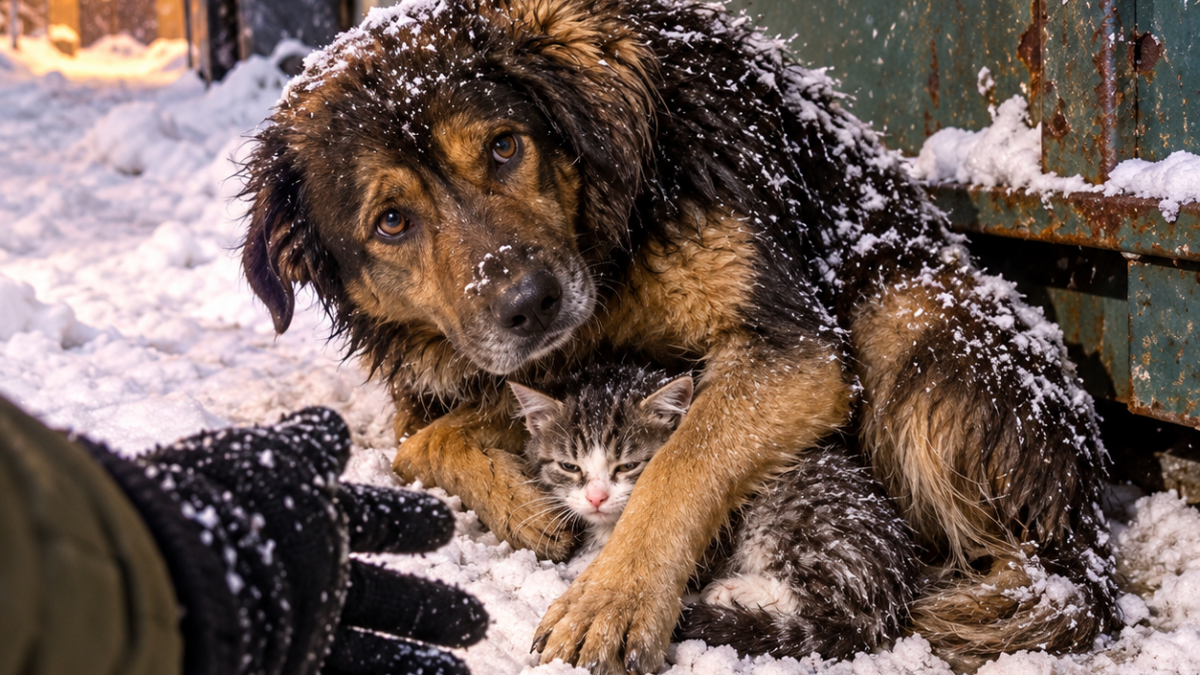
The dog was so cold he could barely lift his head, but the moment I reached for the tiny kitten hidden beneath his chest, he found enough strength to block me with one shaking paw.
He had turned his own body into a shelter, taking the wind and snow while the kitten stayed pressed against the last warmth he had left.
I thought I had stumbled onto one desperate act of survival, but what happened when I tried to separate them made me realize I had found something far more complicated.
My name is Mathieu Leroy.
I was forty-two, divorced for three years, and working as the maintenance supervisor at a high school outside Lyon when I found them.
I wasn’t looking to rescue anyone that night.
I was trying to get home.
My ten-year-old daughter, Camille, was staying with me for the week and had woken with a dry cough. I had run out for cough syrup and acetaminophen, driving my old van to a late-night grocery store about fifteen minutes from the house.
An unusual snowstorm had moved in that evening.
By the time I came back outside, the parking lot lines had disappeared beneath several inches of snow.
Wind pushed white spirals between the buildings.
I had just put the pharmacy bag in my van when I heard something.
A sound so weak I almost ignored it.
I turned toward the back of the store.
Two large dumpsters stood against a concrete wall where the loading area formed a narrow pocket protected from the worst of the wind.
At first, I thought the dark shape beside one dumpster was a trash bag.
Then one brown eye opened.
I stopped.
It was a dog.
A large black-and-tan mixed breed, maybe four or five years old.
His coat was soaked and dull.
Ice clung to the fur around one folded ear.
His sides were hollow enough that I could see his ribs even through his winter coat.
He didn’t growl.
He didn’t stand.
He just watched me.
Then I heard the sound again.
A tiny cry.
It came from underneath him.
I stepped closer.
The dog lowered his head.
Curled against his chest was a gray-and-white kitten.
Seven or eight weeks old, no more.
Frost covered its whiskers.
One eye was crusted nearly shut.
A tiny white paw rested directly over the dog’s heart.
But what stopped me was the dog’s position.
This wasn’t accidental.
He had deliberately made himself into a wall.
His back faced the wind.
His belly covered the kitten.
His front legs formed barriers on either side.
His tail was curled over the kitten’s hind legs.
Only the kitten’s nose remained uncovered.
The dog was taking nearly all the cold himself.
I crouched several feet away.
“Easy, buddy.”
One ear twitched.
That was when I noticed his paws.
The pads were cracked and bleeding in places.
I went back to my van and grabbed an old wool blanket I kept behind the seat.
When I returned, he hadn’t moved.
“I’m taking both of you,” I said.
It felt ridiculous explaining myself to an animal.
But somehow, I needed him to understand one thing.
Both.
Not just the kitten.
I spread the blanket over the snow.
Then I slowly reached beneath him.
The second I lifted the kitten away from his chest, the tiny animal screamed.
Not an ordinary meow.
A sharp, terrified cry.
The dog tried to stand.
His legs shook violently.
He lifted himself only a few inches before collapsing again.
I placed the kitten in a cardboard box I had found near the store’s service entrance.
The dog stared at it.
Then he began crawling.
Not walking.
Crawling.
He dragged himself forward on his elbows, his stomach sliding through the snow.
One inch.
Then another.
He was barely conscious.
But he was still trying to reach that box.
My throat tightened.
“All right,” I whispered. “I get it.”
I moved the box beside him.
The kitten immediately pushed its nose through the opening.
The dog stopped crawling.
His head dropped against the cardboard.
And within seconds, the kitten went silent.
That was the moment I understood separating them wasn’t going to be simple.
What I didn’t know yet was that the dog wasn’t only protecting the kitten from the cold.
For months, they had been keeping each other alive in ways none of us could see.
And when the veterinarian finally discovered what had happened to them before that snowy night, I stopped thinking about rescue.
I started thinking about the person who had left them there.
PART 2
I carried them to my van together.
That was the only way the dog would let me do it.
The kitten stayed inside the cardboard box with one side folded down, and I wrapped the dog in the wool blanket before lifting all seventy or so pounds of him against my chest.
He barely weighed what a dog his size should have weighed.
Even so, my knees nearly buckled.
The strangest part was what happened when the box shifted.
The kitten squeaked.
The dog’s head jerked up instantly.
His body might have been shutting down, but that sound reached some part of him that refused to quit.
“I’ve got him,” I said.
I don’t know why I said “him.”
I hadn’t checked yet.
Maybe I just needed to keep talking.
The dog’s eyes stayed fixed on the box.
I placed him across the back seat.
Then I set the kitten beside his chest.
The change was immediate.
The kitten crawled out of the box and pushed itself against the dog’s neck.
The dog exhaled.
His entire body seemed to loosen by half an inch.
That was enough to convince me I couldn’t take them home.
Camille was sick, and I had no idea what diseases either animal might be carrying.
I called the nearest emergency veterinary clinic.
A woman answered on the fourth ring.
“Emergency veterinary service.”
“I found a dog and a kitten outside.”
“Are they injured?”
“The dog is freezing. I think.”
“Is he conscious?”
“Barely.”
“What about the kitten?”
“Alive. Cold. One eye looks infected.”
“Bring them in now.”
I looked toward the back seat.
“There’s another problem.”
“What?”
“They won’t separate.”
There was a pause.
“What do you mean?”
“I mean the dog nearly collapsed trying to crawl toward the kitten when I moved it away.”
“All right. Don’t force them apart. Keep the van warm, but not too hot. Drive carefully.”
I turned the heater up gradually.
Then I called my ex-wife.
She answered with the voice she used when she assumed something had gone wrong.
“What happened?”
“Nothing with Camille.”
Silence.
“You always start like that when something happened.”
“She’s fine.”
“Mathieu.”
“I found a dog.”
Another silence.
“And?”
“And a kitten.”
“At eleven thirty at night?”
“They’re half frozen.”
She exhaled.
“You’re taking them to a vet.”
“Yes.”
“What about Camille?”
“She’s asleep.”
“You left her alone?”
“My neighbor is sitting with her. I called him before I left.”
That was technically true.
I had called Gérard, the retired history teacher next door, when I realized I wouldn’t be home quickly.
He had been delighted to sit in my kitchen drinking tea while Camille slept upstairs.
My ex-wife sighed.
“All right.”
“I may be late.”
“You’re always late when an animal is involved.”
I frowned.
“That’s not true.”
“You once stopped traffic for a duck.”
“It had twelve ducklings.”
“Exactly.”
Despite everything that had gone wrong between us, hearing her laugh still felt familiar.
“Call me when you know they’re okay,” she said.
“I will.”
The clinic was twelve minutes away.
I made it in nine.
A veterinary technician met me at the entrance with a rolling stretcher.
The moment she tried to lift the kitten, the dog opened his eyes.
His lips didn’t curl.
He didn’t snap.
He simply put his paw over the kitten again.
The technician stopped.
“Oh.”
“That’s what I was trying to explain.”
A veterinarian came out behind her.
Dr. Nora Bellamy.
I learned her name later.
At that moment, all I noticed was how quickly she assessed the scene.
“Bring them in together.”
She lowered the side of the stretcher.
We transferred the dog without moving the kitten more than a few inches.
The kitten immediately tucked itself beneath his neck.
Inside the exam room, Nora checked temperatures.
The dog’s was dangerously low.
The kitten’s was even lower.
“Hypothermia,” she said.
“Both?”
“Yes.”
She listened to the dog’s heart.
“Slow, but regular.”
She lifted his gums.
“Dehydrated. Severe weight loss.”
Then the kitten.
The little animal barely resisted.
“Respiratory infection. Eye infection. Malnutrition.”
She looked at me.
“How long were they outside?”
“I don’t know.”
“Where exactly did you find them?”
I told her.
“Any collar?”
“No.”
“Tags?”
“No.”
“Microchip?”
She reached for a scanner.
The dog had one.
That should have been good news.
Instead, when the scanner beeped, Nora’s expression changed.
“What?”
“The chip is registered.”
“To who?”
“I can’t give you private information yet.”
“Can you contact them?”
“We’ll try.”
The kitten had no chip.
That was unsurprising.
What happened next surprised all of us.
Nora tried moving the kitten to a warming incubator.
The dog’s heart rate jumped.
He struggled to sit up.
The kitten screamed.
Within seconds, both animals were more distressed than they had been while lying together half frozen in my van.
Nora put the kitten back.
The dog collapsed again.
The kitten burrowed into his chest.
Both heart rates began coming down.
Nora stared at the monitor.
“That’s unusual.”
“So I’m not imagining it.”
“No.”
“Can you treat them together?”
“We can try.”
They built what looked like the strangest hospital bed I had ever seen.
A warming pad beneath thick towels.
Warm intravenous fluids for the dog.
Subcutaneous fluids for the kitten.
A low-flow warming unit nearby.
The kitten lay against the dog’s ribs throughout the entire procedure.
Every time someone touched the kitten, the dog opened his eyes.
Every time the dog moved, the kitten reached for him.
“Bonded pair,” one technician said.
Nora shook her head.
“This is beyond ordinary bonding.”
“What does that mean?”
“I don’t know yet.”
I stayed until almost two in the morning.
Before leaving, I stood beside the kennel.
The dog looked at me.
His eyes were clearer.
“You’re safe.”
His ear moved.
The kitten slept beneath his chin.
I reached through the bars and scratched the dog gently behind one ear.
He didn’t pull away.
“What are their names?” the technician asked.
“I don’t know.”
“We need temporary names for the chart.”
I looked at the dog.
He had the face of something tired and stubborn.
“Bear.”
The technician smiled.
“And the kitten?”
The tiny gray head appeared beneath Bear’s jaw.
“Mouse.”
She laughed.
“Bear and Mouse?”
“For tonight.”
The names stuck.
By the next morning, Bear could lift his head.
Mouse could stand.
I knew because Nora called me at seven seventeen.
I had been awake since six, waiting.
“They made it through the night.”
I sat on the edge of my bed.
“Both?”
“Both.”
I closed my eyes.
“Thank you.”
“Don’t thank me yet.”
Something in her tone changed.
“What happened?”
“We reached the number attached to Bear’s microchip.”
“And?”
“The man who answered claims he gave the dog away almost a year ago.”
“Who did he give him to?”
“He says he doesn’t remember the full name.”
“You’re kidding.”
“No.”
“Can people just do that?”
“People do worse.”
I looked toward my bedroom door.
Camille was standing there in pajamas.
“Is that about the dog?” she whispered.
I nodded.
“Are they alive?”
“Both alive.”
She smiled.
Then coughed.
I covered the phone.
“Back to bed.”
“No.”
“Camille.”
“I want to hear.”
Nora continued.
“The registered owner says Bear’s actual name was Rex.”
I looked at my daughter.
“His name is Rex.”
Camille wrinkled her nose.
“Bear is better.”
Nora laughed quietly through the phone.
“Apparently your daughter agrees with our staff.”
“What else did the owner say?”
“He claimed Rex had behavioral problems.”
“What kind?”
“Running away. Guarding food. Aggression toward cats.”
I looked at Camille again.
“Aggression toward cats?”
“Yes.”
I almost laughed.
“He nearly froze to death protecting one.”
“I know.”
“So he’s lying.”
“Possibly. Or something happened after he gave the dog away.”
That sentence stayed with me.
Something happened.
Over the next three days, I visited after work.
Camille came with me once her cough improved.
The first time she saw Bear, she stopped outside the kennel.
“He’s huge.”
“He looks smaller when he’s almost dead in a snowstorm.”
“Dad.”
“What?”
“That isn’t funny.”
“You’re right.”
Mouse was sleeping on Bear’s front leg.
Camille crouched.
“Why is he protecting the kitten?”
“We don’t know.”
She watched them.
“Maybe because nobody else did.”
Sometimes children arrive at answers adults spend weeks trying to complicate.
By day four, Bear could stand.
Barely.
His rear legs shook.
He took three steps toward the water bowl.
Mouse followed.
That was the first thing that made Nora suspicious in a new way.
Mouse did not move like a normal kitten.
He bumped into the water dish.
Then into Bear’s leg.
Nora watched him cross the kennel.
“Come here, little one.”
She waved a hand in front of his face.
No response.
She moved it closer.
Nothing.
She tested each eye.
Mouse could see light.
Shapes, perhaps.
But not detail.
“He’s severely visually impaired,” she told me.
“From the infection?”
“Partly, maybe. There may be congenital damage too.”
Bear stood beside her.
Mouse turned toward the sound of Bear’s breathing.
Then walked directly to him.
Nora looked at me.
“That explains some of it.”
“What?”
“Watch.”
She moved Mouse three feet away.
Mouse froze.
His head moved from side to side.
Then Bear gave one soft whine.
Mouse immediately turned.
Three uneven steps.
Four.
Straight toward him.
“He uses the dog to orient himself,” Nora said.
“So Bear is guiding him.”
“At least partly.”
Then she tested something else.
She had a technician gently lead Bear around the room.
Mouse followed the sound of his tags, his breathing, his nails.
Every time Mouse lost direction, Bear stopped.
Waited.
Whined.
Mouse corrected.
I felt cold for a reason that had nothing to do with the weather.
“How long does it take an animal to learn that?”
Nora looked at Bear.
“Long enough.”
We later discovered the dependence worked both ways.
Bear had severe separation anxiety.
Not ordinary whining.
When Mouse was removed from his sight and scent, Bear’s breathing accelerated.
He paced.
Scratched doors.
Drooled.
His heart rate climbed.
Yet when Mouse touched him, the symptoms faded.
Nora brought in a veterinary behaviorist named Dr. Léa Mercier.
She observed them for nearly an hour.
At the end, she sat beside me in the consultation room.
“I think they regulate each other.”
“What does that mean?”
“The kitten uses Bear physically. Navigation. Warmth. Confidence.”
“And Bear?”
“Bear uses the kitten emotionally.”
I waited.
Léa folded her hands.
“Something has taught that dog that keeping this kitten close is necessary for safety.”
“Because he nearly died protecting him?”
“No. The behavior is older than the snowstorm.”
“How can you tell?”
“Because it’s organized.”
She described patterns I hadn’t noticed.
Bear positioned himself between Mouse and strangers.
He waited before moving through doors until Mouse touched his leg.
He checked Mouse after sudden noises.
Mouse slept beneath Bear’s jaw.
Bear would not eat until Mouse was beside the bowl.
This wasn’t panic created in one freezing night.
It was routine.
A life.
The question became where they had lived that life.
The answer began with Bear’s first owner.
His name was Alain Deschamps.
He eventually agreed to speak with animal protection.
He had adopted Bear—then Rex—as a puppy.
Kept him for three years.
Photos showed a healthy black-and-tan dog sleeping on a sofa and playing in a garden.
Then Alain lost his job.
His marriage ended.
He moved into an apartment that didn’t allow large animals.
According to him, he gave Rex to a man he met through an online pet rehoming group.
“What man?” Sophie, an investigator from a local animal-welfare organization, asked.
Alain rubbed his forehead.
“Patrick something.”
“Surname?”
“I don’t remember.”
“Phone number?”
“Old phone.”
“Messages?”
“Account deleted.”
Sophie stared at him.
“You handed over a microchipped dog without transferring registration?”
“I thought he’d do it.”
“Did you visit his home?”
“No.”
“Did you ask for identification?”
“No.”
“Did you check references?”
“No.”
His face reddened.
“I was desperate.”
Sophie didn’t raise her voice.
“That dog almost froze to death behind a grocery store.”
Alain looked down.
“I know.”
That part mattered later.
Alain made a terrible decision.
But unlike some people in the story, he eventually faced it.
He searched old emails.
Recovered deleted photos.
Found a screenshot of the man’s profile.
Patrick Varenne.
We searched the name.
Nothing important at first.
Then Sophie found a small classified advertisement.
“Animals temporarily boarded. Rural property. Dogs, cats, small livestock.”
Another.
“Pet transport available.”
Another.
“Low-cost rehoming assistance.”
The address was thirty-five minutes outside Lyon.
Animal control visited.
The property looked nearly empty.
Three dogs.
Two goats.
Several outdoor structures.
Everything technically acceptable.
Patrick Varenne was polite.
He denied ever owning Bear.
Then an officer showed him the screenshot.
He changed his story.
“Oh. That dog.”
Sophie later told me how he said it.
Not Rex.
Not Bear.
That dog.
Varenne claimed Rex had been placed with another family.
Which family?
He couldn’t remember.
When?
Maybe eight months earlier.
Records?
None.
Then they asked about a gray kitten.
He said he hated cats.
That answer became important.
Because two weeks later, one of his neighbors called Sophie.
The woman’s name was Madame Fournier.
Seventy-one.
Sharp eyes.
Sharper memory.
She had seen the welfare officers arrive at Varenne’s property and recognized the organization logo.
“He keeps animals somewhere else,” she said.
“Where?”
“Old greenhouse property past the quarry.”
“How do you know?”
“I see his van.”
“How often?”
“Night mostly.”
“Why didn’t you report it?”
“I didn’t know what he was doing.”
Then she added:
“But I’ve heard dogs.”
The second property was leased through Varenne’s brother-in-law.
The search warrant came three days later.
I was not there.
I am glad.
Sophie told me enough.
Twenty-eight animals.
Dogs.
Cats.
Rabbits.
Most living in makeshift pens and transport crates.
Some were there temporarily.
Some had been collected through “rehoming.”
Others were animals whose owners had paid Varenne to transport or board them.
There were no proper records.
No consistent food schedule.
Water bowls frozen overnight.
One shed had no insulation.
Inside that shed, investigators found something that connected Bear and Mouse.
A low wooden enclosure.
Gray fur trapped in one corner.
A broken cat carrier.
A dog chain bolted to the wall.
And on that wall, scratch marks at Bear’s shoulder height.
There was also a photograph.
Not framed.
Not sentimental.
Just part of a stack of pictures Varenne apparently used for online listings.
Bear was in the background.
Thinner than in Alain’s old photographs.
A chain ran from his collar to the wall.
At his feet sat a gray adult cat.
Sophie brought the photo to the clinic.
Mouse was asleep against Bear when she showed it to Nora and me.
“Could that be Mouse’s mother?”
“We don’t know.”
The cat looked like him.
Gray coat.
White chest.
Same white front paws.
We found out two days later.
A former worker identified her.
Her name had been Misty.
Varenne had taken her from an elderly woman who believed he was helping arrange adoption after she entered assisted living.
He never found Misty a home.
Instead, she lived at the second property.
Misty had kittens.
Four.
Three died.
One survived.
Mouse.
Bear had been chained in the same shed.
The worker’s name was Luc.
Twenty-six years old.
He had worked for Varenne for five months.
He admitted he should have reported the conditions sooner.
“I kept thinking it wasn’t my business.”
Sophie asked him what happened between Bear and the cat.
Luc rubbed both hands over his face.
“The dog was scared of everything when I started.”
“People?”
“Mostly men.”
“Other dogs?”
“Some.”
“Cats?”
Luc shook his head.
“No. Misty slept next to him.”
That contradicted Alain’s claim that Bear had once been aggressive toward cats.
Or perhaps that claim had never been true.
Luc continued.
“Patrick used Rex to calm animals.”
“How?”
“He tied him in the shed. New animals sometimes settled if another dog was there.”
“And Misty?”
“She chose him.”
“Meaning?”
“She kept going into his area.”
When Misty gave birth, something went wrong.
She became ill.
Varenne refused veterinary care.
Luc fed her by hand for several days.
One morning, he found her dead.
The surviving kitten was lying beside her.
Bear was chained six feet away.
“What happened then?” Sophie asked.
Luc looked down.
“Rex broke the clip.”
“What clip?”
“On the chain.”
“How?”
“I don’t know. Pulled until it bent, I guess.”
“And then?”
“He went to the kitten.”
Mouse had been perhaps three weeks old.
Too young.
Cold.
Nearly blind already from infection.
Luc bottle-fed him when he could.
But Bear did everything else.
He cleaned the kitten.
Slept around him.
Carried him gently away from dirty bedding.
Alerted Luc when Mouse cried.
“I’ve never seen anything like it,” Luc said.
“Why didn’t you take them?”
“I was scared.”
“Of Varenne?”
“Yes.”
“What happened when you quit?”
Luc swallowed.
“I left them there.”
That answer stayed with me because he didn’t decorate it.
He didn’t pretend.
He left.
Months later, Bear and Mouse were found behind the supermarket.
How they escaped remained uncertain.
But investigators reconstructed enough.
On the evening of the snowstorm, Varenne had transported several animals in his van.
Bear and Mouse were among them.
A store security camera showed his van entering the service lane at 8:43 p.m.
It stayed eleven minutes.
Then drove away.
At 8:54, another camera showed Bear near the dumpsters.
Mouse was beside him.
Not escaped accidentally.
Left.
Abandoned in a snowstorm.
Varenne had dumped them.
When investigators confronted him with the footage, he claimed Bear had become aggressive and that the kitten was feral.
He said he intended to contact a shelter the next morning.
Sophie asked the obvious question.
“Why not bring them to one?”
No answer.
“Why leave them outside?”
He shrugged.
That shrug made me angrier than anything else I heard about him.
Bear had been willing to freeze to protect Mouse.
Varenne could not even be bothered to lie convincingly.
The cruelty charges expanded.
Neglect.
Improper confinement.
Abandonment.
Failure to obtain necessary veterinary care.
Unauthorized boarding activities.
Record violations.
Additional fraud complaints came from owners who had paid for services Varenne never provided.
One family believed their elderly terrier had died naturally while boarding.
Investigators discovered the dog had been transferred elsewhere without permission.
Another woman had paid Varenne to place two cats with a rescue group.
No rescue had ever received them.
People started coming forward.
The case became larger than Bear and Mouse.
But they remained at the center of it.
Their recovery moved slowly.
Mouse’s eye infection improved.
His vision did not.
He could distinguish light and large movement.
Not much more.
That made Bear essential.
Bear learned routes through the clinic.
Mouse followed.
If there was a step, Bear paused.
Mouse bumped his front leg.
Then stepped.
If someone moved a chair, Bear redirected him.
Léa watched them one afternoon and said:
“He’s acting as a guide dog for a cat.”
I laughed.
“Does that make Mouse his emotional-support cat?”
She considered it.
“Actually, yes.”
That became the joke at the clinic.
But it was also true.
Bear’s anxiety lessened when Mouse was present.
His appetite improved.
His sleep deepened.
He stopped flinching at every sound.
Weeks passed.
I visited constantly.
At first, I told myself I was only checking on them.
Then Camille started asking when “our dog and cat” were coming home.
“They aren’t ours.”
She looked at me with the merciless logic of a ten-year-old.
“You named them.”
“Temporary names.”
“You visit every day.”
“Almost.”
“Mouse climbs on your lap.”
“He climbs on everyone.”
“He peed on the vet.”
“That is not evidence of preference.”
“Bear waits at the door when you leave.”
I had no answer to that.
Bear did wait.
The first time I noticed, I nearly walked back inside.
Nora saw me through the window.
“Don’t encourage him.”
“I’m not.”
“You absolutely are.”
“What am I doing?”
“Standing there looking guilty.”
“I don’t look guilty.”
“You look like a divorced father about to make another expensive emotional decision.”
“That is very specific.”
She smiled.
“I’m a veterinarian. Half my job is recognizing that face.”
I went home.
Camille was sitting at the kitchen table drawing.
Two animals were in the picture.
A giant black-and-tan dog.
A tiny gray cat.
“What is that?”
“Our house.”
“We don’t have a dog.”
“You’re slow.”
There are moments when you realize your child has already decided who you are going to become.
This was one of them.
Still, adoption wasn’t simple.
Bear and Mouse were evidence.
Until the legal seizure was resolved, they could not be permanently placed.
So I applied as an approved foster.
My ex-wife called when she heard.
“You’re bringing both?”
“I can’t separate them.”
“Your house is small.”
“Bear likes small spaces.”
“You work all day.”
“Camille is at school all day.”
“That is not a defense.”
“I have a fenced yard.”
“You have a fence that leans.”
“I’m a maintenance supervisor.”
“You’ve been saying you’ll fix that fence for two years.”
I fixed it that weekend.
Bear and Mouse came home three weeks later.
The first night was chaos.
Mouse walked into a chair.
Bear followed him.
Mouse climbed a curtain.
Bear barked.
Mouse knocked over a water bowl.
Bear stepped in it.
Camille laughed so hard she had to sit on the floor.
Then the house became quiet.
Bear stood in the living room.
He had never been there before.
New smells.
New furniture.
New doors.
I watched his breathing quicken.
Mouse walked beneath him.
Rubbed against his front leg.
Bear looked down.
Then lay beside him.
The panic passed.
Camille whispered:
“They really do save each other.”
“Yes.”
That first week, Bear slept beside my daughter’s bedroom door.
Mouse slept between his front paws.
I tried placing separate beds nearby.
Bear ignored both.
Mouse used one as a toilet.
We adjusted.
At six every morning, Bear woke me.
Not by barking.
By placing one enormous paw on my chest.
Mouse sat beside his ear.
Breakfast had become a coordinated operation.
Bear would not eat until Mouse had located his bowl.
Mouse would not begin until Bear started.
I moved their bowls closer together.
Problem solved.
A month into fostering them, something happened that revealed how much trauma remained.
I dropped my keys.
Metal hit the kitchen tile.
Bear exploded backward.
Not aggressively.
Pure terror.
He slammed into the refrigerator.
Mouse startled and ran blindly.
Bear recovered first.
He rushed to Mouse.
Positioned himself over him.
Shaking.
I froze.
“Hey. It’s okay.”
His eyes were huge.
Camille came downstairs.
“What happened?”
“Stay there.”
Bear was panting.
Mouse had tucked himself beneath Bear’s chest.
I crouched.
Didn’t approach.
Léa had taught me that frightened dogs need control more than comfort forced onto them.
So I waited.
Ten minutes.
Then fifteen.
Bear finally walked toward me.
He smelled the keys.
Flinched.
I moved them away.
Later, Luc explained.
Varenne carried a heavy metal key ring.
Keys meant cages opening.
Animals moving.
Chains fastening.
Sometimes punishment.
I stopped carrying my keys loose.
Camille started leaving hers on the same hook every day.
Bear learned that our keys opened the back door.
The car.
The gate.
Not cages.
Trauma rewrites ordinary objects.
Recovery has to write them again.
The court proceedings dragged on for months.
Varenne hired a lawyer who argued that animal-welfare workers had exaggerated conditions.
The abandoned animals, he claimed, were “temporary placements.”
The second property was supposedly just storage.
The security footage did not show him physically placing Bear and Mouse beside the dumpster.
His attorney argued they could have jumped from the van.
Sophie nearly laughed when she told me.
“Bear could barely walk when you found him.”
“I know.”
“And Mouse is visually impaired.”
“I know.”
“And somehow these two coordinated a high-speed escape while he wasn’t looking?”
“That’s the argument?”
“That’s the argument.”
The prosecution found more footage.
A loading-dock camera.
Grainy.
Distant.
But clear enough.
Varenne opened the rear van doors.
Lifted Mouse’s carrier.
Placed it near the dumpsters.
Then dragged Bear down by the collar.
Bear resisted.
Not attacking.
Turning back toward the van.
Toward Mouse.
Varenne shoved him away.
He took the kitten out of the carrier.
Dropped him beside Bear.
Then drove away with the empty carrier still visible inside the van.
The entire sequence lasted fifty-eight seconds.
When Sophie showed me the footage, I watched once.
Then I stood.
“That’s enough.”
She closed the laptop.
I walked into my yard.
Bear was asleep in the sun.
Mouse was stretched across his back.
For a long time, I stared at them.
The snowstorm had not created their bond.
The storm had merely revealed it.
Varenne had left two vulnerable animals outside because they were inconvenient.
Bear had spent what strength he had protecting Mouse.
That contrast became impossible to ignore.
Varenne’s lawyer changed strategy.
The abandonment was admitted.
Now they argued it was a single lapse in judgment.
Then the financial records arrived.
Owners had paid him thousands over several years.
Boarding fees.
Rehoming fees.
Transport fees.
Medical deposits.
Many animals received little or none of what had been promised.
Varenne had treated the animals as money moving through cages.
The case became fraud as well as cruelty.
Luc agreed to testify.
I attended that day.
He looked terrified.
Varenne stared at him from across the room.
The attorney asked:
“You worked there voluntarily?”
“Yes.”
“You accepted payment?”
“Yes.”
“You fed the animals?”
“Yes.”
“You cleaned kennels?”
“When I could.”
“So you participated in the conditions you now criticize.”
Luc swallowed.
“Yes.”
The attorney paused.
That answer had not helped him.
“You could have reported my client.”
“Yes.”
“You didn’t.”
“No.”
“So why should anyone believe you now?”
Luc looked toward the judge.
“Because I’m ashamed.”
The courtroom went still.
He continued.
“I kept telling myself I needed the job. Then I told myself the animals weren’t dying. Then some did die. I still stayed.”
Varenne’s attorney tried to interrupt.
Luc kept going.
“When that cat died, Rex stayed beside her kitten all night. Patrick wanted the kitten gone because it was sick. I begged him to let me keep it there.”
“Mr. Caron—”
“The dog broke a chain to get to that kitten.”
The judge told him to answer only the questions asked.
But it was already in the room.
The prosecutor later brought him back to it.
“What happened after Misty died?”
“Rex took care of the kitten.”
“How?”
“He licked him. Slept around him. Warned us when he cried.”
“Did the kitten have vision problems then?”
“Yes.”
“Did Rex compensate?”
“Yes.”
“How?”
“If Mouse wandered, Rex nudged him back. If there was a step, he stood in front of it.”
The prosecutor displayed a photograph taken at the second property.
Bear lying beside the gray kitten.
Mouse tucked beneath his chin.
Months before the snowstorm.
Same position.
Same protection.
Same bond.
The defense could no longer claim it was accidental.
Then came my testimony.
I hated the idea.
I am a maintenance supervisor, not a veterinarian.
I fix leaking pipes.
Broken doors.
Heating systems.
I don’t enjoy courtrooms.
But Sophie said my observations mattered.
So I went.
I described the night behind the supermarket.
The snow.
The dumpster.
Bear’s body around Mouse.
The attempt to separate them.
The crawling.
The dog dragging himself through the snow toward the box.
The defense attorney asked:
“You are not trained in animal behavior, correct?”
“Correct.”
“So when you say the dog was protecting the kitten, that is your interpretation.”
I looked at him.
“Yes.”
“Not a scientific conclusion.”
“No.”
“So perhaps he was simply seeking warmth.”
“Maybe.”
He smiled.
Then I added:
“But he moved away from the warm van door to reach the kitten.”
His smile faded.
The prosecutor asked:
“What convinced you they should remain together?”
I thought about the answer.
“Because the kitten stopped screaming when Bear touched him.”
“And the dog?”
“He stopped trying to crawl when the kitten came back.”
The courtroom was silent.
“That’s all I knew that night.”
The rest came from people with more expertise.
Nora testified next.
She explained hypothermia.
Malnutrition.
Mouse’s infection.
Bear’s anxiety.
Their heart-rate changes during separation.
Léa testified about behavioral dependence.
She was careful.
Professional.
She did not romanticize them.
That helped.
“They are not dependent because one is weak and one is strong,” she said.
“They are interdependent. The kitten uses the dog as a mobility and orientation aid. The dog uses the kitten as a stabilizing social attachment.”
The judge asked:
“Would separation harm them?”
“In my opinion, yes.”
“How severely?”
“That would depend on duration, but unnecessary permanent separation would create significant welfare concerns for both.”
The defense attorney asked:
“Isn’t it possible they could adjust eventually?”
“Possible.”
“So they do not need each other.”
Léa looked at him.
“Human beings can adjust to many losses. That doesn’t make causing the loss beneficial.”
I wanted to applaud.
I did not.
The most emotional testimony came from the woman who had once owned Misty.
Madame Renard.
Eighty-two years old.
She used a cane.
She had believed Varenne was placing Misty with a family when she moved into assisted living.
Instead, Misty died in a shed.
The prosecutor showed her the photograph.
She touched the image with one finger.
“That’s my girl.”
Her voice broke.
Varenne looked away.
Madame Renard did not.
“You told me she was adopted,” she said directly toward him.
His attorney objected.
The judge told her to answer questions only.
But she had already said what she needed to say.
After court, she asked to meet Mouse.
We arranged it carefully.
She sat in my living room.
Mouse walked toward her voice.
Bear followed.
She whispered:
“Misty had that same walk.”
Mouse stopped near her cane.
She lowered her hand.
He sniffed.
Then climbed into her lap.
Bear sat beside her.
Madame Renard cried without making a sound.
“He smells like her.”
I didn’t know whether that was possible after so much time.
It didn’t matter.
She stayed for two hours.
Before leaving, she pressed money into my hand.
“For food.”
“I can’t take this.”
“You can.”
“I’m serious.”
“So am I.”
She pushed it back.
“Buy them something stupid.”
Camille chose a ridiculous cat tunnel and a giant orthopedic dog bed.
Mouse loved the tunnel.
Bear refused the bed and slept on the floor beside it.
Six months after I found them, Bear began playing.
That sounds small.
It wasn’t.
A red rubber ball rolled out of Camille’s room.
Bear watched it.
Mouse heard it bounce.
Chased the sound.
Missed completely.
Hit Bear’s leg.
Bear looked at me.
Then at the ball.
He picked it up.
Camille froze.
“Dad.”
“I see.”
Bear dropped the ball near Mouse.
Mouse batted randomly.
The ball rolled.
Bear chased it.
Three steps.
Then five.
Camille screamed.
Bear stopped.
We stopped.
Mouse pounced on Bear’s tail.
Bear turned.
Then something unbelievable happened.
He bowed.
Front legs down.
Rear end up.
A play bow.
Camille covered her mouth.
Bear barked once.
Mouse jumped sideways.
Then chased him.
My seventy-pound dog ran circles around the coffee table while a nearly blind kitten pursued him by sound.
I laughed until I cried.
That night, I realized I had stopped thinking of the house as mine.
It was ours.
The legal forfeiture hearing happened two months later.
Varenne wanted several animals returned.
His attorney argued the state could impose conditions instead.
Better fencing.
Inspections.
Reduced numbers.
No unlicensed boarding.
When Bear and Mouse were mentioned, Varenne’s attorney said:
“My client has no interest in reclaiming those particular animals.”
Those particular animals.
I felt anger rise in my chest.
Sophie put a hand on my sleeve.
“Don’t.”
“I’m not doing anything.”
“Your face is doing something.”
The judge ordered permanent forfeiture of all seized animals.
Bear and Mouse were legally free for adoption.
Camille and I were waiting outside the shelter office the next morning before it opened.
The administrator laughed when she saw us.
“You know this isn’t a concert ticket line.”
“I wanted to be first.”
“You are the only applicants being considered for those two.”
“I still wanted to be first.”
The adoption forms required separate paperwork.
Camille objected.
“They’re a set.”
The administrator smiled.
“Legally, they’re two animals.”
“Emotionally, that’s wrong.”
I looked at her.
“You’re ten.”
“And correct.”
We signed both.
Bear Leroy.
Mouse Leroy.
My ex-wife read the forms.
“You gave them your last name?”
“It was on the computer.”
“Mathieu.”
“What?”
“You’ve become exactly the man I expected you to become.”
“That sounds insulting.”
“It isn’t.”
She scratched Bear behind the ear.
Mouse was sitting inside her handbag.
She did not notice.
I chose not to tell her.
Varenne’s criminal trial concluded almost a year after the snowstorm.
Not every allegation led to conviction.
Some records were incomplete.
Some older cases could not be proven.
But enough could.
The court found him responsible for multiple animal-welfare violations, unlawful abandonment, improper confinement, and commercial violations tied to boarding and rehoming activities.
Financial fraud charges were handled separately.
He received penalties, restrictions on animal ownership and commercial handling, fines, and court supervision.
The most satisfying consequence came outside the sentence.
His business disappeared.
The second property was shut down.
Owners reclaimed animals where possible.
Others were adopted.
Every cage was emptied.
The old shed was eventually torn down.
Sophie sent me a picture.
Bare earth.
Nothing else.
I showed Camille.
“That’s where Bear lived?”
“For a while.”
She looked at Bear asleep beside the couch.
Mouse was stretched across his front paws.
“Good.”
That was all she said.
Good.
I expected revenge to feel louder.
I imagined I would feel satisfaction watching Varenne lose his business.
I did.
But it wasn’t the deepest satisfaction.
That came from smaller things.
Bear discovering snow again one year later.
I was afraid he would panic.
The first flakes started falling just before Christmas.
Bear stood at the back door.
His whole body stiffened.
Mouse sat near his feet.
I opened the door but didn’t push him.
Cold air entered.
Bear stepped backward.
I crouched.
“It’s your choice.”
Camille stood behind me.
“Don’t make him.”
“I’m not.”
For five minutes, he stared outside.
Then Mouse walked forward.
He couldn’t see the snow well.
But he could hear it against the patio cover.
He stepped onto the cold ground.
Bear immediately followed.
Of course he did.
Mouse lifted one paw.
Shook it.
Took another step.
Bear moved beside him.
They reached the middle of the yard.
A snowflake landed on Bear’s nose.
He sneezed.
Camille laughed.
Bear looked at her.
Then ran.
Not away.
Across the yard.
One circle.
Two.
Mouse tried following and crashed into a bush.
I went to help.
Mouse came out furious.
Bear barked.
Mouse chased the bark.
Soon both were moving through the snow.
Same weather.
Different ending.
I stood on the patio with my hands in my pockets and cried like an idiot.
Camille noticed.
“You’re crying.”
“No.”
“You are.”
“It’s snowing in my eyes.”
“That’s not how snow works.”
“Go play with your animals.”
“Your animals too.”
She was right.
Years passed.
Bear became a neighborhood celebrity without ever knowing it.
Children waited at the fence to see him.
Mouse became something worse.
A tyrant.
He learned the exact layout of the house.
His limited vision stopped mattering.
He could jump onto counters.
Open cabinet doors.
Steal food from Bear’s bowl.
Bear allowed all of it.
Once Mouse took an entire piece of chicken from Bear’s mouth.
Bear simply looked at me.
“Stand up for yourself.”
He sighed.
Mouse ate the chicken.
Camille turned fourteen.
Then fifteen.
Her room changed.
Posters changed.
Friends changed.
Her relationship with me changed in that complicated teenage way where affection becomes disguised as sarcasm.
But Bear remained constant.
When she came home upset, she sat on the kitchen floor.
Bear put his head in her lap.
Mouse climbed onto her shoulders.
When she fought with her mother, Bear listened.
When she fought with me, Bear listened.
He never took sides.
Smartest member of the family.
Mouse usually sided with whoever had food.
Madame Renard visited until her health declined.
Every time she came, Mouse sat with her.
She called him “little Misty.”
I never corrected her.
Before she died, she sent us a letter.
Camille read it aloud.
She thanked Bear for caring for the last part of Misty she had left.
Then she thanked Mouse for surviving.
At the bottom, she wrote:
Sometimes family is simply whoever refuses to leave you alone in the cold.
We framed that line.
It hangs in my hallway.
Bear grew old before Mouse did.
He had been malnourished too long.
His joints suffered.
The old injuries to his paws caused pain in winter.
Nora managed it carefully.
Medication.
Physical therapy.
Shorter walks.
One afternoon, when Bear was perhaps ten, his rear legs gave out.
He tried to rise.
Failed.
Mouse appeared immediately.
Pressed against his face.
Bear calmed.
I carried him to the car.
Mouse rode beside him.
At the clinic, X-rays showed advanced arthritis.
No catastrophe.
Not yet.
“We can manage this,” Nora said.
“For how long?”
“I don’t know.”
I hated that answer.
It was honest.
Camille was seventeen then.
Old enough to understand.
Too young to accept.
“We’ll fix it.”
“We’ll help it.”
“Same thing.”
“No.”
She glared at me.
I hated teaching her the difference.
Bear improved with treatment.
We built ramps.
Carpet runners.
Raised bowls.
Mouse adjusted every route with him.
When Bear moved slowly, Mouse moved slowly.
When Bear stopped, Mouse stopped.
The guide had become the one needing guidance.
Their roles changed without ceremony.
Mouse began sleeping against Bear’s sore hip.
He groomed Bear’s folded ear.
When Bear hesitated at the ramp, Mouse walked ahead and called.
The kitten Bear had once guided through darkness now guided the old dog through weakness.
That was when I finally understood the full truth of their bond.
It had never been one rescue.
Bear did not save Mouse once.
Mouse did not save Bear once.
They kept saving each other.
Again and again.
In different ways.
At different ages.
That is what family does when it works.
Bear’s final winter came seven years after I found him behind the supermarket.
Snow fell early.
He was moving slowly.
Mouse was no longer a kitten.
He had become a compact gray cat with a white chest and a permanent expression of disapproval.
Bear still followed him everywhere.
One evening, Bear refused dinner.
That frightened me more than limping ever had.
Nora ran tests.
Cancer.
Aggressive.
Already spread.
I sat in the consultation room with my hands clasped.
“How long?”
“Possibly weeks.”
Camille had moved to university by then.
I called her.
She came home the next day.
Bear recognized her before she reached the front door.
His tail hit the floor.
Once.
Twice.
Camille knelt beside him.
“Hey, big guy.”
Her voice broke.
Mouse sat on Bear’s bed.
Watching.
Or listening.
We gave Bear the best final weeks we could.
Roast chicken.
Slow walks.
Sunlight.
Open doors.
Snow when he wanted it.
Warm floors when he didn’t.
Mouse never left him for more than minutes.
The last morning, Bear couldn’t stand.
His breathing had changed.
I knew.
So did Camille.
We called Nora.
She came to the house.
Bear lay on the same wool blanket I had wrapped around him seven years earlier.
I had kept it.
I don’t know why.
Maybe some things become sacred without permission.
Mouse lay against Bear’s chest.
Same place.
Same posture.
Nora examined him.
“He’s ready.”
I hated the sentence.
But I knew.
We had promised Bear that safety meant we would never force him to suffer just because we were afraid to lose him.
Camille rested her hand on his head.
I sat beside his shoulders.
Mouse stayed between his front legs.
Nora hesitated.
“We may need to move Mouse for the injection.”
“No,” I said.
She looked at him.
Then nodded.
“We can work around him.”
Bear’s eyes found mine.
I remembered brown eyes opening beside a dumpster.
Snow on his back.
One paw blocking my hand.
Not aggression.
A promise.
You don’t take him without me.
I scratched behind the folded ear.
“You did it.”
Bear breathed slowly.
“You kept him alive.”
Mouse pressed his face into Bear’s neck.
“And he kept you alive too.”
Nora administered the sedative.
Bear relaxed.
His breathing softened.
Mouse began to purr.
That sound filled the room.
Not loud.
Steady.
Bear’s eyes closed.
The last thing he felt was the same little body he had once shielded from the snow.
Only Mouse wasn’t little anymore.
When Bear took his final breath, Mouse stopped purring.
He lifted his head.
Touched Bear’s nose.
Waited.
Then touched it again.
Camille began sobbing.
I couldn’t speak.
Mouse walked around Bear.
Sniffed his paws.
His ear.
His chest.
Then he lay down beside him.
We gave him time.
That mattered.
Animals understand death differently from us, but separation without explanation can create searching.
Nora said allowing Mouse to remain for a while might help.
For almost forty minutes, he stayed.
Then he stood.
Walked to the back door.
And meowed.
I opened it.
Snow had begun falling.
Softly.
Mouse stepped outside.
I followed.
He walked to the center of the yard.
Stopped.
Lifted his face into the cold air.
For one second, I saw them both again behind that supermarket.
A nearly frozen dog.
A tiny kitten beneath his body.
And I realized something.
Bear had spent his life after that night teaching Mouse that the world could be crossed.
Now Mouse had to cross the first part without him.
The next weeks were difficult.
Mouse searched.
Not constantly.
But enough.
He checked Bear’s bed.
Waited near the back door at dinner.
Paused beside the food bowls.
At night, he sometimes called from the hallway.
I would answer.
He came to my room.
Eventually, he began sleeping on Bear’s old blanket.
Not because he needed Bear to guide him anymore.
He knew the house.
He knew the yard.
He knew us.
Bear had done his work.
Mouse lived another five years.
He became completely blind in his final two.
By then, it barely slowed him.
He knew every room.
Every step.
Every chair.
Whenever we moved furniture, Camille scolded us.
“Mouse map.”
That was the rule.
Don’t change the Mouse map.
He remained bossy.
Stole chicken.
Hated vacuum cleaners.
Loved sunny windowsills.
And every winter, when snow touched the yard, he walked outside.
Slowly.
Confidently.
Sometimes he sat in the exact place where Bear had once run circles during that first good snowfall.
I liked to imagine he remembered.
I don’t know if he did.
I learned from Bear and Mouse not to pretend animals feel things exactly as we do.
Their world belongs to them.
But I know this:
One animal was nearly blind.
The other was terrified of losing him.
One needed a guide.
The other needed a reason to trust.
Together, they survived a shed.
A chain.
Hunger.
Neglect.
Abandonment.
And a snowstorm that should have killed them both.
Varenne thought he was throwing away two animals no longer worth the trouble.
Instead, he created the evidence that ended his operation.
Every animal from his property was eventually placed somewhere safe.
His cages emptied.
His business disappeared.
And the dog he abandoned became the animal my daughter measured every future act of kindness against.
Years later, Camille became a veterinary nurse.
I pretend I’m surprised.
I’m not.
On her first day, she sent me a picture from the clinic.
A frightened dog was lying beneath a table.
A kitten sat beside him.
Her message said:
I’m keeping them together until I know they don’t need each other. Bear taught me that.
I stared at the screen for a long time.
Then I looked toward the shelf in my living room.
Bear’s old collar was there.
Beside it sat Mouse’s tiny first collar from the clinic.
Two lives.
Two species.
One promise.
I had thought I rescued them on that snowy night.
For years, that was the story I told myself.
But eventually I understood.
Bear had already begun the rescue long before I arrived.
He rescued Mouse when his mother died.
Mouse rescued Bear from isolation.
Bear guided Mouse through a world he could barely see.
Mouse taught Bear that being touched did not always mean being taken away.
I only opened the van door.
They did the rest.
And whenever someone tells me animals do not understand loyalty, I remember a half-frozen dog dragging himself through the snow on his elbows because I had moved a cardboard box a few feet away.
He had almost nothing left.
No strength.
No home.
No certainty that I was safe.
But he still had one job.
Get back to Mouse.
And he did.
Every single time.


