We Drove Four Hours to Rescue a Cat Who “Sang” Whenever She Was Afraid—Weeks Later, She Put One Shaking Paw on the Stairs and Did Something We Never Expected.
PART3:
Claire led us down a short hallway lined with photos of adopted animals. Golden retrievers wearing bandanas. Kittens asleep in children’s arms. A beagle with one eye sitting beside an elderly man in a recliner. Happy endings taped to cinder block walls.
Then we reached the cat room.
The sound hit first.
Not barking now, but the layered noises of cats trying to survive waiting. Meows. Scratching. A metal dish sliding. One low growl from a cage near the window.
Claire opened the door slowly.
And then I heard Ethel.
At first, I did not know the sound came from a cat.
It was long and shaking, high at the beginning and thin at the end. Almost like a song, but not pretty. Not loud. Not dramatic. It was the sound of a heart trying to call out without believing anyone would come.
Michael stopped so suddenly I almost ran into him.
His face changed.
I saw it happen.
The wall he had built during the drive cracked straight down the middle.
Ethel was in the bottom cage at the far corner.
The real Ethel did not look like the photo.
She was so thin her shoulder bones showed through her patchy fur. Her belly hung low from having too many litters. One ear had a tear near the tip. Her green eyes were huge, but not curious.
Afraid.
When I knelt in front of her cage, she pressed herself into the back corner and opened her mouth again.
That broken song came out.
Michael swallowed hard.
Claire stood beside us.
“She does that when she’s scared,” she said quietly. “She sings.”
I held a soft treat through the bars and kept my hand still.
Ethel stared at it.
She did not hiss.
She did not swat.
She did not bare her teeth.
She simply looked at the treat like kindness was a trap she had seen before.
After almost a full minute, she crept forward.
One paw.
Then another.
She stretched her neck, took the treat gently from my fingers, and ran back to the corner so fast her thin body hit the plastic wall behind her.
I felt Michael kneel beside me.
“Hey, girl,” he whispered. “Nobody’s taking it back.”
Ethel sang again.
Softer this time.
Claire handed us her file.
The paperwork told the rest of the story in the dry language used when pain has to fit into boxes.
Owner surrender.
Multi-cat household.
Financial hardship.
Multiple litters.
Underweight.
No recent veterinary records.
Five years old.
Possibly older.
I stared at those lines.
Five years old.
Not ancient.
Not hopeless.
Not a kitten either.
Just old enough to have learned the world did not keep its promises.
“She had kittens?” I asked.
Claire’s mouth tightened.
“Several litters, from what we understand. The kittens were rehomed through friends, neighbors, sometimes online. Ethel stayed.”
“She was never fixed?”
“No.”
Michael made a sound under his breath.
Not quite a curse.
Not quite a prayer.
Claire looked at him.
“I know,” she said. “Believe me, I know. But I want to be clear about something. Her previous owner did surrender her. She didn’t dump her outside. She brought her in with the other cats when she realized she couldn’t manage anymore.”
“That’s supposed to make it better?” Michael asked.
“No,” Claire said. “It’s supposed to make it true.”
That answer silenced all three of us.
Because truth is often less satisfying than anger.
Anger gives you a villain.
Truth gives you a mess.
Getting Ethel into the carrier took almost an hour.
Michael sat on the floor with tuna on a paper plate and waited.
He did not reach in.
Did not grab.
Did not force.
He sat cross-legged in front of the open cage door, looking too large and too gentle for that little room, and kept saying, “Take your time, girl.”
I sat against the opposite wall with my hands folded in my lap.
Claire stood near the door and pretended not to watch too closely.
Ethel sang.
Stopped.
Sniffed the air.
Sang again.
Michael slid the plate an inch closer to the carrier.
She watched him like she expected him to betray her.
He did not.
Finally, after fifty-three minutes, Ethel stepped into the carrier.
Not because she trusted us.
Because the tuna was inside and fear had exhausted her.
Claire closed the door slowly.
Ethel spun once, pressed herself against the back, and sang so hard her whole body trembled.
Michael closed his eyes.
“We’re not hurting her,” I said, though I was not sure whether I was speaking to him or myself.
“I know,” he said.
But his voice said he did not know it in his heart yet.
On the drive home, Ethel did not sleep.
She sat stiff in the carrier, staring out at the passing fields, while Ohio rolled by in strips of brown earth, bare trees, and gray barns with peeling paint. Every once in a while, that sad little song rose from the back seat.
I reached my fingers through the carrier door.
She did not move closer.
But she did not move away either.
Michael kept glancing at the rearview mirror.
“She sounds like she’s asking a question,” he said after the third time.
“What question?”
He stared at the road.
“Why?”
I looked back at Ethel.
Her green eyes reflected the light.
“I hope one day she stops asking.”
At home, everything scared her.
The heater clicking on.
The refrigerator humming.
Michael taking off his boots.
A spoon dropping in the sink.
A truck passing outside.
The sound of me opening a cabinet.
Every normal piece of our life arrived to her as a threat.
She ran under the old blue armchair in our living room and would not come out.
That chair had been Henry’s favorite. It sat near the front window, worn at the arms, with a faint dip in the cushion from years of cats and tired people. I had considered getting rid of it after Henry died because looking at it hurt.
Now Ethel hid beneath it.
We put food, water, and a soft blanket nearby. I lay on the rug and looked under the chair, but all I could see were two green eyes in the dark.
“You’re safe here,” I whispered.
Ethel sang.
I told myself she needed space.
I told Michael we should leave her alone.
We went upstairs to bed.
Ten minutes later, I heard it.
That song.
Soft.
Shaky.
Lonely.
I stood at the top of the stairs with my hand on the railing, and something inside me gave way.
Michael sat up in bed behind me.
“Anna?”
“I can’t leave her down there singing by herself.”
He threw back the covers.
“Then we won’t.”
We came downstairs together.
Michael grabbed the quilt from the back of the couch. I turned off every light except the small lamp by the bookshelf.
“I won’t touch you,” I whispered toward the dark beneath the chair. “You don’t have to trust me tonight. Just know I’m here.”
The singing stopped for a few seconds.
Then it started again.
But softer.
Michael stretched out on the couch. I lay on the rug with a pillow under my head, my cheek pressed to the floorboards, close enough that Ethel could see me if she wanted to.
She did not come out.
Not that night.
But around three in the morning, I woke to find the little bowl of water half empty.
That was the first victory.
Tiny.
Invisible to almost anyone else.
Huge to us.
For the next few weeks, healing came in pieces so small they would have looked like nothing to people who wanted miracles.
On day three, Ethel came out when I was across the room.
On day six, she ate while Michael sat nearby.
On day ten, she blinked at me instead of hiding.
On day twelve, she used the litter box while I was in the kitchen, which felt strangely like being trusted with state secrets.
Then one evening, I closed a cabinet too hard, and she vanished under the chair for seven hours.
I cried in the kitchen because I thought I had ruined everything.
Michael put his hand on my shoulder.
“Maybe she doesn’t need us to fix her,” he said. “Maybe she just needs us to not give up.”
So we didn’t.
We moved slower.
Talked softer.
Warned her before we stood up.
Stopped wearing shoes in the house because boots frightened her.
Put a nightlight in the hallway.
Kept the same food bowl in the same place.
Let her choose.
There is a kind of love that wants to rush in and prove itself.
It says, Let me hold you.
Let me fix you.
Let me make this sad thing beautiful.
But Ethel taught us a quieter kind.
The kind that sits on the floor and does not reach.
The kind that says, You may come out when you are ready, and if ready takes longer than I expected, I will change my expectations.
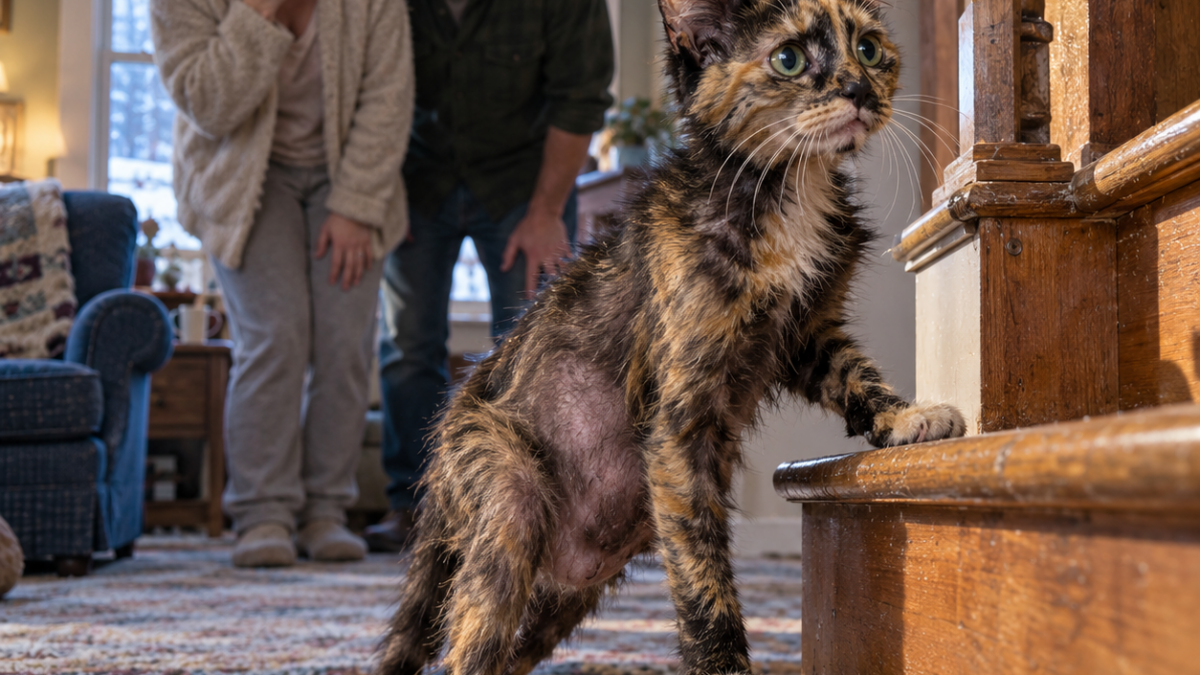
One cold morning, I woke up and found Ethel sitting at the bottom of the stairs.
Those stairs had terrified her since the day she arrived. She would stand at the bottom, look up, and sing like the second floor was another country.
I froze.
Michael froze behind me.
Ethel lifted one paw.
Then another.
One step.
Two steps.
Three.
Her whole body trembled, but she kept going. Halfway up, she stopped and looked back at us.
Neither of us moved.
I barely breathed.
She climbed again.
When she reached the top, she walked straight into our bedroom, jumped onto the bed, and curled up near my feet.
Then she sang.
But this time, it was different.
It did not sound like fear.
It sounded like relief.
Months passed.
Ethel grew fuller through the ribs. Her fur softened where patches had been rough. She learned the house and its rhythms. She had a bed by the window, though she preferred Michael’s chair. She watched birds like she owned the yard. She stole bites of chicken when she thought we were not looking. She followed me into the laundry room and acted offended when I left for work.
And yes, she still sang.
She sang when sunlight hit the rug.
She sang when Michael opened a can of food.
She sang when I came home and said her name.
Ethel was never a broken cat.
She was a tired little soul who had learned to survive without expecting love.
Sometimes happiness does not arrive all at once.
Sometimes it comes slowly, on shaking paws, up one stair at a time.
And sometimes the sound you thought was crying becomes the song of a heart finally coming home.
That should have been the whole story.
At least, that was the version people like.
Scared shelter cat finds patient home.
Woman and husband learn kindness.
Cat heals.
Everyone cries softly and goes to bed feeling better about the world.
But real life has a way of putting someone in the doorway after you already decided the ending.
The message came on a Tuesday afternoon while Michael was rinsing coffee cups at the kitchen sink.
My phone buzzed.
The shelter’s name appeared on the screen.
My stomach tightened for no good reason.
Ethel was asleep in Michael’s chair, one paw hanging over the side like she had paid the mortgage herself.
She looked peaceful.
Safe.
Home.
Then I opened the message.
“Hi Anna, this is Claire from Meadow County Animal Haven. I hope Ethel is doing well. I’m reaching out because her former owner contacted us. She asked if there might be any way to know how Ethel is doing. She also asked, very gently, if a supervised visit would ever be possible.”
I read it twice.
Then a third time.
Michael dried his hands slowly.
“What is it?” he asked.
I handed him the phone.
His face changed before he reached the end.
“No.”
Just one word.
Flat.
Final.
Ethel lifted her head when she heard his voice.
She blinked at us, stretched one thin front leg, and made a small questioning sound.
Not the old song.
Not fear.
Just Ethel being Ethel.
Michael put the phone down on the counter like it had burned him.
“No,” he said again. “Absolutely not.”
I understood him.
I understood him so much it hurt.
Because all I could see was the first day.
The cage.
The patchy fur.
The low belly from too many litters.
The way she backed away from a treat like kindness had teeth.
The way she sang from under the blue chair that first night.
But I also saw something else.
I saw the line in her papers.
Surrendered due to hardship.
Not cruelty charges.
Not abandonment in a parking lot.
Not seized by animal control.
Hardship.
That word is small on paper.
In real life, it can swallow a whole family.
I sat down at the kitchen table.
Ethel hopped down from the chair and padded toward us, slow and careful. She brushed against Michael’s ankle, then mine, like she was checking both sides of the room.
Michael looked down at her.
His voice softened.
“You don’t owe anybody anything, girl.”
And that was the problem.
He was right.
Ethel owed no one.
But maybe we did.
Not a visit.
Not forgiveness.
Not access.
Maybe we only owed the truth.
That she was alive.
That she was loved.
That the song had changed.
I typed back and erased the message four times.
Finally, I wrote:
“Thank you for telling us. We need time to think. Ethel is safe and doing well.”
Then I turned the phone over.
Michael leaned against the counter with his arms crossed.
“I don’t want that woman near her,” he said.
“You don’t know her.”
“I know what Ethel looked like.”
That stopped me.
Because there are some arguments that do not need more words.
Ethel looked up at him and sang one soft note.
Michael bent down and picked her up.
Months earlier, she would have panicked.
Now she melted into his chest.
He held her like something fragile and priceless.
“I know what she looked like,” he said again, quieter.
That night, I could not sleep.
Ethel slept between my feet, warm and heavy.
Michael slept with one hand resting on her back.
I stared at the ceiling and thought about how easy it is to become certain when you are angry.
Anger feels clean.
Compassion is messier.
Anger lets you point.
Compassion asks you to look.
And I did not want to look.
Not really.
I wanted Ethel’s story to be simple.
There was pain.
Then there was us.
There was a bad past.
Then there was a good home.
That kind of story feels good online.
People understand it.
They cheer for it.
They share it.
But real life is not built for clean applause.
The next morning, I called Claire from the laundry room so Michael would not have to hear.
Ethel followed me, of course.
She sat on the folded towels and stared at me like she was my manager.
Claire sounded relieved when she answered.
“I wasn’t sure if you’d respond,” she said.
“I almost didn’t.”
“I understand.”
There was a pause.
Then she said, “Her former owner’s name is Denise. I can’t share private details without permission, but she asked me to tell you she is not asking to take Ethel back.”
My chest loosened a little.
“She said that?”
“Yes. More than once. She knows Ethel is yours now. She just wanted to know if Ethel survived. Her words.”
I closed my eyes.
If Ethel survived.
Not if she was happy.
Not if she remembered.
Survived.
Claire kept talking.
“She said she has carried a lot of shame. She asked if she could send a letter. You do not have to read it. You do not have to answer.”
Ethel began kneading the towel under her paws.
Slow.
Rhythmic.
Safe.
I looked at her torn ear. Her fuller sides. The little scars time had not erased.
“Was Denise cruel to her?” I asked.
Claire was quiet for a moment.
“I can’t tell you what her home felt like. I wasn’t there. But I can tell you what I saw.”
I waited.
“When she brought Ethel in, she was crying so hard she could barely sign the forms. She had six cats with her. Ethel was the oldest female. Three were adopted quickly. Two went to foster. Ethel stayed longer because she was scared.”
I pressed my hand against the washing machine.
“Why so many cats?”
“She started with two. Neither was fixed. Then life got away from her.”
That sentence made me angry.
Then sad.
Then angry again.
Life got away from her.
How many animals have paid for those five words?
“I’m not making excuses,” Claire said, as if she could hear my thoughts. “I just want you to have the whole picture.”
“The whole picture still hurt Ethel.”
“Yes,” Claire said. “It did.”
I appreciated that she did not argue.
Some people try to explain pain until it becomes smaller.
Claire did not do that.
She let it sit there.
Real.
Ugly.
True.
“She can send a letter,” I said finally. “But no visit. Not now.”
“I’ll let her know.”
“And Claire?”
“Yes?”
“Please tell her Ethel sings when she’s happy now.”
Claire was quiet.
Then she let out a breath.
“I think that will mean more than you know.”
When I came out of the laundry room, Michael was waiting in the hallway.
He had heard enough.
Not everything.
Enough.
His jaw was tight.
“You called.”
“I did.”
“You told her no visit?”
“Yes.”
His shoulders dropped a little.
“But I said she could send a letter.”
He looked past me at Ethel, who was now walking circles around our feet.
“A letter can’t scare her,” I said.
Michael did not answer.
That was his way of saying he did not agree, but he loved me too much to fight before breakfast.
Three days later, the letter came.
Not by email.
A real envelope.
No return address on the outside except the shelter’s.
Claire had forwarded it.
It sat on our kitchen table all afternoon.
Neither of us touched it.
Ethel touched it first.
She jumped onto the chair, sniffed the envelope, and sat on it.
Michael looked at me.
“Well,” he said, “there’s her opinion.”
I laughed before I could stop myself.
It felt strange to laugh with that envelope in the room.
Like laughing in a hospital hallway.
But Ethel looked so serious sitting on top of it that the tension cracked.
Michael reached over and scratched her chin.
“Good girl. Protecting your paperwork.”
That evening, after dinner, we opened it.
Michael stood behind my chair.
Ethel stayed on the table beside the envelope.
The letter was handwritten.
The letters were uneven, like the person had stopped more than once.
I will not repeat all of it.
Some things are not mine to share.
But this is what mattered.
Denise wrote that Ethel had not always been called Ethel.
Her first name had been Junie.
She had belonged to Denise’s mother first, an older woman named Ruth Ellen, who used to sit in a recliner and sing old church songs while Junie slept on her lap.
When Denise’s mother got sick, Denise took the cat in.
Then another cat appeared outside.
Then one had kittens.
Then the kittens had kittens before she understood how fast everything could happen.
Her husband left.
Her hours at work were cut.
Her mother needed rides to appointments.
The apartment charged more each year.
She kept telling herself she would catch up.
She kept telling herself she would get the cats fixed next month.
Next month became next winter.
Next winter became years.
“I loved her,” Denise wrote. “I know people will say love is not enough, and they are right. I am not writing to defend myself. I am writing because I failed her, and I have to live with that.”
Michael’s hand tightened on the back of my chair.
I kept reading.
“She used to sing when my mother sang. After my mother passed, Junie kept singing at night. I thought she was looking for her. Maybe she was. Maybe we both were.”
There it was.
The song.
Not just fear.
Not just panic.
A memory.
A language.
A grief.
I looked at Ethel.
She was watching my face.
Denise ended the letter with one request.
Not to visit.
Not to hold her.
Not to get her back.
Just this:
“If you ever feel it would not hurt her, could you please tell her I am sorry? I know she will not understand the words. Maybe I just need them said in the same room where she is loved.”
Michael walked away before I finished the last line.
He went into the living room.
I heard the floor creak.
Then nothing.
I folded the letter carefully.
My hands were shaking.
Ethel jumped down from the table and followed Michael.
I stayed in the kitchen.
For the first time since we brought her home, I wondered if rescue always means taking something away.
Maybe sometimes it does.
Maybe that is necessary.
Maybe love can be real and still not be enough to keep an animal safe.
Maybe surrender can be both a failure and a mercy.
That is what made it hard.
If Denise had been a monster, the story would have been easier.
But she was not a monster.
She was a person who had made choices too late.
And Ethel had paid for every delay.
Later, I found Michael sitting in his chair.
Ethel was on his lap.
He had one hand over his eyes.
I stood in the doorway.
“You okay?”
“No.”
I sat on the couch.
For a long time, neither of us spoke.
Then he said, “My dad had a dog when I was little.”
I looked at him.
Michael did not talk about his childhood much.
Not because it was dramatic.
Because it was heavy in quiet ways.
“Name was Rusty,” he said. “Old mutt. Brown face. White chest. Followed me everywhere.”
Ethel curled her paws under her body.
“When things got tight, my dad gave him to a farmer outside town. Said he’d have more room there. I never saw him again.”
“Oh, Michael.”
“I spent years hating him for that.”
His voice broke on the last word.
I moved closer, but did not touch him yet.
He kept his eyes on Ethel.
“Then I grew up and realized he was choosing between dog food and groceries. Doesn’t make it okay. Doesn’t make it not hurt. But it made him human.”
Ethel lifted her head and pressed her forehead into his palm.
Michael swallowed hard.
“I don’t want Denise in our house.”
“I know.”
“I don’t want Ethel confused.”
“I know.”
“But that letter…”
He stopped.
The room was quiet except for Ethel’s purr.
It was louder now than it had been in the beginning, a rough little motor that had to work harder than other cats.
“That letter made me mad,” he said.
“Me too.”
“And sad.”
“Me too.”
“I hate that.”
“Me too.”
The next week, I made a mistake.
I told my sister.
I should have known better.
Not because Lauren is cruel.
She is not.
She is quick.
Quick to decide.
Quick to defend.
Quick to post opinions online that sound stronger than she feels in real life.
We were having coffee in her kitchen when I told her about Denise’s letter.
She nearly dropped her mug.
“You’re not actually considering letting that woman near Ethel, are you?”
“No.”
“Good.”
“I mean, not now.”
Her eyebrows shot up.
“Not now?”
I stared into my coffee.
“I don’t know.”
She leaned back.
“Oh, honey. No.”
That tone.
The soft one people use when they think you are being foolish.
“You didn’t see Ethel when we got her,” I said.
“Exactly. That’s why this should be easy.”
“It isn’t.”
“It is. Some people don’t deserve closure.”
There it was.
The sentence that would divide every room in America if you said it loud enough.
Some people don’t deserve closure.
Part of me agreed.
Part of me hated that I agreed.
Another part of me wondered who gets to decide.
Lauren folded her arms.
“Ethel is not a therapy tool for someone’s guilt.”
“I know that.”
“Do you? Because it sounds like you’re feeling sorry for the woman.”
“I can feel sorry for Denise and still protect Ethel.”
“Can you?”
I did not answer.
Because that was the real question.
Can we hold compassion in one hand and boundaries in the other?
Or do we always drop one?
That night, I told Michael what Lauren said.
He nodded.
“She’s not wrong.”
“She’s not completely right either.”
“No,” he said. “That’s what makes it annoying.”
A few days later, Claire called again.
I almost did not answer.
This time her voice sounded different.
Careful.
“Denise asked me to pass something along,” she said.
My whole body went tense.
“Claire.”
“I know. I told her I would ask once, and if you said no, that would be the end of it.”
“What is it?”
“She found an old recording of her mother singing. She said Ethel used to respond to that song. She wondered if you wanted it.”
I looked across the room.
Ethel was in the window bed, watching a squirrel with deep professional judgment.
“A recording?”
“Yes. Just audio. No visit. No contact if you don’t want it.”
I almost said no.
Then Ethel sang.
Not loud.
Not scared.
Just a little chirping song at the squirrel.
The sound rose and fell like a question.
I thought about her at the bottom of the stairs, looking up, singing like the second floor was another world.
I thought about how we had never known what her song meant.
We had assumed it was only brokenness.
Maybe part of healing is learning the language of what hurt you.
“Send it to me,” I said.
When it arrived, I did not play it right away.
I waited until Michael came home.
He took one look at my face and said, “There’s more.”
“There’s a recording.”
He closed his eyes.
“Of course there is.”
“We don’t have to play it.”
He hung his coat by the door.
Ethel came running, tail high, singing her welcome-home song.
Michael crouched down.
She bumped her head against his knee.
He rubbed her ears.
“Would it hurt her?” I asked.
“I don’t know.”
That was the most honest answer either of us had.
So we did what we had learned to do with Ethel.
We moved slowly.
We played only five seconds at first.
Low volume.
Across the room.
Ethel was on the rug, batting at a felt mouse with one missing ear.
I pressed play.
A woman’s voice filled the living room.
Old.
Thin.
Sweet.
Humming more than singing.
I did not know the song.
It sounded like something passed down, not performed.
Ethel froze.
Every hair along my arms stood up.
Michael whispered, “Turn it off.”
I did.
Ethel did not run.
She did not hide.
She stared at my phone.
Then she opened her mouth.
And sang one note back.
Michael sat down hard on the couch.
I covered my mouth.
Ethel walked toward the phone.
Not fast.
Not afraid.
She sniffed it.
Then she looked around the room.
At the chair.
At the window.
At us.
Then she sang again.
Longer this time.
Shaky, but not broken.
It was the sound she had made at the top of the stairs.
The sound of finding something and losing it at the same time.
I started crying.
Michael did too, though he turned his face away like that would hide it.
Ethel climbed into his lap.
Not mine.
His.
She pressed her body against his chest while the silent phone sat on the coffee table.
Michael held her with both hands.
“I’m sorry,” he whispered.
At first I thought he was speaking for Denise.
Then I realized he was not.
He was speaking for every person who had ever failed a creature because life became too much.
He was speaking for his father.
For Rusty.
For himself.
Maybe for me too.
Because we all carry a list of things we wish we had understood sooner.
After that, the recording became part of our house.
Not every day.
Not as a trick.
Not as entertainment.
Only sometimes.
On quiet evenings, when Ethel was already calm, we would play a few seconds.
She would lift her head.
Sometimes she sang.
Sometimes she simply listened.
Once, she walked to the blue armchair, the one she had hidden under for so many nights, and sat beside it.
Then she looked at me.
I do not pretend to know what cats remember.
I do not know if Ethel remembered Denise’s mother.
I do not know if she remembered being Junie.
I do not know if the song meant warmth, or loss, or hunger, or a lap that no longer existed.
But I know this.
She did not hide.
Whatever that voice brought back, it did not send her away from us.
It brought her closer.
And that changed Michael.
Not all at once.
Nothing with Ethel ever happened all at once.
But slowly.
One night, he said, “Maybe we could send a photo.”
I looked up from my book.
He did not look at me.
He kept his eyes on the television, which was not even on.
“A photo?”
“To Denise.”
I stayed very still.
“She asked if Ethel survived,” he said. “A photo would answer that.”
“What kind?”
“No faces. No address. Nothing personal.”
“Just Ethel?”
“Just Ethel.”
So we took a picture the next morning.
Ethel in the window bed.
Sunlight across her fur.
Her torn ear visible.
Her green eyes half closed.
She looked older than five in some ways.
Younger in others.
Like a cat who had missed her kittenhood and was trying to borrow some of it back.
I sent it through Claire with one sentence.
“Ethel is safe, loved, and still singing.”
Denise wrote back two days later.
Only three lines.
“Thank you. I cried when I saw her. Please tell her I am sorry, and please tell her I am glad she has you.”
Michael read it and nodded once.
Then he went outside to rake leaves for forty-five minutes, even though there were hardly any leaves.
That was Michael’s way.
He needed motion when feelings got too big.
Winter came hard that year.
Not dramatic.
Just gray.
Cold mornings.
Early darkness.
Bare trees.
The kind of winter that makes everything in a house sound louder.
The heater.
The pipes.
The wind at the back door.
Ethel handled it better than before.
She no longer ran from every sound.
But she still hated the garbage truck.
Every Tuesday morning, when it rumbled down the street, she bolted under the bed.
One Tuesday, she did not come out.
Not after breakfast.
Not after lunch.
Not when Michael opened her favorite food.
By three o’clock, I was on the floor with a flashlight, looking under the bed.
Her eyes glowed back at me.
“Hey, sweet girl.”
She did not move.
I slid a treat toward her.
Nothing.
My first thought was fear.
My second was illness.
That is what love does.
It gives you a longer list of things to worry about.
By evening, she still had not eaten.
Michael called the clinic.
They told us to bring her in.
The carrier came out of the closet, and Ethel saw it.
The old song returned so fast it stole the breath from my chest.
Long.
Shaking.
Terrified.
She ran from room to room, slipping on the hallway rug, searching for a place where the past could not find her.
Michael stood frozen with the carrier in his hand.
“I can’t,” he said.
“We have to.”
“I know. But look at her.”
Ethel crouched behind the laundry basket, panting lightly.
The carrier had become the shelter again.
The cage.
The car ride.
The unknown.
We spent twenty minutes trying to coax her.
Then thirty.
Then forty.
Every time she saw the carrier door, she sang harder.
Finally Michael put the carrier down and sat on the floor.
He looked defeated.
“We promised not to force her.”
“We promised not to give up,” I said.
He looked at me.
I hated saying it.
But love is not always letting fear choose.
Sometimes love is carrying someone through the thing they cannot understand.
We wrapped Ethel gently in a towel.
She did not scratch us.
That almost made it worse.
She just sang.
All the way to the clinic.
All through the waiting room.
Soft enough that only the people near us could hear.
A little boy across from us asked his mother, “Why is the kitty crying?”
His mother looked at me with kind eyes.
“Because she’s scared,” she said.
I wanted to hug her for not making it cute.
The veterinarian was a woman about our age with tired eyes and gentle hands. Dr. Patel examined Ethel slowly.
No rushing.
No loud voice.
No grabbing.
Ethel trembled, but she let it happen.
The diagnosis was not terrible.
A painful tooth.
Maybe more than one.
Common in cats who had gone too long without care.
Treatable.
But it meant a dental procedure.
It meant leaving her there for the day.
It meant another door closing between us.
Michael’s face went pale.
“No,” he whispered.
Dr. Patel heard him.
“I know it’s hard,” she said. “But she’s hurting.”
Hurting.
That word cut through everything.
Not scared.
Not dramatic.
Hurting.
Ethel had been hiding because pain had become bigger than trust.
We scheduled the procedure.
On the morning we dropped her off, she sang in the carrier again.
I cried in the parking lot like a child.
Michael put both hands on the steering wheel and stared straight ahead.
“We’re doing the right thing,” I said.
“I know.”
“You don’t sound like you know.”
“I know it in my head.”
That made sense.
Sometimes the heart takes a later train.
The house felt wrong without her.
Too clean.
Too still.
No paws in the hallway.
No offended chirp from the laundry room.
No little body stealing the warm spot on the chair.
By noon, I had checked my phone eleven times.
By two, Michael had cleaned the kitchen, the garage shelf, and one drawer that had not closed properly since we moved in.
At three-thirty, the clinic called.
Ethel had done well.
Two teeth removed.
She was waking up.
We could pick her up before dinner.
I do not think either of us breathed normally until she was back in the car.
She was groggy.
Offended.
Wrapped in a soft towel.
But when Michael whispered her name through the carrier door, she opened her eyes and sang one tiny, raspy note.
Not fear.
Not relief.
Complaint.
Pure complaint.
Michael laughed so hard he cried.
“There she is,” he said.
Healing after the dental work was not simple.
Nothing with Ethel ever was.
She had medicine.
Soft food.
A cone she hated with the passion of a tiny queen.
We lasted one hour with the cone before she backed into a corner and refused to move.
The clinic suggested a soft collar instead.
She hated that too, but less personally.
For three days, she walked around the house looking like a wilted flower.
Michael called her Madam Lamp.
I told him not to insult the patient.
Ethel forgave him first.
On the fourth night, she climbed onto his chest while he was lying on the couch.
She pressed her forehead under his chin.
Then she sang.
It was rougher now because of her mouth.
But clear.
Strong.
Alive.
I thought that would be the emotional peak of our winter.
I was wrong.
The real test came two weeks later.
Claire called again.
This time I almost laughed when I saw the shelter name.
“What now?” Michael said.
“I don’t know, but I’m afraid to answer.”
I answered.
Claire did not sound careful this time.
She sounded excited.
“Before I say anything, Ethel is fine, right?”
“Yes. Why?”
“I think we found one of her kittens.”
I sat down.
Michael stared at me.
“One of what?”
“One of her kittens,” Claire repeated. “He was adopted out about four years ago through a different small rescue that used to help with overflow. His adopter recently moved into assisted living, and the family brought him to us because our paperwork was listed as a contact.”
My hand flew to my mouth.
“Is he okay?”
“He’s scared. Big orange boy. Very sweet under all the fear. His name is Milo.”
Ethel had kittens year after year.
The kittens went away.
Ethel stayed.
That line from her papers came back so hard it hurt.
“How do you know he’s hers?”
“Old intake records. Same apartment. Same surrender group. Same markings noted on the litter. We can’t prove it like science, but the timeline fits.”
I looked at Ethel.
She was sitting in a cardboard box too small for her, which made it perfect.
“Why are you telling us?”
Claire paused.
“Because he sings.”
The room went silent.
Even the furnace seemed to stop.
Michael whispered, “No.”
But it was not the same no as before.
This one had fear in it.
Claire kept talking.
“I am not asking you to adopt him. I know you’ve already done a lot. I just thought you would want to know.”
Want to know.
What a dangerous phrase.
There are things you cannot unknow once they enter your house.
After we hung up, Michael paced the living room.
“No,” he said again. “We are not becoming cat people with twelve cats.”
“One more is not twelve.”
“That’s how twelve starts.”
I almost smiled.
He pointed toward Ethel.
“She is finally settled.”
“I know.”
“A new cat could upset her.”
“I know.”
“She might hate him.”
“I know.”
“He might bring back stress.”
“I know.”
He stopped pacing.
“Then why do you have that look?”
“What look?”
“The look you had when you saw Ethel’s picture online.”
I sat down beside the box.
Ethel blinked at me.
“Milo is not our responsibility,” I said.
Michael softened.
“No, he’s not.”
“But neither was she.”
That was unfair.
I knew it as soon as I said it.
Michael looked hurt.
I reached for his hand.
“I’m sorry.”
He sat beside me.
We both looked at Ethel.
She had fallen asleep with her chin on the edge of the box.
Trusting the world enough to close her eyes in the middle of a room.
That had once felt impossible.
“I’m scared to ruin this,” Michael said.
“So am I.”
And there was the real dilemma.
People love a rescue story when the hard part is over.
But what do you do when healing asks for more room?
How much peace do you protect?
How much risk do you take?
Does saving one animal mean you owe something to the next?
Or is it okay to say, “This is enough”?
I still do not think there is one clean answer.
Anyone who says there is has probably never sat in a quiet living room with a once-broken cat asleep beside them, wondering if love should open the door again.
We agreed to visit Milo.
Only visit.
Those were Michael’s words.
He said them three times in the car.
“We are only visiting.”
“I know.”
“We are not bringing him home today.”
“I know.”
“I’m serious.”
“I know, Michael.”
He glanced at me.
“You’re using your calm voice. That means you’re not listening.”
“I’m listening.”
“You’re emotionally loading a cat into our imaginary back seat.”
I looked out the window.
“I am doing no such thing.”
I was absolutely doing such a thing.
Milo was in the same room where we had first met Ethel.
Same fluorescent lights.
Same metal cages.
Same smell of disinfectant and fear.
He was huge compared to her, a big orange cat with a wide face, white paws, and one cloudy eye.
Not blind.
Just marked.
His fur was dull.
His body was thick, but not strong.
Like a cat who had been fed enough, but not understood.
He sat in the back of his cage with his tail wrapped tight around him.
When we approached, he opened his mouth.
The sound that came out made my knees weak.
Not Ethel’s song exactly.
Lower.
Rougher.
But it had the same bend in it.
The same trembling question.
Michael turned away.
I thought he was leaving.
Instead, he grabbed a chair and sat down in front of the cage.
“Hey, buddy,” he said.
Milo stopped singing.
Michael put one finger through the bars.
Not close enough to touch.
Just there.
Milo stared at it.
I stood behind Michael, my hands pressed together.
Claire watched from the doorway.
For fifteen minutes, nothing happened.
Then Milo leaned forward and sniffed Michael’s finger.
One sniff.
Then he retreated like he had embarrassed himself.
Michael smiled.
“Oh, you’re related, all right.”
We visited three times that week.
Only visiting.
Each time, Milo came forward a little sooner.
Each time, Michael said we were not making a decision.
Each time, he stayed longer.
On the fourth visit, Claire let us sit with Milo in a small meeting room.
Milo came out of the carrier low to the ground.
He circled the room.
Sniffed the chair.
Sniffed my shoe.
Ignored the toys.
Then he climbed onto Michael’s lap as if he had been waiting for him specifically.
Michael looked at me with panic in his eyes.
“Do not say anything,” he warned.
I raised both hands.
Milo tucked his giant orange head under Michael’s arm.
Then he sang.
Michael closed his eyes.
Claire quietly left the room.
Nobody needed to ask what was happening.
But we still took one more day.
Because Ethel mattered.
Because peace mattered.
Because a feeling is not a plan.
We called Dr. Patel.
We asked about introductions.
We asked about stress.
We asked about Ethel’s history.
We prepared a separate room.
We bought another litter box.
Another food bowl.
Another bed.
Michael carried the bags into the house and said, “This is still not a yes.”
I looked at the two new scratching pads under his arm.
“Of course.”
He pointed at me.
“No sarcasm.”
“No sarcasm.”
Milo came home on a Friday.
We kept him in the spare room.
Ethel knew immediately.
She stood in the hallway, staring at the closed door.
Her tail puffed slightly.
Milo sang from the other side.
Ethel went very still.
Then she sang back.
Not loud.
Not scared.
One note.
The house held its breath.
Milo answered.
Michael whispered, “What does that mean?”
“I have no idea.”
Ethel sat down outside the door.
For twenty minutes, neither cat moved.
They just listened to each other.
I sat on the floor at the end of the hallway and cried silently because I did not want to influence the process with my dramatic human feelings.
Michael found me there and handed me a tissue.
“You’re very subtle,” he said.
“Thank you.”
The introduction took weeks.
Not days.
Weeks.
There was hissing.
There was offended walking away.
There was one dramatic moment when Ethel saw Milo through a baby gate and looked at us like we had invited a bear into her retirement.
Milo, for his part, adored her immediately.
This did not help.
He wanted to follow her.
Sit near her.
Eat near her.
Exist in her royal presence.
Ethel wanted him to calm down and stop being orange.
Every time he got too close, she gave one sharp chirp.
Milo would freeze.
Then lie down.
Then look at Michael as if to ask, “Was that good?”
Slowly, the space between them shrank.
Six feet.
Four.
Two.
One morning, I found them both in the living room.
Not touching.
But sharing the same patch of sunlight.
Ethel had her back to him.
Milo was pretending not to stare.
Michael came up behind me.
“Well,” he whispered, “it’s not war.”
“No.”
“It’s more like a tense neighborhood meeting.”
That became their relationship for a while.
A tense neighborhood meeting.
Then, one afternoon, Ethel surprised us.
Milo was asleep on the rug.
Ethel walked over.
Sniffed his ear.
Lifted one paw.
I held my breath.
She gently touched the top of his head.
Milo opened his eyes.
Neither moved.
Then Ethel groomed him.
One lick.
Maybe two.
Then she walked away like it had been a clerical error.
Milo looked stunned.
Michael whispered, “I think he just got baptized.”
From that day on, he followed her with more confidence.
She corrected him often.
He accepted every correction.
Sometimes they sang at the birds together.
Ethel’s song was higher.
Milo’s was low and rusty.
Together, they sounded ridiculous.
Beautiful.
Like two old doors opening in the wind.
We sent Claire a picture.
Not to Denise yet.
Just Claire.
Ethel and Milo in the window, not touching, but close.
Claire called me crying.
“I wish people could see this part,” she said.
“What part?”
“The part after adoption. Not just the happy photo. The months. The patience. The fear. The second-guessing. The way love has to be practiced.”
That stayed with me.
Love has to be practiced.
Not announced.
Not posted.
Practiced.
With towels on the floor.
Medicine schedules.
Slow introductions.
Apologies.
Boundaries.
Bills you did not expect.
Mornings when you wonder if you made things worse.
Nights when a scared animal finally sleeps.
Spring came late.
The trees budded.
The windows opened.
Ethel sat in Michael’s chair while Milo took the window bed.
They had negotiated this arrangement without us.
One afternoon, I received another letter from Denise.
This time, I did not feel dread.
Not exactly.
I waited for Michael.
We opened it together.
Denise had written that she was moving into a smaller place near her sister.
No cats allowed.
She said that was probably best for now.
She had started volunteering twice a month at a small community pet pantry.
Not handling animals.
Just stacking cans.
Carrying bags.
Helping people get food before things became desperate.
“I am learning,” she wrote. “Too late for Junie, maybe. But maybe not too late for someone else’s cat.”
Michael read that line twice.
Then he handed the letter back to me.
“What do you think?” I asked.
“I think people will argue about her forever.”
“Probably.”
“Some will say she doesn’t deserve to feel better.”
“Yes.”
“Some will say she did the best she could.”
“Yes.”
“What do you say?”
I looked at Ethel.
She was washing one paw in the sun.
Milo was asleep on his back nearby, all four feet in the air, dignity nowhere to be found.
“I say Ethel deserved better.”
Michael nodded.
“And I say Denise should have asked for help sooner.”
He nodded again.
“And I say I’m glad she is helping now.”
Michael looked at the cats.
“That’s a lot of things to say at once.”
“Most true things are.”
A week later, we made one final decision.
We would not have Denise visit.
Not then.
Maybe not ever.
Ethel was not a bridge for human guilt.
She was not a symbol.
She was not proof that everything had worked out.
She was a living creature with a nervous system, a history, and a right to her peace.
But we would send Denise something.
Not a meeting.
Not access.
A recording.
Just audio.
Ethel and Milo singing at the window while Michael opened two cans of food and took too long, according to them.
It was not graceful.
It was not sentimental.
It was loud, bossy, and a little off-key.
It was life.
I sent it through Claire with one note.
“They are safe. They are loved. They sing every day.”
Denise wrote back once.
Only once.
“Thank you for letting the song continue.”
After that, we did not hear from her again.
And that was okay.
Some stories do not need everyone in the same room to heal.
Some apologies are accepted by being left alone.
Some love arrives too late to keep what it lost, but not too late to become something better in another place.
Ethel never became an easy cat.
I want to be honest about that.
She still hid when strangers came over.
She still disliked sudden sounds.
She still gave us looks of deep betrayal when we moved furniture.
She still needed time.
But she also became funny.
Demanding.
Nosy.
She learned the sound of the drawer where we kept treats.
She learned that Michael was easier to manipulate than I was.
She learned that if she sang near the bathroom door, one of us would eventually open it, even though she had no business in there.
Milo learned everything from her.
Good habits.
Bad habits.
All habits.
If Ethel sat in the window, Milo sat in the window.
If Ethel ignored the expensive bed and chose a cardboard box, Milo chose the same box, even if he did not fit.
If Ethel sang, Milo answered.
Sometimes I stood in the hallway and listened to them.
Two voices from one broken line.
Mother and son.
Or maybe not.
We never knew for certain.
But certainty mattered less as time went on.
They had chosen each other.
That was enough.
The blue armchair stayed in our living room.
We talked about replacing it.
It was old.
The fabric was worn.
One leg wobbled.
But Ethel still slept under it sometimes.
Not because she was hiding.
Because it was hers.
The first place in our home that had held her fear without rushing it.
The place where we learned that love does not always look like reaching in.
Sometimes it looks like lying on a couch in the dark and saying, “I’m here,” even when nobody comes out.
Almost a year after we brought Ethel home, Meadow County Animal Haven held a fundraiser for what they called The Waiting Ones Program.
Senior cats.
Fearful cats.
Medical cats.
Cats who were not cute enough, easy enough, young enough, or convenient enough to be chosen quickly.
Claire asked if we would speak.
Michael said no immediately.
Then he looked at Ethel.
She was sleeping in his chair, one paw over her face.
He sighed.
“We’ll think about it.”
That meant yes, eventually.
The event was held in the community center gym, where everything smelled faintly of floor wax and old basketballs. There were folding tables covered with blue cloths, framed photos of adopted animals, donation jars, homemade cookies, and a slideshow playing on a portable screen.
Ethel and Milo did not attend.
That would have been for humans, not for them.
But their picture sat on the center table.
Ethel in the window.
Milo beside her.
Both mid-song, mouths open, looking ridiculous and alive.
Denise did not come.
I did not expect her to.
But her pet pantry had a table in the corner.
Not Denise herself.
Just two volunteers collecting food donations for families in crisis.
That felt right.
Not redemption in a spotlight.
Work in the corner.
Claire introduced us.
My hands shook when I stood.
Michael stood beside me.
“I’m not good at speeches,” I began.
Michael leaned toward the microphone.
“She is lying. She talks to our cats like they are city council members.”
People laughed.
I glared at him.
He smiled.
Then I looked at the photo on the table.
“We adopted Ethel because of one photograph,” I said. “Then we met her and realized a photograph can hide almost everything important.”
The room quieted.
“She was scared. Thin. Tired. She sang when she was afraid. At first, we thought that was all the song was. Fear. But over time we learned it was more than that. It was memory. It was grief. It was a language. And eventually, it became joy.”
Michael’s hand found mine.
“I need to say something that may not fit neatly on a poster,” I continued. “Love without responsibility can still cause harm. Good intentions do not feed animals. Shame does not pay vet bills. Waiting too long to ask for help can hurt the smallest creatures first.”
A woman near the front wiped her eyes.
“But I also need to say this. People in crisis do not get better when all we offer them is judgment after the damage is done. They need help before the damage. Food pantries. Low-cost spay and neuter programs. Foster networks. Neighbors who notice. Friends who ask hard questions with kindness. Shelters that are supported enough to say yes.”
Michael leaned toward the microphone again.
“And adopters who understand that rescue is not one good day,” he said. “It is what happens after the photo.”
I looked at him.
He looked at the crowd.
“We had days when we wondered if we were doing anything right. We had vet bills we did not expect. We had fear come back after we thought it was gone. We had to learn that protecting Ethel meant having boundaries, even when we felt compassion for someone else.”
His voice thickened.
“She did not owe anyone a reunion. She did not owe anyone forgiveness. She owed herself peace. So we chose peace for her.”
The room was silent.
Then, from the back, someone started clapping.
Claire.
Then others joined.
Not thunderous.
Not dramatic.
But steady.
Afterward, a woman approached us with a carrier in her hand. Inside was a gray cat with one eye and a white chest.
“I was going to adopt a kitten,” she said. “But I think I should meet Hazel first.”
Claire looked at me from across the room.
Her face was wet.
That night, when we came home, Ethel scolded us for being gone too long.
Milo joined in because he believed all complaints were group activities.
Michael opened two cans of food.
Too slowly.
The singing started.
Loud.
Bossy.
Alive.
I stood in the kitchen doorway and laughed until I cried.
One evening, almost a year after we brought Ethel home, Michael found me sitting on the floor beside the blue armchair.
Ethel was under it.
Milo was beside me, chewing the corner of a toy fish.
“You okay?” Michael asked.
I nodded.
“Just thinking.”
“Dangerous.”
I smiled.
Ethel stretched one paw out from under the chair and rested it on my knee.
That tiny paw undid me.
Not because it was dramatic.
Because it was ordinary.
A year earlier, she would not come near my hand.
Now she reached for me without thinking.
Michael sat down beside us.
His knees cracked.
He made a sound like an old porch step.
Milo climbed halfway into his lap and then changed his mind.
Ethel came out slowly.
She looked at both of us.
Then she climbed onto Michael’s leg, stepped across him, and settled between us.
Milo tucked himself against her side.
For a few minutes, the four of us stayed there on the floor.
No big lesson.
No perfect ending.
Just a man, a woman, and two cats who had all learned something about staying.
Then Ethel sang.
Soft at first.
Milo answered.
Michael put his arm around me.
I thought about the shelter door.
The cage.
The four-hour drive.
The first song in the dark.
I thought about Denise’s letter.
Lauren’s warning.
The recording of an old woman’s voice.
Milo’s cloudy eye.
The carrier.
The dental appointment.
The slow hallway meetings.
All the little moments that never would have fit in an adoption photo.
This is what people miss when they say, “You rescued her.”
They make it sound like one act.
One day.
One decision.
But rescue is not the moment you open the cage.
Rescue is what happens after.
It is staying patient when fear looks like rejection.
It is paying attention when silence means pain.
It is admitting that love without responsibility can still cause harm.
It is understanding that compassion for people should never come at the cost of an animal’s safety.
And it is also understanding that shame alone does not fix anything.
Only changed behavior does.
That may be the part people argue about.
Maybe they should.
Maybe we need to talk about it more.
Not in a cruel way.
Not with pointing fingers from comfortable chairs.
But honestly.
Because there are Denises everywhere.
People drowning quietly.
People waiting too long to ask for help.
People who love animals but do not have the money, time, knowledge, or support to care for them properly.
And there are Ethels everywhere too.
Paying the price for human delay.
Both things can be true.
That is the hard part.
That is the part that does not fit neatly on a bumper sticker or a comment thread.
Ethel deserved protection.
Denise needed accountability.
Milo needed a second chance.
Michael needed to forgive a memory he had carried since childhood.
And I needed to learn that a healed heart does not become untouched.
It becomes brave enough to feel safe and scared at the same time.
These days, Ethel still sings every morning.
She sings before breakfast.
She sings at sunbeams.
She sings when Michael comes home.
She sings when Milo steals her spot and she wants the household informed of this injustice.
But my favorite song comes at night.
After the dishes are done.
After the lights are low.
After the house settles.
Ethel walks to the bottom of the stairs.
The same stairs that once terrified her.
She looks up.
Then she climbs.
One step.
Two steps.
Three.
Milo usually follows, heavy-footed and clumsy.
At the top, she pauses and looks back, as if making sure we are coming too.
Then she sings.
Not because she is lost.
Not because she is scared.
Not because she expects love to disappear.
She sings because this is her house now.
Her stairs.
Her chair.
Her window.
Her strange orange shadow.
Her people.
Her song.
And every time I hear it, I remember what I thought the first day behind that shelter door.
We had not come to rescue a pet.
We had come to answer a cry nobody else had understood.
But I know better now.
We did not answer it once.
We answer it every day.
With food.
With patience.
With boundaries.
With second chances given carefully.
With doors opened slowly.
With love that does not rush in to prove itself.
And sometimes, late at night, when Ethel curls near my feet and Milo snores beside Michael, I think about that old recording.
A woman’s thin voice.
A lost song.
A cat who remembered.
A home that came after heartbreak.
Maybe that is what healing is.
Not erasing the first song.
Not pretending the crying never happened.
But giving it somewhere safe to change.
Because sometimes the sound that once broke your heart does not disappear.
Sometimes it grows stronger.
Warmer.
Braver.
Sometimes it becomes a duet.
And sometimes, if you are patient enough to listen, the cry nobody understood becomes the music of a family finally learning how to stay.