Two Military K9s Turned Aggressive Inside a Hospital—Then a Quiet New Nurse Stepped Forward and Stopped Them Without Using Force.
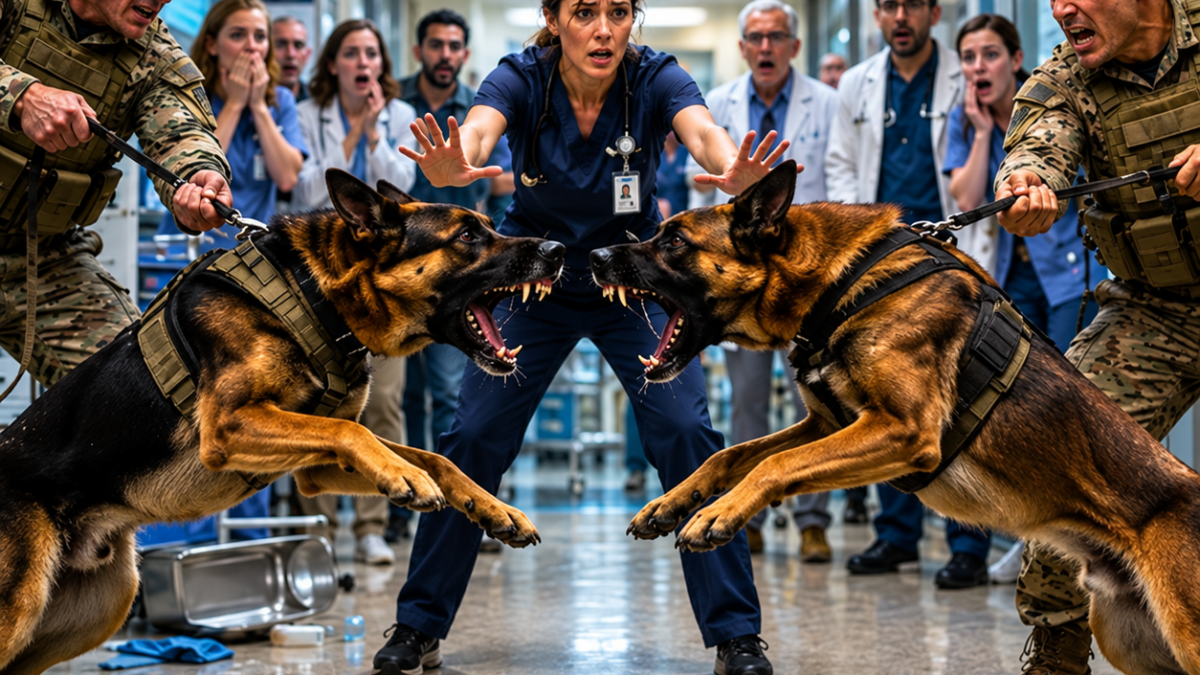
PART3:
For several seconds, nothing happened.
That was the part people later forgot.
The disaster did not begin with lunging.
It began with stillness.
Both dogs froze.
Their ears moved forward.
Their eyes locked.
Their bodies became quiet in the dangerous way trained bodies become quiet before action.
Nolan shortened Bruno’s leash.
Marcus did the same with Vega.
A veterinary technician standing near the exam room door looked from one dog to the other and tried to sound casual.
“Let’s take them into separate rooms.”
“Good idea,” Nolan said.
He turned Bruno slightly.
But before he could move, Vega gave a sharp bark.
Bruno answered.
The sound echoed down the corridor.
People turned.
A child waiting near the doorway with his mother began to cry.
A nurse carrying a tray stopped so suddenly a cup rattled against metal.
“What’s happening?” someone asked.
“Keep people back,” Marcus said.
His voice remained calm, but his grip had tightened.
“Both dogs are becoming reactive.”
Then Bruno lunged.
Not far.
Nolan caught him immediately.
But Vega reacted to the movement.
He pulled forward.
Marcus braced his feet.
“Vega, heel.”
The dog ignored him.
“Vega.”
The Malinois barked again.
Bruno answered with a deeper growl.
And suddenly the two handlers were no longer simply managing excited dogs.
They were fighting to prevent two powerful working animals from reaching each other.
“Get everyone out,” a veterinarian shouted.
The corridor erupted.
Hospital staff began moving patients away. A security officer came from the far end of the hall. A nurse pushed the crying child and his mother through the nearest open doorway. Someone closed the automatic doors leading back toward the main hospital.
“Should we separate them physically?” the security officer asked.
“No,” Marcus snapped. “Do not get between them.”
Bruno pulled again.
Nolan’s shoulder jerked.
Vega strained against Marcus hard enough that the muscles in the handler’s forearm stood out.
Both dogs were now completely focused on each other.
Hackles raised.
Mouths open.
Bodies tight.
Every instinct seemed pointed toward the animal standing opposite them.
Yet neither handler understood why.
These dogs had encountered other working dogs before. They had trained near other breeds. They had operated in loud environments, around vehicles, sirens, equipment, crowds, officers, strangers, and chaos most civilian dogs would never be expected to tolerate.
This was not normal.
A senior veterinarian stepped out of an examination room.
“What triggered this?”
Marcus shook his head.
“Nothing obvious.”
Nolan nodded.
“They saw each other, and that was it.”
“Keep them separated.”
“We’re trying.”
Another bark.
Another pull.
Another wave of fear moving through the people watching.
A nurse whispered, “Can they bite through the leashes?”
Nobody answered.
That made it worse.
The security officer raised his radio.
“Do we sedate them?”
The veterinarian shook his head.
“Not unless we absolutely have to.”
“They’re trained dogs.”
“I know.”
“They’re not responding.”
“I know.”
Then the situation became worse.
Bruno slipped half a step forward.
Vega surged at exactly the same moment.
Both handlers held the leashes.
Barely.
But the movement was enough for Vega’s flank to bump a metal equipment cart.
The cart rolled sideways.
One wheel caught.
Then the whole thing tipped and crashed into the wall with a violent metallic bang.
Several people screamed.
Both dogs reacted instantly.
Their barking became louder.
More frantic.
More explosive.
The corridor dissolved into chaos.
“Everyone back!”
“Close that door!”
“Don’t touch the dogs!”
“Move the patients!”
“Nolan, get him back!”
“Marcus, watch the leash!”
Nolan struggled to pull Bruno back without making the pressure worse.
“Bruno!”
The dog did not respond.
Marcus tried again.
“Vega, look at me.”
Nothing.
The two dogs had entered a state of extreme arousal, and their handlers were doing everything their training told them to do.
But the environment was feeding the fire.
Noise.
People.
Metal.
Movement.
Echoes.
Fear.
The other dog.
Every second added another layer.
At the end of the corridor, a treatment room door opened.
A young nurse stepped out.
She paused with one hand still on the doorknob.
Her name was Claire Bennett.
She was thirty-five years old, new to the hospital, only six weeks into her position. She wore plain navy-blue scrubs, a white hospital ID badge, and a black stethoscope around her neck. Her brown hair was tied in a simple low ponytail. She had no military insignia, no special rank, no reputation inside that building that would make anyone look at her and think, She knows what to do.
Most people in the hospital barely knew her.
Some treated her like she did not belong there.
That had started on her first week.
Not openly.
Not cruelly.
Not in a way anyone could file a report about.
It was quieter than that.
The pause before answering when she asked where supplies were kept.
The way senior nurses spoke around her rather than to her.
The administrator, Richard Sloan, correcting her in front of others for things he would have addressed privately with more established staff.
The assumption that because she was quiet, she was uncertain.
Because she was new, she was inexperienced.
Because she listened before speaking, she had nothing important to say.
Claire had learned a long time ago that people often mistake quiet for emptiness.
So she did what she always did.
She worked.
She arrived early.
She stayed late.
She learned the facility layout, memorized emergency codes, kept her charts clean, checked medication orders twice, and helped patients without making a performance of it.
If anyone had asked her about her life before Walter Reed, she might have answered.
Nobody asked.
Now she stood in the doorway and looked at the corridor.
Everyone else was moving away.
Claire did not.
She looked at Bruno.
Then Vega.
Then Nolan.
Then Marcus.
Then the people surrounding them.
She immediately noticed something everyone else was missing.
The dogs were not simply reacting to each other.
They were reacting to the people around them.
Every shout made them more alert.
Every step closer increased their tension.
Every command delivered loudly added another signal to a space already overloaded with signals.
The handlers thought they were giving direction.
The dogs heard conflict.
The staff thought they were helping.
The dogs saw pressure.
The corridor thought it was responding to danger.
The dogs felt the danger multiplying.
Claire looked at the veterinary team.
Then the security officers.
Then back at the dogs.
She quietly said, “Stop shouting.”
Nobody heard her.
She tried again.
“Everyone stop shouting.”
A security officer looked at her.
“Ma’am, please move back.”
Claire did not move back.
She watched Vega’s eyes.
Then Bruno’s.
And she understood.
The dogs were not listening because they were being given too many signals at once.
Too many bodies.
Too much noise.
Too much tension in the leashes.
Too much fear in the humans.
Too many commands layered over instinct.
Claire took one slow breath.
Then she stepped forward.
Nolan saw her first.
“Don’t come any closer.”
Marcus said the same thing.
“Stay back.”
Claire stopped.
She looked at them, then at the dogs.
Her voice remained completely calm.
“I know.”
Nolan stared at her.
“What?”
“I know what they’re doing.”
The veterinarian frowned.
“Do you have experience with military working dogs?”
Claire did not answer.
Instead, she slowly lowered one hand.
Not toward either dog.
Toward the floor.
Both dogs noticed.
Their barking softened for half a second.
Claire took another careful step.
Nolan’s face tightened.
“Claire, don’t.”
She looked at him.
“I’m not going to touch them.”
Then she turned toward the two dogs and said something that made both handlers go silent.
Something neither dog had heard from anyone in that hospital that morning.
“Break focus.”
Bruno’s ears moved.
Vega’s head tilted.
Claire took one more step.
Her voice became softer.
“Eyes on me.”
The corridor went silent.
For the first time, both military working dogs looked away from each other and toward her.
For a moment, nobody moved.
Bruno’s eyes shifted from Vega to Claire.
Vega did the same.
The barking stopped.
Not completely.
A low rumble still came from both dogs.
But the explosive tension that had filled the corridor only seconds earlier had changed.
Claire noticed immediately.
She did not smile.
She did not celebrate.
She simply kept her posture relaxed.
“Good,” she said quietly. “That’s better.”
Nolan stared at Bruno.
The Army German Shepherd was still tense, but his attention was no longer completely fixed on Vega.
Marcus looked at Claire.
“How did you do that?”
Claire did not answer.
She kept her eyes on the dogs.
“Don’t ask me questions yet.”
Her voice remained calm.
“Just give them fewer things to react to.”
The security officer slowly backed away.
The veterinary staff stopped moving.
Even the hospital employees watching from doorways became completely still.
Claire looked toward the handlers.
“Lower your voices.”
Nolan nodded.
Marcus did the same.
“Now loosen your shoulders.”
They both looked at her.
She continued, “They’re reading your tension.”
Nolan slowly relaxed his grip.
Marcus followed.
The dogs noticed.
Their bodies began to soften.
Not much.
But enough.
Claire took one step sideways.
She did not approach either animal.
Instead, she positioned herself where both dogs could see her without having to look directly at each other.
Then she raised her hand slightly.
“Stay.”
Both dogs remained still.
Claire waited.
Five seconds.
Ten.
Fifteen.
Nothing happened.
Then Bruno looked at Vega again.
His ears went forward.
Claire immediately said, “Eyes here.”
Bruno looked back.
Vega followed.
Claire nodded.
“Good.”
A veterinarian whispered, “She’s controlling both of them.”
Claire heard him.
She shook her head.
“No.”
She kept her eyes on the dogs.
“I’m giving them something else to focus on.”
The veterinarian looked confused.
Claire continued, “They’re not machines. They’re trained animals. And right now, they’re overloaded.”
That distinction mattered.
Military working dogs were trained to operate under stress, but training did not make them immune to stress. A hospital was a strange environment. Different smells, echoing corridors, metal equipment, unfamiliar people, medical alarms, rolling carts, other animals, handlers who were suddenly tense, and in this case, another highly trained dog whose body language could be interpreted as a challenge.
Claire understood that Bruno and Vega did not need someone to overpower them.
They needed someone to lower the intensity of the world around them.
Claire looked toward the equipment cart lying against the wall.
“Move that.”
A technician hesitated.
Claire raised her hand slightly.
“Slowly. No metal noise.”
Two staff members carefully lifted the cart upright and rolled it away.
No clanging.
No shouting.
No sudden movement.
The dogs watched, but neither reacted.
Claire nodded.
“Good.”
She looked at Nolan.
“What’s his release command?”
Nolan answered quietly, “Break.”
Claire nodded.
“And yours?”
Marcus answered, “Free.”
Claire looked thoughtful.
“Don’t use them yet.”
Both handlers nodded.
She waited another few seconds.
Then she crouched slightly.
Bruno’s eyes followed her.
Vega’s did too.
Claire said, “You’re both okay.”
Her voice was almost conversational.
“Nobody is asking you to fight.”
The dogs remained still.
“You saw another dog. That’s all.”
A faint whine came from Vega.
Claire noticed.
“Good.”
She looked at Marcus.
“He’s coming down.”
Marcus looked at his dog.
For the first time, he noticed it too.
Vega’s breathing had slowed.
His tail was no longer rigid.
His ears had relaxed slightly.
Nolan looked at Bruno.
Same thing.
Claire nodded.
“Exactly.”
A nurse standing near the doorway whispered, “Who is she?”
Another nurse answered quietly, “Claire. She’s new.”
“I know. How does she know all this?”
Nobody knew.
Claire slowly extended her hand.
She did not touch either dog.
She simply allowed them to see it.
Then she made a small, deliberate motion with her fingers.
Bruno’s eyes followed.
Vega’s eyes followed.
She lowered her hand.
Both dogs remained focused on her.
Claire quietly said, “Now, back.”
Nolan slowly stepped backward.
Bruno followed him.
Marcus did the same.
Vega followed.
The distance between the dogs increased.
One foot.
Then two.
Then four.
The entire corridor seemed to breathe again.
“Good,” Claire said. “Keep moving.”
The handlers continued backward until they reached opposite sides of the corridor.
The dogs were now separated by several yards.
But Claire did not relax yet.
She knew the first calm moment was not the end.
It was the most fragile part.
A veterinarian approached from behind.
Claire immediately raised one hand.
“Not yet.”
The veterinarian stopped.
“If we crowd them now, they’ll react again.”
The veterinarian nodded.
“How long?”
“Until their breathing is normal.”
“You’re sure?”
Claire nodded.
“Yes.”
For the next few minutes, the corridor became strangely quiet.
No one shouted.
No one rushed.
The two handlers stood several yards apart.
Claire remained between them.
Bruno watched her.
Vega watched her.
Their breathing slowly returned to normal.
Their muscles relaxed.
Their ears softened.
Eventually, Bruno sat.
Nolan smiled.
“Good boy.”
Vega remained standing.
Marcus waited.
Then Vega sat too.
Marcus quietly exhaled.
“Good.”
The corridor released its fear in pieces.
Not cheering.
Not applause.
Just quiet breaths.
A nurse closed her eyes.
The security officer lowered his radio.
A technician leaned against the wall like his knees had just remembered they were responsible for holding him upright.
The veterinarian looked at Claire.
“I’ve worked with canine teams for twelve years.”
He shook his head.
“I’ve never seen anyone settle two dogs that quickly.”
Claire stood.
“I didn’t settle them.”
She looked toward Bruno and Vega.
“They settled themselves.”
Marcus approached her carefully.
“Where did you learn that?”
Claire looked at him.
“Learn what?”
“The movements. The commands. The way you positioned yourself.”
Claire glanced at Bruno.
“Experience.”
Marcus smiled faintly.
“That’s not an answer.”
She returned a small smile.
“Maybe later.”
For a few minutes, everyone believed the situation was over.
Then a door opened.
A technician stepped into the corridor carrying a metal tray.
His hands shook.
The tray slipped slightly.
A loud metallic sound echoed through the hallway.
Bruno’s head snapped toward it.
Vega stood immediately.
Both dogs stiffened.
Claire turned.
“Freeze.”
Everyone stopped.
The dogs looked toward her.
Claire raised her hand.
“Eyes here.”
Bruno looked at her.
Vega followed.
She waited.
Then lowered her hand.
The dogs sat again.
The technician looked horrified.
“I’m sorry.”
Claire smiled gently.
“It’s okay.”
She looked toward the dogs.
“They’re learning that nothing bad is happening.”
That moment changed the staff’s perception of her.
Not fully.
Not all at once.
But something shifted.
She had not gotten lucky.
She understood the animals.
She understood the handlers.
She understood the room.
And yet not everyone was impressed.
At the end of the corridor stood Richard Sloan.
Richard was a senior hospital administrator, and from the day Claire started at Walter Reed, he had made it clear—politely, professionally, and persistently—that he doubted her.
He thought she was too quiet.
Too cautious.
Too slow to assert herself.
Not suited, perhaps, for a demanding military medical environment.
He had criticized her documentation in front of two other nurses during her second week. He had asked whether she understood chain-of-command procedures in a tone that made the question sound like a verdict. He had once told another supervisor, not softly enough, “She needs to learn how things work here.”
Now he watched her calm two military working dogs that several experienced people could not control.
His expression did not soften.
It hardened.
“That’s enough,” Richard said.
His voice cut through the corridor.
Claire looked toward him.
He walked closer.
“Take the dogs to separate examination rooms.”
Claire nodded.
“Yes.”
Richard looked at the handlers.
“You heard her.”
Nolan frowned slightly at being ordered by a man who had not helped.
“Sir?”
“Separate rooms,” Richard said.
Nolan glanced toward Claire.
She nodded.
“It’s okay.”
The handlers moved.
Bruno followed Nolan.
Vega followed Marcus.
Claire remained behind as the dogs disappeared into separate treatment rooms.
Only then did she allow herself to breathe.
A nurse approached her.
“You okay?”
Claire nodded.
“Yes.”
“That was incredible.”
“Thank you.”
The nurse lowered her voice.
“Why didn’t you tell anyone you knew how to handle K9s?”
Claire looked down the corridor.
“Nobody asked.”
That answer stayed with the nurse because it was true.
Claire had not been hired as a K9 specialist.
She was a nurse.
She had arrived quietly.
Done her work.
Stayed late.
Helped patients.
Answered questions.
Learned routines.
And yet several people had already decided who she was.
The new nurse.
The quiet nurse.
The one who did not belong.
They had never asked what she had done before coming there.
Later that afternoon, Nolan returned from Bruno’s examination and found Claire at the nurses’ station.
He waited until she finished updating a chart.
“Can I ask you something?”
Claire looked up.
“Sure.”
“Where did you actually learn that?”
She hesitated.
Then answered, “I spent several years supporting military K9 teams.”
Nolan’s eyebrows rose.
“Which branch?”
Claire smiled faintly.
“That’s complicated.”
Marcus approached from behind.
“I knew it.”
Claire turned.
Marcus folded his arms.
“You’ve done this before.”
She nodded.
“Yes.”
“How many dogs?”
Claire thought for a moment.
“Enough to know every dog is different.”
Nolan smiled.
“That’s probably the smartest answer I’ve heard today.”
The two handlers exchanged a look.
Then Marcus said, “Vega doesn’t usually react like that.”
Nolan nodded.
“Neither does Bruno.”
Claire looked thoughtful.
“Then something about the environment triggered them.”
“What?”
“I don’t know yet.”
Marcus frowned.
“What do you mean?”
Claire looked toward the two examination rooms.
“They recognized something in each other.”
“Different forces?” Nolan asked.
“Maybe. But not the way humans mean it.”
Marcus crossed his arms.
“Army and Marine Corps?”
Claire almost smiled.
“To us, those are uniforms and branches. To them, those are different routines, different body language, different handler expectations, different leash tension, different command patterns.”
Nolan nodded slowly.
Claire continued, “They were two unfamiliar working animals suddenly meeting inside a confined medical corridor while every human around them became tense.”
Marcus looked toward Vega’s room.
“So they’re not enemies.”
Claire smiled.
“No. They were never enemies.”
That evening, Claire was finishing her shift when she heard something from the veterinary corridor.
A bark.
Then another.
She immediately stopped.
The hospital had become quiet. Most day staff had gone home. The corridors held the softer sounds of evening: distant monitors, rolling trash bins, low voices, shoes squeaking on polished floors.
Claire walked toward the sound.
She reached the corner and stopped.
Bruno and Vega were being taken from their separate examination rooms at the same time.
Their handlers had not realized they were approaching each other again.
The dogs saw each other.
Their bodies stiffened.
Claire’s heart dropped.
The same tension returned.
Nolan tightened Bruno’s leash.
Marcus stepped back with Vega.
The dogs stared at each other.
Before either handler could issue a loud command, Claire stepped into the corridor.
She looked at both dogs.
Then calmly said, “Remember this morning.”
Both dogs looked at her.
Claire took one slow step forward.
Then another.
This time, neither dog growled.
Instead, Bruno sat.
A second later, Vega sat too.
The handlers stared in disbelief.
Claire smiled.
“Good.”
Then she looked at the two powerful military working dogs.
“You don’t have to like each other.”
She paused.
“You just have to trust that you’re safe.”
Bruno’s ears relaxed.
Vega’s tail moved once.
And for the first time, the two dogs looked at each other without aggression.
Not friends.
Not yet.
But no longer enemies.
Claire turned to leave.
Marcus called after her.
“Wait.”
She stopped.
“Thank you.”
She looked back.
He smiled.
“You saved us from a very long night.”
Claire laughed softly.
“No.”
She looked at the dogs.
“They just needed someone to remind them who they were.”
As she walked away, neither handler noticed the small shadow crossing her face.
Because Claire knew something they did not.
She had not told them everything.
She had not told them about the years she had spent around military K9 units.
She had not told them about the dogs she had helped rehabilitate.
And she certainly had not told them why she had left that world behind.
That part of her story was still a locked door.
And soon someone at the hospital was going to find the key.
The next morning, Claire arrived before sunrise.
The hospital corridors were nearly empty. Only the quiet sounds of cleaning equipment, distant monitors, and the occasional footsteps of overnight staff disturbed the silence.
Claire carried a paper cup of coffee as she walked toward the veterinary wing.
She expected another ordinary shift.
Instead, she found Nolan Pierce waiting outside Bruno’s examination room.
He looked tired.
But he was smiling.
“Morning.”
Claire stopped.
“Morning.”
Nolan held out his phone.
“Look.”
On the screen was a photograph.
Bruno sat calmly beside Nolan.
A few feet away, Vega sat beside Marcus.
Both dogs were looking in the same direction, not exactly at each other, but close enough that the old tension should have appeared.
It had not.
Claire smiled.
“That’s progress.”
Nolan nodded.
“More than progress.”
He lowered the phone.
“They were in the same hallway for ten minutes yesterday.”
“And?”
“Nothing.”
Claire smiled.
“Good.”
Nolan studied her.
“There’s something else.”
Claire waited.
“The command you gave them.”
“What about it?”
“I’ve heard that command before.”
Claire’s expression changed slightly.
Nolan continued carefully.
“Not from our unit.”
He looked at her.
“From a Navy K9 instructor.”
Claire said nothing.
“And the hand signal?”
He paused.
“That’s not something you learn in ordinary nursing training.”
Claire looked away.
“You’re very observant.”
“I work with dogs.”
“So do I.”
Nolan smiled.
“I think there’s a lot you haven’t told us.”
Claire looked through the examination room window.
Bruno was resting comfortably.
“Maybe.”
Before Nolan could ask another question, Marcus walked into the corridor.
He looked between them.
“Still interrogating the new nurse?”
Nolan laughed.
“Trying.”
Marcus looked at Claire.
“Don’t worry. He does that to everyone.”
Claire smiled.
Then Marcus’s expression became serious.
“Vega is ready.”
“For his examination?”
“Yes.”
“Good.”
He hesitated.
“There’s something I wanted to ask you.”
Claire looked at him.
“Go ahead.”
“Yesterday, when you told us not to separate them by force.”
“Yes.”
“How did you know they’d respond?”
Claire thought for a moment.
“I didn’t know.”
Marcus frowned.
“I made an educated guess.”
“You seemed pretty certain.”
Claire smiled.
“That’s because uncertainty makes dogs nervous.”
Marcus laughed.
“That’s an answer.”
The morning passed peacefully.
Bruno completed his examination.
Vega completed his.
Both dogs were healthy.
Both handlers were relieved.
Most importantly, neither dog showed aggression toward the other.
By lunchtime, the story had spread through the hospital.
Everyone had heard about the two military working dogs.
Everyone had heard about the new nurse.
And everyone had a different version of what happened.
Some said Claire had special canine training.
Others claimed she had been a military handler.
One person said she had worked with police dogs.
Another insisted she had simply gotten lucky.
Claire ignored all of it.
She did not correct anyone.
She just did her job.
But Richard Sloan had not forgotten.
The administrator found her during the afternoon.
“Claire.”
She turned.
“Yes?”
“My office.”
She followed him.
The door closed.
Richard sat behind his desk.
Claire remained standing.
“You’ve created quite a bit of attention.”
Claire looked confused.
“Because of yesterday?”
“Yes.”
“I’m sorry.”
“Don’t apologize.”
He leaned back.
“I’m asking where you learned to handle military working dogs.”
Claire remained silent.
“Your employment file doesn’t mention it.”
“No.”
“Why?”
“Because it wasn’t relevant to the position.”
Richard frowned.
“It became relevant yesterday.”
Claire nodded.
“I understand.”
“So?”
Claire took a breath.
“I had previous experience.”
“What kind?”
She looked at him.
“Military K9 emergency response.”
Richard stared.
“You’re telling me you have formal military K9 experience?”
“Yes.”
“Why didn’t you tell anyone?”
“Nobody asked.”
Richard leaned forward.
“Who did you work for?”
Claire hesitated.
Then quietly answered, “The Navy.”
The room became silent.
Richard looked genuinely surprised.
“You were Navy?”
“No. I worked alongside Navy K9 units.”
“For how long?”
“Almost eight years.”
Richard sat back.
“Eight years?”
Claire nodded.
“Before becoming a nurse.”
Richard looked at the employment file again, then back at her.
“Why didn’t this appear in your application?”
“Because my nursing qualifications were what you hired me for.”
“You could have told me.”
Claire held his gaze.
“Would it have changed anything?”
He did not answer.
Claire understood.
She had known from the beginning how people would react.
Some would respect her.
Some would question her.
Some would assume she was trying to impress people.
Some would dig through her past and make her into a story instead of a colleague.
So she had chosen silence.
Richard looked toward the window.
“Those dogs could have seriously injured someone.”
“I know.”
“You walked toward them.”
“I knew they weren’t committed to attacking people.”
Richard looked back.
“How?”
Claire answered calmly.
“Because they kept looking at their handlers.”
“What does that mean?”
“They were searching for direction.”
She paused.
“An animal committed to attacking usually doesn’t keep checking for permission.”
Richard considered that.
“So you knew they wouldn’t bite?”
“No.”
Claire shook her head.
“I knew there was a better way to reduce the risk.”
Richard was silent for a long moment.
Finally, he nodded.
“Understood.”
When Claire left the office, she expected the same cold reception she had received since arriving.
Instead, a nurse was waiting outside.
Tessa Grant.
One of the staff members who had witnessed the entire incident.
Tessa smiled awkwardly.
“I heard.”
Claire sighed.
“If you’re here to ask about the dogs, no.”
Tessa shook her head.
“I wanted to say I’m sorry.”
Claire frowned.
“For what?”
“For how everyone treated you.”
Claire did not answer.
Tessa continued, “We thought you were just new.”
“I was.”
“No.”
Tessa’s smile faded.
“We thought you didn’t know anything.”
Claire looked down.
“That’s okay.”
“It isn’t.”
Tessa shook her head.
“We should have asked.”
That sentence meant more to Claire than Tessa realized.
Because Claire had spent years learning that people often saw uniforms before they saw individuals. She had watched handlers treated as soldiers first and caregivers second. She had watched K9 teams dismissed as just dogs by people who had never seen what those animals could do.
And she had experienced the same thing herself.
People looked at her scrubs.
They saw a new nurse.
They never wondered what had come before.
That afternoon, something unexpected happened.
The hospital received a call.
The Navy K9 program had heard about the incident.
A senior K9 operations officer wanted to speak with the hospital.
Not because the dogs had fought.
Because someone had managed to calm two highly trained military working dogs during a high-stress confrontation without physical restraint.
The hospital director arranged a meeting.
Claire was asked to attend.
She almost refused.
Then she saw the name on the meeting request.
Commander Daniel Whitaker.
She knew him.
Not personally, exactly.
But she knew the name.
He had overseen one of the K9 programs Claire had supported years earlier.
When she entered the conference room, Commander Whitaker looked up.
He did not recognize her immediately.
Then his expression changed.
“Claire?”
She stopped.
“Hello, Commander.”
He stood.
“I haven’t seen you in years.”
“I know.”
“Last time I saw you, you were working with the rehabilitation team.”
Claire nodded.
“That was a long time ago.”
Whitaker looked toward the hospital director.
“You hired her?”
The director nodded.
“She’s one of our nurses.”
Whitaker smiled.
“She’s much more than that.”
Claire looked uncomfortable.
“Commander—”
He raised a hand.
“I’m not going to embarrass you.”
Then he looked at everyone around the table.
“Claire spent years working with military K9 teams. Behavioral rehabilitation, emergency response, handler support, canine stress management.”
He paused.
“And she was very good at it.”
The hospital director looked at Claire.
“Why didn’t you tell us?”
Claire smiled faintly.
“Because I wanted to be a nurse.”
Whitaker nodded.
“That sounds like Claire.”
The meeting continued.
Whitaker explained that the incident had provided valuable information.
Not about which dog was aggressive.
Not about who had failed.
But about how military medical facilities should manage unexpected encounters between working dogs from different units.
He asked Claire to help develop a short training protocol for hospital staff.
Claire agreed, but she had one condition.
“Don’t teach them how to control dogs.”
Whitaker looked curious.
“What should we teach?”
“How to understand them.”
A few weeks later, the hospital introduced a canine emergency awareness program.
It was not complicated.
Staff learned how to reduce noise.
How to create distance.
How to identify escalation.
How to avoid sudden movements.
How to contact handlers.
How to stop surrounding an animal that already felt trapped.
Most importantly, they learned how to avoid turning a frightened or overstimulated animal into a more dangerous one.
Claire helped teach the first session.
Bruno and Vega were used only for calm demonstration exercises.
They sat several feet apart.
No aggression.
No tension.
Just two working dogs calmly observing each other.
At the end of the session, Nolan looked at Claire.
“I still can’t believe those were the same dogs.”
Claire smiled.
“They’re the same dogs.”
She looked at Bruno.
“They just don’t think they have to fight anymore.”
Marcus laughed as Vega leaned against his leg.
“Think they’ll ever become friends?”
Claire looked at the two dogs.
“Maybe.”
Nolan smiled.
“They already look like it.”
Claire shook her head.
“No.”
She smiled.
“They’re learning how to coexist. That matters too.”
Months passed.
The incident became hospital history.
The staff stopped calling Claire the new nurse.
She became simply Claire.
People began asking for her opinion.
Veterinary staff consulted her when difficult behavioral situations arose.
Nurses stopped overlooking her.
Even Richard Sloan became noticeably more respectful.
One morning, he passed Claire in the corridor.
“Morning.”
“Morning.”
He paused.
“Good work with the canine program.”
“Thank you.”
He smiled, then continued walking.
It was a small moment.
But Claire noticed it.
Sometimes respect does not arrive with an apology.
Sometimes it arrives quietly.
One afternoon, Claire was preparing to leave when she heard a familiar sound.
A soft bark.
She turned.
Bruno stood beside Nolan.
Vega stood beside Marcus.
Both dogs wore their working harnesses.
They had been cleared for duty.
Claire smiled.
“You’re leaving?”
Nolan nodded.
“Back to training tomorrow.”
Marcus added, “Both of them.”
Claire crouched.
Bruno walked toward her.
He stopped directly in front of her.
Claire placed one hand on his shoulder.
“Be good.”
His tail moved.
Vega approached too.
She placed her other hand against his chest.
“And you.”
Marcus laughed.
“He listens to you.”
Claire smiled.
“Only because you taught him how.”
The two handlers prepared to leave.
Then Nolan stopped.
“Claire.”
She looked up.
“Yes?”
“Thank you.”
She smiled.
“You already said that.”
“I know.”
He glanced at Bruno.
“But I never said it properly.”
Claire waited.
“You didn’t just stop a fight.”
He looked at Vega.
“You reminded us that our dogs aren’t machines.”
Marcus nodded.
“They have emotions. Histories. Stress. They react to what we give them.”
Claire smiled.
“Exactly.”
The dogs stood calmly beside their handlers.
No growling.
No tension.
No challenge.
Just two highly trained military working dogs from different branches standing in the same hallway.
The same hallway where, months earlier, people had been running for cover.
Before leaving, Nolan looked back.
“You know what I think?”
Claire smiled.
“What?”
“Maybe they were never fighting because they belonged to different forces.”
Claire raised an eyebrow.
“Then why?”
Nolan looked at the dogs.
“Maybe they just didn’t understand each other.”
Claire nodded.
“That’s usually the problem.”
The doors closed behind them.
Claire stood alone in the corridor.
For a moment, she thought about how differently everything had changed.
When she first arrived at the hospital, people barely noticed her.
She ate lunch alone.
Worked quietly.
Went home.
Some staff treated her as though she had something to prove.
She never argued.
Never demanded respect.
She simply waited.
Then one morning, two military working dogs had reminded everyone of something she already knew.
Sometimes the person who looks inexperienced is simply the person whose experience nobody bothered to ask about.
Claire never forgot that morning.
Not because she had stopped two aggressive dogs.
She had not.
She had simply recognized what was happening before fear took over.
She had lowered the noise, given them space, used familiar signals, and allowed their training to work.
The dogs had done the rest.
That was the truth.
There had been no magic command.
No secret trick.
No supernatural connection.
Just experience, patience, and an understanding that behind every military working dog was a highly trained animal responding to an environment it did not fully understand.
Months later, Bruno and Vega were photographed together during a joint military training exercise.
They sat several feet apart.
Calm.
Focused.
Their handlers stood behind them.
The photograph was eventually displayed in the hospital’s veterinary wing.
Beneath it, someone had added a simple caption.
Different uniforms. Same mission. Trust first.
Claire saw it one morning.
She smiled.
Then kept walking.
Because she did not need the hospital to know everything she had done before arriving.
She did not need recognition.
She did not need a medal.
She had learned long ago that the most important moments in her career were not the ones people applauded.
They were the quiet ones.
The moment an animal finally relaxed.
The moment a frightened handler trusted someone enough to listen.
The moment a patient opened their eyes.
The moment someone who felt invisible realized they had been seen.
Perhaps that was why Claire had been the right person for Bruno and Vega that morning.
Because she understood what it felt like to be misunderstood.
To be underestimated.
To be judged before anyone knew your story.
And when she looked into those two dogs’ eyes, she recognized something familiar.
They did not need to be punished for reacting.
They needed someone to understand why.
That is what most people missed.
The biggest difference between chaos and calm was not strength.
It was not authority.
It was not force.
It was one person stepping forward quietly when everyone else was shouting, and saying, in a voice steady enough for fear to hear:
“I understand.”