Twelve Soaked Bikers Walked Into My Dying Diner at 2 A.M.—I Fed Them With the Last Food I Had, and at Sunrise Hundreds of Motorcycles Came Over the Ridge to Save Everything I Was About to Lose.
PART2:
I was about to dump the coffee and lock up when the floor vibrated under my shoes.
At first, I thought it was thunder after all.
Then headlights swept across the windows.
One motorcycle.
Then four.
Then eight.
Then twelve.
Big touring bikes rolled through the mud and stopped in front of my diner.
The engines went silent.
For a few seconds, nothing happened.
Just rain.
Headlights.
Dark shapes outside the glass.
I looked toward the office where Caleb slept.
Then I looked beneath the counter.
My father’s old shotgun was mounted under there, wrapped in an oilcloth, hidden behind a loose panel he had built himself.
I had never fired it.
I had barely touched it.
But suddenly I was very aware of where it was.
Boots hit the porch.
The door opened.
Twelve men walked inside.
PART3:
They were soaked completely through.
Leather vests.
Heavy boots.
Tattoos.
Beards.
Road grime.
Water ran from their sleeves and dripped onto the black-and-white floor my father had laid tile by tile.
Their patches identified them as the Iron Ravens Motorcycle Club.
I had heard stories about them.
Most people had.
Some said they were dangerous.
Some said they were just loud old men with too much chrome and not enough sense.
Some said you never wanted to owe them money.
Some said you never wanted them to owe you.
I did not know what was true.
I only knew I was a woman alone in a dying roadside diner at two in the morning with my sleeping child in the back.
The biggest man stepped forward.
He was probably fifty, maybe older.
Gray beard.
Scar near his left eye.
Hands like someone had carved them out of old wood.
The patch over his chest said PRESIDENT.
“Ma’am,” he said.
His voice was rough.
But polite.
“The washout ahead is too deep. We can’t get through. We only need somewhere dry until the water drops.”
My heart beat so hard I could hear it.
I looked at the men behind him.
That was when something changed.
They were not threatening me.
They were freezing.
One younger biker’s hands were shaking violently. He could not have been more than twenty-four. His lips had gone pale blue. Another rider had a cut across one cheek that rainwater kept washing open. One older man held his arm tight against his ribs and tried very hard not to shiver.
Water gathered on my floor beneath them.
For one strange second, they stopped looking like twelve frightening strangers.
They looked like twelve human beings who had nowhere else to go.
My father’s voice rose in my memory.
People stop here because they’re hungry, but that doesn’t always mean food.
I pointed toward the booths.
“Sit.”
The president blinked.
“All of you,” I said. “You’re ruining my floor.”
Somebody laughed.
Not loud.
Not mocking.
Relieved.
The tension cracked.
“My name’s Emily.”
“Ray,” the president said.
I made fresh coffee.
Not the sludge that had been sitting there since midnight.
Fresh coffee.
Twelve mugs.
I put them on the counter two at a time and watched those men wrap both hands around them like the cups were fireplaces.
I should have stopped there.
Coffee was cheap.
Hospitality had limits.
I had inventory sheets, overdue bills, and math that did not forgive sentiment.
But I kept looking at the young biker whose hands would not stop trembling.
Then I looked at my refrigerator.
Eggs.
Bacon.
Potatoes.
Bread.
Exactly enough inventory to get me through the weekend if business was decent.
My distributor was coming Friday.
Cash on delivery.
If I cooked for twelve hungry men, I would burn through hundreds of dollars in food I could not afford to replace.
I looked at the overdue bank notice.
Then I looked at them.
“Damn it,” I whispered.
I turned on the grill.
Ray approached the counter while I cracked eggs.
“We didn’t order anything.”
“You’re cold.”
“We don’t have enough cash.”
I stopped.
He explained that his wallet had disappeared when one of the saddlebag compartments opened near the flooded wash. A couple of riders had money, but not enough for twelve full meals.
He looked embarrassed saying it.
That surprised me more than anything.
People who expect to take do not look embarrassed when they cannot pay.
I turned the bacon.
“Did I ask how much money you had?”
“No.”
“Then sit down.”
“Emily—”
“Ray, if you make me burn these eggs because you’re arguing with me, then we’re going to have an actual problem.”
His mouth twitched.
He went back to his booth.
I cooked everything.
Eggs.
Bacon.
Hash browns.
Toast.
Twelve plates so full I could barely carry them.
I had not cooked like that in months.
Not because I did not know how.
Because no one had come hungry enough to need all of me.
The grill hissed. Bacon snapped. Steam rose from the hash browns. Coffee refilled cups. Rain hammered the roof. The diner windows fogged from the heat of twelve soaked men thawing out inside.
They ate in almost complete silence.
Not because they were rude.
Because they were starving.
There is a silence that means disrespect.
There is another that means gratitude has filled someone’s mouth before words could.
This was the second kind.
One rider wiped his plate with toast until nothing remained. Another closed his eyes after the first bite like he was remembering every meal that had ever saved him. The young biker with trembling hands held his fork in both fists at first. By the second cup of coffee, color had returned to his lips.
I tried not to think about the inventory.
I tried not to think about the bank notice.
I tried not to count the eggs.
Then the office door opened.
My blood went cold.
Caleb walked out in dinosaur pajamas holding his yellow toy bulldozer.
His hair stuck up on one side.
His eyes were half closed.
“Mama?”
Every fork stopped.
Twelve bikers looked at my son.
I moved toward him quickly, already regretting every choice that had led to this moment.
But Caleb walked straight past me.
He stopped beside the youngest rider.
“Is that your motorcycle?”
The biker looked at Ray as if he needed permission to answer a six-year-old.
Ray nodded.
“Yeah, buddy.”
“Did it go in the mud?”
“Sure did.”
Caleb held up his bulldozer.
“Mine likes mud.”
Several men smiled.
The young biker laughed.
Not politely.
Really laughed.
The entire room changed.
Not because Caleb was cute, though he was.
Because children have a way of removing costumes. They see boots, beard, leather, patch, scar—and then ask whether your motorcycle likes mud.
For one minute, the Iron Ravens were not rumors.
They were wet men in a diner laughing at a boy in dinosaur pajamas.
I carried Caleb back to bed.
He fought sleep for three seconds, then curled around his bulldozer again.
When I returned, Ray was looking at me differently.
“Good kid.”
“He’s my whole world.”
Ray nodded once, like that sentence needed no explanation.
By five, the storm had moved east.
The rain softened to a whisper.
The black sky thinned toward gray.
Highway patrol reported the water was dropping near the washout.
The men prepared to leave.
They stood slowly, joints stiff, boots still damp. They cleaned up their own table without being asked. One rider used napkins to wipe mud from the floor. Another stacked plates near the counter.
Ray placed a heavy silver ring on my counter.
“For breakfast.”
I pushed it back.
“No.”
“It’s worth money.”
“I run a diner, not a pawnshop.”
His eyes narrowed slightly.
“We don’t like owing people.”
“You don’t owe me anything.”
“Emily.”
“No.”
We stared at each other across the counter.
Two stubborn people standing in a leaking diner neither of us could afford to lose in different ways.
Finally, Ray put the ring back on.
“We’ll remember you.”
I thought that was simply something people said.
He and the others stepped onto the porch. Engines coughed to life one by one. Their headlights cut through the wet predawn darkness. They rolled out of the parking lot slowly, careful of the mud, and turned west toward the highway.
I stood in the parking lot watching their taillights disappear into the wet desert.
Then I walked back inside.
Twelve empty plates.
No eggs.
Almost no bacon.
Half my potatoes gone.
Most of the bread.
My weekend inventory destroyed.
And the bank letter still waiting beneath the register.
I sat on a stool behind the counter.
For the first time all night, I let myself feel afraid.
Not the sharp fear of strangers.
The duller, heavier fear of math.
I had done something kind.
I had also probably finished my own business.
The distributor would come Friday. I would not have enough cash. If I could not restock, the weekend would fail. If the weekend failed, the bank would move faster. If the bank moved faster, Parker’s Roadhouse would become another empty building on a highway people used to travel.
I turned off the neon sign.
“I’m sorry, Dad,” I whispered.
Then the coffee cups began rattling.
I looked up.
The vibration came through the floor.
At first, I thought another storm was coming.
Then it grew stronger.
The windows trembled.
The water in the sink rippled.
A spoon slid an inch across the counter.
I stepped onto the porch.
Morning light burned orange across the Nevada desert.
The clouds were breaking in long purple strips, and the wet highway shone like black glass.
Beyond the ridge, something moved.
Motorcycles.
Not twelve.
Not fifty.
They kept appearing.
Row after row.
Chrome flashing in the sunrise.
Hundreds of riders filled the highway from shoulder to shoulder, all moving directly toward my little diner.
I grabbed the porch railing.
My stomach dropped.
Then I recognized the man riding at the front.
Ray.
And behind him was the largest motorcycle convoy I had ever seen in my life.
They came off the highway in pairs.
One row.
Then another.
Then another.
The parking lot filled almost immediately.
When there was no room left, they parked along both shoulders of the highway, beside the diner, behind the dumpster, even across the dry patches of desert grass.
I stopped counting somewhere around three hundred.
There may have been five hundred.
There may have been more.
All I knew was that Parker’s Roadhouse looked surrounded.
My first thought was Caleb.
I stepped backward toward the door.
Then the engines began shutting off.
One by one.
The roar collapsed into silence.
Nobody rushed toward me.
Nobody shouted.
Nobody acted threatening.
They simply stood beside their motorcycles.
Waiting.
Then Ray dismounted.
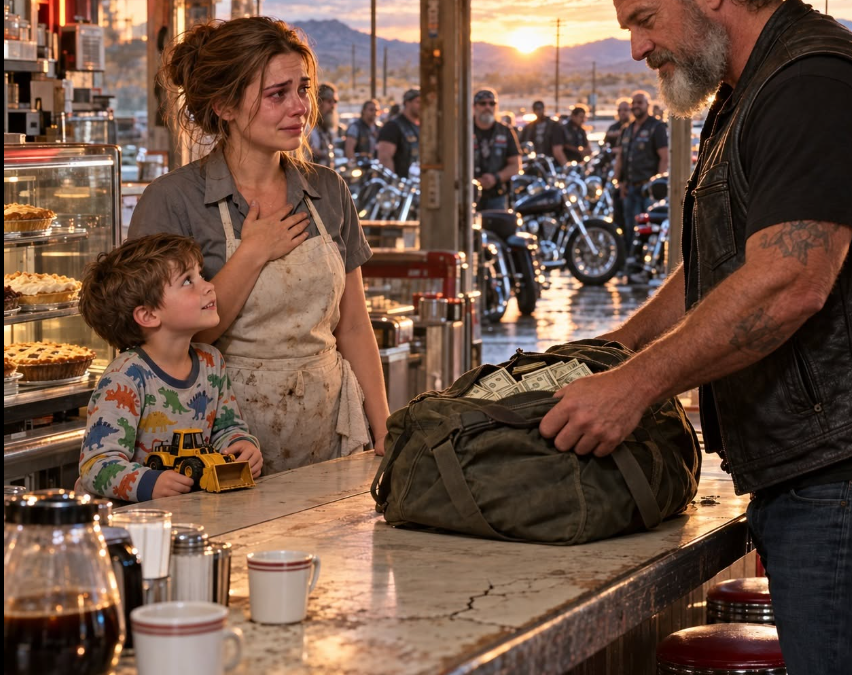
He walked through the crowd carrying an old green canvas duffel bag.
“Ray?”
He climbed onto the porch.
“I told you we’d remember you.”
“I don’t understand.”
“You will.”
He carried the bag inside and dropped it onto my counter.
The impact made my coffee mugs jump.
Then he opened it.
Money.
Not neat stacks.
Not crisp bank-wrapped bundles.
Ones.
Fives.
Tens.
Twenties.
Coins.
Rolled bills.
Crumpled bills.
Cash filled the bag almost to the top.
I stared at it.
“What is this?”
“Breakfast.”
My eyes lifted to his.
“No.”
“Yes.”
“Ray, breakfast didn’t cost this.”
He leaned both hands on the counter.
“I told the other chapters what happened.”
“What exactly did you tell them?”
“That twelve men got caught in a desert flood. That one of my youngest riders was showing signs of hypothermia.”
He paused.
“And that a broke woman running a dying diner fed us anyway.”
My face burned.
“You don’t know anything about my finances.”
He pointed toward the refrigerator.
“You had an inventory sheet hanging right there.”
I groaned.
He continued.
“I saw the overdue utility notice too.”
“Ray—”
“Emily, listen.”
His voice became firm.
“When people see men like us coming, they usually lock doors.”
He glanced around the diner.
“You opened yours.”
I looked down at the bag.
“How much is there?”
“A little over twenty-four thousand.”
My knees almost gave out.
“What?”
“Everybody kicked something in.”
“I can’t take that.”
Ray gave me a flat look.
“Funny. That’s what I said about breakfast.”
“That isn’t the same thing.”
“It is to us.”
“I fed twelve hungry men.”
“And you were one woman who had every reason to protect what little she had.”
His expression softened.
“But you fed us anyway.”
The door opened.
Three riders walked inside.
One carried a red toolbox.
One carried a ladder.
One carried a roll of electrical wire.
I stared.
“What are they doing?”
“Working.”
“On what?”
Ray looked around.
“Everything that’s broken.”
The man with the toolbox walked toward my refrigerator.
Another went outside and climbed onto the roof.
The third headed toward my flickering electrical panel.
Then more riders started moving.
A retired electrician inspected my wiring.
Two roofers patched the leak above booth six.
A refrigeration mechanic replaced a failing relay in my walk-in cooler.
Someone repaired the loose porch railing.
Three men filled potholes in my parking lot.
Another climbed the pole supporting the old neon sign.
A woman named Jo, who owned a diner in Reno, walked behind my counter, looked at my coffee setup, and said, “Honey, this thing has been dying longer than some marriages.”
“I know.”
“We brought a replacement.”
“You brought a coffee machine?”
She looked offended.
“We brought two.”
It became the strangest morning of my life.
Big tattooed men and women in leather vests kept walking into my diner, ordering coffee, and paying fifty dollars.
Sometimes a hundred.
“You need change?” I asked one.
“Nope.”
“Sir, this coffee is two-fifty.”
“Then I guess you’re getting a good tip.”
By seven-thirty, every coffee mug I owned was dirty.
By eight, I had run completely out of coffee.
I had also made more money in tips than I usually made in a month.
Caleb woke to the sound of tools.
He walked into the dining room clutching his bulldozer.
Then stopped.
There were bikers everywhere.
Fixing.
Cleaning.
Laughing.
Carrying supplies.
Standing on ladders.
Rewiring lights.
Scrubbing booths.
Ray spotted him and crouched.
His knees cracked loudly.
Caleb giggled.
Ray reached into his vest and removed a small metal pin shaped like a raven’s wing.
He placed it in Caleb’s hand.
“Remember me?”
Caleb nodded.
“You rode in the mud.”
Ray smiled.
“That’s right.”
Caleb showed him the bulldozer.
“It can pull you out next time.”
For a second, Ray did not answer.
Then he looked toward me.
Something softened in his face.
“I’ll remember that.”
I turned away because my eyes had suddenly filled with tears.
I had spent years refusing to cry inside that diner.
I did not cry when Dad died.
Not in the building, at least.
I cried in my car behind the storage shed where no one could see me.
I did not cry when Caleb’s father left.
I did not cry when the bank rejected my refinancing request.
I did not cry when the roof started leaking over booth six and I had to put a bucket under it during lunch service while pretending that was normal.
I had decided somewhere along the way that if I started, I might never stop.
But that morning something broke.
Not badly.
Maybe something needed to break.
I stood behind my counter watching hundreds of strangers repair the life I had been desperately trying to hold together alone.
One tear fell.
Then another.
Ray noticed.
He politely looked at the coffee machine.
That almost made me cry harder.
By nine, the neon sign outside lit up.
PARKER’S ROADHOUSE.
Every letter.
For the first time in almost three years.
The new compressor hummed.
The roof no longer leaked.
The parking lot was usable.
My electrical problems were fixed.
The porch railing was steady.
The dishwasher no longer sounded like a jar full of bolts.
And there was enough cash in the canvas bag to bring the mortgage current and cover the next several months of operating costs.
Ray tapped twice on the counter.
“We should move.”
“You just got here.”
He shrugged.
“Road’s open.”
I looked beyond him at hundreds of people.
“How do I thank all of you?”
“You don’t.”
“I have to.”
“No.”
He nodded toward my grill.
“Just have breakfast ready next July.”
I laughed through the tears.
“For all of you?”
“That would be financially irresponsible.”
“Finally, something we agree on.”
He smiled.
Then he became serious.
“You gave us what you had when you thought nobody would ever repay you.”
He looked directly into my eyes.
“Don’t ruin it by turning this into a transaction.”
That silenced me.
He was right.
Kindness becomes something different when you demand a return.
But apparently gratitude could be just as stubborn.
The engines started outside.
The sound rolled through the building.
This time, it did not frighten me.
It sounded like thunder leaving.
I stood beside Caleb on the porch as hundreds of motorcycles pulled onto the highway.
Ray rode last.
He raised one hand.
Caleb waved the toy bulldozer.
Then they disappeared west.
For several minutes, neither Caleb nor I moved.
Finally, he looked up at me.
“Are they our friends?”
I looked at the empty highway.
“Yeah.”
“I thought you were scared of them.”
“I was.”
“Why?”
Because sometimes fear is just a story you have been told about someone before you have met them.
I did not know how to explain that to a six-year-old.
So I said, “I didn’t know them yet.”
He considered that seriously.
Then nodded.
“Okay.”
Three weeks later, I walked into the bank and made every overdue payment.
The bank manager, Mr. Kellerman, looked almost disappointed that I had survived.
That might be unfair.
Maybe he was just surprised.
Either way, I enjoyed sliding the receipt into my purse.
I ordered new inventory.
Fixed the broken dishwasher properly.
Paid the utility bill.
Bought a real mattress for Caleb’s office naps until I could hire help.
Then I hired a local high school girl named Tessa for weekend shifts so Caleb would not have to sleep in my office anymore.
And something else happened.
Word spread.
Not from me.
I was too busy restocking eggs.
Truckers started stopping again.
Tourists came because they had heard about “the biker diner.”
Motorcycle groups made Parker’s Roadhouse part of their Nevada routes.
I hated the nickname.
It saved my business.
The first month after the storm, I kept expecting the miracle to run out.
That is what fear does.
It treats relief like a trick.
Every time the parking lot was full, I thought, Enjoy it now. They will stop coming.
Every time the cash drawer had enough in it, I thought, Something will break tomorrow.
Every time I ordered more bacon than usual, I felt like I was tempting fate.
But the customers kept coming.
Some were riders who had been there that morning.
Some had only heard the story.
Some were truckers who said, “My buddy told me this place still knows how to cook eggs.”
Some were tourists who wanted selfies with the neon sign.
Some were old locals who suddenly remembered Parker’s Roadhouse had been there all along.
One woman from Utah drove three hours with her two daughters because, she said, “I wanted them to eat somewhere people still help each other.”
I did not know what to say to that.
So I refilled her coffee.
One year later, almost to the day, I was standing at the grill when I felt a familiar vibration in the floor.
Caleb came running from the kitchen.
“They’re coming!”
I looked through the window.
Motorcycles.
Dozens this time.
Not hundreds.
Ray led them into the parking lot.
He removed his helmet and looked at the diner, the sign, the fixed porch, the repainted trim, the parking lot full of cars.
Then he looked at me.
“You got breakfast?”
I pointed through the window.
Three long tables were covered with eggs, bacon, potatoes, biscuits, coffee, pancakes, and cinnamon rolls Tessa had stayed late the night before to help bake.
Ray stared.
“You cooked all that?”
“You said to be ready.”
“I was kidding.”
“I wasn’t.”
That morning, nobody ate free.
Ray had made me promise.
Every rider paid full price.
Some still tipped too much.
Caleb moved between tables with a coffee pot nearly as big as his arm, supervised by Tessa and me. He wore a little apron that said PARKER’S in crooked letters he had written himself with fabric paint.
Ray sat in booth six.
The booth that no longer had a bucket beside it.
He looked up at the dry ceiling and tapped the table once.
“Your dad would like this.”
I stopped moving.
It had been a long time since someone said my father’s name in a way that felt like he was still part of the room.
“You didn’t know him.”
“No,” Ray said. “But I know what it means to build something people can come back to.”
I looked around.
Truckers.
Riders.
Locals.
Caleb laughing because someone had taught him to balance a spoon on his nose.
The neon sign buzzing outside.
Coffee pouring.
The desert blazing gold beyond the windows.
“Yes,” I said. “He would like this.”
Over the years, the Iron Ravens kept coming.
So did everyone else.
Parker’s Roadhouse became a place people planned for.
Not just a place they stopped by accident.
Ray never let me give him free food.
Not once.
He said it would disrespect the original deal.
I told him there had been no deal.
He said that was the point.
Caleb grew up around truck drivers, ranchers, tourists, and bikers.
When he was thirteen, Ray taught him how a motorcycle engine worked, with my permission and safety glasses that made Caleb look like a bug.
When he was sixteen, Caleb started washing dishes for actual wages and complained the way teenagers complain when they are proud to be useful but must never show it.
When he graduated high school, half a dozen Iron Ravens showed up in the school parking lot wearing clean shirts under their vests because I had threatened them.
Ray complained for weeks.
“I looked like I was going to a parole hearing.”
“You looked presentable.”
“That’s what I said.”
“No, you said you looked emotionally kidnapped.”
“That too.”
Caleb went to community college in Reno, then came back every other weekend to help at the diner.
He said it was because I needed him.
I knew it was because Parker’s was home.
The old canvas duffel bag still sits on a shelf behind my counter.
Empty now.
I keep it because people occasionally ask whether that night changed how I see the world.
It did.
Before that storm, I believed survival meant holding tightly to whatever little you had left.
Money.
Food.
Trust.
Hope.
Do not give anything away.
You might need it tomorrow.
And sometimes that is true.
Sometimes you do have to protect what remains.
Sometimes saying no is wisdom.
Sometimes generosity without boundaries can bury you.
I do not pretend otherwise.
But when twelve freezing strangers walked through my door, I gave away food I could not afford to lose.
I thought it might destroy me.
Instead, it reminded twelve men that somebody still saw them as human beings.
And they reminded hundreds more.
That does not mean kindness always comes back.
Sometimes it will not.
Sometimes you will do the right thing and nobody will notice.
Sometimes you will open the door, pour the coffee, give what you can, and the world will not send a convoy over the ridge at sunrise.
That is what makes it kindness.
But every once in a while, when you are certain you have reached the end, you look toward the horizon and discover that something you gave away in the dark has found its way back to you.
Only bigger.
Louder.
And carrying enough coffee money to save your father’s diner.
Years after that storm, Ray came in alone one afternoon.
No convoy.
No roar.
Just one motorcycle pulling into the lot under a pale desert sky.
He looked older.
So did I.
Caleb was away at school. Tessa was managing the lunch rush. The neon sign worked every day now, though I still suspected it of having moods.
Ray sat in his usual booth.
Booth six.
I poured coffee without asking.
He looked around the diner for a long time.
Then he said, “You ever regret feeding us?”
I laughed.
“No.”
“I mean that night. Before you knew.”
I leaned against the counter.
The question deserved a real answer.
“I regretted it for about twenty minutes.”
His eyebrows lifted.
“Honest.”
“I sat right there,” I said, pointing to the stool behind the register, “and thought I had just finished losing this place.”
“And?”
“And I think I would still do it again.”
Ray nodded.
Not smiling.
Understanding.
“That’s why we came back.”
I looked at him.
“Because I was bad at math?”
“Because you were scared and kind at the same time.”
That sentence stayed with me.
Scared and kind.
People act like courage replaces fear.
It does not.
Kindness does not always come from people with plenty.
Sometimes it comes from people who are down to their last eggs, last bacon, last hope, last nerve—and still cannot look at someone cold and hungry without turning on the grill.
That was not sainthood.
That was my father.
That was the diner.
That was the promise I thought was killing me, turning around at the last second and saving me instead.
Ray lifted his mug.
“To Parker’s.”
I lifted the coffee pot.
“To breakfast.”
He laughed.
Outside, the desert stretched wide and bright under the afternoon sun.
No flood.
No storm.
No engines shaking the windows.
Just the road.
Waiting.
I thought twelve dangerous-looking men came through my door that night because they needed shelter.
Years later, I understand it differently.
We were all stranded in that storm.
The Iron Ravens were stranded by floodwater.
I was stranded by debt, grief, fear, and the stubborn promise I had made to a dead man.
They needed warmth.
I needed proof that I was not as alone as I thought.
They needed food.
I needed someone to remind me that the door still opened.
And Caleb?
Caleb needed to see that sometimes people you fear before you know them can become people who show up when it matters most.
I still open Parker’s before sunrise.
Not every day now.
My knees complain.
My hands ache.
Tessa handles more than she admits.
Caleb says one day he might take over, but I told him only if he wants the building, not the burden.
He says maybe the two are related.
Smart kid.
On storm nights, when rain hits the roof hard enough to wake old memories, I make fresh coffee even if no one is expected.
I check the office where Caleb used to sleep.
I touch the shelf where the empty duffel bag sits.
And sometimes, when thunder rolls low across the desert, I smile before I can stop myself.
Because I remember the sound that came before salvation.
Not thunder.
Engines.
Twelve at first.
Then hundreds.
And I remember standing behind that counter, with nothing left to spare, turning on the grill anyway.