They Returned a 17-Year-Old Cat After Just 96 Hours—But When Bramble Stopped Eating, I Realized He Wasn’t Giving Up on Life… He Was Still Waiting for the Home That Gave Up on Him.
PART3:
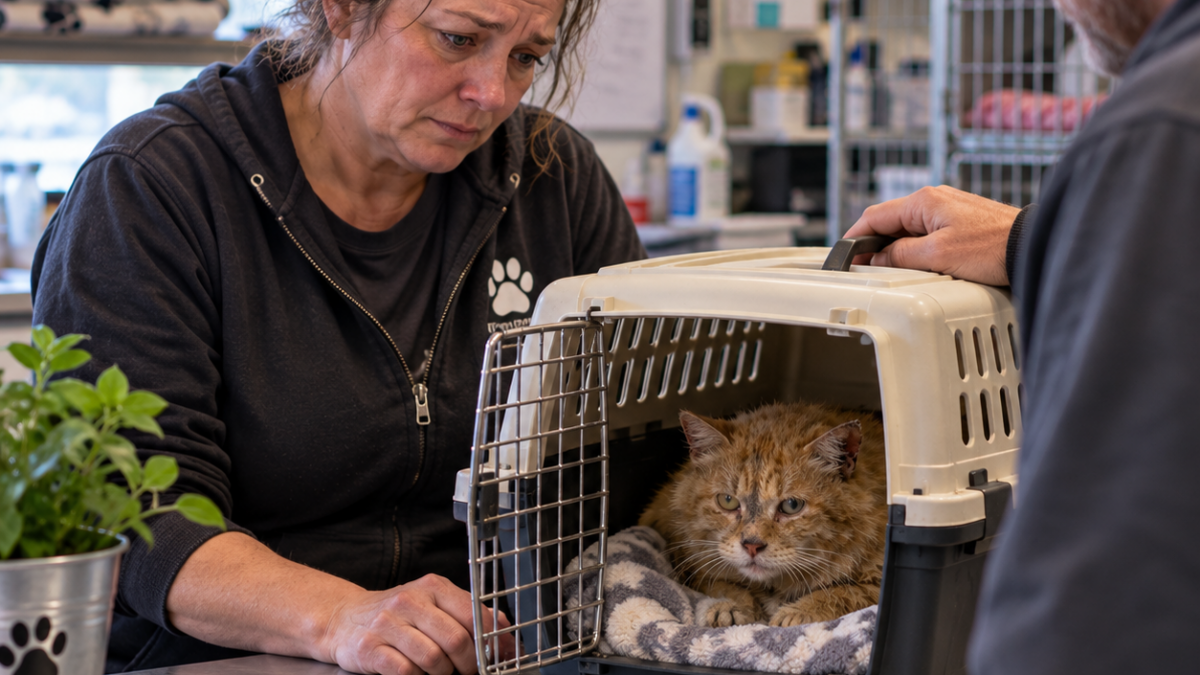
I reached inside slowly, offering two fingers near his nose.
He didn’t lean toward me.
He didn’t pull away.
He blinked once.
That was all.
Nolan pulled a folded document from his jacket pocket.
“I want the adoption fee refunded.”
I looked up.
“The fee is nonrefundable under our agreement.”
His expression changed.
Only slightly.
But I’d dealt with men like him before.
Men who mistook a calm answer for disrespect.
“Excuse me?”
“The contract explains that adoption fees support the rescue’s medical and housing expenses.”
“I donated twenty-five thousand dollars to this organization last year.”
“I know.”
“And you’re arguing with me over eighty-five bucks?”
“I’m explaining the policy.”
He leaned closer.
“Here’s a policy you might want to understand. People who keep places like this open don’t enjoy being talked down to by employees.”
I felt heat rise behind my ears.
I wanted to tell him that money didn’t buy kindness.
That donating to a shelter didn’t give him the right to treat a living animal like a broken appliance.
That Bramble had been alive longer than some people standing in that building, and those years should have earned him more dignity, not less.
Instead, I looked down at the carrier.
Bramble’s eyes had drifted closed.
“Did he drink water this morning?” I asked.
Nolan gave a short laugh.
“Unbelievable.”
He pulled a pen from his pocket, signed the return form without reading it, and slapped it on the counter.
“There. Take your cat.”
Then, as he turned toward the door, he added something I would remember for the rest of my life.
“Frankly, I don’t know why you people bother keeping animals like that alive.”
The bell over the entrance rang when he left.
His black SUV pulled away a moment later.
I stood behind the counter with one hand on Bramble’s carrier.
The lobby went quiet.
Only the old fluorescent light above the adoption board continued buzzing.
I looked at the photograph still hanging near the entrance.
Nolan Pierce smiling.
Bramble in his arms.
The words beneath it read:
EVERY LIFE DESERVES A HOME.
I took the photograph down.
Then I carried Bramble to the back.
Our shelter occupied the end unit of an aging strip mall in Cedar Hollow, Ohio, a former insurance office that had never been designed to house thirty-seven cats, eleven dogs, three rabbits, and an endless rotation of emergencies.
The ventilation barely worked in summer.
The roof leaked over the supply closet every spring.
The sink in the back room dripped unless you turned the handle at exactly the right angle.
We called the room beside that sink the quiet room.
It held three large cages, a narrow window overlooking the dumpsters, and a metal shelf stacked with soft food, medical records, and towels.
The quiet room was where we put animals who needed peace.
Old cats.
Sick cats.
Frightened cats.
Animals recovering from surgery.
Animals whose owners had died.
Sometimes it felt like the place where all the unwanted sadness in Cedar Hollow came to rest.
That morning, two of the cages were empty.
I placed Bramble in the largest one.
Low litter pan.
Fresh water.
Soft bedding.
A shallow plate of warmed chicken food.
Then I opened the cage door and sat cross-legged on the floor.
“You’re back, old man.”
He didn’t look at me.
I waited.
Nothing.
I tried brushing a little gravy onto the edge of his mouth.
His nose moved.
For one hopeful second, I thought he might lick it.
Instead, he turned his face toward the metal wall.
I sat there another twenty minutes.
Then thirty.
Outside, dogs barked.
A volunteer wheeled a cart of clean towels past the door.
Someone in the lobby laughed.
Life continued.
But inside that little room, something had gone terribly still.
At eleven, our veterinarian, Dr. Leena Shah, arrived for her weekly examinations.
She was forty-three, with dark hair pulled into a practical bun and the kind of quiet authority that made frightened animals settle when she entered a room.
She had known Bramble before the adoption.
She looked at him now and frowned.
“He’s lost weight.”
“In four days?”
She lifted him gently from the cage.
He weighed almost nothing in her arms.
She listened to his heart, checked his gums, examined his mouth, and carefully felt along his abdomen.
Bramble endured it without complaint.
That worried her more than any hiss could have.
“Did they give him the medication?”
“I don’t know.”
Dr. Shah closed her eyes briefly.
“Wonderful.”
We checked his records.
Chronic kidney disease.
Arthritis.
A heart murmur.
Dental disease.
Possible thyroid trouble.
He had arrived at our shelter six weeks earlier after his previous caretaker entered long-term assisted living. Before that, his history was incomplete.
He had spent much of his life in one home, then moved between relatives after the death of an owner.
Somewhere during all those transitions, the medical care became inconsistent.
By the time he reached us, he was seventeen years old and tired of being moved.
Dr. Shah studied the latest numbers.
“They’re not good.”
“How bad?”
“Bad enough that he needs careful management. Not bad enough to explain how completely he’s shutting down.”
She set Bramble back on his blanket.
He turned toward the wall again.
I swallowed.
“Do cats give up?”
Dr. Shah was quiet for a moment.
“Stress can seriously affect a cat’s health, especially at his age. Pain and nausea may be part of this. We need to address those first.”
“I know.”
“But yes,” she added softly. “I’ve seen animals stop engaging with the world after too many losses.”
I looked at his thin orange back.
“He’s been returned again.”
Dr. Shah rested a hand on my shoulder.
“Then we need to give him a reason to feel safe.”
That afternoon, I called every senior-cat foster on our list.
All twelve.
One had moved.
Two were dealing with sick family members.
Three already had medical fosters.
Four couldn’t take another animal.
One had stopped fostering after losing her husband.
And the last woman cried when I explained Bramble’s condition.
“I can’t,” she whispered. “Not another goodbye. I’m sorry.”
I told her I understood.
And I did.
The problem with rescue is that understanding someone’s limits doesn’t make the animal’s need disappear.
By closing time, Bramble had eaten less than a teaspoon.
I replaced his food.
Changed his water.
Sat beside him.
“Just one bite, sweetheart.”
He didn’t move.
I went home to my little apartment above a hardware store, heated leftover soup in the microwave, and ate standing over the sink.
Then I sat on the edge of my bed and stared at my phone.
No messages.
No applications.
No miracle.
I thought about the way Nolan had pushed the carrier across the counter.
Like responsibility was something contagious.
I thought about Bramble’s face when he hit the plastic floor.
Then I cried.
Not dramatic sobbing.
Not the kind people show in movies.
Just tired, silent tears from a woman who had spent twelve years trying to protect creatures who couldn’t explain what had happened to them.
My own mother had died six years earlier.
She had been sixty-nine.
A stroke.
Then complications.
Then a hospital room that smelled like antiseptic and overcooked vegetables.
During the final weeks, I worked double shifts because I couldn’t afford to lose my health insurance.
I visited whenever I could.
But there were evenings when I walked into her room and found her asleep with the television on, a half-eaten pudding cup beside the bed.
Once, near the end, she woke and asked me a question.
“Am I making your life difficult, Tess?”
I had said no.
Of course I’d said no.
But I’d been tired.
So terribly tired.
And even though I never said anything cruel, I’ve wondered for years whether she saw the exhaustion in my face and mistook it for resentment.
I never got another chance to explain.
Maybe that’s why old animals undid me.
They reminded me of hospital rooms.
Of people apologizing for needing help.
Of the awful way the world starts treating dependence like failure.
I fell asleep thinking about Bramble.
When I woke, my pillow was wet.
By Saturday morning, he still wasn’t eating enough.
Dr. Shah adjusted his treatment, addressed his nausea and pain, and monitored his hydration.
He accepted a few licks of broth.
Then turned away.
On Monday, I wrote a post for the shelter’s social media page.
I didn’t make him sound perfect.
I didn’t call him playful.
I didn’t promise a happy ending.
I wrote about his age.
His conditions.
His habits.
His need for warmth, patience, medication, and quiet.
I explained that he might have months.
He might have weeks.
He might have less.
Then I wrote:
Bramble does not need someone who can make him young again. He needs someone who will not punish him for being old. He deserves to spend whatever time remains in a room where he isn’t waiting to be returned.
I stared at those words for a long time.
Then I published them.
By lunchtime, the post had been shared more than three hundred times.
People wrote that he was beautiful.
That he deserved love.
That someone should save him.
Someone.
It’s the internet’s favorite word.
Someone should help.
Someone should do something.
Someone should open a door.
By Tuesday afternoon, no one had applied.
And at three-thirty that day, the shelter director called me into her office.
Her name was Lauren Bennett.
She was fifty-two, tired in a different way than I was, with reading glasses hanging from a chain around her neck and a desk permanently buried beneath paperwork.
Lauren had spent twenty years running nonprofit organizations. She was practical, competent, and capable of finding money where none seemed to exist.
She was also frightened of losing our largest donor.
I could see it before she spoke.
Nolan Pierce sat in the visitor’s chair.
One ankle crossed over his knee.
Smiling.
My stomach dropped.
Lauren gestured toward the empty chair across from her.
“Tessa, sit down.”
I stayed standing.
Nolan leaned back.
“Busy morning?”
“What can I help you with?”
His smile widened.
“Apparently you’ve been telling the entire county I mistreated an animal.”
“I didn’t mention you.”
“You didn’t need to.”
Lauren cleared her throat.
“Tessa, the post has created some concerns.”
I looked at her.
“Concerns?”
“Nolan feels the timing could make people connect Bramble’s return with your comments.”
“People can read the intake dates.”
Nolan laughed.
“See? That’s exactly the attitude.”
I folded my hands to keep them from shaking.
“Everything in the post is true.”
Lauren sighed.
“We’re not questioning Bramble’s medical needs.”
“Then what are we questioning?”
“Our approach.”
Nolan leaned forward.
“Let me simplify this. I support this shelter because I believe in solutions. Healthy adoptions. Sustainable operations. Getting animals into homes quickly. What I don’t believe in is emotional blackmail.”
I stared at him.
“Emotional blackmail?”
“That post made it sound like anyone who doesn’t take home a dying cat is heartless.”
“It said Bramble needs hospice care.”
“Exactly. A financial black hole.”
Lauren looked down.
Nolan continued.
“You have twenty healthy cats out front that families actually want. But which animal are you putting on social media? The one who’s going to cost a fortune and die anyway.”
I felt something harden inside me.
“He is still alive.”
“For now.”
The room went silent.
I heard a dog barking somewhere down the hallway.
Then Lauren spoke.
“The board is reviewing a proposal to focus more of our resources on animals with stronger adoption prospects.”
I turned toward her.
“What does that mean?”
“It means we may need different limits for long-term medical cases.”
“Limits on care?”
“Limits on what we can reasonably provide.”
Nolan smiled.
“Nobody likes hard decisions, Tessa. But adults make them.”
He stood, adjusted his jacket, and walked toward the door.
Then he stopped beside me.
“I’d suggest you take that post down before the board makes a decision about your position here.”
I looked him directly in the eyes.
“Are you threatening my job because I asked someone to help a sick cat?”
His smile disappeared.
“I’m reminding you who pays the bills.”
When he left, Lauren stayed behind her desk.
For a long moment, she didn’t speak.
Then she said, “You have to understand the position I’m in.”
I thought about Bramble facing the wall.
“I understand the position he’s in.”
“Tessa—”
“We’re full. We don’t have enough money. I know. I see it every day. But he was adopted from us and returned four days later in worse condition.”
“I’m aware.”
“And now you’re talking about limiting care because Mr. Pierce is embarrassed?”
She looked tired.
“Sometimes you have to choose between helping one animal and keeping the doors open for fifty others.”
I hated that she wasn’t entirely wrong.
I hated even more that Nolan was using that truth to justify his cruelty.
I nodded once.
“Then don’t pretend the decision has nothing to do with him.”
I walked out before she could answer.
The following morning, a seventy-year-old woman came through the shelter’s front door carrying a faded canvas bag.
I remember the exact moment.
The bell rang at 10:17.
Rain was sliding down the front windows.
A volunteer was mopping near the entrance.
I was filling out medication charts behind the counter.
The woman stopped just inside the doorway, folded her umbrella, and looked around.
She was small.
Maybe five feet two.
Silver hair cut neatly around her face.
A plain blue wool coat that had been repaired at one elbow.
Brown shoes with thick rubber soles.
A little pink lipstick worn away in the middle.
Nothing about her suggested wealth.
Nothing suggested influence.
She looked like the kind of woman who knew exactly which day the grocery store marked down bread and always remembered to ask the cashier how her mother was doing.
“Excuse me,” she said.
I looked up.
“Can I help you?”
She smiled.
“I hope so. I’m here about the old orange gentleman.”
Not cat.
Not animal.
Gentleman.
Something in my chest loosened.
“Bramble?”
“Yes, ma’am.”
“I’m Tessa.”
“I’m Clementine Hayes.”
She held out her hand.
Her palm was warm and dry.
“I read what you wrote about him,” she said. “And I would very much like to take him home.”
For a second, I wanted to hug her.
Instead, experience stopped me.
“That’s incredibly kind of you, Mrs. Hayes, but I need to make sure you understand his condition.”
“I understand he’s old.”
“He’s more than old.”
“So am I.”
Her face remained completely serious.
I almost laughed.
Then she added, “Old isn’t a diagnosis, honey. Tell me what’s actually wrong with him.”
That was when I began to hope.
Not much.
Just a little.
I led her to the quiet room.
Bramble was in his cage facing the wall.
The plate of food I’d warmed twenty minutes earlier sat untouched beside him.
Clementine approached slowly.
She didn’t gasp.
Didn’t make exaggerated kissing noises.
Didn’t call him a poor little baby.
She pulled a chair beside the cage and sat down with a soft sigh.
Then she opened her canvas bag.
Inside was a folded yellow towel.
Old.
Thin.
Faded from years of washing.
She placed it on the floor beside his cage.
I watched, confused.
“What’s that?”
“Just something from home.”
Bramble’s nose moved.
Barely.
But it moved.
Clementine noticed too.
“There you are,” she whispered.
I sat beside her and explained everything.
The kidney disease.
The heart murmur.
The arthritis.
The dental pain.
The medication schedule.
The appetite problems.
The uncertainty.
How he might need repeated veterinary visits.
How some days would be hard.
How there might not be many days.
She listened without interrupting.
When I finished, she was quiet for a long time.
Then she looked at Bramble.
“I’m not taking him because I think I can fix him.”
She turned toward me.
“I’m taking him because I don’t want the last room he remembers to be a cage.”
My throat tightened so suddenly I couldn’t answer.
Clementine studied my face.
“You’ve had a hard week, haven’t you?”
I gave a small laugh.
“Something like that.”
She nodded.
“Well, so has he.”
I took a breath and reached for the application.
I asked the questions I always asked.
Did she own her home?
Yes.
Other pets?
No.
Experience with medication?
Yes.
Transportation to the veterinarian?
A small blue Buick that still ran, although it occasionally complained.
Could she handle accidents?
She smiled.
“I cared for my husband through the last three years of his life. I’ve cleaned sheets at two in the morning, changed dressings, learned medication schedules, and cooked meals for a man who sometimes couldn’t remember what food was. I think I can manage a cat missing the litter box.”
I looked down at the form.
“I’m sorry about your husband.”
“Thank you.”
“How long has it been?”
“Four years.”
“Do you have family nearby?”
“A niece in Columbus. A few friends. Mostly it’s just me.”
I hesitated.
“May I ask what brought you to Bramble specifically?”
She glanced at the old cat.
“His picture reminded me of somebody.”
“Your husband?”
“No.”
She smiled faintly.
“Me.”
I looked at her.
She folded her hands.
“After Arthur died, people were wonderful for about six weeks. Food arrived. Flowers. Cards. Everyone said to call if I needed anything.”
Her voice remained calm.
“Then they went back to living. As they should. The world can’t stop for one lonely old woman.”
I didn’t interrupt.
“And I discovered something strange,” she continued. “When you’re old and grieving, people start talking about you like you’re a problem they hope somebody else has solved.”
My fingers tightened around the pen.
“Are you doing okay, Mrs. Hayes?”
She looked at me for a long moment.
“Some days.”
Then she smiled.
“Which is probably the same answer he’d give, if he could.”
Bramble shifted slightly in his cage.
Clementine looked toward him.
“I don’t need him to entertain me,” she said. “I don’t need him to be grateful. I don’t need him to love me back.”
She paused.
“I just know what it feels like when everybody goes home and you’re the only one left in the room.”
I wanted to approve her immediately.
But Lauren had to authorize hospice placements, and after the meeting with Nolan, I knew there might be trouble.
I asked Clementine to wait.
Then I carried the application into Lauren’s office.
She read it.
Frowned.
“Seventy?”
“Yes.”
“Living alone?”
“Yes.”
“Fixed income?”
“Probably.”
Lauren removed her glasses.
“Tessa, we have to be realistic.”
“I have been realistic. She understands every diagnosis.”
“And when Bramble deteriorates?”
“She’ll call us.”
“Who pays?”
“We have a hospice support fund.”
Lauren looked away.
That was the first time I noticed it.
Not hesitation.
Something closer to discomfort.
“What?” I asked.
“The fund is being reviewed.”
“Reviewed for what?”
“Budget adjustments.”
I stared at her.
“That fund was created specifically for senior and hospice animals.”
“I know.”
“We’ve received donations for it.”
“I know, Tessa.”
“Then what’s the problem?”
Lauren lowered her voice.
“Nolan is chairing the finance committee this quarter.”
The room seemed to shrink.
I thought about Bramble.
About Clementine waiting in the lobby.
About that old yellow towel.
Then I said, “If you’re going to deny a qualified hospice adopter because Nolan Pierce is angry with me, I need you to put that reason in writing.”
Lauren looked up sharply.
“Don’t threaten me.”
“I’m not threatening you. I’m asking you to document the decision.”
For a long moment, we stared at each other.
Then she picked up her pen.
“Bring me the veterinary plan. We can approve a thirty-day foster-to-adopt placement, with medical follow-up.”
I could have cried.
Instead, I nodded.
“Thank you.”
She looked exhausted.
“Don’t thank me yet.”
We sent Bramble home that afternoon.
Dr. Shah reviewed the treatment plan with Clementine and emphasized comfort, hydration, appetite, and quality of life. She gave her the emergency number and arranged a checkup the following week.
Clementine wrote everything in a small notebook.
Not on her phone.
In careful, old-fashioned handwriting.
When I placed Bramble inside his carrier, he didn’t protest.
He didn’t look back at me.
Clementine picked up the carrier with both hands, holding it level.
At the door, she paused.
“If he doesn’t eat tonight, I’ll call.”
“Please do.”
“And if he hides?”
“Let him.”
“For how long?”
“As long as he needs.”
She nodded.
“I know something about that.”
Then she carried the old orange cat into the soft gray rain.
I watched her little blue Buick pull away.
Hope rose in my chest.
Then fear followed.
Because hope is expensive in rescue.
You spend it on animals and people you barely know, and sometimes the world makes you pay twice.
The first update came the next morning.
No picture.
Just a text.
He’s behind the green chair. He has not eaten. He is listening when I talk. I am calling that something.
I smiled.
Listening was something.
The following day:
He licked broth from a spoon after I walked away and pretended not to notice.
The third day:
He used the litter box. One back foot missed, but I have cleaned worse from better men.
I laughed so loudly in the supply closet that our volunteer, Maya, stuck her head through the doorway.
“What?”
I showed her the message.
She grinned.
“I like this lady.”
“So do I.”
On day five, Clementine sent a photograph.
It was terrible.
Dark.
Blurry.
Half her thumb covered the corner.
But there was Bramble.
Crouched beneath a green armchair.
Eyes glowing like tiny headlights.
Looking deeply offended by the camera.
I saved it immediately.
The updates continued.
Seven bites of chicken.
One cheek touch.
A successful pill hidden in tuna.
A suspicious slipper.
A forgiven slipper.
A nap beside the heater.
Nothing miraculous.
Nothing dramatic.
Just an old cat beginning to participate in life again.
Two weeks passed.
Then three.
Bramble gained a little stability.
He still had serious medical problems, but he was eating more regularly. He occasionally moved around the apartment. He started grooming his chest again.
Dr. Shah told me that sustained comfort mattered more than any single good day.
Clementine understood.
She never sent messages about miracles.
She told me what happened.
Exactly.
Honestly.
On the thirty-first day, I drove to visit.
Her building stood on Mercer Street in the older part of Cedar Hollow, where brick storefronts leaned against each other like tired relatives and the sidewalks had been cracked by decades of Ohio winters.
A faded sign hung above the front windows.
HAYES FAMILY LAUNDRY.
The laundromat downstairs looked closed.
Most of the windows were covered with pale curtains. A handwritten note on the front door said:
CLOSED TO PUBLIC.
PLEASE CALL FOR PRIVATE LAUNDRY SERVICE.
I parked beside the curb.
The building smelled faintly of detergent and wet concrete when Clementine opened the side door.
“Come in, honey.”
She wore a purple cardigan and slippers.
“How’s our gentleman?”
“He’s running the place.”
I laughed.
“That well?”
“You’ll see.”
We climbed the stairs slowly.
At the top, Clementine opened the door to a small apartment with yellow walls, old wooden furniture, and windows that let in beautiful afternoon light.
Nothing matched.
Everything belonged.
There was a brown couch with a crocheted afghan over the back, a round kitchen table, two bookcases, and framed photographs arranged along the walls.
One showed a smiling man in a fishing hat.
Another showed Clementine standing beside an old red Chevrolet.
A third showed the laundromat decades earlier, its windows bright and its rows of machines full of customers.
In the corner near the window, on a folded quilt beside a floor vent, sat Bramble.
I stopped.
He looked awful.
He looked better.
Both things were true.
His fur was still rough, but his eyes seemed clearer. His spine was sharp, yet he no longer looked as if he were folding inward.
He watched me with the suspicious expression of an elderly man who hadn’t invited company.
“Hey, Bramble.”
He looked away.
Clementine smiled.
“That’s his warm greeting.”
I sat on the floor a few feet from him.
“You remember me, buddy?”
His torn ear twitched.
Then he yawned.
“Apparently not.”
“He remembers,” Clementine said. “He just doesn’t see why it should concern him.”
She showed me everything she’d arranged.
A low-sided litter box.
Rubber mats under the food bowls.
Water in two rooms.
Cushions beside the couch so he could climb without jumping.
Soft blankets that could be washed easily.
Rugs over the slippery floorboards.
A heated pet pad safely tucked beneath the bedding.
She had thought of details most people wouldn’t notice.
A bowl placed far enough from the wall that his whiskers didn’t brush the paint.
A lamp left on at night.
A quiet corner where nobody would disturb him.
Then I heard something from below.
A low mechanical rumble.
Steady.
Rhythmic.
The floor vibrated gently beneath my hands.
Bramble’s ears moved forward.
His eyes half closed.
His shoulders relaxed.
“What is that?” I asked.
“One of the washing machines.”
I glanced toward the floor.
“Downstairs?”
“Yes.”
“I thought the laundry was closed.”
“Officially.”
She smiled.
“I still wash blankets for a few people. And sometimes I run a machine just because.”
The rumble deepened.
Bramble lowered his head onto his paws.
Then he made a sound.
A rough, broken purr.
Like a zipper catching on old fabric.
I stared at him.
I hadn’t heard that sound since before he was returned.
Clementine sat in her chair and began folding a towel that was already folded.
“He likes that noise.”
“How did you figure it out?”
“The first week, he stayed behind the green chair all day. One afternoon, I went downstairs and started a washer. When I came back, he was lying beside that vent.”
She pointed toward the floor.
“At first I thought he liked the warmth. But then the machine stopped, and he got up and went back under the chair.”
“So you ran it again?”
“Of course.”
I smiled.
“Of course?”
“Well, honey, he looked disappointed.”
I laughed.
She shrugged.
“I know it’s silly.”
“No,” I said. “It isn’t.”
The washer continued humming.
Bramble’s purr grew a little louder.
Clementine watched him with an expression I couldn’t quite name.
Tenderness.
Recognition.
Maybe grief.
“Arthur used to complain about that old machine,” she said.
“Your husband?”
“Yes. Number six. The bearings have been noisy since the nineties. He kept saying he’d replace the motor.”
“Why didn’t he?”
She looked toward the window.
“Because every time he saved enough money, something else needed fixing. Roof. Boiler. Somebody’s tire. Somebody’s washing machine.”
She smiled faintly.
“He was like that.”
I looked around her apartment.
At the carefully folded blankets.
The worn furniture.
The pale yellow towel beside Bramble.
“Sounds like a good man.”
“He was.”
Her smile faded slightly.
“He was also stubborn, proud, terrible with paperwork, and convinced every problem in the world could be solved with a wrench.”
I laughed.
“Sounds familiar.”
She folded the towel again.
“When he got sick, I learned that some things don’t have a wrench.”
For a while, neither of us spoke.
The washer hummed beneath us.
Bramble purred.
Then something unexpected happened.
He stood.
Slowly.
Painfully.
His back legs trembled as he shifted his weight.
He walked toward his food bowl.
Stopped.
Sniffed.
And began eating.
One bite.
Two.
Three.
In front of us.
Clementine put a hand over her mouth.
I pretended to look at the bookshelf.
Some moments deserve privacy even when they happen right in front of you.
Before I left, Clementine walked me downstairs.
The old laundromat was dim, with two rows of aging machines and a long folding table near the windows.
A yellow towel lay folded on one end.
An old photograph hung behind the counter.
Four decades earlier, Arthur Hayes stood beside Clementine in front of the laundromat’s grand opening.
They were young.
Laughing.
His arm around her waist.
She followed my gaze.
“We were twenty-six.”
“You look happy.”
“We were scared to death,” she said. “We had six hundred dollars, two borrowed machines, and a landlord who wanted three months’ rent in advance.”
“How’d you manage?”
“Arthur worked nights. I cleaned offices. We ate so many peanut butter sandwiches that I couldn’t look at peanut butter for a year.”
She touched the edge of the photograph.
“But every morning, we opened the door.”
I looked at the old machines.
Most stood quiet.
One still hummed.
“And you still do.”
Clementine smiled.
“Sometimes.”
I walked back to my car feeling something I hadn’t felt in a long time.
Not relief.
Not exactly.
Bramble was still seventeen.
Still sick.
Still fragile.
But he was living.
And for the first time in weeks, that felt more important than counting how close he might be to dying.
I didn’t know then that Nolan Pierce had already begun asking questions about Clementine.
Or that the little brass plaque hanging outside our shelter was about to become the least important thing with his name on it.
Three days after my visit to Clementine’s apartment, Lauren asked me for copies of Bramble’s medical records.
That wasn’t unusual.
We updated our files constantly.
What was unusual was the second document she requested.
Clementine’s financial assessment.
I looked up from the computer.
“Why?”
Lauren stood in the doorway, holding a cup of coffee she hadn’t touched.
“The board wants to review our hospice placement standards.”
“Since when?”
“Since the last meeting.”
“What does Bramble have to do with it?”
She sighed.
“Tessa, please.”
I turned fully in my chair.
“Is Nolan behind this?”
Lauren didn’t answer.
She didn’t have to.
I leaned back.
“Clementine has done everything we asked. Every appointment. Every medication. She documents how much he eats. She calls when something changes. Dr. Shah says his quality of life has improved.”
“I’m aware.”
“Then what are they reviewing?”
Lauren rubbed her forehead.
“Whether we should be placing medically complex animals with adopters who may not have the resources to manage them independently.”
I stared at her.
“She’s managing him.”
“With shelter assistance.”
“That’s the purpose of hospice support.”
Lauren looked down at her coffee.
“The board is considering restructuring that program.”
There it was again.
Restructuring.
Such a polite word.
You can restructure a budget.
A department.
A schedule.
But people often use the word when they don’t want to say what they’re really taking away.
I opened the filing cabinet and removed the appropriate records.
“I’ll give you the medical information,” I said. “But Clementine’s personal financial information is confidential. If the board needs it, I want the request documented.”
Lauren’s eyes narrowed slightly.
“You’re making this unnecessarily difficult.”
“No. I’m making sure we follow the rules.”
For a moment, she looked almost angry.
Then something in her face softened.
“You know I care about these animals.”
“I know.”
“You think I don’t go home sick over some of the decisions we make?”
“No.”
“I’ve been keeping this place open for fourteen years, Tessa. Fourteen years of deciding which bill gets paid, which repair can wait, which fundraiser might save us another month.”
Her voice shook.
“You think I like having to answer to Nolan Pierce?”
I didn’t answer.
She looked toward the quiet room.
“Sometimes the person who writes the biggest check gets the loudest voice, whether you like it or not.”
I thought about that for the rest of the day.
Because she was right about the money.
But being right about money didn’t make Nolan right about Bramble.
That evening, Clementine called.
“He’s eaten eight bites.”
“Eight?”
“Well, seven and a half. I counted the last one generously.”
I smiled.
“That sounds like progress.”
“And he sat beside me while I watched the weather.”
“Really?”
“Yes. Didn’t watch the weather himself, mind you. He stared at my socks like they had personally offended him.”
I laughed.
Then she became quiet.
“Tessa?”
“Yes?”
“Am I doing something wrong?”
My smile vanished.
“What makes you ask?”
“I received a telephone call this afternoon.”
“From whom?”
“A gentleman named Pierce.”
My hand tightened around the phone.
“What did he say?”
“He asked whether I understood the financial responsibility of caring for a terminally ill animal.”
I closed my eyes.
“He had no business calling you.”
“He said the shelter was reviewing whether I was a suitable placement.”
“Clementine—”
“And he asked whether my age might make it difficult for me to manage Bramble’s medical needs.”
My face went hot.
“What did you tell him?”
She paused.
“I told him that getting old doesn’t automatically make a person stupid.”
Despite everything, I almost laughed.
“Good.”
“He didn’t appreciate it.”
“I imagine not.”
Then her voice changed.
“He asked whether I had enough money to provide proper care.”
I looked toward the shelter’s front door, where Nolan’s donation plaque caught the evening light.
“What did you say?”
“I told him that I owned my home, paid my bills, and had never asked him for a dime.”
“That’s right.”
“But afterward…”
She stopped.
“Clementine?”
“I looked around my apartment. At the old furniture. The peeling paint near the kitchen window. The machines downstairs.”
I could hear the shame she was trying to hide.
“And I wondered if maybe he’s right.”
“No.”
The word came out sharper than I intended.
I softened my voice.
“No, he isn’t.”
“You haven’t seen the bills I have tucked in my kitchen drawer.”
“You don’t need a perfect house to provide a safe home.”
“But what if he needs treatment I can’t afford?”
“Then we work with Dr. Shah to figure out what is appropriate and available. That’s why we made a plan before he left.”
She said nothing.
I could hear the faint rumble of the washing machine beneath her apartment.
Finally, she whispered, “He likes it here, Tess.”
My throat tightened.
“I know.”
“He’s started sleeping with his back toward me.”
I smiled through the sudden ache in my chest.
“That’s a good sign.”
“I think so too. He doesn’t seem frightened every minute anymore.”
“That’s because he feels safe.”
She took a shaky breath.
“I’d hate for someone to tell him he’s got to leave again.”
Something inside me hardened.
“Nobody is taking Bramble away because your furniture is old.”
I meant it.
At that moment, I would have risked almost anything to keep that promise.
The next morning, I requested a meeting with the shelter’s board treasurer, Elaine Ward.
Elaine was sixty-one, a retired accountant who wore bright scarves and asked questions that made dishonest people uncomfortable.
She volunteered twice a month and had always treated the animal-care staff with respect.
I found her in the storage room counting donated bags of food.
“Elaine, can I ask you something?”
“Of course.”
“What’s happening with the hospice fund?”
She stopped counting.
“What do you mean?”
“Lauren says it’s being restructured.”
Elaine’s expression changed.
“That’s the first I’ve heard of it.”
I stared at her.
“You’re the treasurer.”
“Yes.”
“Nolan is chairing the finance committee.”
“I’m aware.”
“Then why wouldn’t you know?”
She set down her clipboard.
“That’s an excellent question.”
We sat on two overturned buckets beside a stack of cat litter.
I told her what had happened.
Bramble’s return.
Nolan’s threats.
The phone call to Clementine.
Lauren’s concerns.
The proposed change in placement policy.
Elaine listened without interrupting.
When I finished, she adjusted her glasses.
“Tessa, how much money do you believe is in the senior-care fund?”
I hesitated.
“About thirty thousand? Maybe more?”
She nodded slowly.
“That sounds consistent with what I saw at the beginning of the fiscal year.”
“Then why are we being told there isn’t enough?”
“I don’t know.”
She folded her hands.
“But I intend to find out.”
For the next few weeks, life continued in two separate worlds.
At the shelter, the pressure grew.
At Clementine’s apartment, Bramble began discovering reasons to wake up.
He developed a routine.
Breakfast at seven.
A long inspection of the living room.
A nap beside the vent.
Medication followed by an expression of personal betrayal.
Afternoon sunlight.
Dinner.
Another nap.
And every evening, a few minutes of sitting close to Clementine while she watched television or read.
He never became a cuddly cat.
Not really.
He didn’t leap into her lap.
Didn’t chase strings.
Didn’t suddenly recover his youth because somebody loved him.
But he started choosing to be near her.
That mattered.
On one visit, I found him lying beside her slipper.
Not inside it.
Beside it.
His chin resting against the worn leather.
Clementine whispered, “He likes things that smell like home.”
I looked at her.
“How do you know?”
She smiled.
“Because I do too.”
Then late May arrived, and Bramble had his first serious setback.
Clementine called before the shelter opened.
I knew something was wrong the moment she said my name.
“Tessa.”
Her voice sounded smaller than usual.
“What happened?”
“He won’t eat.”
“Since when?”
“Yesterday morning. He drank a little water, but he turned away from supper.”
“Any vomiting?”
“A little.”
“Is he moving around?”
“Not much.”
I was already reaching for my keys.
“Bring him to Dr. Shah. I’ll meet you there.”
When Clementine arrived at the clinic, Bramble was wrapped in the old yellow towel.
His head rested against her forearm.
He didn’t lift it when I approached.
“Hey, buddy.”
One cloudy eye opened.
Then closed.
We took him into an examination room.
Dr. Shah checked his hydration, temperature, weight, and kidney values.
The numbers were worse.
Not catastrophically worse.
But worse enough.
His chronic illness was progressing, and the nausea had returned. Arthritis made moving uncomfortable. His appetite was poor.
Dr. Shah explained the options carefully.
Supportive treatment.
Comfort medication.
Fluids when medically appropriate.
Close monitoring.
And the difficult possibility that his remaining time might be short.
Clementine listened without speaking.
When Dr. Shah left to prepare the treatment, she remained seated with Bramble’s carrier resting between her shoes.
I sat beside her.
For a while, neither of us said anything.
Then she looked at me.
“How do I know?”
“Know what?”
Her eyes filled.
“How do I know I’m loving him and not just refusing to let go?”
The question landed in a place I knew too well.
I remembered my mother.
Her hospital bed.
The pudding cup.
The question she’d asked me about being difficult.
I looked down at Bramble.
His breathing was quiet.
His eyes half-open.
He was exhausted, but when Clementine moved her hand near the carrier, he turned his nose toward her fingers.
“I think you watch him,” I said.
“Not the calendar. Not what you want. Not what you’re afraid of.”
She swallowed.
“Him?”
“Yes.”
I rested my hand on the carrier.
“You ask whether he’s comfortable. Whether he still has moments he enjoys. Whether treatment is helping him feel better or just making him endure more.”
Clementine nodded slowly.
“And when those moments stop?”
My voice grew quiet.
“Then we listen to what he’s telling us, with Dr. Shah’s help.”
She looked toward the examination-room door.
“Arthur stayed longer than the doctors expected.”
I waited.
“He had good days even near the end. On one of them, he insisted I help him into his chair by the window. He watched the mailman deliver letters for twenty minutes.”
She smiled through tears.
“I remember being so happy he wanted to sit up.”
“What happened?”
“That night, he told me he was tired.”
Her smile disappeared.
“I thought he meant tired from getting dressed. So I told him to rest and we’d try again tomorrow.”
She took a trembling breath.
“But he meant something else.”
I reached for her hand.
“He knew you loved him.”
“I know.”
“Then you didn’t fail him.”
She looked at me.
“People keep saying that.”
“Maybe because it’s true.”
Clementine wiped her face.
“I don’t want to make the same mistake with Bramble.”
I squeezed her hand.
“Then we’ll pay attention.”
Dr. Shah returned.
Clementine straightened in her chair.
“Doctor, I need you to promise me something.”
Dr. Shah stopped.
“What is it?”
“If his suffering becomes more than we can reasonably relieve, I want you to tell me plainly. Don’t soften it because I’m old. Don’t tell me what you think I want to hear.”
Dr. Shah pulled up a chair.
“I promise I’ll be honest with you.”
Clementine nodded.
“Good.”
Then she looked at Bramble.
“And until then, we’ll take care of today.”
The treatment helped.
Not permanently.
Not magically.
But enough.
Two days later, Clementine sent a photograph of Bramble licking broth from a saucer.
Under it, she wrote:
He has resumed management.
I laughed and cried at the same time.
Then a week later, Nolan Pierce posted a picture on the shelter’s social media account.
He stood beside three playful kittens beneath a banner that read:
HEALTHY FUTURES, STRONGER COMMUNITIES.
The caption announced a new initiative focused on increasing adoption efficiency and reducing prolonged shelter stays.
It sounded wonderful until you understood what the words were hiding.
The proposed policy, which I later saw in draft form, would impose new restrictions on medical fostering.
Animals with significant chronic conditions would undergo an expedited review.
Hospice placements would require independent financial verification.
Shelter-funded support would be limited to certain cases approved by the finance committee.
And animals judged unlikely to achieve what the document called “acceptable long-term outcomes” could be considered for euthanasia after veterinary consultation.
Some of those ideas might have sounded reasonable in a different context.
Medical decisions require careful judgment.
Animal suffering should never be prolonged simply because humans cannot bear goodbye.
But this wasn’t a treatment plan written by Dr. Shah.
It was a funding policy written by people who wanted their adoption numbers to look better.
I printed the proposal and carried it to Lauren.
“Did Dr. Shah approve this?”
Lauren glanced at the pages.
“The medical committee will review it.”
“That’s not what I asked.”
“Tessa.”
“Did the veterinarian approve the criteria?”
“No.”
“Then why are we circulating them?”
Lauren removed her glasses.
“Because Nolan has offered to fund a new adoption wing.”
I stared at her.
“How much?”
“Forty thousand dollars.”
“And the conditions?”
She looked away.
I already knew.
Healthy animals.
Fast adoptions.
Beautiful photographs.
Shorter average shelter stays.
Numbers that fit neatly into brochures.
I looked at the proposal again.
“He’s buying the right to decide which animals are worth saving.”
Lauren stood.
“That’s not fair.”
“Isn’t it?”
“Do you have any idea how much good forty thousand dollars could do?”
“Yes.”
“Then stop treating this like a personal feud.”
I met her eyes.
“It became personal when he called a seventy-year-old woman to tell her she wasn’t good enough for the cat he threw away.”
Lauren went still.
“I didn’t authorize that.”
“I know.”
For the first time, she looked genuinely frightened.
“What exactly did he say?”
I told her.
All of it.
When I finished, she sat down heavily.
“That man,” she whispered.
I waited.
She rubbed her forehead.
“I’ll talk to him.”
“That isn’t enough.”
“What do you want me to do?”
“Protect the people who are doing the actual work.”
Her eyes filled unexpectedly.
Then she looked down.
“I’ll see what I can do.”
I wanted to believe her.
But sometimes good people become so afraid of losing what they’ve built that they start defending the person tearing it apart.
By July, our shelter had begun digitizing old paper records.
Boxes and boxes of them.
Adoption agreements.
Medical notes.
Microchip information.
Surrender forms.
Old photographs.
Documents inherited from smaller rescue groups that had closed years earlier.
Some records went back almost two decades.
Most were organized badly.
Some weren’t organized at all.
I spent three afternoons a week scanning paperwork while Maya handled the front desk.
It was tedious work.
Dust.
Paper cuts.
Staples.
Printer errors.
Names written in faded ink.
But there was something strangely moving about it.
Every form represented an animal.
A beginning.
A loss.
A second chance.
A life that had crossed our building and disappeared into the world.
One afternoon, I opened a box marked 2009–2011.
Inside were yellowing intake cards from a rescue called Little Paws of Cedar County, which had merged into our organization years before.
A small photograph slipped from between two pages and landed on my desk.
Four kittens.
In a cardboard box.
Three huddled together.
One tiny orange kitten sat in the corner with his mouth wide open.
I smiled automatically.
Then I noticed the handwritten note beneath the picture.
Found behind laundry vent. Old Hayes Laundromat, Mercer Street.
I stopped.
Hayes.
Mercer Street.
My pulse quickened.
I pulled the intake card closer.
The date was nearly seventeen years earlier.
Four kittens.
Black female.
Gray male.
Calico female.
Orange male.
Beside the orange kitten, someone had written:
Smallest. Very loud when machines stop. Unusual white patch beneath chin.
I felt a cold shiver move down my arms.
Bramble had a white patch beneath his chin.
I turned the page.
The orange kitten’s temporary identification number had been crossed out and replaced with a permanent microchip number.
I recognized the first few digits.
Not because I had memorized them, but because I had scanned Bramble’s chip myself during his intake.
I opened his current file.
Found the number.
Compared it carefully.
Then compared it again.
Every digit matched.
I stared at the two records.
My mouth had gone dry.
The orange kitten in that photograph was Bramble.
I looked at the bottom of the intake card.
Under the word Finder, someone had written:
Clementine Hayes.
My hand began to shake.
I looked at the photograph again.
Four tiny kittens.
A cardboard box.
Old towels.
An orange mouth open in a scream.
A woman had pulled him from behind a laundry vent nearly seventeen years earlier.
A woman named Clementine Hayes.
The same woman who now ran an old washer each afternoon because its sound made a dying cat feel safe.
I sat at my desk for a very long time.
The shelter noise faded around me.
Dogs barking.
Phones ringing.
Maya laughing with a volunteer.
A vacuum running in the hallway.
None of it seemed real.
I looked at the old record.
Then at Bramble’s current medical file.
The microchip proved it.
There was no guessing.
No wishful thinking.
No coincidence involving two similar-looking cats.
He had been found at that laundromat.
By that woman.
As a newborn kitten.
And somehow, after nearly seventeen years, he’d found his way back.
Not because anyone had planned it.
Not because Clementine recognized him.
She couldn’t have.
He had been a tiny, screaming scrap of orange fur.
Now he was an elderly cat with cloudy eyes and an arthritic spine.
She had simply read about a suffering animal and opened her door.
And he had come home to the only sound he might have known before he ever had a name.
I looked at the image of his tiny open mouth.
Then I thought of him purring beside the vent.
A strange, aching feeling opened in my chest.
I knew I needed to tell Clementine.
But first, I wanted to understand the years between.
I began tracing the files.
The kitten had been adopted by George and Martha Hammond, a couple from outside Cedar Hollow, after his first vaccinations and recovery.
The rescue had named him Rusty.
The Hammonds had renamed him Bramble after he repeatedly crawled into a rosebush in their yard.
Martha had written annual updates for years.
Little notes.
Photos.
Birthday wishes.
He slept beside their fireplace.
He hated the vacuum cleaner.
He liked chicken.
He was afraid of thunderstorms.
He once stole an entire piece of roast beef from George’s plate and hid beneath the dining room table with it.
The records made me smile.
Bramble had been loved.
Not all his years were suffering.
That mattered.
Then the photographs stopped.
George died when Bramble was fifteen.
Martha entered assisted living the following year.
A nephew took the cat temporarily but couldn’t manage his medical needs.
Then came a second relative.
Then a rescue intake.
Then a failed placement.
Then another.
By the time Nolan adopted him, Bramble had lost almost every familiar sound and smell from the life he’d known.
I looked at the older photographs.
His younger face.
His alert eyes.
His thick orange fur.
Then at the current medical image of him curled on a towel.
My chest ached.
The world hadn’t always been cruel to Bramble.
But near the end, it had forgotten how to be patient with him.
I copied the relevant records for authorized follow-up, keeping the originals securely in the archive.
Then I called Dr. Shah.
“I found something.”
“What?”
“You’re not going to believe me.”
“Try me.”
I explained the microchip.
The intake card.
The laundromat.
Clementine.
There was silence on the other end.
Then Dr. Shah whispered, “Oh my God.”
“I know.”
“Does Clementine know?”
“Not yet.”
“Tessa…”
Her voice changed.
“Are you certain?”
“I checked the chip number four times.”
Dr. Shah let out a long breath.
“Then you need to tell her.”
I wanted to leave immediately.
But before I could, Lauren appeared in the doorway.
“Tessa, we need to talk.”
Her expression was worse than I’d ever seen it.
“What’s wrong?”
She glanced toward the lobby.
“Nolan wants you at the board’s public adoption event on Saturday.”
My excitement vanished.
“Why?”
“He plans to announce the new policy.”
“And?”
“He wants to discuss Bramble’s placement.”
I stared at her.
“Publicly?”
Lauren looked miserable.
“He’s using it as an example of what he believes needs to change.”
I looked down at the old photograph in my hand.
A tiny orange kitten screaming beside a washing machine.
Then at the current file.
A seventeen-year-old cat who had finally found peace.
Something cold and steady settled inside me.
“No,” I said.
Lauren blinked.
“No?”
“Bramble is not a public example of failure.”
“Tessa, please don’t make this worse.”
I folded the photograph carefully and placed it inside the folder.
“He isn’t a budget problem. He isn’t a mistake. And Clementine isn’t somebody Nolan gets to humiliate because he has money.”
Lauren lowered her voice.
“He’s the board chair, and he can make decisions about this shelter.”
I met her eyes.
“Then maybe somebody needs to make him answer for those decisions.”
That evening, I drove to Clementine’s apartment.
I carried the folder on the passenger seat.
My hands were trembling so badly that I sat in the car for several minutes before going inside.
I had wanted to bring good news.
Now I also carried the possibility of another fight.
Clementine opened the side door with flour on her sleeve.
“Tessa?”
“Hi.”
“Is Bramble all right?”
“Yes.”
She saw the folder.
Her face changed.
“What’s happened?”
“Nothing bad. I promise.”
She studied me for a moment.
Then stepped aside.
“Come in, honey.”
Upstairs, Bramble was on the windowsill.
Watching a squirrel.
Looking deeply offended by its existence.
The old washer hummed below us.
Clementine poured tea.
I sat at the kitchen table.
She sat across from me.
“You’re making me nervous,” she said.
“I’m sorry.”
I opened the folder.
Then I laid the old intake card in front of her.
At first, she looked confused.
“What’s this?”
“An old rescue record.”
She adjusted her glasses.
Read the date.
Then the address.
Her face changed.
“Oh.”
Just that.
Oh.
Her fingers moved slowly toward the paper.
“I remember this.”
I held my breath.
“You do?”
She nodded.
“It was November. Bitter cold. Arthur and I opened early because a woman who cleaned offices at night used to come in before sunrise.”
She stared at the photograph.
“I heard crying behind the last row of dryers.”
Her lips trembled.
“I thought it was a bird.”
I didn’t interrupt.
“Arthur said it was probably a loose belt making noise. But I knew what the machines sounded like.”
She smiled faintly.
“I’d heard them every day for thirty years.”
She touched the corner of the photograph.
“So I made him pull the vent cover.”
“And you found them.”
“Four.”
Her eyes filled.
“Four tiny babies. Their mother must have gotten inside somehow. We searched for her, but she never came back.”
Clementine’s fingers trembled against the paper.
“I wrapped them in towels and put them in a box near the warm machines. Arthur called the rescue.”
She looked at the photograph.
“The orange one was the smallest.”
I nodded.
“He was.”
“He screamed whenever the washing machines stopped.”
I felt tears behind my eyes.
“That’s what the record says.”
Clementine gave a little laugh.
“I told Arthur that kitten was going to grow up bossing everybody around.”
Then she fell silent.
Her gaze moved toward Bramble.
He was still sitting on the windowsill.
Watching the squirrel.
Unaware that the entire story of his life was about to change.
Clementine looked at me.
Then at the photograph.
Then at Bramble again.
“Tessa?”
I swallowed.
“We checked the microchip.”
Her lips parted.
“The orange kitten in that photograph…”
I nodded.
“It’s him.”
She stared at me.
I saw the exact moment she understood.
The way her face went still.
The way her hand rose toward her mouth.
The way the years seemed to collapse between the old photograph and the elderly cat beside the window.
“No.”
Her voice was barely audible.
I slid Bramble’s current record beside the old one.
“Same microchip. Same cat.”
Clementine looked down.
Then she began to cry.
Quietly at first.
One hand covering her mouth.
Then the tears came harder.
“I didn’t know,” she whispered.
“I know.”
“All this time.”
She touched the photograph.
“Oh, Arthur.”
I moved beside her.
She shook her head slowly.
“We saved those babies. We kept them warm for two nights before the rescue could take them.”
“I saw the notes.”
“Arthur barely slept. He was afraid the smallest one wouldn’t make it.”
Her voice broke.
“He kept turning on the machine because the little orange one cried when it stopped.”
I could no longer hold back my own tears.
Clementine looked toward Bramble.
“And now he’s here.”
I nodded.
“He’s here.”
She covered her face with both hands.
Bramble turned from the window.
His cloudy eyes narrowed.
Then he stood.
Slowly.
One stiff paw at a time.
He stepped down onto the cushions Clementine had arranged beneath the sill.
Crossed the room.
Paused.
Then walked toward her chair.
It took him nearly a full minute.
Clementine didn’t move.
He stopped beside her ankle.
Looked up.
And pressed his thin orange shoulder against her leg.
Not much.
Just enough.
Clementine lowered her hand.
Touched the top of his head with one finger.
“I didn’t know it was you,” she whispered.
Bramble closed his eyes.
The washer hummed beneath the floor.
And I realized I was witnessing something no photograph could ever explain.
A woman had saved a tiny orange kitten from freezing behind a laundry vent.
Sixteen years later, after a lifetime of other homes and losses, that kitten had returned to the same room.
The same woman.
The same sound.
Only this time, he was old.
And she was old.
And neither of them had known they were finding each other again.
Clementine leaned down slowly.
“Did you remember the machines, sweetheart?”
Bramble purred.
A rough, rattling little sound.
She began laughing through her tears.
“Oh, you ridiculous old man.”
She stroked his head.
“I should have known.”
I smiled.
“How?”
“The way you look at my food. The way you complain about everything.”
She looked up at me.
“He was bossy even when he was three weeks old.”
For a long time, we sat there with the old file open between us.
Then Clementine said something I’ll never forget.
“I always wondered if those kittens had good lives.”
I looked at her.
“Now you know about one of them.”
She nodded.
“Yes.”
Her smile faded.
“But why did he have to come back like this?”
I didn’t have a perfect answer.
I thought about the Hammonds.
The good years.
The losses.
The relatives who couldn’t manage his care.
Nolan.
The carrier.
The cage.
Then I looked at Bramble resting against her foot.
“I don’t know why he had to suffer,” I said. “But I know where he is now.”
Clementine rested her hand on his back.
“Home.”
I nodded.
“Home.”
We stayed there until the light faded.
When I finally stood to leave, Clementine stopped me.
“Tessa.”
I turned.
She looked at the folder.
“Can I keep a copy?”
“Of course.”
“And the photograph?”
“I’ll make you one.”
She smiled.
“I’d like to put it beside Arthur’s picture.”
I looked at Bramble.
“That sounds right.”
Then her expression became serious.
“Now tell me what’s wrong at the shelter.”
I hesitated.
She raised one eyebrow.
“Don’t make me ask twice.”
So I told her.
About Nolan.
The proposed policy.
The financial review.
The public event.
The questions about her age and money.
The possibility that our hospice funding might disappear.
Clementine listened quietly.
When I finished, she sat very still.
Then she looked down at Bramble.
He was asleep against her slipper.
“You know,” she said, “Arthur and I spent forty-two years running a laundromat.”
I waited.
“Forty-two years of people bringing us their dirty clothes, their problems, and sometimes their secrets.”
Her eyes lifted to mine.
“I’ve met wealthy people who couldn’t tell the truth if their lives depended on it. And I’ve met people who paid with quarters and gave away their last dry blanket to somebody who needed it.”
She folded her hands.
“Money doesn’t tell you what a person is worth.”
“I know.”
“That Mr. Pierce seems to think it does.”
“Yes.”
She looked toward the window.
“Then perhaps somebody ought to explain it to him.”
I smiled sadly.
“He’s not much for listening.”
Clementine’s expression sharpened.
“Neither was Arthur.”
I laughed.
For the first time in days, I felt strong enough to face what was coming.
But I had underestimated Nolan Pierce.
And the Saturday adoption event would prove just how far he was willing to go to protect his reputation.
The event was held in the parking lot outside our shelter.
Nolan’s company had paid for a large white tent, folding chairs, a portable stage, and banners covered in pictures of healthy kittens and puppies.
Across the biggest banner, bright blue letters announced:
A BRIGHTER FUTURE FOR CEDAR HOLLOW’S ANIMALS.
There were balloons.
A local television reporter.
Three food trucks.
A photographer.
And a display table covered with brochures describing the new Healthy Futures Initiative.
I arrived an hour early.
Maya was arranging adoption paperwork beneath the tent. Dr. Shah stood beside the medical information booth, looking deeply unhappy.
Lauren was near the stage, arguing quietly with Nolan.
I couldn’t hear the words.
But I could see the fear in her face.
When Nolan noticed me, he smiled.
Not kindly.
Like a man who had already decided how the afternoon would end.
“Tessa.”
“Mr. Pierce.”
“Glad you could join us.”
“I work here.”
“For now.”
He said it softly enough that nobody else heard.
Then he walked away.
I stood still for a moment.
My heart was pounding.
I had brought copies of the veterinary recommendations, our current hospice-care policy, and Bramble’s medical progress reports. I wasn’t planning to make a speech. I wanted the board to hear facts before changing a policy that could affect dozens of animals.
Clementine had insisted on coming.
I found her near the entrance at eleven-thirty.
She wore her blue coat, brown shoes, and a small silver brooch shaped like a leaf.
In her arms was a framed photograph.
The old one.
Four kittens in a cardboard box.
Beside it, she’d placed a newer picture of Bramble asleep near the floor vent.
She looked nervous.
“You don’t have to do this,” I whispered.
“I know.”
“People may ask questions.”
“I’ve answered questions before.”
“Nolan might be unkind.”
She looked at me over her glasses.
“Tessa, I’m seventy years old. I’ve buried my husband, kept a business alive through two recessions, and learned how to argue with the tax office. I think I can survive one rude man in a suit.”
I smiled.
She squeezed my hand.
“Besides, I didn’t come for him.”
“Who did you come for?”
She glanced toward the shelter.
“The ones still waiting.”
The event began shortly after noon.
Nolan stood at the microphone beneath a banner bearing his company logo. He spoke about progress, efficiency, compassion, and the importance of making difficult decisions.
He was good at it.
That was the frustrating thing.
He looked sincere.
He used the right words.
He thanked volunteers.
Praised the staff.
Spoke about community values.
People applauded.
Then the slideshow began.
Pictures of healthy animals appeared on the large screen.
Puppies running across grass.
Kittens playing with toys.
Families holding newly adopted pets.
Finally, an image of Bramble appeared.
Not Clementine’s photograph.
The original shelter intake picture.
Bramble hunched in his cage, eyes cloudy, fur rough, looking smaller than he had ever looked in real life.
A caption appeared beneath him.
WHEN COMPASSION BECOMES UNSUSTAINABLE.
My stomach dropped.
Nolan turned toward the audience.
“Unfortunately, good intentions do not always create good outcomes.”
I felt Dr. Shah stiffen beside me.
Nolan continued.
“Sometimes organizations become so emotionally attached to individual cases that they lose sight of the larger mission.”
He gestured toward Bramble’s picture.
“This animal is seventeen years old, with multiple chronic illnesses. He has been placed in several homes, each one requiring additional resources, veterinary care, and staff time.”
A few people murmured sympathetically.
“He recently entered a hospice arrangement with an elderly private caregiver.”
I turned toward Clementine.
Her face had gone white.
Nolan went on.
“Now, we respect anyone willing to help. But we must ask whether it is responsible to place medically complex animals with people whose own age, income, or circumstances may limit their ability to provide adequate care.”
Clementine lowered her eyes.
Something inside me snapped.
Not loudly.
Not suddenly.
It was more like a rope pulled tight for months finally reaching its limit.
Nolan clicked to the next slide.
It showed a cost estimate for Bramble’s projected care.
Several figures were highlighted in red.
“Consider what these resources could accomplish if directed toward healthy, adoptable animals.”
He paused for effect.
“Sometimes kindness requires us to accept that a life has reached its natural conclusion.”
Dr. Shah stepped forward.
“That is not a medical conclusion you are qualified to make.”
The microphone caught Nolan’s sharp intake of breath.
The audience went quiet.
He forced a smile.
“Doctor, of course we value your expertise.”
“Then stop presenting a financial argument as a medical recommendation.”
A few people began whispering.
Nolan’s face tightened.
“Perhaps we can discuss individual cases privately.”
“You put his photograph on a public screen,” Dr. Shah said.
She pointed toward Bramble’s image.
“And you implied that his caregiver is inadequate without consulting me or reviewing his current examination findings.”
Nolan looked toward Lauren.
She remained still.
Then Clementine stood.
Not quickly.
She used the back of a chair to steady herself.
I moved toward her, but she shook her head.
She walked slowly toward the front.
The audience parted.
Nolan watched her approach with the expression of a man inconvenienced by someone else’s dignity.
“Mrs. Hayes,” he said, “this isn’t the appropriate time.”
Clementine stopped a few feet from the stage.
“Then perhaps you shouldn’t have brought my cat into it.”
The crowd went silent.
Nolan laughed awkwardly.
“Ma’am, I understand your emotional investment.”
“No,” she said. “I don’t believe you do.”
He glanced toward the reporter.
“Of course, we appreciate your willingness to help. But we’re discussing broader policy.”
Clementine looked at the screen.
At Bramble.
Thin.
Frightened.
Facing the wall.
Then she looked at Nolan.
“That’s a very sad photograph.”
“It illustrates the challenges we’re facing.”
“It illustrates what he looked like after being brought back.”
Nolan’s smile disappeared.
Clementine continued.
“May I ask you a question, Mr. Pierce?”
He crossed his arms.
“Briefly.”
“Why did you return him?”
The crowd shifted.
Nolan looked around.
“That situation was already explained.”
“Not to me.”
“He had medical and behavioral problems.”
“Yes,” she said. “He’s seventeen.”
A few people laughed softly.
“He doesn’t play,” Nolan added. “He doesn’t interact normally.”
Clementine nodded.
“Neither did Arthur much, near the end.”
Nolan frowned.
“Who?”
“My husband.”
The quiet deepened.
“He couldn’t walk without help. He needed medication. Some days he barely ate.”
She looked at the people seated beneath the tent.
“I didn’t think that made him worthless.”
Nolan’s face reddened.
“Mrs. Hayes, comparing a cat to your late husband is emotionally manipulative.”
Clementine did not raise her voice.
“Then you should understand that using a dying cat’s photograph to shame people who care for him is cruel.”
For a moment, nobody moved.
Then someone began clapping.
One person.
Then another.
Nolan lifted his hand.
“Enough.”
The applause stopped.
His eyes went cold.
“Let’s be honest, Mrs. Hayes. You’re living alone over a closed laundromat. Your income is limited. Your building needs repairs. You are not in a position to provide indefinite medical care for an animal with expensive needs.”
I saw Clementine absorb every word.
The color drained from her face.
She stood very straight.
But her hand tightened around the frame.
That was when I stepped beside her.
“Stop.”
Nolan turned toward me.
“Tessa, return to your station.”
“No.”
His expression hardened.
“Excuse me?”
“You don’t get to shame her.”
“This is a professional event.”
“Then act professionally.”
The words came out before I could stop them.
Several people gasped.
Nolan pointed toward the shelter entrance.
“You’re finished.”
I stood still.
“What?”
“Your employment here. Finished.”
Lauren rushed forward.
“Nolan, you cannot—”
“I am chair of the board,” he snapped. “And this employee has repeatedly undermined this organization.”
He turned toward the audience.
“This is exactly the kind of emotional behavior that prevents rescue organizations from making rational decisions.”
I felt every eye turn toward me.
My cheeks burned.
I knew what they saw.
A tired woman in a faded shelter polo shirt.
Cheap shoes.
Hair coming loose from its ponytail.
A woman who made less in a year than Nolan probably spent on vacations.
For a terrible second, I was ashamed.
Not because I’d done anything wrong.
Because humiliation can make you feel guilty before your mind has time to object.
Then I looked at Clementine.
Her hands trembled.
But she was still standing.
I looked at Bramble’s photograph.
Then at Nolan.
“You want to talk about rational decisions?”
My voice was shaking now.
“Let’s talk about a man who adopted a seventeen-year-old cat on Monday and brought him back Thursday because he wouldn’t play.”
Nolan stepped forward.
“Enough.”
“Let’s talk about the medication he didn’t give him.”
“That is false.”
“The return intake and veterinary follow-up document what we know.”
His face reddened.
“Be careful.”
“Let’s talk about a shelter that has designated donations for senior animals but suddenly claims it can’t afford to support them.”
That changed the room.
Nolan went still.
Lauren looked sharply at me.
“What are you talking about?” someone called.
I took a breath.
“The hospice fund.”
Nolan laughed too loudly.
“An employee misunderstanding nonprofit finances. Wonderful.”
I looked toward Elaine Ward, standing near the back of the tent.
She was watching Nolan with a terrible expression.
I knew then that she’d found something.
But I didn’t know what.
Nolan leaned toward the microphone.
“Tessa Wren is no longer authorized to speak on behalf of this organization.”
He pointed toward the parking lot.
“Leave.”
The word hung in the air.
I looked at Lauren.
She opened her mouth.
Then closed it.
She didn’t defend me.
That hurt more than Nolan’s words.
Twelve years.
Twelve years of weekends, holidays, midnight emergencies, and cleaning cages while sick because nobody else could cover the shift.
And in the moment I needed someone to stand beside me, Lauren looked at the ground.
I nodded once.
“Okay.”
Then I turned to Clementine.
“Come on.”
She took my arm.
We walked through the audience together.
Nobody laughed.
Nobody said a word.
But I could feel the stares.
At the edge of the tent, Clementine stopped.
She looked back toward the screen.
Bramble’s image was still there.
Then she raised the framed photograph she’d brought.
“Before we go,” she said quietly, “I’d like people to see something.”
Nolan groaned.
“Mrs. Hayes—”
She turned the frame toward the nearest row.
An orange kitten.
Tiny.
Mouth open.
Three siblings curled beside him.
“This is Bramble,” she said.
Several people leaned forward.
“Sixteen years ago, my husband and I found him behind a washing machine. We kept him warm until a rescue could take him.”
She swallowed.
“We didn’t know what became of him.”
I felt tears rise behind my eyes.
“Last spring,” she continued, “I adopted an elderly cat who had nowhere to go.”
Her voice cracked.
“Then this young woman found his old records.”
She looked at me.
“We learned that he was the same kitten.”
A woman in the second row covered her mouth.
Clementine continued.
“He’d come back to the place where he was first saved.”
The tent was silent.
“Mr. Pierce sees a sick cat and a poor investment.”
She looked toward the stage.
“I see a little life that passed through my hands twice.”
Her voice grew steadier.
“And if I have only one more day with him, that day will be worth more to me than every dollar you’ve put on that screen.”
Nobody moved.
Then applause began.
Not polite applause.
Real applause.
People stood.
A few cried.
The reporter lowered her notebook and stared at the photograph.
Nolan stood rigidly beside the microphone.
For once, he had nothing to say.
Clementine took my arm again.
We walked out together.
I made it to my car before I started crying.
I sat behind the steering wheel with both hands over my face.
Clementine waited beside me.
Then she opened the passenger door and sat down.
“Well,” she said after a moment, “that was unpleasant.”
I laughed through tears.
She reached into her purse and handed me a tissue.
“He’s an awful man.”
“Yes.”
“Your director should have defended you.”
“I know.”
She watched me quietly.
Then she said, “Come have tea.”
I shook my head.
“I need to figure out what I’m going to do.”
“Tea first.”
“Clementine—”
“Tessa, the world will still be difficult in half an hour. You may as well face it with something warm in your stomach.”
So I drove her home.
At the laundromat, Bramble was sleeping beside his vent.
The washer hummed.
The apartment smelled of tea and clean cotton.
Clementine set a cup in front of me.
Then she sat down and said something I didn’t expect.
“Do you know what Arthur told me the year we almost lost this building?”
I shook my head.
“He said, ‘Clem, you can’t keep a business alive by letting people steal from it just because they have nicer shoes.'”
I smiled weakly.
“Sounds like Arthur.”
“He was right.”
She stirred her tea.
“That man is hiding something.”
I looked up.
“What makes you say that?”
“I watched his face when you mentioned the hospice fund.”
I thought about it.
The sudden stillness.
The way Nolan stopped smiling.
The way he had rushed to end the conversation.
Clementine folded her hands.
“People who are telling the truth usually aren’t that frightened of questions.”
The following Monday, Lauren called.
She sounded exhausted.
“I’m sorry.”
I sat at my kitchen table staring at the unpaid bills beside my laptop.
“For what?”
“For Saturday.”
“Am I fired?”
A long silence.
“You’re suspended pending a personnel review.”
“Without pay?”
“Yes.”
I closed my eyes.
“Twelve years, Lauren.”
“I know.”
“Twelve years.”
Her voice broke.
“I know.”
I wanted to shout.
Instead I asked, “Did you know Nolan was going to use Bramble’s photograph?”
“No.”
“Did you know he was going to humiliate Clementine?”
“No.”
“Did you know he planned to fire me in front of everyone?”
“No.”
“Then why didn’t you stop him?”
She didn’t answer.
That silence told me everything.
I hung up.
For the first time in twelve years, I wasn’t going to the shelter.
I didn’t know what to do with myself.
I cleaned my apartment.
Washed clothes.
Organized paperwork.
Checked my bank account.
Then checked it again, as if the numbers might improve out of sympathy.
They didn’t.
My savings could cover roughly six weeks.
Maybe eight if I stopped buying anything that wasn’t absolutely necessary.
I applied for jobs.
Veterinary receptionist.
Kennel technician.
Grocery clerk.
Part-time library assistant.
I sent resumes to places that didn’t need me.
And every evening, Clementine sent an update.
Bramble ate breakfast.
Bramble complained about his medicine.
Bramble moved his bowl with one paw because I had placed it incorrectly.
Bramble slept beside my chair for two hours.
Those messages became the center of my days.
But something else was happening.
The video of Saturday’s event had spread across Cedar Hollow.
A volunteer had recorded the confrontation.
Someone uploaded the clip of Nolan humiliating Clementine.
Then the clip of her holding the kitten photograph.
People reacted.
Not all kindly.
Some accused me of being unprofessional.
Some argued that shelters had to make hard decisions.
Some said nobody should spend scarce rescue funds on a cat who might die soon.
But others asked questions.
Why had Nolan returned Bramble after four days?
Why was a donor deciding medical policy?
Why was a senior-care fund being restructured without clear public information?
And why had a shelter employee been punished for defending an approved hospice placement?
Three days after the event, Elaine called.
“Tessa, I need to see you.”
We met at a small diner on Main Street.
She arrived carrying a plain brown folder.
She looked older than she had a week earlier.
I knew immediately something was wrong.
“What’s happening?”
Elaine sat across from me.
“I’ve reviewed the finance committee records.”
“And?”
She looked around before speaking.
“Some of the transactions don’t make sense.”
I leaned forward.
“What transactions?”
“The senior-care fund received restricted donations totaling more than thirty-eight thousand dollars over the last two years.”
I felt my stomach tighten.
“That’s enough to help dozens of animals.”
“It should have been.”
I stared at her.
“Should have?”
Elaine opened the folder.
“The organization paid several invoices from that fund to a marketing company called Pierce Creative Strategies.”
I frowned.
“Pierce?”
She nodded.
“Nolan’s brother owns it.”
I looked down at the papers.
The invoices described advertising services.
Campaign development.
Branding.
Promotional design.
Consulting.
I recognized the bright blue Healthy Futures banners.
The brochures.
The social media advertisements.
“How much?”
“Just over twenty-two thousand dollars in charges were allocated to restricted senior-care donations.”
I stared at the number.
Twenty-two thousand dollars.
Money donated so old animals could receive medicine, veterinary care, and safe placements.
Money people had given because they believed animals like Bramble mattered.
Used to pay for publicity.
Publicity that had been used to argue those same animals weren’t worth helping.
My hands went cold.
“Is that legal?”
Elaine shook her head.
“Not the way these donations were designated. But we need an independent review before making conclusions about intent or responsibility.”
“Does Nolan know you found this?”
“He knows I’ve requested supporting records.”
“And?”
“He told me I was creating unnecessary friction.”
I almost laughed.
“That sounds like him.”
Elaine didn’t smile.
“Tessa, this is serious. I have notified the other board members and requested an outside financial review. I’ve also asked our attorney to preserve the relevant records.”
I looked down at the folder.
“What can I do?”
“Tell the truth about what you’ve personally witnessed. Keep copies of your own correspondence. Don’t speculate. And don’t let him frighten you into silence.”
I thought about Clementine standing beneath that tent.
The little framed photograph shaking in her hands.
Then I nodded.
“I won’t.”
The review took weeks.
Not days.
Weeks.
There were no dramatic midnight arrests.
No hidden safe full of cash.
No miraculous confession.
Just accountants, emails, receipts, invoices, bank statements, meeting minutes, and people finally asking questions they should have asked earlier.
Sometimes justice looks boring from the outside.
From the inside, it can feel like holding your breath for a month.
Nolan denied wrongdoing.
He claimed the marketing expenses supported the shelter’s overall mission.
He said restricted funds had been temporarily reassigned.
He insisted the invoices were approved.
He accused Elaine of personal bias.
Then he accused me of organizing a campaign against him because I’d been suspended.
He had his lawyer send a letter demanding that I stop making what he called defamatory statements.
I showed it to Elaine.
She directed me to independent legal advice and reminded me to stick to documented facts.
I did.
Meanwhile, Clementine received an unsigned letter questioning whether she had the resources to continue caring for Bramble.
It made no specific allegation of mistreatment.
It merely suggested that his placement might be reviewed.
She called me immediately.
Her voice shook.
“Are they going to take him?”
“No one has given you a lawful reason to surrender him.”
“But what if they come?”
“We’ll speak with the shelter and Dr. Shah. We’ll follow the agreement and document his care.”
She was quiet.
Then she said, “I can’t lose him like that.”
I looked at the photograph she’d sent that morning.
Bramble sleeping beside her slipper.
“I know.”
She took a breath.
“He’s finally stopped watching the door.”
That sentence broke my heart.
The next day, Dr. Shah wrote a detailed medical assessment.
Bramble’s disease was serious and progressive.
His prognosis was guarded.
But his comfort and behavior had improved in Clementine’s care.
He was eating voluntarily on many days, using his litter box with accommodations, resting comfortably, and showing interest in his surroundings.
His current hospice placement remained appropriate.
Dr. Shah submitted the report directly to Lauren and the board.
For the first time, medical evidence—not Nolan’s opinion—became the center of the discussion.
Then something unexpected happened.
Lauren came to my apartment.
It was a rainy Thursday afternoon.
I opened the door and found her standing in the hallway without an umbrella, her hair damp, her face pale.
“Can we talk?”
I stepped aside.
She sat at my kitchen table.
For a long time, she stared at her hands.
Then she said, “I should have defended you.”
I didn’t answer.
“I knew what he was doing was wrong.”
I watched her.
“But I kept thinking about the payroll. The utilities. The repairs. What would happen if he withdrew his donation.”
Her voice trembled.
“I told myself I was protecting the shelter.”
“Maybe part of you was.”
She looked up.
I continued.
“But you also let him use that fear to hurt people.”
Her eyes filled.
“I know.”
For the first time, I believed she understood.
Not because she apologized.
Because she wasn’t trying to make her apology sound like an excuse.
She wiped her face.
“The board has placed Nolan on temporary leave as chair while the financial review continues.”
I sat up.
“Really?”
She nodded.
“And we’ve suspended the proposed medical-placement policy pending a review led by Dr. Shah and independent rescue advisers.”
I exhaled.
Lauren folded her hands.
“Your suspension was handled improperly. I want to offer you reinstatement with back pay, subject to the final board review.”
I stared at her.
A month earlier, I would have said yes before she finished the sentence.
Now I wasn’t sure.
“Tessa?”
I looked toward the window.
I thought about all the times I’d been afraid to speak because the shelter needed money.
All the times I’d watched employees apologize to donors for rules that existed to protect animals.
All the compromises we’d made without noticing how much they cost.
“I love that shelter,” I said.
“I know.”
“But I can’t go back to pretending this was one bad day.”
Lauren nodded.
“I don’t want you to.”
“What changes?”
She was quiet.
Then she said, “That’s what I’m here to ask you.”
We talked for nearly three hours.
About staffing.
Medical authority.
Donor influence.
Transparent budgets.
Senior adoption support.
Foster screening.
The difference between responsible hospice care and keeping an animal alive without regard for suffering.
The need to be honest with adopters without making old cats sound like broken merchandise.
And the importance of protecting staff who raised concerns in good faith.
By the time Lauren left, nothing was fixed.
But for the first time, the people making decisions seemed willing to admit something was broken.
The board’s final review meeting took place in October.
This time it wasn’t a publicity event.
No balloons.
No stage.
No music.
Just a room full of chairs at the county community center and a table where the board sat facing the public.
Elaine presented the independent accountant’s findings.
Restricted donations had been improperly charged for marketing and administrative expenses unrelated to their designated purpose.
Several contracts had not gone through the required conflict-of-interest review.
Invoices from Pierce Creative Strategies had been approved without adequate independent oversight.
The board had also discovered that Nolan had participated in discussions about medical policy while promoting a funding arrangement that benefited his family’s marketing business.
The findings did not prove every accusation people had made.
Elaine was careful about that.
But they established enough.
The board removed Nolan as chair and terminated its marketing agreement with his family’s company.
The organization referred the financial findings to the appropriate state authorities and required restitution as part of its corrective action.
The shelter’s attorney would handle the rest.
Nolan attended the meeting.
He sat near the front wearing another expensive suit.
His face looked tight.
When Elaine finished, he stood.
“This organization would have closed years ago without people like me.”
Nobody interrupted.
He looked toward Lauren.
“I brought in donations. I gave you exposure. I paid for renovations.”
Lauren met his eyes.
“And we appreciated legitimate support. That did not give you authority to disregard our policies or humiliate caregivers.”
Nolan’s jaw tightened.
He turned toward me.
“This all started because of a cat.”
I stood slowly.
“No.”
The room went quiet.
“It started because you thought the cat didn’t matter.”
I looked at him.
“You had every right to realize Bramble needed more care than you could provide. Returning an animal responsibly isn’t always cruel.”
Nolan looked away.
“But you didn’t just admit you couldn’t care for him. You mocked him. You ignored his needs. Then you used his suffering to argue that animals like him didn’t deserve resources.”
I took a breath.
“And when Clementine proved that patience could make his remaining life better, you tried to shame her for being old and not wealthy.”
He said nothing.
I looked toward the board.
“I don’t know whether Bramble has one month left or six. I don’t know how many other senior animals we’ll be able to help.”
My voice trembled.
“But if a shelter only values animals who are young, healthy, easy, and profitable, then we’ve forgotten why shelters exist.”
For a long moment, nobody moved.
Then Lauren stood.
She looked at the room.
“Tessa is right.”
I turned toward her.
Her voice was steady.
“We cannot promise every animal a home. We cannot promise every illness can be treated. We cannot promise infinite resources.”
She glanced toward Dr. Shah.
“But we can promise that medical decisions will be guided by animal welfare, not publicity. And we can promise that donors will not dictate who deserves compassion.”
Applause filled the room.
Not triumphant.
Not wild.
Something quieter.
Relief.
Nolan gathered his papers.
He walked toward the exit without looking at anyone.
The door closed behind him.
And that was the last time I saw him inside the shelter.
The legal and financial consequences continued after that night.
An investigation into the diverted funds resulted in a repayment agreement and additional restrictions on Nolan’s involvement with charitable organizations. His business suffered public scrutiny, and the company that had received the disputed payments lost its shelter contract.
The rescue board adopted new conflict-of-interest rules.
The senior-care fund was restored.
New financial reports would be shared with donors.
The medical team received formal authority over treatment and end-of-life recommendations.
And I returned to work.
Not because everything was suddenly perfect.
Because there were still animals waiting.
Because there were still cages to clean.
Because the quiet room still had that dripping sink and a window overlooking the dumpster.
Because I believed we could do better.
But something inside me had changed.
For twelve years, I had thought being strong meant enduring whatever happened so the animals wouldn’t suffer.
Now I understood that sometimes strength meant refusing to let people use the animals as an excuse to mistreat the humans caring for them.
The following week, Clementine visited the shelter.
She carried a basket of folded towels.
And a small envelope.
Inside was a photograph of Bramble beside the old washing-machine vent.
She’d finally taken a clear one.
He sat on his yellow towel, his cloudy eyes half-closed, looking like a retired pirate who had just heard bad news about the price of fish.
Under the photograph, Clementine had written:
He was never too much.
I taped it above my desk.
Then I looked at the old intake record from nearly seventeen years earlier.
The tiny orange kitten.
The open mouth.
The note about crying whenever the machines stopped.
And for the first time, I saw those two photographs side by side.
Beginning.
And almost ending.
Except Bramble wasn’t finished.
Not yet.
Autumn came.
Then winter.
Bramble passed every date we’d been afraid to name.
Thanksgiving.
Christmas.
New Year’s.
Clementine celebrated each one quietly.
On Thanksgiving, she gave him a teaspoon of plain turkey.
He sniffed it.
Looked offended.
Walked away.
Then returned when she wasn’t watching and ate every bite.
She called it a miracle.
I called it Bramble refusing to be emotionally predictable.
For Christmas, Clementine bought him a small heated bed.
He ignored it completely and slept inside the cardboard box it came in.
Arthur would have appreciated that, she told me.
He had never trusted an expensive purchase until the packaging proved useful.
On New Year’s morning, Clementine sent me a photograph of Bramble sleeping beside her chair while the first winter sunlight spread across the floorboards.
Under it she wrote:
The old gentleman has decided to begin another year.
I stared at the message for a long time.
When Bramble first came back to the shelter, we’d been afraid he might not survive the weekend.
Now he was greeting another year.
Not cured.
Not young.
Not free from pain.
But comfortable enough to enjoy the sun.
That mattered.
And it changed the way we spoke about older animals.
Not because Bramble lived longer than expected.
Because he taught us what the days between diagnosis and goodbye could contain.
A difficult cat could still be funny.
A frightened cat could still learn to trust.
A sick cat could still have preferences.
A dying cat could still be very much alive.
Clementine began keeping a notebook of his daily habits.
She called it his management report.
Every page was dated.
Some entries were practical.
January 4: Ate half breakfast. Good water intake. Walked to window twice.
Others were less clinical.
January 9: Insulted my cooking by sniffing chicken and walking away.
January 12: Slept with face inside left slipper. Refused to explain.
January 17: Took medication in tuna. I am not proud of my deception.
January 21: Washer stopped unexpectedly. Bramble complained until I restarted it.
Then one entry made me cry.
January 26: I think he knows I’m staying.
I read it sitting alone in my car behind the shelter.
Snow had started falling.
Fine white flakes drifting against the windshield.
I thought about how little that sentence would mean to someone who had never loved a frightened animal.
Then I thought about how much it meant to Bramble.
He knew Clementine would be there.
Not because she promised.
Because she kept proving it.
In February, his bad days began coming closer together.
He slept more.
Ate less.
Sometimes his back legs trembled when he stood.
Sometimes he stared at his food as though he wanted to eat but couldn’t manage it.
Clementine adjusted everything.
More rugs.
Lower cushions.
Water bowls closer to his favorite places.
Food beside his bed.
A night-light in the hallway.
She called Dr. Shah whenever something changed.
There were no more arguments about what his care was worth.
The restored hospice fund helped cover medically appropriate treatment and support, and Clementine continued paying what she could.
But eventually, even the best care cannot stop time.
One Sunday evening, Clementine called me.
Her voice was quiet.
Too quiet.
“Tessa.”
I sat up on my couch.
“What happened?”
“He came to me.”
I waited.
“He climbed onto the couch.”
That didn’t sound like much unless you knew Bramble.
Bramble didn’t climb onto laps.
He didn’t ask for affection.
He accepted service.
Sometimes.
Under certain conditions.
“He climbed up himself?” I asked.
“Yes.”
“Is he all right?”
“He’s lying beside me.”
I heard her take a shaky breath.
“Touching my leg.”
My chest tightened.
“Is he breathing comfortably?”
“For now.”
“Any signs of distress?”
“No. He’s just very tired.”
I closed my eyes.
“Do you want me to come?”
There was a long silence.
“Tomorrow,” she whispered. “I think tomorrow, if he makes it.”
“Okay.”
“Tessa?”
“I’m here.”
“I don’t want the last thing he hears to be me crying.”
I swallowed.
“Then tell him something ordinary.”
“Ordinary?”
“Tell him what you’re doing tomorrow. Tell him about the laundry. Tell him his bowl is in the wrong place. Tell him he’s rude.”
She laughed softly.
“He is.”
“He likes ordinary things.”
I could hear the washing machine humming faintly through the phone.
Then Clementine said, “Arthur used to say a home isn’t made by the big things.”
“What did he think made it?”
“The noises.”
She paused.
“The kettle. The furnace. Somebody walking around in the kitchen. Your husband complaining about the newspaper.”
Her voice trembled.
“He said you could tell when a house was loved because it sounded like people were living in it.”
I looked toward my own quiet apartment.
“That sounds beautiful.”
“It used to sound so empty here after he died.”
I closed my eyes.
“And now?”
I heard Bramble’s rough little purr through the phone.
“Now it sounds like home again.”
I stayed on the line until nearly midnight.
We didn’t say much.
Sometimes just being there is the only useful thing left to offer.
The following morning, Bramble was still alive.
I went to Clementine’s after the shelter opened.
Dr. Shah had already spoken with her by phone and arranged to assess him that morning. We both knew his condition might require a final decision about comfort and suffering.
The laundromat was quiet when I arrived.
No humming machine.
No vibration beneath the floor.
For one terrible second, I thought he was gone.
Then Clementine opened the door.
Her face was pale.
“He’s waiting.”
Upstairs, the apartment was warm.
Winter sunlight fell across the floor.
Bramble lay on his yellow towel beside the vent.
He looked smaller than ever.
As if every year had quietly taken a little piece of him until only the most essential parts remained.
One torn ear.
Cloudy eyes.
A crooked white patch beneath his chin.
His body rose and fell with slow breaths.
Clementine lowered herself onto the floor beside him.
It hurt her knees.
I could tell.
But she didn’t complain.
“I turned the machine off,” she whispered.
“Why?”
“I wanted to know if he still wanted it.”
I looked at Bramble.
“What happened?”
“When it stopped, he lifted his head.”
She smiled through tears.
“So I started it again.”
Below us, the old washing machine began its slow, rolling hum.
Bramble’s eyes opened slightly.
Then he relaxed.
I sat on the other side of him.
“Hey, old man.”
His tail moved once.
Clementine gave a small laugh.
“Did you see that?”
“He’s probably annoyed I’m here.”
“That too.”
Dr. Shah arrived a little later.
She examined him gently.
Listened to his heart.
Checked his breathing.
Assessed his hydration, discomfort, and ability to respond.
Then she sat with us on the floor.
Her expression told me the truth before she spoke.
Bramble was nearing the end.
His kidney disease had progressed significantly. He was profoundly weak, and further intervention was unlikely to restore meaningful comfort.
Dr. Shah explained that euthanasia would be a compassionate option now, rather than waiting for a crisis or allowing him to struggle.
Clementine listened carefully.
Then she looked at Bramble.
He was resting his chin on the yellow towel.
His eyes followed her hand.
“Will it hurt him?” she asked.
Dr. Shah shook her head.
“We’ll make him comfortable. He’ll be with you.”
Clementine’s face crumpled.
She pressed one hand against her mouth.
For a long time, she didn’t speak.
Then she nodded.
“I promised him I wouldn’t make him stay just because I wasn’t ready.”
She looked at me.
Her eyes were full of tears.
“I don’t think I’ll ever be ready.”
I reached for her hand.
“I know.”
Dr. Shah gave us time.
There was no rush.
No cold examination table.
No bright clinic lights.
Just Clementine’s apartment.
The yellow towel.
The winter sunlight.
And the sound of the old washer humming downstairs.
Bramble shifted.
His front paw stretched toward Clementine.
She placed her hand beside it.
Not touching.
Waiting.
He rested his paw on one of her fingers.
Just enough.
Clementine bent closer.
“Oh, sweetheart.”
Her tears fell onto the towel.
“I found you twice.”
Bramble blinked slowly.
“But I think maybe you found me the second time.”
I felt my own tears slipping down my face.
Clementine wiped her cheeks.
“I promised you ordinary,” she whispered.
Then she took a breath.
“The towels are done, baby.”
Her voice trembled.
“The blue ones came out nice.”
Bramble’s eyes half closed.
“And I still don’t like that new detergent. Smells cheap. You were right about it.”
The machine hummed.
She stroked his head with one finger.
“Tomorrow I was going to wash the kitchen curtains.”
She smiled through tears.
“You probably would have slept through it.”
Bramble’s paw remained against her hand.
Clementine leaned closer.
“And I was going to clean the window so you could judge the birds properly.”
Her voice broke.
“But I suppose you can judge them from wherever you’re going.”
I covered my mouth.
She rested her forehead near his.
“You’re a good boy, Bramble.”
A small purr trembled beneath his chest.
“You were always a good boy.”
Dr. Shah gave him the medication to help him relax, and we stayed beside him as he settled into a deeper, peaceful sleep.
Clementine never took her hand away.
When the time came, the veterinarian administered the final medication gently.
There was no panic.
No struggle.
No lonely cage.
Bramble lay on the towel he’d chosen, beside the woman who’d saved him as a kitten and welcomed him home again as an old man.
The washer continued its low, familiar hum.
His breathing slowed.
Then stopped.
Clementine leaned over him.
For a while, nobody moved.
She didn’t cry loudly.
She simply folded herself around the small, empty space he’d left.
I looked at Bramble and thought about the morning Nolan Pierce pushed his carrier across our counter.
The way he’d called him a mistake.
The way Bramble stared at the plastic floor.
The way I’d feared he might die facing a metal wall.
Instead, he had lived eleven months and nineteen days in a home where everything was arranged for his comfort.
He had learned the sound of safety again.
He had eaten chicken from a blue-flowered saucer.
Complained about slippers.
Watched squirrels.
Slept in sunlight.
And finally, when his body could no longer carry him, he left surrounded by ordinary love.
I had spent years measuring rescue in adoptions.
How many animals placed.
How many cages emptied.
How many happy photographs posted.
But sitting on that floor, I understood something different.
Sometimes success isn’t making a life longer.
Sometimes it is making the life that’s left feel safe.
We honored Bramble beneath a small maple tree behind the shelter that spring.
Clementine chose the tree.
“It turns orange in October,” she said.
Of course it did.
We placed a simple stone near its roots.
No elaborate inscription.
No long speech.
Just his name.
And beneath it, the words Clementine had written under his photograph.
He was never too much.
A small group of people gathered.
Lauren.
Dr. Shah.
Maya.
Elaine.
A few volunteers.
Several people who had followed his story and adopted senior animals because of it.
Clementine stood beside the tree holding Arthur’s old handkerchief.
For a long time, she stared at the stone.
Then she said, “I used to think it was terrible that I only had eleven months with him.”
I stood beside her.
“Eleven months and nineteen days,” I said.
She smiled.
“You would know.”
I nodded.
She looked toward the shelter.
“Now I think it would have been terrible if he never came back at all.”
We stood quietly beneath the maple.
A breeze moved through its small green leaves.
Then Clementine reached into her purse and pulled out the old photograph.
Four tiny kittens.
The orange one screaming.
She handed it to me.
“For the shelter.”
I looked at her.
“Are you sure?”
She nodded.
“Put it somewhere people can see.”
“Of course.”
She touched the edge of the picture.
“Maybe somebody will look at it and remember that every old animal used to be somebody’s baby.”
My throat tightened.
I promised I would.
After Bramble, the shelter changed.
Not overnight.
Nothing meaningful happens overnight except bread rising and cats knocking things off shelves.
But the changes were real.
We stopped calling senior animals hopeless cases.
Stopped writing “unlikely to adopt” on cage cards as though those words described the whole animal.
Stopped measuring compassion only through adoption statistics.
Dr. Shah helped us create clearer hospice-care guidelines.
Elaine established transparent reporting for restricted donations.
Lauren began attending the weekly animal-care meetings instead of leaving difficult decisions entirely to the front-line staff.
And I started a new program.
At first, it was just a folder on my computer.
I called it Senior and Hospice Placement Support.
Then I stared at the name.
Too clinical.
Too much like the old system.
I deleted it.
And typed something else.
The Last Room Promise.
It began with twelve foster volunteers.
A small supply shelf.
Low-sided litter boxes.
Washable pads.
Soft blankets.
Raised dishes.
Medication organizers.
Printed instructions.
Emergency veterinary contacts.
A promise to help with initial medical expenses when funding allowed.
And, most importantly, a commitment to honesty.
We would never promise that love could cure kidney disease.
Never tell families that hospice was easy.
Never shame someone for deciding they couldn’t provide complicated care.
Never pressure anyone to keep an animal alive through suffering.
But we would stop treating old age as a reason to stop trying before we’d even understood the animal in front of us.
Every senior cat had a history.
Preferences.
Fears.
Habits.
Favorite places.
Things that made them feel safe.
We decided those details mattered as much as their diagnoses.
Clementine became our first volunteer counselor.
She hated that title.
“I am not counseling anybody,” she informed Lauren. “I am telling people where to put the water bowl.”
But families listened to her.
When someone asked whether adopting an old cat would be too painful, Clementine said, “You’re going to lose every pet eventually. The question is whether you want fear making every decision for you.”
When someone worried that a sick cat might never become affectionate, she smiled.
“Then you love them without keeping score.”
When someone asked how to know when it was time to say goodbye, she grew quiet.
“You watch the cat,” she said. “Not your fear. Not the calendar. The cat.”
The first animal placed through the Last Room Promise was a fifteen-year-old gray female named Marigold.
She had no teeth and a meow that sounded like a smoke detector.
She went home with a retired mail carrier who said his house had become too quiet.
The second was a nineteen-year-old tuxedo cat named Winston who needed regular medical care and hated men wearing hats.
The third was a twelve-year-old calico who had outlived two owners and refused to sleep anywhere except inside laundry baskets.
Clementine laughed so hard at that one she had to sit down.
More came after.
Not hundreds.
We were still a small rescue in an Ohio town where people worried about heating bills and car repairs.
But enough.
Enough that senior cats no longer sat invisible while people walked past looking for kittens.
Enough that families began asking who needed a quiet home.
Enough that some animals who would once have spent their final weeks in cages found a couch, a window, and somebody willing to sit beside them.
A year after Bramble died, I drove to Clementine’s apartment with a box of donated towels.
The laundromat downstairs was still mostly closed.
But one machine was running.
I paused at the bottom of the stairs.
The low hum moved through the floor.
For a second, I could almost see him.
An old orange cat on a yellow towel.
One torn ear.
Cloudy eyes.
A face full of complaints.
Clementine came down carrying a laundry basket.
“You’re early.”
“I can come back.”
“No. Help me fold.”
So I did.
We stood at the long wooden table where generations of Cedar Hollow families had folded work shirts, baby blankets, school uniforms, and sheets.
For a while, neither of us spoke.
Some grief doesn’t need to be poked to prove it’s still there.
Then Clementine reached into the basket and lifted a yellow towel.
Not Bramble’s original towel.
That one had gone with him.
But similar.
Old.
Soft.
Clean.
She held it for a moment.
Then she said, “I’ve been thinking about something.”
“What?”
“Arthur spent his whole life fixing machines.”
I smiled.
“I remember.”
“He could take apart a washer blindfolded. Knew every sound it made.”
She looked toward the machines.
“And when Bramble came back, it wasn’t my voice he recognized first.”
“The washer.”
She nodded.
“That silly old machine.”
For a long moment, she stared at it.
“Arthur died thinking everything he built was finished.”
I looked at her.
“He worried about what would happen to the laundromat. To me. To the building.”
Her voice softened.
“But he fixed that washer so many times it kept running years after he was gone.”
She smiled through tears.
“And somehow, that sound helped bring a frightened old cat home.”
I thought about Arthur standing in the cold nearly seventeen years earlier, pulling a vent cover from behind the dryers because his wife insisted she heard kittens crying.
I thought about the little orange one who screamed whenever the machines stopped.
I thought about the man who had saved him without ever knowing what would happen next.
And suddenly, the room felt full of people.
Arthur.
The Hammonds.
Every person who had loved Bramble.
Everyone who had tried.
Everyone who had failed.
Everyone who had offered another chance.
Clementine looked at me.
“You know, Tess, I used to think I had nothing left to give.”
I shook my head.
“You had plenty.”
She smiled.
“I didn’t know that.”
She folded the towel.
“After Arthur died, I thought the useful part of my life was over.”
I looked at the shelves stacked with blankets for senior fosters.
The little handwritten care guides she’d prepared.
The boxes of donated supplies.
The photograph of Bramble hanging near the old cash register.
“And now?”
She glanced around the room.
“Now I think maybe I’m just getting started.”
I laughed.
She did too.
Then she reached into her cardigan pocket and handed me a small index card.
“For the website,” she said. “If you want it.”
Her handwriting was neat and careful.
I read it standing beside the washing machines.
Forever is not always a long time. Sometimes forever is the room where an old cat finally stops waiting to be returned.
I couldn’t speak.
Clementine looked embarrassed.
“Too sentimental?”
I shook my head.
“No.”
I hugged her.
She held me tightly.
When I drove back to the shelter, I taped the card above the cages in the quiet room.
That room still wasn’t beautiful.
The sink still dripped.
The window still looked out over a dumpster.
Some days, it still broke my heart.
But the room felt different now.
Because when an old cat arrived with cloudy eyes, stiff legs, and a bag full of medication, I no longer looked at the cage and thought about how the story might end.
I thought about what could happen next.
A warm blanket.
A sunny window.
A favorite sound.
A hand that didn’t demand affection.
A person who understood that being difficult wasn’t the same as being unworthy.
And sometimes, when I stood in the quiet room late at night, I thought about Nolan Pierce.
The man who returned Bramble after ninety-six hours.
The man who said he was too old.
Too expensive.
Too much trouble.
For a long time, I was angry with him.
Part of me still was.
But Bramble’s life had become far bigger than Nolan’s cruelty.
And I wasn’t going to let the man who rejected him own the ending.
Because the most important part of Bramble’s story wasn’t the person who gave him back.
It was the woman who opened her door.
The woman who didn’t need him to be young.
Didn’t need him to be healthy.
Didn’t need him to earn his place.
The woman who sat beside him through the long nights, counted his bites of food, learned his little habits, and ran an old washing machine because its familiar sound helped him sleep.
The woman who discovered that the helpless kitten she’d pulled from a freezing laundry vent sixteen years earlier had somehow returned to her when both of them needed another chance.
I don’t know if Bramble remembered Clementine herself.
No one can know that for certain.
But I know he remembered comfort.
He heard the hum.
He felt the warmth.
He learned her footsteps.
He stopped hiding every time she entered the room.
And eventually, he came close enough to place one tired paw over her finger.
That was enough.
Some people will tell you that adopting an elderly animal is foolish because the goodbye comes too soon.
Maybe it does.
Maybe eleven months and nineteen days isn’t much time when measured against a human lifetime.
But time is a strange thing.
Ninety-six hours in the wrong home nearly destroyed Bramble.
Eleven months and nineteen days in the right one gave him something he’d lost.
Peace.
Safety.
Routine.
The right to be old without being treated like a mistake.
And in those months, he gave something back.
He gave Clementine a reason to turn on the lights each morning.
He gave me the courage to stand up to someone I’d been afraid of.
He gave our shelter a reason to change.
He gave other elderly cats a better chance.
And he reminded an entire town that worth isn’t measured by youth, health, money, convenience, or how easily somebody can love you.
On the anniversary of his passing, Clementine visited the shelter.
She brought a basket of clean yellow towels.
I was standing in the quiet room when she appeared.
An elderly gray cat had arrived that morning.
Eighteen years old.
Half-blind.
Arthritic.
Recently surrendered after his owner entered a nursing home.
He was curled in the back of his cage, facing the wall.
Clementine looked at him.
Then she looked at me.
“What’s his name?”
“Oliver.”
“How old?”
“Eighteen.”
“Does he bite?”
“Only when he’s frightened.”
She nodded thoughtfully.
“Does he like noise?”
“We don’t know yet.”
Clementine stepped closer.
She placed one folded yellow towel beside the cage.
Oliver’s nose moved.
Barely.
But it moved.
Clementine smiled.
“There you are.”
I felt tears rise instantly.
Those were the same words she’d spoken the first day she met Bramble.
She sat down slowly.
Not reaching.
Not rushing.
Just waiting.
After a while, Oliver turned his head.
His cloudy eyes found her.
And Clementine said, in the gentlest voice I’d ever heard, “Hello, old gentleman. You’ve had a long journey, haven’t you?”
I watched from the doorway.
The afternoon sunlight spilled across the floor.
Somewhere in the building, a washing machine hummed as Maya cleaned the shelter’s blankets.
Oliver’s ears moved toward the sound.
Clementine noticed.
So did I.
We looked at each other.
And for a moment, neither of us spoke.
Then she smiled through her tears.
“Well,” she whispered. “Let’s see what makes you feel at home.”
I left them sitting together.
One old woman.
One frightened old cat.
A yellow towel between them.
No guarantees.
No miracles promised.
No one asking the cat to become young again.
Just another door opening.
And as I walked back toward the front of the shelter, I finally understood the thing Bramble had spent the last eleven months and nineteen days of his life teaching us.
Love doesn’t become less valuable because time is running out.
Sometimes that is when it matters most.
Bramble had been returned after four days because someone decided the rest of his life wasn’t worth the trouble.
But the woman who took him home had already saved him once, long before either of them knew his name.
And when he needed her again, she gave him the one thing nobody could buy, return, or replace.
A place where he was wanted until his very last breath.
A place where he didn’t have to be easy.
A place where he didn’t have to apologize for growing old.
A place where the familiar hum of a washing machine meant that somebody was home.
And somebody was staying.
Bramble had spent ninety-six hours being treated like a mistake.
Then he spent eleven months and nineteen days being loved like he mattered.
In the end, it wasn’t the number of days that made his story extraordinary.
It was the fact that after seventeen years, countless miles, several losses, and more than one goodbye, the little orange kitten who had once cried behind a laundry vent finally returned to the woman who had taught him what safety felt like.
And this time, when the door closed behind him, nobody was bringing him back.