They Ordered a Traumatized German Shepherd Destroyed—Then a Navy SEAL Went AWOL to Save Him, and the Dog Became the Hero No One Saw Coming.
PART3:
“Your physical wounds are healing well,” Hayes said. “You’re strong. Your mobility is returning. Your endurance scores are still above standard.”
Milton said nothing.
“But the psychological assessment tells a different story.”
There it was.
The word they used when they wanted to say broken but needed it to sound professional.
“Severe post-traumatic stress. Chronic insomnia. Spontaneous panic episodes. Dissociative response under simulated fire.”
Milton’s jaw tightened.
“With all due respect, sir, I am fit to deploy.”
Hayes’s expression did not change.
“You froze during live-fire recertification.”
“I had a moment.”
“You dropped your weapon.”
Milton swallowed.
The room seemed to shrink around that sentence.
“My weapon was recovered immediately.”
“By an instructor,” Hayes said. “While you were on your knees, unresponsive to verbal commands.”
Milton stared straight ahead.
He could still hear the shot.
Not from the simulation.
From the desert.
The one that had split the air right before his team leader went down.
“This is not about toughness,” Hayes said. “It is not about courage. Nobody is questioning your service record.”
“Then send me back.”
“I can’t.”
Milton’s hands curled once, then straightened.
Hayes leaned forward.
“You cannot protect a team if your own mind is dragging you into a fight that already happened. The board has determined you are unfit for active field duty at this time.”
The words landed like a fist beneath Milton’s ribs.
Unfit.
He had been called many things in his life.
Dangerous.
Relentless.
Stubborn.
Reliable.
A machine.
A ghost.
A son of a gun.
But never unfit.
Field duty was not what he did.
It was what he was.
“Are you discharging me, sir?”
“No.”
Hayes sighed.
“You have an excellent service record. We are not kicking you out of the Navy. But you’re being reassigned to a low-stress environment until cleared by base psychiatry.”
Milton’s mouth tasted like metal.
“What assignment?”
“K9 support division.”
Milton blinked once.
Hayes continued.
“You will assist with kennel maintenance and basic animal care.”
For the first time since entering the room, Milton’s eyes moved.
“You want me to clean dog cages.”
“I want you to follow orders.”
The commander’s voice sharpened enough to close the door on argument.
“Report to Sergeant Jenkins at the K9 facility by 0800. Dismissed.”
Milton saluted.
Crisp.
Automatic.
“Yes, sir.”
He turned and walked out.
He made it down the corridor, outside into the bright California morning, and halfway across the parking lot before the anger hit hard enough to stop him.
He stood there in uniform, sunlight on his face, fists clenched at his sides.
Kennel maintenance.
Basic animal care.
Cleaning cages.
It should not have mattered.
He had cleaned worse things in worse places.
But this was not about work.
It was about the label.
Unfit.
A man who had spent his adult life becoming useful had been set aside somewhere quiet so he could stop embarrassing the system with his damage.
The K9 support facility sat on the east side of the base near the airstrip.
A long, gray concrete building surrounded by chain-link fence, warning signs, and the constant layered noise of barking dogs, clanging gates, shouted commands, and aircraft engines in the distance.
Milton entered through the main door and found Sergeant Jenkins behind a metal desk, clipboard tucked under one arm.
Jenkins was short, stocky, balding, and built like a man who had spent twenty years arguing with dogs and younger men and preferred the dogs.
He looked Milton up and down.
“So you’re the new guy.”
Milton said nothing.
“A top-tier SEAL doing kennel support,” Jenkins said. “That’s a first.”
“Just tell me what needs doing.”
Jenkins studied him another moment, then pointed toward a supply closet.
“Yellow gloves. Waterproof apron. Hose. Stiff brush. Start with block C. Empty runs first. Refill water buckets. Don’t bother the active-duty dogs. They work. They are not here for you to make friends.”
“Understood.”
Milton took the gloves, apron, hose, and brush.
Block C was dimmer than the rest of the building.
The smell hit him first.
Bleach.
Wet fur.
Concrete.
Old anxiety.
Dogs watched from runs on either side of the corridor. Some barked. Some paced. Some stared with the alert stillness of animals trained to notice weakness faster than people did.
Milton dragged the hose into the first empty run and began scrubbing.
Hard.
Too hard.
The brush rasped against concrete.
Water splashed over his boots.
His shoulders burned.
His hands blistered beneath the gloves.
He welcomed it.
Pain with a location was better than the other kind.
He cleaned one run.
Then another.
Then another.
The physical repetition should have quieted him, but empty labor gave the mind too much room.
The desert crept back in.
Sand against his teeth.
Static in his earpiece.
A voice shouting his name.
Then no voice.
Milton scrubbed harder.
By early afternoon, sweat soaked through his shirt beneath the rubber apron.
Then a siren screamed across the base.
A weekly emergency drill.
Routine.
Harmless.
Except Milton’s body did not know that.
The high-pitched wail punched straight through the concrete walls and into the oldest part of his fear.
His brush clattered to the floor.
His hands flew to his ears.
His breath shortened instantly.
Incoming.
Incoming.
Incoming.
He closed his eyes.
Count backward.
Ten.
Nine.
Eight.
Not real.
Seven.
Six.
You are stateside.
Five.
Four.
It is a drill.
Three.
Two.
One.
His heart slowed by fractions.
His palms were slick inside the gloves.
Then another sound cut through the siren.
Not barking.
Not exactly.
A frantic, tearing, desperate sound from the far end of block C.
Milton opened his eyes.
He followed the noise.
It grew louder with each step.
Metal scraping.
Paws slamming.
High, strangled whining.
He stopped at the last run in the darkest corner.
Inside was the largest German Shepherd he had ever seen.
Dark coat.
Heavy shoulders.
Noble head.
Powerful frame.
And absolute terror in his eyes.
The dog threw himself against the bars again and again, slamming ninety pounds of muscle into the steel door as if the cage were on fire.
His front paws clawed at the mesh.
Blood smeared the metal.
His jaws snapped against the bars, chipping at them, teeth scraping hard enough to make Milton’s stomach turn.
“Hey,” Milton said. “Stop. You’re hurting yourself.”
The dog did not hear him.
The siren had swallowed the room.
The animal spun, hit the door again, slipped, recovered, and clawed harder.
Blind panic.
Not aggression.
Not disobedience.
Panic.
Milton knew it instantly.
He knew it because he had woken up in it every night for months.
He dropped the gloves.
“Hey.”
The dog slammed the bars again.
Blood streaked the concrete now.
Milton heard Jenkins’s voice in his head.
Do not bother the active-duty dogs.
But this one was not active.
This one was drowning.
Milton reached for the latch.
A rational man would have called a handler.
A rational man would have backed away.
A rational man would not unlock the cage of a terrified military German Shepherd while a base siren screamed overhead.
Milton had spent his life doing dangerous things for reasons other people called rational afterward.
He pulled the latch open.
The dog burst out like a grenade.
Milton dropped to one knee, not away from him but into him, catching the animal’s chest and shoulder before he could launch down the hall.
The German Shepherd thrashed with terrifying force.
Claws tore Milton’s forearms.
Teeth snapped inches from his face.
Milton grunted, wrapped both arms around the thick neck and upper body, and pulled the dog against him.
“Hold still.”
The dog fought harder.
Milton tightened his grip, not choking, not crushing, just anchoring.
“I’ve got you,” he said, lowering his voice until it became more vibration than command. “I’ve got you. You’re safe.”
The siren kept screaming.
The dog shook so violently Milton could feel the tremors through his own ribs.
He pressed one hand flat against the dog’s chest.
The heart beneath his palm hammered wild and fast.
Then Milton noticed something that made the hallway tilt.
His own heart was beating at the same rhythm.
Too fast.
Too hard.
Same terror.
Same body trying to escape a battlefield that was not there.
He was holding a mirror made of fur, muscle, and pain.
Milton stopped fighting him.
He held.
He breathed.
Slow.
Deliberate.
Deep enough that the dog could feel his chest expand.
“In,” Milton whispered.
He inhaled.
“Out.”
He exhaled.
The German Shepherd thrashed.
Milton breathed again.
“In.”
The dog’s claws scraped concrete.
“Out.”
Another tremor.
Then, slowly, almost imperceptibly, the dog’s body stopped fighting the hold and began to feel it.
The siren faded.
The dog’s panting continued, but the rhythm changed.
Milton kept breathing.
The German Shepherd lowered his head.
Not surrender.
Exhaustion.
Trust had not arrived.
But panic had run out of fuel.
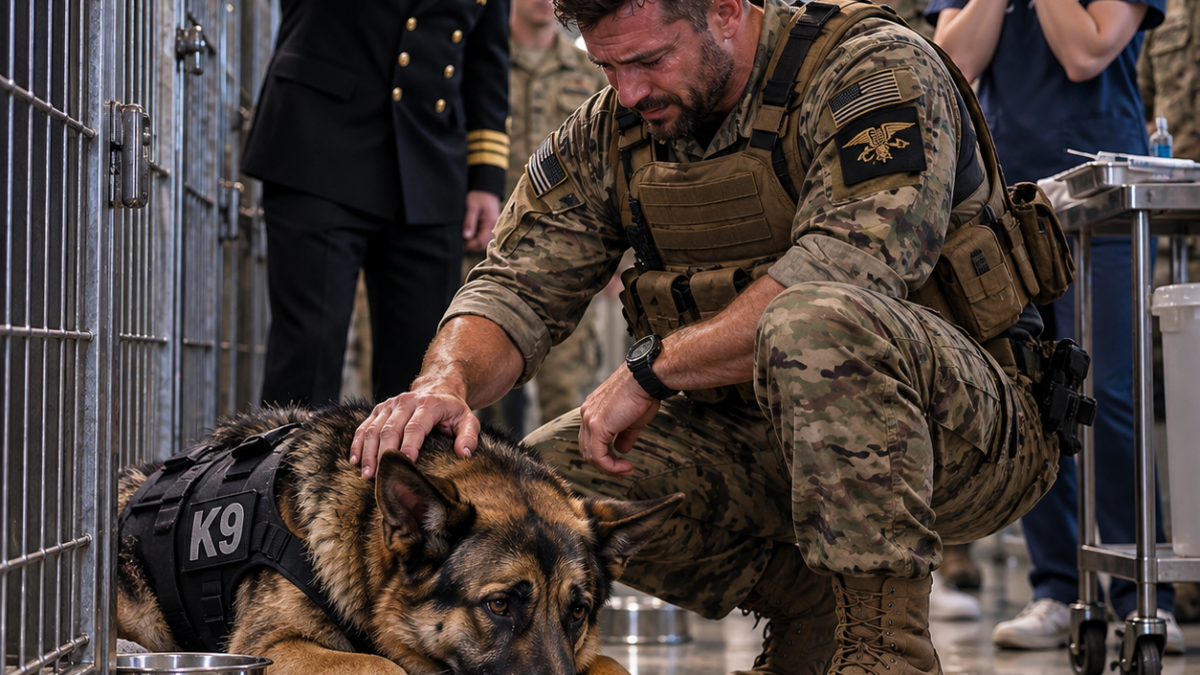
When Jenkins came running down the corridor with two handlers and a catch pole, he found Milton sitting on the wet concrete with the massive dog pressed against his chest, both of them shaking, both of them breathing like survivors.
“What in God’s name did you do?” Jenkins shouted.
Milton did not look up.
“What’s his name?”
Jenkins stopped.
The dog’s head rested against Milton’s shoulder.
“Ranger,” Jenkins said.
Milton looked down at the blood on the dog’s paws.
“Who did this to him?”
The answer came later, in a manila folder stamped with Ranger’s name.
Milton sat alone in the cramped break room, fluorescent light flickering overhead, old coffee burning in the pot behind him.
The file described a purebred German Shepherd with elite early scores.
Tracking speed: exceptional.
Bite inhibition: excellent.
Handler focus: high.
Obstacle confidence: superior.
Search drive: outstanding.
Then the red ink began.
Severe noise phobia.
Unpredictable under fire.
Failed field simulation.
Bite incident after corrective intervention.
Unfit for service.
Recommend transfer to civilian animal control.
Milton stared at those words.
Unfit for service.
The same label, wearing different ink.
He turned the page and found the detail that made his jaw tighten.
Shock-collar correction applied during noise conditioning.
Repeated.
Escalated.
Discontinued after worsening response.
Milton closed the file.
For a long time, he did not move.
The military had a simple process for broken tools.
Evaluate.
Classify.
Remove.
Replace.
It just took different forms depending on whether the broken tool walked on two legs or four.
The next three days blurred into labor.
Milton cleaned runs.
Hauled fifty-pound bags of dog food.
Refilled water buckets.
Scrubbed drains.
He spoke little.
Complained never.
Jenkins watched him, waiting for the SEAL to decide the work was beneath him.
Milton never did.
But every day, his mind returned to the last run in block C.
Ranger refused to leave his cage.
Handlers tried coaxing him with treats and bright voices.
He ignored them.
He stayed curled in the back corner, eyes tracking every movement.
He ate almost nothing.
On Thursday afternoon, Milton walked up with a metal bowl of chicken and rice.
He did not speak.
Did not stare.
Did not reach.
He slid the bowl through the slot, then sat on the opposite wall with his back against the concrete.
Ten minutes passed.
Ranger lifted his head.
Sniffed.
Waited.
Milton stayed still.
The dog crept forward low to the ground, grabbed one mouthful, then retreated to the corner.
“He only eats when it’s quiet.”
Milton looked up.
A woman in blue coveralls stood near the end of the corridor, carrying a clipboard and a medical kit.
“Sarah,” she said. “Vet tech.”
Milton nodded.
She approached slowly, stopping far enough from the run not to crowd the dog.
“He’s terrified of us,” she said.
“I read the file.”
“Then you know what they did.”
“Shock collar.”
Sarah’s expression hardened.
“They thought they could punish fear out of him. Every siren, every thunderclap, every live-fire drill became pain. Now his brain hears noise and expects punishment.”
Milton looked at Ranger.
The dog’s eyes had not left him.
“They’re sending him to animal control,” Milton said.
Sarah’s face softened with grief.
“Yes.”
“Animal control won’t adopt him.”
“No,” she said. “Not with a bite history and noise trauma. They’ll put him down.”
The words hung in the corridor.
Ranger chewed slowly in the back of the cage.
Milton’s voice came out flat.
“That would be a waste.”
Sarah looked at him.
“Yes,” she said. “It would.”
Friday night brought a storm off the coast.
Milton volunteered for night watch.
He told Jenkins he preferred the quiet.
That was only half true.
He preferred being alone when his hands started shaking.
Rain lashed against the windows.
Wind pushed against the concrete building until it groaned.
The old facility seemed to breathe around him.
Milton sat at the front desk watching security monitors flicker between camera angles.
He tried not to hear rotor blades in the storm.
Tried not to feel heat rising off desert sand.
He tapped one finger against the desk.
Inhale four.
Hold four.
Exhale four.
The therapist had taught him that.
He hated that it helped.
Lightning flashed.
The room turned white.
A split second later, thunder cracked directly overhead.
The sound was explosive.
It hit the building like artillery.
The kennels erupted.
Dogs barked in every block.
Metal doors rattled.
Water ran beneath an outer threshold.
Then Milton heard the sound.
Not barking.
Tearing metal.
Panic.
Block C.
He ran.
The corridor lights flickered as he reached the last run.
Ranger had lost himself completely.
The thunder had broken whatever thin wall the last few quiet days had built.
He slammed into the cage door, retreated, slammed again.
The latch bent outward.
Milton was ten feet away when another crack of thunder shook the building.
Ranger hit the door with everything he had.
The latch snapped.
The heavy steel door swung open.
The German Shepherd tumbled onto the wet floor, scrambled up, spun, and bolted straight toward Milton.
Milton did not step back.
He dropped the flashlight.
Ranger crashed into him.
Both went down.
Claws ripped through Milton’s shirt and opened skin across his chest and arms.
Teeth snapped near his jaw.
Milton wrapped his arms around the dog’s neck and shoulders and rolled with him, absorbing the impact, keeping the animal from smashing into the wall.
“Hold still.”
The command did nothing.
Ranger bucked, twisted, kicked.
Milton gritted his teeth.
He pinned the dog close, buried his face in wet fur, and lowered his voice.
“I have you.”
Thunder roared again.
Ranger flinched so hard Milton felt it through his bones.
“I have you,” Milton repeated. “You are safe.”
He pressed one hand to Ranger’s ribs.
There it was again.
That frantic heart.
That impossible mirror.
Milton forced his breathing slow.
Deep inhale.
Slow exhale.
Again.
Again.
Minutes dragged.
The storm raged.
Water ran across the floor.
The building shook.
But in the dark corridor, the fight began to leave Ranger’s body.
First the legs.
Then the shoulders.
Then the jaw.
His breathing stuttered, caught, then followed Milton’s chest.
Not perfectly.
Not calmly.
But enough.
Finally, Ranger dropped his head onto Milton’s shoulder and let out a long, exhausted sigh.
They stayed that way on the cold wet floor.
A broken soldier and a broken dog.
Both alive.
Both ashamed of needing to be held.
Both needing it anyway.
Milton knew right then.
He could not let them destroy this animal.
The next morning, he stood outside Commander Hayes’s office with scratches visible along his neck above the collar of his clean uniform.
He knocked twice.
Entered.
Hayes looked up from his computer.
“Kane.”
“Sir, I want to submit a formal request.”
Hayes leaned back.
“For what?”
“I want to foster Ranger.”
The commander’s eyes narrowed.
“The German Shepherd?”
“Yes, sir.”
“That dog is scheduled for transfer to civilian animal control next week.”
“He’s traumatized, sir. Not useless.”
Hayes sighed.
“Milton—”
“He needs quiet. One handler. A stable environment. The kennel makes him worse. I live alone near the coast. Fenced property. No neighbors close by. Give me thirty days.”
“You are not a certified K9 trainer.”
“No, sir.”
“You are also on medical leave for psychological instability.”
Milton’s face did not move.
“Which means I have the time.”
Hayes studied him.
“I know what he is going through,” Milton said. “Let me try.”
The commander was silent long enough for Milton to hear the office clock ticking.
At last, Hayes said, “Thirty days. Temporary foster only. If he bites anyone, escapes, causes a public disturbance, or worsens, he goes back immediately. You will face disciplinary action if you violate those conditions.”
“Yes, sir.”
“Do not make me regret this.”
“I won’t.”
Getting Ranger into the truck took an hour.
Milton did not pull the leash.
He sat on the tailgate and tossed pieces of hot dog into the bed until Ranger finally climbed in by choice.
His cabin sat several miles from the rocky coastline at the end of a dirt road.
Small.
Weathered.
Quiet.
The ocean wind came through the windows at night and carried salt into everything he owned.
When they arrived, Ranger jumped down and sprinted to the porch, wedging himself beneath a wooden bench.
“Take your time,” Milton said.
He opened the front door and left it open.
Then he went inside and cooked dinner.
He moved slowly.
No dropped pots.
No slammed cabinets.
No sudden reaches.
Two hours later, Ranger crept inside with his belly nearly touching the floor.
He found the darkest corner behind a worn armchair and curled there.
That became his place.
The first week was hard.
Ranger flinched at the refrigerator compressor.
Paced when a garbage truck groaned faintly down the highway.
Froze when wind rattled a loose shutter.
Milton adapted his entire life to the dog.
No television.
No loud music.
No heavy boots in the house.
No sudden lights.
No expectations.
Every morning at six, he placed food near the armchair and walked away.
During the day, he sat on the floor across the room, cleaning gear or reading, a pouch of chicken pieces near his hip.
When Ranger looked at him without growling, Milton tossed a piece across the floor.
Slowly, the distance changed.
Not in dramatic steps.
In inches.
By the second week, Ranger moved from behind the armchair to the edge of the rug.
By the third, he followed Milton into the kitchen but stayed exactly ten feet away, as if an invisible line marked safety.
Milton understood invisible lines.
He had plenty of his own.
Ranger improved.
Milton did not.
Not the way he wanted.
The nightmares still came.
They only changed shape.
One Tuesday night, Milton woke screaming.
He was on the floor before he knew he had left the bed.
The desert ambush played behind his eyes in brutal detail.
Heat.
Gunfire.
His team leader falling.
Blood dark in dust.
A hand reaching for him.
Then nothing.
Milton stumbled into the living room without turning on a light.
He slid down the wall and pulled his knees to his chest.
His breath came too fast.
He pressed both hands over his face.
The old sentence returned, as it always did.
You lived.
They didn’t.
You lived.
They didn’t.
A soft sound broke through the dark.
Milton lifted his head.
Ranger stood near the hallway.
Ears pinned.
Body low.
But not terrified.
Watching.
Milton froze.
The dog turned and picked up an old yellow tennis ball from the floor.
A ball Milton had bought without thinking, though Ranger had never touched it.
Ranger took one step.
Then another.
He crossed the living room slowly, as if approaching an injured animal.
He stopped inches from Milton’s boots and dropped the ball onto his foot.
It rolled to the floor with a soft thud.
Milton stared at it.
Then at the dog.
Ranger took one final step forward, lowered his head, and rested his heavy chin on Milton’s knee.
The contact was so gentle it broke him.
Milton’s throat closed.
His hand shook as he raised it.
He placed his palm against the side of Ranger’s neck.
The dog did not flinch.
He leaned in.
And the desert, for a few minutes, loosened its grip.
Milton sat on the floor in the dark, hand buried in the fur of a dog marked for death, and understood with sudden clarity that he had not rescued Ranger alone.
Ranger had reached back.
Three weeks into the foster period, Milton received the call.
Base command.
He reported to Commander Hayes’s office at 0900.
Hayes was not alone.
A tall, thin officer with wire glasses sat in the corner chair, a black folder open on his lap. His uniform was perfect. His expression suggested perfection was the only moral virtue he trusted.
“Captain Miller,” Hayes said. “Logistics and budget oversight.”
Milton nodded.
“Sir.”
Miller did not return the courtesy with anything resembling warmth.
“I’ll get to the point,” Miller said. “The military is implementing immediate cuts across nonessential departments. The K9 support division is liquidating assets that no longer provide tactical value.”
Milton felt something cold form in his stomach.
“Assets, sir?”
“The dogs,” Hayes said quietly.
Miller flipped a page.
“Specifically those on medical or behavioral failure lists. Ranger is at the top.”
Milton kept his voice steady.
“I’ve been fostering him for three weeks. He is making progress.”
“Progress does not erase liability,” Miller said. “He failed field simulations. He damaged base property. He has a bite record. He is not deployable, transferable, or cost-effective.”
Cost-effective.
Milton heard the phrase and hated it with a clarity that surprised him.
“He sleeps in the same room as me now,” Milton said. “His noise sensitivity is improving. He needs more time.”
“Time costs money.”
“He served this country.”
“He is a dog,” Miller said.
Hayes’s eyes flicked toward Miller, but he said nothing.
Milton’s hands curled behind his back.
“He is not equipment.”
“Legally, he is government property.”
The room went silent.
Miller closed the folder.
“The decision is final. Ranger will be returned to base custody within forty-eight hours and transferred to county animal control.”
“Animal control will euthanize him.”
“That is outside the Navy’s concern.”
Milton turned to Hayes.
“Sir, give me another month. I’ll pay for his food. I’ll sign whatever release you need. Full responsibility.”
Hayes looked older than he had that morning.
“It isn’t just budget, Milton.”
The use of his first name made the next words worse.
“The base psychiatrist submitted your latest evaluation yesterday. Your trauma symptoms remain active. Command will not allow an operator designated psychologically unfit to handle a dangerous animal.”
Milton stared at him.
They were using his own wounds as evidence against the dog.
“He’s not dangerous,” Milton said. “He’s scared.”
Miller snapped, “Watch your tone.”
Milton’s voice rose anyway.
“The system broke him. You broke him. Now you want to throw him away because he doesn’t heal on schedule.”
Hayes lifted a hand before Miller could respond.
“The transfer paperwork is signed. You have forty-eight hours to return the dog to base kennels. Jenkins will handle transport Thursday morning.”
Milton did not move.
“That is a direct order,” Hayes said. “Do you understand?”
The office seemed very far away.
Milton’s jaw clenched so hard his teeth ached.
“Yes, sir.”
“Dismissed.”
Milton drove home with the radio off and both hands locked on the wheel.
The ocean beside the highway looked cold and empty.
His mind ran through options.
Lawyer.
Press.
Veterans group.
Injunction.
Public scandal.
But the truth sat in the passenger seat beside him like a corpse.
By the time any civilian process began, Ranger would be dead.
He pulled into the dirt driveway and sat in the truck for several minutes after shutting off the engine.
Then he went inside.
“Ranger?”
Claws clicked on the floor.
The German Shepherd emerged from the bedroom, ears lifting when he saw Milton.
He walked over and bumped his nose against Milton’s hand.
A simple greeting.
A miracle, if you knew what it had taken.
Milton sank to his knees.
Ranger tilted his head, confused.
Milton pulled the official surrender notice from his pocket.
Forty-eight hours.
Two days.
Black ink pretending not to be a death warrant.
Ranger sat in front of him patiently.
Trusting.
The dog had fought his way back from terror one inch at a time. He had learned to eat, sleep, follow, lean, and breathe beside a human again.
And his reward would be a concrete county kennel and a needle.
A sharp, clean rage moved through Milton.
Not panic.
Not dissociation.
Purpose.
The Navy expected him to obey.
He had built his life on obedience to lawful orders, chain of command, mission priorities, team survival.
But this order had nothing to do with honor.
It was paperwork protecting itself.
Milton crushed the surrender notice in his fist.
“I’m not letting them take you.”
Ranger barked once, sensing the change in the room.
Milton stood.
He threw the paper in the trash.
Then he walked to his bedroom and pulled a canvas duffel from the closet.
He packed like a man planning an operation.
Civilian clothes.
Cold-weather layers.
Medical kit.
Water purification tablets.
Protein bars.
Compass.
Rain shell.
Knife.
Dog food.
Collapsible bowl.
Ranger’s leash.
Cash.
He moved with the speed and precision that had once made him valuable.
Only this mission had no authorization.
No backup.
No extraction.
No forgiveness waiting if he failed.
He looked into the living room.
Ranger watched him.
“Pack light, buddy,” Milton said. “We’re leaving.”
Ranger jumped into the passenger seat without hesitation.
They left after dark.
Milton avoided highways.
Avoided cameras.
Avoided base-adjacent roads.
He drove east, away from the city lights and toward the rugged mountains.
By morning, his phone had thirty-seven missed calls.
Jenkins.
Base security.
Hayes.
When it rang again in his hand, Milton stared at the name.
Commander Hayes.
He answered.
“Sir.”
“Where are you?”
Hayes’s voice was cold.
Underneath the cold was something worse.
Fear.
“We left the area.”
“You are making a massive mistake. You are currently AWOL. Theft of a military working dog is a federal offense. Military police are already tracking your phone.”
Milton looked through the windshield.
Ranger stood near the edge of the clearing, sunrise touching his dark coat.
“You cannot outrun the United States Navy,” Hayes said.
“I’m not bringing him back to die.”
“You are throwing away your career. Your pension. Your rank. You will face court-martial. You could go to prison.”
Milton watched Ranger turn and look at him.
The dog’s eyes held no fear.
Only loyalty.
“My life was already gone, sir,” Milton said quietly. “He brought part of it back.”
“Milton.”
Hayes’s voice softened.
“Don’t do this. Bring him back. I’ll try to slow Miller down. I’ll try to—”
“No, sir.”
Milton looked at the dog.
“I accept the consequences.”
“Do not make me send people after you.”
“Goodbye, Commander.”
He ended the call.
Then he placed the phone on a rock and smashed it with another stone until the screen shattered, the casing split, and the tracking chip was nothing but fragments.
There was no going back.
He drove deeper into the mountains until the logging road ended in brush and fallen trees.
From there, they continued on foot.
Milton carried a heavy pack.
Ranger moved beside him on a long tracking line, alert but calm.
The farther they got from sirens, generators, vehicles, and human noise, the more Ranger changed.
His ears came forward.
His head lifted.
His nose worked the air with purpose.
In the wilderness, the dog did not look broken.
He looked like what he had been born and trained to be.
Hours passed.
They climbed through pines and granite outcrops, heading toward a ridge Milton hoped would give him visibility over the valley.
The air cooled sharply.
Wind strengthened.
Dark clouds rolled over the peaks faster than they should have.
Ranger stopped.
His head lowered.
He sniffed hard, then growled.
Not at Milton.
Not at the trees.
At the mountain itself.
Milton dropped to one knee.
The ground gave a low rumble.
Not thunder.
Deeper.
Structural.
He knew that sound.
Rain-soaked earth shifting under its own weight.
“Move.”
He grabbed Ranger’s line and sprinted toward a granite outcropping.
They reached the rock seconds before the mountain gave way.
The sound was enormous.
A freight train made of mud, trees, rock, and violence.
The landslide tore through the path they had just walked, ripping pines from the ground and carrying boulders like marbles.
Milton pressed his back to granite and pulled Ranger against his chest as debris slammed past.
For two minutes, the world ended in brown motion.
Then silence fell so suddenly it hurt.
Milton coughed dust from his lungs.
Ranger was muddy but unhurt.
The slope below was gone.
The road vanished beneath a scar of raw earth.
They were cut off.
Milton climbed to a higher plateau to assess the terrain.
Ranger followed.
Then stopped.
His ears snapped forward.
He barked once.
Sharp.
Urgent.
Milton listened.
Beneath the wind, faint and thin, came a cry.
A child.
He unclipped Ranger’s line.
“Find them.”
Ranger took off.
Milton followed, scrambling over fallen logs and slick mud until they reached the edge of a shallow ravine.
Below, a yellow school bus sat half buried in the slide.
Children stood on the roof crying.
A woman in a bright green rain jacket dug at the back exit with bare bleeding hands.
Milton slid down the embankment.
“Are you hurt?”
The woman spun around, face streaked with mud and panic.
“Please help us. I’m Clara Mercer. We were on a nature field trip. The road collapsed. Most of the kids got out, but Tommy and Sarah are trapped under the back exit. The mud is too heavy.”
Milton dropped his pack and waded into the mud.
It grabbed his legs like wet cement.
He saw a small hand reaching through a narrow gap beneath the twisted rear door.
“I’ve got you,” he shouted. “Stay calm.”
He grabbed the metal door and pulled.
Nothing.
He set his boots, bent his knees, and pulled again.
The door groaned but did not move.
Too much mud.
Too much pressure.
They needed machinery.
Or ten men.
Or a miracle.
“No one knows we’re here,” Clara said, sobbing. “The radio broke. My phone has no signal.”
A rhythmic thumping echoed through the mountains.
Milton looked up.
Two orange-and-white rescue helicopters appeared over the ridge, flying low above the forest canopy.
“Up here!” Clara screamed, waving both arms.
The helicopters passed.
The ravine was too deep.
The pines too thick.
The bus too hidden.
The pilots could not see them.
The helicopters circled back, lower this time.
Rotor noise filled the valley.
Loud.
Heavy.
Violent.
It vibrated through Milton’s chest.
He turned.
Ranger had collapsed against the mud.
Ears pinned.
Body flat.
Shaking from nose to tail.
The helicopters were directly over them now, and the noise had taken him back to every siren, every shock, every thunderclap, every punishment his body remembered.
The dog scrambled backward.
Slipping.
Panting.
Eyes wild.
He was going to run.
“Ranger, no!”
The dog could not hear him.
The helicopters roared.
Children cried.
Mud settled tighter around the trapped bus.
Milton stood frozen for one impossible second.
Save the children.
Or keep Ranger from bolting into the mountains, where a terrified dog would likely die alone.
Then he moved.
He lunged and threw his body into the mud, wrapping both arms around Ranger’s waist just as the dog launched toward the trees.
They crashed down together.
Ranger thrashed violently.
Milton held on.
“No,” he shouted over the rotors. “You stay with me.”
Ranger snapped blindly.
Not at Milton.
At the fear.
Milton shifted, pinning him flat without crushing him, one leg over the dog’s body, both hands firm against his chest.
He ripped off his waterproof jacket and threw it over Ranger’s head, wrapping the fabric around the dog’s ears to blunt the sound.
Then he leaned close.
Mouth near the covered ear.
“Focus on me.”
Ranger shook.
“Deep inhale. Slow exhale.”
Milton forced his own heart to slow.
“I’m right here. I have you. Do not run.”
The helicopters hovered.
Downwash blasted dirt and rain across the ravine.
Milton ignored it.
Ignored the cold.
Ignored the mud.
Ignored the children screaming.
Just for ten seconds, he gave everything to the dog beneath him.
“You have a job,” Milton said. “Those kids need us. I need you. Stand by me.”
Ranger’s thrashing weakened.
His breathing hitched.
Then, little by little, it found Milton’s rhythm.
The old training fought its way up through the fear.
Milton felt the change before he saw it.
Muscles no longer trying to flee.
Body waiting.
He lifted the jacket.
Ranger’s eyes were clear.
The helicopters still thundered overhead.
The dog did not run.
Milton touched his forehead to Ranger’s for half a second.
“Good boy.”
Then he pointed at the bus.
“Search. Find them.”
Ranger exploded into motion.
Not away from the sound.
Toward the children.
He charged through the mud to the back of the bus, shoved past Clara, and drove his nose into the gap beneath the twisted exit.
He inhaled once.
Then began digging.
His paws moved with brutal speed, throwing mud and stones backward in heavy clumps.
Clara stared.
“Help him!” Milton shouted.
She dropped beside them.
The three of them dug.
Ranger worked like an engine built for rescue.
He bit roots and ripped them aside.
He clawed through mud despite sharp rocks cutting his pads.
He did not look at the helicopters.
Did not flinch at the rotor wash.
He had chosen the job.
The gap widened.
Milton wedged his hands beneath the metal door, braced his boots, and pulled with every ounce of strength he had left.
The door bent upward.
Ranger shoved his head through the opening and clamped his teeth gently around a muddy sleeve.
He backed up, pulling.
A little boy slid out, coated in mud and sobbing.
Clara grabbed him.
“Tommy!”
“One more!” she cried. “Sarah’s still inside!”
Ranger dove back into the hole before Milton spoke.
Mud collapsed around the edges.
The door’s weight shook in Milton’s hands.
His arms trembled.
“Hurry,” he growled.
Inside the dark gap, Ranger found the second child.
A girl trapped beneath a seat cushion and mud.
He gripped the back of her jacket with careful teeth and pulled.
Once.
Twice.
Then she came free.
Ranger backed out, dragging her into the open.
Milton let the door slam shut and scooped the girl into his arms, carrying her to higher ground.
A rescue basket lowered from the helicopter.
Men in bright orange suits rappelled into the ravine.
The cavalry had arrived after the miracle had already begun.
Milton sat on a flat rock, breathing hard, hands bleeding, clothes soaked with mud.
Ranger walked to him slowly.
Paws bleeding.
Coat matted.
Exhausted.
Head held high.
He stopped in front of Milton and sat.
The helicopter roared overhead.
Ranger did not tremble.
Milton smiled, then pulled the dog into his arms.
“You did it,” he whispered into his fur. “You beat it.”
The rescue team lifted the children first.
Then Clara.
Then Milton and Ranger.
Inside the helicopter, Ranger pressed his head against Milton’s leg and watched the muddy ravine fall away beneath them.
The noise did not own him anymore.
When they landed on the roof of a San Diego hospital, medical staff rushed the children and Clara inside.
Milton stepped onto the concrete with Ranger beside him.
A man in a dark suit approached.
Short gray hair.
Federal badge.
Hard eyes.
“Milton Kane,” he said, “I am placing you under military arrest.”
Milton nodded.
“I understand.”
He put one hand on Ranger’s neck.
“But the dog stays with me.”
The agent looked down at the mud-covered German Shepherd.
“The dog comes too.”
They moved through chaos.
Hospital lobby.
News crews.
Reporters.
Cameras.
Someone had already leaked the story of the landslide rescue.
“Are you the Navy SEAL who saved the children?”
“Is that the dog?”
“Is it true you were running from military police?”
Milton kept his head down.
Ranger stayed at his side.
An hour later, still covered in dried mud, Milton stood in Commander Hayes’s office.
Ranger sat by his boots.
Captain Miller occupied the corner chair again, but his face had lost some of its sharpness.
Hayes sat behind the desk with a tablet in front of him.
For once, the room did not feel polished enough to hide what had happened.
“The news is everywhere,” Hayes said. “Every major network. Local, national, online. They’re calling you and Ranger heroes.”
Milton looked straight ahead.
“I went AWOL. I stole military property. I understand the charges, sir.”
Miller cleared his throat.
“The theft of a working dog remains a serious federal—”
“Stop talking, Miller,” Hayes said.
The captain shut his mouth.
Hayes looked at Milton.
“The Navy is not going to court-martial a man who just saved children from a landslide. And we are certainly not putting down the dog that dug them out on live rescue footage.”
Miller’s jaw tightened.
Hayes ignored him.
“Search and rescue confirmed the road washed out behind you. They confirmed you could not safely return. We are reclassifying your absence as emergency medical leave during a natural disaster response.”
Milton said nothing.
“The phone?”
“Destroyed, sir.”
“Accidental damage during rescue conditions,” Hayes said.
Miller inhaled sharply.
Hayes did not look at him.
“All formal charges are dropped.”
The weight lifted so fast Milton nearly swayed.
He looked down at Ranger.
The dog wagged once.
Only once.
Enough.
“What about him?” Milton asked.
Hayes opened a drawer and removed a stack of forms.
He placed them on the desk.
“Permanent adoption. Ranger is officially retired from service with honors. He is no longer government property.”
Milton stared at the papers.
For a moment, the words blurred.
“He’s mine?”
Hayes’s face softened.
“He already was, son. We’re just making the paperwork catch up.”
Milton picked up the pen.
His hand shook for the first time that day.
He signed.
Milton Kane.
Beside him, Ranger leaned against his leg.
Hayes waited until the signature dried.
“There is one more thing.”
Milton looked up.
“Your medical evaluation remains active,” Hayes said. “You are not cleared for field operations.”
“I understand.”
“But today proved something. You can operate under extreme pressure. More importantly, you understand traumatized working dogs in a way our standard program clearly does not.”
Miller shifted uncomfortably.
Hayes continued.
“We are establishing a rehabilitation track for K9s who fail conventional testing due to trauma, noise injury, or handler misuse. Civilian position. Lead instructor. You’d work with Sarah, Jenkins, veterinary staff, and selected handlers.”
Milton’s throat tightened.
“You want me to train broken dogs.”
“No,” Hayes said. “I want you to stop us from calling them broken before we understand what happened to them.”
The room went still.
For the first time in a long time, Milton felt something that did not hurt.
Purpose.
Not the old kind.
Not the kind built from violence, adrenaline, and missions in places nobody would name.
A quieter purpose.
Harder, maybe.
Healing usually was.
“I accept,” Milton said.
Hayes smiled.
Not like a commander dismissing a subordinate.
Like a man relieved to have finally made one correct decision.
“Go home, Milton. Both of you. Get some rest.”
Milton walked out of the naval base with Ranger at his side.
Not as stolen property.
Not as a liability.
Not as a failure.
As his dog.
The next morning, Milton woke before sunrise.
No gasp.
No bedsheets twisted in his fists.
No desert in his mouth.
The room was quiet.
Ranger slept at the foot of the bed, one ear half lifted, his breathing deep and steady.
Milton lay still and listened.
For months, silence had frightened him.
Silence meant the dream was waiting.
Silence meant a sound was coming.
But this silence felt different.
It had weight.
Presence.
A dog breathing in the room.
A second heartbeat.
A reason to get up.
He dressed in a T-shirt and shorts, grabbed the yellow tennis ball from the kitchen counter, and opened the front door.
“Let’s go.”
Ranger bounded out like a dog half his age.
They walked to the beach.
Golden sand stretched for miles.
The ocean rolled in clean blue lines beneath a brightening sky.
Milton stood at the water’s edge and took a deep breath.
Salt air filled his lungs.
The past did not vanish.
It never does.
No sunrise erases the dead.
No dog cures a war.
No act of heroism makes trauma polite enough to leave forever.
But something inside Milton had shifted.
The guilt no longer had the whole room to itself.
Ranger stood beside him, ears forward, eyes bright.
Milton pulled his arm back and threw the tennis ball down the beach.
The German Shepherd launched after it, paws kicking up wet sand, body powerful and free.
He caught the ball on the second bounce, turned, and ran back through the surf with water splashing around his legs.
He dropped it at Milton’s feet and barked.
One sharp, joyful sound.
Milton laughed.
It surprised him.
The sound came out rough at first, like something unused.
Then fuller.
Ranger barked again.
Milton threw the ball.
The dog ran.
For a while, there was nothing else.
No base.
No court-martial.
No labels.
No unfit.
No failed.
Just a man and a dog under an open sky, both alive because each had refused to let the other disappear.
The rehabilitation program began three weeks later.
It started small.
A converted training shed.
Two kennels retrofitted with sound-dampening panels.
A treatment room.
Sarah’s medical station.
Jenkins pretending he had always believed in the idea.
Hayes visited once a week and stood quietly at the back, watching dogs nobody had known how to help.
Milton did not run the program like a punishment course.
No shouting.
No shock collars.
No forced flooding.
No “break them down to build them up.”
He hated that phrase.
Broken things did not need more breaking.
He built the work around quiet.
Routine.
Choice.
Pressure release.
Noise at safe distance.
Trust earned in small increments nobody could brag about on a report.
Some dogs improved.
Some did not.
Some needed retirement.
Some needed medical care.
Some needed a different handler.
Some needed people to admit the training had failed them, not the other way around.
Ranger became the unofficial center of the place.
He did not work every session.
He did not need to.
Sometimes he lay in the corner while younger dogs watched him remain calm through a controlled sound drill.
Sometimes he helped Milton demonstrate grounding techniques.
Sometimes he simply walked beside a frightened dog until that dog understood there was a path through fear and someone had walked it before.
Handlers came skeptical.
Some left changed.
One young petty officer, embarrassed and red-faced, asked Milton after a session, “What if the dog never gets back to full service?”
Milton looked at Ranger.
The dog was asleep by the door, one paw twitching.
“Then stop making service the only measure of worth.”
The petty officer had no answer.
Good.
Some lessons needed silence around them.
Months passed.
Milton still had nightmares.
Some nights, the desert returned.
Some nights, he woke shaking.
But now Ranger climbed onto the bed without asking, pressed his body against Milton’s side, and breathed until Milton remembered how.
Some storms still frightened Ranger.
Thunder made him tense.
Fireworks sent him under the table the first Fourth of July.
But Milton followed him down, stretched out on the floor beside him, and covered both their ears with a blanket while the world outside mistook explosions for celebration.
Healing did not look like becoming who they had been before.
That version was gone.
Healing looked like staying.
Breathing.
Choosing again.
One year after the landslide, the families of the rescued children invited Milton and Ranger to a school assembly.
Milton almost declined.
He hated crowds.
Hated attention.
Hated microphones.
Then a handwritten letter arrived from Tommy, the boy Ranger had pulled from the bus.
Dear Mr. Milton and Ranger,
My mom says I should say thank you better but I don’t know how except thank you for digging me out. I used to be scared of dogs but not Ranger. Ranger is brave even if he gets scared. My dad says that means real brave.
Milton read the letter three times.
Then he went.
The school gym was packed.
Children sat cross-legged on the floor.
Parents lined the walls.
Teachers cried before anyone said anything, which Milton considered unfair.
Ranger walked beside him wearing a simple blue service vest with one patch.
RETIRED K9
The principal began to introduce them with too many adjectives.
Heroic.
Miraculous.
Legendary.
Milton shifted uncomfortably.
When it was his turn, he stepped to the microphone and looked out at the room.
He had led briefings under fire.
He had spoken into radios while bleeding.
He had never felt less prepared.
Ranger leaned against his leg.
Milton looked down.
Then he looked at the children.
“Ranger was scared that day,” he said.
The gym quieted.
“He heard the helicopters, and he wanted to run. He was shaking. He was hurting. He was remembering things nobody in that ravine could see.”
A few adults shifted.
Milton kept going.
“But he stayed. Not because he wasn’t afraid. Because he had a job and someone believed he could do it.”
He rested one hand on Ranger’s head.
“That’s bravery. Not the absence of fear. Staying long enough to do the right thing while fear is still there.”
Tommy stood in the front row and clapped first.
Then Sarah.
Then the whole gym.
Ranger barked once, startled by the applause, but he did not run.
Milton crouched and put a hand to his chest.
“In,” he whispered.
Ranger breathed.
“Out.”
The dog steadied.
The applause softened into something gentler.
Something like respect.
Later, Tommy and Sarah approached.
Ranger sniffed their hands carefully.
Sarah, the little girl, whispered, “He remembers us?”
Milton looked at Ranger.
“I think he remembers what mattered.”
She nodded as if that made perfect sense.
Children often understood truths adults complicated.
Years later, people still told the story wrong.
They said Milton stole a dog and became a hero by accident.
They said Ranger saved children and earned his life.
They said the Navy changed policy because the media forced it.
They said a lot of things.
Some were partly true.
Most were too simple.
Ranger did not earn his life in the mudslide.
He already deserved it in the kennel.
Before the rescue.
Before the headlines.
Before the children.
Before anyone saw what he could do.
That was the lesson Milton carried into every rehabilitation case after.
Worth does not begin when someone becomes useful again.
Worth is there before the miracle.
Before the comeback.
Before the proof.
Ranger had deserved gentleness when he was shaking in the cage.
Milton had deserved help when he froze in the simulation.
Neither of them became valuable because they recovered.
Recovery simply allowed other people to see what should have been honored all along.
On quiet mornings, Milton still took Ranger to the beach.
The German Shepherd grew older.
Gray spread across his muzzle.
His hips stiffened.
His runs became trots, then fast walks, then careful wandering along the foam line.
Milton adjusted without complaint.
He had learned the shape of love.
It was not keeping someone the way they used to be.
It was changing the world around them so they could remain with dignity.
One morning, just after sunrise, Hayes joined them.
He was retired by then.
Civilian clothes.
Baseball cap.
Coffee in hand.
He stood beside Milton and watched Ranger nose through seaweed like it contained national secrets.
“You know,” Hayes said, “I still think about that day in my office.”
“Which one?”
Hayes gave him a look.
Milton almost smiled.
“I gave you a direct order.”
“Yes, sir.”
“You disobeyed it.”
“Yes, sir.”
Hayes sipped his coffee.
“I should say I’m glad you did.”
“You can say it.”
“I’m glad you did.”
Milton watched Ranger lift his head into the wind.
“I’m not sorry.”
“I know.”
“I’d do it again.”
“I know that too.”
For a while, neither man spoke.
Then Hayes said, “Miller retired early.”
“Good.”
“Jenkins pretends not to like your program.”
“He brings Ranger biscuits every Friday.”
“I know.”
“Sarah told you?”
“Ranger told me.”
Milton looked at him.
Hayes shrugged.
“I’m learning to listen.”
That made Milton smile.
Not much.
Enough.
Ranger wandered back, pressed his head against Hayes’s knee, and left a streak of wet sand on his pants.
Hayes looked down.
“I deserved that.”
“Yes, sir,” Milton said.
The commander laughed.
So did Milton.
And the ocean kept moving as if the world had not once tried to throw both man and dog away.
The last file Milton kept in the rehabilitation office was Ranger’s original evaluation.
He did not keep it because he trusted it.
He kept it because he wanted every new handler to see how wrong official language could become when nobody looked beneath it.
Unfit for service.
Severe noise phobia.
Unpredictable.
Liability.
Broken tool.
Milton had crossed out that last phrase himself, though it had never appeared in the file.
Then, beneath it, he wrote a new line.
Not broken. Unheard.
Under that, Sarah added:
Not dangerous. Terrified.
Jenkins added, in blocky handwriting:
Not useless. Retired early against his will.
Hayes added the final note:
Not property. Partner.
Ranger’s paw print sat beneath them all in black ink.
Slightly smudged.
Imperfect.
Permanent.
People sometimes asked Milton when he finally felt healed.
He always disliked the question.
Healing was not a door you walked through once.
It was more like the beach.
The tide came in.
The tide went out.
Some days the water was calm.
Some days it knocked you down.
You learned the rhythm.
You learned where to stand.
You learned who stood beside you.
Milton never became the man he had been before the desert.
Ranger never became the dog he had been before the shock collar and the sirens.
That was not failure.
That was truth.
They became something else.
A man who could guide broken dogs without needing to pretend he was not broken too.
A dog who could lie calmly beside a training shed while frightened animals learned that fear was survivable.
A pair of survivors who had once been labeled liabilities by a system too rushed to understand what it had damaged.
And on the best days, when the sun was low and the beach was empty, they were simply Milton and Ranger.
A man throwing a yellow tennis ball.
A German Shepherd running after it.
The ocean wind carrying away the old noise.
Not forever.
But for that moment.
And sometimes one moment of peace is enough to build the next one on.
That is how they lived.
Not perfectly.
Not untouched by the past.
But together.
They had saved each other in the dark.
And after that, they kept choosing the light.