They Drained Four Feet From My Stock Pond Overnight to Keep Their Golf Course Green—Then State Inspectors Followed the Hidden Pipeline Beneath My Fence.
PART2:
I walked down to the first marker and wiped mud from the painted notches. My father’s markings were still clear after all those years. The water line had dropped farther than I had ever seen it, farther than it had during the worst dry spell I could remember.
That was when I heard the hum.
Low.
Mechanical.
Steady.
It came from beyond the cottonwoods along the western fence, the strip of trees separating my ranch from Green Haven Golf Club.
Green Haven had always been an odd neighbor.
On paper, it was a golf community.
In practice, it was a kingdom of manicured grass, private gates, HOA committees, social calendars, and people who spoke about property values the way church folks talk about salvation.
I had no problem with golf.
I had no problem with people wanting neat lawns and clean roads and Saturday tournaments with polished trophies.
But I had a problem with anyone who looked at a ranch and saw unused resources.
The course had always been green, but lately it had been unnaturally green. That was one of those thoughts I had noticed without stopping to examine. During dry weeks, when the county roads turned dusty and every neighbor complained about pasture stress, Green Haven’s fairways still looked like they belonged in a brochure.
I followed the sound.
The hum grew louder as I moved along the fence line.
Past the old cottonwood with the split trunk.
Past the place where the soil dipped toward the drainage cut.
Past the corner where ornamental shrubs on the Green Haven side had grown thick enough to hide almost anything from someone not looking.
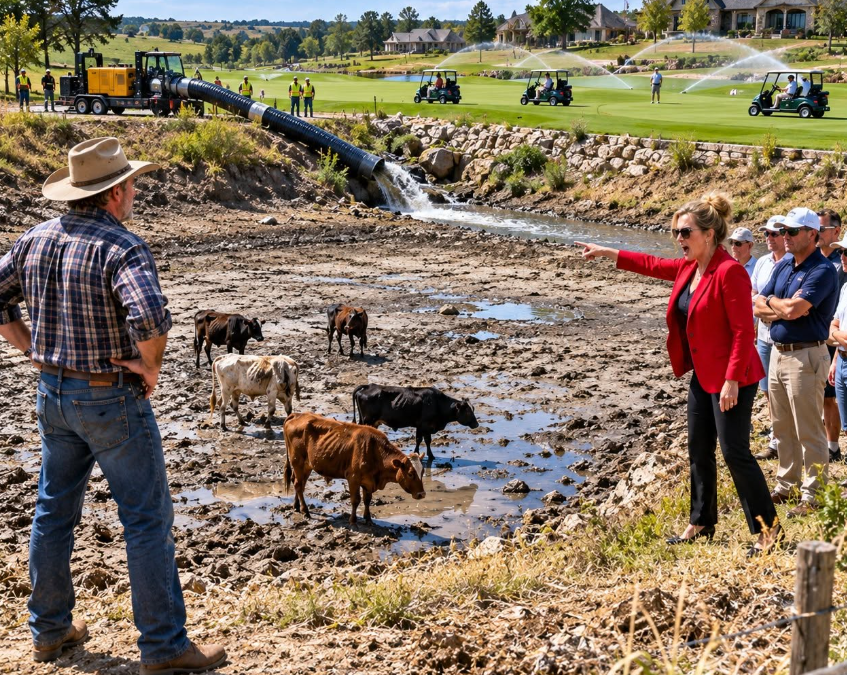
There, half concealed behind glossy shrubs, sat a large portable pump.
A heavy pipeline ran from it.
One end was connected to my pond.
The other disappeared beneath the fence and continued toward the golf course.
For a moment, I simply stared.
Not because I did not understand what I was seeing.
Because I understood it too well.
The pump was not abandoned.
It was running.
The control panel vibrated lightly. The hose jerked with pressure. Someone had installed it carefully enough to stay hidden from my normal path, but not carefully enough to hide from the sound.
I walked straight to the panel and shut it off.
The engine slowed, coughed, and finally fell silent.
The sudden quiet felt enormous.
Behind me, the cattle were still calling near the muddy pond. In front of me, beyond the fence, the Green Haven fairways glowed green through the trees.
Then I heard tires on grass.
An electric golf cart rolled toward the fence and stopped near the shrubs. Victoria Langley stepped out.
She was president of the Green Haven Homeowners Association, which operated in that strange overlapping way some golf course communities do, where the HOA, the club, the property values, and the social committees all seemed to become one creature whenever money was involved.
Victoria wore white slacks, a navy pullover, and sunglasses even though the morning light was still weak. Her blond hair was pulled back in a smooth twist. Her shoes were spotless. She looked polished, composed, and not remotely surprised to find me standing beside the pump.
That was the first thing that made my anger go cold.
She was not shocked.
She was annoyed.
“You cannot shut that down,” she said.
No greeting.
No apology.
No question.
“The course needs water before the weekend tournament.”
I looked back toward the pond.
“My cattle need water before lunch.”
Her expression barely shifted.
“The association has been using reserve water.”
“That is my stock pond.”
“Everyone benefits when the community stays attractive.”
I almost laughed, but there was nothing funny in it.
“Victoria,” I said, “my cattle are standing in mud where four feet of water used to be.”
She glanced toward the pond with the detached irritation of someone being forced to consider an inconvenient fact.
“The tournament brings visitors, business, and property value to the entire area. You are thinking too narrowly.”
That sentence told me everything I needed to know about how this had happened.
She had not stolen water in her own mind.
She had allocated a resource.
She had not trespassed.
She had improved the community.
She had not endangered livestock.
She had protected property values.
Some people can repaint theft so many times they forget what is underneath.
I reached for the large valve connected to the line and turned it closed. Then I secured it with the locking pin mounted beside the control box.
Victoria’s face hardened.
“If you stop irrigation now,” she said, “the entire event will be at risk.”
“Then you should have planned it without draining somebody else’s pond.”
Her mouth tightened.
“You do not understand the position you are putting us in.”
“No,” I said. “You do not understand the position you put yourself in.”
For a moment, we stood there separated by the fence, the dead pump between us and the cattle still bawling beyond the trees.
Then Victoria climbed back into the golf cart.
Before she drove away, she looked at the locked valve and said, “This conversation is not over.”
She was right.
But not in the way she thought.
By midmorning, my ranch had changed into a kind of emergency operation.
The remaining pond water might keep the cattle calm for a few more hours, but I could not rely on it. I called the nearest water hauling company and ordered an emergency delivery. The dispatcher warned me every truck was already strained because of the dry weather and that the delivery would cost more than normal.
I told her to send it anyway.
Cattle cannot drink legal arguments.
Then I called Dr. Samuel Price, our veterinarian.
Sam had treated animals on our ranch for fifteen years. He was not dramatic by nature. His voice stayed level through calving emergencies, snakebites, infections, and storms that left half the county without power.
When I told him the pond had dropped four feet overnight, he did not waste time asking if I was sure.
“How many head are depending on that water?”
I told him.
“How agitated are they?”
“Enough.”
“Get temporary troughs going. Keep them away from the mud if you can. I’ll come by this afternoon.”
“I already called for water.”
“Good. Document the shoreline before anyone tramples it worse.”
“I have.”
“Document everything else too.”
“I am.”
He went quiet for half a second.
Then he said, “Somebody took it?”
“Yes.”
“Golf course?”
I looked across the fence at the green fairways shining in a dry county.
“Yes.”
He exhaled through his nose.
“Of course.”
While I was still on the phone, my email chimed.
The message came from Green Haven Homeowners Association.
Victoria’s name was at the bottom.
The subject line read: Irrigation Interruption Before Invitational Weekend.
I read it once.
Then again, slower.
According to the announcement, Green Haven’s irrigation system had experienced an unexpected interruption caused by interference from a neighboring property owner. Residents were encouraged to remain patient while the association worked to restore water service before the weekend tournament.
No mention of my pond.
No mention of the pipeline.
No mention of my cattle.
No mention that the “neighboring property owner” was the man whose water they had been taking.
I stood in my kitchen with that phone in my hand and felt the old familiar anger that comes when somebody does wrong, then reaches the microphone first.
Within an hour, comments began appearing on the neighborhood community page. I did not belong to it, but someone sent me screenshots.
Homeowners complained about brown patches near a practice green.
Others asked why a rancher would sabotage a community improvement during the hottest week of summer.
A few posted that livestock ponds were natural resources and should be shared during emergencies.
Emergencies, apparently, included golf.
By afternoon, several residents had driven to the fence line. They stood with phones raised, recording my exposed shoreline and the cattle crowding near the remaining pool. From that distance, they could not smell the mud or hear the panic in the herd clearly. They could not see the depth markers or the pump or the hidden line.
They saw what Victoria wanted them to see.
A rancher blocking progress.
That was how narratives work when the first liar gets a head start.
Late that afternoon, the first tanker truck arrived.
The driver backed carefully toward the temporary tanks I had set up near firmer ground. Clean water rushed through the hose, splashing into galvanized troughs. The cattle moved toward it immediately, pushing and snorting, still unsettled by the change.
Relief should have come then.
Instead, all I could think about was how unnecessary it was.
That water should have still been in my pond.
The driver, a man named Ellis who had hauled water in the county for years, glanced across the fence after he finished.
“Course is green,” he said.
“Sure is.”
“Greener than anyone else this week.”
“That occurred to me.”
He looked at my pond, then toward the fairways.
“Has it always stayed that green in dry weather?”
“Not until recently.”
He nodded, not needing more.
Ellis had the kind of face that came from years of watching people create disasters, then act surprised when somebody sent them a bill.
“You keeping track of deliveries?”
“Yes.”
“Good. Water has a price when you have to haul it.”
“So does stealing it.”
He looked toward Green Haven again.
“That too.”
After he left, I walked the fence line again.
That was when I found the second pipeline.
This one was narrower and better hidden. It disappeared beneath ornamental shrubs before curving toward the golf course maintenance building. Whoever installed it had done enough work to avoid casual notice. But once you know one line exists, you start seeing the ground differently.
Disturbed soil.
Newer mulch.
A slight depression where pipe had settled.
A valve box tucked under shrubs that had no reason to be there.
I marked the location on my ranch map and took photographs from every angle I could manage without crossing the property line.
That evening, I installed two trail cameras.
One faced the exposed pump.
The other watched the concealed valve area near the smaller line.
If the system started again after dark, I wanted more than my own word.
I knew Victoria would not stop because I told her to.
People like her do not hear no as an answer.
They hear it as a scheduling problem.
Around eleven that night, I stepped onto my porch and listened.
The ranch was quiet at first.
Crickets.
A light breeze in dry grass.
The occasional low sound from cattle settling around the temporary tanks.
Then the hum returned.
It was softer this time.
Farther away.
But unmistakable.
I looked toward the dark line of cottonwoods and knew Green Haven had found another way to move the water.
I almost walked down there right then.
I almost grabbed a flashlight, crossed my pasture, and put my hands on whatever switch they had turned.
But anger is not evidence.
So I waited.
At dawn, the cameras told the rest of it.
At 12:43 a.m., a Green Haven maintenance vehicle stopped beside the shrubs. Two employees climbed out with flashlights. They opened the concealed valve box, worked for several minutes, and activated a secondary pump. The larger pump I had locked remained untouched, but the backup system took over after dark.
They knew what they were doing.
That mattered.
A mistake happens once in daylight.
A scheme runs at 12:43 a.m.
I copied the video onto two drives, then went down to the pond.
The water had dropped again.
Not four feet this time, but enough. A fresh wet band marked the loss. The remaining pool was smaller. The cattle were calmer because of the temporary tanks, but they still moved toward the pond out of habit, then stopped at the mud as if confused by betrayal.
While measuring the depth markers, I noticed bright survey stakes on the far side of my pasture.
They had not been there the day before.
I followed them along the bank until I reached a small plastic marker pushed into the soil.
Green Haven Reserve Pond.
For a moment, I felt the kind of cold anger that makes the world sharper.
Not just because they had taken water.
Because they had renamed it.
My grandfather’s pond.
My father’s markers.
My cattle’s water.
My land.
And someone had walked onto my property and marked it as Green Haven’s reserve.
I photographed the marker in place from every angle, making sure the fence, pond, and depth posts were visible. Then I pulled it from the ground and placed it in the same evidence box where I had already put printed photos of the pump.
At noon, a pickup truck pulled into my driveway.
The driver introduced himself as Brian Miller. He looked uncomfortable before he even shut the door.
He was in his late thirties, clean-cut, wearing a polo shirt with Green Haven’s logo embroidered over the chest. His wife sat in the passenger seat, twisting her wedding ring like she regretted letting him come.
“I’m sorry to show up unannounced,” he said. “My wife and I bought in Green Haven last year. I think you need to see something.”
From the back seat, he pulled out a glossy real estate brochure.
The kind of brochure that smells like money and fresh ink.
Across the center was a map of the golf community.
There, clearly illustrated, was my stock pond.
Not as my pond.
Not as ranch property.
It was labeled as a permanent irrigation reserve serving the championship course.
Decorative walking paths curved around it in the illustration. Benches dotted the shoreline. A little caption praised Green Haven’s dependable year-round water source that protected course conditions during dry summers.
No such paths existed.
No benches existed.
No public access existed.
No recorded water agreement existed.
Brian watched my face as I turned the pages.
“If this is your pond,” he said quietly, “then they sold us something that was never theirs.”
His wife finally spoke.
“They told us that water feature was part of the community plan. They said future walking trails would connect to the back nine.”
I looked at her.
“Walking trails around my cattle pond?”
She swallowed.
“That’s what they told us.”
Brian looked ashamed, though he had done nothing but believe the people who sold him a house.
“We thought it was all permitted.”
“I’m sure you did.”
He emailed me digital copies of every marketing document the sales office had given him and his wife during closing.
That afternoon, I drove to the county records office.
I requested every survey, parcel map, water record, easement filing, and recorded document connected to my property and Green Haven’s adjacent parcels. The clerk, a woman who knew my family name and had no patience for sloppy paperwork, spent nearly two hours helping me pull certified copies.
The answer was exactly what I expected.
My pond sat entirely within my deeded acreage.
No shared water agreement.
No irrigation easement.
No transfer.
No license.
No recorded right for Green Haven to pump a single gallon.
As I carried the certified copies back to my truck, another HOA email landed on my phone.
Final preparations for the Green Haven Invitational were nearly complete.
Attached photographs showed brilliant green fairways under a cloudless sky. In one image, an ornamental lake beside the course shimmered in the background.
I zoomed in.
Its level had risen.
Mine continued to fall.
By then, the pattern was too clear to ignore.
This was not emergency improvisation.
Green Haven had planned around my pond.
They had marketed around it.
They had installed hidden lines.
They had run pumps at night.
They had told homeowners a story.
They had counted on the tournament arriving before the truth did.
The next afternoon, a man called me from an unfamiliar number.
“My name is Mason Reed,” he said. “I work on the Green Haven maintenance crew.”
His voice was cautious.
Before he said anything important, he asked if we could meet somewhere away from the golf course.
An hour later, we sat across from each other at a small farm supply store outside town. Nobody from Green Haven came there. The parking lot was full of feed trucks, muddy pickups, and men who judged rain by how it affected hay, not tee times.
Mason looked tired.
He was younger than I expected, maybe thirty, with grease under his fingernails and the nervous focus of a man who had carried a secret too long.
“I thought it was legal,” he said before I asked anything. “At first, I swear I did.”
He opened a worn notebook and pushed it across the table.
Inside were handwritten maintenance logs.
Pump activation times.
Valve numbers.
Pressure readings.
Night entries.
Every timestamp after midnight matched what my trail cameras had recorded.
Beside several dates, someone had written instructions in short, careful phrases.
Begin pumping after crews leave.
Stop before sunrise.
Keep reserve line active overnight.
Avoid daytime visibility.
Then Mason showed me text messages.
Some were from supervisors.
Some were from Victoria.
One message read: Keep the reserve line active overnight. Daytime visibility creates unnecessary questions.
Another said: Confirm pressure before dawn. Championship greens must remain tournament-ready.
I read them twice.
My throat felt tight.
Mason looked down at his hands.
“We were told not to discuss the source with homeowners or visitors. They said the pond belonged to the course. Then I saw the county parcel map during a utility inspection. The pipeline crossed private ranch land.”
“Why come to me?”
He took a breath.
“Because after you shut the main pump down, they told us to use the backup at night. That’s when I knew they knew.”
He handed me digital copies of the logs, screenshots, and electrical usage reports from the maintenance building. The power demand rose sharply during the same overnight windows shown on my camera recordings.
Three weeks of pattern.
Three weeks of deliberate pumping.
Before Mason left, he asked for one thing.
“If state officials get involved, tell them I came forward before anyone forced me to.”
“I will,” I said.
Driving back to the ranch, I understood something important.
The evidence no longer depended on me.
Not just my pond.
Not just my photographs.
Not just my word against Victoria’s.
I had county records, marketing brochures, trail camera footage, maintenance logs, electrical reports, text messages, and a witness from inside the operation.
The truth had stopped being a complaint.
It had become a file.
That evening, Dr. Samuel Price came to check the cattle.
He moved through the herd the way good veterinarians do, calm enough that animals trusted his presence before they understood his purpose. He checked eyes, gums, movement, breathing. He watched how they approached the temporary tanks. He looked at the mud around the pond and said almost nothing until we were back near the gate.
“You’ve managed it well so far,” he said.
“But?”
He looked toward the exposed shoreline.
“If the water loss continues much longer, emergency deliveries alone may not be enough. Consistency matters as much as quantity.”
Those words changed the weight of everything.
This was not only about land records.
Not only about Victoria’s arrogance.
Not only about a golf tournament.
Every additional night of pumping increased stress on living animals that depended on that pond. Every gallon stolen for fairways came out of the system my family had built to keep the herd safe.
That night, the pump ran again.
The trail cameras caught the same maintenance vehicle.
Same valve box.
Same timing.
Same quiet theft beneath the cover of darkness.
The next morning, I called the County Water Resources Office.
A woman named Lauren Pierce returned my call two hours later.
Her voice was precise, calm, and serious in the way public officials sound when they hear something that may become much bigger than the first report.
I described the rapid water loss, hidden lines, nighttime pumping, depth markers, cattle impacts, trail cameras, maintenance logs, electrical reports, county deed records, and marketing brochure.
She listened without interrupting.
Then she asked, “Do you have measurements showing the rate of pond level change?”
“Yes.”
“Photographs?”
“Daily.”
“Permanent markers?”
“My father installed them decades ago.”
“Preserve everything exactly as it is,” she said. “I’ll come out tomorrow morning.”
Lauren arrived just after sunrise in a county vehicle, carrying survey equipment, measuring tools, and a waterproof field notebook. Deputy Daniel Hayes followed a few minutes later. Lauren had requested law enforcement presence because of the property line and the possibility of interference.
Neither of them began with opinions.
They began with measurements.
That impressed me.
Lauren walked directly to the depth markers and compared my daily photographs to the current water level. She took readings from several points, measured the exposed shoreline, calculated approximate volume loss, and then stood quietly with her notebook open.
“This rate of loss is far beyond what we would expect from evaporation or normal livestock use,” she said.
Deputy Hayes examined the exposed banks while I showed them the trail camera footage.
Then I gave Lauren the maintenance logs, Mason’s messages, the electrical reports, the certified property records, and the Green Haven brochure.
She reviewed everything at the tailgate of my truck, page by page.
She did not react much.
Good investigators rarely do.
But when she reached the marketing map labeling my pond as Green Haven Reserve Pond, her pen stopped.
“Is there any recorded agreement allowing them to represent this pond as part of their irrigation system?”
“No.”
“Any water-right transfer?”
“No.”
“Any easement?”
“No.”
She looked toward the golf course.
“All right. Show me the pipeline.”
We walked the fence until we reached the decorative shrubs. Lauren brushed away loose soil around the valve box and uncovered a marked connection leading beneath the fence toward the course. Deputy Hayes traced the visible sections, photographed the pipe, and measured the distance to the property line.
Before long, a golf cart approached.
Victoria Langley arrived with two course supervisors.
She stepped out with a folder tucked under one arm and the same controlled expression she had worn when telling me the tournament needed water.
“Good morning,” she said. “I understand there has been some confusion.”
Lauren introduced herself.
Victoria smiled politely and opened the folder.
“We have authorization paperwork for the irrigation system. Green Haven has always operated in accordance with applicable requirements.”
Lauren took the first page.
She read it carefully.
Then she entered the permit number into her county tablet.
A few seconds passed.
Lauren looked up.
“This permit reference belongs to a stormwater retention basin more than two miles from here.”
Victoria’s smile weakened.
“It may have been attached in error by our consultants.”
“It has no connection to this ranch, this pond, or the pipeline crossing this property boundary.”
“Our understanding was that the pond served as a reserve source.”
“Based on what recorded document?”
Victoria flipped through the folder.
“Prior representations.”
“From whom?”
“Our development materials.”
“Marketing materials are not water rights.”
Deputy Hayes asked, “Do you have any agreement signed by Mr. Turner allowing water to be removed from his pond?”
Victoria searched through the folder longer than necessary.
She produced nothing.
Lauren issued a written notice directing that all pumping connected to the disputed pipeline stop immediately while the county completed its review. She attached the notice to the visible control equipment and photographed it from multiple angles.
Victoria accepted the notice without arguing, but her face told the truth.
She was furious.
Before leaving, Lauren said, “Altering the system or continuing operations before this review is complete may create additional regulatory issues.”
Victoria said, “Understood.”
That word would matter later.
The afternoon passed quietly.
For the first time in days, the pond level did not appear to change.
I wanted to believe the notice had ended it.
I should have known better by then.
At 12:18 a.m., my phone vibrated with a motion alert.
I opened the live recording.
A maintenance vehicle had stopped beside a second concealed valve farther down the fence line.
Minutes later, the hum returned.
They had ignored the county order.
Not misunderstood it.
Not missed it.
Ignored it.
The primary pump still carried Lauren’s notice. So someone had simply avoided that location and activated another part of the system.
I saved the recording, wrote down the time, and sat at my kitchen table until dawn with a cup of coffee going cold in my hands.
The next morning, I called Lauren directly.
She answered before the second ring.
I sent the footage, timestamps, and photographs.
Less than an hour later, she arrived with Deputy Hayes.
Neither looked surprised.
That told me something too.
They had given Victoria a chance to do the lawful thing.
Victoria had given them an answer in the dark.
They documented the second pipeline, photographed the fresh tire tracks, measured impressions near the maintenance path, and compared the valve location to the sketches they had made the previous day.
While they worked, a car pulled into my driveway.
A woman stepped out carrying a storage box.
She introduced herself as Evelyn Carter, Green Haven’s HOA treasurer.
She looked exhausted.
“I can’t stay silent anymore,” she said.
She set the box on my truck’s tailgate.
Inside were folders, printed emails, invoices, internal budget notes, and financial statements.
According to Evelyn, the association had approved a special budget months earlier for “irrigation infrastructure improvements.” The invoices never identified my pond by name, but the dates matched the pipeline installation Mason had described. Payments matched contractors tied to valve work along the fence. Electrical upgrades corresponded to the overnight pump usage reports.
Then she showed Lauren the sponsorship agreements for the Green Haven Invitational.
One clause required the course to maintain premium playing conditions throughout the event or risk losing major funding and future promotional opportunities. Another internal email from Victoria instructed staff to keep the course “in tournament condition regardless of temporary obstacles” and added that “public expectations cannot be allowed to slip.”
Temporary obstacles.
That was what my pond, my cattle, and a county stop-work notice were to Victoria.
Obstacles.
Evelyn looked at me when Lauren began sorting through the papers.
“I should have said something earlier,” she said.
I did not answer quickly.
She looked like she expected anger.
Maybe she deserved some.
But I had learned a long time ago that guilt already knows how to punish a person when they are the kind of person capable of feeling it.
“You’re saying something now,” I said.
Her eyes filled, but she held herself together.
“I believed her at first. She told us the developer had secured all water sources years ago. She said old paperwork was scattered, but everything was grandfathered in. When the questions started, she called it a political attack by a rancher who hated Green Haven.”
“I do not hate Green Haven.”
“I know that now.”
Lauren sorted the documents by date on my tailgate. Deputy Hayes compared contractor invoices with the maintenance vehicle registrations visible in the trail camera footage. Mason’s logs, Evelyn’s records, my videos, the electrical reports, the marketing brochure, the permit mismatch, and the water measurements all locked into the same timeline.
By early afternoon, several Green Haven residents had gathered near the fence.
Brian and his wife stood among them, holding the same real estate brochure he had shown me. This time, people were not recording me like I was the villain. They were watching county officials document a system their HOA had told them was legitimate.
Brian asked Lauren whether homeowners would be given accurate information.
Lauren answered carefully.
“My responsibility is to determine how this water system has been operating and whether it complies with county and state requirements.”
Before she left, Lauren closed her notebook and looked toward the fairways.
“The evidence now extends beyond county jurisdiction,” she said. “I’m forwarding the complete file to the state water resources division this afternoon.”
Those words changed everything.
Until then, Victoria could still pretend this was a local misunderstanding.
A boundary dispute.
A permitting delay.
A rancher overreacting.
But state water inspectors had authority the county did not. They could examine the entire pumping system, operating records, water-right claims, electrical connections, contractor installations, and compliance history.
That evening, I stood beside the pond while another tanker refilled the livestock tanks.
The ranch was still under pressure.
The water had not returned.
But for the first time, the burden of proof was no longer mine alone.
The Green Haven Invitational opened two days later under a clear blue sky.
I remember that morning clearly because it felt obscene.
The sky was bright.
The clubhouse parking area was full.
Banners lined the entrance road.
Volunteers set up registration tables beneath white tents.
Golf carts moved in neat little convoys.
Visitors wore pressed shirts and expensive sunglasses and talked about tee times while my cattle drank from temporary troughs because someone had stolen the water they had depended on for generations.
The fairways looked impossibly green against the dry hills beyond them.
I stood at my fence line after checking the temporary tanks.
From where I stood, I could see sprinklers making final passes over the championship greens.
Then a convoy of white state vehicles turned off the highway and entered Green Haven through the service gate.
The atmosphere changed immediately.
The inspectors did not go to the clubhouse.
They drove straight to the maintenance compound.
Lauren Pierce stepped out of the lead county vehicle with the file she had built over the previous week. She introduced me to the lead state inspector, Marcus Hale, a tall man with silver hair, heavy boots, and the kind of calm that comes from knowing his badge covers the whole system, not just the visible part.
Deputy Hayes arrived behind them.
Victoria came out of the maintenance building with two supervisors and a binder.
“I want to be clear,” she said before anyone accused her of anything. “Green Haven has operated in good faith based on the documentation available to us.”
Marcus Hale said, “We’ll review the documentation.”
No one from the state seemed impressed by confidence.
That was bad news for Victoria.
The inspection team requested original operating records, pump control logs, electrical consumption reports, contractor invoices, installation diagrams, water permits, maintenance schedules, and every document associated with the irrigation system.
While Victoria and the supervisors searched through binders, one inspection team opened the control cabinets and compared serial numbers to invoices. Another followed the underground pipeline with locating equipment. A third reviewed electrical data.
Mason Reed arrived and gave his statement.
He was nervous, but he did not back away.
He matched each maintenance entry to the timestamps on my trail cameras. He identified the valve numbers. He explained the overnight pumping instructions. He pointed to the hidden backup line and the second valve used after Lauren’s county notice.
Evelyn Carter presented the financial records.
Brian and several homeowners presented the marketing brochure identifying my pond as a permanent irrigation reserve.
I presented the deed, the certified county maps, the depth marker photographs, the daily measurements, and the videos of Green Haven vehicles activating the pumps after dark.
Victoria kept saying “misunderstanding.”
The records kept saying something else.
Around midday, Inspector Hale gathered everyone near the primary pump station.
Tournament staff hovered nearby, whispering into radios. Sponsors stood near the clubhouse, watching from a distance. Homeowners had gathered along cart paths and behind rope lines, their expressions shifting from curiosity to concern.
Hale held the enforcement order on a clipboard.
“Our review has found no valid authorization allowing water to be transferred from Mr. Turner’s pond through this irrigation system,” he said.
Victoria folded her arms.
“As I’ve explained, there are documents still being gathered.”
“We reviewed the documents provided,” Hale said. “The permit reference supplied by Green Haven applies to a stormwater basin unrelated to this property. We found no recorded easement, no water-right transfer, no signed access agreement, and no permit authorizing withdrawal from the pond.”
The course supervisor stared at the ground.
Hale continued.
“Operating records, witness statements, electrical reports, and video evidence confirm repeated pumping after county officials directed operations to stop.”
That sentence landed hard.
Victoria said nothing.
Hale signed the enforcement order.
“All pumps connected to the disputed pipeline are to be shut down and disconnected from electrical service immediately. Control panels will be sealed pending further review.”
A technician opened the first cabinet.
One by one, the motors wound down.
The hum that had haunted my pasture for days faded into nothing.
Across the fairways, sprinklers stopped turning.
At first, the silence felt unreal.
Then it felt like relief.
Not victory.
Relief.
Tournament organizers gathered in a tight group near the clubhouse, rapidly reviewing revised schedules. Sponsors spoke quietly. Residents watched inspectors place seals on the control panels and photograph each shutdown.
Victoria stood rigid beside the pump station.
For the first time since I had met her, she had nothing to say.
Then one of the residents shouted from near the cart path.
“You told us he was lying!”
Victoria turned her head sharply.
Another voice followed.
“You sold our homes with his pond in the brochure!”
Then another.
“My kids were standing at that fence filming his cattle because of your email!”
The crowd began to shift.
Not into a mob.
Into something worse for Victoria.
A roomful of people realizing they had been used.
Marcus Hale raised one hand.
“This inspection is not a public hearing.”
That quieted them.
But it did not save Victoria.
The truth had already reached the part of the room where reputation lives.
By evening, Green Haven was quiet.
The pond had not risen. It would not recover overnight. But for the first time since the water began disappearing, nothing was taking more.
That mattered.
The days after the shutdown felt strange.
The mechanical hum was gone. The nights returned to crickets, wind, cattle, and the occasional owl from the cottonwoods. The water level stabilized first, then began the slow work of recovery after two cooler evenings and a light rain. Each inch felt larger than it was.
The cattle returned to the shoreline cautiously, as if they did not fully trust it yet.
I understood that.
Trust takes longer to refill than water.
State officials completed their review over the following weeks. The shutdown orders remained in effect until Green Haven could prove compliance through proper legal channels using approved water sources. County records were supplemented with inspection findings identifying the pond as private ranch property and documenting the unauthorized pumping system.
Lauren visited one final time to deliver certified copies of the completed reports.
She stood with me near the depth markers while cattle moved quietly behind us.
“The file is complete,” she said. “Measurements, operating records, electrical data, financial documents, maintenance logs, marketing materials, witness statements. It all points the same direction.”
Deputy Hayes stopped by later that afternoon to return copies no longer needed for the county file.
He looked across the pasture and smiled slightly.
“Sometimes the strongest answer is a complete record.”
I thought of my father’s depth markers.
My grandfather’s springs.
Mason’s notebook.
Evelyn’s invoices.
Brian’s brochure.
The trail cameras blinking in the dark.
“Yes,” I said. “It is.”
Green Haven changed after that.
The tournament did not collapse entirely, but it was no triumph. Several scheduled events were shortened or relocated. Sponsors asked questions. Residents asked more. Community meetings that had been planned as celebrations turned into long, uncomfortable sessions about oversight, budgets, marketing claims, and why homeowners had been told a private ranch pond was part of the course.
Victoria Langley resigned before the next full board meeting.
The announcement said she was stepping down to allow the community to move forward.
That was one way to put it.
Another way would have been that she had run out of words sturdy enough to stand under the weight of the documents.
Evelyn Carter presented updated financial statements and pushed for new approval procedures. Mason kept his job in grounds maintenance after cooperating fully with investigators. Some residents thanked him privately. Others avoided him because truth-tellers make comfortable people uncomfortable.
Brian and his wife came by one afternoon with the original real estate brochure.
“Do you want this?” he asked.
I took it.
The pond on the glossy map looked fake now.
Too blue.
Too neat.
Too available.
I placed it in the filing cabinet with the inspection reports, photographs, maintenance logs, electrical data, county maps, water delivery invoices, and every document collected from the first morning onward.
Together, they told the whole story.
Not loudly.
Completely.
Over the next several months, I repaired the damaged shoreline. The tanker trucks had left deep tracks near the access road, and the cattle had churned parts of the exposed bank while searching for water. I reseeded where I could, fenced off the softest areas temporarily, and let the pond recover at its own pace.
One by one, the temporary tanks came out.
The first time the cattle returned to drinking from the pond naturally, without crowding or bawling or hesitation, I stood by the old depth marker and felt something in my chest loosen.
No official report could describe that feeling properly.
The water rose slowly.
Not dramatically.
Not like a movie.
Just inch by inch, after rain, after cooler nights, after the springs did what they had always done when nobody was stealing from them.
One evening near the end of summer, I walked down the dirt path before sunset and saw the water nearly touching the old normal line.
The pond reflected the sky.
The cattle stood along the bank, calm and heavy and quiet.
Beyond the cottonwoods, Green Haven still operated. Its fairways were not as unnaturally bright anymore, but they were alive. They had found approved water sources and filed the permits they should have filed in the first place.
No hidden pumps.
No midnight hum.
No maintenance carts stopping in the dark beside concealed valves.
No HOA president telling me my ranch needed to sacrifice for a tournament.
I stood there until the light began to fade.
I thought about Victoria’s first words to me.
You cannot shut that down.
She had been wrong.
Not because I had more power than she did.
Because the truth did.
That is what people like Victoria misunderstand. They think authority is the ability to speak first, sound certain, hold a title, send an email, or make everyone else feel unreasonable for objecting.
But real authority is quieter.
It is in deeds.
Maps.
Water records.
Photographs.
Depth markers.
Maintenance logs.
Electrical reports.
Witness statements.
Signed orders.
It is in the patient accumulation of facts until the lie has nowhere left to stand.
My grandfather built that pond because he understood water. My father marked it because he understood records. I protected it because both of them had taught me that land entrusted to you is not just something you use.
It is something you answer for.
Green Haven thought my pond was a reserve.
They were wrong.
It was a promise.