They Burned Down the Diner My Late Husband Left Me Because I Refused to Sell—Then I Called One Number I Hadn’t Used in Five Years, and By Sunrise the Highway Was Shaking.
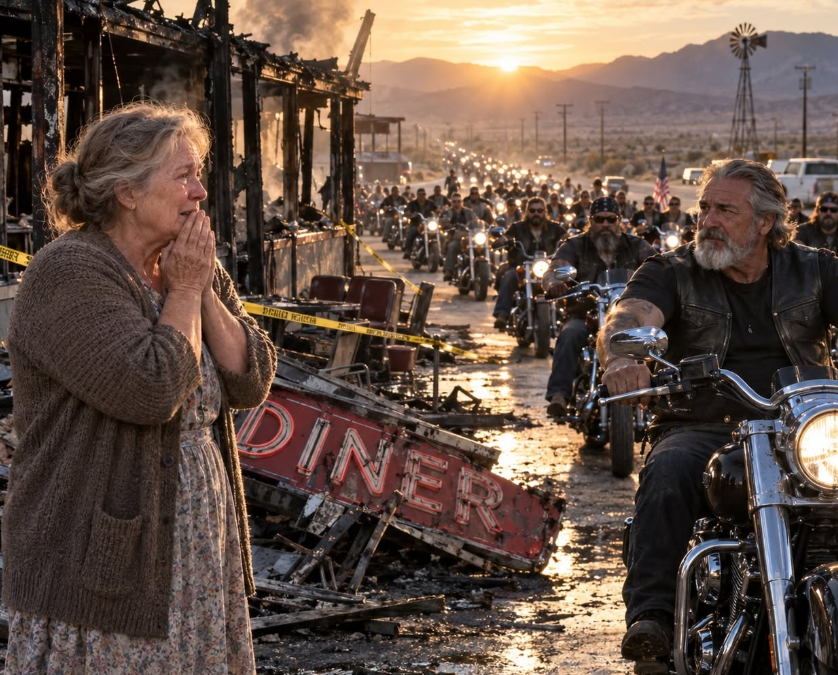
PART2:
The Red Lantern Diner sat six miles outside Cedar Flats, Nevada, along Highway 18 where truckers, ranch hands, tourists, construction crews, and people driving somewhere they didn’t want to go stopped because our coffee was hot and our bathrooms were clean.
Patrick and I opened the place when I was thirty-two.
He was thirty-four.
We had $8,400 in savings.
A borrowed grill.
Two used refrigerators.
A commercial coffee maker that leaked from day one.
And enough confidence to qualify as a shared mental illness.
Patrick had been an auto mechanic.
I had waited tables since I was sixteen.
We thought that combination meant we understood restaurants.
It did not.
Our first year nearly killed us.
We worked seventy-hour weeks.
Argued about food costs.
Burned biscuits.
Mispriced half the menu.
Forgot payroll taxes once.
Learned why health inspectors hate home-canned salsa.
Then somehow the place survived.
So did we.
We raised our daughter Emily there.
She learned to count change before multiplication.
Did homework in booth six.
PART3:
Slept across two chairs during late-night snowstorms.
Every birthday, Patrick marked her height on the pantry doorframe.
Pencil.
Date.
One little horizontal line.
Thirty years of life can hide inside things nobody else would think to save.
That was what burned.
Not tables.
Memory.
Patrick died five years before the fire.
One February morning, he made coffee.
Complained that I had bought the wrong brand of bacon.
Carried a box of frozen hash browns into the walk-in cooler.
Then never came back out.
Heart attack.
Massive.
The ambulance crew worked on him between sacks of potatoes and a case of orange juice.
I watched through the kitchen window.
Afterward, for almost a year, I still put two cups beside the coffee machine each morning.
One black.
One with cream.
His.
Mine.
Then I would remember.
Five years later, I still did it occasionally.
Grief does not disappear.
It becomes inefficient.
You learn to work around it.
The diner was how I worked around mine.
That was why Walter Mercer never understood my answer.
Walter was sixty-eight.
Local boy turned local king.
His family owned Cedar Flats Community Bank.
Mercer Construction.
Mercer Aggregates.
Commercial property from the interstate interchange almost to the county line.
He had financed ranches.
Campaigns.
Equipment purchases.
Two county commissioners.
At least, that was what people joked.
No one laughed loudly.
Walter wanted to build the largest truck plaza on Highway 18.
Fuel islands.
Repair bays.
Fast-food franchises.
Hotel.
Casino annex if gaming approval came through.
Twelve-million-dollar development.
There was only one problem.
The ideal entrance needed my corner.
Five and a half acres.
Red Lantern Diner.
My house sat another half-mile back and was not part of the parcel.
The first offer came through a real-estate lawyer.
$180,000.
I declined.
Walter came personally after that.
He sat in booth four.
Ordered coffee he barely touched.
“Ruth, I respect what you and Patrick built.”
People start negotiations with respect when they are preparing to ignore your answer.
“I appreciate that.”
“Two hundred thirty thousand.”
“No.”
He smiled.
“That’s almost twice what the county assesses the parcel at.”
“I don’t care.”
“Everybody cares about money.”
“I care about the land.”
He looked around.
“It’s a diner.”
“Yes.”
“You can reopen somewhere else.”
“No.”
“Why not?”
“Because I don’t want to.”
That offended him.
Men accustomed to negotiation hate reasons they cannot improve.
Walter came back twice.
Last offer:
$300,000.
More money than I had ever possessed at one time.
I said no.
He leaned across the counter.
“Ruth, you’re sixty-three.”
“I’m aware.”
“Do you really want to be working here at seventy?”
“Maybe.”
“Patrick wouldn’t want you struggling.”
That was the moment I stopped being polite.
“You never knew what Patrick wanted.”
Walter sat back.
“Fair enough.”
He left a business card.
I threw it away.
Then came Chase.
Walter’s only son.
Twenty-seven.
Private-school confidence.
Expensive boots.
A face still young enough to believe consequences were something older people invented.
Three nights before the fire, Chase came in fifteen minutes before closing.
No food.
Whiskey breath.
Sat at the counter.
“You’re costing us money.”
I continued wiping the coffee machine.
“Then stop offering me yours.”
He smiled.
“Dad says you’re stubborn.”
“Your dad says a lot.”
“This project creates ninety jobs.”
“Good.”
“So why are you fighting it?”
“I’m not fighting it.”
I put the towel down.
“I’m keeping what’s mine.”
He laughed.
“You think that diner matters?”
“It matters to me.”
“It’s old.”
“So am I.”
“You could retire.”
“I don’t want to.”
He leaned closer.
“Sometimes people lose things because they don’t know when to let go.”
There are threats you can explain away.
Then there are sentences that leave something cold behind.
I stared at him.
“Are you threatening me?”
His smile widened.
“I’m giving advice.”
He left a twenty-dollar bill for a three-dollar coffee.
I put the change on the counter.
He left it.
I threw the whole twenty into the tip jar for my waitress.
I should have called Sheriff Nolan Briggs.
I didn’t.
That is something people criticized later.
Why didn’t you report the threat?
Because Cedar Flats was small.
Because Walter Mercer had financed Briggs’s reelection fundraiser.
Because Walter’s construction company had built the sheriff’s new substation at cost.
Because Walter knew judges.
County staff.
Fire officials.
Business owners.
Because power in a small town rarely needs to announce itself.
You feel it in which stories stop being told when certain people enter a room.
Two nights later, Chase’s pickup rolled behind my diner at 12:16 in the morning.
Black Ford F-250.
Chrome headache rack.
Small dent above the right rear wheel.
I knew the truck.
Everybody did.
I had stayed late doing inventory.
I was outside with trash.
The pickup slowed.
Passenger window lowered.
Something came out.
A bottle.
Maybe.
There was cloth sticking from the top.
It hit the side window.
Glass shattered.
Then flame.
For years I replayed those three seconds.
Could I have seen Chase clearly enough?
Yes.
Streetlight near the propane cage.
Truck paused.
His face turned.
I saw him.
Would a lawyer call three seconds reliable?
That became another question.
But I knew.
He knew I knew.
And Sheriff Nolan Briggs knew exactly what my accusation meant.
He arrived at 2:40.
Fire mostly controlled.
Building destroyed.
Smoke hanging low.
He stood beside me near the road.
“Fire marshal thinks electrical.”
I turned.
“He has been here twenty minutes.”
“He saw heavy burn in the kitchen.”
“The bottle went through the side window.”
Briggs rubbed his jaw.
“Ruth.”
“I saw Chase Mercer.”
“Did you see him throw anything?”
“Yes.”
“Clearly?”
“I just said I did.”
“It was dark.”
“There was a light.”
He looked toward the ruins.
“Old buildings have wiring problems.”
“The wiring was replaced eleven months ago.”
Silence.
“By Peterson Electric.”
“I know.”
“Then why are you telling me electrical?”
His eyes finally met mine.
And I saw it.
Fear.
Not fear of arson.
Fear of Walter.
He lowered his voice.
“Walter owns half this county.”
“So?”
“So if you accuse Chase publicly and can’t prove it, Walter will bury you.”
“I’m not asking Walter for permission.”
“I’m trying to protect you.”
“By writing a false report?”
His face tightened.
“The preliminary report isn’t final.”
“My insurance adjuster called before sunrise.”
That surprised him.
“What?”
“They already know you’re calling it possible faulty wiring.”
He said nothing.
“If this becomes owner-maintenance negligence, they can fight the claim.”
“Ruth—”
“I replaced the wiring.”
“I know.”
“Then write what I told you.”
He looked away.
“Let the investigation happen.”
I laughed.
Not because anything was funny.
“What investigation?”
He left without answering.
For three days, Cedar Flats became a town full of people suddenly very interested in looking elsewhere.
I went to the grocery store.
Mrs. Harlan, who had eaten pancakes at my diner every Sunday for nineteen years, saw me near produce.
Turned down another aisle.
At the pharmacy, a man from the tire shop told me he was sorry.
Then lowered his voice.
“You should take Mercer’s offer.”
“There is no diner anymore.”
“Land’s still there.”
“That makes me want to sell less.”
He looked frightened.
“You can’t fight them.”
That sentence followed me home.
You can’t fight them.
Insurance said investigation pending.
The bank that held my small remaining business loan happened to be Cedar Flats Community Bank.
Walter’s bank.
The loan officer called.
Very sympathetic.
Asked whether I intended to rebuild.
Too early to know.
He reminded me that destruction of the primary operating structure could trigger collateral revaluation.
Meaning they might call the note.
Another pressure point.
Walter sent no message.
Chase did.
Not with words.
Fourth morning.
7:10.
I was drinking coffee on my porch.
His black pickup came slowly down the road.
Stopped at my mailbox.
Window lowered.
Chase looked at me.
Smiled.
Then drove away.
No threat.
No gesture.
Just confidence.
That smile said:
Nobody is coming.
For about ten minutes, I believed him.
Then I walked inside.
Patrick’s photograph stood on the mantel.
Same one from our twenty-fifth anniversary.
His hair had already gone mostly gray.
His tie was crooked.
He hated ties.
Beside the frame lay a steel emblem.
Motorcycle wheel.
Wings.
Small banner beneath:
IRON SHEPHERDS RC.
Patrick kept it in the junk drawer for years.
After he died, I moved it beside his photograph.
Ten summers before the fire, a mountain storm trapped nearly seventy riders around Cedar Flats.
It was supposed to be August rain.
Turned into hail.
Wind.
Flash flooding.
Road closure.
Most motel rooms were already full because of a construction project.
One motel manager refused the riders entirely.
“Too much trouble.”
Two restaurants closed early when they saw the patches.
The Red Lantern stayed open.
Patrick looked through the front window at drenched men and women clustered beneath the awning.
“They’re wet.”
“Yes.”
“Wet people still eat.”
That was Patrick.
Not a speech.
Just category correction.
Bikers.
Wet people.
Feed them.
They came inside.
Dripping leather.
Mud.
Loud voices.
One woman had blood on her knee from dropping her bike.
Patrick found dry towels.
I made soup.
Eggs.
Burgers.
Coffee.
We pushed tables together.
Turned up the heat.
Some slept in booths after the roads closed.
Their road captain was Samuel Knox.
People called him Preacher.
Not because he was religious.
Because once he started talking, apparently he could continue until civilization ended.
He was big.
Black beard then.
Former Army chaplain’s assistant, oddly enough.
Worked construction management.
He tried giving Patrick several hundred dollars above the bill.
Patrick counted the cash.
Handed most back.
“Food costs what the menu says.”
Preacher pushed it forward.
Patrick pushed it back.
“Kindness isn’t on the bill.”
Preacher remembered.
When Patrick died five years later, I looked out from the funeral home and saw thirty motorcycles waiting.
No one invited them.
They rode behind the hearse.
At the cemetery, Preacher placed the steel emblem in my palm.
“You need us, call.”
I nodded.
Never planned to.
Pride hides behind respectable names.
Independence.
Privacy.
Not wanting to burden people.
Five years passed.
Now I took Patrick’s photograph from the mantel.
Behind it, in my handwriting, was Samuel’s phone number.
Old Arizona area code.
I dialed.
Three rings.
“Yeah?”
“Samuel?”
Silence.
Then:
“Ruth?”
My throat closed.
“Yes.”
“Jesus.”
He sounded immediately alert.
“What happened?”
No hello.
No polite catching up.
What happened.
I sat on the couch.
Then told him.
The offers.
Chase.
Threat.
Fire.
Briggs.
Insurance.
Bank.
Silence in town.
Samuel did not interrupt once.
When I finished, he asked:
“Are you safe right now?”
“I think so.”
“That isn’t what I asked.”
I looked toward the window.
“Yes.”
“Doors locked?”
“No.”
“Lock them.”
“Samuel.”
“Please.”
I locked the door.
Returned.
“I’m not asking you to hurt anyone.”
“I know.”
“I mean that.”
“So do I.”
“No fighting.”
“Ruth.”
His voice softened.
“Patrick would crawl out of the ground and kill me himself.”
That made me laugh unexpectedly.
Then cry.
I hated that.
“I’m sorry.”
“For what?”
“Calling after five years.”
“That isn’t something you apologize for.”
“What are you going to do?”
Long pause.
Then:
“We’re going to come drink coffee.”
“There’s no diner.”
“I heard.”
“I only have one coffee pot.”
“We’ll bring thermoses.”
Click.
Samuel hung up.
I slept badly.
At 4:52 the next morning, my bedroom window rattled.
I opened my eyes.
Thunder.
Except the sky was clear.
The sound grew.
Deep.
Rhythmic.
Hundreds of cylinders overlapping.
I put on slippers.
Walked outside.
Far down Highway 18, lights appeared over the ridge.
One.
Then ten.
Then a line.
Headlights stretched so far I could not see where they ended.
I whispered:
“Patrick.”
Motorcycles came toward Cedar Flats in disciplined formation.
No racing.
No wild revving.
Just a river of machines.
Later, Samuel told me the final count was 317 riders.
Five states.
Different clubs.
Veteran groups.
Independent riders.
Some people who had never met me.
One man had eaten at the Red Lantern fifteen years earlier while driving his father to hospice in California.
I did not remember him.
He remembered that Patrick refused to charge for his father’s soup because the old man could only swallow three bites.
A woman from Utah remembered sleeping in booth three during a snowstorm after her car broke down.
A truck driver remembered me mailing his wallet back when he left it beneath a ketchup bottle.
Stories I had forgotten had apparently kept moving without me.
Samuel’s bike came first.
He parked at my curb.
Helmet off.
He had aged.
White through the beard.
Deep lines.
Left knee stiff when he climbed off.
Still unmistakably Preacher.
He reached the porch.
I said:
“You brought three hundred people.”
“Three seventeen.”
“That’s worse.”
He hugged me.
I started crying.
Again.
“I made it through a fire without crying this much.”
“Maybe I smell worse.”
“You do.”
Behind him, riders began unloading folding tables.
Water.
Coffee urns.
Food.
Portable toilets.
Trash cans.
Samuel had organized a temporary camp more efficiently than half the county.
I stared.
“What are they doing?”
“Spending the day.”
“Why?”
“Because people pay attention when three hundred motorcycles appear.”
“I don’t want intimidation.”
“Good.”
He pointed at a woman approaching.
“Meet Carla Jennings.”
Carla looked about sixty.
Silver hair.
Jeans.
Work boots.
No club vest.
“Retired fire investigator.”
Next.
“Rachel Price. Civil attorney.”
Next.
“Devon Bell. Electrical contractor.”
Next.
“Frank Rojas. Commercial builder.”
Then:
“Lenny Shaw. Former insurance adjuster.”
Two journalists.
A forensic accountant.
A nonprofit director.
A retired deputy attorney general.
I stared at Samuel.
“You brought an army of paperwork.”
“Scariest kind.”
That made me laugh for the first time since the fire.
Samuel’s rule to everyone was simple.
Spend money.
Be polite.
Ask questions.
Don’t threaten anyone.
Do not block roads.
Do not interfere with police.
And absolutely no burnouts in Cedar Flats.
Apparently the last rule caused disappointment.
Carla spent four hours in the ruins.
She did not touch anything the county had officially retained as evidence.
Photographs.
Measurements.
Visual inspection from lawful access areas.
She asked for fire-scene images.
They had already been taken.
By noon, she stood beside me with soot on her jeans.
“This wasn’t electrical.”
My knees weakened.
I knew.
Still.
Professional words matter.
“What do you see?”
“Probable low burn origin near the side window.”
“The bottle.”
“Could be.”
“Accelerant?”
“Patterns suggest it.”
“The marshal said kitchen wiring.”
She looked toward the collapsed kitchen.
“Fire traveled into the kitchen.”
“Can you prove arson?”
“Not standing here.”
Hope dropped.
Carla touched my arm.
“But I can say the current theory deserves independent review.”
Rachel, the attorney, already had public-records requests drafted.
Fire dispatch.
Scene logs.
Body-camera video.
911 audio.
County fire photographs.
Sheriff reports.
Communications involving the Mercer property project.
She worked quickly.
“Why are you helping me?”
Rachel looked confused.
“Preacher asked.”
“That can’t be enough.”
She smiled.
“My brother rides with him.”
Still.
“You don’t know me.”
“No.”
She closed her folder.
“But I know how intimidation works.”
Across the highway stood an abandoned feed store.
Behind it, a small storage business.
One rider noticed security cameras.
That observation changed everything.
The storage owner lived in Reno.
Rachel called.
He agreed to review recordings.
At 2:17, an email arrived.
Video.
12:12 a.m.
Highway 18.
Black Ford pickup heading toward the Red Lantern.
12:21.
Same truck returning.
Plate visible.
Registered to Chase Mercer.
I sat down.
Samuel stood beside me.
“That proves his truck passed.”
“Yes.”
“Not the fire.”
“Correct.”
I appreciated that.
People seeking justice become vulnerable to believing every convenient fact proves everything.
Rachel refused that.
Then came more.
Gas station twenty miles east.
Security footage.
11:42 p.m.
Chase Mercer purchasing two plastic fuel cans.
Credit card receipt.
His card.
One camera caught him filling them.
Samuel watched.
“Not exactly Moriarty.”
“Who?”
“Criminal mastermind.”
“I know who Moriarty is.”
“Then why—”
“I wanted to hear your explanation.”
He stared.
“Patrick was right about you.”
“What did he say?”
“That you were mean.”
I almost smiled.
Evidence came slowly.
A waitress named Nikki at Cedar Café approached one rider.
Chase had been drinking there before the fire.
Said:
“Old lady will cave.”
Another customer heard:
“By next week that corner is ours.”
A mechanic named Dale admitted Chase came in the morning after the fire with scratches along the passenger side of the truck.
“What caused them?”
“He said brush.”
“Did you photograph it?”
“No.”
“Any invoice?”
Dale went inside.
Found one.
Passenger-side paint repair.
Time stamped 8:13 a.m.
The fire started shortly after midnight.
Still circumstantial.
Then a woman named June Holloway came to my house.
Seventy-four.
Lived behind the old feed store.
She had avoided police.
“I saw headlights.”
Her hands shook.
“I saw the truck stop.”
“Did you see Chase?”
“No.”
That mattered.
Rachel did not lead her.
“What did you see?”
“Somebody got out.”
“Man or woman?”
“Man, I think.”
“Could you identify him?”
“No.”
June cried.
“I’m sorry.”
I held her hand.
“You told the truth.”
That is all witnesses owe.
Not certainty they do not have.
By afternoon, Cedar Flats was full of riders eating in restaurants.
Buying gas.
Purchasing hardware they did not need.
Talking.
Listening.
People who had avoided me began approaching.
Not because bikers threatened them.
Because silence became visible.
When three hundred strangers openly asked:
“What happened to Ruth’s diner?”
local people had to hear themselves answer.
“I don’t know.”
Or:
“Everybody knows.”
Those two sentences cannot live together comfortably.
A feed-store employee told a reporter Walter had pressured his landlord to terminate a lease because the property sat inside the proposed plaza zone.
A retired surveyor said project maps had been revised several times specifically around my parcel.
A former Mercer Construction foreman said Chase joked months earlier:
“We’ll get the old lady out.”
Again, not proof of arson.
Pattern.
Pressure.
Motive.
Then Sheriff Briggs arrived.
Evening.
He parked away from the motorcycles.
Walked up carrying his hat.
Samuel sat beside me.
Briggs looked at him.
“Mr. Knox.”
“Sheriff.”
“Nobody here is breaking laws.”
“I know.”
Briggs sounded tired.
I held up the camera still.
“You wrote there were no suspicious vehicles observed.”
His eyes closed.
“I know.”
“Chase’s truck passed twice.”
“I saw the footage.”
“You saw it today.”
“Yes.”
“Your report was written four days ago.”
“Yes.”
He looked older than sixty.
I asked:
“Why?”
He stared at the yard.
Then:
“I was afraid.”
There.
Truth.
Plain.
Ugly.
“Of Walter?”
“Yes.”
“Why?”
“He has friends.”
“So do I, apparently.”
Samuel almost laughed.
Briggs did not.
“I’ve got twenty-two years here.”
He rubbed his forehead.
“My wife works at Mercer Bank.”
I did not know that.
“Walter financed my brother’s equipment business.”
Another thread.
“He supported my campaign.”
I felt sick.
“I told myself I was preventing escalation.”
“No.”
My voice sounded harder than I felt.
“You were protecting yourself.”
Briggs nodded.
“Yes.”
That surprised me.
No excuse.
No argument.
Just yes.
“I contacted state investigators this afternoon.”
“When?”
“After I watched the footage.”
Samuel asked:
“And corrected your report?”
“I filed a supplemental.”
“Supplemental isn’t correction.”
Briggs looked at me.
“I’ll amend it.”
“Will you tell them what I told you the first night?”
“Yes.”
“Will you tell them you discouraged me from naming Chase?”
His jaw tightened.
“Yes.”
It was not forgiveness.
It was evidence.
State investigators arrived the next morning.
So did the state fire marshal.
The county fire investigation was formally reviewed.
Evidence from the ruins was reexamined.
A trained accelerant-detection dog alerted near the side wall debris.
Lab testing later found petroleum distillates inconsistent with normal electrical failure.
Not magic proof.
Combined with surveillance.
Fuel cans.
Timing.
Witness statements.
Cell-site data.
A search warrant.
Investigators located one fuel container in a Mercer Construction waste bin.
Chase’s fingerprint on the handle.
His attorney argued it came from ordinary company use.
Possible.
Then investigators obtained store inventory and purchase records matching the pair he bought.
The second container was never found.
Phone location data placed Chase’s device near the diner.
His defense argued cell-sector range was broad.
Also true.
Then they found text messages.
Walter to Chase, three days before the fire:
Stop bothering Ruth. I will handle the acquisition legally.
That helped Walter.
Another message from Chase to a friend after leaving Cedar Café:
Old bat wants history. Maybe she gets ashes.
I read that line once.
Never again.
Chase was arrested.
Arson.
Property destruction.
Witness intimidation allegations came later after someone connected to him tried pressuring June Holloway to “clarify” her statement.
Walter hired lawyers.
Very expensive ones.
He also held a press conference.
“I had no knowledge of my son’s alleged actions.”
I believed him.
At least regarding the fire.
People wanted Walter to be the secret mastermind.
Reality was more complicated.
Walter had created pressure.
Entitlement.
A culture around Chase that taught him no was temporary.
But investigators found no evidence Walter ordered arson.
That distinction mattered to me.
Truth that helps your enemy remains truth.
What changed was public attention.
Insurance suddenly moved faster.
My claim shifted from maintenance dispute to suspected criminal loss.
The bank stopped threatening immediate collateral review after Rachel sent a letter citing potential lender conflict and preservation duties.
County commissioners publicly called for independent investigation.
Briggs placed himself on temporary administrative leave.
One of the biggest lessons I learned was that 317 motorcycles did not create evidence.
They created attention around evidence.
That was different.
Samuel understood from the beginning.
“I didn’t bring riders to scare Walter.”
He told a reporter that.
“Then why bring them?”
“To make sure Ruth stopped being alone in rooms where everyone else had reasons to stay quiet.”
That quote traveled.
Walter came to see me six days later.
Alone.
No attorney visible.
He stood beside the burned foundation.
Suit pants dusty.
For once, his shoes looked like they belonged on my property.
“I didn’t tell Chase to do this.”
“I know.”
He seemed surprised.
“The investigators told you?”
“No.”
“I just don’t think you did.”
His shoulders lowered.
Then I said:
“But you taught him something.”
“What?”
“That your family doesn’t hear no.”
His face tightened.
“I never taught him to burn anything.”
“No.”
“You think this is my fault?”
“I think Chase is responsible for Chase.”
Walter nodded.
I continued.
“And I think powerful fathers should consider what their sons learn watching everybody else move when they ask.”
That hurt him.
I saw it.
Good.
Not because pain equals justice.
Because sometimes truth needs somewhere to land.
“I wanted the property.”
“I know.”
“I still think it’s the best location.”
“Then you still don’t understand the conversation.”
He looked at the ruins.
“I’m withdrawing every offer.”
“Good.”
“My company will pay uninsured rebuilding costs.”
I laughed.
“No.”
“Ruth.”
“No hush money.”
“Not hush money.”
“What do you call it?”
He thought.
“Responsibility.”
Maybe.
Or reputation management.
Motives are rarely pure.
Rachel negotiated anyway.
Everything written.
No claim on my property.
No purchase option.
No confidentiality clause.
No naming rights.
No future development easement.
Mercer companies funded the insurance gap through a civil settlement agreement without admission of liability by Walter personally.
I accepted.
Some people criticized that too.
“How can you take his money?”
Because lumber suppliers do not accept moral purity.
Because justice does not require me to bankrupt myself proving I dislike someone.
The agreement paid for materials.
That money became walls.
Samuel asked how long rebuilding would take.
Contractor estimated ten months.
Preacher laughed.
Apparently that was a declaration of war against calendars.
Monday morning, trucks came.
Lumber.
Concrete forms.
Electrical conduit.
Roof trusses.
Commercial kitchen equipment donated by a restaurant-equipment dealer whose owner rode with the Iron Shepherds.
Then people started arriving with tools.
The terrifying motorcycle army became:
Carpenters.
Electricians.
Plumbers.
Welders.
Painters.
HVAC technicians.
Concrete finishers.
Equipment installers.
A dentist named Rick who genuinely had no useful construction skill.
“I can pull teeth.”
“Not in my diner.”
“I also make good margaritas.”
“Still no.”
We hired licensed contractors where code required.
Permits.
Inspections.
Union rules.
No cowboy rebuilding.
Samuel insisted.
“Patrick would kill me if this place reopened and electrocuted someone.”
The town joined slowly.
At first one person.
Then five.
High-school football players hauled debris.
The grocery store donated lunches.
Church ladies brought pies.
I found that amusing because half of them had crossed away from me in public after the fire.
One woman, Evelyn Harlan, approached holding two apple pies.
“I’m ashamed.”
I took them.
“That makes two of us.”
She looked confused.
“For what?”
“For pretending I didn’t notice everybody pretending not to notice.”
Evelyn started crying.
“I should have called you.”
“Yes.”
I did not soothe her.
Sometimes apology deserves to feel uncomfortable for a minute.
Then I hugged her.
Both things can be true.
Sheriff Briggs came one Saturday wearing jeans and an old T-shirt.
“What are you doing?”
“Samuel said you need painters.”
“You are on leave.”
“Painting trim isn’t law enforcement.”
His first coat streaked.
I made him redo it.
Samuel nearly fell off a ladder laughing.
Briggs eventually resigned rather than seek reelection.
The state found his initial handling of the fire improper and cited reporting failures, but investigators did not find evidence he took money to cover up arson.
Cowardice.
Conflict.
Bad judgment.
Not bribery.
That distinction mattered too.
He later worked private security in Reno.
Two years after rebuilding, he came in for breakfast.
Paid.
Tipped.
Sat alone.
I served him coffee.
We did not become friends.
Life does not require every wound to end in friendship.
But I stopped hating him.
The new Red Lantern took six months.
Not ten.
Still felt forever.
I insisted booth six go exactly where it had been.
Patrick’s booth.
I salvaged one bent piece of the original red neon sign.
Mounted it behind the counter.
Everything else became new.
Sprinklers.
Updated hood system.
Commercial suppression system.
Wide windows.
Accessible bathrooms.
Better insulation.
A larger kitchen.
Samuel kept pushing for more counter space.
“Why?”
“Because bikers take up room.”
“You are not a design standard.”
“Should be.”
During demolition, one rider found Patrick’s cast-iron skillet under collapsed shelving.
Blackened.
Warped.
Handle intact.
Samuel took it without telling me.
A metalworker cleaned it.
Straightened what could be straightened.
Seasoned it.
Opening morning, before sunrise, Samuel placed something wrapped in a towel on my counter.
“What did you steal?”
“Your optimism wounds me.”
I unwrapped it.
The skillet.
I recognized the notch Patrick had filed into the handle after dropping it in 1998.
My knees weakened.
I held it.
Thirty-one years.
Fire.
Still there.
That was when I finally cried for the diner.
Not the insurance call.
Not the arrest.
Not even the rebuilding.
The skillet.
Samuel looked at the ceiling.
“You bikers are terrible at emotion.”
“Correct.”
“I can’t repay this.”
He looked at me.
“Stop.”
“I mean it.”
“So do I.”
He touched the counter.
“You and Patrick paid ten years ago.”
“With eggs?”
“With a door.”
I stared.
He continued:
“Every other place saw wet leather and trouble.”
His voice softened.
“You saw cold people.”
I heard Patrick.
Wet people still eat.
Samuel smiled.
“People remember who let them inside when everyone else decided what they were before they entered.”
Outside, motorcycles began arriving for opening day.
Not 317.
Closer to ninety.
Enough.
Customers filled the parking lot.
Local families.
Truckers.
Reporters.
Workers who rebuilt.
People who had stayed silent.
People who later spoke.
Walter Mercer came too.
I did not expect him.
He entered alone.
No Chase.
Chase was awaiting trial.
Walter stood near the door.
People noticed.
Conversations changed.
I almost asked him to leave.
Then Patrick’s voice existed in my head.
Wet people still eat.
That rule becomes inconvenient when applied fairly.
Walter sat at the counter.
I approached.
“What do you want?”
“Coffee.”
“Anything else?”
He looked toward booth six.
“Whatever breakfast special is.”
I served him.
He paid.
Left a normal tip.
No speech.
No redemption scene.
That was better.
Chase eventually accepted a plea agreement.
Arson of an occupied commercial property was debated because I had been outside, not inside, when the accelerant was thrown.
Charges included first-degree arson under applicable state law, property destruction, and other related offenses.
He received prison time.
People online wanted longer.
Some wanted his life destroyed forever.
I understood the anger.
But the courtroom was not there to satisfy my imagination.
It was there to assign legal consequences.
At sentencing, I spoke.
Chase looked smaller in jail clothes.
I expected satisfaction.
Didn’t feel it.
I told the judge:
“I don’t want him punished because he burned something sentimental.”
I looked at Chase.
“I want accountability because he believed another person’s no could be removed with fire.”
He looked down.
“That belief is dangerous.”
I continued.
“My diner can be rebuilt.”
“My husband’s things cannot.”
“But the worst thing he tried to burn was my right to decide what happened to my own property.”
The judge listened.
I did not ask for maximum time.
Did not ask for mercy either.
I asked that the sentence reflect what happened.
That was enough.
Walter sold several businesses over the next five years.
Not because the case ruined him entirely.
People love dramatic collapse.
Real wealthy men often remain wealthy after consequences.
His reputation changed.
County politics changed.
Mercer Construction lost public contracts after conflict rules tightened.
The bank underwent regulatory review regarding related-party lending and disclosures.
Again, not because bikers intimidated anyone.
Because attention produced scrutiny.
Scrutiny found problems.
Some serious.
Some ordinary.
Some corrected.
Cedar Flats changed too.
Slowly.
The year after the fire, a rancher named Luis Herrera faced pressure from a company trying to buy his water rights.
Twenty-eight residents attended the county meeting.
Before my fire, maybe three would have.
An immigrant landscaping crew filed wage complaints against a large employer.
Local business owners donated to their legal fund.
People who once whispered began signing statements.
Not everyone became brave.
Towns do not transform like movie characters.
But silence had acquired a cost.
People had seen what nearly happened when everyone assumed someone else would speak.
The Red Lantern became busier than before.
That caused a problem.
I was sixty-four.
My body had not received the memo that justice required fourteen-hour breakfast shifts.
Emily came home from Oregon.
My daughter was thirty-seven then.
Married.
Two children.
Worked in hospital administration.
She walked behind the counter, watched me carry three plates, and said:
“Absolutely not.”
“What?”
“You’re hiring a manager.”
“I am the manager.”
“You are a public-health emergency.”
“I’ve done this thirty years.”
“Exactly.”
She stayed three months.
Helped create schedules.
Inventory software.
Supplier contracts.
Then convinced me to hire a general manager named Tessa.
I hated the idea.
Then enjoyed Tuesdays off so much that I pretended it had been mine.
Every summer, the Iron Shepherds returned.
Not always hundreds.
Twenty.
Fifty.
Sometimes more.
Samuel aged.
His left knee worsened.
He switched from a heavy touring motorcycle to a trike at seventy-two.
Complained for six months.
“It’s stable,” I told him.
“That’s the problem.”
“You resent stability?”
“On three wheels, yes.”
He still ordered coffee black.
Two eggs.
Hash browns crisp.
Rye toast.
Same thing Patrick used to eat.
I never mentioned that.
Maybe Samuel knew.
Maybe not.
At sixty-eight, I finally reduced myself to three shifts a week.
Emily called that “partial surrender.”
At seventy, I stopped opening.
Still came in.
Sat at booth six.
Corrected everybody.
A restaurant can survive an owner not personally controlling every pancake.
I discovered this reluctantly.
One rainy afternoon, Samuel and I sat near the window.
Highway wet.
Few customers.
He asked:
“Why didn’t you sell?”
“Again?”
“Back then.”
“I told you.”
“Patrick.”
“Yes.”
“That all?”
I looked around.
The rebuilt walls.
New counter.
Old skillet mounted above the kitchen pass because inspectors politely requested I stop cooking with a fire-damaged heirloom.
“No.”
“What else?”
I thought.
“When Patrick died, everybody wanted me to change my life.”
Samuel listened.
“Move closer to Emily.”
“Sell the diner.”
“Travel.”
“Rest.”
“Start over.”
I traced a water ring on the table.
“Nobody meant harm.”
“But?”
“I didn’t want a new life yet.”
Samuel nodded.
“The diner gave me a reason to get up before grief decided I didn’t need one.”
He looked toward the counter.
“That makes sense.”
“Walter thought I was attached to a building.”
“You were.”
“Yes.”
I smiled.
“But people act like attachment is stupidity when they want what you’re attached to.”
Samuel laughed softly.
“That’s good.”
“I’ve had seventy years to become profound.”
“You’re seventy-one.”
“Then I’m ahead.”
Patrick’s memory changed over time.
For years, the diner felt like him.
Then eventually it felt like ours again.
Then mine.
Then everybody’s.
That did not betray Patrick.
I once feared it would.
Grief can turn preservation into obligation.
You start thinking love means keeping every chair where it was.
Every recipe unchanged.
Every habit intact.
Rebuilding cured me of that idea better than any advice.
The old Red Lantern burned.
The new one had wider aisles.
Different stove.
New roof.
Yet Patrick remained inside it because memory does not require original walls.
Samuel taught me that without meaning to.
So did fire.
A terrible teacher.
Still a teacher.
When Samuel was seventy-four, he had a stroke.
Mild, according to doctors.
Nothing feels mild when your friend cannot form words correctly.
I drove to Reno.
Found him furious in rehab.
He pointed at a cup.
“Coffee.”
The therapist said:
“He needs thickened liquids right now.”
Samuel looked betrayed by civilization.
I sat beside him.
“You look terrible.”
He tried to swear.
Only half the word came out.
“Language.”
He glared.
For months, speech returned slowly.
Walking improved.
Riding did not.
He had to stop motorcycles.
That loss hurt him.
People said:
“At least you’re alive.”
True.
Unhelpful.
I remembered what he had done for me.
Showed up.
So every Thursday, I drove three hours.
Brought diner food.
Read bad newspapers aloud.
Listened while he practiced words.
When frustration made him throw a plastic spoon, I retrieved it.
“No property destruction.”
He eventually regained enough speech to say:
“You are unbearable.”
I cried.
He rolled his eyes.
Years earlier, he had come when I called.
Now I went.
No account.
No debt.
Just relationship.
That was the part Chase had never understood about power.
He grew up thinking power was control over outcomes.
Money.
Property.
Sheriff.
Bank.
Silence.
Samuel understood a different kind.
The kind built through memory.
Showing up.
Feeding someone.
Answering a phone after five years.
That kind of power cannot be purchased quickly.
It accumulates quietly.
A free coffee.
A booth offered to a stranded traveler.
A mechanic paid fairly.
A waitress defended from a rude customer.
A funeral attended.
A name remembered.
You never know where those small acts go after they leave you.
Patrick and I certainly didn’t.
We fed seventy wet bikers because they were hungry.
No strategy.
No network building.
No imagined future return.
That is why what came back years later meant so much.
Kindness done as investment is business.
Kindness done without expectation becomes memory.
Memory travels.
Samuel died at seventy-eight.
Not on a motorcycle.
Not dramatically.
Pneumonia after another stroke.
I sat beside him two days before.
He could still speak.
Slowly.
“Ruth.”
“Yes?”
“Coffee.”
“You are in hospice.”
“Coffee.”
“The nurse says no.”
“Coward.”
I wet a sponge with black coffee and touched it to his lips.
He smiled.
“Better.”
We sat quietly.
Then he whispered:
“Patrick.”
“What about him?”
“Good man.”
“I know.”
He looked at me.
“You too.”
I laughed.
“Don’t get sentimental now.”
“Too late.”
He squeezed my hand.
Very weak.
“Keep door open.”
I knew what he meant.
Not literally.
The Red Lantern locked at night.
He meant Patrick’s rule.
Wet people still eat.
People before categories.
I promised.
At Samuel’s funeral, motorcycles lined six blocks.
I rode in a car.
My hips had declared war on motorcycles years earlier.
Emily came.
So did half of Cedar Flats.
Sheriff Briggs came quietly and stood in the back.
Walter Mercer did not.
I spoke.
Told the storm story.
The fire.
The phone call.
But I did not describe Samuel as the man who saved me.
Because he hated false simplicity.
“Preacher didn’t save the Red Lantern alone.”
I looked at hundreds of faces.
“He made one call.”
“Then another person made one.”
“Then another.”
“Carla brought expertise.”
“Rachel brought law.”
“Three hundred seventeen riders brought attention.”
“Locals brought testimony.”
“Investigators brought evidence.”
“Workers brought tools.”
“Insurers brought money they owed.”
“Walter brought money he needed to pay.”
“Cedar Flats brought shame, courage, food, paint, labor, and eventually a little backbone.”
People laughed.
“He did something simpler.”
I touched the steel emblem pinned inside my jacket.
“He made sure I did not stand alone long enough for fear to become the only voice in the room.”
That was the truth.
Years after Samuel died, a young waitress at the Red Lantern asked me:
“Was Chase Mercer really that evil?”
I thought.
“No.”
She looked surprised.
“He burned your diner.”
“Yes.”
“Isn’t that evil?”
“What he did was.”
I folded a napkin.
“But if you turn people into monsters, you stop asking how ordinary entitlement became something dangerous.”
She waited.
“Chase was spoiled.”
“Protected.”
“Arrogant.”
“Drunk that night.”
“Angry.”
“Used to hearing yes.”
“Then he made a criminal choice.”
I looked at her.
“That explanation does not excuse him.”
“It tells us what to watch for.”
She nodded slowly.
I had learned to resist simple stories.
Walter was not innocent.
Not guilty of the fire.
Briggs was cowardly.
Not necessarily corrupt for money.
Cedar Flats residents were afraid.
Not heartless.
The bikers looked intimidating.
Most spent the rebuilding arguing about building codes and coffee.
Humans ruin good narratives by being complicated.
I prefer truth anyway.
At seventy-three, I finally sold the Red Lantern.
People were shocked.
“You refused three hundred thousand from Mercer!”
“Yes.”
“Why sell now?”
“Because I want to.”
That was the point everyone missed.
Choice.
I sold it to Tessa, my general manager, and her husband.
Fair price.
Installments.
No corporate chain.
The deed included no ridiculous clause requiring the diner remain unchanged forever.
That would have turned my love into someone else’s burden.
I asked only one thing.
“Keep booth six if you can.”
Tessa smiled.
“It’s bolted down.”
“Everything can be unbolted.”
“We’re keeping it.”
Good enough.
I moved into a smaller house closer to Emily.
Not because Walter had been right.
Because five years earlier and ten years later are different lives.
Timing matters.
Consent matters.
A decision made freely is not the same as one forced by fire.
I still go to the Red Lantern every Thursday.
Same booth.
Coffee.
Eggs.
Sometimes tourists sit nearby beneath a framed photograph showing the opening-day crowd after the rebuild.
They ask:
“Is that the biker story?”
Tessa points at me.
“She was there.”
I say:
“I’ve heard rumors.”
One wall displays the steel Iron Shepherds emblem Samuel gave me.
Beneath it, a small brass plaque.
Patrick’s words:
KINDNESS ISN’T ON THE BILL.
I resisted putting it up.
Sounded sentimental.
Tessa ignored me.
Good managers know when owners are wrong.
Patrick’s restored cast-iron skillet hangs nearby.
The old warped one.
Too damaged for commercial use.
Perfect for memory.
My grandchildren know the story.
They prefer the dramatic version.
“Three hundred bikers came after the bad guy!”
“No.”
“Grandma.”
“They came for coffee.”
“That’s boring.”
“Truth often is.”
“Did they scare him?”
“Probably.”
“Did Preacher threaten him?”
“No.”
“Not even once?”
“Samuel threatened poor coffee constantly.”
They groan.
Maybe when they are older they will understand.
Violence would have helped Chase.
Imagine the headline:
OUTLAW BIKERS TERRORIZE NEVADA TOWN.
Suddenly the story becomes about them.
Ruth disappears.
Fire evidence disappears.
Walter becomes a victim.
Briggs becomes justified.
Samuel understood that.
Powerful people sometimes depend on your anger making you easier to dismiss.
So Samuel brought something harder to dismiss.
Order.
Witnesses.
Expertise.
Cameras.
Money spent in local businesses.
Legal requests.
Patience.
Visibility.
Three hundred seventeen people behaving better than expected became its own argument.
The morning after they arrived, one television reporter asked Samuel:
“Are the Iron Shepherds here to seek justice?”
He said:
“No.”
The reporter looked disappointed.
“What are you here for?”
“To make sure justice gets room to work.”
That answer became another phrase people printed on shirts.
Samuel hated the shirts.
He thought his face looked fat.
He was correct.
The Red Lantern fire happened eighteen years ago now.
I am eighty-one.
Cedar Flats has grown.
The proposed Mercer truck plaza was eventually built.
Not on my old property.
Three miles east.
Walter lived long enough to see it open.
He died at seventy-nine.
Chase got out of prison years earlier.
Worked construction somewhere in Idaho, last I heard.
He wrote me once.
A letter.
No request.
No excuse.
He said:
“I told myself you were an obstacle until I stopped thinking of you as a person.”
That line stayed with me.
I did not answer.
But I kept the letter.
Not because I forgave everything.
Because he finally named the mechanism.
Obstacle.
That is how people justify cruelty.
Turn a person into a category that sits between you and what you want.
Old lady.
Holdout.
Homeless man.
Troublemaker.
Biker.
Immigrant.
Addict.
Widow.
Then what you do to them feels less personal.
Patrick’s gift was the opposite.
He saw categories and corrected them back into people.
Wet people still eat.
That simple.
When Samuel called hundreds of riders, he did the same for me.
Not stubborn widow.
Not inconvenient landowner.
Ruth.
Patrick’s wife.
Woman who fed us once.
Person in trouble.
Come.
Sometimes I wonder what would have happened if I had never called.
Insurance might eventually have paid.
Maybe.
State investigators might have discovered the truth.
Maybe.
Someone might have found the cameras before footage was overwritten.
Maybe.
Briggs might have corrected himself.
Maybe.
The land might have ended up sold.
Maybe.
I do not tell the story to argue that bikers possess some magical moral power.
They don’t.
Some are wonderful.
Some are terrible.
Same as bankers.
Sheriffs.
Widows.
The miracle, if there was one, was not motorcycles.
It was connection.
I had one phone number.
One person who remembered being welcomed.
He had another number.
Then another.
By dawn, loneliness had turned into a network.
That can happen in less dramatic ways too.
A neighbor.
A lawyer.
A union.
A church.
A support group.
A family member.
One person who believes you enough to stand beside you while facts are gathered.
Isolation makes abuse efficient.
Community makes it expensive.
That is what I learned.
Not that every fight can be won.
Not that powerful people always lose.
Not that kindness guarantees repayment.
Nothing guarantees repayment.
Patrick died before any of those riders returned.
He never knew the storm night would matter years later.
He did not feed them for future protection.
That is precisely why the story matters.
We are too obsessed with return on investment.
What do I get?
Who owes me?
Will this benefit me?
Patrick fed cold strangers because they were cold.
I kept the diner because I loved it.
Samuel came because I called.
People testified because shame finally became heavier than fear.
Then life continued.
Messy.
Incomplete.
Real.
Every morning in my current house, I still occasionally take out two coffee cups.
Yes.
After all these years.
One black for Patrick.
One with cream for me.
Then I notice.
Smile.
Put one back.
Grief has become almost friendly now.
Not because losing him became good.
Because love remained long enough to stop feeling like an emergency.
Sometimes I drive out to the diner before sunrise.
Tessa lets me in.
I sit in booth six.
Highway dark.
Trucks passing.
Coffee steaming.
And if the weather is right, sound travels strangely across the desert.
A motorcycle far away can seem much closer.
For a second, I am sixty-three again.
Standing barefoot on my porch.
Windows shaking.
Headlights coming over the ridge.
I remember believing I had lost almost everything.
Patrick.
Diner.
Town’s courage.
My confidence.
Then 317 motorcycles appeared.
But the thing I remember most is not the sound.
It is what happened after the engines stopped.
People climbed off.
Took off helmets.
Introduced themselves.
Opened folders.
Carried toolboxes.
Asked questions.
Bought breakfast.
Found cameras.
Requested records.
Told the truth.
Built walls.
Painted trim.
Restored a skillet.
That is what saved the Red Lantern.
Not noise.
People.
So when someone tells the story now and says:
“Hundreds of bikers came to defend an old widow.”
I correct them.
They came because once, years earlier, my husband looked at seventy wet strangers everyone else feared and saw people who needed a warm room.
We gave them coffee.
Eggs.
Soup.
A place to sleep.
We did not know their occupations.
Their politics.
Their bank accounts.
Their usefulness.
We knew they were cold.
Years later, when my world burned, they remembered.
Not because kindness creates debt.
Because kindness creates memory.
And sometimes memory grows roots in people you never expect.
Sometimes it crosses state lines.
Sometimes it survives five silent years.
Sometimes it answers the phone on the third ring.
And sometimes, when a powerful man’s son believes one frightened widow is standing alone on five acres he wants, memory comes over the Nevada ridge before sunrise with 317 headlights behind it.
Chase Mercer burned down a diner because he thought fire could turn my no into yes.
He was wrong.
Walter Mercer thought money was the strongest power in Cedar Flats.
He was wrong too.
Sheriff Briggs thought fear could keep a town quiet forever.
Wrong again.
The strongest thing any of us had built was something nobody could see on a property map.
Thirty-one years of names.
Meals.
Open doors.
Favors.
Funerals.
Coffee.
The simple habit of treating strangers like people before asking whether they had earned it.
That kind of power takes decades to build.
You barely notice while you’re doing it.
Then one terrible morning, when everything you recognize has become ash, you hear engines in the distance and discover it was there all along.
Patrick knew.
Maybe that is why he never worried much about money.
“Take care of people,” he used to tell me.
“Most everything else is bookkeeping.”
I thought he was being sentimental.
Turns out he was explaining infrastructure.
The Red Lantern survived because of inspectors, insurance, lawyers, contractors, witnesses, evidence, neighbors, and money.
But the reason any of those people arrived together began ten years earlier with one locked door that Patrick chose to open.
So if there is one thing I know at eighty-one, it is this:
Open the door when you safely can.
Feed the cold person.
Learn the waitress’s name.
Return the wallet.
Show up at the funeral.
Believe the frightened neighbor long enough to ask another question.
Do not assume the person everybody fears is dangerous.
Do not assume the person everybody respects is safe.
And never mistake silence for agreement.
Sometimes silence is only fear waiting to discover it has company.
I was alone beside the ashes of my husband’s diner when the sheriff told me staying quiet would be easier.
For three days, I almost believed him.
Then I made one phone call.
By sunrise, the highway was shaking.
And when all those engines finally went quiet, Cedar Flats had to hear something it had spent years refusing to say aloud:
No family owns a town.
No amount of money turns another person’s property into your right.
And no widow is truly alone when enough people remember the door she once opened for them.