They Abandoned Their Old Cat at Pump Seven With a Blue Towel—A Year Later, the Girl Who Loved Her Walked Back In and Uncovered the Lie
PART3:
A cat does not give twelve years of her life to a house without learning every sound inside it. She knew the floorboards. She knew the couch. She knew the kitchen window where the sun warmed the sill in the afternoon. She knew the can opener and the rattle of dry food in a plastic bin. She knew footsteps. Hands. Voices. Anger. Laughter. Maybe grief. Maybe birthdays. Maybe the sound of someone crying into a pillow while she pressed her small body against the door.
And now she was sitting beside pump seven like some forgotten suitcase, still believing the right person was coming back.
I called the small animal clinic down the road.
“Dr. Harris,” I said when he answered, “somebody left an old cat at pump seven.”
There was a pause.
Not surprise. Not exactly.
Just the tired silence of a man who had spent thirty years learning how often people confuse helplessness with inconvenience.
“Is she injured?” he asked.
“Not bleeding. She’s old. Thin. Scared, maybe.”
“Can you bring her in?”
I looked at Nellie.
She was still watching the road.
“Yeah,” I said. “I can bring her.”
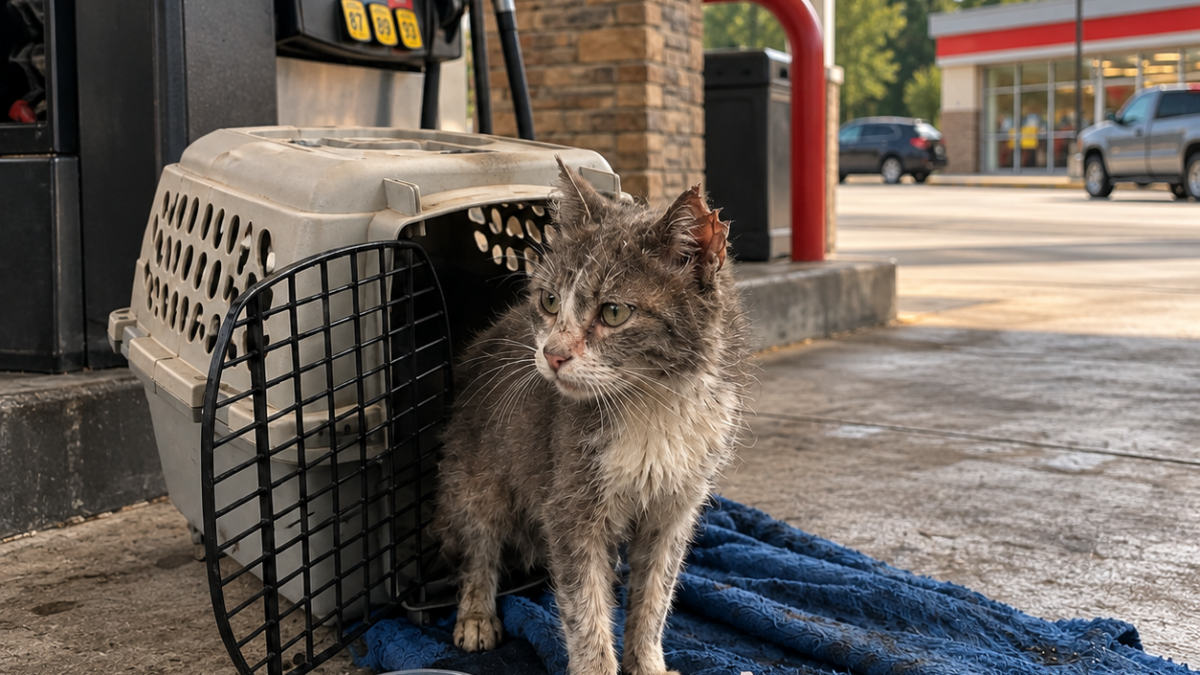
She did not fight when I touched the carrier. She did not claw or growl. She pressed both paws into the blue towel, leaned her body low, and stared through the holes in the plastic door as I carried her across the lot.
A customer at pump four watched me.
“Somebody dump that thing?” he asked.
That thing.
I wanted to turn around and say, “She has a name.”
Instead I said nothing, because if I opened my mouth, my voice would come out sharper than I could afford while wearing a name tag.
Inside the store, my coworker Raul looked up from restocking cigarettes.
“Oh no,” he said quietly.
“I have to take her to Harris.”
“I got the counter.”
“You sure?”
He looked toward the carrier. Nellie had gone perfectly still, only her eyes moving.
“Go,” he said. “Before I start hating everybody who walks in here.”
At the clinic, the bell over the front door rang when I entered.
Nellie’s head lifted.
A man in muddy work boots came out holding a beagle puppy.
Her head lifted higher.
The man walked past us.
Nellie watched him go.
A woman with a carrier wrapped in a fleece blanket came in behind me.
Nellie turned toward the door.
Not them.
Again and again, during the hour we were there, that bell rang and Nellie lifted her head. Every time, hope moved through her old body before disappointment gently crushed it back down.
Dr. Harris examined her with slow hands.
He was near sixty, tall and narrow, with wire-framed glasses and a face that could look stern until an animal leaned into him. He had been my vet back when my husband was alive and we had a mutt named Lucy who ate socks like they were religious offerings. He had also been the one who came to my house when Lucy’s hips gave out and my husband was already too sick to help me carry her to the car.
So when he touched Nellie’s torn ear and sighed, I knew he was not just seeing a stray.
He was seeing a life that had belonged somewhere.
“She’s around twelve,” he said. “Maybe thirteen. Dehydrated. Bad teeth. Arthritis in the hips. Some muscle loss. Fleas, but not terrible. She’s been cared for at some point.”
“At some point,” I repeated.
He looked at the note.
His jaw tightened.
“She needs quiet,” he said. “Soft food. Warmth. Pain management. A dental evaluation eventually, if she stabilizes. Mostly patience.”
“I can keep her tonight.”
“You sure?”
“No.”
He almost smiled.
“That’s usually the honest answer.”
“I work shifts. My house is small. I haven’t had a cat in years.”
“Nellie doesn’t need a perfect house tonight,” he said. “She needs a door that closes with her on the safe side.”
I looked at her in the carrier.
She was staring at the clinic entrance again.
I told myself I was only helping for one night.
Maybe two.
Just until someone from a rescue could take her. Just until Dr. Harris could make a call. Just until I figured out what came next.
People tell themselves little lies when their hearts are already making bigger decisions.
I brought Nellie home after my shift.
By then it was dark and colder. The gas station lights buzzed behind me as I carried her to my car. Pump seven stood empty under the canopy, the concrete wet and shining, like nothing had happened there at all.
That offended me in a way I could not explain.
Some places should look changed after what they witness.
My house sat six miles outside town, a small white place with green shutters that needed painting and a porch light that flickered whenever it rained. My husband, Daniel, had bought it with me when we were young enough to think every repair was an adventure. After he died, I kept saying I would move somewhere easier, somewhere without gutters to clean and a yard that grew wild if I blinked too long.
But every corner still had his fingerprints.
The loose step he meant to fix.
The dent in the pantry door from the time he tried to carry in a frozen turkey and slipped.
The pencil marks inside the laundry room where he measured our niece every summer until she got too old to care.
The house was quiet now. Too quiet most nights. I had gotten used to eating dinner standing at the sink, one hand on a plate, the other scrolling through nothing on my phone.
I set Nellie up in the laundry room with food, water, a litter box, a soft blanket, and her blue towel.
She ignored everything except the towel.
She curled on it facing the door.
I sat on the floor across from her for twenty minutes.
“You’re safe,” I said.
Her eyes stayed open.
“I know that doesn’t mean much from a stranger.”
Her torn ear twitched.
“You can hate me for a while if you need to.”
She did not hate me.
That would have required energy.
She simply watched the hallway like she expected her real life to walk through it any minute and explain this had all been a terrible mistake.
At midnight, I woke to a sound.
Not a yowl.
Not a scream.
One rough, broken cry.
I found her sitting in the laundry room doorway, staring down the hall. The food was untouched. The water had barely moved. Her body was small in the dark, outlined by the yellow light from the stove clock.
She looked like an old woman waking in a house she did not recognize.
“Oh, baby,” I whispered.
She did not come to me.
So I picked up the towel with her still on it, slow enough not to frighten her, and carried both into my bedroom.
I placed her beside the bed.
She did not climb up.
She did not purr.
She did not act grateful in any way that would make me feel noble.
She simply lowered herself onto the towel, tucked her paws under her chest, and closed her eyes.
That was the first time I understood something about her.
Some hearts do not need a grand rescue.
They need one room where the door does not close behind them.
The first weeks were slow.
Nellie learned my house like a person reading a contract they did not trust. She sniffed corners. She avoided the kitchen until she heard the can opener enough times to believe it meant food. She flinched whenever I dropped a spoon. She woke at every car passing on the road.
The first time a truck crunched into my driveway, she dragged herself to the front window so fast her hips nearly gave out.
It was only Raul bringing me soup because he said I looked “haunted and underfed.”
Nellie stared at his truck until he backed out.
Then she stayed by the window for an hour after he left.
I started closing the curtains at night.
Not because I wanted to hide the world from her.
Because she kept looking for a world that had already abandoned her.
On her third week with me, she finally ate a full meal.
It was canned chicken in gravy, warmed for seven seconds because Dr. Harris said old cats liked the smell stronger. I set the shallow plate down and turned away, pretending not to watch. Nellie sniffed. Waited. Sniffed again.
Then she ate.
I stood by the sink with tears in my eyes over half a can of cat food.
Grief makes people strange.
So does tenderness.
By the end of the first month, she had claimed the patch of sun under the back window. By the second, she knew I came home at six fifteen most evenings and complained if I stopped for groceries. By the third, she allowed me to brush her twice along the spine before turning and giving me a look that said I had mistaken tolerance for permission.
She had personality under all that sorrow.
A sharp one.
She hated stainless steel bowls, so I bought ceramic plates. She hated salmon but loved turkey. She refused three expensive cat beds and then slept for two weeks in a cardboard box that had once held motor oil filters. She would not sit on my lap, but if I cried during old movies, she appeared near my ankle like a judgmental ghost.
Still, the blue towel remained her anchor.
She slept on it every night.
She dragged it three feet once, then seemed offended by the labor and cried until I moved it properly. She pressed her face into it when thunder rolled. She stood on it after vet visits like touching it restored her balance.
One Saturday, I made the mistake of washing it.
I thought I was helping.
It smelled like dust, old concrete, and something faintly sour from her carrier ride. I waited until she was asleep under the window, lifted it gently, and put it in the washer on delicate with unscented detergent.
That night, Nellie unraveled.
She wandered from room to room. She cried under the dining table. She checked the laundry room, the bedroom, the hallway, the chair where I sometimes folded the towel. She stood in the exact empty place beside my bed where it belonged and stared at the floor like I had removed a piece of the earth.
I got down on my knees.
“I’m sorry,” I whispered. “I didn’t know.”
She looked at me.
For the first time since pump seven, I saw betrayal in her face.
Small. Confused. Ancient.
When the towel came out of the dryer, still warm, I laid it back beside my bed.
Nellie stepped onto it with one paw.
Then the other.
Then she lowered herself down and pressed her face into the cloth.
Something inside her stopped spinning.
I never washed it again.
I shook it out gently. I folded it carefully. I carried it when she needed carrying. It became ugly, worn thin in the middle, faded at the edges, and more sacred than anything else in my house.
A year passed that way.
Nellie grew softer with me, though never easy. Her jump disappeared, so I bought carpeted steps for the bed. She ignored them for two weeks, because apparently accepting help was beneath her dignity. Then one morning I woke up with her tail in my face and accepted that I had been trained.
She stopped lifting her head at every car.
She stopped rushing to the window when tires crunched in the driveway.
She stopped waiting at the door.
Then, one night, she did something new.
She left the blue towel on the floor.
Slowly, with the careful determination of an old queen climbing a mountain, she used the carpeted steps, reached my bed, and pressed her small body against my ribs.
She slept there until morning.
I lay awake for a long time, afraid to move, feeling the fragile weight of her trust.
I still kept the towel.
Not because she was trapped in the past.
Because healing does not always mean throwing the old pain away. Sometimes it means letting an old cat keep the last piece of the life that broke her heart until she finally believes the new one will stay.
I thought that was the saddest part of Nellie’s story.
I was wrong.
The saddest part walked into the gas station almost a year after pump seven and asked, with shaking hands, “Do you still have the old cat?”
I was behind the counter when she came in.
It was a Tuesday afternoon in September, hot enough that the asphalt shimmered and the air smelled like gasoline, sun-baked trash, and fried chicken from the deli case. Raul was in the back arguing with a soda vendor. Pump three was printing receipts for once, which felt like a miracle no one appreciated.
The girl stood near the candy rack for several minutes before approaching the counter.
She looked about twenty-two. Maybe twenty-three. Thin face. Dark circles under her eyes. Brown hair pulled back carelessly, like she had done it in a rearview mirror with trembling hands. She wore jeans, a wrinkled gray sweater despite the heat, and shoes with one untied lace.
At first I thought she needed directions.
Then she said, “Do you still have Nellie?”
My hand froze on a roll of quarters.
The whole store seemed to narrow around her.
Nobody at Miller’s knew Nellie’s name except me, Raul, Dr. Harris, and the person who had written that note.
Her name is Nellie. She likes the towel.
That sentence had lived in my head for a year.
I had hated it.
Pitied it.
Turned it over in my mind at midnight while Nellie slept beside my ribs and kicked softly in her dreams.
Now a stranger had brought it back like it still belonged to her.
I set the quarters down.
“Who are you?”
The girl swallowed.
“My name is Tessa.”
She looked at the counter instead of my eyes.
“I grew up with her.”
Something cold moved through me.
Not fear.
Not even anger.
Protection.
I thought of Nellie that morning, asleep in the laundry basket she had stolen from me, one paw curled over her cloudy eyes. I thought of the blue towel folded beside the bed. I thought of how long it had taken her to stop searching every engine for a life that had chosen to leave.
And I thought, no.
No, you do not get to walk back in because guilt finally learned how to drive.
Tessa must have seen the answer on my face.
“I didn’t leave her,” she said quickly.
I did not soften.
“Somebody did.”
Her mouth trembled.
“I know.”
She pulled out her phone, tapped through photos with frantic fingers, and turned the screen toward me.
There was Nellie.
Younger. Rounder. Bright-eyed.
Standing on a kitchen chair with one paw in a bowl of flour.
Beside her was a little girl about ten years old, laughing with missing front teeth and flour on her nose.
The child had Tessa’s eyes.
I looked longer than I meant to.
In the photo, Nellie looked certain. Not young exactly, but secure. Certain of the floor beneath her. Certain of the hands around her. Certain houses did not simply vanish.
Tessa wiped her cheek with the back of her hand.
“She was mine,” she whispered. “Or I thought she was.”
I handed the phone back slowly.
“Your family left her at a gas pump.”
“My mom told me she found her a home.”
“That’s what she called pump seven?”
Tessa flinched.
The words had come out before I could soften them. Cruelty sometimes feels like justice for one hot second. Then it sits in the room between you, ugly and breathing.
Tessa closed her eyes.
“I was out of state when it happened,” she said. “My aunt had surgery in Tennessee. I was staying with her because she didn’t have anyone else. My mom and stepdad were moving. They said the new place didn’t allow pets.”
Her fingers tightened around her phone.
“I begged them to wait. I told them I would take Nellie as soon as I got back. I said I’d live in my car before I let her go somewhere bad.”
Her voice broke.
“My mom said she handled it.”
The bell over the front door rang.
Nellie was not there, but my body remembered. My shoulders tightened as a man walked in for a pack of cigarettes. I scanned him out. My hands worked automatically while my mind returned to that clinic, to the way Nellie lifted her head every time the bell rang.
Waiting.
Waiting.
Waiting.
When the man left, Tessa looked at me like she already knew.
“She waited, didn’t she?”
I said nothing.
Her hand covered her mouth.
“Oh God.”
I wanted to stay angry.
Anger is clean when the person in front of you looks like a villain.
Tessa did not.
She looked like somebody who had been lied to by the people she trusted, and now the lie had teeth.
“How did you find me?” I asked.
“I saw a post.”
My stomach tightened.
Three weeks after Nellie climbed onto my bed for the first time, I had written about her. I had not included names. I had not shown security footage. I had not posted a license plate. I wrote about an old cat, a blue towel, and how cruel it is to make a loyal animal believe you are coming back.
I wrote it because I was angry.
I wrote it because people came into the station every month talking casually about “getting rid of” an old dog, an old cat, an old responsibility.
I wrote it because Nellie had finally slept through a car pulling into my driveway, and somehow that broke me worse than all the waiting had.
The post spread around town.
People argued for days.
Some said whoever left her should be ashamed.
Some said no one knows what a family is going through.
Some said housing is hard and vet bills are worse.
Some said an old cat is not a child.
Some said love means finding a way.
Some said love is easy to preach when you are not broke, sick, tired, or trapped.
I read too many comments.
Then I stopped, because somewhere in the middle of that noise, Nellie was asleep in my house and did not need a debate.
She needed breakfast.
Now Tessa stood in front of me because of that post.
“Is she alive?” she asked.
The hope in her voice hurt me.
So did the fear beneath it.
For one dark second, I wanted to make her wait.
I wanted to look at her and say nothing, to let silence press on her chest the way pump seven must have pressed on Nellie’s. I wanted this girl to feel one inch of that old cat’s confusion.
I am not proud of that.
Pain will reach for small revenge and call it balance.
I exhaled.
“Yes,” I said. “She’s alive.”
Tessa gripped the counter with both hands.
Her whole body folded around the relief.
“Thank you,” she whispered.
I did not say she was welcome.
I was not ready to be kind.
“She’s old,” I said. “Her hips are bad. Her teeth are bad. She eats soft food. She sleeps a lot. She trusts slowly.”
Tessa nodded at every word like each one was a debt she deserved to pay.
“Can I see her?”
There it was.
The question I had known was coming.
My first answer was already in my bones.
No.
No, because she cried in my hallway at midnight.
No, because she spent months lifting her head at every car.
No, because she finally believes my bed will still be there in the morning.
No, because love does not get to disappear and return with wet eyes expecting a place at the table.
But I remembered something Dr. Harris had told me after Nellie’s first month.
“She may grieve people who failed her,” he had said. “That doesn’t mean the grief is foolish. It means the bond was real.”
I hated that sentence when he said it.
I hated it again behind that counter.
Because when you rescue something, part of you wants the rescued heart to understand your version of justice. You want it to reject the person who hurt it. You want it to choose you so clearly that the universe stamps your pain as righteous.
But animals do not love like courtroom witnesses.
They love in smells.
Sounds.
Routines.
Hands.
A voice that once called them to dinner.
A towel that once meant home.
I wrote Dr. Harris’s number on a piece of receipt paper.
“Call him,” I said. “Tell him who you are. If he thinks seeing you would hurt her, the answer is no.”
Tessa took the paper carefully.
“Thank you.”
“I’m not doing this for you.”
“I know,” she said.
And somehow that was the first thing she said that made me believe her.
That night, I went home and found Nellie asleep on my pillow.
She had taken over my side of the bed months earlier. I had surrendered without negotiation.
I sat beside her.
“Nellie,” I said softly.
Her cloudy eyes opened halfway. She blinked with the irritated dignity of an old woman whose nap had been interrupted by incompetent staff.
“There’s somebody asking about you.”
She yawned.
I almost laughed.
Then I looked at the blue towel folded on the chair.
“I don’t know what the right thing is.”
Nellie closed her eyes again.
That was the trouble.
She trusted me now.
And trust feels like a gift until you realize it is also a responsibility.
Dr. Harris called the next afternoon.
“I spoke with Tessa,” he said.
“And?”
“I believe she’s telling the truth.”
I leaned against the kitchen counter.
Nellie was eating soft chicken from a shallow plate because she had decided bowls were beneath her station.
“She asked if she could take Nellie?”
“No,” he said. “She asked what Nellie needs.”
That stopped me.
I had expected demands.
Tears.
A speech about family.
Maybe some legal threat pulled from the internet by a twenty-two-year-old who thought love and ownership were the same thing.
Instead, she had asked what Nellie needed.
“What does Nellie need?” I asked.
“A choice,” Dr. Harris said.
I hated how simple he made it sound.
He told me how to arrange the visit.
Quiet room.
No grabbing.
No loud crying.
No forcing.
Let Nellie smell, listen, decide.
“If she hides, the visit ends,” he said. “If she approaches, let her. If she walks away, let her.”
“And if she remembers?”
He sighed.
“Then you let her remember.”
I did not sleep much.
I kept thinking about the photo on Tessa’s phone. The child with flour on her nose. Nellie’s bright eyes. That kitchen chair. That life before pump seven.
Had Nellie been waiting for Tessa?
For Tessa’s mother?
For the stepfather who decided she was too old to matter?
Or had she simply been waiting for the world to become familiar again?
People like clean stories.
Good person. Bad person.
Rescuer. Abandoner.
Victim. Villain.
Real life has dirt under its nails.
A cat can be loved by a child and left by an adult. A towel can be both comfort and evidence. A person can do the right thing and still feel jealous when the past knocks on the door.
I told Tessa she could come Saturday morning.
I gave her three rules.
No other family.
No sudden movements.
No asking to take Nellie home.
She replied immediately.
I promise.
Saturday came too fast.
I cleaned the living room like somebody important was coming. Then I looked at Nellie asleep in a patch of sun with one paw touching the blue towel and realized somebody important was already there.
She watched me move around the house.
She had learned my moods by then. She knew when I was leaving for work. She knew when I was pretending not to worry. She knew when pain made me quiet. She never comforted me dramatically. She simply sat closer than usual, which from Nellie was practically a sermon.
That morning she sat on the towel and stared at me.
“You don’t know it,” I told her, “but you’re about to become the judge.”
She flicked her torn ear.
At ten, a car pulled into the driveway.
Nellie lifted her head.
Not like before.
Not with panic.
Just awareness.
I opened the door before Tessa could knock.
She stood on the porch holding nothing but her keys.
No carrier.
No blanket.
No treats.
No trap disguised as love.
Her eyes moved past me into the house, then returned to my face.
“I’m nervous,” she said.
“Good,” I said.
That almost made her smile.
She stepped inside quietly.
Nellie was in the living room, half on the towel, half off, looking like she had been expecting a staff meeting and was already unimpressed.
Tessa stopped at the edge of the room.
Her hand flew to her mouth.
She did not say Nellie’s name right away.
I respected that.
She knelt slowly on the rug.
Not close.
Not reaching.
Just making herself smaller.
Nellie stared at her.
My heart beat hard enough to hurt.
Tessa whispered, “Hey, Bean.”
Nellie’s ears moved.
Not up.
Not back.
Toward the sound.
Bean.
I had never heard that name.
Tessa smiled through tears.
“You still look mad at everybody.”
Nellie blinked.
Then she stood.
Slowly.
Carefully.
Her hips stiff, back paws uncertain, front legs doing most of the work.
She stepped off the blue towel.
One step.
Then another.
Tessa pressed both hands to her knees, forcing herself not to reach.
“You don’t have to come to me,” she whispered. “You don’t have to.”
Nellie stopped halfway between us.
She sniffed the air.
Then she turned around and walked back to the towel.
The breath left my lungs.
Tessa closed her eyes.
“I deserve that,” she said.
But Nellie did not hide.
She sat down on the towel and looked at Tessa.
Not at the door.
Not at the road.
At her.
For twenty minutes, that was all she did.
She looked.
Tessa talked.
Quietly, like confession was something you placed on the floor and let an animal decide whether to approach.
She told Nellie about the apartment she had now. The tiny kitchen. The window over the sink. The quilt she still had from childhood. She said she was sorry. She said she had not known. She said she looked for her as soon as she found out. She said she screamed at her mother until her throat hurt. She said she should have come home sooner.
She told her all the things humans say to animals when they finally understand animals were listening all along.
Nellie did not move closer.
But she did not leave.
When Tessa stood to go, her face was wet.
“Thank you for letting me see her.”
I nodded.
At the door, Nellie gave one rough little meow.
It sounded like an old screen door opening in a house no one had lived in for years.
Tessa froze.
So did I.
Nellie did not get up.
She did not run to her.
She did not forgive in a way people could turn into a pretty ending.
She only made that one small sound.
Tessa put her hand over her heart.
“Bye, Bean,” she whispered.
After she left, I sat on the floor beside Nellie.
“You just had to make it complicated, didn’t you?”
Nellie tucked her paws under her chest.
Then she leaned, very slightly, against my knee.
That was her answer.
The story should have stayed private after that.
It did not.
Families are not built out of one person’s choices. They are built out of everyone who believes they still have a claim.
Three days later, Tessa’s mother came to the gas station.
I knew before she said a word.
She had Tessa’s mouth and the same nervous way of holding her purse strap too tight. But where Tessa looked sorry, this woman looked prepared.
Prepared is different.
Prepared means you practiced your version in the car.
She came to the counter wearing a cream blouse, gold earrings, and the careful expression of someone arriving to correct a misunderstanding.
“Are you Grace Miller?” she asked.
I was not related to the gas station owners, but people made that mistake so often I barely noticed.
“Grace Harlan,” I said. “What can I do for you?”
Her gaze flicked to my name tag.
“My name is Marlene Whitaker. I believe you’ve been speaking with my daughter.”
The register hummed between us.
“Tessa.”
“Yes.”
“I have.”
She inhaled through her nose.
“I think there has been a misunderstanding.”
There it was.
The sentence people use when they hope soft words can carry hard facts.
I did not speak.
Marlene continued.
“We were in a terrible situation. We had to move quickly. My husband’s job changed. Our lease fell through. The apartment we found wouldn’t allow animals, and Nellie was old, and Tessa was away, and we truly believed someone would help her.”
“At a gas pump?” I asked.
Her cheeks colored.
“We left her where people would see her.”
“People did see her.”
Her eyes dropped.
I kept my voice low.
That mattered.
A raised voice would have let her become the victim inside her own story.
“She sat there for hours,” I said. “Watching cars leave.”
Marlene’s face changed.
Just a little.
Not enough to make her innocent.
Enough to make her human.
“I didn’t know that,” she whispered.
Of course she did not know.
That was the whole point of leaving.
You do not have to watch the waiting. You do not have to hear the first cry in the dark. You do not have to see the old body tremble every time a bell rings. You drive away and tell yourself somebody kinder will finish the hard part.
“My daughter is very upset,” Marlene said.
“She should be.”
Her mouth tightened.
“I don’t think you understand what our family was going through.”
There it was again.
The sentence that had divided half the town online.
Nobody knows what someone is going through.
It is true.
It is also not a magic eraser.
Hardship explains some choices. It does not bless all of them.
“I know people go through terrible things,” I said.
Marlene nodded slightly, as if relieved I had finally stepped onto the path she wanted.
Then I said, “Nellie went through one too.”
Her nod stopped.
A customer came in and bought a pack of gum. We both waited through the small beeps of the register like two women standing on opposite sides of a river.
After he left, Marlene said, “We are not monsters.”
“I didn’t call you monsters.”
“Your post made people think that.”
“I didn’t name you.”
“You didn’t have to.”
That was true.
Sometimes shame recognizes its own photograph.
Marlene looked through the window toward pump seven.
It was empty.
The concrete had been washed a thousand times since that day.
Still, I could see Nellie there.
Small.
Still.
Trusting the wrong direction.
“Tessa wants to keep visiting her,” Marlene said.
“That’s up to Nellie.”
“She’s a cat.”
My patience left the room.
“No,” I said. “She is not just anything.”
Marlene looked startled.
I leaned forward.
“She is twelve or thirteen years of mornings. She is every can opened in your kitchen. She is every time she climbed into a lap when someone was sick. She is fur on laundry, scratches on chair legs, a warm spot on a couch, a sound in the hallway at night.”
My voice shook, but I kept it quiet.
“She is not a bag you left by mistake.”
Marlene’s eyes filled.
For the first time, she looked less prepared.
“I know,” she whispered.
I did not comfort her.
People argue about that too—whether you owe comfort to someone who caused harm once they finally feel sorry.
I do not know the answer for every situation.
I only know that day, behind that counter, I had no comfort to spare.
It all belonged to Nellie.
Marlene asked if she could see her.
I said no.
Not forever.
Just no.
Not then.
Not because I wanted punishment.
Because Nellie had carried enough confusion for one lifetime.
Marlene nodded stiffly.
Then she asked something I did not expect.
“Does she still have the towel?”
I went still.
“Yes.”
Her hand moved to her mouth.
“That was Tessa’s towel.”
“What?”
“When Tessa was little, she had nightmares. She dragged that blue towel around everywhere for years. Nellie used to sleep on it outside her bedroom door.”
Something twisted inside me.
I had hated that towel. Then protected it. I had thought it was a leftover scrap from the people who abandoned her.
I did not know it had once belonged to the child who loved her.
“I put it in the carrier because…” Marlene stopped. “Because I couldn’t leave her with nothing.”
I wanted to say, You did leave her with nothing.
I wanted to say, It helped and hurt at the same time.
I wanted to say, She survived because of that towel, and she suffered because of why she needed it.
But I said nothing.
Marlene left a few minutes later.
She did not ask for Nellie back.
She did not apologize in the full, clean way I wanted.
She only said, “I hope she’s comfortable.”
“She is,” I said.
That was the only gift I gave her.
That night, I sat beside Nellie with the towel in my lap.
“You hear that?” I whispered. “This was Tessa’s.”
Nellie sniffed it once.
Then she placed one paw on it like she owned the final word.
Maybe she did.
The next few weeks were strange.
Tessa came every Saturday.
At first, Nellie watched from the towel. Then from beside the towel. Then from the arm of the couch. By the fourth visit, she allowed Tessa to scratch under her chin for three seconds.
Only three.
Then she bit her.
Not hard.
Just enough to remind everyone that forgiveness did not mean unlimited access.
Tessa laughed and cried at the same time.
“I missed that,” she said.
I believed her.
And I hated that I believed her.
Part of me wanted Nellie’s old life to be entirely bad. That would make everything easier. It would make me the only safe place. The only gentle voice. The only bed.
But love is not made smaller because it existed before you.
That is a hard lesson when you rescue something.
You want to believe you are the beginning of the story.
Most times, you are not.
You are the chapter where the door finally stays open.
Tessa never pushed.
She brought soft treats but always asked before giving them. She brought an old photo album once and sat on my living room floor showing me pieces of Nellie’s previous life.
Nellie in a laundry basket.
Nellie stealing toast.
Nellie sitting inside a cardboard box with her torn ear already torn, looking proud and dangerous.
“The ear happened when she was young,” Tessa said. “She got into a fight with a raccoon under the porch.”
I raised an eyebrow.
“A raccoon?”
“My dad said she lost the ear but won the argument.”
There was softness in her voice when she said dad.
I did not ask.
She told me anyway.
His name had been Robert. He died three years before pump seven. Heart attack at forty-nine, sudden and unfair. After that, everything in their house had loosened.
Bills.
Tempers.
Boxes.
Promises.
Marlene remarried too fast, according to Tessa. Moved too fast. Got practical too fast. Her new husband, Evan, was the kind of man who used words like “liability” and “burden” when talking about living things.
Nellie, old and stiff and inconvenient, became one more problem nobody wanted to say out loud.
“I should have taken her sooner,” Tessa said one afternoon.
She was sitting cross-legged on the rug. Nellie was asleep two feet away, which was Nellie’s version of a standing ovation.
“I keep thinking that,” she said. “If I had pushed harder, she wouldn’t have waited at that gas station.”
I could have told her it was not her fault.
Part of it was not.
Part of it was.
That is the uncomfortable truth about love. Sometimes we are not the person who does the harm, but we were still too far away when harm happened.
“You were young,” I said.
Tessa nodded.
“But she was old.”
Neither of us spoke.
That sentence stayed in the room.
She was old.
Old animals live at the mercy of everyone else’s calendar. Everyone else’s lease. Everyone else’s patience. Everyone else’s new chapter.
They cannot call a friend. They cannot explain their medical needs. They cannot say, “Please don’t make me start over now.”
They only sit where they are placed.
And wait.
The online argument returned when someone reposted Nellie’s story months later.
This time, people knew she was alive.
That made them louder.
Some said I was cruel for letting Tessa visit but not Marlene.
Some said I was too soft for letting any of them near Nellie.
Some said Tessa deserved the cat back.
Some said an old cat should not be moved again.
Some said people make mistakes.
Some said abandonment is not a mistake; it is a decision.
Some said poverty changes everything.
Some said character shows up exactly when things get hard.
I read comments for one evening.
Then I closed my phone and looked at Nellie.
She was lying on her back with one paw in the air, snoring like a tiny broken lawn mower.
She did not care what strangers thought justice should look like.
That became my answer.
Justice for Nellie was not a comment section.
It was a warm bed.
Medicine crushed into food she pretended not to like.
Carpet runners on slick floors.
Tessa sitting quietly nearby, learning that love after harm must ask permission every single time.
Marlene not being invited until Nellie showed she could handle more.
And me admitting that my anger could protect Nellie, but it could also build walls higher than she needed.
Nobody online likes that answer.
It is too slow.
Too gentle.
Too unsatisfying.
People want villains punished or families reunited.
They do not want the quiet middle.
But most healing lives in the quiet middle.
Then the investigation started, though not the way people imagine investigations start.
There were no police lights. No dramatic knock at midnight. No detective standing in the rain with a folder full of secrets.
It started with a vet bill.
Dr. Harris had scanned Nellie for a microchip during that first visit, but nothing had appeared. Nearly a year later, during a routine check, a new technician named Maya asked if she could scan again.
“Sometimes old chips migrate,” she said. “Sometimes they’re missed if the animal is tense.”
Nellie was tense by nature, as if the world owed her an explanation and had failed to provide it.
Maya scanned slowly along Nellie’s shoulders, back, and chest.
The scanner beeped.
Dr. Harris looked up.
I felt my stomach drop.
“What does that mean?” I asked.
“It means she has a chip,” Maya said.
Dr. Harris frowned.
“I scanned her myself.”
“It’s low,” Maya said. “Almost behind the left shoulder blade.”
She read the number out loud.
Dr. Harris typed it into the registry.
A name appeared.
Not Marlene Whitaker.
Not Tessa.
Robert Calder.
Tessa’s father.
Below his name was an old address, an old phone number, and a secondary contact.
Tessa Marie Calder.
Her number had changed, but the name was there.
Dr. Harris sat back.
“That changes things,” he said quietly.
I looked at Nellie.
She was glaring at the scanner like it had personally insulted her.
“What does it change?”
“It proves ownership history,” he said. “It also proves someone could have contacted family if they wanted to surrender her properly.”
The words sat cold in the room.
Someone could have contacted Tessa.
Someone had chosen not to.
When I called Tessa, she came to the clinic straight from work, still wearing her diner apron. She had flour on one sleeve and panic on her face.
Dr. Harris showed her the registry.
She covered her mouth.
“My dad chipped her,” she whispered.
Her fingers hovered over the screen but did not touch it.
“He told me if she ever got lost, she’d find her way back.”
No one spoke.
Then Tessa’s face changed.
Not grief this time.
Understanding.
“My mom knew,” she said.
Dr. Harris removed his glasses.
“Tessa—”
“No. She knew. She knew Nellie was chipped. We had a magnet from the chip company on the fridge for years. She used to joke that Nellie had better paperwork than we did.”
Her voice sharpened.
“She didn’t just leave her. She left her somewhere and hoped nobody checked.”
I thought of Marlene standing at my counter, saying there had been a misunderstanding.
Prepared.
Practiced.
Not fully lying, maybe.
But not fully telling the truth.
Tessa turned to me.
“I need to ask her.”
“You don’t owe me that conversation,” I said.
“No.” Her eyes shone. “But Nellie does.”
I did not go with her.
It was not my family, though somehow Nellie had made it partly mine.
Tessa told me later what happened.
She went to Marlene’s apartment that evening. Evan was there, sitting in a recliner, watching a football game with the volume too high. Marlene was folding laundry at the kitchen table.
Tessa put the printed chip registry on the table.
“Why didn’t you call me?”
Marlene looked at the paper.
Her face went pale.
Evan muted the television.
“What is this?” he asked.
Tessa did not look at him.
“Dad chipped Nellie. My name was on the backup contact. If you had taken her to a shelter, if you had called a rescue, if you had done anything except dump her, someone could have found me.”
Marlene sat down slowly.
Evan stood.
“We did what we had to do,” he said.
Tessa finally looked at him.
“No. You did what was easiest.”
He laughed once, ugly and short.
“You were a kid playing hero from another state. You had no job, no apartment that allowed pets, no plan.”
“I had a phone,” Tessa said. “You could have called.”
Marlene began to cry.
Evan rolled his eyes.
“Oh, here we go.”
That was when the secret came out.
Not from guilt.
From arrogance.
Evan said, “Your mother wanted to call. I told her no.”
Tessa froze.
Marlene whispered, “Evan.”
He kept going because men like Evan often mistake cruelty for strength when they finally have an audience.
“I wasn’t driving three hours to bring an old cat to a twenty-one-year-old waitress living on someone’s couch. And I wasn’t paying surrender fees because your dead father couldn’t stop collecting strays.”
Tessa stared at him.
Marlene’s face crumpled.
Evan pointed at the paper.
“That cat was half-dead already. Your mother was drowning. I made a decision.”
“You abandoned my father’s cat,” Tessa said.
“I got rid of a problem.”
Marlene flinched.
Even Tessa, furious as she was, noticed that.
Because cruelty can hide inside practical language for a long time.
Then one day it says what it really means.
A problem.
That was what Nellie had become.
Not a companion. Not a promise. Not the last living creature who still carried Robert Calder’s routines in her bones.
A problem.
Tessa left before she said something she could not take back.
She called me from her car, sobbing so hard I could barely understand her.
I sat on my porch steps with the phone pressed to my ear while Nellie watched me through the screen door.
“He told her not to call me,” Tessa said. “He admitted it.”
I closed my eyes.
“I’m sorry.”
“My mom let him.”
“Yes.”
“She let him erase Dad from that house piece by piece, and then she let him erase Nellie too.”
Wind moved through the dry leaves in my yard.
Sometimes grief comes from losing a thing.
Sometimes it comes from learning who helped take it.
The next morning, Tessa went back to Marlene’s apartment and asked for something else.
Security footage.
Not from the gas station.
From a small doorbell camera at their old rental, one they had forgotten still uploaded clips to Tessa’s cloud account because Robert had set it up years before.
Marlene claimed she did not know anything about it.
Maybe she didn’t.
But Tessa knew the password.
Her father’s birthday.
She found the video from the morning of the move.
It showed Evan carrying Nellie’s carrier to his truck.
Nellie was inside, crying.
Marlene stood by the passenger door holding the blue towel.
Even through the grainy camera, Tessa could see her mother crying.
Evan said something the camera did not catch.
Marlene shook her head.
He reached out, took the towel from her, and shoved it into the carrier.
Then he looked directly toward the house and said, loud enough for the doorbell camera to catch, “Tessa can get over it. I’m not letting a dying cat decide where we live.”
Marlene did not answer.
She got into the truck.
Evan drove away.
Sixteen minutes later, according to the gas station camera Dr. Harris convinced me to request before the system overwrote old backups, Evan’s truck pulled into pump seven.
Marlene got out first.
She opened the back door.
Evan lifted the carrier, set it beside the pump, and looked around.
Marlene bent down.
She adjusted the towel.
For one brief second, her hand slipped through the open carrier door and touched Nellie’s head.
Then Evan said something.
Marlene stood.
They got into the truck.
Nellie watched them.
The truck left.
Nellie stood up inside the carrier, pressed her nose to the wire door, and stared after them.
Tessa watched both videos in Dr. Harris’s office.
So did I.
Marlene had come too.
She had agreed after Tessa said she needed the truth spoken in front of someone who would not let it become fog again.
Evan did not come.
Cowards rarely attend the consequences they create.
The room was silent when the video ended.
Marlene looked destroyed.
Tessa looked like grief had aged her ten years in ten minutes.
I looked at the frozen image on the screen: Nellie’s small face behind the carrier door, the truck turning toward the highway.
For a year, I had imagined the abandonment.
Seeing it was worse.
Because imagination leaves gaps where mercy can hide.
Video does not.
Tessa turned to her mother.
“You told me you found her a home.”
Marlene covered her face.
“I thought somebody would take her.”
“That is not the same thing.”
“I know.”
“No, Mom. I don’t think you do. You let me grieve Dad, then you let me grieve Nellie, but you made me grieve a lie. You let me think some kind person had her while she sat at a gas station waiting for you.”
Marlene sobbed.
“I was scared.”
Tessa’s voice cracked.
“So was she.”
Dr. Harris looked down.
I wanted to leave. Not because I did not care, but because some family wounds are so private they make witnesses feel indecent.
But Tessa had asked me to stay.
So I stayed.
Marlene lifted her head.
“Evan said we couldn’t keep losing money. He said your father left me with debt and animals and repairs and memories I couldn’t afford. He said you would never forgive me if I surrendered Nellie to a shelter, because old cats don’t get adopted. He said at least at a gas station someone might take pity.”
“You believed him?”
“I wanted to,” Marlene whispered. “Because believing him meant I didn’t have to decide.”
That was the truest thing she had said.
Tessa stepped back as if the words had pushed her.
“You were her person too.”
“I know.”
“No, you were. After Dad died, Nellie slept outside your door every night.”
Marlene began to shake.
“She did.”
“And you left her.”
“Yes.”
There it was.
Not excuse.
Not explanation.
Not misunderstanding.
Yes.
Two letters.
A door opening.
Marlene looked at me then.
“I left her,” she said. “You saved her.”
I did not know what to do with that sentence.
I had wanted it for months.
Now that I had it, it did not feel like victory.
It felt like standing in the ashes of a burned house and finding the person who lit the match crying beside you.
Tessa wiped her face.
“I don’t know how to forgive you.”
Marlene nodded.
“You don’t have to.”
That was when Dr. Harris finally spoke.
“Nellie does not need anyone in this room to turn this into a trial,” he said gently. “She needs every human connected to her to become less selfish than they were yesterday.”
His voice did not rise.
It did not need to.
Marlene looked at her hands.
“I want to see her,” she said, but it came out differently than before.
Not entitled.
Not prepared.
Ashamed.
I thought about Nellie. Her tired hips. Her rough meow. Her slow trust. The way she leaned against my ribs at night.
“No,” I said.
Marlene closed her eyes.
I continued, “Not yet.”
Tessa looked at me.
I looked at Dr. Harris.
He gave a slight nod.
“If Nellie is going to see you,” I told Marlene, “it will be at the clinic. Quiet. Short. No touching unless she comes to you. No crying over her like she owes you comfort. No asking for forgiveness from a cat who cannot speak English just because your conscience finally can.”
Marlene accepted every word.
“I understand.”
I was not sure she did.
But for the first time, she seemed willing to learn.
A few weeks later, Tessa came with a small paper bag.
Inside was an old toy mouse.
Flattened. Gray. Missing one felt ear.
“I found it in a box from our old house,” she said. “It was hers.”
I expected Nellie to ignore it.
She ignored most gifts on principle.
Tessa set it near the edge of the blue towel.
Nellie sniffed it.
Then she did something I had not seen since I found her.
She put one paw over the mouse and pulled it beneath her chest.
Tessa made a sound like someone had touched a bruise.
I looked away.
There are moments too private to stare at, even in your own living room.
Nellie slept with that mouse for three days.
Then she dropped it in her water bowl.
That was also very Nellie.
By summer, her body began to fail in small ways.
Not all at once.
Old cats decline like candles.
One day the flame is steady.
Then it leans.
Then it steadies again.
Then you realize you have been watching too closely because you are afraid of the dark.
Her hips worsened. Her appetite flickered. Some nights she could climb the bed steps; some nights she sat at the bottom and waited for me to lift her. When she allowed it, I did. When she refused, I slept on the floor beside her because stubbornness deserved company.
Dr. Harris adjusted her medicine.
He spoke gently, but I knew his face.
I had seen that face on people at the pump before a long drive they did not want to take.
Tessa came more often.
She never asked if Nellie was dying.
People think not asking keeps the answer away.
It does not.
One evening, Tessa arrived with dinner for me in a plain white container from the local diner.
Meatloaf, potatoes, green beans, and a slice of pie wrapped in foil.
“You keep feeding her,” she said. “Somebody should feed you.”
That almost undid me.
Because grief makes you forget your own body. You count pills. Wash blankets. Track appetite and water levels and litter box habits. You celebrate half a plate of food like a holiday. Then one person notices you have not eaten since morning, and suddenly hunger feels like a shame.
We sat at the kitchen table while Nellie slept on the blue towel between us.
Tessa said, “My mom wants to write you a letter.”
I put my fork down.
“You don’t have to read it,” she added quickly.
I looked at Nellie.
“She can write it.”
The letter came a week later.
No return address.
Just my name on the envelope, written carefully.
I opened it after work while Nellie slept.
Marlene did not make many excuses this time.
She wrote that she had been overwhelmed after Robert died. That debt had scared her. That Evan had sounded certain when she felt broken. That she had told herself a busy gas station was better than a roadside. That she believed someone would find Nellie quickly because believing otherwise would have forced her to turn the truck around.
Then came the line that made me sit down.
I left her with the towel because I could not bear to leave her with nothing, but I see now that I still left her.
I read that line twice.
Then three times.
I did not cry until the end.
Please tell her I am sorry, even if she cannot understand the words.
I folded the letter and sat beside Nellie.
“She says she’s sorry,” I whispered.
Nellie opened one cloudy eye.
Then she went back to sleep.
It was not cinematic.
No music swelled. No spiritual forgiveness floated through the room. No wound closed because a human finally named it.
Just an old cat sleeping through a late apology.
Maybe that was right.
Not every apology gets an audience.
Not every wound has to perform closure for the person who caused it.
Sometimes the best you can do is tell the truth late and accept that late is still late.
After that, I let Marlene come once.
Not to my house.
To Dr. Harris’s clinic.
Neutral ground.
Quiet room.
No pressure.
Tessa came too.
I brought Nellie in her carrier with the blue towel inside. She hated car rides and told me so the entire way. By the time we arrived, she had insulted my driving, my character, and possibly my ancestors.
Dr. Harris met us at the door.
“She’s feisty today,” he said.
“That means she’s in charge.”
Marlene was already in the room.
She looked smaller than she had at the gas station. No practiced speech. No purse held like a shield. Just a woman sitting in a chair, staring at her hands.
When I opened the carrier, Nellie did not come out.
Fair enough.
Tessa knelt nearby.
“Hey, Bean,” she whispered.
Nellie looked at her.
Then she looked at Marlene.
The room went still.
Marlene started crying, but quietly.
“I’m sorry, Nellie,” she said.
Nellie stayed in the carrier.
Marlene did not reach in.
I respected that.
“I should have done better,” Marlene said. “You deserved better. Robert would have hated what I did.”
Tessa flinched at her father’s name.
Marlene continued anyway.
“I let fear make me cruel. I let someone else call you a problem because I was too tired to defend what I loved.”
Nellie blinked.
Then she turned around inside the carrier and faced me.
Some people would call that rejection.
Maybe it was.
Or maybe it was simply information.
This is where I feel safe now.
Marlene covered her face.
Tessa put a hand on her shoulder.
I did not.
That may sound cold.
Maybe it was.
But I had learned something from Nellie.
You can be present without offering yourself to be held.
The visit lasted eleven minutes.
When it ended, Marlene thanked me.
Then Dr. Harris.
Then she leaned down near the carrier, still not touching it, and whispered, “Goodbye, old girl.”
Nellie did not answer.
In the car home, she finally stopped complaining and fell asleep with one paw over the edge of the towel.
I realized then that I had been afraid of the wrong thing.
I had been afraid the past would steal her.
But the past had entered the room, and Nellie had not followed it.
She had looked at it.
Heard it.
Smelled it.
Then chosen the carrier that would take her home with me.
I wish I felt only peace.
I did not.
I felt peace.
And sadness.
And guilt for feeling relieved.
Because Tessa lost something too.
Not the way Nellie did.
Not the way I might have if Nellie had chosen differently.
But loss does not become fake because someone else’s loss is bigger.
That is another thing people do badly now.
We rank pain like receipts.
We tell people they cannot hurt because somebody else hurt worse.
But hearts do not work that way.
Two things can be true.
Tessa loved Nellie.
Tessa failed to protect Nellie.
Marlene harmed Nellie.
Marlene was ashamed.
Evan was cruel.
Marlene let him be.
I rescued Nellie.
I was also jealous of a young woman who knew her kitten years.
Nellie was abandoned.
Nellie was still capable of choosing love again.
All true.
All uncomfortable.
All part of the same story.
By late fall, Nellie had more bad days than good ones.
She still ate, but less.
She still yelled when breakfast was late, but softer.
She still swatted Tessa sometimes, just to maintain order.
But her walks grew shorter. Her body grew lighter. Her eyes, already cloudy, seemed to look past things.
One night, she did not come to bed.
I found her in the living room on the blue towel.
The old toy mouse was beside her.
She looked very small.
I sat on the floor.
“Not tonight,” I whispered.
She looked at me.
Not scared.
Not waiting.
Just tired.
That was the difference.
At pump seven, she had waited because she believed someone was coming.
That night, she looked at me because she knew I was already there.
I called Dr. Harris the next morning.
He told me to bring her in.
His voice was too gentle.
I called Tessa after that.
She answered on the first ring.
When I said her name, she knew.
“I’m coming,” she said.
At the clinic, Dr. Harris examined Nellie with hands that had held too many old animals and somehow remained kind.
He did not rush.
He did not make it dramatic.
He explained that Nellie was tired. That her pain was harder to manage. That her body had done its best. That sometimes love means not asking for one more day because our hearts are not ready.
Tessa cried, but she did not speak over him.
Marlene was not there.
Tessa had called her.
Marlene said goodbye over the phone.
Tessa held the phone near Nellie’s ear for a moment. Marlene’s voice came through small and broken.
“Thank you for being our girl.”
Nellie did not react much.
But Tessa needed to do it.
Maybe Marlene did too.
Then the phone was put away.
The room became quiet.
I had brought the blue towel.
Of course I had.
I laid it on the table, and Nellie sank into it with a sigh.
That towel had been a bed.
A wound.
A bridge.
A witness.
It had carried the smell of the life that broke her heart.
Then the smell of my house.
Then Tessa’s trembling hands.
Then the soft dust of every room where Nellie had learned she was safe.
Tessa stood on one side of the table.
I stood on the other.
Nellie’s paw rested between us.
For a second, I thought about the people online.
The ones who would say Tessa should not be there.
The ones who would say Marlene should have been there.
The ones who would say I made the right call.
The ones who would say I made the wrong one.
Then Nellie opened her eyes and looked at me.
None of them mattered.
Not one.
I put my hand on her back.
Tessa placed one finger near Nellie’s paw, not touching until Nellie shifted slightly toward her.
Permission.
Even at the end, that mattered.
Dr. Harris helped her go gently.
No fear.
No struggle.
No waiting.
Just one long breath.
Then stillness.
I have seen people leave things behind at the gas station for thirteen years.
Phones.
Keys.
Sweaters.
Receipts.
Coffee cups.
But nothing has ever felt as empty as the blue towel after Nellie was gone.
Tessa folded it with me.
Neither of us spoke for a long time.
Finally she said, “Do you want to keep it?”
I looked at her.
The towel had been hers first.
Then Nellie’s.
Then mine, in a way I could not explain without sounding foolish.
“I think it belongs with Nellie,” I said.
Dr. Harris made paw prints for us in soft clay.
One for me.
One for Tessa.
When he pressed Nellie’s tiny paw into the clay, I had to turn away.
That print did something to me.
It proved she had been here.
That her body was real.
That her steps across my floor mattered.
That pump seven was not the end of her story.
A week later, I returned to work.
People asked if I was okay.
I said yes because that is what you say when you can scan coffee and make change without crying.
At two o’clock, I looked out at pump seven.
A woman stood there with a cardboard box in her arms.
My stomach dropped.
I moved faster than I thought I still could.
By the time I got outside, she was crying.
Inside the box was an old orange cat.
Big head.
Thin body.
One eye sealed shut.
For one terrible second, I thought, not again.
Then the woman said, “I saw the story about Nellie. I didn’t know where else to go. I can’t keep him, but I didn’t want to leave him.”
She had not walked away.
She had stayed.
That mattered.
I took a breath.
“What’s his name?”
“Biscuit,” she said.
Of course it was.
Old orange cats always look like they have either been named Biscuit or committed tax fraud.
I called Dr. Harris.
Then I looked at the woman.
“You did the right thing by staying.”
She cried harder.
People will argue about that too.
They will say she should have kept him.
They will say she should have planned better.
They will say compassion makes people careless.
They will say judgment makes people cruel.
Maybe all of that can be true in pieces.
But I know what I saw.
I saw a woman at pump seven who did not want to abandon an old cat in silence.
I saw Nellie’s story stop one more animal from waiting alone.
That does not make the world fixed.
It makes it less broken for one creature.
Sometimes that is the only miracle we get.
Biscuit went to Dr. Harris.
Then to a foster woman named June who had a soft spot for old tomcats with bad manners.
He is still alive.
He bites everyone except June.
Naturally, she adores him.
Tessa still comes by sometimes.
Not every Saturday now.
Life moves, even after grief.
She is studying to be a veterinary technician. She says Nellie made the decision for her. I believe that.
Marlene sent one more letter.
In it, she wrote that she had left Evan.
There was no dramatic explanation. No request for applause. Just a plain sentence near the bottom of the page.
I know leaving him does not undo what I did, but staying with a man who taught me to ignore my conscience felt like abandoning her twice.
Below that, she wrote something I kept reading.
I am trying to become someone who would not do it again.
I sat with that sentence for a long time.
That may be the closest thing to accountability most people can actually live.
Not a perfect speech.
Not public humiliation.
Not forgiveness on command.
Just becoming someone who would not do it again.
As for me, I still work at the gas station.
Thirteen years became fourteen.
Pump seven still clicks too loudly. Pump three still jams whenever it feels emotionally unstable. People still forget sunglasses, phones, wallets, and coffee cups.
But there is a small sign taped inside the front window now.
It does not mention Nellie.
It does not shame anyone.
It says:
If you cannot keep your animal, come inside.
Do not leave them alone.
We will call someone.
That sign has started more conversations than anything I have ever posted.
Some people roll their eyes.
Some say it is too much.
Some say animals are animals and people have real problems.
I always answer the same way.
“Yes,” I say. “People do have real problems.”
Then I look toward pump seven.
“So do the animals who trust them.”
I keep Nellie’s paw print on my dresser.
Beside it is the old toy mouse Tessa brought. The blue towel is gone now, in the way all physical things eventually go, but sometimes before dawn I still wake and feel the shape of Nellie against my ribs.
Small.
Warm.
Certain.
And I think about what she taught me.
Not that every person deserves easy forgiveness.
Not that every sad story has a villain simple enough to hate.
Not that love fixes what cruelty breaks.
She taught me something harder.
Trust can come back, but it should never be demanded.
Guilt is not the same as repair.
Old animals are not practice for compassion.
They are the final exam.
Because loving a kitten is easy.
Loving the playful years is easy.
Loving the cute photo, the funny habit, the healthy body, the soft little face in the window is easy.
The test comes later.
When the teeth go bad.
When the hips ache.
When the carpet gets stained.
When the food costs more.
When your life changes and the animal does not understand the new rules.
That is when love stops being a feeling and becomes a choice.
Nellie was not just a cat.
She was a promise somebody made without knowing how long a promise can live.
At pump seven, that promise was broken.
But not forever.
Because an old cat waited on a blue towel.
A tired gas station clerk noticed.
A young woman came back with grief in her hands.
A mother learned the difference between excuse and apology.
A vet made room.
A sign went up.
Another old cat was not left alone.
That is not a perfect ending.
It is better than that.
It is a useful one.
So if this ever reaches someone sitting in a car with a carrier in the back seat, thinking nobody will know, understand this.
They will know.
Maybe not your name.
Maybe not your face.
But they will know the sound of your engine leaving.
They will know the empty space where your hands used to be.
They will know the difference between being surrendered with care and being abandoned with a note.
Do not make an old animal spend its last good hope watching the road.
Go inside.
Ask for help.
Make the call.
Stay until someone answers.
Because love is not proven by how loudly we say we care when it is easy.
Love is proven by what we refuse to leave alone when it becomes hard.