The Vet Told Me Not to Name the 187-Gram Premature Kitten—Then at 3 A.M. on Day Four, I Reached Into Her Box and Realized Something Was Terribly Wrong.
PART3:
The kitten made a sound so faint I almost imagined it.
Dr. Sarah sighed.
“She’s a preemie,” she said.
“What does that mean?”
“It means she’s early. Too early. Barely two weeks old, maybe less.”
She weighed her on a little digital scale.
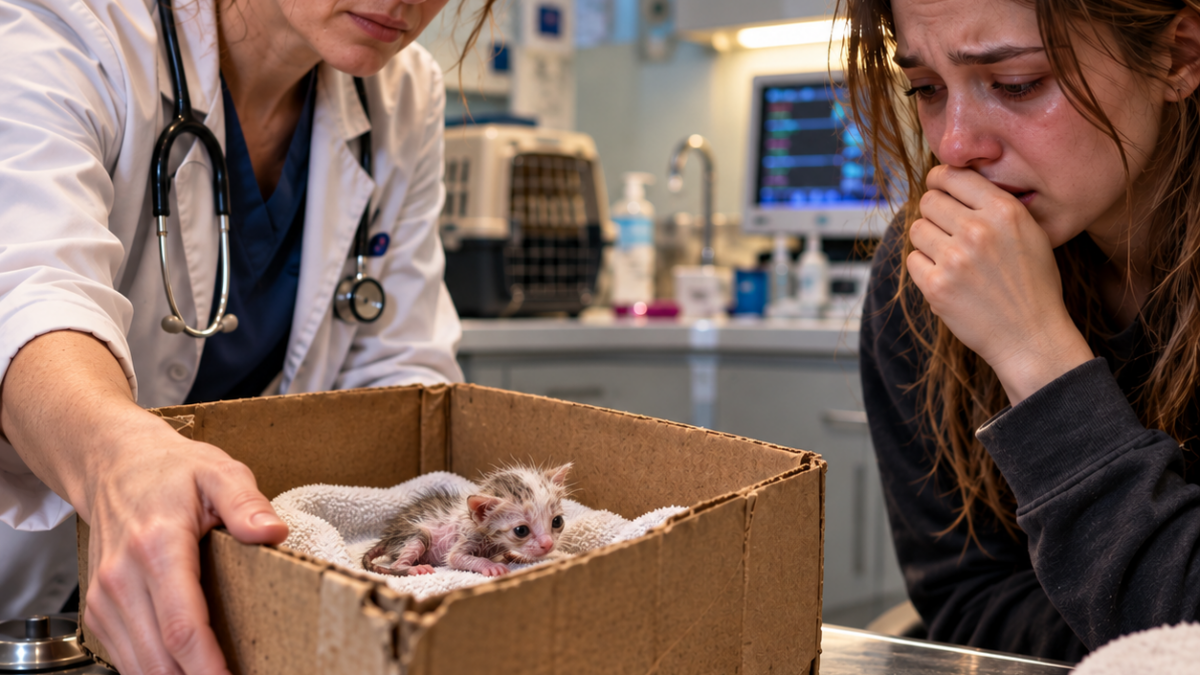
“One hundred eighty-seven grams.”
I stared at the number.
It meant nothing to me.
Numbers never mean enough until they are attached to something you love.
“Is that bad?”
Dr. Sarah looked at me with the careful face professionals use when they do not want to crush you but also will not lie.
“It’s very small.”
“Can you save her?”
She did not answer immediately.
That was my answer.
She slid the beat-up cardboard box closer and placed the kitten inside on a warming pad.
“Don’t bother naming her,” Dr. Sarah said softly.
I looked up.
The words sounded cruel until I saw her face.
She was not being cruel.
She was trying to spare me.
“Hope is a brutal thing,” she said, “when a life weighs less than half a cup of coffee.”
I hated her for saying it.
I also understood she had probably watched people name things that never made it through the night.
She handed me kitten formula, tiny syringes, cotton balls, instructions, warnings, and a look that said the odds were not good.
“Keep her warm. Feed every two hours. Stimulate her to pee and poop. Watch for fading. If she stops swallowing, call us.”
I nodded like I was capable.
I was not.
When I got back to my apartment, I set the kitten on the kitchen counter beside a brown egg I had pulled from the fridge.
They were almost the same size.
That was when it hit me.
This was not a kitten in the way I understood kittens.
She was a scrap.
A breath with fur.
Huge eyes.
A pink nose.
A body so delicate it looked like one wrong touch could erase her.
I named her Molly anyway.
Maybe because I was stubborn.
Maybe because Dr. Sarah had warned me not to.
Maybe because something that tiny deserved at least one person in the world speaking to her like she was already real.
“Molly,” I whispered.
Her little mouth opened.
No sound came out.
“Yeah,” I said, trying not to cry. “That’s you.”
Taking care of an orphaned premature kitten is not a commitment.
It is an obsession.
It does not enter your life politely.
It takes over everything.
Suddenly, my entire universe shrank to a cardboard box, a heating pad, a syringe, and the question of whether one tiny chest was still rising.
Every two hours, day and night, my alarm went off.
Midnight.
Two.
Four.
Six.
I would stumble out of bed, warm the formula, test it on my wrist, and sit under the ugly kitchen light trying to coax a few drops into Molly’s mouth.
Half the time, she was too weak to latch.
The formula would bead on her lips.
I would panic.
Then wipe it away.
Then try again.
One drop.
Wait.
Another drop.
Wait.
Sometimes it took forty-five minutes to get a few milliliters into her belly.
After that, I had to stimulate her with a warm cotton ball because newborn kittens cannot go to the bathroom on their own. Then I had to clean the syringe. Boil water. Change the towel. Check the heating pad. Weigh her. Write the number down.
Then collapse for maybe forty minutes before the alarm started again.
My apartment became a disaster.
Towels on the floor.
Formula stains on my shirts.
Dirty mugs by the sink.
My work laptop balanced beside a box full of kitten supplies.
My eyes were bloodshot.
My hands shook from lack of sleep.
I smelled like milk replacement and fear.
But something strange happened.
For the first time in months, I had a reason to get up.
Not a vague reason.
Not some self-help, inspirational reason.
A real one.
A tiny life in a cardboard box needed me every two hours, and there was no snooze button for that.
My own emptiness had to move aside because Molly was hungry.
My own isolation had to wait because Molly needed warmth.
My own dark thoughts became less persuasive because a 187-gram creature was making demands on the future.
She did not know she was saving me.
She was too busy trying to survive.
Then came day four.
I will never forget day four.
My alarm went off at 3:00 a.m.
I dragged myself out of bed, warmed the formula, and reached into the box.
Molly did not move.
Usually, when she smelled milk, she made a weak little squeak.
That night, nothing.
Her body felt too cool.
Not cold, exactly.
But wrong.
Her breathing was shallow, with long pauses between each rise of her ribs.
“Molly?”
I touched her gently.
Nothing.
Panic gripped me so hard I could barely think.
I tried to feed her.
The milk gathered on her lips and stayed there.
She would not swallow.
She could not.
I held her in the palm of my hand, and she looked even smaller than she had the night I found her. Her head tilted to one side. Her body had lost that tiny spark of resistance I had started to count on.
And then the dark thoughts came back.
Fast.
Sharp.
Familiar.
She’s not going to make it.
You can’t even save a kitten.
You can’t save anything.
Not her.
Not yourself.
I called the emergency clinic in tears.
A technician answered.
I tried to explain, but my voice kept breaking.
“She’s not swallowing,” I said. “She’s cold. She’s barely breathing. I don’t know what to do.”
The technician was quiet for a second.
Then she said the sentence that changed everything.
“If she’s fading, there may not be much we can do medically at that size. Keep her warm. Hold her close to your heart. Sometimes they just need to know they aren’t alone.”
I stood there in my kitchen holding a dying kitten while the city slept around me.
Hold her close to your heart.
That was the instruction.
Not a surgery.
Not a miracle drug.
Not something impressive.
Just warmth.
Presence.
A heartbeat.
I unbuttoned my flannel shirt and placed Molly directly against my bare chest, right over my heart. Her body was so small she barely covered the space beneath my collarbone.
I pulled a heavy fleece blanket around us both and sat down in the old rocking chair by the window.
Outside, the city was dead quiet.
No traffic.
No voices.
No sirens.
Inside, the only sound was the ticking of the wall clock.
I sat there in the dark with my hand cupped gently over her.
I talked to her because I did not know what else to do.
I told her about the sunshine she had not seen yet.
I told her about the birds that landed on the fire escape in spring.
I told her that my apartment was ugly but the morning light came in nice if you waited long enough.
I told her there were blankets she had not ruined yet.
I told her there were shoelaces to attack, curtains to climb, glasses of water to knock over, and a whole life of annoying me ahead of her if she would just stay.
Then I begged.
I am not proud of how I sounded.
I begged that tiny kitten like she had the power to choose, because if she did not, then I had nothing left to ask.
“Just one day at a time, Molly,” I whispered. “Just fight for today.”
Two hours passed.
My back ached.
My legs went numb.
My shirt stuck to my skin.
At some point, I stopped crying because I had no moisture left.
Then I felt it.
Not a sound at first.
A vibration.
So faint I thought my own heart had stuttered.
Then again.
A tiny rhythmic hum against my collarbone.
A purr.
The smallest purr I had ever felt.
But to me, it was louder than a freight train.
I froze.
“Molly?”
She shifted.
Then she made a demanding little squeak and started rooting against my shirt.
She was hungry.
I almost dropped the blanket trying to stand up.
I warmed fresh formula with hands that would not stop shaking. I held the syringe to her mouth.
This time, she swallowed.
One drop.
Then another.
Then another.
That night, Molly drank a full syringe.
The next morning, I put her on the digital kitchen scale.
202 grams.
She had gained fifteen grams.
Just fifteen.
A number so small most people would round it out of a story.
But when those digits flashed on the screen, I broke down.
Not because we had won forever.
I did not know that yet.
But because we had won the night.
Sometimes that is all you get.
A night.
A breath.
Fifteen grams.
A reason to keep going.
Molly grew.
Slowly at first.
Then offensively.
She became less like a ghost and more like an unpaid landlord with claws.
Her eyes cleared.
Her fur thickened.
Her belly rounded.
She learned to scream for food with the outrage of a creature who had survived death and expected better service.
By the time she became a real kitten, my apartment no longer belonged to me.
It belonged to Molly.
She attacked my socks like they owed her money.
She climbed curtains.
She slept in my laundry and looked insulted when I tried to remove her.
She sprinted across my chest at four in the morning with the confidence of someone who had never once paid rent.
She knocked pens off my desk.
She bit the corner of my tax folder.
She once opened a blank document on my laptop by walking across the keyboard, then sat on it like she had started her memoir.
Before Molly, I could go three days without speaking out loud and barely notice.
After Molly, I narrated everything.
“Excuse me, ma’am, that is not your keyboard.”
“No, we do not eat phone chargers.”
“Please stop biting the tax documents. The government is already difficult enough.”
I became a grown man negotiating with a twelve-pound cat like she was a tiny orange attorney.
She won most of the arguments.
Dr. Sarah laughed every time I brought her in.
“That cannot be the same kitten,” she said during one checkup while Molly tried to climb into the sink.
“It is,” I said. “Unfortunately, she has become management.”
Dr. Sarah rubbed Molly’s chin.
Molly purred so loudly the metal exam table vibrated.
“She had no business making it,” Dr. Sarah said softly.
“I know.”
“No,” she said, looking at me. “I mean that. Sometimes the ones who survive don’t make medical sense.”
I looked at Molly.
She was chewing the corner of a pamphlet about dental care.
“She makes no sense in general,” I said.
But I understood what Dr. Sarah meant.
Molly was a miracle.
Not a clean miracle.
Not the kind people put in pretty stories with soft music and perfect endings.
She was the messy kind.
The expensive kind.
The kind that slept on clean laundry, screamed at closed doors, knocked water onto my router during a work call, and made me feel human again without ever asking permission.
She was alive.
And for a while, that was enough.
Then the world reminded me that love does not protect anyone from bills.
It started with work.
Late spring.
Fewer meetings.
Fewer emails.
More phrases like “shifting priorities” and “temporary restructuring.”
Anyone who has worked remotely for a company that suddenly gets too polite knows that feeling.
The quiet dread.
The company chat slowing down.
The manager scheduling a fifteen-minute meeting with no details.
Mine happened on a Tuesday.
No drama.
No shouting.
Just three people on a video call using careful voices while telling me my position had been eliminated.
They thanked me for my contributions.
They said it was not a reflection of my performance.
They said a lot of things that sounded kind but still meant my paycheck was gone.
When the call ended, I closed my laptop and sat there in silence.
Molly jumped onto my desk, stepped on the keyboard, opened a blank document, and sat on it.
I stared at her.
She stared back.
“Great,” I said. “You’re hired.”
She blinked slowly.
I chose to interpret that as an unreasonable salary demand.
At first, I tried not to panic.
I told myself I had some savings.
Not much.
Enough to breathe if I breathed carefully.
I updated my résumé.
I applied for jobs.
I took freelance work that paid late and demanded too much.
I canceled subscriptions.
I ate toast for dinner more often than I would admit to anyone with a working sense of nutrition.
I told myself this was temporary because that is what people say when the floor starts moving beneath them.
Molly, of course, noticed none of this.
She still expected breakfast at 6:12.
She still knocked pens off my desk if I ignored her.
She still slept across my chest at night with one paw pressed against my throat like she was checking whether I intended to keep breathing.
And strange as it sounds, that helped.
When your life falls apart quietly, routine can be a rope.
Molly was my rope.
Then one morning, she did not come for breakfast.
That was the first warning.
Molly never missed breakfast.
This was a cat who could hear a drawer open from another room and arrive before the spoon touched the bowl.
But that morning, her dish stayed full.
I found her under the bed.
At first, I tried to believe she was being dramatic.
Cats are excellent at making you believe the world has ended because you moved a pillow.
“Molly,” I said, crouching down. “Come on.”
She looked at me from the darkness.
Her eyes were dull.
Not sleepy.
Not annoyed.
Dull.
Something cold moved through my chest.
I reached under the bed and touched her side.
She did not run.
That scared me more than anything.
Molly always had an opinion about being touched.
That morning, she let me slide her out without one protest.
She was heavier now.
Not the 187-gram scrap from the alley.
She was a real cat.
A spoiled, bossy, dramatic, twelve-pound cat.
But in my arms, she felt small again.
Too still.
Too quiet.
I called Dr. Sarah’s clinic with that old panic already rising in my throat.
They fit us in before lunch.
I drove with one hand on the steering wheel and one hand on Molly’s carrier, as if holding the plastic handle could somehow hold her inside this world.
At every red light, I looked down.
She did not meow.
She just lay there.
I started praying, even though I had been inconsistent with God at best.
People do that in animal hospitals.
They pray in parking lots.
They bargain with the universe beside vending machines.
They promise to be better people if one small heartbeat keeps going.
Dr. Sarah took one look at Molly and stopped smiling.
That was how I knew.
Not from the thermometer.
Not from the scale.
Not from the way the technician moved quickly and quietly.
I knew from Dr. Sarah’s face.
“What happened?” she asked.
“She wouldn’t eat,” I said. “She’s hiding. She’s not herself.”
Dr. Sarah examined her gently.
Molly barely moved.
No angry swat.
No offended tail flick.
Just silence.
They ran tests.
I sat in the tiny waiting room beneath fluorescent lights that made everyone look tired.
A woman across from me held an old terrier wrapped in a blanket.
A teenage boy sat with a shoebox on his lap and kept wiping his eyes with his sleeve.
Nobody said much.
Animal clinics have their own kind of silence.
It is not empty.
It is full of love trying not to fall apart.
When Dr. Sarah called me back, she had an image on the screen.
“I’m going to be direct,” she said.
My stomach dropped.
“There’s a blockage.”
I stared at the screen like I understood anything.
I did not.
“She likely swallowed something,” Dr. Sarah said. “Thread, ribbon, part of a toy, something like that. It isn’t moving through.”
“Can you fix it?”
“Yes,” she said. “But she needs surgery. Soon.”
I nodded too quickly.
“Okay. Do it.”
Then Dr. Sarah took a breath.
I knew what was coming before she said it.
“The estimate is high.”
There are sentences that split your life in two.
Before the number.
After the number.
She handed me the paper.
Four thousand eight hundred and seventy dollars.
That was the estimate.
Not a guarantee.
An estimate.
My ears started ringing.
I read it again because sometimes your brain refuses to accept math when your heart is in the room.
Four thousand eight hundred and seventy dollars.
I had nine hundred and sixty dollars in checking.
A little more in savings.
Rent due in ten days.
A car that made a sound like a drawer full of forks.
A credit card already carrying more than I liked to admit.
And a cat on an exam table who had once purred herself back from the edge of death against my collarbone.
Dr. Sarah did not pressure me.
That matters.
I want to say it clearly.
She did not shame me.
She did not treat me like a bad person because I turned pale.
She simply sat on the rolling stool beside me and said the thing no one wants to hear.
“There are options.”
I hated that word.
Options.
It sounded clean.
Reasonable.
Professional.
But in that room, it meant choosing how much pain I could afford.
Surgery.
Supportive care that probably would not work.
Or letting her go before she suffered more.
I looked at Molly.
Her paw was tucked under her chest.
Her eyes were half closed.
She trusted me completely.
That was the worst part.
Not the money.
Not the fear.
The trust.
She had no idea a number on a piece of paper could decide whether she got tomorrow.
I asked Dr. Sarah for a few minutes.
She nodded and left us alone.
The second the door closed, I broke.
Not dramatically.
Not loudly.
Just that awful quiet crying where your face folds in on itself and you cannot stop it.
I put my hand on Molly’s side.
“I don’t know what to do,” I whispered.
Her ear twitched.
That was all.
That tiny movement nearly destroyed me.
Because I remembered the alley.
The paper towel.
Her cold body on my chest.
The purr against my collarbone.
The fifteen grams.
The first time she attacked my sock.
The blank document on my laptop.
Her ridiculous little life expanding inside mine until my apartment no longer felt empty.
Years ago, I had begged her to fight.
Now it was my turn.
Except this time, love was not enough.
Warmth was not enough.
A syringe was not enough.
This time, there was a bill.
I called the finance number the clinic gave me.
Denied.
I tried another option.
Denied.
I called my bank.
Polite sympathy.
No help.
I sat in the parking lot with my forehead against the steering wheel while Molly stayed inside on fluids.
That was when I made the mistake that changed everything.
I posted online.
Not a fundraiser at first.
Not even a request for money.
A photo.
Molly from the night she survived as a kitten, lying beside that brown egg on my kitchen counter.
Under it, I wrote:
This is Molly. Years ago, she weighed 187 grams and I begged her to live. Today she needs surgery I can’t afford because I lost my job. I’m not asking anyone to fix my life. I’m asking if anyone has work I can do today. Yard cleanup, moving boxes, hauling junk, anything legal and honest. I need to save my cat.
I almost deleted it.
It felt humiliating.
People talk about asking for help as if it is always brave.
Sometimes it is.
Sometimes it feels like standing naked in the middle of the street holding your worst fear in both hands.
I hit post anyway.
For about ten minutes, nothing happened.
Then my phone started buzzing.
At first, it was kind.
A woman three blocks over needed help moving old patio furniture.
A retired man asked if I could clean out his garage.
Someone else had shelves to assemble.
I said yes to everything.
Then the comments changed.
They always do.
One person wrote, “This is why people who can’t afford emergencies shouldn’t have pets.”
Another wrote, “Four thousand dollars for a cat? People have kids who need food.”
Someone else wrote, “Be responsible. It’s an animal. Make the hard choice.”
Then came the sentence I still remember exactly.
Love doesn’t pay vet bills.
I stared at it for a long time.
Because the worst comments are not always the cruelest.
Sometimes the worst ones contain a piece of truth.
Love does not pay vet bills.
Love does not cover rent.
Love does not make a surgeon’s time free.
Love does not erase the fact that animal care can break a person financially overnight.
All of that is true.
But there was another truth sitting beside it.
If only people with perfect savings accounts deserved pets, half the animals in America would be alone.
And half the people would be too.
That is where the argument exploded.
One side said pets are family.
The other said family requires financial responsibility.
One side said poor people deserve companionship.
The other said animals deserve owners who can afford care.
One side called me loving.
The other called me selfish.
The terrible part was that I could understand pieces of both.
That is what made it hurt.
This was not a clean argument with heroes on one side and monsters on the other.
It was an American argument.
Money versus mercy.
Responsibility versus reality.
A country full of lonely people telling each other what love should cost.
I wanted to throw my phone across the parking lot.
Instead, I went to work.
I moved patio furniture for forty dollars and a bottle of water.
I cleaned a garage for ninety.
I carried boxes down three flights of stairs for a woman whose husband had recently died.
She kept apologizing for the dust.
I told her dust was the least scary thing I had seen that day.
By five o’clock, my back screamed.
My hands were blistered.
My shirt was soaked through.
I had made two hundred and sixty dollars.
It was not enough.
Not even close.
But every dollar felt like a refusal to give up.
Around sunset, I got a message from a man named Calvin.
I knew him only vaguely.
He lived in my building, fourth floor, always wore work boots, and never said much beyond a nod near the mailboxes.
His message said:
I have a storage unit I’ve been avoiding. Need help clearing it. Pay is $300. Tonight.
I said yes before asking questions.
The storage unit sat on the edge of town in one of those rows of metal doors under buzzing lights.
Calvin met me there with two coffees and a face that looked like it had forgotten how to relax.
Inside the unit were boxes.
Dozens of them.
Kitchen things.
A broken lamp.
Baby clothes.
Photo albums.
A folded walker.
The kind of objects that tell you a story before anyone speaks.
We worked in silence for a while.
Then Calvin picked up a small pink sweater, held it for half a second, and placed it carefully into a donate box.
“My wife loved cats,” he said.
I stopped moving.
He did not look at me.
“She passed two years ago. Cancer. We had this little black cat that slept beside her through the worst of it. Mean little thing. Hated everybody but her.”
I waited.
Sometimes people do not need advice.
They need space to continue.
“When my wife died, that cat stopped eating,” Calvin said. “Vet said grief can do strange things to animals. I spent money I didn’t have trying to keep her alive.”
He laughed once, without humor.
“My brother told me I was insane. Said it was just a cat.”
He taped a box shut.
“Three weeks later, I came home from work, and that cat was waiting by the door for the first time. Like she had decided we were all each other had.”
His voice cracked on the last word.
He turned away.
I pretended to study a box labeled Christmas.
“The cat lived another four years,” he said. “Best four years I had after my wife.”
Then he looked at me.
“People who say ‘just a cat’ have never had one be the only living thing waiting for them.”
I did not know what to say.
So I nodded.
We loaded boxes until my arms shook.
At the end, Calvin handed me five hundred dollars.
Not three.
Five.
I tried to refuse.
He closed my fingers around the bills.
“This is not charity,” he said. “This is me paying a debt to a cat that got me through hell.”
I sat in my car afterward and cried again.
There is no dignified version of loving something you might lose.
By midnight, the post had spread beyond my neighborhood.
Not viral in the famous way.
Viral in the messy local way.
People arguing.
People sharing.
People telling stories in the comments that broke my heart.
A woman said her dog was the reason she stayed sober.
A man said his cat was the only reason he came home during a divorce instead of driving until the road ended.
A nurse said she cried into her old beagle’s fur after brutal shifts.
A college student said her rabbit was the first living thing that made her feel needed.
Then, beneath all that, more arguments.
Human needs come first.
You can care about humans and animals.
Pets are a luxury.
Love is not a luxury.
Emergency care should not bankrupt anyone.
Don’t own what you can’t afford.
Then who adopts the unwanted ones?
It was brutal.
It was beautiful.
It was a whole country condensed into a comment section.
By 1:30 a.m., I had raised, earned, borrowed, and scraped together enough for the deposit the clinic required to begin surgery.
Not the full amount.
Enough to say yes.
I called Dr. Sarah.
My voice shook.
“Do it,” I said.
There was a pause.
“You’re sure?”
No.
I was not sure.
I was unemployed, exhausted, and making the kind of decision strangers online would happily dissect like they had never made a desperate choice in their lives.
But Molly was alive.
And while she was alive, I could not make a decision based only on fear.
“Yes,” I said. “I’m sure.”
Dr. Sarah’s voice softened.
“Okay. We’ll take good care of her.”
I did not sleep.
I sat in my apartment without Molly, and the silence was enormous.
It is strange how much space one small animal can take up.
Her dish sat on the floor.
Her toy mouse was under the chair.
A little dent in the blanket marked where she usually slept.
I kept expecting to hear her jump onto the counter.
I kept expecting to say, “Get down,” and have her ignore me.
Instead, nothing.
No paws.
No purr.
No tiny dictator demanding breakfast.
At four in the morning, I picked up the old fleece blanket from the night she almost died as a kitten.
I had kept it all those years.
I told myself cats like familiar smells.
That was partly true.
The fuller truth was that I could not throw away the thing that had held both of us together when I was falling apart.
I sat in the rocking chair by the window and held the blanket against my chest.
For the first time in years, I said out loud what I had never admitted.
“I’m scared to be alone again.”
That was the real fear.
Not only losing Molly.
Losing the version of myself she had pulled out of the dark.
Because before her, I had been disappearing.
Quietly.
Politely.
In a way nobody noticed because I still paid bills and answered emails.
People think loneliness looks dramatic.
It usually does not.
Sometimes loneliness looks like a clean inbox.
A made bed.
A person who says, “I’m fine,” because explaining the truth would take too much energy.
Molly interrupted that.
She made noise.
She needed things.
She turned my life from gray into chaos.
And somehow, chaos saved me.
The clinic called at 7:18 a.m.
I nearly dropped the phone.
Dr. Sarah said the surgery had gone well.
They had removed a piece of string and fabric from Molly’s intestine.
It looked like part of an old toy.
My whole body went weak.
“She’s stable,” Dr. Sarah said. “She’s not out of the woods yet, but she made it through surgery.”
I leaned against the kitchen counter.
The same counter where I had once placed her beside a brown egg.
The same counter where 202 grams had flashed on a digital scale and made me think we had won the war.
I should have known life does not work that way.
You do not win once.
You keep choosing.
You keep showing up.
You keep paying attention.
You keep loving even when love hands you a bill you cannot read without shaking.
When I visited Molly that afternoon, she looked terrible.
Shaved belly.
Sleepy eyes.
Tiny bandage.
A little cone around her head that made her look deeply offended by modern medicine.
But when she heard my voice, her tail moved.
Just once.
One small thump against the blanket.
I put my hand near her face.
She pressed her nose into my fingers.
That was all.
That was everything.
Dr. Sarah stood beside me.
“She’s tough,” she said.
“She’s expensive,” I answered.
Dr. Sarah smiled.
“She can be both.”
I laughed, and it came out like a sob.
Then she said something I have thought about many times since.
“People think veterinary medicine is full of easy choices. It isn’t. Most people are doing the best they can with the money they have and the love they carry.”
That sentence should be printed on every clinic wall.
Because shame lives in those waiting rooms.
I saw it.
I felt it.
People staring at estimates like they are moral report cards.
People whispering on phones.
People deciding between rent and treatment.
People being told by strangers that whatever choice they make proves who they are.
But here is the truth comment sections do not like:
Sometimes there is no choice that does not hurt.
Choosing surgery hurt.
Choosing not to do surgery would have hurt.
Asking for help hurt.
Reading judgment from strangers hurt.
There was no clean version of that day.
Only the version where Molly got a chance.
When I brought her home two days later, I had to keep her calm.
That sentence was hilarious.
Keeping Molly calm was like asking a thunderstorm to use an inside voice.
She was supposed to rest.
She interpreted rest as walk across the couch, glare at the wall, attempt forbidden jumps, then blame the nearest human.
I slept on the floor beside her recovery crate the first night.
Not because she needed me to.
Because I needed to hear her breathing.
Sometime around 3 a.m., she woke and made that same squeaky-wheel sound from the alley.
Older now.
Lower.
Still ridiculous.
I put my fingers through the crate bars.
She rubbed her cheek against them.
I whispered the same thing I had whispered years before.
“Just one day at a time, Molly.”
Only this time, I think I was saying it to both of us again.
The bill did not disappear.
Let me be clear about that.
This is not one of those stories where the universe fixes everything by sunrise.
I still had payments to make.
I still needed work.
I still had rent due.
I still woke up some mornings with my chest tight from worry.
But something had shifted.
Not because strangers saved me.
Not exactly.
Because strangers reminded me I was not as alone as I thought.
That is different.
The internet can be cruel.
But it can also become a kitchen table that stretches farther than you imagined.
For every person who said, “It’s just a cat,” another person said, “I understand.”
For every person who called me irresponsible, someone quietly sent twenty dollars and wrote, “My dog saved me after my husband died.”
For every lecture, there was a story.
And the stories mattered more.
A week later, I posted an update.
Just a photo of Molly in her cone, looking furious enough to run a small country.
I wrote:
She made it through. She is home. She is angry. She has already tried to bite the cone, the blanket, my sleeve, and possibly the concept of rest itself. Thank you to everyone who gave work, help, kindness, or even just a story. I know people disagree about what we owe animals. But Molly reminded me that sometimes the creatures we rescue become the reason we keep going.
The comments exploded again.
Of course they did.
People argued under the recovery photo like Molly had personally requested a congressional hearing.
But something different happened that time.
The people with stories started answering back.
Not with insults.
With truth.
One woman wrote, “When my son moved out and my house went quiet, my cat gave me a reason to come home.”
A man wrote, “I used to think pets were replaceable until my dog sat with me through panic attacks.”
A teacher wrote, “Some of my students have no safe place except the animal waiting for them.”
A single father wrote, “My daughter cried for the first time in months because our old cat came home from the vet. Don’t tell me that isn’t family.”
Then Calvin commented.
Just one sentence.
Some of us are still here because an animal stayed.
Nobody argued with him.
Not right away.
Maybe even the loudest people could feel the weight of that.
Molly recovered slowly.
Her fur grew back unevenly.
Her energy returned in waves.
First, she climbed onto the chair.
Then the couch.
Then my desk.
Then, because she had no respect for history or medical debt, she tried to chew another string.
I threw away every string toy in the apartment that night.
She judged me for it.
Hard.
A month after surgery, I found part-time contract work.
Not perfect.
Not stable.
But enough to stop the bleeding.
Two months later, I found a full-time position with a smaller company that did not use phrases like “family culture” while cutting people loose on video calls.
I started paying down the clinic balance.
Slowly.
Painfully.
One boring payment at a time.
And something else happened.
I started answering messages from people who had seen the post.
Not all of them.
I could not.
But some.
A man asked what to do because his cat had stopped eating and he was scared of the bill.
I told him I was not a vet.
I told him to call a clinic and ask questions.
I told him not to let shame make the decision before he had information.
A woman said she felt stupid for grieving her rabbit.
I told her grief is not measured by pounds.
A teenager said his family called him dramatic because he cried when their dog got sick.
I told him tenderness is not weakness.
I meant it.
Because somewhere between the alley and the surgery estimate, Molly had turned me into someone who could say things like that and believe them.
Before her, I thought needing anyone was dangerous.
After her, I understood something better.
Need is not the enemy.
Indifference is.
That is what the argument online missed.
The real danger is not people loving animals too much.
The real danger is people training themselves not to love anything too deeply because loss is expensive.
Because grief is embarrassing.
Because strangers might judge.
Because someone might call your heart irresponsible.
I refuse that.
I refuse to live so carefully that nothing can break me.
Molly broke me open.
Yes, it cost money.
Yes, it caused stress.
Yes, I made a choice some people still think was foolish.
Maybe they are allowed to think that.
But I am allowed to know what she gave me.
I am allowed to know that a life does not have to be human to be holy to the person holding it.
I am allowed to know that the world gets colder every time we say “just” before a living thing.
Just a cat.
Just a dog.
Just an old man.
Just a lonely neighbor.
Just a cashier.
Just someone online asking for help.
That little word is how we practice looking away.
Molly is not just a cat to me.
She is the alarm that made me get out of bed when I did not care whether I got up.
She is the warm weight on my chest when the apartment feels too quiet.
She is the ridiculous creature who survived the alley, the cold, the bad night, the surgery, and my terrible ability to keep receipts organized.
She is proof that small lives can leave huge fingerprints.
A few weeks after Molly came home, Dr. Sarah mailed me something.
Not a bill.
Those still came separately.
This was a photo.
She had printed it from the clinic file.
Molly from that first night.
The preemie kitten.
The damp paper towel.
The huge eyes.
The tiny body that weighed 187 grams.
On the back, Dr. Sarah had written:
Don’t bother naming her. I was wrong.
I stood in my kitchen holding that photo for a long time.
Molly jumped onto the counter beside me.
She sniffed the picture.
Then she tried to bite it.
Because sentiment has limits, apparently.
I laughed so hard I had to sit down.
Then I cried anyway.
I taped the photo beside my desk, right next to the newer picture of Molly in her cone looking offended by existence.
The beginning.
And the middle.
Not the end.
Not yet.
I do not know how many years I get with her.
None of us know that.
Not with pets.
Not with people.
Not with anything we love.
But I know this.
Years ago, I found a kitten beside a dumpster and thought I was saving one tiny life.
Then she saved mine.
Years later, when the bill came due and half the world had an opinion, I learned another lesson.
Love is not proven by having unlimited money.
Love is proven by showing up with whatever you have.
Sometimes that is a syringe at 3 a.m.
Sometimes it is body heat under an old fleece blanket.
Sometimes it is garage-cleaning money, blistered hands, and the humility to ask strangers for work.
Sometimes it is making the best painful choice you can while people who are not in the room tell you what they would have done.
I am not telling anyone else what choice to make.
I would never do that.
Every family, every animal, every bill, every heartbreak is different.
But I am saying this:
Be careful when you tell someone “it’s just a cat.”
You may be talking about the only heartbeat that kept them company through the worst season of their life.
You may be talking about the reason they got sober.
The reason they came home.
The reason they opened the blinds.
The reason they made one more phone call.
The reason they took one more breath.
The reason they stayed one more day.
We do not always know what is holding someone together.
Sometimes it has paws.
Sometimes it sheds on the couch.
Sometimes it knocks your water glass onto your laptop and then looks deeply disappointed in you.
Sometimes it begins as a 187-gram scrap of fur placed beside a brown egg on a kitchen counter by a man who had no idea he was the one being rescued.
Molly is asleep beside me now.
She is stretched across half my desk, one paw on my keyboard, making this very difficult to type.
Her belly fur is still a little uneven from surgery.
Her left whiskers are slightly shorter because she once stuck her face too close to a candle and scared ten years off my life.
She is spoiled.
She is bossy.
She is expensive.
She is alive.
Every time I look at her, I think about that comment.
Love doesn’t pay vet bills.
No.
It doesn’t.
But love is why we try.
Love is why we swallow our pride.
Love is why strangers carry boxes in storage units at midnight.
Love is why a man who thought he had nothing left found himself whispering into the dark:
Just fight for today.
Some days, that is enough.
Not enough to fix the whole world.
Not enough to answer every argument.
Not enough to make life fair.
But enough to keep one small creature breathing.
Enough to keep one lonely man from disappearing.
Enough to remind us that mercy is not wasted just because it is expensive.
So yes, people can argue.
They can debate responsibility, money, priorities, and whether one cat is worth thousands of dollars.
I understand why they do.
But Molly is walking across my desk right now, stepping on the keys like she owns the place.
And maybe she does.
Because she did not just survive in my home.
She brought life back into it.
I will gladly spend the rest of mine repaying that debt.
One vet payment.
One scratched chair.
One stolen bite of tuna.
One ordinary morning at a time.