The Ugliest Cat in the Shelter Reached for Me With a Seven-Toed Paw Just as I Was Ready to Give Up
PART3:
Then I began opening job listings and closing them before applying because every description seemed to want a person who was energetic, dynamic, fast-paced, digitally native, passionate, visionary, and somehow willing to perform seventeen years of experience for entry-level money.
My savings shrank.
My confidence shrank faster.
Dana called.
I told her I was fine.
Friends texted.
I answered with thumbs-up emojis.
One former coworker wrote, “You’ll land somewhere better.”
I wrote, “I know!”
I did not know.
That was the problem.
By November, I started driving around in the evenings for no reason.
I would go to the grocery store and sit in the parking lot after buying milk.
Ten minutes.
Twenty.
Sometimes thirty.
Not because I liked parking lots.
Because going upstairs meant opening a door into silence.
There is a kind of tired people talk about openly.
Work tired.
Parent tired.
Didn’t-sleep-last-night tired.
Then there is another kind.
The kind that makes simple tasks feel negotiable.
The kind that lets dishes sit because washing them feels strangely complicated.
The kind that makes you ignore mail.
The kind that whispers that nobody would notice if you disappeared from your own life a little more each day.
I wasn’t planning anything.
I want that understood.
I wasn’t standing at some dramatic edge.
I was simply becoming less present.
And because I could still pay my rent and answer texts and buy groceries, nobody knew how frightened I was by that.
I didn’t fully know either.
Then, on a gray Thursday afternoon, I walked into Harbor Lane Animal Shelter because I did not want to go home yet.
That was the whole reason.
I had stopped at the coffee shop next door.
The shelter sign stood beneath a row of faded blue awnings.
ADOPTIONS TODAY.
I thought animals might be less depressing than another hour alone in my apartment.
That assumption turned out to be questionable.
The adoption room smelled like bleach, old blankets, dust, and the very particular optimism of places where living creatures wait for strangers to decide their future.
The front cages held the easy cats.
I knew that immediately.
Kittens.
Fluffy ones.
A silver tabby with green eyes.
A tiny black-and-white cat who reached through the bars and chirped whenever someone walked past.
Families gathered there.
Phones came out.
“Look at this one!”
“Oh my gosh, she’s beautiful.”
“Can we hold him?”
I wandered toward the back.
That was where I saw Oliver.
He was sitting in the far corner of a large enclosure on a faded blue blanket.
The first thing I noticed was his face.
One eye pointed slightly left.
The other looked forward but seemed unconvinced that forward was worth the commitment.
His nose tilted a little.
One ear sat higher than the other.
His whiskers looked like someone had cut them during an earthquake.
Then he stood.
One front paw was enormous.
Not swollen.
Not injured.
Just enormous.
He walked toward the bars with a slightly uneven rolling step.
I counted his toes.
Seven.
I counted again.
Seven.
“What happened to you?”
The cat sat down.
One eye looked at me.
The other looked somewhere near the exit.
A voice beside me said, “Nothing.”
I turned.
A young woman stood holding a stack of folded towels.
Late twenties.
Dark curls falling out of a loose bun.
Name tag: LENA.
She smiled.
“He was born like that.”
“The eye too?”
“Yep.”
“And the foot?”
“Polydactyl.”
“I know what that means.”
“Sorry.”
“I watched Jeopardy.”
She laughed.
I liked her immediately.
“What’s his name?”
“Oliver.”
“How long has he been here?”
Her smile changed.
“Longer than anyone else.”
I looked back at him.
“How long?”
“Eight months.”
“Eight?”
“He’s had some foster time mixed in, but yes.”
“Why?”
Lena shifted the towels.
“You see him.”
I knew exactly what she meant.
Nobody says it plainly.
People want love that photographs well.
Not everybody.
But enough.
The first cats taken home are often the ones who look the way people imagine love should look.
Symmetrical.
Soft.
Bright-eyed.
Young.
Oliver looked like a cat built from spare parts.
“Is he healthy?”
“Completely.”
“No neurological problems?”
“Nope.”
“Vision?”
“Good enough to find food three rooms away.”
“That feels medically significant.”
“It is to Oliver.”
I crouched.
He came closer.
Lena said softly, “He’s very affectionate once he trusts you.”
“He doesn’t look affectionate.”
“He looks like he’s auditing you.”
I laughed.
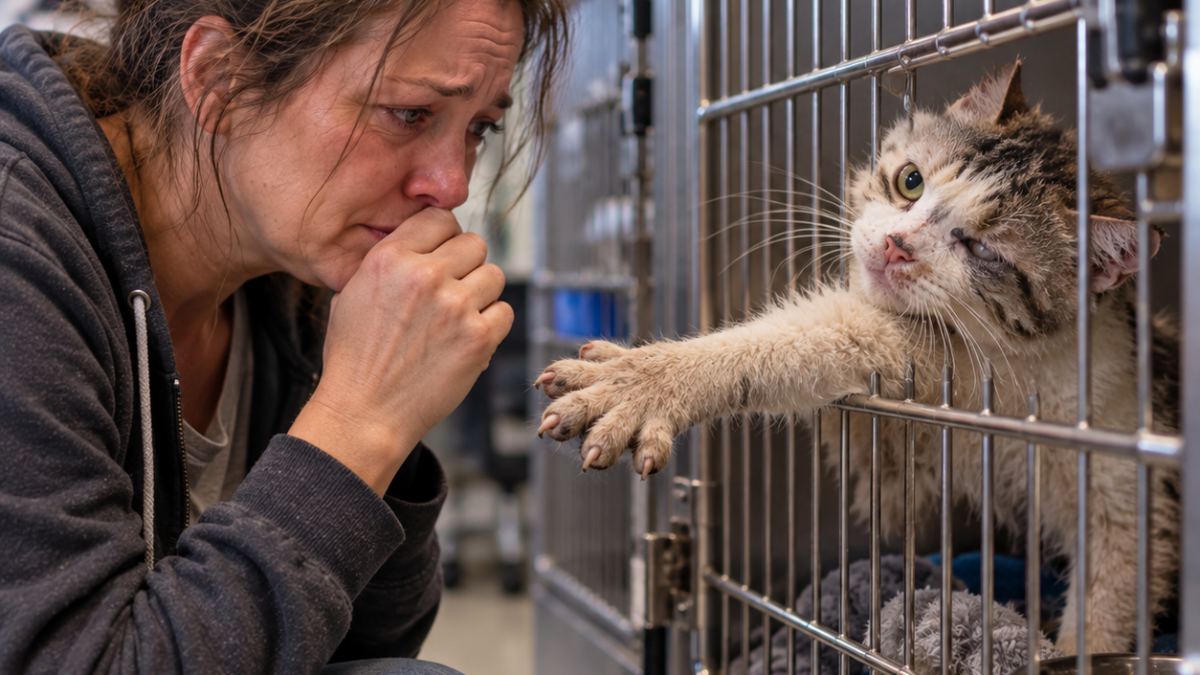
Oliver pushed his giant paw through the bars.
Seven toes spread like a baseball glove.
Then one claw hooked into the sleeve of my sweater.
“Excuse me.”
He pulled.
Not hard.
Just enough that I had to step closer.
Lena smiled.
“Well.”
“What?”
“He usually ignores people.”
“That makes two of us.”
The joke came out automatically.
Then I heard what I’d said.
Lena heard it too.
Neither of us commented.
Oliver kept his paw hooked into my sweater.
I looked at that strange foot.
At the crooked face behind it.
At an animal who had spent eight months watching people walk past him toward something prettier.
Something inside me cracked.
Not healed.
Cracked.
There is a difference.
Healing comes later.
Cracking is just the moment light finds a way in.
I whispered, “You too, huh?”
Oliver blinked.
Lena asked, “Want to meet him?”
“I absolutely do not need a cat.”
“I didn’t ask that.”
“I am unemployed.”
“Still didn’t ask.”
“My apartment is small.”
“Oliver’s not especially ambitious.”
“I don’t know anything about cats.”
“Most cats prefer it that way.”
I looked at her.
She was trying not to smile.
“Fine.”
Ten minutes later, Oliver was climbing into my lap in a little meet-and-greet room while I filled out foster-to-adopt paperwork I had no intention of requesting when I woke that morning.
By six o’clock, he was in a carrier in the passenger seat of my car.
I kept looking over at him at red lights.
“This is ridiculous.”
Oliver sneezed.
“I agree.”
He stared past me.
“This is temporary.”
He began licking one seven-toed paw.
“One week.”
No response.
“Two maximum.”
I had no idea that several months later, the shelter director would try to take him back.
That first night, I nearly returned him voluntarily.
Oliver entered my apartment like a drunk contractor with no respect for structural integrity.
Within twenty minutes, he tipped over his water bowl.
Then he got behind my armchair and screamed because he apparently forgot how he got there.
Then he emerged and dragged one of my socks into the hallway.
At seven-thirty, he discovered the curtains.
At seven thirty-one, the curtain rod came down.
The crack echoed through the apartment.
Oliver ran.
I screamed.
The woman downstairs banged on her ceiling.
I stood in the living room holding a bent curtain rod.
“Are you kidding me?”
Oliver appeared behind the couch.
His eyes went in their separate directions.
“Do not look at me like that.”
He came out.
Stepped in spilled water.
Walked across my résumé.
Then tried to eat a corner of it.
“Oliver!”
He ran.
Litter sprayed from the bathroom.
My chest tightened.
I had spent months feeling like I could barely manage myself.
Now I had imported a small criminal.
By nine, I was exhausted.
My apartment looked worse than it had that morning.
The curtains hung crooked.
A dish towel was in the hallway for reasons unknown.
There was litter everywhere.
Oliver knocked a pen off the coffee table.
Something inside me snapped.
“Maybe there’s a reason nobody picked you.”
The second I said it, I wished I could pull the words back.
Oliver froze.
The room went completely still.
I heard my own sentence.
Ugly.
Cruel.
And not really meant for him.
Because nobody had picked me either.
Not for the jobs.
Not for the future I thought I had earned.
Not for whatever next chapter people kept promising would appear if I stayed positive.
My throat tightened.
“I’m sorry.”
Oliver sat down.
“I’m really sorry.”
He walked away.
I felt sick.
That night I sat on the kitchen floor in the dark.
No television.
No music.
Just the laundromat dryers vibrating faintly beneath the building.
My phone didn’t ring.
Nobody knocked.
I rested my forehead against my knees.
And I cried.
Quiet at first.
Then harder.
The kind of crying that embarrasses you even when nobody is there.
“I’m tired,” I whispered.
No one answered.
“I’m so tired.”
For the first time in months, I let myself say it without adding but I’m fine.
I don’t know how long I sat there.
Five minutes.
Thirty.
Eventually I heard footsteps.
Tap.
Tap.
Tap.
Uneven because of Oliver’s giant paw.
He entered the kitchen.
Stopped several feet away.
I wiped my face.
“You should stay away from me.”
Oliver ignored that.
He walked closer.
Then climbed into my lap.
Clumsily.
No grace whatsoever.
His back foot caught my sweatpants.
His tail hit me in the face.
Finally, he settled against my stomach.
Then he put that seven-toed paw right in the center of my chest.
I started crying again.
Harder.
Oliver purred.
Not because he forgave me.
Not because he understood unemployment.
Not because he had mystical insight into depression.
He was a cat.
Warm.
Odd.
Hungry.
Present.
But presence can become enormous when you have been alone too long.
“Okay.”
I put one hand on his back.
“Okay, buddy.”
He stayed.
That was the beginning.
Not a miracle.
Not salvation.
A beginning.
The next morning Oliver threw up on my only decent bath mat.
That is what genuine healing looks like sometimes.
You cry all night.
Then at seven in the morning, someone vomits on your belongings.
I stood over the bath mat.
Oliver stared up at me.
“Well.”
He meowed once.
“You seem pleased.”
Another meow.
I laughed.
A small laugh.
Rusty.
Surprising.
Then I cleaned the mat.
Fed him.
Refilled the water.
Scooped the litter.
Made coffee.
Halfway through pouring my cup, I realized I had completed five tasks before eight-thirty without arguing with myself first.
Oliver sat beside the coffee maker.
His paw landed briefly on my bare foot.
“You are extremely bossy for a homeless person.”
He blinked.
“Formerly homeless.”
That mattered.
So did routine.
Oliver required breakfast.
Litter.
Fresh water.
He wanted the curtains open because he liked watching delivery trucks.
He wanted dinner at five, which meant I had to know when five happened.
He woke me.
Followed me.
Sat on job applications.
Bit the corner of my laptop.
On his fourth day, he stole half a hamburger bun and dragged it down the hallway as if he had killed it personally.
I chased him.
He growled.
I laughed until my stomach hurt.
Then Dana texted.
My sister and I loved each other.
We were simply very good at forgetting to prove it.
I sent her a picture of Oliver on the windowsill.
One eye left.
One forward.
Seven-toed paw hanging over the edge.
Dana replied:
What on earth is that?
I wrote:
My cat. Be respectful.
Her response came immediately.
That is not a cat. That is a landlord’s curse.
I snorted coffee through my nose.
Then another message appeared.
I’m glad you got him.
No inspirational paragraph.
No pity.
I stared at those words.
A few days later, she called.
“How are you?”
The automatic answer rose.
Fine.
I looked at Oliver.
He sat on my coffee table pushing a paperclip toward the edge.
“Honestly?”
“Yeah.”
“Not great.”
Silence.
Not awkward.
Space.
Dana said, “Okay. Tell me the true version.”
So I did.
Job.
Money.
Parking lots.
Silence.
The dishes.
The box beside the closet.
The feeling of shrinking.
Then I said something I hadn’t said aloud.
“I think I took the cat because I needed one living thing to notice if I stopped showing up.”
Dana inhaled.
Oliver pushed the paperclip off the table.
It hit the floor.
Dana said softly, “I’m glad you told me before that got worse.”
Before that got worse.
No accusation.
No drama.
A fact.
We made a plan.
Counseling through a community clinic.
Walk outside daily.
Answer one phone call I would normally ignore.
Apply for jobs without deciding in advance I would be rejected.
“Also,” Dana said, “stop pretending independence means disappearing.”
“That sounds fake-deep.”
“It sounds annoying because I’m right.”
“Goodbye.”
“I love you.”
I didn’t say it automatically.
I actually felt it.
“Love you too.”
Oliver bit my shoelace.
Days became weeks.
I did not transform into a wellness commercial.
Some mornings were terrible.
Some interviews went badly.
One hiring manager looked at my résumé and said, “You’ve been in the workforce a long time.”
I smiled.
“That is generally what seventeen years means.”
I did not get that job.
I cried in my car afterward.
Then went home.
Oliver met me at the door.
Not romantically.
Dinner was late.
Still.
He met me.
Every Tuesday, I saw a counselor named Dr. Neal in a small office above a dental practice.
I hated the first session.
Cried through the second.
Almost canceled the third.
Went anyway.
Oliver became known around my building because I started taking him outside in a harness.
“Taking” suggests cooperation.
For the first week, he lay flat on the sidewalk like I had violated international law.
A little boy stopped his scooter.
“Mom, that cat looks broken.”
His mother looked horrified.
I laughed.
“Yeah.”
The boy studied Oliver.
“Aren’t we all?” I added.
He nodded seriously.
“Cool.”
Then rode away.
The woman downstairs called Oliver “the weird gentleman.”
The laundromat repairman called him “Tax Cat” because he said Oliver looked like he knew your deductions were fraudulent.
A college student on the first floor called him Goblin King.
People started asking about him.
Then, indirectly, me.
“How’s the weird cat?”
“Destroying my property.”
“You doing okay?”
“Better.”
The word surprised me the first time I used it.
Better.
Not good.
Not fixed.
Better.
One month after adopting Oliver permanently, I returned to Harbor Lane with unopened cat food he refused to eat.
Lena stood behind the front desk drinking coffee from a mug that read WORLD’S OKAYEST ADULT.
“Oliver!”
She looked around.
“Where is he?”
“Home. Society has suffered enough.”
She laughed.
Then took me to the adoption wall.
Photographs of animals with new families.
Red bows.
Carriers.
Children.
Near the bottom was Oliver’s intake picture.
Flat ears.
Crossed eyes.
Huge paw.
Beneath it someone had written:
FINALLY CHOSEN.
I stared at the word finally.
“How many people met him before me?”
Lena hesitated.
“Several.”
“Why didn’t they take him?”
“The usual.”
“What’s the usual?”
She looked toward the front lobby.
“People loved him online.”
I frowned.
“Online?”
She pulled up the shelter page.
There was Oliver.
Posted months before I met him.
The caption was gentle.
Healthy.
Affectionate.
Unique appearance.
The comments weren’t.
Why does that cat look like he owes me money?
This dude sees yesterday and tomorrow at the same time.
Ugliest thing I’ve ever loved.
He’s special!
Be honest, he’s ugly.
Hundreds of reactions.
Shares.
Laughing emojis.
He had been entertainment.
“Did anybody apply?”
“A few.”
“A few?”
Lena looked uncomfortable.
“One family came twice.”
“What happened?”
“He was marked unavailable for evaluation.”
“Was he sick?”
“No.”
“Why unavailable?”
She lowered her voice.
“I don’t know.”
Something in her face told me she did know something.
Not enough yet.
“Who marks animals unavailable?”
“Management.”
“Meaning?”
“Grant.”
I knew the name.
Grant Bellows.
Executive director of Harbor Lane.
His photograph appeared on fundraising letters.
Silver hair.
Bright smile.
Expensive suits.
Always holding a puppy.
“He runs the shelter?”
“Yes.”
“Does he like cats?”
Lena made a face so small most people would have missed it.
I did not.
“Interesting question.”
I donated the food.
Then asked if they needed volunteers.
Lena answered before I finished.
“Yes.”
That was how Harbor Lane became part of my week.
Tuesday and Thursday.
Three hours.
Bowls.
Laundry.
Kennels.
I learned names.
Miss Patty, fifteen years old, thyroid medication, one permanently judgmental expression.
June, a black cat with three teeth.
Earl, a hound with a scar across his chest.
Rufus, a one-eyed tabby who purred like a lawn mower.
An anxious white dog named Benny who refused to walk on tile.
The back row held animals people tended to skip.
Old.
Shy.
Scarred.
Dark-colored.
Medical histories.
Odd faces.
I loved them almost immediately.
Not because they were morally superior.
Miss Patty tried to bite me twice.
June stole food.
Earl farted offensively.
They were simply living things who had already lost enough without being required to audition beautifully.
Families came.
I started noticing patterns.
Children wanted kittens.
Young couples wanted photogenic dogs.
Retirees sometimes asked for calm older animals.
Good people existed.
Many.
But beauty worked first.
That was undeniable.
One Saturday, a couple passed Miss Patty.
“We want a cat that brings joy.”
Miss Patty was sleeping in sunlight.
I thought, You mean easy joy.
Young joy.
Joy that doesn’t require pills.
I was becoming cynical.
Lena called it “volunteer puberty.”
“First you love everyone,” she explained while we cleaned bowls. “Then you hate everyone. Eventually you learn people are complicated.”
“Comforting.”
“No.”
Then Oliver’s second photograph changed everything.
Lena asked me to bring him in for a follow-up feature.
“Long-stay success stories.”
“No.”
“Maren.”
“I’m forty-eight and unemployed. I have standards.”
“You let Oliver sleep on your pillow.”
“Different standards.”
She convinced me.
Oliver arrived furious about the carrier.
Lena photographed us together.
I looked tired.
No makeup.
Hair pulled back.
Oliver looked catastrophically Oliver.
Seven toes visible.
Eyes in separate zip codes.
The caption read:
OLIVER WAITED LONGER THAN ANY CAT IN OUR ADOPTION ROOM.
NOT BECAUSE ANYTHING WAS WRONG WITH HIM.
BECAUSE PEOPLE DIDN’T KNOW WHAT TO DO WITH A FACE THAT DIDN’T FIT THEIR IDEA OF LOVABLE.
THEN MAREN CAME IN ON A BAD DAY.
OLIVER REACHED FOR HER FIRST.
SOMETIMES THE ANIMALS EVERYONE OVERLOOKS BECOME THE ONES WHO HELP US SEE OURSELVES DIFFERENTLY.
I hated the last sentence a little.
Then the post exploded.
Local groups.
Regional rescue pages.
Then larger accounts.
Thousands of shares.
Women wrote about job loss.
Divorce.
Age.
Illness.
Feeling invisible.
People wrote:
I thought it was just me.
That sentence appeared over and over.
I thought it was just me.
A three-legged dog owner.
A widower.
A woman recovering from cancer.
A fifty-six-year-old software engineer who had submitted two hundred résumés.
People saw themselves in a cross-eyed cat.
That should have been beautiful.
Mostly, it was.
Then Grant Bellows called me.
“Ms. Mercer?”
“Maren Mercer.”
“Grant Bellows, Harbor Lane.”
His voice sounded expensive.
“Of course.”
“Oliver is becoming quite the celebrity.”
I looked at Oliver.
He was inside a cardboard box chewing the flap.
“He’s handling fame.”
Grant laughed.
“We’d love to feature the two of you at our annual donor gala.”
“I don’t really do galas.”
“It would help the shelter.”
That phrase has power.
Help the shelter.
Suddenly saying no feels selfish.
“What would I have to do?”
“Tell your story. Bring Oliver. Photos. Maybe a short Q&A.”
“Oliver hates crowds.”
“We can manage that.”
“He really hates crowds.”
“We’re an animal organization, Maren.”
Something in his tone bothered me.
“I’ll think about it.”
“Wonderful.”
Before I could decide, Harbor Lane launched a campaign.
THE ONES IN THE BACK.
Oliver’s face appeared everywhere.
Donate to help overlooked animals get seen.
A beautiful concept.
Money poured in.
People sent five dollars.
Twenty.
One hundred.
A local pet company pledged ten thousand.
A bank offered matching donations.
Grant called again.
“We’ve had incredible engagement.”
“Good.”
“We want Oliver at the gala.”
“I don’t think—”
“We’ll have a quiet room.”
“He gets stressed in unfamiliar places.”
“You bring him to the shelter.”
“He knows the shelter.”
“Maren, we’re talking about maybe forty minutes.”
“No.”
Silence.
His voice changed.
Not much.
“Excuse me?”
“I’ll come. Oliver won’t.”
“He is central to the campaign.”
“He is my cat.”
Technically obvious.
Somehow controversial.
Grant laughed.
“Of course.”
Then, “Let me circle back.”
People who say circle back rarely mean something pleasant.
Two days later, Lena called.
“Did Grant ask you to bring Oliver?”
“Yes.”
“You said no.”
“Yes.”
“Good.”
“What’s wrong?”
She lowered her voice.
“He’s mad.”
“About a cat?”
“About money.”
I sat down.
“What money?”
“The campaign.”
“Isn’t it doing well?”
“Too well.”
I waited.
Lena continued.
“He wants meet-and-greets.”
“No.”
“I know.”
“Paid?”
“Donor-level access.”
“You’re joking.”
“No.”
I stared at Oliver.
He was licking his giant paw.
“I’m not bringing him anywhere.”
“I know.”
Then Lena said something strange.
“Keep your adoption paperwork.”
“What?”
“Just keep it.”
My stomach tightened.
“Lena.”
“I have to go.”
The next morning, an email arrived from Harbor Lane.
SUBJECT: ADOPTION FOLLOW-UP REVIEW.
It requested updated veterinary information.
Housing confirmation.
Employment status.
Financial ability to provide long-term care.
I read it twice.
Then called.
A woman in administration answered.
“Is this routine?”
Pause.
“Yes.”
“Every adopter gets this?”
Another pause.
“Some.”
“Why me?”
“Mr. Bellows requested it.”
I laughed.
Not because anything was funny.
I completed the form.
Unemployed.
Adequate savings.
Veterinary records current.
Landlord approval attached.
Oliver healthy.
Two days later, Grant called.
“We have concerns.”
“About what?”
“Long-term stability.”
“For Oliver?”
“Yes.”
“You approved the adoption months ago.”
“Circumstances evolve.”
“Mine haven’t.”
“You remain unemployed.”
My face burned.
“I have savings.”
“Animals can be expensive.”
“I know.”
“Oliver may need specialty care later because of his congenital abnormalities.”
“That is medically false.”
“I’m simply saying—”
“My veterinarian says his extra toes and eye alignment don’t require specialty care.”
Grant paused.
“We have a responsibility to ensure placements remain appropriate.”
“Do you review everyone who loses a job after adopting?”
“This isn’t personal.”
“It became personal when I wouldn’t bring Oliver to your fundraiser.”
Silence.
Then:
“That accusation is unfair.”
“Is it wrong?”
“We’ll continue the review.”
The email following his call included a clause from the adoption contract allowing Harbor Lane to reclaim an animal if there was evidence of neglect, misrepresentation, or inability to provide care.
None applied.
Still, I panicked.
Oliver was asleep on my bed.
I sat beside him.
“No.”
He opened one eye.
“You’re not going anywhere.”
I called Dana.
Then Lena.
Then my veterinarian.
Then a local attorney through a legal-aid referral.
For months I had believed I was too tired to fight.
Fear can discover reserves you didn’t know existed.
The attorney, Melissa Grant, read the contract.
“They can investigate.”
“Can they take him?”
“Not unless they establish a legitimate contractual basis or pursue legal process.”
“So no?”
“So document everything.”
I did.
Bills.
Food.
Vet visits.
Photos.
Landlord letter.
Savings.
Counseling appointments, though those were none of Grant’s business.
Then I went to the gala.
Alone.
No Oliver.
Harbor Lane’s annual gala was held in a hotel ballroom with chandeliers large enough to have their own weather systems.
The walls displayed enormous photographs of overlooked animals.
Oliver had the center position.
His crooked face filled an eight-foot banner.
THE ONES IN THE BACK DESERVE TO BE SEEN.
I almost laughed.
Lena worked registration.
When she saw me, relief crossed her face.
“You came.”
“You sound surprised.”
“I thought you’d burn the invitation.”
“Thought about it.”
She slipped something into my hand.
A small flash drive.
“What is this?”
“Not here.”
My stomach tightened.
Grant took the stage at eight.
Charismatic.
Confident.
He thanked donors.
Praised staff.
Talked about dignity.
Worth.
Second chances.
Then he told Oliver’s story.
My story.
Only it was different.
He described me as “a woman going through a difficult personal crisis.”
He said Harbor Lane had “placed Oliver as an emotional-support companion.”
False.
He said the shelter had “continued providing close oversight to ensure both Oliver and Maren remained stable.”
More false.
People looked at me.
I wanted to disappear.
Then a photo appeared of me and Oliver.
“Stories like this demonstrate why professional shelter guidance matters.”
Grant smiled.
“Sometimes adopters form intense attachments during periods of emotional vulnerability.”
My skin went cold.
He was not honoring me.
He was preparing the room.
“Unfortunately, that can occasionally create resistance when shelters make recommendations in the animal’s best long-term interest.”
Lena whispered something behind me.
A curse, probably.
Grant continued.
“In Oliver’s case, we are currently evaluating whether his placement continues to meet our stability criteria.”
The room changed.
People murmured.
My face burned.
He had just announced to two hundred strangers that I might lose my cat.
Then he said the sentence I will never forget.
“Compassion cannot mean allowing someone’s loneliness to become an animal’s risk.”
Something inside me went still.
The humiliation was almost surgical.
Unemployed.
Lonely.
Middle-aged.
Unstable.
Every private fear dressed in respectable language.
Grant looked toward me.
“We care about Maren deeply.”
No, he didn’t.
That was when I stood.
My knees shook.
“Then tell them why you started reviewing the adoption.”
Grant froze.
“Maren, we’ll speak privately.”
“No.”
The room quieted.
“You asked me to bring Oliver here.”
His smile tightened.
“This isn’t—”
“For paid donor photographs.”
A donor near the front turned.
Grant said, “That is inaccurate.”
“Was Oliver part of your proposed VIP experience?”
Silence.
“Grant?”
He laughed.
“Naturally, donors wanted to meet an animal who inspired them.”
“And I said no.”
“This is not relevant to our welfare review.”
“Then why did the review begin forty-eight hours later?”
Now the room was truly silent.
Grant’s face hardened.
“You are understandably emotional.”
There it was.
The oldest trick.
A woman disagrees.
Call her emotional.
I almost smiled.
“You’re right.”
He blinked.
“I am emotional.”
I pointed toward Oliver’s huge banner.
“Because that’s my cat.”
Applause began somewhere.
Small.
Grant raised his hand.
“This event is about helping animals.”
I looked at the banner.
“Then maybe we should talk about the animals you didn’t help.”
His face changed.
I had not planned those words.
But the flash drive in my palm suddenly felt heavy.
Lena stepped out from behind registration.
“Grant.”
His eyes snapped toward her.
“Not now.”
She walked toward the stage.
“Yes. Now.”
She held a folder.
Not the flash drive.
Paper.
“Three months before Maren adopted Oliver, the Watkins family applied for him.”
Grant went white.
I looked at Lena.
“What?”
Grant said sharply, “Lena, you are discussing confidential—”
“They were approved.”
Lena looked at the audience.
“They came twice.”
My heartbeat accelerated.
“They asked to take Oliver home.”
I whispered, “What happened?”
Lena looked at Grant.
“He placed Oliver on administrative hold.”
Grant stepped from behind the podium.
“Stop.”
She didn’t.
“The file said medical observation.”
“Lena.”
“But he had already been medically cleared.”
Murmurs moved through the room.
Grant’s voice rose.
“There were behavioral concerns.”
“No.”
Lena opened the folder.
“I kept the email.”
Everything stopped.
Grant looked at her.
Not angry.
Afraid.
Lena read.
“Do not release Oliver this week. His social post is outperforming our other content by four hundred percent. Keep him available for the campaign through month-end. He generates more engagement in-house than we will ever get once he disappears into somebody’s living room.”
I felt the words physically.
More engagement in-house.
Oliver had not been unwanted.
Someone had wanted him.
Approved.
Ready.
Grant had kept him.
In a cage.
Because his strange face generated clicks.
Lena continued.
“There’s another email.”
Grant moved toward her.
One board member stood.
“Grant, stay where you are.”
Lena read:
“Odd-looking animals perform extremely well in pity-driven campaigns. We need to think strategically before moving them too quickly.”
Pity-driven campaigns.
My stomach turned.
Miss Patty.
June.
Earl.
Animals in the back.
Was that why some stayed?
The board chair, a woman named Dr. Nadine Harris, walked toward Lena.
“Give me the folder.”
Grant said, “These emails are being stripped of context.”
Nadine looked at him.
“Then give us the context.”
“We have to fund operations.”
“That’s not what I asked.”
Grant’s jaw tightened.
“You want honesty?”
He turned toward the room.
“Fine.”
His polished donor voice disappeared.
“You people love stories.”
Nobody spoke.
“You don’t donate to spreadsheets. You donate when something makes you cry.”
His eyes swept the ballroom.
“Oliver raised more money in two months than twenty ordinary cats raised all year.”
Ordinary cats.
I saw Lena flinch.
Grant continued.
“We are full every week. Staff burn out. Veterinary bills are obscene. Everybody wants moral purity until the electric bill arrives.”
Some of that was true.
That made the rest uglier.
“If an animal’s story can fund care for fifty others, yes, we use the story.”
Nadine said, “Did you delay Oliver’s adoption to keep fundraising from him?”
Grant looked at her.
Then made the mistake people make when they believe necessity excuses anything.
“Yes.”
A gasp moved through the room.
“But he got adopted.”
Eventually.
After being displayed.
Laughed at.
Passed around online.
Kept available because his face performed well.
I felt sick.
Then Grant pointed toward me.
“And look what happened. She benefited too.”
The room went still.
I stared at him.
“What?”
“You were unemployed. Isolated. By your own admission barely functioning.”
“Grant.”
Nadine’s voice was warning.
He ignored her.
“Oliver gave you purpose.”
I could not believe what I was hearing.
“So you’re welcome.”
A woman near the front said, “Oh my God.”
Grant gestured toward the banner.
“This is what people refuse to understand. Outcomes matter.”
I looked at him.
Then at Oliver’s enormous crooked face behind him.
“The outcome does matter.”
My voice shook.
“But you don’t get credit for wounds you helped create.”
Applause.
Louder.
Grant started to respond.
Nadine took the microphone away.
“The program is suspended.”
His face changed.
“What?”
“The campaign. Effective immediately.”
“You can’t—”
“The board can.”
“This is my organization.”
“No,” Nadine said. “It isn’t.”
That was only the beginning.
The flash drive Lena handed me contained financial summaries and email copies she had preserved after realizing several shelter campaigns did not match what staff were told.
I gave it to Nadine.
Then to my attorney when requested.
The board hired an outside accountant.
The investigation took four months.
Not two dramatic days.
Four exhausting months.
Grant was placed on administrative leave.
He insisted everything he had done was legal.
Some of it probably was.
Not every unethical decision is illegal.
That is another uncomfortable truth.
The investigation found that Grant had repeatedly delayed adoption availability for animals whose posts generated unusually high engagement.
Usually not for months.
Often days or weeks.
Enough to matter.
Staff were encouraged to create “high-emotion narratives” around unusual-looking, elderly, injured, and long-stay animals.
Again, storytelling itself was not wrong.
Stories raise money.
Money saves animals.
The wrong part was when fundraising began influencing placement decisions.
An animal became more valuable waiting than adopted.
That changed everything.
Then the money became the second problem.
The Ones in the Back campaign had raised more than $118,000.
Donors had reasonably believed most of it would directly support long-stay and medically complex animals.
The disclosures allowed broad operational expenses.
Grant used that flexibility aggressively.
Professional photography.
A branding agency.
Social-media consulting.
The gala.
Executive travel to fundraising conferences.
A new office renovation.
Technically, some expenses could arguably support fundraising.
But the board had not received clear breakdowns.
Staff had been told there was no money for several treatments while thousands went toward marketing.
One invoice hurt me more than the others.
$4,800.
Campaign photography and visual identity development.
I thought of Miss Patty needing thyroid medication.
Oliver behind bars.
Grant had spent nearly five thousand dollars making overlooked animals look worth caring about.
Lena said it best.
“They already were.”
The Watkins family came forward during the review.
I met them once.
A couple in their forties.
Teenage son.
Their previous cat had been polydactyl.
They had seen Oliver’s first post and applied immediately.
The shelter told them he required additional medical assessment.
They waited three weeks.
Called twice.
Then received an email saying he was no longer available.
They assumed he had been adopted.
He hadn’t.
He remained at Harbor Lane another four months.
Mrs. Watkins cried when she met him at my apartment.
Not because she wanted him back.
She sat on my couch.
Oliver sniffed her shoe.
Then walked away to attack a cardboard box.
“He looks happy.”
“He’s destructive.”
“Happy and destructive.”
I smiled.
She wiped her face.
“I thought nobody wanted him.”
“So did I.”
That was the secret.
The whole viral story had been built around the cat nobody wanted.
Except someone had wanted him.
The tragedy wasn’t that Oliver was too ugly to be loved.
The tragedy was that someone in power decided his rejection was more profitable than his adoption.
That truth changed the public conversation completely.
People were furious.
I tried not to read everything.
Dana helped.
“You’re banned from comments after nine.”
“I’m forty-eight.”
“You behave like a twelve-year-old with internet access.”
Fair.
The board fired Grant.
Official reasons included violating adoption-procedure safeguards, failing to disclose conflicts between fundraising and placement decisions, misleading the board regarding campaign restrictions, retaliation against staff, and initiating an unsupported adoption review against me.
Unsupported.
That word mattered.
Harbor Lane sent me a letter formally confirming they had no basis to challenge Oliver’s adoption.
I printed it.
Taped it to the refrigerator.
Oliver tried to eat one corner.
“You have no respect for justice.”
He sneezed.
The board also adopted new rules.
No animal could be held from an approved adopter for marketing purposes.
Medical holds required veterinary documentation.
Fundraising staff could not override animal-care decisions.
Campaign spending had to be reported separately.
Any post featuring an adopted animal required adopter permission.
And no donor event could include animals without welfare approval.
Boring rules.
Beautiful rules.
People think justice is a dramatic speech.
Sometimes justice is a policy nobody notices because it quietly prevents the next bad thing.
Grant did not go to prison.
People online were disappointed.
Life is not written by people who enjoy revenge endings.
The financial review did not find enough evidence of criminal theft to support the wild accusations circulating online.
It found governance failures.
Misleading allocation.
Improper discretion.
Retaliatory management.
He lost his job.
Lost his board influence.
His consulting contract connected to the campaign ended.
Harbor Lane refunded a portion of restricted donations and reallocated another portion under independent oversight.
That was real.
Grounded.
Enough.
I didn’t need Grant destroyed.
I needed Oliver safe.
I needed Lena safe.
I needed the next animal adopted when the right person came instead of kept behind glass because sadness converted well.
Lena became adoption coordinator.
Nadine remained board chair.
A shelter veterinarian named Dr. Priya Shah joined the operations committee.
And Harbor Lane started something new.
They called it the Back Row Project.
I hated the name at first.
Then I loved it.
Every week, staff chose animals who were being overlooked.
Not because they looked unusual.
Because they had waited.
The posts were honest.
No manufactured tragedy.
No pity bait.
No fake urgency.
Medical needs explained clearly.
Behavior explained clearly.
Good and bad.
Miss Patty’s post said:
FIFTEEN YEARS OLD. THREE TEETH. THYROID MEDICATION. DISLIKES BEING PICKED UP. LOVES SUNLIGHT. WILL JUDGE YOUR LIFE CHOICES.
She was adopted in four days.
By a sixty-two-year-old nurse named Colleen.
Colleen said, “I don’t need cheerful. I need honest.”
June, the three-toothed cat, went home with a widower.
Earl the scarred hound was adopted by a retired truck driver who sat with him for forty minutes before asking a single question.
People started entering the shelter and saying:
“Can we see the back row first?”
The first time I heard that, I had to walk into the supply closet.
Lena followed.
“Are you crying?”
“No.”
“You’re crying into paper towels.”
“Dust.”
“There is no dust.”
“Emotional dust.”
She laughed.
Hope arrives in strange sentences.
Can we see the ones in the back first?
That became mine.
Meanwhile, I got a job.
Not a grand career revival.
Not a six-figure position proving middle age is powerful.
Real life rarely distributes symbolic victories that neatly.
I got part-time administrative work at a neighborhood community center.
Twenty-eight hours a week.
Benefits after ninety days.
Bad carpet.
Worse printer.
Coworkers who drank terrible coffee.
I loved it.
My manager, Teresa, was fifty-nine.
During my interview she looked at my résumé.
“You’ve done this work longer than I have.”
I braced myself.
Then she said, “Great. Maybe you can figure out why our invoicing system hates us.”
I laughed.
“I can try.”
She hired me the next day.
On my first afternoon, a teenage volunteer couldn’t get the copier working.
I fixed it by kicking the lower drawer.
Some knowledge is institutional.
I came home at five-thirty.
Oliver sat behind the door.
Not because he had missed me spiritually.
Dinner.
Still.
He was there.
“I got the job.”
He looked at me.
Then sneezed directly into my mouth.
“Thank you.”
I made actual dinner.
Chicken.
Rice.
Vegetables.
Not crackers.
Not cereal.
Not cheese eaten over the sink.
Oliver stole chicken.
I let him keep one tiny piece.
The apartment remained small.
The fridge still hummed.
The laundromat vibrated beneath the floor.
But the rooms felt inhabited.
There is a difference between being housed and living somewhere.
Oliver taught me that without teaching anything intentionally.
He scratched the couch.
Knocked pens down.
Waited outside the bathroom.
Slept on my ribs.
Made demands.
Because of him, time had shape.
Morning food.
Work.
Evening food.
Litter.
Play.
Sleep.
I started inviting Dana over.
She lived ninety minutes away.
Before Oliver, we had seen each other twice in a year.
Now she visited every month.
Mostly, she claimed, because Oliver looked worse in person.
“He has charisma.”
“He has an eye pointing at Kentucky.”
“Jealousy is ugly.”
“So is Oliver.”
He loved her immediately.
Traitor.
One evening, Dana sat at my kitchen table.
“You know what scared me?”
“What?”
“When you finally told me how bad things were.”
I looked down.
“I should have noticed.”
“It wasn’t your job.”
“I’m your sister.”
“I lied.”
That stopped her.
I looked at her.
“I said I was fine every time you asked.”
Dana nodded slowly.
“Why?”
“Because I didn’t want to be difficult.”
She stared at me.
“Maren.”
“I know.”
“That is the dumbest thing you’ve ever said, and you once dated a drummer named Skip.”
“He owned property.”
“He lived with his mother.”
“She owned property.”
Dana laughed.
Then cried.
Then I cried.
Oliver sat on the table between us eating a napkin.
Families heal with dignity in fiction.
Mine healed while confiscating paper from a cross-eyed cat.
Months after Grant left, Harbor Lane held another fundraiser.
Smaller.
Community center.
Folding chairs.
No hotel ballroom.
No giant banner of Oliver.
Nadine invited me to speak.
I said no.
Then yes.
Then no again.
Lena threatened to put my phone number on Miss Patty’s medication schedule.
I went.
Oliver stayed home.
No negotiation.
I stood at a cheap microphone before maybe eighty people.
I had notes.
I didn’t use them.
“I used to think Oliver was the cat nobody wanted.”
The room quieted.
“That made the story easy.”
I looked at Lena.
“Attractive, even.”
A few people laughed.
“The ugly cat. The overlooked woman. They choose each other.”
I breathed.
“But then we learned Oliver had been wanted.”
Silence.
“A qualified family applied for him. They were told he wasn’t available. He stayed behind bars because somebody thought people would donate more if they kept seeing the strange cat nobody chose.”
I saw tears.
Anger.
“That changed the lesson for me.”
I looked at my hands.
“Oliver’s story isn’t about proving ugly things deserve love.”
My voice shook.
“Nothing alive should have to prove that.”
The room remained silent.
“It is about how quickly we believe a story of unworthiness when the world repeats it enough.”
I thought of interviews.
The cardboard box.
Parking lots.
My dark kitchen floor.
“I believed I was washed up because I lost one job.”
I looked toward Dana.
“I believed being lonely meant I had failed at adulthood.”
I looked toward Lena.
“I believed Oliver must have been unwanted because he waited in the back.”
I swallowed.
“Sometimes being unchosen doesn’t tell you what you’re worth.”
“It tells you something about the choices around you.”
Someone clapped.
Then another.
I continued.
“We should still be honest. Looks matter to people. Age matters. Medical costs matter. Behavior matters. Money matters.”
No fairy tale.
“But none of those should quietly become synonyms for worth.”
That was the line people shared afterward.
None of those should quietly become synonyms for worth.
I wished I could say I invented it through wisdom.
I had written it on a grocery receipt in the parking lot.
Oliver became seven.
Then eight.
He never became beautiful in the traditional sense.
I mean that lovingly.
His left eye drifted more when he was tired.
The giant paw remained absurd.
His whiskers never agreed on a direction.
A photographer once asked whether I wanted his eyes corrected digitally for a magazine profile about the Back Row Project.
“No.”
She looked surprised.
“It would just make the image more balanced.”
“No.”
“Okay.”
Oliver’s face had spent enough of his life being treated like a problem to solve.
Leave it.
My own face changed too.
More gray.
Lines.
I stopped coloring my hair at fifty-one.
Dana said I looked distinguished.
I told her women were never called distinguished unless someone was preparing to describe them as older.
She laughed.
I let it grow.
At work, Teresa promoted me to full-time operations coordinator.
Not because of my inspirational journey.
Because I was good at spreadsheets and could negotiate printer contracts like organized crime.
That mattered to me.
I did not want every success attributed to Oliver.
He didn’t update my résumé.
Didn’t do therapy.
Didn’t attend interviews.
Didn’t budget my savings.
I did those things.
He made it harder to disappear while I was doing them.
That was enough.
Years later, people still messaged me about the original post.
Some asked about Grant.
I rarely answered.
He no longer deserved much narrative space.
Some asked whether Oliver had “saved my life.”
I always struggled with that.
The phrase is beautiful.
Too simple.
Oliver did not save me like a firefighter carrying someone from a burning house.
He interrupted me.
That is different.
He interrupted isolation.
Interrupted mornings without shape.
Interrupted silence.
Interrupted the story that said being overlooked meant being finished.
Then other people helped.
Dana.
Dr. Neal.
Lena.
Teresa.
My coworkers.
Me.
Healing that depends on one animal alone can become another dangerous romantic idea.
What Oliver did was open the door.
I had to walk through.
One winter, Harbor Lane asked me to photograph a new intake for the Back Row Project.
A white cat.
Ten years old.
Missing one ear.
One damaged eye.
Three legs.
“She is going to be expensive,” Lena said.
“Honest start.”
“Her name is Pearl.”
Pearl sat in the back of the enclosure and hissed at me.
“Charming.”
“Extremely.”
I sat outside the cage.
Twenty minutes.
Pearl stopped hissing.
Thirty.
She moved closer.
Forty.
She touched my finger with her nose.
I took one photograph.
Not flattering.
Not dramatic.
True.
I wrote:
PEARL IS TEN.
SHE HAS THREE LEGS, ONE EYE, AND ABSOLUTELY NO INTEREST IN MAKING YOU FEEL LIKE A HERO.
SHE NEEDS MEDICAL FOLLOW-UP, PATIENCE, AND A HOME WITH NO YOUNG CHILDREN.
SHE ALSO PURRS WHEN YOU SCRATCH THE LEFT SIDE OF HER FACE AND SNORES LOUD ENOUGH TO SOUND LIKE BAD PLUMBING.
IF YOU WANT EASY, KEEP SCROLLING.
IF YOU WANT PEARL, COME MEET PEARL.
A woman named Monica arrived the next morning.
Sixty-four.
Retired high-school principal.
She read Pearl’s file.
Asked good questions.
Sat with her for an hour.
Then said, “She looks difficult.”
Lena nodded.
“Yes.”
“Perfect.”
Pearl went home.
That evening, I sent the photo to Dana.
She wrote:
You have created a cult.
I responded:
A low-margin cult.
Oliver was asleep beside me.
Nine years old now.
Slower.
Still healthy.
His seven-toed paw twitched in his sleep.
I looked at it.
The paw that snagged my sweater.
The paw on my chest.
The paw in every viral photograph.
I thought about the way Grant turned it into a symbol.
Then the way strangers turned it into their own meaning.
Then the way I eventually stopped caring what it symbolized.
It was Oliver’s foot.
That was all.
We are dangerous with symbols sometimes.
We take living things and make them represent our arguments.
Ugly cat.
Invisible woman.
Corporate cruelty.
Compassion.
Ageism.
Rescue.
Redemption.
All true in pieces.
But Oliver never woke up worried about his cultural significance.
He wanted breakfast.
Sun.
Boxes.
My pillow.
Me.
That grounded everything.
When I became too philosophical, he bit cardboard.
There is wisdom in that.
Oliver developed kidney disease at eleven.
Early stage.
Manageable.
Still, I cried in the veterinarian’s parking lot.
People who have been pulled back toward life become very frightened of losing the things associated with that return.
I called Dana.
“He’s sick.”
“How sick?”
“Not dying.”
“Okay.”
“I’m scared.”
“I know.”
She did not tell me he would be fine.
Fine is often a gift people give themselves because they cannot tolerate your fear.
She stayed on the phone.
Oliver responded to treatment.
Prescription food.
Monitoring.
Medication later.
He hated all of it.
Especially the food.
He looked at me the first time I served it like I had betrayed several generations of his family.
“Your kidneys are not a democracy.”
He walked away.
Ten minutes later, hunger defeated ideology.
He ate.
The kidney disease progressed slowly.
Two years.
Then three.
By thirteen, Oliver slept more.
He stopped climbing curtains years earlier.
Thank God.
He still waited by the coffee maker.
Still knocked pens down.
Still put his paw on my foot sometimes.
I was fifty-nine when I realized he had been with me longer than the job I lost mattered.
That stunned me.
For years, the layoff felt like the dividing line in my life.
Before.
After.
Then time moved.
Oliver became the dividing line instead.
Before Oliver, I thought being chosen proved value.
After Oliver, I understood being chosen often depended on timing, circumstance, bias, luck, visibility, and who happened to be looking.
Worth lived somewhere else.
He taught me that simply by existing in a face people didn’t understand.
When Oliver was fourteen, his kidneys worsened quickly.
He lost weight.
Stopped grooming as much.
Still wanted breakfast.
Then one morning, he didn’t.
I knew.
Before the veterinarian said it.
Anyone who has loved an animal long enough eventually learns to fear a full bowl.
The vet came to my apartment.
Dana drove down.
Lena came too.
She was director of Harbor Lane by then.
The shelter had changed.
So had we.
Oliver lay on the blue blanket from his first cage.
Lena had saved it all those years.
I didn’t know.
She brought it folded in a bag.
“You kept this?”
“I steal emotionally significant textiles.”
I laughed and cried at the same time.
Oliver sniffed it.
Then lay down.
His eyes looked in their usual directions.
His giant paw rested on my wrist.
Fourteen years old.
My apartment was no longer temporary.
I had bought it when the landlord converted the building to condos.
The laundromat still operated below.
The refrigerator had been replaced twice.
The curtains were different.
One rod still had a tiny dent from Oliver’s first night.
I never fixed it properly.
The veterinarian sat beside us.
I knew the decision.
Pain.
Nausea.
Weakness.
No good path back.
Love does not become more real because it refuses endings.
Sometimes love finally becomes brave enough to allow one.
I leaned close.
“You were a nightmare.”
Oliver blinked.
“The curtains.”
Dana laughed behind me.
“The bread.”
Lena wiped her face.
“The bath mat.”
Oliver’s paw shifted.
I put my hand beneath it.
“Everybody thought I saved you.”
My throat closed.
“You know that’s not exactly true.”
He purred.
Very faintly.
Not agreement.
Just Oliver.
“I’m okay now.”
That was the hardest sentence.
“I need you to know I’m okay now.”
As if he had been waiting.
As if he needed permission.
He didn’t.
I did.
“I have people.”
Dana put her hand on my shoulder.
“I have work.”
Lena leaned against the wall crying openly.
“I have a life.”
Oliver closed his eyes.
“You don’t have to keep supervising.”
The veterinarian gave the first medication.
Oliver relaxed.
His seven-toed paw remained in my hand.
Then, gently, quietly, the cat everyone called ugly left a world that had spent years arguing over what he meant.
He meant everything to me.
That was enough.
For weeks after, I still looked toward the coffee maker.
Grief repeats routines after the subject is gone.
I stepped around places where he used to sleep.
Heard phantom paws.
Opened cans before remembering.
I did not collapse.
That mattered.
I cried.
Missed work two days.
Went to therapy again for a month.
Called Dana too much.
Volunteered less.
Then more.
I was sad.
Not erased.
That difference was the proof.
Oliver had not become the only reason I lived.
He had helped me build enough reasons that losing him didn’t take them all.
I think that may be the kindest ending he could have given me.
Harbor Lane planted a tree behind the shelter.
No giant plaque.
No slogan.
Just a small marker:
OLIVER
7 TOES.
0 RESPECT FOR CURTAINS.
DEEPLY LOVED.
I insisted on the second line.
Lena insisted on the third.
Years later, the Back Row Project remains.
Not because Oliver was magical.
Because the policy changes survived him.
Animals no longer stay for content.
Adoption readiness belongs to medical and behavior staff.
Campaign money is transparent.
Potential adopters can ask for “the ones who have waited.”
And people do.
One afternoon, when I was sixty-one, I visited the shelter and saw a middle-aged woman standing in the back row.
She wore a navy blouse.
Tired eyes.
Holding her purse tightly.
A cat sat in the cage in front of her.
Brown.
Scarred nose.
One missing tooth.
Nothing especially dramatic.
Just overlooked.
The woman asked Lena, “How long has he been here?”
“Longest in the room.”
I stopped walking.
The woman crouched.
The cat reached one paw through the bars.
Not seven toes.
Normal paw.
Still.
My chest tightened.
She laughed.
Then cried.
She tried to hide it.
Lena did what she had done for me years earlier.
Nothing.
She didn’t rush.
Didn’t tell her everything happened for a reason.
Didn’t turn it into a moment.
She let the woman feel what she felt.
Eventually the woman whispered:
“I don’t need a cat.”
Lena said, “I didn’t ask.”
I had to turn away.
Some stories do not repeat exactly.
They rhyme.
The woman adopted him.
His name was Winston.
Two weeks later, she sent a picture.
Winston asleep on her bed.
Her message said:
I didn’t realize how quiet my house had gotten.
I printed it.
Put it beside Oliver’s photo at Harbor Lane.
Not because every lonely person needs a pet.
They don’t.
Not because pets replace therapy, family, money, medicine, purpose, or human connection.
They don’t.
Because sometimes connection begins somewhere small enough to enter.
A paw through bars.
A bowl that needs filling.
A reason to get up before noon.
A living creature who does not care what your résumé says.
People still call Oliver “the ugly cat” when they retell the story.
It doesn’t bother me anymore.
Beauty was never the argument.
He was ugly to some people.
Fine.
I was ordinary.
Fine.
Not everything valuable becomes secretly beautiful once you learn to love it.
That is another trap.
Oliver did not need us to discover he was gorgeous.
I did not need the world to realize forty-eight was secretly young.
Pearl did not need her missing leg reframed as inspiring.
Miss Patty did not need to become sweet.
Worth is not a makeover.
That is what took me years to understand.
We keep trying to rescue things from rejection by proving the rejectors were wrong about the surface.
Look, the ugly cat is actually beautiful!
Look, the older woman is actually vibrant!
Look, the disabled dog is actually inspiring!
Maybe.
But what if Oliver really was the strangest-looking cat in the room?
What if I really was tired?
What if Miss Patty really was grumpy?
What if Pearl really was difficult?
Then what?
Still worthy.
That is the radical part.
The world gets nervous around worth that does not perform.
Worth that doesn’t photograph well.
Worth that needs medication.
Worth that has wrinkles.
Worth that has failed.
Worth that is unemployed.
Worth that is scared.
Worth that is inconvenient.
Oliver never argued for himself.
He reached.
That was all.
A seven-toed paw through metal bars.
The rest was my decision.
I could keep walking.
Or stop.
I stopped.
Years later, I understand how much of life changes that way.
Not through grand courage.
Through stopping.
Stopping before you dismiss someone.
Stopping before you judge.
Stopping before you scroll.
Stopping before you accept the story that says being passed over means you had nothing worth choosing.
Stopping long enough to look again.
Grant Bellows looked at Oliver and saw engagement.
The Watkins family saw a cat they wanted.
Lena saw a sweet idiot who needed a home.
I saw myself.
Oliver probably saw a sweater he could snag.
All of us were looking at the same animal.
Meaning depends heavily on the eyes doing the looking.
That is why I no longer let the wrong people define me.
The people who rejected my job applications did not know the whole person.
The company that put my life in a cardboard box did not get to decide whether my usefulness had ended.
The strangers who called Oliver ugly did not know what he would become in my apartment.
Grant, who saw value only while Oliver generated money, understood less than anyone.
And me?
I had spent months agreeing with all of them.
That may be the part I regret most.
Not losing the job.
Not the bad interviews.
Believing rejection was evidence.
It wasn’t.
Sometimes being overlooked means you were in the wrong room.
Sometimes it means the system was measuring the wrong thing.
Sometimes it means the person choosing had bad judgment.
Sometimes there simply wasn’t room.
And yes, sometimes we need to change.
Grow.
Learn.
Get help.
Oliver did not teach me that every rejection is unjust.
He taught me not to turn rejection into identity.
There is a difference.
I still volunteer at Harbor Lane twice a month.
I am sixty-two now.
Dana says I have become bossier.
I say confident women get called bossy when they stop adding smiley faces to requests.
We are both probably right.
The young volunteers know Oliver from the photographs.
Most never met him.
One asked me recently, “Was he really as weird-looking as everyone says?”
I considered lying.
“No.”
She looked disappointed.
“He was weirder.”
She laughed.
I showed her my favorite picture.
Not the viral one.
Not the shelter intake photo.
Oliver at age ten.
Asleep on my chest.
Seven-toed paw spread across my collarbone.
My face partially visible beneath him.
No makeup.
Gray hair coming in.
Both of us unconscious.
Nothing aspirational about it.
No lesson.
No campaign.
Home.
That is my favorite.
Because in the end, that was all I had wanted.
Not attention.
Not vindication.
Not to become an example of resilience.
A home that felt inhabited.
Someone living enough inside my days that silence stopped sounding like evidence I had been forgotten.
Oliver gave me that.
Then taught me to build the rest myself.
So when people ask whether I believe pets save us, I tell them this:
Sometimes.
But not the way people think.
They do not always drag us out.
Sometimes they make us responsible for tomorrow morning.
Sometimes tomorrow morning is enough.
Breakfast.
Water.
Litter.
A walk.
A vet appointment.
A joke sent to your sister.
A résumé updated while a cat sits on the keyboard.
A counseling session you attend because something at home is expecting dinner.
A small task.
Then another.
Then another.
Until months later you look around and realize you have accidentally re-entered your own life.
That is what Oliver did.
One ordinary requirement at a time.
And if there is any justice in the whole strange story, it is this:
The cat Grant Bellows believed was worth more behind bars became the reason Harbor Lane stopped allowing animals to be treated that way.
The cat strangers laughed at changed how families walked through the shelter.
The animal whose face supposedly made him difficult to place became the face that taught thousands of people to ask about the ones no one noticed.
And the woman who thought being laid off meant she had already happened found out she had entire years of herself left.
Oliver never became prettier.
I never became younger.
Neither of us needed to.
I was forty-eight when he reached through those bars.
Tired.
Unemployed.
Lonely enough to avoid my own apartment.
He was crooked-eyed.
Seven-toed.
Eight months into waiting.
Both of us had been evaluated by people who decided to keep looking.
Then he hooked one claw into my sweater.
And I stopped.
That was it.
The whole beginning.
People can dress it up if they want.
Call it fate.
Rescue.
Healing.
A second chance.
I think Oliver would have found all of that exhausting.
He would have preferred chicken.
So I will say it plainly.
The ugliest cat in the room reached for me when I had almost stopped reaching for anything.
I took him home.
He wrecked my curtains.
I hurt his feelings.
He sat on my chest anyway.
And little by little, the life I thought nobody wanted stopped feeling like something I was waiting to escape.
It became mine again.
Not perfect.
Mine.
And that turned out to be more than enough.