The Quiet New Nurse Was Asked to Leave a Military Memorial—Then Every K9 Broke Formation and Walked Straight Toward Her.
PART2:
Every person who has worked around animals long enough knows that moment. The room shifts before the people understand why. A current moves through bodies. Attention gathers.
She turned slightly.
Her eyes met Brutus’s.
Her expression changed.
Softened.
Not dramatically.
Just enough.
She whispered, so quietly almost no one heard, “Hey, buddy.”
Brutus took one step forward.
Ryan tightened the leash.
“Stay.”
Brutus stopped.
But he did not look away.
Then another K9 turned its head.
A German Shepherd named Major, old enough to have silver around his muzzle and too dignified to acknowledge most people, lifted his nose from formation and looked toward Mara.
A younger Malinois shifted beside his handler.
A Dutch Shepherd seated near the center rose slowly from his position.
The handlers began looking at one another.
Something was happening.
The officer who had asked Mara to leave glanced back at the formation, confused.
“Mara,” he said, though he did not know until later how strange it was that he had used her name only because he had read it from her temporary hospital identification badge. “Please continue outside.”
She nodded quickly.
“I’m sorry.”
She took another step.
Brutus moved again.
PART3:
This time Ryan could not stop him without turning the memorial into a struggle, and that was the last thing any handler wanted in front of a grieving family.
“Brutus,” Ryan said low. “Hold.”
The dog stood rigidly for one second.
Then he walked out of formation.
Slowly.
Deliberately.
Not lunging.
Not pulling.
Just walking.
Another canine followed.
Then another.
The crowd began whispering.
A handler near the second row gave a command under his breath.
“Stay.”
The dog beside him looked up, hesitated, then stepped forward too.
“Leave it.”
No response.
“Heel.”
Nothing.
Not because the dogs were out of control.
They were not barking.
They were not snarling.
They were not dragging handlers across the grass in panic.
They were doing something far more unsettling.
They were making a collective decision.
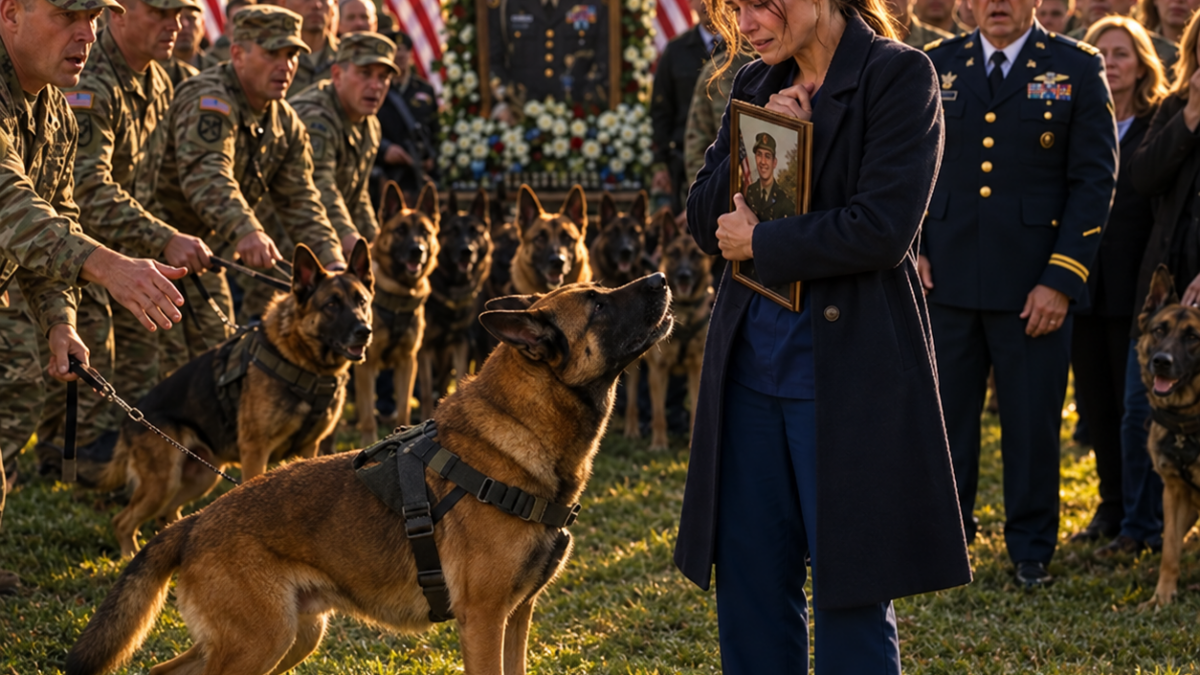
One by one, trained military working dogs left formation and walked toward the quiet nurse who had been asked to leave.
Mara stood frozen near the rear boundary rope, eyes wide, photograph pressed tightly against her coat.
“Please don’t,” she whispered.
But she was not commanding them.
She did not raise her hands.
She did not call them.
She did not bend down or encourage them or make the soft clicking sounds people make when they want animals to come closer.
She simply stood there, looking overwhelmed and almost frightened, as six military working dogs gathered around her.
Brutus reached her first.
He stopped directly in front of her, looked up, and wagged his tail once.
Not wildly.
Not like a pet greeting its owner.
Like recognition.
Mara’s mouth trembled.
“Brutus,” she whispered.
At the sound of his name in her voice, the dog stepped closer and pressed his shoulder lightly against her leg.
Major, the old German Shepherd, lowered himself to the grass beside her right foot.
The Dutch Shepherd circled behind her and sat facing the crowd, as if deciding he would monitor the memorial from there now.
Another Malinois stood near her left side, relaxed but alert.
The crowd fell completely silent.
Even the flags seemed to stop moving.
The officer who had just asked Mara to leave stared at the scene with disbelief spreading across his face, because he suddenly realized what nobody else had known.
Those dogs knew her.
Not casually.
Not as someone they had passed in a hallway.
They knew her with the complete and wordless certainty of animals who remember who sat beside them when they were frightened.
Mara looked down at the dogs gathered around her.
Tears filled her eyes.
“You remember,” she whispered.
The words were not meant for the crowd.
They were meant for the dogs.
But in the silence, everyone heard.
An older handler stepped forward.
His name was Chief Petty Officer Allan Reeves, though most people called him Chief Reeves because some men seemed born into titles that fit them even after retirement. He had known Master Sergeant Elias Grant for more than twenty years. He had trained with him, argued with him, buried dogs with him, and once spent fourteen hours beside him during a search operation nobody at the memorial liked discussing because the ending had been too hard.
Chief Reeves had a scar through one eyebrow, a slow walk, and the kind of face that made younger handlers stand straighter without being told.
Now that face had gone pale.
He looked at Mara.
Then at the photograph in her hand.
“Where did you get that?”
Mara swallowed.
Her fingers tightened around the folded copy.
“Elias gave it to me.”
Chief Reeves stared.
“He never met you.”
Mara shook her head.
“No.”
She looked down at Brutus, then at Major, then at the other dogs.
“But his dogs did.”
Chief Reeves did not understand at first.
Then something moved through his expression.
A memory.
A line connecting itself.
A story he had almost missed.
His eyes filled before he spoke.
Because he understood.
Elias Grant had spent his final months helping the veterinary rehabilitation wing teach new staff how to recognize stress in military working dogs. He had been sick by then, sicker than most of them knew. He had already been restricted from full field work, already told to slow down, already running on stubbornness and the kind of devotion that made him a legend and, sometimes, impossible to manage.
During those months, one quiet young nurse had stayed behind after shifts.
Sat with dogs who were anxious during treatment.
Learned names.
Learned patterns.
Learned which K9s hated loud carts.
Which ones became defensive when cornered.
Which ones needed their handlers in the room.
Which ones did better if no one looked directly at them.
Which ones wanted space but not abandonment.
Which ones only calmed when a person sat on the floor and expected nothing.
Chief Reeves turned toward the memorial officer.
Then toward Mara.
Then toward the dogs surrounding her.
“Let her stay,” he said quietly.
Mara looked up, startled.
The officer opened his mouth, but Chief Reeves was not finished.
He looked toward the front of the ceremony area, where the family of Master Sergeant Elias Grant stood near a table holding a folded American flag, a framed photograph, and a pair of well-worn K9 gloves.
“Actually,” Chief Reeves said, his voice rough, “let her come forward.”
Nobody moved.
Mara looked as if she might refuse.
As if being allowed to stay was somehow more frightening than being asked to leave.
The dogs remained around her.
Their handlers stood several feet away, uncertain whether they should call them back or allow what was happening to continue.
The memorial officer glanced toward the senior command staff.
A captain near the front gave the smallest nod.
So Mara Ellis, the quiet new trauma nurse nobody had really noticed for seven weeks, walked slowly toward the memorial platform with six military working dogs around her.
Not in perfect formation.
Not according to any manual.
But with a dignity nobody could have choreographed.
Every eye followed.
And by the time Mara reached the front, Elias Grant’s widow had stepped forward.
Rebecca Grant was not the kind of woman people described as fragile. She had spent nearly thirty years married to a military canine handler, which meant she had learned how to live with waiting, worrying, sudden calls, injuries, deployments, and the odd domestic reality of sharing a home with men and dogs trained for danger. She was in her late fifties, wearing a dark coat and a small silver pin shaped like a paw print on her lapel.
She had been standing near the memorial table, listening, holding herself together in the practiced way of people who know the ceremony is not the place where grief can have all of them.
Now she looked at Mara.
Then at Brutus leaning against her.
Then at Chief Reeves.
“Who is she?”
Chief Reeves cleared his throat.
“Mara Ellis. New trauma nurse at the medical center.”
Rebecca’s eyes moved across the dogs.
“They know her?”
“They seem to.”
“How?”
Mara opened her mouth, then closed it.
“I’ve been around the veterinary wing,” she said softly.
Rebecca looked at her.
“Were you close to Elias?”
“No.”
“Did you work with him?”
Mara hesitated.
“Not officially.”
Rebecca’s expression tightened, not with anger, but confusion sharpened by grief.
“Then why are his dogs doing this?”
Mara looked down at Brutus.
“I don’t know.”
Chief Reeves interrupted quietly.
“I think I do.”
Everyone looked at him.
He nodded toward the photograph in Mara’s hand.
“That’s not just a picture.”
Mara looked down.
“What do you mean?”
“That photograph came from Elias’s training office.”
“Yes.”
“He kept copies of those pictures everywhere.”
A faint smile passed across Mara’s face through her tears.
“I know.”
Chief Reeves narrowed his eyes slightly.
“How?”
Mara took a breath.
“Because I used to sit in his office sometimes.”
The words changed the air again.
Chief Reeves stared.
“You knew him?”
Mara looked at the photograph.
“Not like you did.”
She swallowed.
“But yes. I knew him.”
The story had started months earlier, before Mara Ellis became the quiet new nurse nobody noticed, before the memorial, before every dog in formation remembered her at once.
It had started in a hallway that smelled of antiseptic, wet fur, and coffee left too long on a warmer.
Mara had been hired into the trauma unit of a military medical center after transferring from a civilian hospital three counties away. She was thirty years old, competent, careful, and far less inexperienced than many of her coworkers assumed. She had worked emergency rotations, long-term rehabilitation cases, and disaster response overflow during two hurricanes. She had held pressure on wounds, sat with families during the minutes between hope and loss, and learned how to read vital signs on machines and faces.
But she did not talk about herself.
That was one reason people underestimated her.
Mara arrived early. Completed assignments. Stayed late when someone needed help. Covered breaks without making an announcement. Helped confused patients find rooms. Cleaned up spilled coffee before anyone slipped. Checked on veterans who said they were fine in the exact tone that meant they were not.
Then she went home.
Some employees described her as shy.
Others thought she was distant.
A few assumed she was inexperienced because she asked careful questions instead of performing confidence loudly.
Mara never corrected them.
She had learned that sometimes the quietest way to work was to let people think whatever they wanted while you kept doing the job properly.
But there was one place where Mara was never invisible.
The military veterinary rehabilitation wing.
It began during her second week.
She had been walking a stack of corrected forms down to records when she heard raised voices near the veterinary corridor.
Not shouting exactly.
Controlled concern.
The kind hospital people used when a situation was starting to lean in the wrong direction.
A military working dog had been brought in for treatment after becoming unusually anxious during a routine examination. Brutus, a Belgian Malinois, seven years old, assigned to a naval security unit. He was not dangerous in the way civilians imagined. He was overwhelmed.
A hallway cart had crashed near the exam room moments earlier. A metal tray had hit the floor. The sound echoed sharply through the corridor. Brutus, already stressed by the unfamiliar room and the smell of disinfectant, shut down into rigid alertness.
His handler was speaking with the veterinarian.
The veterinary staff needed someone to sit nearby while they adjusted the room and tried to reduce stimulation.
Mara happened to be passing through.
She stopped at the doorway.
Inside, Brutus stood near the far corner, ears high, mouth closed, body tense. His eyes were not soft. They moved between the door, the equipment, the handler, and every person who stepped too close.
A young technician muttered, “We need him settled before we can finish.”
Mara looked at the dog.
Then she set her paperwork on a counter.
“I can sit.”
The technician blinked.
“You work in trauma, right?”
“Yes.”
“With people.”
“Yes.”
The handler looked at her, uncertain.
Mara did not reach for Brutus. She did not call him. She did not crouch dramatically and say, “It’s okay, boy,” the way people did when they wanted to reassure themselves more than the animal.
She simply sat down on the floor near the doorway, not blocking the exit, not looking directly into his eyes.
Then she waited.
The room changed.
Not immediately.
Nothing real ever changed immediately.
For several minutes, Brutus stood exactly where he was. Then his breathing shifted. His ears angled slightly. His head lowered a fraction. His nose moved.
Mara stayed still.
The handler watched.
The technician watched.
Brutus took one step.
Then another.
He approached not like a pet seeking affection, but like a professional evaluating whether this person understood the rules of his world.
Mara did not move.
Finally, Brutus stopped beside her and lowered his head.
Slowly, he rested it against her knee.
The handler stared.
“You’ve worked with dogs before?”
Mara glanced up.
“A little.”
That was all she said.
It was not the last time she met Brutus.
Over the following weeks, Mara became a familiar presence in the veterinary rehabilitation wing. Not because she was assigned there. Not because anyone added her name to a schedule. She simply stopped whenever her shifts allowed.
Sometimes she helped carry supplies.
Sometimes she sat with a nervous canine before an examination.
Sometimes she stayed beside an older retired working dog while its handler completed paperwork.
Sometimes she said nothing at all.
She never treated the animals like pets.
That mattered.
She understood they were trained professionals. They had jobs, history, boundaries, habits, injuries, and dignity. She did not coo at them like puppies or assume every wagging tail was an invitation. She learned to ask handlers before touching. She learned names before nicknames. She learned that a dog could be brave and still afraid, disciplined and still exhausted, obedient and still in pain.
Even the strongest working dog could have a bad day.
And sometimes what they needed was not another command.
It was a quiet room.
A familiar voice.
A few minutes without pressure.
The handlers noticed.
The veterinarians noticed.
The dogs noticed most of all.
Mara did not think she was doing anything special.
That was one reason Master Sergeant Elias Grant noticed her.
She first met him outside Treatment Room 3.
He was sitting on a bench with a cane propped beside him, though he seemed to resent the object for existing. He was in his late fifties, broad through the shoulders, with close-cropped gray hair, a weathered face, and eyes that missed nothing. His posture remained military even in fatigue. A heart monitor patch was visible beneath the collar of his shirt when he shifted.
At the time, Mara did not know he was sick.
She only knew he was watching a German Shepherd through the glass window of the treatment room with the complete attention of someone listening to a language nobody else recognized.
The dog inside was older, lying on a padded mat, visibly anxious. He avoided eye contact, ears pinned slightly back, body curled but not relaxed.
Mara stopped beside the door.
Elias did not look at her immediately.
“You knew?”
Mara frowned.
“Excuse me?”
He nodded toward the dog.
“You knew not to walk straight in.”
She glanced through the glass.
“He doesn’t want anyone near him right now.”
Elias looked at her then.
“Why?”
“He’s avoiding eye contact.”
“Good.”
“He’s breathing fast.”
“Good.”
“His body is turned away from the door.”
“Good.”
“He looks like he wants space, but he’s watching everything. So not abandonment. Space.”
Something in Elias’s expression changed.
Interest.
Approval, maybe.
He pointed toward the room.
“You like dogs?”
“Yes.”
“That’s not what I asked.”
Mara looked confused.
Elias smiled faintly.
“Do you understand dogs?”
She thought for a moment.
“I try to.”
Elias nodded.
“Better answer.”
Then he opened the door.
Inside, the older German Shepherd lifted his head but did not move.
Mara crouched near the doorway.
She did not approach.
Elias lowered himself to the floor with more effort than he wanted her to notice. She noticed anyway.
“You see what he’s doing?” he asked.
“He’s deciding whether we’re going to make things worse.”
Elias looked amused.
“What should we do?”
Mara hesitated.
“Nothing.”
“Exactly.”
So they sat.
For several minutes, they simply waited.
Eventually the dog approached.
Not because he had been called.
Because he had decided.
Elias looked at Mara.
“That’s the job.”
“What is?”
“Waiting until they decide you’re safe.”
That became the beginning of an unlikely friendship.
Mara did not realize it at first.
Elias would sometimes find her in the veterinary wing and invite her into whatever quiet observation he was doing. Sometimes they talked about dogs. Sometimes about patients. Sometimes about nothing. He did not pry into her life, and she appreciated that. She did not ask too many questions about his health, and he appreciated that even more.
He taught her things that were not formal procedures.
Small things.
How a canine’s ears changed when it was uncomfortable.
How a working dog could become defensive when overwhelmed.
How a handler sometimes became so focused on obedience that he missed pain.
How a dog that refused to move was not always being stubborn.
How growling could mean fear, not aggression.
How licking lips, turning away, refusing eye contact, freezing, yawning, or leaning into pressure could be communication.
One sentence stayed with Mara more than any other.
“If the dog suddenly changes, don’t punish the change. Find the reason.”
She remembered it every day.
At first, Elias seemed like a man with extra time and too much knowledge to keep in his own head.
Only later did she understand the truth.
He was dying.
Not dramatically.
Not in a way that made people whisper in halls at first.
A serious heart condition. Worsening symptoms. Doctors advising him to slow down. Restrictions placed on his duties. No more direct work with younger K9s. No more field exercises. No more long days pretending his body was still willing to obey.
Elias resisted.
Not because he did not care about his health.
Because he believed there were still dogs who needed him.
Eventually, he shifted his work to the veterinary rehabilitation wing. He trained new handlers. Advised medical staff. Reviewed cases. Helped identify stress responses during treatment. Sat with older dogs. Corrected young staff quietly. Gave praise rarely enough that people remembered every instance.
Mara became one of the people he tested his ideas with, though she did not know it then.
One afternoon, he asked her a strange question.
“Why do you work here?”
They were sitting in his office, a small room crowded with binders, photographs, worn leashes, training manuals, and a coffee mug that said K9 HANDLER: BECAUSE HUMAN PARTNERS ARGUE TOO MUCH.
Mara shrugged.
“I like helping people.”
“That wasn’t my question.”
She looked at him.
“Then what was?”
“Why do you stay when nobody notices?”
Mara smiled faintly.
“I don’t know what you mean.”
“You stay late.”
“Sometimes.”
“You check on patients after your shift.”
“If they need it.”
“You sit with dogs nobody else wants to sit with.”
She looked away.
“They’re not difficult on purpose.”
Elias studied her.
“No. They’re not.”
He leaned back, rubbing his sternum briefly before dropping his hand.
“That’s why they trust you.”
“Who?”
He nodded toward the kennel area.
“The ones who can’t explain what’s wrong.”
Mara did not know what to do with that.
Praise made her uncomfortable, especially when it saw too much.
Elias’s health worsened.
He hid it badly from people trained to observe.
Mara noticed he sat more often. Walked slower. Sometimes paused mid-sentence as if waiting for his own heartbeat to remember discipline. She noticed the hand that occasionally pressed against the edge of his desk. The way his breathing changed after short walks. The way Captain Warren Hale began appearing in the wing more often, not hovering exactly, but close enough to make it clear someone had been ordered to care.
Elias hated being cared for.
That part was obvious.
Before leaving the facility for what everyone called “medical retirement” and nobody said felt permanent, Elias spent one final week in the veterinary wing. He spoke with handlers. Visited former canine partners. Reviewed files. Wrote notes in his tight, slanted handwriting.
On Mara’s last shift with him, he handed her the photograph.
It showed him sitting on the grass beside several military working dogs. Brutus was there, younger by only a year but somehow sharper. Major lay in front, head on paws. Two Malinois sat behind Elias, one alert, one squinting into sunlight. Elias’s hand rested lightly on Brutus’s shoulder.
Mara looked at it.
“What’s this?”
“Evidence.”
“Of what?”
“That I was once surrounded by better company than officers.”
She smiled despite herself.
On the back was a handwritten sentence.
They remember the people who were kind to them.
Mara ran her thumb over the ink.
“Why are you giving this to me?”
“Because one day someone will ask why you care about these dogs.”
“What should I tell them?”
Elias smiled.
“Tell them the truth.”
“What truth?”
“They remember.”
At the time, Mara thought he meant the dogs.
Standing at his memorial weeks later, surrounded by those dogs, she finally understood he had meant more.
The ceremony continued only after Mara was allowed to remain.
Chief Reeves guided her toward the front but did not touch her. The dogs moved with her. Brutus stayed closest. Major settled beside the platform. The Dutch Shepherd sat behind her like a sentry.
The handlers looked uncertain, but the senior command staff let it happen.
What else could they do?
Call trained K9s away from the one person they had chosen to honor in the middle of a memorial for the man who taught everyone to respect what dogs were saying?
The chaplain stepped forward again.
His voice trembled once before steadying.
He spoke about Elias Grant’s service.
Two decades around military working dogs.
Deployments.
Training operations.
Rescue work.
Discipline.
Loyalty.
Responsibility.
The bond between a handler and a dog who would go where commanded without understanding politics, borders, or human reasons—only trust.
Mara listened with tears on her face.
Rebecca Grant came to stand beside her.
For a while, neither woman spoke.
Then Rebecca whispered, “He would have loved this.”
Mara wiped her eyes quickly, embarrassed by crying in front of the widow.
“I wish I’d known he was that sick.”
Rebecca shook her head.
“He didn’t want people worrying about him.”
“He always worried about everyone else.”
Rebecca’s mouth trembled into something like a smile.
“Yes.”
She looked at Brutus leaning against Mara’s leg.
“Especially them.”
The chaplain said something that made Mara’s throat tighten.
“A handler’s legacy is not measured only by missions completed or commands given. Sometimes it is measured by the people he taught to care for those who came after him.”
Rebecca reached for Mara’s hand.
Mara looked down, startled.
Rebecca held on.
When the formal ceremony ended, nobody immediately left.
People gathered around the memorial table.
Former handlers spoke quietly.
Family members hugged one another.
Officers who had looked composed during the service now stood with red eyes and lowered voices.
Mara remained beside the dogs because the dogs remained beside her.
The memorial officer who had asked her to leave approached.
He looked younger now somehow, stripped of certainty.
“I owe you an apology.”
Mara shook her head.
“You don’t.”
“I asked you to leave.”
“You were doing your job.”
“I didn’t know.”
Mara looked down at Brutus.
“Neither did I.”
Captain Warren Hale approached next.
He was an older Navy officer with calm eyes and the kind of authority that did not need to announce itself. He had known Elias for more than twenty years and looked like a man who had spent the service remembering everyone’s mistakes and most of their virtues.
He stopped in front of Mara.
“I’ve heard about you.”
Mara smiled nervously.
“I hope that’s a good thing.”
“It is.”
He glanced at Brutus.
“Elias believed you understood something most people never learn.”
Mara waited.
“What?”
“Working dogs don’t need everyone to love them.”
He paused.
“They need people who respect them.”
Mara looked down at the photograph in her hand.
“He taught me that.”
Captain Hale nodded.
“Then you listened.”
He reached into his coat pocket and removed a small laminated card.
Mara recognized the handwriting immediately.
Elias’s.
Captain Hale handed it to her.
On the front was a simple list.
Observe.
Wait.
Listen.
Respect.
Mara stared at it.
“Where did you get this?”
“He gave it to me before he retired.”
She turned it over.
There was no explanation on the back.
Only the same four words written again, smaller.
Observe.
Wait.
Listen.
Respect.
Captain Hale said, “He told me if something happened to him, I should give this to the person who understood it.”
Mara’s eyes filled.
“You knew?”
“I suspected.”
He looked toward the dogs.
“Today confirmed it.”
The memorial grounds slowly emptied.
The dogs eventually returned to their handlers.
Brutus was the last one to leave.
Ryan called him softly.
“Come on, buddy.”
Brutus looked at Mara.
She crouched, holding the photograph in one hand and the laminated card in the other.
“You have to go.”
Brutus stepped toward her.
Mara gently touched his head.
“I’ll see you at the hospital.”
Brutus looked at her for another moment.
Then finally turned toward his handler.
Ryan looked back at Mara.
“You know he’ll expect you tomorrow.”
Mara smiled through tears.
“I’ll be there.”
The next morning, Mara returned to work expecting everything to feel normal.
It did not.
People were talking.
Not about the memorial.
About her.
One nurse stopped her near the medication room.
“Is it true?”
Mara blinked.
“What?”
“That all the canines left formation for you?”
Mara adjusted the strap of her bag.
“I didn’t ask them to.”
The nurse laughed softly.
“I know. That’s what makes it incredible.”
Another coworker who had barely spoken to her before held the elevator door.
“Morning, Mara.”
The simple use of her name felt stranger than the dogs had.
In the break room, two nurses stopped talking when she walked in, then smiled too quickly.
Mara poured coffee she did not want and left before anyone could ask for the whole story.
She did not know how to explain it.
How do you tell people that a memorial exposed your life in a language only dogs spoke clearly enough for humans to believe?
Later that morning, she entered the veterinary wing.
Brutus was there.
The moment he saw her, his tail began moving.
Ryan smiled from beside the exam table.
“Told you.”
Mara crouched.
“Hey, buddy.”
Brutus approached and pressed his head against her shoulder.
From the neighboring area, another dog barked once.
Mara turned.
Major was staring at her too.
Then a Dutch Shepherd lifted his head over the edge of a mat.
Mara looked around.
“Apparently, I have an audience.”
The veterinarian laughed.
“You’ve had one for weeks.”
That afternoon, Captain Hale called a small meeting.
The room included several canine handlers, veterinary staff, military medical personnel, and representatives from the training facility.
Mara sat quietly near the end of the table, back straight, hands folded, uncertain why she had been invited. She expected someone to ask her for a statement about the memorial, maybe clarification for an internal report, maybe a polite request to keep certain details out of public discussion.
Captain Hale entered with several folders.
He placed them on the table.
Then looked directly at Mara.
“This meeting is about Elias’s final training project.”
Mara frowned.
“Training project?”
Hale opened the top folder.
Inside were handwritten notes in Elias’s tight script. Mara recognized them before she could read them fully.
Military working dog welfare.
Stress indicators.
Behavioral changes during medical care.
Handler communication.
Recovery after treatment.
Environmental triggers.
Mara leaned forward.
“I’ve seen some of these.”
The room grew quiet.
Captain Hale looked at her.
“You have?”
“Elias showed me a few pages. He never said it was official.”
“That’s because it wasn’t finished.”
Hale turned one page.
“Elias believed our military hospitals were good at treating physical injury. But he believed we were still learning how to recognize emotional stress in working dogs, especially during treatment and recovery.”
A handler nodded.
“That sounds like him.”
“He wanted to create a short orientation program for medical personnel who encounter military working dogs.”
Mara looked down at the notes.
“What happened to it?”
Hale did not answer immediately.
He did not have to.
Elias had died before he could finish.
Then Captain Hale slid a folder toward Mara.
“Until now.”
Mara stared.
“Me?”
“Yes.”
“No.”
The answer came too fast.
A few people looked surprised.
Mara shook her head.
“I’m not a handler. I’m not veterinary staff. I’m a trauma nurse.”
“You are one of the people Elias was testing his ideas with.”
“I didn’t know.”
“You didn’t need to.”
She opened the folder with hesitant fingers.
Inside were observations.
Some about the dogs.
Some about staff responses.
Some about training principles.
Then she saw a line underlined twice.
Mara understands what the dogs are saying before they know how to say it.
Her vision blurred.
“He wrote that?”
Captain Hale nodded.
Mara closed the folder.
“I can’t finish this.”
“Why?”
“Because I’m not Elias.”
Nobody spoke.
Then Chief Reeves leaned forward.
“Nobody is asking you to be.”
Mara looked at him.
“He didn’t want someone to replace him,” Reeves said. “He wanted someone to continue the work.”
Mara looked down again.
The pages contained practical observations.
Nothing dramatic.
No grand theories.
Just simple, precise reminders.
Watch the ears.
Watch the breathing.
Watch the eyes.
Watch where the dog’s weight is.
Give space when space is being asked for.
Do not confuse fear with aggression.
Do not punish unusual behavior before understanding it.
Let the handler explain what is normal.
Let the dog show what has changed.
Mara knew every principle.
She had been using them already.
She simply had not realized Elias had been teaching her to name them.
The meeting lasted almost two hours.
By the end, the military veterinary team agreed to develop a short orientation program for medical staff who regularly encountered military working dogs.
Mara would help.
Not because she was the most experienced person.
She was not.
Not because she outranked anyone.
She did not.
But because Elias had trusted her judgment, and the handlers trusted his.
That was enough.
Weeks later, Mara stood in a training room with a group of new nurses.
Brutus sat beside her.
A large German Shepherd named Scout lay quietly on a mat nearby, watching the room with the bored wisdom of an animal who had seen too many new humans overestimate themselves.
Mara held up a photograph.
“Tell me what you see.”
One nurse answered, “A dog that looks aggressive.”
Mara smiled gently.
“What else?”
The nurse hesitated.
“His ears are forward.”
“Good.”
“His mouth is closed.”
“Good.”
“He’s staring.”
“Good. Anything else?”
Another nurse spoke.
“His weight is shifted backward.”
Mara nodded.
“Exactly.”
She lowered the photograph.
“That’s important. Don’t only look at the face. Look at the entire animal.”
She pointed toward Scout.
“A working dog can appear intimidating while actually being uncertain. A dog can growl without intending to attack. Sudden behavioral changes can indicate pain, stress, fear, confusion, fatigue, or changes in environment. If we force compliance too quickly, we may get the dog through the procedure but lose trust for the next one.”
The nurses listened.
Brutus remained beside her, calm, focused, occasionally glancing at Mara as if checking whether she was using the correct tone.
At the end of the session, one nurse asked, “Why do you care so much?”
Mara looked at Brutus.
Then Scout.
Then the handlers standing along the wall.
“Because they spend their lives protecting people,” she said. “They deserve people who know how to protect them too.”
The room went quiet.
The nurse nodded slowly.
“I never thought about it that way.”
Mara smiled.
“Most people don’t. That’s why we’re here.”
Months passed.
Mara’s relationship with the K9 unit became part of her normal life. She was not a handler. She was not trying to become one. She remained a nurse.
But she became the person medical staff called when a working dog became unusually stressed around treatment.
Sometimes she simply sat nearby.
Sometimes she helped the handler understand what the dog might be communicating.
Sometimes she did nothing at all.
And that was often the point.
One afternoon, Scout refused to enter an examination room.
His handler tried twice.
Scout backed away, not violently, but firmly.
Mara arrived, took in the scene, and sat down on the floor near the doorway.
The handler looked at her.
“That’s it?”
“For now.”
Five minutes passed.
Scout looked at her.
Then took one step.
Mara remained still.
Another step.
Eventually Scout walked into the room.
The handler smiled.
“How do you do that?”
Mara shook her head.
“I don’t.”
She looked at Scout.
“He does.”
Not everything worked.
Mara learned that too.
Some dogs still needed sedation for painful procedures.
Some handlers resisted her suggestions.
Some staff rolled their eyes at what they called “soft handling,” at least until Brutus growled at one of them for ignoring clear warning signs and then calmed when Mara asked everyone to step back.
Some days were exhausting.
Some days she went home and wondered whether Elias had overestimated her.
On those days, she carried the laminated card in her pocket.
Observe.
Wait.
Listen.
Respect.
One evening, after a difficult case involving a young Malinois with a leg injury and too much fear trapped inside too small a room, Mara returned to Elias’s memorial alone.
She had begun doing that occasionally.
Not because she thought memorial plaques answered questions.
Because she needed somewhere to put them.
The grounds were quiet.
Training fields stretched dark under the evening sky.
She stood before Elias’s plaque and held the laminated card in her hand.
“You were right,” she whispered.
The wind moved through the trees.
“I understand now.”
Then she heard footsteps behind her.
She turned.
Rebecca Grant was standing several yards away, holding a small box.
Mara smiled softly.
“Hi.”
Rebecca walked toward her.
“I’ve been looking for you.”
“Why?”
Rebecca held out the box.
“This belongs with you.”
Mara opened it.
Inside was Elias’s old K9 whistle.
Her eyes widened.
“I can’t take this.”
“You can.”
“But it’s his.”
“I know.”
Rebecca looked toward the memorial.
“He wanted you to have it.”
Mara could not speak.
“When?” she finally managed.
“Before he died.”
“How did you know?”
Rebecca smiled sadly.
“He told me.”
Mara held the whistle carefully, as if it were fragile.
“What exactly did he say?”
Rebecca took a breath.
“He said, ‘If Mara is still helping the dogs when I’m gone, give this to her.’”
Mara’s eyes filled.
Rebecca continued.
“He said you wouldn’t use it to command them.”
A small smile touched her face.
“You’d use it to remind yourself to listen.”
A tear fell onto Mara’s hand.
“I didn’t know.”
Rebecca placed a hand on her shoulder.
“He knew.”
That evening, Mara returned to the K9 facility with the whistle still in her hand.
Brutus was waiting.
The moment he saw her, he stood.
Mara walked toward him and crouched.
She held out the whistle.
Brutus sniffed it.
Then looked at her.
“Your old friend left this for me,” she said.
Brutus gently nudged her hand.
Mara touched his shoulder.
“You remember him too.”
The dog rested his head against her.
Mara closed her eyes.
For a moment, she could almost imagine Elias sitting nearby, watching, probably telling her she was overthinking everything.
A year after the memorial, the military facility held another ceremony.
This time, Mara was invited.
Not as an outsider.
Not as a visitor.
Not as the quiet new nurse standing at the back with an old photograph.
She was part of the program Elias had started.
Handlers stood in formation.
Their K9s stood beside them.
Families gathered.
Medical staff attended.
Mara stood near the front with Rebecca Grant, Captain Hale, Chief Reeves, and the veterinary team.
Captain Hale stepped onto the platform.
He spoke about Elias.
About his service.
About his love for working dogs.
Then he spoke about the program that now carried his name.
The Elias Grant Military Working Dog Care Initiative.
Mara looked down.
She had not expected the title to hit her so hard.
Captain Hale continued.
“This program exists because one handler believed that caring for a working dog did not end when the mission ended.”
He paused.
“And because one nurse understood what he was trying to teach.”
Mara looked toward the formation.
Brutus stood beside Ryan Cortez.
Their eyes met.
Brutus’s tail moved once.
Mara smiled.
The ceremony continued.
A memorial plaque was unveiled. Elias’s name was engraved beneath the program title. Below it, in smaller lettering, were four words.
Observe.
Wait.
Listen.
Respect.
Captain Hale invited Mara forward.
There was no medal.
No dramatic music.
No grand applause.
Just a simple recognition certificate and a handshake.
Mara accepted it with both hands.
Then she turned toward the K9 formation.
Brutus was watching her.
So was every other dog.
She smiled through sudden tears.
“Thank you,” she whispered.
The handlers laughed softly.
One of them said under his breath, “I think they’re waiting for you.”
Mara looked confused.
“For what?”
“You’ll see.”
The command was given for the handlers to stand at ease.
The dogs remained beside them.
Then Mara stepped down from the platform.
She walked toward the formation.
Brutus’s ears lifted.
He took one step.
Ryan smiled.
“Go ahead.”
Brutus walked toward Mara.
Then another dog moved.
Then another.
Soon several K9s were standing around her again.
This time, the handlers did not stop them.
Nobody panicked.
Nobody shouted.
Nobody treated it as a breakdown in discipline.
They understood now.
This was trust.
Mara looked around at the dogs.
Her eyes became emotional.
“You guys remember everything?”
Brutus leaned against her.
She placed her hand gently on his head.
“And I remember too.”
Rebecca stood nearby, tears in her eyes.
Captain Hale walked over.
“She changed them,” he said quietly.
Rebecca shook her head.
“No.”
She looked at Mara, surrounded by dogs who had once left formation to speak the truth no human had known how to say.
“Elias changed her.”
Captain Hale smiled faintly.
“Maybe.”
Rebecca watched Brutus press his shoulder against Mara’s leg.
“Or maybe they changed each other.”
The ceremony ended.
People began leaving.
The K9s returned to their handlers.
Brutus was last again.
Mara crouched beside him.
“You have to go.”
Brutus looked at her.
She smiled.
“I’m still going to be here.”
Ryan nodded.
“He knows.”
Mara scratched Brutus gently behind the ears.
“Good.”
Brutus finally turned and walked away.
He looked back once.
Mara raised her hand.
Then he continued beside his handler.
That night, Mara returned to the memorial alone.
She carried the old photograph Elias had given her.
She also carried the whistle.
For a long time, she stood before the plaque in the quiet dark.
Then she placed the photograph beneath the flowers.
She did not leave the whistle.
Not yet.
She held it in her palm and looked toward the distant K9 facility, where the kennel lights glowed softly against the night.
“I think I finally understand what you meant,” she whispered.
The wind moved gently across the field.
“They remember.”
She smiled.
“And so do I.”
From somewhere inside the facility, a dog barked.
Then another answered.
Mara turned toward the sound.
For the first time since she had arrived at the military hospital, she did not feel like the quiet new nurse anymore.
She felt like she belonged.
Not because people had finally noticed her.
Not because she had received recognition.
But because she had learned what Elias understood long before her.
You do not have to be loud to leave a lasting mark.
Sometimes you simply sit beside someone who is afraid.
You wait.
You listen.
You stay.
And eventually, they remember.
That was why, on that first morning at the memorial, every military K9 broke formation.
They were not disobeying.
They were not confused.
They were not reacting to a command.
They were remembering the woman who had sat beside them when nobody else had time.
The woman who never demanded their trust.
The woman who listened when they could not speak.
And the nurse who quietly carried forward the final lesson of a handler who had devoted his life to them.
Observe.
Wait.
Listen.
Respect.
Mara kept those four words with her for the rest of her career.
And whenever someone asked why the military K9s trusted her, she never took the credit.
She simply smiled and said, “They remembered first.”