The K9 Guard Dog Blocked the Operating Room and Refused to Move—Then a Quiet Nurse Whispered a Military Code and Everyone Learned Who She Used to Be.
PART3:
“Incoming trauma. Three minutes out. Multiple casualties. Structural collapse. Possible secondary device. All available surgical staff to OR corridor two.”
The hallway changed instantly.
Nurses moved.
Residents turned.
A tech abandoned a supply cart mid-count.
The sound of wheels and shouted updates traveled from the emergency elevator bank like a storm rolling closer.
Voss’s face went pale.
Then furious.
As if the emergency were a personal inconvenience scheduled to embarrass him.
“Get the dog out of the way before that gurney gets here,” he barked.
The guards reached for Talon’s leash again.
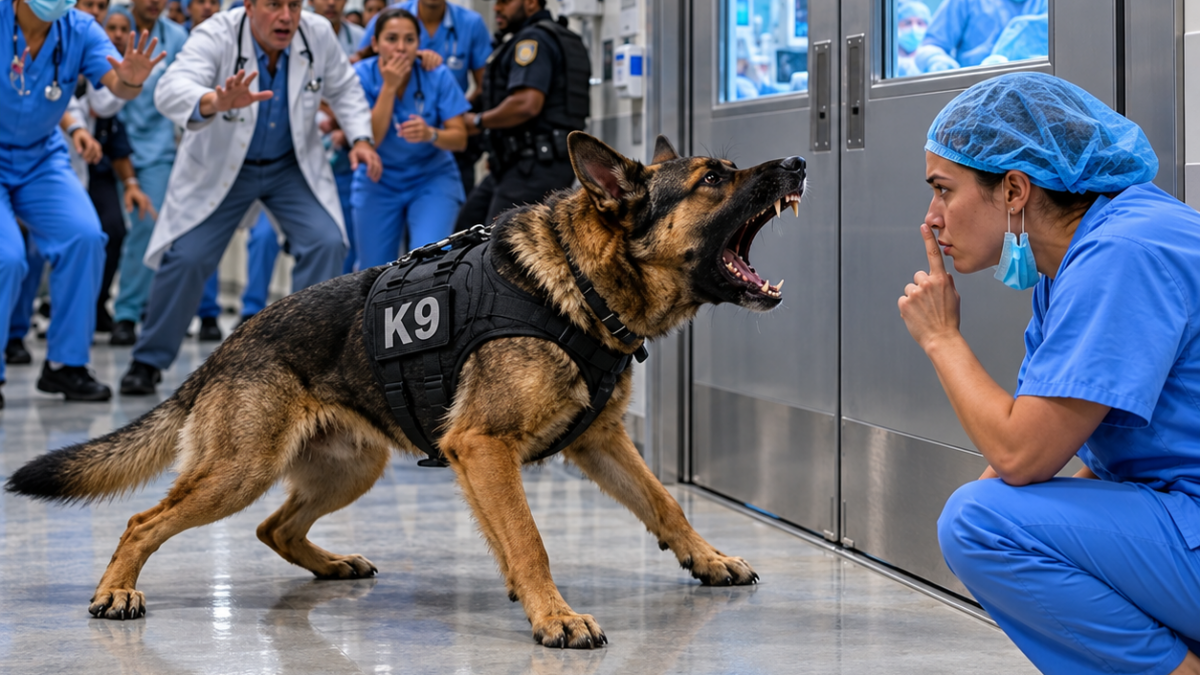
The German Shepherd snapped his head toward the door and let out a low, continuous growl that Dana felt in her back teeth.
She had heard that sound before too.
Explosive detection dogs did not growl at nothing.
They growled at odor.
At pressure change.
At wires they could smell through drywall.
At chemical signatures buried beneath rubber, blood, dust, and human panic.
Dana’s hands, which had trembled through morning rounds and trembled through Voss’s tirade thirty seconds earlier, went suddenly still.
She noticed it the way she noticed most things about her old self now, from a distance.
Like watching someone else’s hands remember what hers had tried to forget.
“Sir,” she said.
This time, her voice did not waver.
“You need to stop that gurney.”
Voss turned on her, incredulous.
“Excuse me?”
“The dog isn’t malfunctioning. He’s alerting.”
“Alerting to what, Nurse Whitfield? A mop bucket?”
A younger nurse, Priya, glanced between them, sensing something had shifted in the air though she could not have named it.
Dana took one step toward Talon.
Just one.
The dog’s growl dropped half an octave.
His ears flicked toward her once.
The way a soldier’s eyes flick toward a familiar voice in a crowded room.
Voss saw it and misread it completely.
“Oh, wonderful. Now she thinks she’s a dog whisperer.” He pointed down the hall. “Get back to your station before I write you up for insubordination.”
Dana did not answer.
She was doing math in her head that had nothing to do with medication doses.
Three minutes out.
Multiple casualties.
Structural collapse.
Possible secondary device.
A dog locking on to the one door every incoming gurney would roll through.
Nine years ago, she would have called that a pattern.
Tonight, she was trying to call it a nurse’s overactive imagination because that was the only version of herself anyone in this building was allowed to see.
Except her hands were not shaking anymore.
And somewhere behind her ribs, a voice she had not used in three years was clearing its throat.
Waiting.
She thought of the training yard at Fort Campbell.
Wet grass at five in the morning.
A German Shepherd’s weight leaning into her leg.
Rex.
The name hit hard enough that she almost closed her eyes.
She pushed it down.
Folded it small.
Forced it back into the drawer where she kept things she was not allowed to miss out loud.
Talon’s eyes flicked toward her again.
Not confused.
Waiting for confirmation.
This dog was not asking her to obey.
He was asking her to remember.
Priya touched her sleeve.
“Dana, are you okay? You look different all of a sudden.”
“I’m fine,” Dana said.
And for the first time in fourteen months, she almost believed her own lie.
Down the corridor, the elevator chimed.
The gurney was coming.
Talon’s growl rose again, sharp and steady, aimed directly at the door Voss had just ordered them to force him through.
Dana felt something she had not felt since the day she buried a set of dog tags in a box she never opened anymore.
She felt herself starting to remember who she used to be.
The elevator doors opened onto chaos.
Two EMTs pushed a gurney through, shouting vitals over each other.
Behind them, a second gurney followed.
Behind that came two firefighters in turnout pants, one with a blood-soaked bandage around his arm.
And behind them all, hospital security wheeled in a stretcher carrying someone who was clearly not a patient.
A man in a torn maintenance jacket.
Hands zip-tied.
Blood on his knuckles that was not his own.
“Structural collapse at the east parking garage,” one EMT called out. “But it wasn’t structural. Somebody rigged a support column. We got two dead on scene. Four critical incoming behind us.”
Voss’s face drained of color.
“A device?” he said. “You’re telling me there was a device?”
“Bomb squad’s still clearing it,” the EMT said. “This guy was found running from the scene with a partial detonator in his jacket. PD wants him held here under guard until transport.”
Talon’s growl had not stopped since the elevator opened.
If anything, it deepened.
Aimed now not at the door.
Not at the EMTs.
Not at the blood.
At the zip-tied man’s jacket pocket.
Where something square pressed against the fabric.
Dana’s mind sorted the information the way it used to sort information in a colder place.
Detonator recovered.
Partial device.
Possible secondary.
Man calm enough to run instead of panic.
Hands bound but body controlled.
Eyes too steady.
Breathing too even.
Not a panicked civilian.
Not a simple accomplice.
A trained variable.
Her eyes moved over him the way they used to move over unknowns in a compound she had been sent to clear.
Posture controlled.
Shoulders relaxed.
Hands zip-tied but not straining.
No frantic questions.
No “What’s happening?”
No “I need a lawyer.”
No “I’m hurt.”
Just watching.
Calculating.
Waiting to see who in the room understood the situation first.
Not well enough, Dana thought, for a dog that still remembered his work.
“Get that jacket off him,” she said.
Voss turned on her again, but this time his voice had lost its certainty.
“What did you say?”
“His jacket. Get it off him and get everyone back thirty feet now.”
“You do not give orders in my trauma bay, Nurse.”
Talon lunged the length of his leash, nearly pulling the guard off his feet, every muscle aimed at the zip-tied man’s chest pocket.
The man’s eyes flicked to Dana.
Just for a second.
A flicker of recognition that had nothing to do with her nursing badge.
It was gone before anyone else caught it.
But Dana caught it because she had spent nine years learning to read exactly that kind of flicker.
“Everybody out of this corridor,” she said.
Her voice came from somewhere she had buried on purpose.
“Non-essential personnel, clear the hall. Security, secure that pocket without touching it directly. Somebody call whoever’s running EOD on scene and tell them there may be a second device inside this building.”
For three full seconds, nobody moved.
Because the nurse who never spoke above a whisper had just given six orders in a row without blinking.
Then Priya moved first.
She grabbed a wide-eyed intern by the sleeve and guided him back through the double doors.
“Move,” Priya said. “You heard her.”
That broke the spell.
A respiratory therapist backed away.
One of the EMTs pulled the second gurney into the alcove.
A resident reached for the wall phone.
Voss found his voice again, but smaller now.
“You have no authority to clear a hallway.”
“I have the only set of ears in this building that knows what that dog is telling you,” Dana said. “Clear the hallway, Gerald, or explain to the fire marshal why you didn’t.”
Something in the way she said his first name—flat, unafraid, almost bored—made Voss step back half a pace before he caught himself.
The security guard peeled back the jacket with gloved hands.
Slow.
Careful.
The way Dana silently coached him with two fingers pressed downward in a gesture nobody in the room recognized except her.
Inside the pocket sat a small rectangular unit.
Wires coiled beneath the torn stitching.
A blinking amber light steady and unbothered by all the panic around it.
The zip-tied man smiled.
“Talon smelled it before your dogs did,” he said almost conversationally. “Good boy still has the nose.”
Dana’s blood went cold in a way it had not in three years.
“You know this dog.”
“I trained near the unit that washed him out,” the man said. “Bad batch of handlers. Good dog, though. Shame what they did to him.”
Voss looked between them.
Lost.
“What is happening right now?”
Dana ignored him.
Her eyes stayed on the amber light.
“Is there a second trigger?” she asked the man. “Or is that the only one?”
“Depends how fast your bomb squad moves,” he said, still smiling.
Dana turned to the guard.
“Get this unit into a blast container if the hospital has one. If not, get it into the courtyard away from load-bearing walls, and nobody touches those wires but EOD.”
“There’s no blast container in this hospital,” Voss said, panic breaking through his composure. “This is a civilian trauma center, not a—”
“Then we improvise,” Dana said.
Something in her tone made three separate staff members move at once without waiting for Voss to approve it.
She crouched beside Talon.
The German Shepherd went still the instant she came within arm’s reach, as if he recognized something in her posture that had nothing to do with scent or rank.
“Easy,” she murmured so low only the dog could hear it. “I’ve got this one.”
Talon’s growl finally broke, dissolving into a low whine of something that looked almost like relief.
Voss stared at her like he had never seen her before in his life.
Which, in the way that mattered, he had not.
Somewhere down the hall, a phone began ringing at the nurses’ station.
Sharp.
Insistent.
The kind of ring that meant someone important had already heard about the device before hospital security finished securing the corridor.
Threats like this traveled faster through federal channels than through any hospital intercom.
Dana kept one hand resting on Talon’s head.
Steady.
Grounding them both.
The courtyard cleared in under ninety seconds.
Staff and ambulatory patients funneled out through the east exit under Dana’s directions, though she gave them so quietly that half the hospital would later swear Voss had organized the evacuation himself.
She would not correct them.
She never wanted credit.
She wanted the building empty.
The security guard set the device down in the open courtyard exactly where she indicated, forty feet from the nearest wall, and stepped back the way she had shown him.
Palm flat.
Low.
The universal signal for slow, controlled distance.
A gesture she had not used since a different desert.
A different life.
A different dog.
She moved through the hallway, giving instructions in the same flat tone she used to give patients bad news.
A tone that made people listen because it never once suggested panic was an option.
A resident who had mocked her twenty minutes earlier now followed her directions without question.
Talon paced beside her, nose low, working the seams of the corridor the way he had once worked buildings that no longer existed except in classified reports.
Dana felt something loosen in her chest that had been clenched tight for three years.
“Bomb squad four minutes out,” someone called from the door.
“We don’t have four minutes if there’s a second unit still active inside,” Dana said.
The zip-tied man watched her with open curiosity now, head tilted, still smiling in a way that made the hair on Dana’s arms rise.
“You’re not a nurse,” he said.
“I’m exactly a nurse,” Dana said.
“Where’s the second device?”
“Depends what you used to be,” he said, ignoring her question entirely. “For a dog like that to still trust you.”
Voss finally found something to hold on to.
“You two know each other?”
“No,” Dana said at the same time the man said, “Sort of.”
Talon strained against his leash again.
This time toward the hospital’s mechanical room door, thirty feet down the corridor behind them.
His growl returned.
Low.
Insistent.
Nose working the air in short, sharp pulls.
Dana did not need him to finish the sentence.
“Second device is inside the mechanical room,” she said. “Get everyone off this floor and the floor above it.”
“How do you know that?” Voss demanded.
“Because that’s where I’d put it.”
For one unguarded second, her voice carried nine years of training nobody in that hospital had ever been told about.
“If I wanted the first device found, and the second one missed while everyone congratulates themselves for catching the obvious one.”
The zip-tied man’s smile finally faltered.
“She’s better than the last handler,” he muttered, mostly to himself.
Dana crouched in front of him, level with his eyes, and something in her posture made two security guards straighten involuntarily, though neither could have said why.
“Who told you to target this hospital?” she asked.
Quiet.
Even.
“Wrong question,” he said. “Ask me who taught your dog to alert on my specific compound. That’s the interesting one.”
Dana’s jaw tightened.
“Answer the first question.”
“I don’t answer questions from nurses.”
He smiled again.
Wider this time.
Testing her.
Dana leaned in half an inch.
No more.
“Staff Sergeant Dana Whitfield. Military Working Dog Program. Nine years. Three deployments.”
She said it so quietly that only he and Talon heard the first part.
Then she spoke the code.
“Brimstone. Heel. Hold.”
Talon sat.
Instantly.
Rigid.
Ears forward.
Body squared.
The growl stopped like someone had cut power to it.
The zip-tied man’s face changed.
Not much.
Enough.
Because until that moment, he had been playing a game against hospital staff.
Now he knew he had triggered something else entirely.
Talon let out a low sound at Dana’s feet, half growl, half recognition, as if the dog understood exactly what name had just been spoken aloud for the first time in three years.
The man’s eyes moved from Dana to the dog and back again.
Calculating.
Recalculating.
The smugness drained out of his expression one degree at a time.
“You’re supposed to be dead,” he said.
“Or discharged. Or both.”
“I got discharged,” Dana said. “The dead part didn’t take.”
Voss, standing three feet away, had stopped breathing entirely.
The man exhaled.
Some of the bravado drained out of him at once, replaced by something closer to resignation.
“Mechanical room. Behind the boiler housing. Sixty-second timer started when the first unit was found instead of triggered manually. Somebody’s watching a camera feed somewhere and getting nervous right about now.”
Dana was already moving.
“Voss. Fire alarm. Full building. Now. Get everyone on the mechanical-room floor moving toward stairwell C, away from the boiler wall.”
“You don’t have the authority.”
“I don’t need authority,” Dana said, already running. “I need forty seconds.”
Talon tore free of the guard’s slackened grip and ran beside her.
Exactly where he had run beside a different handler a lifetime ago before either of them had been discarded by people who never understood what they were looking at.
Behind them, Voss stood frozen in the corridor, phone forgotten in his hand, watching the nurse he had threatened to write up an hour earlier sprint toward the one part of the building everyone else was fleeing.
It was the first time in six years running Ashford Trauma Center that he had absolutely no idea what to do next.
And some small, honest part of him understood that not knowing was the most useful thing he had felt all night.
The mechanical room smelled like heat and rubber and the specific ozone tang of old wiring.
Underneath it all, faint and chemical, was the compound Talon had been bred and trained to hunt.
Dana hit the boiler housing at a dead run.
Talon was half a step ahead of her.
Nose driving him toward the gap behind the unit exactly where the man upstairs had said it would be.
Sixty seconds.
Voss’s fire alarm was already screaming through the ceiling.
She could hear the distant thunder of feet moving toward stairwell C.
Faster than expected.
Faster than she had dared hope.
She dropped to her knees behind the boiler housing.
The device sat wedged against a support beam.
Smaller than the first.
Wires running to a timer whose red display had ticked down to thirty-eight seconds and was not slowing down for anyone.
Somewhere above her, the building was emptying in an orderly rush.
Boots on stairs.
Doors swinging.
The particular controlled panic of people who had been told exactly what to do and were doing it because a voice they did not recognize had told them to.
Dana’s hands, which had trembled through fourteen months of civilian life, went perfectly steady.
She had defused exactly one device in the field nine years ago under a sergeant’s supervision and a great deal of luck.
She had never expected to do it again in cobalt-blue scrubs with a hospital fire alarm screaming overhead.
“Thirty-four seconds,” she said out loud, mostly to keep her own hands moving at the right speed.
“Talon. Sit. Stay.”
The dog sat instantly.
Ears forward.
Body rigid with an old, buried discipline neither of them had used in years.
Dana traced the wiring with two fingers.
Not touching.
Just reading.
The way she had been trained to read a hundred configurations that all boiled down to the same handful of principles.
Two leads to the timer.
One lead she did not recognize.
Likely a decoy meant to punish an amateur who cut the wrong wire first.
She had seen configurations like this before in a country she was not permitted to name out loud in casual conversation.
Built by hands that thought civilians would never look close enough to notice the difference between a real lead and a trap.
Whoever built this one had made the same mistake twice.
Arrogance.
It was one of the few constants she had learned to count on in every device she had ever knelt beside.
Talon shifted his weight but held his set, eyes locked on her hands, waiting for a signal she had not given a dog in three years and somehow still remembered exactly how to give.
Footsteps pounded down the stairwell behind her.
A security guard’s voice cracked.
“Ma’am, you need to get out of there!”
“Stay in the stairwell,” she called back without turning. “Nobody comes past this door.”
Twenty-six seconds.
She traced the second lead.
The real one.
Straight and unbothered into the timer’s primary input.
No loop.
No decoy resistance.
No cleverness.
Exactly the kind of simple, arrogant wiring a man like the one upstairs would use if he believed nobody in a civilian hospital could possibly know better.
Dana exhaled slowly.
The way she had exhaled a hundred times in places that no longer existed on any map she was allowed to discuss.
Eighteen seconds.
Her fingers found the lead.
She did not think about Rex.
Did not think about the last device.
Did not think about the blast that had taken the sound out of the world for thirty-seven seconds and put it back wrong.
Did not think about waking up without a leash in her hand.
Did not think about being told she was lucky.
Lucky.
She let none of it into the moment.
There was only the wire.
The timer.
The count.
Twelve seconds.
She cut it clean.
The red display froze at eleven.
Then went dark.
For one long moment, the only sound in the mechanical room was Talon’s breathing, fast and shallow, and Dana’s heartbeat finally arriving late to a party that had already ended.
She sat back on her heels and let herself shake once.
Just once.
Just for a second.
The way she never allowed herself to shake in front of anyone.
Then she stood, brushed off her scrubs, and walked back into the stairwell, where a dozen hospital staff stood frozen, staring at her like she had just stepped out of a different world.
Which, in the way that mattered most, she had.
Voss stood at the top of the stairs, phone in hand, fire alarm finally silencing around them.
“You just—”
He could not finish.
“Defused it,” Dana said. “You’re welcome. Get EOD down here to confirm and sweep for a third unit because men like that rarely stop at two.”
Down the hallway, radios crackled with police voices.
Through the courtyard doors, Dana could see flashing lights arriving in force.
Not just EOD.
A black SUV convoy rolled in behind the bomb-squad truck, moving with the smooth aggression of people who had no business responding to a civilian bomb call this fast unless somebody with a much longer reach had already been listening.
Dana stood in the stairwell doorway, one hand resting on Talon’s head, and watched the convoy doors open in perfect, practiced unison.
Whatever came next, she understood one thing with total clarity.
The version of herself she had spent fourteen months trying to keep hidden had just walked into daylight in front of the entire hospital.
There was no folding her back into that drawer now.
The convoy doors opened before the SUVs had fully stopped.
Six men in tactical gear moved through the courtyard with the specific unhurried efficiency of people who had done this a thousand times and expected the same from everyone around them.
At the center of them walked a woman in civilian clothes with a military police credential clipped to her belt.
She moved like she owned every square foot of ground she crossed.
Dana recognized the walk before she recognized the face.
Some things never left a person.
No matter how many years or how many hospitals stood between then and now.
Voss intercepted them at the courtyard door, already talking, already trying to reclaim some authority over a scene that had stopped listening to him twenty minutes ago.
“I’m the administrator here, and I want an explanation for why federal agents are storming my hospital.”
The woman in civilian clothes looked past him entirely.
Her eyes found Talon first.
Then Dana.
Scrubs dark with sweat.
Badge crooked.
Hands finally trembling now that the moment no longer required them not to.
“Whitfield,” the woman said.
Dana went very still.
“Colonel Reyes.”
Voss’s head snapped between them.
“You know her? You know this nurse?”
“She is a nurse,” Reyes said, not unkindly, more like someone correcting a fact on a whiteboard. “She is also Staff Sergeant Dana Whitfield, formerly Military Working Dog Program. Nine years. Three deployments. One of four handlers in the last decade certified for dual explosive and tactical detection work in hostile environments.”
Voss stared at Dana.
No snide line came.
No correction.
No authority.
Just stunned silence.
Reyes continued.
“We’ve had eyes on this compound signature for eight months. We didn’t expect to find it defused by the one handler we lost track of after her discharge.”
Talon’s tail moved slow and uncertain at the sound of Reyes’s voice.
“He’s yours too,” Dana said quietly. “Isn’t he?”
Reyes looked down at the dog.
A shadow crossed her face.
“He was attached to the same program. He wasn’t washed out. He was pulled.”
Dana’s hand tightened once on Talon’s fur.
“Pulled from what?”
“Same operation that compromised your partner,” Reyes said. “We pulled Talon before they could finish what they had already started with Rex. We lost the threat on you both when the program got quietly shut down.”
“Rex,” Voss said slowly, like a man stepping onto thin ice. “You mean the dog? The one whose file is sealed in this hospital’s donation records?”
“Not now, Gerald,” Dana said.
It came out gentler than she expected because for the first time in fourteen months she did not need his approval to say his name like that.
Reyes studied her.
“You’ve been running from this for three years.”
Dana looked toward the mechanical-room door.
“Tonight it ran back.”
“That’s not something the Army usually gets to fix twice.”
“I didn’t do this for the Army,” Dana said. “I did it because a dog nobody would listen to was telling the truth, and I was the only one in the building who still remembered how to listen.”
Reyes almost smiled.
“That’s the only reason any of us are still good at this job.”
She glanced at Talon, who had settled at Dana’s feet with the boneless calm of a working dog who finally understood the job was done.
“He’s aged out of active detection work. Command wanted to retire him quietly and never mention the program that failed him. I fought that decision for eight months because I didn’t think either of you deserved to disappear twice.”
“You could have told me he was alive,” Dana said.
For the first time that night, something in her voice cracked.
Just slightly.
“You changed your number four times in three years,” Reyes said, not unkindly. “We weren’t hiding him from you. We were trying to find you.”
Behind them, EOD confirmed the mechanical room clear.
No third device.
The zip-tied man was loaded into a federal transport instead of a squad car, which told Dana everything she needed to know about how deep this had gone.
Voss finally found something resembling his voice.
“Nine years of service,” he said slowly, as if reading it off an invisible file. “You’ve been working in my trauma bay for fourteen months, and you let me humiliate you in that hallway an hour ago.”
Dana looked at him.
“You didn’t know.”
“That’s not the defense you think it is.”
“No,” Dana said. “But it is the truth.”
“I called you insubordinate. I threatened to write you up over a dog that just saved this entire building.”
“Talon saved this building,” Dana said. “I just finally remembered how to translate what he was saying.”
Reyes stepped closer, lowering her voice so only Dana could hear.
“The program wants you back.”
Dana shook her head.
“No.”
“Not in the field.”
Dana stopped.
“Training,” Reyes said. “There’s a joint unit standing up. Tactical medicine and canine detection. Civilian hospitals. Soft targets. Mass-casualty response. Nobody is better positioned to build it than the handler who kept her nerve in scrubs for fourteen months while nobody in the building knew what she used to be.”
Dana looked down at Talon.
The dog leaned his full weight against her leg the way a partner leans when the job is finally, finally over.
“And him?”
“He goes wherever his handler goes,” Reyes said. “That was never in question.”
For the first time in three years, Dana let herself imagine a version of the future that did not involve disappearing.
Around them, the courtyard was slowly returning to something like order.
Staff filtered back toward the building in small, cautious clusters.
Ambulances resumed their normal rhythm as if the last hour had not happened at all.
Only the boiler-room door, still propped open with EOD equipment scattered around it, told the truth about how close the night had come to going a very different way.
By morning, the story had already moved through every floor of Ashford Trauma Center in the particular exaggerated way hospital stories always did.
For once, exaggeration was unnecessary.
The night shift had changed over hours earlier.
Dana had not gone home.
She sat in the break room in yesterday’s scrubs, badge crooked, watching the coffee machine blink its empty light without bothering to refill it.
Talon lay in the hallway outside, head on his paws, eyes half open.
Every time someone walked past, his tail moved once.
Not for everyone.
For the ones who slowed down.
For the ones who had learned overnight that a dog lying in a hospital corridor might be doing more than resting.
Voss found Dana alone.
He stood in the doorway a long moment before speaking.
“I owe you an apology,” he said. “Several, actually. I don’t know where to start.”
“You don’t have to start anywhere.”
“Yes, I do.”
Dana turned the empty coffee cup slowly between her hands.
Voss came in but did not sit until she nodded toward the chair.
That detail did not escape her.
He sat across from her.
For once, he looked tired instead of important.
“I’ve run this trauma center for six years,” he said. “I built my reputation on control. Knowing exactly what was happening in every room under my authority. Last night, I found out I knew nothing about the person standing closest to me the entire time.”
“Most people don’t want to know,” Dana said. “It’s easier to have an enemy in scrubs than a soldier you don’t understand.”
Voss absorbed that.
“Colonel Reyes told me about the offer.”
“She talks a lot for someone in federal intelligence.”
“She talks exactly as much as she wants to,” Voss said. “Which is apparently more than I deserve to hear, given how I treated you.”
Dana looked toward the hallway.
Talon’s tail thumped once against the floor.
“I’m taking it,” she said.
“The program?”
“Yes.”
“I assumed as much.”
“I’m not leaving nursing behind. Not entirely. I want the unit built inside civilian hospitals, not separate from them. People like you need to understand what a dog like Talon is actually telling you, not just what he looks like when he’s inconvenient.”
Voss nodded slowly.
Something like respect settled into his face for the first time since she had met him.
“I keep thinking about the version of last night where nobody listened to you,” he said. “Where I got my way and that dog got dragged out of the corridor. Where that gurney rolled straight through those doors on schedule.”
Dana said nothing.
“I built my entire career on being the person who stays calm and in control during a crisis,” Voss continued. “Last night I found out real control means knowing when to hand it to someone better equipped to hold it.”
“Most people never get there,” Dana said. “Most people just get louder instead.”
“Then I’d like Ashford to be the first hospital in the pilot program.”
Dana looked at him.
“If that offer still stands after everything I said to you in that hallway.”
“It stands,” Dana said. “Everyone gets to be better than their worst hour. You just have to actually be better, not just say it.”
Outside the break-room window, Talon lay in a patch of morning sun near the nurses’ station, tail thumping lazily whenever a staff member walked past.
To anyone who did not know better, he looked like an ordinary hospital dog.
Dana knew better.
So did Voss now.
Priya found Dana at the end of shift, still in yesterday’s scrubs, badge slightly crooked.
“You could have told me,” Priya said.
Not accusing.
Just quiet.
“I couldn’t tell anyone,” Dana said. “That was the whole point for three years.”
“And now?”
Dana looked out at Talon.
At the hallway that had almost cost the building everything.
At Voss standing near the nurses’ station already fielding a call from hospital administration about federal training grants.
“Now I get to stop hiding the parts of myself that actually saved someone.”
Colonel Reyes’s convoy left that afternoon, but the paperwork for the joint program arrived within the week.
Within a month, Ashford Trauma Center had a small K9 training suite built into its east wing, staffed by one very specific instructor and one very specific dog who had both been given up on once by people who mistook silence for brokenness.
Dana never raised her voice in that hospital again.
Not because she could not.
Because she finally understood something nine years of service had never quite taught her.
Command presence was never about volume.
It was about knowing exactly which thirty seconds mattered and being the only person in the room who did not flinch when they arrived.
The first training class was small.
Six nurses.
Two security guards.
One resident who had snickered at Dana in the hallway and now could barely meet her eyes.
Voss attended from the back of the room.
Not to supervise.
To learn.
Talon stood beside Dana as she explained alert behaviors.
Not tricks.
Not obedience.
Language.
“Dogs like Talon don’t speak in words,” she told them. “They speak in weight shifts. Ear position. Breath. Refusal. Focus. A dog blocking a door may be disobedient. Or he may be giving you the only warning you’re going to get.”
The resident raised a hand.
“Why didn’t he just bark?”
Dana looked at Talon.
“Because barking is for us. Alerting is for the handler. If nobody understands the handler’s language, the dog looks broken.”
The room went quiet.
Good quiet.
Listening quiet.
She continued.
“Your job is not to assume every dog is right. Your job is not to assume every dog is wrong. Your job is to ask why. Why this door? Why this pocket? Why this room? Why now?”
Voss wrote that down.
Dana saw.
Did not comment.
Later, as the class practiced safe approach distance, Talon walked past Voss and paused.
The administrator froze.
Talon sniffed his shoe.
Then moved on.
Voss exhaled like he had been cleared by a judge.
Dana hid a smile.
“Don’t look so relieved,” she said.
“I am very relieved.”
“That’s healthy.”
“I’m learning.”
“You are.”
That was all she gave him.
It was enough.
The pilot program grew.
Not quickly.
Nothing good in a hospital grew quickly.
There were committee meetings.
Budget reviews.
Risk assessments.
Legal language.
Training waivers.
Insurance questions.
Three people from administration who used the phrase “optics” until Dana nearly walked out of the room.
But Talon changed things simply by existing.
He made abstract policy visible.
He stood in classrooms.
He walked corridors.
He sat outside mechanical rooms while staff learned how not to crowd his blind spots.
He demonstrated how alerting looked when it was subtle.
He demonstrated how stress looked when it was misunderstood.
He demonstrated that a creature written off as failed could still be the most competent body in a crisis if someone stopped demanding the wrong kind of performance.
Hospital security changed first.
The guards who had once reached for his collar began learning hands-off control.
Distance.
Voice discipline.
Line management.
Environmental reading.
One of them, Marcus Reed, apologized to Dana after the third session.
“I was one of the ones who almost dragged him.”
“I know.”
“I didn’t understand.”
“I know.”
“I should have.”
Dana looked at him.
“Now you do.”
He nodded.
And he did.
That mattered more than the apology.
Nurses changed next.
They were quicker than the physicians, though Dana would never say that in writing.
Nurses already understood subtlety.
They read pain before patients admitted it.
They knew when breathing changed, when skin color shifted, when the daughter who said she was fine was two seconds from collapsing in the hallway.
They understood that bodies speak.
It was not much of a leap to understand that dogs did too.
Priya became one of the best students.
She had a way of watching Talon that reminded Dana of herself before life had made watching hurt.
“What did the code mean?” Priya asked one evening after class.
Dana was wiping down training mats.
“What code?”
“The one you whispered. The one that made him sit.”
Dana paused.
Talon, lying near the door, opened one eye.
“Brimstone?”
Priya nodded.
Dana looked at the dog.
“It was an old unit confirmation word. Not a command, exactly. More like telling him the person speaking had clearance inside his world.”
“That’s why he listened?”
“That’s why he believed I might know what I was doing.”
Priya smiled faintly.
“Same thing?”
“Not always.”
Talon thumped his tail once.
Dana said, “He has opinions.”
“I noticed.”
For a long time after Priya left, Dana sat beside Talon on the training-room floor.
The fluorescent lights were off.
Only the low night lighting remained.
Blue-gray.
Quiet.
The kind of light that made hospital hallways look like they existed between worlds.
She rested a hand on Talon’s shoulder.
Not gripping.
Never gripping.
Just there.
“I should have known,” she whispered.
Talon sighed.
The kind of sigh old working dogs give when humans begin speaking in regrets.
“I saw you for six months and pretended I didn’t know what you were.”
He did not answer.
Because he was a dog.
Because he had already forgiven things no human had earned.
Because dogs, despite what people like to say, do not live only in the present. They remember. They carry. They adjust. But they do not make shrines out of pain the way people do.
Dana was trying to learn that.
Some evenings, long after the training suite became a permanent fixture of the east wing, staff would still ask her about that night.
Dana rarely gave them more than the outline.
Talon blocked a door.
Dana recognized an alert.
Device found.
Evacuation.
Second device defused.
Federal response.
End.
People always wanted more.
They wanted the code.
The past.
The dramatic version.
The secret life of the quiet nurse.
Dana understood the hunger.
Stories made fear easier to hold.
But some parts of that hallway belonged only to her and to a dog who had spent years being written off as broken by people who never considered that his silence, like hers, had simply been waiting for someone to listen correctly.
Talon lived out his working years exactly where he belonged.
Not in combat.
Not in a kennel.
Not in a ceremonial retirement photo used for funding brochures and forgotten afterward.
In a hospital.
In corridors full of machines, fear, blood, antiseptic, grief, birth, death, and human beings who needed someone paying attention to what they missed.
Every new class of trainees learned his name before they learned Dana’s rank.
That was exactly the order she preferred.
Voss retired two years later.
In his farewell speech, he did not talk much about budgets.
Or expansion.
Or surgical volume.
Or his tenure.
He stood behind the podium in the hospital atrium, older than Dana remembered him looking that night, and looked toward the east-wing corridor where Talon lay in his usual patch of sun.
Then he said, “The most important thing I learned in this building is that authority is not the same thing as being loud. It is not the same thing as being certain. Sometimes the quietest person in the room is holding everything together. And sometimes the smartest thing you can do is stop talking long enough to hear what they already know.”
Nobody who had been in that hallway the night of the collapse needed to ask what he meant.
Dana stood in the back.
Arms crossed.
Talon beside her.
Priya leaned close and whispered, “That was almost good.”
Dana whispered back, “Don’t encourage him.”
Talon’s tail moved once.
Even he seemed amused.
There is a particular kind of person the world tends to misjudge.
The quiet one.
The one who lowers her eyes and lets other people fill the silence.
The one everyone assumes has nothing left to give because she never announces what she carries.
Dana Whitfield spent fourteen months letting an entire hospital believe she was ordinary because ordinary felt safer than being seen.
But safety built on hiding is never really safety.
It is just a longer, quieter kind of exhaustion.
What changed everything that night was not a title.
Not a uniform.
Not even a military code.
It was a single moment when she stopped protecting her secret and started protecting the people around her instead.
That is the difference between hiding and humility.
Hiding says, “I cannot let you see this part of me.”
Humility says, “I will show you exactly as much as you need to be safe, and not one ounce more for my own comfort.”
Gerald Voss spent six years believing authority meant never being wrong in front of his staff.
It took one dog, one hallway, and one nurse he had underestimated to teach him that real authority is the willingness to say, “I was wrong,” and then actually change.
Most people never get that lesson delivered so directly.
Most of us get smaller versions every week in quieter hallways from quieter people we have decided are not worth listening to.
The truth is that everyone around you is carrying something you cannot see.
The tired coworker who never explains herself.
The neighbor who flinches at fireworks for reasons he will never mention.
The dog everyone calls broken because nobody bothered to learn his language.
Respect is not something you hand out based on rank, title, or how loudly someone defends themselves.
It is something you extend because competence rarely announces itself.
And the people who have been through the most are often the ones working hardest to seem like they have not.
Years after that night, when Dana was asked what saved Ashford Trauma Center, people expected her to say training.
Or instinct.
Or timing.
Or Talon.
She always looked down at the old German Shepherd beside her, gray around the muzzle now, eyes still sharp, body still ready when the world shifted wrong.
Then she gave the only answer that felt true.
“We listened.”
Talon would lift his head at her voice.
Not much.
Enough.
And somewhere in that small movement was the whole story.
A broken dog who had never been broken.
A quiet nurse who had never been weak.
A hospital administrator who finally learned to step back.
A hallway full of people who survived because one animal refused to move and one woman remembered the language everyone else had forgotten.
The operating room doors were repaired after that night.
The mechanical room was rebuilt.
The courtyard concrete was replaced where EOD damaged it during the sweep.
The east wing got new signage, new cameras, new training protocols, and one framed photograph near the nurses’ station.
Not of Voss.
Not of the federal convoy.
Not of Dana in uniform.
Just Talon, lying in a patch of morning sun, head on his paws, eyes half open.
Below it, on a small brass plate, were four words Dana had chosen herself.
HE WAS LISTENING FIRST.