The HOA Used a Fake Survey to Steal 15 Acres of My Family’s Farm and Built 100 Mansions Behind It—Then They Discovered Who Actually Owned the Levee Protecting Them.
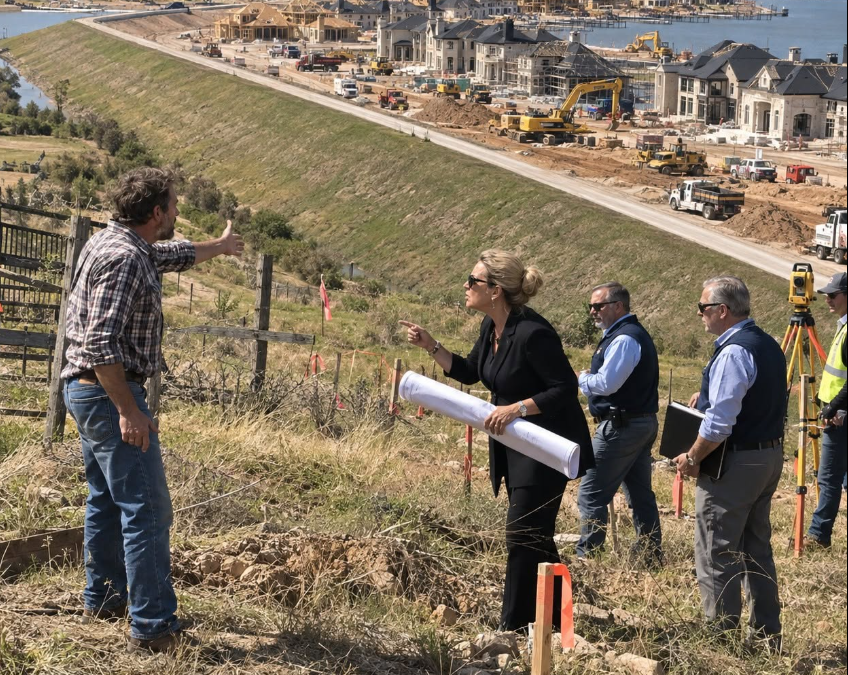
The HOA Used a Fake Survey to Steal 15 Acres of My Family’s Farm and Built 100 Mansions Behind It—Then They Discovered Who Actually Owned the Levee Protecting Them.
They tore down my father’s fence in broad daylight, smiling like the law belonged to whoever could afford better boots.
They called my family’s land “community property,” but the secret buried behind that levee was older than their mansions, older than their fake survey, and worth more than all their lies combined.
By the time the storm came, the same people who laughed while my pasture disappeared were begging me to save the neighborhood they had built on stolen ground.
“Tear down his fence. This is community property now.”
I heard Trent Covington give that order from fifty yards away.
At first, my mind refused to understand what my eyes were seeing. There are certain things you don’t expect to find on land that has carried your family’s name for almost seventy years. You don’t expect a backhoe in your pasture. You don’t expect a line of dump trucks crawling over coastal grass like beetles. You don’t expect strangers in reflective vests ripping cedar posts out of the ground where your father once taught you how to stretch wire tight enough to sing when the wind hit it.
But there they were.
Three sections of my east fence already lay twisted in the mud. The top wire had snapped and coiled like a wounded snake. The old cedar posts my grandfather sank by hand were being dragged up by a yellow backhoe, roots and clay clinging to them, each one coming out of the earth with a sound that felt almost human.
Behind the machine, a crew was spreading crushed limestone across grass my great-grandfather had bought with shrimp-boat money in 1958.
Not leased.
Not borrowed.
Not disputed.
Owned.
My boots sank into the damp ground as I crossed the pasture. The morning was already hot, the kind of Gulf Coast heat that rises from the marsh before breakfast and stays under your shirt all day. Egrets lifted from the tidal ditch beyond the levee, white wings flashing against the flat gray sky. Somewhere behind me, one of my cattle bellowed, startled by the machinery.
Trent Covington stood beside a black Mercedes near the broken fence line, one hand in his pocket, polished boots untouched by mud. He wore a blue button-down shirt rolled at the sleeves, dark sunglasses, and the relaxed expression of a man who had never doubted that the world would move when he told it to.
I had known Trent for fourteen months, long enough to understand that he never raised his voice unless he had an audience and never smiled unless someone else was losing.
His foreman saw me first.
He was a heavyset man with a sunburned neck and a clipboard tucked under his arm. He lifted one hand toward the backhoe operator, and the machine paused with its bucket clamped around another post.
Trent did not turn.
He kept watching gravel pour from the tailgate of a dump truck across my pasture.
“What the hell are you doing?” I shouted.
The dump truck brakes hissed.
A few workers looked at one another.
Trent finally turned his head slowly, like I was a mosquito interrupting lunch.
“Bennett,” he said.
He always called me Bennett. Not Mason. Not Mr. Bennett. Just Bennett, as if my family name was a problem on his schedule.
“Get your machines off my property.”
His expression barely changed.
“This isn’t your property anymore.”
For one second, I genuinely wondered whether the heat had distorted his words.
“What?”
He reached into the open passenger door of the Mercedes and pulled out a folded document. He shook it once, clean and crisp, the way men like him produce paper when they want theft to look official.
A county plat.
He held it between us.
“The boundary was corrected last year.”
“Corrected?”
“Your original survey contained inconsistencies.”
I almost laughed.
I am a licensed land surveyor.
I had been one for twenty-two years.
PART2:
There are few things more insulting than a liar explaining a survey to a surveyor while standing on land he is stealing.
“Show me,” I said.
He handed it over like he was doing me a kindness.
I knew the document before I opened it. I had seen a copy at the county clerk’s office three weeks earlier, after Eric Maynard from the feed store called and said, “Mason, did you sell that east strip to those Harbor Pointe people?” I told him no. He said, “Then you better go look at the new plat map, because somebody thinks you did.”
The plat in my hands showed the southern boundary of Harbor Pointe Estates pushed two hundred feet into my land, swallowing fifteen acres of pasture, a barn, a tool shed, part of the dirt access road, and the high ground leading to the old tidal levee.
Fifteen acres erased with one black line.
According to that line, my grandfather’s hay barn belonged to the Harbor Pointe Homeowners Association. The tool shed where my father kept his welding torch belonged to the HOA. The cattle lane that ran toward the creek belonged to the HOA. Even the oak where my mother scattered my father’s ashes fell on their side of the “corrected” boundary.
It was impossible.
It was fraudulent.
It was also recorded.
That was the most dangerous part.
“You know this is fake,” I said.
Trent smiled a little. “The county recorded it.”
“That doesn’t make it real.”
“It makes it enforceable until a court says otherwise.”
Behind us, the backhoe operator restarted the engine.
I turned my head. “Shut that machine off.”
Trent lifted one hand without looking away from me.
“Keep working.”
The bucket dropped.
Another fence post came out.
Something hot and animal moved through my chest.
For one second, I imagined grabbing Trent Covington by the front of that expensive shirt and dragging him through six inches of limestone gravel until the shine came off him.
Instead, I folded the plat carefully.
I handed it back.
“You’re making a mistake.”
PART3:
“No, Bennett.” Trent slid the paper into his car. “You’re the one refusing to accept what changed.”
“My deed didn’t change.”
“Deeds are interpreted through surveys.”
“Not through forged surveys.”
His smile disappeared.
“You should be careful with that word.”
“You should be careful where you put your machines.”
The foreman shifted behind him. Workers pretended not to listen.
Trent lowered his sunglasses just enough for me to see his eyes.
“You had your chance to be reasonable,” he said.
“I had my chance to what?”
“To work with us. We offered to buy that strip.”
“You offered me thirty thousand dollars for fifteen acres of waterfront-adjacent pasture and a levee access road.”
“It was unused land.”
“My cattle use it. My family uses it. The drainage system uses it.”
“The drainage system will be improved.”
“By burying it under gravel?”
He gave a small sigh, the kind people use when they are explaining the world to someone they consider slow.
“Harbor Pointe is not some trailer park, Bennett. We are building one hundred custom coastal homes with private marina access, walking trails, security gates, and tax revenue this county desperately needs. Your little fence is standing in the middle of progress.”
“My little fence is standing on my land.”
“Not according to the record.”
I looked past him toward the hill of dirt and limestone, toward the line of trucks, toward the broken cedar posts.
“You filed a fake plat and thought I wouldn’t know?”
“I filed a corrected plat prepared by a licensed surveyor and accepted by county review.”
“Which surveyor?”
His jaw tightened.
“You can obtain public records like everyone else.”
“I already did.”
“Then why are we having this conversation?”
“Because your surveyor used a monument that doesn’t exist, ignored three recorded deeds, moved a section line without basis, and somehow managed to place my grandfather’s barn inside an HOA that didn’t exist when he built it.”
The foreman’s face changed. He looked from me to Trent.
Trent noticed and snapped, “Keep working.”
Nobody moved.
I turned to the backhoe operator. “You touch another post, and I’ll name you personally in the trespass suit.”
The man killed the engine.
The sudden silence was enormous.
Wind moved through the sawgrass beyond the levee. A chain clinked against the backhoe bucket. Somewhere far off, a gull cried over the tidal flats.
Trent’s face flushed.
“You really want to do this?” he asked quietly.
“I didn’t start it.”
“No. Your family started it sixty years ago by sitting on land they never developed, blocking growth, blocking access, blocking every decent project this county has tried to build.”
“My family preserved that land because it floods.”
His mouth twitched.
“There it is. The old swamp-man warning. The land floods. The marsh floods. The creek floods. Nobody understands water except the Bennetts.”
“You sure don’t.”
He stepped closer.
“Look behind you, Mason.”
I hated hearing my first name in his mouth.
I didn’t turn.
He pointed anyway, toward the rising roofs beyond my pasture. Harbor Pointe Estates had appeared in less than two years where old pine woods and low cow ground used to be. White framing, black windows, copper gas lanterns, artificial lagoons, sales banners promising elevated coastal luxury. A hundred mansions planned, sixty already framed, twenty finished, and more foundations being poured every week.
“Those homes are sold,” he said. “Families have contracts. Investors have money in this. Banks have money in this. The county has permits issued. You think one angry surveyor with a sentimental fence is going to stop it?”
I looked at the broken cedar posts in the mud.
“I think one honest survey can.”
He laughed then.
Not loudly.
Not because it was funny.
Because men like Trent laugh when they want witnesses to know who has power.
“File whatever you want,” he said. “By the time you get a hearing, that fence will be gone, the road will be paved, and your pasture will be Harbor Pointe common area. Then maybe we’ll let you apply for trail access like everyone else.”
That was when my sister called.
I felt my phone buzzing in my pocket and almost ignored it, but I saw Lydia’s name on the screen. Lydia never called during her shift at the clinic unless it mattered.
I answered without taking my eyes off Trent.
“Mason,” she said, breathless, “you need to get to the house.”
“What happened?”
“It’s Mom.”
The rage inside me dropped through the floor.
My mother had been living with Lydia since her stroke the previous winter. Some days she could speak clearly. Other days her words tangled in her mouth and came out in pieces. She still knew the land, though. On her worst days, if you asked her where she was from, she would whisper, “Bennett ground.”
“What about Mom?” I asked.
“She saw the trucks from the porch. She tried to stand up. She fell.”
I closed my eyes.
“Is she hurt?”
“I don’t know. Ambulance is coming.”
Trent watched my face with faint curiosity.
I put the phone back in my pocket and stepped closer to him.
“You stop now,” I said.
His eyebrows lifted.
“My mother just got hurt because of what you’re doing.”
“That’s unfortunate.”
Unfortunate.
Not sorry.
Not is she all right?
Unfortunate.
Something in me went very still.
I pointed toward the broken fence.
“You are going to remember this morning.”
Trent smiled, but it didn’t reach his eyes.
“So are you.”
I left him there because my mother mattered more than cedar posts, more than gravel, more than giving Trent the fight he wanted. But as I drove back across the ranch road, dust rising behind my truck, I looked in the rearview mirror and saw the backhoe move again.
He kept working.
At the house, my mother sat on the porch steps with Lydia kneeling beside her and two EMTs checking her shoulder. She was eighty-one years old, thin as a reed, her silver hair pinned messily back, one side of her mouth still slightly slack from the stroke. But her eyes were sharp, and when she saw my truck, she lifted her trembling hand toward the east pasture.
“Mason,” she said.
“I’m here, Mama.”
“They’re taking Henry’s fence.”
Henry was my father.
“I know.”
Her eyes filled with tears. “He fixed that after Camille.”
I knelt in front of her.
Hurricane Camille had come before my time, but in our family, storms were not dates on a calendar. They were relatives. Camille. Elena. Georges. Katrina. Isaac. Sally. Each one had left a mark on the land, a story, a repaired roof, a line on the kitchen wall where water rose or almost rose.
“I know,” I said again.
My mother gripped my wrist with surprising strength.
“Don’t let them have the levee.”
I looked at her.
Her voice had gone clearer, the way it sometimes did when memory cut through damage.
“Not the levee, Mason.”
“I won’t.”
“They don’t know.”
“Know what?”
Her eyes moved toward Lydia, then back to me.
“Your father hid the blue book.”
A chill passed through me despite the heat.
“What blue book?”
But the EMT touched my shoulder.
“Sir, we need to transport her for imaging.”
My mother’s hand tightened.
“Blue book,” she whispered. “Henry knew they’d come someday.”
Then they lifted her carefully onto the stretcher, and the moment was swallowed by ambulance doors, radio chatter, Lydia crying, and my own helplessness.
I followed them to the hospital, but my mind kept circling the same words.
The blue book.
Henry knew they’d come someday.
My father had been dead four years. He had died at seventy-six, sitting in his truck under the live oak after checking cattle, one hand still resting on the gearshift. A heart attack, clean and fast, according to the doctor. I had found him at sunset, the windshield gold with reflected marsh light.
My father kept records for everything. Receipts, deeds, cattle vaccines, rainfall charts, fence repairs, old maps, handwritten notes about where the land sank after storms. His office at the farmhouse still smelled like dust, pencil lead, and tobacco, though he had quit smoking twenty years before he died.
After the hospital admitted my mother for observation and Lydia promised to stay, I drove back to the farmhouse.
The machines were gone from the pasture by then, but the damage remained. Fence down. Gravel spread. Survey stakes with orange ribbon driven into my land like little flags of occupation. A temporary sign had been planted near the dirt road.
HARBOR POINTE ESTATES FUTURE NATURE WALK ACCESS.
Private amenity for residents only.
I stood there reading it until the letters blurred.
Then I walked to my father’s office.
I searched for the blue book until midnight.
I opened filing cabinets, toolboxes, old map tubes, the safe behind his desk. I found tax receipts from 1974, a hand-drawn sketch of the barn roof, a photo of me at thirteen holding fencing pliers with a grin too big for my face. I found my parents’ wedding invitation, my grandfather’s discharge papers, a cigar box full of brass survey markers, and my father’s notes from the year he taught me how to run a level rod.
No blue book.
At one in the morning, Lydia called from the hospital.
“Mom’s shoulder isn’t broken,” she said. “Bad bruising. They’re keeping her overnight.”
“Good.”
“You sound awful.”
“I’m in Dad’s office.”
“The blue book?”
“You heard her?”
“She kept saying it after you left.”
“Do you know what it is?”
“No.”
I leaned back in his chair and stared at the ceiling fan. It made the same uneven click it had made since I was a kid.
“Lydia,” I said, “did Dad ever mention developers wanting the levee?”
She was quiet for a moment.
“Not directly.”
“What does that mean?”
“It means I remember him and Grandpa arguing once. I was in high school. They thought I was asleep. Grandpa kept saying the county would forget who kept the water out. Dad said forgetting was the first step to stealing.”
I closed my eyes.
Forgetting was the first step to stealing.
That sounded exactly like my father.
“Did they mention documents?”
“Maybe. I remember Grandpa saying something about the old levee compact. Or contract. I don’t know.”
“Compact?”
“I was sixteen, Mason. I was more interested in sneaking out to meet Ray Miller than listening to property law.”
Despite everything, I almost smiled.
“Ray Miller was an idiot.”
“He had a Mustang.”
“It had three different colored doors.”
“It still counted.”
For a second, we were just siblings again, standing somewhere in memory before fake surveys and hospital rooms and men like Trent Covington.
Then Lydia sighed.
“Mason, be careful.”
“I am.”
“No, you’re angry. That’s different.”
I looked at the survey stakes through the dark window.
“I know.”
“Trent has money. Lawyers. County friends.”
“I have deeds.”
“And a temper.”
“I didn’t touch him.”
“Yet.”
I said nothing.
“Mason.”
“I won’t.”
After we hung up, I kept searching.
At two-thirty, I found the blue book in the last place I looked because of course that is how dead fathers keep secrets. It was not in the safe. Not in the map drawers. Not in the labeled property files.
It was tucked inside an old ammunition box beneath the loose floorboard under his desk.
The book was small, navy blue, with cracked corners and a rubber band around it. On the front, in my father’s block handwriting, were three words.
LEVEE AND TITLE.
My hands shook when I opened it.
Inside were copies of records I had never seen.
The original 1958 deed to my great-grandfather, Amos Bennett.
A 1961 county drainage agreement.
A 1963 easement showing the Bennett family granted limited access to the county for maintenance of a tidal floodgate, but retained ownership of the levee structure and adjacent high ground.
A 1979 letter from the Army Corps of Engineers acknowledging the levee as a private agricultural flood-protection embankment, not a public flood-control structure.
A hand-marked map showing the levee crest, old benchmarks, buried concrete monuments, and the location of two floodgates near the marsh.
Then, folded between pages, a letter from my father to me.
My name was written on the outside.
I sat very still.
The paper had yellowed slightly. He must have written it near the end, when his handwriting had grown heavier.
Mason,
If you are reading this, either I am gone or too sick to explain it myself. I should have shown you earlier, but a man gets foolish about what he thinks he can still handle.
The east levee is the key. Not the pasture. Not the barn. The levee.
Your great-grandfather built the first berm after the 1957 flood wiped out his winter hay. The county later tied its drainage ditch into our floodgate and wrote the agreement you will find in this book. They got access. We kept ownership. No HOA, developer, neighbor, or county board can claim the levee without a deed from us.
Developers have wanted that ridge for thirty years because it is the only dry throat between the creek and the inland basin. If they control it, they can pretend the low ground behind it is safe. If they do not control it, their flood maps and drainage plans become expensive fiction.
I have refused three offers. They will come again. Maybe smiling. Maybe threatening. Maybe with paper.
Remember what I taught you: corners do not move because rich men need them to.
Trust the old monuments. Trust water. Water tells the truth even when men lie.
Dad
I read the letter once.
Then again.
By the third time, I was crying.
Not loud. Not dramatically. Just sitting in my father’s chair at three in the morning with one hand over my mouth while the whole past rearranged itself around me.
He had known.
Maybe not Trent specifically. Not Harbor Pointe. Not the fake plat. But he had known someone would come for the levee because the levee was the only reason Harbor Pointe could exist on that low bowl of land behind my pasture.
I spread the documents across the desk and saw it.
The fifteen acres Trent had erased were not random. They were not just scenic pasture or a future walking trail. They included the access road, barn pad, and high ridge leading to the levee crest. If Harbor Pointe could claim those fifteen acres, they could claim continuous control from their subdivision to the levee. They could tell buyers the HOA maintained the protective embankment. They could tell banks the development had private flood mitigation. They could tell insurers the homes sat behind an owned and maintained barrier.
But the levee had never belonged to them.
And without it, one hundred mansions sat in a drainage basin waiting for the next big storm to remember the shape of the land.
The next morning, I did not call Trent.
I called my attorney.
Her name was Vivian Cho, and she had represented me twice before, once over a boundary dispute between two farmers and once when a timber company “accidentally” cut a row of live oaks on my south line. Vivian was five feet tall, wore red glasses, and had the courtroom presence of a loaded shotgun.
She listened without interrupting while I explained the fence, the fake plat, my mother’s fall, the blue book, and the levee documents.
When I finished, she said, “Do not confront him again alone.”
“I already did.”
“Then stop being predictable.”
“That sounds like advice based on experience.”
“It’s advice based on men with land and tempers.”
“I didn’t hit him.”
“Congratulations on meeting the minimum standard for adulthood.”
I smiled despite myself.
Then her tone changed.
“Mason, listen carefully. If this plat was recorded with knowingly false boundary data, we may have fraud, slander of title, trespass, conversion, and possibly conspiracy depending on who signed what. But the levee issue is bigger.”
“I know.”
“No, I mean bigger than your land. If homes were sold using representations that the HOA owns or controls a levee it does not own, that implicates disclosures, flood insurance, bank underwriting, county permits, maybe state regulators.”
“Good.”
“Good legally. Dangerous personally.”
I looked out the office window toward the broken fence.
“You think Trent will escalate.”
“I think men who build empires on paper don’t like paper being used against them.”
She paused.
“Can you resurvey the property independently?”
“I can, but he’ll say I’m biased.”
“Then hire someone better than you.”
“There isn’t anyone better than me.”
“Mason.”
“I know a guy.”
“Good. Hire him. Quietly. I want certified corner recovery, historical deed overlay, aerials, LIDAR if you can get it, and a levee ownership packet.”
“I can start today.”
“And Mason?”
“Yeah?”
“Take photos of everything before it disappears.”
By noon, I had photographed every broken post, every tire track, every survey stake, every load of gravel, every boot print near the fence. I flew my drone over the east pasture and the Harbor Pointe construction zone, careful to stay within legal limits. The footage showed the truth from above: their gravel road cutting across my land like a scar, headed straight toward the levee.
At three, I met Deputy Carl Henson at the fence line.
He was a big man with a tired face and mirrored sunglasses. He had gone to high school with Lydia and still called my mother Miss Ruth. I thought that might help.
It didn’t.
“Mason,” he said, looking at the recorded plat Trent had emailed him, “you know I can’t sort this out in the pasture.”
“You can enforce trespass.”
“Not when both parties have paperwork.”
“My paperwork predates his by sixty years.”
“And his is recorded too.”
“Fraudulently.”
“That’s for a judge.”
I felt my jaw tighten. “So he can just tear down my fence?”
“I’m not saying it’s right. I’m saying it’s civil.”
There are few words more useless to a landowner watching his property get destroyed than it’s civil.
I looked at the broken posts.
“Carl, if I went over there and ripped down his entrance gate, would that be civil?”
He sighed. “Don’t do that.”
“Would you arrest me?”
“Probably.”
“Then you do know how trespass works.”
His face hardened.
“I’m trying to keep this from becoming something worse.”
“It already is something worse.”
He lowered his voice.
“Mason, I know your family. I respect your father. But Harbor Pointe has county approval. They have lawyers. If you go off half-cocked, they’ll paint you as unstable.”
“They already started.”
“Then don’t help them.”
That was the second time in twenty-four hours someone told me my anger could be used against me.
I hated that they were right.
The next day, Trent served me with a cease-and-desist letter.
It accused me of interfering with HOA development, harassing workers, threatening contractors, and falsely claiming ownership of common property. It demanded I remove “unauthorized cattle fencing and personal materials” from the disputed area within seventy-two hours. It warned that if I continued interfering, Harbor Pointe HOA would seek damages for construction delays.
At the bottom was the name of a law firm from Mobile that charged more per hour than most men around here made in a week.
I read the letter at my kitchen table while my mother slept in the back bedroom, recovering from the hospital. Lydia stood at the sink, washing a coffee mug with unnecessary force.
“He’s trying to scare you,” she said.
“He is scaring me.”
She turned, surprised.
I looked at the letter.
“I’m not afraid of Trent. I’m afraid of what money can do before truth catches up.”
Lydia dried her hands and sat across from me.
“You found Dad’s book.”
“Yes.”
“Then truth already caught up. It just hasn’t knocked yet.”
That afternoon, the first news story appeared.
LOCAL RANCHER BLOCKS HARBOR POINTE COMMUNITY TRAIL, CLAIMS LAND DISPUTE.
The article included a photo of me from ten years earlier at a county meeting, cropped so I looked angry. It quoted Trent Covington saying Harbor Pointe was “committed to responsible growth” and that “one neighboring landowner” was attempting to derail community improvements with “outdated claims and emotional rhetoric.”
Emotional rhetoric.
My father’s fence became emotional rhetoric.
My mother’s fall became emotional rhetoric.
My great-grandfather’s deed became emotional rhetoric.
By evening, my phone was full of messages.
Some supportive.
A lot not.
People called me greedy. Bitter. Anti-growth. A swamp hoarder. One man said I should be ashamed for trying to ruin families’ dream homes. A woman whose profile picture showed her standing in front of a Harbor Pointe sales banner wrote, We paid for access to that nature trail. You don’t get to steal from an entire community.
Steal.
I stared at that word until my eyes burned.
The next morning, I drove to Harbor Pointe’s sales office.
Not to confront Trent. Vivian had forbidden that.
I went because the sales office had public brochures.
A young agent with perfect teeth greeted me at the door.
“Welcome to Harbor Pointe. Are you looking for a home site?”
“No,” I said. “Just information.”
She handed me a glossy folder.
Inside were renderings of white-columned homes, children riding bicycles, couples walking dogs along a landscaped trail that crossed my pasture and curved along the levee.
One page read:
Protected by privately maintained coastal levee system owned and managed by Harbor Pointe HOA.
Another said:
Exclusive resident access to elevated nature ridge and restored marsh overlook.
There was a map showing the trail, the barn site labeled “future pavilion,” and the levee labeled “HOA flood protection boundary.”
I kept my face blank.
The agent smiled.
“Isn’t it beautiful? The levee trail is one of our biggest selling points.”
“I bet.”
“We had a lot of environmental review. Very safe. The developer is local and really cares about the land.”
“Does he?”
“Oh yes. Mr. Covington personally oversaw the preservation plan.”
I almost thanked her for the evidence.
Instead, I took two folders and left.
Vivian laughed when I brought them to her office.
Not because it was funny.
Because attorneys sometimes laugh the way surgeons say, “Well, there’s your problem.”
“They put it in the marketing materials,” she said.
“They sold homes on it.”
“They didn’t just sell homes on it. They represented ownership and maintenance responsibility. This is good.”
“Good for us.”
“Bad for them.”
She opened a legal pad.
“We’re filing for a temporary restraining order. Today.”
The hearing happened four days later in Judge Malcolm Reeves’s courtroom.
Trent arrived with two attorneys, a development consultant, and a county commissioner named Wallace Pruitt who claimed he was only there as an observer. Trent wore a charcoal suit and the serene expression of a man who believed courtroom wood paneling had been installed for people like him.
I wore my best navy jacket, the one my mother said made me look like I had a job indoors. Lydia sat behind me. My mother insisted on coming, though she used a wheelchair and looked pale beneath her church hat. When Vivian saw her, she leaned toward me.
“Your mother is either very brave or very stubborn.”
“Both.”
“Good.”
The other side argued that the plat was recorded, that construction delays were costly, that I had acted aggressively, and that Harbor Pointe residents would suffer irreparable harm if the trail and access road were delayed.
Vivian stood with one folder in her hands.
She did not raise her voice.
“Your Honor, my client is a licensed surveyor, but we are not asking the court to take his word today. We are asking the court to look at the recorded deeds, historical monuments, county drainage agreement, aerial imagery, and the developer’s own marketing materials. Harbor Pointe does not merely claim a walking trail. It claims ownership of land my client’s family has held since 1958 and, more significantly, a private levee system that was never conveyed to them.”
One of Trent’s attorneys stood.
“Your Honor, this is an attempt to complicate a simple boundary correction.”
Judge Reeves looked over his glasses.
“Sit down, Mr. Danner. I’ll tell you when I’m confused.”
The attorney sat.
Vivian continued.
“The so-called correction moves a boundary line two hundred feet without a deed, without a boundary agreement, without a court order, and without notification to the affected landowner. It relies on a survey that misidentifies existing monuments and creates a result contradicted by every historical record we have located.”
She placed enlarged maps on an easel.
The courtroom shifted.
Maps do that. Words can be argued with. Lines have a way of embarrassing lies.
The original deed line.
The 1963 drainage easement.
The 1988 county aerial.
The 2004 FEMA elevation layer.
The 2019 Harbor Pointe plat.
One line after another, the fake boundary stood out like a crooked bone.
Trent watched, expression flat.
Then Vivian showed the sales brochure.
“Harbor Pointe has marketed homes as protected by a levee it does not own. That levee sits on Bennett land. The HOA’s claim appears to depend entirely on the disputed plat.”
Judge Reeves picked up the brochure and read silently.
When he looked up, his face had changed.
“Mr. Danner,” he said, “does your client contend the HOA owns the levee?”
Trent’s attorney stood slowly.
“Your Honor, Harbor Pointe’s position is that the HOA has maintenance responsibility pursuant to development approvals and recorded documents.”
“That is not what I asked.”
The attorney cleared his throat.
“Ownership is part of the disputed boundary issue.”
Judge Reeves looked at Trent.
“Mr. Covington, did your company market these homes as protected by a levee system owned and managed by the HOA?”
Trent stood. “Your Honor, the marketing language was prepared by third-party consultants and reflects our understanding of the corrected boundary.”
“Did you personally know Mr. Bennett disputed that boundary?”
“Only recently.”
I felt Vivian’s hand touch my sleeve, warning me not to react.
Judge Reeves glanced at our filings.
“You offered to purchase the disputed acreage before filing the corrected plat.”
Trent hesitated.
“We explored several options.”
“So you knew Mr. Bennett claimed ownership before you claimed the land as common area.”
His attorney jumped up. “Your Honor—”
“Sit down.”
The attorney sat.
Trent’s face tightened.
Judge Reeves leaned back.
“I am issuing a temporary restraining order. No further construction, grading, fencing removal, marketing of the disputed land, or representation of ownership regarding the levee until this court determines title. Existing disturbed areas are to be stabilized but not expanded. No party is to harass, threaten, or interfere with the other. And Mr. Covington?”
Trent looked up.
“If I discover that homes were sold based on knowingly false flood-protection claims, your boundary problem will become the smallest problem in this courtroom.”
For the first time since I had known him, Trent Covington looked uncertain.
Outside the courthouse, cameras waited.
Trent stepped to a microphone like he had expected them. Men like him always know where cameras are.
“Today’s ruling is procedural,” he said. “Harbor Pointe remains committed to its homeowners, to responsible development, and to resolving this misunderstanding created by one neighbor’s refusal to cooperate with progress.”
He turned slightly, making sure the cameras caught me behind him.
“My hope,” he continued, “is that Mr. Bennett will consider the families affected by his actions.”
I stepped forward before Vivian could stop me.
Reporters swung microphones toward me.
My mother’s wheelchair was beside me. Lydia’s hand rested on her shoulder.
I looked straight at the cameras.
“My family has considered families on this coast for sixty-eight years,” I said. “That is why we maintained the levee. That is why we kept the drainage ditch open. That is why my father refused to let low land be sold as safe just because the brochures looked pretty.”
Trent’s face darkened.
I kept going.
“I didn’t move a boundary line. I didn’t tear down a fence. I didn’t sell houses behind a levee I didn’t own. Mr. Covington wants people to ask why I’m fighting. They should ask why he needed a fake survey to build.”
Vivian whispered, “That’s enough.”
It probably was.
But my mother lifted her hand from the wheelchair and said, loud enough for the nearest microphone to catch, “Water tells the truth.”
The clip went viral locally by dinner.
For the first time, the public story shifted.
People began asking questions. Harbor Pointe homeowners demanded copies of flood disclosures. A buyer posted photos of the brochure online. A local retired engineer wrote a long analysis explaining that if the Bennett levee was not owned or maintained by the HOA, Harbor Pointe’s drainage plan might be incomplete. Environmental groups noticed the marsh fill. State regulators requested documents.
Trent stopped smiling in public.
Then he came to my house at night.
It was after ten. My mother was asleep. Lydia had gone home. I was at the kitchen table reviewing old benchmark notes when headlights swept across the window.
My dog, Boone, lifted his head and growled.
I opened the front door but did not step onto the porch.
Trent stood at the bottom of the steps in a white shirt with the collar open, no tie, no cameras, no attorneys. For the first time, he looked tired.
“You shouldn’t be here,” I said.
“I came to offer you a way out.”
I almost laughed. “Of my own land?”
“Of this mess.”
“Get off my property.”
“Five million.”
The number hung between us.
Even Boone stopped growling for a second.
“What?”
“Five million dollars. You sign a boundary settlement. We keep the fifteen acres and levee access. You agree not to challenge prior marketing representations. We add language saying the HOA has maintenance rights. You can keep limited grazing rights for five years.”
I stared at him.
“You’re bribing me on my porch.”
“I’m solving your problem.”
“You think my problem is money?”
“I think everyone’s problem is money once the number gets big enough.”
I stepped onto the porch then.
The night smelled like wet grass and distant saltwater. Frogs sang from the ditch. Behind Trent, his Mercedes idled at the gate.
“My great-grandfather worked shrimp boats for twenty-six years to buy this land. My grandfather ran cattle on it until his hands twisted from arthritis. My father maintained that levee every storm season without asking the county for a dime. You think five million dollars buys the right to erase them?”
Trent looked toward the dark pasture.
“I think dead men don’t need acreage.”
The words were so cold I felt them physically.
I moved down one step.
Trent took half a step back before he caught himself.
“You came here alone,” I said, “because your lawyers wouldn’t put this offer in writing.”
“It’s a generous offer.”
“It’s hush money.”
“It’s reality.”
“No. Reality is what happens when the water rises. You built in a basin and sold people a lie.”
His face hardened.
“You think you’re some coastal prophet because your family patched a mud hill?”
“That mud hill is why your mansions haven’t flooded yet.”
“They won’t flood.”
“You better pray you’re right.”
He stepped closer, anger breaking through.
“You have no idea what you’re doing. If Harbor Pointe collapses, the county loses millions. Contractors go bankrupt. Families lose deposits. Banks sue. You think they’ll blame me? No, Bennett. I’ll still have lawyers. They’ll blame you. The stubborn rancher who killed their dream.”
“Maybe you should have built the dream on land you owned.”
For a moment, I thought he might hit me.
Instead, he smiled.
It was worse.
“You know, your father was smarter than you.”
I went still.
Trent noticed.
“He understood leverage. That’s why he never went public. Men like Henry Bennett knew when to make a private deal.”
“You didn’t know my father.”
“I knew of him.”
“Not the same thing.”
“He refused an offer once. A good one. Then he died with his ranch house needing a new roof and his wife wearing drugstore shoes.”
My hands curled.
“Say another word about my mother.”
“There he is.” Trent smiled wider. “That temper. I was wondering when it would show up.”
I looked past him and saw the tiny red light on his dashboard.
A camera.
He had come to provoke me and record it.
I stepped back.
“You should leave.”
“Or what?”
“Or I’ll call Vivian, and she’ll call your lawyers, and tomorrow the judge will hear that you came to my home after dark to offer money and insult my dead father.”
His smile faltered.
“And Trent?”
He looked at me.
“My porch camera has audio.”
That was not true.
At least, not then.
But he didn’t know that.
His expression changed just enough.
He turned without another word and walked to his car.
The next morning, I bought a porch camera.
Two weeks later, the independent survey came back.
The surveyor I hired was named Samuel Ortega, seventy-two years old, semi-retired, and mean enough to make younger engineers sweat. He had surveyed coastal Alabama, Mississippi, and Louisiana before GPS made mediocre men feel talented. He trusted old monuments more than new software and carried field notes in pencil because “ink acts too permanent for something men mess up so often.”
Samuel recovered all four historic monuments tied to my eastern boundary.
One was buried beneath three inches of gravel Trent’s crew had spread.
Another had been knocked loose and tossed near a ditch.
The third, a concrete marker my grandfather installed in 1971, sat exactly where my father’s records said it would.
The fourth had been ignored completely by the Harbor Pointe survey.
Samuel’s final report was devastating.
The Harbor Pointe plat did not correct a boundary. It created one.
It referenced a rebar pin set by the developer’s surveyor as if it were an original monument. It misapplied a bearing from a neighboring parcel. It failed to reconcile senior deed calls. It omitted the 1963 drainage easement. It included no signed boundary agreement from the Bennett family. It showed structures as “unverified improvements” despite the barn being visible on aerial imagery for fifty years.
At the end, Samuel wrote one sentence that made Vivian grin.
The 2019 plat cannot be reconciled with the historical record and appears to have no defensible basis for relocating the Bennett northern boundary.
“Appears,” I said when I read it.
Samuel looked offended.
“I’m an old man, not a reckless one. ‘Appears’ is what you write when you want a judge to understand you’re being polite.”
The deposition phase began in July.
By then, Harbor Pointe was in chaos. Construction lenders froze draws. Buyers demanded explanations. Homeowners who had already moved in formed angry factions. Some blamed Trent. Some blamed me. Some blamed the county. A few drove past my ranch slowly, glaring through tinted windows as if I had personally arranged for their dream kitchens to sit in a flood basin.
One afternoon, a woman in a white SUV stopped at my gate while I was repairing temporary fencing.
She stepped out wearing workout clothes and oversized sunglasses.
“Are you Mason Bennett?” she asked.
“Yes.”
“My name is Rebecca Lang. We bought Lot 38.”
I nodded cautiously.
“My children are supposed to start school here next month,” she said. “We sold our house in Birmingham. Everything we own is in storage. Now the builder says closing is delayed indefinitely because of your lawsuit.”
I leaned on the fence post.
“I’m sorry your family is caught in it.”
“Are you?”
“Yes.”
“Because it doesn’t feel like it. It feels like you’re punishing all of us.”
I wiped sweat from my forehead.
“Mrs. Lang, did Harbor Pointe tell you the HOA owned the levee?”
“They told us the neighborhood was protected.”
“Did they tell you my family owned the levee?”
She looked away.
“No.”
“Did they tell you part of the trail and drainage access was disputed?”
“No.”
“Then I’m not the person who lied to you.”
Her mouth tightened. “Maybe not. But you’re the person who can make this go away.”
I looked at the broken fence still waiting for full repair.
“That’s what Trent told me.”
“My husband says men like you just want a payout.”
“Your husband doesn’t know me.”
“No,” she said, voice breaking. “I guess nobody knows anybody anymore.”
She took off her sunglasses, and I saw she had been crying.
That softened something in me.
“I don’t want your children hurt,” I said quietly. “I don’t want anyone hurt. That’s why I’m fighting. If those homes are unsafe, pretending they’re safe won’t protect your family.”
She looked toward the levee.
“Is it unsafe?”
That was the hardest question anyone had asked me.
“The land is low,” I said. “The levee helps. But it was built for pasture and storm surge reduction, not to guarantee one hundred luxury homes behind it. It needs inspection. Drainage needs review. Floodgates need maintenance. Ownership needs to be honest. Without that, I wouldn’t put my family there.”
Her face changed.
Not anger now.
Fear.
“Thank you,” she whispered, as if she hated needing to.
She drove away slowly.
That evening, I found an anonymous note taped to my gate.
STOP DESTROYING FAMILIES.
Two days later, someone cut my south fence and let eight cows onto the county road.
A week after that, my barn was spray-painted with the word THIEF.
My mother saw it before I could clean it off.
She stood in the yard leaning on her walker, staring at the red letters on the weathered boards her husband had nailed decades earlier.
“People are scared,” she said.
“That doesn’t excuse it.”
“No.”
Her hand trembled on the walker.
“But scared people will believe the easiest lie if it lets them sleep.”
I pressure-washed the barn until the red paint ran down in watery streaks like blood.
Then I went inside and added the vandalism photos to Vivian’s evidence folder.
The truth finally cracked open in a deposition room with bad coffee and fluorescent lights.
The developer’s surveyor was named Paul Kettering. He was younger than me by a decade, clean-shaven, nervous, and wearing a suit that looked recently purchased. He had signed the 2019 plat. I remembered him vaguely from a state conference years earlier, a man who talked too loudly about drone mapping and client relationships.
Vivian questioned him for three hours.
At first, he hid behind language.
Professional judgment.
Available records.
Client-provided information.
Field conditions.
Boundary ambiguity.
Then Vivian placed Samuel Ortega’s report in front of him.
Kettering’s hands changed. He stopped tapping his pen.
She led him through each discrepancy.
The false monument.
The omitted deed.
The ignored barn.
The drainage easement.
The missing notification.
His answers grew shorter.
Finally, Vivian asked, “Mr. Kettering, who instructed you to use the rebar pin as controlling evidence of the boundary?”
“My field crew located it.”
“That was not my question.”
He swallowed.
“I discussed it with Mr. Covington.”
“What did he tell you?”
Trent’s attorney objected.
Vivian waited.
Kettering looked at his own attorney.
His attorney’s face said nothing, which said everything.
Kettering’s voice dropped.
“He said the Bennett line was wrong historically.”
“Based on what?”
“He said there had been an old handshake agreement.”
“Did he provide written evidence?”
“No.”
“Did he provide a deed?”
“No.”
“Boundary agreement?”
“No.”
“Court order?”
“No.”
Vivian leaned forward.
“Did you tell Mr. Covington the boundary could not be moved without legal support?”
Kettering stared at the table.
“Yes.”
“And what did he say?”
Kettering closed his eyes briefly.
“He said to make the map work.”
The room went silent.
Across the table, Trent Covington did not move.
Vivian’s voice stayed calm.
“Make the map work for what?”
Kettering looked like a man watching his career fall through a trapdoor.
“For the development plan.”
Trent’s attorney called for a break.
Vivian smiled.
It was not a happy smile.
It was the kind of smile that meant someone had just stepped into the light and found no shadow left to hide in.
After that, people started cooperating.
A former Harbor Pointe project manager produced emails showing Trent knew the levee ownership was “unresolved” before permits were finalized. One email from Trent read: Bennett old man won’t sell. Proceed with corrected boundary strategy. County wants this approved. We’ll clean up title later.
Another email mentioned Commissioner Pruitt.
Make sure Wallace keeps review moving. No need to flag Bennett easement unless asked.
The county suddenly discovered internal errors.
The recorder’s office admitted the corrected plat had been accepted without proper supporting documents. Planning staff claimed they relied on certified professional submissions. Commissioner Pruitt denied wrongdoing, then stopped attending public meetings.
The state licensing board opened an investigation into Kettering.
The district attorney requested files.
Trent’s public statements shifted from confidence to victimhood.
He called the case “a misunderstanding weaponized by anti-growth activists.”
Then “a technical dispute.”
Then “a coordinated attack on housing.”
By September, the first tropical system formed in the Gulf.
At first, nobody worried.
People who live on the Gulf Coast become amateur meteorologists against their will. We study spaghetti models like scripture and pretend not to fear the ones that bend toward home. The storm was called Iris, a name too soft for the red eye forming on radar. It strengthened, weakened, wobbled, then turned north with the casual cruelty of weather.
Two days before landfall, the county issued a flood watch.
I drove the levee at sunrise.
The old road was rutted from Trent’s unauthorized gravel work, but passable. The levee itself rose gently above the marsh, grass-covered and uneven, not impressive if you didn’t understand water. To the east, tidal creek. To the west, Harbor Pointe basin, full of half-built mansions, retention ponds, and streets with names like Heron Bend and Magnolia Tide.
I checked the first floodgate.
Partially blocked.
Silt and construction runoff had built against the grate.
I checked the second.
Worse.
Someone had dumped riprap too close to the outflow and narrowed the channel. Not enough to matter in a normal rain. Enough to matter if Iris dropped twelve inches and pushed storm surge into the creek.
I called Vivian first because every move now had legal consequences.
Then I called Kyle Mercer, the county emergency management director.
He met me at the levee with two public works trucks and the expression of a man who had slept badly for twenty years.
“You own this?” he asked.
“Yes.”
“Can we clear it?”
“Yes.”
“Will Harbor Pointe object?”
“They can object underwater.”
For six hours, crews cleared debris, cut brush, pulled silt from the gate, and opened old channels my father had marked in the blue book. I worked beside them until my shoulders burned. Rain began before noon, light at first, then steady. Harbor Pointe residents gathered behind temporary barricades, watching.
Rebecca Lang was among them. So was her husband, a tall man with folded arms and a face full of forced certainty.
Trent arrived at three in a county SUV with Commissioner Pruitt.
That told me more than either of them intended.
He marched down the gravel access road in a rain jacket, shouting before he reached us.
“What are you doing?”
I was standing knee-deep in muddy water with a shovel in my hands.
“Clearing the floodgate.”
“You can’t alter drainage during an active storm event.”
Kyle Mercer turned slowly.
“We’re emergency management.”
Trent barely looked at him.
“This levee is part of Harbor Pointe’s approved drainage plan.”
I laughed once, rain running off the brim of my hat.
“You picked a hell of a day to claim ownership.”
Pruitt stepped forward. “Mason, let’s not inflame things.”
I looked at the commissioner.
“How much did he promise you?”
His face reddened. “Careful.”
There was that word again.
Careful.
Every bully’s favorite prayer.
Kyle Mercer cut in. “Mr. Covington, unless you have a court order, step back. We have rising water and blocked outflow.”
Trent pointed at me. “He’s creating liability.”
“No,” Rebecca Lang said from behind the barricade.
Everyone turned.
She stood in the rain, hair plastered to her face.
“No more of that,” she said, voice shaking. “No more telling us the person finding the problem is the one creating it.”
Her husband grabbed her arm gently. “Rebecca.”
She pulled away.
“No. We bought here because you said the levee was ours. You said the drainage was safe. You said everything was reviewed. Now I’m watching the man you called greedy clear the floodgate you apparently forgot existed.”
Other homeowners murmured.
Trent’s face hardened.
“Mrs. Lang, this is not the time.”
“When is the time?” she shouted. “After our houses flood?”
Lightning flashed over the marsh.
For one second, the world was all white light, rain, and the sound of water pushing against old earth.
Then the floodgate opened.
A roar came from beneath the levee.
Water that had been backing into the Harbor Pointe basin surged through the cleared channel toward the creek, brown and foaming, carrying sticks, silt, plastic wrapping, and the bright orange ribbon of a survey stake.
People stepped back instinctively.
The sound was enormous.
It was the sound of pressure releasing.
The sound of a lie losing its grip.
Kyle Mercer shouted orders into his radio. Public works crews moved to the second gate. I climbed the bank, soaked, shaking from exhaustion.
Trent stared at the rushing water.
For the first time, I saw real fear on his face.
Not guilt.
Not remorse.
Fear of exposure.
Because everyone standing there understood what the water had just said.
The levee worked.
The floodgate mattered.
And Harbor Pointe had built one hundred mansions without understanding either one.
Iris made landfall sixty miles west of us as a strong tropical storm, not a hurricane, though the difference meant little to people watching water climb their porch steps. It rained for thirty hours. Roads disappeared. Ditches became rivers. The marsh rose like something alive.
Harbor Pointe flooded.
Not catastrophically. Not the way it would have if the gates had stayed blocked. But enough.
Crawlspaces filled. Streets became brown canals. Three unfinished foundations shifted. Retention ponds overflowed. A model home took eight inches of water through its back doors. Construction materials floated down Magnolia Tide Drive like wreckage.
My pasture flooded too, as it always had. But pasture can hold water. Grass bends. Cattle move to high ground. Old barns breathe through storms better than luxury drywall.
At three in the morning, I stood on my porch with my mother beside me in her wheelchair, wrapped in a quilt, both of us listening to rain hammer the roof.
“You opened the gates?” she asked.
“Yes.”
“Good.”
“The neighborhood still flooded some.”
“Would’ve been worse.”
“Yes.”
She nodded.
“Your father would’ve been proud.”
I swallowed hard.
“I wish he was here.”
“He is,” she said simply. “Every time you choose the land over your temper.”
I laughed softly. “That doesn’t sound like Dad.”
“No,” she said. “That part is me.”
After the storm, the lawsuits multiplied.
Homeowners sued Trent.
Buyers sued the development company.
The county suspended Harbor Pointe’s remaining permits.
State environmental regulators inspected the fill and drainage work.
The district attorney opened a formal investigation.
Kettering surrendered his survey license pending review.
Commissioner Pruitt resigned “to spend time with family,” which fooled absolutely no one.
Trent’s company filed a statement blaming “historic data discrepancies” and “unprecedented rainfall.” Then a local news station aired drone footage of the blocked floodgate, the fake boundary overlay, and video of me and county crews clearing the channel while Trent tried to stop us.
The headline changed everything.
DEVELOPER SOLD MANSIONS BEHIND LEVEE HE DIDN’T OWN, RECORDS SHOW.
This time, the cameras came to me.
I did not stand behind a microphone.
I met the reporter at the old barn, the spray-painted boards cleaned but still faintly stained if you knew where to look.
She asked, “Are you happy to be vindicated?”
I looked across the pasture toward Harbor Pointe, where families were dragging wet furniture to curbs.
“No,” I said. “Vindication doesn’t dry out a child’s bedroom.”
She blinked, surprised.
“What do you want to happen now?”
“I want the truth recorded. I want my land restored. I want the people responsible held accountable. And I want every family who bought there to know exactly what they were sold so they can make safe decisions.”
“Do you blame the homeowners?”
“I blame the people who lied to them.”
That quote spread farther than anything angry I could have said.
It also brought Rebecca Lang back to my gate.
This time, she brought her husband.
His name was Thomas. He looked humbled in the painful way proud men look when they have run out of arguments.
“I owe you an apology,” he said.
I was repairing the east fence again, setting new cedar posts where Trent’s crew had torn out the old ones. My hands were blistered. My back hurt. I wanted to be less tired before accepting anyone’s apology, but life rarely waits for ideal conditions.
“For what?” I asked.
“For calling you a thief online.”
Rebecca closed her eyes.
I looked at him.
“That was you?”
He nodded, face red. “I was scared. Angry. We had everything tied up in that house. Trent told us you were trying to extort the HOA.”
“And you believed him.”
“I wanted to.”
That was honest enough to matter.
I drove a staple into the fence post.
“Fear makes liars sound useful.”
He nodded.
“We’re joining the homeowner suit,” Rebecca said. “But we also wanted to ask if there’s anything we can do to help repair the fence.”
I almost said no.
Pride rose fast. This was Bennett land. Bennett fence. Bennett problem.
Then I heard my father’s letter in my mind.
Trust water.
Water tells the truth.
Maybe people could too, if given the chance.
I handed Thomas a pair of gloves.
“Ever stretched barbed wire?”
“No.”
“You’re about to learn.”
He worked badly at first. Most people do. He nicked his thumb, cursed, apologized to my mother though she wasn’t there, and listened while I showed him how to keep tension on the wire without letting it whip back. Rebecca carried posts. Lydia arrived with sandwiches and raised her eyebrows when she saw Harbor Pointe people working our fence.
By sunset, we had repaired two sections.
It didn’t fix what had happened.
But it changed the shape of what came next.
The final hearing on title happened in November.
The courtroom was full. Homeowners. Reporters. County staff. Contractors. Old neighbors who had known my father. My mother sat in the front row, wearing the same church hat as before, though Lydia had pinned it straighter this time.
Trent looked older.
Not poor. Not broken. Men like Trent rarely become either quickly. But the shine had dulled. His suit fit the same, but his confidence didn’t.
Vivian presented the chain of title cleanly and mercilessly.
Samuel Ortega explained the monuments.
The county clerk testified about recording deficiencies.
Kettering, under immunity for his cooperation, testified that Trent pressured him to make the boundary conform to the development plan.
Emails were entered.
Marketing brochures were entered.
The blue book was entered.
When Vivian presented my father’s letter, Trent’s attorney objected on relevance.
Judge Reeves read it silently.
Then he overruled the objection.
I watched the judge’s face as he reached the line: corners do not move because rich men need them to.
He looked up at Trent.
The courtroom was silent enough to hear paper shift.
When it was my turn to testify, Vivian asked me what the land meant to my family.
I could have talked about acreage, deeds, cattle, flood control, valuation.
Instead, I talked about my father’s hands.
How they looked wrapped around a post driver.
How he taught me that a fence line was not just where ownership stopped, but where responsibility began.
How my great-grandfather bought the land because he wanted one place in the world where no boss could tell him to move along.
How my mother remembered storms by waterlines and meals cooked for neighbors without electricity.
How the levee was never a luxury amenity, never a marketing feature, never a pretty ridge for evening walks.
It was work.
It was warning.
It was promise.
Trent’s attorney tried to make me sound emotional on cross-examination.
“You’re very attached to this land, aren’t you, Mr. Bennett?”
“Yes.”
“Attached enough to resist development?”
“Attached enough to resist theft.”
A few people murmured.
He adjusted his glasses.
“You understand Harbor Pointe represents significant economic value to this county?”
“Yes.”
“And your refusal to compromise endangered that value?”
“No.”
“No?”
“Fraud endangered it.”
He moved closer.
“Isn’t it true that you were offered a substantial sum of money to resolve this dispute?”
“Yes.”
“And you refused?”
“Yes.”
“Because no amount would satisfy you?”
“Because the offer required me to lie.”
He paused.
I turned slightly so I could see the homeowners in the gallery.
“I was asked to sign papers saying the HOA controlled a levee it never owned. If I did that, every family behind it would keep living under a false promise. I refused because my father taught me that land records are supposed to tell the truth after people are gone.”
The attorney had no good follow-up.
Judge Reeves issued his ruling two weeks later.
He voided the 2019 corrected plat as it related to the Bennett boundary. He quieted title to the fifteen acres in my name. He declared the levee and access road private Bennett property subject only to the limited 1963 county drainage easement. He ordered Harbor Pointe and its related entities to remove unauthorized improvements from my land, restore damaged pasture, replace fencing, and pay damages to be determined.
Then he referred the matter for criminal review.
Trent Covington was indicted in January on charges connected to fraud, filing false instruments, and conspiracy. Commissioner Pruitt followed in March. Kettering lost his license but avoided prison by cooperating. Trent’s company collapsed into receivership. Harbor Pointe homeowners eventually negotiated a settlement that funded drainage repairs, independent engineering review, and buyback options for the most vulnerable lots.
The mansions did not all disappear.
Life is not that neat.
Some families stayed after new disclosures, new flood work, and expensive redesigns. Some left. Some lost money they never should have had to risk. The county rewrote its plat review rules. The levee became the subject of an official maintenance agreement that respected ownership, access, and safety instead of pretending one erased the others.
As for the fifteen acres, the court ordered restoration.
But I did not rebuild exactly what had been there.
That surprised people.
For months, I thought justice meant putting everything back. Every post. Every inch. Every blade of grass. But after the storm, after the homeowners helped repair the fence, after watching families carry wet furniture from homes they had been deceived into buying, I began to understand that restoration was not the same as pretending nothing happened.
So I made a choice.
The land stayed mine.
The levee stayed mine.
The fence went back up.
But along the inside of the restored boundary, I granted a narrow, supervised walking easement to the county, not the HOA, open twice a month for school groups, coastal engineers, and residents who wanted to learn what that land actually was. Not a luxury trail. Not a selling feature. A living lesson in water, memory, and consequence.
We put up signs.
Not fancy ones.
Plain cedar posts with metal plaques.
BENNETT FAMILY LEVEE
PRIVATE LAND
CONSTRUCTED FOR AGRICULTURAL FLOOD PROTECTION
MAINTAINED BY FOUR GENERATIONS
WATER ALWAYS REMEMBERS THE LOWEST PLACE
My mother cried when she saw that last line.
“That was Henry,” she said.
“Yes.”
“And me.”
“Yes, Mama.”
“And you.”
I looked across the marsh, where egrets hunted in the gold light.
“Maybe.”
She reached for my hand.
“No maybe.”
The day Trent pleaded guilty, I was repairing the barn roof.
Vivian called while I was on the ladder.
“You sitting down?” she asked.
“I’m on a roof.”
“That’s not ideal.”
“What happened?”
“He took the plea.”
I looked toward Harbor Pointe in the distance.
“What’s he getting?”
“Prison time. Restitution. Ban from development work tied to public approvals. Details at sentencing.”
I waited for satisfaction to hit.
It didn’t come the way I expected.
There was relief, yes. A loosening in my chest. But there was also exhaustion. The kind that follows a long storm when you step outside and see that surviving still leaves work everywhere.
“Good,” I said.
“That’s it?”
“What do you want me to do, dance on the roof?”
“Please don’t. I don’t want another case.”
I smiled faintly.
After we hung up, I climbed down and walked to the oak where my father’s ashes had been scattered. The fake plat had put that tree on HOA land. The court had put it back where it belonged.
Late afternoon light moved through the leaves.
I stood there for a long time.
“I didn’t sell it,” I said aloud.
The wind moved over the pasture.
Maybe that was answer enough.
That spring, we held a fence-raising.
Not because we couldn’t hire a crew. The settlement money could have paid for the best fencing company on the coast. But Lydia said people needed a way to put their hands on something real after all the paper. My mother said my father would haunt us if we didn’t feed everyone. So we invited neighbors, Harbor Pointe residents who had apologized, old ranch families, county workers who had cleared the floodgate, even Deputy Henson, who showed up with work gloves and the guilty expression of a man who had learned the limits of calling theft civil.
We set cedar posts along the restored line.
Thomas Lang worked beside me again, better this time. Rebecca brought lemonade. Mrs. Mercer from down the road made potato salad. Eric Maynard from the feed store brought a trailer of hay for the cattle because, in his words, “lawsuits don’t feed cows.”
My mother sat in the shade beneath a canopy, holding court like a queen in a folding chair.
At noon, she asked for the microphone we had set up for announcements.
Nobody argued.
She stood with Lydia’s help.
The crowd quieted.
“When my husband was alive,” she said, “he used to say a fence is only as honest as the men who respect it.”
Her voice was thinner now, but steady.
“I thought that meant keeping people out. But I have learned this year that a good fence also shows people where truth stands. Some crossed this line with machines and lies. Some crossed it later with apologies and work gloves. I know which crossing Henry would forgive.”
Thomas looked down.
Rebecca wiped her eyes.
My mother turned toward Harbor Pointe.
“To the families who were lied to, I am sorry. To the men who lied, may the law teach what their mothers did not. And to my son—”
She looked at me.
I suddenly wanted to be anywhere else.
“To my son, Mason, who wanted to punch a man and instead opened a floodgate, your father would be proud.”
People laughed, then clapped.
I looked away because I could not hold all that feeling in public.
That evening, after everyone left, I walked the fence line alone.
The new cedar posts smelled sharp and clean. The wire caught sunset in little sparks. The pasture was still scarred in places where gravel had been removed and soil replaced, but grass was coming back. It always does, if the roots survive.
At the levee, I stopped.
The marsh beyond it glowed bronze. Water slid through the cleared gate with a soft, steady sound. Not roaring now. Not dangerous. Just moving where it was meant to move.
I thought about Trent standing by his Mercedes telling me this was community property now.
I thought about my mother saying not the levee.
I thought about my father’s letter.
Trust the old monuments. Trust water.
For most of my life, I thought surveying was about measuring land.
It isn’t.
Not really.
It is about memory made physical. A stone in the ground. A rusted pipe. A line of trees planted by someone long dead. A ditch cut to drain a field. A fence repaired after a storm. A deed written by hands that expected the future to behave honestly.
But the future does not behave honestly unless someone makes it.
That was what Trent never understood.
He thought land was empty if it wasn’t covered in houses. He thought history was weak if it wasn’t printed on glossy paper. He thought my family’s dignity could be bought, my anger could be used against me, and my silence could be recorded as consent.
He thought wrong.
A few months after sentencing, I received a letter from one of the Harbor Pointe children.
Her name was Emma Lang. Rebecca’s daughter. She was nine.
The letter was written in purple marker.
Dear Mr. Bennett,
Thank you for saving the water gate. My mom says our house might not be our house forever but we are safe. I am sorry people were mean to you. I like the cows. My dad says fences are harder than they look. I think your levee is kind of like a dragon sleeping in the grass.
Sincerely, Emma
P.S. My brother says your dog looks like a potato.
Boone did look like a potato, so I could not take offense.
I pinned the letter above my father’s desk, next to his blue-book note.
That felt right.
The story of those fifteen acres did not end with a judgment or a plea or a fence.
Stories tied to land rarely end. They settle into the soil and wait for the next person to need them.
Sometimes school groups come now with clipboards and muddy shoes. I show them the levee. I show them the floodgate. I show them the old benchmark my grandfather set and the false pin the developer used. I explain senior rights and title chains in words simple enough for teenagers and blunt enough for county officials standing nearby.
I tell them a map is not true because it looks official.
A line is not lawful because it benefits someone powerful.
A recorded lie is still a lie.
Then I tell them to watch the water.
The water comes through the gate brown and patient, carrying leaves, silt, fish, and the memory of every storm before it.
“Water doesn’t care about brochures,” I tell them. “It doesn’t care about campaign donations, sales contracts, or what somebody promised at a closing table. Water goes where gravity tells it. If you want to build near it, you better respect what it already knows.”
Most of them nod because they think this is a lesson about engineering.
Maybe it is.
But it is also a lesson about people.
Because lies move like water too. They find low places. Weak rules. Silent rooms. Tired clerks. Scared neighbors. Men willing to look away because the project is good for the county. Families willing to believe because their dreams are already packed in boxes.
And truth, like a levee, requires maintenance.
You cannot build it once and brag about it forever. You have to walk it after storms. Clear the gates. Patch the holes. Remember who built it and why.
Sometimes, when the light is right, I still see my father along the fence line.
Not as a ghost. I don’t mean that.
I mean I see him in the straightness of the wire. In the old hammer hanging in the barn. In the way my hands now look more like his than I ever expected. I see him in the blue book, in the court order, in the repaired pasture, in my mother’s face when she watches cattle move across land that still carries our name.
The oak still stands.
The barn still stands.
The levee still stands.
And every time I pass the place where Trent’s backhoe tore out the first cedar post, I remember the sound it made coming from the ground.
Like rotten teeth, I thought then.
But I was wrong.
Those posts were not rotten.
The lie was.
And once we pulled hard enough, the whole thing came out by the roots.