The HOA Turned My Family’s Private Lake Into a Security Dock While My Father Was Dying—Then I Found the Map He Hid Beneath the Cabin Floor.
PART2:
A dying man trying not to make noise because he had spent his entire life believing discomfort was something he should carry privately.
Dad had never been sentimental.
He loved Grace ferociously but expressed it by checking her tire pressure.
He loved me but usually demonstrated that by telling me what I had repaired incorrectly.
He loved Rowan Lake more openly than he loved almost anything.
The lake was easier for him.
Water didn’t require explanations.
Our family had held the land since 1948.
My grandfather, Elias Rowan, bought the acreage after returning from the Pacific.
Like a lot of men from that generation, he brought home silence and called it discipline.
He didn’t want neighbors.
Didn’t want town.
Didn’t want a porch close enough to hear another man’s radio.
He wanted timber.
Cold water.
Granite.
Distance.
He found all four outside Alder Hollow, Montana.
Rowan Lake sits beneath a horseshoe of pine and gray rock, with the Bitterroot foothills rising blue in the distance.
It isn’t enormous.
Large enough that one side can disappear behind morning mist.
Small enough that on quiet nights you can hear someone drop a tackle box across the water.
Snowmelt feeds it through narrow gullies in spring.
The water stays cold well into summer.
Near shore, you can see the stones.
PART3:
Farther out, the bottom drops quickly and the water turns the dark blue of deep glass.
Grandpa Elias built the cabin first.
Two rooms.
Peeled logs.
Tin roof.
Stone chimney.
Porch facing west.
He built the dock the next year from cedar posts cut on the property.
Dad used to tell the story.
Elias set the pilings by hand, waist-deep in water, singing hymns badly enough to frighten trout.
Dad inherited the place in 1982.
He repaired everything.
Then repaired it again.
Added the boathouse.
Replaced the roof twice.
Planted lodgepole pine along the northern bank.
Taught me how to read water.
“Clear water means spring flow.”
I was probably eight.
“Brown means runoff.”
Ten.
“Foam means agitation.”
Eleven.
Then one summer, Dad pointed to a rainbow film near the old outboard.
“What’s that?”
“Pretty.”
He stared at me.
“It’s oil.”
“Still pretty.”
“No.”
He crouched beside me on the dock.
“Pretty doesn’t mean clean.”
That sentence returned forty years later.
Because when I drove through the gate carrying his ashes, Rowan Lake looked beautiful from a distance.
Morning light.
Pines reflected.
Thin fog above the western cove.
Then I saw the oil.
The cruiser blocked the entrance twenty yards inside my property.
White Ford Explorer.
Amber light bar.
Black lettering:
STERLING COMMUNITY SECURITY.
A man in a charcoal uniform stepped out.
No badge I recognized.
Body armor.
Radio.
Sidearm.
He raised one palm.
“Sir, this access road is temporarily restricted.”
I stopped my truck.
For a moment I genuinely thought I had taken the wrong road.
Grief does that.
It makes familiar things look misfiled.
Then I saw Grandpa’s split-rail fence.
Dad’s rusted mailbox.
The cottonwood with the lightning scar.
My road.
My property.
“My name is Caleb Rowan.”
The guard checked a tablet.
“Do you have authorization?”
I looked at him.
“To enter my own land?”
He hesitated.
That told me something.
“Sir, the lake operations zone is under Sterling Ridge HOA management.”
“No.”
He looked down at the tablet again.
“No?”
“No.”
I put the truck in park.
“This property is Rowan land.”
“The association has an access agreement.”
“With who?”
“Property representative.”
“Name.”
He shifted.
“Sir, if you have documentation concerns, you need to contact the HOA administrative office.”
I opened the door.
The urn containing my father’s ashes sat buckled into the passenger seat.
I had joked with Grace when leaving Missoula that Dad would hate the seat belt.
He thought they were unnecessary below thirty miles an hour.
Now the guard stepped closer.
“Sir, stay in the vehicle.”
I got out.
Not fast.
Not aggressive.
Just enough.
“Who authorized you to carry a gun on my land?”
His hand moved away from his belt.
Good.
Training.
At least some.
“The association contracted us.”
“My question wasn’t who pays you.”
I pointed toward the lake.
“Who gave permission for this?”
That’s when I saw the dock.
Or what remained of it.
Dad’s original cedar structure was still there beneath steel decking.
But somebody had expanded it.
Floating aluminum sections.
Fuel drums.
Power pedestals.
Security cameras.
Six low-profile patrol boats painted slate gray.
Console lights.
Radio antennas.
Heavy rubber bumpers.
Each bore the same black shield logo.
STERLING RESPONSE MARINE DIVISION.
At the end of the dock floated a rectangular glass-walled building.
Maybe thirty feet long.
Black frame.
Satellite dish.
Generator box.
Tinted windows.
Like someone had dragged a corporate conference room onto my father’s lake.
My green childhood canoe was gone.
The guard said:
“Sir?”
I walked past him.
He caught up.
“You can’t enter the restricted dock area.”
I stopped.
He nearly walked into me.
“Call whoever you need.”
Then I kept going.
He did call someone.
Several someones, apparently.
By the time I reached the shore, two more security employees stood near the boathouse.
One man.
One woman.
Both armed.
Neither touched me.
Good choice.
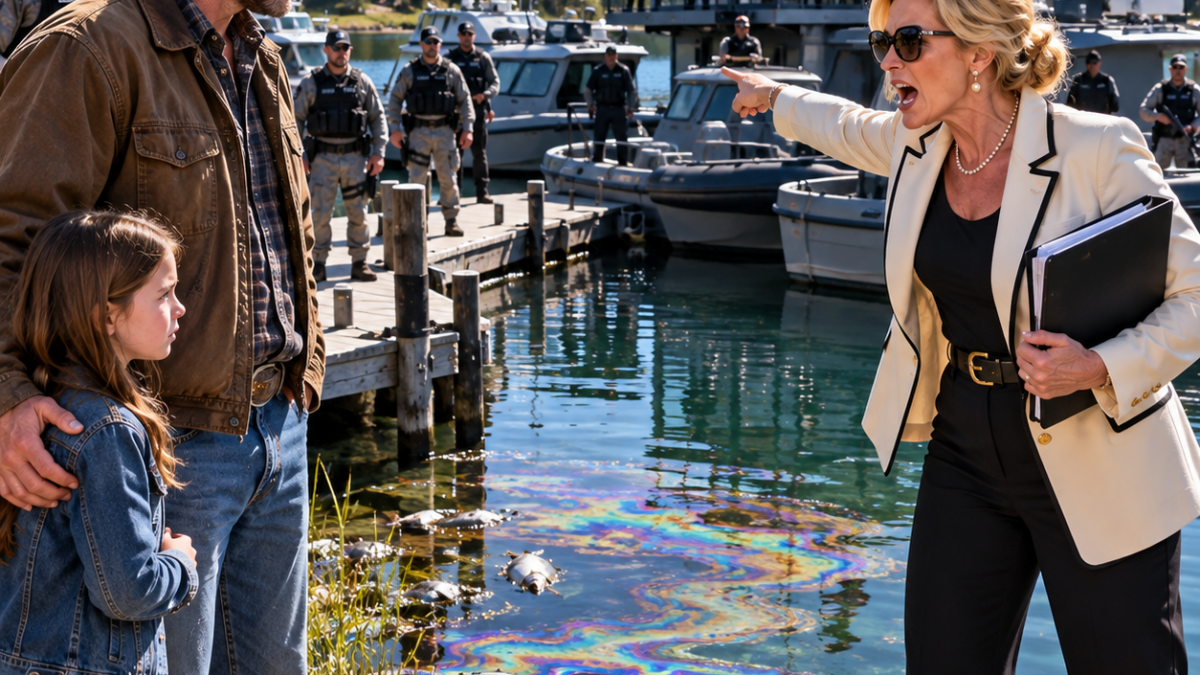
The lake smelled wrong.
Diesel.
Hot rubber.
Something chemical.
I crouched near the reeds.
Three trout floated belly-up near shore.
One twitched.
I looked toward the fuel station.
No spill containment boom.
No absorbent pads visible.
Fuel sheen stretched along maybe forty yards of water.
My grief did something unexpected.
It disappeared.
Not really.
It moved aside.
Anger needed room.
I walked onto the dock.
The boards beneath the steel overlay creaked exactly the way I remembered.
Dad’s dock was still under there.
Buried.
A man emerged from the floating building.
Polo shirt.
Slacks.
Earpiece.
“Mr. Rowan?”
“At least somebody knows.”
“I’m Grant Mercer, operations supervisor.”
“What operation?”
“Rowan Lake Community Safety Initiative.”
I looked around.
“No.”
He gave a professional smile.
“I understand this may be surprising.”
“Dead fish usually are.”
His smile weakened.
“We had a small fuel incident.”
“Who reported it?”
“It is being handled.”
“To state environmental quality?”
“We’re assessing whether formal reporting thresholds were met.”
“Who tested the water?”
“Our contractor.”
“Name.”
“We can provide documentation.”
“Now.”
“Mr. Rowan—”
“Who tested my lake?”
Before he answered, tires sounded behind us.
Black Range Rover.
Then another SUV.
The first stopped near the cabin.
A woman stepped out wearing tan riding boots, cream coat, dark sunglasses despite the cloud cover.
Vanessa Sterling.
I knew her.
Not well.
But enough.
She had moved into Sterling Ridge four years earlier.
The HOA itself sat east of my property.
Forty-eight expensive homes built on former grazing land.
Stone entrances.
Decorative ponds.
Rules about mailbox height.
Dad hated it on principle.
He called it “a subdivision pretending to be a government.”
Technically the HOA had no authority over us.
Our land predated it.
Not annexed.
No covenants.
No membership.
No dues.
No shared roads.
No utilities.
Nothing.
Vanessa had still visited.
Three times that I knew.
First asking whether Dad would allow residents limited fishing access.
No.
Second asking whether the HOA could use our eastern shoreline for a “community emergency water source.”
No.
Third asking whether he’d consider a sale.
Very no.
I had been in Missoula by then.
Dad mentioned the conversations in passing.
“Woman talks like land is embarrassed not to be earning more money.”
That was his complete analysis.
I should have asked more.
Vanessa walked toward me.
“Caleb.”
No Mr. Rowan.
Familiarity used as ownership.
“I heard about Harlon.”
“You heard?”
“I’m very sorry.”
“Were you?”
Her expression changed slightly.
“I know this is difficult.”
“What is this?”
I pointed around.
She removed her sunglasses.
“Your father and I reached an agreement before his condition worsened.”
“No.”
“We did.”
“No.”
Her tone hardened.
“You’ve been away a long time.”
“I was with him.”
“I know.”
The way she said it irritated me.
“You were not managing this property.”
“Neither were you.”
She folded her arms.
“The lake had become underused.”
I actually laughed.
“Underused?”
“Environmentally unmanaged.”
“You put diesel boats on it.”
“For safety.”
“Whose?”
“The Sterling Ridge community.”
“This isn’t Sterling Ridge.”
“It serves the entire north basin.”
“There is no north basin community.”
“There is now.”
She said it with such certainty that for one second I understood how people like her acquired things.
Not through force.
Through grammar.
Say something enough times in official language and eventually everyone starts asking whether it might already be true.
Vanessa pointed toward the floating facility.
“We established a private emergency response dock with wildfire evacuation capacity, water rescue, and shoreline patrol.”
“Why?”
“Because public services are twenty-five minutes away.”
“So you built a navy.”
She smiled thinly.
“Don’t be dramatic.”
I looked at six gray patrol boats.
“Right.”
“We’re in wildfire country.”
“I know where I live.”
“And the HOA has a responsibility to prepare.”
“On HOA property.”
“Your father understood the benefit.”
“My father told you no.”
“Initially.”
That word.
Initially.
I felt something cold move behind my ribs.
“What did he sign?”
She looked almost relieved.
Finally.
The real conversation.
“A long-term lake-use agreement.”
“How long?”
“Twenty-five years.”
My mouth went dry.
“With renewable operating rights.”
“For what amount?”
Vanessa hesitated.
“Total compensation package was approximately five hundred forty thousand dollars.”
I stared.
Dad’s medical bills had been enormous.
Even with insurance.
He had worried about leaving me debt.
Would he have—
No.
I knew his voice in my head.
No.
“What compensation?”
“Some direct.”
“Some infrastructure.”
“Some assumption of environmental maintenance.”
“Direct amount.”
“Two hundred thousand.”
“Paid where?”
“To an account designated by your father.”
I almost believed her then.
Because Dad had changed near the end.
Not mentally, mostly.
But pain.
Medication.
Fear.
He knew treatment was costing me.
I had lied about that.
Told him everything was covered.
It wasn’t.
Maybe he thought he could fix it.
Maybe he signed something.
Vanessa saw doubt.
Pressed.
“He wanted Grace protected.”
That snapped my attention back.
“What did you say?”
“He talked about your daughter.”
“Don’t.”
“He was worried about the property becoming a burden.”
“Don’t use her.”
“I’m telling you what he said.”
“You weren’t at his bedside.”
“No.”
“But I spent hours with him here.”
“When?”
“Before hospice.”
“How many?”
“Several visits.”
“Who witnessed them?”
“Our counsel.”
Of course.
I looked toward the cabin.
“Where are the papers?”
“Recorded.”
“County?”
“Yes.”
“Give me copies.”
“I can have them emailed.”
“Paper.”
She smiled.
“You really are Harlon’s son.”
Then:
“Caleb, I know you are grieving.”
There it was.
The emotional disqualification.
Grieving means unreasonable.
Grieving means paperwork wins.
She continued:
“But the lake is no longer simply a family recreation asset.”
“It never was.”
“Then you should understand why broader stewardship matters.”
I stepped closer.
Not threatening.
Enough that her security detail noticed.
“You tied armed patrol boats to the dock my grandfather built.”
“Private safety boats.”
“You installed fuel storage.”
“Compliant storage.”
“Fish are dead.”
“Incident under review.”
“You put a floating office in my father’s fishing cove.”
“Command center.”
“While he was dying.”
She lifted her chin.
“With his permission.”
I looked at her.
“Then show me his signature.”
She did.
Not immediately.
Forty minutes later.
Inside my cabin.
My cabin.
Except someone had been inside.
Furniture moved.
Dad’s desk cleared.
A wall-mounted electronic access panel near the back door.
New locks on two interior cabinets.
I noticed everything.
Vanessa sat at the kitchen table.
Same table where Dad taught Grace to clean trout.
Grant Mercer placed a document folder between us.
I opened it.
ROWAN LAKE COMMUNITY ACCESS AND RESILIENCE AGREEMENT.
Twenty-seven pages.
Dense.
Legal.
Exhibits.
Operating maps.
Insurance clauses.
Emergency easements.
Dock modification rights.
Water access.
Security enforcement.
Fueling rights.
Equipment storage.
Twenty-five years.
Renewable for ten under certain conditions.
I found the signature page.
HARLON E. ROWAN.
The signature looked like his.
Not a crude forgery.
Not obviously.
Date:
August 14.
Dad had been in pain management but still living at the cabin then.
Hospice began September.
Witness:
Vanessa Sterling.
Notary:
Diane Lockett.
I knew Diane.
County mobile notary.
Former bank employee.
Careful woman.
Hard to imagine her forging anything.
My stomach dropped.
Then I noticed another signature.
Mine.
CALEB T. ROWAN.
I stared.
Vanessa said:
“You signed the family acknowledgment electronically.”
“No.”
“Your father provided it.”
“No.”
My signature looked real enough to fool someone who had never watched me write.
But I knew it.
The C was too clean.
My signature has a broken stroke because of an old hand injury.
This one didn’t.
“What email?”
Grant opened a supporting record.
Electronic consent confirmation.
Sent to:
caleb.rowan.1979@—
Not my email.
Close.
Mine had no period before the year.
Vanessa glanced at it.
“What?”
“That isn’t my address.”
Her face did something very small.
Grant looked at her.
“Vanessa?”
She recovered.
“The family acknowledgment wasn’t required for validity.”
“Then why forge it?”
“No one forged anything.”
“Who created that address?”
“We didn’t.”
“Who accessed it?”
“I don’t know.”
I looked again at Dad’s signature.
Different question.
“Where was he when this was signed?”
“Here.”
“Not hospital?”
“No.”
“Diane was here?”
“Yes.”
“Attorney?”
“Our counsel joined by video.”
“Whose counsel?”
“The association’s.”
“Dad had a lawyer?”
Vanessa paused.
“He declined separate representation.”
That sounded like Dad.
Unfortunately.
“Money?”
“Transferred after execution.”
“To what bank?”
She handed me another page.
Account ending 4421.
I did not recognize it.
Dad banked at Bitterroot Federal Credit Union.
Same account for thirty years.
I knew the last four digits.
“What is 4421?”
“His designated estate account.”
“No.”
Vanessa looked at Grant.
“I don’t know his personal banking.”
I stood.
“This meeting is over.”
“Caleb.”
“Leave.”
“You can’t interfere with operations.”
I looked at her.
“You have ten minutes to get everyone out of my cabin.”
“The agreement gives us—”
“Ten.”
“If you disrupt security operations, you could expose yourself to liability.”
“Nine.”
Grant closed his folder.
Vanessa stayed seated.
“Your father wanted this.”
I stopped counting.
“What did he say?”
She looked at me.
“He said the lake had to survive the family.”
That sounded like him.
Almost.
Too close.
Dad had said something similar many times.
“Land has to survive us.”
Not family.
Us.
He believed ownership was temporary.
Stewardship wasn’t.
Vanessa knew enough to weaponize his language.
Maybe because he really had spoken to her.
Maybe because she had listened.
That frightened me more than a fake signature would have.
They left.
Security remained on the dock.
I called the county sheriff.
Not 911.
Civil issue initially.
Deputy arrived.
Looked at recorded agreement.
Looked at me.
Looked uncomfortable.
“Caleb, if this is recorded, I can’t just remove them.”
“This is private property.”
“They claim licensed access.”
“My signature is forged.”
“That changes things, but I need a report.”
“Take one.”
He did.
I called county recorder.
Confirmed filing.
Called bank.
No 4421 under Dad’s name that they could disclose.
Estate attorney?
Dad didn’t have one currently.
Used local attorney Mitchell Frost years earlier for land issues.
I called.
His receptionist went quiet when I said Harlon Rowan.
“Mr. Frost retired.”
“Where are his files?”
“Transferred.”
“To who?”
“His daughter.”
“Name?”
“Anna Frost.”
I wrote it down.
Then Grace called.
My daughter was twenty-two.
Architecture student.
Smart enough to notice emotional avoidance before I did.
“You home?”
“Yes.”
“How bad?”
I looked toward the lake.
Six patrol boats.
Floating command center.
Dead fish.
“Strange.”
“That means bad.”
“Yes.”
Silence.
Then:
“You find Grandpa’s canoe?”
“No.”
She knew why I asked.
Dad had promised Grace the canoe.
Not because it had value.
Because she’d spent summers painting it every three years.
Green.
Always the exact wrong green according to Dad.
He complained every time.
Then admired it all winter.
Grace said:
“I’m coming.”
“No.”
“Dad.”
“I just got here.”
“Exactly.”
“I need to figure out what happened.”
“So do I.”
“You have classes.”
“I can miss two.”
“Grace.”
She became quiet.
Then said:
“Grandpa died too.”
That stopped me.
Of course.
I had been grieving as a son.
Forgot she was grieving as a granddaughter.
“I’m sorry.”
“Stop deciding I need protecting when what I need is to be there.”
That sounded like my father.
Uncomfortably.
“Come tomorrow.”
“I already bought gas.”
She arrived that night.
Five hours from Bozeman because apparently speed limits were suggestions inherited from Harlon Rowan.
She walked onto the porch.
Saw the security lights across the lake.
“What the hell?”
“Language.”
She stared at me.
“You have armed strangers guarding Grandpa’s dock and you’re worried about language?”
“Reflex.”
She hugged me.
Hard.
Then went inside.
The cabin affected her immediately.
His boots still by the door.
Coffee tin.
Fishing hat.
Grace touched the chair where he always sat.
Cried.
No dramatic collapse.
Just tears dropping silently while she kept one hand on the chair back.
I stood there uselessly.
Eventually she wiped her face.
“What did he sign?”
I showed her.
She read faster than I did.
Architect students apparently train for hostile documents.
“This site plan is wrong.”
“What?”
She turned Exhibit C.
Operations boundary.
Outlined in red.
“This shoreline line.”
“Looks right.”
“No.”
She pointed.
“The dock is here.”
“Yes.”
“Cabin here.”
“Yes.”
“But the eastern property line cuts through the inlet.”
“So?”
“Grandpa’s survey marker is thirty yards farther east.”
I looked.
She was right.
I remembered hiking to it.
Old iron pipe.
Orange cap.
The agreement’s map gave the HOA extra shoreline.
Maybe forty feet.
Not massive.
But intentional?
Grace kept reading.
“Dad.”
“What?”
“This legal description references Parcel 17B.”
“Yes.”
“Isn’t Rowan property 17A?”
I stared.
She was right again.
How did she know?
“Grandpa made me draw the parcel maps when I was sixteen.”
Of course he did.
“He said architects who can’t read land are interior decorators.”
“That sounds like him.”
Grace looked at the agreement.
“If this legal description attaches to the wrong parcel…”
“It may not grant what Vanessa says.”
“Maybe.”
We needed a lawyer.
Anna Frost returned my call at 8:12 the next morning.
She was forty-something.
Land-use attorney.
Daughter of Dad’s old lawyer.
She arrived before noon carrying two boxes.
Not because she had the HOA agreement.
Because she had something else.
“My father handled your grandfather’s estate transfer.”
“Elias?”
“And later Harlon’s title updates.”
She looked at Grace.
“Your grandfather was… meticulous.”
Grace smiled.
“That’s the polite version.”
Anna placed a 1982 survey on the table.
Then another document.
“Rowan Lake is unusual.”
“How?”
“Your family owns the entire lakebed.”
I knew that.
Most people didn’t.
“And almost all shoreline.”
“Yes.”
“But that’s not the unusual part.”
She unfolded another map.
The lake.
Colored zones.
Blue lines.
Handwritten notes.
“Your grandfather purchased separate submerged-land rights when the original timber company split the parcels.”
“Meaning?”
“Meaning surface water use and lakebed ownership were explicitly severed from neighboring tracts.”
“So Sterling Ridge never had riparian rights.”
“Correct.”
“Even houses near the eastern side?”
“They have no lake access unless your family grants it.”
I smiled for the first time in days.
Anna did not.
“Don’t celebrate.”
“Why?”
“Because Harlon could grant access.”
I looked at the agreement.
“Which he apparently did.”
“Maybe.”
She studied his signature.
“My father kept one additional note.”
She removed an envelope.
Dad’s handwriting.
CALEB — AFTER I’M GONE, FLOOR. NORTH BEDROOM. THIRD BOARD FROM WINDOW.
I forgot how to breathe.
“When did you get this?”
“Three weeks before he entered hospice.”
“Why didn’t you give it to me?”
“He instructed me not to unless someone tried to claim lake rights after his death.”
Grace whispered:
“Grandpa.”
Anna continued:
“He was concerned.”
“About Vanessa?”
“He didn’t name her.”
“He said someone was ‘trying to buy water with paper.’”
That was Dad.
I stood.
North bedroom.
Third board from window.
The bedroom had been mine growing up.
Then Grace’s.
Pine floor.
Old planks.
I counted.
Third board.
No obvious latch.
Grace found it.
Tiny finish nails newer than the others.
We pried the board.
Beneath it:
oilcloth package.
Inside:
a rolled survey map.
A notarized declaration.
Several photographs.
USB drive.
And a letter.
My name.
CALEB.
My hands shook opening it.
Son,
If you’re reading this, somebody didn’t respect no.
I laughed once.
Then cried.
Dad continued.
Vanessa Sterling wants the lake for a security operation.
She says wildfire.
Some of that is honest.
Most is money.
They plan to sell “preparedness memberships” to neighboring developments and contract patrol services.
She offered too much.
I told her no.
She returned with a lawyer.
I still told her no.
Then she came back after she learned I was sick.
That part made me angry.
So I let her talk.
Grace sat beside me.
Anna stood quietly.
The letter continued.
I signed one document.
Read that sentence twice.
Not because I agreed to sell the lake.
Because I wanted them to file it.
I looked at Anna.
“What?”
She raised one finger.
“Keep reading.”
Dad wrote:
Your grandfather taught me that dishonest people rarely read the old paper. They read the new paper and assume it replaced everything beneath it.
The map shows the conservation boundary.
The 1982 deed has a restrictive covenant.
No commercial fuel storage.
No paid motorized access.
No permanent structures over the deep-water spawning shelf.
Any agreement attempting those uses terminates automatically and triggers restoration liability against the party operating them.
I looked at Anna.
“Is that real?”
She nodded slowly.
“I remembered a covenant, but not the details.”
We spread the old map.
There it was.
A conservation restriction Dad and Grandpa placed when transferring title in 1982.
Recorded.
Still active.
It did not prohibit family boating.
Or limited private access.
But commercial marina operations?
Fueling?
Paid patrol?
Permanent floating facility?
Explicitly prohibited unless amended by all current beneficial owners and the state fisheries trust named as third-party enforcer.
“State fisheries trust?”
Anna kept reading.
“The covenant was part of an old habitat restoration program.”
“Why?”
“Native trout.”
Dad had spent years restoring spawning beds.
I remembered hauling gravel.
Hated it at fifteen.
Now understood.
Grace pointed at the HOA agreement.
“So Grandpa signed something he knew would self-terminate?”
Anna held up a hand.
“Potentially.”
“Why sign at all?”
I returned to the letter.
Dad answered.
She wanted my signature because investors would not release money without it.
I asked for one change.
Section 18.4.
Read it.
We found it.
Tiny.
Nearly buried.
18.4 — Operator warrants that all proposed activities conform with all prior recorded covenants, submerged-land restrictions, environmental obligations, and third-party enforcement rights. Any nonconforming commercial activity shall render this Agreement void ab initio as to operating rights and place all restoration, environmental remediation, and reasonable enforcement costs upon Operator and its affiliates.
Grace looked up.
“Void from the beginning.”
Anna nodded.
“If enforceable.”
Dad had not accidentally signed away the lake.
He had handed Vanessa a loaded contract.
But why?
The letter continued.
I know you will ask why I did not simply refuse.
Because refusal was not stopping her.
She had already been using the eastern access with contractors.
I wanted her company name, investors, insurers, and operating plan on one document.
Section 18.4 puts responsibility where it belongs.
If she behaves, nothing happens.
If she doesn’t, you’ll have a clean trail.
I closed my eyes.
That was my father.
Not confrontation.
Trap built from patience.
Grace whispered:
“He knew.”
“Yes.”
Then Anna said:
“There is more.”
She held up another document.
Durable power revocation.
Date before the HOA agreement.
Then a financial fraud notice Dad filed with his bank.
He had discovered someone attempted opening an account in his name.
Ending 4421.
The same account Vanessa claimed received payment.
The bank blocked it.
Reported it.
The money never legally reached Dad.
The supposed half-million-dollar agreement rested on a compensation transfer to a fraudulent account.
“Who opened it?” I asked.
“Unknown from this file.”
Anna looked at me.
“But someone had enough information to impersonate him.”
Grace said:
“And Dad knew.”
“Yes.”
“Then why didn’t he call police?”
Anna answered:
“He did.”
She pulled out a report number.
County financial crimes referral.
Pending.
Dad died before investigators completed it.
The USB drive contained recordings.
Vanessa visiting the cabin.
Dad apparently began recording after the second meeting.
Audio first.
Then video from a small camera mounted near the bookshelf.
Vanessa’s voice.
Warm.
Reasonable.
“We’re trying to protect the neighborhood, Harlon.”
Dad:
“Then protect your neighborhood.”
“The lake affects everyone.”
“Rain affects everyone too. You don’t own clouds.”
Grace laughed through tears.
Another recording.
Vanessa:
“You understand your medical costs aren’t going away.”
Dad:
“Neither are you, apparently.”
“We can take that burden off Caleb.”
“Leave my son out of it.”
“He’ll inherit the property.”
“He’ll inherit whatever I decide.”
Then:
“Two hundred thousand immediately.”
“For what?”
“Signature.”
“What about the rest?”
“Infrastructure investment.”
“So you’re paying yourself to build on my land and calling it compensation.”
Silence.
Dad had seen everything.
Then the final meeting.
Vanessa.
HOA attorney.
Notary Diane.
Dad.
He appeared thin but alert.
The video was timestamped.
Diane asked:
“Mr. Rowan, do you understand what you are signing?”
“Yes.”
“Are you signing voluntarily?”
“Yes.”
“Has anyone coerced you?”
“No.”
Vanessa looked relieved.
Then Dad asked:
“Section eighteen stays?”
HOA attorney answered:
“Yes.”
“Every word?”
“Yes.”
“Good.”
He signed.
Then looked directly toward the camera.
Almost invisible smile.
My father had set a trap and left it for me.
But even that was not the most important file.
There was one final recording.
Dad alone.
He looked exhausted.
He spoke slowly.
“Caleb.”
Grace took my hand.
“If they crossed the line, don’t make this about beating Vanessa.”
I frowned even before he continued.
“Make it about fixing the lake.”
Of course.
“Men like us get stupid about land.”
I almost laughed.
“Your grandfather did.”
“I did.”
“You will.”
Grace looked at me.
“He knew you.”
“Quiet.”
Dad continued.
“Land isn’t your pride.”
“Water isn’t your revenge.”
“If somebody poisoned it, clean it.”
“If somebody lied, prove it.”
“Don’t become a liar to beat one.”
“Don’t threaten anybody.”
“Don’t break anything.”
“And for God’s sake, don’t let Grace drive my truck.”
Grace stared at the screen.
“What?”
I laughed so hard it hurt.
Then cried harder.
The next three days became less dramatic than people imagine legal battles.
No guns.
No bulldozers.
No heroic shouting.
Paper.
Calls.
Sampling.
Photographs.
Survey flags.
That was how Vanessa began losing.
Anna filed notice disputing operating rights.
State environmental quality received the spill report.
Fish, Wildlife & Parks sent two biologists after photographs of dead trout.
The fisheries trust from the old covenant still existed under a successor conservation foundation.
Their attorney called Anna within hours.
“Commercial fueling?”
“Yes.”
“On Rowan Lake?”
“Yes.”
Long silence.
“We’re coming.”
County surveyor confirmed the HOA site plan used Parcel 17B.
Wrong parcel.
Worse:
The floating command center sat partly above a protected spawning shelf explicitly marked on the recorded conservation map.
Fuel samples showed petroleum contamination.
Not catastrophic.
But real.
The six boats had been refueled on the water.
No proper containment.
The HOA’s “small incident” exceeded reporting requirements once cumulative sheen and shoreline impact were documented.
Vanessa responded exactly how people like her respond when facts become dangerous.
She escalated the narrative.
HOA email to residents:
ROWAN FAMILY ATTEMPTS TO DISMANTLE COMMUNITY EMERGENCY SAFETY PROGRAM FOLLOWING PATRIARCH’S DEATH.
Then:
CALeb ROWAN THREATENS FIRE-READINESS ACCESS DURING HIGH-RISK SEASON.
I had threatened nothing.
Residents began showing up at the gate.
Some angry.
Some frightened.
One woman yelled:
“If there’s a wildfire, are you going to let our children burn because you want your private fishing hole?”
That one landed.
Not because it was fair.
Because fire was real.
Montana summers burn.
Sterling Ridge had legitimate evacuation concerns.
Vanessa had wrapped theft around a real fear.
That made her effective.
I could have shouted back.
Instead I opened the gate.
Not to the dock.
To the meadow.
Invited residents to a meeting.
Grace thought I was insane.
Anna thought it strategically useful.
We stood beneath the cottonwoods.
About sixty residents came.
Vanessa did too.
With her attorney.
Security.
Cameras.
I placed three maps on a folding table.
Old property map.
Conservation covenant.
HOA operating plan.
No speech at first.
I waited.
People yelled anyway.
Then an elderly man said:
“Let him talk.”
I did.
“This lake is private.”
Boos.
I raised one hand.
“That’s not the whole sentence.”
Quiet returned.
“It is private, but fire is public.”
That changed faces.
“If there is a real wildfire emergency, nobody in my family is going to stand at this gate counting deeds while homes burn.”
Vanessa’s face tightened.
She wanted greed.
Not nuance.
“I will sign an emergency-only access agreement with the county fire district.”
Murmurs.
“Not the HOA.”
“Not Sterling Security.”
“The public fire district.”
“Water drafting.”
“Evacuation if necessary.”
“Training by appointment.”
“No membership fee.”
“No commercial marina.”
The crowd changed.
Vanessa stepped forward.
“You can’t simply replace a comprehensive preparedness system with a handshake.”
“No.”
Anna handed me papers.
“With this.”
Draft memorandum.
Fire chief had already reviewed it.
Vanessa smiled.
“Your father signed broader rights.”
I looked at her.
“Yes.”
The crowd went quiet.
She expected denial.
I continued:
“He did sign.”
Grace watched me.
“He also required your organization to comply with every prior recorded restriction.”
Vanessa’s smile disappeared.
Anna placed Section 18.4 beside the covenant.
“And commercial fuel storage, paid patrol access, and permanent structures over the spawning shelf violate those restrictions.”
Vanessa’s attorney stepped in.
“That’s a disputed interpretation.”
Anna said:
“Great.”
She smiled.
“Then we’ll let the recorded documents decide.”
Vanessa pointed at me.
“You accepted half a million dollars.”
“No.”
“Your father did.”
“No.”
“We have transfer records.”
“To an account created fraudulently in his name and frozen before disbursement.”
That was the first moment Vanessa Sterling actually looked afraid.
Tiny.
But visible.
Someone in the crowd asked:
“What?”
I held up Dad’s bank fraud notice.
“Someone attempted opening an account using my father’s identity.”
Vanessa said:
“That has nothing to do with us.”
“I didn’t say it did.”
Important.
Dad had told me.
Don’t become a liar to beat one.
“We’re letting investigators determine who created it.”
Vanessa looked toward her attorney.
He had not known.
That mattered.
Then Grace brought out a tablet.
Not for public playback.
Just enough.
“We also have recordings of contract discussions.”
Vanessa’s face changed again.
Her attorney whispered something.
She snapped:
“You recorded private negotiations?”
I said:
“My father recorded conversations in his own home consistent with Montana law.”
Anna had checked.
Vanessa looked around.
The crowd was no longer hers.
Not mine either.
Better.
They were thinking.
That is dangerous to anyone whose authority depends on emotional momentum.
The county issued temporary suspension of marina operations two days later pending environmental review and property-right dispute.
Security boats were ordered not to launch except to remove equipment under supervision.
Vanessa refused publicly.
Privately, insurers intervened.
Sterling Community Security’s liability carrier learned about:
disputed land rights,
recorded environmental covenant,
fuel release,
misrepresented operational boundary,
possible forged family acknowledgment,
and unpermitted commercial activity.
Insurance companies become remarkably principled when uninsured exposure appears.
Coverage reservation letter arrived.
Then lenders.
The floating command center had not been paid for by HOA dues alone.
Sterling Ridge HOA had signed financing with Sentinel Preparedness Partners.
A private investor group.
Their security depended on operating revenue from surrounding communities.
Dad had predicted investors.
His agreement named them as “affiliates” for restoration obligations if they knowingly operated under the contract.
That clause got everyone’s attention.
Grant Mercer came to see me alone.
No uniform.
No earpiece.
He stood on the porch.
“Can we talk?”
“About?”
“The boats.”
“What about them?”
“I didn’t know the site plan was wrong.”
“I believe you.”
He looked surprised.
“Why?”
“You’re here without Vanessa.”
He exhaled.
“I was hired to run marine operations.”
“Former law enforcement?”
“Coast Guard.”
That explained him.
“Then you know what fuel sheen means.”
His jaw tightened.
“Yes.”
“Why didn’t you report?”
“I filed an internal incident.”
“That’s not what I asked.”
He looked toward the water.
“Vanessa said levels were below threshold.”
“You believed her?”
“For about six hours.”
“What happened after?”
“I was told the environmental contractor had cleared it.”
“Who?”
“Sterling Environmental Compliance.”
Anna later discovered that company belonged to Vanessa’s brother-in-law.
Grant did not know that.
When I told him, he closed his eyes.
“Jesus.”
He handed me a flash drive.
Operational emails.
Fuel logs.
Incident photos.
One message from Vanessa:
DO NOT CONTACT STATE UNTIL WE HAVE INTERNAL NUMBERS. ROWAN TITLE ISSUE EXPECTED TO RESOLVE AFTER ESTATE TRANSITION.
Another:
CALEB IS OCCUPIED WITH HOSPICE. INSTALLATION WINDOW IS NOW.
I read that line three times.
Installation window is now.
While Dad died.
That was the sentence that almost broke my promise to him.
For a moment I wanted revenge.
Real.
Primitive.
I imagined Vanessa watching the boats towed away.
Losing her house.
Losing everything.
Dad’s voice:
Land isn’t your revenge.
I closed the laptop.
Grant said:
“I’m resigning.”
“That doesn’t fix anything.”
“No.”
“I know.”
“Why give me this?”
“Because I told myself it was emergency preparedness.”
He looked at the lake.
“I still believe the idea has value.”
“Maybe.”
“But this…”
He shook his head.
“This wasn’t preparedness.”
“What was it?”
“Expansion.”
Exactly.
Vanessa had built a business model.
Sterling Ridge would host the command center.
Other HOAs would pay annual “resilience subscriptions.”
Boat patrol.
Wildfire readiness.
Search capability.
Private shoreline enforcement.
Maybe even emergency transport.
Rowan Lake gave the whole thing legitimacy.
A dramatic mountain lake.
Boats.
Uniforms.
Images for brochures.
Dad’s land was not just useful.
It was branding.
And once the operation physically existed, she believed removal would become politically impossible.
Classic strategy.
Build first.
Make dismantling look dangerous.
She nearly succeeded.
The forged electronic acknowledgment led somewhere worse.
County investigators traced the fake email setup to an IP address used by Sterling Ridge’s HOA management office.
Not Vanessa personally.
An assistant manager named Lindsey Vale.
Lindsey initially denied involvement.
Then her attorney contacted investigators.
Immunity discussion.
She turned over messages.
Vanessa:
Need family acknowledgment before lender closes.
Lindsey:
Caleb hasn’t responded.
Vanessa:
Use the address Harlon provided.
Lindsey:
He didn’t provide one.
Then no reply for thirty minutes.
Later:
Vanessa:
I handled it. Send packet.
That was not proof she forged my signature.
But it was close enough to turn a civil dispute into something else.
Search warrant eventually recovered a laptop.
Browser history.
Temporary email registration.
Scanned signature image from an old county filing where I had signed as witness on Dad’s timber permit.
The signature pasted onto the electronic acknowledgment.
Not a master criminal conspiracy.
Worse in a way.
Casual fraud.
Done because someone believed the paperwork would never be challenged.
Vanessa was not arrested dramatically on my dock.
Real cases take time.
Interview.
Forensics.
Charges reviewed.
Lawyers.
Eventually she faced state charges related to forgery, deceptive business practices, and environmental violations, though not every allegation prosecutors considered became a final count.
The HOA sued me first.
Of course.
Declaratory judgment.
They asked a court to affirm access rights.
Anna almost celebrated.
“Why are you happy?”
“Because now they chose the forum.”
“So?”
“Discovery.”
Discovery is a terrifying word when your emails are bad.
Within weeks we obtained board minutes.
Vanessa had told residents the Rowan family was “supportive.”
False.
She told investors Dad had “no active heirs involved in property management.”
Technically I had been in Missoula.
Misleading.
She described the lake as “functionally abandoned.”
Dad lived there until treatment forced him out.
Most damaging:
An internal presentation titled PHASE TWO — REGIONAL RESPONSE EXPANSION.
Projected revenue.
Three neighboring HOAs.
Two luxury cabin developments.
Annual subscriptions.
Boat docking fees.
Training events.
Corporate retreats.
There it was.
Corporate retreats.
So much for wildfire.
One slide displayed my father’s dock with a rendering.
Glass command center.
Flags.
Patrol boats.
A restaurant deck planned for phase three.
Grace stared at it.
“They were going to put a restaurant on Grandpa’s dock.”
“Apparently.”
“He would haunt them.”
“He might.”
She smiled.
Then became serious.
“Dad.”
“Yes?”
“What happens after we win?”
I hated the certainty.
“If.”
“When.”
“You really are his granddaughter.”
“What happens?”
“Restore shoreline.”
“Remove fuel system.”
“Repair dock.”
“Maybe reopen the boathouse.”
“And then?”
“What do you mean?”
“The lake.”
I understood.
“Private again.”
Grace looked disappointed.
“What?”
“Grandpa let school kids come sometimes.”
True.
Once a year.
Local middle school science class.
Water sampling.
“Veterans too.”
Also true.
Dad let a veterans fly-fishing group use the west cove twice each summer.
Not public.
Invited.
Controlled.
Quiet.
Grace said:
“Vanessa was wrong.”
“Yes.”
“But she wasn’t wrong that the lake could help people.”
I stared.
I did not like hearing wisdom from my twenty-two-year-old when it complicated a clean victory.
“She used that argument to steal it.”
“I know.”
“So?”
“So don’t let her define the only alternative.”
Dad again.
Through Grace this time.
The civil case turned at the preliminary hearing.
Not final trial.
Hearing on temporary rights.
Vanessa’s attorneys argued:
Harlon knowingly signed.
Yes.
Payment and substantial performance created reliance.
Disputed.
Public safety favored continued operation.
Questionable.
Our side presented:
Recorded conservation covenant.
Section 18.4.
Incorrect parcel description.
Fraudulent Caleb acknowledgment.
Fraudulent bank account.
Environmental violations.
Dad’s contemporaneous bank report.
Audio/video showing his intent and awareness.
Judge took a recess.
Returned.
Suspended HOA operating rights pending full litigation.
Ordered removal of commercial fuel.
Restricted boats from lake.
Required preservation of all equipment and records.
Most importantly:
The court found the HOA had not shown a clear legal right to continued commercial lake use.
Vanessa sat completely still.
Outside the courthouse, cameras waited.
She gave a statement.
“This decision endangers families.”
I gave none.
Dad would have hated cameras.
The HOA board began collapsing within a month.
Not literally.
Politically.
Residents demanded financial records.
Discovered legal fees.
Insurance problems.
Loans.
Vanessa had exceeded spending authority on parts of the marina project.
Several board members claimed she had not disclosed investor conditions.
Some were telling the truth.
Some were saving themselves.
Typical.
Recall vote scheduled.
Vanessa fought.
Lost.
Eighty-three percent.
The new board president called me.
His name was Paul Danner.
Retired firefighter.
One of the residents who had originally shouted at me about wildfire access.
He came to the cabin.
Hat in hands.
“I owe you an apology.”
“For?”
“My behavior at the meadow.”
“You were scared.”
“I accused you of risking children.”
“Yes.”
“I was wrong.”
“You were manipulated.”
He shook his head.
“Still my mouth.”
Fair.
Then:
“We still need wildfire water access.”
“Yes.”
He looked surprised.
“I meant what I said.”
We signed an agreement with Alder Hollow Fire District.
Not the HOA.
Public emergency access.
No commercial rights.
No permanent dock facilities.
Training twice yearly.
Water drafting points marked.
Emergency gate code held by dispatch.
Cost:
One dollar per year.
Dad would have approved the legal consideration.
Grace said:
“Grandpa would’ve charged them pie.”
Also possible.
The floating command house was removed on a cold morning in October.
People expected me to celebrate.
I didn’t.
I stood with Grace on shore.
Crane barge from a nearby reservoir contractor handled removal.
Glass box rose slowly.
Water streamed from floats.
Behind it, our dock appeared scarred.
Steel fasteners through cedar.
Fuel line holes.
Cut railing.
Dad’s work damaged but still there.
Grace cried.
“So did I.”
Not because we won.
Because victory revealed what had been harmed.
The six gray boats left on trailers.
Security cameras came down.
Fuel tanks removed.
Contaminated shoreline soil excavated.
Absorbent treatment.
Water testing.
Fish & Wildlife monitored trout population.
The spill was limited enough that the lake could recover.
Some fish died.
Most did not.
Restoration costs eventually passed through insurers and defendants under settlement.
The HOA did not pay all of it.
That mattered to me.
Ordinary residents had been misled too.
I did not want retirees losing homes because Vanessa chased expansion.
Anna negotiated aggressively to separate individual homeowners from corporate and leadership liability where possible.
Sentinel Preparedness Partners paid.
Sterling Community Security’s carrier paid part.
Vanessa’s associated development company paid.
Civil settlement remained partly confidential.
One condition I refused confidentiality on:
Rowan ownership.
Environmental restoration.
And Dad’s Section 18.4.
That became public.
The criminal case resolved the following year.
Vanessa pleaded guilty to fewer charges than angry people wanted.
Forgery-related offense.
Business record falsification.
Environmental reporting violation.
Probation plus custodial time under a negotiated sentence, restitution, fines, and prohibition from serving in certain fiduciary roles for a period.
Online strangers called it too light.
Maybe.
I stopped needing the punishment to carry my grief.
Lindsey cooperated and received reduced consequences.
Grant Mercer was never charged.
He testified.
Lost his job.
Later joined county search and rescue.
People are complicated.
Even Vanessa.
That annoyed me most.
At sentencing, she asked to speak.
I expected excuses.
There were some.
She talked about wildfire fear.
County delays.
Residents wanting security.
Her frustration with government response times.
Then she said:
“I believed the Rowan property was being wasted.”
That was the center.
Not safety.
Entitlement.
Judge asked:
“Wasted by whom?”
Vanessa looked toward me.
“By a family that used it privately.”
The judge answered:
“Private property is not abandoned because you imagine a more profitable use.”
That line spread online.
Dad would have hated becoming internet content.
Grace sent me the clip anyway.
At my victim statement, I did not talk about property value.
I talked about Dad.
“Ms. Sterling came to my father after learning he was sick.”
“She knew he was vulnerable physically.”
“He was not vulnerable intellectually.”
“He understood the agreement better than she did.”
People in the courtroom shifted.
I continued.
“He signed because he wanted a record of what she intended to do.”
“Then he left that record for me.”
I looked at Vanessa.
“You thought his illness meant time was on your side.”
“It wasn’t.”
I almost stopped there.
Then remembered his final recording.
“This case is not why I’m angry anymore.”
Vanessa looked at me.
“I’m angry because you turned a place he loved into an argument.”
“That took time away from grieving him.”
“That is the part I cannot invoice.”
I sat.
No applause.
Good.
The dock restoration took almost a year.
I could have replaced it.
Would have been easier.
Instead Grace insisted we save original cedar wherever possible.
Architecture student.
Sentimental dictator.
We removed steel decking.
Pulled fasteners.
Replaced only rotten or drilled-through boards.
New pilings where needed.
Old cedar where safe.
One section still carries a black diesel stain that never fully sanded out.
I wanted it gone.
Grace stopped me.
“Leave it.”
“Why?”
“History isn’t always pretty.”
Dad would’ve liked that.
We found the canoe in a storage warehouse leased by Sterling Security.
Green.
Scratched.
One side dented.
They had moved it when installing the dock.
Grace ran her hand across it.
Then looked at me.
“Wrong green.”
“Always.”
We repainted it together.
Same shade.
Still wrong.
The first summer after restoration, Rowan Lake stayed quiet.
No patrol boats.
No command center.
No investors.
Morning fog returned to being the loudest thing.
Then the fire district came for training.
One engine.
One tanker.
Twelve firefighters.
Paul Danner helped coordinate.
They practiced drafting water from the designated access point.
Dad’s dock remained untouched.
Grace brought lemonade.
I watched children from Sterling Ridge standing beyond the gate with their parents.
Curious.
I thought about keeping it closed.
Then opened it.
Not permanently.
For the afternoon.
The kids sat on the shore.
Firefighters showed them equipment.
One boy asked me:
“Is this your lake?”
I said:
“My family owns it.”
“Then why are they using it?”
I looked at the fire crews.
“Because owning something doesn’t mean nobody else can ever need it.”
Grace heard.
Smiled.
I pointed at her.
“Don’t.”
Too late.
The local middle school resumed Dad’s science day the following spring.
Twenty-six students.
Water testing.
Aquatic insects.
Trout habitat.
One girl found a fuel-weathered piece of rubber near the old dock.
She asked what happened.
I told her the short version.
“People built something they weren’t allowed to build.”
“Why?”
“They thought they had permission.”
“Did they?”
“Not for what they did.”
She considered.
“Adults should read better.”
“Yes.”
That may be the entire story.
Grace graduated.
Her thesis project?
Community access design on privately conserved waters.
Of course.
She proposed a small education pavilion near the meadow.
No floating glass.
No restaurant.
No permanent lights.
Dad would have complained about the roof pitch.
We built it anyway.
Named nothing after him.
He hated memorial plaques.
But inside one beam, Grace carved:
PRETTY DOESN’T MEAN CLEAN.
I saw it.
Pretended not to.
Five years after Dad died, I finally scattered his ashes.
Yes.
Five years.
The urn sat on the cabin mantel the entire time.
People assumed I couldn’t let go.
Maybe.
But mostly I kept waiting for the lake to feel like his again.
Then one October morning, Grace came home.
She was twenty-seven now.
Working in Bozeman.
We carried the urn into the green canoe.
Paddled to the western cove.
No motor.
Dad would’ve approved.
Water was cold.
Clear.
Trout moved beneath us.
Grace held the urn.
“You want to?”
“No.”
“Me neither.”
We laughed.
Then cried.
Finally I opened it.
Wind nearly caused a disaster.
Dad would have considered that hilarious.
We scattered him near the cedar shadows.
Not all.
Grace kept a small amount.
“Is that weird?”
“Yes.”
“Okay.”
I kept some too.
Also weird.
Family tradition.
On the paddle back, Grace asked:
“Do you think Grandpa knew Vanessa would violate the agreement?”
“Yes.”
“Then why didn’t he tell us?”
“He wanted proof.”
“No.”
She shook her head.
“What?”
“He wanted you to choose what to do after.”
I looked at her.
She continued.
“If he told you before he died, you would’ve spent his last weeks fighting Vanessa.”
That hit hard.
“He didn’t want that.”
I stopped paddling.
Seventy-three nights.
Hospital.
Dad never mentioned it.
Not once.
He let me sit beside him.
Talk baseball.
Argue about pain medication.
Help him drink water.
He carried the HOA problem alone so I could be his son instead of his lawyer.
My throat closed.
Grace whispered:
“He protected your time.”
That was the inheritance I had missed.
Not land.
Not lake.
Time.
Dad’s last gift was not the trap in Section 18.4.
It was refusing to let Vanessa steal his final weeks from us.
I cried in the canoe until Grace pretended not to notice.
Dignity inherited from Harlon.
Years later, people still tell the story like this:
HOA tried to steal military family’s private lake.
Not exactly.
We were not a military family in the way headlines implied.
Grandpa served.
Dad did not.
I spent six years in the Army Corps of Engineers before entering private construction management, which apparently became “military family” online.
The boats were not military either.
Private security vessels painted to look tactical.
But headlines prefer compression.
The real story is quieter.
A woman saw private land and decided underuse was a moral failure.
A dying man realized she would not accept no.
Instead of shouting, he made her describe exactly what she wanted.
Then he made sure the paper she relied on also contained the condition that would destroy her claim if she crossed the line.
He kept old maps.
Old covenants.
Bank reports.
Recordings.
Not because he was plotting revenge.
Because he understood something I didn’t.
Ownership is mostly memory written down.
Who bought what.
Where the line runs.
What rights transferred.
What rights didn’t.
Promises.
Restrictions.
Signatures.
Paper seems weak until somebody tries to lie about land.
Then paper becomes stone.
The old map still hangs in the cabin now.
Framed.
Grace insisted.
Next to it is the HOA agreement.
Also framed.
I thought that was strange.
She said:
“One shows what was true.”
“The other shows what somebody tried to make true.”
Fair.
Section 18.4 highlighted.
Dad’s signature below.
The signature Vanessa once thought gave her twenty-five years.
Instead it connected her name, her company, her investors, and her insurers to every prohibited thing they built.
Most dangerous signature she ever filed.
Not because Dad forged anything.
Not because he tricked a confused woman.
Because he told the truth in a contract she was too confident to respect.
The lake today is healthier than when I inherited it.
That is the part that matters.
Trout counts recovered.
Fuel contamination cleared.
Eastern spawning beds restored.
Fire district still has emergency access.
Schoolchildren visit twice a year.
Veterans fly-fishing group comes each June and September.
Sterling Ridge residents may apply for limited community days through the conservation program Grace created.
No motorboats except emergency or approved maintenance.
No private security.
No commercial memberships.
No tactical branding.
No restaurant.
No floating command center.
People sometimes ask whether allowing any community access means Vanessa was right.
No.
Consent is the difference.
That word became sacred to me.
You can share something without surrendering it.
You can say yes today because you retained the right to say no yesterday.
Forced generosity is not generosity.
Taking land because you imagine a better use is still taking.
The fact that I later opened the gate does not justify the people who tried to remove the gate.
Choice is the entire point.
Paul Danner still lives in Sterling Ridge.
We fish occasionally.
He is terrible.
Talks too much.
Scares trout.
One afternoon he asked:
“Do you ever think the marina could have worked if Vanessa had just asked differently?”
I looked at the water.
“Maybe parts of it.”
“Rescue boats?”
“County could stage one during fire season.”
“Training?”
“By appointment.”
“Emergency dock?”
“Maybe.”
He laughed.
“So she wasn’t completely wrong.”
“About need?”
“No.”
“About ownership?”
“Completely.”
That was the tragedy.
Real needs corrupted by entitlement.
It happens everywhere.
Someone sees a useful thing.
Then decides usefulness gives them a right to control it.
Dad understood that line.
He taught it badly when I was a kid.
“Borrowing without asking is stealing.”
I thought he meant tools.
He meant everything.
Grace eventually inherited a quarter interest in Rowan Lake when I reorganized the family trust.
She asked:
“Why now?”
“Because I want you arguing with me while I’m alive.”
She smiled.
“Grandpa would’ve approved.”
“Probably.”
“What’s my first vote?”
“No floating restaurants.”
“Unanimous.”
The Rowan Conservation Trust now owns the lakebed and core shoreline.
Family-controlled.
Permanent ecological restrictions stronger than before.
Emergency public-service easement.
Educational access.
No commercial marina.
Anna designed the structure.
Her father would have approved.
Vanessa Sterling disappeared from Montana after probation ended.
Not literally.
Public records still existed.
She moved south.
I heard she worked in property consulting for a while.
People expected me to track her.
I didn’t.
Why?
Because Dad told me not to make the lake my revenge.
Every hour spent following her life was an hour I was not living mine.
That lesson took longer than the lawsuit.
I still get angry sometimes.
When I see the stain on the old cedar.
When somebody mentions the forged email.
When I remember INSTALLATION WINDOW IS NOW.
While Dad was dying.
Anger returns.
Water through cracks.
Then I walk to the shore.
Look at the trout.
Listen.
The lake does not care who won.
That helps.
Dad was right about water.
It doesn’t require explanations.
On quiet mornings, I sit on the rebuilt dock with his old coffee mug.
Green canoe tied nearby.
Same wrong paint.
Sometimes Grace joins me.
Sometimes not.
The floating command house is gone.
Security cruiser gone.
Gray boats gone.
The only engine sound usually belongs to a distant fire truck on the county road or a small maintenance boat once or twice a year.
When fog sits low, the lake looks almost exactly as it did when I was eight.
Almost.
No place returns fully.
Neither do people.
That is not failure.
Restoration is not pretending damage never happened.
It is making life possible around the scar.
The cedar dock carries holes where steel bolts once passed through.
We filled some.
Left others.
The western reeds grew back.
Fish returned.
Dad is gone.
I stopped waiting for that fact to feel acceptable.
It never will.
It became survivable.
There is a difference.
If you asked me now what my father left me, most people would expect:
A private lake.
A cabin.
A valuable tract of Montana land.
All true.
But those are not the things I think about.
He left me Section 18.4.
Not the legal clause itself.
The thinking behind it.
Do not fight noise with more noise.
Make people put promises on paper.
Read what sits beneath new claims.
Keep records.
Protect the resource, not your ego.
And leave your children enough choice that they can become different stewards than you were.
He also left me one sentence on video:
“If somebody poisoned it, clean it.”
That became my answer to almost everything.
Vanessa poisoned trust.
We rebuilt it.
Fuel poisoned shoreline.
We cleaned it.
Grief poisoned some of my relationship with Grace.
We repaired that too.
Not perfectly.
But enough.
Dad’s death taught me grief behaves like water.
So does healing.
It does not arrive as a wall disappearing.
It finds small openings.
A daughter coming home.
A repaired canoe.
A trout beneath clear water.
A firefighter filling a tanker from a lake without pretending he owns it.
A child studying insects where armed guards once stood.
A dock still carrying the marks of what happened and remaining useful anyway.
The morning I returned from hospice, I thought the worst thing Vanessa Sterling had stolen was Rowan Lake.
I was wrong.
For a while, she had stolen my understanding of what the lake meant.
She made it into territory.
Evidence.
Money.
A lawsuit.
A battlefield.
Dad gave it back.
Not through the court.
Through the map beneath the floor.
Through the recordings.
Through Grace.
Through that final message.
Land isn’t your pride.
Water isn’t your revenge.
Fix the lake.
So we did.
And that is why the last thing I see now when I walk through my gate is not a security cruiser.
Not gray boats.
Not Vanessa.
I see my father’s cedar dock stretching into clear water.
I see the green canoe.
I see Grace’s education pavilion in the meadow.
I see the red emergency-access marker near the fire district intake.
I see trout where diesel once floated.
And when the light is right, I can still see the old black stain in one section of cedar.
I used to hate it.
Now I leave it alone.
Because my father taught me something long before I was wise enough to understand him.
Pretty doesn’t mean clean.
But damaged doesn’t mean lost either.