The HOA Tried to Destroy My Farm With Fake Violations—Then I Proved Their $480,000 Clubhouse Was Sitting on 2.3 Acres of My Family’s Land.
PART2:
Before I came back to farming full-time, I spent eighteen years as a licensed land surveyor.
Boundary disputes.
Plat research.
Easements.
Right-of-way work.
Construction staking.
Legal descriptions.
I had walked property lines through cedar, mud, mesquite, rattlesnake country, and subdivisions where two men nearly came to blows over four inches of driveway.
I could look at a deed description and picture the land before I ever set foot on it.
That career mattered later.
At the beginning, I was simply a widower trying to hold together a farm and raise a daughter.
Loretta died three years before Sheila started coming after us.
Ovarian cancer.
She was forty-four.
Ellie was nine.
There are things I remember perfectly about those fourteen months and things I cannot remember at all.
I remember Loretta’s hand gripping mine during the first oncology appointment.
I remember Ellie sitting cross-legged on the hospital room floor doing math homework.
I remember the smell of antiseptic.
I remember Loretta asking about the chickens two days before she died.
I do not remember driving home from the hospital for the last time.
The farm saved us afterward.
Not in some poetic, magical way.
It simply gave us jobs that had to be done.
Chickens had to eat.
Bees had to be checked.
Fences broke.
Weeds grew.
Tomatoes did not care how sad you were.
Ellie fed the hens before school. I pulled honey frames in the evenings. We harvested vegetables. We labeled jars. We repaired irrigation. We did not sit around discussing grief because neither one of us knew how to talk about something that large without being swallowed by it.
We worked.
Then Ridgecrest Estates arrived.
Around 2019, Darren Prescott bought roughly three hundred acres east of us.
Cedar came down.
Earthmovers arrived.
Hills changed shape.
Roads appeared.
Then houses.
Big stone fronts.
Three-car garages.
Small lots.
Swimming pools.
Decorative mailboxes.
Most of the people who moved in were decent.
Austin families.
Tech workers.
Remote employees.
Parents who wanted better schools and more space.
They wanted Hill Country views.
What some of them did not expect were roosters, manure, bees, tractors, dust, and the occasional smell that reminded you there had been farms there before the real-estate brochures.
Then came Sheila.
Darren’s wife.
HOA president.
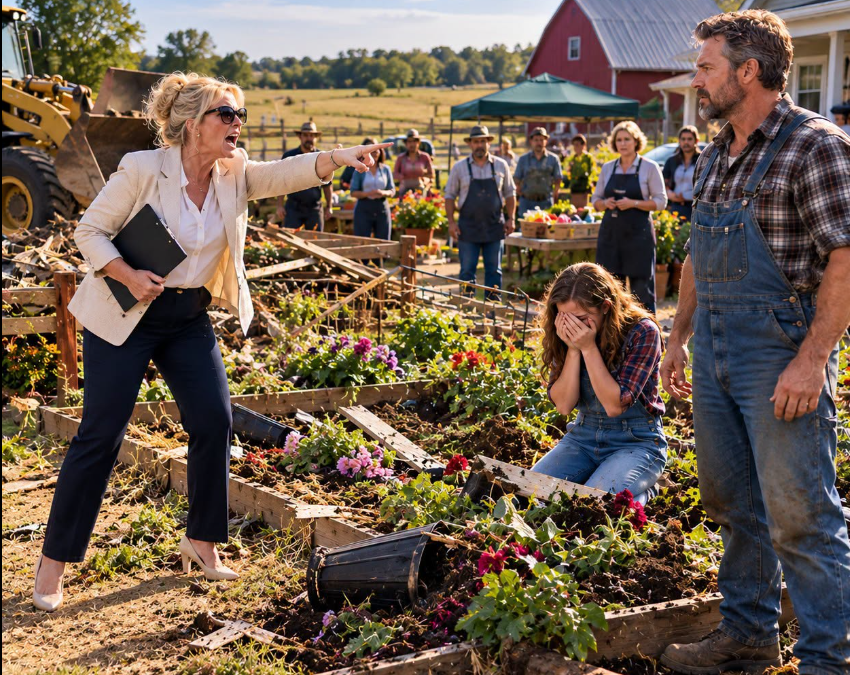
Sheila dressed as though every Tuesday afternoon board meeting might be photographed for a magazine.
Linen blazer.
Perfect hair.
Expensive sunglasses.
Clipboard.
She controlled four of the five board seats either directly or through people who almost always voted with her.
The exception was Patty Lyndon.
Retired teacher.
Sharp memory.
Read every page before meetings.
Patty was the only person on that board who seemed to understand the purpose of rules was to define authority, not manufacture it.
My farm was never inside Ridgecrest.
Not one inch.
My deed did not contain Ridgecrest covenants.
My family owned the land decades before Ridgecrest existed.
That should have ended the issue.
But Sheila wasn’t trying to enforce legitimate HOA restrictions.
She was trying to create pressure.
Darren had a third phase planned.
Eighty additional luxury homes.
Pool complex.
Clubhouse amenities.
A development package he valued at around forty-two million dollars.
My property disrupted the layout.
Without my acreage, the clean expansion they wanted became harder.
I had been approached before.
Darren himself came out one afternoon about a year after phase one opened.
He stood on my porch in polished boots that had never met a muddy pasture and offered to buy.
The number sounded large until I considered what 160 acres near Dripping Springs had become worth.
More important, I did not want to sell.
“This land isn’t available,” I told him.
He smiled like men smile when they believe refusal is just negotiation spoken by poorer people.
“Everything is available at the right number.”
“Not this.”
“You’re sitting on a development opportunity.”
“I’m sitting on my farm.”
He looked past me toward the fields, the barn, the garden, the chickens, the stand by the road.
To him, none of it looked permanent.
That was his first mistake.
He smiled again.
“Think about it.”
“I already did.”
He left.
I thought that was the end.
Then the HOA letters began.
The first came in March.
Crisp envelope.
Ridgecrest Estates logo.
Community Standard 4.7.
Odor and nuisance emissions.
I read it standing at the mailbox.
According to Sheila’s letter, I had fourteen days to correct offensive agricultural odors or face escalating fines.
I laughed.
Actually laughed.
Our compost operation sat hundreds of yards from the nearest Ridgecrest lot. I used aged manure and plant waste. Nothing exotic. Nothing illegal. Nothing different from what we had done for years.
Eight days later came letter number two.
Excessive livestock noise.
Specifically chickens.
Forty-two hens.
One rooster named Pete.
Pete was loud.
I will give Sheila that.
But Pete had been crowing before Ridgecrest poured its first foundation.
I took sound readings from the property edge.
Forty-one decibels at seven in the morning.
Saved them.
Timestamped them.
Filed them.
Letter three claimed my farm vehicles were obstructing a shared access route.
That one irritated me because it was easily disproved.
The road was governed by an old recorded easement tied to county access. My grandfather had signed documents related to it decades earlier. Our trucks were parked off the easement behind our fence.
I photographed everything.
Measured setbacks.
Saved GPS-tagged images.
Three letters.
Three claims.
Three failures.
I called the HOA office.
An administrator answered.
Polite woman.
Sounded embarrassed.
“I’d like to know who authorized these violations,” I said.
“I can forward your question.”
“Please do.”
No one called.
So I attended a board meeting.
Ridgecrest clubhouse.
Twenty residents.
Folding chairs.
Burnt coffee.
Sheila at the front.
Four allies around her.
Patty at the far end.
Public comment opened.
I stood.
“My property is not within Ridgecrest Estates.”
Sheila looked at me.
“I’m aware of your concerns.”
“They aren’t concerns. My deed is not subject to your association.”
“We have received resident complaints.”
“Resident complaints do not expand your jurisdiction.”
A few people turned toward one another.
Sheila smiled.
“We’ll review the matter.”
“There’s nothing to review.”
“The board will determine that.”
Patty leaned toward her microphone.
“Sheila, he’s right.”
Sheila ignored her.
I continued.
“If somebody in Ridgecrest has a legitimate complaint, they can use county procedures. You cannot fine my property under Ridgecrest covenants.”
“Thank you, Mr. Bridger.”
“That’s it?”
“You’ve been heard.”
The board voted.
Four to one.
All three violations upheld.
Patty was furious.
“This is absurd,” she said. “We cannot enforce HOA rules against property outside the HOA.”
Sheila barely looked over.
“Motion carries.”
Then she moved to pool maintenance.
I walked outside.
Sat in my truck for ten minutes.
I wasn’t furious yet.
Surveyors learn something early.
When a line is disputed, don’t argue from memory.
Measure.
Gather monuments.
Pull deeds.
Verify.
I drove home.
Put the three letters on my kitchen table.
That was when I noticed something.
Each was signed by Sheila.
No board resolution number.
No formal enforcement action.
No reference to any actual vote.
Just Sheila Prescott, HOA President.
A woman claiming authority she didn’t have, backed by procedure she hadn’t even bothered to fake properly.
Two weeks later, Ridgecrest passed a new rule.
No commercial agricultural activity within five hundred feet of subdivision property.
My roadside stand?
Approximately four hundred eighty feet from the nearest Ridgecrest lot.
Twenty feet inside the line Sheila had invented.
Patty called me afterward.
“She knew exactly where your stand was.”
“I figured.”
“I told them we can’t regulate your land.”
“What did Sheila say?”
“Community safety.”
I laughed.
“Of course.”
“She also said property values.”
There it was.
Safety and property values.
The two phrases people use when they want interference to sound civic-minded.
The board voted four to one.
Again.
They were not writing valid law.
They were constructing paperwork.
Enough letters.
Enough rules.
Enough official language.
Maybe I would get nervous.
Maybe I would hire lawyers until the bills hurt.
Maybe Darren would return with another offer.
I still didn’t understand how far they were willing to go.
That changed when the health inspector arrived.
Thursday morning.
County truck.
Man in khakis.
Badge.
Clipboard.
His name was Nolan Kirby.
“Mr. Bridger?”
“Yes.”
“We received a complaint regarding unsanitary food sales.”
“Come look.”
I had nothing to hide.
Nolan inspected honey jars.
Egg storage.
Display crates.
Hand-washing station.
Chicken areas.
Compost.
He asked about food handling.
I answered.
Forty-five minutes later, he closed his notebook.
“One of the cleaner small farm operations I’ve inspected this year.”
“Any violation?”
“No.”
“You’ll put that in writing?”
“Official report will be filed.”
“Thank you.”
He shook my hand and left.
For three days, I thought maybe that would end the health angle.
Saturday morning proved otherwise.
I went toward the stand shortly after sunrise.
Two signs stood on the county right-of-way before my gate.
White laminated boards.
Big red letters.
WARNING.
HEALTH HAZARD AHEAD.
UNSANITARY FOOD SALES.
CONSUME AT YOUR OWN RISK.
I stopped the truck.
For the first time since the letters began, I felt something truly cold move through me.
Not anger.
Violation.
The signs were designed to look official without actually claiming to come from a government agency.
No logo.
No name.
No contact.
Just accusation.
I photographed them.
Close.
Wide.
Placement.
Fasteners.
Then I opened the stand.
Normally Saturday morning was steady.
Regulars.
Parents with kids.
People heading toward wineries.
Neighbors.
That day traffic was thin.
Cars slowed.
Some passed without turning.
By the following week, sales were down roughly forty percent.
Regular customers still came.
They knew us.
New people did not.
One woman called.
“I saw the health warning.”
“We were inspected.”
“What did they find?”
“Nothing.”
“Then why are signs up?”
“That is something I’m documenting.”
There was a pause.
“I have kids. I just can’t take the chance.”
I understood.
That was the genius of the signs.
Strangers had no reason to trust me over something that looked official.
That night Ellie and I were washing dishes.
She had become quiet.
At twelve, she was old enough to understand more than I wanted her to.
She dried a plate.
“Dad?”
“Yeah?”
“The people who know us will still buy from us.”
“Most will.”
“What about people who don’t?”
I stopped the faucet.
She looked at the plate instead of me.
“They see the sign first.”
I leaned against the counter.
“We have the health report.”
“They don’t know that.”
No.
She was right.
The damage had already occurred.
I told her we would handle it.
She nodded.
That was all.
But something changed for me.
This wasn’t just Sheila sending nonsense letters anymore.
She was interfering with how I supported my daughter.
Texas law contained strong protections for established farming operations. Our farm predated Ridgecrest by generations. I knew nuisance pressure would not erase that easily. And Nolan’s inspection report gave me something concrete.
No violations.
The health signs said the opposite.
I didn’t tear them down immediately.
Instead, I documented them.
Dates.
Locations.
Customer calls.
Sales numbers.
Week-over-week decline.
Photographs.
I built a file.
Sheila interpreted silence as weakness.
That was her recurring mistake.
Then Darren brought water into it.
One Tuesday morning, a backhoe appeared on the Ridgecrest side of our boundary.
The operator dug a drainage ditch.
There was nothing inherently suspicious about drainage work. Central Texas weather makes drainage essential.
But I knew slopes.
I knew grades.
I knew how water moved.
This ditch aimed directly toward my vegetable acreage.
I walked over.
The operator shut down the machine.
His name was Kevin Brant.
Sun-weathered.
Working man.
I pointed toward the trench.
“That grade is pushing discharge toward my field.”
Kevin wiped his forehead.
“I just dig where they tell me.”
“I know.”
He looked toward the development.
“Plans came from Prescott’s people.”
“I figured.”
“I’m not trying to flood you.”
“I know that too.”
I had no fight with Kevin.
He was operating equipment to a layout somebody else had provided.
I photographed the trench.
Took coordinates.
Measured.
Then waited.
Two weeks later, the storms came.
Four inches of rain in six hours.
Violent Hill Country spring weather.
The kind that turns dry ground into moving water before sunrise.
At 5:30 I stepped onto the porch carrying coffee.
Two acres were underwater.
Brown runoff had spread across the vegetable field.
Six inches deep in places.
Rows disappeared beneath muddy water.
I set the cup down and walked.
Ellie came behind me in pajamas and rain boots.
Neither of us spoke.
The tomatoes were flattened.
Peppers underwater.
Squash broken.
Then we reached the basil.
That old plant.
Loretta’s plant.
Uprooted.
Ellie knelt in the mud.
Picked it up.
The stem hung limp.
Roots exposed.
She held it gently.
“Mom planted this one.”
I looked at my daughter standing ankle-deep in runoff, holding the last living thing from one of her mother’s gardening days.
That was the moment patience changed form.
I did not stop being patient.
I stopped being passive.
The damage appraisal ultimately reached around twenty thousand dollars.
Crop loss.
Soil remediation.
Drainage repairs.
I spent three days measuring.
Photographs.
Flow path.
GPS points.
Sediment samples.
Construction material carried onto my soil.
I filed a grading complaint.
No permit.
No engineering review that I could find.
Nothing showing an approved drainage change sending concentrated runoff toward my farm.
Then I called Wade.
He had been helping me understand the escalating HOA situation.
“They flooded Ellie’s garden.”
Silence.
“Loretta’s basil is gone.”
Another pause.
“What do you want to do?” he asked.
“Courthouse.”
“I’ve been waiting for that word.”
But the most important discovery happened almost by accident.
While documenting the flood, I looked across toward the Ridgecrest clubhouse.
Parking lot.
Pavilion.
Building.
Something bothered me.
Not emotionally.
Geometrically.
The parking lot looked too far south.
I had spent eighteen years training my eyes to notice when lines didn’t feel right.
A fence ten feet off.
A road centerline drifting.
A monument where it shouldn’t be.
The clubhouse looked roughly forty feet farther south than I expected.
Maybe more.
I said nothing.
Went home.
Opened old notes.
Pulled maps.
Then drove to the Hays County Clerk’s office.
I knew the building well.
Old paper.
Floor wax.
Counters worn from decades of elbows.
Tim Overstreet was working.
He recognized me.
“Colton Bridger.”
“Tim.”
“Thought you retired.”
“Farmers don’t retire.”
“What do you need?”
“Original Bridger tract. Ridgecrest phase-one plat.”
He found both.
Rolled sheets.
Spread them on the counter.
I aligned calls.
Compared monuments.
Traced boundaries.
Four minutes later, I stopped.
Tim noticed.
“What?”
“Give me a second.”
The Ridgecrest plat showed common area Lot C.
Clubhouse.
Parking.
Pavilion.
But when I traced the deed chain underneath Lot C, I found nothing transferring the relevant 2.3-acre strip from the Bridger family trust.
No deed.
No easement granting a clubhouse site.
No license.
No sale.
Nothing.
I checked again.
Then again.
My pulse slowed rather than accelerated.
That always happened when I found something big.
The clubhouse was built on my land.
Not figuratively.
Not arguably according to some vague visual boundary.
The structure itself, the parking area, and part of the associated amenity space occupied acreage that had never left the Bridger chain of title.
I looked at Tim.
“I need certified copies.”
He glanced at the plats.
“Found something?”
“Looks like it.”
He did not ask more.
I paid seven dollars.
Walked outside.
Sat in my truck.
I could see the courthouse reflected faintly in the windshield.
I said it aloud.
“Darren, you built on my land.”
For months Sheila had written letters pretending she controlled my farm.
Meanwhile, the building where she held those meetings was sitting on Bridger property.
The irony almost made me laugh.
Almost.
But I knew better than to act on one review.
Truth needed confirmation.
First call went to Sandra Chalmers.
Real-estate attorney in Austin.
Board certified.
Fifteen years in property litigation.
I gave her everything.
Certified plats.
Chain of title.
My old field notes.
She read.
Checked.
Asked questions.
Then looked at me.
“It was never gone.”
“What?”
“The strip.”
She tapped the deed chain.
“No valid transfer.”
“So the clubhouse—”
“Is sitting on your property.”
“No ambiguity?”
“Not from what I’m seeing.”
I exhaled.
Sandra leaned forward.
“Do not go over there with a tractor.”
“I wasn’t planning to.”
“You smiled.”
“I smile sometimes.”
“Not like that.”
She was right.
I had imagined it for perhaps half a second.
But property cases are won with documents, not theatrics.
Next step was an independent survey.
Nathan Freed.
Licensed.
No relationship to me.
Fresh review.
I wanted nobody later claiming I had manipulated my own measurements.
Nathan spent two days on the land.
GPS.
Total station.
Monument recovery.
Deed calls.
His final line matched mine essentially to the tenth of a foot.
2.3-acre overlap.
Clubhouse squarely inside it.
Now we had deed chain and independent field confirmation.
Then came markers.
Sixteen orange-capped survey stakes.
Bright.
Obvious.
Nathan and I installed them along the true boundary beside the clubhouse parking area.
Broad daylight.
No secrecy.
Every forty feet.
Straight line.
The orange caps looked like punctuation marks driven into the ground.
People came out of the clubhouse and stared.
One woman asked what they were.
“Property markers.”
“For what property?”
“Mine.”
Her face changed.
That afternoon Sandra filed formal trespass notice against Darren.
Served at his development office.
According to the process server, Darren read page one and asked everyone else to leave the conference room.
I installed cameras.
Four.
High definition.
Night vision.
Cloud backup.
Each covering sections of the newly marked line.
Then I called Russ Whitfield.
Local reporter.
Dripping Springs Dispatch.
Russ had the kind of instincts that made developers uncomfortable.
“I have a story.”
“What kind?”
“HOA harassment. Agricultural business interference. Flood damage. And a clubhouse built on land the developer doesn’t own.”
Silence.
“You have documents?”
“Every piece.”
“When can I run it?”
“Not yet.”
He laughed softly.
“You’ve got something else coming.”
“I think Darren and Sheila haven’t finished making mistakes.”
“I’ll wait.”
Meanwhile, Patty and Wade began talking directly with Ridgecrest homeowners.
Not campaigning against Sheila.
Asking questions.
“Are you satisfied with how your HOA is being managed?”
Complaints surfaced quickly.
Basketball hoop fines.
Truck-logo violations.
Selective enforcement.
Petty notices.
Phyllis Draper, seventy-three, had been fined because her cat sat on a sidewalk.
“Biscuit doesn’t know what an HOA is,” she told me later.
“Neither does Biscuit care.”
“Exactly.”
Within ten days, sixty-seven homeowners signed a petition seeking a financial audit.
Sixty-seven out of one hundred forty homes.
Not enough for every procedural goal Patty wanted.
Enough to show something important.
Almost half the neighborhood was willing to sign its name against Sheila’s management.
The Prescotts panicked.
The first visible sign was Sheila’s Escalade stopping beside my survey stakes.
Camera footage caught her getting out.
Looking.
Tilting her head.
Then understanding.
Orange survey caps are not subtle to someone married to a developer.
She called Darren.
We later learned about the conversation.
“There are survey pins by the clubhouse.”
Darren already knew.
He had been served.
He apparently told her it was some utility survey.
Routine.
Nothing to worry about.
That lie lasted until 11:47 that night.
Camera three triggered.
White Ford F-250.
Headlights off.
Registered to Prescott Development Group.
A man in dark clothing got out carrying a pry bar.
He walked directly to the first orange marker.
Levered it out.
Then another.
Then another.
Seven survey monuments removed in fourteen minutes.
I watched the recording at breakfast.
Ellie was eating cereal across from me.
“What’s that?”
“Work.”
“You look happy.”
“I’m not happy.”
“You’re doing the face.”
“What face?”
“The one where somebody made a mistake and you know it.”
Kids see everything.
I saved the footage.
Three backups.
Sent one to Sandra.
The sheriff’s office received a report that afternoon.
Deputy watched the video.
“Truck plate is clear.”
“Yes.”
“Markers documented?”
“Independent survey.”
He nodded.
“Well.”
That was all he needed to say.
Two days later, Sheila hand-delivered something pretending to be a cease-and-desist letter.
No law firm.
No attorney.
No bar information.
Just dramatic formatting.
Sandra read it.
Removed her glasses.
“This isn’t a cease and desist.”
“What is it?”
“A craft project.”
That was the first time I laughed in her office.
We didn’t argue with the letter.
I replaced the seven markers.
Then added an eighth.
Concrete footing.
Right beside the clubhouse entrance.
Impossible to miss.
Anyone entering Sheila’s office now stepped past a property marker reminding them whose land supported the building.
Darren’s next mistake was far worse.
He tried to solve a title defect with paperwork.
A quitclaim deed appeared.
Backdated three years.
It purported to transfer the disputed 2.3 acres from a shell company into the Ridgecrest HOA.
Simple problem.
The supposed prior owner had never held my family’s title.
Bigger problem.
The notary commission shown on the document had not existed on the date printed on the deed.
The notary’s commission was newer than the supposedly three-year-old signature.
County staff caught it.
The instrument was flagged.
County attorney notified.
Sandra called me.
“You sitting down?”
“Yes.”
“He tried to file a deed.”
“What kind?”
“Backdated quitclaim.”
I closed my eyes.
“Please tell me he didn’t.”
“He did.”
“Notary?”
“Commission date doesn’t work.”
I was silent.
Sandra continued.
“Do nothing.”
“I wasn’t going to.”
“Good.”
“Is this as bad as it sounds?”
“For him? Potentially worse.”
Darren had spent months assuming paperwork could create reality.
Now paperwork was documenting his problem.
Sheila chose Facebook.
She posted that I was a con artist attempting to steal community property through legal manipulation.
Warned homeowners against the audit petition.
Claimed I was trying to destroy Ridgecrest property values.
Russ captured screenshots.
Residents responded.
Most did not respond the way Sheila expected.
They posted stories about our farm.
Pictures from the roadside stand.
Kids holding honey jars.
People remembering buying produce from my parents.
Then Phyllis wrote the comment that shifted the tone completely.
The Bridgers had owned that land since 1961, she wrote.
Instead of attacking the farmer, maybe Sheila should explain why the clubhouse was sitting on land her husband did not own.
Dozens of replies.
Sheila deleted the post later that night.
Screenshots remained.
Of course they did.
Three days later, Ridgecrest announced a special meeting.
Friday.
Seven p.m.
Mandatory attendance strongly encouraged.
Agenda item?
The property dispute.
The clubhouse held eighty comfortably.
Roughly one hundred twenty people came.
Standing room.
Windowsills.
Walls.
Russ in back.
Local television camera.
Sheila at the front table.
Navy blazer.
Her loyal board members beside her.
Patty at the end.
I arrived two minutes after seven.
Not intentionally dramatic.
Traffic.
Sandra walked with me.
I carried a white banker’s box.
Inside it were more than sixty years of property history.
Original Bridger survey.
Ridgecrest plat.
Certified deed chain.
Independent survey.
Photos.
Health inspection.
Sales records.
Drainage evidence.
Flood documentation.
Survey-marker footage.
Quitclaim issue.
Everything.
I wore the blue shirt Loretta used to like.
That mattered only to me.
Sheila called the meeting to order.
She started with vague language about coordinated attacks on community property.
Patty interrupted.
“Point of order.”
Sheila stopped.
Patty raised the audit petition.
“Sixty-seven homeowners have formally demanded financial review under the bylaws.”
“We’ll address that after—”
“No. It takes precedence.”
The room murmured.
Sheila’s left eye twitched.
Small.
But I saw it.
She acknowledged the petition.
Then looked at me.
“Mr. Bridger, you may address the membership.”
I stood.
Carried the box forward.
Set it down.
I did not look at Sheila first.
I looked at the residents.
“Most of you know my farm.”
Several nodded.
“My family bought that land in 1961.”
I removed the first document.
“This is the original survey.”
Laid it flat.
“This is the Ridgecrest phase-one plat.”
Second sheet.
“And this is an overlay.”
I aligned the benchmarks.
Red-shaded overlap.
2.3 acres.
Right through the clubhouse site.
People leaned forward.
“This building,” I said, “is sitting on my family’s property.”
Silence.
One woman whispered, “Oh my God.”
Sheila stood.
“That is disputed.”
Sandra stepped forward.
“No, Mrs. Prescott. It is now professionally surveyed and supported by the deed chain.”
Darren sat near the front.
His face had changed.
Sandra continued.
“An instrument was recently presented attempting to show prior transfer of this parcel.”
Every eye shifted.
“The document is under review because the notarization date is inconsistent with the notary’s actual commission.”
Darren shot to his feet.
“That deed is valid.”
Sandra turned.
“Mr. Prescott, I strongly recommend you stop speaking until you consult your attorney.”
“I know exactly what—”
“Darren.”
Sheila said his name sharply.
He looked at her.
The room was silent.
Then the side door opened.
Deputy Vance Hubbard walked in carrying a manila envelope.
He approached the front.
“Sorry to interrupt.”
He was not sorry.
He handed paperwork over.
Formal trespass notice.
Court-backed restrictions concerning continued use while ownership issues moved through proceedings.
Sheila stared at the document.
“You cannot remove us from our clubhouse.”
Deputy Hubbard looked at her.
“Ma’am, county records identify this parcel as Bridger family property.”
She gripped the edge of the table.
“This building belongs to Ridgecrest.”
“The building may be owned by your association. The land beneath it is another issue.”
That sentence landed harder than anything I had said.
You can own walls.
Roof.
Furniture.
HVAC.
Pool equipment.
But if all of it sits on somebody else’s dirt, you have a serious problem.
I closed my box.
Walked outside.
The evening air felt cold compared with the packed room.
People followed.
Not all at once.
Then almost everyone.
The television cameraman came too.
At the wrought-iron clubhouse gate, I stopped.
I had brought a new brass padlock.
Sandra had already advised me about the temporary control we could exercise under the circumstances.
I threaded it through the gate.
Clicked it shut.
One clean metallic sound.
For months Sheila had tried to shut down my farm business.
That night her HOA office was the thing being shut out.
I did not smile.
At least I don’t remember smiling.
Inside, Patty called for a no-confidence vote.
The result was overwhelming.
Sheila was removed.
Darren’s situation got worse.
The marker footage had placed his company truck at the scene of survey-monument removal.
The questionable deed was already under official review.
His development plans became toxic.
Phase three collapsed.
Banks do not like title fraud allegations attached to multimillion-dollar expansions.
The promised forty-two-million-dollar project disappeared.
Civil claims moved forward.
Lost farm sales.
Drainage damage.
Crop losses.
Costs.
Legal fees.
The eventual settlement reached $312,000.
I read the agreement twice before signing.
Not because the number excited me.
Because I wanted the fight over.
People asked what I would do with the clubhouse.
Some expected demolition.
Phyllis wanted me to plant watermelons through the parking lot.
She was mostly joking.
Mostly.
I considered the property carefully.
Legally, the discovery gave me leverage I never expected.
Emotionally, I had every reason to be angry.
But I kept thinking about the people who used that building.
Birthday parties.
Book clubs.
Exercise classes.
Neighborhood meetings.
Kids.
Families.
Those residents had not forged deeds.
They had not flooded Ellie’s garden.
They had not put health-hazard signs near my stand.
Most had simply bought homes and trusted the Prescotts.
The new HOA board came to see me.
Patty was president.
She looked exhausted.
“I assume you’re here about the clubhouse.”
“Yes.”
“You want to keep using it.”
“Yes.”
“Do you expect me to give you the land?”
“No.”
Good answer.
We negotiated a lease.
Fifteen years.
$2,800 per month.
Fair market terms.
Clear.
Audited.
Recorded.
No strange side deals.
No assumptions.
No fake authority.
The padlock came off the gate the day we signed.
I removed it myself.
But I required one unusual provision.
Part of the rent had to support a community farmers market.
First Saturday in June.
Twelve vendors.
Honey.
Produce.
Goat cheese.
Bread.
Breakfast tacos.
Flowers.
Local meat.
The same clubhouse Sheila had used as headquarters for an effort to shut down my farm became the center of a farmers market.
I enjoyed that irony.
Ellie ran our honey table.
She had designed new labels.
BRIDGER FAMILY FARM.
ESTABLISHED 1961.
Little bee in the corner.
She sold forty jars in two hours.
I stood near the truck and watched her.
She explained clover versus wildflower honey.
Counted change.
Smiled at customers.
For a moment, she looked so much like Loretta that I had to turn away.
Phyllis bought the first jar.
Handed Ellie ten dollars.
“Keep it.”
“Ma’am, that’s too much.”
“It’s an investment.”
“In what?”
“Your father staying out of trouble.”
Ellie laughed.
I did too.
The flooded acreage recovered.
Not quickly.
Soil rarely cares about your schedule.
We repaired drainage.
Reworked beds.
Added organic matter.
Waited.
By the following season, rows were returning.
Tomatoes.
Peppers.
Squash.
Basil.
Ellie planted new basil where Loretta’s old plant had died.
Not from the same seed line.
We didn’t pretend it was.
That mattered.
Replacement is not resurrection.
The old plant was gone.
The new one was new.
But growth is allowed to be new.
I used part of the settlement to create the Loretta Bridger Agricultural Scholarship.
Five thousand dollars a year.
Dripping Springs High School senior.
Agriculture.
Land management.
Related field.
Loretta believed land gave back what you put into it.
She was right.
One October evening, Ellie and I sat on the porch.
Cooler air.
Juniper.
Wood smoke.
Clubhouse lights glowing across the road.
The gate was open.
No padlock.
People inside.
A farmers-market planning meeting, I think.
Ellie sat beside me.
Quiet.
Then she asked, “Dad?”
“Yeah?”
“Do you think Mom would like the scholarship?”
I put my arm around her.
“She’d love it.”
“The farmers market?”
“Probably.”
“The clubhouse?”
I laughed.
“She’d think the whole story was ridiculous.”
Ellie smiled.
“Would she be proud of you?”
I looked across the property.
“I don’t know.”
“I do.”
I pulled her closer.
“She’d mostly be proud of you.”
We sat until the stars came out.
That could have been the ending.
For me, in some ways, it was.
But there were pieces of the story I kept turning over afterward.
The first was how close I came to misunderstanding the entire conflict.
When the first letter arrived, I thought Sheila cared about compost.
Then chickens.
Then trucks.
I kept addressing individual complaints.
Prove the compost safe.
Measure the rooster noise.
Photograph the vehicles.
But the complaints were never the point.
Each one was a lever.
The goal was pressure.
Make the farm annoying to own.
Reduce sales.
Create legal expense.
Damage reputation.
Flood fields.
Eventually I might decide Darren’s purchase offer sounded easier than fighting.
Once I understood that, everything made sense.
The five-hundred-foot rule.
Health complaint.
Signs.
Drainage ditch.
They were all moving in one direction.
Land acquisition without calling itself acquisition.
The second thing I thought about was Sheila’s concept of authority.
She genuinely seemed to believe HOA letterhead transformed a preference into a legal command.
That was why she never stopped when Patty warned her.
Why she could vote four to one on rules governing property outside Ridgecrest.
Why she assumed saying community safety gave the board jurisdiction over a farm older than the subdivision by almost sixty years.
She did not understand boundaries.
Which was ironic.
Because boundaries were exactly what I understood.
People imagine surveying as finding lines.
It isn’t.
A boundary line is rarely a physical object.
It exists because documents, monuments, measurements, history, and law agree that it exists.
The line can disappear beneath grass.
A fence can be built in the wrong place.
A monument can get buried.
A developer can draw a plat badly.
But ownership doesn’t move simply because somebody stops looking.
That 2.3-acre strip had always belonged to the Bridger family.
For years, Ridgecrest used it as though it didn’t.
The clubhouse foundation went down.
Parking lot went in.
Pavilion.
Yoga studio.
Nobody checked deeply enough.
Or maybe somebody checked and assumed the problem would never matter.
I still don’t know.
What I do know is that when I stood at the county clerk’s counter and lined up those plats, I did not create anything.
I found something.
Truth does not care how expensive the building sitting on top of it is.
That thought stayed with me.
Darren had built a $480,000 clubhouse.
To Ridgecrest it was a symbol of permanence.
Stone.
Glass.
Asphalt.
Landscaping.
Everything looked established.
My ownership was invisible.
Until it wasn’t.
One piece of paper.
One line.
One survey.
Suddenly the building that looked permanent became the vulnerable thing.
The farm Sheila wanted gone was the thing that had been there all along.
I also thought often about the night the markers disappeared.
People asked why I didn’t confront whoever was pulling them.
Because I didn’t need to.
That’s the simple answer.
Cameras existed.
Survey existed.
Coordinates existed.
Ownership existed.
If I ran outside, I created confrontation.
Maybe danger.
Maybe argument.
Maybe a story where each side accused the other.
If I stayed inside, I got fourteen minutes of clean evidence.
That principle applied to almost the entire dispute.
Sheila wanted emotional reactions.
I gave her records.
Darren wanted me to argue.
I measured.
They wanted noise.
I kept files.
Patience is not the absence of action.
Sometimes patience is the most aggressive form of preparation.
There was another part I had trouble letting go.
The health-hazard signs.
Of everything they did, those bothered me more than the HOA letters.
More than the fines.
Maybe even more than the clubhouse.
Because those signs attacked trust.
The farm stand had existed for decades.
People bought food from us because they trusted us.
They trusted my grandfather.
My father.
Loretta.
Me.
Then somebody put up two laminated pieces of plastic and strangers stopped turning into our driveway.
That’s how fragile reputation can be.
You can spend thirty years building it and thirty seconds creating doubt.
After the settlement, I kept Nolan Kirby’s inspection report framed inside the stand.
ZERO VIOLATIONS.
Not because I thought customers needed convincing anymore.
Because Ellie asked me to.
“What if somebody new comes?”
“They’ll see it.”
That was enough for her.
Years later, when I look at that report, I don’t think about hygiene.
I think about the difference between accusation and evidence.
Sheila had accusations.
I had inspection results.
She had official-looking signs.
I had public records.
She had votes.
I had jurisdiction.
She had confidence.
I had boundaries.
Confidence lasts until documentation enters the room.
The new Ridgecrest board became almost boring.
I mean that as the highest compliment.
Patty insisted every major vote be recorded properly.
Meeting notices went out early.
Budgets were posted.
Residents could ask questions without being treated as insurgents.
The audit uncovered enough bad process to embarrass people, though not every rumor proved true.
That mattered too.
Once a conflict becomes emotional, people want every accusation against the other side to be true.
Reality is messier.
Some expenses were ordinary.
Some procedures were poor.
Some decisions were indefensible.
The right thing was to separate them.
Patty understood that.
One day she came to the farm stand.
Bought eggs.
Paid full price despite my attempt to refuse.
“You saved our clubhouse,” she said.
“I locked you out of it.”
“For a week.”
“Still.”
“You could’ve taken it.”
“I did take it.”
“You know what I mean.”
I did.
I could have turned the whole outcome into punishment.
Instead we wrote a lease.
I told her why.
“Your neighborhood isn’t Sheila.”
Patty nodded.
“Thank God.”
“Most people there did nothing to Ellie.”
She looked toward the garden.
“I’m sorry about what happened.”
“So am I.”
“Was that really Loretta’s basil?”
“Yes.”
Patty stood quietly.
“I wish I’d stopped Sheila sooner.”
“You tried.”
“Not hard enough.”
That sentence sounded familiar.
I had asked myself similar things about Loretta’s illness.
What if we had found it earlier?
What if I had pushed harder?
What if another doctor?
Grief teaches you the cruelty of impossible hindsight.
So I told Patty something I had spent years learning.
“You acted when you understood what was happening.”
She looked at me.
“That has to be enough.”
Maybe I was saying it for myself.
Darren eventually disappeared from local development circles.
Not literally.
People knew where he was.
But his name stopped appearing on signs.
Phase three never happened.
The land he intended to develop remained caught in financial and legal consequences for a long time.
His reputation changed.
That was perhaps more expensive than any settlement.
Development depends heavily on credibility.
Banks.
Investors.
County officials.
Landowners.
Contractors.
When people begin wondering whether your documents can be trusted, every future deal becomes harder.
I never took pleasure in that.
I did take satisfaction in knowing he could not use the same tactics easily against someone else.
Sheila disappeared from HOA leadership.
For a while, I heard stories about her blaming everybody.
Me.
Patty.
The county.
The media.
Disloyal residents.
Sandra.
At some point those stories stopped reaching me.
That was freedom.
Not her defeat.
The absence of her voice in my life.
No letters.
No meetings.
No threats.
No new complaint.
I could wake up and think about weather instead of litigation.
I could check bees instead of cameras.
I could worry about frost instead of fake liens.
The farm became a farm again.
One Saturday, maybe a year after the settlement, I found Ellie at the roadside stand before sunrise.
She had rearranged the honey display.
Again.
“You changed it.”
“It looks better.”
“It looked fine.”
“It looked like a fifty-year-old man arranged it.”
“I am a fifty-year-old man.”
“Exactly.”
I pretended to be offended.
She smiled.
Customers arrived.
A family from Austin stopped.
The father looked at the Bridger Farm label.
“Established 1961?”
“My great-grandfather,” Ellie said.
“You work here?”
“I own at least half the labor.”
The man laughed.
His daughter pointed at the bee illustration.
“You draw that?”
“Yep.”
They bought two jars.
Normal transaction.
No drama.
No health warning.
No HOA.
I stood behind the table afterward.
That tiny exchange felt bigger than the settlement check.
Because businesses survive through ordinary trust.
Not courtroom victories.
A customer pulling in.
Buying honey.
Coming back.
Recommending you.
That was what Sheila had tried to break.
It was back.
The farmers market continued.
At first, Ridgecrest residents treated it like an event.
Then it became routine.
First Saturday.
People walked to the clubhouse parking lot carrying canvas bags.
Local vendors learned they could count on traffic.
Gloria’s breakfast tacos became so popular that people arrived early.
Phyllis ran a senior-fitness class inside before the market opened.
Kids played near the pavilion.
Ellie eventually expanded our table to include beeswax candles.
Her idea.
I pretended to object because I had become fond of the role.
“They’ll cannibalize honey sales.”
“You don’t know what cannibalize means.”
“I absolutely do.”
“You’re using it wrong.”
She sold out the first morning.
Loretta would have loved that.
The clubhouse rent funded the market infrastructure.
Tents.
Tables.
Permits.
Promotion.
Waste pickup.
Everything transparent.
Every dollar tracked.
That was my requirement.
Not because I distrusted Patty.
Because systems should not depend on trusting one person.
That had been Ridgecrest’s mistake.
They trusted Sheila rather than building procedures strong enough to restrain Sheila.
Good governance assumes someday the wrong person will hold the title.
Rules matter most then.
The scholarship had its first recipient the following spring.
A boy whose family ran cattle west of town.
He planned to study agricultural engineering.
I handed him the certificate.
Ellie stood beside me.
Afterward, she asked whether her mother had known we would do things like that.
“No.”
“Would she have wanted her name on it?”
I thought.
“She would’ve complained that five thousand dollars was too much.”
Ellie laughed.
“Then secretly added another thousand.”
“Exactly.”
Grief had changed by then.
It no longer arrived like a truck.
It came in smaller ways.
A phrase Ellie used.
A certain smell in the garden.
A song in a grocery store.
The angle of late sun across the porch.
Loretta was still absent.
But the absence had become integrated into the land rather than tearing holes through every day.
The basil row became one of those places.
Ellie planted new varieties.
Genovese.
Thai basil.
Purple basil one year.
She put a little wooden marker at the end.
LORETTA’S ROW.
I never asked her to.
One summer afternoon, Darren’s old drainage ditch filled during a storm.
By then proper grading corrections had been completed.
Water moved where it should.
Across designed channels.
Away from our beds.
I stood in rain watching it.
No flooding.
No muddy surge.
No basil torn out.
Just drainage doing its job.
That was another kind of ending.
Systems fixed.
People often want dramatic justice.
Bulldozer versus bulldozer.
You destroyed my farm, I destroy your clubhouse.
You humiliated me, I humiliate you.
There would have been emotional satisfaction in demolition.
For maybe a day.
Then what?
An empty slab.
Angry families.
Another scar on land already fought over.
The lease was better.
The building stayed.
The HOA paid fair rent.
The farmers market grew.
My family kept ownership.
Every month, a check arrived for use of land the Prescotts once pretended wasn’t mine.
I will admit that part felt good.
Not revenge.
Recognition.
You cannot simply build across someone’s boundary and expect the land beneath your foundation to surrender.
Ownership has memory.
Deeds have memory.
Survey monuments have memory.
Even when somebody pries them out at midnight, coordinates remain.
The earth does not forget where a line was simply because a man with a pry bar hopes it will.
That is probably the clearest lesson my surveying career ever gave me.
Monuments matter.
Documents matter.
But neither creates the land.
They describe relationships people are obligated to respect.
When Sheila looked at my farm, she did not see 160 acres with history.
She saw an obstacle.
When Darren looked at my boundary, he saw something flexible enough to ignore.
That mindset cost both of them.
The land did not move.
Their plans did.
Years passed.
Ellie grew taller.
Pete the rooster eventually died.
We replaced him with another rooster who was somehow louder.
Ridgecrest residents complained jokingly at the farmers market.
“Does he have to start at five?”
“No.”
“So you’ll stop him?”
“No.”
They laughed.
That was the difference.
Neighbors can complain.
That’s normal.
People living beside farms sometimes dislike sounds or smells.
Farmers dislike subdivision traffic.
You talk.
You adjust where reasonable.
You coexist.
You do not invent jurisdiction.
You do not manufacture health warnings.
You do not redirect water.
You do not forge land documents.
There is a line.
Once people understand the line, coexistence becomes easier.
One evening, years after everything ended, I walked from the farmhouse toward the clubhouse.
No legal reason.
No inspection.
No dispute.
Just walking.
The farmers market had closed.
Vendors gone.
Parking lot empty.
I stopped near where we had set those orange markers.
The eighth marker by the front door was no longer there. After the lease was executed and permanent survey documentation filed, Nathan had installed more appropriate monuments.
But I could still remember the bright orange cap.
I could still remember Sheila stepping over it.
I looked at the clubhouse.
Warm lights inside.
Book club.
Maybe exercise class.
Something ordinary.
I thought about that Friday night when one hundred twenty residents followed me outside and watched me click a brass padlock onto the gate.
At the time, it felt like a climax.
Now it felt like a transition.
The point was never to keep the gate locked.
The point was to make everyone stop pretending the gate stood on land the HOA owned.
Once reality was acknowledged, the lock could come off.
That was why I refused to demolish the building.
Justice that only destroys can become another form of vanity.
I wanted restoration.
My business restored.
Our reputation restored.
My field restored.
Our ownership recognized.
Ellie’s sense that adults could protect something restored.
The community’s relationship with the farm restored.
Those things took longer than locking a gate.
But they lasted.
At home that night, I opened the fireproof box.
Inside were the old easement papers.
Grandfather’s records.
Original survey copies.
Settlement documents.
Lease.
Loretta’s death certificate was in another folder nearby.
Lives and land reduced to paper in strange ways.
Births.
Deaths.
Sales.
Boundaries.
Agreements.
I pulled out my grandfather’s original survey.
His name.
Earl Bridger.
I wondered what he would think about a luxury clubhouse eventually standing on his acreage.
Probably confused.
Then I imagined telling him it paid rent supporting a farmers market.
He would understand that part.
My grandfather cared less about ownership as status than ownership as responsibility.
Land needed to produce something.
Hay.
Food.
Shelter.
Income.
Community.
That clubhouse, unintentionally, eventually did.
Maybe that was enough.
Ellie turned sixteen before I realized how much the fight had shaped her.
She came home from school angry one afternoon.
A classmate had been accused of cheating.
Wrongly, according to Ellie.
“What happened?”
“Teacher says she copied.”
“Did she?”
“No.”
“How do you know?”
“I saw what happened.”
“What are you going to do?”
“I wrote everything down.”
I looked at her.
Dates.
Who sat where.
Which assignment.
What she heard.
She had documentation.
I laughed.
“What?”
“Nothing.”
“Dad.”
“You’re my daughter.”
She rolled her eyes.
“Obviously.”
But inside I thought about the health signs.
The flood line.
The cameras.
The deeds.
Maybe the greatest thing she learned was not to be suspicious.
I hoped not.
I hoped she learned that truth deserves support.
Memory.
Records.
Witnesses.
Details.
Because loud confidence can bury truth when nobody preserves it.
A few months later, Russ published a retrospective on Ridgecrest.
Not sensational.
He focused on land-use conflict as suburbs expanded into agricultural areas.
He interviewed me.
Asked whether I hated development.
“No.”
“Really?”
“People need homes.”
“After all this?”
“My problem wasn’t houses.”
“What was it?”
“People building houses and assuming everything around them had to become part of the subdivision.”
He wrote that down.
That distinction mattered.
Dripping Springs was changing.
Nothing I could do would freeze 1961.
New neighborhoods would come.
Traffic would increase.
Land values would rise.
Farms would sell.
Some willingly.
Some under pressure.
The answer could not be development is evil.
The answer had to be respect existing rights.
Do the title work.
Design drainage responsibly.
Talk to neighbors.
Understand that a rooster isn’t a violation just because your brochure forgot to mention agriculture.
And never assume a person is powerless because his property looks less expensive than your project.
That last one was Darren’s fatal mistake.
He saw an old farmhouse.
Barn.
Roadside produce stand.
Widower.
Twelve-year-old daughter.
He saw vulnerability.
He did not see eighteen years of surveying experience.
Decades of county records.
A family trust.
A community of customers.
Patty.
Phyllis.
Russ.
Sandra.
Nathan.
Nolan.
He misjudged the network of facts and people around that land.
Predatory pressure depends on isolation.
Once other people started looking, his leverage weakened.
That included Ridgecrest residents.
They were never my enemy.
Sheila wanted them to believe I was.
Farm versus neighborhood.
Old resident versus newcomers.
Property values versus agriculture.
That framing protected her.
Because if Ridgecrest homeowners viewed me as hostile, they wouldn’t ask why their president was spending money harassing land outside the HOA.
Once they met me, bought honey, saw Nolan’s report, read the deeds, and understood the clubhouse issue, the conflict changed.
It became residents versus bad governance.
Not residents versus farmer.
That was the moment Sheila truly lost.
The night of the special meeting, the maps mattered.
The deputy mattered.
The padlock made good television.
But Sheila had already lost when eighty-nine comments appeared beneath her Facebook post defending my farm.
Public legitimacy had shifted.
Her own neighborhood no longer believed the story she was telling.
You cannot govern people effectively once every letter you send makes them ask what you are hiding.
The new board understood that.
Patty eventually stepped down voluntarily.
At her last meeting, she invited me.
I sat in the back.
She ended with a short speech.
“An HOA is not a government,” she said. “It is not a private kingdom. It is a contract between neighbors. Read the contract.”
I smiled.
She had distilled two years of conflict into three sentences.
Afterward, I walked her to her car.
“You’re done?”
“Absolutely.”
“Going to miss it?”
“No.”
“Not even the meetings?”
“Especially not the meetings.”
She opened the door.
“Colton?”
“Yeah?”
“Thank you for not destroying the clubhouse.”
“You already thanked me.”
“I know.”
“Why again?”
“Because I don’t think people understand how angry you had every right to be.”
I thought about Ellie holding the basil.
The signs.
The flood.
The forged deed.
“No,” I said. “They probably don’t.”
Patty waited.
“I understood something before I locked that gate.”
“What?”
“If I destroyed it out of anger, Sheila would still be making decisions about my land.”
Patty smiled.
“There’s the surveyor.”
Maybe.
Or maybe just age.
I had learned that the strongest revenge against someone trying to control your choices is making choices they no longer influence.
The clubhouse stayed because I wanted it to.
The lease existed because I chose it.
The market grew because we designed it.
The land remained Bridger land.
That was enough.
One late fall evening, the air turned cool early.
Ellie and I sat on the porch.
She was older now.
College applications scattered across the kitchen table behind us.
Agricultural science was on her list.
So was environmental planning.
Maybe surveying.
I tried not to influence her.
“Mom would tell me to leave Texas for college,” she said.
“She would.”
“You don’t want me to?”
“I want you to go wherever makes sense.”
“That sounds fake.”
“It is extremely difficult to say.”
She smiled.
We watched cars entering the farmers market lot for an evening harvest event.
Headlights crossed the acreage.
People stepped out carrying baskets.
The clubhouse doors opened.
Music came faintly across the field.
“I remember when you locked that gate,” Ellie said.
“You were there.”
“I thought you were going to tear the building down.”
“So did half the county.”
“Why didn’t you?”
I looked at her.
“Because you were watching.”
She frowned.
“What does that mean?”
“I wanted you to see what protecting something looks like.”
“Destroying it would’ve protected the land.”
“For a moment.”
“And leasing it?”
“Protected ownership without punishing people who hadn’t hurt us.”
She was quiet.
“What about Darren?”
“He got consequences.”
“Sheila?”
“Same.”
“Was that enough?”
I watched the clubhouse lights.
“Yes.”
It had taken me years to mean that fully.
Consequences are not the same as suffering.
I did not need the Prescotts miserable forever.
I needed the pressure to stop.
The title corrected.
The farm compensated.
The dangerous behavior documented.
The community protected from repeat conduct.
Anything beyond that belonged to bitterness.
I had already lost Loretta.
I was not giving more years to people I disliked.
That night, after Ellie went inside, I walked toward the garden.
The basil she had planted after the flood had spread.
You could smell it when you brushed against the leaves.
I pinched one.
Rolled it between my fingers.
Loretta’s basil was gone.
That used to feel unbearable.
Now the new plants did not feel like replacements.
They felt like continuation.
The same with the farm.
My grandfather’s operation was gone.
My father’s version was gone.
Mine would eventually be gone.
Ellie might run something different.
Or sell.
Or lease.
History does not mean freezing a place.
It means carrying forward enough truth that the next person gets to choose.
That was exactly what Sheila tried to take from us.
Choice.
She wanted pressure strong enough that selling became the only reasonable option.
Instead, every move she made forced me to learn how much choice I actually had.
Ignore fake rules.
Use farm protections.
Publish clean inspection results.
Document lost revenue.
Challenge grading.
Survey the property.
Enforce title.
Lease the clubhouse.
Fund a market.
Create a scholarship.
Keep farming.
Choice after choice.
The opposite of being pushed out.
Sometimes, on Saturday mornings, visitors ask about the farmhouse.
“How long has your family been here?”
“Since 1961.”
“And Ridgecrest?”
“Later.”
They usually nod and move on.
They do not know the whole story.
They don’t need to.
I prefer that.
A farm shouldn’t need a legal legend to justify its existence.
It should just exist.
Rows.
Animals.
Bees.
Work.
Weather.
Markets.
Family.
That normalcy was the final victory.
Not the padlock.
Not the meeting.
Not the $312,000.
Not the failed forty-two-million-dollar development phase.
Those things were dramatic.
Drama ends.
Normal life is what remains.
The roadside stand remains.
The farmhouse remains.
The barn remains.
The creek still runs cold over limestone.
Live oaks still throw enormous shadows across pasture.
Traffic on Ranch Road 12 is worse.
The stars are harder to see than when I was young.
Progress takes some things.
Time takes others.
But when I stand at the edge of our acreage and look toward Ridgecrest, I no longer see an enemy subdivision.
I see houses.
Families.
A clubhouse on land they now legally lease.
A farmers market in the lot.
Children carrying honey jars.
Neighbors buying tomatoes.
Something that finally fits.
Darren wanted my property erased into phase three.
Instead, phase three disappeared.
Sheila wanted the farm business silenced.
Instead, Ridgecrest began hosting a market built around local farms.
They wanted me to leave.
I became their landlord.
I did not plan any of that.
That is what makes it satisfying.
I didn’t manufacture a trap.
They built on the wrong land.
They fabricated violations.
They dug the ditch.
They posted the signs.
They pulled the survey markers.
They tried the deed.
My role was simpler.
I checked.
That is the word I come back to.
Check.
Check the deed.
Check the plat.
Check the authority.
Check the slope.
Check the vote.
Check the inspection.
Check the document date.
Check who owns the dirt.
People like Sheila and Darren depend on the assumption that nobody will.
Most people see a formal letter and assume somebody verified it.
See a clubhouse and assume somebody owned the site.
See a subdivision plat and assume the developer traced every deed correctly.
See a warning sign and assume a health official authorized it.
See an HOA vote and assume the HOA has jurisdiction.
Sometimes all those assumptions are wrong.
And when they are, confidence does not fix them.
Only facts do.
I kept the original fake violation letters.
They’re in the fireproof box now beside the good records.
Someday Ellie can throw them away.
I keep them because the first one still makes me laugh.
Odor and nuisance emissions.
A subdivision built beside a working farm complaining that a farm smelled like agriculture.
Maybe that should have warned me.
Not that Sheila was dangerous.
That she had no idea what kind of place she had moved next to.
Hill Country land has its own logic.
Water runs downhill.
Bees follow bloom.
Cattle find weak fence.
Property follows title.
You can landscape around those realities.
You cannot vote them away.
Loretta understood the land better than anyone.
She never cared much about deeds, but she understood continuity.
Plant something.
Care for it.
Leave it stronger.
That is why I think she would have liked the ending.
Not because Darren lost phase three.
Not because Sheila lost her board seat.
Not because the clubhouse rent checks come to me.
Because people use that property now in a way that feeds something rather than consumes it.
Market stalls.
Scholarship.
Garden.
Community.
Ellie.
One October evening, long after the lawyers stopped calling, I sat beside my daughter on the porch.
She had her feet on the railing.
I usually told her not to do that.
That night I didn’t.
The sky turned deep amber.
Fireflies blinked over the pasture.
Across the road, the clubhouse lights came on.
The farmers market committee was setting up tables for the next morning.
“You know what’s weird?” Ellie asked.
“What?”
“They tried to make us leave.”
“Yeah.”
“And now they pay us rent.”
“Yep.”
“And sell vegetables in their parking lot.”
“Our parking lot.”
She smiled.
“Your parking lot.”
“Ours.”
She looked at me.
Then toward the garden.
“Mom would’ve thought that was funny.”
I nodded.
“She had a mean sense of humor.”
Ellie laughed.
We sat quietly.
The porch creaked under us.
One of those boards I still had not fixed.
The barn stood dark against the last light.
Somewhere beyond it, chickens settled into the coop.
Bees were already quiet.
The world had become ordinary again.
That was when Ellie asked the question I had never asked myself directly.
“Dad, when did you know we were going to win?”
I thought about it.
The health report?
No.
The flood evidence?
No.
The plat?
Maybe.
The independent survey?
Closer.
The cameras?
No.
The meeting?
No.
Then I knew.
“When I realized we didn’t need to beat them.”
She looked confused.
“What?”
“We only needed to prove what was ours.”
She considered that.
“The farm.”
“The farm. The business. The truth.”
“And the clubhouse.”
I smiled.
“And the clubhouse.”
She leaned against my shoulder.
Across the road, somebody opened the clubhouse doors.
Warm yellow light spread across the parking lot.
The same parking lot I had once traced on a transparency overlay in front of a room full of people.
The same lot Sheila thought belonged to her association.
The same lot Darren thought he could fix with a backdated piece of paper.
Now it existed under a legitimate lease.
Clean.
Recorded.
Undisputed.
That mattered to the surveyor in me.
But sitting there with Ellie, I realized something else mattered more.
The farm was still alive.
Not merely owned.
Alive.
Rows growing.
Customers arriving.
Honey selling.
A scholarship carrying Loretta’s name.
A daughter planning her future without fear that somebody else’s development plan would decide it for her.
That was the outcome I cared about.
I never wanted a war with Ridgecrest.
I never wanted Sheila’s job.
I never wanted Darren’s money.
I wanted to farm.
Raise my daughter.
Keep the land my family had cared for.
Sell honest food from a roadside stand.
That should have been simple.
They made it complicated.
So I answered complexity with precision.
Letter by letter.
Measurement by measurement.
Document by document.
Until the people who thought I was trapped discovered something they should have checked before the first fake violation ever reached my mailbox.
They were holding their meetings on my land.
And once I proved that, I did not have to destroy anything.
I only had to close one gate.
One brass padlock.
One click.
Long enough for everyone to finally understand where the boundary had been all along.
Then I opened it again.
On my terms.
The farm remained.
The market grew.
The garden came back.
And when I walk past Loretta’s row at sunset, basil scent rising in the warm Texas air, I sometimes think about Sheila’s first mistake.
She looked at 160 acres and saw empty land waiting to become houses.
She never understood that land is not empty just because you cannot see everything living inside it.
My grandfather was there.
My father was there.
Loretta was there.
Ellie’s childhood was there.
Decades of work were there.
Recorded lines were there.
And beneath the clubhouse where Sheila tried to order me off my own farm, the truth had been waiting quietly the entire time.