The HOA Towed My Work Truck From My Own Driveway and Tore Up My Lawn—Then One Missing Vote Turned Their “Legal Tow” Into the Board’s Worst Mistake.
PART3:
“Cedar Ridge is a residential community.”
“I know. I live here.”
“The truck carries commercial markings.”
“It’s my work truck.”
“That is exactly the concern.”
I folded my arms.
“Who complained?”
“I’m not going to identify individual homeowners.”
“How many?”
“Several.”
“Several have names?”
Her smile disappeared for half a second.
Then it came back.
“You should consider parking it elsewhere.”
“Where?”
“Off community property.”
I turned and looked deliberately at the driveway.
“This isn’t community property.”
“The board is reviewing the issue.”
“My driveway is inside my property line.”
“We’ll review the matter.”
She gave me another practiced smile.
Then she walked toward the sidewalk.
I watched her leave and honestly thought that would be the end of it.
There was nothing to review.
The driveway belonged to me.
Not partly.
Not mostly.
Entirely.
Before buying the house, I had checked the survey because the driveway ran close to a utility easement on one side. The county documents were clear. The pavement itself was inside my parcel. The HOA owned none of it.
A week later, the first violation notice arrived.
COMMERCIAL VEHICLE STORAGE.
That was the heading.
According to the notice, I was violating community guidelines by storing a commercial vehicle where it was visible from neighboring properties.
I read the document at the kitchen table.
Megan sat across from me eating leftovers.
“You have got to be kidding me,” she said.
“I wish.”
“Does the HOA even have that rule?”
“That’s what I’m checking.”
I pulled out the governing documents.
There were pages and pages of covenants, restrictions, amendments, procedures, and architectural standards.
For almost two hours, we read.
Megan highlighted sections.
I wrote notes.
Eventually, she tapped one paragraph.
“Here.”
I leaned over.
The rule restricted certain commercial vehicles from remaining overnight on association-owned common roads.
Common roads.
Not private driveways.
“That’s it?” I asked.
“That’s the only commercial vehicle language I can find.”
I read the section again.
It did not describe my situation.
Not even close.
I emailed the board.
Short.
Professional.
I identified the notice number and asked them to provide the exact covenant section prohibiting my work truck from being parked on my privately owned driveway.
Three days passed.
Then I received one sentence.
The board has interpreted the covenant accordingly.
That was the entire answer.
No section.
No analysis.
No explanation.
No reason why a rule about common roads now applied to private residential property.
Just interpretation.
I printed the email.
Megan looked at it and shook her head.
“That isn’t an answer.”
“No.”
“So what now?”
“Nothing.”
She raised an eyebrow.
“Nothing?”
“They can send all the letters they want. The rule doesn’t say what Vanessa wants it to say.”
That afternoon, Walter walked over carrying a basket of tomatoes.
He listened while I explained everything.
Then he chuckled.
“She’s looking for a fight.”
“I’m not giving her one.”
“That might not be your choice.”
“I’ve got work. I’m not spending my evenings arguing about where I park my truck.”
Walter placed the tomatoes on the porch rail.
“Common sense should take care of it.”
“Exactly.”
He nodded.
Looking back, that might have been the most optimistic conversation either of us had during the entire ordeal.
The letters kept coming.
Warning.
Second warning.
Final warning.
Notice of potential enforcement action.
Possible towing.
Possible assessment.
Each envelope sounded more serious than the previous one.
I saved all of them.
At first, I saved them because Megan told me to.
Then I started saving them because Vanessa’s confidence made me uncomfortable.
People are dangerous when they are angry.
But sometimes they are even more dangerous when they are absolutely certain nobody will challenge them.
I created a folder.
Every letter.
Every email.
Every envelope.
Every date.
When Vanessa spoke to me in person, I wrote down what she said afterward.
I was not planning a lawsuit.
I was protecting myself.
One Friday evening, about a month after the first notice, I came home late.
The light was fading.
I was unloading conduit from the Ford when I noticed a dark pickup across the street.
Two men sat inside.
Neither looked familiar.
They were not talking.
One of them appeared to be watching my house.
I kept unloading.
A few minutes later, they drove away.
Megan was standing inside the garage.
“Who was that?”
“No idea.”
“Were they watching you?”
“Maybe.”
“You should write down the plate.”
“I didn’t get it.”
She looked concerned.
I tried to dismiss it.
“Probably contractors.”
“Doing what?”
“No clue.”
That night, I checked the truck before going to bed.
Locked.
Tools secure.
Everything normal.
The next morning, I woke early.
Saturday.
Mowing day.
I made coffee.
Pulled on old jeans.
Walked toward the front door.
The second I opened it, something felt wrong.
Too empty.
It took my brain maybe two seconds to understand why.
The truck was gone.
I stopped on the porch.
Coffee in my hand.
Staring at the driveway.
For one ridiculous moment, I wondered if I had parked somewhere else.
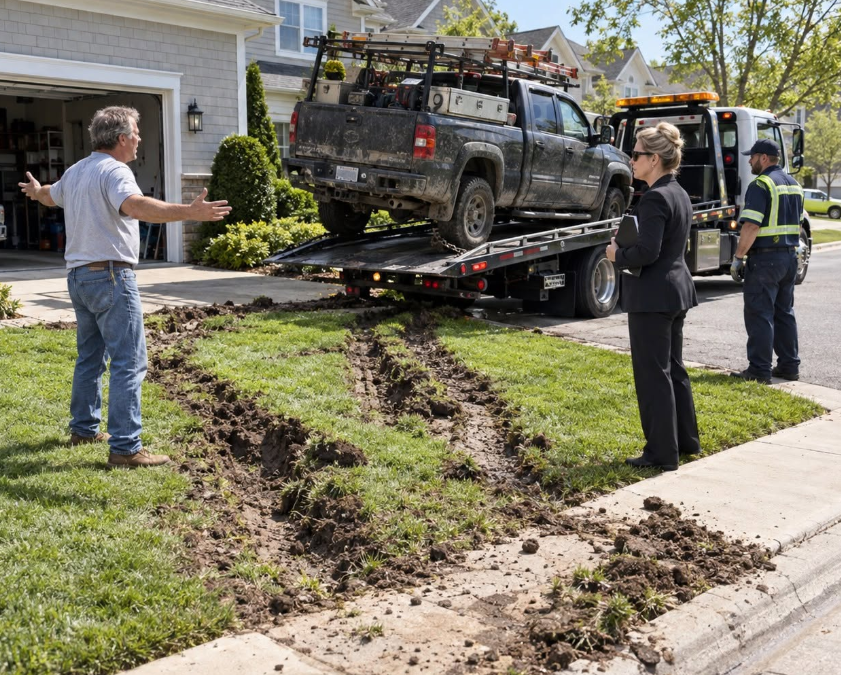
Then I saw the lawn.
Two deep tire ruts cut across the grass.
Fresh dirt had been thrown over the edge of the driveway.
One sprinkler head was broken and lying sideways.
Another was gone completely.
My mailbox leaned at an angle.
Mud streaked the concrete.
The tracks told the story before anybody else did.
A heavy truck had driven onto my yard.
Not accidentally.
Several feet into the grass.
I set the coffee down.
Megan came outside behind me.
She stopped.
“Oh my God.”
I walked toward the ruts.
The grass I had planted myself after we bought the house was ripped open. Chunks of sod were turned over. The soil beneath was dark and wet.
I crouched beside a broken sprinkler head.
Megan stood behind me.
“Please tell me they did not actually tow it.”
I already had my phone out.
The first towing company I called was the one named in Vanessa’s final notice.
A woman answered.
I gave her my address.
She did not even let me finish.
“Yes, sir. We have the vehicle.”
I closed my eyes.
“Who authorized the tow?”
“The homeowners association.”
“Police?”
“No.”
“County?”
“No, sir.”
“The HOA?”
“Yes.”
I looked at the damaged yard.
“Who specifically?”
There was a pause.
“I have an authorization form here.”
“Name?”
Another pause.
“Vanessa Holloway.”
Megan heard it.
Her face changed.
I thanked the dispatcher.
Then drove Megan’s car to the impound yard.
The place sat behind a chain-link fence in an industrial area about twenty minutes away. My Ford was easy to spot.
White cab.
Ladder rack.
Company lettering.
Exactly where I had left it, except now behind a locked gate.
I felt angrier looking at it than I expected.
Not because I was emotionally attached to the truck.
Because somebody had taken it from my home while I slept.
A vehicle I needed for work.
A vehicle parked on land I owned.
Inside the office, a manager slid paperwork across the counter.
“Release fee plus storage.”
“I’m not paying.”
He looked at me.
“Then I can’t release it.”
“It was illegally towed.”
“You’ll need to take that up with whoever ordered it.”
“Who ordered it?”
He tapped the paperwork.
I looked down.
Vanessa Holloway.
Her signature.
Clear.
I pulled out my phone.
“Mind if I photograph this?”
He shrugged.
I took pictures of every page I could see.
Tow authorization.
Time.
Vehicle information.
Address.
Signature.
The manager watched.
“You’re not taking the truck?”
“Not if I have to pay to recover something that never should have been taken.”
“You understand storage charges keep accumulating.”
“I understand.”
He leaned back.
“If the HOA authorized it, you need to talk to them.”
“I will.”
I walked out without the Ford.
That was harder than I expected.
Part of me wanted to pay.
Get the truck.
Go home.
Forget everything.
I had jobs scheduled Monday.
Equipment inside.
Clients expecting me.
The logical thing seemed to be paying the fee and fighting about reimbursement later.
But another thought bothered me.
The entire month, Vanessa had acted as if her interpretation automatically created authority.
If I paid without challenging the tow, she would treat that as confirmation.
The truck was removed.
I paid.
Case closed.
I could not do it.
When I arrived home, Walter was standing in my driveway.
He wore work boots even though he had been retired for years.
“Truck really got taken?”
“Yes.”
He looked at the lawn.
His expression changed.
“What?”
“Nothing.”
“Walter.”
He walked slowly along the tire marks.
Stopped near the edge of the driveway.
Looked toward the sidewalk.
Then toward my mailbox.
“That’s interesting.”
“What?”
“They crossed the easement.”
I followed his finger.
Walter crouched.
“You still have the survey?”
“Two copies.”
He smiled.
“That’s what I like to hear.”
Inside, Megan cleared the dining table.
We spread everything out.
Deed.
Closing papers.
County survey.
Easement diagrams.
HOA notices.
My emails.
Their replies.
Tow authorization photographs.
Walter joined us with his reading glasses.
He studied the survey.
Then looked at the yard through the window.
“No question.”
“You’re sure?”
“I did this for thirty years.”
He pointed at the document.
“Utility easement ends here.”
His finger moved.
“Driveway stays inside your parcel.”
Then he indicated where the tow truck tracks had gone.
“They drove well beyond both.”
Megan leaned back.
“So they entered private property.”
Walter nodded.
“Sure looks like it.”
Then I remembered the cameras.
Three years earlier, somebody had stolen a package from our front porch. After that, I installed a security system.
One camera covered the driveway.
I had barely thought about it since.
I almost ran to the computer.
The system stored recordings.
I pulled up the overnight footage.
At 2:17 in the morning, headlights appeared.
A tow truck backed toward my property.
We watched silently.
The truck stopped.
Adjusted.
Then the driver turned sharply.
The rear wheels rolled off the driveway.
Across the lawn.
Four feet.
Maybe more.
The truck positioned itself in front of my Ford.
A man got out.
Checked something.
Then they hooked the truck.
The entire operation was visible.
No guesswork.
No missing angle.
No unclear boundary.
Video.
Timestamp.
Movement.
Vehicle.
Damage.
Megan watched twice.
Then a third time.
Finally, she said quietly, “They’re going to regret this.”
I did not smile.
But for the first time that morning, I felt like I could breathe.
The next step was documentation.
Not yelling.
Not threats.
Evidence.
Monday morning, I called a licensed landscaping contractor.
He came that afternoon.
He walked the lawn with a clipboard.
Measured the ruts.
Checked the damaged irrigation.
Dug carefully around one broken sprinkler connection.
Then another.
He whistled.
“What?”
“You can see the surface damage.”
“I know.”
“You can’t see all the cracked fittings underneath.”
He wrote numbers.
Walked farther.
Measured again.
Finally, he said, “Honestly, your truck isn’t going to be the expensive part.”
“What is?”
“That tow rig driving through wet ground.”
“How bad?”
“You’re replacing a lot of sod. Irrigation needs repair. Compaction needs addressing. This isn’t filling two tire marks with dirt.”
He prepared an estimate.
Photos.
Written scope.
I asked for everything in detail.
He gave it to me.
Then I contacted the post office.
The mailbox had been bent during the towing maneuver.
I expected the local supervisor to tell me to replace it myself.
Instead, she asked questions.
“How was it damaged?”
“Tow truck.”
“While handling your vehicle?”
“Yes.”
“Do you have video?”
“Yes.”
She explained that because the mailbox was part of the federal mail delivery system, they wanted the damage documented.
I was surprised.
I was not trying to turn the mailbox into some dramatic federal case.
I simply wanted proof.
So I let them document it.
By Tuesday afternoon, our dining room looked like a legal office.
Megan stood at one end of the table.
I sat at the other.
Photographs.
Estimates.
Screenshots.
Survey maps.
Security footage saved in multiple places.
HOA letters.
Emails.
Tow paperwork.
Mailbox documentation.
“Attorney?” Megan asked.
“Probably.”
“But?”
I looked at the HOA insurance information.
“First I want to see what happens if the carrier sees this.”
She smiled.
“You’ve been thinking about this.”
“All day.”
I prepared a formal demand package.
No emotional language.
No accusations about Vanessa’s personality.
No story about her sunglasses.
Only facts.
Vehicle parked on private driveway.
Covenant language concerning common roads.
Written request for rule clarification.
No specific rule supplied.
HOA authorized tow.
Tow contractor entered private property.
Security video.
Property survey.
Landscaping damage.
Irrigation damage.
Mailbox damage.
Impound costs.
Every photo labeled.
Every page numbered.
I sent it to the HOA’s insurance carrier.
Two days later, Vanessa knocked on my door.
No smile.
No sunglasses.
Leather binder.
She stood stiffly.
“You filed an insurance claim.”
“I documented what happened.”
“You didn’t need to involve the carrier.”
“Who should I involve?”
“The board.”
“I involved the board for a month.”
“This could have been handled internally.”
“You had my truck dragged out of my driveway while I was asleep.”
“You were given multiple warnings.”
“Warnings based on what rule?”
“We’ve already discussed this.”
“No. You sent me a sentence saying the board interpreted the covenant.”
Her jaw tightened.
“You’re making this much bigger than it needs to be.”
I almost laughed.
“You tore up my front yard with a tow truck.”
“That was the contractor.”
“You authorized the contractor.”
“The board authorized enforcement.”
That phrase stayed in my head.
The board authorized enforcement.
I would come back to it later.
At the time, I simply said, “Somebody crossed my property line.”
“The HOA has easement rights.”
“Not where the truck went.”
“We have attorneys.”
“Good.”
She blinked.
“They’ll have something to do.”
Her face hardened.
“You’re not going to win this.”
I leaned against the doorframe.
“Maybe not.”
She waited.
“But the cameras don’t lie.”
For the first time since she became president, Vanessa looked uncertain.
Only for a moment.
Then she turned and walked away.
The following week, I received a call from county code enforcement.
A man named Daniel Ruiz introduced himself.
“I’m reviewing a complaint related to property access and a towing incident.”
“I have documents.”
“I heard.”
He came by that afternoon.
Daniel was calm.
Methodical.
He measured the driveway.
Checked the easement.
Compared my survey with county information.
Watched the security footage.
Then watched it again.
He paused the video when the tow truck’s wheels entered the lawn.
He pointed.
“Where’s the easement line?”
I showed him.
He measured.
Then sat back.
“Well.”
I waited.
“That’s a problem.”
“For me?”
He looked at the screen.
“For whoever authorized this.”
Two days later, the impound yard called.
The same manager.
His tone was completely different.
“Mr. Brooks?”
“Yes.”
“We’ve received updated instructions concerning your Ford.”
“What instructions?”
“The vehicle is being released immediately.”
“How much?”
“No charge.”
I paused.
“Storage?”
“Covered.”
“Tow fee?”
“Covered.”
“By whom?”
Another pause.
“The homeowners association has assumed responsibility.”
I drove there that afternoon.
The gate opened.
I climbed into my Ford.
The cab smelled exactly the same.
Coffee.
Tools.
Dust.
I sat behind the wheel for a moment before starting it.
I should have felt relieved.
I did.
But mostly I felt curious.
Vanessa had spent weeks acting absolutely certain.
Now suddenly the HOA was paying.
Something had changed.
That evening, Daniel Ruiz emailed me the county findings related to the property line.
The tow contractor had entered private property beyond the applicable easement.
That alone was serious enough for the insurance company to care.
But another issue was developing.
Board members were asking for the records showing who had authorized the tow.
Meeting minutes.
Votes.
Approvals.
Apparently, nobody could find them.
Vanessa maintained that the board had approved enforcement.
Several directors said they did not remember voting.
One director quietly told Walter that he remembered a discussion about my truck but not a formal tow authorization.
That distinction bothered me.
I pulled out the HOA bylaws again.
Not the vehicle section.
This time, I started reading governance procedures.
The boring pages.
Meeting rules.
Board authority.
Votes.
Records.
Minutes.
Most people never read those sections because they assume internal board procedure has nothing to do with them.
I almost skipped one paragraph.
Then a sentence caught my eye.
Every enforcement action requiring board approval had to be supported by a recorded vote in the official meeting minutes and made available to homeowners upon request.
I read it again.
Then a third time.
Megan looked up from the other side of the table.
“You found something.”
I turned the binder toward her.
She read.
Her eyes moved across the sentence.
Then back.
“Tell me they forgot.”
“I don’t know.”
“You think they did.”
“I think if they had a vote, they would have sent it already.”
The next morning, I submitted a records request.
Very simple.
Please provide the meeting minutes and recorded board vote authorizing the towing of my vehicle.
That was it.
No accusations.
No demands.
No threats.
Twenty-four hours.
Nothing.
Forty-eight.
Nothing.
Then an email.
The matter will be addressed during an emergency board meeting Thursday evening.
I stared at the screen.
Megan leaned over my shoulder.
“That’s not the document.”
“No.”
“If it existed…”
“They would attach it.”
By Thursday, the entire neighborhood knew.
I still have no idea how information traveled that fast in Cedar Ridge.
Maybe board members talked.
Maybe Walter talked.
Walter definitely talked.
When Megan and I arrived at the clubhouse, every chair was taken.
People stood along the walls.
Homeowners who had never attended a meeting were there.
People I had barely spoken to.
Walter stood near the back.
He gave me a nod.
Vanessa entered carrying the leather binder.
For months, that binder had almost become part of her identity.
This time, she held it tighter.
She looked tired.
Not defeated.
Not yet.
But the confidence was cracked.
At the front table sat the other directors.
Linda Pierce, a retired accountant, sat directly beside Vanessa.
I knew Linda only vaguely.
She was quiet at meetings.
Very precise.
The kind of person who seemed to listen more than she spoke.
That night, before Vanessa could begin the agenda, Linda leaned toward the microphone.
“Before new business, we need to address the records request related to the Brooks towing incident.”
Vanessa immediately said, “The board acted within its authority.”
Linda looked at her.
“Then let’s see the vote.”
Silence.
Not ordinary silence.
The kind where everyone suddenly becomes aware of the air conditioner.
Vanessa opened her binder.
Flipped pages.
Stopped.
Turned another page.
Then another.
I watched her fingers.
Fast.
More pages.
Linda did not move.
Finally, Vanessa looked up.
“The documentation appears to have been misplaced.”
Someone two rows behind me laughed.
Not because it was funny.
Because everyone knew what misplaced probably meant.
Linda’s expression did not change.
“Did the board conduct a recorded vote?”
“We discussed the matter.”
“That is not what I asked.”
“We reached a consensus concerning enforcement.”
“Was there a recorded vote?”
Vanessa hesitated.
Another director leaned toward his microphone.
“I don’t remember voting.”
Vanessa turned.
“We discussed escalation.”
“Yes,” he said. “But I don’t remember a motion to tow.”
Another director nodded slowly.
“Neither do I.”
Vanessa’s face changed.
“The president has enforcement authority.”
Linda opened the bylaws.
“Not for an action requiring board approval.”
She read the relevant procedure aloud.
Recorded vote.
Official minutes.
Available upon request.
Then she looked up.
“Where is the vote?”
Vanessa said nothing.
That was the moment the room changed.
Until then, many people probably saw my dispute as one homeowner fighting over one work truck.
Now everyone understood the problem could be larger.
A woman stood.
“I paid a fine last year over my fence.”
Another homeowner raised his hand.
“What about the citations for holiday decorations?”
Someone else called out.
“Were those voted on?”
Another voice.
“What about my landscaping violation?”
Vanessa tried to regain control.
“Individual compliance matters are not all the same.”
Linda said, “Correct. We need to determine which actions required approval and whether procedure was followed.”
The questions multiplied.
People who had quietly paid fines suddenly wanted records.
People who had removed decorations wanted to know whether enforcement had been authorized.
People who had accepted Vanessa’s interpretation of the bylaws began asking the exact question I had asked months earlier.
Where is it written?
At one point, Vanessa lifted both hands.
“This association cannot function if every enforcement decision becomes a courtroom.”
Linda answered calmly.
“No one is asking for a courtroom. They’re asking us to follow our own procedures.”
That sentence silenced the room.
Then a speaker on the conference table crackled.
The HOA’s insurance representative was attending remotely.
He cleared his throat.
“Based on the information currently available, the carrier has accepted responsibility for covered damages arising from the unauthorized tow and associated property intrusion.”
Nobody spoke.
I looked at Megan.
She looked at me.
The representative continued.
The policy would address the documented landscaping repairs, irrigation damage, mailbox damage, and towing-related expenses, subject to the normal claims process.
In plain English, the association’s insurer had accepted what I had been saying from the beginning.
The truck should not have been removed the way it was.
The property should not have been entered the way it was.
Vanessa sat completely still.
But I knew enough about insurance to understand that payment was not the end.
Insurance companies ask questions.
Why did the claim happen?
Who authorized the action?
Did the board follow its procedures?
Could the loss have been prevented?
The next week was uncomfortable for everyone on the board.
Attorneys representing the carrier interviewed directors individually.
I was not in those meetings.
I learned only what became part of later discussions.
Several directors said they had assumed Vanessa was handling the matter properly.
Nobody had independently checked my survey.
Nobody had verified that the commercial vehicle rule applied to private driveways.
At least one director admitted there had been no formal vote authorizing the tow.
The action had simply moved forward as if Vanessa’s decision and the board’s decision were the same thing.
That was the real failure.
Not that a board interpreted a rule differently from a homeowner.
People can disagree.
The failure was using enforcement power without following the procedures that gave that power legitimacy.
At the next HOA meeting, Linda Pierce placed a motion on the agenda.
The room was full again.
Vanessa sat at the front.
No oversized sunglasses.
No confident smile.
The leather binder was closed.
Linda read the motion.
“I move that Vanessa Holloway be removed as president effective immediately for failure to comply with governing procedures and for exposing the association to unnecessary liability.”
Nobody moved for several seconds.
Then another director seconded it.
This time, there was a vote.
An actual vote.
Recorded.
Hands went up.
One.
Two.
Three.
Every hand except one.
Vanessa’s.
She did not argue.
That surprised me.
I had expected a speech.
A defense.
Maybe anger.
Instead, she quietly closed the binder.
Stood.
Walked around the table.
As she passed my row, she stopped.
For a second, we looked at each other.
Her expression was not angry.
Mostly tired.
“I only wanted people to follow the rules,” she said softly.
I thought about everything.
The letters.
The truck.
The torn lawn.
The missing vote.
Then I gave her the only answer that felt honest.
“So did I.”
She looked at me.
Then nodded once.
And walked out.
No applause.
No cheering.
No dramatic celebration.
I was glad.
Whatever Vanessa had done wrong, watching somebody lose a position in front of their neighbors did not feel like entertainment.
It felt like the end of something that should never have gone that far.
A few days later, I came home from work and found a county survey crew near my driveway.
Two men were checking measurements.
One carried equipment.
Another held a metal marker.
I walked over.
“What’s going on?”
“We’re correcting the easement marker.”
Apparently, an older marker near the property had been placed inaccurately years earlier. The official recorded survey was clear, but the physical marker created confusion.
They removed the old one.
Measured carefully.
Then drove the corrected marker into the ground exactly where the survey showed it belonged.
Metal hitting soil.
A simple sound.
But I stood there watching.
It was not about gaining a few feet.
I already owned the land.
The paper had said so all along.
What mattered was seeing reality physically line up with the record.
Facts do not become less true because an authority figure ignores them.
A landscaping crew arrived next.
They removed damaged sod.
Repaired the irrigation.
Replaced broken fittings beneath the ground.
Leveled the areas compressed by the tow truck.
Laid new grass.
Within weeks, the scars were mostly gone.
The sprinkler heads came on one evening just before sunset.
Water arched over the lawn.
I stood on the porch with Megan.
She handed me a drink.
“Looks normal.”
“Almost.”
The new mailbox stood straight.
The lawn was green.
And my white Ford sat exactly where it had always sat.
On my driveway.
Inside my property line.
Company decals visible.
Ladders on top.
Tools inside.
Nobody complained.
Nobody sent a warning.
Nobody threatened a tow.
About a month later, one final envelope arrived from the HOA.
I opened it at the kitchen table.
Inside was a formal letter.
Every citation connected to my truck had been rescinded.
The violations were permanently marked as issued in error.
I read that sentence twice.
Then folded the letter.
Megan watched me.
“You keeping it?”
“Absolutely.”
She laughed.
“You have a problem.”
“I have a filing system.”
I placed the letter into the same folder that contained Vanessa’s warnings.
I kept everything.
Not because I wanted to stay angry.
I did not.
I kept it because the folder told the whole story.
One notice by itself looked official.
Several notices together looked intimidating.
A tow authorization looked decisive.
But once you placed those documents beside the actual covenant, survey, security footage, and missing board vote, the meaning changed.
Paperwork can intimidate people.
It can also protect them.
You just have to read it.
Life in Cedar Ridge slowly returned to normal.
Linda became interim president.
Her style could not have been more different.
At her first meeting, she brought copies of the governing procedures and placed them on the table.
Whenever someone asked whether the board could do something, her answer was rarely immediate.
She would say, “Let’s check.”
I liked that.
A leader who checks is safer than one who always claims to know.
Several older fines were reviewed.
Some stood because the violations were clear and properly documented.
Others were withdrawn.
Nobody discovered some massive conspiracy.
There was no secret account.
No criminal mastermind.
The truth was more ordinary.
Vanessa had become too confident.
Other directors had become too passive.
People assumed somebody else had verified the details.
That is how bad decisions happen.
Not always through evil.
Sometimes through momentum.
One person says the rule means this.
Nobody checks.
A warning goes out.
Nobody challenges it.
A second warning.
A tow notice.
A signature.
A truck disappears.
By the time anyone asks whether the first assumption was correct, damage has already been done.
Walter came over one evening with tomatoes.
He looked at the Ford.
“Still ugly.”
“Thank you.”
“Industrial appearance.”
“Get off my property.”
He laughed.
Then pointed toward the repaired lawn.
“They did good work.”
“They did.”
“You glad you kept the survey?”
“Very.”
He handed me the basket.
“You know what I always told junior techs?”
“What?”
“Property lines don’t care about confidence.”
I smiled.
“That sounds like something you invented after this happened.”
“Maybe.”
He walked back toward his garden.
Megan and I talked about the whole thing many times afterward.
At first, she had been angrier than I was.
The morning we found the truck gone, she wanted an attorney immediately.
Later, after everything settled, she admitted she was glad we had documented things first.
“You know what scared me?” she asked one night.
“What?”
“How normal Vanessa made it sound.”
“What do you mean?”
“The first complaint.”
I nodded.
“She came to the door and acted like the truck rule was obvious. Then the letter made it look official. Then the second letter made the first one feel more legitimate.”
She paused.
“If we hadn’t read the bylaws, I probably would have assumed she was right.”
“So would most people.”
“That’s the scary part.”
She was right.
Authority often works because people assume someone else checked.
The HOA president must know the rules.
The towing company must have authority.
The board must have voted.
The notice must be valid.
The easement must reach that far.
Must.
Must.
Must.
Until somebody asks for proof.
I thought often about the impound manager.
He had not been rude.
From his perspective, he had paperwork authorizing a tow.
The driver probably believed the same thing.
A contractor receives an authorization, sees an address, performs the job.
That is why the responsibility could not stop at the person operating the tow truck.
Someone created the authority.
Someone signed the request.
Someone decided the rule applied.
Someone failed to verify the property line.
And several people assumed the process had been followed.
The board learned that lesson the expensive way.
Insurance paid covered damages, but insurance is not magic.
Claims affect associations.
Legal review costs money.
Administrative mistakes consume time.
Board members spent evenings explaining why nobody could produce a vote that the bylaws required.
Homeowners demanded records.
Trust had to be rebuilt.
Vanessa lost her position.
None of that happened because I wanted revenge.
At least not by the time it ended.
I would be lying if I said I never wanted revenge.
The morning I saw those ruts across my lawn, I was furious.
When the impound manager told me to pay for my own truck, I wanted to send Vanessa a bill for every minute she had wasted.
When she stood on my porch and told me I would not win, part of me wanted to prove her wrong simply because she had said it.
But anger was not what won anything.
Evidence did.
The survey.
The video.
The written covenant.
The landscaping estimate.
The photographs.
The tow authorization.
The missing meeting minutes.
Those things did not shout.
They did not insult anyone.
They simply sat there being true.
That was enough.
A couple of months after Vanessa was removed, I saw her walking through Cedar Ridge.
No binder.
She was alone.
For a moment, I considered turning into my garage before she reached the house.
Then she saw me.
“Ethan.”
“Vanessa.”
She stopped at the edge of the driveway.
Her eyes moved toward the Ford.
I almost smiled.
She noticed.
“No,” she said.
“What?”
“I’m not here about the truck.”
“I didn’t say anything.”
“You were thinking it.”
“Maybe.”
She looked at the repaired yard.
“They did a good job.”
“They did.”
Silence.
Then she said, “I should have checked.”
I did not need to ask what she meant.
“Yes.”
“I thought the commercial vehicle provision applied.”
“You also told the tow company to enter my property.”
Her mouth tightened.
“I know.”
“And the board didn’t vote.”
“I know.”
There was no point piling on.
So I stopped.
She looked toward the street.
“I really did think I was protecting the neighborhood.”
“I believe you.”
That seemed to surprise her.
“You do?”
“Yes.”
“Then why…”
“Because believing you’re doing the right thing doesn’t automatically make the method right.”
She nodded slowly.
“That’s fair.”
Another silence.
Then she said, “I’m sorry about the lawn.”
“And the truck?”
She almost smiled.
“And the truck.”
I nodded.
“Thank you.”
She continued walking.
That was it.
No friendship.
No dramatic reconciliation.
No movie ending.
Just an acknowledgment.
It was enough for me.
The Ford stayed with me for several more years.
Eventually, the transmission started slipping.
The air conditioning became unreliable.
Rust appeared around one wheel well.
Megan kept asking when I was going to replace it.
“Still runs.”
“Barely.”
“Still works.”
“So does a tractor from 1952. That doesn’t mean you drive it to appointments.”
When I finally bought another work truck, I removed the ladders and company equipment from the Ford.
For a second, seeing it empty felt strange.
That truck had been at the center of the biggest neighborhood dispute of my life.
Yet it had never done anything wrong.
It simply sat in a driveway.
That was the absurdity.
All that conflict grew from an object doing exactly what it had done for four years.
The rule did not change.
The property line did not change.
The driveway did not change.
What changed was who believed they had authority.
That taught me something about boundaries.
People usually imagine boundaries as fences.
Survey markers.
Property lines.
Things you can see.
But some of the most important boundaries are procedural.
A board must vote.
A decision must be recorded.
A rule must actually say what someone claims it says.
Those procedures seem boring until someone ignores them.
Then they become the only thing separating legitimate authority from one person’s opinion.
That was Vanessa’s real mistake.
Not disliking my truck.
She was allowed to dislike it.
Not wanting Cedar Ridge to look residential.
That was a reasonable concern.
Her mistake was assuming that because she believed the truck violated the spirit of the neighborhood, she could skip the written limits of her authority.
That is where everything broke.
The truck became an excuse.
The lawn became evidence.
The missing vote became the truth.
Sometimes I think about what would have happened if I had paid the impound fee immediately.
Maybe the truck comes home.
Maybe I send the HOA a complaint.
Maybe they refuse reimbursement.
Maybe I get tired.
Maybe the grass gets repaired out of my own pocket.
Maybe Vanessa’s interpretation becomes the new normal.
Maybe another homeowner gets towed later.
Maybe nobody ever asks for the recorded vote.
It is impossible to know.
I do know I came close.
Standing at that impound counter, I nearly pulled out my wallet.
I had jobs.
I needed the truck.
Paying would have been easier.
Easier and faster.
That is how bad decisions survive.
Not because nobody sees them.
Because challenging them costs time.
Most people are busy.
They cannot spend Tuesday night reading forty pages of bylaws.
They cannot miss work to argue with an impound yard.
They do not have security cameras.
They do not have a retired survey technician living next door.
I got lucky in several ways.
But I also learned to keep records.
That part was not luck.
Years after everything happened, I still have the folder.
The first violation notice is inside.
So is the one-sentence email.
The tow authorization photo.
The landscape estimate.
Printed stills from the camera.
The insurance correspondence.
The final rescission letter.
Sometimes when I clean out old paperwork, I consider throwing the folder away.
Megan tells me I never will.
She is probably right.
It reminds me of something useful.
A confident person can still be wrong.
An official letter can still be wrong.
A board can still be wrong.
Even a unanimous opinion would not move a property line.
Facts are stubborn that way.
The repaired lawn eventually became indistinguishable from the rest.
You cannot see where the tow truck drove anymore.
The sprinkler system works.
The mailbox stands straight.
The physical damage disappeared.
The neighborhood changed more permanently.
Board meetings became better attended for a while.
Homeowners asked more questions.
Some people complained that meetings took longer.
Linda once joked that democracy was inconvenient.
I thought that was a good problem.
People started reading notices.
The board started citing sections.
Votes were recorded carefully.
Minutes were posted on time.
Not because everyone suddenly distrusted everything.
Because trust works better when it can be verified.
Walter kept growing tomatoes.
He still overwatered them, no matter what he claimed.
My daughter graduated.
Megan eventually convinced me to replace the Ford.
Life moved forward.
Vanessa remained in the neighborhood.
She kept mostly to herself.
Occasionally we waved.
That became normal too.
There was no need to hate her forever.
I did not want the rest of my life defined by one fight over a pickup truck.
But I never forgot the morning the driveway was empty.
That image stayed with me.
An empty rectangle of concrete.
Deep tracks through grass.
Broken sprinkler heads.
A bent mailbox.
The strange feeling that someone had entered my property while I slept and made a decision for me.
That feeling was what pushed me forward.
Not pride.
Not the truck.
Not even the repair money.
It was the realization that if I accepted what happened without asking questions, I was teaching the board exactly how much of my property I was willing to let them control.
I was not willing to teach that lesson.
The final HOA letter sits at the front of the folder now.
Every citation related to the truck rescinded.
Issued in error.
Those three words mattered more than I expected.
Issued in error.
Not withdrawn as a courtesy.
Not waived.
Not settled.
Error.
An official acknowledgment that the original premise had been wrong.
I did not frame the letter.
Megan would have killed me.
But I considered it.
The strangest thing is that after all the meetings, claims, surveys, and arguments, the solution was incredibly simple.
The board had rules.
I had rules.
The neighborhood had rules.
Everyone just had to follow the same ones.
Vanessa once told me she wanted people to follow the rules.
At the meeting where she lost her position, I told her the same thing.
I meant it.
I still do.
Because rules only protect a community when they restrain authority as much as they restrain homeowners.
Otherwise, they are not rules.
They are weapons.
That was what Cedar Ridge almost forgot.
My old Ford reminded everyone.
Not by being beautiful.
Not by being special.
Just by sitting exactly where it had every right to sit.
On my driveway.
On my property.
Behind a lawn that eventually grew back.
And beside a small metal survey marker that nobody in Cedar Ridge ever seemed willing to ignore again.