The HOA Sued Me Over 1,500 Cows and Ordered Me Off My Ranch—Then Their Lawyers Discovered They Had Picked a Fight With the Wrong Owner.
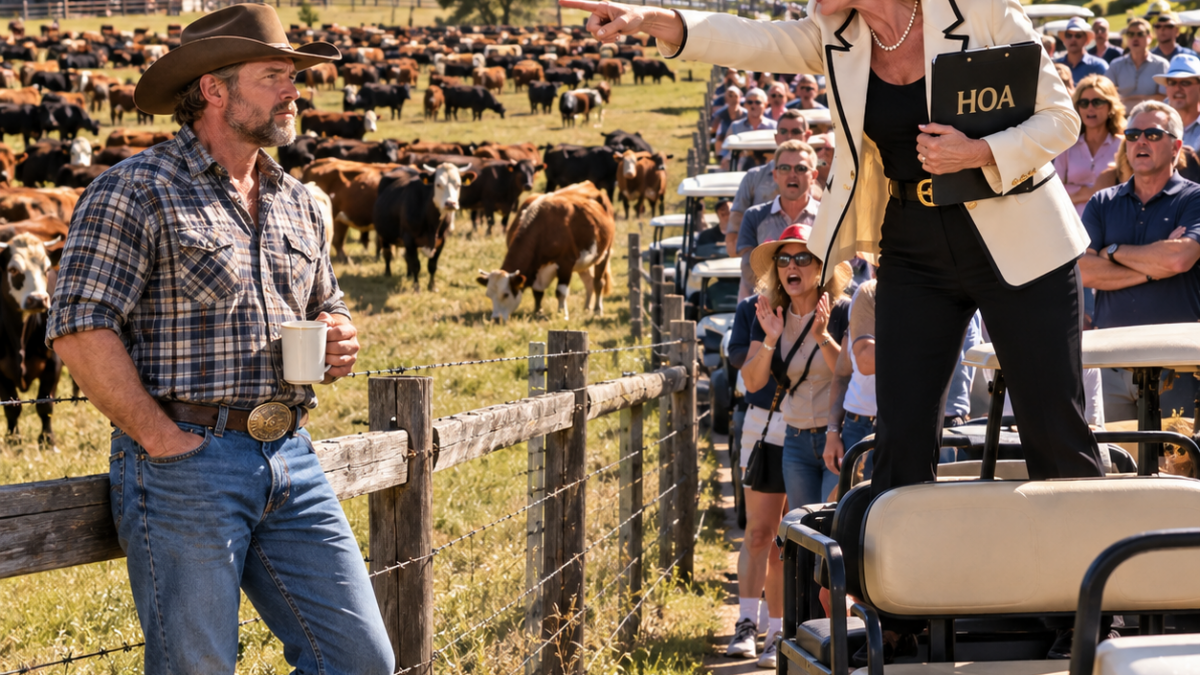
PART2:
One heifer lifted her head, chewed slowly, and looked toward the golf carts.
Then went back to grass.
Probably the smartest response anyone had that morning.
Willow Creek Estates sat along my southeastern boundary.
The development hadn’t existed when the ranch first became agricultural land, but it had grown fast.
Large homes.
Stone entry monument.
Community pool.
Walking paths.
Decorative ponds.
Two-car and three-car garages.
Everything looked new enough that the trees hadn’t yet caught up with the architecture.
Most houses had been sold with language about “country living without sacrificing suburban convenience.”
The irony wasn’t lost on me.
People had bought homes marketed as country living.
Then complained when the country contained livestock.
I wasn’t angry at all of them.
Most residents had nothing to do with the campaign at first.
A few were genuinely concerned about odor.
A few worried about flies.
Some wondered whether truck traffic would increase.
Reasonable questions.
Those could have been answered in twenty minutes.
Deborah didn’t want answers.
She wanted momentum.
She was president of the HOA, a successful local real estate agent, and one of those people who could turn uncertainty into applause before anyone had time to check the facts.
She spoke confidently.
That mattered.
PART3:
People often assume confidence means preparation.
Sometimes it means the opposite.
Six months earlier, I had purchased the ranch through one of my holding companies.
The property covered a little over two thousand acres.
Rolling grass.
Mesquite.
Stock ponds.
Several wells.
An older ranch house.
Equipment barns.
Working pens.
A network of internal roads.
It had been used for agriculture for generations.
The purchase wasn’t impulsive.
Nothing about the fifteen hundred cattle was impulsive either.
The operation had taken almost three years to assemble.
Grazing agreements.
Water studies.
Environmental review.
Transportation planning.
Veterinary protocols.
Feed contracts.
Insurance.
Agricultural exemptions.
Fencing upgrades.
Stocking calculations.
Rotational grazing plans.
Backup water.
Emergency access.
The cattle didn’t arrive because I woke one morning and thought:
You know what would really upset those people behind the stone monument?
Fifteen hundred cows.
They arrived because the numbers worked.
I had spent most of my adult life building agricultural businesses.
I grew up in a family that owned seventy-two acres and never enough money.
My father raised cattle part-time while working as a mechanic.
My mother kept the books for three small businesses in town.
We were not poor in the dramatic sense.
There was food.
There was a house.
But we knew exactly which bills could wait three days.
I was thirteen the first time I heard my parents argue quietly about whether to sell six cows to cover property taxes.
That sound stays with you.
My father died when I was twenty-six.
Heart attack.
Unexpected.
Two weeks later, I discovered how much debt he had hidden from us.
Not from dishonesty.
Pride.
He wanted everyone to believe the farm was fine.
It wasn’t.
I sold most of it.
Kept twelve acres around my mother’s house.
And promised myself something that sounds arrogant now.
I would never again love land I could not afford to protect.
So I learned.
Agricultural finance.
Commodity contracts.
Water rights.
Feed margins.
Equipment leasing.
Insurance.
Eventually I bought a small trucking company that mostly moved hay.
Then a feed-storage operation.
Then another trucking company.
Then acreage.
Then cattle.
Then processing contracts.
The first twenty years did not look impressive.
The twenty-first suddenly did.
That is how compounding works.
People see the tree.
They forget roots spent years underground.
By forty-seven, I controlled five operating companies directly and had substantial ownership interests in several more.
Most were boring.
Boring was good.
Whitaker Agricultural Holdings.
Whitaker Livestock Logistics.
Red Mesa Feed Cooperative.
Crescent Water Resources.
Iron Prairie Land Company.
No giant glass headquarters.
No private jet.
No television commercials.
My office still smelled faintly like saddle soap because the previous owner had stored tack there.
I drove a twelve-year-old Ford F-250.
Not because I wanted to cosplay as working class.
I liked the truck.
It started.
It pulled.
It was paid for.
Deborah saw it and formed a biography.
Dusty boots.
Old pickup.
Modest ranch house.
Therefore:
Small rancher.
Debt.
Pressure point.
That assumption would eventually cost Willow Creek more than the cattle ever could.
That morning, I walked down from the porch toward the fence.
My ranch manager, Wade Sullivan, came around the barn.
Sixty-one.
Former rodeo calf roper.
A man who considered smiling an unnecessary expenditure of facial muscles.
He nodded toward the golf carts.
“Your fan club.”
“I see.”
“Want me to run them off?”
“They’re on their side.”
“For now.”
That mattered.
Deborah’s golf cart was parked inside Willow Creek property.
She wasn’t trespassing.
She was performing.
Residents had gathered along walking path behind development’s boundary fence.
Maybe forty people.
Phones.
Coffee cups.
Dogs on leashes.
Deborah saw me coming and lifted a folder.
“Mr. Whitaker!”
“Morning.”
“We need to speak immediately.”
“You’re speaking.”
A few residents chuckled.
She didn’t.
“This operation is in direct violation of Willow Creek community standards.”
“I’m not in Willow Creek.”
“The ranch borders Willow Creek.”
“Yes.”
“That places you within our agricultural impact perimeter.”
I looked at Wade.
He looked back.
Neither of us had heard that phrase before.
I asked:
“Your what?”
“Agricultural impact perimeter.”
“Is that a county designation?”
“Our counsel has reviewed it.”
“That wasn’t my question.”
Deborah stepped off golf cart.
She was probably fifty-five.
Perfect blond hair.
White vest over a blue blouse.
Pearl earrings.
Everything about her said she expected meetings to go her way.
“Our residents purchased homes with a reasonable expectation of peaceful residential use.”
“Then they purchased residential lots.”
“Your livestock affects those lots.”
“So does weather.”
“Don’t be flippant.”
“I’m not.”
I pointed toward cattle.
“This property is zoned and taxed for agriculture. It has been agricultural longer than your subdivision has existed.”
“We are not disputing your right to agricultural activity generally.”
That was first lie.
“We are challenging industrial-scale livestock concentration.”
“These cattle aren’t concentrated.”
“There are fifteen hundred.”
“Across more than two thousand acres.”
A man in crowd said:
“That is less than one per acre.”
Deborah turned.
“Please let board handle this, Mark.”
Mark raised both hands.
Interesting.
Someone already checking numbers.
Deborah looked back at me.
“You have thirty days to reduce herd below seventy-five.”
Wade made a noise that sounded like cough and laugh fighting.
I asked:
“Where did seventy-five come from?”
“Our environmental consultant.”
“What’s his name?”
She hesitated.
“That’s privileged.”
“No, it isn’t.”
“The number is not negotiable.”
“Good.”
She looked pleased for half second.
Then I continued:
“Because you don’t have authority to negotiate it.”
Her mouth tightened.
She held out envelope.
“Formal notice.”
I did not take it.
“Mail it.”
“I’m serving you.”
“You’re not process server.”
“I’m association president.”
“Exactly.”
She placed envelope on top rail of fence.
I left it there.
Deborah said:
“If you refuse compliance, association will pursue injunctive relief.”
“Then have lawyer call mine.”
“Your lawyer?”
There it was.
Surprise.
Small farmers apparently aren’t allowed counsel.
“Yes.”
She recovered.
“Fine.”
Then louder, for audience:
“Willow Creek will not be bullied by commercial interests.”
Wade looked at cattle.
Then at me.
“What commercial interests?”
I said:
“Apparently Daisy over there.”
He nodded.
“She does look aggressive.”
That ended first public confrontation.
Not campaign.
Two days later, I received certified demand letter.
Willow Creek Property Owners Association v. Grant Whitaker.
Not a lawsuit yet.
Threat.
Claims:
Nuisance.
Odor.
Vector attraction.
Dust.
Noise.
Truck traffic.
Visual degradation.
Water contamination risk.
Diminished property values.
Alleged violation of a “community agricultural buffer covenant.”
That last one interested my attorney.
Her name was Sarah Caldwell.
Forty-three.
Board-certified in property law.
Texan in way that made people who underestimated her regret it.
We met at her office.
She read demand.
Then read again.
“Grant.”
“Yeah?”
“What is community agricultural buffer covenant?”
“No idea.”
“Good.”
“Why good?”
“Because neither does county recorder.”
She turned laptop.
Map.
Willow Creek’s recorded declaration.
Sections.
Restrictions.
No buffer extending onto outside land.
No agricultural perimeter.
No jurisdiction beyond platted development.
Sarah leaned back.
“They’re trying nuisance law because covenants can’t reach you.”
“Can nuisance claim work?”
“Anyone can file claim.”
“That wasn’t question.”
She smiled.
“Potentially, but facts matter. Preexisting agricultural use. Right-to-farm protections. Zoning. Stocking density. Environmental compliance. Distance. Operational practices.”
“So?”
“So I need records.”
“How many?”
“All.”
“That’s lawyer answer.”
“Correct.”
I gave her environmental reports.
Water testing.
Manure-management protocols.
Fly control.
Truck schedules.
Well data.
County agricultural exemption.
Veterinary records.
Land history.
She spent week.
Called.
“Your operation is annoyingly clean.”
“Thank you?”
“Don’t get sentimental.”
“Can they shut us down?”
“I don’t see legitimate basis.”
“Then why are they doing it?”
Sarah was quiet.
“That’s better question.”
We found answer slowly.
Willow Creek had three undeveloped phases planned north and west.
The subdivision’s original developer, Lancaster Residential Partners, had sold most existing lots.
Lancaster.
As in Deborah Lancaster.
Not coincidence.
Her husband, Preston, had been managing partner before retiring.
Their son, Evan, now ran development acquisitions.
Public records showed a proposed Phase Four road corridor ending at my southeast pasture.
That road made no sense.
It stopped at fence.
Unless it was supposed to continue.
Sarah found conceptual map submitted to county planning two years earlier.
A collector road crossed part of what was now my ranch.
At time, previous ranch owner had been negotiating.
No deal finalized.
Then he died.
Estate sold ranch to me.
The proposed road disappeared from public plans.
But another document showed something more interesting.
Willow Creek’s future amenity map included:
WESTERN EQUESTRIAN GREENBELT
Across my land.
Not theirs.
Sixty-eight acres along creek.
Walking trails.
Horse paths.
Pavilion.
A lake expansion.
Sarah stared at map.
“They marketed land they didn’t own.”
“Conceptual.”
“Still.”
“Maybe they thought they’d buy.”
“Maybe.”
I remembered Deborah’s first demand:
Cows go or he goes.
Not environmental concern.
Land preparation.
Phase Four homes would sell better overlooking manicured “greenbelt” than working cattle.
The cattle were not problem.
They were obstacle.
I told Sarah:
“Don’t confront yet.”
She smiled.
“I wasn’t going to.”
“You were.”
“Yes.”
Instead we watched.
HOA hired environmental consultant.
He photographed cattle from public trail.
Sent drone over fence.
We had sheriff warn him after drone descended low enough to disturb herd.
HOA distributed flyer:
PROTECT WILLOW CREEK FROM INDUSTRIAL CATTLE EXPANSION
Residents began emailing county.
Complaints increased.
Some legitimate.
Some bizarre.
One claimed cattle caused her pool water to “smell earthy” from half mile away.
One blamed cows for coyotes.
Another said property had become unsafe because her child heard “animal noises at dawn.”
That one almost broke Wade.
“What does she think country living sounds like?”
“Apparently spa music.”
But one resident emailed me directly.
Mark Jensen.
Engineer.
Man who had corrected stocking math.
His message:
I don’t think board is giving us full information. Would you be willing to answer some questions privately?
I invited him.
He came Saturday.
Not alone.
His wife, Helen.
Two other couples.
I walked them through ranch.
Showed water.
Rotation.
Buffers.
Equipment.
They were surprised.
Helen said:
“They told us manure was being stored in open piles near creek.”
“Where?”
She looked around.
“Apparently nowhere.”
“We don’t store that way.”
Mark asked:
“Are cattle increasing?”
“Current plan stays between fourteen hundred and sixteen hundred depending season and rainfall.”
“They told us you planned five thousand.”
“No.”
“Feedlot?”
“No.”
“Slaughterhouse?”
“No.”
Helen shook head.
“This is not what Deborah said.”
I didn’t attack Deborah.
Important.
I said:
“Ask her for documents.”
Mark looked at me.
“Why aren’t you defending yourself at HOA meetings?”
“Not member.”
“You could attend public session.”
“Your board isn’t public government.”
“You know what I mean.”
“Yes.”
I stopped near fence.
“If I start arguing inside your association, I validate idea they supervise me.”
Mark nodded slowly.
“Fair.”
Two weeks later, HOA filed suit.
Official.
Temporary restraining order request.
They wanted judge to cap herd at seventy-five while case proceeded.
Sarah called at 7:10 a.m.
“They did it.”
“Expected?”
“Yes.”
“Can they get TRO?”
“They can ask.”
Court hearing four days later.
Deborah arrived with three board members, two attorneys, and probably thirty residents.
I arrived with Sarah and Wade.
Old Ford.
Dust on boots.
I noticed Deborah looking toward parking lot behind us.
Maybe expecting more.
Sarah whispered:
“She thinks we’re underprepared.”
“Are we?”
“No.”
“Good.”
HOA lawyer, Martin Keene, was competent.
That mattered.
Don’t confuse client with counsel.
Martin argued odor, public health, property values, truck traffic, and alleged environmental risk.
He produced resident affidavits.
Photos.
Consultant report.
Then Sarah stood.
“How many cattle were on property before Willow Creek Phase Three was approved?”
Their consultant did not know.
County agricultural records did.
Previous owner ran between nine hundred and twelve hundred seasonally.
Sarah introduced aerial photographs from fifteen years earlier.
Cattle.
Hay.
Pens.
Agricultural use.
Then current environmental reports.
Water clean.
Stocking within recommended ranges.
No feedlot permit required because operation pasture-based.
Truck movements limited.
Fly-management plan.
Right-to-farm statute arguments.
Finally she asked judge:
“Your Honor, opposing party seeks extraordinary injunctive relief restricting lawful agricultural use on land outside its jurisdiction without evidence of imminent harm.”
Judge Maria Alvarez looked at Martin.
“Counsel, what is legal basis for seventy-five-animal limit?”
Martin glanced toward Deborah.
That was first sign.
“We believe equitable relief is warranted pending nuisance review.”
“Why seventy-five?”
“Environmental consultant’s recommendation.”
Judge looked at report.
“Where?”
Martin turned pages.
The number was not there.
Deborah leaned toward him.
Whispered.
He looked annoyed.
“Your Honor, may I clarify after recess?”
Judge:
“No temporary order today.”
Not victory final.
But cattle stayed.
Outside courthouse Deborah approached me.
“You’re spending a lot of money delaying inevitable.”
I looked at Sarah.
She looked delighted.
“Deborah,” Sarah said, “I’m counsel.”
“I was speaking to Mr. Whitaker.”
“He’s represented.”
Deborah ignored.
“Grant, eventually cost of fighting this will exceed value of cattle.”
There it was.
Pressure strategy.
I asked:
“What do you think cattle are worth?”
She smiled.
“Enough that you’ll make rational decision.”
“What decision?”
“Sell.”
“Cattle?”
“Land.”
Sarah went very still.
Deborah realized perhaps she’d said too much.
Then tried recover.
“Or restructure operation.”
I looked at her.
“Who wants land?”
“The community.”
“Community can’t buy through lawsuit.”
“We can negotiate.”
“How much?”
“Two point eight million.”
For 2,043 acres.
I laughed.
Not performative.
It escaped.
Deborah flushed.
“That is fair based on assessed agricultural value.”
“No.”
“It is substantially above what previous owner paid.”
“I know what I paid.”
Her eyes narrowed.
That was another thing she didn’t know.
Purchase had been structured through multiple entities and note assumptions.
Public deed reflected transferred consideration incompletely because of asset structures.
She had guessed.
“You’re overleveraged,” she said.
Sarah’s eyebrows rose.
“Excuse me?”
Deborah looked at me.
“We know previous ranch estate had debt.”
“I didn’t inherit debt.”
“You financed acquisition.”
“Yes.”
“Interest rates are not friendly.”
“No.”
“You have fifteen hundred head consuming cash every day.”
“Yes.”
“Legal fees.”
“Yes.”
“Eventually numbers make decision for you.”
I understood then.
She believed she could squeeze.
Not win law necessarily.
Raise cost until I sold.
Classic.
I said:
“Send offer through Sarah.”
Deborah smiled, thinking progress.
Sarah waited until we reached truck.
Then said:
“I want to bury her.”
“No.”
“Professionally.”
“Still no.”
“She just admitted lawsuit is acquisition pressure.”
“Maybe.”
“You heard her.”
“Record?”
“No.”
“Then document.”
Sarah sighed.
“You’re irritatingly patient.”
“Expensive lesson from farming.”
We requested discovery.
That’s when story changed.
HOA wanted my financial records.
They argued necessary to prove commercial scale and damages.
Sarah objected broad.
Court ordered limited operational disclosures.
Fine.
We produced ranch-level entity records.
Whitaker Ranch Operations LLC.
That name made Deborah happy.
I know because one of residents later forwarded board email.
It appears Mr. Whitaker’s ranch is held through a single-purpose LLC with substantial acquisition debt. Counsel believes continued pressure may produce settlement.
Substantial acquisition debt.
True.
Single-purpose LLC.
Also true.
What they did not understand was owner.
Whitaker Ranch Operations LLC was wholly owned by Iron Prairie Land Company.
Iron Prairie was wholly owned by Whitaker Agricultural Holdings.
I owned eighty-two percent voting interest in that.
The remaining eighteen percent belonged to family trusts and two long-time executives.
Debt existed because debt is often rational.
The ranch could have been purchased cash.
I chose not to.
Capital has uses.
Deborah saw mortgage and assumed weakness.
Like seeing tractor loan and assuming farmer can’t afford tractor.
Discovery expanded.
We requested HOA communications concerning ranch purchase.
They resisted.
Court ordered.
Emails arrived.
Thousands.
Sarah and paralegals worked nights.
Then she called me at 11:38 p.m.
“Grant.”
“What?”
“Your fan club is much worse than I thought.”
I sat up.
“Tell me.”
Email from Deborah to son Evan:
If cattle operation can be characterized as incompatible commercial nuisance, we may be able to force sale below four million. Western acreage is essential to Phase Four premium lots.
Another:
Do not approach Whitaker formally until TRO leverage established. He appears undercapitalized.
Another:
Old truck, limited residence improvements, ranch-level debt. Likely asset-rich/cash-poor.
I laughed.
Sarah:
“What’s funny?”
“Old truck made due diligence.”
“There’s more.”
Board members discussed litigation budget funded through special assessment.
Deborah told them property-value protection.
She did not disclose family development interest clearly.
One email:
My family relationship to developer is immaterial because HOA’s objectives align with community welfare.
That sentence would become important.
Texas nonprofit governance counsel joined case.
Conflict-of-interest rules.
Fiduciary duties.
Disclosure obligations.
Maybe more than nuisance suit now.
Still, I did not retaliate publicly.
Residents didn’t know emails.
Discovery confidential.
Deborah’s campaign grew.
Signs appeared:
SAVE WILLOW CREEK
STOP INDUSTRIAL RANCHING
Someone put inflatable cow with red X near clubhouse.
Wade wanted steal it.
“No.”
“It’s abandoned livestock.”
“No.”
“Could use it at Christmas.”
“Wade.”
Fine.
Then came inspection incident.
Three HOA representatives and consultant crossed fence through unlocked service gate.
They claimed right under litigation.
They did not.
Wade found them photographing wellhead.
Called sheriff.
No confrontation.
Deputy escorted out.
Deborah called local news.
Headline:
RANCHER CALLS POLICE ON ENVIRONMENTAL INSPECTORS
I nearly admired spin.
Reporter called me.
I said:
“They were not government inspectors. They entered private property without permission.”
“HOA says litigation gives inspection rights.”
“Court has discovery procedures.”
“Do you have something to hide?”
“No.”
“Then why deny inspection?”
“Because owning land still means something.”
That quote aired.
Surprisingly, public opinion shifted a little.
Texas.
People understand fences.
Then drought worsened.
Deborah seized opportunity.
She told residents cattle threatened community water supply.
Willow Creek’s decorative ponds dropped six inches.
HOA newsletter:
REGIONAL AGRICULTURAL WITHDRAWALS MAY BE CONTRIBUTING TO AQUIFER STRESS.
No name.
Everyone knew.
Problem:
Willow Creek bought water from Crescent Water Resources.
My company.
They did not know I controlled it.
This requires explanation.
Crescent Water Resources began years before I purchased ranch.
Small regional utility company.
Three wells.
Treatment.
Wholesale contracts.
I acquired controlling stake four years earlier through Whitaker Agricultural Holdings after founder retired.
Company retained name.
Independent management.
Regulated operations.
Willow Creek contracted Crescent before I bought it.
I never interfered.
I didn’t even know subdivision was customer until after ranch purchase.
Ranch itself drew agricultural well under separate permitted system.
Different aquifer allocation.
Deborah sent residents email implying “Whitaker cattle withdrawals” harmed HOA water.
Crescent’s general counsel forwarded to me.
“Do you want us to respond?”
“Yes. Factually.”
Crescent issued statement:
Willow Creek’s potable water supply is not drawn from Whitaker Ranch agricultural wells. Current storage and pressure remain within contractual requirements. Decorative pond levels are not governed by Crescent potable-water service.
Deborah accused utility of siding with me.
At board meeting:
“We are reviewing alternative providers.”
That was fine.
Then she stopped paying two Crescent invoices while disputing.
Not fine.
Utility handled normally.
Notice.
No personal involvement.
Mark Jensen called.
“You own Crescent?”
“How’d you know?”
“Corporate filing.”
“Yes.”
“Deborah knows?”
“Probably now.”
Long silence.
“You own our water company.”
“Controlling interest.”
“Why didn’t you tell us?”
“Why would I?”
He laughed.
“Fair.”
Then:
“What else do you own?”
I said:
“Some things.”
That answer spread.
Not intentionally.
Residents started researching.
Internet.
Secretary of State filings.
Business databases.
LinkedIn.
Land records.
Whitaker Agricultural Holdings.
They found more.
Red Mesa Feed.
Livestock Logistics.
Land.
But structure complicated enough they didn’t see full picture.
Deborah dismissed it.
At one HOA meeting captured on video:
“Mr. Whitaker uses multiple LLCs to create appearance of financial strength.”
I watched twice.
Appearance.
Wade said:
“Should send bank statement.”
“No.”
“Just first page.”
“No.”
“He thinks you’re broke.”
“She.”
“Same problem.”
The seventy-second day after golf-cart speech was county hearing that broke everything open.
Not trial.
Consolidated hearing covering HOA’s amended injunction request, discovery disputes, agricultural nuisance claims, and county questions relating to proposed Phase Four road and water representations.
By then, enough filings had accumulated that county attorney requested review because Willow Creek had referenced “county-supported agricultural buffer controls” that did not exist.
That annoyed government.
Never invent government authority in writing.
Hearing room held maybe ninety.
Packed.
Residents.
Media.
HOA board.
Developer representatives.
Our team.
Deborah wore navy suit.
Confident.
Still.
Maybe because she believed financial pressure worked.
Day before, her attorney sent settlement:
Sell 612 acres along southeastern ranch boundary for $4.1 million.
Reduce herd near development.
Grant road easement.
Dismiss claims.
Interesting change.
Not whole ranch now.
Strategic land.
I rejected.
Hearing started at nine.
County planning director testified first.
No agricultural impact perimeter.
No HOA jurisdiction outside plat.
No county seventy-five-cow threshold.
No approved Phase Four access across ranch.
Deborah’s attorney looked increasingly unhappy.
Then environmental consultant.
He admitted he never recommended seventy-five specifically.
Deborah had asked him:
“If cattle were reduced below residential-hobby scale, would impact decrease?”
He said yes.
She chose seventy-five herself.
Judge Alvarez asked:
“Based on what?”
Deborah answered from counsel table before attorney could stop her:
“It was reasonable.”
Judge looked over glasses.
“Ms. Lancaster, let your counsel speak.”
Then water.
Crescent representative explained systems separate.
No evidence ranch withdrawals caused pond decline.
Decorative ponds fed by irrigation wells owned by HOA.
Those wells had mechanical problems.
Deborah knew.
Internal emails showed maintenance warning.
Still blamed cattle publicly.
Residents murmured.
Then road.
County planning displayed Phase Four conceptual map.
Western greenbelt.
Proposed collector.
Judge asked developer representative:
“Who owns highlighted acreage?”
He answered:
“Currently Whitaker Ranch Operations.”
“Did developer have option?”
“No.”
“Agreement?”
“No.”
“Easement?”
“No.”
“So why included?”
“Conceptual planning.”
Sarah stood.
“Your Honor, may I approach?”
She introduced marketing brochure.
COMING SOON — WESTERN GREENBELT ACCESS FOR PHASE FOUR RESIDENTS
Deborah shifted.
Brochure dated four months before ranch sold to me.
Previous owner never signed.
Residents whispered louder.
Judge:
“Ms. Lancaster, were you aware this amenity was being marketed?”
Her attorney:
“Objection—”
Judge:
“I’ll allow limited answer.”
Deborah:
“It was aspirational.”
Sarah:
“Were buyers told property was not owned?”
“Sales contracts contain disclaimers.”
“That’s not my question.”
Deborah looked at attorney.
He whispered.
“I don’t know what individual sales agents told buyers.”
Then came ownership.
Sarah requested court clarify standing and real-party-interest issues because HOA repeatedly described me as “operator” while seeking personal financial disclosures.
Martin Keene, HOA attorney, said:
“We understand Mr. Whitaker owns ranch entity.”
Sarah:
“Indirectly.”
He paused.
Judge:
“Why does it matter?”
Sarah looked at me.
I nodded.
She introduced organization chart.
First page.
Whitaker Ranch Operations LLC.
Owned 100% by Iron Prairie Land Company.
Iron Prairie owned 100% by Whitaker Agricultural Holdings.
Whitaker Agricultural Holdings voting interests:
Grant Whitaker, 82%.
Family trusts, 12%.
Management interests, 6%.
Nothing dramatic yet.
Then Sarah added land schedule.
Iron Prairie didn’t own one ranch.
It owned or controlled 18,640 acres in county and adjacent counties.
A murmur.
Deborah looked at document.
Her face changed slightly.
Next.
Crescent Water Resources.
Whitaker Agricultural Holdings:
61% controlling interest.
Next.
Whitaker Livestock Logistics.
100%.
Fleet contracts serving regional ranches.
Next.
Red Mesa Feed Cooperative.
74%.
Next.
A tract map.
This one caused silence.
Yellow:
My 2,043-acre ranch.
Blue:
Iron Prairie acreage north.
Green:
Iron Prairie acreage west.
Orange:
A 640-acre parcel south held under option.
Combined holdings wrapped Willow Creek on three sides except east highway corridor.
Not intentionally.
Historical acquisitions.
Different opportunities.
But visually?
Willow Creek looked like postage stamp inside my land interests.
Judge Alvarez leaned forward.
Martin Keene turned toward Deborah.
“What is this?”
He whispered too loudly.
She whispered:
“I don’t know.”
There.
The moment title came from.
Wrong owner.
Not legally—she knew I owned ranch.
Wrong in sense she thought she understood who she was fighting.
Sarah said:
“Your Honor, opposing party has repeatedly represented Mr. Whitaker as an undercapitalized ranch operator whose use can be economically pressured into sale.”
Martin objected.
“Argument.”
Sarah:
“We have emails.”
Judge:
“Proceed carefully.”
Email displayed:
He appears undercapitalized. Continued litigation expense should encourage rational disposition.
Deborah to Evan Lancaster.
Date.
Board litigation began.
Martin closed eyes.
He had not seen it.
That was obvious.
Sarah:
“Mr. Keene, was this communication produced to you?”
He stood.
“Your Honor, I request brief recess.”
Judge granted twenty minutes.
Hallway exploded.
Residents talking.
Reporters.
Board members.
Martin took Deborah and two board members into conference room.
Door shut.
Mark came to me.
“You own land behind us?”
“Yes.”
“The ridge?”
“Yes.”
“The creek west?”
“Yes.”
“Water company?”
“Yes.”
He stared.
“Why do you live in that house?”
I looked toward him.
“What house should I live in?”
Helen laughed.
Mark shook head.
“I hate rich people.”
“Fair.”
He smiled despite.
Recess ended.
Martin looked different.
Controlled but angry.
He addressed court:
“Your Honor, Willow Creek requests opportunity to confer regarding newly produced conflict materials.”
Sarah stood.
“These materials came from Willow Creek’s own production.”
That was brutal.
Judge’s eyebrow rose.
Martin turned slightly toward Deborah.
He had been given document dump apparently without key emails flagged.
Client may have withheld context.
Bad.
Judge denied delay beyond lunch.
Then board conflict.
Emails showed Deborah encouraged HOA litigation while family developer stood to gain land access.
She disclosed family “historical connection” but not consulting compensation.
Sarah introduced payment records obtained through discovery in separate development subpoena.
Deborah had received $12,500 monthly from Lancaster Development Advisory LLC.
Her attorney stood.
“Personal income irrelevant.”
Sarah:
“Not when HOA president recommended member-funded litigation targeting land needed by company paying her.”
Silence.
Judge:
“I’ll admit for conflict inquiry, not nuisance merits.”
Residents reacted.
One woman said loudly:
“You’re kidding.”
Bailiff:
“Ma’am.”
Deborah stared forward.
Her face pale now.
Mark whispered:
“There goes clubhouse.”
I elbowed him.
During lunch, Willow Creek board held emergency meeting in hallway conference room.
Deborah excluded after counsel advice.
Two board members came to Sarah.
They wanted settlement.
Sarah said:
“Speak through counsel.”
Correct.
Martin approached.
Professional.
“Can we discuss resolution?”
Sarah:
“Yes.”
They went private.
She returned twenty minutes later.
“They want dismiss nuisance suit without prejudice, mutual fees each side.”
“No.”
She smiled.
“Good.”
“I want dismissal with prejudice.”
“Yes.”
“Reimbursement of legal fees.”
“Likely partial.”
“Written acknowledgment no jurisdiction.”
“Absolutely.”
“Correct resident statements about water.”
“Yes.”
“Independent HOA financial audit.”
“That one isn’t yours to demand legally, but members are.”
“Road?”
“No claim or marketing based on our land without agreement.”
“Good.”
Sarah:
“And they want confidentiality.”
“No.”
“Figured.”
Back in hearing, board’s vice president, Harold Price, stood.
Seventy.
Retired dentist.
Clearly hated public speaking.
“Your Honor, board voted to authorize counsel to negotiate dismissal.”
Deborah turned.
“What?”
Harold did not look at her.
Judge:
“Ms. Lancaster, remain seated.”
She whispered fiercely to attorney.
Her personal lawyer now, not HOA’s, had arrived.
Different problem.
Martin told judge:
“Association no longer supports pending injunction.”
Judge asked:
“Does association withdraw allegations of immediate agricultural emergency?”
Martin paused.
“Yes.”
That sentence traveled through room.
All those signs.
Meetings.
Special assessments.
Emergency.
Gone.
Judge dismissed TRO request.
Other claims pending settlement.
County attorney then asked separate questions about false references to county authority.
Not criminal accusation yet.
But serious.
Deborah had signed notices:
COUNTY-ALIGNED AGRICULTURAL BUFFER ENFORCEMENT.
County had never approved.
She claimed phrase meant “consistent with county goals.”
County attorney responded:
“Then why use county seal?”
Deborah went still.
A modified county seal had appeared on two HOA notices.
Not exact.
Enough to imply.
Her explanation deteriorated.
Then the sentence.
County attorney:
“Who advised you HOA possessed authority to enforce restrictions on Whitaker Ranch?”
Deborah:
“Our counsel provided broad guidance.”
Martin immediately stood.
“Your Honor, I need clarify that.”
Judge allowed.
Martin:
“Our firm repeatedly advised association its covenants do not extend beyond platted property.”
Deborah turned.
“You said nuisance remedies—”
“Public nuisance remedies through court, not HOA enforcement authority.”
County attorney:
“So who told you you could order herd reduction?”
Silence.
“Who told you?”
Deborah was angry now.
Cornered.
“Nobody had to tell me. I knew.”
You could feel room change.
Law loves documents.
But arrogance under oath can accomplish what documents cannot.
County attorney:
“You knew based on what authority?”
Deborah realized.
Too late.
Her lawyer whispered:
“Do not answer.”
Judge permitted invocation of privilege where appropriate.
Hearing ended soon after.
Outside, reporters surrounded.
I avoided.
Deborah did not.
Mistake.
She said:
“This is not over. Mr. Whitaker has used complex corporate structures to intimidate ordinary homeowners.”
That clip went everywhere locally.
Next morning headline:
HOA PRESIDENT SAYS LANDOWNER’S BUSINESS HOLDINGS “INTIMIDATE” COMMUNITY AFTER COURT REJECTS CATTLE RESTRICTIONS
Residents were furious.
Not at cows anymore.
At fees.
Conflict.
Phase Four.
Water misinformation.
Special assessment.
Mark sent photo of inflatable anti-cow decoration deflated in clubhouse dumpster.
Wade was devastated.
“I could have saved it.”
“No.”
Settlement took eleven more days.
Terms:
Willow Creek dismissed all nuisance and covenant claims with prejudice.
Acknowledged no HOA jurisdiction over ranch.
Paid substantial portion of my legal costs from non-member insurance and developer reimbursement settlement, not solely dues.
Published correction on water claims.
Removed marketing materials depicting my land as future amenity.
Agreed any future road or trail access required separately negotiated written agreement.
No drones below lawful operational thresholds over livestock.
No unauthorized entry.
In return, I agreed not to pursue sanctions against association itself beyond fees already negotiated.
Why?
Residents.
I could have tried to punish entire HOA.
But many members were victims too.
Deborah?
Different.
Board removed her as president.
Members recalled her two weeks later.
Internal audit found association funds used for consultants tied to Lancaster development interests.
Whether every payment was criminal was for others.
State real estate commission opened inquiry regarding disclosures.
Civil suit by residents followed.
Lancaster family development company became entangled.
Their Phase Four financing weakened.
Not because I destroyed them.
Because buyers and lender discovered promised amenities depended on property not owned.
Banks dislike imaginary collateral.
I received offers.
Three in one week.
Developer wanted 612 acres.
Then 410.
Then road easement only.
Numbers rose.
$4.1 million.
$7.5 million.
$11 million.
Finally $18.2 million for combined corridor and development rights.
I said no.
Wade asked:
“You hate money?”
“No.”
“Eighteen million.”
“Yes.”
“That’s a lot of fence.”
“Road splits ranch.”
He nodded.
“Still a lot.”
Months later another solution emerged.
County planned western connector road through land north of Willow Creek.
My land.
Iron Prairie.
Unlike Deborah, county approached correctly.
Survey.
Public process.
Appraisal.
Engineering.
Condemnation authority existed if necessary, but they negotiated.
Road corridor along edge that did not disrupt grazing significantly.
County offered fair compensation.
More importantly, road solved Phase Four access without cutting ranch core.
I agreed.
Willow Creek got alternate western route.
Not through original pasture.
Funny part?
The land county needed belonged to me too.
Mark called after plans announced.
“You’re selling road easement?”
“Yes.”
“So after all that, their development still crosses your property.”
“Different tract.”
“Deborah is going to explode.”
“She doesn’t matter.”
That was important.
Once conflict ends, don’t keep enemy alive as hobby.
County road built.
Phase Four eventually continued under different developer after Lancaster sold interest.
Western greenbelt?
Changed.
Developer approached me to license seasonal walking trail along creek outside cattle areas.
I said maybe.
We negotiated insurance.
Fencing.
Hours.
No dogs off leash.
Fee.
Residents now use two-mile trail under revocable agreement.
Imagine.
Ask legally.
Pay fairly.
Get yes.
One Saturday, I walked trail and saw Deborah.
Not literally.
Her former house had sold.
She moved.
But woman in similar white vest made me turn.
For half second, old irritation.
Then gone.
Trauma is too strong word.
Conditioning maybe.
Months of letters make certain clothes suspicious.
Wade retired eventually.
Before he left, he gave me framed print of first morning.
Someone had photographed Deborah on golf cart pointing at cows.
In foreground, heifer chewing.
Caption Wade added:
EMERGENCY LIVESTOCK, 6:15 A.M.
I laughed.
Hung it in office.
Sarah saw.
“You framed evidence?”
“History.”
“Technically meme.”
“Still.”
Deborah’s own legal story continued.
Resident civil litigation settled confidentially.
Real estate board disciplined her license for disclosure issues, though not permanently revoked.
I don’t know full financial result.
I stopped following.
People were surprised.
“How can you not know?”
Easy.
Not my life.
That’s another lesson money teaches if you’re lucky.
Winning does not require watching opponent lose forever.
My cattle stayed.
Herd fluctuated.
Drought forced reduction one year to 1,180.
Rain returned.
Numbers rose.
No one applauded.
Good.
Normal is victory.
Willow Creek residents adapted.
Odor complaints decreased mostly because wind patterns were explained and we planted additional vegetative buffer along one section.
Not because required.
Because it helped.
We adjusted truck schedule away from school-bus hours after residents raised legitimate concern.
Again:
Reasonable questions.
Reasonable answers.
The irony was Deborah’s aggression delayed cooperation that could have happened from beginning.
One afternoon, Mark brought his grandson to ranch.
Kid maybe nine.
Asked:
“Are these the illegal cows?”
I looked at Mark.
He covered face.
“Sorry.”
I crouched.
“No.”
“Grandpa said HOA tried arresting them.”
Mark groaned.
“I did not say arresting.”
The boy pointed to black Angus.
“Which one was leader?”
I looked at herd.
“That one.”
Totally random.
Kid stared with awe.
Worth it.
Over years, story became distorted.
“HOA tried confiscating fifteen hundred cows.”
No.
“HOA discovered rancher secretly owned entire county.”
Definitely no.
“Millionaire pretended to be poor to trap HOA.”
No.
I never pretended.
I wore my clothes.
Drove my truck.
Lived in ranch house.
Other people decided wealth has costume.
That part fascinated me most.
Deborah did not lose because I had money.
Important.
If I had owned only that ranch, law would have been same.
Her HOA still lacked jurisdiction.
Agricultural protections still mattered.
Her conflict still existed.
Water statements still false.
The ownership reveal did not create my rights.
It exposed her strategy.
She believed cost could substitute for legal merit.
She believed if opponent was financially weak enough, pressure could manufacture outcome.
Finding out I was not weak ruined leverage.
But what if I had been?
That’s uncomfortable question.
What if I had been Grant Whitaker with one ranch, fifteen hundred cows, mortgage, no holding company, no extra acreage?
Could I afford seventy-two days?
Expert reports?
Property lawyer?
Discovery?
Environmental testing?
Probably harder.
That bothered me.
So after case, Sarah and I helped establish small agricultural legal-defense fund through county farm association.
Nothing named after me.
Don’t ask.
It helps farmers and ranchers facing improper land-use pressure.
Not legitimate environmental enforcement.
Improper pressure.
Sometimes they win.
Sometimes they’re wrong.
Fund pays for first review either way.
Because rights you cannot afford to assert are fragile.
Sarah liked saying that.
I stole it.
Years later, Deborah’s original demand letter remained in my office drawer.
Not framed.
Occasionally I found it looking for something.
Reduce herd to seventy-five within thirty days.
Seventy-five.
Number invented from confidence.
I once showed new ranch manager.
He asked:
“What would’ve happened if you complied?”
“Business model changes completely.”
“Would you have sold?”
“No.”
“Then?”
“Lease cattle elsewhere, fight later maybe.”
He shook head.
“You always knew she’d lose?”
“No.”
That surprised him.
“But law—”
“Law isn’t weather forecast.”
You can have strong case and still lose motion.
Judge.
Facts.
Costs.
Timing.
Nothing guaranteed.
“What did you know?”
I thought.
“That ranch was ours.”
Sometimes that’s enough.
My mother lived to ninety.
She followed lawsuit from her house despite pretending not to.
After ownership chart appeared on news, she called.
“You embarrassed that woman.”
“I did not.”
“I saw television.”
“Court records did.”
“You should have told her.”
“What?”
“That you had money.”
I laughed.
“Mom.”
“She thought you were poor.”
“Her problem.”
My mother paused.
Then said:
“Your father would have loved cows.”
That ended everything.
Dad never saw scale.
He died when seventy-two acres felt impossible.
Sometimes I wish he could walk current ranch.
See wells.
Herd.
Trucks.
Maybe he’d complain gates wrong.
Probably.
I named one stock pond after him.
He would hate that.
“It’s a pond, Grant. Don’t put my name on water.”
Too late.
One evening, years after Deborah, I sat on same porch.
6:15.
Fog.
Coffee.
Willow Creek sprinklers.
Cows grazing.
Almost exact first morning.
Except no golf carts.
No applause.
No woman shouting.
Just cattle.
Wade’s replacement radioed about broken water valve.
Normal.
I watched heifer lift head.
Maybe descendant of one from photo.
Impossible to know.
She chewed.
Went back grass.
Again smartest response.
People ask what I would do differently.
Probably communicate sooner with residents.
Not because Deborah deserved it.
Because information vacuum helped her.
I assumed facts were obvious.
Agricultural land has cattle.
Turns out obvious facts still need explanation when someone else is defining story first.
I should have sent plain-language letter after first complaints.
Stocking.
Water.
Traffic.
Right-to-farm.
Contact number.
Maybe conflict still happens.
But residents would have had source besides Deborah.
That’s on me.
Another thing:
I should have taken her $2.8 million offer more seriously.
Not to accept.
To understand motive.
Nobody offers to buy nuisance unless they value land.
That contradiction should have told me faster.
Sarah caught.
Lawyers are expensive because sometimes they notice obvious thing you are too annoyed to see.
I still drive same Ford?
No.
Transmission finally died at 311,000 miles.
I replaced with newer used F-250.
Wade accused me of lifestyle inflation.
Truck has heated seats.
He’s right.
I kept old truck in barn.
Sentimental.
Deborah had used it as evidence I was undercapitalized.
Maybe I should bronze it.
No.
That’s Tom-level behavior.
Willow Creek’s current HOA president is a woman named Elena Ruiz.
Civil engineer.
First meeting she requested appointment.
Came alone.
No binder.
She said:
“I want reset.”
“Good.”
“We have residents with concerns.”
“Always.”
“We also recognize ranch predates development.”
“Good start.”
She brought map.
Not to claim.
Ask.
Drainage crossing.
HOA’s stormwater culvert discharged near my fence.
Heavy storms caused erosion.
Actual shared issue.
We worked.
County engineer.
Cost sharing.
Fixed.
Nobody sued.
Months later Elena joked:
“I feel like we’re wasting opportunity. Shouldn’t someone stand on golf cart?”
“Required apparently.”
She laughed.
Good leadership can make same institution feel entirely different.
HOA did useful things.
Pool maintenance.
Road medians.
Neighborhood events.
Stormwater.
Architectural standards residents had agreed to.
Not villain.
Power doesn’t become bad because acronym.
Power becomes dangerous when people forget boundary.
Deborah forgot.
Or chose not to care.
At county farm association talk, someone asked me:
“What’s biggest lesson?”
I said:
“Read documents.”
They laughed.
I wasn’t joking.
Deeds.
Covenants.
Maps.
Contracts.
Emails.
Water rights.
Ownership.
Most dramatic conflicts eventually come down to boring paper.
Deborah had applause.
I had recorded plat.
Guess which survived hearing.
Another farmer asked:
“Did money save you?”
I answered:
“It made endurance easier.”
Truth.
“But documents saved claim.”
Also true.
“What about ownership reveal?”
“That saved me from being squeezed.”
Important distinction.
The hearing room moment looked like reversal:
HOA thinks poor rancher.
Surprise, rancher controls companies and land.
Viral.
But real reversal was less glamorous.
Deborah believed pressure worked because she misread opponent.
If her legal position had been sound, my balance sheet would not matter.
You cannot out-own law.
You can outlast bad-faith tactics.
That was what happened.
I once asked Sarah whether she enjoyed revealing chart.
She smiled.
“I’m attorney. We live for charts when opposing counsel hasn’t read discovery.”
“Cruel.”
“Professional.”
“Same sometimes.”
She laughed.
Martin Keene, HOA attorney, later sent her referral on unrelated matter.
I was surprised.
Sarah wasn’t.
“He was counsel, not Deborah.”
“He defended her.”
“That was job.”
“He looked angry.”
“At her.”
“Why?”
“She withheld things.”
Lawyers hate surprises from clients even more than opposing counsel.
Apparently after hearing he withdrew from representing Deborah personally.
HOA kept his firm for transition because board needed someone who knew case.
Funny world.
No clean heroes.
No pure villains except maybe inflatable cow.
Wade still angry.
One afternoon, he returned for barbecue.
Looked at framed picture.
“You know where inflatable ended?”
“No.”
“Mark took it.”
“What?”
“He put it in garage.”
I called Mark.
He denied.
Helen answered background:
“It’s in attic!”
Mystery solved.
Years later, Willow Creek held fall festival.
They asked ranch to bring educational livestock exhibit.
I said yes under conditions.
Small calves.
Not fifteen hundred.
Wade volunteered.
Of course.
Children fed hay.
Parents asked questions.
Elena gave speech.
No mention Deborah.
Good.
Mark brought inflatable cow.
Against my wishes.
Set beside booth.
Sign:
SURVIVOR OF GREAT CATTLE EMERGENCY
I told him take down.
He refused.
Residents took photos.
I surrendered.
Maybe communities heal through stupidity too.
At sunset, I walked back across fence.
Looked toward Willow Creek.
Houses glowing.
Children.
Pool.
Trail.
The subdivision had become neighbor finally.
Not claimant.
The difference was respect.
I thought of Deborah’s first words:
Either cows go or he goes.
Neither happened.
Cows stayed.
I stayed.
She left.
But that’s not ending I care about.
Better ending:
People stopped treating boundary as battlefield.
Development continued.
Ranch continued.
Both adapted.
The world did not require one to erase other.
That was option all along.
Arrogance makes coexistence feel like defeat.
Good governance understands compromise doesn’t mean surrendering rights.
My granddaughter Emma—different generation now—once saw framed golf-cart photo.
Asked:
“Who’s that angry lady?”
“Old HOA president.”
“Why’s she yelling?”
“Cows.”
Emma looked confused.
“What did cows do?”
“Existing.”
She stared at me.
“Adults are weird.”
Correct.
Then pointed at heifer.
“Is that one yours?”
“Yes.”
“All of them?”
“Most in photo.”
“How many?”
“About fifteen hundred.”
Her eyes widened.
“You own fifteen hundred cows?”
“Company does.”
“That’s you.”
“Sort of.”
“Are you rich?”
Children ask directly.
I said:
“I have more than I need.”
She considered.
“Can I have horse?”
This is why you don’t tell children wealth.
“No.”
“Then what’s point?”
Fair.
We got her horse at eleven.
I lost.
Some fights not worth litigation.
The ranch remains agricultural.
Not forever maybe.
Land changes.
Children may sell someday.
Development may reach farther.
That’s their decision when time comes.
I put conservation restrictions over creek bottom.
Not because Deborah.
Because I wanted.
Some tracts preserved.
Some flexible.
Ownership means stewardship too, not only exclusion.
Dad taught that without fancy word.
The most valuable thing I owned was never acreage.
It was ability to choose rather than be forced.
That is what Deborah threatened.
Not cows.
Choice.
She wanted litigation cost to turn my no into yes.
When she discovered ranch was smallest piece of my ownership, everyone focused on money.
But what she really discovered was pressure lever she thought she held was not attached to anything.
I could afford to say no.
That made her strategy collapse.
I wish every landowner had same protection.
They don’t.
That is why rules matter.
Courts.
Recorded boundaries.
Due process.
Conflict disclosures.
Right-to-farm statutes.
Not because everyone is wealthy.
Because some aren’t.
On that first morning, half neighborhood applauded.
By hearing day, many sat behind me.
Not because they suddenly loved cows.
Because they learned same governance willing to invent authority over ranch could invent authority over them.
Mark later said:
“When she was fighting you, I thought it was your problem.”
Then:
“When I saw secret payments, realized it was ours.”
That’s governance lesson.
Abuse rarely stays neatly aimed.
Today, Willow Creek newsletter sometimes announces:
RANCH ACTIVITY NOTICE — LIVESTOCK MOVEMENT THURSDAY 6–9 A.M. EXPECT TEMPORARY TRUCK TRAFFIC.
We provide schedule voluntarily.
Residents appreciate.
No drama.
Once newsletter added cow emoji.
Wade complained unprofessional.
I reminded him of sign.
He shut up.
I still think about Deborah occasionally.
Not anger.
Curiosity.
Did she ever understand?
Maybe.
Maybe not.
People can lose case and keep story where they were victim.
Humans protect ego harder than property.
Doesn’t matter.
Court didn’t require her self-awareness.
Only compliance.
That’s another useful thing.
You don’t need opponent to admit wrong for boundary to hold.
You need enforceable outcome.
The morning she stood on golf cart, she had crowd.
Microphone.
Confidence.
A folder of invented rules.
I had coffee.
Old truck.
Dusty boots.
Fifteen hundred cows.
To anyone watching, power looked obvious.
It wasn’t.
Seventy-two days later, under fluorescent county lights, the visual reversed.
Her board whispering.
Her attorney asking questions.
Residents furious.
Ownership maps projected.
But even then, real power wasn’t my holdings.
It was the boring line on recorded plat showing Willow Creek stopped at fence.
Everything else was decoration.
I sometimes tell young ranch managers:
“Know where fence is.”
They think literal.
I mean more.
Know where authority ends.
Know your contracts.
Know water.
Know debt.
Know who can tell you what.
Know who cannot.
And when somebody says they have power over you, ask calmly:
“Show me.”
Deborah never could.
She had confidence.
She had applause.
She had lawyers she didn’t listen to.
She had a golf cart.
She had fifteen hundred cows on other side of fence and somehow convinced herself number made them hers to regulate.
What she did not have was jurisdiction.
That single missing piece beat everything else.
One evening Mark and I sat on my porch.
Years later.
He brought bourbon.
I drank little.
We watched cattle.
He said:
“You know what first made me suspicious?”
“What?”
“She said fifteen hundred cows were environmental emergency.”
“Reasonable concern potentially.”
“No.”
He shook head.
“She said it before consultant came.”
Good point.
“She had conclusion before evidence.”
Exactly.
Then:
“What made you suspicious?”
“The $2.8 million offer.”
He laughed.
“Cheap.”
“Very.”
“How much ranch worth then?”
I looked at him.
“No.”
“Come on.”
“No.”
“You’re impossible.”
“Yes.”
Some mysteries healthy.
The sun went down.
Willow Creek lights turned on.
Cattle moved toward water.
Quiet.
Mark said:
“Country living.”
I laughed.
Finally.
That’s what brochures promised.
They got it.
Not sanitized version.
Real one.
Cattle.
Dust.
Trucks.
Stars.
Occasional smell.
Coyotes.
Fence repairs.
Thunderstorms.
People with land next door who do not belong to HOA.
Country living is not scenery.
It’s other people doing things you didn’t design.
That was Deborah’s deepest misunderstanding.
She wanted countryside as amenity.
Controlled greenbelt.
Decorative pond.
Horse trail.
No manure.
No equipment.
No unpredictable land use.
A picture.
But land is not picture.
It works.
Feeds.
Drains.
Floods.
Grows.
Changes.
Sometimes holds fifteen hundred cows.
If you buy house beside working land, you buy proximity to reality.
Good HOA can help residents understand.
Bad one tries regulate world beyond deed.
Willow Creek eventually learned.
So did I.
I learned not every resident applauding angry speech is enemy.
Some just lacked information.
I learned silence can look like guilt if other side owns microphone.
I learned disclose facts early without granting authority.
I learned courts are slow, expensive, imperfect, still better than golf carts.
And I learned never sell old truck.
Well.
That last lesson failed mechanically.
The truck sits barn now.
Emma wants when sixteen.
Absolutely not.
Maybe seventeen.
We will negotiate.
Legally.
Written agreement.
No HOA required.
If someone asked me today to summarize entire seventy-two days in one sentence, I would probably say:
Deborah thought she had found a rancher she could pressure into selling, when what she had actually found was a landowner patient enough to let her put every bad assumption in writing.
The cattle were never secret.
The deeds weren’t secret.
My companies weren’t secret.
Her conflict wasn’t even especially hard to discover.
Nothing depended on trap.
Only assumption.
She saw old Ford and decided debt.
Saw ranch house and decided small.
Saw boots and decided unsophisticated.
Saw silence and decided weak.
Saw cattle and decided nuisance.
Saw HOA title and decided authority.
Then built litigation on top of those decisions.
Wrong assumptions stack like hay.
Tall.
Neat.
Impressive.
Until weight shifts.
Then the whole thing comes down at once.
Mine came down in county hearing room on seventy-second day when map appeared and Martin Keene whispered:
“What is this?”
He wasn’t asking about property.
He was asking how client let him fight man she never bothered to understand.
I remember looking at Deborah.
For first time since golf cart, she wasn’t talking.
No applause.
No cameras raised by supporters.
Just map.
And one fact she could not speak over.
The ranch she wanted was only smallest piece.
But even that wasn’t point.
She had spent months believing ownership gave me too much power only after discovering scale.
She never understood ownership already gave me enough.
One fence.
One deed.
One word.
No.
That should have been enough from beginning.