The HOA Sent Livestock Haulers to Seize My Inherited Red Devon Herd—Then the Driver Looked at Their Paperwork and Asked One Question Nobody Had Prepared For.
PART2:
I owned Haw Agricultural Repair, a two-bay shop behind my house where compact tractors, hay equipment, pumps, skid-steer attachments, and small farm machines came in broken and left working.
I liked problems I could trace.
A hydraulic cylinder leaked because a seal failed.
A tractor overheated because airflow was blocked.
A pump lost pressure because something inside the system was worn, cracked, stuck, contaminated, or connected to the wrong place.
You found the weak point.
You fixed it.
You moved on.
That was the kind of world I understood.
That Monday morning, I was halfway under a utility tractor replacing a split return hose when my phone buzzed across the workbench.
The subject line read:
DUNMIRE ESTATES LIVESTOCK USE NOTICE.
I slid out from under the tractor, wiped my hands on a rag, and opened the email.
The wiping was pointless. The screen already had fingerprints all over it.
The notice came from Crest Point Community Management.
Kendra Daly was copied.
It said Dunmire Estates had received information indicating that livestock activity on my property might constitute a commercial use inconsistent with the rules applying to my lot.
I read it twice.
Then I looked through the open shop door toward the pasture.
Fifteen red Devon cattle were spread across the grass. A few stood near the water trough. Two younger animals were rubbing against a fence post. The others barely seemed interested in anything beyond grazing.
They had been on my property less than two weeks.
They were registered cattle.
They were also the herd Gene had spent years building.
Gene was my uncle, though that word never covered the whole job.
He had been the person who showed up when my mother could not manage everything on her own. He taught me how to change brake pads before I had a driver’s license, how to sharpen a mower blade without ruining the balance, and how to keep my mouth shut when somebody was explaining something I had not yet earned the right to argue about.
He also never confused helping somebody with making their decisions for them.
When he died, most of his estate became ordinary paperwork.
Bank accounts.
Tools.
A truck.
A small farm parcel that went to another relative.
The cattle were different.
I had helped with them for years, enough to know their habits and records, but I had never called myself a cattleman.
I was a mechanic with pasture behind a shop.
Gene had left the herd to me because, according to the note in his estate file, “Grady knows them and will not do anything stupid just because somebody tells him it is efficient.”
That sounded like him.
Before moving the cattle to my place, I checked Dunmire’s governing documents for the older acreage lots.
I was not trying to sneak fifteen cows into a manicured subdivision and hope nobody noticed.
My property was one of a handful of legacy parcels that existed before Dunmire Estates had grown around them. The development had added newer homes, internal streets, landscaped entrances, decorative street lamps, a clubhouse, a pool, committees, newsletters, and all the usual HOA machinery over the years.
But some of the original acreage lots retained limited agricultural-use rights.
I had read those provisions before Gene’s cattle ever stepped onto my pasture.
So the notice did not scare me.
It annoyed me.
There is a difference.
I set the phone beside a box of hydraulic fittings and finished the tractor before answering.
My reply was longer than it needed to be.
That was how I handled conflict then.
If somebody misunderstood me, I assumed I had not explained enough.
I wrote that the cattle were mine through Gene’s estate. I said there was no public sales yard, no livestock auction, no boarding operation, and no customer traffic related to the herd. I explained that Haw Agricultural Repair serviced equipment, not animals. People brought me tractors, pumps, mowers, balers, and hay equipment.
Nobody came to my shop to buy cattle.
I told Crest Point I could provide the herd count and registration records if that would clear up the concern.
Then I added a sentence I would write in one form or another too many times over the next month.
I want to resolve this cooperatively.
At the time, I meant it as reassurance.
I believed reasonable people solved reasonable misunderstandings by giving each other enough information.
Kendra answered that afternoon.
Her message was polite.
Shorter than mine.
She thanked me for the explanation and said Crest Point’s concern was not simply the presence of cattle.
The issue, she wrote, was whether registered breeding stock, anticipated animal sales, and agricultural business activity on the same parcel together constituted a continuing commercial livestock use.
At the bottom was a line telling me to expect a formal follow-up if the matter could not be resolved.
I read that part again.
Then I looked across the shop at the tractor I had just repaired.
Machines were easier when a hose was connected to the wrong port.
Pressure told you immediately.
Paperwork could stay connected wrong for weeks before anything started moving.
I still believed I could fix this before it did.
The next morning, before opening the shop, I pulled Dunmire’s governing documents up on my laptop again.
I had already read the section that applied to my lot before bringing Gene’s cattle over.
This time, I printed it.
DUNMIRE ESTATES — LEGACY AGRICULTURAL USE SCHEDULE.
My property was listed among the older acreage parcels.
The schedule allowed limited personal agricultural use, including cattle, as long as the owner stayed within the livestock capacity and followed containment, feed-storage, sanitation, nuisance, and maintenance rules.
It prohibited a public livestock auction.
It prohibited operation of a sales yard.
It prohibited third-party boarding.
It prohibited feedlot-style commercial operations.
I had none of those things.
My herd count was fifteen.
The listed capacity for my acreage was higher than that.
I set the page beside Kendra’s email and tried to understand where she saw a commercial operation.
Gene had owned the cattle before me, but he had never built some giant ranch business around them. He cared about bloodlines. He kept clean registration records. He sold calves when herd management called for it.
That was how livestock worked.
Animals were born.
Some stayed.
Some did not.
After he died, the estate paperwork listed each animal by registration number and ear tag.
I remember sitting at his kitchen table with the executor, looking at the herd written out as if fifteen living animals could fit neatly into fifteen lines.
Gene had trusted me with more than those lines.
He had taught me to show up when something depended on me.
When I was sixteen, he once made me drive back across town because I had promised a neighbor I would help replace a broken stock-tank valve.
I told him the neighbor could handle it without me.
Gene said, “Maybe. But that isn’t the same as you keeping your word.”
That was about as close as he ever came to a lecture.
I carried that habit into everything.
Customers knew that if I said a tractor would be ready Thursday, I would still be in the shop Wednesday night if that was what it took.
So when Kendra asked for information, I gave it to her.
Herd count.
Registration records.
Proof that no cattle belonging to anyone else were being boarded on my property.
A description of Haw Agricultural Repair’s business activity.
Invoices showing the shop repaired tractors, pumps, mowers, and hay equipment.
No livestock sales operation.
No auction schedule.
No buyer appointments.
No boarding fees.
No feedlot.
Kendra called two days later.
Her voice was calm enough that at first I thought the conversation was going well.
“I appreciate the documentation,” she said. “But the concern isn’t limited to customer traffic.”
“I understand that. I’m asking what conduct you think crosses the line.”
“The animals are registered breeding stock.”
“Yes.”
“And you anticipate sales?”
“I expect I’ll sell calves when it makes sense. Gene did the same thing.”
“That is commercial activity.”
I looked out through the shop door.
One of the heifers had her head buried in the mineral feeder, pushing hard enough to scrape metal across the packed dirt.
“Kendra, the schedule doesn’t say an owner can never sell an animal.”
“It also doesn’t authorize a commercial breeding operation.”
“I’m not running a sales yard.”
“That isn’t the only way livestock use becomes commercial.”
That was what made the dispute difficult.
She was not saying cattle were prohibited.
She was saying the way I intended to keep them changed what they were.
I read the schedule again while she talked.
“Can you point me to the definition Crest Point is using?”
“We’re reviewing the use as a whole.”
“That isn’t a definition.”
“It is how compliance review works.”
I took a breath.
Years of dealing with customers had taught me not to argue just because somebody used a sentence I disliked.
“So what would resolve it?”
There was a pause.
“Reducing the livestock activity to clearly personal use would help.”
“How many cattle is that?”
“I can’t give you a number outside the formal review.”
“The schedule already gives me a number. I’m under it.”
“Grady, capacity and use classification are separate questions.”
That answer stayed with me.
Not because it was obviously wrong.
Because I could meet one written requirement and still have no idea what Crest Point wanted me to change.
A formal follow-up arrived Friday afternoon.
It identified the alleged violation as continuing commercial livestock use and gave me an opportunity to correct or respond before the matter advanced.
I printed that notice too.
By the end of the day, three pages were lined across my workbench.
The legacy agricultural-use schedule.
My herd inventory.
Crest Point’s violation notice.
Each one described the same fifteen cattle differently.
The schedule treated them as livestock my lot could accommodate.
The estate records treated them as property Gene had left to me.
Crest Point treated them as evidence of a business.
I still thought the answer was another meeting.
Then I reached the last paragraph.
If the matter remained unresolved, Crest Point would schedule a formal compliance hearing before the Dunmire board.
I had spent my whole life fixing problems before they became expensive.
This one had just been given a hearing date.
The hearing notice gave me fourteen days.
That was enough time to prepare and nowhere near enough time to stop thinking about it.
I kept working.
A mower deck came in with a bent spindle.
A hay tedder needed a gearbox seal.
One of my regular customers dropped off a compact tractor with a hydraulic whine every time the loader came up under weight.
I handled all of it with the Dunmire hearing date sitting in the back of my mind.
Before the meeting, I sent Crest Point one more packet.
Nothing dramatic.
The herd count remained fifteen.
No third-party animals had been added.
No livestock customers came onto the property.
No boarding fees existed.
The repair-shop invoices showed exactly what Haw Agricultural Repair did.
Tractors.
Pumps.
Hay equipment.
Small farm machines.
I even separated the cattle records from the shop records so nobody could treat the two as one operation just because they shared an address.
Kendra acknowledged receipt.
Her position did not change.
The hearing was held in Dunmire’s management conference room on a Wednesday afternoon.
I changed out of my work shirt before I left and put a clean jacket over a T-shirt.
I could still smell hydraulic oil on my hands no matter how much soap I used.
Three board members sat along one side of the table.
Kendra sat at the end with a thin folder in front of her.
There was no crowd.
No angry neighbors.
No cameras.
Just five people, a clock on the wall, and fifteen cattle being discussed like a land-use category.
Kendra went first.
“The concern is not cattle ownership or basic livestock capacity,” she said. “Crest Point’s position is that the combination of registered breeding stock, anticipated animal sales, and agricultural business activity on the parcel constitutes a continuing commercial livestock use.”
One board member looked at me.
“Mr. Haw?”
I had practiced a longer answer.
I did not use it.
“The legacy agricultural-use schedule allows cattle on my lot,” I said. “I’m under the livestock capacity. I don’t run an auction, a sales yard, a feedlot, or a boarding operation. My repair shop fixes equipment. It does not sell cattle. If Dunmire has a written definition that turns ordinary herd management into a commercial livestock business, I’m asking to see it.”
Kendra folded her hands.
“The board is permitted to evaluate the total use of the property.”
“I understand.”
“The fact that there’s no auction doesn’t end the analysis.”
“I understand that too.”
What I still did not understand was what I was supposed to change.
Nobody answered that.
The board deliberated in private for less than twenty minutes.
When they came back, the chair told me the violation determination would stand.
I asked whether the board was ordering me to remove cattle.
“No,” she said. “The determination is that the current use remains non-compliant. Management will issue the next written step.”
That distinction mattered later.
At the time, it just sounded like I had lost.
I drove home through late-afternoon traffic and pulled into the shop instead of the house.
The compact tractor I had promised for Thursday was still sitting in Bay Two. Its loader arms were raised on safety supports. The hydraulic line I had planned to replace that afternoon was still coiled on the workbench.
There were four missed calls on my phone.
One customer had left a voicemail asking whether his pump would still be ready by Friday.
I checked the clock.
The hearing had taken most of the afternoon.
Driving there and back had taken the rest.
I had spent hours defending fifteen cattle and had not turned a single wrench.
That bothered me more than the meeting.
Two days later, Crest Point’s written decision arrived.
The continuing charge was not enormous.
That almost made it worse.
It was small enough to keep accumulating without creating one dramatic number I could point to and call ridiculous.
Then I reached the part that mattered.
If the violation remained unresolved, Dunmire could pursue additional remedies available under the governing documents and applicable law, including court relief.
I read that sentence again.
Court meant time.
Consultation.
Paperwork.
Maybe attorney fees.
Maybe more days away from the shop.
Maybe customers deciding the guy who used to answer on the second ring was suddenly too busy with his own problems.
I pulled out a yellow legal pad and did what I always did when a repair threatened to get expensive.
I listed costs.
Lost shop hours.
Possible legal consultation.
Delayed jobs.
Continuing charges.
I stopped after the fourth line.
The cattle were fifteen animals in a pasture.
The dispute was already taking up more space in my life than they did.
That evening, Kendra called.
“I wanted to make sure you received the board’s determination.”
“I did.”
“There is still an opportunity to resolve this without additional enforcement.”
“What does that look like?”
“Reduce the livestock activity to a clearly personal level.”
“We’ve been over this. What level is that?”
“The association is not going to design your compliance plan for you.”
I leaned against the workbench.
“So I’m supposed to fix something you won’t define.”
“You’ve been given the basis for the determination.”
“That isn’t the same thing.”
Her voice stayed even.
“Grady, the board has made its decision. At this point, Crest Point has to consider the remedies available to the association.”
I looked through the open bay door toward the pasture.
The cattle were quiet.
Nothing out there looked different from the week before.
The word remedies did.
I thought she meant lawyers.
I did not know she had started thinking about something with wheels.
By the end of that week, people had started asking me about the cattle without saying they were asking about the cattle.
A neighbor named Diane Whitley stopped by the shop to pick up a repaired generator and stayed near the workbench longer than usual.
“I saw the association update,” she said.
I kept winding the extension cord around the generator frame.
“What update?”
“The one about unresolved livestock compliance.”
That was how Dunmire worded it.
No name.
No address.
Just a short paragraph saying association resources were being used to address a continuing livestock matter on a legacy acreage parcel.
There were only a handful of legacy acreage lots.
Nobody needed a map.
Diane looked uncomfortable.
“I’m not trying to get in your business.”
“That usually means we’re about to get in my business.”
She gave me a tired smile.
“I just wondered if there was some number you could get down to and be done with it.”
“I’ve asked that. They won’t give me one.”
She frowned.
“So what are they asking you to do?”
“That’s part of the problem.”
She took the generator handle.
“Grady, I like you. I’m not saying they’re right. I’m just saying maybe this isn’t the hill to die on.”
After she left, I stood in the open bay and watched her truck disappear.
I knew what she meant.
That was what bothered me.
If somebody had told me to fight on principle no matter what it cost, I could have dismissed them.
Diane was saying something practical.
So were a few other people.
Reduce the herd.
Sell some cattle.
Take the pressure off.
Get back to work.
By Monday, I had started asking myself the same thing.
That afternoon, Boyd Harper pulled into the shop in a mud-splattered pickup.
Boyd bought and sold registered cattle across three counties. Gene had known him for years. I had known him long enough to know that if Boyd made an offer, he expected both sides to walk away satisfied.
He had come for a fuel pump I rebuilt for him.
Before he left, he nodded toward the pasture.
“Heard you’ve got some trouble with Dunmire.”
“Apparently everybody has.”
He rested one hand on the truck door.
“You looking to thin the herd?”
I almost said no.
Instead, I asked, “What are you looking for?”
He glanced toward the cattle.
“Six head, maybe. Depends which ones you’ll let go.”
We walked the fence line.
No contracts.
No pressure.
Just two men looking at cattle.
Boyd pointed out a pair of younger cows and three heifers he liked. He asked about one bull prospect and checked the registration number from a photo on my phone.
Then he gave me a number.
It was fair.
More than fair, considering he knew I was under pressure.
“I can bring a trailer Friday,” he said. “Paperwork is simple. You sign them over. I pay you. They’re mine when they step on the trailer.”
That stayed with me.
You sign them over.
I pay you.
They’re mine.
Clear.
Voluntary.
Everybody knows whose animals they are before the trailer moves.
I looked at the six cattle Boyd had picked.
If I sold them, I would still have nine.
Maybe the association would decide the problem was small enough to tolerate.
Even if it did not, the argument would be weaker.
The money would cover a good part of whatever legal consultation came next.
My shop would get my full attention again.
I could see a way to make the pressure stop.
“Friday works,” I said.
Boyd nodded.
“I’ll call Thursday night.”
He drove away.
I went back into the shop and wrote the six tag numbers on a yellow pad.
Then I stared at them.
Nothing about those six animals needed to change.
Pasture was fine.
Feed was fine.
The herd was under capacity.
I was not selling because the cattle needed to go.
I was selling because I wanted Kendra Daly to stop calling.
That was harder to admit than I expected.
I had spent most of my life telling myself I was good at compromise.
Standing there with six ear-tag numbers on a yellow pad, I saw another possibility.
Sometimes I called it compromise when what I really meant was making the problem smaller until somebody else stopped being unhappy with me.
I picked up my phone.
Boyd answered on the second ring.
“You change your mind already?”
“Yeah.”
“No problem.”
“I’m sorry.”
“Don’t be. They’re your cattle.”
I looked at the pad.
“Not like this.”
There was a short pause.
Then he said, “Fair enough.”
He did not ask me to explain.
I tore the page off the pad and dropped it in the trash.
The next morning, I went out early to check the water trough before opening the shop.
The pasture was still silver with dew.
Near the gravel turnout by the loading gate, I saw two bright orange marks on the ground.
At first, I thought a utility crew had been there.
Then I noticed one mark at the edge of the turnout, another near the gate post, and a short white line along the gravel shoulder.
Measurement marks.
Fresh ones.
I stood there looking at them while the cattle moved quietly behind me.
Somebody had started planning for a truck.
The orange marks were still there when the first vehicle showed up.
It was not a livestock trailer.
It was a white utility pickup with CREST POINT SITE SERVICES printed in small gray letters on the door.
Two men got out wearing reflective vests.
One carried a measuring wheel.
The other had a clipboard and folding tape.
I stepped out of the shop before they reached the turnout.
“Can I help you?”
The older one checked the address on his clipboard.
“Grady Haw?”
“That’s me.”
“We’re checking access dimensions.”
“For what?”
He glanced at the other man, then back at the page.
“Site preparation.”
“What are you preparing for?”
He did not get defensive.
He turned the clipboard around.
Near the top was a work-order line.
LIVESTOCK ABATEMENT — ACCESS PREPARATION.
At first, all I saw was the word livestock.
Then I saw abatement.
“What exactly are you preparing?”
He pointed toward the gravel turnout.
“We were asked to verify turning clearance, loading-gate approach, and temporary-panel placement for livestock removal. That’s what the work order says.”
“Who told you the cattle could be removed?”
“I don’t know.”
He said it without hesitation.
“We were sent to measure access. That’s all I’ve got.”
I looked at the measuring wheel.
One of the orange marks I had found that morning sat right where he would have started checking the turning radius.
“Did somebody come out here before today?”
He shook his head.
“Not us. The markings were already down when we got the assignment.”
The second man stood near the edge of the turnout, careful not to cross the fence line.
“Do you want us to leave?”
That surprised me.
I looked at the work order again.
“Stay off my property.”
“We can do the turnout from here.”
“Then do that.”
I took pictures.
Not because I had decided every object in my life needed to become evidence.
I wanted to remember what the scene actually looked like.
A measuring wheel.
A white pickup.
Two contractors doing exactly the job they had been sent to do.
Nothing dramatic.
And a work order using a word nobody at the hearing had used.
Abatement.
I called Kendra while they measured.
She answered on the fourth ring.
“Kendra, I have a Crest Point Site Services crew outside my gate.”
“Yes. They’re measuring access for livestock abatement. That is part of enforcement preparation.”
“What does abatement mean?”
“It means the association is preparing corrective action if voluntary compliance is not achieved.”
“Corrective action meaning you’re physically removing my cattle.”
“We’ve discussed the need to resolve the livestock use.”
I stayed on the same point.
“Are you planning to put my cattle on trucks?”
There was a pause.
Not long enough.
“The association is arranging professional relocation as an available abatement measure.”
I looked out at the two men measuring the turnout.
“Available under what authority?”
“The enforcement process has been completed.”
I let that sit.
“Grady, you have been given multiple opportunities to bring the property into compliance.”
“So that gives Crest Point possession of my cattle?”
“I didn’t say possession.”
“Then what do you call putting them on somebody else’s trailer?”
She did not answer.
Instead, she said, “You will receive written notice before any scheduled action.”
The call ended two minutes later.
I stood there with my phone in one hand and watched the Site Services crew finish.
The older man rolled the measuring wheel back toward his truck.
“For what it’s worth,” he said, “we’re done.”
“Did you measure inside the property?”
“No.”
“Good.”
He nodded.
“We only had authorization for the roadside approach.”
That stayed with me.
Everybody seemed to know exactly where their own job stopped.
By three that afternoon, the written notice arrived.
Subject:
SCHEDULED LIVESTOCK ABATEMENT.
I printed it at the shop.
The paper was still warm when I carried it to the workbench.
Removal date: following Thursday.
Arrival window: 7:00–8:00 a.m.
Animal count: 15.
Temporary destination: Cedar Ridge Livestock Holding, Colepepper County.
Then came the inventory.
Fifteen tag numbers.
All of them mine.
I ran my finger down the list.
Numbers Gene had written in his ledger years before were now sitting under the word removal.
The notice said the cattle would be professionally relocated pending compliant disposition of the ongoing livestock matter.
It included access instructions for the contractor.
Use roadside turnout.
Approach loading gate from east.
Do not enter shop yard.
The whole thing had been planned carefully enough to sound ordinary.
That was what made it worse.
If somebody had written WE ARE TAKING YOUR CATTLE, I would have known exactly what I was looking at.
Instead, the document used words like abatement, relocation, disposition, and access.
Every word softened what the trucks were actually supposed to do.
I opened the hearing decision.
Then the scheduled removal notice.
Then every board communication I had saved.
I started looking for one sentence.
Not another violation finding.
Not another compliance warning.
I wanted the sentence that said the board had authorized Kendra Daly to take custody of fifteen animals that still belonged to me.
I could not find it.
So I sent one more email.
This one was shorter than the others.
Please provide the board action authorizing physical removal of my cattle.
Then I sat down at the workbench and waited to see what they would send back.
Kendra did not answer with a board order.
She sent instructions for a records request.
That was fine with me.
By then, I had stopped expecting useful information to arrive in the same email as the question.
I kept the request narrow.
The agenda packet from the meeting where the board discussed enforcement.
The open-session minutes.
The resolution authorizing whatever came next.
Any non-privileged record identifying the enforcement action the board had approved.
I did not ask for legal advice.
I did not ask for attorney emails.
I wanted the board’s own words.
Then I went back to work.
With the removal still scheduled for Thursday, three days passed without anything changing in the pasture.
The cattle ate.
The trough filled.
The shop made the noises I trusted.
An impact gun hammering on a stubborn wheel bolt.
The compressor cycling in the back room.
A hydraulic pump whining on the test bench.
Every time a diesel engine slowed on the road, I looked up anyway.
On the fourth afternoon, Crest Point sent me a PDF packet.
Twenty-seven pages.
I printed it.
Most of the pages were what I expected.
The hearing summary.
The continuing violation finding.
A management report describing the dispute as unresolved commercial livestock activity.
Then I reached the board resolution.
I read it once at the printer.
Then again at the workbench.
The key sentence authorized Crest Point Community Management and association counsel to pursue lawful remedies available under the governing documents and applicable law, including appropriate court relief where necessary.
That was it.
No livestock removal.
No temporary custody.
No authorization to consign cattle.
Nothing saying Dunmire could transfer animals to a holding facility over my objection.
I sat down.
For weeks, I had been arguing about whether my fifteen cattle counted as commercial use.
That argument was still there.
The board had ruled against me on it.
Nothing in the resolution changed that.
But the scheduled removal notice said something different from the resolution in front of me.
The board had authorized Crest Point to pursue a remedy.
Kendra was acting as though Crest Point had already obtained one.
I laid the documents side by side.
On the left:
Pursue lawful remedies.
On the right:
Scheduled livestock abatement.
Fifteen animals.
Thursday morning.
Temporary holding facility.
The two documents did not connect.
It felt like looking at a hydraulic system where the lines reached the same machine but not the same port.
Something was missing between them.
I called Crest Point.
Kendra answered.
“I received the board records.”
“Good.”
“I’m looking at the resolution.”
“All right.”
“It says you and counsel are authorized to pursue lawful remedies.”
“Yes.”
“It specifically mentions court relief among other available remedies.”
“Yes.”
“Where does it authorize you to take custody of my cattle?”
“The board authorized enforcement under the governing documents.”
“I’m asking about custody, not the violation history.”
“Grady, we’ve been through the violation history.”
“I know. I was there.”
“The matter remains unresolved.”
“Where does the board authorize physical possession of the animals?”
A pause.
“You’re separating words that operate together.”
“I’m separating the words the board voted on from the action you scheduled.”
Her voice cooled slightly.
“The association is not required to use only one remedy at a time.”
“I didn’t say it was.”
“Then I’m not sure what you’re asking.”
I looked at the resolution again.
“Yes, you are.”
I kept my voice level.
“If the board authorized physical removal or gave Crest Point custody, show me where.”
“The board authorized enforcement.”
“That is not the same thing.”
“That is not how the documents are structured.”
“Then how are they structured?”
Kendra exhaled.
“The governing documents permit abatement after the compliance process has been exhausted. The board authorized management to pursue available remedies. That is the authority supporting the scheduled action.”
That was the connection she was relying on.
Not a new document.
A theory.
Kendra was combining the board’s lawful-remedies resolution with Dunmire’s general abatement language and treating the result as enough to remove the cattle.
I did not tell her she was legally wrong.
I was not qualified to decide that over the phone.
I asked something simpler.
“Has a court ordered me to remove the cattle?”
“No court filing has been completed.”
“Has any court given Dunmire possession of them?”
“No.”
“Have I signed them over?”
“No.”
“Then what document are you giving the transporter that says you can release my cattle into its custody?”
Her answer took longer.
“The contractor will receive the documentation required for the scheduled abatement.”
“That still doesn’t answer it.”
“The operation remains scheduled.”
We ended the call there.
I stayed at the workbench after the line went dead.
The board resolution remained on my left.
The removal notice remained on my right.
I had spent most of the dispute trying to prove what the cattle were.
Personal use.
Commercial use.
Breeding stock.
Inherited property.
By then, that was no longer the question bothering me most.
The question was how Crest Point had moved from permission to pursue enforcement to a truck scheduled to take fifteen animals away.
Somebody had made that jump.
I wanted to know who.
I did not get the answer that afternoon.
I got another notice.
Crest Point confirmed the Thursday removal window was unchanged.
The livestock contractor would arrive between seven and eight in the morning.
Cedar Ridge Livestock Holding was still listed as the temporary destination.
The same fifteen ear-tag numbers were attached.
Nothing in the notice said who had authority to release the cattle into somebody else’s custody.
That was the part I kept coming back to.
So I stopped writing long emails.
My earlier messages had paragraphs.
Background explanations.
Copies of the agricultural schedule.
Details about the repair shop.
I kept trying to make sure nobody could misunderstand me.
This time, I wrote five lines.
I own all fifteen animals listed in your removal notice.
I have not sold, assigned, surrendered, or transferred them.
I do not consent to their removal.
I do not authorize Dunmire Estates or Crest Point Community Management to release them into another party’s custody.
Please identify the document establishing your authority to take custody over my present objection.
I sent it at 9:12 that morning.
Kendra replied at 10:03.
Her answer was longer than mine.
She recited the history.
Initial violation notice.
Opportunity to correct.
Formal hearing.
Board determination.
Continuing non-compliance.
Authority to pursue enforcement and abatement under the governing documents.
Then she closed with one sentence.
The scheduled livestock relocation remains authorized and will proceed as noticed.
I read it once.
Then called her.
“Kendra, I saw your email.”
“I assumed you would.”
“You answered the violation question again.”
“I answered the basis for enforcement.”
“The violation isn’t what I’m asking about.”
“Grady, the association is not required to relitigate the hearing every time enforcement advances.”
“I’m not asking you to relitigate anything.”
“Then what do you want?”
I looked at the five lines on my screen.
“The document that lets Crest Point hand my cattle to somebody else.”
“The association is exercising its abatement authority.”
“That is your position. I’m asking what document gives you custody.”
“The cattle are the physical condition creating the violation.”
Her voice stayed professional, but there was less patience in it now.
“You’ve been given the applicable enforcement record.”
“And none of it says I transferred the cattle.”
“No one said you did.”
“Then who is releasing them to the hauler?”
“The association is arranging removal.”
“On whose custody?”
A pause.
“The contractor has been retained to perform the scheduled relocation.”
I closed my eyes.
That was what she had been doing for weeks.
I would ask one question.
She would answer the one next to it.
“Kendra, I’m going to make this simple. If I’m standing at the gate Thursday morning saying, ‘Those animals are mine and I am not releasing them,’ what document are you giving the driver that says you can?”
“The contractor will receive the documents necessary to perform the work.”
“Which document?”
“Grady, I’m not going to speculate about contractor intake procedure.”
“The operation remains scheduled?”
“Yes.”
That was the end of the useful part of the call.
Before hanging up, I asked about Cedar Ridge.
I wanted to know where the cattle were supposed to go if the trucks actually left with them.
Kendra gave me the facility name again and the county.
The scheduled removal notice listed Cedar Ridge’s contact number beside the destination.
I called the facility myself.
A man named Owen answered.
I told him my name and asked whether they were expecting cattle from Dunmire Estates.
He checked.
“Yes, sir. We have a temporary intake reservation for fifteen head Thursday morning.”
“Are you buying them?”
“No.”
“Are they scheduled for auction?”
“No.”
“Slaughter?”
“No, sir.”
That mattered.
“What is the reservation for?”
“Temporary boarding and care pending pickup or disposition instructions from the booking party.”
I thanked him and hung up.
The call did not make me feel better.
But it made the plan clearer.
Kendra was not trying to secretly sell Gene’s cattle.
She really did believe this was administrative abatement.
Take the animals off the property.
Put them somewhere else.
Charge somebody for transport and feed.
Call the violation corrected.
That made the whole thing feel less personal.
And somehow more serious.
The plan did not depend on anger.
It depended on process.
By Wednesday afternoon, I had stopped trying to persuade Crest Point.
I finished two customer jobs.
I replaced a leaking steering cylinder on a compact loader.
I rebuilt a pump from a hay sprayer and left it on the pickup shelf with the invoice underneath.
Normal work helped.
At 5:30, I checked the pasture.
Fifteen head.
Water good.
Gate latch good.
No broken wire.
Nothing about the cattle had changed.
Inside the shop, my phone showed one final Crest Point message.
Removal schedule confirmed.
No new explanation.
No custody document.
Just a time.
7:00 a.m.
I printed the message and set it beside the board resolution.
Then I turned off the shop lights.
The next morning, I heard diesel on the road before seven.
This time, I knew exactly what the trucks were coming for.
What I still did not know was whether anyone driving them had been told that I had already said no.
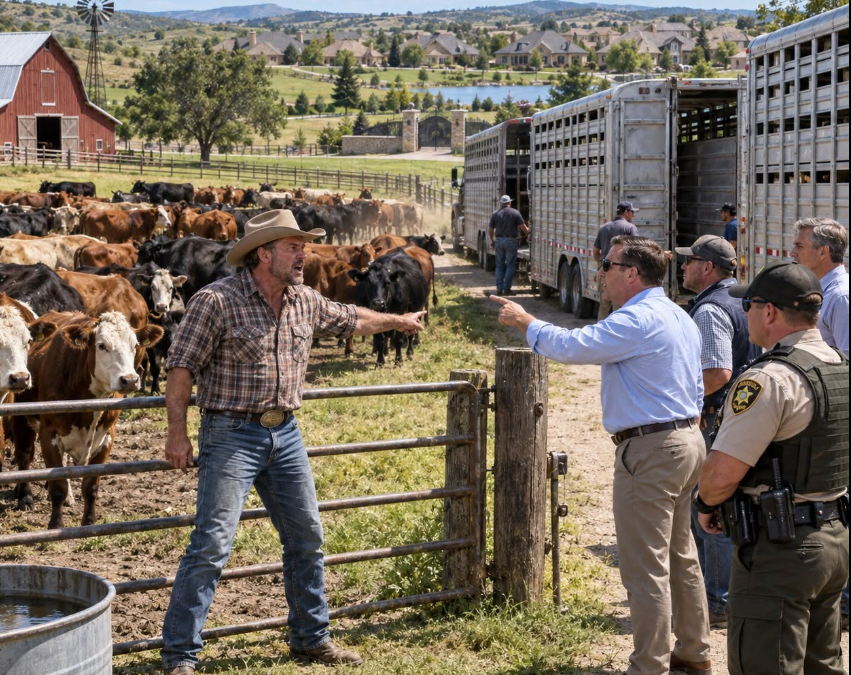
The driver was still holding the packet when the moment caught up with the one I had been heading toward for six weeks.
He passed the paperwork to the field lead beside the truck.
The field lead raised his radio.
“Dispatch, hold one.”
Kendra turned toward him.
“What’s the issue?”
He did not answer her right away.
I stayed on my side of the gate.
The cattle had moved closer, drawn by the hiss of air brakes.
The field lead pointed at the paperwork.
“Mr. Haw is stating he owns the livestock and is not releasing them.”
Kendra opened her blue folder.
“That issue has already been resolved through the association’s enforcement process.”
The field lead looked at me.
“So you’re saying none of these animals have been transferred?”
“That’s right.”
“No sale?”
“No.”
“No surrender agreement?”
“No.”
“You haven’t authorized Dunmire or Crest Point to release them?”
“No.”
He nodded and keyed the radio.
“Dispatch, owner at origin is disputing release authority. We need intake confirmation before loading.”
Kendra’s expression changed slightly.
Not panic.
Annoyance.
“The company already accepted the job.”
“I understand.”
“Then the job should proceed.”
“Dispatch still has to clear the pickup.”
That was when I understood there were two decisions.
Somebody had sent the trucks.
The people standing in front of me still had to decide whether their company would load the cattle.
The second trailer idled farther down the road.
The first remained lined up with my loading gate.
The field lead spoke into the radio again.
“Client is Crest Point Community Management. Origin is Dunmire Estates legacy parcel. Fifteen head. Temporary destination Cedar Ridge.”
A voice came through the speaker too faint for me to catch every word.
The field lead looked at Kendra.
“Dispatch says client intake represents that Crest Point has authority to arrange removal.”
That was the first time I heard what Crest Point had told the hauling company.
Not a court order.
Not a custody transfer.
A client representation.
Kendra nodded.
“Correct.”
I looked at her.
“You told them you had authority to release my cattle.”
“I told them the association had authority to conduct the abatement.”
I let that sit.
The field lead lifted one hand.
“I’m not deciding that.”
Kendra turned toward him.
“You have a contracted pickup, a listed destination, and an authorized client.”
“And an owner at origin saying the livestock were never released.”
“The association is the authorized party for the abatement.”
“Maybe. I still need operations to clear the conflict.”
Her voice tightened.
“The association has completed notice, hearing, and enforcement review. This is not a surprise dispute.”
I said nothing.
Three weeks earlier, I would have explained the schedule, the herd size, the hearing, Gene, and the shop all over again.
None of that answered the question in front of us.
The driver stayed with Trailer One.
He checked the rear gate latch but did not open it.
The portable panels remained stacked beside the utility pickup.
Kendra took out the hearing decision, the abatement notice, and the board resolution.
She laid them on the hood of the Crest Point pickup.
“Here,” she said. “The violation was sustained. The compliance period expired. The board authorized pursuit of lawful remedies, and the governing documents permit abatement. The contractor was retained on that basis.”
The field lead scanned the pages.
“I’m not saying the association has no enforcement authority.”
“Then what are we waiting for?”
“For our office to confirm we can accept custody under this pickup.”
That was the real dividing line.
This was not a court ruling.
The hauler was not deciding Dunmire’s covenants.
It was the company’s own pickup-risk procedure.
Once the person claiming ownership expressly refused release, the contractor wanted to know what gave somebody else the right to transfer possession.
Kendra looked toward me.
“Grady, your refusal does not suspend the enforcement action.”
“I know.”
“You are obstructing the remedy.”
“No. I’m standing on my property asking who gave you custody.”
Her jaw tightened.
The field lead keyed his radio.
“Dispatch, I have the association resolution in hand. It authorizes pursuit of lawful remedies. I also have the abatement notice. Owner remains present and expressly refuses release.”
The voice came back clearer when he stepped closer to the truck.
“Do you have anything showing the association can release the animals over owner objection?”
The field lead looked at Kendra.
She tapped the board resolution.
“That is the authority.”
He read the line again.
“Dispatch wants to know whether there’s a separate custody instrument, court order, owner release, or other document resolving possession.”
“There is an abatement provision in the governing documents.”
“Do you have that?”
“Yes.”
She pulled another page from the folder.
The field lead read it.
One of the cattle bumped the steel rail.
The sound carried across the turnout.
The driver looked up from the trailer.
Kendra said, “This has already been reviewed.”
The field lead did not look at her.
“Maybe by you.”
He was not siding with me.
He was defining the edge of his own job.
He raised the radio again.
“Dispatch, sending the abatement provision now.”
He took a photo of the page and transmitted it.
We waited.
The first trailer remained backed toward my gate.
The second still idled down the road.
Every animal on Crest Point’s list was still behind me.
Then the radio crackled.
“Hold loading.”
The field lead turned slightly so he could hear.
The voice continued.
“Compliance wants client basis for release over owner’s present objection. Do not open trailer until resolved.”
Kendra reached for her folder again.
Nobody moved toward the cattle.
Kendra stopped with one hand inside the blue folder.
The field lead kept the radio near his ear.
“Compliance wants the client basis for release over the owner’s present objection,” he repeated.
Kendra returned to the same packet she had already shown him.
“The owner had notice and a hearing. The violation was sustained. The board authorized enforcement, and the governing documents permit abatement.”
The field lead nodded.
“I understand.”
“Then proceed.”
“I can’t until our office clears custody.”
“This is not a custody dispute. It is an enforcement action.”
I stayed where I was.
That was the disagreement.
Kendra saw enforcement.
The hauling company saw an owner standing ten yards away saying no.
The field lead keyed his radio.
“Dispatch, client maintains abatement authority. No owner release. No court possession order. No separate custody instrument.”
A voice came back.
“Copy. Hold both units.”
The second trailer’s engine dropped to idle.
“Why both?” Kendra asked.
“Same pickup. Same client. Same livestock. It’s one job and one company decision.”
Kendra picked up the board resolution.
“This authorizes lawful remedies.”
“Yes.”
“And abatement is a remedy under the declaration.”
“Maybe it is.”
“Then what is the problem?”
He folded his arms.
“The problem is that we haul livestock. We don’t decide disputed ownership at the gate.”
Her face tightened.
“Nobody is asking you to decide ownership.”
“You’re asking us to take possession from a location where the listed owner is refusing release.”
“I am the authorized client.”
“And he is saying you are not authorized to release his animals.”
She looked at me.
“Grady, your refusal does not erase the board’s action.”
“I never said it did.”
“Then stop pretending there is no enforcement authority.”
“I’m not.”
I pointed at the papers on the hood.
“I’m saying none of those papers make you the person who can hand my cattle to him.”
The field lead raised one hand.
“Hold on.”
He turned away and listened to the radio.
Nobody moved.
The first trailer sat angled toward the loading gate, rear door closed.
The portable panels were still stacked.
Behind me, one of the cows pushed her nose between two rails and blew out a long breath.
I could smell dust, diesel, and hay.
The hauler’s office was not ruling on Dunmire’s covenants.
It was not deciding whether my livestock use violated anything.
It was deciding whether its own company would accept custody under the documents in front of it.
The field lead finally said, “Understood.”
He lowered the radio.
Kendra stepped closer.
“What did they say?”
“Our compliance desk will not accept the pickup under the current documentation.”
“That is not your decision to make.”
“It is our decision whether we load.”
“The association contracted your company.”
“We accepted dispatch based on client information. We now have a material conflict at pickup.”
“What information?”
He glanced at the first page.
“Client represented authority to arrange removal from origin.”
Kendra did not deny it.
“Correct.”
“And the owner at origin is expressly disputing that authority.”
“The association documents support it.”
“Our office reviewed what you sent. They are not clearing us to accept custody today.”
Kendra’s voice dropped.
“So you are refusing a contracted service because the violating owner objects.”
“No. We are declining a disputed pickup because we are not the party that resolves the dispute.”
Kendra looked past him at the trailers.
The first driver was already climbing into his cab.
The second driver walked to the rear of his trailer, checked the empty livestock gate, and latched it again.
“There has to be a supervisor I can speak with,” Kendra said.
“You can call our office.”
“I need the trucks to remain while this is reviewed.”
“They’re not remaining on a blocked pickup.”
“No one is blocking you.”
The field lead looked at the closed corral gate, then at me standing inside my property.
“I know.”
The first truck started forward.
Its tires rolled over one of the orange measurement marks Crest Point’s site crew had used two days earlier.
For six weeks, every new piece of paper had made the operation feel more inevitable.
Now Trailer One passed my gate without ever opening its rear door.
It turned onto the main road.
Empty.
Nobody cheered.
There were only engines, cattle, and people watching a plan stop inside the process meant to carry it out.
Kendra made one last call.
I heard only her side.
“Yes, the owner is objecting.”
A pause.
“No, there is no separate release.”
Another pause.
“The board authorized the action.”
Then she stopped talking.
Trailer Two pulled forward.
Its aluminum sides flashed in the morning sun as it turned after the first truck.
Empty.
I watched until both trailers disappeared beyond the trees.
Then I turned back toward the corral.
The cattle had spread out again.
One stood closest to me, her red coat dusty along the shoulder.
Her yellow ear tag read 417.
I knew that number.
I had seen it in Gene’s ledger.
I had seen it on Crest Point’s removal inventory.
Twenty minutes earlier, somebody expected that animal to be inside one of those trailers.
Now she lowered her head and went back to hay.
I put one hand on the top rail.
The trucks were gone.
The original violation was not.
And by Monday morning, Dunmire was going to have to explain how permission to pursue a remedy had turned into an operation that almost carried fifteen animals away.
By Monday, the trailers were gone, but the paperwork had multiplied.
Dunmire’s board called a special review with Crest Point.
I was not invited to sit in the room for that part.
I did not need to be.
What mattered came in writing two days later.
The scheduled livestock removal had been canceled.
No animal had been transferred.
No temporary boarding had occurred.
No transport, staging, or holding charges from the failed pickup would be assessed to me.
Then came the part that mattered more.
The board compared the resolution it had actually passed with the way Crest Point had classified and presented the operation to contractors.
The board resolution authorized management and counsel to pursue lawful remedies.
Crest Point had turned that into a physical livestock-abatement operation and presented the removal as ready to carry out.
The board’s review concluded that the physical removal plan went beyond what the recorded authorization itself clearly established.
The wording was careful.
It did not say Kendra had committed some dramatic crime.
It did not say Dunmire had never possessed enforcement authority.
It said the operation had crossed a line the board had not clearly drawn.
That sounded less exciting than some people wanted.
It was also more accurate.
A week later, I learned Crest Point’s management contract would not be renewed when its current term expired.
Kendra never called me to apologize.
I never asked her to.
The consequence was quieter.
Dunmire had decided it wanted a different management company after the contract ended.
That was enough.
But the harder issue was still standing in my pasture.
Fifteen Red Devon cattle.
The original livestock-use dispute had not disappeared just because two trailers left empty.
So I went back to the same table where the argument had started.
This time, the board had association counsel there.
I brought the legacy agricultural-use schedule, my herd records, and one page of notes.
No speech.
No replay of the pickup.
No photograph of the empty trailers.
We worked on terms.
The board chair started by saying, “We need something both sides can actually operate under.”
“That would be an improvement,” I said.
She almost smiled.
The final agreement took two meetings.
It said I could keep the existing fifteen-head herd under the legacy agricultural-use schedule.
The normal capacity limits remained in place.
So did fencing, containment, feed-storage, sanitation, and nuisance requirements.
No public livestock auction.
No sales yard.
No third-party boarding.
No feedlot-style operation.
If I materially expanded the herd or turned the property into a separate public livestock business, Dunmire retained the right to review that use through the normal process.
What changed was the gray area that had started the dispute.
The agreement recognized that occasional private sales or disposition of individual animals as part of ordinary herd management did not, by themselves, transform the property into a public commercial livestock operation.
I read that sentence twice.
It did not declare that my interpretation had always been right.
It did not declare Dunmire’s position had always been wrong.
It closed the current enforcement matter under written conditions both sides could understand.
The board chair slid the final copy across the table.
“This closes the existing violation if you agree to these operating limits.”
I read the page one more time.
“What happens if somebody disagrees later?”
“Then we start with the written agreement.”
She paused.
“Not assumptions.”
That was the best sentence I had heard from Dunmire in six weeks.
I signed.
So did the association.
That afternoon, I went back to the shop.
There were no neighbors waiting.
No cameras.
No victory lap.
A customer had left a compact tractor outside with a note taped to the steering wheel.
HYDRAULICS GET HOT AFTER 20 MINUTES.
That problem made sense to me.
I changed clothes, opened the bay, and got back to work.
The machine had good pressure cold.
After twenty-three minutes, pressure started dropping and the oil temperature climbed faster than it should have.
I shut it down.
Pulled the filter.
Found metallic debris.
There it was.
A problem that did not become philosophical just because I asked where it came from.
Near sunset, I shut off the compressor and walked out to the pasture.
The orange measurement marks near the turnout were already fading under dust and tire traffic.
No trailers.
No portable panels.
No Crest Point truck.
I checked the water trough.
Full.
Feed.
Good.
Fence line.
Good.
I closed the steel latch on the loading gate and pulled it once to make sure it caught.
Then I counted.
One.
Two.
Three.
Four.
Five.
Six.
Seven.
Eight.
Nine.
Ten.
Eleven.
Twelve.
Thirteen.
Fourteen.
Fifteen.
I was smiling a little.
Not because I had beaten anybody.
Because fifteen was just a herd count again.
I went inside and pulled Gene’s old ledger from the shelf.
His handwriting leaned hard to the right.
Dates.
Breeding notes.
Calving records.
Tag numbers.
I turned a few pages.
The same number that had been printed on Crest Point’s removal inventory.
For one morning, that number had meant a cow somebody expected to put on a truck.
Now it meant what it had before all of this.
One animal accounted for.
I ran my thumb along the edge of the page and thought about Boyd’s offer.
Six cattle.
Fair price.
Easy exit.
There had been nothing wrong with selling them.
There would have been nothing weak about deciding the herd was too much work and changing my plans.
What mattered was why I made the choice.
Compromise was still compromise when I chose it.
Exhaustion was something else.
That distinction followed me over the next few months.
A calf was born in early spring.
Tag 438.
Healthy.
Strong.
I kept her.
A month later, Boyd stopped by for another pump.
He leaned against the fence while we watched the herd.
“You still mad at me for trying to buy six?”
“I was never mad at you.”
“Good. Because I’d still buy 423 if you ever decide to sell her.”
I looked toward the cow he meant.
“Maybe next year.”
“Your decision.”
“Yes.”
He gave me a sideways look.
“You seem to enjoy saying that now.”
“I’ve paid enough for the privilege.”
He laughed.
Then he got serious.
“You know Gene would’ve liked this.”
“The fight?”
“No. He hated meetings.”
“So did I.”
“I mean you keeping the difference clear.”
“What difference?”
Boyd looked toward the pasture.
“Between somebody asking and somebody deciding.”
That sounded exactly like something Gene would have understood.
Later that summer, I sold two animals.
Not six.
Not because Dunmire wanted the herd smaller.
Because keeping those two did not make sense for the breeding plan.
Boyd bought them.
We stood at the loading gate on a clear Saturday morning.
One trailer.
One truck.
No blue Crest Point folder.
No orange measurement marks.
No contractor radio asking who owned what.
Boyd handed me the transfer paperwork.
I read it.
I signed.
He signed.
Payment cleared.
Then we loaded the two cattle.
The trailer gate closed.
Boyd checked the latch twice.
“You good?”
I looked at the pasture.
Thirteen animals remained.
“Yeah.”
He pulled away.
The trailer left with cattle inside.
And I felt fine.
That surprised me.
For months, I had associated a livestock trailer with somebody trying to take a choice away from me.
That morning, the same sound of diesel on gravel meant something entirely different.
The difference was not the trailer.
It was the permission.
That became clearer the longer the dispute faded.
The new management company took over Dunmire in the fall.
Their first property-use review with me lasted twenty-five minutes.
The manager brought a copy of the written livestock agreement.
She sat across from me in the same conference room where Crest Point had once told me to reduce the herd to a “clearly personal level.”
She pointed to the capacity limit.
“You’re at thirteen?”
“Yes.”
“Any third-party boarding?”
“No.”
“Public sales?”
“No.”
“Feedlot activity?”
“No.”
“Any nuisance complaints?”
“Not that I know of.”
She checked the file.
“None.”
Then she closed it.
“That’s it.”
I looked at her.
“That’s it?”
“That’s the agreement.”
“You don’t want to discuss whether registered breeding stock creates a commercial character when viewed in the totality of the parcel?”
She stared at me for two seconds.
Then realized I was joking.
“No.”
“Good.”
She smiled.
“I’ve heard there was some history here.”
“Apparently.”
That was the entire review.
No hearing.
No notices.
No trailer measurements.
No one describing my pasture as an abatement site.
I drove home and opened the shop.
A customer was waiting with a broken PTO shaft.
Normal again.
That was what I had wanted from the beginning.
Not to prove that rules did not apply to me.
Not to force Dunmire to accept anything I wanted forever.
I wanted a line I could read.
A standard I could meet.
A process that did not quietly turn disagreement into possession.
Gene’s herd changed over the next two years the way every herd changes.
Calves came.
Some stayed.
Some left.
One older cow died naturally after a long decline.
I buried her on the back edge of the pasture where the ground rose toward the oak line.
Another animal went to Boyd.
A young bull went to a breeder in the next county.
Every transfer had paperwork.
Every transfer had a price or a clear disposition.
Every one happened because I chose it.
The first time another livestock trailer came up the road after the Crest Point mess, I still looked up from the shop faster than I needed to.
Old reflex.
The driver was Boyd.
He leaned out the window.
“You going to make me show a court order?”
“Depends what you’re here for.”
“A hydraulic pump.”
“Then you’re safe.”
He laughed and parked by the shop.
Years later, the orange measurement marks by the turnout were completely gone.
The loading gate was still there.
So was the top rail where I had rested my hand while watching the empty trailers drive away.
Sometimes customers heard a version of the story and asked whether I had known the haulers would refuse.
“No,” I told them.
That part mattered.
I had not staged some clever trap.
I had not discovered a secret law nobody else knew.
I had not called the hauling company in advance and told them what to do.
I simply refused to pretend a question had been answered when it had not.
The contractor asked who was releasing the animals.
Crest Point had one answer.
I had another.
The hauler decided it was not willing to solve that conflict by putting fifteen cattle on a trailer first and asking questions later.
That was enough.
The part people found disappointing was that Dunmire’s original concerns did not disappear completely.
The board still had authority to enforce its rules.
I still had limits on the agricultural use of my property.
I could not turn the pasture into a public livestock market.
I could not fill it with somebody else’s cattle for boarding fees.
I could not ignore fencing, sanitation, capacity, or nuisance standards.
And if I changed the use enough, Dunmire could review it again.
I was fine with that.
Being reasonable did not mean I had to win every argument.
It did not mean rules stopped applying because I disliked them.
It meant I could listen, negotiate, accept limits, and still refuse to let somebody else choose my boundary for me.
One evening, long after Crest Point’s contract had ended, I found Gene’s ledger open on the workbench.
I had pulled it out earlier while checking a registration number and forgotten to put it away.
The page showed old tag numbers.
Some belonged to cattle no longer in the herd.
Some were still out there.
I carried the ledger to the pasture fence.
The sun was low enough that the red coats almost glowed.
I counted without meaning to.
One.
Two.
Three.
All the way through.
The number had changed since that Thursday morning.
But now every change had a reason I could name.
A calf born.
A cow sold.
An animal transferred.
A death.
A decision.
Mine.
I thought about what Gene had told me when I was sixteen.
Maybe the neighbor could have fixed that stock-tank valve without me.
But that was not the same as me keeping my word.
For years, I had thought the lesson was about reliability.
It was.
But there was another part I had missed.
A promise only means something when the person making it actually makes it.
So does permission.
Crest Point had spent six weeks treating the absence of my agreement like a delay in their process.
Then they treated their own enforcement authority like permission to transfer animals that had never stopped belonging to me.
On paper, the distance between those ideas looked small.
At the loading gate, it was wide enough for two empty trailers to drive through.
The next morning, I opened Haw Agricultural Repair at seven.
A utility tractor was already waiting in Bay One.
The cattle stood at the far fence, heads down in the grass.
My phone was quiet.
I picked up a wrench and went back to work.