The HOA Sent an Excavator to Tear Down My Silo—Then the Contractor Read the Ownership Line and Realized Rachel Had No Right to Touch It.
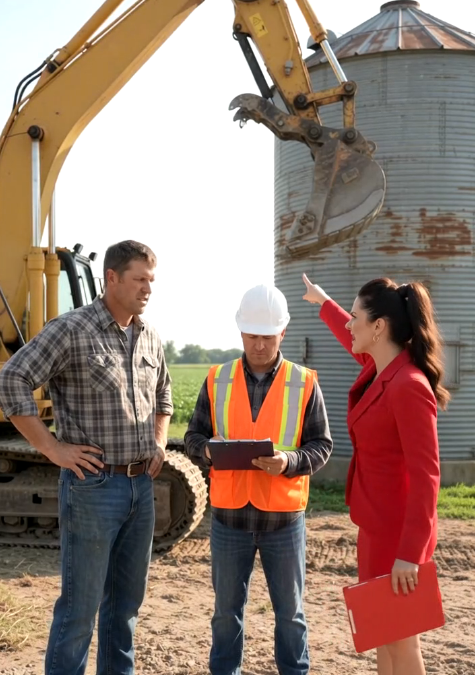
PART3:
The demolition contract behind it named the HOA as the client and described the job as removal of one obsolete grain silo, disposal of debris, and site grading after demolition.
My silo.
My field.
Someone else’s contract.
“How much did they hire you for?” I asked.
Luis hesitated.
“Thirty-six thousand, including mobilization and haul-off.”
Rachel cut in.
“That is association business.”
“No,” I said. “You hired a demolition company to destroy something on my property.”
She raised the red folder in her hand.
“The silo has been abandoned for years.”
“It hasn’t been used for grain.”
“That’s what abandoned means.”
“No,” I said. “That means I stopped filling it.”
Luis looked from me to the silo.
“You use it?”
“Yes.”
“For what?”
“Storage. Farm supplies. Fencing materials. Pump parts.”
Rachel gave a sharp little sigh.
“That does not change its status.”
“It changes whether you know what you’re talking about.”
Her eyes narrowed.
Rachel Voss was the president of the Briar Ridge Homeowners Association, though calling it Briar Ridge made it sound older and more dignified than it was.
Twenty years earlier, my father had sold the eastern acreage of our family farm to a developer. The developer built a subdivision with curved streets, stone entrance columns, landscaped medians, and houses large enough to make the land beneath them seem embarrassed. Eventually, the subdivision created an HOA.
My family kept the farmhouse, the back fields, the machine shed, and the silo.
We were not part of Briar Ridge.
That mattered.
It had always mattered.
The subdivision sat east of the old fence line. My retained field sat west of it. There were places where our road, drainage, and boundary history overlapped, but the land itself had not magically become theirs because homeowners on a terrace disliked looking at old steel.
Rachel had never accepted that.
She had moved into Briar Ridge eight years earlier and become HOA president three years after that. She was the kind of person who treated being elected by twelve irritated neighbors as if she had been entrusted with regional government. She spoke in polished phrases. She loved printed binders. She used words like standards, continuity, community value, and architectural harmony.
When she said them, people nodded.
Not always because they agreed.
Sometimes because they wanted the meeting to end.
She had sent me letters before.
Notices.
Requests.
Concerns.
The silo appeared regularly.
Visual impact.
Aesthetic inconsistency.
Possible deterioration.
Obsolete agricultural remnant.
Western viewshed obstruction.
That last phrase had made me laugh the first time I saw it.
Western viewshed obstruction.
A hundred years of farm land, a silo my father built, and now it was an obstruction because someone eating brunch on a clubhouse terrace preferred a cleaner horizon.
I had ignored most of it because the letters never demanded anything immediate. They warned. They suggested. They urged review. They requested cooperative action.
Then Rachel got tired of urging.
That morning, she had brought a machine.
Luis turned to the excavator operator and lifted one hand.
“Shut it down.”
Rachel’s head snapped toward him.
“What are you doing?”
The operator lowered the bucket slowly and killed the engine.
The field changed when the machine went silent.
Birds returned to the fence line.
Wind moved through the dry grass.
Somewhere beyond the subdivision, a dog barked once.
Luis closed the permit folder.
“I’m not proceeding until this authorization issue is clear.”
Rachel’s face flushed.
“You have a signed contract.”
“I do.”
“Then perform it.”
“My contract requires a valid permit.”
“You have one.”
“I have an application packet.”
He tapped the blank signature line again.
“And I have a missing owner authorization.”
Rachel looked at me like I was a problem she had expected but intended to step over.
“Ethan, you know this is coming down eventually.”
“No. I know you want it down.”
“The covenant gives the association authority.”
“What covenant?”
She smiled.
It was not a warm smile.
“The farm transition covenant your father signed when he sold the subdivision land.”
I had heard of it, but only vaguely.
Twenty years is a long time. My father handled the sale. I was younger then, old enough to help move equipment and young enough not to care what every legal document said. I remembered maps spread across the kitchen table, men in shirts with rolled sleeves, arguments about drainage, easements, fencing, and road access.
I did not remember giving away the silo.
“My father never sold you this field,” I said.
“Authority is not always ownership.”
That was Rachel’s kind of sentence.
Technically possible.
Practically slippery.
Luis rubbed his jaw.
“Mrs. Voss, if you have a covenant giving the HOA demolition authority, I need the complete document in the file.”
“It is in the board materials.”
“It is not in my permit file.”
She looked toward the excavator, then back at Luis.
“The board packet should have been forwarded.”
“Maybe it should have.”
His voice stayed even.
“But it wasn’t.”
Rachel opened the red folder and pulled out a highlighted page.
She handed it to him.
Luis read the highlighted sentence.
His expression did not change.
Then he looked at the top of the page.
“This starts in the middle of a paragraph.”
Rachel’s mouth tightened.
“The relevant language is highlighted.”
Luis looked back down.
“I want the whole section.”
“You don’t need the whole section to understand that obsolete agricultural structures may be removed by the developer or successor association.”
I heard the sentence then.
Obsolete agricultural structures may be removed by the developer or successor association.
For one second, my stomach dropped.
Because there it was.
A sentence that sounded exactly like what Rachel had been claiming.
I looked at the silo.
Old.
Weathered.
No longer used for grain.
Maybe obsolete in the eyes of people who liked clean terraces and stone entrance signs.
Then I looked back at the page.
Luis was still frowning.
“What comes before this?”
Rachel closed the folder slightly.
“Historical context.”
“Legal conditions usually live in historical context,” Luis said.
For the first time, Rachel looked genuinely angry.
“This delay is unnecessary.”
“Maybe,” Luis said. “But demolition is permanent.”
That word landed in me.
Permanent.
Letters could be answered.
Meetings could be argued.
Permits could be appealed.
But once that bucket punched through the silo wall, the dispute would no longer be about preventing harm.
It would be about measuring damage.
Luis understood that.
Rachel did not seem to care.
Or maybe she did care, and that was why she had tried to move fast.
I stepped closer to Luis.
“I want a copy of everything in that file.”
Rachel snapped, “You’re not entitled to association business records.”
“I’m entitled to documents being used to demolish my property.”
Luis opened the folder.
“You can have a copy of the permit application and the contract scope. I’m not giving legal advice, but I am not comfortable proceeding today.”
Rachel inhaled slowly.
The kind of breath a person takes when trying not to reveal how much control they just lost.
“Fine,” she said. “Pause the work.”
Luis looked at the operator.
“We’re done for today.”
“Not done,” Rachel said sharply. “Paused.”
Luis did not answer.
That was the first small victory.
Not because the silo was safe forever.
Because the bucket came down without touching it.
The next morning, I went looking for the document Rachel kept talking about.
My father had kept every closing document in a thick brown binder. I found it in the bottom drawer of the old filing cabinet in his office.
The room still smelled faintly of paper dust and machine oil. Dad had used that office for everything: taxes, seed orders, equipment manuals, county notices, and letters from attorneys he did not trust until he had read them twice.
The binder contained maps, closing statements, correspondence, and several documents with names I barely remembered.
One tab read:
Farm Transition Covenant.
That got my attention.
Before I opened it, I unfolded the original survey map from the closing.
My father had written notes in pencil along the margins.
Retained parcel.
Keep access open.
Keep the silo.
I remembered that deal better once I saw his handwriting.
Twenty years earlier, the developer had offered him another twelve thousand dollars to include the back acre where the silo stood.
At the time, that was real money for our family.
Dad turned it down.
I had asked him why.
He tapped the survey with one finger and said, “Once you surrender the anchor of a property, the people around you start deciding what the rest of it is worth.”
I was younger then.
I thought he was talking about land prices.
Standing over that same map twenty years later, with excavator tracks still cut into my field, I understood he had meant something larger.
The silo was not beautiful.
It was not historic architecture.
It was weathered galvanized steel, old bolts, faded seams, and decades of work.
But Dad had deliberately kept the ground beneath it.
That made Rachel’s claim feel different.
She was not arguing over some forgotten piece of farm equipment.
She was trying to exercise authority over the exact acre my father had once refused to surrender.
I opened the covenant.
The first pages dealt with fencing, construction access, drainage protection, and how the remaining agricultural property could be used while the subdivision was being built. Farther down, I found language about agricultural structures.
Not a simple sentence.
A paragraph.
I read it twice.
Certain old farm structures could be removed in connection with future redevelopment or acquisition of the retained farm property. The wording included phrases like future acquisition, upon transfer, developer, or successor association.
Those words did not sound anything like Rachel’s claim that the HOA could tear down my silo whenever it wanted.
But I was looking at an old copy.
Some pages were difficult to read. I could not tell whether later amendments existed. I photographed everything.
Then I called my older brother.
He remembered the closing better than I did.
“The developer wanted flexibility,” he said. “Dad wanted to keep farming.”
“Did Dad ever sell them the back field?”
“No.”
“Did he give them the silo?”
My brother laughed.
“Why would he do that?”
That was not evidence, but it told me my memory was not completely off.
Around noon, Rachel emailed me.
The subject line read:
Demolition Authority.
She quoted one sentence from the transition covenant:
Obsolete agricultural structures may be removed by the developer or successor association.
Then she added:
The HOA is exercising authority granted under the recorded farm transition covenant.
I went back to my copy.
Her quote was there.
But it did not begin where the paragraph began.
Several words appeared before it.
Words about acquisition.
Words about transfer.
Words Rachel had not included.
I printed her email and placed it beside the covenant.
Then I called Luis Ortega.
“Has Rachel sent you anything else?”
“She sent me part of a recorded covenant.”
“Part of it?”
“A highlighted page.”
“Does it mention transfer?”
There was a pause.
“I don’t remember.”
“Can you send me what she sent you?”
Ten minutes later, the email arrived.
Rachel had highlighted the same removal provision she quoted to me. The page started in the middle of the paragraph. No preceding page. No complete section.
Luis called back.
“I’m not saying she’s wrong,” he said. “But I’m not putting an excavator into that silo based on half a paragraph.”
“Good.”
“I need the permit clean.”
That was the difference between Luis and Rachel.
Luis was worried about what he could prove before his machine moved.
Rachel seemed satisfied with what she could quote.
Late that afternoon, I walked back to the silo.
The excavator was gone. Deep tire tracks still cut through the edge of the field where it had sat the day before. I stood beneath the steel structure and looked toward the subdivision roofs beyond the fence line.
Somewhere inside that old transition covenant was the authority Rachel claimed gave the HOA power over my silo.
Maybe she had read it correctly.
Maybe I was missing something.
But the question had changed.
I no longer wanted to know whether the covenant mentioned demolition.
It clearly did.
I wanted to know what had to happen before that removal provision became active, and whether that thing had ever happened at all.
Luis came back two mornings later.
This time, there was no excavator behind him.
Just his white work truck, a second pickup with his superintendent, and a stack of paperwork under his arm.
That told me more than anything Rachel had said.
A demolition contractor who had already mobilized equipment was now showing up without the machine.
Luis stepped out and looked toward the silo.
“Before anybody touches steel,” he said, “I need the file clean.”
His superintendent, Mark Ellis, walked the perimeter while Luis spread documents across the hood of his truck: permit application, utility clearance sheet, demolition plan, insurance certificate, waste disposal form.
Then he tapped the blank owner authorization line.
“That’s still my problem.”
I nodded.
“You talked to the county?”
“I talked to someone at the permit desk. They said they’ll review the application, but if the work is happening on your parcel, they want owner authorization unless there’s some other legal authority that satisfies them.”
“Did Rachel send you the covenant?”
“She sent more of it.”
“How much more?”
Luis gave me a look.
“Enough that I called my lawyer.”
That was new.
Before I could ask what his lawyer said, Rachel’s black SUV came up the field road. She got out wearing a fitted red blazer under a charcoal coat, carrying the same red folder she had brought the first day.
She walked straight to Luis.
“I thought the equipment would be here.”
Luis did not look up from the paperwork.
“It will be here when the paperwork is in order.”
“It is in order.”
“Then help me clear the owner authorization issue.”
Rachel set the red folder on the truck hood and opened it.
“The association’s rights come from the farm transition covenant.”
She pulled out a highlighted page.
Luis barely looked at it.
“I have that.”
She frowned.
“Then you know the authority exists.”
“I know there’s language about removal.”
“Exactly.”
Luis looked at her.
“I also know there’s language before it.”
Rachel’s expression tightened.
I stayed quiet.
That was the first time Luis had said anything suggesting he had read beyond the sentence she highlighted.
Rachel shifted tactics.
“The silo is obsolete. It has not been used for agricultural storage in years.”
“That’s not a permit answer,” Luis said.
“It is a safety issue.”
She reached into the folder and handed him another document.
That one was new.
The letterhead belonged to a structural engineering firm.
At the top was a title:
Exterior Condition Observation — Existing Grain Silo.
Luis started reading.
I stepped closer.
Rachel placed one hand over the lower half of the page.
“This was commissioned by the HOA.”
“I can see that.”
“The engineer identified visible corrosion and deterioration.”
I looked at her.
“Which engineer?”
“Daniel Reeves.”
“Was he inside the silo?”
Rachel did not answer immediately.
Luis looked down at the memo again.
“What was the scope?”
Rachel’s voice sharpened.
“The structure is old.”
“That wasn’t my question,” Luis said.
She turned toward me.
“You’ve admitted it isn’t being used for grain.”
“I told you I use the lower area for storage.”
“That does not make the structure safe.”
I looked toward the silo.
The galvanized panels had dulled over the years. Rust stained a few seams. One ladder bracket near the lower ring needed replacement. None of that was news to me.
But Rachel was talking as if the thing might collapse before lunch.
Luis read another paragraph.
“This says visual observation from accessible exterior areas.”
Rachel folded her arms.
“And?”
“Did the engineer inspect the inside?”
“I’m not responsible for his methodology.”
Luis looked at Mark, his superintendent.
Mark had finished walking the perimeter and now stood beside the lower access hatch.
“Door’s locked,” Mark said.
I held up my keys.
“I can open it.”
Rachel shook her head.
“That isn’t necessary.”
Luis looked at her.
“If safety is the reason for emergency demolition, why wouldn’t an interior inspection be necessary?”
Her eyes narrowed.
“I did not say emergency demolition.”
I almost laughed.
“You had an excavator with the bucket in the air.”
Luis closed the engineering memo.
“The contractor scheduled mobilization because your office told us the permit was routine.”
Rachel turned toward him.
“It is routine.”
“Not anymore.”
The wind moved across the field and rattled dry grass against the fence.
Luis gathered the papers into one stack.
“I need four things before I proceed.”
Rachel already looked annoyed.
“Go ahead.”
“County permit approval. Confirmation of the authority you’re relying on. Owner authorization, or whatever substitute the county accepts. And if you’re claiming this is a safety demolition, I need the full engineering basis for that claim.”
“The HOA is your client.”
“Yes.”
“And we signed a contract.”
“Yes.”
“So perform it.”
Luis did not move.
“My contract does not require me to demolish a structure without a valid permit.”
Rachel stared at him.
He kept going.
“And it doesn’t require me to gamble my license because two parties disagree about who has authority over the site.”
Her face went still.
Mark looked away toward the silo.
I could tell he had heard this kind of argument before.
Luis took out his phone.
“I’m calling the permit desk again.”
Rachel stepped closer.
“There is no reason to involve them in a private covenant dispute.”
“They’re already involved. You filed a permit application.”
He put the phone on speaker.
A clerk answered after two transfers. Luis gave the application number and explained the project in plain language.
Demolition of an existing grain silo on a privately owned farm parcel adjacent to an HOA subdivision.
The clerk pulled up the file.
“I see the application,” she said.
Luis asked, “What’s outstanding?”
There was keyboard noise.
“Property owner authorization.”
Rachel leaned toward the phone.
“The HOA has recorded covenant authority to remove obsolete agricultural structures.”
The clerk paused.
“I’m not making a determination about your covenant.”
Rachel’s mouth tightened.
The clerk continued.
“For this application, the parcel owner of record is Ethan Hail. If you believe another recorded instrument gives the applicant authority to perform demolition without his consent, submit that instrument for review.”
Luis looked at Rachel.
“That’s what I needed.”
Rachel spoke toward the phone.
“So the county will accept the covenant.”
“I said you may submit it.”
“Will you approve the permit?”
“I can’t answer that until the file is complete and reviewed.”
Luis thanked the clerk and ended the call.
Nobody spoke for several seconds.
The answer had not declared me right.
It had not declared Rachel wrong.
But it had done something more useful.
It had forced her claim onto paper.
Luis turned to Rachel.
“Send the complete covenant. Not one highlighted page.”
“You already have the relevant language.”
“I want the complete section.”
Rachel picked up her folder.
“You are delaying a board-approved project.”
“I am delaying demolition. There’s a difference.”
Then Luis pointed toward the silo.
“Once that comes down, I can’t put it back.”
That sentence hit me harder than I expected.
Up to that point, the whole dispute had been emails, excerpts, signatures, and arguments about what a covenant meant.
Luis had just reduced it to the one fact that mattered most.
If the HOA was wrong after demolition, the mistake would be permanent.
Mark stepped toward us.
“There’s another issue.”
He held up a utility marking sheet.
“The underground service map is incomplete on the south side.”
I looked at it.
A buried electrical line ran from the machine shed toward a pump box near the silo.
Mark pointed at the route.
“If we bring equipment in, we need that marked.”
Rachel exhaled.
“Fine. Schedule utility marking.”
Luis shook his head.
“No mobilization until the permit problem is resolved.”
She looked at him as though he had switched sides.
He had not.
That was what made his position so strong.
Luis was not protecting me.
He was protecting his company, his permit, his insurance, his license, and every one of those things required him to care whether Rachel actually had authority before his excavator touched my silo.
Rachel gathered the engineering memo and covenant page.
I held out a hand.
“I want a copy of that condition report.”
“It belongs to the association.”
“It describes my silo.”
“You can request it formally.”
Luis reached into his file.
“I have a copy.”
Rachel turned toward him.
“You were not authorized to distribute that.”
Luis looked at the document.
“You sent it as part of the project file.”
Then he handed it to me.
I read the first paragraph.
The engineer had observed the structure from outside. That much was clear. What was less clear was what he had concluded from that observation.
The memo used phrases like visible corrosion, age-related deterioration, and recommendation for further evaluation.
I did not see the words immediate collapse.
I did not see condemned.
I did not see emergency.
Rachel took one step toward me.
“You are not qualified to interpret that.”
“No,” I said, folding the copy. “But neither are you.”
For the first time that morning, she had no quick reply.
Luis closed the truck hood.
“No equipment comes back until I have a complete permit file.”
Rachel looked toward the empty patch of field where the excavator had been two days earlier.
Then she looked at me.
“This delay is on you.”
I shook my head.
“No. The blank signature line is on you.”
She got into her SUV and left.
Luis stayed another fifteen minutes. Before leaving, he handed me a copy of the county checklist. At the top, beside the project address, my name still appeared as record property owner.
Below it was the requirement that had stopped the machine the first day.
Owner authorization.
I watched his truck disappear down the lane.
The silo stood behind me, motionless in the morning light.
Rachel had a covenant.
She had an engineering memo.
She had a signed demolition contract.
But none of those things had yet answered the question that mattered to Luis, the county, or me.
If the HOA really had authority to destroy that silo without my consent, why was every practical step toward demolition still waiting on paperwork tied to my name?
That was when I called Dana Whitaker.
Dana was forty-eight, compact, precise, and almost impossible to rush. Her office sat above a title company in town, which meant property records were never more than a staircase away. She handled real estate disputes, title issues, easements, and the kind of rural property problems that never appeared in legal dramas because no one on television wants to watch people argue for four hours about drainage language from 1998.
Dana read Rachel’s highlighted covenant page without saying anything for almost a full minute.
Then she slid it back across the desk.
“Where’s the page before this?”
“That’s what I’ve been asking.”
She looked at the demolition contract next.
Then the permit application.
Then the engineering memo Luis had given me.
Finally, she picked up my father’s old farm transition covenant.
“This copy isn’t good enough.”
“I figured.”
“We need the recorded version, every amendment, the deed history on your retained parcel, and whatever the HOA relied on when it hired Ortega.”
She tapped Rachel’s highlighted excerpt.
“And I want the words before this sentence.”
That afternoon, we started with the deed chain.
My father’s old farm had been split when he sold the eastern acreage to the developer. The recorded deed described exactly what had been conveyed. Subdivision land went east. Our retained farm parcel remained west.
Dana traced the legal description with a pencil.
“Your current deed derives from this retained parcel.”
“Yes.”
“And there was never a later sale?”
“Not that I know of.”
“That answer is why we search.”
We followed every transfer after my father’s sale.
The retained parcel eventually came to me.
No deed in the chain showed it being conveyed to the developer.
None showed it going to the HOA.
The silo stood inside that retained tract.
Dana copied everything and moved on.
The recorded farm transition covenant took longer.
The first version was eighteen pages. Then there was an amendment. Then a corrective recording fixing an exhibit reference. Rachel’s highlighted sentence appeared on page eleven.
Dana read the paragraph silently.
Then she handed it to me.
“Start at the beginning.”
I did.
The sentence Rachel kept quoting was there.
Obsolete agricultural structures may be removed by the developer or successor association.
But the paragraph did not start there.
It began with a condition.
The removal language applied in connection with the future acquisition, redevelopment, or transfer of portions of the retained farm property. A later sentence referred again to action occurring upon acquisition or transfer.
I looked at Dana.
“That’s what she left out.”
“That is what comes before the sentence she highlighted.”
“Does it mean she has no authority?”
Dana shook her head.
“I’m not giving you that conclusion yet.”
I had expected that answer.
She continued reading.
The transition covenant dealt with a possible future change in the remaining farm property if my family ever sold additional acreage to the developer or a successor. Some provisions operated immediately. Others described what would happen later if another transfer occurred.
The removal provision sat inside that second category.
Dana marked the section.
“Now we find out whether the trigger ever happened.”
We already had the deed chain.
Nothing in it showed the HOA acquiring my back field.
But Dana wanted more.
She ordered subdivision closing records, parcel maps, subsequent transfer documents, and the HOA’s own files concerning the demolition project.
The first response from the management company was thin.
They sent the demolition contract, Rachel’s highlighted covenant page, a board resolution authorizing removal of the silo, and the exterior condition memo.
I already had most of it.
No complete covenant.
No title review.
No explanation of what event supposedly activated the removal provision.
Dana sent a second request.
This one was narrower.
She asked for every document the board reviewed before approving demolition, every communication concerning ownership or parcel authority, all engineering materials, and the complete minutes for the meetings where the project had been discussed.
Two days later, a much larger file arrived.
That was when the story changed again.
The engineer’s memo came first.
Daniel Reeves, a structural engineer hired by the HOA, had written it six weeks earlier. The title sounded more serious than the contents.
Exterior Condition Observation — Existing Grain Silo.
Dana tapped the scope section with her pen.
“Visual observation from perimeter locations only.”
She moved down the page.
“No interior measurements. No material testing. No structural calculations attached.”
I leaned closer.
“But Rachel keeps calling this a safety assessment.”
“It is an assessment,” Dana said. “A limited one.”
She turned to the recommendation.
“Further evaluation before continued long-term use.”
“That’s not demolition.”
“It’s certainly not a condemnation order.”
I looked through the supporting documents.
“Did Reeves ever ask me for access?”
Dana checked the correspondence log again.
“There’s no access request in this production.”
“Then he couldn’t have inspected the inside.”
“Don’t jump farther than the paper takes us.”
She tapped the memo once more.
“What the paper tells us is that his stated scope was exterior observation from perimeter locations. That’s enough for now.”
She placed the memo beneath the board minutes instead of beside the deed.
“Keep this one quiet.”
“Why?”
“Because Rachel is using it as her safety document.”
Dana looked at the line describing further evaluation.
“I’d rather hear her explain exactly what she thinks this engineer concluded before anyone corrects her.”
I understood.
We did not need to tell Rachel where the weakness was.
We needed to let her put weight on it first.
Then we opened the board minutes.
The earliest reference to the silo was not under safety.
It appeared under a heading called:
Western Viewshed Improvement.
I read the phrase twice.
“What does that even mean?”
Dana kept reading.
The HOA had been discussing improvements to the western edge of the subdivision ahead of a clubhouse refinancing package and a new round of home marketing by a builder that still owned several premium lots.
The silo was repeatedly described as a visual obstruction and obsolete agricultural remnant. One director asked whether landscaping could screen it. Rachel argued removal would create a cleaner western view from the clubhouse terrace and several high-value homes.
Safety appeared later.
Much later.
A month after the first viewshed discussion, Rachel presented Reeves’s exterior memo and recommended moving directly to demolition.
The board minutes summarized her position:
The recorded farm transition covenant authorizes association removal of obsolete agricultural structures affecting subdivision use and appearance.
Dana stopped.
“Does the covenant say affecting subdivision use and appearance?”
“No.”
She checked.
It did not.
That language came from Rachel’s summary.
We kept going.
At the next meeting, the board approved solicitation of demolition bids. Luis’s company was one of three. Ortega Demolition Services was not the cheapest, but it was the only bidder that included permitting and full debris haul-off.
The board chose them.
Then Dana found an email attached to the meeting packet.
It was from Rachel to the property manager. The date was three days before Luis’s company received final approval.
Please have Ortega price mobilization for the earliest possible demolition date. We can complete county paperwork concurrently.
Dana read it again.
“They priced mobilization before the permit package was complete and before anyone asked me.”
“Yes.”
Another email followed.
The manager asked whether legal counsel should verify the transition covenant before the contract was executed.
Rachel replied that the authority had already been established during the original development process and that additional legal review would unnecessarily delay the viewshed project.
That sentence sat on the screen between us.
For the first time, I understood why the excavator had arrived before the permit file was clean.
The rush had not started with Luis.
It started with the board, or at least with Rachel’s promise to the board that the legal issue was already settled.
Dana printed the email.
“Pressure,” she said.
“What?”
“This explains pressure.”
“It still doesn’t prove intent.”
“I think we document what she read, what she told the board, and what she chose not to verify.”
That was Dana’s way of refusing to turn evidence into a speech before it was ready.
We returned to the recorded covenant.
She placed Rachel’s highlighted page beside the full paragraph.
The difference was almost absurd.
Rachel’s version began with the right to remove old farm structures.
The recorded paragraph began several lines earlier with the future acquisition or transfer of the retained farm property.
Same document.
Same page sequence.
Different meaning depending on where you started reading.
“That’s why I wanted the words before the comma,” Dana said.
She was speaking figuratively, but the point was exact.
The authority Rachel claimed did exist in the covenant.
The question was whether it existed now.
Dana ordered one more title certification to make sure no later instrument had transferred any interest we had missed. By then, the documents covered almost the entire conference table.
My deed chain showed the farm parcel had remained outside HOA ownership.
The complete transition covenant contained a future transfer condition before the removal provision.
The engineer’s written scope appeared far narrower than the safety language Rachel had been using.
The demolition company had been pushed toward early mobilization while the permit remained incomplete.
And the board minutes showed the project had begun as western viewshed improvement long before safety became its public justification.
None of those facts alone ended the dispute.
Together, they changed what the dispute was about.
Rachel had spent days insisting the covenant gave the HOA authority.
Now I could finally see the paragraph she relied on, and Dana had found something else worth waiting for.
Rachel was leaning on an engineer’s report much harder than the report appeared willing to lean back.
Dana placed six documents across the conference table.
My current deed.
The recorded farm transition covenant.
The amendment.
Rachel’s demolition contract.
The incomplete permit application.
Daniel Reeves’s engineering memo.
Then she put Rachel’s highlighted page beside the full covenant section.
“Now we can finally talk about what this language actually does,” she said.
I leaned forward.
Dana pointed to the beginning of the paragraph.
“This is the trigger. Future acquisition, redevelopment, transfer of the retained farm property.”
Then she moved her finger down to the sentence Rachel kept quoting.
“Obsolete agricultural structures may be removed by the developer or successor association.”
She looked at me.
“The removal authority is not floating by itself. It sits inside a paragraph tied to a future event.”
“So if they never acquired the farm…”
“Then we have a serious question about whether that authority ever became operative.”
She raised one hand before I could answer.
“Notice how I said that.”
I nodded.
“You’re not saying we won.”
“Correct.”
She pulled my deed closer.
“What we can say is that the title records we found do not show the retained parcel being conveyed to the developer or the HOA. The covenant language Rachel relies on appears conditioned on an acquisition or transfer we have not found.”
Then the demolition contract.
“The HOA signed this as if current authority already existed.”
Finally, the permit application.
“And the county is asking for owner authorization because the applicant has not yet shown another basis that satisfies the permit process.”
The pieces were not complicated once they sat next to each other.
That was what made the whole thing so hard to believe.
Rachel had taken a future contingency and treated it like a present command.
Dana turned to the engineer’s memo.
“This creates a second problem. Because the board seems to have used a limited exterior observation to support a much broader safety narrative.”
She pointed to Reeves’s actual recommendation.
“Further evaluation. Nothing here orders demolition.”
I looked at the demolition contract.
“So what happens now?”
Dana started gathering the documents.
“Now we stop debating Rachel in the field.”
The first letter went to HOA counsel.
Dana attached the complete covenant section, the deed chain, the demolition contract, and Rachel’s permit application. She asked counsel to identify the exact recorded event the HOA believed triggered the removal clause.
Not the sentence describing removal.
The event that supposedly made that sentence operative.
She also demanded that the HOA suspend all demolition activity while that issue was reviewed.
The second notice went to Ortega Demolition Services.
Dana made clear that I did not authorize entry, demolition, debris removal, grading, or any other work on my parcel. She did not threaten Luis. She did not need to.
He called me before the email had been in his inbox for twenty minutes.
“My lawyer agrees,” he said. “We’re off the site until this is resolved.”
“You’re canceling the job?”
“Suspending it.”
He sounded careful.
“If the HOA proves authority and the permit gets approved, that’s one thing. Until then, my crew doesn’t touch the silo.”
The third filing went to the county permit office.
Dana attached my deed and a written statement confirming that I had not signed the owner authorization line. She also submitted the complete covenant rather than Rachel’s excerpt.
Her cover letter did not ask the county to interpret the covenant as a judge would. It simply stated that the claimed substitute authority was disputed and requested that the permit application remain incomplete unless the applicant satisfied county requirements.
The fourth letter was a preservation notice.
Board emails.
Management communications.
Engineering correspondence.
Demolition bids.
Permit discussions.
Covenant interpretations.
Any communication about the western viewshed project.
Dana wanted everything preserved.
By the end of the day, Luis had confirmed in writing that Ortega Demolition would not remobilize.
The county updated the permit file.
Status: Incomplete.
Owner authorization / authority documentation pending.
That line did more than any argument I had made in the field.
It did not decide the covenant.
It did not award me anything.
It simply stopped the machinery from returning while Rachel’s claimed authority was still unresolved.
The next morning, she called.
“You’ve interfered with a lawful HOA project.”
“No,” I said. “I told the county I didn’t authorize demolition.”
“You’re subject to the covenant.”
“Then show Dana when the transfer happened.”
There was silence.
Rachel recovered quickly.
“The covenant runs with the land.”
“That isn’t what I asked.”
“The association succeeded to the developer’s rights.”
“After what transfer?”
Her voice hardened.
“You’re reducing a complex recorded agreement to one phrase.”
I almost laughed.
“That’s exactly what you did.”
She hung up.
An hour later, Dana forwarded an email from HOA counsel. His name was Michael Grant. He acknowledged receipt of her demand and said he was reviewing the recorded covenant, title chain, board materials, and permit history.
More importantly, he instructed the board and management company not to authorize further demolition activity pending that review.
For the first time, Rachel was not the person setting the schedule.
Luis was not returning.
The county was not completing the permit.
HOA counsel had told the board to stop.
Dana still refused to celebrate.
“We have shifted the burden,” she said. “That is not the same thing as a final legal ruling.”
“What burden?”
“The HOA says a condition-based covenant gives it present authority. Fine. Now it has to identify the condition that occurred.”
She circled one phrase in the full covenant.
Upon acquisition or transfer.
“That is the hinge.”
I thought about the excavator bucket hanging in the air the first morning.
The whole demolition project had looked inevitable then.
A machine.
A signed contract.
A board order.
A woman in red telling everyone the matter was already decided.
Now the entire project was stalled by words written years earlier in a paragraph Rachel had quoted only halfway.
The silo was still standing.
The permit was still incomplete.
And the question facing the HOA was no longer whether the covenant mentioned demolition.
It did.
The question was whether the event required to activate that power had ever happened.
So far, nobody had shown that it had.
The special board meeting started at 6:30 on Thursday evening.
Rachel sat rigid at the center of the table, the sharp red of her blazer standing out against the dark oak. The farm transition covenant lay open directly in front of her. Michael Grant, the HOA’s attorney, sat two seats away.
Dana and I sat across from them.
Luis Ortega joined by video from his office.
Daniel Reeves, the engineer, sat near the end of the table with a copy of his condition memo.
Rachel opened first.
“The board approved this project based on recorded authority that has existed since the subdivision was created.”
Michael looked down at the transition covenant.
“Then let’s read the authority.”
Rachel stopped.
He turned to the relevant section.
Not the highlighted sentence.
The whole paragraph.
He read the language covering future acquisition, redevelopment, or transfer of the retained farm property.
Then he read the words that followed.
Upon acquisition or transfer.
Only after that did he reach the removal provision Rachel had been quoting.
The room went quiet.
The treasurer leaned forward.
“When did the association acquire Mr. Hail’s parcel?”
Rachel answered immediately.
“The covenant was designed to allow the subdivision to remove old agricultural structures as development progressed.”
Michael looked at her.
“That wasn’t the question.”
She folded her hands.
“The rights passed to the association as successor.”
Dana spoke for the first time.
“Successor to which right, after which triggering event?”
Rachel turned toward her.
Michael raised one hand.
“I’ll handle the legal discussion.”
Then he looked back at Rachel.
“Do we have a recorded acquisition or transfer of Mr. Hail’s retained parcel?”
The property manager shook her head.
“Not in the title records we received.”
Rachel’s face tightened.
“The intent of the covenant is obvious.”
Michael closed the document halfway.
“Intent may matter. So does the condition written into the instrument.”
The treasurer looked down at the demolition contract.
“So we signed a thirty-six-thousand-dollar job before confirming the condition happened.”
Rachel did not hesitate.
“We relied on the recorded covenant and the engineering assessment.”
Then she pushed the engineering file toward the center of the table.
“We’re ignoring the other issue. We have Daniel Reeves’s assessment right here. It documents serious structural deterioration.”
Her confidence returned as soon as she said his name.
“The board did not invent a safety concern. A licensed engineer documented it.”
Michael looked down the table.
“Mr. Reeves.”
Reeves straightened.
“Did you condemn Mr. Hail’s silo?”
Rachel’s hand remained on the folder.
Reeves cleared his throat.
“No.”
The room went still.
Michael continued.
“Did you determine that it was in imminent danger of collapse?”
“No.”
Rachel turned toward him.
Michael did not.
“What exactly was your scope?”
Reeves glanced at his own memo.
“Exterior visual observation from accessible perimeter and common area locations.”
“Did you inspect the interior?”
“No.”
“Perform structural testing?”
“No.”
“What did you recommend?”
Reeves paused.
“Further evaluation.”
Rachel’s fingers stopped against the edge of the red folder.
“You told me the structure was deteriorating.”
Reeves finally looked directly at her.
“It is deteriorating.”
Rachel gave a small sharp nod as though the answer rescued her argument.
Then Reeves continued.
“Deterioration isn’t a demolition order, Rachel.”
Her expression changed.
Not dramatically.
Just enough.
The certainty went out of it.
Reeves lowered his voice.
“I never inspected the interior because I was never given access. My memo was not a condemnation, and I did not recommend immediate demolition.”
Rachel pulled the folder back toward herself.
“That distinction was never made clear to the board.”
Reeves looked down at the copy bearing his signature.
“It’s in the recommendation.”
Dana said nothing.
She did not need to.
This was exactly why she had never called Reeves before the meeting. Rachel had introduced him as the authority supporting demolition. Reeves had just defined, in his own words, how little his report actually supported.
Luis’s face remained visible on the monitor.
Michael turned toward him.
“Would Ortega Demolition proceed under the current permit file?”
“No.”
“Why?”
Luis answered without hesitation.
“The county still shows owner authorization or substitute authority as unresolved. My company isn’t risking a license violation or property damage claim while that remains open.”
Rachel’s voice sharpened.
“The HOA contracted with you in good faith.”
“I’m not accusing the HOA of bad faith,” Luis said. “I’m saying my excavator doesn’t move until the permit is valid.”
The treasurer pushed the demolition contract away.
Another director looked through the meeting packet.
“I want to go back to something.”
Rachel turned toward him.
He tapped the minutes.
“Why did this project start under Western Viewshed Improvement if safety was the reason we needed to move quickly?”
Rachel answered.
“Both concerns existed.”
The director looked at Reeves.
“When were you hired?”
“After the viewshed discussions had already begun.”
Nobody spoke for several seconds.
Michael broke the silence.
“My recommendation is that the association suspend the demolition contract, withdraw the current permit application, and obtain an independent legal review before taking any further action under this covenant.”
Rachel stared at him.
“You’re advising us to abandon the project.”
“I’m advising the board not to demolish a structure on disputed authority.”
The motion came from the treasurer.
Suspend the demolition contract.
Withdraw the pending permit.
No further mobilization.
Outside counsel review required before any future demolition action involving my parcel.
The vote was four to one.
Rachel voted no.
The motion passed.
She did not argue afterward.
She just sat with one hand resting on the red folder that had seemed so authoritative when she carried it into my field.
A week earlier, she had stood beside an excavator, telling me the silo was coming down that day.
Now her own board had stopped the project before the machine ever returned.
Michael closed the transition covenant.
The clause had finally been read out loud, and once everyone heard the words that came before Rachel’s favorite sentence—and heard the engineer explain what his report actually said—there was nowhere left for certainty to hide.
The demolition contract was formally suspended the following week.
Ortega Demolition submitted its documented mobilization costs, and the HOA negotiated a settlement with the company under the contract.
I did not pay any of it.
Luis called me after the paperwork was finished.
“Looks like your silo survived me.”
“You never touched it.”
“That was the point.”
He laughed.
Then his voice turned serious.
“I’m glad we stopped when we did.”
So was I.
Dana handled the remaining correspondence with HOA counsel. The board adopted a new project authorization policy requiring three things before the association could hire a contractor for work on land it did not own: record owner verification, counsel review of any claimed covenant or easement authority, and a completed permit file before mobilization.
The rule was dry enough to sound boring.
That was exactly why I liked it.
Boring paperwork was better than an excavator showing up first.
Daniel Reeves also issued a written clarification to his earlier engineering memo. His original observation had documented exterior deterioration and recommended further evaluation. It had not condemned the silo. It had not described an emergency. It had not authorized demolition.
That clarification went into the HOA file beside the original report.
Rachel remained on the board.
She did not remain president.
The directors formally censured her for presenting a condition-based covenant as current demolition authority without obtaining legal confirmation that the triggering transfer had occurred. At the next officer reconsideration, another director took the presidency. Rachel also lost unilateral authority to sign project contracts involving property outside the HOA’s recorded ownership.
There was no dramatic resignation.
No courtroom.
No police.
The consequences came through meeting minutes, counsel instructions, a suspended contract, and a board that no longer let one person define what a document meant.
A few weeks later, I hired my own structural inspector.
He entered the silo.
He checked the lower panels, access hatch, ladder connections, anchor points, and the areas where Reeves had seen corrosion from a distance.
There were repairs to make.
A few fasteners needed replacement. One lower seam needed treatment. The access ladder needed work.
But the recommendation was maintenance.
Not demolition.
I spent two Saturdays fixing the easy items and hired a metal contractor for the rest. By early fall, the silo looked almost exactly the way it had before Rachel arrived with the demolition crew.
That was fine with me.
One morning, I walked across the back field just after sunrise.
The grass was wet. The subdivision roofs beyond the fence caught the first light. There was no excavator beside the silo, no orange safety vests, no red folder.
I unlocked the lower access hatch and pulled it open.
The steel latch clicked against the frame.
Wind moved softly across the field and through the dry weeds along the fence line.
For weeks, people had argued about clauses, permits, engineering language, and what a recorded covenant was supposed to allow.
The silo had stood there through all of it.
Still mine.
Still useful.
Still upright.
Rachel had thought she could erase twenty years of history by starting halfway through a paragraph.
But property disputes have a strange way of turning on the smallest words.
Upon transfer.
Two words that looked insignificant until somebody tried to move an excavator without proving the transfer had ever happened.
I closed the access hatch and heard the steel latch settle into place.
A few weeks earlier, that sound might have been buried beneath the engine of a demolition machine.
Now it was the only sound in the field.
And I finally understood what my father meant when he called that acre an anchor.
An anchor is not always beautiful.
It is not always valuable to the people looking from the outside.
Sometimes it is weathered steel, faded seams, old bolts, and a lower storage room full of fencing supplies.
But it holds the line.
Rachel came into my field thinking the silo was the easiest thing to remove because it looked old, unused, and alone.
She was wrong.
The silo was not alone.
It was tied to a deed, a retained parcel, a blank signature line, a permit checklist, a contractor who refused to move without clean authority, a lawyer who read the words before the sentence Rachel liked, and a father who had once turned down twelve thousand dollars because he understood something I only learned when the excavator stopped.
If you surrender the anchor, someone else starts deciding what the rest is worth.
I kept mine.