The HOA Secretly Stole Water From My Grandfather’s Well for 3 Years—So I Shut Off Their Luxury Pool in Front of 150 Guests.
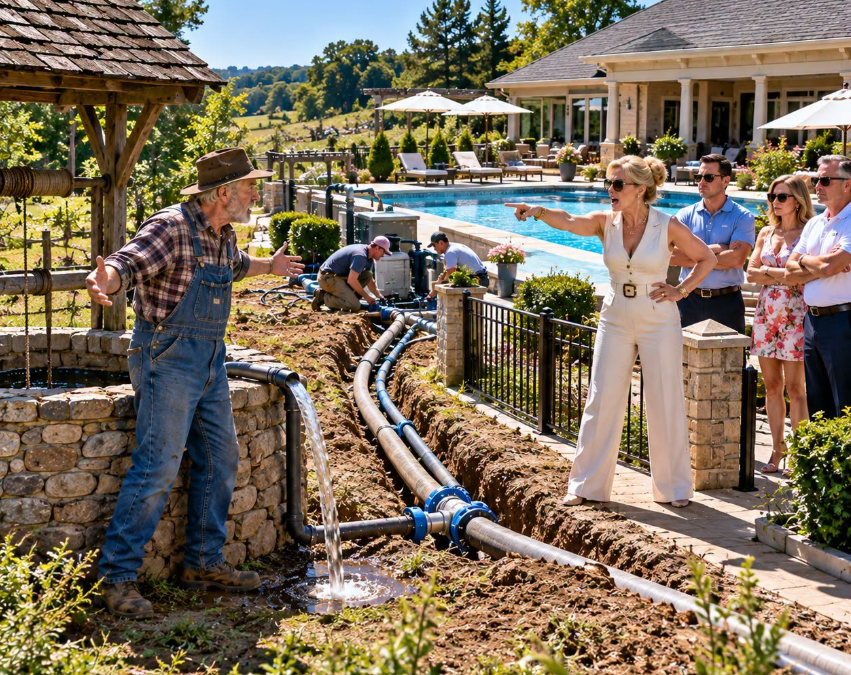
PART2:
Back then there was almost nothing around him except cedar scrub, live oaks, limestone, rattlesnakes, and a few old ranch houses separated by enough distance that neighbors could argue and still not see one another’s porch lights.
He built the house himself.
Not with contractors.
Not with a construction loan.
With his own hands.
He poured concrete in stages because he couldn’t afford to do it all at once. He framed the walls. Ran the wiring. Laid the roof. Dug fence posts. Cleared enough land for a pasture.
Then, in 1968, he drilled the well.
Three hundred twenty feet.
Down into the aquifer.
The first time it produced clean water, he called every neighbor within driving distance.
That story had been told so many times in our family I could see it even though I hadn’t been born yet.
Grandpa standing beside the wellhead.
Mud on his boots.
Shirt soaked through with sweat.
A pipe blasting clear, cold water while everybody laughed like they had struck oil.
He was proud of that well in a way I never fully understood until I inherited the property.
When I was a boy, he used to walk me out to the pump house with a flashlight.
“Listen.”
I would stand there hearing the pump cycle.
“What am I listening for?”
“Anything different.”
“That’s it?”
“That’s most maintenance. Knowing what normal sounds like.”
He taught me to read pressure gauges before I understood algebra.
He taught me flow rates.
How to prime a pump.
How to recognize cavitation.
How different pipe materials behave under pressure.
He also taught me something more important.
Water was valuable.
But being lucky enough to have it did not mean you had to become selfish with it.
There was always a spigot near the road.
Anyone could fill a jug.
Grandpa never charged anyone.
If a neighbor’s pump broke, he let them take what they needed. If someone was working outside in August, they could stop for cold water.
“Water belongs to the land and the people living on it,” he used to say.
But there was a difference between sharing and stealing.
Grandpa understood that too.
So did I.
I went to Texas A&M, studied civil engineering, and eventually specialized in water systems.
Municipal lines.
Pump stations.
Distribution networks.
Pressure management.
Infrastructure assessment.
For fifteen years, I designed systems most people never think about unless something goes wrong.
Then I moved into consulting.
By the time I inherited Grandpa’s land, I knew more about pipes and water distribution than anyone in our neighborhood was ever going to want to hear.
That should have made what Brenda did impossible.
Instead, it simply made her mistake easier for me to prove.
Grandpa died at eighty-nine.
Sharp until almost the end.
Still checking the well house.
Still walking the property every morning.
By then, I had already lost my wife.
Ellie’s mother died four years before Grandpa.
Cancer.
Fast.
Merciless.
One month we were arguing about whether Ellie needed braces. A few months later, I was standing beside a hospital bed trying to understand how a family of three was supposed to become a family of two.
Ellie was young enough to still need me constantly and old enough to understand exactly what had disappeared.
We spent the years after that in a rental in Round Rock.
It was clean.
Convenient.
Close to school.
And it never felt like home.
So when Grandpa left me the property, I didn’t have to think long.
Ellie and I moved back.
The place needed work.
The pump house roof leaked at one corner.
Fence wire sagged.
The porch boards had started to cup.
The house smelled like dust, cedar, and the aftershave Grandpa had worn for forty years.
But for the first time since my wife died, Ellie relaxed.
She planted tomatoes where Grandpa used to keep his garden.
We ate dinner on the porch.
Coyotes called from somewhere beyond the pasture.
Crickets filled the dark.
It felt like we had finally reached a place where grief could stop chasing us every minute of every day.
Then Brenda Hargrove arrived at my door with a welcome basket.
That was three days after we moved in.
She was dressed like she was headed to some charity luncheon in downtown Austin.
Blonde hair carefully styled.
Pearls.
Pressed blouse.
Perfect smile.
She carried cheese, wine, a candle, and three printed pages of HOA rules.
“Welcome to the neighborhood.”
“Thank you.”
She looked past me.
Not rudely enough that I could accuse her of anything.
Just deliberately enough that I noticed.
Her eyes went to the pasture.
The fence.
The porch.
Then the pump house.
“What’s that building?”
“The well house.”
“Oh.”
Her smile stayed in place.
“We have guidelines regarding accessory structures.”
“It was built around the same time as the house.”
“Of course. But older properties sometimes need to be brought into compliance.”
I stared at her.
“Compliance with an HOA that didn’t exist when the structure was built?”
She laughed lightly.
Like I had made a charming joke.
“We’ll get you caught up.”
That was my first warning.
After she left, Ellie came into the entryway.
“She’s weird.”
“Ellie.”
“What?”
I looked through the window and watched Brenda walk back toward her white SUV.
“You may not be wrong.”
The neighborhood around Grandpa’s property had changed dramatically.
When I was a kid, it had been a loose collection of country homes.
Then Vance Hargrove bought sixty acres to the east.
Vance was a developer.
The kind who could look at limestone, cedar trees, and open sky and immediately imagine gatehouses, marketing brochures, and oversized stone entrances.
He built fourteen luxury houses over several years.
Big homes.
Outdoor kitchens.
Three-car garages.
Pools.
Decorative lighting.
Country living for people who wanted all the appearance of rural Texas without any of the inconvenience.
And with the development came an HOA.
Grandpa’s property predated it.
Our well predated it.
Our water easement predated it.
But Brenda behaved as if time itself had started the day she became HOA president.
She ran unopposed.
Nobody else wanted the job.
Apparently, she interpreted that not as apathy but as coronation.
The first few weeks after we moved in, she sent emails about mailbox colors and roadside weeds.
I mostly ignored them.
Then one morning in late April, I turned on the kitchen faucet.
The flow was wrong.
Most people would not have noticed.
I did.
The stream was thinner.
Pressure lower.
Not catastrophic.
But obvious.
I checked the shower.
Same problem.
Outside spigot.
Same.
I walked to the pump house.
Pump running normally.
Pressure tank cycling.
No visible leaks.
Electrical draw within range.
Wellhead dry.
I checked the flow meter.
That’s where I stopped.
Something was pulling water.
A lot of it.
The well was producing, but the volume reaching the house was far lower than expected.
I checked every branch I knew.
Then I grabbed boots, marking paint, a probe, and a shovel.
My private line ran underground for roughly nine hundred feet through a recorded easement.
Part of it followed the edge of Grandpa’s original parcel before looping back toward the house and outbuildings.
I had grown up helping maintain it.
I knew its route.
That afternoon, I walked the whole thing.
About six hundred feet from the well house, close to the boundary with the Hargrove development, I noticed disturbed soil.
Fresh.
Not obvious if you weren’t looking.
But obvious to me.
The grass had been cut and replaced.
Ground slightly softer.
A trench line had settled just enough to show.
I knelt.
Then started digging.
It didn’t take long.
My shovel hit PVC.
I cleared more dirt by hand.
There was the old line.
And attached to it was something that absolutely had not existed before.
A T-junction.
New PVC.
Clean fittings.
Fresh enough that when I leaned closer I could still smell solvent cement.
The branch ran east.
Toward the Hargrove houses.
I sat back on my heels.
For a few seconds, I genuinely tried to create an innocent explanation.
Maybe utility work.
Maybe an emergency connection.
Maybe some old branch Grandpa had never mentioned.
But the fitting was new.
The trench was new.
And nobody had contacted me.
Someone had cut into my private water line.
I felt heat rise in my face.
Not panic.
Not yet.
Anger.
Pure, immediate anger.
Then training took over.
I didn’t touch the connection.
Didn’t cut it.
Didn’t shut it.
Didn’t give anyone the chance to say I had altered evidence.
I photographed everything.
Wide shots.
Close-ups.
Pipe diameter.
Fittings.
Trench.
Location relative to property markers.
Forty-seven pictures.
Then I measured the branch.
Recorded coordinates.
Noted pressure.
Noted time.
I called Derek Simmons.
Derek had gone through engineering school with me before becoming a licensed plumber.
He drove out the next morning.
He crouched beside the splice.
Ran one hand over the fitting.
“This isn’t amateur work.”
“I know.”
“Recent.”
“Looks that way.”
He scratched at the dirt near the glue joint.
“Couple weeks, maybe a month.”
“Can you document that?”
He looked at me.
“Already knew you were going to ask.”
“That’s why I called you.”
He took his own photographs.
Measured everything.
Then followed the direction of the new line as far as we could trace from the surface.
It went toward the Hargrove property.
Derek stood up.
“Want me to cut it?”
Every part of me wanted to say yes.
“No.”
He looked surprised.
“No?”
“Not yet.”
“What are you thinking?”
“I’m thinking whoever did this believes I won’t be able to prove it.”
Derek smiled slightly.
“That sounds dangerous.”
“For them.”
That evening, I emailed Brenda.
Short.
Professional.
No accusations.
I stated that I had discovered an unauthorized connection to my private water line and asked for an explanation and immediate removal.
I attached nothing.
I wanted to see what she would say before she knew how much I had documented.
Three days passed.
Then I received her answer.
Not by email.
An HOA violation notice.
UNKEPT LANDSCAPING.
VISIBLE NONCOMPLIANT UTILITY STRUCTURE.
The utility structure was Grandpa’s pump house.
I stood in the kitchen holding the letter.
Ellie read it over my arm.
“Isn’t that building older than the HOA?”
I looked at my daughter.
“By decades.”
“Then how can it violate the HOA?”
“Excellent question.”
She read the paper again.
“This is because you asked about the pipe, isn’t it?”
Sixteen years old.
Still grieving her mother.
Still adjusting to a new home.
And she saw Brenda clearly.
I put the violation notice on the refrigerator.
“Probably.”
“What are you going to do?”
I looked through the window toward the pump house.
“Make her answer.”
I prepared a formal complaint.
Twelve pages.
Photos.
Measurements.
Derek’s assessment.
Grandpa’s well permit.
County easement documents.
Proof the line belonged to our property.
I made copies for every board member.
At the next meeting, I sat in Brenda’s living room.
Of course the HOA meetings were held at her house.
That detail told you almost everything about the organization.
Her dining room had become the seat of local government.
Vanilla candles burned on a side table.
Framed photographs showed Brenda and Vance at charity events with various people whose names she liked to mention.
Five board members sat around a polished table.
I laid out the documents.
Explained the pressure drop.
The trench.
The splice.
The direction of the unauthorized branch.
When I finished, Brenda folded her hands.
“Thank you, Colton.”
I waited.
“The board appreciates your concerns.”
“My concerns?”
“We’ll refer this matter to the appropriate committee.”
“What committee?”
She paused.
“The infrastructure review committee.”
A board member looked down.
I knew immediately.
There was no committee.
“Who chairs it?”
Brenda’s smile tightened.
“We’ll follow up.”
“When?”
“As soon as the review is complete.”
“You have photographs of an unauthorized connection to a private water line.”
“And we will investigate appropriately.”
I looked around the table.
Nobody met my eyes.
That was my second warning.
Two weeks passed.
Nothing.
I checked the HOA portal.
My complaint wasn’t there.
I contacted the management company.
They told me the file might have been misplaced during a software update.
I asked them to explain how a physical complaint hand-delivered to five board members got erased by software.
They stopped being helpful.
So I moved outside the HOA.
I filed with the county water authority.
Brenda responded by having my truck towed.
I wish that was an exaggeration.
One Monday morning, Ellie was home sick.
I was working at the kitchen table when she called from the front room.
“Dad?”
Something in her voice made me stand.
A tow truck was backing into our driveway.
My truck was parked where Grandpa had parked his vehicles since the early sixties.
The driver showed me an authorization claiming I was blocking a designated fire lane.
“My driveway?”
He shrugged.
“I just have the order.”
“From who?”
“HOA management.”
“This isn’t a fire lane.”
“Take it up with them.”
Ellie watched from the window as they took my truck.
She looked scared.
That made me angrier than the tow.
Because Brenda wasn’t just bothering me anymore.
She was making my daughter feel like our home could be taken apart one piece at a time.
I got the truck back two days later.
Three hundred forty dollars.
I kept the receipt.
By then, neighbors had started repeating things Brenda was saying.
I was unstable.
I was trying to “hoard community water.”
I was threatening neighborhood access to essential resources.
That one almost impressed me.
She had tapped into my grandfather’s private line without permission and somehow transformed herself into the defender of shared resources.
The county sent an inspector named Dale Murchison.
Mid-fifties.
Khaki pants.
Clipboard.
Firm handshake.
He seemed competent.
He inspected the splice.
Took notes.
Asked good questions.
For the first time in weeks, I felt relieved.
“Should have something in about two weeks,” he said.
“Do you see the issue?”
He gave the careful answer inspectors give when they don’t want to commit before writing a report.
“I see what you’ve shown me.”
Fair enough.
Two weeks later, his report arrived.
NO ACTIONABLE VIOLATION FOUND.
I read it once.
Then again.
Then a third time.
It barely addressed the splice.
No meaningful discussion of the easement.
No analysis of the pressure loss.
No explanation for the unauthorized branch.
Just bureaucratic language carefully constructed to produce no result.
I sat at Grandpa’s kitchen table.
The pump cycled somewhere outside.
A mockingbird sang from the live oak.
Late afternoon light fell across the floor.
Everything looked peaceful.
I had never felt less peaceful.
I found out later that Dale had attended a barbecue at the Hargrove property not long after his inspection.
Vance was good at relationships.
County employees.
Planning staff.
Local officials.
Nothing necessarily as crude as an envelope of cash.
Just food.
Golf.
Introductions.
Business favors.
That quiet network where everybody knows who can make future problems easier or harder.
Whether any specific favor changed Dale’s report was not something I could prove then.
What I could prove was simpler.
His report didn’t match the physical evidence.
That night, after Ellie went to bed, I sat on the porch with a glass of water from Grandpa’s well.
I looked east toward the Hargrove development.
Then I made a decision.
No more expecting Brenda to cooperate.
No more expecting the HOA to investigate itself.
No more relying on one county report.
I was going to build a case.
Not an argument.
A case.
I got a notebook.
On the first page I wrote:
OWNERSHIP.
CONNECTION.
FLOW.
PERMITS.
DOCUMENTS.
MONEY.
Then I started digging.
The county clerk’s office became my second home.
I pulled original well records.
Surveys.
Easements.
Utility applications.
Connection permits for the Hargrove development.
As a civil engineer, I know what infrastructure paperwork should look like.
What I found didn’t look right.
Fourteen luxury homes.
Incomplete approvals.
Connections that didn’t match the documentation.
Easements used in ways the recorded language didn’t appear to support.
Applications filed without clear final authorization.
The deeper I went, the less the stolen pool line looked like one unauthorized plumbing job.
It started looking like a development built on shortcuts.
Then I found the document.
SHARED WATER RESOURCE AGREEMENT.
I had never seen it.
The agreement claimed the HOA had rights to access and distribute water from private wells within what it described as the community boundary.
Grandpa’s property was referenced.
His name appeared as a consenting landowner.
But his signature didn’t.
Instead, the agreement had been signed on behalf of the arrangement by a former HOA president years after Grandpa had stopped participating in HOA activities.
I stared at the page.
Then I called Grandpa’s old attorney.
He was mostly retired.
He remembered Wallace immediately.
“Your grandfather hated associations.”
“I know.”
“Thought they were what happened when people got too bored.”
“That sounds like him.”
I emailed the agreement.
He called back.
“Wallace never executed this.”
“You’re certain?”
“I handled his property work.”
“There’s no agreement?”
“Not one giving them rights to the well.”
I looked at the document lying on my desk.
“So this is false.”
“I would say it has serious authenticity problems.”
Lawyers.
Even when furious, they choose words carefully.
I appreciated that.
I hung up.
Then I sat in my truck outside the county building for nearly twenty minutes.
Grandpa had given water away freely his entire life.
That mattered.
He had been generous because it was his choice.
Someone had taken that generosity and tried to turn it into permanent legal surrender.
That made me furious in a way the stolen gallons hadn’t.
They had put his name inside a lie.
I hired Meredith Callaway.
Austin attorney.
Water rights.
Private wells.
Environmental enforcement.
The first meeting lasted almost three hours.
She spread the records across a conference table.
Asked questions.
Challenged assumptions.
Made me prove things I thought were obvious.
Good attorneys do that.
At the end, she leaned back.
“This is strong.”
“How strong?”
“The private line is documented. The easement is documented. The physical tap is documented. You have an independent plumbing assessment. And if this supposed shared water agreement was never properly executed, they have a serious problem.”
“What about the development permits?”
“That’s not just your civil dispute anymore.”
“So what do we do?”
“Stop talking to Brenda.”
That surprised me.
“Completely?”
“Unless communication is written and necessary.”
“Why?”
“Because she already knows you object. Nothing useful comes from giving her more opportunities to manufacture a different story.”
I nodded.
“What else?”
“We file at the state level.”
That was how the Texas Commission on Environmental Quality entered the story.
Meredith helped prepare the complaint.
Unauthorized connection.
Potential distribution violations.
Development permit issues.
Questionable documentation.
We included everything we could substantiate.
Not rumors.
Not neighborhood gossip.
Records.
Meanwhile, I upgraded my water system.
That was the part I enjoyed.
Engineering was simpler than people.
I installed industrial-grade electromagnetic flow meters on the branches.
Timestamped logging.
Remote monitoring.
I could see exactly how much water moved, where, and when.
Then I installed motorized shutoff valves.
Remote control.
Encrypted connection.
Manual backups.
If water left my property through an unauthorized branch, I wanted the ability to stop it without digging up half the line.
Derek helped.
He looked at the new valve.
“You planning something?”
“I’m protecting my system.”
“That wasn’t my question.”
I smiled.
“July Fourth.”
He stopped tightening a fitting.
“Oh.”
Everyone knew Brenda’s Fourth of July party.
She treated it like a campaign event.
Hundreds of invitations.
Catered food.
Live music.
Local officials.
Press.
Every year it got larger.
And that year, the Hargroves had built something spectacular.
A twenty-five-thousand-gallon luxury pool.
Stone waterfall.
Misters over the patio.
Outdoor bar.
Restaurant-style kitchen.
Ice maker.
Multiple sinks.
Filtration.
The entire backyard had been designed to make people forget they were standing on former scrubland northwest of Austin.
And every major water-dependent feature was connected to the same unauthorized line.
My line.
When I realized that, I did not immediately plan to shut it off during the party.
That idea developed slowly.
First, I just wanted data.
Then I wanted witnesses.
Then Meredith asked one afternoon, “When does the pool use the most water?”
“Depends.”
“Operationally.”
“Party load. Misters. Kitchen. Waterfall. Cleaning. Refill.”
“When is their biggest party?”
I looked at her.
She looked at me.
Neither of us smiled.
“Fourth of July.”
She closed the folder.
“Interesting.”
We prepared.
Cameras went along the easement.
Night vision.
Cloud storage.
The splice remained in place because it was evidence and because Meredith wanted the diversion documented.
Every gallon was logged.
Then I started talking to older neighbors.
Quietly.
Margaret Peel had been fined twelve hundred dollars over a garden fence.
Bo Henderson got cited for parking a work trailer on his own land.
Hank Weaver got six hundred dollars in fines because Christmas lights remained up until January eighth.
Everybody had a Brenda story.
That mattered.
Not because their fines proved the water theft.
They didn’t.
But it showed me something.
I wasn’t alone.
Brenda’s power depended heavily on people believing resistance was an individual problem.
Once neighbors started comparing experiences, that illusion weakened.
Margaret listened while I explained the water records.
Then she asked, “What do you need from us?”
“For now? Nothing.”
“No.”
She leaned closer.
“You didn’t come over here for nothing.”
“I need people willing to tell the truth when this becomes public.”
She nodded.
“Tell us when.”
Three weeks before July Fourth, Brenda sent me a registered letter.
She declared Grandpa’s well a potential health threat.
Threatened to petition for condemnation.
I read it in Meredith’s office.
She laughed.
Actually laughed.
“Can she do that?”
“No.”
“Should I respond?”
“I will.”
The next day, Vance showed up with a lawyer.
I met them on the porch.
The lawyer spoke for several minutes about property boundaries, community obligations, potential liens, prolonged litigation, and shared infrastructure concerns.
I let him finish.
Then I handed him Meredith’s business card.
“You should call my attorney.”
He looked at the card.
Then at Vance.
Something changed in his face.
A tiny shift.
Professional suspicion.
He looked at the card again.
“Ms. Callaway represents you?”
“Yes.”
Vance said nothing.
They left.
I watched them walk across the gravel.
For the first time, I wondered how much Brenda and Vance’s own attorney actually knew.
Then Brenda went through Ellie.
Not directly.
Through her children.
Or at least through kids repeating what they had heard.
Ellie came home from school one afternoon and dropped her backpack beside the kitchen table.
Usually she talked immediately.
That day, nothing.
“What happened?”
“Nothing.”
“Ellie.”
She stared at the table.
Then her eyes filled.
“They’re saying we’re losing the house.”
I sat across from her.
“Who?”
“People at school.”
“Why?”
“They said you’re crazy. That you’re stealing water from everybody. That Brenda is going to have the property taken.”
I felt something hard settle in my chest.
Not rage.
Something colder.
Ellie wiped her face.
“Can we just let them use it?”
I didn’t answer immediately.
She continued.
“I don’t care about the water.”
“I know.”
“I just want it to stop.”
That hurt.
Because I understood.
Adults romanticize standing up to bullies.
We turn it into speeches.
Principles.
Victory.
For a sixteen-year-old girl who had already lost her mother, standing up meant walking into school wondering who had heard that her father was unstable.
I moved beside her.
Took both her hands.
“Listen to me.”
She looked up.
“If someone takes something from you and then convinces everybody you’re the problem for objecting, giving them what they want doesn’t make them reasonable.”
“But it would stop.”
“For now.”
She looked away.
I thought of Grandpa.
“Your great-grandfather gave water to anyone who asked.”
“I know.”
“He would have helped Brenda too.”
“Then why does it matter?”
“Because she didn’t ask.”
Ellie looked back at me.
“She took it. Then she lied about taking it. Then she used his name to pretend he agreed.”
Her face changed slightly.
“And now she wants us afraid enough not to question her.”
I squeezed her hands.
“We are going to be okay.”
“You promise?”
“Yes.”
That night, I sat alone outside.
Stars stretched over the Hill Country.
Grandpa used to call the Milky Way God’s waterline.
I hadn’t thought about that in years.
The pump house light glowed near the pasture.
I could hear insects.
A truck far away.
Then nothing.
I knew then there was no version of the story where I sold.
No version where I gave Brenda the line.
No version where I let her rewrite Grandpa’s generosity into surrender.
Three days before July Fourth, contractors descended on the Hargrove property.
Landscapers.
Electricians.
Caterers.
Event crews.
The same plumber tied into final connections.
My meters went crazy.
Diversion increased nearly forty percent.
The waterfall ran for hours during testing.
Misters.
Kitchen.
Pool systems.
Ice production.
Nineteen gallons a minute at peak periods.
I sat at my desk watching graphs update.
Every spike became another timestamp.
Every timestamp another piece of evidence.
Brenda sent two hundred invitations.
Cream cardstock.
Gold lettering.
Margaret showed me hers.
STAR-SPANGLED CELEBRATION OF COMMUNITY.
I stared at it.
“Community.”
Margaret snorted.
“I know.”
Guest list included local officials.
A mayor.
County commissioner.
Political staff.
Businesspeople.
News crew.
Brenda loved important people.
She liked photographs beside them even more.
Meredith contacted a local assignment editor.
Nothing improper.
No sensational promises.
Just a suggestion that if they were already planning to cover the event, they might want to keep filming.
By then, our civil lawsuit was ready.
Cease-and-desist ready.
TCEQ complaint filed.
Flow data preserved.
Photos preserved.
Independent assessment preserved.
Grandpa’s records preserved.
I tested the remote shutoff fourteen times.
Open.
Close.
Open.
Close.
No glitches.
No pressure surge beyond safe thresholds.
No risk to my side of the system.
The night of July third, I couldn’t sleep.
I walked to the well house around midnight.
Opened the door.
The pump hummed.
Gauge normal.
Pressure stable.
I ran my hand across the old block wall.
Grandpa had painted the interior himself.
Badly.
He had left brush marks everywhere.
I used to tease him about it.
Now I wouldn’t have repainted those walls for anything.
On a shelf sat an old photograph.
Grandpa standing beside the well house holding a wrench.
I carried it back to the porch.
Set it beside my phone.
Then looked toward the faint lights on the Hargrove property.
“Almost there.”
I felt ridiculous talking to a photograph.
I did it anyway.
July Fourth came clear and hot.
By noon it was ninety-four degrees.
A perfect Hill Country summer day if you had shade, cold drinks, and enough water.
Brisket smoke drifted across the properties.
Classic rock.
Laughter.
Cars lined the road.
By one o’clock, the Hargrove backyard looked like a resort.
The pool was bright turquoise.
The waterfall poured down twelve feet of decorative stone.
Fine mist drifted over the patio.
White tents shaded food stations.
The outdoor bar ran constantly.
Kids played in the shallow end.
Adults held drinks and talked business.
The whole thing ran on Grandpa Wallace’s well.
Ellie sat beside me.
“Are we really doing this?”
“Yes.”
“When?”
“When Meredith says we’re ready.”
She nodded.
At one fifteen, the mayor arrived.
One thirty, the county commissioner.
Around two, the television crew started filming.
Brenda met them wearing a white sundress and gold jewelry.
She walked backward toward the pool while talking to a reporter.
Even from a distance, I could see the hand gestures.
She was giving them the grand tour.
Vance stood near the grill shaking hands.
I checked the meter.
Seventeen gallons per minute.
Then eighteen.
Then nineteen.
Every system was running.
At two thirty, Meredith called.
“You good?”
“System’s stable.”
“Evidence recording?”
“Yes.”
“Ellie there?”
“Yes.”
“Do you want her there?”
I looked at my daughter.
She heard the question.
“I’m staying.”
I told Meredith.
“She’s staying.”
“Fine.”
A pause.
“Colton.”
“Yeah?”
“Do exactly what we discussed. Shut off your private line. Don’t enter their equipment area. Don’t touch their property. Don’t argue.”
“I know.”
“I mean it.”
“Understood.”
She hung up.
At two forty-five, I looked toward the party.
The news crew was interviewing Brenda near the waterfall.
Perfect.
I opened the app.
The remote valve icon glowed green.
Ellie looked at me.
I picked up Grandpa’s photograph.
Placed it on the porch railing facing east.
Then touched the screen.
CLOSE.
The motorized valve turned.
Two seconds.
Flow dropped.
Nineteen gallons.
Eleven.
Four.
Zero.
I looked up.
The waterfall sputtered.
Once.
Twice.
Then stopped.
The misters died.
A bartender looked at the faucet in his hand.
The outdoor kitchen crew started opening valves.
The ice maker made a grinding sound and went silent.
Pool circulation changed.
People began noticing.
“What happened?”
“Water’s off.”
“Is there a main break?”
A woman held her hand under a misting head.
Nothing.
Then Brenda heard the waterfall stop.
Her head snapped around.
“Vance!”
He was already moving.
“The water!”
Vance ran toward the equipment area.
Opened a panel.
Checked controls.
Then another.
He came back sweating.
“What happened?” Brenda demanded.
“I don’t know.”
“What do you mean you don’t know?”
“There’s no supply pressure.”
“Fix it!”
“I can’t fix no supply!”
Brenda lowered her voice.
People were watching.
Vance disappeared again.
The camera crew kept filming.
Smart operator.
They had come to film a party.
Now they smelled a story.
Ellie whispered, “She knows.”
I watched Brenda turn slowly toward our property.
For a second, she stared directly at my porch.
“Yes.”
“How can you tell?”
“Because she just remembered where the water comes from.”
I stood.
Meredith’s car was coming up the drive.
Right on schedule.
Gray suit.
Briefcase.
No rush.
I grabbed the leather folder.
Ellie stood too.
“You’re staying here.”
“I know.”
“If anything gets ugly, go inside.”
“Dad.”
“I mean it.”
She looked toward the party.
Then at me.
“Grandpa would be proud.”
That almost broke me.
Instead, I nodded.
Meredith reached the porch.
“Ready?”
“Yes.”
We crossed the property line together.
By then, guests were openly discussing the outage.
People in swimsuits stood around holding dry cups.
Food service had slowed.
The heat felt suddenly harsher without the misters.
Brenda saw me.
Her face changed.
For maybe half a second, pure fear.
Then the public smile came back.
“Colton!”
She rushed toward me.
“Oh, thank God. Something’s happened to the water system. Can you take a look?”
I almost admired her.
Even then.
Even with everything collapsing.
She tried to turn me into the repairman.
Meredith stepped forward.
“Ms. Hargrove?”
Brenda looked at her.
“Yes?”
“My name is Meredith Callaway. I represent Colton Birch.”
The smile vanished.
Meredith opened her briefcase.
“You and Vance Hargrove are being served with a civil complaint and formal cease-and-desist concerning unauthorized diversion of water, interference with private infrastructure, property damage, and alleged fraudulent documentation.”
She handed Brenda the papers.
Brenda took them automatically.
Like a person catching something thrown unexpectedly.
Vance appeared.
“What the hell is this?”
Meredith looked at him.
“Mr. Hargrove?”
“Yes.”
She handed him his copy.
“You are also being served.”
Guests had started drifting closer.
Nobody tries to look like they’re listening at moments like that.
Everyone listens.
The commissioner stood about six feet away with a paper plate of brisket.
Meredith took a large envelope from her case.
“Commissioner.”
He looked startled.
“Yes?”
“This is a copy of a complaint packet submitted regarding infrastructure and water connection irregularities associated with the Hargrove development. The state has been notified.”
He took it.
Looked at the first page.
Then the next.
His brisket suddenly stopped mattering.
The television cameraman moved closer.
Brenda saw the camera.
“No.”
She pointed.
“Turn that off.”
Nobody did.
I spoke.
Not loudly.
I didn’t need to.
“The water stopped because I shut off my private water line.”
A woman near the bar looked at me.
“Your line?”
“Yes.”
Brenda raised her voice.
“This is a community utility.”
“No.”
Meredith stepped beside me.
“It is a private well and private line serving Mr. Birch’s property under longstanding recorded rights.”
Brenda looked around.
“This man has been attempting to deprive the neighborhood of water for months.”
I opened my folder.
“Grandpa drilled the well in 1968.”
I held up a copy of the permit.
“This is the original record.”
Another page.
“This is the recorded easement.”
Another.
“These are photographs of a connection cut into my private line without my permission.”
People shifted.
I saw the mayor step closer to the commissioner.
Then I held up the flow records.
“These meters document diversion.”
Vance interrupted.
“We have an agreement.”
I looked at him.
“What agreement?”
“You know exactly what agreement.”
“The Shared Water Resource Agreement?”
“Yes.”
“Good.”
I pulled out the copy.
“My grandfather never signed it.”
Silence.
Brenda’s face changed.
Tiny.
But I saw it.
I continued.
“His attorney confirmed there was no executed agreement giving the HOA access to this well.”
Vance stepped forward.
“That’s a legal interpretation.”
“No,” Meredith said.
“It’s an authenticity issue.”
The reporter had moved beside the cameraman.
She raised her microphone.
“Mrs. Hargrove, are you saying the HOA believed it had authorization to use Mr. Birch’s well?”
Brenda glared at her.
“This is a private neighborhood matter.”
The reporter didn’t move.
“Then why is his water supplying your residence?”
Brenda pointed at me.
“Because for decades this water source was understood to serve the community.”
I felt anger rise.
I let it pass.
“My grandfather shared water with neighbors.”
I looked directly at her.
“He did not give you ownership.”
“That’s your opinion.”
“No.”
I held up the easement.
“That’s the record.”
Someone behind me said, “So the pool is on his well?”
Another voice.
“Wait. They tapped his pipe?”
People began talking.
Vance tried to recover.
“This is a misunderstanding involving legacy infrastructure.”
Derek would have laughed himself sick hearing that.
I didn’t.
“You dug into my line this spring.”
“That connection predates—”
I interrupted.
“I have photographs of fresh solvent cement.”
Vance stopped.
“I have a licensed plumber’s assessment.”
His jaw tightened.
“And I have flow records showing diversion to this property.”
Brenda looked around at her guests.
This was her worst nightmare.
Not being sued.
Being watched.
Being doubted.
Her authority always depended on presentation.
She could send a frightening letter because she controlled how it was framed.
She could call me unstable because she told the story first.
She could dismiss my complaint because the meeting happened in her living room.
But she couldn’t control 150 people hearing documents read aloud while her waterfall sat dry behind her.
She pointed toward the house.
“Vance, call our attorney.”
Meredith almost smiled.
“He already has my information.”
Vance looked at her.
That told me the lawyer had called.
Interesting.
The commissioner was still reading.
His face had gone darker.
He looked at Vance.
“Fourteen properties?”
Vance turned.
“What?”
“This complaint says there are permit deficiencies affecting fourteen connections.”
“We’re addressing that.”
“When?”
“This is not the place.”
The commissioner held up the pages.
“You handed me planning paperwork on phase two last month.”
Vance’s face changed.
Brenda snapped, “This has nothing to do with the party.”
I finally answered.
“It has everything to do with the party.”
She looked at me.
“The waterfall.”
I pointed.
“Misters. Outdoor kitchen. Ice maker. Pool systems. They’ve all been drawing from my private line.”
“You cannot cut off water in this heat.”
“I shut off my own infrastructure.”
“There are children here.”
“The house has other legal options for emergency water.”
That mattered.
I had confirmed it beforehand.
I wasn’t trapping anyone without drinking water.
I was ending unauthorized diversion through my system.
Brenda tried another angle.
“You did this deliberately to humiliate us.”
“No.”
I paused.
“I did it deliberately to stop you taking my water.”
The reporter raised the microphone.
“How long do you believe the diversion has been happening?”
“Approximately three years based on records we’re reviewing.”
The crowd reacted.
Three years sounded different than three weeks.
The woman who had spoken earlier said it again, louder.
“They stole his water?”
Brenda spun toward her.
“No one stole anything!”
Meredith answered.
“Whether conduct qualifies legally as theft or another violation will be determined through the proper process. But there is no signed authorization from my client permitting this connection.”
That was why I hired Meredith.
She never overreached.
Brenda did enough of that for everyone.
Vance tried to lower the temperature.
“Colton.”
He took a step closer.
“Come on.”
I stared at him.
“We can work something out.”
“You already worked something out.”
“What?”
“You cut into my line without telling me.”
“That was contractors.”
“Working for who?”
He stopped.
“This is ridiculous.”
“No.”
I looked around.
“This is actually very simple.”
I held up Grandpa’s well permit.
“My family owns the well.”
Easement.
“My property owns the line.”
Photos.
“Someone connected to it without permission.”
Flow records.
“Water from that connection came here.”
Agreement.
“And the document claiming permission contains no valid signature from my grandfather.”
Silence again.
“That’s the entire issue.”
Brenda’s champagne glass was still in her hand.
I noticed because it looked absurd.
Perfect white sundress.
Gold jewelry.
Legal papers in one hand.
Champagne in the other.
Behind her, the dead waterfall.
One hundred fifty people in the heat.
The camera recording.
For years she had used paperwork to scare other people.
Now she was holding mine.
She lowered her voice.
“You’re going to regret this.”
Meredith heard it.
“So will the microphone.”
Brenda glanced toward the reporter.
Too late.
I looked at her.
“You’ve been running parties on stolen water for three years.”
Her eyes locked onto mine.
“This one is the last.”
I turned around.
I didn’t wait for an answer.
Meredith followed me.
Behind us, voices rose.
Someone asked Vance about permits.
Someone else asked Brenda about the agreement.
The commissioner was on his phone.
The reporter was talking to guests.
The DJ finally stopped the music.
That was when the party truly died.
Not when the water stopped.
When the music stopped.
The walk back to my property felt longer than the walk over.
Not because I was afraid.
Because the adrenaline had started draining.
Halfway across, Meredith said quietly, “You did fine.”
“I feel sick.”
“That’s normal.”
“I expected to feel better.”
“You probably will later.”
Ellie was waiting on the porch.
The second I reached her, she hugged me.
Hard.
I put one arm around her.
She smelled like sunscreen and lemonade.
Over her shoulder, I could see the Hargrove waterfall.
Dry.
Cars began leaving.
One.
Then another.
Then a line.
The Fourth of July party dissolved in waves.
Brenda shouted somewhere in the distance.
I couldn’t make out the words.
I didn’t care.
I closed our porch door.
Poured Ellie more lemonade.
Then poured myself a glass of water.
From Grandpa’s well.
That evening, the story ran on local television.
The first segment showed Brenda’s pool while the waterfall still operated.
Then footage of it stopping.
Then Meredith serving papers.
Then me holding Grandpa’s permit.
The reporter used careful language.
Alleged unauthorized diversion.
Private well dispute.
State complaint.
Questions surrounding water connection permits.
Good reporting.
Nothing sensational needed to be added.
The images were dramatic enough.
By the next morning, larger outlets were calling.
TCEQ moved quickly once investigators started looking at the infrastructure.
Inspectors confirmed significant problems.
Unauthorized connections.
Permit deficiencies.
Multiple properties affected.
The total volume diverted over the years was estimated in the millions of gallons.
Vance’s development company eventually faced hundreds of thousands in penalties and remediation costs.
Several homes needed water system reconstruction.
That part mattered.
I never blamed the families who bought those houses.
Most had no idea.
They thought they had purchased legal homes with properly approved infrastructure.
Some were terrified when the story broke.
One young couple came to my gate.
They had a baby.
The husband looked embarrassed.
“Are we stealing your water too?”
I told him, “You bought a house. You trusted the developer.”
“We didn’t know.”
“I believe you.”
He looked toward the well house.
“What happens now?”
“The state and your utility professionals will sort out proper service.”
He nodded.
Then his wife asked, “Do you hate everyone in the new section?”
The question surprised me.
“No.”
“Brenda makes it sound like you do.”
“I have a problem with people taking my water. Not with families needing water.”
Her shoulders relaxed.
That conversation stayed with me.
Brenda had spent months trying to divide the neighborhood into old residents and new residents.
Us and them.
Traditional property owners versus selfish holdouts.
When the truth emerged, most people realized the real line was simpler.
People who acted honestly.
People who didn’t.
Our civil case settled later that year.
One hundred eighty-five thousand dollars covering water diversion, property damage, legal costs, and related claims.
Every unauthorized connection to my line was removed.
My easement was restored.
The remote valves stayed.
So did the cameras.
I trusted documents.
I also trusted redundancy.
The questioned Shared Water Resource Agreement went to authorities for further review.
Brenda became tied to a fraud investigation over the documentation.
Her attorneys did most of the talking after that.
She stopped coming to my house.
Stopped emailing me directly.
Stopped sending violation notices.
The HOA held an emergency election.
Brenda lost.
Forty-one to three.
Margaret Peel became president.
The woman with the twelve-hundred-dollar garden fence fine.
At her first meeting she stood in front of the room with the bylaws in one hand.
“I don’t want this job.”
Everyone laughed.
She continued.
“That’s probably the best qualification anyone has had in years.”
First, the board reviewed Brenda’s petty fines.
Many were canceled.
Then they rewrote procedures.
No more complaints disappearing.
No more president controlling every file.
Written records.
Real votes.
Clear appeal processes.
Bo Henderson built a cedar bulletin board outside the community center.
When he finished, he called me.
“Come look.”
I drove over.
The board was solid enough to survive a tornado.
“You overbuilt this.”
He crossed his arms.
“People said that about the pyramids.”
“It’s a bulletin board.”
“It’s a symbol.”
“Of what?”
“That I had leftover cedar.”
I laughed harder than I had in months.
Dale Murchison, the county inspector whose report had found no actionable problem, was reassigned.
Later I heard he retired early.
I didn’t celebrate.
But I didn’t feel sorry for him either.
There are moments in public work when doing nothing is still a decision.
His report had told me no one would help.
In a strange way, that forced me to build a better case.
Brenda and Vance listed their house.
The listing emphasized acreage.
Outdoor entertaining.
Luxury finishes.
Curiously, very little mention of the pool.
The house sat for months.
People knew it.
The stolen-water house.
Not the branding Brenda imagined.
But the part that mattered most happened on the southeast corner of my property.
I used part of the settlement to build a small stone pavilion near the road.
Nothing fancy.
Concrete pad.
Shade roof.
Stainless steel spigot.
Filtration.
Drainage.
Derek helped me plumb it.
Bo poured concrete.
Margaret brought sandwiches.
Ellie painted the sign.
BIRCH FAMILY WATER STATION
IN MEMORY OF WALLACE BIRCH
FREE WATER FOR NEIGHBORS
When she finished, she stepped back.
“What do you think?”
I stared at the blue and white letters.
“Grandpa would complain you used too much paint.”
She smiled.
“Then he’d brag about it to everybody.”
“Exactly.”
The first person to use the station was Dorothy, an older woman from the original section.
Her municipal connection had been unreliable.
She brought two plastic jugs.
Filled both.
Then touched the sign with one hand.
“Wallace would like this.”
I turned away.
Derek saw me.
“You crying?”
“Dust.”
“There is no dust.”
“Texas is entirely dust.”
He laughed.
The water station gets used constantly now.
Runners.
Kids.
Older neighbors.
Families from Vance’s development.
Nobody pays.
Nobody signs a form.
Nobody needs HOA approval.
That’s the point.
A young couple from the new section comes most Sundays.
They bring a jug.
Their little boy waves at me like I personally invented water.
I wave back.
Sometimes Ellie sits out there while doing homework.
The station became exactly what Grandpa believed water should be.
Available when people needed help.
Shared by choice.
Not taken through deception.
Months later, Ellie and I were sitting on the porch at sunset.
She was almost seventeen.
Growing up faster than I wanted.
She looked toward the station.
“Can I ask you something?”
“Sure.”
“Would you have let Brenda use the well if she had asked?”
I thought about it.
“For the pool?”
“Yeah.”
“Maybe.”
She looked surprised.
“Seriously?”
“With a proper agreement. Metered use. Limits. Costs covered. No risk to our supply.”
“So all she had to do was ask?”
“Pretty much.”
Ellie laughed.
“That makes it worse.”
“It does.”
She leaned back.
“Why didn’t she?”
I knew the answer.
“Because asking means admitting the other person gets to say no.”
Ellie was quiet.
That sentence explained Brenda better than anything else.
She didn’t just want water.
She wanted authority over the water.
Over Grandpa’s well.
Over my property.
Over the rules.
Over the narrative.
Asking would have acknowledged a boundary.
And people like Brenda hate boundaries they didn’t create.
I thought often about that first weak stream from the kitchen faucet.
Such a small thing.
If I hadn’t known water systems, maybe I would have blamed the pump.
Replaced equipment.
Called a contractor.
Spent money chasing the wrong problem.
The diversion might have continued for years.
That possibility bothered me.
Not because I believed everyone should become an engineer.
Because systems become easy to abuse when ordinary people are trained not to question them.
A letter looks official.
So we assume it is.
A board says it has authority.
So we assume it does.
An inspector writes no violation.
So we assume nothing happened.
A developer says permits are complete.
So buyers trust him.
A document uses Grandpa’s name.
So maybe nobody checks whether Grandpa actually signed it.
Brenda’s entire operation depended on people not looking twice.
I looked twice.
Then a third time.
Then forty-seven times with a camera.
That was the difference.
The party became the famous part of the story.
People loved that scene.
The waterfall dying.
The misters stopping.
Brenda holding lawsuit papers in a white sundress.
The mayor watching.
The commissioner reading the complaint while holding brisket.
The television camera catching everything.
I understand why.
It was satisfying.
But the real victory happened before July Fourth.
It happened in the county clerk’s office.
In Meredith’s conference room.
In the trench beside the old water line.
On my laptop while flow data recorded at two in the morning.
At the kitchen table where Ellie asked why we couldn’t just surrender.
The shutoff took two seconds.
Building the case took months.
That distinction matters.
Anger gives you the urge to act immediately.
Evidence gives you the ability to act effectively.
If I had cut the unauthorized branch the day I discovered it, Brenda would have called me unstable.
Maybe claimed I had interrupted community utilities.
Maybe destroyed evidence.
Maybe found another route.
Instead, I photographed it.
Measured it.
Logged it.
Watched it.
She kept taking water because she believed I was weak.
Every gallon became evidence.
She thought my silence meant surrender.
It meant my meter was running.
That still makes me smile.
One evening, about six months after everything ended, I walked to the pump house.
Ellie had gone out with friends.
The property was quiet.
I opened the door.
Same hum.
Same pressure gauge.
Same block walls with Grandpa’s terrible paint job.
I shut the door and stood outside.
The sun was low.
Gold light across the pasture.
The water station sat near the road.
A cyclist had stopped to fill a bottle.
He drank.
Raised one hand in thanks.
Then rode off.
I imagined Grandpa beside me.
He would have asked one question.
“You keeping the pump maintained?”
Not whether I won.
Not whether Brenda lost.
Not how much the settlement was.
The pump.
That was Grandpa.
I smiled.
“Yes, sir.”
Nobody answered.
A year earlier, I might have felt foolish.
That evening, I didn’t.
I walked back toward the house.
Halfway there, I heard Ellie call from the porch.
“Dad!”
“What?”
“Water pressure’s weird!”
My heart stopped for half a second.
Then I heard her laughing.
I pointed at her.
“That is not funny.”
She laughed harder.
“You should have seen your face.”
“You’re grounded.”
“I’m almost seventeen.”
“Then you’re almost grounded.”
She came down the steps.
For the first time in years, the sound of our home felt normal.
Not the careful normal after grief.
Not the tense normal during the HOA fight.
Just normal.
That may have been the biggest thing Brenda almost stole.
Not water.
Peace.
The feeling that your own home belongs to you.
That your daughter can sit at the kitchen table without wondering whether strangers are coming to tow your truck.
That turning on a faucet doesn’t start an investigation.
That a letter in the mailbox isn’t another threat.
We got that back too.
I still keep the original violation notice on the refrigerator.
The one Brenda sent after I asked about the unauthorized splice.
Ellie keeps asking why.
“Because it annoys me.”
“That’s unhealthy.”
“You sound like your mother.”
She always smiles when I say that.
I keep it because it reminds me of the moment Brenda showed me exactly who she was.
A reasonable person receiving evidence that someone had tapped a private water line would ask questions.
Brenda responded with punishment.
That told me the water mattered.
Her retaliation was information.
So was the towing.
The rumors.
The fake sense of shared ownership.
Every attempt to scare me revealed where she was vulnerable.
People talk about bullies as if confidence makes them powerful.
Often, confidence just makes them careless.
Brenda believed nobody would challenge her paperwork.
So the paperwork was sloppy.
Vance believed relationships could smooth over infrastructure shortcuts.
So the infrastructure records were incomplete.
They believed Grandpa’s old line was forgotten.
I knew exactly where it ran.
They believed I was just one grieving father on old land.
They forgot I had designed water systems for fifteen years.
That was not brilliance on my part.
It was arrogance on theirs.
They didn’t bother learning who they were dealing with.
They just assumed I would eventually get tired.
There were nights I almost did.
That part matters too.
I was not fearless.
When the truck disappeared, I was scared.
When Ellie cried, I was scared.
When the county report dismissed the splice, I was furious because beneath the anger was fear that connections mattered more than evidence.
When Meredith explained litigation costs, I wondered whether I could afford to keep going.
When Brenda threatened condemnation, I knew it was nonsense but still felt my stomach tighten.
A legal letter can be wrong and still scare you.
Standing your ground is rarely one heroic moment.
Usually, it is waking up the next morning and deciding you still haven’t quit.
Over and over.
The Fourth of July was simply the morning when all those decisions became visible.
Years later, I suspect people will still remember the waterfall.
They will probably exaggerate it.
They’ll say the pool emptied instantly.
It didn’t.
They’ll say Brenda fell into the water.
She didn’t.
They’ll say the mayor arrested somebody beside the grill.
Absolutely not.
Real life was better because it didn’t need those details.
The waterfall stopped.
The mist stopped.
The kitchen taps stopped.
The party realized the water did not belong to Brenda.
My attorney walked in with papers.
The camera kept rolling.
And for once, Brenda could not control what everybody saw.
That was enough.
The HOA changed.
The illegal connections came out.
The development faced penalties.
My well was secured.
Neighbors got their voices back.
And the water continued flowing.
Grandpa always said water tells you where the weakness is.
A crack.
A bad joint.
Poor pressure.
Wrong slope.
Water finds it.
I used to think he was talking about plumbing.
Now I think he was talking about people too.
Brenda’s weakness was control.
Vance’s was shortcuts.
The board’s was silence.
The county system’s weakness was familiarity and complacency.
Mine was grief.
For a while, Brenda understood that better than I did.
She thought if she applied enough pressure, I would protect Ellie by leaving.
Instead, Ellie became the reason I stayed.
I wanted her to see that kindness and surrender are not the same thing.
Grandpa shared his water.
He was generous.
But he wasn’t weak.
There’s a difference.
The water station became proof of that.
Anyone can stop there.
Anyone can fill a bottle.
Nobody gets a bill.
But the valve belongs to us.
The choice belongs to us.
Consent matters.
That is what Brenda never understood.
She called stolen water a community resource.
She called retaliation enforcement.
She called forged authority paperwork.
She called her private interests neighborhood standards.
Every abuse came wrapped in a nicer word.
Eventually the words stopped working.
All it took was one valve.
Two seconds.
Zero gallons per minute.
And 150 people watching.
Sometimes I still open the old flow logs.
Not because I need them.
The case is over.
I look at the graph from July Fourth.
Nineteen gallons per minute.
Then a vertical fall.
Zero.
Perfect.
Clean.
Engineers appreciate clean data.
There it is.
Three years of entitlement ending in one line.
But my favorite part isn’t the drop.
It’s what happened afterward.
A smaller line begins later.
The Birch Family Water Station.
Neighbors filling jugs.
Kids filling bottles.
Legal.
Voluntary.
Free.
Grandpa’s water still serving the community.
Just the way he wanted.
Only now everyone understands the difference between being welcomed and taking something because you think nobody can stop you.
That is the real ending.
Not Brenda’s dry waterfall.
Not the lawsuit.
Not the election.
Not even the settlement.
The ending is a stainless-steel spigot beside a quiet Hill Country road.
Cold water running into somebody’s jug.
A blue-and-white sign painted by my daughter.
My grandfather’s name above it.
And a valve behind the system that nobody touches without permission.
Because the well survived.
The land survived.
We stayed.
And after everything Brenda Hargrove did to convince me that her authority mattered more than my ownership, the final truth turned out to be embarrassingly simple.
She could throw the biggest party in the county.
She could invite officials.
She could invite cameras.
She could build a waterfall high enough for everybody to see.
She could call stolen water a community resource until she believed it herself.
But when I closed the valve on my grandfather’s private line, not one person at that party could argue with what happened next.