The HOA Secretly Drained the Lake Behind My House and Left Dead Fish Along the Shore—Then My Dog Found the Pipe They Thought Nobody Would Ever See.
PART2:
One terrible attempt at teaching our daughter how to cast a fishing line when she was nine.
Ellen dropped her wedding ring between two boards once and made me crawl underneath the dock with a flashlight while she stood above giving instructions.
I found it.
Eventually.
She laughed until she cried.
Years later, when cancer took her, the lake became the place where the house felt least empty.
I built a cedar bench near the shoreline after she died.
Nothing elaborate.
Just solid wood.
Wide enough for two people even though most evenings only Scout and I used it.
Scout was my German Shepherd.
Eight years old when the lake trouble began.
Black and tan.
Ninety pounds.
Too intelligent for his own good.
He had never been a police dog or military dog.
Just mine.
But Scout understood routine.
The lake was part of his.
Every morning we walked the western trail.
Every evening he checked the dock.
If a heron stood too close, Scout watched it.
If a deer crossed the waterline, he watched that too.
He didn’t bark much.
That was why I paid attention when he did.
The first warning came in early April.
PART3:
Scout stopped near the spillway path and stared downhill.
I followed his gaze.
Fresh tire tracks.
Not unusual by themselves.
The HOA occasionally sent landscaping crews along the trail.
But these tracks continued off the maintained path and down toward the bank.
I saw disturbed brush.
Freshly cut limbs.
Then a narrow trench.
Maybe two feet deep.
Someone had backfilled part of it.
I crouched.
The soil was damp.
New.
Scout sniffed once and growled.
“Yeah,” I said. “I don’t like it either.”
I photographed the tracks.
Didn’t think much more of it.
Three days later, the lake level looked lower.
Not dramatically.
Maybe two inches.
Maybe three.
Spring had been dry.
That could happen.
I checked the staff gauge mounted near my dock.
Two-point-eight inches below the previous week’s reading.
Possible.
Then another three days passed.
Another four inches.
That was not possible.
Not from weather.
Not with the snowmelt coming down from the western drainage.
I kept a simple rain gauge near the garden.
The county also published watershed data.
Inflow should have been rising.
Instead lake elevation was falling.
I pulled up historical April records from my work computer.
Average seasonal gain:
between 0.6 and 1.4 inches per week.
Current loss:
almost seven inches in six days.
Something was removing water.
I walked the entire western shoreline.
Scout beside me.
No obvious breach.
No spillway malfunction.
Outlet gate looked normal from above.
No unusual downstream flow.
That narrowed possibilities.
Either seepage.
Unlikely at that rate.
Or pumping.
I called the HOA management office.
A woman named Kara answered.
“Oak Hollow Community Association.”
“This is Samuel Hargrove, Lot 37.”
“Yes, Mr. Hargrove.”
“I need to know whether maintenance has been doing any work around the lake.”
Pause.
“What kind of work?”
“Any work involving water level.”
“Let me check.”
Typing.
Long enough to be theatrical.
“I don’t see anything.”
“What about equipment on the western trail?”
“Landscaping.”
“What kind?”
“Vegetation management.”
“Near the spillway?”
“Yes.”
“Why?”
“I don’t have project details.”
“Who does?”
“Mr. Whitmore.”
Brad Whitmore.
HOA president.
Forty-five.
Real estate developer.
Two SUVs.
One boat he talked about more than his children.
Brad had been president for eighteen months.
He treated the position the way some men treat a minor military command in countries with no army.
Monthly newsletters became directives.
Board meetings became performances.
Rules multiplied.
Trash cans.
Fence stain.
Political signs.
Kayaks visible from the street.
He liked phrases such as:
community standards.
asset optimization.
risk management.
long-term value protection.
I preferred words that meant something.
I called him.
He answered on the fourth ring.
“Sam.”
Not Samuel.
We were not friends.
“Brad.”
“What can I do for you?”
“The lake is dropping.”
Silence.
Then:
“We know.”
“How?”
“We’ve been monitoring it.”
“Why didn’t anyone notify shoreline owners?”
“Because there is no emergency.”
“What is causing it?”
“Water optimization.”
I actually looked at my phone.
“What?”
“Temporary elevation management.”
“That isn’t an answer.”
“It is exactly the answer.”
“No, Brad. Water does not disappear because you rename the process.”
He laughed.
“You engineers.”
“What are you doing?”
“The association is rebalancing the lake ahead of summer.”
“Rebalancing how?”
“We’re lowering it slightly.”
“How?”
“Controlled withdrawal.”
There it was.
“How much?”
“Within responsible limits.”
“Number.”
“Sam, you’re treating this like a dam failure.”
“How much water are you removing?”
He sighed.
“I don’t have the flow data in front of me.”
“Where is it going?”
“Beneficial use.”
I stopped.
“Where?”
“Several common-area projects.”
“What projects?”
“I’m not going to conduct a board meeting by phone.”
“You don’t need a board meeting to tell me where you’re pumping lake water.”
His tone changed.
“First, it is not your lake.”
“I didn’t say it was.”
“You’ve developed a strange sense of ownership over the western side.”
“I own shoreline.”
“The association has management responsibilities.”
“Not withdrawal authority.”
“Our counsel disagrees.”
That sentence told me this had been planned.
Nobody says our counsel disagrees when discussing routine landscaping.
“When was this approved?”
“Board action.”
“Date.”
“March.”
“Public meeting?”
“Executive operational session.”
“You approved pumping an environmentally connected lake in executive session?”
“We approved infrastructure improvements.”
“That is not the same thing.”
“Sam.”
His voice became slower.
Condescending.
“You know water systems.”
“Yes.”
“But community management is broader than engineering.”
I almost laughed.
“Water is still water after a board vote.”
“Come to Thursday’s meeting.”
“I will.”
He hung up.
That evening Scout would not leave the western trail.
He kept returning to the same disturbed bank.
Finally I took a shovel.
Not to excavate HOA property.
The trench crossed onto my parcel by nearly six feet.
I knew the survey line.
I removed loose fill.
Six inches.
A foot.
Then metal.
Black-coated steel pipe.
Four inches in diameter.
Too large for irrigation.
I exposed maybe eighteen inches.
Scout barked.
The pipe vibrated.
Not much.
Enough.
Flow.
I put my palm on it.
Water moving fast.
I stared toward the lake.
Then followed the buried alignment uphill.
The trench disappeared through common land toward the eastern ridge.
I went inside.
Opened the security-camera system.
Ellen had insisted on cameras after packages started disappearing years earlier.
Two covered the driveway.
One covered the dock because teenagers occasionally trespassed to fish.
Another trail camera sat near the back tree line.
I rarely checked it.
Now I did.
March 28.
Nothing.
March 29.
White utility truck.
Mini excavator.
Three workers.
March 30.
Trenching machine.
One worker wearing an Oak Hollow maintenance vest.
Another truck with a logo:
BLUECREST LAND & WATER.
March 31.
Pipe sections.
April 1.
Brad Whitmore.
Clear.
Baseball cap.
Vest.
Pointing.
At 11:17 a.m., he walked past the camera with a rolled plan in his hand.
At 11:24, crews began burying pipe across the tree line.
Nobody asked permission.
Nobody notified me.
My camera had recorded all of it.
Scout sat beside my chair.
I looked at him.
“They’re pumping it.”
He sneezed.
Fair response.
I copied every file to two drives.
Then cloud storage.
Old professional habit.
Evidence exists in at least three places or eventually it exists nowhere.
Thursday’s board meeting had the largest attendance I had seen in years.
Maybe forty people.
Usually twelve.
Why?
Because everyone had noticed the water.
The common fishing dock sat two feet lower than normal.
Kayaks dragged through mud.
One homeowner’s decorative shoreline fountain no longer reached intake depth.
Children had found stranded bluegill in a shrinking cove.
Brad opened the meeting smiling.
“Before rumors get out of hand…”
Bad opening.
“…I want to clarify that Oak Hollow Lake is undergoing a planned temporary water-level optimization.”
A woman behind me whispered:
“He loves that word.”
Brad continued.
“This measure supports three community objectives.”
Slide appeared.
IRRIGATION RESILIENCE.
FIRE SUPPRESSION RESERVE.
LANDSCAPE REHABILITATION.
I raised my hand.
Brad ignored me.
“Recent drought projections—”
“Brad.”
He stopped.
“This isn’t drought response.”
“Questions at the end.”
“You’re currently withdrawing water.”
Murmurs.
Brad’s jaw tightened.
“Yes.”
“Rate?”
“We’re within modeled capacity.”
“Rate?”
Treasurer looked uncomfortable.
Brad said:
“Approximately three hundred gallons per minute during operating periods.”
I stared.
“Operating how many hours?”
“Variable.”
“Average.”
“Eight to ten.”
People started doing math on phones.
I did not need one.
Three hundred gallons per minute.
Eighteen thousand per hour.
At ten hours:
180,000 gallons per day.
More if rate was higher.
And the observed lake loss suggested it was.
“Where is the water going?”
Brad clicked the next slide.
A map.
Green lines.
I recognized several destinations.
HOA entrance landscaping.
Central park irrigation reservoir.
New athletic field.
Then one line continued beyond the subdivision.
I pointed.
“What’s that?”
Brad looked.
“Partner connection.”
“To where?”
“Adjacent development.”
“What development?”
He paused.
“Hawthorne Ridge.”
People started talking.
Hawthorne Ridge was a new luxury subdivision under construction east of us.
Who was developing it?
Whitmore Communities LLC.
Brad’s company.
There it was.
“You’re pumping Oak Hollow Lake into your development.”
Brad’s face flushed.
“No.”
“The map literally shows a connection.”
“It is an emergency intertie.”
“For what emergency?”
“Construction dust suppression and fire reserve.”
“Are they paying?”
Silence.
I looked toward the treasurer.
“Are they paying the HOA?”
She looked at Brad.
Bad.
Brad said:
“There is a reimbursement structure.”
“How much?”
“This is commercially sensitive.”
The room erupted.
One homeowner shouted:
“Commercially?”
Another:
“You’re selling our lake?”
Brad slapped one palm on the table.
“Nobody is selling anything.”
I stood.
“Then publish the agreement.”
He stared.
“Sit down.”
“No.”
“You are out of order.”
“This isn’t Congress.”
A few people laughed.
He hated that.
I continued.
“Does the county know?”
“Yes.”
Lie.
I knew county drainage staff.
“Environmental review?”
“Our consultant determined none was required.”
“Name.”
“Bluecrest.”
Of course.
“The same company installing the pipe?”
“They are qualified.”
“Who signed off?”
Brad looked at counsel seated beside him.
Counsel leaned toward microphone.
“Mr. Hargrove, the association’s position is that temporary redistribution within the managed watershed does not constitute a material modification.”
I almost admired the sentence.
Wrong in several ways.
Smooth in all of them.
“Hawthorne Ridge is not inside the Oak Hollow managed watershed.”
The attorney paused.
Brad jumped in.
“We are done with this discussion.”
“No.”
Someone behind me said it.
Then another.
“No.”
Board meeting collapsed.
Not violently.
Administratively.
People shouting.
Phones recording.
Treasurer asking for recess.
Brad demanding order.
I left.
Arguing was no longer useful.
Next morning an envelope appeared taped to my front door.
NOTICE OF VIOLATION.
Unauthorized excavation on common-area boundary.
Fine:
$250.
I laughed.
Second notice arrived by email.
UNAPPROVED EXTERIOR SECURITY DEVICE.
My trail camera.
Fine:
$150.
Third:
Vegetation disturbance near protected shoreline.
Fine:
$500.
I had disturbed soil exposing their illegal pipe on my parcel.
By Sunday:
Dock maintenance deficiency.
Cedar bench placement violation.
Unapproved wildlife feeding.
I did not feed wildlife.
Scout stared at the stack.
“This is where they kill me with paperwork.”
He put one paw on the bottom notice.
Good boy.
I replied to each in writing.
Disputed.
Request evidence.
Request authority.
Preserve records.
No emotion.
Then the fish began dying.
First bluegill.
Then trout.
The western cove had become shallow enough that afternoon sunlight heated water rapidly.
Reduced volume concentrated nutrients.
Exposed vegetation began decomposing.
Dissolved oxygen dropped overnight.
I tested it myself with equipment from work.
Not official evidence.
Still informative.
Dissolved oxygen at dawn:
3.4 milligrams per liter in the western cove.
Stressful.
Some spots lower.
Temperature six degrees Fahrenheit above normal seasonal profile.
I photographed every dead fish.
Recorded location.
Time.
Water level.
Then called Montana Department of Environmental Quality.
Not because I wanted drama.
Because once fish start dying, the argument is no longer HOA politics.
A field investigator named Rachel Mendoza arrived Monday morning.
Thirty-eight.
Brown field jacket.
Braided hair.
Clipboard.
No interest in Brad’s vocabulary.
I showed her the lake.
The staff gauge.
Historic elevations.
My photos.
Then the pipe.
Scout walked ahead.
Rachel crouched.
“You didn’t install this?”
“No.”
“Property line?”
I showed survey stakes.
“It crosses mine here.”
She photographed.
Measured diameter.
Placed a hand on the pipe.
“Flowing.”
“Yes.”
“Destination?”
“HOA claims irrigation and neighboring construction.”
Her expression changed.
“Neighboring development?”
“Yes.”
“Permit?”
“Not that I’ve found.”
She looked at me.
“You’re an engineer?”
“Water operations.”
“That explains the spreadsheet.”
I had given her forty-three pages.
She smiled faintly.
“Most complaints come with three blurry phone photos and a paragraph in all caps.”
“I can add all caps if helpful.”
“Please don’t.”
She walked to the shoreline.
Scout followed.
At one muddy exposed section he suddenly stopped.
Growled.
Rachel looked.
“What is it?”
“He keeps reacting there.”
We moved closer.
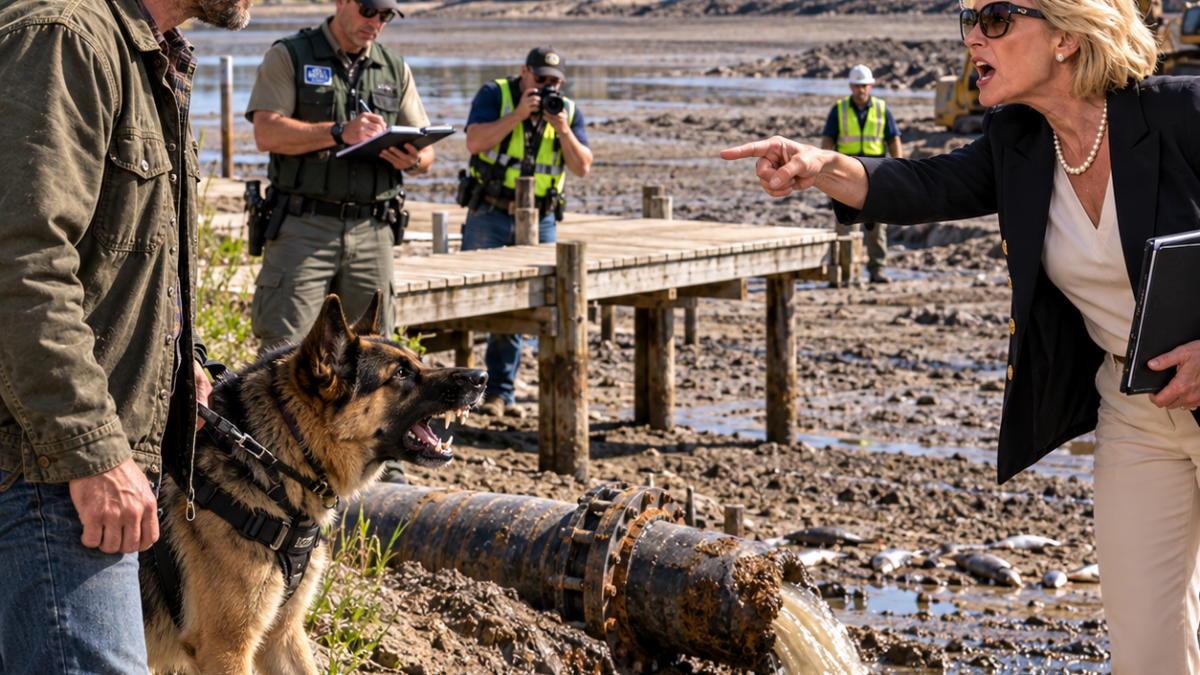
A second pipe outlet sat partly submerged.
Not visible at normal water level.
Eight-inch corrugated line.
Freshly attached fitting.
Rachel photographed it.
“Is that part of the normal lake outlet?”
“No.”
“You sure?”
“I inspected this lake informally for twenty years.”
“Informally?”
“I live here.”
She nodded.
The pipe ran toward the normal drainage corridor.
But water wasn’t flowing out.
It appeared configured as an intake or bypass connection.
Rachel said:
“Don’t touch anything.”
“I wasn’t planning to.”
That afternoon Brad arrived.
He had apparently seen the state vehicle.
His Range Rover came down the common trail too fast.
He stepped out wearing sunglasses.
“Sam.”
“Brad.”
Then saw Rachel.
“Who are you?”
She showed identification.
“Rachel Mendoza, state environmental quality.”
His entire posture changed.
Professional smile.
“Of course.”
That was the first time I saw Brad worried.
“We’ve been expecting coordination.”
Rachel said:
“No, you haven’t.”
He blinked.
She continued:
“No permit application under Oak Hollow.”
“Our consultant advised—”
“I spoke with the county this morning.”
Brad looked at me.
I said nothing.
Rachel pointed toward the exposed intake.
“What is that line for?”
“Temporary water management.”
“Where does it terminate?”
“Multiple sites.”
“Which include Hawthorne Ridge?”
Brad hesitated.
“Yes.”
“Commercial development?”
“Fire reserve infrastructure.”
“Under construction.”
“Yes.”
“Owned by you?”
“By a company I’m affiliated with.”
Rachel wrote.
Brad turned toward me.
“You really called the state without coming to the board?”
I laughed.
“I came to the board.”
“You created panic.”
“You drained six feet of lake.”
“Not six.”
“Four-point-nine currently.”
He stared.
“Measured?”
“Daily.”
Rachel looked between us.
“Mr. Whitmore, do not alter or remove this pipe until the department completes inspection.”
Brad folded his arms.
“This is HOA infrastructure.”
“Then preserving it should be easy.”
She placed a bright state evidence tag on the exposed section.
Scout sniffed it.
Rachel looked at him.
“He always this interested?”
“In things people bury.”
“Useful dog.”
“Very.”
The stop-work notice came two days later.
Immediate suspension of pumping pending review.
Brad sent a newsletter within three hours.
TEMPORARY STATE PAUSE DOES NOT INVALIDATE OAK HOLLOW WATER OPTIMIZATION PLAN.
People started calling it Water Optimization the way people name a scandal after the phrase that caused it.
Memes appeared on the neighborhood Facebook page.
One showed an empty bathtub:
BRAD SAYS IT’S OPTIMIZED.
Another showed a dead fish wearing sunglasses.
I did not participate.
Grace would have.
My daughter lived in Denver and called after seeing the posts.
“Dad.”
“Yes?”
“Did your HOA steal a lake?”
“Temporarily.”
“That is not a sentence.”
“Apparently it is.”
“Do you need me to come?”
“No.”
“That means yes.”
“Stay in Denver.”
“You’re terrible at asking for help.”
“Genetic.”
“Mom would be furious.”
That stopped me.
Ellen would have been.
Not loud.
Worse.
Precise.
She had been an accountant.
Her idea of revenge was reconciling someone else’s numbers in front of them.
Grace said:
“What would Mom check?”
I looked toward the stack of HOA documents.
“Money.”
That changed the investigation.
I requested association financial records under our governing documents.
Brad delayed.
Thirty days.
Then claimed confidentiality.
Treasurer, Linda Vale, contacted me privately.
Not related to Lindsey from the other story—no, this was our Linda, sixty-two, retired school administrator, honest to the point of discomfort.
She came to my house after dark.
Scout barked once.
Then recognized her.
Linda carried a binder.
“I shouldn’t be doing this.”
“Then don’t.”
“I already copied it.”
She sat at my kitchen table.
“I didn’t understand what the payments were.”
“What payments?”
She opened bank statements.
Hawthorne Ridge Development had paid Oak Hollow HOA three transfers.
$22,000.
$31,500.
$18,750.
Descriptions:
WATER INFRASTRUCTURE COST SHARING.
Another payment went the opposite direction.
Oak Hollow to Bluecrest Land & Water.
$64,000.
Pipe installation.
Brad had used HOA money to build a pumping system partly serving his private development.
Then the development reimbursed part.
Potential conflict.
Maybe worse.
“Was this disclosed?”
Linda shook her head.
“He called it shared emergency infrastructure.”
“Board vote?”
“Two votes.”
“Who voted?”
“Brad, Mitchell, and Karen.”
Five-member board.
Three majority.
“What did the minutes say?”
“Fire resilience.”
“No Hawthorne?”
“No.”
Ellen would have smiled.
Numbers.
I copied everything.
Then told Linda:
“Take originals home.”
“You don’t want them?”
“I don’t want anyone claiming I took association records.”
She nodded.
“Your wife used to say things like that.”
“I know.”
“She scared me.”
“She liked you.”
“Both can be true.”
The state investigation widened.
Fish & Wildlife joined after confirming mortality.
County water resources joined because the pipe crossed drainage infrastructure.
Then came an engineer from the state water-rights office.
That was where Brad’s plan began collapsing technically.
Oak Hollow Lake received water under a historical impoundment and drainage structure.
No individual party held unrestricted consumptive withdrawal rights for export to a separate development.
Temporary fire use?
Possible under emergency conditions.
Irrigation within certain adjacent lands?
Maybe, depending on right.
Commercial construction export?
Very different.
Records showed no transfer application.
No temporary-use authorization.
No measurement plan.
No fish-protection screening on intake.
The pump system was moving an estimated 320 to 410 gallons per minute.
Higher than Brad admitted.
Automated schedule:
ten hours overnight.
Why overnight?
Noise.
Visibility.
Reduced resident awareness.
My cameras confirmed.
Every night between roughly 11 p.m. and 9 a.m., utility crews accessed the pump enclosure.
That explained why most residents saw no equipment operating.
I had footage.
Dates.
Times.
Truck plates.
Brad.
Bluecrest crews.
One clip mattered more than the rest.
April 6, 2:13 a.m.
Brad stood with a Bluecrest supervisor near the pump.
Audio was faint but usable.
Brad said:
“Keep it below the dock line until the sale closes.”
The supervisor answered:
“We’re already dropping fast.”
Brad:
“Then slow it after Monday.”
Sale.
What sale?
Rachel Mendoza asked the same question.
County property records answered.
Hawthorne Ridge had presold fourteen premium lots.
Advertisements included:
GUARANTEED SUMMER WATER FEATURES.
PRIVATE COMMUNITY POND.
IRRIGATED COMMON GREEN.
FIRE-RESILIENT LANDSCAPING.
The new development did not yet have enough secure water for all promised amenities.
Oak Hollow Lake solved that.
Brad had marketed homes using water he did not control.
Now motive existed.
Not merely convenience.
Contractual pressure.
He needed water moving before closings.
The HOA pumping infrastructure disguised the supply source as community resilience.
Residents began turning on him.
Brad responded with more fines.
Mine climbed past $4,000.
Dead tree violation.
Mailbox finish.
Unapproved bench.
Unregistered dock repair.
Improper refuse container visibility.
Scout allegedly off-leash in common area.
That one was true once.
I paid none.
I appealed all.
Then received a lien warning.
That changed my mood.
They were trying to create financial pressure against my house while state investigators examined conduct by the president.
Anna Benton—an attorney recommended by a colleague—took one look and said:
“Retaliation.”
“Can we prove it?”
She tapped dates.
“State inspector visits Monday.”
“Three new violations Tuesday.”
“You speak at county hearing Wednesday.”
“Lien notice Thursday.”
She looked at me.
“Judges understand calendars.”
We sent a preservation letter.
Demanded suspension of enforcement tied to disputed notices.
Requested independent hearing.
Brad’s attorney responded with twelve pages.
Anna read the first two.
Then smiled.
“What?”
“They’re nervous.”
“How can you tell?”
“Page count.”
I trusted her.
The lake kept falling for another day after the stop-work order because stored lines and downstream distribution continued draining.
Then stabilized.
Lowest point:
five feet seven inches below seasonal target at my cove.
My dock sat ridiculous in the air.
Mud cracked.
Old beer cans emerged from sediment.
A bicycle frame.
Three fishing rods.
One cellphone that looked ancient.
Scout found a tennis ball and considered the ecological disaster worthwhile for approximately twenty minutes.
Then fish mortality peaked.
We collected carcasses under state supervision.
Trout.
Bass.
Bluegill.
Dozens.
Maybe hundreds including small fish not counted.
Lab results showed stress consistent with rapid habitat reduction, temperature increase, and low dissolved oxygen.
No single toxic release.
The harm came from taking too much water too quickly.
That mattered legally.
Brad repeatedly claimed:
“No contamination event occurred.”
Technically he was trying to create reasonable doubt around “killed fish.”
But environmental damage does not need poison.
Remove habitat.
Heat remaining water.
Oxygen falls.
Fish die.
Water answered.
Exactly as it always does.
Three weeks after Scout first found the pipe, the state held an administrative site conference.
Not a courtroom.
Folding tables near the common dock.
Agency staff.
County officials.
HOA counsel.
Board.
Residents.
Brad wore a navy blazer.
Confident again.
He had hired a hydrologist.
Consultant argued lake decline partly reflected drought and seepage.
I listened.
Then Rachel displayed gauge records.
Historic precipitation.
Inflow.
Satellite shoreline images.
Pump meter estimates.
Camera timestamps.
Drought could explain perhaps six to nine inches.
Observed loss exceeded sixty.
Then the hydrologist tried:
“Preexisting leakage may be underestimated.”
State engineer asked:
“Where?”
No answer.
“Soil saturation downstream?”
Normal.
Dam piezometer readings?
Normal.
Outlet flow?
Normal.
Then Rachel placed a photograph on the table.
The buried four-inch pressure line.
Another.
Pump installation.
Another.
Hawthorne Ridge connection.
Another.
Dead trout.
Then she said:
“We also recovered pump controller data.”
Brad looked toward Bluecrest.
Bluecrest’s owner looked at his shoes.
The controller had internal logging.
Flow.
Run time.
Dates.
Totalized volume.
Twenty-eight days.
Approximately 4.7 million gallons.
Silence.
Even I was surprised.
Nearly five million gallons.
Brad finally said:
“That water remained in beneficial community use.”
Rachel answered:
“Hawthorne Ridge is not Oak Hollow.”
“It is adjacent.”
“That’s not the standard.”
“Our fire-resilience plan—”
“Had no fire district approval.”
Brad looked toward county fire chief.
The chief shook his head.
“We were never consulted.”
That was devastating.
Brad had used fire safety as political cover without even involving fire services.
Then county planning director spoke.
“Hawthorne Ridge’s approved plans identify municipal connection as future water source for common features.”
Brad said:
“Future.”
“Yes.”
“Temporary need existed.”
“Which you did not disclose.”
People murmured.
Brad’s attorney interrupted.
“This meeting is not a trial.”
Rachel nodded.
“No.”
Then calmly:
“It is fact finding.”
Those two words ended more careers than shouting ever could.
The state issued orders.
Pumping system decommissioned pending permits.
Restoration plan required.
Fish habitat remediation.
Monitoring.
Potential penalties reserved.
Separate referrals for unpermitted water use.
County opened ethics review regarding HOA representations.
Residents demanded a special election.
Brad refused initially.
Governing documents required one if thirty percent signed.
They collected fifty-seven percent in three days.
The recall meeting happened in the Oak Hollow clubhouse.
Standing room only.
Brad gave a forty-minute presentation.
He blamed misinformation.
Me.
State bureaucracy.
Climate variability.
Hostile residents.
He said:
“I made difficult decisions to protect property values.”
Someone yelled:
“You lowered my property value by removing the lake!”
Laughter.
Brad continued.
He argued Hawthorne Ridge cost sharing reduced HOA expenses.
Technically true.
He argued the pumping equipment could support wildfire response.
Potentially true.
He argued the lake would refill.
Probably true over time.
That was the problem with sophisticated wrongdoing.
Not every sentence is false.
The lie lives in how truths are arranged.
Then Linda Vale asked to speak.
Brad visibly stiffened.
The treasurer walked to the microphone.
“I voted for the project.”
Room quiet.
“I believed I was approving emergency infrastructure.”
She looked at residents.
“I was wrong.”
Brad interrupted.
“You were present at every meeting.”
Linda turned.
“Yes.”
“And the materials you provided did not disclose that your development had presale obligations requiring water-dependent amenities.”
Brad’s face changed.
Linda held up printed emails recovered through board records.
“I did not know the project schedule had been accelerated to coincide with Hawthorne Ridge closings.”
She looked at me.
“I also approved the first violation notices against Sam.”
I had not known that.
She continued.
“I regret it.”
Then to the room:
“Those fines should never have been used to punish a homeowner for raising a safety concern.”
That ended Brad more effectively than anything I could say.
Vote:
74 percent removal.
He lost.
Two allied board members resigned.
Linda stayed only long enough to help transition records, then resigned too.
I asked her why.
“Because accountability should include me.”
I respected that.
The new board suspended every violation notice issued against me during the dispute.
Not quietly.
Public vote.
Refund of attorney-review fees.
Removal of lien threat.
Then they hired independent counsel.
First question:
“Can the HOA sue Brad?”
Anna looked at me afterward.
“You enjoying this?”
“No.”
“Good.”
“Why good?”
“People who enjoy litigation become expensive.”
The HOA did pursue claims.
Not because I demanded it.
Because insurance and fiduciary duties left little choice.
Brad’s company had benefited from association-funded infrastructure without full disclosure.
Settlement negotiations lasted months.
Bluecrest claimed it relied on HOA authorization.
Brad claimed board consent.
Board members claimed incomplete information.
Insurers blamed exclusions.
The usual circular firing squad.
Meanwhile, I wanted the lake back.
That became harder than winning meetings.
You cannot refill five million gallons instantly without creating another problem.
The watershed needed to recover naturally.
State approved a staged restoration.
Stop withdrawals.
Repair disturbed banks.
Install habitat structures in damaged cove areas.
Remove abandoned pipe sections where doing so would not create erosion.
Aeration during low-oxygen periods.
Monitor temperature.
Restrict fishing temporarily.
Spring inflow did the rest.
Slowly.
One inch.
Two.
Rainstorm.
Five.
Snowmelt.
Another foot.
My dock approached water again.
Scout checked daily.
The first day water touched the lowest step, he barked.
Once.
Then looked at me as if he had personally fixed it.
“You did find the pipe.”
Tail wag.
Fair.
Grace came home in June.
She stood on the cedar bench Ellen and I had used.
Looked across recovering water.
“Mom would’ve killed Brad.”
“No.”
“She would’ve audited him to death.”
“That is closer.”
Grace had her mother’s eyes.
That was still difficult sometimes.
She walked to the dock.
“Why didn’t you call me sooner?”
“I didn’t want you worrying.”
“Dad.”
“Yes?”
“You have to stop doing that.”
“Doing what?”
“Turning loneliness into protection.”
That hurt because it was true.
Ellen had died four years earlier.
Since then I had become highly skilled at not asking anyone to share difficult things.
Scout did not count.
Dogs volunteer.
Grace said:
“You sent me pictures after the state already showed up.”
“I handled it.”
“I know.”
“That isn’t the point?”
“No.”
Apparently children inherit their dead mother’s arguments.
I sat beside her.
“I’m sorry.”
She leaned against me.
“Good.”
We watched Scout chase dragonflies.
Later that summer, criminal charges did not appear.
That disappointed some residents.
They wanted Brad handcuffed.
The facts supported civil, regulatory, and administrative violations more clearly than a dramatic felony case.
There had been no forged deed.
No nighttime armed sabotage.
He had exploited governance, conflicts of interest, incomplete disclosures, and unpermitted water withdrawal.
Consequences came differently.
State penalties.
Restoration liability.
Civil settlement.
Loss of HOA office.
Business lawsuits from Hawthorne Ridge purchasers once promised amenities were delayed.
Professional reputation damage.
His development lender restructured financing.
His insurer fought coverage.
Sometimes accountability looks like paperwork arriving for years.
The final state order required Brad’s development company and associated contractors to pay most restoration costs connected to the unpermitted withdrawal.
Oak Hollow HOA paid a smaller portion reflecting its role.
The new board chose not to special-assess homeowners immediately.
Reserve funds and insurance covered much of it.
I appreciated that.
Most residents had not drained anything.
They had believed a president who used polished phrases.
One afternoon, Brad came to my house.
Alone.
Scout growled before the doorbell.
I stepped onto porch.
Brad looked thinner.
No blazer.
No HOA pin.
“What do you want?”
“To talk.”
“About?”
“Settlement.”
“Attorneys handle that.”
“Not money.”
I waited.
He looked toward the lake.
“It’s almost full.”
“Getting there.”
“I didn’t think it would drop that fast.”
That sentence interested me.
“You’re a developer.”
“Yes.”
“Not a hydrologist.”
“No.”
“Then why did you ignore the people who told you the rate was too high?”
His jaw tightened.
“Bluecrest said it was manageable.”
“They installed what you paid them to install.”
“I had a consultant.”
“Paid by whom?”
He looked away.
I continued:
“You wanted a certain answer.”
He did not deny it.
Finally:
“Hawthorne Ridge was under pressure.”
“I know.”
“Closings.”
“Yes.”
“If we missed the landscape commitments, buyers could walk.”
“So you moved the risk onto Oak Hollow.”
“I thought the lake would recover.”
“It will.”
“Then what’s the difference?”
I stared.
There it was.
He still did not fully understand.
“The fish.”
He looked toward the water.
“The shoreline.”
“The wetland.”
“The people whose property you used without disclosure.”
“The HOA members whose money you spent.”
“The fact that you decided the damage was acceptable because somebody else would live with it.”
He sighed.
“I made a bad decision.”
“No.”
I shook my head.
“You made about thirty smaller decisions.”
That landed.
“You approved pipe.”
“You hid the commercial connection.”
“You ran pumps at night.”
“You dismissed complaints.”
“You issued fines.”
“You kept going after the fish died.”
“One bad decision would have been easier.”
He sat on the porch step without asking.
Scout remained behind the screen door.
Brad said:
“I hated you.”
“I know.”
“You stood in those meetings like you already knew the answer.”
“I usually did.”
He almost smiled.
“That didn’t help.”
“No.”
Then:
“Why didn’t you come after my company harder?”
“What?”
“You could’ve joined the purchasers.”
“I wasn’t a purchaser.”
“Environmental damages.”
“The state handled them.”
“Personal claim for the pipe crossing your lot.”
“Settled.”
“You could’ve tried to ruin me.”
I looked at him.
“Ellen died four years ago.”
He frowned, unsure.
“My wife.”
“I know who she was.”
“For months after, I was angry at people for being alive normally.”
He said nothing.
“I learned something.”
“What?”
“Anger feels like purpose for a while.”
Scout lay down.
I continued.
“Then it starts charging rent.”
Brad looked at the lake.
“I didn’t forgive you.”
“I’m not asking.”
“Good.”
He stood.
At the driveway he stopped.
“For what it’s worth, I am sorry about the dog fines.”
I laughed.
“Those were the least convincing.”
“Your dog was technically off leash.”
“Leave.”
He did.
I never became his friend.
He never returned to Oak Hollow leadership.
Hawthorne Ridge eventually connected to the municipal system.
Funny how quickly an impossible expense becomes possible when illegal water disappears.
Oak Hollow changed.
The new board created a water committee.
I refused chairmanship.
They asked twice.
“No.”
“Why?”
“I already have a job.”
“You’re the obvious choice.”
“That is exactly why I shouldn’t.”
I agreed to serve as unpaid technical adviser for one year.
With boundaries.
Public meetings.
Published data.
No executive-session water decisions except true legal matters.
Lake gauge online.
Monthly water level.
Temperature.
Dissolved oxygen.
Rainfall.
Outflow observations.
Residents mocked the dashboard at first.
Then loved it.
Transparency is boring until secrecy hurts you.
We also wrote something into the lake-management policy:
Any withdrawal above ordinary maintenance volumes requires written identification of legal authority, destination, estimated volume, environmental impact, and responsible operator before work begins.
Brad called it bureaucracy once in a local interview.
I framed that quote in my garage.
Scout grew older during all of it.
Nine.
Ten.
His hips slowed.
Still checked the dock.
Still disliked buried pipes.
Two years after the draining incident, he developed degenerative myelopathy.
No cure.
Progressive weakness.
The same shoreline he had patrolled became difficult.
I bought a support harness.
He hated it.
Grace called it his “parachute.”
Scout looked insulted.
Eventually he could no longer walk the full western trail.
So I drove him in the utility cart.
We stopped near the place where he first growled at the trench.
The pipe was gone.
Grass returned.
He sniffed.
Then looked at me.
“Nothing there.”
He sniffed again.
“State checked.”
He was unconvinced.
Good engineer.
On his final summer, the lake reached one of the healthiest readings we had recorded in years.
Trout survey recovered.
Oxygen stable.
Wetland vegetation returned.
I carried Scout down to Ellen’s bench one evening.
Ninety pounds had become seventy-two.
He lay beside my feet.
Water reflected orange sunset.
The dock floated at full level.
I scratched behind his ears.
“You found it first.”
His tail moved.
“Everyone gives me credit.”
Another weak wag.
“Typical.”
I had lost Ellen beside machines.
Hospital.
White walls.
I did not want Scout’s last memory to be fear inside a clinic if we could avoid it.
When the time came, our veterinarian came to the house.
Grace drove in.
Scout lay on a blanket beside the lake.
He ate pieces of steak.
Apparently end-of-life dietary guidelines are liberal.
The veterinarian gave him the medication.
Grace held his paw.
I kept one hand against his chest.
He looked toward the water.
Then at me.
And was gone.
I buried some of his ashes beneath Ellen’s cedar bench.
Not all.
Grace took a little.
She said her apartment needed “better security.”
For months afterward I still expected to hear him bark near the shoreline.
Sometimes I did.
Memory is cruel like that.
The new board wanted to name the restored western trail after Scout.
I said no.
Grace overruled me through social pressure.
Now a small wooden marker near the path reads:
SCOUT TRAIL
HE NOTICED FIRST.
I pretend to dislike it.
I don’t.
Five years after Brad drained the lake, Oak Hollow held its first public watershed day.
Not public in the unrestricted sense.
Residents.
County staff.
Local high-school environmental science classes.
Fish & Wildlife.
Kids tested water.
Measured clarity.
Counted insects.
Rachel Mendoza came.
She had been promoted.
Still carried a clipboard.
We stood near the old pipe location.
“You ever think we’d end up here?”
“No.”
She looked at the students.
“Better ending than court.”
“Agreed.”
A teenager nearby asked why the lake level gauge had so many historical markings.
Rachel pointed toward me.
“He’ll tell you.”
I explained.
Normal seasonal fluctuation.
Drought.
Rain.
The draining event.
One kid asked:
“Why would anybody take that much water?”
“For another development.”
“Didn’t they know fish would die?”
I considered.
“They knew the lake would drop.”
“That isn’t what I asked.”
Smart kid.
“No.”
I said.
“I don’t think they understood the consequences clearly enough.”
“Then why didn’t they ask somebody?”
Exactly.
“Sometimes people stop asking questions when they like the answer they already have.”
Rachel smiled.
The kid wrote that down.
I hoped he forgot my name and remembered the sentence.
That was enough.
The most important thing the state investigation exposed was not Brad.
Brad was temporary.
The dangerous thing was how many safeguards depended on somebody deciding to use them.
Board members could have asked for permits.
Didn’t.
Contractor could have asked for water-right documentation.
Didn’t force it.
Consultant could have demanded ecological modeling.
Accepted a narrower scope.
Treasurer could have questioned reimbursements earlier.
Didn’t understand them.
County inspectors might have noticed trenching sooner.
No complaint yet.
Residents noticed water falling.
Assumed someone else knew why.
I noticed because water was my profession.
Scout noticed because somebody dug where nobody normally dug.
The system worked only after suspicion became evidence.
That bothered me.
So Oak Hollow made the process less dependent on specialists.
We installed public lake gauges.
Posted withdrawal policy.
Created emergency contact chain.
Required contractor permits to be visible online.
Any resident could ask:
Who authorized this?
Where is the water going?
How much?
Simple questions.
Powerful because they no longer required an engineer.
Brad’s house sold three years after the incident.
He moved.
I heard Colorado.
Maybe Texas.
Did not care.
The old HOA office changed too.
Less decorative granite.
More boring binders.
Good.
Linda Vale returned to the board eventually.
Not as treasurer.
General member.
She asked residents before voting.
Sometimes too much.
I preferred that problem.
One meeting ran three hours because she wanted everyone to understand irrigation contracts.
Someone complained.
I said:
“Remember Water Optimization?”
Meeting continued without complaint.
Grace eventually moved back closer.
Married.
Had a son.
Ellen would have loved him.
His name is Owen.
At four, he threw rocks into the lake for forty minutes.
At five, he asked why Grandpa Samuel knew how deep water was.
“At this spot?”
“Yes.”
“Gauge says six-point-two feet.”
“No.”
He frowned.
“How do you know without the stick?”
“I don’t.”
“Then you’re not really an engineer.”
Children are ruthless.
I taught him how lake levels work.
He lost interest after ninety seconds and chased a frog.
Probably healthier.
The cedar bench is still there.
Ellen’s bench.
Scout beneath it in part.
I sit there less than I used to.
Not because grief ended.
Because life grew around it.
That is different.
The lake taught me the same thing.
After the withdrawal, I wanted restoration to mean returning exactly to before.
Same depth.
Same fish.
Same shoreline.
Impossible.
Some fish were gone.
Sediment shifted.
Plants colonized exposed mud.
Then water returned and rearranged them again.
New reeds grew.
One shallow pocket became better frog habitat than before.
Restoration did not erase damage.
It created another stable balance.
Grief is like that.
Engineers hate metaphors.
I became more tolerant with age.
The original four-inch steel pipe sits in my garage.
Legally released after evidence retention ended.
Rachel asked why I wanted it.
I did not know.
Maybe proof.
Maybe reminder.
Grace wanted to turn it into a lamp.
I forbade it.
One day Owen asked:
“What’s that?”
“The pipe that drained the lake.”
His eyes widened.
“All of it?”
“No.”
“How much?”
“Almost five million gallons.”
He stared at the steel.
“That’s a lot.”
“Yes.”
“Did Scout bite it?”
“No.”
“Why not?”
“Professional restraint.”
Owen accepted this.
The pipe carries scratches from when we exposed it.
State evidence paint.
One faded orange tag.
I thought once about throwing it away.
Didn’t.
It reminds me of something people in technical professions often forget.
Facts are not self-enforcing.
A lake can drop five feet.
Fish can die.
A pipe can vibrate beneath your hand.
And somebody can still stand in a meeting and call it optimization.
Evidence needs witnesses.
Records.
Measurements.
People willing to say:
No.
That word does not describe what is happening.
Brad’s biggest mistake was not the pumping rate.
Not even the hidden connection.
It was believing language could outrun reality indefinitely.
He called export “resilience.”
Commercial supply “cost sharing.”
Retaliation “compliance enforcement.”
Fish mortality “seasonal stress.”
An emptying lake “water optimization.”
Water did not care.
Neither did Scout.
Neither did the camera pointed toward the tree line.
Neither did the state investigator kneeling beside a pipe and photographing the fitting.
Reality is stubborn that way.
Eventually the lake level becomes a number.
The flow becomes a log.
The money becomes a bank transfer.
The truck becomes a license plate.
The newsletter becomes evidence of what someone claimed before the facts arrived.
That is why I tell people:
Document before you argue.
Not because arguments are useless.
Because memory changes when pressure starts.
People remember differently.
Emails disappear.
Meetings become interpretations.
Numbers don’t solve everything.
But they give truth somewhere to stand.
On the anniversary of the state stop-work order, nobody celebrates.
Good.
Environmental damage is not a holiday.
But I walk the trail.
Past the restored bank.
Past Scout’s marker.
Past Ellen’s bench.
To the dock.
I look at the gauge.
Usually normal.
Sometimes drought lowers it.
Sometimes spring raises it.
Normal fluctuation is beautiful after you’ve seen artificial loss.
One evening Owen came with me.
He pointed at the gauge.
“Grandpa?”
“Yes?”
“What if somebody drains it again?”
I almost gave him the adult answer.
Permits.
Policies.
Oversight.
Monitoring.
Instead:
“We’d notice.”
He thought.
“Scout isn’t here.”
“No.”
He looked around.
Then pointed toward the camera above the boathouse.
“We have that.”
“Yes.”
“And you.”
“For now.”
“And me.”
I smiled.
“Apparently.”
He threw a rock.
Three skips.
Better than mine at his age.
Water closed behind it.
That is another thing about lakes.
Surface heals quickly.
Sometimes too quickly.
You can look across calm water and forget what happened beneath it.
That is why records matter.
Why markers matter.
Why Scout’s little sign remains.
Not to keep everyone angry.
To keep everyone literate.
So the next person who hears “temporary optimization” asks:
Temporary how long?
Optimization for whom?
Water going where?
Authorized by who?
Measured how?
What happens downstream?
Who pays if you’re wrong?
Those questions are not hostile.
They are stewardship.
Brad mistook scrutiny for opposition.
That was partly why he failed.
He believed anyone asking technical questions was challenging his authority.
In reality, we were giving him chances to stop.
He ignored them.
That is what I remember most.
Not the recall vote.
Not state penalties.
Not watching the pump removed.
The opportunities.
At the first phone call:
Tell the truth.
At the board meeting:
Pause.
When fish died:
Stop.
When the state arrived:
Cooperate.
When fines began:
Don’t retaliate.
Every stage offered an off-ramp.
Pride kept him driving.
I have been guilty of that in other ways.
With Ellen.
With Grace.
With work.
Thinking competence meant carrying things alone.
It doesn’t.
A good system shares load.
So does a family.
That may be the most useful lesson I got from nearly five million gallons of missing water.
These days, Oak Hollow Lake looks almost ordinary.
That is the highest compliment I can give it.
No protest signs.
No state trucks.
No pumps in the dark.
Children fish from the eastern dock.
Geese make a mess along the walking path.
People complain about algae in August.
Someone inevitably wants more fountains.
Normal problems.
Sometimes a new homeowner asks about the shallow scars on the western bank.
Someone tells them:
“The HOA drained the lake once.”
They laugh.
Think it’s an exaggeration.
Then they see Scout Trail.
Or the online gauge archive.
Or the old meeting minutes.
And realize:
No.
It happened.
I do not need them angry.
I only need them aware.
Because lakes are balances.
So are communities.
Take too much from either and the damage begins quietly.
A few inches.
One buried pipe.
One exception.
One meeting nobody attends.
One question nobody asks.
By the time everyone sees the exposed mud, the process may have been running for weeks.
Scout saw it first.
Not because he understood water rights.
Because somebody disturbed his routine.
I understood it next because numbers stopped making sense.
Rachel proved it because institutions finally looked.
Residents stopped it because evidence gave them courage to question authority they had elected themselves.
No single hero.
No magical victory.
Just observation becoming documentation, documentation becoming accountability, and accountability becoming repair.
The first morning I saw my dock hanging over mud, I thought the lake had been stolen from us.
What I eventually understood was that water itself had not betrayed us.
People had altered the balance.
And people could restore it.
Not completely.
Nothing damaged returns exactly.
But enough.
Enough for trout.
Enough for frogs.
Enough for children throwing stones.
Enough for a widower to sit beside a cedar bench and remember his wife without looking at dead fish.
Enough for an old German Shepherd’s trail marker to face clear water again.
Brad Whitmore called what he did “water optimization.”
The state called it unauthorized withdrawal.
The board eventually called it misconduct.
Lawyers called it several things that cost by the hour.
Scout never needed a phrase.
He stood at the edge of the mud, stared at a buried steel pipe, and growled.
He was right.