The HOA Secretly Drained Propane From My Private Tank for Years—Then I Locked Every Valve and Their Biggest Community Event Shut Down Within Hours.
PART2:
A small maintenance building stood farther back near a gravel service lane.
The pavilion was popular.
Birthday parties.
Cookouts.
Holiday gatherings.
Board-sponsored events.
Neighborhood dinners.
Summer movie nights.
It was one of the few HOA amenities I genuinely thought people received value from.
My property sat along the eastern edge of the development.
Behind my backyard was a twenty-foot-wide maintenance corridor.
That corridor was covered by an easement allowing the HOA to reach utility infrastructure and move maintenance equipment along the rear of the eastern row of houses.
I knew that when I bought the property.
The previous owner told me plainly.
“You’ll see HOA trucks behind the fence sometimes.”
That did not bother me.
Easements exist for a reason.
PART3:
If a utility line broke, I did not want someone waiting for my permission before repairing it.
What the previous owner did not tell me was that the HOA had a much more intimate relationship with something sitting inside my property line.
A five-hundred-gallon propane tank.
The tank sat on a concrete pad near the eastern rear corner of the lot.
It had originally supplied the house furnace and cooking range.
The previous owner liked propane.
I did not have a problem with it, but after moving in, I replaced the old heating system with a heat pump.
Then I replaced the gas range with electric.
That reduced my propane consumption dramatically.
I considered removing the tank.
Never got around to it.
It still contained fuel.
It was inspected and in good condition.
And I occasionally used propane for a portable garage heater during winter.
So I kept it.
For roughly the first year, I barely thought about it.
Then one spring morning, I walked out to check the gauge.
I had used the garage heater several times over winter.
Nothing excessive.
That simple fact eventually created a serious problem for the Clearfield Estates Homeowners Association.
I moved into Clearfield Estates seven years before everything came apart.
It was a medium-sized community of around one hundred forty houses built around a shared amenity complex.
The clubhouse sat near the center.
Beside it was a covered pavilion.
Then the swimming pool.
A small maintenance building stood farther back near a gravel service lane.
The pavilion was popular.
Birthday parties.
Cookouts.
Holiday gatherings.
Board-sponsored events.
Neighborhood dinners.
Summer movie nights.
It was one of the few HOA amenities I genuinely thought people received value from.
My property sat along the eastern edge of the development.
Behind my backyard was a twenty-foot-wide maintenance corridor.
That corridor was covered by an easement allowing the HOA to reach utility infrastructure and move maintenance equipment along the rear of the eastern row of houses.
I knew that when I bought the property.
The previous owner told me plainly.
“You’ll see HOA trucks behind the fence sometimes.”
That did not bother me.
Easements exist for a reason.
If a utility line broke, I did not want someone waiting for my permission before repairing it.
What the previous owner did not tell me was that the HOA had a much more intimate relationship with something sitting inside my property line.
A five-hundred-gallon propane tank.
The tank sat on a concrete pad near the eastern rear corner of the lot.
It had originally supplied the house furnace and cooking range.
The previous owner liked propane.
I did not have a problem with it, but after moving in, I replaced the old heating system with a heat pump.
Then I replaced the gas range with electric.
That reduced my propane consumption dramatically.
I considered removing the tank.
Never got around to it.
It still contained fuel.
It was inspected and in good condition.
And I occasionally used propane for a portable garage heater during winter.
So I kept it.
For roughly the first year, I barely thought about it.
Then one spring morning, I walked out to check the gauge.
I had used the garage heater several times over winter.
Nothing excessive.
I kept rough energy notes because apparently retirement did not cure me of being an engineer.
Based on my estimated use, I expected the tank to read around sixty-two percent.
The gauge read forty-one.
I stared at it.
Then tapped the glass.
Still forty-one.
A twenty-one percentage point discrepancy on a five-hundred-gallon tank represented roughly one hundred five gallons.
Propane was around two dollars and forty cents per gallon at the time.
Something like two hundred fifty dollars of fuel was missing relative to my estimate.
I checked the tank.
No obvious damage.
No smell.
No frost.
No signs of leaking.
I looked at the service line going toward the house.
Nothing unusual.
My first conclusion was not theft.
It was that I had probably been sloppy with my own numbers.
That is a humbling thing for an engineer to admit, but it happens.
People remember wrong.
Estimates drift.
Gauges are not laboratory instruments.
The garage heater may have run longer than I thought.
Maybe I had left it on overnight once.
Maybe I had overestimated the fuel level after the last fill.
So I made a note in a small black notebook I kept in the garage.
April 12. Tank gauge: 41%. Expected: 62%. Difference unexplained.
Then I moved on.
That should have been the end of it.
It was not.
By August, the tank had dropped again.
This time, I had barely used any propane at all.
No furnace.
No gas stove.
No heater.
Nothing except one brief test of a burner assembly I was repairing for a friend.
The gauge had dropped twelve percent in five months.
Sixty gallons.
Impossible for my usage.
I called Clearfield Fuel and Supply, the company that had serviced the tank since before I bought the house.
The dispatcher pulled up my account and read the last delivery date.
“February 8th,” she said.
“Three hundred twenty gallons delivered.”
“That’s impossible.”
“No, sir. I’m looking at the ticket.”
“I wasn’t home that day.”
“You don’t need to be home for an exterior tank.”
“I know that. But three hundred twenty gallons?”
“Yes, sir.”
“Who requested the delivery?”
“You’re on automatic refill.”
“I never set that up.”
There was a pause.
“It may have transferred with the property account.”
“I pay these invoices?”
“Yes, sir. Auto-pay from the checking account ending in 7712.”
That was my account.
The previous owner had been on automatic refill. During closing, I had signed forms transferring tank service because it seemed ordinary. I had not paid close attention because the first few bills were small, and life after moving had been full of boxes, contractors, and learning which light switches controlled nothing.
I asked for the full delivery history.
The dispatcher hesitated.
“How far back?”
“Since I bought the property.”
She emailed it that afternoon.
I printed the records and spread them across my kitchen table.
Year one: two deliveries.
Year two: three deliveries.
Year three: three deliveries.
Year four: four deliveries.
The gallons did not match my life.
Not even close.
After replacing the furnace and range, my annual consumption should have been maybe eighty to one hundred gallons, depending on winter garage use.
The invoices showed between five hundred and eight hundred gallons per year.
For several years.
Charged to me.
Paid by me.
Quietly.
Automatically.
I sat there looking at the numbers while my coffee went cold.
The overcharge was not a few dollars.
It was thousands.
My first call went back to Clearfield Fuel.
This time I asked for delivery tickets with driver notes.
They sent them.
Several had handwritten comments.
Gate access via maintenance road.
Tank accessible from corridor.
Clubhouse event week.
Top off before Fall Festival.
I read that last one three times.
Top off before Fall Festival.
My tank.
My account.
Their festival.
The Clearfield Estates Fall Festival was the HOA’s biggest event of the year. It filled the pavilion, pool deck, clubhouse lawn, and parking area. Food trucks, rented heaters, fire pits, live music, raffle tables, bounce houses, and a catered dinner for VIP sponsors.
I had gone once during my first year.
It was pleasant enough if you enjoyed standing in line for chili while someone with a microphone thanked sponsors for forty minutes.
I had not gone back.
Now, looking at that delivery note, I felt something cold settle in my stomach.
I walked out to the tank and looked harder than I ever had before.
The tank sat on its concrete pad inside my property line. The main service line went toward my house, exactly where it should. But on the far side, behind the tank and half-hidden by ornamental grass planted by the previous owner, was a second line.
Black polyethylene.
Buried shallow.
Leaving the tank pad toward the maintenance corridor.
I stared at it for a long time.
I had seen it before.
Of course I had.
I had assumed it was an old abandoned branch from some previous outdoor appliance. A pool heater that no longer existed. A generator that had been removed. A shop line capped somewhere underground.
You know the most dangerous assumption an experienced person can make?
That something old is inactive because nobody mentioned it.
I took photographs.
Then I followed the direction of the buried line as far as I could.
It vanished beneath the fence line at the maintenance corridor.
On the other side was HOA land.
From there, the corridor ran behind three houses and toward the amenity complex.
I did not dig.
I did not cut.
I did not touch the line.
I took more photographs and called my attorney.
Her name was Brenda Walsh.
She had handled my estate documents and the property closing. She was sharp, careful, and had a voice that could make a bad idea shrivel before anyone admitted it was bad.
I explained the numbers first.
Then the delivery notes.
Then the second line.
She said nothing for a moment.
Then she asked, “Raymond, does your deed mention a propane easement?”
“No.”
“Does the HOA declaration mention your tank?”
“Not that I remember.”
“Does your closing paperwork include any shared utility agreement?”
“No.”
“Are you certain?”
“I’m certain enough to say no, not certain enough to swear.”
“Good answer. Send me everything.”
By the next afternoon, Brenda had pulled the recorded documents.
There was a maintenance corridor easement.
There was a drainage easement.
There were utility easements for electric, water, cable, and stormwater access.
There was nothing granting the HOA propane rights through my tank.
Nothing.
No recorded shared-fuel agreement.
No cost-sharing clause.
No permission.
No disclosure.
The tank was mine.
The fuel was mine.
The bill was mine.
And a buried line appeared to be feeding HOA amenities from my property without legal authority.
Brenda told me not to confront anyone yet.
That was difficult.
At the time, the HOA president was a man named Victor Sloane.
Victor was sixty-one, a former regional bank executive, and the kind of person who could say “neighborly cooperation” while making it sound like a collections notice. He wore pastel polo shirts tucked into pressed shorts, even in October. He chaired meetings with a polished wooden gavel nobody had asked for. He treated the HOA budget like a corporate balance sheet and homeowners like minor shareholders who were lucky to receive his annual report.
We had never had a serious conflict.
I paid dues.
I maintained my property.
I attended no meetings.
That made me, in Victor’s eyes, either ideal or irrelevant.
Probably both.
The board included four other members: Lydia Park, who handled social events; Martin Cale, who oversaw maintenance; Joyce Feld, treasurer; and Evan Brooks, a younger homeowner who mostly tried to ask reasonable questions and was ignored.
Lydia Park was the one who organized the Fall Festival.
That would matter later.
For the next six months, I documented everything.
I installed a secondary dial gauge.
I installed a non-invasive temperature sensor and pressure monitor.
I logged tank level every Sunday morning at 8:00.
I logged outdoor temperature.
I logged any personal use.
I compared fuel drops to known usage.
Then I set up two trail cameras.
One facing the tank.
One facing the maintenance corridor gate.
The HOA trucks came and went behind my fence as expected. Landscapers. Pool contractors. Maintenance carts. Nothing obviously dramatic.
Then, six weeks before the Fall Festival, Clearfield Fuel delivered again.
The driver came through the maintenance corridor, not my driveway.
He did not knock.
He did not leave a ticket at my door.
He filled the tank from the rear side, photographed the gauge, typed something on a handheld device, and left.
Two days later, the invoice hit my bank account.
Four hundred eleven gallons.
Over one thousand dollars.
I had not ordered it.
I had not authorized it.
I had not used it.
That was the day this stopped being a mystery and became a case.
Brenda sent a formal letter to Clearfield Fuel and Supply demanding all account records, authorization forms, delivery instructions, payment history, driver notes, and any communications involving the HOA or Clearfield Estates amenities.
She sent a second letter to the HOA requesting documentation of any claimed right to use, access, draw from, maintain, or benefit from the propane tank on my property.
She used polite language.
Brenda always used polite language.
That is how you knew she was loading the cannon.
Clearfield Fuel responded first.
Their records showed my tank account had been associated with two delivery profiles.
Residential account: Raymond Kowalski.
Auxiliary note: Clearfield Estates pavilion/event backup supply.
The second note had existed since before I purchased the home.
That was not the worst part.
The worst part was the internal billing memo.
Bill all gallons to residential owner; HOA reimburses previous owner by separate arrangement.
There had once been an arrangement.
Not with me.
With the previous owner.
Brenda dug deeper.
The previous owner, a man named Howard Gilman, had agreed twelve years earlier to let the HOA temporarily draw propane from the tank during construction of the pavilion kitchen and outdoor heaters. In exchange, the HOA reimbursed him monthly and agreed to install an independent tank within eighteen months.
Howard had apparently let the arrangement continue because he was friendly with the original board and they paid him.
Then Howard sold the house to me.
The HOA never disclosed the arrangement.
Clearfield Fuel transferred the tank account to me.
The separate reimbursement stopped.
But the deliveries continued.
And the HOA kept drawing from my tank.
For years.
Charging me.
Using the fuel.
Saying nothing.
I called Howard Gilman.
His number still appeared in an old closing email. I expected it to be disconnected. It was not.
He answered on the fifth ring with a suspicious “Hello?”
“Mr. Gilman, my name is Raymond Kowalski. I bought your house in Clearfield Estates seven years ago.”
“Oh,” he said. “The tank.”
Not hello.
Not how’s the place.
The tank.
I closed my eyes.
“Yes,” I said. “The tank.”
He sighed.
“I wondered when that would surface.”
“You knew?”
“I told the closing agent there was a temporary HOA propane arrangement.”
“No one told me.”
“I assumed it was in the paperwork.”
“It wasn’t.”
He was quiet for a moment.
“Raymond, I’m sorry.”
That was the first apology I received in the entire matter.
It was not enough.
But it was real.
Howard explained that the HOA had connected the pavilion kitchen, patio heaters, and later the maintenance building water heater to the buried line during construction. It was supposed to be temporary until they installed a dedicated amenity tank. But the old board decided the dedicated installation was too expensive, and Howard agreed to keep the arrangement because they reimbursed him, plus a small convenience payment.
“How much?” I asked.
“Actual propane cost plus fifteen percent.”
I almost laughed.
They had not only used my fuel.
They had ended the reimbursement and kept the discount.
“Did you ever sign anything recorded?”
“No. It was a board letter. Maybe meeting minutes.”
“Do you have copies?”
“I might.”
He did.
Three days later, Howard mailed me a folder.
Inside were old emails, a signed temporary access letter, reimbursement statements, and one very important paragraph:
This temporary connection shall terminate upon sale or transfer of the Gilman property unless expressly renewed in writing by the new owner.
I had never renewed it.
No one had asked.
The HOA had no right to keep using the tank after the sale.
Brenda read that paragraph and smiled.
Not happily.
Professionally.
“Raymond,” she said, “they knew this arrangement did not automatically continue.”
“How do we prove that?”
“We ask for records. People who hide things badly tend to store proof in folders named ‘old agreements.’”
She was right.
The HOA response arrived two weeks later.
Victor Sloane did not write it himself. The HOA’s attorney, a man named Peter Lang, sent it.
It claimed the propane connection was a long-standing community utility arrangement. It claimed the buried line served common amenities. It claimed my purchase of the property included “constructive notice” of existing utility conditions. It claimed the HOA had relied on continued access and use in good faith.
It did not include a single recorded easement.
It did not include my written consent.
It did not include payment records to me because none existed.
Then, at the end, it included a sentence that made Brenda sit back in her chair.
The Association expects Mr. Kowalski to maintain the status quo and avoid any unilateral disruption of common-area services pending resolution.
I read it twice.
“Maintain the status quo,” I said.
Brenda nodded.
“The status quo where they take your propane and you pay for it.”
“What happens if I stop them?”
“We do it safely. We do it with a licensed propane contractor. We document the line. We notify the supplier. We notify their attorney. We do not let them frame you as reckless.”
That was exactly what we did.
I hired an independent propane contractor named Abel Torres.
Abel was fifty-eight, built like a refrigerator, and spoke slowly because he preferred sentences to arrive fully assembled. He had installed propane systems across three counties for thirty-five years and considered shortcuts a personal insult.
He inspected the tank.
Then the hidden branch.
Then the regulator setup.
Then the underground line disappearing toward the HOA corridor.
He stood there with one hand on his hip and said, “This is creative.”
“Creative good or creative bad?”
“Creative like a raccoon learned plumbing.”
The branch had a regulator, but it was not labeled. The shutoff was accessible from my side but partially obscured by shrubs. The line itself appeared serviceable but undocumented. There was no current inspection tag for the common-area branch. No clear emergency labeling. No separate meter. No way to distinguish my usage from HOA usage at billing.
Abel looked at me.
“Do you want this disconnected?”
“Eventually. Safely.”
“Good. Because eventually is better than suddenly with gas.”
He prepared a report.
Brenda sent that report to the HOA, Clearfield Fuel, and the county fire marshal.
Then came the first panic.
Not from Victor.
From Lydia Park.
She called me directly, which she should not have done because attorneys were involved.
I answered because I did not recognize the number.
“Mr. Kowalski, this is Lydia Park from the HOA board.”
“Yes.”
“I know there’s some misunderstanding about propane service.”
“There is no misunderstanding.”
“The Fall Festival is in three weeks.”
“I know.”
“The pavilion kitchen and patio heaters are already booked.”
“I assume the HOA has propane service arranged.”
A pause.
“That’s what we’re trying to discuss.”
“No,” I said. “You’re trying to continue using my tank.”
“Only temporarily.”
“You have used it for seven years.”
She inhaled sharply.
“I didn’t know that.”
That sentence sounded honest.
I believed it then.
I believe it now.
“Then ask Victor,” I said.
“Victor says the lawyers are handling it.”
“Then let them.”
She lowered her voice.
“Raymond, I have three hundred residents coming. Caterers. Donors. A children’s program. The heaters are important because the forecast is cold. We can’t just lose fuel access.”
“You did not lose access,” I said. “You never had it from me.”
She had no answer.
After that call, Brenda told me to stop answering unknown numbers.
The board called an emergency meeting the following night.
I did not attend.
But Evan Brooks did, and Evan had apparently become uncomfortable enough to start recording meetings for his own notes.
He sent the recording to Brenda anonymously at first.
Later, he admitted it.
In that recording, Victor Sloane told the board, “Kowalski is attempting to exploit a technicality for leverage.”
Joyce Feld asked, “Did we reimburse him for the propane?”
Victor said, “Historically, reimbursement was handled with the prior owner.”
Joyce asked, “After Raymond bought the property?”
Silence.
Then Victor said, “The arrangement continued.”
Evan asked, “With his permission?”
Victor replied, “The infrastructure was existing.”
That phrase became very important later.
Existing.
As if the presence of a pipe created permission to use whatever flowed through it.
Lydia Park sounded close to tears.
“We need the event. Sponsors already paid. The heaters, the kitchen, the outdoor burners—everything uses that line.”
Evan said, “Then we need a temporary tank.”
Victor replied, “That would cost thousands on short notice.”
Joyce said, “We may owe him more than that already.”
Victor snapped, “Nobody is admitting liability in a board meeting.”
Too late.
He already had.
Brenda listened to the recording twice.
Then she said, “We move before the festival.”
That sounded cruel.
It was not.
The date was not chosen to cause maximum embarrassment.
It was chosen because the HOA kept refusing to stop, and the Fall Festival was the moment they would draw the most propane from my tank.
If we waited until after, they would use another enormous amount of fuel, then claim we had tolerated the arrangement through the event.
Brenda filed for declaratory relief and an injunction.
At the same time, Abel Torres applied for a safety inspection and lockout authorization on the undocumented common-area branch.
The county fire marshal, Denise Calhoun, inspected the system three days before the festival.
Fire Marshal Calhoun was a compact woman with silver hair, sharp eyes, and absolutely no interest in HOA politics.
She looked at the tank.
Looked at the branch.
Looked at Abel’s report.
Looked at the old temporary agreement.
Then asked one question.
“Where is the separate meter for the common-area draw?”
“There isn’t one,” I said.
She looked toward Victor, who had finally appeared with Peter Lang, the HOA attorney.
“No meter?”
Victor folded his hands.
“This was an established historical arrangement.”
Fire Marshal Calhoun stared at him.
“That is not a safety device.”
Abel coughed into his hand.
I looked away.
Calhoun continued. “Where are the current inspection records for the line feeding the pavilion?”
Victor looked at Peter.
Peter said, “We are still gathering documents.”
“That means no.”
“We do not concede that.”
Calhoun turned to me. “Mr. Kowalski, did you authorize the HOA to draw fuel from this tank?”
“No.”
“Did you know they were drawing fuel from this tank?”
“Not until I investigated unexplained consumption.”
She turned back to Victor.
“Then I am ordering the common-area branch locked out pending proof of authorization, inspection, labeling, pressure testing, and correction of billing and metering issues.”
Victor’s face changed.
“You can’t shut down the pavilion two days before our biggest event.”
Fire Marshal Calhoun looked at him.
“I am not shutting down your event. I am shutting down an undocumented fuel connection on private property.”
Victor’s lips thinned.
“Our residents rely on these amenities.”
“Then your board should not have relied on a tank you do not own.”
The lockout happened the next morning.
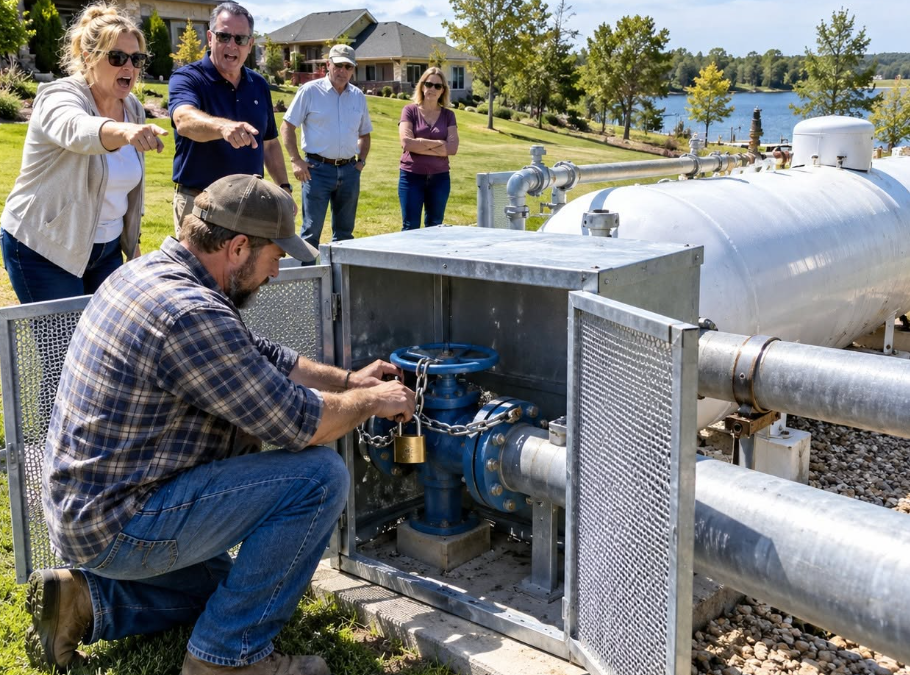
Abel installed a steel valve box with a lockout hasp over the common branch shutoff. He tagged it. Fire Marshal Calhoun signed the notice. Brenda photographed everything. Clearfield Fuel was notified not to fill the tank through any HOA request and to remove all auxiliary notes from my account.
By 9:30 a.m., the branch was secured.
By 12:18 p.m., my phone began ringing.
Unknown number.
Ignored.
Another.
Ignored.
Then Lydia Park left a voicemail.
“Raymond, please call me. The caterer says the pavilion kitchen won’t light. The outdoor heater contractor says there’s no gas pressure. Victor says you locked the tank. We have sponsors arriving tomorrow. Please. I don’t know what to do.”
I sat at my kitchen table and listened to it twice.
I did feel bad for her.
I did not unlock the valve.
At 1:04, Victor called.
I let it go to voicemail.
His message was shorter.
“Mr. Kowalski, your unilateral action is causing significant harm to the community. Restore service immediately.”
I forwarded both messages to Brenda.
At 1:22, Peter Lang emailed her, demanding immediate restoration of propane service and accusing me of tortious interference with an HOA event.
Brenda replied at 1:31.
Mr. Kowalski has not interfered with HOA property or services. The Association’s unauthorized use of Mr. Kowalski’s propane tank has been lawfully suspended under county fire marshal order due to lack of authorization, lack of metering, lack of inspection documentation, and lack of billing segregation. The Association remains free to obtain its own lawful propane supply.
I admired Brenda’s ability to make “buy your own gas” sound like a court ruling.
By 3:00 p.m., Clearfield Estates was in full panic mode.
The festival was scheduled for the next day. The forecast called for forty-one degrees and wind. The caterer had planned to use the pavilion kitchen and outdoor burners. The rented patio heaters were already delivered. The VIP donor dinner was supposed to be held under the covered pavilion with propane heat. The fire pits used propane. The hot cider station used propane.
All of it had depended on my tank.
My fuel.
My money.
My silence.
Lydia Park came to my door at 4:12 p.m.
She looked exhausted.
Her hair was pulled back badly, and she had a folder under one arm that was losing papers. She was not polished like Victor. She looked like a person trying to keep a train from derailing with both hands.
I opened the door but did not invite her in.
“Raymond,” she said. “I know I shouldn’t be here.”
“You shouldn’t.”
“I’m sorry.”
That stopped me.
Because it was not strategic.
It was immediate.
“I’m sorry,” she said again. “I didn’t know. I chair events. I don’t handle utilities. Victor told us it was an old easement. I should have asked more questions. I should have looked. But I didn’t know residents’ dues weren’t paying for that propane. I didn’t know you were.”
I believed her.
That did not change the valve.
“Lydia,” I said, “you need to rent temporary propane tanks and have a licensed contractor install them.”
“We tried. Everyone says too short notice.”
“That is not my fault.”
“I know.”
Her eyes filled, and she looked away quickly.
“There are kids performing tomorrow. A dance school. A veterans’ dinner. The raffle supports the community food bank. I know that doesn’t erase what happened to you, but this is not just Victor’s party.”
That was the first thing anyone had said that made me uncomfortable.
Not guilty.
Uncomfortable.
Because she was right.
The HOA had stolen from me.
Victor had hidden it.
The board had failed to ask questions.
But the children, veterans, caterers, volunteers, and food bank had not drained my tank.
They were about to pay socially for something they did not do.
I told Lydia to wait.
Then I called Brenda.
She listened.
Then said, “You are under no obligation to help them.”
“I know.”
“But you want to.”
“I don’t want people freezing because Victor is arrogant.”
“Then help safely, without reopening the unauthorized line.”
“How?”
“Offer technical guidance only. No fuel from your tank. No access to your system. Written agreement. They pay all costs. Fire marshal approval. Contractor installed. Temporary tanks placed on HOA property. And Victor does not get to present it as his solution.”
I almost smiled.
“That last part legal?”
“No. Personal.”
So I told Lydia what to do.
I gave her the names of three propane contractors with emergency event capability. I told her which one might still answer. I told her what size temporary tanks were likely needed for heaters versus cooking. I told her to separate the food service from patio heat, prioritize the kitchen, reduce heater zones, and move the VIP dinner inside the clubhouse if possible.
I did not unlock my tank.
I did not supply fuel.
I did not let anyone touch my system.
But I helped her keep the event from collapsing completely.
She stood on my porch taking notes, crying quietly, and saying thank you between sentences.
At the end, she said, “Victor will hate this.”
“Good.”
By the next morning, the festival looked different.
Temporary propane tanks sat on HOA property behind the pavilion, installed by a licensed contractor at emergency weekend rates so high even I winced. The caterer had limited burners. Half the patio heaters were canceled. The fire pits were decorative only. The VIP dinner moved indoors. The hot cider station switched to electric warmers. The bounce house company loaned extra extension cords. Volunteers wore jackets. Children still performed.
The event survived.
But the panic had exposed everything.
Residents saw the temporary tanks.
Residents heard the rumors.
Residents asked why emergency propane had been needed when the pavilion supposedly had gas service.
Residents wanted to know why Victor looked furious and Lydia looked like she had not slept.
Then Evan Brooks stood up during the sponsor thank-you speech and asked, loudly, “Victor, are we going to tell people why the pavilion lost propane?”
The microphone picked up enough of it.
The crowd shifted.
Victor tried to laugh it off.
“This is not the venue.”
Evan replied, “Funny, because this venue was apparently stealing gas from Raymond Kowalski for seven years.”
There are sentences a community cannot unhear.
That was one of them.
The festival did not end immediately.
But it changed shape.
People clustered in small groups. Volunteers whispered. Sponsors asked questions. The caterer told three people she had been given inaccurate utility information. Someone took photos of the temporary tanks. Someone else posted on the resident forum.
By evening, Clearfield Estates knew enough to be angry.
By Monday, they knew enough to be ashamed.
Brenda filed the full civil complaint that week.
Conversion.
Trespass.
Unjust enrichment.
Fraudulent concealment.
Negligence.
Interference with property.
Violation of consumer billing protections.
She sought reimbursement for every gallon paid by me and used by the HOA, plus interest, inspection costs, attorney fees, disconnection costs, and punitive damages against responsible individuals.
The discovery process was ugly.
It always is when people who thought emails were private learn that private does not mean invisible.
Victor had known.
Joyce Feld, the treasurer, had known more than she admitted but less than Victor. She had seen old budget references to “propane reimbursement” but assumed it had become part of a service contract. Martin Cale, maintenance chair, had authorized contractors to inspect the pavilion line but never verified the tank ownership. Lydia genuinely did not know. Evan did not know. Most residents had no idea.
Victor’s emails were the worst.
Three years earlier, Joyce had asked why there was no separate propane invoice for the pavilion.
Victor replied:
The legacy arrangement remains operational. No need to create a budget issue unless questioned.
Another email, sent after Brenda’s first letter:
Kowalski is a retired engineer type. He may be overanalyzing consumption. We should avoid acknowledging any obligation until counsel reviews exposure.
Then, after the lockout notice:
If he shuts us down before Fall Festival, we characterize it as hostile interference and resident endangerment.
Brenda read that last one aloud in her office.
Then she looked at me.
“He planned to blame you for stopping him from stealing.”
“I assumed.”
“You have excellent instincts.”
“I have excellent gauges.”
The HOA held an emergency community meeting two weeks after the festival.
This time, I attended.
Not because I wanted to.
Because residents deserved to hear the truth from someone who had kept records instead of rumors.
The clubhouse was packed. Folding chairs filled the main room. People stood along the walls. The temporary propane tanks were gone by then, but everyone knew where they had been.
Victor sat at the front table with a face like stone.
Lydia sat at the opposite end, pale but composed.
Evan sat beside her with a folder.
Joyce looked like she wanted to melt through the floor.
The HOA attorney sat behind Victor, whispering advice Victor mostly ignored.
Victor opened the meeting.
“We are here to address misinformation concerning a longstanding utility arrangement involving common-area propane service.”
Someone in the back shouted, “Did we steal from Raymond?”
Victor struck the gavel.
“Please maintain decorum.”
Evan stood.
“No.”
The room went silent.
Victor turned slowly.
“Excuse me?”
Evan faced the residents.
“I joined this board to help with playground repairs and pool hours. I did not join to conceal unauthorized fuel use. The residents deserve an accurate timeline.”
Victor said, “Evan, sit down.”
Evan did not.
He opened his folder.
“There was a temporary propane agreement with the previous owner. It terminated upon sale unless renewed in writing. It was not renewed. Mr. Kowalski was never reimbursed. The HOA continued drawing propane from his tank. His account paid for deliveries. When he discovered it, the board did not disclose the truth. We tried to preserve the arrangement through legal pressure.”
People started talking all at once.
Lydia stood next.
“I’m sorry,” she said.
The room quieted enough to hear her.
“I organized events using that pavilion for years. I thought fuel service was properly handled by the HOA. I was wrong not to verify it. I apologized privately to Mr. Kowalski, and I’m apologizing publicly now. The event should never have depended on fuel taken from a homeowner without his permission.”
That was what responsibility sounded like.
Not perfect.
Not complete.
But real.
Victor pushed back his chair.
“This is reckless and legally prejudicial.”
I stood then.
I had not planned to speak yet.
But I did.
The room turned toward me.
I walked to the front with my own binder.
Not burgundy.
Plain black.
The kind engineers use when they know people are about to argue with numbers.
“My name is Raymond Kowalski,” I said. “For seven years, propane from a tank on my property was used by HOA amenities without my permission. The gallons were billed to my account. I discovered it because the consumption did not match my use.”
I opened the binder.
“Here are delivery records. Here are invoices. Here are gauge logs. Here are photographs. Here is the old agreement with the previous owner stating it terminates upon sale unless renewed in writing. Here is the fire marshal lockout notice. Here is the contractor report identifying no separate meter.”
Victor leaned into his microphone.
“This is subject to litigation.”
“Yes,” I said. “Because you made it subject to litigation.”
A few people murmured.
I continued.
“I want something understood. I did not shut down your festival. I shut down an unauthorized fuel connection on my property after inspection by the fire marshal. When Lydia came to me for help, I gave her contractor contacts and technical guidance so your event could continue without using my tank.”
Lydia looked down.
I looked at the residents.
“You can be angry about the emergency cost. You can be angry about the embarrassment. You can be angry that your board failed to install a proper tank years ago. But do not be angry that I stopped paying for fuel I never agreed to provide.”
Arthur Bell, one of the older residents, stood with both hands on his cane.
“How much did we take?”
I looked at Brenda, who sat near the wall.
She nodded.
“Based on delivery records, estimated common-area consumption, and my personal usage, the HOA used approximately four thousand eight hundred gallons over seven years.”
A woman near the front whispered, “Oh my God.”
“At average delivered rates,” I continued, “plus fees and taxes, that is a little over fourteen thousand dollars in fuel charges paid from my account. That does not include inspection costs, legal fees, or the time value of money.”
The number was not enormous compared to some lawsuits.
But theft does not become acceptable because it arrives in monthly portions.
Victor said, “Those calculations are disputed.”
Brenda stood.
“They are documented.”
Victor’s attorney touched his shoulder.
Victor shook him off.
“This community has relied on that amenity system for years. Mr. Kowalski purchased a property with existing infrastructure. He cannot simply pretend there was no obligation attached.”
I looked at him.
“There was an obligation.”
The room quieted.
“Yours,” I said. “To ask.”
That landed harder than I expected.
Maybe because it was simple.
Maybe because everyone understood it.
The recall petition started that night.
Victor resigned before the vote.
He said he was stepping down to avoid distracting from community business.
Nobody believed him.
Joyce resigned too.
Martin Cale stayed long enough to help transition maintenance records, then left the board quietly. Lydia remained and later became interim president after Evan refused the position by saying he would rather “eat gravel.”
The settlement came six months later.
The HOA reimbursed me for the documented propane usage, inspection expenses, legal fees, lockout costs, and a negotiated damages amount. Victor personally contributed under the settlement because of his written knowledge and concealment. Clearfield Fuel also paid a smaller amount for failing to update account instructions and for continuing auxiliary delivery notes without verifying authorization after the property transfer.
But the bigger consequence was infrastructure.
The HOA had to install its own dedicated propane system on HOA property.
Proper tank.
Proper pad.
Proper permits.
Proper meter.
Proper emergency shutoff.
Proper labels.
Proper billing.
Abel Torres installed it.
At my recommendation.
Victor would have hated that.
Fire Marshal Calhoun inspected and approved it.
The old buried branch from my tank was capped, pressure-tested, and abandoned in place after documentation. The steel valve box remained for a while, then Abel removed the branch connection entirely.
For the first time since I moved into Clearfield Estates, my propane tank served only me.
That should have been the end.
But communities have memories, and so do people.
The following year, the Fall Festival happened again.
I did not plan to go.
Then Lydia called.
Not from an unknown number this time.
From her own.
“Raymond,” she said, “I know you probably want nothing to do with this event.”
“That is accurate.”
“We’re dedicating the food bank raffle in honor of residents who helped keep last year’s festival going.”
“I did not help for recognition.”
“I know. That’s why people want to recognize you.”
“No, thank you.”
She paused.
Then said, “There will be pie.”
“That is not a legal argument.”
“No. But it’s a good one.”
I went for twenty minutes.
That was the plan.
I stayed two hours.
The pavilion was warm, powered by the HOA’s own tank. The kitchen worked. The heaters worked. The fire pits worked. Children ran around with painted faces. Someone played guitar badly near the cider table. The food bank raffle raised more money than the previous year.
A small sign stood near the new propane enclosure.
AUTHORIZED SYSTEM — HOA PROPERTY
Installed after resident safety review
Ask before you use what you do not own
I stared at it longer than I meant to.
Evan appeared beside me with a paper plate.
“Too subtle?” he asked.
“You wrote that?”
“Lydia edited out my first version.”
“What did it say?”
“Don’t steal gas from engineers.”
I laughed.
For the first time since the whole mess began, I laughed without bitterness.
Lydia came over later and handed me a cup of cider.
“Everything running correctly?” she asked.
“Pressure looks stable.”
“You checked?”
“Of course I checked.”
She smiled.
“I figured.”
Across the pavilion, I saw families gathered under heaters that were finally connected to a system they owned and paid for. No hidden line. No quiet billing. No old agreement buried under years of convenience. Just proper equipment doing what it was supposed to do.
That should not have felt emotional.
It did.
Because I had spent most of my life believing systems matter. Not just machines and pipes, but human systems. Agreements. Records. Boundaries. Responsibilities. The little structures that allow people to live near each other without quietly taking what is not theirs.
When those systems fail, somebody always pays.
For years, that somebody was me.
Not anymore.
A month after the festival, I removed the old ornamental grass around my tank. It had hidden too much. I replaced it with gravel and clear access space. Abel helped me install new labels.
PRIVATE PROPANE SYSTEM
NO HOA ACCESS
EMERGENCY CONTACT: OWNER
It was not decorative.
I liked it anyway.
On a cold Saturday morning, I stood by the tank with a cup of coffee and checked the gauge.
Seventy-six percent.
I checked my notebook.
Exactly where it should have been.
No unexplained drop.
No mystery consumption.
No silent leak of money, fuel, and trust.
Just a number that made sense.
You cannot imagine how satisfying that is unless you have spent years watching numbers lie because someone else was hiding the truth behind them.
Clearfield Estates eventually became quieter.
Not perfect.
No HOA becomes wise overnight.
People still argued about fence stain, pool hours, and whether inflatable holiday decorations were cheerful or evidence of social collapse.
But residents read budgets more carefully.
Board meetings got longer because people asked questions.
Contracts were reviewed.
Old arrangements were audited.
Easements were explained in plain English.
The new board created a policy requiring written legal review before using any infrastructure not clearly owned by the association.
That policy was informally called the Kowalski Rule.
I pretended to dislike that.
I did not dislike it as much as I claimed.
Victor sold his house the next spring.
He never apologized.
That surprised no one.
The day the moving truck came, I saw him standing near his driveway, arms crossed, watching movers carry out furniture. For a moment, he looked toward my house.
I lifted one hand.
Not a wave exactly.
More like a period at the end of a sentence.
He looked away.
That was fine.
Some people can leave a place without ever understanding what they did to it.
Understanding was no longer my problem.
That evening, I sat in my garage with the portable heater running on my own propane, paid for by me, used by me, flowing through a line that went nowhere near the HOA.
The flame burned steady behind the metal grille.
Blue.
Clean.
Predictable.
I opened my notebook and wrote one final entry.
November 18. Tank 74%. Consumption normal. Problem resolved.
Then I closed the notebook.
For seven years, the HOA had treated my tank like a community resource, my bank account like a reserve fund, and my silence like consent.
They thought I would never notice because most people do not think in gallons, pressure, and flow.
They forgot something simple.
A quiet man is not always unaware.
Sometimes he is measuring.
Sometimes he is documenting.
Sometimes he is waiting until every valve, invoice, delivery ticket, and hidden line tells the same story.
And when that happens, he does not have to shout.
He just locks the box.
Lets the phones ring.
And waits for the people who took from him to finally understand what they lost.