The HOA Secretly Drained My Ranch for 8 Years—Then I Closed One Rusted Valve and 312 Luxury Homes Lost Water in 43 Minutes.
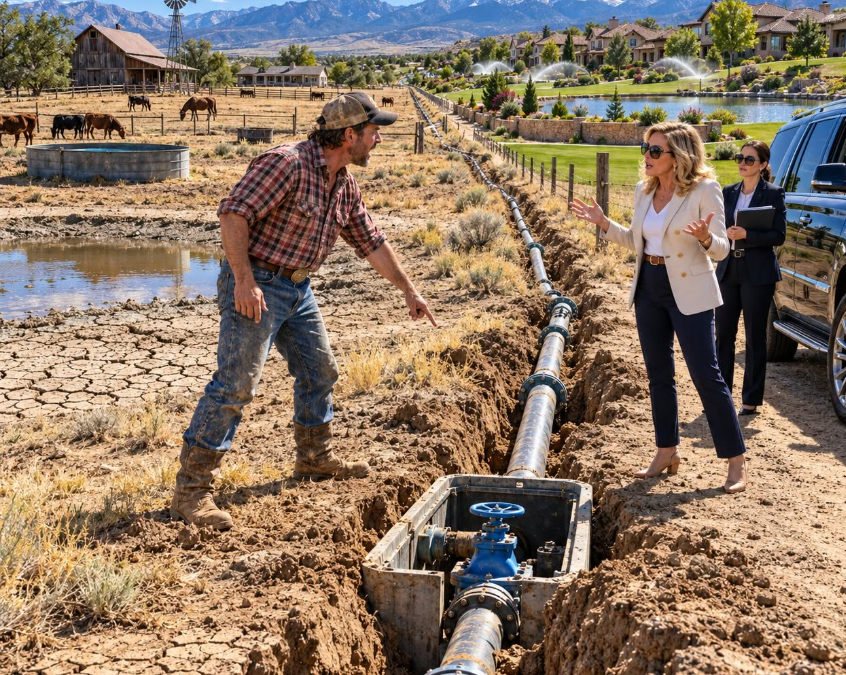
PART2:
Then I began doing the calculations I had been avoiding because I already knew I would not like the answer.
Pump run time.
Well output.
Pressure drop.
Storage recovery.
Estimated unaccounted flow.
I did the math once.
Then again.
Then a third time because a man alone in a ranch office at midnight will sometimes recalculate a nightmare hoping arithmetic becomes merciful.
It did not.
Approximately 190,000 gallons per day were disappearing from my system.
Not per week.
Per day.
Enough water to supply a small neighborhood.
Enough water to destroy a pasture if it were leaking openly.
Enough water that there should have been mud, sinkholes, washed-out soil, saturated draws, or a visible plume somewhere along the buried line.
There was nothing.
Water does not vanish.
People make it vanish.
That was the thought I did not want to have.
I stood in the equipment shed with a flashlight in one hand and my notebook in the other, listening to pump number three grind through another long cycle in the dark.
Somewhere on my ranch, a line was feeding something it had no right to feed.
The next morning, I started pulling records.
My father’s records.
Walter Holloway did not trust computers.
He did not trust digital mapping, online banking, cloud storage, automatic payments, GPS collars, smart meters, or any machine that required a password he couldn’t write on masking tape and stick inside a drawer.
When I was younger, that drove me crazy.
“Dad,” I used to tell him, “paper burns.”
“So do computers,” he would answer.
“Computers don’t burn unless your office burns.”
“Exactly.”
Walter kept everything.
Tax receipts. Pump manuals. Well logs. Hand-drawn maps. Deeds. Easement agreements. Notes from phone calls. Photographs of repairs. Empty seed bags with flow calculations written on the back. A coffee can full of brass tags from valves he had replaced in 1989.
After he died, I spent two weeks trying to organize his office and six months avoiding it afterward.
There were too many ghosts in those drawers.
My father and I had not ended well.
That matters.
If you want to understand why finding that pipe broke something open in me, you have to understand Walter Holloway.
We loved each other. I believe that now.
But love can be buried under pride so deep that by the time you dig it up, one of you is gone.
My father wanted me to stay on the ranch. I wanted pipes, systems, cities, blueprints, pressure models, and a life that did not require me to pull calves at two in the morning during a blizzard. He took my leaving as betrayal. I took his silence as punishment.
For years, we spoke in weather reports and cattle prices.
When my mother died, we stood beside her grave with three feet between us and did not know how to cross it.
Near the end of his life, he started calling more often. Not to talk about feelings. Walter would have rather wrestled a bull with one arm tied than talk about feelings. He called about strange things.
Pump cycles.
Unauthorized survey stakes.
A white utility truck near Willow Draw.
A woman from the new development asking about water rights.
At the time, I thought grief and age had made him suspicious.
“Dad,” I told him once, impatient after a long city council meeting, “if someone is taking water, you need evidence.”
“I got ears,” he said.
“That’s not evidence.”
“You always did think paper knew more than land.”
“I think measurements matter.”
“So measure.”
“I’m three hours away.”
“Then maybe you ought to come home.”
That was the last real argument we had.
I did not come home that week.
Or the next.
A month later, he had a stroke in the north barn and lay on the cold concrete until a neighbor found him.
He lived two more weeks in the hospital.
I arrived in time to hear him say my name once.
Grant.
That was all.
Not I forgive you.
Not I’m sorry.
Not check the water.
Just my name, spoken like he was trying to hand me something too heavy and did not have strength left.
Nine years later, I stood in his office surrounded by paper and understood I had been late to more than his deathbed.
I pulled down every map from the shelf above his desk.
Old ranch water layout.
Wellfield sketches.
Irrigation lines.
Valve locations.
County road crossings.
The lower storage tank profile.
Most were familiar.
Then I found one I had never seen.
It was folded inside a manila envelope marked in Walter’s handwriting:
NORTH LINE — DO NOT TRUST COUNTY COPY.
My stomach tightened.
I opened it carefully.
The map showed the lower wellfield and pump number three’s distribution route, drawn in pencil and blue ink. My father had marked all known valves, line depths, and fittings. Along the far eastern edge of the ranch, near Willow Draw, a section was circled in red.
Beside it, he had written:
Noise after midnight. 2016.
Pressure drop follows Sterling Oaks fill cycle?
Possible unauthorized tap?
Find valve before they do.
Sterling Oaks.
Two miles east of my property line, Sterling Oaks was not a ranch, despite every road name trying to pretend otherwise.
It was a gated luxury subdivision built on what used to be the old Kincaid sheep place. Three hundred twelve homes. Stone entry monuments. Artificial ponds. Pickleball courts. Fiber internet. A clubhouse with a copper roof and a view of mountains so distant they looked borrowed.
Its residents drove vehicles that cost more than my first house. Its HOA newsletter used words like legacy, stewardship, and prairie elegance. Its president, Patricia Wexler, had once mailed me a letter complaining that my cattle were visible from their western walking trail and “diminished the premium rural aesthetic promised to homeowners.”
I mailed it back with a sticky note that said:
They were here first.
Patricia Wexler did not appreciate humor.
She was in her early sixties, tall, silver-haired, and permanently composed in a way that made other people feel underdressed. A former real estate attorney from Denver, she had moved to Sterling Oaks early and quickly became the HOA president, chair of the architectural committee, informal mayor, and social executioner.
People like Patricia do not ask.
They frame demands as standards and standards as inevitability.
Eight years earlier, while my father was still alive, Sterling Oaks had been expanding its amenities and fighting with the county over water capacity. I remembered reading something about it in the local paper. The developer had promised a private community water system fed by permitted wells and storage tanks. Then the wells underperformed. Then costs rose. Then the developer went bankrupt. Then the HOA took over the system through a complicated settlement that nobody outside Sterling Oaks understood.
At least, that was the public version.
I looked at my father’s red circle.
Possible unauthorized tap.
My mouth went dry.
I found more notes in the envelope.
Pressure log sheets.
Dates.
Times.
Numbers.
My father had been tracking pump number three years before I noticed.
2016: night cycling
2017: increased draw
2018: unexplained demand after Sterling Oaks Phase III opens
2019: Wexler asks about “regional emergency interconnect” — said no
2020: survey stakes east draw, removed
2021: county water board says no record of Holloway connection
2022: check valve noise under frost line?
Then, at the bottom of one page:
Grant would know.
That sentence hit harder than accusation.
Grant would know.
Not Grant doesn’t listen.
Not Grant thinks I’m crazy.
Grant would know.
He had wanted me.
He had needed me.
And I had been too proud, too tired, too certain that my father was just an old rancher suspicious of change.
I sat in his chair and pressed my fist against my mouth.
For the first time in nine years, I cried for him in a way that was not self-pity.
Then I got to work.
The first thing I did was locate the valve my father had mentioned.
The ranch water system was old but not primitive. My grandfather had started with wells and gravity tanks. My father added buried distribution lines and booster pumps. I modernized parts of it after inheriting the land, though I never fully trusted the old north line because records were inconsistent.
Walter’s map showed a service valve buried near a dry wash west of Willow Draw. According to the original design, it was part of an abandoned ranch extension intended to supply a future calving barn that was never built. My father had marked it with a triangle and the words:
Do not abandon. Keep closed unless testing.
That valve did not appear in the county copy.
It did not appear in the digital ranch map I had built after inheriting the property.
It did not appear on any utility record I could find.
But Walter had drawn it.
That meant it existed.
I spent half a day walking the draw with a metal detector, probe rod, and shovel.
The wind cut across the ridge hard enough to make my eyes water. Sagebrush scraped my jeans. The ground was dry and stubborn. Twice, I thought I found the valve box and dug up nothing but rocks and old fencing wire. By midafternoon, my back hurt, my knees ached, and I was angry at a dead man for hiding things too well.
Then the probe hit metal.
Hollow.
A valve lid.
Buried under eight inches of packed dirt and grass roots.
I cleared it by hand.
The lid was rusted but intact.
No markings.
No sign anyone had touched it in years.
I pulled it up and shined my flashlight down.
A valve stem.
Old.
Rusted.
Real.
My heart started beating harder.
I drove back to the shop, got a valve key, and returned just before sunset.
For ten minutes, I stood over that hole and did not turn it.
Because once I did, the question would stop being theoretical.
If nothing happened, my father had been wrong, and I had spent weeks chasing ghosts.
If something happened, my father had been right, and I had spent years dismissing the only person who had tried to tell me.
Finally, I set the valve key onto the stem.
I turned it one quarter rotation clockwise.
It resisted.
I leaned harder.
The old valve gave a groan that came up through the steel key and into my hands.
Half turn.
Full turn.
Another.
The sound changed beneath the ground.
Not loud.
But there.
Flow shifting.
Water pressure pushing against something that had just been denied.
I closed the valve completely.
Then I walked back to the pump shed and waited.
Twenty minutes later, pump number three stopped.
For the first time in weeks, the system sat quiet.
I checked the gauge.
Pressure rising.
Normal.
I checked again.
Still normal.
I stood in the shed with one hand on the pump housing, feeling the warmth fade from the motor.
“Dad,” I whispered.
The word broke in my throat.
I did not leave the valve closed that day.
Not yet.
I opened it again after testing because I did not know what I was cutting off, and despite what people later claimed, I was not reckless. If there was an illegal connection, I needed documentation, not a dramatic gesture that could hurt innocent people.
But now I knew.
Something beyond that valve was taking water.
A lot of it.
I spent the next ten days gathering proof.
I installed temporary flow meters.
I logged pump cycles every hour.
I compared pressure with the valve open and closed.
I collected acoustic readings along the buried line.
I pulled satellite imagery from prior years.
I filed public records requests with the county, the state engineer’s office, and the rural water district.
I called an old colleague named Nora Vasquez, one of the sharpest water rights attorneys in Wyoming.
Nora had once told a mayor in a public meeting that his understanding of water law sounded like “a brochure written by a horse.” I trusted her.
She drove out two days later in a mud-splattered Subaru and stood beside me at the valve site, gray hair tucked under a wool hat, reading my father’s map.
“You think Sterling Oaks tapped your private ranch line?” she asked.
“I think it’s more than that.”
“How much more?”
“Roughly 190,000 gallons a day.”
She looked up slowly.
“That is not a leak.”
“No.”
“That is a system.”
“Yes.”
She folded the map.
“Grant, before you do anything, understand this. If they have been taking that water for eight years, money has moved. Assessments. Utility charges. Maintenance fees. Maybe developer reimbursements. Maybe state filings. People don’t hide water for fun.”
“I know.”
“No. You know hydraulics. I know thieves with paperwork.”
We walked the pasture line to the east boundary.
From the ridge, Sterling Oaks looked peaceful.
Red roofs.
Stone walls.
Thin ribbons of road curving through prairie grass they had replanted after bulldozing the actual prairie grass.
Artificial ponds glittered in the distance.
A maintenance building stood near the western edge, much closer to my ranch than any of their brochures showed.
Nora shaded her eyes.
“Who runs their water system?”
“HOA-controlled utility association, I think.”
“You think?”
“That’s the public story.”
“Then we find the real one.”
She was right.
The real one was worse.
Sterling Oaks had been charging each household a monthly “water infrastructure stabilization fee” averaging $126 per home. On top of that, homeowners paid usage rates, reserve contributions, and a special assessment for “emergency source redundancy” after the developer went bankrupt.
Over eight years, those charges added up.
Nora estimated $4.73 million had moved through accounts tied to water infrastructure, maintenance, emergency supply, and debt repayment.
Yet county filings showed no completed regional interconnect, no new permitted high-output well, no purchased wholesale water contract sufficient for their demand, and no lawful easement across Holloway Spur.
“What were they selling?” Nora asked one evening at my kitchen table, papers spread across the surface.
“Water they didn’t own.”
“No,” she said. “They sold confidence. The water was just how they delivered it.”
The next document we found made my hands go cold.
It was a 2015 memorandum submitted during Sterling Oaks Phase III approval.
Water Supply Contingency: Western Emergency Intertie.
The attached exhibit showed a twelve-inch main running west from Sterling Oaks toward my ranch, stopping at the property boundary.
Not crossing it.
The note read:
Future connection subject to easement negotiation with Holloway Spur Ranch.
Future.
Subject to negotiation.
There had never been negotiation.
Not with me.
Not with my father, according to his notes.
But someone had built the line anyway.
The question was who approved crossing my land.
The answer came from a forged easement.
Nora found it in a county archive, misfiled under a road access category rather than water utility records. A one-page document dated 2016. It claimed Walter Holloway had granted Sterling Oaks Community Water Cooperative a subsurface utility easement across the northeast corner of the ranch for emergency water transmission and related infrastructure.
My father’s signature sat at the bottom.
Notarized.
Recorded.
I stared at it until the letters blurred.
“That’s not his signature,” I said.
Nora leaned closer.
“You’re sure?”
“My father wrote like he was carving words into wood. This is too smooth.”
“Could his stroke have affected—”
“He had the stroke in 2014?”
“No. 2023.”
Nora nodded. “Then we’ll get an expert.”
I kept staring.
The witness name beneath it was Patricia Wexler.
The notary was Elaine Porter, who I recognized as the former administrative assistant for the Sterling Oaks developer.
The document contained no payment amount.
No metes and bounds description sufficient for a real easement.
No engineering exhibit.
No mention of water rights.
No county water board approval.
No state engineer review.
It was exactly the kind of document a confident liar creates when she expects nobody to read it closely.
But my father had read land the way I read pressure.
He had known.
He just had not been able to prove it before death took the shovel out of his hands.
The morning I closed the valve for good, frost silvered the low grass.
It was October 16.
I woke at 4:30 and lay in bed staring at the dark ceiling, listening to wind move around the corners of the old ranch house.
My father had built that house in stages.
The kitchen first, because my mother said she could live without a finished bedroom but not without a decent place to cook. Then the bedrooms. Then the porch. Then the office. Every room carried some evidence of his hands. A slightly uneven doorframe. A shelf too sturdy for what it held. A patch in the hallway drywall where he once lost patience moving a cabinet.
I made coffee.
I did not drink it.
At 5:12, Nora arrived with a thermos, her coat buttoned wrong, and legal documents in a folder under one arm.
At 5:31, my neighbor Pete Laramie pulled in with his pickup because he had offered to witness the valve operation. Pete was seventy, half deaf, and had once punched a county assessor for calling his corrals “unimproved structures.” Good witness. Bad diplomat.
At 5:44, I called the sheriff’s office non-emergency line and reported that I would be isolating a private ranch water valve due to suspected unauthorized use and potential theft. The dispatcher sounded confused but logged it.
At 6:08, we reached the valve box.
The eastern sky was just beginning to pale.
Sterling Oaks sat invisible beyond the ridge, still asleep behind gates and stone pillars, unaware that eight years of stolen certainty were about to lose pressure.
Nora turned on her phone camera.
“State your name,” she said.
“Grant Holloway.”
“Location?”
“Northeast section of Holloway Spur Ranch, private water distribution valve identified in Walter Holloway ranch map and confirmed by field testing.”
“Purpose?”
“To isolate unauthorized flow from the Holloway private water system pending legal review.”
My hand closed around the valve key.
For a moment, I could feel my father beside me.
Not as a ghost.
As weight.
As expectation.
As all the times he had called and I had said later.
Nora said softly, “Grant?”
I looked down into the valve box.
“I’m sorry, Dad,” I whispered.
Then I turned the key.
One turn.
Two.
Three.
The valve fought me.
Rust, age, pressure, and eight years of being left open against the truth.
I leaned my shoulder into it.
The stem moved.
The underground pipe groaned faintly.
At 6:17 a.m., the valve closed.
Forty-three minutes later, Patricia Wexler was screaming at my gate.
She arrived in a white Range Rover with Sterling Oaks HOA decals on the doors and rage bright enough to warm the frost. Behind her came two more vehicles, then a maintenance truck, then three homeowners in pajamas and winter coats.
By the time I reached the front gate, she was already out of her vehicle, pounding on the metal with both hands.
“Grant Holloway!”
Pete, standing beside me with a travel mug, muttered, “Sounds like your water test worked.”
Nora shot him a look.
I walked to the gate but did not open it.
Patricia stood on the other side wearing a camel coat over what looked like silk pajamas, her silver hair pulled back too tightly, her face flushed with fury.
“What did you do?” she demanded.
“Good morning, Patricia.”
“Do not play games with me. You shut off our water.”
“Your water?”
Her eyes flashed.
“Sterling Oaks has no pressure. Three hundred twelve homes have no water. The clubhouse is down. The fire suppression system is alarming. You sabotaged a $2.4 million community water system.”
I looked past her at the people gathering behind the Range Rover.
A young father holding a toddler wrapped in a blanket.
An older woman with curlers in her hair.
A man in a fleece vest filming with his phone.
A Sterling Oaks maintenance worker looking pale enough to faint.
I did not argue with Patricia.
By then, I already knew the question that was going to unravel eight years of lies.
Why was their twelve-inch water main buried six feet under land my family had owned for three generations?
I held up the copy of the forged easement.
“Tell them about this.”
Patricia’s eyes dropped to the paper.
For the first time since I had known her, her face went still in a way that was not control.
It was fear.
She recovered fast.
“That is a recorded utility easement.”
“No,” I said. “It’s a crime scene with a notary stamp.”
Gasps rose behind her.
The man filming stepped closer.
Patricia turned sharply. “Stop recording.”
He did not.
A woman called out, “Patricia, what is he talking about?”
Patricia did not look back.
“Mr. Holloway is attempting to extort the association by disrupting essential service.”
Nora stepped beside me.
“My name is Nora Vasquez. I represent Mr. Holloway. Sheriff’s deputies are on their way. So are county water officials. I would advise everyone present to preserve communications and records relating to Sterling Oaks water supply, the western intertie, and any assessments collected for infrastructure stabilization.”
The phrase infrastructure stabilization did what my accusation had not.
Homeowners reacted.
Because they knew those words.
They had paid those bills.
A man shouted, “That’s the fee on our statement.”
Another said, “Western intertie? Patricia said that was never activated.”
Patricia’s jaw tightened.
“This is not the forum.”
Pete laughed. “Lady, looks like the forum drove itself here.”
Patricia pointed at him. “Who are you?”
“Man with water at my house.”
That did not help.
The sheriff arrived at 7:26.
Sheriff Caleb Dorsey had a weathered face and a habit of pausing before he spoke, which made impatient people expose themselves. He listened to Patricia first because she was loudest. Then he listened to me because Nora handed him documents.
The forged easement.
My father’s map.
Flow calculations.
Valve test logs.
Photos of the valve box.
Public filings showing Sterling Oaks had no recorded lawful connection.
Sheriff Dorsey read longer than Patricia liked.
“This is a civil property dispute,” she insisted.
He did not look up.
“Maybe.”
“It is. Mr. Holloway cannot simply cut off water to hundreds of homes.”
I said, “I closed a private valve on my ranch.”
“You interfered with an essential utility.”
“You built your utility under my land.”
Patricia snapped, “We have an easement.”
Nora said, “We dispute the validity of that easement and have evidence of forgery.”
That word spread through the homeowners like fire through dry grass.
Forgery.
Patricia turned on Nora.
“You should be very careful.”
Sheriff Dorsey finally looked up.
“Mrs. Wexler.”
She faced him.
“Careful with threats at my scene.”
“My community is without water.”
“And I’m trying to determine why.”
He turned to me.
“Grant, is there a way to restore temporary flow without compromising evidence?”
I knew that question was coming.
“Yes.”
Patricia pounced. “Then do it.”
I looked at the homeowners.
Not at her.
At them.
At the toddler in the blanket.
At the older woman hugging herself in the cold.
At people who had woken up to dry taps and no idea that their community had been built on a lie running under my pasture.
“I can restore limited flow temporarily,” I said. “Under written emergency agreement, with the county present, without recognizing any easement, and with Sterling Oaks paying for metering, backflow protection, and immediate inspection.”
Patricia laughed sharply.
“You think you can dictate terms during an emergency you created?”
Nora said, “The emergency was created eight years ago.”
A county water official arrived at 8:10.
Then the state engineer’s local representative.
Then a crew from a private utility contractor Sterling Oaks used for maintenance.
By noon, a temporary emergency agreement had been drafted in the bed of Sheriff Dorsey’s truck while Patricia made phone calls and homeowners shouted at one another near the road.
I reopened the valve at 12:34 p.m.
Not fully.
Enough to restore limited pressure while investigators documented the system.
Sterling Oaks got water back.
But not trust.
Never trust.
Once pressure returned, the real collapse began.
People sometimes think the dramatic moment is the valve closing.
It wasn’t.
The dramatic moment was the week after, when Sterling Oaks residents began receiving copies of documents they had never been shown.
Their monthly fees.
Their annual budget reports.
The water reserve fund.
The emergency intertie assessment.
The developer settlement.
The forged easement.
The state engineer’s letter saying no independent water right existed for the volume Sterling Oaks had been using through the unauthorized connection.
Patricia had not merely stolen water.
She had built a financial machine around pretending she hadn’t.
The original developer, Redstone Communities, had underbuilt the water supply. Their wells could handle early phases but not full buildout. When Phase III homes sold faster than expected, the system began failing pressure tests. Instead of delaying construction or paying for a lawful wholesale connection, Redstone negotiated quietly with Sterling Oaks’ early HOA leadership, including Patricia, to create a “temporary emergency intertie” westward.
My father refused.
There were notes proving it.
A 2016 letter from Walter Holloway to Redstone:
I will not grant an easement for Sterling Oaks water transmission. Holloway Spur wells and distribution infrastructure serve agricultural operations only. Any attempt to access, connect, cross, or burden this land without written agreement will be treated as trespass.
The letter was stamped received.
Two months later, the forged easement appeared.
Three months after that, a contractor trenched across a remote section of my ranch while my father was hospitalized for pneumonia, according to his medical records and Pete Laramie’s memory.
“They told us it was county drainage work,” Pete said later in a sworn statement. “Had orange cones and everything. I thought Walter approved it. Didn’t know he was in Cheyenne hospital then.”
They buried a twelve-inch main six feet down, tied into the old ranch extension beyond the hidden valve, and connected it to Sterling Oaks’ western pump house.
Then they charged homeowners for the privilege of being deceived.
For eight years.
$4.73 million in water infrastructure stabilization fees, emergency source charges, reserve transfers, and maintenance assessments.
Some money paid for legitimate repairs.
Some paid debt.
Some disappeared into consulting contracts, management fees, legal expenses, and “system oversight” payments to entities tied to Patricia Wexler, Redstone’s former executives, and a water consultant named Alden Price.
Alden Price became important.
He had signed off on the “emergency intertie compliance summary” stating that all easements had been secured and all supply rights were “adequate for community demand.”
He had also notarized one of the internal documents referencing my father’s supposed consent.
Alden was retired by then.
He lived in Arizona.
Nora found him before investigators did.
Not physically.
On paper.
Payments to Price Water Strategies continued for six years after the intertie was built. Annual consulting fee: $82,000. Scope: water security, regulatory compliance, intertie monitoring.
Intertie monitoring.
That meant they knew it existed.
The HOA board minutes told a different story.
Every year, Patricia reported that Sterling Oaks’ water system was “independent, stable, and protected through layered redundancy.” She told residents the western source existed only as an emergency backup. She said regulatory approvals were complete. She said the fees were necessary because “rural luxury living requires private infrastructure discipline.”
People paid.
Because the faucets worked.
Because their lawns stayed green.
Because the entrance ponds stayed full.
Because no one wanted to believe their million-dollar homes depended on stolen ranch water and a forged signature from an old man they had been told was difficult.
The first town hall after the valve incident was held in the Sterling Oaks clubhouse.
I did not want to go.
Nora said I should.
“Why?” I asked.
“Because if you don’t show up, Patricia owns the room.”
“She can have it.”
“No. She has had it for eight years.”
So I went.
The clubhouse looked like a ski lodge designed by someone who had never been cold. Stone fireplace. Exposed beams. Leather chairs. Large windows framing a decorative pond that had likely been filled with my water.
Nearly three hundred residents packed the room.
Some stood along the walls. Some sat on the floor. A few glared at me like I had personally drained their showers. Others looked frightened. Most looked betrayed before the meeting even started.
Patricia sat at the front table in a cream blazer, flanked by two attorneys.
She had not resigned.
Of course she hadn’t.
People like Patricia do not step down when exposed. They reframe exposure as persecution.
The HOA treasurer, a thin man named Lloyd Decker, tried to call the meeting to order. His hands shook so badly the microphone squealed twice.
Patricia took over.
“We are here tonight,” she began, “because our community has been attacked.”
A sound moved through the room.
Not agreement.
Unease.
She continued.
“A neighboring ranch owner unilaterally disrupted our water supply, placing families, seniors, and fire safety at risk. While he now circulates inflammatory claims, the board has always acted in good faith based on professional guidance.”
A woman shouted, “Did you forge the easement?”
The room erupted.
Patricia raised her hands.
“I will not respond to defamatory accusations.”
A man stood. “We paid that stabilization fee for seven years. Where did the money go?”
“Our reserves were managed appropriately.”
“Then why are we using his water?”
“Our water system includes multiple components.”
“That’s not an answer.”
Patricia’s attorney leaned toward her.
Nora whispered to me, “Let them ask first.”
I stood in the back, hat in my hands, wishing I were anywhere else.
Then an older man near the front turned around.
“Mr. Holloway.”
The room quieted.
He was maybe seventy-five, with oxygen tubing under his nose.
“Did your father sign that easement?”
“No.”
My answer was not loud.
It did not need to be.
Patricia said, “That is his opinion.”
I looked at her then.
“No. My opinion is that you’re a thief. The signature is a fact.”
People inhaled sharply.
Her eyes narrowed.
“There he is,” she said. “That hostility is exactly what this board has endured from the Holloways for years.”
Something inside me went cold.
“The Holloways?” I said.
She smiled, sensing an opening.
“Your father was combative, Mr. Holloway. He repeatedly refused reasonable cooperation with Sterling Oaks and made unsupported accusations against respected professionals. We accommodated his confusion as kindly as possible.”
Confusion.
That word did it.
Not thief.
Not liar.
Not difficult.
Confusion.
She was trying to turn my dead father into a senile obstacle in front of the people who had benefited from stealing from him.
I walked to the front.
Nora whispered, “Grant.”
But I kept moving.
The room parted.
Patricia watched me with that slight superior tilt of her head.
I stopped ten feet from the table.
“My father was many things,” I said. “Hard. Proud. Stubborn enough to argue with thunder. He could hold a grudge so long it should’ve paid property tax.”
A few people laughed nervously.
“But he was not confused.”
My voice shook once.
I let it.
“He heard your system taking water before I did. He tracked the pressure drops. He wrote down pump cycles. He warned Redstone. He warned the county. He told me, and I didn’t listen because I thought he was old and angry and maybe losing the thread.”
The room went still.
I held up Walter’s map.
“This is his work. These are his numbers. This is the valve he found but did not close because he wasn’t willing to hurt 312 households without proof. He died before he got that proof. So if you want to call someone confused, Patricia, you can start with everyone in this room who confused your confidence for honesty.”
The silence afterward felt like weather pressure before a storm.
Then the older man with oxygen stood slowly.
“I move to suspend Patricia Wexler from all board authority pending investigation.”
The room exploded.
Patricia’s attorney objected.
Residents shouted.
Lloyd Decker looked like he might faint.
Nora smiled for the first time all week.
The vote was messy, loud, and legally imperfect.
But politically, Patricia Wexler ended that night.
She walked out before the meeting adjourned, her cream blazer bright under the clubhouse lights, her face set in stone. Homeowners parted, but no one spoke to her. No one defended her. No one followed.
Outside, she found me near my truck.
For a moment, I thought she would keep walking.
She didn’t.
“This isn’t over,” she said.
“No.”
“You think because you have a sad story about your father, that makes you righteous?”
“No.”
“You shut off water to families.”
“I exposed why they depended on mine.”
“You could have come to me privately.”
I stared at her.
“My father did.”
Her face changed.
Just a flicker.
Enough.
“He came to you, didn’t he?” I said.
She said nothing.
“When?”
She looked toward the clubhouse, where angry voices still rose behind the glass.
“He was unreasonable.”
The words were quiet.
But there it was.
Not denial.
Memory.
I stepped closer.
“What did he say?”
She looked back at me, and for the first time I saw the person beneath the polish. Not a mastermind. Not a queen. A woman who had built so many layers of justification that truth could only reach her as irritation.
“He said we were stealing,” she said.
“You were.”
“He had no vision.”
“He had a deed.”
“He had more water than he needed.”
I almost laughed.
Not because it was funny.
Because after all the lawyers and fees and forged papers, the moral logic was that simple.
He had more than we needed him to have.
“You don’t get to decide that,” I said.
She leaned in.
“Communities require sacrifice.”
“Then sacrifice your own.”
Her face hardened.
“My residents will suffer because of you.”
“No, Patricia. They suffered because you sold them a lie and called the invoice a fee.”
She walked away.
Two weeks later, investigators searched the Sterling Oaks management office.
That was the beginning of the official unraveling.
Computers seized.
Financial records subpoenaed.
Bank accounts traced.
Alden Price interviewed.
Elaine Porter, the notary, found living in Rapid City and suddenly very interested in cooperating after being shown the forged signature and a series of payments routed through a consulting account.
The truth came out in pieces.
Elaine admitted she had notarized the easement without Walter present. She claimed Patricia brought the document and said Walter had signed it but was too ill to appear. Elaine said Redstone’s attorney assured her it was acceptable under “emergency project circumstances.”
It was not acceptable.
Alden Price admitted he knew the easement was questionable but had been told “the old man would come around.” When he realized Walter would not, he drafted language vague enough to satisfy lenders and county reviewers without explicitly stating the intertie was lawful.
Redstone’s former development manager admitted the unauthorized connection was supposed to be temporary until a regional water district agreement was finalized.
That agreement failed.
The connection remained.
The money kept flowing.
So did my water.
Patricia maintained she relied on professionals.
Professionals maintained Patricia pressured them.
Everyone involved pointed at everyone else with hands wet from the same bucket.
Meanwhile, Sterling Oaks had to face reality.
Without Holloway water, their system could not support full daily demand. Their own wells produced less than promised. Storage was insufficient. Fire flow reliability was questionable. Lawn irrigation had masked shortages for years because my ranch system had quietly carried their peak loads.
The county ordered emergency conservation measures.
No lawn watering.
No pond refilling.
No clubhouse showers.
No decorative fountains.
The “prairie elegance” went brown in six weeks.
Homeowners who once complained about my cattle began attending water board meetings with binders.
A few came to my gate.
Most came angry.
Then ashamed.
Then tired.
One woman named Marcy Alden brought banana bread and cried before I opened the gate.
“My husband said terrible things about you online,” she told me.
“I saw.”
“He deleted them.”
“That fixes the internet, then.”
She gave a wet laugh.
“We didn’t know.”
“I believe that.”
“But we didn’t want to know either.”
That was harder.
“Yes,” I said. “That part is yours.”
She nodded.
“We have two kids. We bought there because they promised stability. Safe water. Good schools. Community. We thought the fees were just what it cost.”
“That’s how schemes work.”
She looked past me toward the ranch.
“Did your father really know?”
“Yes.”
“I’m sorry nobody listened.”
I accepted the banana bread.
Not because bread repairs theft.
Because sometimes apology needs somewhere to sit.
Winter came hard that year.
The kind of Wyoming winter that does not arrive so much as occupy.
Snow packed against the north fences. Water tanks froze if heaters failed. Cattle grew shaggy and patient. The wind hit the house at night like something trying to get in.
The legal fight slowed but did not stop.
Nora filed suit to quiet title, invalidate the forged easement, recover damages for unauthorized water use, trespass, unjust enrichment, and injury to ranch infrastructure. The state engineer opened a water rights enforcement action. The attorney general’s office joined the financial investigation. Homeowners filed a class action.
People kept asking how much water Sterling Oaks stole.
The number varied depending on dates and flow assumptions, but our conservative calculation put it at more than 500 million gallons over eight years.
Half a billion gallons.
From wells my grandfather drilled.
Through pipes my father maintained.
Under land my family paid taxes on.
For a community that called us unsightly.
I thought knowing the number would make me angrier.
Instead, it made me sad.
Water is not just a commodity on a ranch.
It is survival.
It is calves in August.
Grass in drought.
Fire protection.
A kitchen tap after breaking ice all morning.
My father had spent his last years listening to his system struggle under a burden stolen in secret, and I had mistaken his worry for old-man suspicion.
That regret became the hardest thing to live with.
Not Patricia.
Not the lawsuits.
Not the reporters.
Regret.
It sat with me at dinner.
Rode with me in the truck.
Stood beside me in Walter’s office whenever I opened his maps.
One night in January, after a day spent thawing a line in twenty-below wind, I found another note.
It was tucked inside the back cover of his pressure logbook.
Not hidden exactly.
Waiting.
Grant,
If you ever read this, I expect it means you finally found the drop.
I should have told you better. Maybe I tried and did it wrong. Maybe you heard me wrong because I spent too many years making everything sound like criticism.
There is water leaving the north line. I am sure of it. I do not have the strength to chase it alone anymore.
I am writing this down because paper may reach you when my voice does not.
You were right to leave if leaving was what made you a man. I was wrong to make you feel like coming home was the only way to love this place.
But if you are home now, listen to the pumps.
They tell the truth.
Dad
I sat at his desk with that letter in my hands while the wind screamed outside.
For nine years, I had carried my father’s last word like a stone.
Grant.
Now I understood it had not been the only thing he left me.
He had left maps.
Numbers.
A valve.
A warning.
And, buried behind all that stubborn paper, an apology.
I laid my head down on the desk and wept like an old man and a son at the same time.
The settlement negotiations began in spring.
Sterling Oaks wanted a temporary water agreement.
The county wanted stability.
The state wanted compliance.
Homeowners wanted showers, lawns, fire protection, and someone else to pay.
Nora wanted blood, legally speaking.
I wanted my father alive long enough to hear someone say he had been right.
Since that was impossible, I settled for truth in writing.
My terms were simple.
The forged easement would be declared void.
Sterling Oaks would acknowledge no ownership, easement, prescriptive right, or entitlement to Holloway water.
All unauthorized infrastructure under my ranch would be mapped, metered, and either removed or converted under a lawful, paid, temporary emergency agreement.
Sterling Oaks would pay damages for eight years of unauthorized water use and infrastructure strain.
The HOA would fund independent water system reconstruction, including new permitted wells, storage, conservation measures, and a lawful connection to the regional rural water district.
No decorative irrigation until essential capacity was secured.
And one more term.
At first, Nora argued against it.
“Grant,” she said, “you don’t need a public statement.”
“I do.”
“You already have the documents.”
“I need them to say his name.”
So they did.
As part of the settlement, Sterling Oaks issued a public acknowledgment:
Walter Holloway did not grant Sterling Oaks HOA, Redstone Communities, or Sterling Oaks Community Water Cooperative any lawful easement, water right, or permission to connect to the Holloway Spur Ranch water system. Mr. Holloway raised concerns regarding unauthorized water use prior to his death. Those concerns were valid.
I read that sentence once.
Then again.
Then I drove to the small cemetery outside Laramie where my parents were buried.
Snow still lingered in the shaded edges of the stone fence. The grass was brown. The wind was sharp.
I stood at my father’s grave and read the statement aloud.
My voice cracked on valid.
When I finished, I folded the paper and placed it beneath a small stone at the base of his marker.
“You were right,” I said.
The wind moved through the dry cemetery grass.
“I’m sorry it took me so long.”
The criminal indictments came in June.
Patricia Wexler.
Alden Price.
Elaine Porter.
Two former Redstone executives.
Charges included conspiracy, fraud, filing false instruments, theft of services, and water rights violations. The legal language was cold and formal. It did not mention my father sitting alone in his office writing pressure numbers by hand. It did not mention my pump running itself tired in the dark. It did not mention the way Patricia said confusion like a knife.
But it was something.
At Patricia’s first court appearance, Sterling Oaks residents filled the back rows.
I sat near the aisle with Nora.
Patricia entered in a gray suit, no jewelry except a wedding ring, her silver hair pinned neatly back. She looked smaller but not humbled. There is a difference.
When she saw me, her expression did not change.
After the hearing, outside the courthouse, reporters shouted questions.
“Mrs. Wexler, did you know the easement was forged?”
“Mr. Holloway, do you blame the homeowners?”
“Is Sterling Oaks financially insolvent?”
Patricia said nothing.
Her attorney guided her toward a black SUV.
Then a homeowner stepped forward.
It was the older man with oxygen from the town hall.
His name was Arthur Bell.
He did not shout.
He simply said, “You told us we were safe.”
Patricia stopped.
For one moment, I thought she might say something human.
I was wrong.
She turned slightly and said, “I did what was necessary to protect property values.”
The cameras caught it.
All of it.
Arthur stared at her like she had struck him.
Then he said, very quietly, “My wife used that water.”
Patricia got into the SUV.
The clip aired that night.
By morning, no one was talking about property values.
They were talking about what kind of person hears water theft, forged documents, failed fire flow, and criminal charges and still thinks the moral center of the story is property value.
Patricia eventually pleaded guilty to reduced charges after Elaine Porter and Alden Price agreed to testify. She avoided the maximum sentence but received prison time, restitution obligations, and a permanent ban from serving in any HOA, utility cooperative, or development oversight role.
Redstone’s executives settled civil claims and faced separate penalties.
Sterling Oaks survived, but not as it had been.
The gates stayed, but the attitude changed.
The decorative ponds were drained and converted into emergency storage basins.
Lawns were replaced with native landscaping.
The clubhouse showers were removed.
A real water board was formed, with state oversight and homeowner representation.
Monthly bills went up before they went down.
People complained.
Then they learned to read them.
As for the twelve-inch main beneath my ranch, part of it was removed. Part remained under a temporary emergency agreement while Sterling Oaks built lawful supply infrastructure. This time, every gallon was metered. Every payment recorded. Every inspection witnessed.
The first legal check arrived in September.
Damages.
Back charges.
Infrastructure compensation.
Attorney fees.
The amount was large enough that Pete Laramie whistled when I told him.
“What are you going to do with it?” he asked.
We were sitting on the tailgate near the north pasture, watching cattle graze in low evening light.
“Fix things.”
“That narrows it down on a ranch.”
“The lower tank. Pump three. The south fence. New monitoring system.”
“Sounds responsible.”
“You sound disappointed.”
“I was hoping you’d buy a boat.”
“We live in Wyoming.”
“Exactly. It’d be mysterious.”
I laughed.
I had not laughed much that year.
The rest of the money went into the Walter Holloway Rural Water Trust.
Nora helped me set it up.
Its purpose was simple: help rural landowners audit private water systems, challenge unauthorized utility encroachments, and obtain legal help before developers buried problems too deep for one old rancher to dig up alone.
At the dedication, I stood in the equipment shed beside pump number three, now rebuilt and running smooth.
There were maybe thirty people there.
Pete.
Nora.
Sheriff Dorsey.
A few Sterling Oaks residents, including Arthur Bell and Marcy Alden.
Some ranchers from neighboring counties.
A local reporter.
I held my father’s pressure logbook in one hand.
“I used to think my father and I fought because we were different,” I said. “He trusted land. I trusted systems. He trusted paper maps. I trusted instruments. He heard pumps. I calculated flow.”
I looked at the rebuilt pump.
“What I learned is that we were listening to the same truth in different languages.”
The shed was quiet.
“My father knew something was wrong. He wrote it down. He preserved it. He waited for someone to believe him. I wish that someone had been me sooner.”
My voice caught.
I let it.
“This trust exists because no landowner should have to prove alone that powerful people are stealing from them with paperwork. And no old man’s warning should be dismissed just because it inconveniences a community that can afford better lawyers.”
Arthur Bell wiped his eyes.
Nora looked at her shoes.
Pete blew his nose loudly enough to ruin the moment, which my father would have appreciated.
Afterward, Marcy Alden came up to me.
“We’re teaching a water literacy class at Sterling Oaks,” she said.
“That sounds painful.”
She smiled. “It is. But necessary. Would you come speak?”
“About what?”
“How water systems work. How not to trust people like Patricia just because they use long words. How to ask better questions.”
I looked toward the ridge, where Sterling Oaks sat beyond sight.
“Maybe.”
She nodded.
“We put up a plaque near the old clubhouse fountain.”
I stiffened.
“What kind of plaque?”
“For your father.”
I said nothing.
“It says, ‘Walter Holloway was right to ask where the water came from.’”
I looked away.
The wind moved through the open shed door.
“That would embarrass him,” I said.
“Good.”
I smiled despite myself.
A month later, I went to see it.
The old fountain had been shut off permanently. In its place was a stone basin filled with native grasses and river rock. The plaque was small, bronze, and simple.
Walter Holloway was right to ask where the water came from.
I stood in front of it for a long time.
Sterling Oaks residents passed behind me quietly.
No one interrupted.
For years, that community had taken water from my ranch and never asked why their abundance came so easily. Now, at least, one sentence near a dry fountain asked the question for them every day.
That felt like something my father might accept.
Not forgiveness.
Walter was not built for quick forgiveness.
But acknowledgment.
He would have valued that.
The ranch is quieter now.
Pump number three runs on schedule.
The gauges hold steady.
The north line has meters, alarms, and isolation points that would make my younger engineer self smug. The hidden valve is no longer hidden. It sits inside a proper box with a steel cover, labeled and mapped. Sometimes I stop there on morning rounds and look down at it.
One rusted valve.
That was all it took to expose eight years of lies.
But that is not exactly true.
The valve did not expose anything by itself.
My father’s notes did.
My calculations did.
Nora’s persistence did.
Elaine’s eventual confession did.
Homeowners who finally chose truth over comfort did.
Water did what water always does.
It moved according to pressure until someone changed the pressure.
People are not so different.
For eight years, pressure moved everyone in the wrong direction.
Pressure to build.
Pressure to sell.
Pressure to maintain property values.
Pressure to keep lawns green.
Pressure to avoid delays.
Pressure to dismiss a rancher.
Pressure to call theft an intertie and a forged easement a recorded document.
Then one morning, I closed a valve, and the pressure changed.
Truth flowed the other way.
Sometimes I still hear my father in the pump shed.
Not literally.
I mean I hear him in the way the motor settles after filling the tank. In the click of the pressure switch. In the scratch of his pencil notes when I turn pages in the logbook. In the stubborn little triangle he drew on a map where the hidden valve waited for me to become the son he had asked for too late.
I wish I had listened sooner.
That wish will live with me.
But regret, like water, needs somewhere to go or it turns stagnant.
So I work.
I maintain the lines.
I fund the trust.
I answer calls from ranchers who say, “This may sound crazy, but my pump’s been running strange.”
I always tell them the same thing.
“It doesn’t sound crazy. Start writing numbers.”
Sterling Oaks has water now.
Legal water.
Expensive water.
Water that comes with conservation rules, meters that cannot be bypassed, board meetings people actually attend, and bills that show where the money goes.
Some residents hate me.
Most do not.
A few wave when they pass the ranch road.
Arthur Bell sends a Christmas card every year with one sentence inside:
Still asking where it comes from.
I keep them in my father’s desk.
Patricia Wexler wrote me once from prison.
Nora told me not to read the letter.
I did anyway.
It was three pages of justification.
She said Sterling Oaks would have failed without decisive action. She said the county put impossible burdens on private communities. She said Walter Holloway was obstructionist. She said I had benefited from publicity. She said history would judge her differently.
At the bottom, she wrote:
You could have solved this privately.
I folded the letter and placed it in the stove.
Then I watched it burn.
Some things do not deserve a file.
The morning after, I walked to the north pasture before sunrise.
Frost lay silver on the grass, just like the morning I closed the valve. The wind was low. Cattle moved as dark shapes against the pale horizon. Far to the east, Sterling Oaks lights shimmered faintly, not as bright as they once were.
I opened the valve box.
Not to turn it.
Just to look.
The stem was clean now, greased, tagged, documented.
Above it, on the underside of the lid, I had bolted a small metal plate.
Walter’s words.
Paper may reach you when my voice does not.
I stood there until the sun broke over the ridge.
Then I closed the lid and went back to work.
Because land does not heal because truth is spoken once.
Systems do not stay honest because one liar is caught.
Water does not protect itself.
Someone has to listen.
Someone has to measure.
Someone has to remember that a working faucet is never proof of a clean story.
At 6:17 on a Monday morning, I turned one rusted valve beneath my ranch.
Forty-three minutes later, 312 luxury homes had no water.
But what really stopped that day was not their showers, their sprinklers, or their clubhouse coffee machines.
What stopped was the lie that my father had been confused.
The lie that rural land was empty if rich people needed it.
The lie that a forged signature could become truth if enough people paid monthly fees on time.
And the lie that water taken quietly is not stolen.
My father used to say water always finds the low place.
He was right.
But he forgot one thing.
Given enough pressure, water can also rise.