The HOA Secretly Connected 41 Homes to My Private Water Main—Then I Opened Their Locked Utility Shed and Found Every Meter Spinning on My Account.
PART2:
One evening around five thirty, I stood beside it with a notepad and a flashlight. The dial was moving slowly. At 5:52, still slow. At 6:03, it began turning faster. By 6:15, the rate had increased enough that I crouched down beside the meter and watched it in disbelief.
“There’s no way,” I muttered.
I drove back onto the property and shut down the irrigation system completely.
Then I closed the valves supplying several outbuildings.
I checked again.
The meter kept moving.
I shut down practically everything I could safely shut down.
The meter kept moving.
That was when the feeling in my stomach changed.
Concern became suspicion.
A normal leak would continue around the clock.
But this looked like dozens of people coming home from work.
Showers.
Dishwashers.
Cooking.
Laundry.
Toilets flushing.
Sprinklers kicking on.
The next day, I ran a more aggressive test.
For twenty-four hours, I shut off my irrigation system completely and kept my own water use to the bare minimum. I drank coffee from bottled water just to spite the problem.
The master meter continued recording substantial usage.
I walked my land looking for the signs every contractor knows.
Soft soil.
Unexplained green patches.
Pooling water.
Erosion.
Mud where there shouldn’t be mud.
Nothing.
That evening, I called Owen Talbot.
Owen had worked around pipelines most of his adult life, and I trusted him because he wasn’t the kind of man who invented complicated explanations before ruling out simple ones. He showed up the following morning with pressure gauges, line-locating equipment, probes, and the expression of someone who expected to find a boring problem.
“I hope it’s boring,” I told him.
He gave me a sideways look.
“Expensive boring or cheap boring?”
“I’ll settle for anything that belongs to me.”
He laughed.
Neither of us realized how literal that sentence was about to become.
Owen checked the pressure near the head of the main, then again farther down the property. He checked valves. He listened. He took readings.
About an hour later, he straightened and rubbed the back of his neck.
“I don’t think you’ve got a leak.”
“Then where’s the water going?”
He looked down the slope toward Stone Ridge.
“Something’s pulling it.”
I followed his eyes.
“What do you mean something?”
“Demand. Active demand. This pressure pattern looks like somebody opens up downstream and starts drawing.”
“There is no downstream.”
Owen looked at me.
“Then we find out why the pipe thinks there is.”
We started walking the route of the buried main.
I knew the approximate line from memory, and I still had some of the old as-built drawings from my grandfather’s nursery. We worked slowly, following the locator and watching the ground.
Near the boundary with Stone Ridge Estates, Owen stopped.
“See that?”
I looked at the grass.
At first, I didn’t.
Then I did.
It was too uniform.
Not greener exactly.
Newer.
A narrow disturbed section crossed the route of the old main.
Someone had dug there and reseeded afterward.
I stared at it.
“That wasn’t me.”
Owen knelt and pushed a locating probe into the ground.
A few seconds later, his expression changed.
“There’s another metal line here.”
“Parallel?”
“No.”
He moved the probe.
“Perpendicular.”
He traced it several feet.
Then he pointed.
“It hits yours right around there.”
I felt a cold tightening behind my ribs.
“Dig.”
We didn’t bring in an excavator.
Not yet.
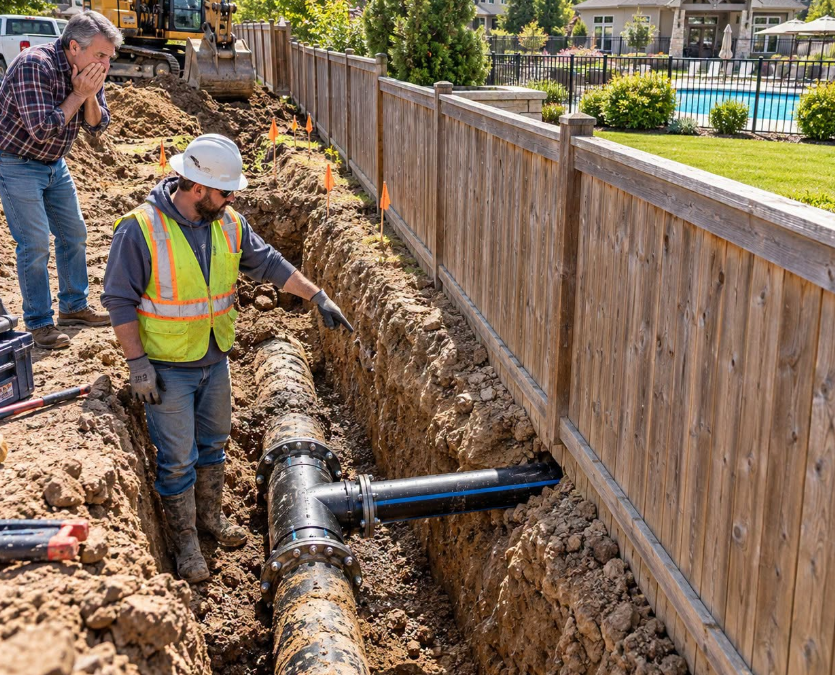
Owen used hand tools and opened a small inspection pit, working carefully until we were roughly three feet down. Then the dirt around the main fell away.
I saw the fitting before he said anything.
The original water main had decades of age on it.
The fitting attached to it did not.
It was newer.
Much newer.
A tee had been installed directly into my main.
One branch continued along my property.
The other turned toward Stone Ridge.
Owen sat back on his heels.
“Well.”
I stared into the hole.
“Tell me that’s some old nursery branch I forgot about.”
“It’s not.”
“You sure?”
“Barrett, this fitting isn’t remotely the same age as your line.”
He brushed more soil away.
“And whoever installed it wasn’t feeding one garden hose.”
The branch was large enough to carry serious demand.
I felt anger then, but mostly disbelief.
Someone had crossed onto my land.
Excavated my private line.
Cut into it.
Installed a branch.
Buried the work.
Repaired the ground.
And never said a word.
I went straight back to the house and pulled out every old drawing I had.
Nothing.
I checked county permits.
Nothing.
I searched recorded easements.
Nothing.
No utility easement.
No shared infrastructure agreement.
No right of access.
No document giving Stone Ridge Estates permission to touch that main.
Owen and I returned with the locator.
We followed the unauthorized branch through a stand of trees and toward the property boundary. It crossed beneath a private road inside Stone Ridge. Then the signal ended beneath a small concrete utility building.
I had seen the structure before.
I had never thought much about it.
Why would I?
It looked like the sort of building an HOA might use for irrigation controls or electrical equipment.
There was a sign on the door.
STONE RIDGE HOA.
AUTHORIZED UTILITY PERSONNEL ONLY.
And hanging through the latch was an industrial padlock.
I photographed the building.
Then Owen walked around the side.
“Barrett.”
Something in his voice made me hurry.
A large supply pipe entered one side of the structure. On the opposite side, multiple smaller pipes disappeared underground.
Owen crouched.
He looked from one set to the other.
Then he stood slowly.
“This isn’t one connection.”
“What is it?”
“It looks like distribution.”
“For what?”
He stared toward the neighborhood.
“For them.”
I called the HOA office.
I expected confusion.
I expected someone to say they would check the records.
I expected a property manager to apologize and schedule a meeting.
Instead, Joselyn Pike arrived about twenty minutes later with two board members walking behind her.
And the first thing I noticed was that she did not look surprised.
Joselyn had been president of Stone Ridge for almost six years. I knew her mostly by reputation. She was organized, confident, and very good at presenting every board decision as if it had already been professionally reviewed by experts no ordinary person needed to question.
She had overseen clubhouse improvements.
Renegotiated landscaping contracts.
Approved capital projects.
Residents seemed to believe she was effective.
That morning, she stepped out of her SUV, looked at me, looked at Owen, looked at the disturbed soil near the building, and folded her arms.
“What’s the problem?”
I stared at her.
“The problem is your pipe is connected to my private water main.”
She barely blinked.
“That system has been in place for years.”
“No, it hasn’t.”
“It serves Stone Ridge through shared infrastructure.”
“Shared with who?”
“The community.”
“That’s not what I asked.”
Her jaw tightened.
I pointed toward my property.
“That main belongs to me. Show me the easement.”
“You’re oversimplifying the situation.”
“Then make it complicated. Show me the easement.”
One of the board members glanced at Joselyn.
She changed direction.
“There are historic utility rights associated with this property.”
“What recording number?”
“We’re not conducting a legal records review beside a utility building.”
“I’m not asking for a legal seminar. I’m asking why there’s a pipe attached to my main.”
She looked at Owen.
“And who are you?”
“My contractor,” I said.
Owen didn’t bother answering.
Joselyn stepped toward the shed.
“This is HOA utility property. You need to leave.”
I almost thought I had misheard her.
Then I noticed the survey marker.
It stood a few feet beyond the building.
I pointed at it.
“That marker says your shed is partly on my parcel.”
Her eyes moved toward the marker.
For the first time, her confidence flickered.
Only for a second.
Then she reached for the shed door, checked the lock, and said, “You do not have authorization to open this building.”
I looked at the supply pipe entering the wall.
“I don’t need to open it to know where your water is coming from.”
She turned away.
“You’ll need to speak with counsel.”
“Fine.”
She took several steps.
“Joselyn.”
She stopped.
“Whatever is behind that door is attached to a meter with my name on it.”
She looked back.
“It isn’t that simple.”
That sentence stayed with me.
Because it was that simple.
That night, my master meter recorded the highest single-day consumption I had ever seen.
My first instinct was to shut the branch.
Owen could have done it.
I could have done it myself.
I had the tools.
I had access to my side of the connection.
And every gallon crossing the master meter was being billed to me.
But my attorney, Graham Whitaker, stopped me.
“Don’t touch it yet.”
“Graham, they’re taking water.”
“I understand.”
“They’re taking water through a pipe buried on my property.”
“I understand that too.”
“So why am I leaving it on?”
“Because the moment you shut it down, Joselyn gets a new story.”
“What story?”
“That you knowingly disconnected service to forty-one households.”
I leaned back in the chair.
“Forty-one?”
“We don’t know how many yet.”
“Exactly.”
“Which is why we document first.”
I hated that answer.
But Graham was right.
If I reacted emotionally, the HOA could move the argument away from what they had done and toward what I had done in response.
So instead of touching the valve, Graham sent a formal records demand.
We requested everything.
The permit for the utility shed.
The connection authorization.
Any easement.
Engineering drawings.
Supply contracts.
Board resolutions.
Meter records.
Invoices.
The list of properties served.
Anything establishing the HOA’s legal right to use my line.
Their attorney responded with a phrase that sounded impressive until anyone tried to verify it.
Historic utility easement.
Graham read the letter twice.
Then he looked at me.
“Recording number?”
“None.”
“Book and page?”
“None.”
“Date?”
“None.”
“Instrument?”
“None.”
He tossed the letter onto his desk.
“Then what they’ve given us is a sentence.”
I went to the recorder’s office myself.
Nothing.
No easement.
No historic right.
No agreement.
Not only was there no document giving Stone Ridge access to the main, but the subdivision had been built years after my family’s water system was already in the ground.
Around then, a Stone Ridge homeowner named Calvin Dorsey contacted me.
He had heard there was some kind of dispute near the boundary. Calvin had worked in accounting, and he came prepared with paperwork of his own.
He sat at my kitchen table and slid an HOA statement across to me.
“Every house pays this.”
I looked at the line item.
COMMUNITY WATER SERVICE: $74.00.
“Every month?”
“Every month.”
“How many houses?”
“Forty-one on this section.”
I looked at him.
“Forty-one.”
Calvin pulled out his phone.
“Forty-one times seventy-four.”
He entered the numbers.
“$3,034 a month.”
I leaned back.
“They’re billing you?”
“Apparently.”
“For water?”
“That’s what everybody thinks.”
I stood and retrieved my utility bill.
I set it beside his HOA statement.
“Here’s the account that buys the water.”
Calvin looked at the name.
BARRETT LAWSON.
He stared at it for several seconds.
“Stone Ridge doesn’t have an account?”
“Not on my main.”
“So we’re paying the HOA.”
“Yes.”
“And you’re paying the utility company.”
“Yes.”
His mouth opened slightly.
“Where does our money go?”
That turned out to be one of the most important questions in the entire case.
Calvin began searching old HOA communications. He found a newsletter announcing that Stone Ridge had completed what it proudly called an independent private water distribution system.
Independent.
That word mattered.
Because there was nothing independent about secretly cutting into another man’s private pipe.
Calvin also remembered when the utility shed had been built.
Not years earlier.
About eighteen months earlier.
I checked older satellite imagery.
No shed.
No building.
No visible construction.
Joselyn’s timeline was collapsing.
Graham petitioned for a formal inspection before anyone could alter anything.
The court approved access.
A county inspector attended.
Joselyn was present when the padlock was cut.
She objected repeatedly.
“This is unnecessary.”
Nobody answered.
“This equipment is HOA property.”
The inspector documented the lock.
Owen photographed the door.
Graham stood nearby with a folder tucked under his arm.
I watched the bolt cutters close.
The lock dropped.
For a moment, nobody moved.
Then the door opened.
I will never forget the sound.
Not because anything dramatic happened.
Because the room was quiet except for forty-one tiny mechanical movements.
Forty-one meters.
Forty-one separate meter assemblies lined the walls in neat rows.
Numbered.
One through forty-one.
And every one of them was spinning.
I stepped inside.
At the center of the room sat a large header pipe connected to the supply entering from my main.
From there, the water divided.
Again.
Again.
Again.
Until forty-one smaller lines disappeared toward the homes.
On the wall hung a laminated spreadsheet.
Lot numbers.
Previous meter readings.
Current readings.
Dates.
Dollar amounts.
It looked like the control room of a small utility company.
Except the utility company was me.
And nobody had bothered to tell me.
I turned toward Joselyn.
“Years?”
She said nothing.
“How long did you say this had been here?”
Her attorney stepped forward.
“We are not going to conduct questioning informally.”
I looked back at the meters.
Owen was already studying fittings.
“This took planning,” he said.
“What kind?”
“Real planning.”
He pointed to the header.
“Somebody sized this for neighborhood demand. You don’t just guess at forty-one homes. You calculate peak flow. Pressure. Pipe diameter. You stagger distribution.”
He turned.
“This wasn’t built by somebody improvising with parts from a hardware store.”
The county inspection engineer was Meredith Sloan. She moved slowly around the manifold. Then she stopped at a certification sticker.
She leaned closer.
“That’s our logo.”
“Good?” I asked.
“No.”
Joselyn looked over.
Meredith photographed the sticker.
“Why no?”
“Because I don’t remember approving this location.”
She read the permit number.
Then she walked to her vehicle and checked the county database.
A few minutes later, she came back.
Her expression had hardened.
“The permit number is real.”
Joselyn immediately said, “There.”
Meredith held up one hand.
“It belongs to a commercial warehouse project.”
Silence.
“Where?”
“Nearly twenty miles from here.”
I looked at the sticker again.
Someone had taken a legitimate permit number from an unrelated project and placed it on this equipment.
It was camouflage.
Something intended to satisfy a casual inspection.
Joselyn spoke quickly.
“Then the contractor made an error.”
Graham looked at her.
“Which contractor?”
“I don’t remember the company off the top of my head.”
“You spent tens of thousands of HOA funds and don’t remember who built it?”
“I said I don’t recall at this moment.”
“Invoice?”
“We’re locating historical records.”
Owen made a quiet sound that was almost a laugh.
Joselyn glared at him.
He pointed around the room.
“You’ve got excavation, commercial fittings, road boring, forty-one meters, backflow equipment, concrete work, and a full distribution manifold. This wasn’t a forgotten handyman invoice.”
Meredith was examining the backflow assembly.
Suddenly, she called Owen over.
They spoke quietly.
Then she turned to me.
“Barrett, there’s another issue.”
“What?”
“The backflow protection here doesn’t meet the standard it should.”
“What does that mean?”
“It means under the wrong pressure conditions, water from inside Stone Ridge could potentially reverse into your line.”
I stared at her.
“Back into my property?”
“Yes.”
“From forty-one homes?”
“Potentially from the downstream network.”
That changed everything.
Until then, I had thought of the situation as theft.
Unauthorized use.
Trespass.
Money.
Now there was a safety issue.
If contaminated downstream water reversed through that connection, my private line could become the route.
The utility company’s compliance chief, Renee Maddox, became involved soon afterward. She confirmed what I already suspected.
Their only customer in that area was me.
Stone Ridge did not have forty-one accounts.
It didn’t have ten.
It didn’t have one.
The HOA had never paid the water company for the water being distributed to its residents.
Renee pulled two years of master meter data.
We put it on a screen.
The graph was almost insulting in its clarity.
Steady historic use.
Then a sharp jump.
The date aligned almost perfectly with construction of the shed.
Month after month, the elevated consumption continued.
Renee pointed.
“Whatever changed here began around this period.”
I looked at Joselyn.
She crossed her arms.
“We intended to reconcile costs.”
Graham leaned forward.
“When?”
She looked at him.
“Excuse me?”
“You’ve been drawing water approximately eighteen months. When exactly did you intend to reconcile?”
“We were still establishing the operational structure.”
“Eighteen months?”
No answer.
Then Renee uncovered something that made the room go quiet again.
Stone Ridge had previously applied for a direct extension of the municipal water main.
A legal connection.
A real one.
The estimated cost had been about $286,000.
The HOA withdrew the application.
A few weeks later, construction on the private utility shed began.
I stared at the paperwork.
“So they knew what the legal option cost.”
Graham nodded.
“And chose something else.”
Old board minutes surfaced next.
Joselyn had told the board she had found a “private solution” that would avoid the $286,000 extension.
Three weeks later, the HOA contracted excavation work.
One month after that, the shed went up.
Six weeks later, residents began paying water fees.
That same week, my master meter usage jumped.
It wasn’t an accident buried in confusing paperwork.
The timeline was nearly perfect.
The HOA treasurer, Elise Porter, began asking her own questions. She had approved payments connected to the work, but Joselyn had described those expenditures as common area infrastructure improvements.
Elise handed Graham one invoice.
The wording was brief.
TIE IN TO EXISTING 8 IN MAIN.
No owner listed.
No easement number.
No authorization reference.
Another invoice described forty-one residential submeter installations.
I read it twice.
Joselyn could no longer plausibly claim ignorance about how many homes were connected.
Forty-one was literally on the paperwork.
The contractor records also showed when the excavation had crossed my property.
A weekend.
I had been out of town for work.
That detail made me angrier than almost anything else.
Not because it proved they knew I was gone.
We couldn’t prove that.
But because I pictured the scene.
A crew arriving.
Equipment crossing the line.
A trench opening on land my grandfather had walked for thirty years.
Workers exposing the private main my family had paid for.
Cutting into it.
Installing the tee.
Covering the evidence.
And by the time I came home, the ground probably looked ordinary again.
Nobody called.
Nobody left a letter.
Nobody requested permission.
Nobody offered payment.
Nobody even had the nerve to tell me afterward.
When the paperwork began closing around them, the HOA tried something so audacious that even Graham looked impressed.
They sent me a bill.
$18,600.
INFRASTRUCTURE ACCESS AND MAINTENANCE ASSESSMENT.
I called Graham.
“They’re billing me.”
“I saw.”
“For their system.”
“I saw that too.”
“Have they completely lost their minds?”
“No.”
His voice was calm.
“Actually, this is calculated.”
“Calculated how?”
“They need evidence of a shared arrangement.”
“What arrangement?”
“Exactly.”
He tapped the invoice.
“If you pay any part of this, they may later argue you recognized the infrastructure as shared.”
I stared at the total.
“So they take my water for eighteen months, charge their homeowners for it, then send me a maintenance bill.”
“Do not pay a cent.”
“I wasn’t planning to.”
“Not even under protest.”
I refused the assessment.
Instead, Graham sent a notice of trespass and a demand for a complete accounting.
Every dollar collected.
Every gallon distributed.
Every meter.
The exact tie-in date.
The contractor.
The approving officer.
The source of the permit number.
And every internal document tied to the project.
By then, residents were talking.
Information moved through Stone Ridge faster than the HOA could contain it. Some homeowners remembered construction noise after normal working hours. Others remembered being told the shed was part of an irrigation upgrade. Nobody remembered being told the neighborhood was about to receive residential water through a pipe owned by the guy next door.
Joselyn called an emergency HOA meeting.
And that was when she tried to turn me into the villain.
According to people who attended, she stood in front of the residents and told them a private landowner was threatening the community’s water supply.
Not that the HOA had tapped my main.
Not that my name was on the utility account.
Not that I had been paying the underlying bill.
Not that the utility shed contained forty-one hidden meters.
Not that the county had concerns about the permit number.
Just one frightening message.
Barrett Lawson may shut off your water.
It was smart.
If I were a homeowner with kids, laundry, showers, and no knowledge of the paperwork, I might have been angry too.
Then Calvin stood up.
He didn’t shout.
That was the beauty of it.
He asked one question.
“If we’ve been legally purchasing our own water all along, why is the only utility account in Barrett Lawson’s name?”
The room went quiet.
Joselyn tried to redirect.
Calvin asked again.
“Whose name is on the account?”
The meeting ended early.
Unfortunately for Joselyn, someone recorded it.
Afterward, Elise came to see me privately.
She looked nervous.
“There is something you need to know.”
We sat inside my workshop.
“What?”
“The water money.”
“What about it?”
“It doesn’t go where you think.”
I waited.
“We have a separate account. Stone Ridge Utility Reserve.”
“How much?”
“Over the last eighteen months? Close to fifty-six thousand collected.”
I stared at her.
“For water.”
“Yes.”
“And how much went to the water company?”
Her face told me before she answered.
“None.”
“Because I paid the water company.”
She nodded.
“So where did fifty-six thousand dollars go?”
Elise put several pages on my workbench.
“Landscaping. Clubhouse renovation. Legal expenses. Management expenses. Transfers.”
I flipped through the records.
Every page made me angrier.
Residents were being billed for water.
But their water fees were not being used to buy water because the HOA wasn’t buying water.
I was.
The HOA had turned my private main into a revenue stream.
They drew the resource through my master meter.
They billed residents.
They redirected the money elsewhere.
Meanwhile, my own pressure suffered and my account absorbed the cost.
I called Renee.
“Can you estimate how much of my usage is abnormal?”
She said she could provide data but would avoid legal conclusions.
That was fine.
We needed numbers.
The numbers suggested Stone Ridge had consumed several million gallons over the period the manifold was operating.
Millions.
I sat in Graham’s office while he assembled the damages timeline.
Water charges.
Investigation costs.
Pressure loss.
Potential equipment strain.
Trespass.
Unauthorized connection.
Safety exposure from the backflow defect.
He built a binder thick enough to stop a door.
I joked about that once.
He didn’t laugh.
“This is how cases are won.”
“With binders?”
“With timelines people can’t escape.”
He cross-referenced invoices against meter readings.
Emails against construction dates.
Board minutes against contracts.
Satellite imagery against Joselyn’s claim that the system had existed for years.
The municipal extension withdrawal against the construction of the illegal tie-in.
The more organized the evidence became, the less room there was for innocent explanations.
Then came the settlement offer.
Graham called me.
“They want to resolve it.”
“How?”
“Twenty-two thousand dollars.”
I laughed once.
“That’s it?”
“There’s more.”
“Of course there is.”
“They want continued use of your main.”
I stopped laughing.
“And?”
“You grant Stone Ridge a permanent easement.”
I leaned back.
“They steal access, get caught, then pay twenty-two thousand to own the right forever?”
“Essentially.”
“Confidentiality?”
“Yes.”
I almost admired the nerve.
“They want me to legalize what they did.”
“That’s exactly what signing it would do.”
“No.”
“You haven’t heard every clause.”
“I don’t need to.”
I rejected it.
The next day, a work crew appeared beside the utility shed.
They claimed they had been hired for emergency repairs.
Owen happened to be with me when we saw the truck.
He stared at the equipment.
“That doesn’t look like repairs.”
“What do you see?”
“Pipe caps.”
He walked closer.
“Cutting equipment. Excavator.”
“Meaning?”
“Meaning I’d like to know what they plan on cutting.”
We contacted Meredith immediately.
By then, the evidence mattered too much to risk alteration.
The county issued an emergency preservation notice preventing anyone from modifying the system while the investigation continued.
The crew left.
But before they did, the excavation they had started exposed something else.
Owen crouched beside the pit.
“There’s another line.”
I felt my temper rise instantly.
“Another house?”
“No.”
He followed the smaller PVC branch.
“Different direction.”
We traced it.
Not toward the forty-one residential connections.
Toward the clubhouse.
That branch fed Stone Ridge’s landscaping irrigation.
The clubhouse.
A decorative pond.
A maintenance area used to wash HOA vehicles and equipment.
And unlike the residential branches, this line passed through no submeter at all.
Not one.
I looked at Owen.
“So the residents at least have meters.”
“Yeah.”
“But the HOA’s own usage is completely unmetered.”
“Looks that way.”
That explained another mystery.
I had sometimes seen consumption spikes in the middle of the night.
Renee pulled hourly usage.
Between roughly one and four in the morning, there were recurring surges.
Stone Ridge’s irrigation schedule matched them.
My water had been watering their lawns while I slept.
By that point, the homeowners were furious.
Not at me.
At the board.
They had spent eighteen months paying $74 every month for a service their association didn’t legally own.
They were looking at a reused permit number.
An unauthorized connection.
A separate utility fund.
A hidden unmetered common-area branch.
And a possible backflow safety issue.
Calvin formally demanded an independent audit.
Joselyn opposed it.
Elise supported it.
The board split.
For the first time in years, Joselyn did not control the vote.
The audit moved forward.
And buried in the records was the email that ended almost every plausible defense she had left.
It came from the original contractor.
The message said the existing eight-inch main appeared to be privately owned.
The contractor requested written authorization confirming permission to connect.
Then came Joselyn’s reply.
Short.
Clear.
Proceed.
Board authorization is sufficient.
I read it once.
Then again.
Then I passed it to Graham.
He said nothing for several seconds.
Finally, he looked at me.
“This matters.”
“Because she knew.”
“Because she was warned.”
There was more.
The contractor later requested formal easement documentation.
That email received no meaningful answer.
The work continued anyway.
Invoices were paid.
The project went live.
Residents were billed.
My meter spun.
Joselyn’s defense changed again.
Now she argued that because I had failed to object for eighteen months, I had effectively accepted the arrangement.
Graham almost looked offended when he explained why that argument made no sense.
“The connection was underground.”
“Correct.”
“The meters were inside a locked shed.”
“Correct.”
“You received no notice.”
“None.”
“No invoice until after you discovered it.”
“Right.”
“No request for consent.”
“No.”
“No contract.”
“No.”
“No easement.”
“No.”
He leaned back.
“Then they concealed the thing they now claim you should have objected to.”
Meredith’s final technical report made the problem even more serious.
The system was formally identified as an unauthorized cross-connection. The backflow protection did not meet required standards. The configuration could not continue indefinitely.
The water authority was going to require correction whether I wanted it or not.
That was important because by then Joselyn had created a narrative that I was personally threatening forty-one families.
I wasn’t.
And I didn’t want forty-one households suddenly dry because their board had made bad decisions.
I had met some of those residents.
Most of them had done nothing wrong.
They had paid bills.
Trusted their HOA.
Turned on faucets.
They hadn’t crawled under my fence and installed a tee fitting.
So I agreed to a controlled transition period.
Stone Ridge would be given limited time to establish a legitimate water source.
No permanent easement.
No forgiveness of the old connection.
No conversion of unauthorized use into some grandfathered right.
Just time.
Joselyn apparently interpreted that as weakness.
According to later board discussions, she told people I would never actually allow the supply to be disconnected.
She still hadn’t understood something fundamental.
The county was now involved.
The water authority was involved.
This was no longer simply Barrett Lawson versus Stone Ridge Estates.
The existing configuration itself had been determined unacceptable.
Joselyn sent another community message.
The subject warned residents about a private landowner threatening their water supply.
Graham told me not to engage publicly.
“She wants an argument.”
“I want to answer.”
“Don’t.”
“She’s lying.”
“I know.”
“So everybody just gets her version?”
“No.”
He pushed the evidence binder toward me.
“They get documents.”
We organized an open documentation session for Stone Ridge homeowners.
No speeches.
No shouting.
No social media war.
Just records.
On folding tables we laid out my deed.
The property survey.
The original water main installation records.
The master meter agreement.
County land records showing no easement.
The usage graph.
Photographs of the forty-one meters.
The contractor email.
The fake certification number beside the actual warehouse permit it belonged to.
Invoices for the tie-in.
The board minutes discussing a private solution after abandoning the $286,000 municipal extension.
Residents walked slowly from page to page.
Some asked questions.
Some said almost nothing.
Calvin brought his own billing statements.
At one point, he studied the submeter readings.
Then his expression changed.
“Barrett.”
“What?”
“Look at this.”
He placed his bills beside the meter history.
“What am I looking at?”
“My charge is always seventy-four dollars.”
“Right.”
“My meter usage changes.”
I saw it.
The homes had individual meters.
But residents were charged a flat fee regardless of how much water the meters recorded.
Calvin looked toward Owen.
“Then why install forty-one meters?”
Owen shrugged slightly.
“If you’re asking for a technical necessity based on the billing model, I don’t see one.”
“Then what were they for?”
“I can only give you a theory.”
“Give it.”
“Because forty-one meters make the room look like a real utility.”
Meredith, who was nearby, immediately clarified.
“I can’t speculate about motive.”
Then she pointed at the devices.
“But I can tell you these are not recognized utility meters under our authority.”
That statement hit hard.
The room Joselyn had built to look official was becoming less official by the minute.
Joselyn left before the session ended.
Two board members demanded she surrender remaining project records.
She refused.
Elise froze transfers out of the utility reserve account.
That was the moment Joselyn began losing practical control, not just public trust.
Then another county record appeared.
Three years earlier, during approval of the final phase of Stone Ridge, the HOA had represented that residential lots would receive water through an independent municipal connection.
But forty-one lots had ended up on my private main instead.
That raised a question much bigger than a boundary dispute.
Had approvals been granted based on infrastructure information that was never actually true?
The county opened an administrative review.
From that moment forward, my civil claim was only one piece of Joselyn’s problem.
Renee and Meredith returned to the shed with a full inspection team.
A formal notice was posted on the door.
The system was mapped.
Every branch.
Every meter.
Every fitting.
The final picture was ugly.
One unauthorized connection to my main.
Forty-one residential submeters.
One unmetered branch serving HOA common facilities.
No recorded easement.
No approved cross-connection permit.
A permit number belonging to another project.
Backflow protection that failed the required standard.
The municipal utility prepared a plan to give Stone Ridge legitimate service.
By then, the cost was going to be far worse than the $286,000 the HOA had tried to avoid.
Roadway excavation.
Permits.
A completely new main.
Testing.
Certified backflow equipment.
Forty-one individual utility accounts.
Repaving.
Restoration.
Residents were furious.
Again, not because the legal solution cost money.
Because their association had been collecting money for eighteen months while failing to build the legal solution in the first place.
The emergency HOA meeting after the audit was the first one I attended.
The room was full.
People stood along the walls.
Joselyn sat at the front table with the remaining board members.
She looked tired but still controlled.
When questions started, she returned to the contractor defense.
“The board relied on professional contractors to perform compliant work.”
Elise opened a folder.
Joselyn stopped.
Elise didn’t shout.
She simply read the contractor’s email.
The existing main appears to be privately owned.
Please provide written authorization from the owner confirming permission to proceed.
Then Elise read Joselyn’s response.
Proceed.
Board authorization is sufficient.
You could feel the room change.
Not gradually.
Instantly.
One homeowner in the back said, “You knew?”
Joselyn leaned toward the microphone.
“That email is being taken out of context.”
Another voice.
“What context makes that okay?”
She tried to explain that the board had believed it possessed infrastructure authority.
Calvin stood.
“Then why did the contractor ask for the owner’s permission?”
Applause broke out.
Someone demanded the board vote.
The motion was made to remove Joselyn Pike as president pending the outcome of the investigation.
This time, she did not have the votes to stop it.
The result was announced.
She was out.
Joselyn gathered her papers.
Before leaving, she looked across the room toward me.
“You still have to prove damages.”
The room quieted again.
Graham answered before I could.
“Yes.”
His voice was almost pleasant.
“And that’s exactly what we intend to do.”
After Joselyn was removed, everything changed.
Not magically.
The pipes were still there.
The legal problems were still there.
The residents still needed water.
But for the first time, the board contacted me as if I were the owner of the property they had been using.
The interim board asked if I would meet with the membership.
No lawyers making speeches.
No dramatic accusations.
Just answers.
I agreed.
Mostly because I had never blamed the forty-one households.
At the clubhouse, people asked questions for nearly an entire evening.
“When did you first know?”
“When the pressure problem led us to the buried branch.”
“Did you know we were paying the HOA?”
“No.”
“Did you ever receive any of our fees?”
“Not one dollar.”
“Did you approve the meters?”
“No.”
“Did you approve the shed?”
“No.”
“Did you agree to supply the neighborhood?”
“No.”
“Are you going to shut us off tomorrow?”
“No. There’s a transition process now.”
One woman looked embarrassed.
“I believed you were trying to hurt us.”
“I know.”
“Joselyn said…”
“I know what she said.”
She looked down.
“I’m sorry.”
“You didn’t install the pipe.”
That became my attitude toward most of Stone Ridge.
People can make terrible decisions when they’re given bad information.
The homeowners had been given a simple story.
Their HOA had built a private system.
They paid a monthly fee.
Water came out of the faucet.
Why would they investigate?
Most people don’t search county records before taking a shower.
The weeks that followed were less dramatic and more exhausting.
Engineers.
Utility crews.
Permits.
Meetings.
Construction schedules.
Temporary supply arrangements.
Pressure testing.
Road closures.
More paperwork than I ever wanted to see again.
The utility company directly supervised the transition so nobody would unexpectedly lose service.
Stone Ridge began construction of its real municipal connection.
I refused every suggestion that the old unauthorized branch should remain as emergency backup.
No easement.
No permanent right.
No continued access.
I wasn’t going to spend the rest of my life wondering whether a locked valve on my land would become somebody else’s infrastructure claim twenty years later.
Eventually, the new municipal system was ready.
The transition date was scheduled.
That morning, I met Owen near the old utility shed.
Renee was there.
Several utility employees were checking connections.
Some Stone Ridge residents stood at a distance watching.
The forty-one old meters were still turning.
Owen glanced at me.
“Ready?”
“Eighteen months ago.”
He smiled slightly.
Then the municipal utility confirmed the new service was live.
One by one, the forty-one houses were officially transferred off my master meter.
Renee checked the records.
“All forty-one are clear.”
Owen walked to the old branch valve.
For a second, I looked through the open shed door.
Rows of meters.
Forty-one numbers.
Forty-one spinning dials.
A system somebody had built in secret and tried to turn into a permanent fact.
Owen put his hand on the valve.
“Last chance to rent them water.”
I looked at him.
“Shut it.”
He closed the valve.
Inside the shed, the meters slowed.
Then stopped.
All of them.
The silence was strange.
I walked down to the county road.
I crouched beside my master meter the same way I had months earlier when I was still trying to understand why the dial raced every evening.
This time, it barely moved.
I opened the workshop tap.
Full pressure.
No surge.
No collapse.
No unexplained demand.
The water behaved exactly the way it had before Stone Ridge ever touched it.
The civil case continued.
The HOA was required to produce a complete accounting of the water fee program.
Money collected.
Money transferred.
Improper charges.
The association’s insurance carrier declined to cover portions tied to intentional misconduct, which forced the board to examine individual responsibility for decisions surrounding the original project.
The county continued its own permitting and administrative actions separately.
Joselyn never returned to any position of authority inside Stone Ridge.
And in the end, there was no dramatic revelation about me.
I wasn’t a judge.
I wasn’t secretly a federal agent.
I didn’t have some politician in my family.
I didn’t know somebody powerful who made a phone call and destroyed the HOA overnight.
I was just a landowner who noticed his water pressure was wrong.
What brought the entire operation down was much more ordinary.
A buried pipe.
Forty-one meters.
A locked utility shed.
A permit number copied from the wrong project.
An old utility bill.
A contractor’s email.
A usage graph.
Records.
Dates.
Numbers.
Things that were hard to argue with once somebody put them all in the right order.
A few weeks after the transition, the old utility shed was scheduled for demolition.
I went out with Owen to watch.
An excavator tore away part of the concrete structure. Workers disconnected the dead plumbing. Then the machine lifted the manifold from the ground.
For the first time, I could see the whole thing in daylight.
The large header.
The branching pipes.
Forty-one smaller connections fanning outward.
It looked almost absurd sitting above ground.
Underground, it had felt mysterious.
Complicated.
Untouchable.
Above ground, it was just pipe.
Owen stood beside me.
“You want a piece?”
“A piece of what?”
“The manifold.”
“For what?”
“Souvenir.”
I shook my head.
“I’ve got pictures.”
He laughed.
“Probably healthier.”
The excavator lifted another section free.
Beneath it, my original main remained.
Old.
Simple.
Exactly where my grandfather’s crew had put it decades earlier.
The unauthorized tee was removed.
The branch toward Stone Ridge disappeared.
For the first time in eighteen months, there was nothing physically connecting their neighborhood to my system.
Calvin came by that afternoon.
He wasn’t carrying bills.
No folders.
No calculator.
Just coffee.
He stood beside the trench and watched the workers.
“Looks different.”
“Better.”
He nodded.
“We’re rewriting some bylaws.”
“That’s probably a good idea.”
“Independent engineering review for any major infrastructure project.”
I looked at him.
“Before spending?”
“Before approval. Before spending. Before construction.”
“That would’ve helped.”
“Yeah.”
We stood quietly.
Then Calvin looked at the remains of the shed.
“I still can’t believe nobody knew.”
I thought about that.
The answer was obvious now.
People had known pieces.
Residents knew they paid $74.
Elise knew money went through a separate reserve account.
Contractors knew they had been asked to tie into an existing main.
The board knew the municipal extension would cost $286,000.
The county had records about the planned infrastructure.
I knew my water pressure had dropped.
But nobody had the whole picture.
Not until a three-foot hole opened beside my fence.
“That’s the trick,” I said.
“What?”
“If everybody only sees one piece, nobody knows what they’re looking at.”
Calvin nodded.
The excavator pulled the final section of pipe free.
Owen directed the operator away from my main.
For several minutes, I watched the dirt settle.
Then I went back to the workshop.
There was one small test I still wanted to make.
I turned on the tap.
The line jumped immediately to full pressure.
I let it run.
Ten seconds.
Twenty.
Thirty.
No drop.
No hesitation.
No invisible neighborhood pulling against it from the other side of the hill.
Just water.
My water.
My line.
My property.
I shut off the faucet and stood there listening to the quiet.
For eighteen months, forty-one hidden meters had been turning behind a locked door while the water feeding them passed through an account bearing my name.
The HOA had charged families for that water.
Used the money elsewhere.
Watered its own landscaping for free.
And when I discovered the connection, its president had tried to tell everyone I was the one threatening the neighborhood.
What ended it wasn’t rage.
It wasn’t revenge.
It wasn’t me charging into that shed with bolt cutters the first day I saw the lock.
As satisfying as that might have felt, it would have been the wrong move.
What ended it was refusing to let them change the question.
The question was never whether forty-one families deserved water.
Of course they did.
The question was whether an HOA could secretly take somebody else’s private infrastructure, bury a connection underground, hide forty-one meters behind a locked door, charge residents for the resource, and then claim the arrangement had become legitimate simply because nobody discovered it quickly enough.
The answer was no.
Stone Ridge eventually got the water system it should have built from the beginning.
Its homeowners got legitimate utility accounts.
The county got a compliant system.
The old illegal branch disappeared.
And I got back something that should never have required lawyers, inspectors, audits, emergency notices, engineering reports, and months of fighting to recover.
Control over my own pipe.
I thought that would be the end of how I remembered it.
But a few days after the shed demolition, I walked toward the boundary one last time.
The concrete slab was still there, though half broken.
The walls were gone.
The industrial padlock Joselyn had once guarded so aggressively was gone.
The laminated meter chart was gone.
The manifold was gone.
There was nothing left to hide.
For the first time, I could stand exactly where those forty-one meters had once been and look straight through the empty space toward the neighborhood.
Kids rode bicycles on the other side of the private road.
A sprinkler ran in someone’s yard.
A man washed his truck.
Ordinary things.
The difference was that now every gallon came through infrastructure that actually belonged there.
Owen’s truck pulled up behind me.
He leaned through the open window.
“Pressure still good?”
“Perfect.”
“Meter?”
“Normal.”
“Nobody stealing your water?”
I looked at the empty slab.
“Not today.”
He laughed.
I climbed into the passenger seat.
As we drove back toward my workshop, we passed the spot where that first buried tee had been uncovered.
The inspection pit had been filled.
Fresh dirt sat over it.
Soon grass would grow back.
If somebody came along in another year, they would never know anything had happened there.
That was almost funny.
The entire mess had started because somebody believed underground meant invisible.
They believed if they covered the pipe, locked the meters, reused a permit number, and kept the paperwork vague enough, the system would become reality simply because it kept operating.
And for eighteen months, that almost worked.
But buried doesn’t mean gone.
Hidden doesn’t mean legal.
And a locked door doesn’t change who owns the pipe feeding everything behind it.
When I reached the workshop, I opened the tap one more time.
The pressure didn’t move.
Not even a flicker.
For me, that was enough.