The HOA Put a $5 Million Casino Barge on My Private Lake—Then My Scheduled Drawdown Left It Inches From the Bottom.
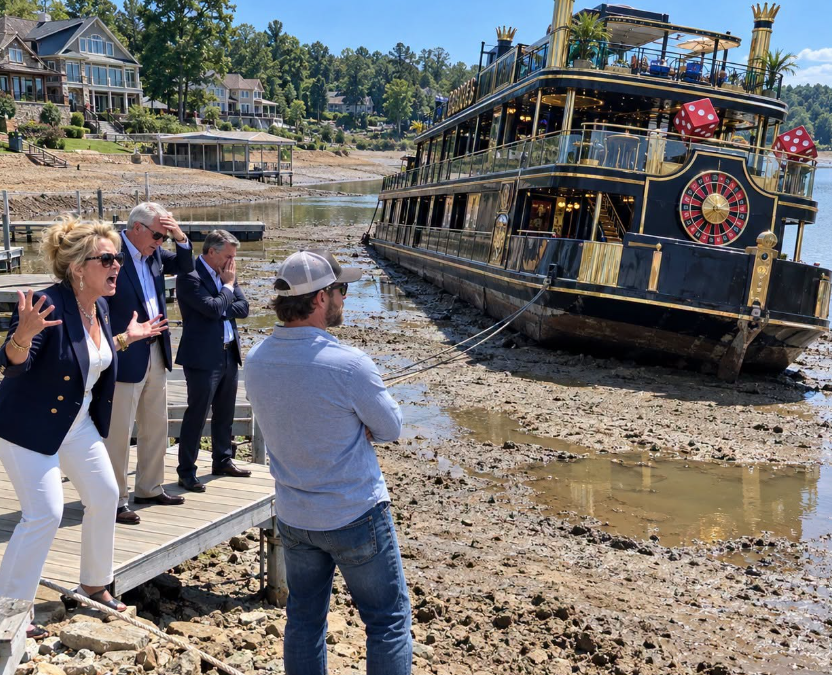
PART2:
And from the way she picked up a blue folder from the folding table beside her, I knew someone had warned her I might have questions.
She walked toward me.
“Ethan.”
“Karen.”
Her grip tightened slightly on the folder.
“I assume you’re here about the vessel.”
I looked past her.
“Is that what we’re calling it?”
Her expression didn’t change.
“The casino barge.”
“That’s a casino?”
She opened the folder.
“The association approved the project last winter.”
“I must have missed that meeting.”
“You don’t live under the association.”
True.
I owned and managed the private lake and its water-control infrastructure.
The HOA controlled most of the residential shoreline and marina facilities through longstanding recreational agreements.
Our responsibilities overlapped in strange ways.
They handled docks.
Common areas.
Recreational use.
Marina operations.
I handled the lake itself.
Water levels.
Gates.
Agricultural releases.
Drainage.
Structural inspections.
The agreements had existed longer than either Karen or I had been involved. Most years, that relationship required almost no thought. The HOA wanted enough water for boats. I wanted enough control to meet downstream obligations.
Usually, those goals fit together.
Karen opened the blue folder.
“The project has marina approval, engineering review, structural certification, and authorization under the recreational easement for approved floating facilities within the western cove.”
She turned to a page.
“The easement expressly permits—”
“I know.”
She stopped.
Actually stopped.
It might have been the first time I had ever interrupted one of Karen’s prepared explanations by agreeing with her.
She looked at me.
“You know?”
“I know what the easement says.”
Her shoulders dropped by maybe half an inch.
I walked toward the edge of the dock.
“How much water does she draw?”
Karen closed the folder.
“What?”
“Draft.”
She followed me.
I looked down between the dock and the hull. The water was dark enough that I couldn’t see bottom.
“How much clearance does your marine engineer require?”
Karen opened the folder again.
This time, she flipped farther back.
She gave me a number.
I did the subtraction mentally.
Then looked toward the lake gauge.
“What?” she asked.
“Our seasonal drawdown starts Friday.”
Her face changed.
Not dramatically.
Just enough.
“What drawdown?”
I looked at her.
“The seasonal agricultural release.”
She stared at me for a second.
Then opened another page.
“The consultant modeled normal operating water levels.”
“Normal recreational level?”
“Yes.”
“Not seasonal release datum.”
Her eyes moved back toward the barge.
“How much are you taking out?”
I told her.
She pulled a pen from the folder.
“Over how long?”
I told her that too.
Karen started calculating.
I did the same thing.
Then she showed me the consultant’s numbers.
According to her paperwork, the barge had comfortable clearance.
According to mine, I could complete the scheduled release without putting anything in the cove on the bottom.
Both sets of numbers looked reasonable.
That should have reassured me.
It didn’t.
Machines have taught me not to trust reassurance.
Gates.
Pumps.
Boats.
Valves.
Water systems.
They don’t care how confident you are.
They respond to measurements.
I crouched near the edge of the dock.
“When did they last sound this cove?”
Karen checked.
“During project design.”
“When?”
“Seven months ago.”
“At what lake level?”
She looked at the page.
Then at me.
“I’ll have to check.”
“Do that.”
Her eyes narrowed.
“You think there’s a problem.”
“I don’t know.”
“That sounded like yes.”
“It sounded like I don’t know.”
I stood.
“If your numbers are right and mine are right, Friday is boring.”
“And if they’re not?”
“Then Friday gets interesting.”
Karen looked toward the barge.
Workers were carrying champagne glasses aboard. One of them laughed at something. Nobody looked worried.
Neither of us had enough information yet to change that.
So I went home.
Thursday evening, I checked the water-control schedule again. Downstream irrigation releases had already been coordinated. Several orchards depended on those windows. You don’t just move agricultural water by a day because something unexpected appears at a marina.
People plan pumps around it.
Crews.
Fertilizer schedules.
Reservoir storage.
If I cancelled, the problem didn’t disappear.
It moved downstream.
That distinction became important later.
Friday morning, I was at the gate before sunrise.
The air was cool. Mist sat low over the lake. Birds moved through the reeds along the southern bank. For a while, everything looked too peaceful for what was coming.
I checked the schedule.
Checked the gauge.
Checked the gate position.
Then opened the release.
The first stage was small.
Nothing dramatic.
Water began moving downstream.
The gauge started descending.
At the marina, the casino still looked ridiculous in the early morning light.
Too polished.
Too large.
Too expensive.
Like someone had parked a hotel in a farm pond.
Karen arrived before seven.
Of course she did.
Clipboard.
Coffee.
Blue folder.
She stepped onto the dock.
“How fast?”
“Exactly on schedule.”
“How much so far?”
I told her.
She checked her report.
The first visible problem wasn’t the hull.
It was the gangway.
As the water level dropped, the barge moved lower relative to the fixed dock. The red-carpet gangway angle increased. Workers adjusted the connection.
That worked.
For roughly three minutes.
Then a catering employee pushed a loaded cart onto the gangway.
The cart accelerated.
Fast.
The employee made a noise I still can’t imitate.
Two workers caught the cart before a stack of covered breakfast trays became fish food.
Karen watched.
“Wheel stops.”
Someone ran to get them.
Problem solved.
For three minutes.
Then one of the small service boats left the casino.
It made it maybe twenty yards.
Scrape.
Every head on the dock turned.
The operator killed the engine instantly.
The boat drifted.
He leaned over the stern.
Then looked toward us.
“I touched something.”
Karen walked to the depth chart.
I walked to the lake gauge.
“Your level?” she asked.
“Correct.”
“Mine too.”
The operator returned slowly.
When he stepped onto the dock, he showed us the propeller.
Fresh scrape.
Karen looked toward the channel.
“That should still have another foot and a half.”
“It probably does.”
She turned.
“According to that chart.”
“Yes.”
She gave me a look.
“You have a gift for making accurate statements sound terrible.”
“I’ve been told.”
For the moment, the solution was obvious.
Move the service boats to the opposite side.
Depth poles there showed more water.
Karen ordered the adjustment.
Crews shifted lines.
Changed access.
The next boat cleared perfectly.
Karen looked at me.
I shrugged.
Maybe that was it.
Maybe the first operator had drifted outside the channel.
Maybe there was a shallow hump.
Maybe the chart was slightly conservative.
People like simple explanations.
I do too.
The lake did not.
Twenty minutes later, one of the restaurant employees walked onto the dock carrying a carpenter’s level.
Karen stared at him.
“Why do you have that?”
He pointed toward the barge.
“The glasses keep sliding.”
Nobody said anything.
He placed the level on the prep counter.
The counter was straight.
The bubble was not.
Karen’s face went hard.
I looked at the hull.
Now that I knew to look, I could see it.
Slight list.
Very slight.
But real.
The entire casino had tilted.
“Clear unnecessary personnel,” Karen said immediately.
No panic.
No argument.
Just action.
“Keep essential crew only until we know why.”
I walked the shoreline.
Checked gauge markers.
Checked the gate.
Checked release flow.
Everything was correct.
I had not overdrawn.
The gate was functioning properly.
No sensor failure.
No unexpected surge.
No bad reading.
When I returned, Karen had the marine report spread across a folding table.
I put my operations sheet beside it.
For the first time, we actually compared how both documents defined lake level.
Not just the numbers.
The reference.
Her report described clearance at normal recreational pool.
Mine managed releases from seasonal agricultural datum.
I read her heading again.
Then mine.
Then hers.
“Karen.”
“I see it.”
“We’re not using the same zero.”
“No.”
Neither document was wrong.
That was almost worse.
The marine consultant had calculated the barge’s clearance correctly for the lake condition he had been given.
My operations schedule had calculated drawdown correctly against the water-control system’s operating datum.
Nobody had ever forced those two systems onto the same page.
I took out a calculator.
Karen did too.
We recalculated.
The casino still technically had enough water.
But not nearly as much as everyone believed.
Karen looked at the hull.
“That explains the clearance.”
“Not the list.”
“No.”
I walked back toward the original survey stakes.
Looked at the hull.
Looked at the shoreline markers.
Then something bothered me.
“Karen.”
“What?”
“Did she move?”
“Down?”
“Sideways.”
Karen stepped beside me.
The barge had rotated a few degrees.
Not much.
Several feet at one corner.
Earlier, moving the service boats had changed the mooring loads. The crew had eased lines. The hull had turned slightly toward one side of the cove.
At full recreational level, a few feet sideways was meaningless.
The water hid everything.
During drawdown, the bottom mattered.
And the cove bottom did not descend evenly.
One edge sloped sharply.
I pointed.
“She’s sitting over the slope.”
Karen followed the line.
“So fixing the service boats caused this.”
“Helped cause it.”
She exhaled.
“I preferred the catering cart.”
“So did I.”
We checked the contour chart.
The casino was still afloat.
But one side now had significantly less water underneath it than the other.
That explained the list.
Karen folded her arms.
“Stop the release.”
“I can pause between stages.”
“Then pause.”
“I can’t cancel it.”
She looked at me.
“Why?”
“Downstream irrigation.”
“How many users?”
“Several orchards.”
“Can you move their window?”
“Not without creating another problem.”
Her jaw tightened.
That was the first moment I saw the real weight of the situation land on her.
Not anger at me.
Responsibility.
She had a five-million-dollar project tied to the marina.
Opening night approaching.
Staff.
Food.
Entertainment.
Permits.
Public gaming requirements.
And now the lake was doing exactly what it was supposed to do.
“Can we tow it deeper?” she asked.
“Probably.”
She grabbed her phone.
“Tug.”
The marina operator started calling.
The answer came quickly.
The proper tug drew too much water.
It could not safely reach the casino in the shallow condition we had already created.
Karen stared at her phone.
“You’re joking.”
“No.”
“That was him.”
“I know.”
One of my maintenance guys, Cody, pointed toward the water-control dock.
“What about Mabel?”
Karen followed his hand.
Mabel was tied beside the gate.
Mabel is not an impressive vessel.
Aluminum utility hull.
Faded paint.
Flat deck.
Oversized cleats.
Engine that sounds angry even when idling.
She is the kind of boat people stop noticing five minutes after seeing her.
But she has one quality that suddenly mattered more than beauty.
She draws almost nothing.
Karen looked from Mabel to the casino.
Then back to me.
“That?”
I nodded.
“She does better once people stop judging her.”
“You want to tow a five-million-dollar casino with that?”
“No.”
“Good.”
“I want to use her to help rotate the bow while the mooring crew does the real work.”
“That sounds slightly less insane.”
“Only slightly.”
Before moving anything, we reduced weight.
Portable beverage stock.
Cases of food.
Decorative equipment.
Unused furniture.
Service supplies.
Anything heavy that could come off without affecting structural balance was transferred ashore.
Workers formed lines across the gangway.
The absurdity of it started to hit everyone.
Hours earlier, they had been carrying things onto a luxury casino for opening night.
Now they were carrying everything back off because the lake had become too shallow.
Karen stood at the end of the dock coordinating.
“Keep the lower deck balanced.”
“Don’t stack everything on one side.”
“Those crates go to the pavilion.”
“No, not there. We still need emergency access.”
Nobody questioned her.
That was one thing I respected about Karen.
When a problem became real, she stopped performing authority and started using it.
I brought Mabel around.
Cody handled the stern line.
A casino deckhand took the bow connection.
We weren’t towing.
We were applying controlled lateral force.
The mooring crew would ease one side.
Tighten the other.
Mabel would help swing the bow.
A few degrees at a time.
“Ready?” I called.
Karen raised one hand.
“Hold.”
She checked personnel.
Checked lines.
Checked the gangway.
Then dropped her hand.
“Go.”
Mabel pushed.
The casino barely seemed to move.
Then the water around the hull changed.
Slow rotation.
A foot.
Two.
Three.
Depth poles improved.
Someone cheered.
Karen snapped her head toward him.
“Save it.”
The cheering stopped.
She was right.
We were nowhere near done.
Another few feet.
Then someone shouted.
“Gangway!”
The red-carpet gangway had reached the limit of its travel.
If we rotated any farther, the connection could bind or tear.
“Stop!”
I killed Mabel’s push.
The hull settled against the lines.
Karen looked at the gangway.
“Disconnect it.”
The marina manager hesitated.
“That closes public access.”
“There is no public access.”
“Opening prep—”
“Disconnect it.”
They removed the gangway.
Now the casino was physically separated from the dock except for utility and mooring connections.
It suddenly looked less like a building and more like what it actually was.
A floating structure dependent on a shrinking layer of water.
We resumed.
Mabel pushed.
Lines eased.
The bow came around.
Depth improved.
The list decreased.
For ten minutes, I thought we had solved it.
Then I checked the drawdown schedule.
Remaining drop.
Projected final level.
Corrected datum.
Current position.
I calculated twice.
Then a third time.
Karen saw my face.
“What?”
I handed her the numbers.
She read them.
“No.”
“Yeah.”
“We still have clearance.”
“Barely.”
“How much?”
I showed her.
“That’s enough.”
“For calm water.”
Karen looked across the lake.
A breeze had started.
“Wake?”
“Problem.”
“Wind?”
“Problem.”
“Another few degrees of rotation?”
“Bigger problem.”
She looked at the authorized marina boundary.
“Move farther.”
“We can.”
“Then do it.”
I pointed at the chart.
“Outside your authorized cove.”
She understood immediately.
Moving the barge farther toward deep water would put it outside the area covered by the recreational approval.
Karen closed her eyes.
Just for a second.
When she opened them again, she looked at the contour map.
“Then where is the safest place?”
That question changed everything.
Not:
Who screwed this up?
Not:
How do we keep opening night?
Not:
Can you cancel your release?
Safest place.
I traced the contour lines.
There was a broad section of lake bed still within the permitted cove.
Flat.
Relatively level.
Soft sediment, according to older maintenance notes.
Not deep enough to keep the casino comfortably afloat at final drawdown.
But maybe something else.
I stared at it.
Karen watched me.
“What?”
I kept looking.
Then I said the sentence that sounded completely wrong.
“We stop trying to keep it floating.”
Karen did not blink.
“You want to put a five-million-dollar casino on the bottom.”
“Temporarily.”
“That word is doing heroic work right now.”
I pointed at the contours.
“Barely floating over uneven water is the dangerous option.”
“And sitting on the lake bed isn’t?”
“Not if it settles evenly.”
Karen stared at the map.
I continued.
“Right now one corner can strike first. Wind turns you three feet, the bottom comes up under one side, and all that weight loads unevenly.”
She looked toward the vessel.
“If we position it over the flat section?”
“Let the water take it down slowly.”
“Controlled grounding.”
“Exactly.”
“Can that hull handle it?”
“I don’t know.”
There was no bravado in that answer.
There couldn’t be.
Five million dollars changes the meaning of guessing.
Karen reached for her phone.
“Martin.”
Martin Vale was the marine engineer associated with the project.
We sent him everything.
Hull specifications.
Corrected water-level conversion.
Contour sheet.
Projected release.
Proposed position.
Then we waited.
Those fifteen minutes felt longer than the previous three hours.
Workers stood around the marina in small groups.
Nobody talked loudly.
The casino lights were still on even though it was morning.
Music testing had stopped.
The entire vessel looked frozen halfway between opening night and emergency response.
Martin called back.
Karen put him on speaker.
“I reviewed the hull.”
“And?” Karen asked.
“It can tolerate temporary grounding.”
I felt the tension release from my shoulders.
Then Martin continued.
“If.”
Of course.
Karen looked at me.
“If what?”
“If the bottom is level enough and the substrate supports the hull evenly.”
I looked toward the target area.
“No hard shelf?”
“Not under one side. You don’t want point loading.”
“Soft sediment?”
“Preferable.”
Karen rubbed her forehead.
“So we need to inspect the lake bottom before intentionally putting the casino on it.”
“Yes.”
“When you say it like that, Martin, it sounds completely reasonable.”
“It is reasonable.”
“Nothing about today feels reasonable.”
We deployed a maintenance crew with probes.
Target area.
Multiple points.
Port side.
Starboard side.
Center.
Bow.
Stern.
Soft sediment.
No obvious hard shelf.
No buried obstruction detected within the contact zone we expected.
The readings came back.
Martin reviewed them.
“Proceed slowly.”
Karen looked at me.
“Well.”
“Well.”
“You still think this is safer?”
“Yes.”
“Tell me you’re certain.”
“I’m not going to lie to you.”
She stared at me.
Then nodded once.
“Good.”
That moment probably saved us later.
Trust is strange.
People think trust comes from sounding certain.
Sometimes it comes from refusing to pretend.
Karen turned toward the crews.
“All right. New plan.”
Everyone gathered.
She explained it clearly.
We were not trying to rescue the casino by forcing it into deeper water.
We were positioning it over the safest section of lake bed so it could settle evenly as the scheduled drawdown continued.
No one was to improvise.
Every line movement called out.
Every distance repeated.
No sudden engine input.
No unnecessary people aboard.
A worker raised his hand.
“Are we intentionally grounding the vessel?”
Karen looked at him.
“Yes.”
He lowered his hand.
Another worker murmured, “That’s a sentence.”
I agreed.
We moved again.
Mabel took the bow.
Crews handled mooring tension.
Karen coordinated from the dock.
I worked from the boat and shoreline markers.
“Three feet port.”
Line eased.
“Hold.”
Mabel idled.
“Two feet forward.”
The hull shifted.
“Hold.”
One mooring line came tight too early.
The barge began rotating.
“Ease number four!”
Someone released it.
The hull stopped.
“Reset.”
We did.
Again.
Slow.
Painfully slow.
That was the only safe speed.
Then the wind came.
Not a storm.
Not even a strong gust by normal standards.
But a three-deck floating structure has a lot of surface area.
The gust caught the upper deck.
The bow moved.
Several feet.
Fast.
“Hold!”
Mabel pushed against it.
A mooring line snapped tight.
The casino rotated toward the hard edge of the contour.
For one second, every person on the dock froze.
Karen’s eyes locked on the depth poles.
“Ethan?”
“Don’t pull.”
“What?”
“If we yank it back, we overcorrect.”
The bow kept pressing.
Mabel held.
“Opposing tension.”
Cody understood.
He shouted to the line crews.
One side tightened gradually.
The other eased.
Mabel maintained position.
No sudden pull.
The hull stopped.
Then, almost imperceptibly, slid back.
Six inches.
One foot.
Two.
Back over the level section.
I exhaled.
Someone on the lower deck sat down.
Karen pointed.
“Stay alert.”
The worker stood again.
But I could hear the shake in her voice now.
Not much.
Enough.
We finally aligned the casino over the target bottom.
Then there was nothing left to do except finish the drawdown.
That was how I ended up back at the control gate with Karen standing on the dock and workers calling out inches beneath a five-million-dollar vessel.
Eleven inches.
Nine and a half.
Eight.
Seven.
The water dropped almost too slowly to see.
But the numbers kept changing.
A mooring line creaked.
“Six!”
Karen checked the hull level.
Still even.
“Five!”
One worker stared over the side.
Another watched the depth pole like it was a countdown clock.
“Four!”
I looked at Karen.
She looked back.
Neither of us spoke.
“Three!”
Someone on the upper deck started folding the FLOATING CASINO banner.
Karen told him to leave it.
“It’s earned the day off.”
That broke the tension for half a second.
Then:
“Two!”
The water continued downward.
One inch.
Nobody breathed.
Then the hull settled.
Not a crash.
Not a scrape.
One slow, heavy thump.
Almost gentle.
Five million dollars touched the lake bed.
Every person went silent.
I closed the gate to the scheduled hold point.
“Check it.”
Workers moved.
Hull level.
Structural indicators normal.
No hard impact.
No alarm.
No sudden list.
Martin stayed on speaker while measurements came in.
Port contact even.
Starboard even.
Bow stable.
Stern stable.
The barge sat exactly where we wanted it.
Karen finally let out a breath.
For the first time all day, she put the clipboard down.
“We did it.”
“Looks like.”
“Don’t say looks like.”
“We did it.”
She nodded.
Then picked the clipboard up again.
Of course.
“Opening requirements.”
I stared at her.
“You’re thinking about opening night?”
“It’s tomorrow.”
“Karen.”
“I’m checking.”
She read.
Then stopped.
Her expression changed.
“What?”
“The vessel has to be afloat during public gaming.”
I looked at the casino.
Then at the dry line showing against the hull.
“So we saved the world’s most expensive decoration.”
Karen closed the folder.
For several seconds, she said nothing.
Then she started laughing.
Not polite laughter.
Actual exhausted laughter.
I laughed too.
There was nothing else left to do.
The casino could not legally open for gaming while grounded.
That part was simple.
But the food was already purchased.
Musicians were booked.
Staff had been scheduled.
People expected an event.
The HOA pavilion sat right beside the marina.
Karen looked from the grounded barge to the pavilion.
Then back to me.
“You hungry tomorrow?”
“What?”
“We’re not wasting the food.”
Opening night changed.
No casino gaming.
No public guests aboard the grounded vessel.
Instead, Karen converted the night into a shoreside dinner and music event.
Tables came out around the pavilion.
String lights went up.
The band moved ashore.
Food service relocated.
The grounded casino stayed illuminated behind everything, three decks of lights reflecting weakly in the remaining water around it.
It looked absurd.
Beautiful, in its own way.
Like a luxury hotel had landed in a meadow.
Residents started arriving.
Most already knew something had happened.
In a lakeside community, news moves faster than water.
People walked toward the pavilion and stared.
One older man looked at the casino.
Then at the shoreline.
Then at Karen.
“That thing supposed to be there?”
Karen didn’t miss a beat.
“Temporarily.”
I coughed to hide a laugh.
Someone else called it the world’s fanciest lawn ornament.
That name spread immediately.
The World’s Fanciest Lawn Ornament.
By sunset, people were taking pictures with it behind them.
The band played.
Dinner was served.
Kids ran along the grass near the pavilion.
Older residents sat at tables facing the lake.
Nobody gambled.
Nobody boarded the vessel.
And somehow the opening-night disaster turned into one of the best-attended HOA events Karen had ever organized.
At one point, she took the microphone.
I was standing near the back.
She thanked the crews.
The marina staff.
Martin.
Then she thanked me.
Publicly.
“For helping us avoid what could have been significant damage to the casino vessel.”
People turned toward me.
I hate that.
I raised one hand.
Karen looked at me.
I said, loud enough for the nearby tables to hear, “If you hadn’t agreed to ground it, none of this works.”
That mattered.
Because the easy version of the story would have made one of us the villain.
Karen built a casino.
I lowered the lake.
Casino hits bottom.
Everybody picks a side.
But that wasn’t what happened.
Karen had done the reviews.
The barge had approvals.
The marina easement allowed it.
My drawdown had been scheduled.
The agricultural releases were legitimate.
My gate readings were correct.
Her depth report was correct.
The failure happened between the systems.
Two correct sets of paperwork.
Two different reference points.
One very expensive gap in communication.
For the next several days, the casino sat on the lake bed.
We checked it constantly.
Hull level.
Sediment contact.
Mooring tension.
Weather.
Water return.
The seasonal release cycle ended.
The lake began recovering.
At first, nothing happened.
Then one morning, a thin dark line of water appeared between part of the hull and the sediment.
By afternoon, buoyancy began taking weight.
The casino lifted gradually.
No sudden movement.
No structural complaint.
The next day, it was fully floating again.
I was there.
Karen was too.
Of course she was.
She watched the depth pole.
“Clear?”
I checked.
“Clear.”
“All the way?”
“Yes.”
She looked toward the upper deck.
“Someone get that ridiculous banner back up.”
A worker laughed.
The casino floated without structural damage.
No bent hull.
No cracked fitting.
No serious loss beyond the delayed opening and the cost of emergency adjustments.
Considering what could have happened, that felt almost impossible.
The HOA did not treat the incident like a freak accident and move on.
To Karen’s credit, she attacked the system problem.
Marina planning began using my seasonal drawdown calendar.
My operations office started issuing advance level projections directly to shoreline facility managers.
The HOA adopted the same lake-level reference used by the water-control system.
One datum.
One zero.
One set of language.
They installed a live depth board at the marina.
Not a decorative gauge.
A real operating display.
Current lake level.
Upcoming scheduled drawdown.
Projected minimum.
Marina clearance advisories.
Karen made sure everybody involved with any future floating project had to review it.
Several weeks later, she invited me aboard for the actual opening.
The casino looked different when it was floating comfortably.
Not because the paint changed.
Because I no longer looked at it and imagined the lake bed under the hull.
The gangway was nearly level.
Service boats moved freely.
Staff carried food aboard without gravity trying to steal it.
Music drifted from the upper deck.
Karen met me near the entrance.
“Try not to lower anything tonight.”
“I’ll see what I can do.”
She handed me a guest badge.
Inside, near the entryway, a small framed sign had been mounted on the wall.
BEFORE TESTING YOUR LUCK, CHECK THE WATER LEVEL.
I stared at it.
Karen came up beside me.
“You like it?”
“You put that there?”
“Board approved.”
“How many committees?”
“Don’t start.”
I laughed.
She laughed too.
That was the real end of the crisis.
Not when the casino floated.
Not when opening night finally happened.
When we could stand aboard the same vessel and laugh about what nearly happened because both of us understood why it had happened.
I had spent most of my working life around systems that punish assumptions.
Water is one of the worst.
People look at a lake and think level means level.
Flat surface.
Simple number.
But a managed lake is not one number.
It is storage.
Elevation.
Datum.
Release rate.
Downstream demand.
Rainfall.
Evaporation.
Bottom contours.
Shoreline geometry.
Infrastructure.
One person can talk about “normal lake level” and mean one elevation.
Another can use the same phrase and mean something completely different.
That was our mistake.
The casino’s engineers designed from normal recreational conditions.
I operated from agricultural control conditions.
No one lied.
No one ignored the rules.
We simply had never put the two pieces together.
And the cost of discovering that almost became five million dollars.
Months later, I was standing near the control gate with Cody when the casino lights came on across the lake.
He looked toward it.
“You ever think about grounding it again?”
“No.”
“Just for fun?”
“No.”
“Mabel could do it.”
“Mabel is retired from casino rescue.”
He patted the utility boat.
“She has one successful operation.”
“She has enough ego already.”
Cody laughed.
I looked across the water.
From that distance, the barge looked perfectly natural.
That was strange.
The first day I saw it, I thought it looked impossible.
Too big.
Too polished.
Too much building sitting on water.
Now it belonged to the landscape.
Not because I suddenly loved casinos.
Because the people running it finally understood the lake as part of the facility.
Before the incident, the lake was scenery in their project documents.
Afterward, it was infrastructure.
That distinction changed everything.
Karen and I had another meeting the following spring.
She came to my office carrying the same blue folder.
I pointed.
“You still have that thing?”
“Updated.”
“Of course.”
She sat across from me.
The HOA wanted to schedule several large marina events.
Instead of giving me finished dates, Karen had brought proposed dates.
“Drawdown windows?” she asked.
I gave her the calendar.
She compared them.
Moved two events.
Asked about a third.
We finished in twenty minutes.
At the end, she closed the folder.
“That was easier.”
“Yes.”
“Annoyingly easier.”
“Yes.”
She looked toward the lake through the office window.
“I keep thinking about that first conversation.”
“At the dock?”
“You said the drawdown started Friday.”
“You looked like I had personally scheduled it to ruin your project.”
“I did not.”
“You did.”
“I looked concerned.”
“You looked like you wanted to sue gravity.”
She smiled.
“Maybe a little.”
Then she became serious.
“I genuinely thought the engineering covered it.”
“It did.”
“Not enough.”
“No.”
She tapped the folder.
“That’s what bothered me afterward. Nobody made a reckless decision.”
I nodded.
“If somebody had been obviously incompetent, it would have been easier.”
“Fire them. Fix it. Move on.”
“Exactly.”
Instead, the incident forced everyone to confront a more uncomfortable truth.
Competent people can build a dangerous situation if their information never meets.
That lesson spread beyond the casino.
The marina started coordinating dredging records with water operations.
Dock owners received seasonal depth notices.
New floating structures had to submit both recreational pool clearance and seasonal minimum clearance.
Emergency response maps incorporated the lake-bottom contours we had relied on during the grounding.
Mabel became an official shallow-water response asset.
That last part made Cody unbearably happy.
He painted her name again.
Badly.
I made him redo it.
One afternoon that summer, I walked along the western cove during full recreational pool.
Boats everywhere.
Families.
Music.
Restaurant noise from the casino.
The exact place where the hull had grounded was under several feet of water again.
You couldn’t see it.
That felt appropriate.
Most important problems disappear from view after they are solved.
The danger is forgetting they existed.
At the casino entrance, the framed water-level sign remained.
I saw people photograph it.
Most probably thought it was a joke.
It was.
But it was also operating philosophy.
Check the water level.
Simple.
Almost embarrassingly simple.
Five million dollars had been required to teach us to put that sentence in writing.
I still remember the lowest point of the drawdown more clearly than almost anything else.
Not because I thought the casino would be destroyed.
By then, Martin had approved the controlled grounding. We had inspected the substrate. The hull was positioned. We had done everything we could.
But there is still something unnatural about deliberately lowering water beneath something that expensive.
Your instincts scream stop.
Keep it floating.
Floating is good.
Bottom is bad.
That instinct had nearly become our biggest danger.
If we had insisted on keeping the barge barely afloat, one unexpected movement could have put one corner down first.
A wind gust.
A wake.
Mooring slip.
Uneven loading.
Then millions of pounds would have concentrated onto one part of the hull.
Controlled grounding sounded worse.
It was safer.
That lesson stayed with me.
Sometimes the correct response to a worsening situation is not to preserve the condition you originally wanted.
It is to choose the safest version of the condition you can no longer avoid.
Karen wanted the casino floating.
I wanted the release completed.
Neither goal mattered once the geometry changed.
The only useful question became:
What keeps people and equipment safe now?
Karen asked it.
That is why I never turned this story into a revenge story.
People who hear the short version sometimes do.
HOA built a casino on your lake?
You dropped the water?
It hit bottom?
They expect me to smile and say I taught Karen a lesson.
I didn’t.
The lake taught both of us one.
I had my own assumptions.
I knew the release schedule.
I knew the gauge.
I knew the lake.
But I did not know a five-million-dollar floating facility had been designed against a different reference. If I had arrived Friday morning, opened the gate, and never walked over to compare paperwork, I could have been just as responsible for what happened next.
Responsibility is not the same as fault.
That became clear to me during the crisis.
My responsibility was the lake.
Once I knew a structure was at risk, I couldn’t simply say, “Not my approval.”
Karen’s responsibility was the casino.
Once she understood the release could not simply be cancelled without consequences downstream, she couldn’t say, “Not my schedule.”
We both had parts of the system.
The problem existed between them.
That is where we had to work.
Opening night eventually became a regular event.
People came from outside the development.
The restaurant did well.
The HOA used part of the marina revenue for shoreline improvements.
I had very little to do with any of that.
Which suited me.
I preferred the gate.
One year after the grounding, Karen invited the water-control crew to dinner aboard the casino.
Cody wore a shirt with buttons.
That was how I knew he took it seriously.
Mabel was tied at the marina.
Someone had put a tiny casino flag on her bow.
I suspected Cody.
He denied it badly.
During dinner, Karen stood up.
I immediately knew something was happening.
She had that meeting expression.
“I have a presentation.”
I groaned.
People laughed.
She clicked a remote.
A screen displayed a photograph from the grounding day.
The casino sitting low.
Workers everywhere.
Mabel at the bow.
The FLOATING CASINO banner half removed.
Under the picture:
LESSONS LEARNED.
Karen went through the changes.
Shared datum.
Drawdown calendar.
Live depth board.
Emergency procedures.
Shallow-water support.
Then the final slide appeared.
A photograph of the depth pole.
11 INCHES.
Under it:
WHEN BOTH SIDES ARE RIGHT, CHECK THE REFERENCE.
I looked at Karen.
“That’s not bad.”
“I know.”
“You’ve been waiting a year to show me that.”
“Yes.”
After dinner, I went outside.
The lake was calm. Casino lights reflected across the surface. The same water that had almost become a problem looked completely harmless.
That is another thing water does.
It hides history.
The lake bed where the casino grounded was invisible.
The slope that caused the list was invisible.
The channel where the service boat scraped was invisible.
Everything dangerous sat beneath a smooth surface.
Documents can do the same thing.
Two reports can look complete.
Professional.
Stamped.
Approved.
Correct.
The gap is invisible until the real world forces them together.
That morning, reality had forced ours together.
Scraped propeller.
Sloping glasses.
Listing hull.
Shrinking clearance.
One problem after another until we finally understood that the paperwork was not contradicting itself.
It was describing two different versions of the same lake.
The following winter, Martin Vale came back to inspect the vessel.
I joined him.
We went through the lower hull spaces.
He checked structural members.
Contact areas.
Fittings.
No damage from the grounding beyond ordinary cosmetic wear.
At one point, he tapped a section of the hull and looked at me.
“You were lucky.”
“Prepared.”
“Both.”
I couldn’t argue.
He continued.
“If the bottom had been harder…”
“I know.”
“If one corner touched first…”
“I know.”
“If that gust happened ten minutes later…”
“I know.”
He smiled.
“You don’t enjoy compliments.”
“I enjoy accurate ones.”
“You were lucky and prepared.”
“That I’ll take.”
Karen joined us.
“What’s the verdict?”
Martin closed his inspection case.
“Healthy.”
She touched the wall.
“Good.”
Then looked at me.
“Worth five million?”
“Ask accounting.”
She laughed.
When I returned to the control gate that afternoon, I thought about that first Friday again.
There was another version of the story that easily could have happened.
Karen could have demanded I stop.
I could have refused angrily.
She could have accused me of sabotaging her project.
I could have accused her of ignoring the lake.
Lawyers could have gotten involved before engineers did.
Everybody could have defended their paperwork.
The water would have kept falling.
The barge would have kept moving.
Physics would have won while we argued over who had permission.
Instead, we got measuring tapes.
Depth poles.
Charts.
Calculators.
A shallow-draft boat.
Engineers.
That is not as satisfying as revenge.
It is more useful.
Years of managing water had taught me one rule above almost everything else:
The system does not care whose ego survives.
The lake never cared that Karen was HOA president.
It never cared that I controlled the gate.
It did not care that a marine consultant had stamped a report.
It did not care that farmers expected irrigation.
It did not care that opening night was scheduled.
Water moved according to elevation.
The barge moved according to buoyancy.
The bottom stayed where it had always been.
That simplicity became comforting once we stopped fighting the wrong problem.
A few residents later asked Karen why the project review had missed the seasonal drawdown.
She answered publicly.
No excuse.
“The marina process and the lake operations process were not using the same reference system.”
That was it.
I respected her for that.
She didn’t throw the consultant under the bus.
Didn’t blame me.
Didn’t blame staff.
She described the failure accurately.
Then described the fix.
I did the same when downstream users asked whether the casino had interrupted their release.
“No.”
Because it hadn’t.
The release happened.
The orchards received their water.
The casino survived.
Nobody had to lose for the situation to be solved.
That is probably the strangest thing about the whole story.
At the height of the crisis, it felt like someone had to give.
Either I stopped the drawdown.
Or Karen moved the casino illegally outside its approved area.
Either agriculture lost its window.
Or the casino risked damage.
Then the contour map showed us a third option.
Put the casino on the bottom.
Nobody had entered the morning wanting that.
It became the best answer anyway.
That idea followed me into other parts of my work.
When people got stuck defending Option A against Option B, I started asking what assumptions created only two choices.
Sometimes there was a third.
Usually uglier.
Often safer.
Like intentionally grounding a casino.
Karen started doing the same thing.
At one marina meeting, I heard her tell a contractor, “Don’t give me the answer we wanted. Give me the safest answer based on the level we actually have.”
I didn’t interrupt.
But I smiled.
The blue folder eventually disappeared.
Karen upgraded to a tablet.
I told her civilization had advanced.
She told me not to get emotional.
The live depth board remained.
At seasonal drawdown, it displayed projected changes several days in advance.
Casino staff built shutdown and service procedures around those numbers.
The service boats had minimum operating thresholds.
The gangway had additional adjustment range installed.
Mooring geometry was changed so small access shifts would not allow the barge to rotate toward the slope as easily.
Martin’s firm added low-water scenarios to the operating manual.
The system became boring.
That was success.
No catering carts trying to escape.
No carpenter’s levels on restaurant counters.
No five-million-dollar thumps.
Just procedures.
One autumn morning, I started the seasonal drawdown again.
Same gate.
Same schedule.
Same western cove.
The casino was open.
Karen stood at the marina with a coffee.
I radioed.
“Beginning Stage One.”
Her voice came back.
“Received.”
“Current elevation confirmed?”
“Confirmed.”
“Minimum projected clearance?”
She gave me the number.
“Reference?”
She paused deliberately.
Then said, “Your reference.”
“Our reference.”
Another pause.
“Our reference.”
I opened the gate.
Water moved.
The casino continued operating.
Gangway adjusted.
Service boats remained inside their safe zones.
Nothing happened.
It was one of the most satisfying days of my career.
Not because of drama.
Because there wasn’t any.
Nobody remembers the thousands of times infrastructure works.
Only the day something nearly fails.
But the boring days are what all the work is for.
Late that afternoon, Karen came down to the gate.
“How much farther?”
I told her.
“Casino good?”
I looked at the shared display.
“Plenty.”
She nodded.
“Downstream?”
“On schedule.”
“Good.”
She stood beside me watching the water.
After a minute, she said, “You know people still tell the story wrong.”
“How?”
“They say you lowered the lake to teach me a lesson.”
I laughed.
“I’ve heard that.”
“You never correct them?”
“Sometimes.”
“What do you say?”
“That I lowered the lake because it was Friday.”
Karen laughed so hard she nearly spilled her coffee.
That might be my favorite summary.
I lowered the lake because it was Friday.
Because that was the schedule.
Because downstream users were expecting water.
Because the gate existed to manage releases.
Karen put the casino there because the permits allowed it.
Because the easement allowed it.
Because engineers approved it.
The crisis did not begin with malice.
It began with two ordinary decisions colliding.
People prefer stories with villains because villains make systems feel simple.
Fire the villain.
Remove the bad person.
Problem solved.
Our problem was harder.
Nobody needed to be removed.
The information needed to be connected.
That is less dramatic.
It also lasts longer.
The floating casino banner still comes out for special events.
Every time I see it, I remember the worker taking it down as the clearance fell.
Karen telling him to leave it.
“It’s earned the day off.”
I remember eleven inches.
Nine and a half.
Six.
Four.
Two.
The silence before contact.
The thump.
Then the first inspection call:
Level.
Stable.
No alarm.
What sounded like failure was actually the moment the danger decreased.
Once the hull was supported evenly, the uncertainty stopped.
The barge wasn’t drifting toward a shelf.
Wasn’t rotating.
Wasn’t vulnerable to a wake.
It was sitting safely on soft sediment waiting for the lake to return.
Sometimes stability looks a lot like losing.
That is the part I remember most.
We had spent hours trying to save the barge by keeping it floating.
The breakthrough came when we stopped insisting floating was the definition of saved.
Months after the incident, I asked Martin whether controlled grounding had ever been considered in the original operating plan.
“No.”
“Why?”
“Because nobody planned to operate at that water level.”
“Because of the datum?”
“Because of the datum.”
He shook his head.
“In engineering, every disaster has a sentence that sounds stupid afterward.”
“What’s ours?”
He thought.
“Everybody had the correct number.”
That was good.
Everybody had the correct number.
And still we nearly put five million dollars onto the bottom the hard way.
The difference between catastrophe and controlled grounding was context.
Karen eventually had that sentence added to the marina training.
Not literally.
But the idea.
Numbers without reference were not accepted.
Every depth report had to identify datum.
Every projected clearance had to identify water condition.
Every facility plan had to include seasonal minimum.
People complained initially.
Extra paperwork.
Extra fields.
Extra review.
Then Karen would point toward the casino.
Complaints stopped.
Nothing motivates administrative compliance like a five-million-dollar example visible through the window.
Two years later, the casino hosted a charity event for regional agricultural programs.
That amused me.
Several orchard owners who had depended on the release that nearly grounded the vessel attended.
I stood with one of them on the upper deck.
He looked over the rail.
“You’re the lake guy?”
“That depends.”
“They said you almost parked this thing on the dirt.”
“Technically we did park it on the dirt.”
He laughed.
“You could’ve stopped our release.”
“Could have caused you problems.”
He nodded.
“My pumps were scheduled that weekend.”
“I know.”
He looked toward the shoreline.
“So they put the casino down instead.”
“Safely.”
“That’s crazy.”
“Yes.”
He raised his glass.
“Appreciate it.”
That moment connected the whole thing for me.
At the marina, the drawdown looked like an inconvenience.
Downstream, it was water people had planned around.
At the orchards, the casino looked like entertainment.
At the marina, it was five million dollars of structure, employment, contracts, and obligation.
Every system looks optional when you only see your side.
That had been the original failure.
We had all seen our side.
The lake forced us to see the rest.
Karen and I never became close friends.
That would make the story too neat.
We became something more useful.
Reliable counterparts.
She knew if I said the lake would drop ten inches, it would drop ten inches unless weather or safety forced a change.
I knew if she said the marina had adjusted for it, she had checked.
We disagreed sometimes.
Dock expansions.
Boat traffic.
Wake limits.
Shoreline work.
But the arguments changed.
Which reference?
Which requirement?
What actual measurement?
Those questions replaced assumptions.
One afternoon, she called me.
“I have a stupid question.”
“Those are expensive lately.”
“Can a floating stage ground safely?”
I laughed.
“Karen.”
“What?”
“You’re building another floating thing.”
“It’s a stage.”
“How much?”
“Not five million.”
“That was not the answer I wanted.”
She laughed.
“Before I approve anything, I want seasonal minimum clearance.”
I leaned back in my chair.
“You learned.”
“I learn very quickly when the lesson weighs several hundred tons.”
The stage project was approved later.
Designed correctly.
Nothing touched bottom.
I almost found that disappointing.
Almost.
The lake is still private.
The water system still serves more than recreation.
The casino still floats in the western cove.
And every year, the water still drops.
People sometimes stand on the casino deck during seasonal drawdown and look at the depth board.
Most don’t know the full story.
Some know a simplified version.
HOA built casino.
Lake guy lowered water.
Casino hit bottom.
Funny.
Dramatic.
Close enough for conversation.
But the real story is hidden in the part people usually skip.
Karen did not accuse me.
I did not accuse her.
When the service boat scraped bottom, we measured.
When the barge listed, we measured.
When the reports disagreed, we compared references.
When towing became impossible, we changed methods.
When floating became dangerous, we grounded it.
When opening night became illegal, Karen moved the event ashore.
When the lake returned, we changed the system so the same mistake could not happen again.
That sequence mattered more than who sounded right first.
On the anniversary of the grounding, somebody at the casino put a small marker on the marina depth board.
GROUNDING DAY.
Karen removed it.
Then put it back.
I accused her of sentimentality.
She denied it.
That evening, I stood on the dock looking down into several feet of water.
The bottom was invisible.
The casino floated comfortably beside me.
Karen walked over.
“You thinking about it?”
“Eleven inches.”
“I remember nine and a half.”
“You would.”
“Port side.”
“Exactly.”
She looked at the hull.
“For a minute I thought you were insane.”
“For a minute?”
“Fine. Several hours.”
“You still agreed.”
“I had an engineer telling me you weren’t insane.”
“That helped.”
“A lot.”
We stood there quietly.
Then she said, “If I had told you to stop the release?”
“I would have paused while we assessed safety.”
“And then?”
“I would’ve resumed if we could do it safely.”
“So I couldn’t have bullied you.”
“No.”
She smiled.
“I wasn’t going to.”
“I know.”
That was why the story worked out.
Neither of us needed the other to lose.
We needed the barge not to break.
We needed downstream users not to lose their water.
We needed the permit boundary respected.
We needed the hull safe.
Once those became the goals, ego became irrelevant.
I think about that whenever someone tells me conflict requires choosing a winner.
Sometimes.
Not always.
Sometimes the physical world gives you a set of constraints that makes winning the wrong objective.
The lake did that to us.
It never proved Karen wrong.
Her project was legal.
Her clearance calculation was legitimate within its reference.
It never proved me right in some triumphant sense.
My release was scheduled.
My gauge was accurate.
None of that prevented the crisis.
The lake simply exposed the missing connection.
And it took a five-million-dollar casino sitting inches above mud to make everybody pay attention.
The final time I saw the old marine report, Karen had written something across the cover in black marker.
SAME LAKE. DIFFERENT ZERO.
I asked if that was official.
She said, “It is now.”
I still have the original operations sheet from that week.
Not framed.
Not displayed.
Folded inside the control-room logbook.
The numbers are ordinary.
Release stage.
Time.
Elevation.
Flow.
Nothing on the page looks dramatic.
That may be the most interesting thing about it.
The crisis was never hidden in a crazy number.
It was hidden in the meaning of the number.
That is the kind of problem you can stare at for hours without seeing.
Until a service boat scrapes.
Until the glasses slide.
Until the casino tilts.
Then suddenly everybody wants to know where zero is.
The world’s fanciest lawn ornament did eventually become a casino again.
The floating banner went back up.
The red carpet came back.
The musicians played aboard.
Gaming opened legally.
People took pictures.
The HOA considered the project a success.
So did I.
Not because of what happened.
Because of what changed afterward.
A mistake you survive and refuse to learn from is just delayed repetition.
We learned.
The marina learned.
I learned.
Karen learned.
The procedures changed.
That made the five-million-dollar scare worth something.
Years from now, somebody else may manage the lake.
Somebody else may run the HOA.
They may never know my name.
May never know Karen’s.
May never know Mabel once helped maneuver a casino while workers shouted depth readings from the deck.
That is fine.
If they use the same datum, check the drawdown calendar, read the live depth board, and never have to intentionally put a casino on the lake bed, then the system worked.
That is enough.
But I will always remember the moment the hull touched.
That slow thump.
Karen watching the level.
Workers frozen.
My hand on the control.
Five million dollars no longer floating.
And instead of disaster, relief.
Because by then, we finally understood something neither of our perfectly organized reports had told us at the beginning.
A lake does not care who has the better folder.
It only answers to the truth underneath the water.