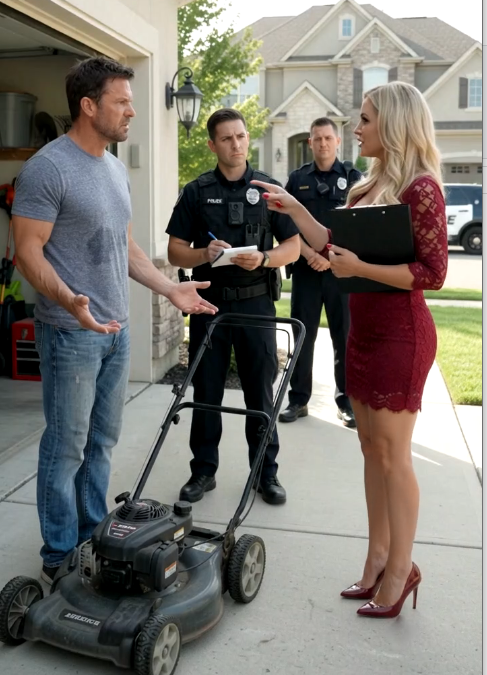
The HOA President Sent Two Police Officers to My Door Over a Lawnmower—Then They Learned She Filed the Noise Complaint 13 Minutes Before I Even Turned It On.
PART3:
“Do you have any way to verify that?”
“Yes.”
That was the second mistake Deborah made.
The first was calling early.
The second was assuming I was the kind of man who did not keep records.
I stepped back into the garage and pointed toward the small security camera mounted above the side door.
“That camera covers the garage and driveway. It records motion and time stamps everything.”
Officer Harris looked relieved.
“Would you be willing to show us?”
“Absolutely.”
Deborah shifted behind him.
“That’s really not necessary. The issue is community disturbance, not surveillance footage.”
Officer Harris looked at her.
“Ma’am, you called us here.”
Her mouth closed.
I opened the camera app on my phone.
The footage was clear.
At 3:53, I walked into the garage wearing work gloves and checked the mower’s gas.
At 3:58, I rolled it out onto the driveway.
At 4:00 exactly, I pulled the starter cord.
At 4:01, I began mowing the front strip.
At 4:17, I pushed the mower back toward the garage.
At 4:20, the officers arrived.
Officer Harris watched the screen without expression.
His partner, Officer Kim, looked toward Deborah.
“So the mower started after the complaint.”
Deborah lifted her chin.
“I could hear him preparing.”
“Preparing is not excessive noise,” Officer Kim said.
Deborah’s cheeks flushed.
“He has a pattern of hostile behavior toward the association.”
That was the sentence that told me this was not about grass.
It had never been about grass.
Officer Harris handed me back my phone.
“Mr. Walker, we don’t see any violation here. You’re within normal hours. We’ll note the time discrepancy in the report.”
Deborah’s eyes snapped toward him.
“The HOA expects cooperation from residents.”
Officer Harris gave her a professional smile that contained no warmth.
“The police department responds to legal complaints, ma’am. Not HOA expectations.”
For one beautiful second, Deborah Voss had no answer.
The officers left five minutes later.
Deborah lingered on the walkway, still holding her clipboard.
I stood in the open garage.
The mower sat behind me, grass stuck to its wheels.
“You embarrassed yourself,” I said.
Her eyes narrowed.
“You have no idea what you’re doing.”
“I mowed my lawn.”
“You think this is funny?”
“No.”
She took one step closer.
“You moved into this neighborhood and immediately started making everyone uncomfortable.”
“Everyone?”
“You question every notice. You challenge every correction. You act like rules don’t apply to you.”
“Rules apply to me when they exist.”
“They exist.”
“Then stop inventing them.”
Her face hardened.
That was the first time I saw what lived underneath the polished smile.
Not annoyance.
Not pride.
Something colder.
“You’re going to regret treating this association like an enemy, Mr. Walker.”
Then she turned and walked back toward her house at the end of the cul-de-sac.
I watched her go.
That was the moment I realized she would not stop.
Not because of the lawn.
Not because of the noise.
Because I had made the mistake of proving her wrong in front of people she could not control.
And Deborah Voss did not forgive embarrassment.
I had moved into Willowbrook Estates eleven months earlier.
The neighborhood looked peaceful from the outside: brick homes, tidy lawns, mature maples, curved streets, white mailboxes, a small pond near the entrance, and decorative stone signs that read WILLOWBROOK ESTATES in elegant black letters.
After my divorce, I wanted quiet.
That was all.
I was forty-six, working as a claims investigator for a regional insurance company, and tired in the way a man becomes tired when he has spent two years dividing a life into boxes, signatures, and bank accounts.
The house on Briar Glen Drive was not fancy, but it was solid. Three bedrooms. Finished basement. Two-car garage. A small maple tree in the front yard. Enough space for me, my tools, my books, and the silence I thought I wanted.
The seller, a retired widower named Carl Renner, shook my hand at closing and said, “Nice neighborhood, but watch the HOA president.”
I thought he was joking.
He was not.
Deborah visited me six days after I moved in.
She arrived with a welcome basket in one hand and a black binder in the other.
“Welcome to Willowbrook,” she said brightly. “I’m Deborah Voss, HOA president.”
“Nice to meet you.”
“I just wanted to personally introduce myself and make sure you had the community standards packet.”
She handed me the binder.
It was thick enough to stop a door.
“I got the covenants during closing,” I said.
“Oh, this is more updated.”
That turned out to be a generous description.
Some parts were copied from the recorded CC&Rs.
Some parts were board resolutions.
Some parts were neighborhood preferences Deborah had apparently promoted into law by typing them in bold.
I learned that slowly.
At first, I tried to be polite.
Deborah asked when I planned to repaint the mailbox post.
I told her it looked fine.
She smiled and said, “It’s close, but not quite within current aesthetic expectations.”
I painted it.
Then she asked me to move my trash bins behind the side fence instead of beside the garage.
I moved them.
Then she left a notice about “visible garden equipment” because I had leaned a rake against the porch for one afternoon.
I put the rake away.
Then came the American flag.
I installed a small bracket near the front door and put up a flag my father had given me before he died. Deborah left a notice saying exterior fixtures required architectural review.
I read the CC&Rs.
The actual recorded covenants allowed flags.
I sent her the section.
She replied with a three-sentence email saying the board appreciated my engagement and would “review the matter.”
The notice disappeared.
But her smile changed after that.
She stopped treating me like a new resident.
She started treating me like a problem.
The fines began in February.
Twenty-five dollars for leaving my garage door open while I carried in groceries.
Fifty dollars for “excessive driveway activity” because I changed my own oil on a Saturday afternoon.
Seventy-five dollars for “nonconforming winter wreath color palette,” which was the moment I started questioning whether Deborah had ever heard herself.
I appealed each one.
I cited the recorded covenants.
Not Deborah’s binder.
The covenants.
Each appeal was met with a delayed response, then a vague adjustment, then a new notice for something else.
By spring, I had a folder in my desk labeled HOA.
By June, it needed a second folder.
By August, I started keeping a spreadsheet.
Date.
Notice.
Rule cited.
Recorded authority.
Response.
Status.
Paid or disputed.
That spreadsheet saved me later.
At the time, it was mostly how I kept myself from feeling crazy.
That is what people like Deborah do best.
They do not just pressure you.
They make you wonder if resisting pressure is unreasonable.
Was I making too much of a mailbox?
Was I being difficult about trash bins?
Was I turning every small issue into a fight?
Then she called the police before my mower started, and the answer became clear.
No.
I was not imagining it.
She had been building something.
And the lawnmower complaint was the first time the frame cracked.
The day after the police visit, I requested the incident report.
I did it properly.
I drove to the police department, filled out a public-records request, and asked for the call log, dispatch notes, and officer narrative.
The clerk said it might take a few days.
I thanked her.
That evening, I downloaded the security footage from my garage camera, saved the files to two drives, and emailed one copy to myself.
Then I printed the HOA noise rules.
Allowed lawn equipment hours:
Monday through Saturday, 8:00 a.m. to 7:00 p.m.
Sunday, 10:00 a.m. to 5:00 p.m.
I had mowed on Tuesday at 4:00 p.m.
Well within the rules.
Three days later, the incident report arrived.
I read it at my kitchen table.
The call had been received at 3:47 p.m.
Complainant: Deborah Voss.
Complaint: “Resident intentionally operating loud lawn equipment during official HOA meeting after repeated warnings.”
Repeated warnings.
That phrase made me sit back.
There had been no warning.
Not one.
Officer Harris’s narrative was short but precise.
Upon arrival, officers contacted homeowner Mark Walker. Homeowner provided security footage showing lawn equipment began operating at approximately 1600 hours. Complaint was received prior to observed start time. No municipal noise violation observed. Complainant advised matter appeared civil/HOA-related and no police action would be taken.
I read the line again.
Complaint was received prior to observed start time.
There it was.
A sentence Deborah could not smile her way around.
I placed the police report in the HOA folder.
Then I made a third folder.
I labeled it Deborah.
That might sound dramatic.
It was not.
It was practical.
Because by then I understood that this was no longer about whether I could win individual arguments.
I needed to understand the pattern.
Patterns are my job.
Insurance investigation is not as exciting as television makes it seem. Most of it is documents, timelines, statements, receipts, photos, contradictions, and the patience to notice when one small fact does not fit. People think fraud is discovered in dramatic confrontations. Usually, it is discovered in timestamps.
A receipt issued after a claimed accident.
A photo uploaded before reported damage.
A witness statement that places someone in two places at once.
Deborah’s complaint had been filed thirteen minutes before the mower started.
A small fact.
A fact that did not fit.
So I started looking for others.
The first thing I noticed was the meeting.
Deborah had said I disrupted an official HOA board meeting at her residence.
But under Willowbrook’s governing documents, board meetings required forty-eight hours’ notice to members unless they were emergency sessions. I had received no notice.
I checked the community website.
No meeting posted.
I checked email.
No meeting notice.
I asked two neighbors casually whether they knew about a board meeting that Tuesday.
Neither did.
One of them, a retired nurse named Ellen Price, lived across the street from Deborah.
“She had people over,” Ellen said. “But it looked like wine and gossip, not a board meeting.”
“How many?”
“Four women. Maybe five. They sat on the back patio.”
“At three forty-seven?”
Ellen thought for a moment.
“Probably. I remember because my grandson came home from school around then, and Deborah’s friends were already there.”
“Did they seem bothered by noise?”
“What noise?”
I nearly smiled.
“Exactly.”
The next morning, I emailed the HOA management company.
Dear Board,
Please provide the official notice, agenda, minutes, attendee list, and emergency justification, if any, for the HOA board meeting allegedly held at President Deborah Voss’s residence on Tuesday, September 12, at approximately 3:47 p.m.
Regards,
Mark Walker
The response came two days later from a property manager named Allison Webb.
Mr. Walker,
No official board meeting was held on that date. The next scheduled board meeting is October 3.
Thank you.
Allison Webb
Community Management Services
I printed it.
Into the Deborah folder it went.
Now I had three things.
A police complaint filed before the mower started.
A false claim of repeated warnings.
A false claim of an official board meeting.
One lie can be a mistake.
Three lies are architecture.
I began asking quiet questions.
Not accusations.
Questions.
I asked my neighbor Tom Alvarez whether he had ever received odd violation notices.
He laughed without humor.
“Deborah sent me one for having my basketball hoop two inches over the driveway seam.”
“Was that in the rules?”
“No idea. I paid fifty bucks to make her stop emailing me.”
I asked Ellen Price.
She had paid a fine for planting yellow mums in October because Deborah said the approved fall palette emphasized “earth tones.”
I asked Mr. Kessler two doors down.
He had been fined for parking his daughter’s car overnight during Thanksgiving.
I asked the Hendersons near the pond.
They had received five notices in six months after they declined to support Deborah’s proposal for a new clubhouse renovation.
That caught my attention.
“After they declined?”
Mrs. Henderson nodded.
“She came by asking whether we’d support a special assessment. We said no. Suddenly our shutters were too faded.”
“What happened?”
“We paid for repainting.”
“Did the board vote on the assessment?”
“No. It never went anywhere.”
I went home and opened my spreadsheet.
Then I added a new column.
Potential trigger.
By the end of the week, a pattern emerged.
Most residents got occasional warnings.
But the people who challenged Deborah, embarrassed her, declined her requests, or voted against her priorities received repeated fines.
Not always large.
Twenty-five dollars.
Fifty.
Seventy-five.
Enough to irritate.
Enough to intimidate.
Not enough for most people to hire a lawyer.
That was the brilliance of it.
Deborah had weaponized inconvenience.
On September 20, eight days after the police incident, I received a certified letter from the HOA.
The envelope was thick.
Inside was a formal Notice of Continuing Violation.
According to the letter, I had engaged in “harassing conduct toward association leadership,” “excessive noise activity,” “failure to cooperate with enforcement personnel,” and “conduct detrimental to community harmony.”
Community harmony.
That phrase alone should have been illegal.
The letter imposed a $500 fine and required me to attend a compliance hearing.
Failure to attend, it warned, may result in escalation, including additional fines, suspension of privileges, legal action, and assessment lien proceedings.
There it was.
Assessment lien proceedings.
That changed the stakes.
This was no longer Deborah leaving ridiculous notices.
This was the HOA threatening my property.
I called an attorney that afternoon.
Her name was Marlene Cho, and she came recommended by a coworker who had once fought a condo board over roof repairs. Marlene specialized in real estate disputes and had the calm, dry voice of someone who had heard every possible version of petty tyranny.
I summarized the situation.
She listened.
When I finished, she said, “Send me everything.”
“How much is everything?”
“All of it.”
“Are you sure?”
“No one who says ‘community harmony’ in a legal notice should be trusted with selective context.”
I liked her immediately.
I scanned the notices, emails, police report, camera stills, rule excerpts, Allison Webb’s email, my spreadsheet, and photos.
Then I sent them.
The next morning, Marlene called.
“Mr. Walker.”
“Mark is fine.”
“Mark, I have two questions.”
“Go ahead.”
“First, have you paid any of the fines?”
“Some early ones. Under protest? Not formally. I just wanted them to stop.”
“Second, do you have copies of the recorded CC&Rs, not the board handbook?”
“Yes.”
“Good. Because half of what they are citing appears to come from guidelines that may not have been properly adopted.”
I closed my eyes.
That was exactly what I had suspected.
Marlene continued.
“The police report is useful. The management company email is more useful. Together, they suggest the notice contains factual statements the HOA knew or should have known were false.”
“What do we do?”
“We respond. Firmly. We demand withdrawal of the fine, preservation of records, and copies of all board votes authorizing these enforcement actions.”
“And if they refuse?”
“Then we make their paperwork the problem.”
Marlene’s first letter went out two days later.
It was not emotional.
That made it more frightening.
It identified the false police complaint.
The incorrect meeting claim.
The absence of a noise violation.
The lack of prior warnings.
The improper fine.
The threat of lien proceedings.
It demanded rescission of the $500 charge, correction of my account, and production of records including board minutes, enforcement logs, emails concerning me, communications with police, and any documents showing authority for Deborah to initiate enforcement action individually.
It also instructed them to preserve all relevant documents.
The HOA did not respond within the ten days Marlene gave them.
Instead, Deborah came to my house again.
This time she came alone.
It was 7:10 p.m., just after sunset. I saw her on the doorbell camera before she knocked.
No red dress this time.
No smile.
She stood under the porch light holding a white envelope.
I opened the door but kept the storm door closed.
“Deborah.”
“Mr. Walker.”
“If this concerns the legal letter, you should talk to Marlene Cho.”
Her expression tightened.
“I’m here as a neighbor.”
“No, you’re not.”
She looked past me into the house.
“You’ve made this much bigger than it needed to be.”
“I didn’t call the police before my mower started.”
Her lips thinned.
“That was an error in timing.”
“That’s an interesting phrase.”
“You are creating hostility in this community.”
“I’m creating documentation.”
That landed.
Her eyes sharpened.
“You think you’re clever.”
“I think you should leave.”
She held up the envelope.
“This is your final opportunity to resolve the matter informally.”
“Put it in the mailbox.”
“I’m handing it to you.”
“No, you’re not.”
For a second, we stood there separated by glass and steel mesh.
Then she said quietly, “You’re going to wish you had been more cooperative.”
I looked at the doorbell camera.
“Is that your official position as HOA president?”
Her eyes flicked toward the camera.
She lowered the envelope.
Then she walked away.
I saved the video.
The next morning, Marlene sent another letter.
This one was shorter.
It stated Deborah had attempted direct contact after counsel had been retained and instructed the HOA to direct all communication through legal counsel.
Three days later, the HOA’s attorney finally responded.
His name was Richard Bell.
His letter claimed the board acted in good faith, denied harassment, and stated the $500 fine would remain pending until the compliance hearing.
Marlene laughed when she read it.
Not loudly.
Just once.
“That was a mistake.”
“What part?”
“All of it. But especially the hearing.”
The hearing was scheduled for October 3.
The same date Allison Webb had previously identified as the next scheduled board meeting.
Marlene advised me to attend, say very little, and record if permitted under state law.
Ohio allowed one-party consent for recording conversations.
Marlene told me not to announce it.
“Let them talk,” she said.
That became the theme of my life for the next several weeks.
Let Deborah talk.
Let the board talk.
Let the documents talk louder.
On October 3, I walked into the Willowbrook clubhouse carrying a folder and a digital recorder in my jacket pocket.
The clubhouse had beige walls, fake plants, a coffee station, and a framed aerial photo of the neighborhood from 1998. About thirty residents sat in folding chairs. More than usual, according to Ellen, who took a seat near the back and gave me a small nod.
Deborah sat at the front table with four board members.
To her right was Richard Bell, the HOA attorney.
To her left was Allison Webb from the management company.
Deborah looked composed.
That worried me more than if she had looked angry.
Composure meant she had prepared a performance.
She called the meeting to order and moved through routine items with artificial brightness.
Landscaping contract.
Pool closing.
Holiday decorations.
Then she reached my name.
“Next, we have a compliance matter involving Mr. Mark Walker of 114 Briar Glen Drive.”
Every head turned.
I stood.
Deborah folded her hands.
“Mr. Walker has engaged in repeated violations of community standards, including excessive noise, refusal to cooperate with association enforcement, and hostile conduct toward board leadership.”
I looked at Richard Bell.
He did not look back.
Deborah continued.
“The board has attempted to handle this privately, but Mr. Walker has escalated matters unnecessarily.”
I said nothing.
That seemed to irritate her.
“Mr. Walker, do you wish to address the board?”
“Yes.”
I opened my folder.
“I have three questions.”
Deborah smiled.
“Proceed.”
“Was there an official HOA board meeting at your residence on September 12 at 3:47 p.m.?”
Her face froze for half a second.
“That was an administrative gathering.”
“That wasn’t my question.”
A few people shifted in their chairs.
Richard Bell leaned toward Deborah, but she spoke before he could stop her.
“It was association-related.”
I looked at Allison Webb.
“Allison, did the management company records show any official board meeting on that date?”
Allison looked uncomfortable.
“No.”
Deborah turned toward her.
“Allison.”
Allison swallowed.
“There was no posted meeting.”
I nodded.
“Second question. Did I begin mowing before or after the police complaint was made?”
Richard Bell stood.
“I don’t think this is productive.”
I removed the police report from my folder.
“The complaint was received at 3:47 p.m. My security footage shows the mower began operating at 4:00 p.m.”
A murmur moved through the room.
Deborah’s face reddened.
“This has already been addressed.”
“No, it hasn’t.”
I looked at the board.
“Third question. Who authorized the $500 fine?”
Deborah lifted her chin.
“The enforcement committee.”
“Who sits on that committee?”
No answer.
I waited.
Finally, a board member named Alan Price cleared his throat.
“We don’t have a formal enforcement committee.”
Deborah’s head snapped toward him.
Alan looked down at the table.
“I mean, not one separately appointed.”
I turned back to Deborah.
“So who authorized it?”
She said nothing.
Richard Bell stepped in.
“The board ratified the enforcement action.”
“When?”
He looked at his papers.
“At this meeting.”
I stared at him.
“You ratified the fine after issuing it?”
The room went quiet.
That was the first visible crack.
Deborah tried to regain control.
“Mr. Walker, your tone illustrates exactly the kind of hostility we’re dealing with.”
A woman in the back row spoke up.
“Answer the question.”
It was Ellen.
Deborah looked startled.
Ellen stood slowly.
“He asked who authorized the fine. I’d like to know too.”
Tom Alvarez raised a hand.
“And I’d like to know who authorized mine.”
Another voice followed.
“And mine.”
Then another.
“What enforcement committee?”
The room changed.
People who had arrived expecting to watch someone else’s problem suddenly realized they might be looking at their own.
Marlene had told me something the day before.
“Bullies survive by isolating targets. The moment other people compare notes, the structure weakens.”
She was right.
Deborah tried to adjourn the compliance portion.
Residents objected.
Richard Bell whispered to her.
Allison Webb sat pale and silent beside them.
Finally, Alan Price pushed back his chair.
“I move that all pending fines issued without documented board authorization be suspended pending review.”
Deborah stared at him.
“You can’t do that.”
“I’m on the board.”
“This is not on the agenda.”
“It is now.”
Another board member, Susan Miller, seconded.
The vote was three to two.
The fines were suspended.
Mine included.
Deborah’s face looked carved from stone.
The next morning, Marlene received a message from Richard Bell requesting a conference.
“That was fast,” I said.
“They have a problem,” Marlene replied.
“What problem?”
“Possibly several. But the big one is that their own board just admitted, in public, that enforcement actions may have been issued without proper authorization.”
“Is that enough?”
“It’s enough to start asking for more.”
And we did.
Marlene demanded full enforcement records for the past three years.
The HOA resisted.
Marlene filed a petition in county court to compel inspection of association records.
That was when Deborah’s kingdom began to come apart.
The records arrived in stages.
First came the official violation log.
Then email threads.
Then board minutes.
Then account ledgers.
Then something called the “priority compliance list.”
That list changed everything.
It was not supposed to exist.
At least not officially.
It was an internal spreadsheet kept in a shared HOA folder.
Names.
Addresses.
Violation history.
Notes.
Some entries were ordinary.
Trash bins.
Late dues.
Unapproved paint.
But several homeowners were marked with a red asterisk.
At the top of the sheet was a legend.
Priority residents.
Beside my name was a note.
Uncooperative. Challenges authority. Monitor closely.
Beside Tom Alvarez:
Complained about pool contract. Increase inspections.
Beside Ellen Price:
Opposed clubhouse assessment. Watch exterior.
Beside the Hendersons:
Declined support. Pressure via maintenance.
I read those lines three times.
Pressure via maintenance.
There are moments when suspicion becomes evidence so cleanly that anger arrives late.
This was one of them.
Marlene was quiet when she called.
“Mark, this is not just selective enforcement anymore.”
“What is it?”
“It looks like retaliation.”
More records followed.
Emails from Deborah to Allison.
Make sure Walker gets cited this week. He needs to learn this community has standards.
Another:
If Alvarez wants to question board decisions, his driveway can be inspected monthly.
Another:
Hendersons still refusing assessment support. Find something visible.
Then came the email about me sent two hours before the police complaint.
Walker usually mows Tuesday afternoons. Board gathering at my house today. If he starts, I want it documented as intentional disruption.
Allison had replied:
We cannot issue a violation for anticipated noise.
Deborah replied:
Then I’ll handle it.
At 3:47 p.m., she called police.
Before I started mowing.
I sat in Marlene’s office reading the email from a printed page.
For several seconds, I could not speak.
Marlene waited.
Finally, I said, “She planned it.”
“Yes.”
“She wanted a police report.”
“Yes.”
“For the file.”
“That appears likely.”
I thought about Deborah standing behind those officers, smiling.
Delighted.
Now I knew why.
She had expected the police visit to become evidence against me.
A record.
A stain.
A tool.
Instead, it became the thread that pulled her whole scheme apart.
Marlene filed an amended complaint.
Selective enforcement.
Retaliation.
Abuse of association authority.
Improper fines.
Failure to maintain records properly.
Defamation based on false statements in enforcement notices.
We sought removal of unlawful fines, reimbursement for fines paid by affected homeowners, attorney’s fees, and injunctive relief requiring independent oversight of enforcement procedures.
I was not the only plaintiff anymore.
Tom joined.
Ellen joined.
The Hendersons joined.
Then six others.
By December, Deborah was no longer fighting one “difficult homeowner.”
She was facing eleven neighbors with records.
The hearing was scheduled for January.
By then, Willowbrook Estates was not peaceful anymore.
It looked the same from the outside.
Holiday wreaths.
Clean sidewalks.
Soft porch lights.
Children riding bikes in winter coats.
But beneath that polished surface, the neighborhood had split into conversations.
People compared fines.
People requested records.
People asked when enforcement committees had been created.
People asked why certain homes had been inspected weekly while others never received notices at all.
People asked where the fine money had gone.
That last question opened a second door.
The ledger showed thousands of dollars collected through violation fines.
Some went into the general fund.
Some covered management fees.
But several entries were marked Community Standards Initiative.
Marlene requested invoices.
The invoices showed payments to a consulting firm called Voss Residential Strategies.
Deborah’s husband owned it.
The amounts were not enormous.
That almost made it worse.
Eight hundred dollars.
Twelve hundred.
Fifteen hundred.
Enough to hide among routine expenses.
Not enough to attract attention unless someone already knew where to look.
The descriptions were vague.
Compliance review.
Community standards planning.
Resident engagement guidance.
Marlene stared at the invoices.
“Does the board know her husband owns this company?”
I did not know.
At the next special board meeting, Alan Price asked publicly.
Deborah denied any impropriety.
“It’s a legitimate consulting vendor.”
Alan asked whether she disclosed the relationship before voting on payments.
She said the services were approved informally.
Susan Miller asked where that approval appeared in the minutes.
Deborah said the board was becoming distracted by personal attacks.
That answer did not work anymore.
By then, everyone knew her language.
Community standards.
Harmony.
Best interests.
Personal attacks.
Words she used when the facts were inconvenient.
The January hearing took place in a small county courtroom with fluorescent lights and wooden benches worn smooth by decades of people waiting for their problems to be called.
I sat beside Marlene.
Deborah sat across the aisle with Richard Bell.
She wore navy blue.
No clipboard.
No smile.
Officer Harris testified first.
He was calm, factual, and devastating.
He confirmed the complaint time.
He confirmed my footage.
He confirmed there had been no noise violation.
He confirmed Deborah had been advised that police would not enforce HOA preferences.
Then Allison Webb testified.
She looked miserable.
Marlene asked whether there had been an official board meeting on September 12.
“No.”
“Did Deborah Voss tell police there was?”
“I believe so.”
“Did the management company authorize the $500 fine before it was issued?”
“No.”
“Did the board?”
“No.”
“Who directed it?”
Allison looked toward Deborah.
“Mrs. Voss.”
The room went still.
Marlene introduced the priority compliance list.
Then the emails.
One by one.
Make sure Walker gets cited this week.
Increase inspections.
Pressure via maintenance.
If he starts, I want it documented as intentional disruption.
Then the police report.
Then the timestamped video.
The judge, a woman named Rebecca Sloan, read quietly.
She did not interrupt often.
When Richard Bell argued that the HOA had broad discretion to enforce community standards, Judge Sloan looked up.
“Discretion is not a license for retaliation.”
Bell tried to argue that the plaintiffs were difficult residents.
Judge Sloan turned a page.
“Difficult is not a covenant violation.”
That line traveled through Willowbrook faster than any official notice ever had.
Deborah testified last.
Richard Bell guided her gently.
She said she cared deeply about the neighborhood.
She said enforcement was difficult.
She said residents often misunderstood the burden placed on volunteer leaders.
She said I had been confrontational since moving in.
Then Marlene stood.
“Mrs. Voss, did you call the police on Mr. Walker at 3:47 p.m. on September 12?”
“Yes.”
“Had his lawn mower started?”
“I believed it was about to.”
“That wasn’t my question.”
Deborah inhaled.
“No.”
“Did you tell police he was intentionally disrupting an official HOA board meeting?”
“I may have used those words.”
“Was there an official board meeting?”
“It was association-related.”
“Was there an official board meeting?”
“No.”
“Did you issue a $500 fine afterward?”
“The association did.”
“Who authorized it before it was sent?”
Deborah paused.
“The president has authority to act when necessary.”
“Please point to the covenant provision allowing the president to unilaterally impose a $500 fine based on a false police complaint.”
Richard Bell objected.
The judge allowed the question in narrower form.
Deborah could not answer.
Marlene then showed her the email to Allison.
Walker usually mows Tuesday afternoons. Board gathering at my house today. If he starts, I want it documented as intentional disruption.
“Those are your words?”
“Yes.”
“And when Allison told you the HOA could not issue a violation for anticipated noise, you wrote, ‘Then I’ll handle it.’ Correct?”
“Yes.”
“Then you called police before he started mowing.”
Deborah’s voice was low.
“Yes.”
“Because you wanted documentation against him.”
“I wanted the situation addressed.”
“The situation that had not happened yet?”
No answer.
That silence did more than any speech could have done.
Judge Sloan issued her ruling two weeks later.
The court found the $500 fine invalid.
Then it went further.
It found a pattern of improper selective enforcement against multiple homeowners.
It ordered the HOA to rescind all fines issued without proper board authorization.
It required reimbursement of improperly collected fines with interest.
It prohibited Deborah from participating in enforcement decisions pending a board review.
It ordered the HOA to adopt written enforcement procedures consistent with the recorded covenants.
It awarded attorney’s fees.
And it referred the conflict-of-interest payments involving Voss Residential Strategies to the state attorney general’s charitable and nonprofit oversight division for review.
Deborah resigned three days later.
Not in person.
By email.
The message was short.
Effective immediately, I resign as president of the Willowbrook Estates Homeowners Association.
No apology.
No explanation.
No community harmony.
Just one sentence.
For a few hours, the neighborhood felt almost confused by the absence of her.
Then people started coming outside.
Tom Alvarez waved at me from his driveway.
Ellen brought over banana bread and said, “I baked this because I’m too old to TP someone’s house.”
The Hendersons invited me to sit on their porch.
Nobody celebrated loudly.
It was not that kind of victory.
It was quieter.
Relief often is.
The new board held an open meeting in February.
The room was full.
Alan Price, now interim president, stood at the front and looked nervous in a way I trusted.
“I’m going to start by saying something the previous board should have said,” he began. “We work for the homeowners. We do not rule them.”
People applauded.
He announced an independent audit.
A review of fines.
A conflict-of-interest policy.
A requirement that all enforcement notices cite specific recorded authority.
Not handbook preferences.
Not community expectations.
Recorded authority.
When the meeting ended, I walked outside into cold air.
The clubhouse parking lot was full of neighbors talking in small groups.
For the first time since I had moved in, Willowbrook looked less like a controlled community and more like an actual one.
Messy.
Imperfect.
Human.
A few weeks later, I mowed my lawn again on a Tuesday afternoon.
Four o’clock.
Exactly.
Not because I needed to make a point.
Because the grass needed cutting.
The mower started on the second pull. I moved in straight lines across the front yard, then along the side strip, then around the maple tree.
No police came.
No clipboard appeared.
No one accused me of destroying community harmony.
Ellen waved from across the street.
Tom gave me a thumbs-up.
I finished at 4:38, rolled the mower into the garage, and stood for a moment in the quiet.
I thought about the first day Deborah came to my door with the welcome basket and the binder.
I thought about how easy it had been, at first, to comply.
Paint the mailbox.
Move the bins.
Put away the rake.
Take down nothing, but question everything quietly.
That is how people like Deborah gain ground.
Not all at once.
One unreasonable request at a time.
One small fine.
One vague rule.
One warning dressed as neighborly advice.
One person made to feel difficult for asking, “Where does it say that?”
Then another.
Then another.
Until the whole neighborhood learns to obey paperwork nobody has actually read.
The lawnmower complaint changed everything because Deborah made one mistake.
She let her desire to punish me outrun time itself.
She called the police before the noise existed.
Thirteen minutes.
That was all.
Thirteen minutes between her story and the truth.
But sometimes thirteen minutes is enough to reveal an entire system.
I still keep the police report.
It sits in the front of the folder labeled Deborah.
Behind it are the violation notices, emails, meeting minutes, court order, reimbursement checks, and the printed line from Judge Sloan’s ruling that Ellen had framed for the clubhouse office.
Difficult is not a covenant violation.
I think about that sentence often.
Because people in power love to confuse resistance with misconduct.
They call questions hostility.
They call boundaries disrespect.
They call documentation aggression.
They call obedience harmony.
But rules only deserve respect when they are real, lawful, and applied honestly.
A clipboard is not a crown.
A title is not a weapon.
A community is not one person’s private kingdom.
And if someone knocks on your door with authority they do not have, sometimes the smartest thing you can do is not shout.
It is check the timestamp.
Read the rule.
Save the footage.
Find the paper.
Then let the truth arrive with its own hard knock.