The HOA President Kept Driving Through My Private Ranch Gate—Then I Stopped Arguing and Let the Boundary Teach Her Why It Was There.
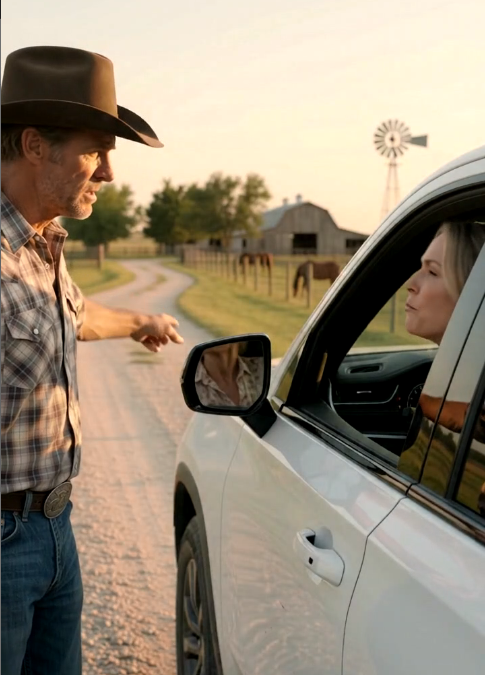
PART2:
She had once made a retired schoolteacher cry over a birdbath Karen claimed was “not aligned with community character.”
She had a way of speaking that turned preferences into rules before anyone had time to ask where the rules were written.
I had avoided her as much as a man could avoid someone whose subdivision bordered his land.
That was easy at first because my ranch was not part of Willow Ridge.
My deed carried no HOA covenants.
I paid no HOA dues.
Their board could regulate what happened behind their entrance monument.
They could not regulate my cattle pasture.
That distinction mattered.
At least, it mattered to me.
The gate marked the difference.
Two heavy wooden panels hung between thick posts faced with limestone, the right panel slightly darker where my father had replaced a cracked plank years ago.
A black and white sign beside the latch read PRIVATE PROPERTY.
Beyond it, my gravel road curved through pasture toward the barn, equipment shed, hay lot, and north fence line.
There was no clubhouse back there.
No public walking path.
No neighborhood shortcut.
No HOA maintenance facility.
Just my land.
My father built that gate when I was twenty-four.
I could still see him in my mind, standing in the August heat with a level in one hand and sweat darkening the front of his shirt.
“Measure twice,” he had said.
“I know, Dad.”
“Then measure again.”
I laughed then because young men laugh when older men repeat things that later turn out to be wisdom.
He did not laugh.
“A gate that doesn’t close right isn’t much of a gate, Daniel.”
At the time, I thought he was talking about hinges.
Years later, after marriage, children, droughts, funerals, and long seasons of trying to hold land together while the world around it changed, I understood that he had been talking about responsibility.
A gate either holds or it does not.
A boundary either means something or it does not.
And if you are the one trusted to keep it, you do not get to shrug when somebody treats it like decoration.
My wife, Ellen, understood that better than anyone.
She had been gone four years by then.
Cancer took her slowly enough for us to say everything and quickly enough that none of it felt finished.
Some mornings I still turned toward her garden expecting to see her in that old straw hat, kneeling beside the tomatoes, scolding Ranger for stepping on the marigolds.
Some evenings I still caught myself listening for her voice from the kitchen window.
“Daniel, wash your hands. Supper’s ready.”
People told me after she died that I should sell.
The town was growing.
Developers were paying prices my grandfather could not have imagined.
The ranch was too much work for one man.
They meant well.
But they did not understand.
The ranch was not just land.
It was my father’s hands in the gate.
My mother’s roses by the porch.
Ellen’s garden.
My daughter Rebecca’s first pony ride.
My son Matthew’s initials carved into the inside of the tack room door before he moved to Colorado and built a life of his own.
It was grief and work and memory all braided together into soil.
So I stayed.
I kept the cattle.
Kept the horses.
Kept the fences patched.
And kept the gate closed.
Not locked twenty-four hours a day.
Not guarded.
Not covered in warnings.
Closed.
That was all.
Anyone with legitimate business knew what to do.
Open it.
Drive through.
Close it behind you.
On a working ranch, an open gate can mean a loose cow on a county road.
It can mean a horse panicking near machinery.
It can mean a stranger wandering into a pasture with a bull and learning too late that rural land is not a park.
Access is not ego out here.
It is safety.
It is responsibility.
Everybody around me seemed to understand that.
Everybody except Karen Whitmore.
The first time she drove through my gate, I was near the barn replacing a cracked water line.
Ranger was lying in the shade, half asleep, when his ears lifted.
A moment later, I heard tires on gravel.
At first, I assumed it was a feed delivery or maybe the vet’s assistant coming early.
Then the white Lexus appeared around the bend, bright and spotless, moving slowly like the driver was touring property for sale.
Karen stopped beside the barn and rolled down her window.
“Morning,” she said.
I wiped my hands on a rag and walked over.
“Morning.”
She looked around as if she had discovered a hidden resort.
“Beautiful property.”
“Thank you.”
“I’ve never been back here.”
“I figured.”
She missed the meaning underneath that, or pretended to.
“I wanted to see where this road connects.”
“It doesn’t.”
Her eyebrows lifted.
“It looks like it continues toward the north side of the subdivision.”
“It goes toward my north pasture.”
“Oh.”
She glanced past me.
“We’ve been reviewing emergency access routes.”
“Okay.”
“One of the board members thought this might connect.”
“It doesn’t.”
She smiled then, that polished HOA smile people use when they want to end a conversation without admitting anything.
“Good to know.”
She started to roll up the window.
I stepped closer.
“Karen.”
She stopped.
“Yeah?”
“This is private.”
She looked toward the gate.
“I know.”
“No, I mean the road.”
“I understand.”
“If you need to come onto the ranch again, call me first.”
Her expression changed just slightly.
It was quick, almost nothing, but I saw it.
A flicker of offense.
As if permission was something other people asked for.
“Of course,” she said.
Then she turned around and drove out.
I watched her SUV reach the entrance.
The gate stayed open behind her.
I walked two hundred yards to close it.
That should have been the end of it.
A week later, I was repairing fence in the lower pasture when I heard tires again.
I looked up and saw the same white SUV moving through my gate.
Karen drove farther this time, past the barn and toward a fork where the ranch road split between the hay meadow and the north pasture.
She stopped, stepped out, and lifted her phone as if she were documenting evidence.
I walked toward her.
“Karen.”
She turned with a look of mild surprise, as though I had appeared in her office instead of on my own land.
“Oh. Hi.”
“What are you doing?”
“Just checking the access.”
“We already checked it.”
“I’m mapping possible HOA service routes.”
I stared at her.
“This isn’t an HOA service route.”
“I know currently it isn’t.”
“Currently?”
She pointed with her phone.
“This is the most direct path toward the rear edge of our neighborhood.”
“Across my ranch.”
“Yes.”
“No.”
Her eyebrows rose.
“I’m not proposing anything permanent.”
“You’re standing on private property after I told you to call before coming here.”
“I didn’t think you meant official HOA business.”
I almost laughed.
“What else would I mean?”
She folded her arms.
“The HOA needs to understand surrounding access options.”
“Then the HOA can look at a map.”
“Maps don’t show everything.”
“Neither does driving through somebody else’s gate.”
That annoyed her.
“I am not damaging anything.”
“That’s not the point.”
“Then what is?”
“Permission.”
She gave me that look people give when they think a simpler explanation is hiding behind your refusal to do what they want.
“The gate was open.”
“It was closed.”
“Not locked.”
“A closed gate does not become public because it isn’t locked.”
She sighed.
“I’m trying to do my job.”
“And I’m asking you to stay off my land.”
“I’ll note the concern.”
“No.”
She looked at me then.
I kept my voice calm.
“Don’t note it as a concern. Understand it as a boundary.”
For several seconds, neither of us spoke.
The wind moved through the grass.
A horsefly circled the hood of her Lexus.
Then Karen got back into the SUV.
“Fine.”
She drove out.
Again, I closed the gate behind her.
That evening, I took out the land-record binder.
My father had started it decades earlier, back when paperwork was kept in yellow folders and people wrote notes in pencil because ink felt too permanent.
I had added to it over the years.
Deeds.
Surveys.
Easement records.
Tax documents.
Old photographs of fence lines before Willow Ridge existed.
Receipts for materials.
Letters from the county.
Anything that might someday matter.
I did not check the records because I doubted myself.
I checked because memory is weak when people start arguing over land.
Paper holds still.
The survey was clear.
My parcel extended beyond the gate.
The entrance sat inside my boundary.
The gravel road beyond it ran through my land.
There was no recorded HOA right-of-way.
No blanket access easement.
No community road agreement.
There was an emergency-services provision farther south, but it followed a different route and had nothing to do with my ranch entrance.
I put the survey back in the binder.
Problem solved, I thought.
Then came the third time.
The morning Karen hit the gate, I did not rush after her at first.
I walked to the entrance and examined the damage.
The latch was bent.
Not destroyed, but twisted enough that the two panels no longer met properly.
The lower hinge on the right side had started pulling loose from the post.
Fresh tire marks cut through the dirt where a vehicle had turned too sharply, and scrape marks showed where the wooden panel had been pushed by something wide and hard.
I ran my fingers over the damaged wood.
It was my father’s gate.
That should not have mattered more than the practical problem, but it did.
Some objects become containers for people you cannot call anymore.
A gate can be lumber and hardware to everyone else.
To me, it was a Saturday in August with my father’s voice telling me to measure again.
Ranger sat beside me, watching the road.
I took photographs.
Then I got into my truck and drove after Karen.
I found her near the north fence, standing beside her SUV with a clipboard in her hand.
When I parked behind her, she turned around sharply.
“You following me?”
“This is my ranch.”
“Yes, I know.”
“Do you?”
She sighed.
“What now?”
“You drove through my gate again.”
“We need periodic access.”
“No.”
“There’s infrastructure along the neighborhood boundary.”
“On your side.”
“We still need visual access from this side.”
“Then ask.”
“I shouldn’t have to request permission every single time the association needs to inspect adjacent areas.”
“Yes, Karen,” I said, stepping closer but keeping my voice even. “You absolutely should.”
She stared at me like I had said something childish.
“Why are you making this so difficult?”
“I’m not.”
“You’re treating a simple access issue like trespassing.”
“Because you’re entering property after being told not to.”
“We’re not strangers.”
“That doesn’t matter.”
“I’m the HOA president.”
“That matters even less.”
Her expression hardened.
“The association has responsibilities.”
“So do I.”
“The road is the obvious access path.”
“Need isn’t ownership.”
She blinked.
“What?”
“Needing to use a road doesn’t mean you own the road.”
“I never said the HOA owned your ranch.”
“Then stop driving through it like you do.”
For once, she did not immediately answer.
I pointed toward the entrance.
“Turn around.”
“This is unreasonable.”
“Turn around.”
She did.
I followed at a distance.
At the gate, she drove through first.
I watched her vehicle swing too close to the right panel.
The wood jerked.
The latch struck metal.
She kept going.
I stopped my truck, got out, and stood beside the gate until her SUV disappeared.
That was the moment irritation became something else.
Not rage.
Not revenge.
Resolve.
I was done trying to convince Karen Whitmore that a boundary existed.
I would make the boundary speak for itself.
That night, I called my daughter.
Rebecca was thirty-three, a real estate attorney in Austin, and every bit as steady as her mother had been.
She answered on the second ring.
“Hey, Dad.”
“You busy?”
“For you, no.”
I told her everything.
She listened without interrupting, which is how I knew she was taking it seriously.
When I finished, she asked, “Did you tell her clearly not to enter without permission?”
“Three times.”
“Do you have anything in writing?”
“Not yet.”
“Then start.”
“I don’t want to make this a legal circus.”
“Writing something down doesn’t make it a circus. It keeps somebody else from rewriting the story later.”
I looked out the kitchen window toward the dark line of the fence.
“She damaged your grandfather’s gate.”
Rebecca was quiet.
Then she said softly, “Dad.”
“I know. It’s wood. I’m not pretending otherwise.”
“It’s not just wood.”
My throat tightened.
“No.”
“What are you thinking?”
“Repair it. Reinforce it. Make sure unauthorized vehicles can’t push through.”
“Whatever you build, make sure it’s on your property. Make sure it doesn’t interfere with legitimate emergency access. And make sure you document everything.”
“You sound like a lawyer.”
“I am a lawyer.”
“Your mother would’ve liked that answer.”
Rebecca laughed softly.
“Mom would’ve written Karen a letter herself and made her feel polite while she bled.”
That made me smile despite everything.
Ellen had been gentle, but she had never been weak.
She once stopped a county road crew from removing a hundred-year-old oak by standing in front of the bulldozer with a folder of approved plans in her hand.
The oak still stands.
“Send the email,” Rebecca said. “Take photos. Keep records. And Dad?”
“Yeah?”
“Don’t let her make you angry enough to look like the unreasonable one.”
“I won’t.”
“I mean it.”
“I know.”
After we hung up, I opened my laptop and wrote Karen an email.
I kept it simple.
I stated that the ranch road was private property, that she had entered multiple times without permission, that the gate had been damaged, and that no future access was authorized unless requested and approved in advance.
I attached photographs of the damage and a copy of the survey page showing the boundary.
I read it twice.
Then I sent it.
Karen replied the next afternoon.
“Daniel, thank you for sharing your perspective. The HOA will continue evaluating available access options in accordance with its operational responsibilities.”
I stared at that sentence for a long time.
It did not say she would stop.
It did not acknowledge the damage.
It did not mention permission.
It took my boundary and reduced it to a perspective.
I forwarded it to Rebecca.
Her response came ten minutes later.
“She didn’t answer the request. Save everything.”
I did.
The next morning, I called a fencing contractor named Walter Briggs.
Walter was sixty-four, broad-shouldered, gray-bearded, and had been building ranch entrances around the county longer than most people in Willow Ridge had owned their houses.
He arrived in a faded blue work truck just after breakfast.
When I showed him the gate, he squinted and ran a hand along the damaged latch.
“Somebody’s been rough on this old girl.”
“White Lexus.”
He looked at me.
“HOA?”
“President.”
Walter chuckled once, without humor.
“Of course.”
I explained what had been happening.
He listened with his hands on his hips, occasionally glancing toward the subdivision.
When I finished, he said, “You want another gate?”
“No.”
“Automatic opener?”
“No.”
“Lock it?”
“I need regular ranch access. Feed deliveries, vet, equipment, ranch hands, emergency vehicles if necessary.”
“Chain?”
“Someone determined enough can cut it. And Karen seems determined enough to pretend anything not welded shut is an invitation.”
Walter nodded slowly.
“What are you trying to stop?”
“Unauthorized vehicles entering without permission.”
He walked the entrance, measured the road width, studied the fence line, then looked back at me.
“Bollards.”
“That’s what I was thinking.”
“Not decorative ones.”
“No.”
“Steel. Deep-set. Permanent outer posts. Maybe removable center posts where you need equipment clearance. We protect the gate without turning the whole entrance into a wall.”
“What about emergency access?”
“We plan for it.”
“I don’t want to block anything legitimate.”
“Then we verify the survey and coordinate the layout properly.”
That mattered to me.
I was not going to stop Karen from ignoring my boundary by ignoring somebody else’s.
Walter came back later that day with measurements, and I called the county office to confirm there were no requirements I would be violating.
Rebecca had a title professional review the recorded easements again.
Everything pointed to the same conclusion.
The ranch entrance was mine.
The road was mine.
The HOA had no documented unrestricted right to drive through it.
So we planned carefully.
Property line.
Road width.
Gate swing.
Pedestrian clearance.
Equipment clearance.
Emergency access.
Every measurement was checked.
Walter scheduled the work for the following week.
Before installation began, my ranch hand, Luis Ortega, told me something that changed the whole shape of the problem.
Luis had worked with me for nine years.
He was quiet, reliable, and had the kind of integrity that made you trust what he said even when he used very few words.
He found me near the barn on Friday afternoon, hat in hand, looking troubled.
“Mr. Mercer?”
“Yeah?”
“I need to tell you something.”
I turned from the feed bin.
“What is it?”
“That woman. Karen.”
My stomach tightened.
“What about her?”
“I saw her last week with a man in a silver pickup.”
“On the ranch?”
“She came through the gate. He stayed near the subdivision fence.”
“What were they doing?”
“Looking at the road. Pointing. Talking.”
“Did you hear anything?”
Luis hesitated.
“Only some.”
“Tell me.”
“She said they needed the access question handled before the developer meeting.”
I stared at him.
“The what?”
“The developer meeting.”
“What developer?”
“I don’t know, sir.”
He looked embarrassed, as though he had failed me by not knowing more.
“I didn’t think much of it until the gate got damaged.”
I leaned against the feed bin.
Karen had told me she was reviewing emergency access.
Then drainage.
Then maintenance.
Now a developer.
“Luis, why didn’t you tell me earlier?”
He looked down.
“I thought maybe it was HOA business. I didn’t want to make trouble.”
“You’re not making trouble.”
He nodded, but his face stayed worried.
After he left, I stood in the barn aisle listening to the old fan tick in the rafters.
A developer meeting.
That phrase would not leave my mind.
The land north of Willow Ridge belonged to the Holloway family trust.
Ninety-some acres of scrub pasture, rocks, and cedar.
For years, people had speculated that it would be developed someday.
I had heard rumors, but rumors were like mesquite seeds around here.
They blew everywhere.
Most never took root.
But if a developer wanted to build north of Willow Ridge, a maintenance or service route along the western side might be valuable.
And my ranch road was the easiest existing path.
Convenience had just grown teeth.
That evening, I sent a formal letter to the Willow Ridge board, not just Karen.
I described the unauthorized entries, the damaged gate, and the planned protective installation.
I requested any documents supporting the HOA’s claimed access rights.
I also asked whether any pending development or infrastructure project involved use of my ranch road.
Three days later, an envelope arrived in my mailbox.
It was printed on HOA letterhead.
The heading read:
NOTICE OF OBSTRUCTION OF COMMUNITY ACCESS
I stood at the mailbox and read it twice while the wind lifted dust across the road.
The letter alleged that I was obstructing a historically used maintenance corridor.
It warned that physical barriers could interfere with community operations and emergency planning.
It demanded that I refrain from altering the entrance until the board reviewed the matter.
At the bottom, in bold text, it said failure to comply could result in additional enforcement measures.
I was not part of the HOA.
My property was not subject to HOA covenants.
Yet Karen had sent me what looked like a violation notice.
For a moment, I laughed.
Then I folded the letter, put it back in the envelope, and walked to the house.
Rebecca drove out that weekend.
She sat at my kitchen table reading the notice while her two children played with Ranger in the yard.
When she finished, she placed the paper flat on the table.
“This is either a spectacular misunderstanding or a bluff.”
“Which one?”
“Maybe both.”
She tapped the phrase “historically used maintenance corridor.”
“They don’t identify a recorded easement.”
“They keep saying historic.”
“Historic use can matter in some cases, but this letter doesn’t prove anything. It’s pressure.”
“They’re threatening enforcement.”
“They can threaten whatever they want. That doesn’t mean they have authority over you.”
I looked out toward the gate.
“Should I pause the work?”
“Have the survey and title records been checked?”
“Yes.”
“County issues?”
“Cleared.”
“Emergency access considered?”
“Yes.”
“Then document the installation. Photograph everything. Keep invoices. Keep communications.”
I nodded.
Rebecca studied me.
“Dad, is this really about the gate, or is it about Grandpa?”
The question landed harder than I expected.
I looked at the old photograph on the wall: my father, Ellen, Rebecca, Matthew, and me standing in front of that same entrance twenty years earlier.
“It’s about someone acting like what we own is less real because she wants it.”
Rebecca’s expression softened.
“That’s a fair answer.”
On Monday morning, Walter’s crew arrived.
Deep holes.
Concrete.
Steel.
Measurements checked twice, then again.
The posts went in heavy and straight, the kind of solid that makes people stop assuming they can nudge their way past.
Walter repaired the gate hardware, tightened the hinges, replaced the bent latch, and reinforced the damaged panel without removing the parts my father had built.
By sunset, the entrance looked different.
Not hostile.
Not ugly.
Just final.
The gate still stood where it had always stood.
But now steel bollards protected both sides of the approach, and a controlled removable section allowed authorized access when needed.
No vehicle could angle around.
No bumper could force the panel open without deliberate destruction.
I stood beside Walter as his crew loaded the truck.
“What do you think?” he asked.
I looked at the entrance.
“For the first time in weeks, I think I’ll sleep.”
Walter wiped his hands on his jeans.
“If that woman is as stubborn as you say, she’ll be back.”
“I know.”
“She’ll be mad.”
“She can be mad on the other side.”
Walter grinned.
“That’s what steel is good for.”
That night, I walked to the entrance after supper.
The sky had turned purple over the pasture.
The last cattle were moving toward the water trough.
Ranger sat beside me, his old body leaning against my leg.
I closed the gate and listened.
Click.
The latch seated cleanly.
It was such a small sound.
But it felt like a promise being kept.
The next morning, Karen came back.
I was drinking coffee on the porch when I heard her SUV before I saw it.
Same engine.
Same tires on gravel.
Same confidence.
She came toward the entrance the way she always had.
Then she saw the bollards.
The Lexus stopped hard enough that its front end dipped.
For several seconds, Karen sat behind the windshield, motionless.
Then she backed up.
Turned left.
Stopped.
Backed up again.
Tried the right side.
Stopped.
There was no opening.
The fence line and steel posts did exactly what they were supposed to do.
Eventually, the driver’s door opened.
Karen stepped out wearing white slacks, a pale blue blouse, and sunglasses that looked expensive enough to have their own insurance policy.
She stared at the steel.
Then at me.
“What did you do?”
I walked toward the gate.
“Morning.”
“What are these?”
“Bollards.”
“I can see that.”
“Then why did you ask?”
Her face tightened.
“You’ve blocked the road.”
“No.”
“You absolutely have.”
“I secured my entrance.”
“The HOA uses this road.”
“You use this road.”
“As HOA president.”
“Without permission.”
“We’ve already discussed this.”
“Several times.”
I pointed toward the repaired latch.
“You bent that.”
“I did not.”
“Your vehicle did.”
“You can’t prove that.”
“I don’t care enough to argue about it.”
Her mouth opened slightly.
“The gate was being damaged,” I said. “So I protected it.”
“You can’t just install steel barriers on an access route.”
“It’s not your access route.”
She folded her arms.
“We have a right to reach the rear boundary.”
“Show me.”
She stared.
“What?”
“Show me the document.”
“The HOA has always used surrounding routes for maintenance access.”
“Not this one.”
“Because you’re the first owner who’s made it an issue.”
That sentence told me everything.
Not: we have an easement.
Not: it’s recorded.
Not: here’s the agreement.
Just: nobody complained before.
I walked back to my truck, retrieved the survey, and unfolded it across the hood.
Karen approached reluctantly.
I pointed to the boundary.
“Here’s Willow Ridge. Here’s my parcel. Here’s the gate. Here’s the road.”
She leaned closer.
“The road runs adjacent to community property.”
“Adjacent isn’t inside.”
“The HOA needs boundary access.”
“Need is not ownership.”
“You keep repeating that.”
“Because you keep ignoring it.”
I traced the line with my finger.
“The gate is here. The road runs across my property. This easement is the emergency-services corridor. It’s south of here. This utility access is also elsewhere.”
She stared at the document.
For the first time since I had known her, Karen became quiet because of paper instead of because she was preparing another argument.
Then she pointed.
“The subdivision map shows access continuing near this boundary.”
“Near.”
“Yes.”
“Not through.”
She looked toward the bollards.
“We still need a route.”
“Then request one.”
“From you?”
“Yes.”
“Every time?”
“Unless we negotiate something different.”
She shook her head.
“That’s impractical.”
“Maybe.”
“HOA operations can’t depend on whether you’re available.”
“Then use the access routes the HOA actually owns.”
“You are obstructing community operations.”
“I’m stopping unauthorized driving across private land.”
She pulled out her phone.
“I need to call the board.”
“Go ahead.”
She walked several yards away.
I could hear pieces of her conversation.
Steel posts.
Vehicle access.
Private road.
Claims he owns it.
Survey.
She kept looking at me while she spoke.
I waited.
Not smiling.
Not satisfied.
I was not enjoying any of it.
I wanted the situation resolved.
If the HOA had a legitimate right I had somehow missed, I would deal with that.
Property rights worked both ways.
Nobody gets to shout “mine” louder than the paper.
After several minutes, Karen ended the call.
“The board is sending a surveyor.”
“Good.”
She blinked.
“Good?”
“Yes.”
“You don’t object?”
“Why would I?”
“Most homeowners become defensive when an HOA requests verification.”
“I’m not in your HOA.”
She looked away.
“You know what I mean.”
“I do.”
I folded my survey.
“Have whoever comes contact me first. I don’t want strangers walking the ranch without notice.”
She exhaled sharply.
“Again with permission.”
“Yes.”
“I’ll let them know.”
That afternoon, a professional surveyor called.
He explained that the HOA had retained him to verify the boundary near the ranch entrance.
I agreed immediately.
We met the next morning.
Karen attended, of course.
So did Thomas Bell, the HOA treasurer, a tired-looking man in his early sixties who kept glancing between Karen and me like he regretted saying yes to public service.
The surveyor located monument references, checked existing pins, compared recorded plats, and took measurements along the fence and entrance.
I stayed out of his way.
Karen did not.
“Are you measuring from the subdivision monument?” she asked.
“Yes.”
“And the road?”
“I’ll get there.”
“This older fence isn’t necessarily the legal boundary.”
“Correct.”
She glanced at me as if that helped her.
I said nothing.
A fence can be wrong.
That was why we were surveying.
When the field work was finished, the surveyor reviewed his measurements.
Karen stood beside him.
“So?”
He pointed toward the gate.
“The entrance is inside Mr. Mercer’s parcel.”
Her face did not move.
“How far?”
He gave the measurement.
She looked toward the road.
“And the gravel access?”
“Also on his parcel through this section.”
“What about HOA access rights?”
“I’m verifying boundary, not title rights,” he said.
I respected that.
A surveyor should say what he knows and stop there.
Karen pressed anyway.
“So you’re not saying we’re prohibited from using it.”
“I’m saying the physical road here is on his side of the property line.”
She looked at me.
I pulled out the title documents.
“We already checked recorded easements.”
The surveyor examined them briefly, careful not to overstep.
“I’d have an attorney interpret rights,” he said.
“Agreed,” I replied.
Karen looked frustrated.
“I thought you said there was nothing.”
“I said there’s nothing granting unrestricted HOA vehicle access.”
“You’re playing with words.”
“No.”
I looked at the surveyor.
“Is there any ambiguity about where this gate sits?”
He shook his head.
“Not from what I’m seeing.”
“The bollards?”
“Inside the parcel.”
“The fence?”
“Generally tracks the boundary closely here.”
I nodded.
“Thank you.”
Karen stared at the steel posts.
Months of argument had been reduced to coordinates.
That is one reason I have always liked surveys.
They are not emotional.
They do not care who chairs the board.
They do not care who has lived somewhere longer.
They do not care who thinks a road would be more convenient if it belonged to them.
They measure.
Karen started toward her SUV.
I stopped her.
“Karen.”
She turned.
“I’m not trying to make things difficult for your neighborhood.”
She looked skeptical.
“If the HOA ever needs legitimate temporary access across the ranch, call me.”
“For maintenance?”
“If there’s a real need.”
“So now you’re offering access.”
“By permission.”
She rolled her eyes slightly.
“That’s exactly the point I’ve been making.”
“No.”
I stepped closer to the gate.
“The point you’ve been making is that you shouldn’t have to ask.”
She said nothing.
“Those are not the same thing.”
Thomas Bell suddenly became very interested in the dirt beneath his shoes.
The surveyor packed his equipment.
Karen finally said, “So what happens if there’s an emergency?”
“Use the recorded emergency route.”
“And if that route is blocked?”
“Call emergency services. If they need this entrance, I’ll make sure they get through.”
“What if you’re not home?”
“The removable section has an emergency provision.”
Her eyes moved toward the bollards.
I had planned for that.
Of course I had.
I was not trying to build a fortress.
I was preventing casual unauthorized entry.
Karen’s argument shifted again.
“So you spent all this money because I drove through a gate?”
“No.”
“Then why?”
“Because asking you to stop didn’t work.”
She looked at me for a long time.
Maybe that was the first moment she understood the situation from my side.
Not emotionally.
Practically.
Every conversation had given her another chance.
The bollards existed because those conversations failed.
Finally she nodded once.
“I’ll tell the board.”
“Good.”
She got into her SUV.
For a moment, I wondered whether she would make one last attempt to argue with the steel.
She did not.
She turned around and drove back toward Willow Ridge.
I watched until the white SUV disappeared beyond the trees.
Then I closed the gate.
Click.
Secure.
For two days, things were quiet.
No SUV.
No phone call.
No violation notice.
I walked the fence line after breakfast, checked the repaired hinge, checked the latch, and tried to convince myself that maybe the survey had ended it.
But quiet does not always mean peace.
Sometimes it means someone is preparing a louder lie.
The email arrived Friday morning.
It came from the Willow Ridge HOA distribution list and had been sent to every homeowner in the subdivision.
I only received it because Thomas Bell forwarded it to me with a single sentence.
“You should know what’s being said.”
The subject line read:
URGENT: WESTERN ACCESS OBSTRUCTION AND COMMUNITY SAFETY CONCERNS
I opened it.
Karen had written that an adjacent landowner had installed “unauthorized steel barriers” blocking a historically used access corridor.
She claimed the obstruction could delay emergency response, complicate drainage maintenance, and interfere with future community infrastructure needs.
She said the board was reviewing legal remedies.
She did not mention the survey.
She did not mention my emails.
She did not mention the damaged gate.
She did not mention that I had offered temporary access by permission.
And she certainly did not mention any developer.
By noon, comments were appearing on the neighborhood message board.
“Who is this rancher and why does he hate our community?”
“Can the HOA force him to remove the barriers?”
“What if there’s a fire?”
“Typical old landowner trying to stop progress.”
One message made my hands go cold.
“My kids ride bikes near that area. If emergency crews are delayed because of him, he should be liable.”
I pushed back from the desk.
Ranger lifted his head from the floor.
For weeks, I had kept the dispute private because I did not want to turn neighbors against one another.
Karen had no such hesitation.
She had taken the story public and made me the villain.
That evening, a man I had never met slowed his truck outside my gate and shouted, “Open the road, old man!”
Then he drove off before I could answer.
The next morning, somebody left a handwritten note stuffed between the gate boards.
STOP HOLDING OUR NEIGHBORHOOD HOSTAGE.
I stood there with the paper in my hand, feeling something I had not felt in years.
Not fear.
Humiliation.
It is a strange thing to be lied about publicly.
Private anger is heavy enough.
Public accusation adds another weight.
It makes you feel watched even when you are alone.
It makes every passing car sound like judgment.
I had spent decades being a good neighbor.
Now people who had never set foot on my land believed I was endangering children because Karen needed a road she did not own.
Rebecca arrived that afternoon.
She found me in the barn cleaning tack with more force than necessary.
“You saw the email?” she asked.
“Yes.”
“And the message board?”
“Yes.”
She crossed her arms.
“Dad, you can’t stay silent now.”
“I don’t want to feed the circus.”
“The circus is already in town.”
I looked at her.
Her face softened.
“I know you hate this.”
“I do.”
“But Karen is creating a record too. A false one. If you don’t correct it, people will accept it.”
I set the saddle soap down.
“What do you suggest?”
“Ask to attend the next HOA meeting. Bring documents. Stay calm. Tell the truth.”
“They won’t want me there.”
“Thomas can request it.”
I frowned.
“How much has Thomas told you?”
“Enough.”
That was how I learned Thomas had called Rebecca too.
He was worried.
Not just about Karen’s email.
About something else.
He came to my house the following day.
Thomas Bell arrived in a dusty silver sedan, carrying a briefcase and the expression of a man who had spent too many nights choosing between comfort and conscience.
I poured coffee at the kitchen table.
He looked around the room, his eyes lingering on the old family photographs, Ellen’s framed watercolor of the south pasture, and the land-record binder beside my elbow.
“I should have come sooner,” he said.
“Why didn’t you?”
He looked down.
“Because I didn’t want to get involved.”
At least he was honest.
He opened his briefcase.
“Karen told the board your road was a historic maintenance corridor. She said you were refusing reasonable cooperation.”
“I know.”
“She did not show us your emails.”
“I figured.”
“She did not mention that the survey confirmed your entrance is inside your parcel.”
“I figured that too.”
He slid a folded map across the table.
“I think you need to see this.”
I unfolded it.
It was a conceptual development plan for the Holloway tract north of Willow Ridge.
Rows of proposed houses.
Retention ponds.
A service lane.
Drainage improvements.
And along the western side, near my property line, a narrow route labeled:
EXISTING AGRICULTURAL ACCESS — POTENTIAL MAINTENANCE CONNECTION
My ranch road.
I stared at the map.
“Where did this come from?”
“A planning consultant working with the developer.”
“When?”
“About three months ago.”
“Before Karen ever came through my gate.”
Thomas nodded.
The kitchen seemed to go quiet around us.
I could hear the refrigerator hum.
A crow called from the pasture.
Ranger shifted under the table.
Karen had not discovered my ranch road by accident.
She had come looking for the line on that map.
“Did she tell the developer the HOA had access?” I asked.
Thomas swallowed.
“She represented that the association had historically used it.”
“That’s not permission.”
“I know.”
“Did she tell them I owned it?”
“I assumed she had.”
“You assumed?”
His face reddened.
“I know.”
He pulled out another document.
“These are meeting notes from an executive session.”
I read the page.
Most of it was vague language about infrastructure coordination, potential community benefits, shared maintenance obligations, and development compatibility.
Then I saw Karen’s handwritten note in the margin.
“Mercer road best route. Establish historic use before engineering deadline.”
I read it again.
Establish historic use.
Not verify.
Not request.
Establish.
I looked at Thomas.
“Why are you showing me this?”
“Because yesterday Karen asked the board to authorize legal action against you.”
I said nothing.
“She also wants residents to attend the next meeting and speak about safety concerns.”
“After she frightened them with false information.”
Thomas nodded miserably.
“And because I think she has a conflict of interest.”
Rebecca leaned forward.
“What kind?”
Thomas looked at her.
“I don’t have proof of wrongdoing.”
“Then be precise.”
He nodded.
“Karen’s husband, Greg Whitmore, owns a landscaping and site-preparation company. Small, but growing. Last month, I saw his company listed as a prospective subcontractor in a developer packet for the Holloway project.”
Rebecca’s expression sharpened.
“Was that disclosed to the board?”
“Not formally.”
I leaned back.
There it was.
The road was not just convenient for the HOA.
It was valuable to the development.
And if the development moved forward, Karen’s family might benefit.
I felt anger rising, but under it was something colder.
Karen had not just trespassed.
She had used fear.
Emergency access.
Community safety.
Children.
All while hiding the fact that the road she wanted helped a project connected to her own household.
Thomas looked ashamed.
“I don’t know if she did anything illegal.”
Rebecca said, “Nobody is saying that.”
“I just know the board wasn’t given the whole picture.”
I folded the map.
“What do you want from me?”
“The meeting is Thursday. I can ask that you be allowed to speak.”
“I’m not part of your HOA.”
“No. But they’re discussing your land.”
He looked toward the window, where the gate stood faintly visible down the road.
“They should hear from you before they vote.”
Rebecca looked at me.
I knew what she wanted.
I also knew what Ellen would have wanted.
Not a fight.
The truth.
“All right,” I said.
Thomas exhaled.
“Thank you.”
“But I’m bringing documents.”
“Please do.”
“And I’m not going there to yell.”
Thomas gave a tired smile.
“That will already make you the calmest person in the room.”
The Willow Ridge HOA meeting took place Thursday night in the clubhouse.
I had never been inside before.
The building smelled like lemon cleaner and new carpet.
Framed photographs of neighborhood picnics lined the hallway.
A bulletin board announced pool rules, holiday decoration guidelines, and a warning about unapproved basketball hoops.
About fifty residents had gathered.
Some were curious.
Some looked angry.
A few turned when Rebecca and I walked in, and I saw recognition in their faces.
There he is.
The rancher.
The man blocking emergency access.
I wore clean jeans, a pressed blue shirt, and the brown boots I usually saved for church.
Rebecca wore a dark blazer and carried a leather folder.
We sat near the back.
Karen sat at the head table, perfectly composed, blonde hair smooth, papers stacked in front of her.
When she saw us, her mouth tightened.
At seven sharp, she called the meeting to order.
Routine business came first.
Pool repairs.
Landscaping costs.
Complaints about overnight parking.
I listened quietly.
Then Karen reached the agenda item.
“Western boundary access.”
The room shifted.
People sat straighter.
Karen adjusted her glasses.
“As many of you know, Willow Ridge has been evaluating emergency, maintenance, and infrastructure access along our western and northern boundaries. Unfortunately, an adjacent property owner has installed substantial steel barriers across a historically used route, creating serious concerns for community safety and future operations.”
Murmurs moved through the room.
A woman in the front row raised her hand.
“Does this mean fire trucks can’t get through?”
Karen’s face turned solemn.
“It could create delays.”
That was the first lie spoken out loud.
Rebecca wrote something in her notebook.
Karen continued.
“We have attempted to resolve this cooperatively. However, the owner has refused to recognize the association’s longstanding access needs.”
Second lie.
A man near the aisle muttered, “Unbelievable.”
Karen went on.
“We are therefore considering legal measures to preserve the community’s rights.”
Thomas raised his hand.
“Madam President.”
Karen looked annoyed.
“Yes, Thomas?”
“I’d like the minutes to reflect that the board has not established the existence of a recorded HOA easement across Mr. Mercer’s ranch road.”
The room quieted.
Karen’s smile tightened.
“We’ve discussed historic access.”
“Historic access is not the same thing as a recorded easement.”
“We are not here to debate legal terminology.”
Linda Foster, another board member, leaned toward her microphone.
“I think legal terminology matters if we’re discussing legal action.”
A few residents nodded.
Karen’s jaw tightened.
Thomas continued, “Mr. Mercer is here tonight. Since this agenda item concerns his property, I believe he should be allowed to speak.”
Karen’s eyes flashed.
“This is a private HOA meeting.”
Thomas looked at the audience.
“We invited residents to discuss his land. It seems appropriate to allow him five minutes to respond.”
Karen leaned back.
For a moment, I thought she would refuse.
But too many people were watching.
“Five minutes,” she said.
Rebecca touched my arm.
“Calm and factual,” she whispered.
I stood.
The room felt smaller from the front.
Faces watched me with suspicion, curiosity, and in a few cases, open dislike.
I placed my folder on the table.
“My name is Daniel Mercer,” I began. “I own the ranch west of Willow Ridge. My family owned that land before this subdivision existed.”
I heard someone shift in a chair.
“I’m not here to insult anyone or interfere with your neighborhood. I’m here because inaccurate statements have been made about my property.”
Karen folded her arms.
I held up the survey.
“This is the boundary survey confirmed last week by the HOA’s own surveyor. The ranch entrance, gate, and gravel road in question are inside my parcel.”
I placed the document where the board could see it.
“There is a recorded emergency-services route farther south. I have not blocked it. There are utility provisions elsewhere. I have not blocked those either.”
The woman who asked about fire trucks leaned forward.
“The email said emergency access was obstructed.”
I looked at her.
“That email did not tell you the whole truth.”
A murmur passed through the room.
Karen snapped, “Mr. Mercer—”
I turned toward her.
“Karen, you had your turn.”
Her face reddened.
I continued.
“I asked Karen not to enter my land without permission. More than once. I followed up in writing.”
I held up the emails.
“She continued entering.”
Then I held up the photographs.
“This is my gate after repeated unauthorized vehicle access.”
The room changed.
Not dramatically.
But enough.
People leaned forward.
They saw the bent latch.
The damaged hinge.
The scrape marks.
“My father built that gate,” I said, and despite myself my voice softened. “But even if he hadn’t, it is part of a working ranch. A gate controls animals, vehicles, and safety. It is not decoration.”
For the first time that night, nobody interrupted.
“I installed the bollards inside my property after checking the boundary, title records, and access issues. The design allows authorized access. If the HOA has a legitimate temporary need, it can ask. If the HOA believes it needs permanent rights, there are proper ways to negotiate that.”
Karen leaned into her microphone.
“The association cannot have its operations dependent on one man’s permission.”
I looked at her.
“Then the association needs an actual legal right, not an assumption.”
Thomas looked down to hide a small smile.
I turned back to the residents.
“I am not your enemy. I have opened my land for neighbors before. I’ve helped pull cars out of ditches. I’ve allowed contractors through when asked properly. I’m not against cooperation. I’m against people deciding for me that permission is unnecessary.”
A man in the second row raised his hand.
“What about the northern development?”
The room went quiet.
Karen’s head turned sharply.
I had not mentioned it yet.
Apparently, someone else had heard rumors too.
“What development?” a woman asked.
I looked at Karen.
She stared back at me, warning in her eyes.
I opened the final document.
“This is a conceptual site plan for the Holloway tract north of Willow Ridge.”
Several residents began whispering.
“The map labels my ranch road as a potential maintenance connection.”
A man stood halfway.
“Wait. We were told this was about emergency access.”
“So was I,” I said.
Karen’s voice cut through the room.
“That map is preliminary and irrelevant.”
Rebecca stood now.
Her voice was calm, professional.
“My name is Rebecca Mercer. I’m Daniel’s daughter and an attorney. We are not making accusations beyond what the documents show. But if the board is asking residents to support legal action over my father’s road, residents deserve to know whether that road is being considered for a development-related purpose.”
Karen pointed at her.
“You are not authorized to address this board.”
Linda Foster said, “I want to hear the answer.”
The room stirred.
Thomas cleared his throat.
“The development exists. Preliminary discussions have occurred.”
Now the room erupted.
“What development?”
“When were we told?”
“Is that why dues are going up?”
“Who approved this?”
Karen banged the gavel.
“Order.”
But her control was slipping.
A resident near the front stood.
“Karen, did you know his road was private?”
Karen’s mouth tightened.
“We believed there was historic access.”
“Did you have an easement?”
“We are investigating.”
“That’s not an answer.”
Another resident spoke up.
“Did you send that email before or after the HOA surveyor confirmed the road was on his land?”
Karen looked at Thomas.
Thomas answered quietly.
“After.”
The room changed again.
A low, angry sound moved through the residents.
Karen gripped the edge of the table.
“You are all missing the larger issue.”
Linda Foster’s voice was sharp now.
“No, Karen. I think we are finally seeing it.”
Then Thomas pulled a document from his folder.
“I also need to disclose something.”
Karen’s eyes widened.
“Thomas.”
He looked at her, and in that moment I saw a man who had spent years being polite to power and had finally grown tired of himself.
“The developer packet lists Whitmore Site Services as a prospective subcontractor for the Holloway project.”
Silence.
Then somebody said, “Whitmore?”
A woman near the front turned slowly toward Karen.
“Isn’t that your husband’s company?”
Karen’s face drained of color.
“That is a private business matter.”
The room exploded.
“Private?”
“You scared us about fire trucks!”
“You told us he was endangering children!”
“You didn’t disclose this?”
Karen lifted the gavel and struck it hard.
“This meeting is out of order.”
Linda Foster stood.
“No, Karen. This presidency is out of order.”
The words landed like a slap.
For the first time since I had known her, Karen Whitmore looked genuinely uncertain.
Not annoyed.
Not offended.
Uncertain.
Her authority had always depended on people accepting her version of events before they asked for proof.
Now proof was on the table.
The survey.
The emails.
The photos.
The development map.
The subcontractor connection.
A resident named Marsha Delgado, whose husband used a wheelchair, stood with tears in her eyes.
“You used emergency access to scare us,” she said. “My husband had a heart attack last year. You knew exactly what words would terrify people.”
Karen’s voice hardened.
“I was protecting the community.”
“No,” Marsha said. “You were protecting a project.”
Another man stood.
“You owe Mr. Mercer an apology.”
Karen looked at me.
For a second, something like hatred crossed her face.
Not because she was sorry.
Because I had refused to stay in the role she wrote for me.
She gathered her papers.
“I will not be publicly attacked by people who do not understand governance.”
Rebecca said, “Governance usually includes disclosure.”
Karen glared at her.
Then she turned to the board.
“This meeting is adjourned.”
Linda said, “You don’t get to adjourn your way out of this.”
But Karen had already stood.
She walked out of the room with her back straight and her dignity held together by sheer force.
No one followed.
The door closed behind her.
For a long moment, the room was silent.
Then Thomas looked at me.
“Mr. Mercer,” he said, voice thick with embarrassment, “on behalf of at least one member of this board, I’m sorry.”
Linda added, “More than one.”
A few residents nodded.
Marsha wiped her eyes.
“I’m sorry too,” she said. “I believed the email.”
I looked around the room.
Some faces were ashamed.
Some angry.
Some still confused.
I felt the humiliation of the past week begin to loosen, but not disappear.
Public lies do not vanish the moment truth enters the room.
They leave bruises.
“Thank you,” I said. “I’m not looking for a fight. I just want my property respected.”
A man in the back stood.
He was the one I recognized from the neighborhood message board, the same man who had called me selfish online.
“I said some things I shouldn’t have,” he admitted. “I didn’t know.”
I nodded.
“That’s why documents matter.”
Rebecca touched my shoulder.
I knew I was done.
We left before the meeting fully broke apart.
Outside, the night air was cool.
The clubhouse lights glowed behind us, filled with raised voices and consequences.
When we reached my truck, Rebecca stopped.
“You okay?”
I looked toward the dark outline of the ranch beyond the subdivision lights.
“No.”
She waited.
“But I will be.”
The fallout did not happen all at once.
That is not how real consequences usually work.
They arrive in emails, special meetings, legal reviews, uncomfortable silences, and people changing how they look at you in grocery store aisles.
The HOA board suspended any legal action against me the next morning.
Two days later, they issued a correction to residents.
It acknowledged that the ranch road was located on private property, that no recorded HOA easement had been confirmed, and that future access requests would be coordinated directly with me.
It did not name Karen as a liar.
Organizations rarely use clean words when messy ones protect them from lawsuits.
But the meaning was clear enough.
A week later, Karen resigned as HOA president.
The official reason was “personal matters.”
Everyone knew better.
The board commissioned an outside review of communications related to the Holloway development.
The developer withdrew the map showing my road as a potential maintenance connection and revised the plan to use access entirely within land they controlled.
Whitmore Site Services did not receive a contract.
Whether that was because of public pressure, legal advice, or common sense, I never knew.
Karen never came to my house to apologize.
At first, I told myself I did not care.
Then one morning, while repairing a section of fence near the subdivision boundary, I saw her walking alone on the HOA side.
She was not wearing her usual polished armor.
No sunglasses.
No clipboard.
Just jeans, a gray sweater, and tired eyes.
She stopped when she saw me.
For a moment, neither of us spoke.
Then she said, “Daniel.”
“Karen.”
She looked toward the gate in the distance.
“I honestly thought the HOA had access.”
I leaned on the fence post.
“I believe you thought that at first.”
Her face tightened, not with anger this time, but with discomfort.
“At first?”
“You kept going after I told you otherwise.”
She looked down.
“The old board president always called it rear access.”
“Maybe he did.”
“He said the ranch owner never minded.”
“My father may have allowed people through.”
“So you understand why I thought—”
“I understand why you asked.”
She looked at me.
“But not why I kept using it.”
“No.”
She swallowed.
“I should have checked.”
“Yes.”
“And I should have disclosed the developer issue.”
“Yes.”
For the first time, she did not defend herself.
A breeze moved through the fence grass.
Finally, she said, “Greg’s company was struggling. We’d put everything into it. I thought if the development happened, and if his bid got through, we could finally breathe.”
There it was.
Not an excuse.
A motive.
Her arrogance had not come from nowhere.
It had come from fear dressed up as authority.
I had seen that before.
People in trouble sometimes reach for power because honesty feels too vulnerable.
But fear does not give a person the right to take what belongs to someone else.
“My wife died four years ago,” I said.
Karen looked surprised.
“I know.”
“No, I mean you know the fact. You don’t know what the ranch became after that.”
She said nothing.
“I stayed because this land is where I still feel connected to her. To my father. To everything I’ve lost and everything I’m still responsible for.”
Her eyes shifted toward the pasture.
“When you drove through that gate after I told you not to, you weren’t just using a road. You were making a decision that belonged to me.”
Her face changed.
For once, she seemed to hear all of it.
“I’m sorry,” she said.
The words were quiet.
Not dramatic.
Not enough to fix everything.
But real.
I nodded.
“Thank you.”
“I didn’t mean to make you look like a villain.”
“But you did.”
She closed her eyes briefly.
“I know.”
We stood in silence.
Then she gave a small, sad smile.
“Those bollards are excessive.”
I almost smiled.
“They’re effective.”
“Yes,” she said. “They are.”
She started walking again, then stopped.
“Daniel?”
“Yeah?”
“The gate looks good.”
I glanced toward it.
“My father built it.”
“I know that now.”
She walked on.
I never became friends with Karen Whitmore.
Life is not that neat.
We did not share coffee.
We did not laugh about old misunderstandings.
But after that day, she never crossed my land without permission again.
The new HOA president, Linda Foster, sent me a formal letter acknowledging the confirmed property boundary and stating that all future access requests would be made in advance and in writing.
I saved it in the land-record binder.
Not as a trophy.
As a record.
Because paper remembers better than people.
A few months later, the HOA needed a drainage contractor to inspect a culvert near the rear corner of the subdivision.
Linda emailed me.
The request included the date, company name, purpose, insurance information, and approximate time.
They asked.
I said yes.
That morning, I opened the controlled access, let the contractor through, and watched him complete the inspection without drama.
Karen was there too, standing back near the HOA fence line.
When the work was finished, she approached slowly.
“Everything okay?”
“Fine.”
“The contractor said this route saved almost an hour.”
“Probably.”
She hesitated.
“Thank you.”
“You’re welcome.”
Then she looked at the bollards.
“I still think they’re excessive.”
“I know.”
“But effective.”
“Very.”
This time, she almost laughed.
Then she walked away.
That was the closest thing we ever had to peace.
Over time, the tire ruts at the entrance faded.
Rain softened them.
Grass returned.
The repaired latch stayed straight.
The hinge held firm.
The steel posts became part of the landscape, as ordinary as the cedar fence and the cattle guard.
People stopped slowing down to stare.
Willow Ridge found new things to argue about.
Holiday lights.
Pool hours.
A shed painted the wrong shade of beige.
The Holloway development eventually moved forward with its own internal service road, which cost the developer more money and caused no harm to my ranch.
That seemed fair.
Progress, if it is honest, can pay its own way.
One evening nearly a year later, Rebecca visited with her children.
My grandson, Caleb, stood by the gate and tapped one of the bollards with a stick.
“Grandpa, why are these here?”
His little sister, Emma, answered before I could.
“To stop bad guys.”
I laughed.
“Not exactly.”
Caleb looked disappointed.
“Then why?”
I knelt beside him.
“To remind people to ask before they come in.”
He frowned.
“Why wouldn’t they ask?”
“That,” Rebecca said from behind us, “is an excellent question.”
I looked at my daughter.
She smiled, and for a second, I saw Ellen in her face so clearly it hurt.
Later, after the children were asleep in the guest room, Rebecca and I sat on the porch with glasses of iced tea.
The sun was low.
Cattle moved like dark shapes in the distance.
Ranger slept beside my chair, dreaming old dog dreams.
Rebecca looked toward the gate.
“You ever think about selling?”
I was quiet for a while.
“Some days.”
She turned to me.
“Really?”
“Some days I’m tired.”
“I know.”
“But not yet.”
She nodded.
“Mom would understand.”
“She’d tell me to quit being stubborn while secretly being proud I hadn’t.”
Rebecca laughed softly.
“She really would.”
We sat in silence.
Then she said, “You handled it well, Dad.”
“I don’t know about that.”
“I do.”
“I waited too long.”
“You gave her chances.”
“I let her make me look like a fool.”
“No,” Rebecca said. “She tried. There’s a difference.”
I looked toward the gate.
The wood caught the last orange light of sunset.
The steel posts stood exactly where Walter had measured them.
The fence followed the survey.
Everything was where it belonged.
Including the road.
Including the truth.
“I kept thinking if I explained it calmly enough, she’d respect it,” I said.
Rebecca leaned back.
“And?”
“And sometimes people don’t need another explanation. They need a consequence.”
She smiled.
“Mom definitely said that at least once.”
“She said it to you when you were sixteen.”
Rebecca laughed.
“I knew that sounded familiar.”
The years kept moving after that, the way years do.
Grass grew over damage.
Neighbors forgot their anger.
The HOA changed leadership.
Karen’s white SUV appeared less often on the streets beyond the fence, and when it did, it stayed where it belonged.
One afternoon, Walter came back to adjust a hinge.
Normal wear.
Nothing dramatic.
He tapped one of the bollards with his boot.
“Any more unwanted traffic?”
“No.”
“Told you.”
“You did.”
“People respect concrete.”
“Apparently more than conversation.”
Walter laughed.
“Concrete doesn’t negotiate.”
I remembered that.
Because it captured what the whole ordeal had taught me.
For weeks, I thought I needed Karen to agree with me.
I didn’t.
I needed her to respect the boundary.
Agreement is emotional.
Boundaries are practical.
She could think I was unreasonable forever.
She could believe the road should have been shared.
She could believe the HOA deserved easier access.
None of those opinions changed the survey.
I did not need to defeat her argument.
I needed to stop unauthorized vehicles.
So I repaired the gate.
Protected it.
Documented the boundary.
Left legitimate access possible.
And stopped arguing.
There is peace in realizing not every conflict deserves persuasion.
Some people hear your explanation.
Others hear an opening bid.
If the issue is preference, negotiation may help.
If the issue is where your deed ends and someone else’s authority begins, eventually you need something firmer.
Not anger.
Evidence.
Not threats.
Structure.
I had both.
Survey.
Steel.
That was enough.
I still walk the entrance most mornings.
Old habit.
I check fence tension.
Look for animal tracks.
Make sure the latch is seated.
The tire marks Karen left are gone now.
Unless someone knew the history, they would never look at that gate and imagine there had been a fight over it.
That is probably how good boundaries should end.
Quiet.
Boring.
Respected.
People sometimes assume private property means hostility.
It does not.
My ranch is private because it is a working ranch.
There are animals.
Equipment.
Water systems.
Terrain people do not know.
A driver cutting across the wrong pasture can leave a gate open.
A loose cow can become a highway accident.
A vehicle can damage irrigation.
A visitor can get hurt near machinery.
Control of access is not ego.
It is responsibility.
Karen saw a road.
I saw everything the road led through.
That difference mattered.
The HOA had responsibilities too.
Drainage.
Safety.
Maintenance.
Community planning.
I did not dispute those responsibilities.
I disputed the idea that responsibility on their side created authority on mine.
It did not.
Once everyone finally separated those two ideas, the problem became simple.
They needed access sometimes.
I owned the route.
So they asked.
I could say yes when reasonable.
No when not.
If they ever needed permanent rights, there were proper channels.
Survey.
Negotiation.
Easement.
Recording.
Compensation if appropriate.
That is what property systems are for.
They are much better than somebody in a white SUV deciding that a closed gate does not really mean closed.
A few years from now, I may sell the ranch.
Maybe not.
If I do, the next owner will receive a thick binder.
Deed.
Survey.
Easements.
Bollard layout.
Correspondence with the HOA.
The board’s written acknowledgment.
The access requests.
Everything.
I do not want the next owner standing at the same gate having the same argument.
And I do not want some future HOA president relying on a rumor that the ranch road has “always been community access.”
History becomes clearer when somebody bothers to document it.
The next person should not have to argue.
He should be able to open the binder.
The last time I saw Karen near the boundary, she was walking alone at dusk.
She stopped on the HOA side of the fence.
“Still guarding the frontier?” she asked.
I looked at the pasture.
“Looks quiet.”
“I was joking.”
“I know.”
She stood there a moment.
Then she said, “Greg sold the company.”
I turned.
“Did he?”
She nodded.
“Too much debt. Too many bad decisions.”
“I’m sorry.”
She looked surprised.
“So am I.”
There was no triumph in seeing her humbled.
Maybe a younger version of me would have enjoyed it.
But age and grief take the sweetness out of other people’s downfall.
I did not want Karen ruined.
I wanted her stopped.
There is a difference.
She looked toward the gate.
“I thought if I could make everything work, everyone would thank me later.”
“That’s a dangerous excuse.”
“I know that now.”
I leaned on the fence.
“My father used to say a shortcut across another man’s land is still another man’s land.”
Karen smiled faintly.
“He sounds like he was difficult.”
“He was right often enough to be annoying.”
She laughed once.
Then her face grew serious.
“I really am sorry, Daniel.”
“I know.”
She nodded.
Then she continued down the path.
I watched her go until she disappeared behind the trees.
The pasture behind me was quiet.
The road stretched from the gate toward the barn, pale in the evening light.
Cattle moved in the distance.
Ranger’s successor, a young shepherd named Scout, nosed through the grass near my boots.
The steel posts stood where Walter had sunk them deep into concrete.
The wooden gate rested between them, repaired but still carrying the marks of age, weather, and my father’s hands.
I closed it before heading back to the house.
Click.
That sound still gets me.
Not because it is loud.
Because it is final.
Some problems end with court orders.
Some end with apologies.
Some end with public votes, resignations, or expensive lessons.
Mine ended in the sound of a gate closing properly.
No engine forcing through.
No tires cutting the entrance.
No email twisting the truth.
No woman in a white SUV deciding my permission was optional.
Just a quiet road, a closed gate, and the simple dignity of a boundary finally being treated like a boundary.
That was not revenge.
It was not punishment.
It was not even victory in the way people usually mean it.
It was ownership respected.
It was responsibility restored.
It was my father’s gate standing straight again after someone tried to push through it one too many times.
And as I walked back toward the porch, with the ranch road behind me and the last light fading over the pasture, I understood something I wish Karen had understood from the beginning.
A closed gate does not have to be angry.
It does not have to shout.
It does not have to explain itself forever.
Sometimes the quietest boundary is the strongest one.
And sometimes the most powerful thing a man can do is stop arguing with someone determined not to listen, repair what they damaged, save the proof, and let the truth stand there in steel and wood where everyone can finally see it.