The HOA President Had My 74-Year-Old Father Handcuffed on His Own Land—Three Weeks Later, I Returned With an FBI Convoy and a Federal Search Warrant.
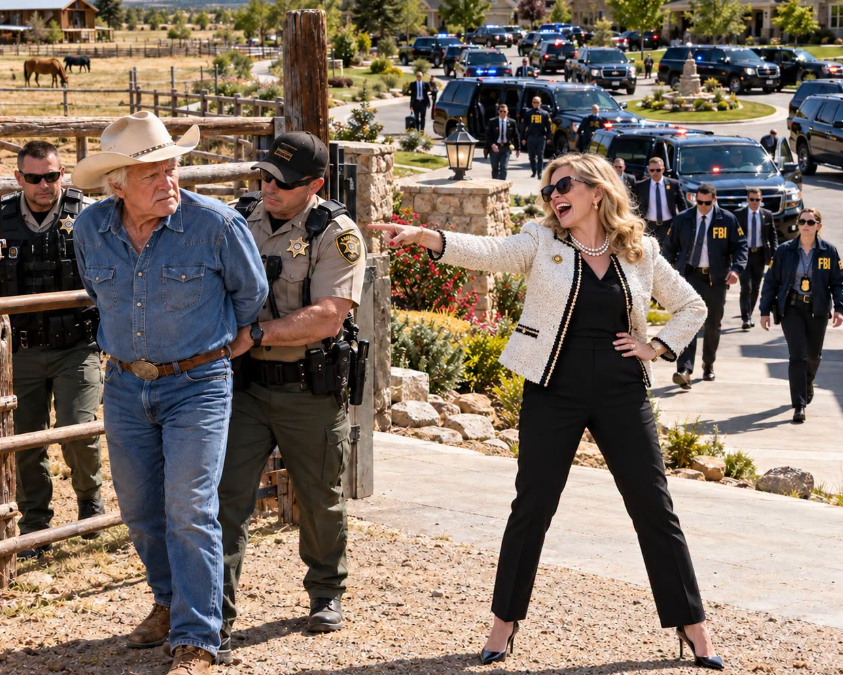
PART3:
The deputy hesitated.
At least I think he did.
The video shook.
Then Karen added, “His neighbors need to see what happens when people keep ignoring the board.”
I stood up so fast my chair hit the wall.
“Dad.”
He didn’t answer.
“Dad, can you hear me?”
The deputy’s voice came through.
“Sir, turn around.”
“My hands are bad.”
“Sir.”
“I said my hands—”
“Don’t resist.”
Then steel clicked.
Once.
Twice.
Dad made a sound.
I’ve tried to describe that sound in reports.
To investigators.
To a federal prosecutor.
I never got it right.
It wasn’t a yell.
It was smaller.
A breath dragged through pain.
The sound of somebody being surprised by his own body.
Dad’s hands had been deteriorating since 2016.
Arthritis.
Tremor.
Loss of grip.
Some days he could still turn a wrench.
Some days he couldn’t button a cuff.
Pulling his arms behind him was bad enough.
Forcing his wrists together was worse.
His phone fell.
The screen filled with gravel.
I could see nothing.
Just blue edge of sky.
The base of the cedar post.
One of Karen’s white shoes.
I shouted through the speaker.
“Dad!”
Nobody picked it up.
I heard neighbors.
Muted voices.
At least six, maybe more.
Nobody stepped in.
Then Karen’s voice came close to the phone.
Very clear.
“Somebody kill that call.”
Pause.
“And clear the driveway before ten.”
Another voice asked why.
“I’ve got a man coming to look at the property.”
The call went dead.
I stared at my screen.
Three hours away.
My father in handcuffs.
A woman talking about his land while he was being taken away.
I picked up my keys.
The whole drive down I did arithmetic.
Not FBI arithmetic.
Family arithmetic.
My parents bought that property in 1962.
Three point two acres.
Farmhouse.
Machine shed.
Gravel drive.
Pear trees.
A few garden beds.
Nothing fancy.
Nothing anyone would call development land when they bought it.
In 1998, a developer purchased the surrounding fields.
One hundred ninety houses became Barrow Glenn Estates.
Roads.
Gate.
Clubhouse.
HOA.
The development wrapped around my parents’ land.
But it stopped at their fence.
Because the developer didn’t own it.
My father and mother declined every offer.
They never signed covenants.
Never joined an association.
Never paid dues.
Their property became an island inside the subdivision.
For years, nobody cared.
My mother died in 2011.
Dad stayed.
Kept everything as she had left it.
Pear trees pruned in February.
Machine shed full of tools.
Cedar post.
Same mailbox.
Same gravel.
He belonged there more than almost anybody who later bought a house around him.
The drive should have taken three hours.
It felt like six.
Dad wasn’t released.
No one could tell me much on the phone.
County lockup.
Criminal trespass.
Resisting.
I kept thinking about those words.
Trespass.
On his own property.
By the time they finally brought him out, he had been held six hours.
He was still wearing his brown work jacket.
Same clothes from the video.
He walked slowly.
Both hands held slightly away from his body.
As if his wrists no longer belonged to him.
I got out.
“Dad.”
He looked at me.
Didn’t smile.
The skin around both wrists was raw.
Two red rings.
One side already swelling.
I felt something inside me go cold.
“They charged me.”
His voice was hoarse.
“With what?”
He tried to laugh.
“Criminal trespass.”
It didn’t become a laugh.
“And resisting.”
“Resisting what?”
He looked toward the parking lot.
Didn’t answer.
I opened the passenger door.
Halfway home, he said, “Don’t tell your sister.”
I almost laughed from sheer disbelief.
“You got arrested.”
“She’s got enough going on.”
“Dad.”
“Porter.”
He said my name in that way he had since I was twelve.
Conversation over.
We drove.
The house smelled like motor oil and coffee.
Same as childhood.
I made him sit at the kitchen table.
Got ice.
He hated the ice.
I asked, “How long has Karen been doing this?”
“Doing what?”
“This.”
He nodded toward the kitchen cabinets.
“Third drawer.”
I opened it.
The drawer wouldn’t slide all the way.
Paper jammed behind it.
I pulled harder.
Stacks of HOA notices.
Rubber bands.
Some opened.
Some sealed.
I started reading.
UNAPPROVED STRUCTURE: MACHINE SHED.
That shed had existed before Barrow Glenn.
UNAPPROVED VEGETATION: FRUIT TREES.
My mother’s pear trees.
UNAPPROVED SURFACE: GRAVEL DRIVEWAY.
IMPROPER VEHICLE STORAGE.
Dad’s pickup.
Each notice had fines.
Daily fines.
Compounding penalties.
“Dad.”
He sat with an ice pack across his wrists.
“Why didn’t you tell me?”
“They don’t have authority.”
“You still tell me.”
“They send letters.”
“Thousands of dollars in letters.”
“Paper doesn’t make them right.”
He said it like he’d said it a hundred times.
Maybe he had.
Just not to me.
I kept digging.
Newer notices.
Higher totals.
$18,400 assessed.
Then heavier paper.
County recording stamp.
NOTICE OF LIEN.
Barrow Glenn Estates HOA.
Amount:
$31,200.
Against my father’s parcel.
I felt my pulse in my neck.
Below it, a form letter.
One sentence:
Records reflect this parcel has been member property since 2019.
I read it three times.
“Dad.”
“What?”
“They say you joined.”
He looked confused.
“Joined what?”
“The HOA.”
He actually laughed.
Not much.
But real.
“No.”
“2019.”
“No.”
“Do you remember signing anything?”
“Porter.”
“No, I mean anything at all from them.”
“I never signed one thing those people handed me.”
I believed him.
Immediately.
But belief is not evidence.
That distinction had defined my career.
I had worked twenty-two years in federal law enforcement.
By then, I supervised a financial crimes squad.
Fraud.
Paper.
Money.
Asset schemes.
Forged documents.
Transactions designed to look legitimate because the people running them understood that most people stop questioning once they see a seal.
My father could tell me the truth all night.
If the county record said he joined, we needed to know why.
That evening I walked the property.
Two neighbors came over separately.
Neither wanted to be seen talking too long.
They told me about Karen.
Three terms.
Three loyal board members.
Beulah Cranfield.
Chester Ainsworth.
Prudence Hallagan.
Treasurer Neville Ashcraft.
Private patrol company called Iron Veil.
Trucks circling at night with amber bars.
One neighbor said, “She has a system.”
“What system?”
“You get on her list.”
He glanced toward the road.
“You stay on it.”
The second neighbor hesitated.
Then:
“There was a man here this morning.”
“What man?”
“After your dad left.”
“Police?”
“No.”
“HOA?”
“Didn’t know him.”
“What was he doing?”
“Taking pictures of the house.”
“From where?”
“Road.”
“What did he look like?”
“Business clothes. Clipboard.”
I filed that away mentally.
At nine that night, Karen called my cell.
Not office.
Personal.
“Porter.”
Her voice was completely different from the video.
Soft.
Concerned.
“I am so glad you’re in town.”
I sat at Dad’s kitchen table.
“Are you?”
“I’ve worried about your father for some time.”
“He was handcuffed this morning.”
A perfectly placed sigh.
“I hated that.”
“You told them to cuff him.”
“He was confused.”
“He was standing on his driveway.”
“He wanders.”
“He does not wander.”
“Porter.”
Her voice lowered.
“He forgets things.”
My jaw tightened.
“He becomes argumentative when people try to help him.”
“What exactly were you helping him with?”
“The property has become too much for him.”
There it was.
Not safety.
Property.
Karen continued gently.
“A man his age should not be managing three acres.”
“He has managed it since 1962.”
“Exactly.”
She paused.
“It is time.”
“For what?”
“The association would consider buying.”
I said nothing.
“Fair price.”
Still nothing.
“Quick closing.”
Then the blade inside the soft voice:
“All of this goes away.”
I leaned back.
“What goes away?”
“The fines.”
“The lien.”
“Other complications.”
“My father’s criminal charges?”
“I can’t speak for the county.”
She could speak for the deputy that morning.
I didn’t say it.
Instead, I asked, “Karen, where does the HOA get authority over his parcel?”
“It’s member property.”
“No, it isn’t.”
“Your father signed a joinder.”
“When?”
“2019.”
I looked at Dad.
He was standing in the kitchen doorway.
Listening.
“Recorded,” Karen said.
She sounded satisfied.
“Not really debatable.”
Then:
“Please tell Arless I hope he’s feeling better.”
She hung up.
Dad remained in the doorway.
“Signed what?”
“She says you joined the association.”
“No.”
“Six years ago.”
His right hand trembled against the frame.
“Porter.”
“I know.”
“I never signed anything those people ever put in front of me.”
“I know.”
“Ask tomorrow.”
“I believe you.”
“Ask next week.”
“Dad.”
“I’ll tell you the same.”
I believed him.
The problem was that I knew exactly what a recorded document could do.
And I knew something else Karen didn’t know yet.
For the previous four months, my squad had been working a financial fraud case involving an investment fund buying homeowners association liens across the state.
Thousands of them.
Purchased at discounts.
The fund made money when homeowners failed to cure.
Some paid.
Some refinanced.
Some lost property.
We had been analyzing patterns.
Assignments.
Bulk lien purchases.
Management companies.
Associations.
It was complicated enough that most of the data lived in spreadsheets nobody read line by line unless a name mattered.
Until that night, Barrow Glenn had never mattered to me.
Now I needed records.
The county recorder opened at 8:30.
I arrived at 8:25.
The clerk brought out the 1998 platbook.
Heavy.
Linen bound.
Smelled like toner and basement.
She turned it.
Barrow Glenn Estates.
One hundred ninety lots.
Roads curving around a rectangle in the center.
Inside the rectangle:
NOT A PART.
My father’s property.
Excluded in permanent ink on the developer’s original plat.
Next:
Declaration.
Exhibit A.
Lots one through one ninety.
Nothing else.
No father’s parcel.
No annexation.
No catchall.
No future-property language that automatically swept him in.
I had both certified.
Twelve dollars.
The clerk slid them into a manila envelope.
Then said, “You’re the second person this month asking about that parcel.”
I looked up.
“Who was first?”
“Can’t tell you.”
“When?”
“Couple weeks.”
“Attorney?”
“Didn’t say.”
“Paid how?”
“Cash.”
Clipboard man.
Maybe.
I filed it.
Tuesday night, HOA meeting.
Clubhouse.
Forty residents.
Folding chairs.
Coffee urn.
Projector fan grinding overhead.
Karen sat at the front with Cranfield, Ainsworth, and Hallagan.
Open forum.
I stood.
“My name is Porter Fairbanks.”
Karen watched me approach.
I placed the certified plat on the table.
“1998.”
Then declaration.
“Exhibit A.”
I traced.
“My father’s parcel is marked not a part.”
No reaction.
“It isn’t one of the one hundred ninety lots.”
Karen reached beside her.
She did not look at my documents.
Instead, she lifted one page from her folder.
“Joinder and Annexation Agreement.”
I stopped.
She held it high enough for the room.
“Document number 2019-00004188.”
Recorded March twelfth, 2019.
Executed by Arless Fairbanks.
Notarized.
County recorded.
Raised seal.
Blue ink signature.
My father’s name.
Karen looked at me.
“Paper beats memory, Mr. Fairbanks.”
Somebody clapped.
Then more.
Enough.
I stood there with two certified documents in my hands while a single recorded page changed the room.
An older man near the back stood.
Delbert Yansy.
Gray hair.
Hands in jacket pockets.
“Karen, hold on.”
Karen turned.
“I’ve lived here nineteen years. Arless never joined anything.”
“Thank you, Delbert.”
“I’m not finished.”
“You are.”
No yelling.
She looked at the woman keeping minutes.
“Note Mr. Yansy was disruptive.”
Delbert sat.
Slowly.
He didn’t look at me.
I understood.
Karen could reach every mailbox in that room.
I told Dad the meeting went badly.
He said, “It never goes well.”
Then went to bed.
At six the next morning, Iron Veil circled twice.
At seven, a white maintenance truck backed into Dad’s driveway.
I walked out carrying coffee.
Two men.
Polos.
Tools.
Chain around cedar post.
“Stop.”
The older man kept working.
“What are you doing?”
“Work order.”
“From?”
He handed me a sheet.
Board directive.
Removal of unapproved signage from common area.
Removal of unapproved vegetation encroaching setback.
Then I heard the chainsaw.
Eleven pear trees.
My mother planted them the spring I was born.
Dad had pruned them every February since she died.
By the time I got around the machine shed, four were already down.
Low stumps.
Fresh pale wood.
Sap.
Dad came out wearing an undershirt.
He didn’t shout.
He walked directly toward the man holding the saw.
I got behind him.
Wrapped both arms around his chest.
“Let me go.”
“No.”
“Porter.”
“No.”
“Those are your mother’s trees.”
“I know.”
“Let me go.”
“No.”
He fought me.
Four seconds.
Maybe five.
A seventy-four-year-old man with damaged hands fighting his own son because strangers were cutting his wife’s trees.
Then he stopped.
We stood there while the crew finished.
That remains one of the hardest things I’ve ever done.
If Dad touched that worker, Karen got another report.
Another arrest.
Violent elderly man.
Confused.
Dangerous.
She was building a file.
I could see it now.
The truck left at 8:40.
The cedar post rode away in the bed.
That afternoon, a certified letter came.
Addressed to me care of Dad’s house.
Karen knew I was staying there.
The association intended to initiate foreclosure because of the $31,200 lien.
I sat at the kitchen table.
Then walked to Dad’s old filing cabinet in the machine shed.
Pulled the largest recent contract I could remember him signing.
Sale of his half of the repair shop.
Eight pages.
My mother’s death year.
Blue ink signature.
I placed it beside the 2019 joinder.
Stared.
Something bothered me.
I lowered the desk lamp.
Held both against light.
Signatures change.
Always.
Pressure.
Angle.
Spacing.
Pen speed.
Surface.
Mood.
Age.
These two did not.
The A leaned at exactly the same degree.
The double L joined at the same height.
A tiny skip existed in the downstroke of the F.
In 2011, his pen had crossed a rough spot in the paper.
That same microscopic break existed in 2019.
Same location.
Same shape.
Congruent.
Not similar.
Copied.
I sat down.
My ears rang.
“Dad.”
He came in.
Dish towel on shoulder.
“Sign this.”
Blank paper.
He sat.
Placed his left hand flat over the table to steady his right.
Started.
Eleven seconds.
The new signature looked nothing like 2011.
A square A.
L’s separate.
Whole line sloped down.
Final letters trembled.
He studied it.
Then the 2019 joinder.
“That’s not mine.”
“I know.”
“I can’t write like that.”
“I know.”
“Not since…”
“2016.”
He looked at me.
“You know.”
I did.
I’d filled out Medicare forms.
The 2019 signature wasn’t signed in 2019.
It was reproduced from something older.
Not traced.
Tracing trembles.
This was too perfect.
A stamp.
Print.
Mechanical reproduction.
A physical tool likely existed somewhere.
That thought lodged in my head.
What made it?
Who possessed it?
The notary block gave me the next step.
Cecile Hartnett.
Commission number.
Secretary of State database.
Employer:
Pilgrim Trust Abstract.
Barrow Glenn’s management company.
Not independent.
On payroll with the entity handling association books and billing.
Not proof.
But significant.
Then I did what I should have done sooner.
I pulled every Barrow Glenn annexation recorded since 2015.
Four.
Dad’s.
A widow named Winona Stackhouse.
A small pasture.
A half acre with a well house.
All four properties had been holdouts.
All excluded from the 1998 plat.
All annexed between 2019 and 2020.
Nobody remembered owners voluntarily joining.
The pattern changed everything.
Then I opened my work file.
The investment fund.
Lien purchases.
I scrolled to selling associations.
Barrow Glenn Estates HOA.
Twenty-two assigned liens since 2019.
I stared.
The association surrounding my father had been inside my federal case for months.
I hadn’t noticed because it was one name among thousands.
That’s when family dispute stopped being family dispute.
County commercial filings produced more.
Barrow Glenn HOA had an option agreement with Haven Ridge Property Group.
Residential developer.
$2.4 million payable to association.
Condition:
Deliver a contiguous clear-title assemblage including the north quarter and all excluded parcels inside the loop.
Deadline:
September thirtieth.
I looked at Dad’s refrigerator calendar.
Then thought about Karen’s voice during the arrest.
Clear the driveway before ten.
I’ve got a man coming to look at the property.
Clipboard man.
Site visit.
Appraisal.
My father’s arrest had been scheduled into a real-estate deadline.
I spread documents.
Forged-looking joinder.
Payroll notary.
Other holdouts.
$2.4 million deal.
Lien fund.
I had a case.
Then the worst realization arrived.
I couldn’t investigate it.
My father was the victim.
I supervised the squad handling a related financial investigation.
Every query I’d run looked compromised.
Every document I touched could become a defense exhibit.
FEDERAL AGENT USES DATABASES TO SAVE FATHER’S PROPERTY.
It didn’t matter that fraud was real.
Conflict was real too.
For ninety seconds, I considered doing what no one might discover.
Keep pulling.
Build it quietly.
Hand it off.
Stay off paper.
Then I called my ASAC at home.
Hugh Salinger answered.
“Hugh.”
“What happened?”
“I need to self-report a conflict.”
Silence.
“How bad?”
“Family victim intersects existing case.”
Longer silence.
“I need it documented tonight.”
He understood.
Six days later, Karen’s lawyer struck.
Gideon Akroyd.
Fourteen-page complaint to the Office of Professional Responsibility.
Copied to U.S. Attorney.
Sheriff.
Community newsletter.
Allegation:
Supervisory federal agent misused position and databases to intimidate volunteer HOA board for personal family benefit.
The worst part?
Facts were technically accurate.
I had run queries.
I had confronted the board.
I had county records.
The complaint did not need to prove corruption.
It only needed appearance.
Karen printed it in the newsletter.
Glossy paper.
My name in bold.
By Thursday, the story had inverted.
Dad wasn’t the seventy-four-year-old cuffed on his property.
I was the federal bully trying to erase my father’s debts.
Delbert called.
Talked four minutes without saying sorry.
I told him I understood.
I did.
An OPR inspector named Ren Callister interviewed me for five hours.
Conference room.
Blinds closed.
She was fair.
Thorough.
Thorough hurt.
At the end, she placed me on administrative suspension.
I surrendered credentials.
Service weapon.
Plastic tray.
Signed form.
Twenty-two years.
Ninety seconds.
Hugh met me afterward.
“Wall memo goes out today.”
I nodded.
“You do not access, discuss, direct, request, or receive anything concerning Barrow Glenn, Trumbull residence, or your father’s parcel.”
“Understood.”
“Not from me. Not from squad.”
“Yes.”
“Someone calls you?”
“I hang up and report.”
He exhaled.
“Civil-rights piece involving arrest goes to Doyle Winterborn.”
I knew Winterborn by reputation.
Three floors above.
Now I couldn’t ride the elevator to his office.
That was the day the skill I had spent my adult life building became legally unavailable for the one person I wanted to protect.
Wednesday, county courthouse.
I sat beside Dad.
No badge.
Suit felt wrong.
Akroyd won in eleven minutes.
Not because the joinder was real.
He didn’t need to prove that.
His argument was procedural.
Recorded instrument.
Facially valid.
County judge in summary proceeding couldn’t declare forgery based on a son’s handwriting comparison.
If we believed fraud, file a quiet-title action.
Eight to fourteen months.
Judge denied stay on lien.
Akroyd stood.
“Foreclosure has been scheduled.”
Twenty-one days.
Ten a.m.
My father’s house.
Machine shed.
Three point two acres.
Remaining seven pear trees.
Courthouse steps.
Dad said nothing in the truck.
Friday, county amended criminal charges.
Trespass.
Resisting.
Now obstruction.
Supplemental report from Deputy Gus Threadgill described Dad as combative.
Dad had to report weekly.
Tuesday.
Nine a.m.
County hallway.
Sign a sheet like probation.
I watched what it did to him.
First two weeks after the trees were cut, he stood by the stumps every afternoon.
Then he stopped.
He sat in the machine shed.
Radio off.
One Sunday I brought coffee.
He said, “I might’ve signed.”
“What?”
“In 2019.”
“No.”
“If she’d asked me straight.”
I listened.
“If I was tired.”
“Dad, you didn’t.”
“I know.”
He turned the cup.
“I wish I had.”
“Why?”
“It’d be easier to be a fool than robbed.”
That sentence broke something loose.
I could not investigate.
Could not query.
Could not use my badge.
But I remained a witness.
I was on the video call when the arrest happened.
Dad was the victim.
We could testify.
Evidence I had gathered from public counters could be described as civilian retrieval.
I stopped trying to be an agent.
Became a complaining witness.
I wrote an affidavit.
Twenty-six pages.
Every fact.
Every public document.
Every date.
Attached plat.
Declaration.
Signature comparison.
Haven Ridge option.
September thirtieth circled.
I did not send it to my squad.
I drove to the U.S. Attorney.
Assistant U.S. Attorney Imogen Blackwood.
Winterborn present.
I put the affidavit down.
Said clearly, “I’m not asking to work this.”
They watched.
“I’m asking to be interviewed.”
Blackwood read.
Slowly.
At the lien fund section, she stopped.
“This fund is your squad’s case?”
“Yes.”
“When did it open?”
“February.”
She looked up.
“February this year?”
“Yes.”
Winterborn leaned forward.
That mattered.
My federal investigation predated Dad’s arrest by four months.
Akroyd’s narrative said I initiated the case because of a family grievance.
Impossible.
Blackwood closed the binder.
“Your father Monday at nine.”
I nodded.
“Mr. Fairbanks.”
“Yes?”
“You don’t call me.”
“I understand.”
“I call you.”
Sixteen days until foreclosure.
Grand jury subpoenas went out.
I learned like any citizen.
Dad received a witness letter.
Pilgrim Trust produced eleven boxes.
Management companies don’t go to war for clients when federal subpoenas arrive.
Dad testified.
I sat along the wall.
Family member.
Nothing else.
Mouth shut.
They showed one document.
November 2018.
Legal advisory from association outside counsel to the board.
Four excluded parcels could not be annexed without voluntary signatures.
Association had no mechanism to compel.
Upper right corner:
KT.
11/26/18.
Karen had been told four months before Dad’s forged joinder exactly what she couldn’t do.
She needed a real signature.
No alternative.
Dad had never seen the advisory.
That was the point.
Not mistake anymore.
Knowledge.
Cecile Hartnett came in with a lawyer.
Nineteen years a notary.
Eleven with Pilgrim Trust.
She admitted Karen had repeatedly brought pre-executed documents and asked her to notarize signatures she hadn’t witnessed.
Had Cecile met Arless Fairbanks?
No.
Never.
Why notarize?
Long pause.
“Because she was the client.”
Another.
“And I liked my job.”
Cooperation agreement.
First crack.
Didn’t feel like victory.
Foreclosure clock still running.
Iron Veil produced logs.
That was when the deputy problem became something else.
Special detail on arrest morning.
Off-duty employment permit.
Gus Threadgill.
Paid by Barrow Glenn HOA.
Ninety dollars an hour.
Four-hour minimum.
He wasn’t dispatched by county.
There was no call for service.
At 7:52, Karen’s personal cell contacted him.
My father had not been arrested by a deputy responding independently to a citizen complaint.
He had been handcuffed by an off-duty deputy being paid by the person ordering the arrest.
That distinction was enormous.
Nine days before the sale, Callister completed OPR review.
Finding split.
Civil-rights matter stayed walled from me permanently.
Arrest.
Threadgill.
Karen communications relating to Dad’s detention.
Winterborn.
But the financial fraud case?
Opened February.
Assigned before dispute.
No basis to strip squad entirely.
Hugh handed my credentials back in a parking garage.
“Financial only.”
“Yes.”
“You ask one question about your dad’s arrest…”
“You take them.”
“I take them personally.”
He held the credentials one extra second.
“Work your case, Porter.”
“I will.”
“Not your father’s.”
“I understand.”
At that moment, I didn’t know both would lead to the same address.
Karen’s response was extraordinary.
Special HOA meeting.
Seven days before sale.
Ninety residents.
Karen stood where she’d always stood.
Claimed the association was under attack by a federal employee with a personal grudge.
Every board action lawful.
Then she proposed retroactive ratification.
All actions since 2018.
Every notice.
Fine.
Lien.
Recorded instrument.
Official act.
Cranfield seconded.
Ainsworth and Hallagan raised hands.
Voice vote.
Passed.
Delbert came to Dad’s driveway afterward.
“She made everybody sign the check.”
“What?”
“She tied the whole board to her.”
He was right.
People who could claim she acted alone had now publicly ratified everything.
Two days later, Karen moved records.
U-Haul at the clubhouse.
Announcement:
Association records archived at president’s residence for security during litigation.
Nineteen boxes.
Catillian Court.
I did not go there.
Did not photograph.
Did not drive past.
The wall memo mattered.
I worked the financial file.
Lien assignments came with financial statements.
Card activity.
Expenses.
Thursday afternoon, while reconciling 2019 expenses, a $41 charge appeared.
Meridian Stamp and Engraving.
January twenty-second, 2019.
Forty-one dollars normally means nothing.
The date did.
Dad’s joinder had been recorded March twelfth.
I looked up the vendor.
Storefront in the state capital.
Address plates.
Plaques.
Custom pre-inked signature stamps made from customer-provided samples.
I stopped touching the keyboard.
Sent it to Blackwood.
Subpoena.
Meridian still had the order.
Small shops keep strange records forever.
January 22, 2019.
One custom pre-inked signature stamp.
Black housing.
Billed to Barrow Glenn operating card.
Shipped February fourth.
Shipping address:
Residence on Catillian Court.
Karen’s.
They retained the artwork file.
Scanned signature block.
Source:
Dad’s 2011 repair-shop sale contract.
Public commercial filing.
Downloadable for four dollars.
Somebody had taken Dad’s genuine signature from 2011, sent it to a stamp company, and bought his identity for forty-one dollars.
The tiny skipped line in the F.
The leaning A.
The joined L’s.
Every defect preserved.
One question remained.
Where was the stamp?
Physical object.
Could not delete.
Could shred documents.
Could wipe drives.
But the stamp existed.
Size of a deck of cards.
Mailed to Karen’s house.
No reason to leave.
Blackwood went to the magistrate.
Search warrant application.
Karen’s residence.
Items:
Signature stamp bearing Arless Fairbanks.
Nineteen boxes of association records publicly announced as moved into the garage.
Judge Everline Prather signed at 9:04 p.m.
I stood in the hallway when Blackwood came out.
She looked at the warrant.
Then the clock.
Foreclosure sale at ten the next morning.
“We execute at six.”
We staged at 5:40 a.m.
Gravel lot behind the Baptist church half a mile from the Barrow Glenn gate.
Six vehicles.
Fourteen people.
Two evidence techs.
Photographer.
Analyst.
Eight agents in raid jackets.
I stood at the lead Suburban tailgate under a flashlight.
Operations brief.
No excitement.
No jokes.
Professionals know search warrants are work, not theater.
I read the address.
Layout.
Known occupants.
No registered firearms.
Garage priority.
Boxes moved eight days before.
Likely still packed.
Knock and announce.
Then I stopped.
Looked at every agent.
“The complaining witness in the underlying forgery is my father.”
No one moved.
“I am on the financial case only.”
I held the clipboard.
“All seized items logged by Agent Doss.”
Doss clicked his pen.
“I do not touch boxes.”
Pause.
“If anybody has a problem with my presence, say it now. I’ll move to the second car.”
Silence.
Doss said, “Copy.”
5:58.
The convoy entered Barrow Glenn.
No lights.
No sirens.
Six sets of headlights.
School-zone speed.
Past mailboxes.
Past houses whose residents had watched Dad arrested.
6:01.
Catillian Court.
Vehicles separated.
That is something civilians rarely understand.
A convoy doesn’t just stop.
It breaks apart into roles.
Lead vehicle passed the driveway and stopped nose-out near the end of the cul-de-sac.
Second covered entrance.
Third angled across garage apron.
Fourth and fifth peeled off.
Agents went side yards.
Within ninety seconds, fourteen federal agents surrounded Karen’s house.
FBI letters across backs.
Porch light came on.
Then neighbor lights.
One kitchen.
Four.
Ten.
Whole court.
A man in a bathrobe stepped outside holding his phone.
Curtains.
Phones.
Garage lights.
Three weeks earlier, neighbors had stood outside Dad’s house while steel closed on his wrists.
Now they were awake.
Karen opened the front door four inches on the chain.
Quilted housecoat.
Hair flattened on one side.
She looked at the vehicles.
Then said the first thing I will probably remember forever.
“This is a private community.”
An agent said, “Ma’am, unchain the door.”
“These vehicles are not authorized to stage here.”
“Ma’am.”
“You require board approval.”
“Unchain the door.”
“I am the board.”
For one second, nobody responded.
Then:
“Ma’am. Unchain. The. Door.”
She did.
Stepped onto the porch.
Slippers.
Started another sentence.
Then saw me.
Bottom of the steps.
Warrant in hand.
Two seconds.
That’s all.
I watched arithmetic happen behind her eyes.
My father.
Phone on gravel.
Newsletter.
My name in bold.
Foreclosure.
The federal investigation she accused me of inventing.
Porch light cast everything yellow.
Old photograph color.
I said, “Karen Trumbull.”
Her jaw tightened.
“I have a federal search warrant signed last night by Judge Everline Prather.”
I held it.
“To search this residence.”
She recovered.
Fast.
“Your father signed that agreement.”
Louder now.
For neighbors.
“It was witnessed.”
She pointed.
“Notarized.”
Again.
“Recorded.”
She looked at me.
“You cannot come to my house because you don’t like a document.”
I said, “Cecile Hartnett testified to a grand jury eleven days ago.”
Her hand moved from the railing to the front of her robe.
“She admitted notarizing signatures she did not witness at your direction.”
Karen stared.
“She’s under a cooperation agreement.”
“That’s her word.”
“Yes.”
Agents passed inside.
Karen turned to follow.
Then faced me again.
“I never touched your father.”
There was the second wall.
“A sheriff’s deputy arrested him.”
I said nothing.
“That was his decision.”
Nothing.
“His judgment.”
Nothing.
“I called about a trespasser like anyone else.”
Agent Doss came around the side holding a plastic evidence bin.
“Ma’am, is this your phone?”
Karen looked.
“That’s private.”
“Listed on warrant.”
“You are not taking—”
“Ma’am.”
Doss held it.
“It’s on the warrant.”
Karen released it.
Twelve days later, phone extraction would show a 7:52 a.m. message to Threadgill.
HERE NOW. BRING CUFFS. MAKE IT LOOK OFFICIAL. NEIGHBORS ARE WATCHING.
But that morning, we didn’t know.
We only had the device.
Seven minutes after entry, an agent came out.
Evidence bag.
Small black object.
Deck-card size.
Curved handle.
“SSA Fairbanks.”
My whole body went still.
“Master bedroom.”
He held the bag.
“Second desk drawer. Under checkbook.”
I did not touch it.
Doss took custody.
Placed blank printer paper on the hood of the third vehicle.
Removed the stamp according to evidence procedure.
Held it two inches above paper.
Pressed.
Small dry thump.
Lifted.
My father’s name appeared in black.
ARLESS FAIRBANKS.
The A leaned.
The L’s joined.
Skip in the F.
Exactly.
A signature Dad made in 2011 because his pen crossed rough paper now reproduced fourteen years later on the hood of a federal vehicle in Karen Trumbull’s driveway.
Nobody spoke.
Fourteen agents.
Karen on the porch.
Neighbors.
A sprinkler down the street clicked on.
Tick.
Tick.
Tick.
Karen stared at the paper.
“That’s not…”
She stopped.
No end to the sentence.
Garage door opened.
Nineteen boxes.
Stacked three high.
Some still taped.
U-Haul stickers.
Minutes.
Correspondence.
2018 legal advisory.
Holdout files.
Winona Stackhouse.
Other excluded parcels.
Karen had announced moving them in public.
Now they sat in her garage.
Her husband came outside wearing a jacket over pajamas.
Stood on the lawn.
Didn’t approach.
Karen walked down her front steps between agents.
Past mailbox.
Past flag bracket.
Past neighbors she had fined for paint and lawns and parked cars.
She looked at me once.
I said nothing.
Anything would have made the moment smaller.
At the hood of the third car, I signed the seizure log.
One pre-inked signature stamp, black housing.
Recovered bedroom desk.
I handed the pen to Doss.
Checked my watch.
6:31.
Foreclosure sale in three and a half hours.
At 9:40, the courthouse trustee read the sale list.
Reached Dad’s parcel.
“Withdrawn at request of the United States Attorney.”
Eleven words.
A man with an auction paddle lowered it.
Dad’s land stayed Dad’s.
I wasn’t there.
Blackwood called.
“It’s withdrawn.”
I sat in Dad’s kitchen.
Closed my eyes.
Dad looked at me.
“What?”
“Sale’s off.”
He didn’t react immediately.
Then:
“For today?”
“No.”
“Porter.”
“They pulled it.”
He put both hands flat on the table.
His right one trembled.
I watched.
Eleven weeks later, the quiet-title action became straightforward.
Signature stamp in evidence.
Notary testimony.
Records.
Court voided document 2019-00004188 as forged.
Lien struck.
$31,200 gone.
$18,400 assessments found unauthorized.
Parcel restored to the status it always should have had:
3.2 acres.
Not a part.
The criminal charges against Dad disappeared in one hearing after the county attorney reviewed Karen’s text to Threadgill.
Trespass.
Resisting.
Obstruction.
Dismissed.
Record expunged.
No more Tuesday check-ins.
His wrist marks had already faded.
Other things didn’t.
No court order could give him back six hours in lockup.
Nobody tried to pretend otherwise.
Karen was indicted on eleven counts.
Wire fraud.
Aggravated identity theft.
Forgery of recorded instrument.
Deprivation of rights under color of law connected to use of an off-duty deputy.
The board removed her unanimously the next Tuesday.
I found that vote almost funny.
Same people had ratified her actions.
Within six weeks, Cranfield, Ainsworth, and Hallagan were gone too.
Hard to unring a public vote.
Threadgill surrendered his peace officer certification rather than face the licensing board.
Iron Veil lost contracts in three counties.
Haven Ridge terminated the option in October.
$2.4 million never arrived.
Residents had paid special assessments for legal defense and got nothing.
Winona Stackhouse got her acre back.
Other two holdouts restored.
Karen’s house went on the market in spring.
Sign in yard.
Everybody on the street knew.
Dad never went to see it.
Neither did I.
April, Delbert Yansy called.
“Your dad home Saturday?”
“Why?”
“You’ll see.”
He arrived with four men.
Post-hole digger.
Cedar post.
Cut.
Planed.
Two men had stood in the road during the arrest.
They didn’t apologize.
I didn’t demand it.
They dug the same hole.
Set the post.
Leveled it.
Packed gravel.
Dad brought a chisel.
His hands were worse.
Took all afternoon.
FAIRBANKS.
Letters crooked.
Deep on the left.
Shallow on the right.
Delbert said, “Looks good.”
Dad leaned back.
“First one was crooked too.”
Then he replanted four pear trees.
Young.
Thin trunks.
Nothing like the old row.
He tamped the last one.
Said without looking at me, “I won’t see these bear.”
I started to answer.
He continued, “That’s all right.”
Pressed the soil.
“Neither did your mother.”
That June, transfer paperwork came through.
Dad decided to put the parcel in both our names.
I argued.
Lost.
We signed at the same kitchen table.
Dad steadied his right hand with his left.
Eleven seconds.
A square A.
L’s separate.
Signature sloping downhill.
Final letters trembling.
He looked at it.
“Ugly.”
I smiled.
“It’s yours.”
He capped the pen.
We went outside.
Sat on the step.
A water hose ran slowly along the new pear trees.
For a while, neither of us spoke.
That’s where the official story ends.
Court orders.
Indictments.
Search warrant.
Property restored.
But it isn’t where the experience ended for me.
For months afterward, Dad reacted to cars stopping near his driveway.
He’d look through the window.
Not obviously.
Just enough.
If an Iron Veil-style truck passed, his shoulders changed.
The body remembers things paperwork cannot expunge.
He also stopped opening certified mail.
Before, he’d ignore HOA envelopes because he thought they were nonsense.
Afterward, he would set anything requiring a signature on the kitchen table and leave it for me.
Not fear exactly.
Distrust.
A piece of paper had nearly taken his property.
That’s hard to unlearn.
I kept reminding him, “Not every document is Karen.”
He would say, “One was enough.”
Fair.
My own return to work wasn’t clean either.
OPR cleared the misuse allegations within scope findings.
But conflict management followed.
Every document in the Barrow Glenn financial case carried walls.
Other agents handled certain witnesses.
I didn’t touch evidence tied directly to Dad.
Doss logged.
Winterborn worked the civil-rights side.
Blackwood coordinated.
It was the right way.
Still uncomfortable.
Federal work trains you to separate facts from feelings.
This case punished every attempt.
Dad’s name in evidence.
Dad’s signature on forged instruments.
Dad’s wrists.
Dad’s house.
I could never make it just another file.
So I didn’t try.
I followed rules instead.
That’s what rules are for.
Not to make you emotionless.
To keep emotion from deciding process.
Karen misunderstood rules completely.
For her, rules were proof of authority.
If she could produce a notice, she believed authority existed.
If a board voted, she believed law followed.
If a document was recorded, she believed truth became whatever the document said.
That is a dangerous way to think about paperwork.
Records are powerful because we trust the processes behind them.
Signature means consent.
Notary means person appeared.
Lien means lawful obligation.
Deputy means public authority.
Karen didn’t merely break rules.
She hollowed out symbols people depend on.
Dad’s signature became fake.
Notary seal became theater.
HOA lien became weapon.
Deputy badge became private enforcement.
That was why the federal case grew beyond a property dispute.
The injury was larger than three acres.
When a society relies on documents, forging them steals more than a name.
It steals trust.
Cecile Hartnett told the grand jury she notarized without witnessing because Karen was the client and Cecile liked her job.
That sentence bothered me almost as much as Karen.
Not because Cecile was equally responsible.
She wasn’t.
But systems fail through small concessions.
One seal.
One exception.
One client who asks a favor.
Then another.
Eventually, a fake joinder sits in county records looking legitimate enough to defeat a homeowner in court.
Cecile cooperated.
Helped.
Good.
But I hope every notary who heard the story understood her part.
A seal isn’t decoration.
Dad knew almost none of this.
He didn’t care about regulatory lessons.
He wanted pear trees.
When I explained the Meridian stamp order, he stared.
“Forty-one dollars?”
“Yes.”
“They spent forty-one dollars to steal my name?”
“Basically.”
He shook his head.
“My name is worth more than that.”
I laughed.
“So was shipping.”
He didn’t laugh.
Then he did.
Small.
That was progress.
The copied signature came from the 2011 repair-shop sale contract.
A public filing.
Anyone could download it.
Dad couldn’t understand why a public system exposed it.
I explained commercial filings need accessibility.
He said, “Then maybe don’t let people buy stamps.”
Fair policy suggestion.
Not exactly simple.
But fair.
The man with the clipboard at the arrest turned out tied to Haven Ridge’s site evaluation.
That piece mattered because it showed the arrest wasn’t a random enforcement event.
Karen wanted the property clear for the inspection window.
Dad in cuffs.
Driveway empty by ten.
Site visit.
The planning chilled me.
She wasn’t improvising.
This wasn’t temper.
It was logistics.
That’s why I stopped using the word Karen casually when talking about the case.
People online use it for an entitled woman yelling over parking.
This was different.
She used institutional structures deliberately.
HOA.
Management company.
Notary.
Lien process.
Foreclosure.
Private patrol.
Off-duty deputy.
Real estate option.
The scheme worked because each component looked ordinary alone.
An HOA notice?
Normal.
A recorded joinder?
Normal.
Lien?
Normal.
Foreclosure?
Legal process.
Off-duty deputy?
Common arrangement.
Property appraisal?
Normal.
Put together, the mechanism was predatory.
Dad happened to be the holdout in the middle.
Once we found the other three, it became impossible to call it a personal feud.
Winona Stackhouse later met Dad.
She was older.
Lived on the north edge.
Her property had been annexed by a similar instrument without her understanding.
I was not present the first time.
Dad told me.
“She brought pie.”
“What kind?”
“Cherry.”
“Good?”
“Too sweet.”
“Did you tell her?”
“I’m seventy-four, not stupid.”
They became occasional friends.
Two victims comparing paperwork.
That was one unexpected result.
The lien investment fund case widened.
I won’t turn this story into that case because confidentiality matters and because Dad’s piece had its own boundaries.
But the pattern matters.
Associations assigning liens.
Investors buying.
Foreclosures creating opportunities.
Developers seeking assemblages.
Not every lien was fraudulent.
Most weren’t.
But incentives can distort behavior.
When revenue exists at the end of enforcement, someone must watch who benefits.
Karen had a $2.4 million incentive.
Clear title assemblage.
Deadline.
Dad’s parcel sat in the way.
That does not automatically make every fine fraudulent.
But once a forged joinder appears, context becomes impossible to ignore.
I often think about that first county judge.
People asked whether I was angry.
No.
He was right within the proceeding.
Facially valid recorded instrument.
Summary hearing.
Can’t declare forgery because a son says the signatures match too perfectly.
That’s not weakness.
That’s due process.
The same safeguards protect real owners from false accusations.
The problem was time.
Foreclosure faster than quiet-title litigation.
Fraud exploited asymmetry.
Karen knew paper could move faster than truth.
That’s why the search warrant mattered.
Not dramatic convoy.
Evidence.
The stamp compressed eight to fourteen months of litigation into physical proof.
Without it, maybe we still win.
Not before the sale perhaps.
Maybe emergency federal motion.
Maybe not.
I don’t enjoy thinking about the alternate.
Dad’s property at auction.
Developer acquiring.
Later forgery proven.
Undoing the sale complicated.
Damage deeper.
We were hours away.
9:40 withdrawal.
Twenty minutes before ten.
That number stays.
People hear FBI convoy and imagine power.
Truth is, we were late.
Barely.
Law isn’t magic.
Bad actors can move quickly.
Investigations require probable cause.
Subpoenas take time.
Witnesses need counsel.
Records production.
Review.
Search warrant affidavit.
Judge.
Every step matters because government power should be slow enough to be checked.
That means sometimes victims wait.
Dad waited with a sale date.
Hard.
Necessary.
I never told him how close.
He knew.
Of course.
But I didn’t narrate every hour.
He had enough.
Karen’s public complaint against me was smart.
I hate admitting that.
She took true facts.
Federal agent.
Database queries.
Family victim.
Board confrontation.
Then framed motive.
That forced OPR.
Suspension.
Slowed me.
Protected her temporarily.
But it also created independent scrutiny.
Callister’s review established the February case predated the dispute.
Her attempt to discredit me produced a clean chronology.
That’s common in investigations.
Aggressive defense sometimes creates records.
Still, being suspended hurt.
Turning in credentials after twenty-two years felt like having an identity removed.
I knew administrative suspension wasn’t guilt.
Emotion ignored the distinction.
Hugh handled it well.
Parking garage return.
No speech.
“Financial only.”
That was his way of saying trust restored with boundary.
I respected it.
When we staged at the Baptist church, I was aware every agent knew the Dad connection.
I insisted on saying it aloud.
Transparency protects a case.
If one agent had concern, I would’ve stepped aside.
Nobody did.
Not loyalty to me.
Confidence in controls.
Doss evidence custodian.
I don’t touch.
Financial scope.
Search warrant issued independently.
That’s how a personal case becomes an institutional case properly.
Karen likely expected me to storm her house emotionally.
Instead, every item was logged by someone else.
The image of the stamp on the hood remains vivid.
Not because of triumph.
Because of absurdity.
Such a small object.
Black plastic.
Forty-one dollars.
Could fit in a pocket.
That device nearly transferred three acres worth generations.
Shows the power of symbols.
A mark on paper can move banks.
Courts.
Police.
Property.
That is why forgery is serious.
Dad saw the stamp later only in an evidence photo.
He said, “Ugly little thing.”
Yes.
The nineteen boxes mattered too.
Karen moved them for “security.”
Maybe she believed home was safer.
Maybe she planned to review them.
Maybe concealment.
I won’t infer beyond records.
But the public announcement gave probable location.
Irony.
She wanted residents to know she controlled the files.
That statement later supported the warrant.
Again, authority performance created evidence.
Her phone messages were worse.
Bring cuffs.
Make it look official.
Neighbors are watching.
Those words explain the arrest completely.
Not public safety.
Optics.
She wanted spectacle.
Dad cuffed where residents could see.
Social enforcement.
Fear.
The deputy’s badge converted an HOA dispute into state-looking punishment.
That is why deprivation of rights under color of law mattered.
A private person cannot rent state authority to settle property leverage.
Threadgill should have known.
He surrendered certification.
That part upset Dad.
Not satisfaction.
“Man threw away a career for ninety dollars an hour?”
“Four-hour minimum.”
Dad shook his head.
“Still.”
Yes.
People make enormous decisions for surprisingly small incentives.
Cecile liked her job.
Threadgill got side pay.
Board members wanted Karen pleased.
Residents wanted the HOA peaceful.
Each compromise small to them.
Large to Dad.
That’s another lesson I don’t love.
Harm can be assembled from ordinary cowardice.
Not everyone is a mastermind.
Karen was central.
Others enabled.
The neighbors who watched the arrest haunted Dad less than I expected.
He never accused them.
I did, privately.
He said, “What were they supposed to do?”
“Say something.”
“To an armed deputy?”
“Call someone.”
“Porter.”
He looked at me.
“They didn’t know.”
“They knew you lived there.”
“Knowing isn’t the same as knowing.”
That was generous.
Maybe too generous.
But the April work party with the cedar post changed things.
Two men who had watched came.
No apology.
They dug.
Dad accepted.
Maybe that was their apology.
He preferred work over speeches.
When Delbert set a level against the post, Dad complained the hole was too loose.
Everyone relaxed.
For a few hours, the neighborhood felt normal.
Then Dad chiseled the letters.
His hand tremor made FAIRBANKS uneven.
I offered help.
He refused.
“This one has to be mine.”
I understood.
The forged signature had used his old hand.
The new cedar post carried his current hand.
Crooked.
Authentic.
When transfer papers came in June, the same symbolism returned.
He signed slowly.
Ugly, he said.
It’s yours, I said.
That line means more to me now.
Authenticity is not prettiness.
The real signature shook.
The fake one was perfect.
For years, institutions treat neatness as credibility.
Sometimes imperfection is proof.
Dad’s tremor became evidence of identity.
We had medical history too, but the visual contrast was powerful.
He couldn’t produce his 2011-style signature in 2019.
Someone else could only do it by copying.
The pear trees grew.
Not fast.
First year, Dad checked them constantly.
Too much water.
Then not enough.
He had opinions.
One didn’t take well.
He replaced it the following spring.
He called me to ask what the nursery charged for a replacement.
I said the trees were his, not an HOA settlement issue anymore.
He complained anyway.
Dad returned to pruning.
That was the recovery marker.
He spent afternoons outside again.
Machine shed radio on.
Neighbors stopped whispering.
Iron Veil trucks gone.
Barrow Glenn hired different management eventually.
Board changed.
I stayed out.
Not my HOA.
That was the whole point.
Dad wasn’t a member either.
The new board sent a formal acknowledgment.
No covenants.
No assessments.
No enforcement.
Access only ordinary public road rights.
Good.
No apology could undo the trees.
But correct boundary mattered.
Haven Ridge deal vanished.
The $2.4 million never paid.
Residents later learned their legal fees and assessments had funded defense of a project that would enrich the association but depended on improperly acquiring holdouts.
Anger turned board elections.
Fine.
I don’t celebrate residents losing money.
Many never knew.
Karen framed the project as community value.
Again, collective benefit can become an excuse to ignore individual ownership.
Dad once said, “If they’d offered enough, maybe I’d sell.”
“Would you?”
“No.”
“Then what’s enough?”
“Enough to make me think about saying no.”
That was Dad.
He understood negotiation.
What he couldn’t tolerate was theft disguised as governance.
Neither can I.
I think often about Karen’s sentence on the porch during the search.
“This is a private community.”
She genuinely reached for HOA authority against a federal warrant.
Not because she thought it legally blocked us, I suspect, but because it was her reflex.
Every conflict solved by board control.
Street approvals.
Vehicle permissions.
Mailbox threats.
Lien notices.
She had lived so long inside that small authority that larger systems became abstractions.
The convoy made hierarchy visible.
But that’s not why the warrant was valid.
Federal letters on jackets don’t make truth.
Probable cause and judicial authorization do.
Important distinction.
Dad’s arrest proved uniforms can be misused.
Our search had to be the opposite.
Documented.
Limited.
Evidence logged.
Warrant scope.
No revenge search.
The convoy did not enter her cul-de-sac to scare her.
Vehicles positioned for warrant execution.
Safety.
Evidence preservation.
Scene control.
Neighbors watched because a suburban cul-de-sac has windows.
Karen had made Dad’s arrest public intentionally.
Her search became public because the neighborhood woke up.
Different motives.
I never told agents to make neighbors watch.
Would have been wrong.
The fact that they did watch carried its own irony.
At 6:31, the search was still going.
I checked my watch because of the sale.
Blackwood had already handled the withdrawal request.
I couldn’t.
Again, the wall.
I waited.
9:40 call.
Eleven words.
Saved land.
Dad didn’t cheer.
He asked, “What about the charges?”
Still pending that morning.
I said, “One thing at a time.”
He nodded.
Paperwork unwinds slower.
Eleven weeks.
Quiet title.
Then criminal dismissal.
Then property corrections.
Then board changes.
Recovery administrative.
You don’t get a single movie ending.
You get letters arriving.
Orders filed.
Databases updated.
Tuesday check-in canceled.
Lien release.
Title clear.
One by one.
Dad kept each in a new folder.
Not third-drawer chaos.
I bought a file box.
Labeled it.
He mocked me.
“Federal government finally taught you folders?”
“Apparently.”
We filed.
In spring, Karen’s house sale sign appeared.
Dad drove past daily anyway because the road looped.
Never commented.
One day I asked, “You see it?”
“What?”
“Her house.”
“Oh.”
That was victory of irrelevance.
For months, Karen dominated our conversations.
Now Dad cared about pear buds.
Good.
My sister eventually found out everything.
Obviously.
Dad’s “don’t tell your sister” lasted about twelve hours.
She called furious at me for not calling.
Then furious at Dad.
Then cried.
Then drove down.
She cleaned his wrist wounds like he was a child.
Dad hated every second.
Family.
She later brought him a small camera with one button to photograph trees.
Dad preferred the phone eventually.
He learned.
Every time a video call started, I remembered gravel.
That faded.
Not fully.
Trauma can attach to technology too.
The original call saved evidence.
Audio of Karen.
Dad’s phone on gravel captured language.
Not enough alone to prove the entire scheme, but contemporaneous.
Sometimes accidents document truth.
Had the call ended earlier, we would have relied on witnesses.
Six neighbors were silent publicly, but some later gave statements.
People speak differently once power shifts.
That bothered me.
Before warrant, afraid.
After, cooperative.
I understand but don’t admire.
Courage that waits for safety isn’t useless.
But earlier courage can prevent harm.
Delbert spoke at the first meeting.
Karen shut him down.
He tried.
I remember that.
There is one sentence from Karen’s phone that I return to more than any other.
Not the $2.4 million agreement.
Not the work order to cut the trees.
Not even the forged joinder.
MAKE IT LOOK OFFICIAL.
Four words.
That was the whole mechanism.
Make the arrest look official.
Make the signature look official.
Make the joinder look official.
Make the lien look official.
Make the foreclosure look official.
Make the removal of pear trees look official.
Make a private real estate goal look like HOA enforcement.
Most people do not have time to investigate every symbol of authority placed in front of them.
They see a seal and assume somebody checked.
They see a deputy and assume lawful dispatch.
They see a county record and assume genuine signature.
They see a lien and assume debt.
Karen understood that trust and turned it around.
The FBI search warrant also looked official.
Raid jackets.
Vehicles.
Judge’s signature.
But appearance wasn’t what made it legitimate.
Process did.
Probable cause.
Independent prosecutor.
Magistrate.
Specific items sought.
Evidence chain.
Conflict controls.
That distinction is why I never enjoyed the neighbors watching as much as people imagine.
I didn’t want to show Karen what happens when she ignores me.
That would be her logic.
I wanted evidence secured legally.
Then courts could decide.
They did.
Dad’s land remained.
His name was cleared.
My professional record survived because independent review worked.
Maybe not perfectly.
But it worked.
The new Barrow Glenn board eventually asked Dad whether he wanted road signage clarifying his parcel wasn’t HOA property.
He said no.
“Deed’s enough.”
I looked at him.
“We’ve been through this.”
He smiled.
“Fine. Deed and FBI.”
I laughed.
“Please don’t put that on a sign.”
He didn’t.
The only sign he wanted was the cedar post.
FAIRBANKS.
Nothing about Karen.
Nothing about FBI.
Nothing about lawsuits.
That’s what I mean when I say Dad understood legacy better than I did.
He didn’t want a victory marker.
He wanted the original marker restored.
The men who came with Delbert worked quietly.
One dug.
One tamped.
One checked plumb.
Another carried gravel.
Two had stood nearby during the arrest.
At one point, one man and I were on opposite sides of the post, holding it straight.
We made eye contact.
He looked away.
I could have forced a conversation.
Didn’t.
When the post stood, Dad brought coffee.
Paper cups.
They drank in the driveway.
Nobody mentioned handcuffs.
Sometimes people repair what they failed to protect by using their hands.
That can be enough.
The pear trees were harder.
Dad wanted the same variety my mother had planted.
We found four.
He dug slower.
I tried to help.
He let me dig holes but insisted on setting the trees.
“Roots need spread.”
“I know.”
“No, you don’t.”
“You’ve explained it for thirty years.”
“Then listen.”
I listened.
He spread roots.
Backfilled.
Tamped.
Ran the hose.
When he said he wouldn’t see them bear, he didn’t sound sad.
Matter-of-fact.
Trees operate on time larger than ours.
Maybe that was why planting mattered.
He did something for a future he might not witness.
Karen had acted as though deadlines were everything.
September thirtieth.
Foreclosure in twenty-one days.
Appraisal at ten.
Dad planted for five years away.
Different worldview.
The transfer paperwork in June formalized the future.
Both names.
I argued because I didn’t want ownership to feel like a burden transferred because of fear.
Dad said, “Stop making it dramatic.”
“I work federal cases. Everything’s dramatic.”
“You push paper.”
“Sometimes six vehicles.”
He rolled his eyes.
Then signed.
Real signature.
Shaky.
Slow.
No notary shortcut.
No stamp.
No perfect line.
He looked at it.
“Ugly.”
I said, “It’s yours.”
That answer was for more than the signature.
Land.
Name.
Mistakes.
Hands.
All his.
When we went outside afterward, the afternoon was warm.
The hose ran along the pear row.
Water darkened the soil around the new trunks.
Dad sat on the step.
I sat beside him.
For a while, neither of us said anything.
A car passed inside the subdivision.
Slowed near the drive.
Then kept going.
Dad watched it.
I asked, “You okay?”
“Yeah.”
“You sure?”
He nodded.
Then:
“Think they’ll bear?”
“The trees?”
“No, the cedar post.”
I laughed.
He smiled.
There he was.
For the first time in months, the house felt like his again.
Not evidence scene.
Not contested parcel.
Not foreclosure asset.
Home.
That is the part headlines usually miss.
A federal convoy is memorable.
Fourteen agents.
Search warrant.
Signature stamp.
But a convoy leaves.
Courts close files.
Indictments become docket numbers.
The real ending is what remains when authority leaves.
My father remained.
The farmhouse.
Machine shed.
Seven old pear trees.
Four new ones.
Cedar post.
Three point two acres marked exactly the way the original developer wrote it:
NOT A PART.
Karen tried to change those words with a forged page.
She almost succeeded because paper has power.
But paper also kept the truth.
1998 plat.
2018 legal advice.
2011 signature.
2019 stamp invoice.
Card statement.
Option agreement.
Payroll log.
Phone records.
Every lie created a record somewhere outside her control.
That’s what people who manufacture official-looking reality forget.
Systems overlap.
The notary keeps records.
County keeps filings.
Vendor keeps artwork.
Phone keeps texts.
Bank keeps transactions.
People remember.
Neighbors watch.
Eventually, versions collide.
And when they do, chronology usually favors what actually happened.
Dad bought the land in 1962.
Subdivision arrived in 1998.
Karen’s own lawyer warned her in 2018.
Stamp purchased in January 2019.
Joinder recorded in March.
Liens assigned.
Developer deal.
Arrest.
Foreclosure.
Search.
That sequence was stronger than every speech Karen gave.
I learned it early in financial crime.
Follow money.
Follow paper.
Follow dates.
I never expected to use that lesson while sitting at my father’s kitchen table.
I hope I never have to again.
Dad still hates certified mail.
He still prunes trees.
His hands shake.
He sometimes needs help with the phone camera.
The replacement cedar post has weathered darker now.
The letters remain crooked.
Good.
Every imperfection proves a real person made them.
When I see the post, I think of the perfect forged signature.
Crisp.
Identical.
Impossible.
Perfection was the lie.
The shaky line was truth.
If I had to explain the entire case using one image, I wouldn’t choose Karen on the porch surrounded by FBI agents.
I wouldn’t choose the stamp in an evidence bag.
I’d choose two signatures on Dad’s table.
One from 2019.
Perfect copy of 2011.
And one he wrote in front of me.
Uneven.
Slow.
Falling downhill.
The first nearly cost him everything.
The second looked ugly enough to be real.
That’s what Karen never understood about authority either.
Real authority has limits.
It hesitates.
Documents conflicts.
Accepts review.
Allows appeal.
It looks less impressive than unchecked power because it carries restraints.
Karen hated restraints.
So she removed them.
Notary without witness.
Deputy without dispatch.
Lien without valid membership.
Foreclosure without legitimate debt.
Board action without honest consent.
Every shortcut made her look stronger.
Until independent systems looked back.
Then there was nothing underneath.
The day after the transfer, Dad called me.
I was already north again.
Back at work.
“Porter.”
“Yeah?”
“Camera.”
I smiled.
“What now?”
“I want a picture of the trees.”
“Okay.”
“Don’t start.”
“I’m not.”
He figured it out before I finished explaining.
The image came through later.
Four young pear trees.
Hose.
Part of the cedar post at left.
His thumb in the corner.
Bad composition.
Perfect photograph.
I saved it.
Not evidence.
Not case file.
Family.
And whenever somebody tells the story as the morning my FBI convoy surrounded the HOA president’s house, I remember something quieter.
Before the convoy.
Before the warrant.
Before federal letters.
My father stood in his own driveway with his hands cuffed behind him while Karen told a deputy to make it look official.
Months later, he sat at his own kitchen table with his left hand pressed over his right, forcing a trembling pen across real transfer paperwork.
Nobody rushed him.
Nobody copied it.
Nobody stamped his name for him.
Nobody told him where to sign.
He took eleven seconds.
Then he capped the pen himself.
That was the difference.
Consent.
The one thing Karen could never manufacture no matter how many seals, liens, votes, or uniforms she put around the lie.
And outside that kitchen, water kept running slowly down the row where four new pear trees stood in the places she had ordered cut down.
The cedar post was back.
The house was still there.
My father was home.