The HOA President Demolished My Private Bridge to Improve Her Lake View—Then She Learned the Utility Easement Beneath It Would Cost Her $1.8 Million.
PART3:
If Karen disliked a mailbox color, soon there would be a discussion about neighborhood standards.
If she disliked a hedge height, a landscaping committee would suddenly discover the importance of uniform sightlines.
If Christmas lights stayed up two days too long, somebody received a notice that sounded as if federal regulators had become involved.
Most people found it easier to comply than argue.
That made Karen effective.
It also made her increasingly convinced that being effective meant being right.
Her house sat across the inlet from mine.
Large place.
Wraparound porch.
Floor-to-ceiling windows facing the lake.
Mountain view behind the water.
Beautiful.
She had apparently paid a premium for what the real-estate listing called an unobstructed panoramic vista.
There was one problem.
My bridge existed.
It had existed when she toured the house.
It had existed before she bought.
It had existed more than two decades.
But sometime after moving in, Karen decided the bridge was offensive to her view.
Not unsafe.
Not illegal.
Offensive.
The first confrontation happened one evening in early spring.
I was fishing from my dock.
Karen walked onto the property uninvited.
I heard footsteps behind me.
When I turned, she was standing with her arms crossed and sunglasses pushed into her hair.
“Daniel.”
“Karen.”
“We need to discuss the bridge.”
I looked toward it.
“What about it?”
“It needs to go.”
I waited.
She seemed surprised I didn’t immediately ask why.
Eventually she supplied the explanation herself.
“It ruins the lake view.”
“For who?”
“Everyone.”
I glanced around.
“No one’s ever mentioned it.”
“People talk privately.”
“Do they?”
“It looks cheap.”
I almost laughed.
The bridge was plain, but structurally clean.
No rusted rail.
No crumbling concrete.
No graffiti.
Nothing.
She continued.
“It isn’t consistent with Cedar Hollow standards.”
“It’s not under Cedar Hollow jurisdiction.”
Her expression changed.
“Everything visible from the lake affects Cedar Hollow.”
“That isn’t the same thing.”
“The board can regulate structures affecting common aesthetics.”
“Not this one.”
She stared at me.
“You’re mistaken.”
“No.”
“Have you read the bylaws?”
“Twice.”
“Then you know I’m right.”
“I know the opposite.”
She folded her arms tighter.
“Daniel, I’m trying to solve this reasonably.”
I reeled in my fishing line.
“The bridge is fully permitted.”
“That doesn’t mean it meets current association standards.”
“It doesn’t need to.”
“Why?”
“It predates them. And the property arrangement falls outside HOA control.”
She smiled in a way I came to recognize.
Not friendly.
More like someone hearing an answer she had already decided to reject.
“This isn’t over.”
“I didn’t think it would be.”
She left.
Two weeks later, the letters started.
First:
FORMAL NOTICE OF AESTHETIC NONCOMPLIANCE.
The violation cited a guideline concerning structures visible from the water.
I pulled the covenant history.
The provision had been adopted eight years earlier.
The bridge was over twenty years old.
Grandfathered.
Outside jurisdiction anyway.
I responded politely.
Attached permits.
Attached plat map.
Explained dates.
A week later:
SECOND NOTICE.
This one demanded I repaint the bridge.
Approved community palette.
I emailed the board secretary.
“Can you send me the approved bridge color palette?”
She replied, “What bridge color palette?”
Exactly.
Third letter:
FINAL COMPLIANCE DEMAND.
$200 per day if not corrected within thirty days.
That one was signed personally by Karen.
I sent another response.
Permit.
Plat.
Deed reference.
Legal explanation.
I copied the HOA attorney.
No anger.
No threats.
Just documents.
Karen ignored them.
By early summer, her requests became almost comical.
Remove the railing.
She called it “industrial and depressing.”
The railing was required by safety code.
Plant evergreens tall enough to hide the bridge.
At my cost.
Reduce visible concrete.
Install decorative stone facing.
At my cost.
One letter suggested exploring “alternative access solutions” that would allow full removal.
Every time, I gave the same answer.
No.
With supporting documentation.
Karen began appearing in person.
Three unannounced visits in one month.
The second time, I met her near the bridge.
“You really want to fight the entire association over this?”
“I’m not fighting the association.”
“You refuse every compromise.”
“Because none of them are required.”
“The board represents the community.”
“And?”
“You’re one homeowner.”
“On private property.”
She stepped closer.
“You think technical paperwork makes you untouchable.”
I remember that sentence.
Because technical paperwork was exactly what made her later decision so catastrophic.
At a July community barbecue, Karen made the threat publicly.
There were maybe a dozen people near the grills.
Someone joked about the famous bridge dispute.
Karen turned toward me.
“Don’t worry. I’ll make that thing disappear one way or another.”
A few people laughed.
Uneasy laughter.
I didn’t.
“Is that a threat?”
“Call it a prediction.”
I made a note in my logbook that evening.
I kept a small black notebook on the dispute.
Engineering habit.
Every letter.
Every phone call.
Every date.
Every conversation.
By the end of July:
Eleven letters.
Four proposed fines.
More than two thousand dollars in threatened penalties.
Three unannounced visits.
One public threat.
I didn’t know then how valuable that log would become.
Most residents thought the bridge obsession was ridiculous.
They had bigger problems.
Roof leaks.
Property taxes.
Kids.
Work.
Nobody could understand why Karen cared so much about a small concrete structure across the inlet.
A few supported her.
Property values, they said.
Visual consistency.
Community standards.
Fine.
People are allowed opinions.
The problem came when Karen decided opinion created authority.
In August, the HOA held an emergency meeting.
Official subject:
Fall landscaping standards.
Within ten minutes, Karen redirected discussion toward my bridge.
She gave a speech.
Property values.
Premium lakefront character.
Neglect.
Marketability.
She cited percentages.
Nobody knew where they came from.
Claimed local agents agreed with her.
No names.
Then she called the bridge a threat to everyone’s investment.
That’s when Gregory Ashford finally spoke.
Gregory was the association attorney.
Quiet man.
The kind who seemed uncomfortable with being noticed.
He had reviewed some of my responses.
He raised a hand.
“Before the board takes any action, I’d recommend a full review of the bridge’s original permitting and easement status.”
Karen frowned.
“Why?”
“Because the structure predates portions of the current covenant framework.”
“We know that.”
“Then it may be protected.”
“It’s visible from association property.”
“Visibility doesn’t automatically create jurisdiction.”
The room went quiet.
He continued.
“If the bridge sits on private property subject to older easements and grandfather protections, forcing alteration or demolition could create significant liability.”
Several board members visibly relaxed.
I think some had been waiting for someone else to say it.
Gregory added, “We should table this until title and utility records are reviewed.”
Karen interrupted.
“Gregory.”
He stopped.
“I am the president of this association.”
Nobody answered.
She continued.
“We cannot allow legal overcaution to paralyze basic governance.”
Gregory’s face tightened slightly.
“Legal caution is part of governance.”
Karen moved on.
I left that meeting thinking the matter had reached its ceiling.
She had been warned publicly by her own attorney.
Surely that ended any chance of physical interference.
I was wrong.
Early September, I left for Denver.
Two-week consulting job.
Routine.
An engineering firm wanted my opinion on a complicated structural retrofit.
I locked the house.
Checked cameras.
Asked a neighbor to collect mail.
Told him I’d be back before the tenth.
Nothing about leaving felt risky.
Karen had sent ridiculous notices.
She had not physically touched the bridge.
I believed there was a line even she wouldn’t cross.
While I was gone, she found a demolition contractor.
Robert Sanchez.
Small company.
Good enough local reputation.
Karen told Robert the HOA possessed full authority to remove an unpermitted structure.
She gave him an authorization letter.
Association letterhead.
Her signature.
No mention of my permits.
No mention of Gregory’s warning.
No mention of utility easements.
No mention that I owned the bridge and had refused demolition.
No county verification.
No utility locate.
Nothing.
Robert assumed the paperwork was legitimate.
That assumption nearly destroyed his company.
Thursday morning, just after eight, excavators arrived.
Neighbors came outside.
Phones appeared.
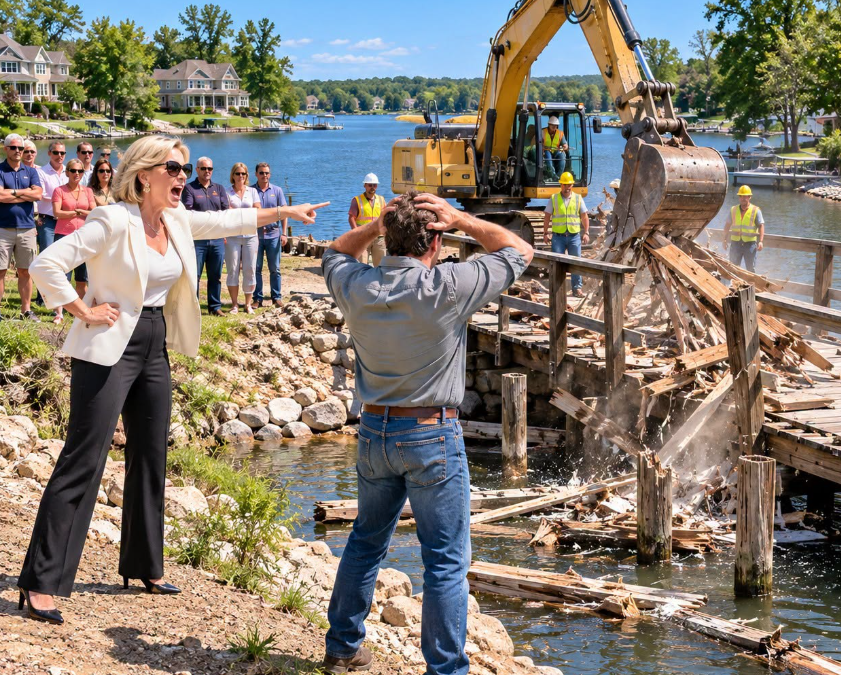
Karen stood beside the inlet wearing a white blazer.
She directed the work.
The first machine struck concrete.
Then another.
Within three hours, a bridge that had stood safely for more than twenty years was broken into slabs and twisted rebar.
Six different neighbors recorded it.
Maybe more.
One video became infamous later.
Karen standing beside the wreckage.
She swept one arm toward the lake.
Smiled.
“The neighborhood looks beautiful now.”
Those words followed her everywhere.
Regional news got the footage that evening.
Headline:
WHOSE BRIDGE WAS IT ANYWAY?
Karen agreed to be interviewed.
Of course she did.
She explained that the association had acted to protect community aesthetics.
She claimed the bridge lacked conformity.
Claimed the HOA had exhausted every reasonable option.
Said the removal improved the lake for everybody.
I knew none of this.
I was in Denver.
Four days later, I flew home.
My neighbor met me before I got my suitcase out of the truck.
“Daniel.”
Something about his face made me stop.
“What happened?”
He held out his phone.
Video.
I watched.
Karen.
White blazer.
Excavator.
Concrete cracking.
I watched twice.
No expression.
Not because I wasn’t angry.
Because my brain had switched into professional mode.
Structural engineers learn this during failures.
Emotion later.
Sequence first.
What was touched?
What load path changed?
What infrastructure is nearby?
What documentation exists?
I handed the phone back.
Then walked to the inlet.
The bridge was gone.
Broken slabs.
Exposed soil.
Rebar.
Brown water.
Utility marker tape.
That last detail froze me.
Orange marker tape.
Cut.
I crouched.
Looked closer.
I knew the title easement.
I knew utilities existed in the corridor.
But I had never needed to expose them physically.
Now I could see evidence of what the excavator had crossed.
I made three calls.
First:
My old law firm.
Second:
County engineering office.
“Reissue every original permit and easement document connected to parcel Hayes-17.”
Third:
Frank Delgado.
Senior engineer with the regional utility company.
Old professional contact.
“Frank.”
“Daniel. What’s up?”
“Someone demolished the Cedar Hollow bridge.”
Pause.
“What bridge?”
“The private one across the inlet.”
Another pause.
“The one with the utility corridor?”
“Yes.”
His tone changed immediately.
“Send coordinates.”
“I know the coordinates.”
“Send them anyway. And pictures. Right now.”
“How bad could this be?”
“Don’t touch anything.”
That answer told me enough.
Within forty-eight hours, a joint inspection team arrived.
Hard hats.
Survey gear.
Cable-locating equipment.
Utility maps.
Water system personnel.
Electrical crews.
They removed debris carefully.
Then the full problem emerged.
Fiber-optic cable.
Regional.
Serving thousands of homes across three counties.
High-pressure water main.
Feeding a large portion of the lakeside district.
Including Karen’s house.
Underground electrical conduit.
Linking a regional substation to nearby neighborhoods.
All three sat beneath the bridge.
All three were protected by a permanent recorded easement.
The easement prohibited excavation, demolition, structural modification, or obstruction without formal utility approval and engineering review.
Karen had ordered an excavator onto it because she disliked the view.
Frank stood over the exposed corridor.
I’ve known engineers who swear constantly.
Frank usually didn’t.
That day, he did.
“A fence contractor knows to call before digging.”
He pointed toward the exposed line.
“Look at this.”
The bucket marks were inches from critical infrastructure.
“How close?”
“Too close.”
“What happens if they rupture the main?”
“We lose pressure over a major section. Potential flooding here. Emergency replacement.”
“Fiber?”
“Could knock out service over three counties.”
“Electrical?”
He shook his head.
“They were lucky.”
Lucky.
That word angered me more than anything Karen had written.
Not compliant.
Not safe.
Lucky.
She had gambled with infrastructure she didn’t know existed.
People she didn’t know existed.
Services she didn’t understand.
All for a view.
I walked the wreckage that evening alone.
Flashlight.
Camera.
Notebook.
Depth.
Width.
Utility tape.
Cut conduit markings.
Excavation paths.
Every detail.
I numbered photographs.
Added timestamps.
Sent everything to Diane Cole, the attorney handling my case.
Diane had known me long enough not to ask why I was doing the investigation myself.
She replied:
“Keep going. You’re making this almost too easy.”
County investigators arrived.
They treated the site more like infrastructure damage than an HOA disagreement.
Robert Sanchez cooperated immediately.
He handed them Karen’s authorization letter.
Association letterhead.
Her signature.
The language said the HOA accepted responsibility for the removal.
Robert said Karen told him ownership and authority were undisputed.
He had believed her.
Then investigators obtained HOA meeting minutes.
No formal vote approving demolition.
No board resolution.
No utility consultation.
No county approval.
No survey.
No locate request.
No engineering review.
Nothing.
Just Karen.
Then Gregory’s emails surfaced.
Weeks before demolition:
Karen,
I strongly recommend no physical action involving the Hayes bridge until title, easement, and utility status are independently confirmed.
Another:
The bridge likely qualifies for grandfather protection and may sit within recorded utility easements. Removal could expose the association to substantial liability.
Another:
Please do not authorize demolition without board approval and county utility clearance.
Karen never responded.
She couldn’t claim nobody warned her.
Her own attorney had.
Repeatedly.
Then the outages began.
Some fiber service had already been damaged during excavation.
Dozens of homes lost internet.
Water pressure dropped across the district while crews stabilized the main.
Nearly forty households lost usable water for much of two days.
Electrical technicians shut down sections of the local grid as a precaution.
Several homes lost power.
Two contained elderly residents relying on medical equipment.
Emergency crews worked around the clock.
Overtime hit six figures quickly.
Temporary rerouting.
Replacement cable.
Water-main stabilization.
Electrical safety work.
Infrastructure hardening.
Utility companies sent demand letters to the HOA.
Then Robert’s demolition company filed a counterclaim.
Karen had misrepresented authority.
Then the HOA’s insurer reviewed everything.
Denied coverage.
Intentional unauthorized destruction exclusion.
That was the first moment Karen seemed to understand how big the problem had become.
Until then, I think she believed this was still fundamentally about my bridge.
Maybe she’d pay to rebuild it.
Maybe I would sue.
Maybe the HOA would cover some cost.
Then everyone would move on.
No.
The bridge itself was only one line item.
The real cost was what she had endangered underneath it.
The insurer hired an independent adjuster.
Three days on site.
Permits.
Photos.
Minutes.
Easements.
Emails.
His report was brutal without sounding emotional.
No reasonable HOA president should authorize excavation over a marked utility easement without a utility locate request.
That step was so basic homeowners used it before installing fence posts.
He described Karen’s conduct as consistent with willful disregard rather than honest mistake.
Coverage denial became almost inevitable.
Karen requested a private meeting.
Late September.
Gregory arranged it.
She arrived without the white blazer.
Something subdued.
I remember noticing that because Karen normally dressed as though she expected cameras.
We sat in a conference room.
Diane beside me.
Gregory at one end.
Karen opened.
“I think this has gotten out of hand.”
I said nothing.
“The association is willing to discuss covering reasonable bridge repairs.”
Diane asked, “Define reasonable.”
Karen looked at me instead.
“In exchange, Daniel would agree to release personal claims and help put this behind the community.”
I folded my hands.
“This isn’t about a bridge anymore.”
“Of course it’s about the bridge.”
“No.”
“It was your property.”
“You excavated protected regional utilities.”
“Nothing catastrophic happened.”
Gregory shifted.
Karen continued.
“The situation is being exaggerated.”
That’s when Gregory spoke.
“You were warned.”
She turned.
“What?”
“I warned you in writing.”
“You’re my attorney.”
“Yes.”
“Then act like it.”
He remained calm.
“My job is to advise you on the law.”
“I expected support.”
“I cannot rewrite the record.”
Her face changed.
Not fear.
Betrayal.
She genuinely seemed offended that the attorney who warned her would not now pretend he hadn’t.
The meeting went nowhere.
Two weeks later, mediation.
Diane turned a conference table into a timeline.
Original permit.
County plat.
Permanent easement.
Twenty-year history.
My letters.
Karen’s notices.
Gregory’s warnings.
No board vote.
Demolition authorization.
Video footage.
Utility damage.
Insurance denial.
Robert’s statement.
Karen tried the phrase good faith.
Diane asked, “Good faith after how many written warnings?”
Karen said she believed the bridge was unpermitted.
Diane placed the permit in front of her.
“I sent this to you four separate times.”
Karen looked at me.
“I never personally received all of your attachments.”
Diane produced email receipts.
She had.
Karen argued community standards.
Diane produced covenants.
No authority over the bridge.
Karen argued board support.
Minutes showed no vote.
One by one, the story collapsed.
Board members were present.
I watched their faces.
Not anger at first.
Shock.
Then embarrassment.
Patricia Nguyen, a retired schoolteacher, had defended Karen strongly at the August meeting.
She stood during a break.
“I feel deceived.”
Karen looked at her.
“Patricia, sit down.”
“No.”
Everyone froze.
“I defended you.”
“I was protecting the community.”
“You told us counsel had been consulted.”
“I did consult counsel.”
Gregory said quietly, “And I advised against demolition.”
Patricia stared at Karen.
“You never told us that.”
Another board member spoke.
“I assumed Gregory approved.”
“He did not.”
The room shifted.
Mediation ended without settlement.
County court.
Late October.
Judge Patricia Loomis.
No-nonsense reputation.
She asked the most important question personally.
“Mrs. Whitfield, who granted you authority to order demolition of Mr. Hayes’s private bridge?”
Karen hesitated.
“I believed the association possessed that authority.”
“Based on what document?”
“Our governing covenants.”
“Which provision?”
Her attorney stepped in.
Judge Loomis stopped him.
“I asked Mrs. Whitfield.”
Karen named a general aesthetic provision.
Diane stood.
“That provision postdates the structure and does not authorize demolition of private property outside HOA jurisdiction.”
The judge looked at Gregory’s emails.
“You were warned?”
Karen’s lawyer objected to characterization.
The judge read the email herself.
“No physical action until title, easement, and utility status are independently confirmed.”
She looked at Karen.
“Did you receive this?”
“Yes.”
“Did you independently confirm those items?”
“I believed the contractor—”
“Did you confirm them?”
“No.”
Two days of testimony followed.
Frank Delgado.
He explained infrastructure.
Fiber.
Water.
Electrical.
Risk.
He described how close the excavation came to a larger failure.
The courtroom got very quiet when he explained that thousands of households could have lost essential service.
County surveyor.
Confirmed the bridge was legal.
Confirmed the easement was permanent.
Confirmed the corridor.
Economic damages expert.
This was where numbers arrived.
Emergency repair.
Temporary service restoration.
Fiber replacement.
Water-main stabilization.
Electrical shutdown and repair.
Contractor penalties.
Lost business productivity.
Infrastructure hardening.
Bridge loss.
Legal costs in specified categories.
The total:
$1,800,000.
Exactly.
Karen stared at the table.
Someone behind me whispered.
Susan Ferraro testified too.
She lived three houses away.
Internet outage lasted nearly two days.
She worked remotely.
Critical client meeting.
Canceled.
Missed deadline.
Her testimony lasted maybe ten minutes.
No dramatic language.
That made it effective.
Judge Loomis later cited it.
Damage wasn’t abstract.
Karen’s decision reached homes where residents had no role in the bridge dispute.
Then ruling.
Karen personally liable for authorizing unlawful destruction and unauthorized excavation of protected utility infrastructure.
HOA shared partial liability for inadequate oversight.
But the majority of financial responsibility fell on Karen.
Why?
No board vote.
Direct legal warnings.
Intentional authorization.
Her signature.
Robert Sanchez’s company avoided the worst penalties because Karen misrepresented authority.
Still fined for failing to perform basic permit and utility verification.
Nobody walked away entirely clean.
Karen walked away destroyed financially.
Within days, emergency HOA meeting.
Unanimous removal.
For once, Karen didn’t control the agenda.
Didn’t sign the final document.
Didn’t decide who spoke.
She was removed.
Less than a month later, her lakefront mansion was listed.
The mansion with the premium view.
The view that started everything.
Legal fees mounted.
Judgment.
Additional neighbor claims.
Savings nowhere close.
House sold.
Michael Whitfield, her husband, filed for legal separation.
I never celebrated that.
Their marriage had nothing to do with me.
From what I heard, Michael told friends he had spent years making excuses for behavior he should have challenged earlier.
Karen moved to a modest rental across town.
She considered appeal.
Her new attorney advised against it.
Evidence too strong.
Appeal likely to increase costs.
By spring, she worked part-time at a home-goods store two towns away.
People enjoyed that detail too much.
I didn’t.
Humiliation isn’t the same thing as accountability.
What mattered was that she no longer had authority to do this again.
Cedar Hollow changed quickly.
New bylaws.
Any action affecting private property required:
Full board vote.
Written legal review.
Utility and easement survey.
Documented locate request before ground disturbance.
Meeting minutes published immediately.
Gregory received authority to formally halt legally questionable actions until review.
Residents joked meetings became boring.
Perfect.
Association meetings should be boring.
Boring means nobody is secretly demolishing infrastructure.
County changed too.
The regional planning office began requiring proof of utility clearance for HOA structural modifications near recorded easements.
Officials called it the Cedar Hollow incident.
Frank presented at an infrastructure conference.
He used one photo.
Cut orange utility marking tape.
His closing point:
The smallest ignored detail becomes the largest exhibit later.
I rebuilt the bridge.
Of course I did.
Part of the settlement funded reconstruction.
This time, I designed it myself.
Wider.
Two vehicles.
Reinforced concrete.
Capacity well beyond county minimum.
Weathering-steel railings.
Integrated utility access.
Better drainage.
Cleaner profile.
Karen wanted the bridge removed because she said it was ugly.
Ironically, the replacement was beautiful.
I didn’t design it to punish her.
I designed it because if I had to rebuild, I was going to do it correctly.
I inspected every pour.
Every reinforcement cage.
Every bearing surface.
Old habits.
Workers joked retirement had failed.
“You’re supposed to let us do this.”
“I am.”
“You’re here every morning.”
“That doesn’t mean I’m working.”
They laughed.
Near the entrance, I installed a small bronze plaque.
RESPECT PROPERTY.
RESPECT THE LAW.
Nothing about Karen.
No amount.
No joke.
People understood anyway.
A young couple stopped by one evening.
New residents.
They thanked me.
“For what?”
“Standing up to her.”
“I mostly sent letters.”
“You weren’t scared?”
“Of Karen?”
They laughed.
“Yes.”
“No.”
“Why?”
“Because the documents were clear.”
The wife said, “We were afraid to question anything our first months here.”
“Why?”
“Everyone said she could make life miserable.”
“Rules only work when they’re real.”
She frowned.
“What do you mean?”
“If someone cites a rule, ask to see it.”
Simple.
Maybe too simple.
But Cedar Hollow had spent years forgetting.
Robert Sanchez changed his company procedures too.
Every excavation now required written proof of locate requests.
No exceptions.
I ran into him at a hardware store about a year later.
He looked uncomfortable.
“Daniel.”
“Robert.”
“I never properly apologized.”
“You relied on paperwork.”
“I should’ve checked.”
“Yes.”
He nodded.
“That job nearly ended us.”
“It could’ve ended worse.”
He understood.
“If we’d hit the main…”
“Or electrical.”
He shook his head.
“I think about it.”
“Good.”
Not cruel.
Good contractors remember close calls.
That’s how practices improve.
Residents started attending meetings.
People who had never gone before.
Patricia Nguyen joined oversight.
Same woman who defended Karen earlier.
She told me, “I should have asked more questions.”
“Most people don’t.”
“That’s how she got away with it.”
“Probably.”
Gregory said the board had never functioned more transparently.
I asked if that made his job easier.
“No.”
“Why not?”
“More people read things.”
I laughed.
“Sounds healthy.”
“It is.”
By the following spring, Cedar Hollow was peaceful again.
My bridge reflected in the water.
Karen’s old mansion had been sold.
New owner.
No complaints about the view.
Imagine that.
I sat on the dock fishing.
Same place where Karen first told me the bridge didn’t belong in a community of Cedar Hollow’s caliber.
Beneath the rebuilt bridge, fiber hummed.
Water main held pressure.
Electrical conduit operated.
Invisible infrastructure doing its job.
That’s what good infrastructure does.
You shouldn’t need to think about it.
Until someone ignores it.
I’ve been asked what made Karen act the way she did.
I don’t know.
People want psychology.
Arrogance.
Control.
Entitlement.
Maybe.
I can only speak to what happened.
She disliked a bridge.
She believed her title gave her authority.
Her attorney warned otherwise.
I sent permits.
She ignored them.
The board never approved demolition.
She authorized it anyway.
Those are facts.
Motives matter less than documentation.
One signature cost her $1.8 million because she signed beneath a decision she did not have legal authority to make.
That’s the engineering version of the story.
Load followed connection.
Responsibility followed signature.
Failure followed ignored warning.
Simple.
But emotionally, the situation taught me something I hadn’t learned in twenty years of structural work.
I used to think professionals were the people most likely to respect boundaries.
Engineers understand limits.
Lawyers understand jurisdiction.
Surveyors understand lines.
But titles can make anyone forget.
Karen’s title wasn’t fake.
She was genuinely HOA president.
That gave her certain powers.
Manage association property.
Enforce valid covenants.
Administer budgets.
Call meetings.
Represent members within defined authority.
Then she stretched those powers.
First small.
Mailbox.
Hedge.
Lights.
Then larger.
Private bridge.
When nobody stopped the earlier stretches, she interpreted silence as permission.
That’s dangerous.
A bridge doesn’t care who is president.
Load limits remain.
Property lines remain.
Easements remain.
Water mains remain.
Laws remain.
Reality is not impressed by confidence.
That became the real lesson.
Karen’s authority worked socially.
People complied.
Then she applied social authority to physical infrastructure.
The infrastructure exposed the difference.
You can’t intimidate fiber-optic cable.
You can’t order an easement to disappear.
You can’t tell a high-pressure water main you’re HOA president.
Those systems obey engineering and law.
Nothing else.
For months after trial, people treated me like I had won something.
I didn’t feel victorious.
My original bridge was gone.
Utilities damaged.
Residents inconvenienced.
HOA money spent.
Robert’s business nearly ruined.
Karen lost her house.
Marriage damaged.
Nobody truly won.
The community corrected a failure.
That’s better language.
Correction.
The new bridge corrected physical damage.
The bylaws corrected governance.
County policy corrected process.
Robert corrected business practice.
Maybe Karen corrected nothing.
I can’t control that.
I corrected my own assumptions too.
I had assumed legal clarity would prevent physical overreach.
Wrong.
Documents protect you only if you’re prepared to use them after somebody ignores them.
That realization made me update how I stored records.
Digital copies.
Cloud backup.
Separate offsite copies.
Not because I expected another demolition.
Because evidence should not depend on one safe inside one house.
Engineers think in redundancy.
I should have earlier.
I also began teaching younger engineers one principle differently.
On site, people sometimes treat easements as paperwork.
They’re not.
An easement can be a physical map of invisible risk.
Cable.
Pipe.
Power.
Drainage.
Access.
Maintenance rights.
The ground might look empty while carrying millions of dollars beneath it.
That’s exactly what happened at Cedar Hollow.
Karen looked at the bridge and saw concrete blocking her view.
Frank looked beneath it and saw regional infrastructure.
Perspective changes risk.
Good decision-making requires the broader perspective.
Karen never asked.
That was the fatal step.
Not knowing isn’t always negligence.
Refusing to check can be.
Especially after someone warned you.
That’s why Gregory’s emails mattered so much.
They changed:
I didn’t know.
Into:
I was told.
Then proceeded.
Willful disregard.
Insurance companies care deeply about that distinction.
Courts too.
If Gregory had never warned Karen, some parts of the case might have looked different.
Still unauthorized.
Still negligent.
But the written warnings made intent harder to soften.
She had exits.
Many.
First letter from me.
Check permit.
Second.
Check plat.
Gregory warning.
Stop.
Board meeting.
Table issue.
Before contractor.
Call county.
Before excavation.
Utility locate.
Before first bucket hit concrete.
Pause.
She ignored every exit.
People later said the $1.8 million judgment came suddenly.
It didn’t.
It accumulated decision by decision.
Warnings are structural supports too.
Remove enough, failure becomes inevitable.
My divorce years earlier had taught me peace mattered.
This ordeal refined that.
Peace isn’t avoiding conflict at any cost.
Sometimes peace requires a boundary.
A real one.
You can be calm and still say no.
You can refuse without shouting.
You can defend without becoming the person attacking you.
I never matched Karen’s volume.
That frustrated her.
Maybe she mistook calm for weakness.
Many people do.
In engineering emergencies, the loudest person in the room is rarely the most useful.
I learned to slow down.
Measure.
Document.
Decide.
Same method here.
When I returned from Denver and saw rubble, I wanted anger.
Instead, I made calls.
Lawyer.
County.
Utility.
That sequence changed everything.
Had I driven to Karen’s house and screamed, what then?
Satisfying for ten minutes.
Useless in court.
Maybe harmful.
Documentation doesn’t feel dramatic.
But it survives.
Six neighbor videos.
My security camera.
Authorization letter.
Emails.
Permits.
Easement.
All survived emotion.
Karen’s line—“The neighborhood looks beautiful now”—became infamous.
People laughed about it afterward.
I didn’t.
The footage disturbed me.
Not because she sounded cruel.
Because she sounded certain.
Certainty without verification is one of the most dangerous forces in construction.
A worker certain power is off.
A contractor certain a line is abandoned.
A designer certain soil can handle load.
A board president certain a bridge is hers to demolish.
Certain isn’t data.
Check.
Always check.
Frank’s conference presentation eventually circulated among engineers I knew.
Someone sent me the slide with cut utility tape.
Message:
“This your bridge?”
I replied:
“Unfortunately.”
Then another:
“Great case study.”
I wrote:
“Terrible project. Good lesson.”
That’s accurate.
The replacement bridge became part of Cedar Hollow.
No controversy.
New owner across the inlet apparently liked it.
One afternoon he came over.
“Beautiful structure.”
“Thanks.”
“Previous owner hated it?”
“The old one.”
“I don’t understand why.”
“Neither did I.”
He looked toward his house.
“The view is great.”
Exactly.
Months of war over a view that never needed fixing.
That’s another thing.
People can become obsessed with a problem because they’ve named it a problem.
Once Karen decided the bridge was an eyesore, every morning reinforced the irritation.
She could have changed her interpretation.
She chose to change the landscape instead.
Expensive mistake.
I sometimes think about Michael Whitfield.
We barely spoke.
He stayed out of HOA politics.
That seemed reasonable at first.
But later, reportedly, he said he should have questioned Karen earlier.
Maybe.
There is a lesson in passive distance.
If someone close to you accumulates authority and uses it badly, staying neutral isn’t always neutral.
But that’s not my story to judge.
I saw Michael only once after the separation.
Grocery store.
He nodded.
I nodded.
Nothing else.
Good.
Some conflicts don’t need every possible conversation.
Karen became less discussed over time.
Healthy sign.
For months, every dinner at Cedar Hollow returned to her.
Then gradually:
School.
Weather.
Boats.
Property taxes.
Normal topics.
Communities recover by becoming boring again.
I liked that.
The oversight committee posted agendas.
Financial statements.
Legal reviews.
Before structural work near utility corridors, records were checked.
Nobody complained paperwork slowed things.
They had seen what speed cost.
The county added clearance requirements.
Other HOAs grumbled at first.
Another form.
Another verification.
Frank told me, “They hate it until the first time it prevents something.”
Safety often feels excessive before the accident.
Afterward, obvious.
Engineers live in that paradox.
We design against events people think won’t happen.
Then when nothing happens, they ask whether the precautions were necessary.
Yes.
That’s why nothing happened.
Karen’s demolition had no precautions.
No survey.
No locate.
No review.
Result:
Chaos.
The rebuilt bridge had many precautions.
Nothing happened.
Success.
Years after the case, I was consulting for a firm reviewing a pedestrian bridge replacement.
A young project manager said, “We’ve got existing utility maps. Should be enough.”
I asked, “Did you physically locate?”
“Not yet.”
“Do it.”
“Map is recent.”
“Do it.”
He looked at me.
Then smiled.
“Cedar Hollow?”
“Exactly.”
They located.
A telecom conduit was nine feet away from the mapped position.
He never questioned me again.
Experience is expensive.
Use it more than once.
The $1.8 million number remains what people remember.
Why?
Numbers make stories simple.
Karen removed bridge.
Karen pays $1.8 million.
But the total represented many losses.
Utility repair.
Service interruption.
Emergency labor.
Business disruption.
Infrastructure replacement.
Property damage.
Every dollar connected to an effect.
Consequences travel.
One decision at the inlet reached Susan Ferraro’s client call miles away.
Reached elderly residents’ power supply.
Reached workers repairing fiber at night.
Reached water crews stabilizing pressure.
Reached insurer.
Reached contractor.
Reached HOA members.
That’s systems thinking.
Nothing is isolated.
A bridge isn’t just a bridge if utilities run beneath it.
An HOA isn’t just one president if residents bear financial exposure.
A view preference isn’t private if you use institutional power to enforce it.
Karen treated each issue as isolated.
Her view.
My bridge.
Her authority.
Reality connected them all.
That was why damage multiplied.
One spring evening, the young couple returned.
They had started attending board meetings.
“You’re responsible for us wasting Tuesday nights now.”
“You’re welcome.”
They laughed.
The husband said, “They’re boring.”
“Good.”
“Like painfully boring.”
“Excellent.”
He shook his head.
“Karen meetings weren’t boring.”
“And how did that work out?”
Point made.
Boring governance became a local compliment.
I would choose boredom over $1.8 million every time.
I kept my old logbook.
Eleven letters.
Four fines.
Three visits.
Threat.
The book sits in my study beside the bridge permits.
Sometimes I show it to younger professionals.
Not because the handwriting matters.
Because contemporaneous records matter.
Memory shifts.
People forget exact wording.
Dates blur.
A simple log can preserve sequence.
At trial, Karen’s team tried to describe the demolition as the culmination of a legitimate compliance process.
My log showed the process.
I responded.
Provided permits.
Raised jurisdiction.
Copied attorney.
No unresolved ambiguity.
The association had notice.
Karen proceeded anyway.
That matters.
Documentation is respect for future truth.
You don’t know which detail will matter later.
Write it now.
My former firm once joked I was obsessive about change orders.
This case proved why.
Missing signatures cost contractors thousands.
Wrong signatures can cost presidents $1.8 million.
After reconstruction, I commissioned a full as-built survey.
Utility locations.
Depth.
Access panels.
Easement references.
Stored digitally and physically.
Anyone touching that bridge in the future will know exactly what exists beneath.
No excuses.
The bronze plaque remains.
RESPECT PROPERTY.
RESPECT THE LAW.
I’ve considered adding:
CALL BEFORE YOU DIG.
Frank would approve.
But two lines are enough.
People read them.
Sometimes take photos.
The bridge has become a local story.
New residents hear it as warning.
Good.
Warnings prevent repetition.
I don’t care whether they remember my name.
Remember the process.
A woman wanted a clearer lake view.
Ignored title.
Ignored attorney.
Ignored utilities.
Demolished bridge.
$1.8 million.
Memorable enough.
The old mansion across the water eventually sold again.
New owners planted flowers.
No hostility.
They invited me to dinner once.
I went.
From their living room, the bridge is visible.
I stood near the window.
The owner said, “This was the famous view?”
“Apparently.”
He looked.
“I like the bridge.”
I laughed.
“Careful. That’s controversial.”
His wife said, “It frames the inlet.”
Perspective.
Same object.
One person sees obstruction.
Another sees structure.
The law doesn’t need to decide aesthetic taste.
It only needs to decide who owns what and who may destroy it.
Karen forgot that.
Aesthetic authority feels subjective.
Property authority isn’t.
The association could say:
We dislike the bridge.
Fine.
They could ask:
Would you redesign?
Fine.
I could say:
No.
End.
That should have been the entire dispute.
Instead, Karen couldn’t accept a boundary she didn’t control.
Some people experience no as disrespect.
That creates endless trouble.
I’ve negotiated with contractors over millions.
Best partners understood:
No is information.
Not insult.
If load limit says no, redesign.
If soil says no, redesign.
If owner says no and you lack authority, stop.
Don’t bulldoze.
Simple.
People sometimes ask if I would have considered modifying the bridge voluntarily.
Before Karen escalated?
Maybe.
I was an engineer.
I like better structures.
If she’d approached me differently:
Daniel, the bridge’s appearance bothers me. Would you ever consider improving the railing or landscaping? I’d contribute.
Maybe.
Conversation.
Choice.
Instead she said:
It needs to go.
Then weaponized HOA power.
That killed cooperation.
Authority is terrible at creating goodwill when used where it doesn’t belong.
The rebuild cost more than a cosmetic upgrade ever would have.
Everyone lost time.
Another expensive lesson.
Robert Sanchez eventually sent me a photo of his company’s new pre-dig checklist.
UTILITY LOCATE CONFIRMED?
PERMIT VERIFIED?
OWNER AUTHORIZATION?
EASEMENT REVIEW?
All checkboxes.
He wrote:
Never again.
I replied:
Good system.
That’s how professionals respond to failure.
Change process.
Not just apologize.
Cedar Hollow did the same.
County did too.
Frank did in training.
I did in records.
The only question I can’t answer is whether Karen did.
Maybe losing office, mansion, marriage, and money changed her.
Maybe she still believes everybody overreacted.
Not my responsibility.
Accountability doesn’t require conversion.
It requires consequence.
Her consequence was clear.
The legal system didn’t punish her for having bad taste.
It punished unauthorized destruction after warning.
Important distinction.
This wasn’t revenge over a bridge.
It was liability.
I like that precision.
Stories often flatten legal disputes into good person versus bad person.
Reality is documentation.
Authority.
Duty.
Notice.
Action.
Damage.
Causation.
Those elements mattered.
Karen supplied them.
Her signature connected action.
Gregory’s emails supplied notice.
Easement supplied duty.
Utility damage supplied harm.
Videos supplied conduct.
Permits supplied ownership and legality.
Once assembled, the case became almost mechanical.
That was why Diane called my preparation almost too easy.
Not easy emotionally.
Easy evidentiary structure.
That’s the best kind of legal case.
Facts align.
There was one moment at trial I rarely mention.
During a break, Karen and I stood maybe fifteen feet apart in the hallway.
No attorneys beside us for a minute.
She looked older.
Tired.
She said, “I never meant for anyone to lose utilities.”
I believed that.
“I know.”
She seemed surprised.
“Then why are you doing this?”
“Because intent doesn’t restore a water main.”
Her face tightened.
“I was trying to protect the community.”
“From my bridge?”
No answer.
“You were warned.”
“I thought Gregory was being cautious.”
“That’s what attorneys do.”
“He always predicts worst-case scenarios.”
“Sometimes worst-case exists for a reason.”
She looked away.
Maybe that was the closest she came to understanding.
I didn’t push.
Court resumed.
Some consequences don’t need speeches.
The judge did enough.
When the $1.8 million number was read, I didn’t feel satisfaction.
I thought about the first letter.
Aesthetic noncompliance.
How far from $1.8 million that seemed.
But each step connected.
Small misuse of authority can scale.
That’s why people should challenge early.
Not because every petty HOA letter becomes catastrophe.
Because boundaries erode gradually.
If the bridge fine had worked, Karen’s belief in authority would have strengthened.
Then the next private structure.
Then another.
Systems drift unless corrected.
Cedar Hollow corrected dramatically.
Others can correct earlier.
Ask:
Where is that authority written?
When was it adopted?
Does it apply to my parcel?
Grandfathered?
Easement?
Permit?
Board vote?
Legal review?
Five minutes of checking can save years.
I told the young couple that.
They started printing meeting packets.
Karen would have hated them.
Probably a compliment.
By summer, fishing became normal again.
I sat on the dock.
Bridge reflected.
Cars crossed.
Utilities stayed hidden.
No news trucks.
No excavators.
No white blazers.
Normal.
That’s the life I bought Cedar Hollow for.
The divorce had taught me peace mattered.
The bridge taught me peace requires maintenance.
Boundaries are part of maintenance.
If you never defend them, someone eventually decides they don’t exist.
That doesn’t mean becoming hostile.
It means being clear.
My responses to Karen were clear.
Permits attached.
Jurisdiction explained.
No.
Maybe she mistook politeness for uncertainty.
That’s her mistake.
Politeness doesn’t weaken a boundary.
You don’t need anger to mean no.
I carried that lesson into consulting.
Younger engineers sometimes soften safety language.
“We may want to consider…”
No.
If unsafe:
“This does not meet required capacity.”
Clear.
Ambiguity invites rationalization.
Karen rationalized every warning.
Likely protected.
Could create liability.
She heard possibility.
Gregory actually said:
Do not proceed.
She proceeded.
Words matter.
So do people willing to act on them.
The county policy resulting from Cedar Hollow made clearance mandatory.
No discretion.
That’s stronger.
Sometimes systems shouldn’t depend on someone’s judgment.
Require the check.
Then the next Karen can’t simply decide it isn’t necessary.
That’s why regulation exists.
Not because everyone is incompetent.
Because competent people still get overconfident.
The rebuilt bridge has survived storms.
Freeze-thaw cycles.
Heavy rain.
Normal traffic.
I inspect it annually.
No concern.
Weathering steel develops the exact patina I expected.
Karen called the old railing industrial and depressing.
The new railing is more industrial.
And beautiful.
I enjoy that irony privately.
Not revenge.
Engineering taste.
Weathered steel works.
The utility access panels are integrated beneath deck segments.
Frank’s crews can reach systems without major demolition.
If work is needed, documented sequence.
Everything designed for future maintenance.
That is what Karen never understood.
Good design respects future people.
Her demolition served present preference.
My rebuild serves decades.
Infrastructure is an agreement with the future.
You build something knowing you may never see its full life.
My bridge will probably outlive me.
That feels right.
Maybe someday someone buys my house.
Reads the title report.
Sees bridge easement.
Sees utility corridor.
Sees plaque.
Asks why the paperwork is so thorough.
Someone will tell them.
Good.
The story becomes another layer of protection.
Memory can function like signage.
Don’t repeat this.
Cedar Hollow residents tell newcomers:
Read your rules.
Attend meetings.
Ask questions.
Check authority.
That’s healthier culture.
Karen’s era relied on passivity.
New culture rewards scrutiny.
A community doesn’t become weaker when residents question leaders.
It becomes harder to misuse.
That’s the difference between control and governance.
Karen wanted control.
The reformed board governed.
Boringly.
Successfully.
I was invited to join the oversight committee once.
Declined.
“I don’t even belong to the HOA jurisdiction for this parcel.”
“That’s why we’d like you.”
“No.”
They laughed.
I wasn’t moving into neighborhood politics.
I had done my part.
Sometimes refusing power is healthy too.
I didn’t need a title.
I had a dock.
A fishing rod.
Occasional consulting.
Enough.
The settlement also allowed me to cover reconstruction without compromising retirement plans.
People assume $1.8 million went to me directly.
It didn’t.
That’s not how the total worked.
Multiple damages.
Utility entities.
Infrastructure.
Various claims.
Liabilities.
My own recovery was one part.
That’s worth clarifying.
The number represented system-wide consequences, not a lottery ticket.
I didn’t become richer from Karen’s mistake in any meaningful emotional sense.
I lost time.
Lost original bridge.
Dealt with litigation.
No one should seek that.
The correct victory would have been Karen accepting the permit in spring.
Cost:
Zero.
Everything after was waste.
That may be the strongest criticism.
Not that she was mean.
That she created preventable waste.
Money.
Labor.
Materials.
Court time.
Emergency crews.
Insurance resources.
Community trust.
All because she wouldn’t accept one bridge in her view.
Waste bothers engineers.
Unnecessary failure especially.
The first bridge was sound.
Demolition itself introduced risk.
No performance benefit.
No safety need.
Purely aesthetic.
Then replacement.
Massive negative value.
An engineer’s nightmare.
I once calculated the rough embodied cost out of curiosity.
Concrete removed.
Replacement concrete.
Steel.
Utility repairs.
Crew hours.
Fuel.
Not to mention money.
All avoidable.
I stopped before finishing.
Too depressing.
One November afternoon, I found the old black logbook while reorganizing my study.
Read the entries.
April 12 — Karen on dock, demands bridge removal.
April 26 — first HOA letter.
May 9 — second letter, repaint request.
June 3 — rail removal request.
July 14 — barbecue statement: “make that bridge disappear.”
August 22 — Gregory warns board.
September — demolition.
The progression looked obvious in hindsight.
At the time, each event felt irritating but manageable.
That’s how escalation works.
Looking backward compresses.
Living through it stretches.
I added one final entry.
Bridge rebuilt. Easement intact. Matter closed.
Then put the notebook away.
Closure sometimes needs a sentence.
Years later, Cedar Hollow barely resembles the community conflict-wise.
Still wealthy.
Still gated.
Still rules.
But people laugh more at meetings.
Disagreement doesn’t feel dangerous.
Residents challenge board proposals.
Board answers.
Nothing collapses.
Imagine that.
Karen had convinced people strong leadership required unquestioned authority.
It didn’t.
Strong systems tolerate disagreement.
Bridges do too, metaphorically.
Loads move.
Structures flex.
Rigid isn’t always strong.
Good design distributes force.
Good governance should too.
One person should not carry every decision.
Karen concentrated authority.
New bylaws distributed it.
Board vote.
Legal review.
Survey.
Oversight.
Multiple supports.
Redundancy.
That’s structural engineering applied socially.
Maybe I think too much like an engineer.
Fine.
It works.
The most satisfying thing isn’t Karen losing her mansion.
It’s that the next president cannot do what she did nearly as easily.
That is durable repair.
Change person only?
Temporary.
Change system?
Stronger.
That’s how you rebuild after failure.
First ask:
Why did it fail?
Not:
Who do we blame?
Both matter, but sequence matters.
Cedar Hollow identified:
Unilateral authority.
Poor documentation access.
Weak legal-stop mechanism.
Low resident participation.
Then redesigned.
That is exactly how engineers approach structural failure.
Root cause.
Corrective measure.
Monitoring.
I respected the new board for that.
Gregory became much more assertive after.
Good.
A lawyer warning buried in an inbox is weak protection.
New rule gave him formal stop authority.
If a future president ignores him, action halts anyway.
That’s design improvement.
Frank’s utility company improved markings and documentation around private easements too.
Robert improved contractor verification.
Everyone improved.
Expensive lesson used widely.
Perhaps that is the only way to extract value from preventable disaster.
Learn enough that cost isn’t repeated.
One evening, the new owner of Karen’s old house invited a few neighbors over.
I stood on the porch where Karen once drank morning coffee staring at my bridge.
The view was spectacular.
Lake.
Mountains.
Sunset.
Bridge small in foreground.
I said to the owner, “You know, she spent $1.8 million trying to fix this.”
He looked confused.
“Fix what?”
Exactly.
That moment almost made me laugh.
The problem existed mostly in Karen’s perception.
The lake had always been beautiful.
The bridge never ruined anything.
Her obsession ruined far more than the structure ever could.
There is a lesson there beyond property law.
Not every irritation needs removal.
Sometimes coexist.
Sometimes adapt.
Sometimes look past it.
She couldn’t.
I can.
The bridge sits in my view too.
I like it.
Not because of what happened.
Because bridges connect.
Obvious symbolism.
Still true.
My house to county road.
Utilities across the inlet.
Old infrastructure to new.
Property history to present.
And, in a strange way, Cedar Hollow before Karen’s fall to after.
One structure became boundary and lesson.
I never wanted that role.
But there it is.
At dusk, I still fish from the dock.
The new bridge casts a longer shadow than the old one.
Weathering-steel rail glows dark orange.
Cars occasionally cross.
Underneath:
Fiber.
Water.
Electrical.
Quiet.
Doing what they were designed to do.
Karen once believed the bridge blocked her view.
What she never understood was that the most important part of it was invisible.
The easement.
The utilities.
The legal history.
The engineering.
That’s true of many things.
We judge visible surface.
Real structure hides below.
Authority too.
Title is visible.
Legal power underneath.
Karen had title:
HOA President.
She lacked foundation:
Jurisdiction.
Permit.
Vote.
Easement rights.
When she loaded too much onto the title, it failed.
Structural analogy again.
Couldn’t resist.
One final morning comes back to me.
Spring after reconstruction.
I drove across the new bridge before sunrise.
First time alone.
No contractors.
No inspection crews.
No cameras.
Just me.
Stopped halfway.
Probably not recommended.
Got out.
Looked over the water.
The old bridge had carried me thousands of times.
I hadn’t appreciated it.
Most functioning infrastructure becomes invisible through reliability.
Then when it’s gone, you understand.
The new bridge felt solid beneath my boots.
I put one hand on the weathered-steel rail.
Across the inlet, Karen’s old house was dark.
Different owners hadn’t moved in yet.
No one staring.
No one demanding removal.
I thought about her first words.
It ruins the view.
Then Gregory’s warning.
Then the excavator.
Then Frank saying inches.
Then the judge.
Then $1.8 million.
All from one preference elevated into authority.
I got back in my truck.
Drove across.
No ceremony.
That’s how the story should end.
Not with Karen falling.
With the bridge functioning.
Because repair matters more than punishment.
Cedar Hollow learned.
County learned.
Contractor learned.
I learned.
The utilities stayed safe.
The residents got services.
Governance improved.
Life continued.
Karen Whitfield believed being HOA president gave her the power to erase anything she didn’t like from the landscape.
The bridge proved otherwise.
It had permits older than her presidency.
An easement older than her mansion.
Utilities serving people she had never considered.
And a legal foundation her title could not touch.
She signed one authorization letter believing her signature turned preference into law.
Instead, that signature became the clearest evidence of who ordered an unauthorized demolition.
That is the irony I think about most.
She wanted proof of authority.
She created proof of liability.
One piece of paper.
One impulsive order.
One excavator.
$1.8 million.
People still ask if I felt vindicated when the ruling came down.
No.
I felt tired.
Then relieved.
Vindication is noisy.
Relief is quiet.
I bought Cedar Hollow for quiet.
Eventually I got it back.
And now, when morning light reaches the inlet, the new bridge stands exactly where the old one stood, carrying cars above three protected utility systems below.
Across the water, the lake view remains spectacular.
It always was.
The only thing Cedar Hollow truly needed removed was the idea that one person’s title could override everyone else’s property, law, and common sense.
That took longer than rebuilding the bridge.
It cost far more.