The HOA Ordered Me Off My Own 340-Acre Reservoir—Then One Signature in the County Records Destroyed Their 20-Year Claim Overnight.
PART2:
The mist was lifting now, revealing the full reach of the reservoir—three hundred forty acres at full pool, tucked into the northeastern end of Greer Valley. My grandfather had engineered it by damming a natural drainage draw. My father had learned to swim in it. My uncle Raymond had maintained the dam, the spillway, and the surrounding acreage for thirty years. I had spent childhood summers throwing rocks from the north bank while Grandpa Elias explained that water was never just water.
“It is a system,” he used to say. “Water always tells you where somebody made a mistake.”
That morning, standing beside Diane’s HOA SUV, I began to understand that the mistake had been sitting on my land for two decades.
Diane held out the paper.
“You do not have authorization to use this water.”
I looked at her hand.
Then at her face.
She continued.
“Your presence here constitutes trespass. You have fourteen days to remove any watercraft, equipment, and personal property from the reservoir access area, or Clearwater Ridge HOA will pursue enforcement action.”
She delivered every word cleanly, almost elegantly.
That was what fascinated me most.
Confidence is persuasive, even when it is built on nothing.
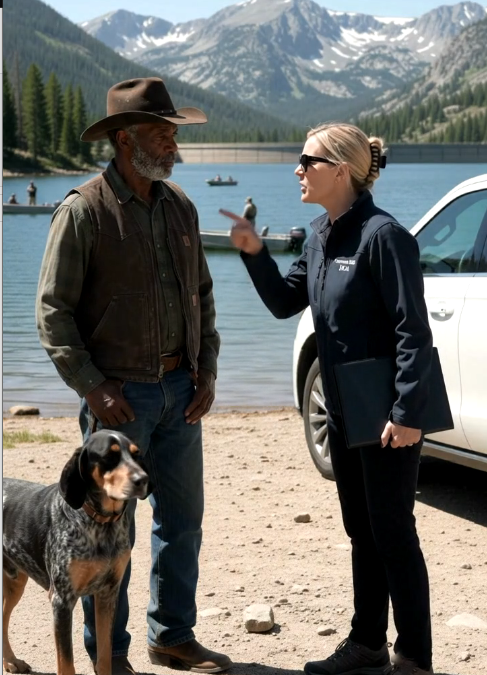
And Diane had absolutely no idea she had driven down my road, parked on my land, walked across my property, stood beside my water, and handed the owner a trespass warning.
I let her finish.
Then I said, “Thank you for bringing this to my attention.”
Her expression shifted.
Not enough to call it surprise.
More like disappointment.
She had expected an argument. People carrying clipboards often do. They come prepared to dominate a scene, and when you refuse to give them noise, they do not know where to put their authority.
She lowered the paper slightly.
“Do you understand the notice?”
“I understand what it says.”
“You’ll need to comply within fourteen days.”
“I heard you.”
She studied me, perhaps waiting for anger.
I gave her none.
Instead, I looked at the two fishing boats, the kayak, the dock, the illegal ramp, the staging area, the members-only sign, and the woman who had just threatened me with enforcement on land her association did not own.
Then I looked back at Diane.
“I’ll review the records.”
“You may do that,” she said. “But the association’s position is established.”
I almost smiled.
Established.
That was a dangerous word when used by people who had not read the instruments beneath their own confidence.
Diane clipped the notice back to her board, climbed into the SUV, and drove away across my land as if the road belonged to her too.
I stood there until the sound of her engine faded.
The man in the red kayak looked over once, then paddled toward the deeper water.
Nobody else seemed concerned.
Nobody appeared to wonder who owned the land beneath their feet or the water beneath their hulls.
That was the part that stayed with me.
Not Diane’s warning.
Not the clipboard.
Not the fourteen-day deadline.
The casualness.
The easy laughter from the boats.
The coffee cups.
The fishing lines.
The assumption that a place becomes yours if enough people use it long enough and nobody makes them stop.
I took photographs.
The ramp.
The dock.
The sign.
The boats.
The tire tracks in the staging area.
Then I drove back to the ranch house, went upstairs to the room my uncle Raymond had used as an office, and opened my grandfather’s cedar box.
That was when the real fight began.
Eight months earlier, I had inherited 3,400 acres of high-country valley, ponderosa timber, grazing land, drainage corridors, and water rights after Uncle Raymond died.
Raymond had never married. He had no children. He was my father’s older brother, a quiet, stubborn man who could repair a fence in a blizzard and go three days without saying more than ten words unless the topic was cattle, water, or taxes.
He had managed Greer Valley for three decades after my father moved to Billings and I grew into my own career.
I had spent most of my adult life as a civil engineer designing drainage systems, retention structures, culverts, municipal watershed projects, and the kinds of infrastructure people rarely notice until something fails.
Water had been my profession.
Records had been my habit.
Boundaries had been my language.
A survey marker meant something to me.
So did a priority date.
So did a recorded easement.
So did the difference between someone saying they had a right and someone being able to show where that right came from.
My grandfather Elias understood those distinctions even better than I did.
He was not wealthy.
He was meticulous.
There was a difference.
Elias acquired the original acreage in 1951 through a mix of federal patent land, private purchase, and neighboring ranch ground from a sheep operation that failed after two brutal winters. Over the next decades, he added parcels until the Greer holding stretched across approximately 3,400 acres.
He documented everything.
Property tax receipts.
Survey sketches.
Grazing leases.
Dam maintenance notes.
Water filings.
Boundary adjustments.
Recorded easements.
Letters from county officials.
Receipts for culvert pipe bought in 1962.
Even a hand-drawn map showing where he intended to place the reservoir before he hired a Bozeman surveyor.
When Uncle Raymond died and the estate passed to me, I found forty years of records arranged with the precision of a man who did not believe memory was an acceptable substitute for paper.
The abstract in the cedar box ran sixty-one pages.
At the time, I thought that was excessive.
By the end of the year, I would understand it had saved me more than forty thousand dollars in attorney fees and dismantled a claim Clearwater Ridge HOA had treated as fact for two decades.
I carried the cedar box downstairs to the kitchen table.
The house was quiet around me.
Wind pressed against the windows. Somewhere in the distance, a raven called from the timberline. The reservoir lay beyond the northern draw, invisible from the house but suddenly present in every thought I had.
I opened the box and began laying out documents.
The 1951 patent.
The original land purchases.
A 1963 survey.
The water right certificate.
The dam easement.
Spillway maintenance correspondence.
A 1987 boundary adjustment.
Raymond’s succession to title in 1991.
My deed.
The title insurance file from the estate transfer.
Nothing in that box suggested Clearwater Ridge owned so much as a reed along the shoreline.
The reservoir had always been part of Greer land.
Elias had built it properly.
He had commissioned a licensed surveyor before the dam was constructed. In 1963, he dammed the natural drainage draw and created an impoundment covering roughly 340 acres at full pool. He filed the water right with the State of Montana under prior appropriation doctrine.
Priority date: April 14, 1963.
Water Right Certificate No. 41-7792.
He recorded the dam and spillway infrastructure, documented maintenance access, and marked the surrounding property boundaries. The reservoir did not sit in some vague overlap between properties. It was inside Greer Valley.
My father had grown up beside that water.
So had Raymond.
So had I, in pieces.
I remembered being eight years old, walking across the dam face with Grandpa Elias while he explained why the embankment had the slope it did.
“Too steep and water will punish it,” he said.
He pointed with a walking stick toward the spillway.
“Too narrow and a storm will teach you humility.”
Then he tapped my chest lightly with the stick.
“Remember this, Callum. Water always tells you where somebody made a mistake.”
Back then, I thought he meant erosion.
Leaks.
Bad grading.
Undersized culverts.
I became an engineer, and for years that sentence followed me into every design review.
But Clearwater Ridge taught me that water reveals more than engineering mistakes.
It reveals human ones too.
The subdivision did not exist when Elias built the reservoir.
It arrived in the late 1990s, when a neighboring landowner sold approximately 480 acres to a developer. That parcel sat east of Greer Valley, beyond a timbered ridge and down toward a county road. It was divided into ninety-four residential lots arranged around paved roads, a clubhouse, and a decorative man-made pond that the marketing materials generously called a lake.
Clearwater Ridge HOA was created when the subdivision was platted in 1998.
Its covenants, conditions, and restrictions were recorded with Garfield County.
I had read them shortly after inheriting Greer Valley.
That is the sort of thing I do.
The jurisdictional description was exact.
Clearwater Ridge consisted of the 480-acre subdivision shown in Plat Book 14, pages 112 through 118.
No part of Greer Valley appeared in that description.
Not one acre.
Not the ranch house.
Not the dam.
Not the eastern bank.
And certainly not the reservoir.
There was also no language granting the HOA an easement across Greer property or any recreational right in the water.
Legally, the two properties were neighbors.
Nothing more.
Yet six weeks after taking possession, I noticed the boat ramp.
I had driven to the southeastern bank on a September morning to check an old access trail Raymond used during spillway inspections. The trail wound through pine and grass, then opened onto a gravel staging area I had never seen on any Greer map.
At first, I thought it might be an old ranch improvement Raymond had installed.
Then I saw the poured concrete ramp.
Roughly twelve feet wide.
Descending straight into the water.
Beside it stood a wooden dock with metal cleats, weathered but maintained.
Bolted to the dock was the Clearwater Ridge members-only sign.
That morning, I counted seven boats.
Two kayaks.
Several aluminum fishing boats.
A small pontoon with a canopy.
People were laughing.
Fishing.
Drinking coffee.
Nobody looked toward me.
Nobody appeared to wonder who owned the land beneath their feet or the water beneath their hulls.
I took photographs.
Then I called Gordon Aatz.
Gordon was a Billings attorney specializing in property and water law. He had handled part of the estate transfer and already knew the Greer chain of title better than most people outside my family. He was not dramatic. His voice rarely changed. If Gordon ever ran from a burning building, I suspected he would first alphabetize the exits.
I described the ramp, dock, sign, and boats.
There was a pause.
“Send me everything,” he said. “I’ll pull Garfield County.”
By the following Monday, he called back.
“There’s no recorded easement.”
“No license?”
“No.”
“Access agreement?”
“No.”
“Water-use agreement?”
“No.”
“Recreational covenant?”
“No.”
He let the silence sit.
“Nothing grants Clearwater Ridge HOA or its members any legal right to cross Greer property or use the reservoir.”
I looked out the kitchen window toward the northern slope.
“What about the ramp?”
“The boat ramp was never authorized by any recorded instrument I can find. Neither was the dock. Neither was the sign.”
I almost laughed.
Almost.
But one question bothered me.
Raymond had managed the property for thirty years. He was capable of kindness when he wanted to be, though he often hid it behind gruff silence. Could he have given them informal permission? Maybe he had allowed neighbors to fish. Maybe somebody misunderstood a handshake arrangement. Maybe something harmless had hardened into expectation.
That mattered to me.
There is a difference between someone acting on a misunderstanding and someone knowingly taking what is not theirs.
So I waited.
I walked the eastern bank.
I reviewed the 1963 survey.
I compared the high-water line against boundary monuments.
Every inch of the boat ramp was inside Greer property.
So was the dock.
So was the staging area.
I photographed everything again.
Then Diane Collier arrived and told me I had fourteen days.
That was the moment the question stopped being theoretical.
After she left, I spread the documents across my kitchen table and called Gordon.
He listened while I read Diane’s notice aloud.
When I finished, he asked, “Did she cite a recorded instrument?”
“No.”
“What did she cite?”
“Long-standing use. Community amenity. Association maintenance.”
Gordon sighed.
“That’s not a chain of title.”
“She seemed very sure.”
“People are often sure of things they’ve never checked.”
I looked at the cedar box.
“Where do we start?”
“With records. All of them. If there is a document they’re relying on, we need to find it before they use it against you.”
“The county search didn’t show anything.”
“Then we go deeper. Older index. Microfiche. Possibly a misfiled instrument. You’d be surprised what gets recorded and forgotten.”
Two days later, I drove to the Garfield County recorder’s office.
The building sat on a quiet street in town, brick and plain, the kind of government building where history waits in filing cabinets while people argue outside about what they think they remember.
A clerk named Harold helped me.
Harold wore wire-rim glasses and had the patient demeanor of a man who had watched generations of citizens discover that family stories and recorded documents are not always the same thing.
“What are we looking for?” he asked.
“Anything tied to Greer Valley, Clearwater Ridge, reservoir access, recreational license, water access, easement, boat ramp, or a man named Gerald Witmore.”
Harold looked over his glasses.
“That’s quite a list.”
“It’s quite a problem.”
He smiled slightly.
“Most of them are.”
We started with the 1951 patent and moved forward chronologically.
Elias’s purchases.
The 1963 water certificate.
The dam easement.
Drainage agreements.
Tax records.
Raymond’s succession to title in 1991.
Clearwater Ridge plat in 1998.
CC&Rs.
Subdivision documents.
Maintenance declarations.
Nothing surprised me until we reached 2003.
Harold stopped at a microfiche entry.
“That’s odd.”
“What?”
“Declaration of Recreational Access License.”
I leaned closer.
“Open it.”
The screen flickered, sharpened, and revealed a single-page document.
DECLARATION OF RECREATIONAL ACCESS LICENSE.
The document purported to grant Clearwater Ridge HOA members a nonexclusive recreational license to use the reservoir for nonmotorized watercraft during daylight hours.
Annual review.
Nominal consideration: one dollar.
It had been notarized.
Recorded.
And signed.
The HOA president at the time was Gerald Witmore.
His signature appeared on behalf of Clearwater Ridge.
Then I looked at the signature line for the landowner.
I read it once.
Twice.
Then a third time.
Gerald Witmore.
Same name.
Same signature.
I stared at the page.
The man granting the HOA access had signed as HOA president.
Then he had apparently walked around the table, figuratively speaking, and signed again as the landowner.
Except Gerald Witmore had never owned one square foot of Greer Valley.
I felt Harold watching me.
“You all right?”
I pointed at the screen.
“Print that.”
He did.
Thirty-five cents.
Possibly the best thirty-five cents I ever spent.
That evening, I laid the copy on my kitchen table beside Elias’s original survey.
Outside, wind moved through the ponderosa stands.
The reservoir lay somewhere beyond the dark window.
And I kept looking at those two signatures.
One man had purported to grant his organization a recreational right across land he did not own.
For one dollar.
Someone had notarized it.
Someone had recorded it.
And for more than twenty years, apparently nobody had asked whether the man on the landowner line actually owned the land.
The next morning, I called Gordon.
I read the document aloud.
When I reached the two signatures, there was silence.
Finally he said, “Send me a copy.”
Four days later, Gordon called.
“Callum, this is worse for them than I expected.”
His written opinion eventually ran eleven pages, but the principle was simple.
A person cannot convey a property right he does not possess.
Gerald Witmore had owned no interest in Greer Valley.
No title.
No easement.
No authority from Raymond.
No power of attorney.
Nothing.
Therefore, Gordon’s opinion was that the 2003 instrument conveyed nothing.
It was void from inception.
The Latin phrase was void ab initio.
Not defective.
Not incomplete.
Not something that could be fixed by saying people had relied on it.
Nothing had legally passed.
“You can’t build twenty years of rights on a document that never conveyed any right in the first place,” Gordon said.
He recommended we give the HOA a chance to resolve the matter without court.
I agreed.
Not because I was afraid of court.
Because I wanted to know whether the current board was mistaken or defiant.
Gordon drafted a formal notice.
The letter described the chain of title, attached the survey, identified the 1963 water right, explained that Gerald Witmore had no ownership interest when he executed the 2003 document, demanded Clearwater Ridge cease recreational use, and requested removal of the dock and boat ramp within sixty days.
The letter went certified mail.
Board president Patricia Voss signed the return receipt.
Then we waited.
During that waiting period, I went to see my neighbor Walt Harlan.
Walt had ranched the parcel south of Greer Valley for thirty-one years and had known Raymond well. His kitchen smelled of black coffee, woodsmoke, and old dog. He sat across from me in a flannel shirt, his hands wrapped around a mug, listening while I explained what I had found.
When I finished, Walt did not look surprised.
“Raymond never gave them anything in writing,” he said.
“You’re sure?”
“Absolutely.”
“How?”
“Because they asked him.”
I leaned forward.
“When?”
“Twice that I remember.”
“And what did he say?”
“No.”
Walt took a drink of coffee.
“Raymond didn’t want the liability. Told me himself. Said he wasn’t going to have some weekend fisherman drown out there and leave the Greers holding the bag.”
That mattered.
“Did he let anyone fish informally?”
“Maybe a few old-timers he knew. But not the HOA. Not as an association.”
“Did he know about the ramp?”
Walt’s face darkened.
“He knew something was going on. He was sick by then. Didn’t get around as much. I told him once I saw trucks near the bank. He said he’d look into it.”
“Did he?”
Walt looked toward the window.
“He had a bad winter after that.”
Raymond had died slowly, first from illness, then from exhaustion. By the time he passed, he had been too tired to chase down every trespass, every old assumption, every person who thought rural silence meant permission.
Walt tapped the table.
“There’s something else.”
“What?”
“At the county fair in 2019, a Clearwater Ridge board member named Rick Sour asked me whether the Greer family might ever sell the reservoir parcel.”
“Why ask you?”
“People ask old ranchers everything. They think we know all the gossip.”
“What did he say exactly?”
“Said the HOA had ‘some kind of arrangement’ and hoped to formalize it into a permanent easement someday.”
I felt something settle into place.
If board members were discussing formalizing access in 2019, then at least some of them understood whatever they had was not a true permanent easement.
I wrote down everything Walt told me.
Date.
Time.
Names.
Then I filed my notes.
Seventeen days after Clearwater Ridge received Gordon’s letter, its answer arrived.
Four pages.
HOA letterhead.
Signed by Patricia Voss and association counsel Dale Hennessy.
They did not accept our position.
They doubled down.
The letter claimed the 2003 recreational license was valid and enforceable. It said Clearwater Ridge had relied on it in good faith for more than twenty years. It claimed members had acquired an equitable interest in continued reservoir access. It warned that if I interfered, the HOA would seek a temporary restraining order preserving what it called the status quo.
The third paragraph called the reservoir a community resource.
I stared at those words.
Community resource.
Three hundred forty acres of water built by my grandfather on land my family had taxed, maintained, and protected for generations had become a community resource because somebody had typed it on letterhead.
I called Gordon.
I read the response.
He listened until I reached the end.
Then he said two words.
“Let’s file.”
In December, Gordon filed Greer v. Clearwater Ridge Homeowners Association in Garfield County District Court.
We sought declaratory judgment that the 2003 instrument was void, quiet title to the reservoir and banks, permanent injunctive relief, removal of the dock and boat ramp, and attorney fees and costs.
Our exhibits included the 1951 patent.
The full chain of title.
The 1963 survey.
Water Right Certificate No. 41-7792.
The dam easement.
Clearwater Ridge’s CC&Rs.
The 2003 recreational license.
The certified-mail record proving the current board had been shown the title problem before litigation.
The HOA responded on the thirteenth day.
They asserted equitable estoppel.
Laches.
Unjust enrichment.
Acquiescence.
Twenty years of reliance.
What they did not produce was a deed.
Or a valid easement.
Or a water certificate.
Or any document signed by an actual Greer landowner granting permanent access.
Their case remained balanced on one page from 2003.
One page.
Two signatures.
One man.
The deposition of Gerald Witmore occurred in February.
By then, he lived near Tucson.
He appeared by video from a bright room with desert sunlight behind him. He was in his late sixties and looked like a man who had not expected a decision made two decades earlier to follow him into retirement.
Gordon began calmly.
“Mr. Witmore, did you sign the 2003 Declaration of Recreational Access License?”
“Yes.”
“As president of Clearwater Ridge?”
“Yes.”
“Did you also sign the landowner authorization?”
Gerald shifted.
“Yes.”
“Did you own Greer Valley?”
“No.”
“Did you own the reservoir?”
“No.”
“Did Raymond Greer authorize you in writing to execute a license on his behalf?”
“Not in writing, no.”
“Did you have a power of attorney?”
“No.”
“An easement?”
“No.”
“A deeded interest?”
“No.”
“Did you perform a title search before executing the document?”
“No.”
“Did an attorney advise you that you had authority to sign for the landowner?”
“No.”
The deposition went on.
Gerald described what he remembered as an informal understanding. He said Clearwater Ridge residents had always admired the reservoir. He said early buyers were told there would be “access opportunities.” He said the developer was under pressure to offer amenities that made the subdivision competitive. He said Raymond had never “strongly objected,” a phrase so weak Gordon repeated it back to him.
“Never strongly objected is not the same as consent, correct?”
Gerald looked uncomfortable.
“I suppose.”
“Did Raymond sign anything?”
“No.”
“Did he accept payment?”
“No.”
“Did he attend any board meeting approving recreational access?”
“Not that I recall.”
“Did you ever tell residents you owned the reservoir?”
“No.”
“Then why did you sign as landowner?”
Gerald rubbed his forehead.
“I thought it was just a formality.”
Gordon paused.
“A formality transferring access to land you did not own?”
Gerald looked away from the camera.
“I didn’t think of it that way at the time.”
That answer stayed with me.
I didn’t think of it that way.
How many bad decisions hide behind that sentence?
A man signed away land he did not own.
An HOA built a ramp.
Residents launched boats.
Boards collected dues.
Lawyers wrote letters.
Twenty years passed.
And the explanation was that nobody thought of it that way.
By the time the deposition ended, the foundation beneath the HOA’s position had narrowed to something almost invisible.
The hearing was set for April before Judge Elaine Morrow.
The night before, I drove to Billings and stayed in a hotel room overlooking a parking lot full of spring slush.
I barely slept.
Not because I doubted the documents.
Because property disputes become personal no matter how hard you try to keep them clinical.
Every exhibit contained something from my family.
Elias’s survey.
Raymond’s title.
My father’s childhood landscape.
The reservoir where my grandfather taught me how water moved.
It is easy to tell yourself a case concerns instruments and statutes.
Then you see your grandfather’s handwriting attached to an exhibit number, and you remember it also concerns people who are no longer here to protect what they built.
The courtroom was smaller than I expected.
Patricia Voss sat with Dale Hennessy, the HOA’s attorney. Diane Collier was there too, sitting behind them with the same clipboard I remembered from the reservoir bank. She did not look at me when I entered.
Several Clearwater Ridge residents filled the back row.
Some watched me with open resentment.
Some looked curious.
One older man wore a canvas jacket with the Clearwater Ridge logo embroidered over the heart.
I wondered how many mornings he had fished on my water believing he had every right to be there.
Gordon argued without theatrics.
He walked Judge Morrow through the chain of title one instrument at a time.
Then he placed the 2003 license beside that chain.
“Gerald Witmore appears nowhere in the title,” Gordon said. “He possessed no transferable interest. He was not an owner, not an agent, not a grantee, not an easement holder, and not a person authorized by any recorded or written instrument to convey recreational access to Greer Valley.”
Judge Morrow looked down at the document.
Gordon continued.
“The association does not ask this Court to interpret ambiguous language from an owner. It asks the Court to treat a nonowner’s signature as if it conveyed rights from an estate he never held.”
Dale Hennessy stood and spoke about reliance.
Maintenance expenses.
Community expectation.
Equity.
Good faith.
Twenty years of peaceful use.
Children who had grown up fishing there.
Members who had bought homes believing reservoir access was part of the lifestyle.
His argument was not emotionless.
I understood why.
If you cannot prove ownership, you make people feel the weight of what they might lose.
Judge Morrow listened.
Then she asked one question.
“Counsel, did Clearwater Ridge conduct a title search before relying on this instrument?”
Hennessy paused.
“The association relied upon the fact that the instrument was recorded.”
“That wasn’t my question.”
Another pause.
“No, Your Honor.”
Judge Morrow made a note.
The room was silent.
That was when I knew the case had turned.
Because recorded does not mean valid.
Recorded does not mean verified.
Recorded does not mean the person signing had anything to give.
A courthouse records office is not a magic place where false authority becomes true because a stamp lands on paper.
Twenty-two days later, Gordon called me.
I was walking the dam face when my phone rang. The water was high from spring melt. Wind came down the valley in cold sheets, and the reservoir had that green-gray color it gets before storms.
I answered.
“Got the ruling,” Gordon said.
I stopped.
“And?”
“Void ab initio.”
I said nothing.
He continued.
“No valid easement. No recreational license. No right of access. Equitable-estoppel defense denied. Quiet title entered in your name.”
I looked across the reservoir.
“Structures?”
“Ninety days. Their expense.”
“And fees?”
“Awarded.”
I closed my eyes.
“Clean sweep,” Gordon said.
For a moment, I could hear Elias.
Water always tells you where somebody made a mistake.
But court rulings do not instantly erase twenty years of habit.
Three weeks later, on a Saturday morning in late May, I drove toward the eastern bank to check the spillway after heavy rain.
Before I reached the ramp, I smelled gasoline.
Outboard fuel.
I stopped.
Four boats were on the reservoir.
Two aluminum fishing boats.
A kayak.
And the same canopy-topped pontoon I had seen months earlier.
Seven people.
Three trucks and trailers sat in the staging area.
The Clearwater Ridge members-only sign still hung from the dock.
Technically, the HOA remained inside its ninety-day removal period.
The structures had not yet violated the court deadline.
The boaters were different.
Their supposed access right no longer existed.
I had brought a copy of Judge Morrow’s ruling.
I walked onto the dock.
One fishing boat sat perhaps sixty yards away.
Two men were aboard.
I waited until they noticed me.
Then I raised my hand.
They came toward shore.
The older man wore the canvas Clearwater Ridge jacket I had seen in court. He tied the boat to a cleat and climbed carefully onto the dock.
“Morning,” he said.
“Morning.”
I extended my hand.
“Callum Greer. I own this property.”
The younger man looked at his companion.
The older man’s face changed.
“We have access rights,” he said. “The HOA has an arrangement.”
I removed the ruling from my jacket.
“Not anymore.”
He took it.
Read the first paragraph.
Then read it again.
The younger man leaned over his shoulder.
I watched their eyes reach the phrases quiet title and void ab initio.
The older man looked at the date.
“This is recent.”
“Three weeks.”
His expression was no longer defensive.
It was confused.
“We weren’t told.”
Those three words stayed with me.
We weren’t told.
I had spent months dealing with board members, lawyers, arguments, filings, and documents. But these two men were not the HOA board. They were residents who had been using a reservoir because their association had told them they could.
I felt no satisfaction humiliating them.
“I understand,” I said. “You should speak with your board.”
The younger man reeled in his line.
They pushed away from the dock and rowed toward the pontoon.
I watched the older man explain something.
Heads turned toward me.
The kayak stopped moving.
The other fishing boat changed direction.
Within ten minutes, every boat was heading to shore.
Seven people gathered around the staging area.
I introduced myself.
Then I explained the situation.
“This reservoir is private property,” I said. “My family has owned the land for generations. The water right was filed in 1963. Clearwater Ridge claimed access through a 2003 document the court has now ruled legally void.”
A woman near the pontoon crossed her arms.
“So the HOA never had the right?”
“Not under any valid recorded instrument.”
“Did the board know?”
“They were served with the case. They participated in it. Their attorney argued it.”
Several people exchanged looks.
One man muttered something I could not hear.
The woman asked, “Is there an appeal?”
“You’ll need to ask your association’s attorney.”
Another man, younger than most of them, spoke from near the trailers.
“Would you ever consider giving residents legitimate access?”
I thought about it.
“I might consider proposals made properly.”
He looked surprised.
“Meaning?”
“Written agreement. Liability terms. Defined access. Insurance. Actual signatures from people who actually own what they’re signing away.”
A couple of people smiled despite the situation.
I continued.
“But today, there is no access agreement. And now that I’ve explained that to everyone here, nobody can say they didn’t know.”
No one argued.
They loaded their boats.
The last truck crossed my gate at 9:47 that morning.
I wrote the time in my log.
Then I returned to the reservoir.
Without engines and voices, it changed.
Or maybe it simply returned to itself.
Wind moved across the surface.
A mallard worked the reeds near the northern inlet.
The mountains reflected faintly in the water.
Nothing about the reservoir suggested it had been at the center of a legal fight.
That was one of the things I loved about it.
Land does not participate in our arguments about land.
Water does not care what your letterhead says.
A boundary does not move because someone speaks confidently enough.
But Clearwater Ridge was not finished embarrassing itself.
Three days after the boaters left, the HOA held an emergency meeting.
I did not attend.
I did not need to.
But Walt Harlan had a niece who lived in Clearwater Ridge, and by the next morning, half the county seemed to know what had happened.
Residents were furious.
Not at me, or at least not mostly.
At the board.
At Patricia.
At Diane.
At Dale Hennessy.
At the old leadership that had allowed a bad document to become community mythology.
People had bought homes believing access to the reservoir was part of the value. Real estate listings had implied it. Welcome packets had mentioned it. Social events had been organized around it. Dues had funded dock maintenance. Residents had brought grandchildren there and built memories on a right their HOA never possessed.
Some felt cheated.
Some felt humiliated.
Some wanted to sue the association.
Some wanted to blame Gerald Witmore, though by then he was retired in Arizona and apparently not eager to answer more questions.
The public unraveling reached its peak when an elderly woman named Miriam Blake stood at the HOA meeting and held up a photograph of her late husband fishing from the dock.
According to Walt’s niece, Miriam’s voice shook.
“We loved that place because you told us it was ours,” she said. “Now I learn we were trespassing on a neighbor’s property for twenty years. Do you understand what that means? You made us the kind of people we would have complained about.”
Nobody on the board had a good answer.
Diane tried to explain that she had acted based on the association’s records.
Someone asked whether she had ever checked the title.
She said that was not her role.
That answer did not help her.
Patricia Voss tried to redirect blame toward prior boards.
Then someone produced a copy of Gordon’s formal notice, signed for by Patricia herself before the lawsuit.
“You were told,” a resident said.
Patricia reportedly looked down at the table and said nothing.
There are few things more damaging to authority than a room full of people realizing their leaders confused confidence with competence.
By late July, the HOA began removing the dock and ramp.
For three days, crews worked along the eastern bank.
A jackhammer broke apart the concrete ramp.
The sound carried across the valley.
Dock boards were unbolted and stacked on a flatbed.
The faded members-only sign came down with them.
I watched from a distance.
I did not celebrate.
There was something strangely sad about dismantling structures that should never have been built.
Not because Clearwater Ridge deserved them.
Because mistakes become physical when they are allowed to remain long enough.
Concrete gets poured.
Wood gets bolted together.
Children grow up believing a place belongs to them.
A generation passes.
Then someone finally checks the deed.
When the ramp was gone, the bank looked wounded.
The compacted gravel staging area remained, pale and hard against the grass. Tire tracks crisscrossed it. Rusted nails and bits of broken concrete hid near the shoreline.
I hired a restoration crew with experience in riparian repair.
They regraded the bank, removed debris, laid erosion matting, and reseeded the staging area with native grass. I paid for the initial work myself because I did not want to wait for the HOA to argue about every invoice, then submitted the documentation through Gordon as part of enforcement.
By spring, green shoots began breaking through the compacted soil.
Patricia Voss resigned from the Clearwater Ridge board in August.
Diane Collier stepped down from the amenities committee.
The court later finalized the attorney-fee award at approximately $41,000.
Payment arrived in October.
I deposited it into the Greer property-maintenance account.
That felt appropriate.
The whole conflict had started because somebody treated land records casually.
I was not going to treat the accounting the same way.
Diane never returned to my gate.
I sometimes wondered what she thought when she learned the outcome.
Whether she remembered standing on my reservoir bank telling me I was trespassing.
Whether she remembered the clipboard.
The fourteen-day deadline.
The phrase private recreational amenity.
Maybe she did.
Maybe she didn’t.
She was never the most important person in the story anyway.
Neither was Patricia.
Neither was Gerald Witmore.
The most important thing was the assumption.
An assumption had survived more than twenty years because it wore the clothes of authority.
A recorded document.
An HOA logo.
A members-only sign.
A boat ramp.
A dock.
Annual community habits.
Every year of use made the next year feel more legitimate.
Every boat launched from the ramp reinforced the belief that the right existed.
Eventually, nobody asked the original question.
Who owns this?
That is how institutional mistakes become powerful.
Not necessarily through conspiracy.
Often through repetition.
People inherit conclusions instead of checking evidence.
Boards repeat what earlier boards told them.
Residents trust the board.
New attorneys see a recorded document and assume someone previously verified it.
Twenty years pass.
Then a woman with a clipboard stands in front of the actual landowner and tells him to leave.
The moment I remember most clearly is not Judge Morrow’s ruling.
It is not Gordon saying “clean sweep.”
It is not the ramp being broken apart.
It is not even Diane telling me I had fourteen days to get off my own reservoir.
It is the man in the canvas jacket holding the court order.
His face changed as he read.
“This is recent,” he said.
Then:
“We weren’t told.”
That sentence contained nearly everything.
They weren’t told because the people who claimed authority had never properly examined what their authority rested on.
The truth was not hidden.
The county records were available.
The 1951 patent was there.
The 1963 water right was there.
The survey was there.
The title history was there.
And the 2003 document was there too, carrying two signatures from the same man in two incompatible roles.
Nobody had needed to expose a sophisticated forgery.
Nobody needed a private investigator.
Nobody needed a dramatic confession.
Someone only needed to read.
I still walk the dam every spring.
I inspect the embankment.
Check for erosion.
Look at the spillway.
Measure what needs measuring.
Elias taught me that maintenance is mostly paying attention before a small problem becomes a large one.
Property ownership is not very different.
One morning the following spring, I stopped near the eastern bank.
The staging area had nearly disappeared beneath new grass.
You could still identify where the dock had been if you knew where to look, but nature was erasing it faster than I expected.
The reservoir was high.
Pale green.
A great blue heron stood in the reeds near the inlet, motionless except for the occasional turn of its head.
I stayed there for a while.
I thought about my grandfather commissioning that original survey.
About him standing on roughly the same ground in 1963.
About my father walking beside him as a boy.
About Uncle Raymond refusing to formalize recreational access because he did not want the liability.
About Gerald Witmore deciding, for reasons I still do not fully understand, that his own signature could stand in for the signature of a man who actually owned the property.
Then I thought about Diane.
Her SUV.
Her clipboard.
Her absolute certainty.
“You do not have authorization to use this water.”
There is a peculiar arrogance in telling a man he needs permission to stand on his own land.
But the lesson I carried away from the entire affair was not about arrogance.
It was about records.
Titles can sound impressive.
Letters can sound threatening.
Organizations can behave with extraordinary confidence.
A policy can be repeated so many times that everyone begins treating it like law.
None of those things changes ownership.
The deed in Elias’s cedar box did not become weaker because nobody at Clearwater Ridge had bothered to read it.
The water right did not evaporate because residents had been boating for twenty years.
And Gerald Witmore did not become a landowner because he signed his name on the correct line of the wrong document.
Reality remained reality while everybody argued around it.
Today, the 3,400 acres remain in my name.
So does the reservoir.
The water right certificate is stored with the rest of the Greer records.
Judge Morrow’s ruling sits behind the chain of title.
Gordon’s opinion is there too.
So are my photographs, certified-mail receipts, field notes, and the copy of the 2003 recreational license that cost me thirty-five cents at the recorder’s office.
I kept that one especially.
Sometimes I open the cedar box and look at it.
Two Gerald Witmore signatures.
One above the other.
The first as president of Clearwater Ridge HOA.
The second pretending to authorize access from the landowner.
Twenty years of boats, docks, maintenance dues, board meetings, community assumptions, threats, and legal arguments flowed from those two lines of ink.
My grandfather would probably have found the entire situation less dramatic than I did.
Elias did not romanticize paperwork.
To him, records were simply what responsible people kept.
If I told him what happened, I suspect he would listen quietly, ask whether the spillway was functioning properly, and then say something like:
“Did they check the deed?”
And when I said no, he would probably shrug.
That would be enough explanation for him.
Because the record had always been there.
The reservoir had always been ours.
And anyone who genuinely wanted to know the truth could have found it long before an HOA representative drove onto my property to tell me I was not allowed to be there.
That is the thing about land.
It remembers even when people don’t.
It holds the survey stakes beneath grass.
It holds old water under new assumptions.
It holds the work of dead men whose signatures still mean something because they signed only what was theirs to sign.
And sometimes, when enough people have repeated the wrong story for long enough, the most powerful thing left is not anger, not shouting, not even revenge.
It is one quiet document opened on a table.
One name missing from a title.
One signature in the wrong place.
And a reservoir, still and patient, waiting for everyone else to catch up to the truth it had been holding all along.