The HOA Moved Its $1.9 Million Pool Onto My Ranch and Dug 11 Feet Down— Then I Found the Yellow Pipeline Post They Had Cut Down
PART2:
Then she walked toward the fence with a smile that had no warmth in it.
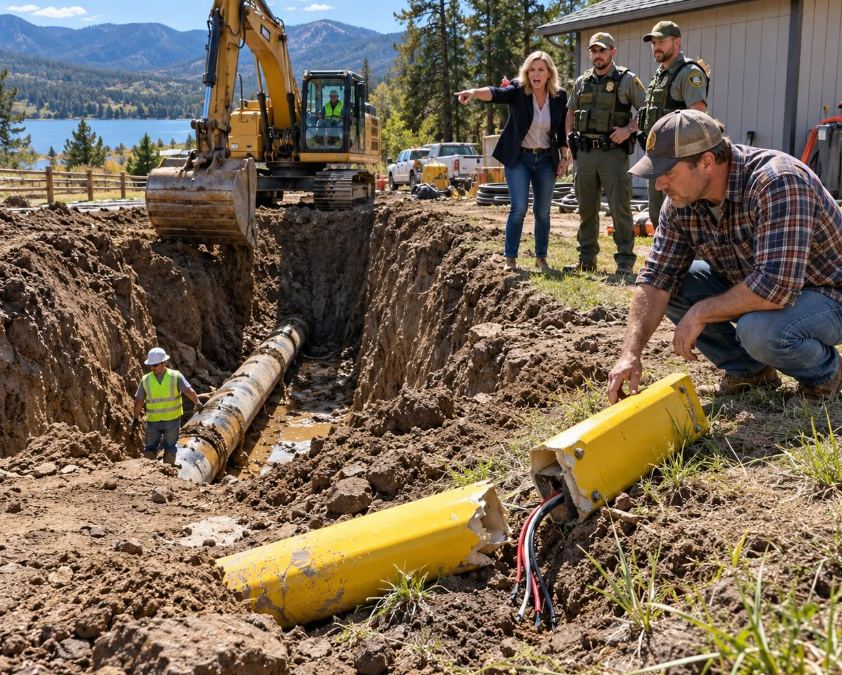
“Caleb,” she called. “You’re not authorized to be in our construction area.”
“I’m standing on my side.”
“You crossed behind the maintenance shed.”
“To pick up a pipeline test station someone cut down.”
The nearest workers turned.
The excavator still idled below us, diesel rumbling against the limestone walls.
Laura’s smile tightened.
“That post marked the abandoned line.”
I raised it higher.
“No.”
“Our utility consultant identified the abandoned line west of the clubhouse.”
“That isn’t what I said.”
“Then what are you saying?”
“I’m saying abandoned surface markers don’t have connected test wires.”
For several seconds, nobody moved.
The excavator’s diesel engine filled the silence.
A crow called from the oak trees behind my barn.
Wind pushed the smell of wet clay, diesel, and cut stone across the fence.
Laura looked from the post to the excavation.
“That was outside the dig area.”
“It was beside your revised stakes.”
“The revised stakes are accurate.”
“According to who?”
Her chin lifted. “A licensed surveyor.”
“Funny. Mine says your pool shifted twenty-eight feet onto my ranch.”
“That matter is being handled through counsel.”
“No,” I said. “Your trespass is being handled through counsel. Your crew digging near an active gas line is being handled right now.”
Behind her, a man climbed out of the excavation.
Darren Holt.
He was the general contractor’s field superintendent, mid-fifties, sunburned neck, dusty boots, and the wary eyes of a man who had spent enough years on job sites to know bad news usually arrives carrying evidence. I had spoken with him twice before. Both times, he had been polite, careful, and uninterested in Laura’s theatrics.
He walked toward the fence.
“Can I see that?”
PART3:
Laura stepped forward. “Darren, this is unnecessary.”
He held out his hand anyway.
I passed the post through the fence.
Darren turned it over. His thumb touched the clipped leads.
His face changed.
“Nobody told me these were connected.”
Laura’s voice sharpened immediately.
“Your utility clearance is in the site trailer.”
He looked at her. “The package says obsolete marker.”
“It is obsolete.”
“Who confirmed that?”
“The project consultant.”
Darren looked back at the dangling wires.
Then toward the excavator sitting eleven feet below grade.
“Who cut it down?”
Laura’s mouth tightened. “Maintenance removed visual clutter from the staging area before the pool work began.”
“Maintenance cut a pipeline test station?”
“It was a post.”
“It had test leads.”
“It was abandoned.”
“You keep saying that.”
“Because it’s true.”
Darren stared at her for one long second.
Then he turned toward the excavation and raised one hand.
The excavator operator killed the engine.
The sudden silence hit the job site like somebody had pulled a plug.
Every man there felt it.
People who have worked around excavation know there is a sound to ordinary risk. Machinery. Backup alarms. shouted measurements. Diesel. Rebar. The rhythm of work.
But when that rhythm dies all at once, the air changes.
Laura turned on Darren.
“What are you doing?”
“Stopping excavation until I understand that post.”
“We have concrete scheduled Wednesday and the shell crew Friday.”
“I also have connected wires on something we were told was abandoned.”
“That post was outside your work area.”
“It was beside the revised stakes.”
Her eyes flicked toward me.
“This is exactly what he wants.”
Darren frowned. “What who wants?”
Laura pointed through the fence like I was a trespassing animal.
“He has been trying to interfere with this pool since the vote passed. He opposed the easement adjustment, he objected to our temporary construction access, and now he conveniently discovers a piece of old utility junk days before concrete.”
I laughed once, because the alternative was saying something that would help her.
“Laura, I’ve worked pipeline integrity longer than you’ve been weaponizing Robert’s Rules of Order.”
Her cheeks flushed.
Darren looked at me. “You’re saying this line may be active?”
“I’m saying connected test leads mean nobody touches that hole until the operator verifies status and location.”
“Do you know the operator?”
“I have a pretty good idea.”
Laura folded her arms.
“The operator already cleared our project.”
“Show me the ticket.”
“It’s in the trailer.”
“Then get it.”
Her eyes narrowed.
“You don’t get to order people around on our property.”
“Your property?” I looked at the pit, then the stakes, then the post. “You shifted the pool onto my ranch, cut down a pipeline test station, and dug eleven feet into limestone before verifying the line. You’re lucky I’m ordering instead of evacuating.”
Darren’s face darkened.
“Evacuating?”
I looked him straight in the eye.
“If that’s the old Gulf South lateral and it’s still live, you could be within the tolerance zone or already inside it. Depends where your surveyor moved the stakes and whether your locates were based on bad plans.”
One of the rebar workers muttered something under his breath and stepped away from the excavation rim.
Laura heard it.
“Everyone stay where you are,” she snapped. “No one is in danger.”
That was the moment I knew she was dangerous.
Not because she wanted a pool. People want amenities. They want pretty places for their kids to swim, summer cookouts, shaded cabanas, the feeling that their dues bought something visible.
No.
Laura was dangerous because she needed to be right more than she needed people to be safe.
I pulled out my phone.
“What are you doing?” she demanded.
“Calling 811.”
“We already called.”
“I’m calling again.”
“This is harassment.”
“It’s prevention.”
She stepped closer to the fence.
“Caleb, listen to me carefully. If you interfere with our contractors, Sterling Oaks will pursue damages. We have delays already costing thousands per day.”
“Then add a phone call to your budget.”
Darren said, “I want the locator back out here.”
Laura turned on him. “You work for us.”
“I work for Harlan Construction.”
“And Harlan works for us.”
“And if I dig into a gas transmission line, none of that matters.”
Her jaw clenched.
I made the call.
The woman at 811 took the information and gave me a ticket number. When I said there was a severed test station and active excavation within a disputed easement, her tone changed. She told me to stop all digging immediately and contact the pipeline operator if known. I told her I would.
Then I called a number I had not called in four years.
Ridgeway Gas Transmission.
Regional control center.
A man answered, bored at first.
“Ridgeway control.”
“This is Caleb Rowe, retired field inspector, employee number 44718. I’m standing beside a severed test station near a pool excavation at Sterling Oaks off County Road 9. I believe it may be on the old Bay 12 lateral. There are clipped test leads and ongoing excavation within possible proximity.”
The boredom vanished.
“Say location again.”
I gave coordinates.
I heard typing.
Then quiet.
“Mr. Rowe, confirm excavation has stopped.”
“For now.”
“For now?”
“The HOA president is pushing the contractor to continue.”
“Do not allow them to continue.”
“I’m trying.”
“Are you in a safe location?”
I looked at the open pit, the workers, Laura’s furious face, the clubhouse, the houses beyond it where families were probably making lunch and not imagining the ground could burn.
“No,” I said. “Not if that line is where I think it is.”
The control operator put me on hold for less than thirty seconds.
When he came back, his voice had changed again.
“Field response is being dispatched. Estimated arrival forty minutes. We are notifying county fire and emergency management.”
Laura heard enough to understand.
She took two steps back, pulled out her own phone, and began calling someone with the clipped, furious tone of a woman who expected the world to fix itself before witnesses gathered.
It did not.
Within twenty minutes, two Sterling Oaks board members arrived in golf carts.
One was Martin Pike, the treasurer, a retired banker who always wore pastel shirts and looked worried about grass height. The other was Jill Sorrento, secretary, a former school principal with sharp eyes and a softer conscience than Laura liked. Both stared at the yellow post in Darren’s hands as though it were a snake.
Then the homeowners started coming.
They drifted toward the clubhouse in sandals, tennis skirts, polos, and confusion. Some had children with them. A few carried pool renderings from the newsletter. One man asked loudly why the excavator had stopped when “we were finally ahead of schedule.”
Laura moved among them, smiling too hard.
“Just a precaution,” she said. “A neighbor raised a concern. We’re resolving it.”
A neighbor.
Not a landowner.
Not a retired pipeline inspector.
Not the man holding the warning she had tried to hide.
Just a neighbor.
I stood by my fence and watched her spin danger into inconvenience.
That was Laura’s gift.
She could make truth sound rude.
My daughter Emily arrived before the Ridgeway trucks.
She came in her white county EMS SUV, hair pulled into a braid, uniform still on from a twelve-hour shift. Emily was twenty-eight, stubborn as a cedar root, and the only person I knew who could make fear look like anger in less than a second.
She parked by my gate, crossed the pasture fast, and stopped when she saw the post.
“Oh, Dad,” she said.
“I know.”
“Is it live?”
“Don’t know yet.”
Her eyes moved to the pool pit.
“That’s deep.”
“Eleven feet.”
“Jesus.”
Laura spotted her uniform and marched over.
“Are you here officially?”
Emily looked at her. “I’m here because my father called me.”
“Then you have no authority on this site.”
Emily stared at her.
“I have enough authority to tell people not to stand near a possible gas line excavation.”
Laura’s nostrils flared.
“This is not a possible gas line excavation. This is a pool project.”
Emily pointed at the post.
“That says gas pipeline.”
“It’s abandoned.”
“Then why are you sweating?”
Jill Sorrento made a sound that might have been a cough or might have been the beginning of a laugh.
Laura’s head snapped toward her.
Nobody laughed after that.
The first Ridgeway truck arrived at 2:17 p.m.
I remember the exact time because I looked at my watch like men do when they want facts to hold them upright.
The truck was white with amber lights and Ridgeway’s blue logo on the door. Two technicians got out wearing flame-resistant clothing, hard hats, and the serious expressions of people trained not to panic near things that can level a block.
One of them was a woman named Tessa Malloy.
I had trained her fifteen years earlier when she was fresh out of a technical program and thought pipeline maps were cleaner than reality. Now she wore a supervisor badge and looked like the kind of person reality had taught well.
She saw me and stopped.
“Caleb Rowe.”
“Tessa.”
“I heard you retired.”
“I tried.”
Her eyes went to the severed post.
“Please tell me that isn’t what I think it is.”
“I would if I could.”
She took it from Darren and looked at the clipped leads.
Her jaw tightened.
“Who cut this?”
Laura stepped forward smoothly.
“I’m Laura Baines, president of Sterling Oaks HOA. We were informed this marked an abandoned line and was outside the approved work zone.”
Tessa did not shake her hand.
“Who cut this?”
Laura blinked.
“I believe maintenance removed it during site preparation.”
“On whose instruction?”
Laura’s smile thinned.
“That detail would be in our project records.”
Tessa looked at her for a long moment, then turned to her technician.
“Get the locator. Pull current maps. I want cathodic readings at the nearest accessible station and a hand-dig verification plan before anyone breathes near that pit.”
The technician moved fast.
Laura said, “Excuse me, but we already have utility clearance.”
Tessa looked at the excavation.
“Not from what I’m seeing.”
“Our consultant—”
“Your consultant does not operate our pipeline.”
“We were told the Bay lateral was abandoned.”
Tessa’s face changed at the name.
“So you knew there was a Bay lateral.”
Laura realized she had stepped wrong.
“It appears in old records.”
“It appears in current records.”
A sound passed through the crowd.
Not loud.
Just enough.
Martin Pike stepped forward, pale now.
“Current?”
Tessa looked toward him. “Who are you?”
“HOA treasurer.”
“Then you may want to call your attorney.”
Laura snapped, “Martin, don’t engage.”
But Martin was staring at the pit.
“Laura, you told us the gas line was inactive.”
“It is.”
Tessa said, “It transports gas seasonally during peak demand and remains pressurized.”
The crowd changed all at once.
Mothers pulled children back from the construction fence. A man who had been filming lowered his phone. Darren Holt closed his eyes for half a second, the way a man does when he realizes how close he came to carrying guilt forever.
I looked at Laura.
Her face had gone still.
Not shocked.
Calculating.
That scared me more than shock would have.
Tessa’s crew began working.
They set up a perimeter. County fire arrived. Then emergency management. Then the sheriff’s department, mostly to keep residents back and stop Laura from trying to control the scene through sheer social force.
A locator swept the ground.
The first pass was inconclusive because of interference from rebar, equipment, and the severed test connection. The second pass, tied into another station west of my pasture, painted a yellow line that curved closer to the excavation than anyone wanted to see.
Darren stood beside me, arms folded, face hard.
“How close?” he asked.
“Too close to guess,” I said.
He nodded.
“I should’ve stopped when the stakes moved.”
I looked at him.
“You knew?”
“I knew something was off. Original drawing had the pool farther east. Revised layout put the deep end near the fence. Laura said the HOA acquired an easement adjustment from you.”
“She lied.”
His mouth tightened. “I asked for paperwork. Her consultant sent a letter.”
“From who?”
“Baines Land Advisory.”
I stared at him.
“Baines?”
“Her brother-in-law’s firm, I think.”
Of course.
Of course it would be that stupid and that arrogant.
The kind of lie that survives not because it is clever, but because everyone assumes no one would be bold enough to write it down under their own name.
Tessa returned from the locator work and looked directly at me.
“We need to pothole.”
“Hand dig?”
“Vac truck first, then hand expose. No mechanical excavation.”
I nodded.
Laura stepped in.
“No.”
Everyone turned.
Tessa’s eyebrows lifted.
“No?”
Laura gestured toward the pool pit.
“You are not digging up our construction site without board approval.”
The fire chief stared at her.
“Ma’am, we have a potential active gas transmission line conflict.”
“And I have fiduciary obligations to this community. This project is nearly two million dollars. We cannot allow every contractor and utility company to start tearing it apart because of one disputed marker.”
Tessa took one step closer.
“That marker belongs to a federally regulated pipeline operator.”
“It was on our property.”
“No,” I said. “It wasn’t.”
Laura turned, and the mask cracked.
“You need to stop saying that.”
“Why? Because your homeowners might ask why their pool is on my ranch?”
A wave of murmurs moved through the crowd.
Martin looked at Laura.
“What does he mean?”
Laura ignored him.
“This is a boundary dispute,” she said loudly. “Mr. Rowe has been trying to obstruct Sterling Oaks improvements for months because he resents the development. He refused to sell a useless strip of pasture and is now inventing safety concerns to extort the association.”
Emily stepped toward the fence.
“Careful.”
Laura smiled at her. “Like father, like daughter.”
I felt my daughter’s temper before I saw it.
“Emily,” I said quietly.
She stopped, breathing hard.
Laura looked pleased.
That was her method.
Push until someone reacted, then point to the reaction as proof.
I had dealt with people like her in incident investigations. Plant managers who blamed operators for alarms they ignored. Contractors who blamed laborers for drawings they changed. Executives who called explosions unforeseen after signing off on warnings in red ink.
I had learned one thing.
Do not give them heat.
Give them paper.
I reached into my truck and pulled out the folder I had started weeks earlier. Copies of my deed. The original pipeline easement. Survey overlays. Photos of the moved stakes. The cease-and-desist letter Vivian Grant, my attorney, had sent three days after Laura’s crew first crossed the fence line.
And one certified letter from Ridgeway Gas Transmission dated nine months earlier.
The letter was addressed to Sterling Oaks HOA.
Re: Bay 12 Lateral Easement and Proposed Recreational Improvements.
I held it up.
Laura’s face changed.
That change was small, but every person watching saw it.
Martin whispered, “Laura?”
I read aloud.
“Ridgeway Gas Transmission has reviewed preliminary documents concerning proposed recreational amenities near the Bay 12 Lateral. Please be advised that any construction, grading, excavation, fencing, paving, or permanent structures within the recorded pipeline easement or near associated corrosion-control test stations require written approval and field verification by Ridgeway prior to commencement. Surface markers and test posts may not be removed, relocated, damaged, obstructed, or altered by any party.”
The crowd went silent.
I lowered the letter.
“It was sent to your HOA office. Certified mail. Signed for by L. Baines.”
Laura’s mouth opened slightly.
Tessa turned toward her.
“You received that?”
Laura said nothing.
Darren looked like he wanted to throw his hard hat into the pit.
Martin took the letter from me with shaking hands.
“Laura?”
Her voice came out cold.
“I receive hundreds of documents.”
“You signed for this,” he said.
“I did not personally review every utility notice.”
“But you told us Ridgeway cleared the site.”
“They failed to respond to our final submission.”
Tessa said, “Because you never sent one.”
Laura’s eyes flashed.
“How would you know?”
“Because I checked the project file on the way here.”
That was when Jill Sorrento stepped forward.
Her voice was quiet.
“Laura, I asked about that yellow post in March.”
Laura turned slowly.
Jill looked terrified, but she continued.
“At the board meeting. I asked why it was inside the orange construction fencing. You said Ridgeway abandoned the line in 2008.”
“It was in the minutes,” Martin said.
“No,” Jill said. “It was discussed after executive session. Laura said there was no need to include it because it was utility clutter.”
Laura’s expression sharpened into something ugly.
“Jill, perhaps now is not the time to misremember.”
Jill flinched.
I saw it.
So did Emily.
So did Martin.
That flinch told me Laura had been using that tone in smaller rooms for years.
Tessa did not care about board politics.
She turned to the fire chief.
“We are exposing the line.”
The chief nodded. “Do it.”
Laura’s voice rose.
“You cannot authorize damage to HOA property.”
The sheriff, a man named Duke Hanley who had known me since I was nineteen, stepped between her and Tessa.
“Mrs. Baines, step back.”
“This is outrageous.”
“Step back.”
She looked at him like he had betrayed civilization.
Then she stepped back.
The vac truck arrived at 3:06.
By then, the job site had become a public reckoning.
Residents lined the safe perimeter. Construction workers stood in clusters, whispering. The pool pit sat silent, rebar half-tied, machinery frozen in place. The luxury clubhouse behind it looked ridiculous in the background, with its stone columns and gas lanterns and a banner that said STERLING OAKS SUMMER SPLASH OPENING SOON.
Tessa’s crew marked a pothole location near the edge of the excavation, close enough to make Darren swear under his breath.
The vacuum excavation began.
Soft at first. Controlled. Careful.
A high-pressure air lance broke up soil. The vacuum hose pulled it away. Layer by layer, the ground surrendered its secrets.
At four feet, they found tracer wire.
At six, coating fragments.
At seven and a half, steel.
The technician brushed away soil by hand.
Yellow coating appeared beneath clay.
A gas transmission pipeline.
Not abandoned.
Not west of the clubhouse.
Not irrelevant.
There.
Closer to the pool excavation than any honest contractor would have allowed without a full engineering review.
Tessa knelt, examined the exposure, and stood slowly.
Her face said enough.
Darren took off his hard hat and stared at the ground.
“How far from the pit?”
Tessa looked at the measurement.
“Eleven feet, four inches from the nearest excavation wall.”
Darren said a word I won’t repeat.
I turned toward Laura.
She had gone very pale.
Martin sat down on a stack of pavers like his legs had stopped trusting him.
Jill covered her mouth.
A woman in the crowd began crying. “My kids play at that clubhouse.”
Another homeowner said, “They had summer camp registration open.”
The fire chief ordered the area cleared beyond the original perimeter. Ridgeway began pressure checks. County emergency management requested site plans. Darren notified Harlan Construction’s safety director, who notified their insurance carrier, who probably notified God.
Laura tried to leave.
Emily saw her first.
“She’s going to the office.”
I turned.
Laura was walking fast toward the clubhouse, phone pressed to her ear.
Tessa called after her. “Mrs. Baines, do not remove any records from that office.”
Laura didn’t stop.
Sheriff Hanley looked at his deputy.
“Go with her.”
The deputy followed.
Laura stopped then, turned back, and said loudly, “Am I being detained?”
Hanley said, “No. But if project records connected to a safety investigation disappear, this day gets worse for you.”
Laura looked around at the watching homeowners.
For the first time since I had known her, she had no audience left to command.
She lowered the phone.
The first story hit the local news before dark.
CONSTRUCTION STOPPED AT STERLING OAKS AFTER ACTIVE GAS LINE FOUND NEAR POOL EXCAVATION.
By morning, the headline had sharpened.
HOA PRESIDENT KNEW OF PIPELINE WARNING BEFORE $1.9M POOL DIG, RECORDS SHOW.
That was when people started knocking on my door.
Not all at once.
At first, it was Jill.
She arrived the next morning carrying a manila folder and the exhausted face of someone who had slept very little and remembered too much.
I met her on the porch.
My ranch house sits on a rise above the west pasture, with three pecan trees out front and a wraparound porch my late wife, Caroline, loved more than any room inside. She used to sit there in summer with a glass of iced tea, watching storms roll over the county road, telling me the sky looked honest before rain. After she died, I stopped sitting there for almost a year.
Now Jill stood on those steps, holding a folder against her chest like a confession.
“I’m sorry,” she said.
That was all.
Two words.
But they sounded like they had cost her something.
I opened the screen door.
“Come in.”
She sat at my kitchen table. Emily poured coffee. Jill’s hands shook so badly she had to hold the mug with both hands.
“I should have pushed harder,” she said.
“For what?”
“The pipeline. The boundary. All of it.”
She opened the folder.
Inside were copies of emails.
Not board-wide emails.
Private ones.
Laura to Baines Land Advisory.
Laura to a pool design consultant.
Laura to a county permitting clerk.
Laura to Darren’s company.
Jill had printed them from her personal account because Laura sometimes copied the board, then followed up privately when she wanted the official version softened.
I read one dated February 14.
The Rowe fence remains visually and functionally incompatible with west amenity integration. Proceed using revised exhibit. Counsel believes adverse use argument can be developed if Rowe continues nonresponse.
I looked at Jill.
“I never received an offer.”
“I know.”
Another email.
Pipeline post complicates pool layout. Please confirm abandoned status or provide language sufficient for board reliance. Need to avoid triggering Ridgeway review, as timeline cannot absorb federal operator delay.
My jaw tightened.
Emily leaned over my shoulder and whispered, “Dad.”
I kept reading.
From Laura to her brother-in-law, Grant Baines.
Can we treat the yellow post as legacy marker if no active locate appears in current county GIS? Construction cannot move again. We already shifted shell west to preserve oak grove near clubhouse and keep cabana symmetry.
There it was.
The reason.
Not engineering.
Not safety.
Not legal boundary.
Symmetry.
They had shifted a $1.9 million pool toward my ranch, toward an active gas line, toward an easement they had been warned about, because Laura Baines did not want to cut down ornamental oaks near the clubhouse and ruin the view from the cabanas.
I read the sentence three times.
Each time, it got uglier.
Jill looked down.
“I asked her if moving west meant crossing your line. She said you had agreed informally.”
“I didn’t.”
“I know that now.”
“You knew it then.”
She flinched, but did not argue.
“Yes,” she whispered. “I think I did.”
Emily’s face softened slightly.
Jill wiped her eyes.
“Laura makes you feel stupid for asking questions. Like safety is negativity. Like caution is disloyalty. I kept telling myself if the consultants signed off, it wasn’t my place.”
I closed the folder.
“My wife used to say people like that don’t need everyone to lie. They just need good people to doubt themselves at the right moment.”
Jill looked at me.
“She sounds wise.”
“She was.”
“I’m sorry.”
This time, I knew she meant more than the pool.
I nodded.
Jill handed me a flash drive.
“Board packets. Draft minutes. Invoices. The maintenance work order for removing the post.”
I went still.
“You have that?”
She nodded.
“It says, ‘Remove obsolete yellow utility marker from west amenity staging area per L.B. prior to excavation.’”
Emily exhaled sharply.
“Who did it?”
“HOA maintenance supervisor. Mark Ellison.”
I knew Mark. Quiet man. Three kids. Always waved when he drove past my gate. Not a bad man, I thought. But bad orders do not require bad men. They only require obedience.
Jill stood.
“I’m going to the sheriff and Ridgeway too. I just wanted you to know first.”
I looked at the flash drive in my hand.
“You understand what this does?”
She nodded.
“It ends Laura.”
“No,” I said. “Laura ended Laura. This just stops everyone else from pretending.”
By noon, Ridgeway had opened a formal investigation.
By two, the county suspended all Sterling Oaks pool permits.
By five, Laura Baines issued a statement.
It was exactly the kind of statement people write when they are not sorry but have been told sounding sorry may help.
As HOA president, I have always prioritized resident safety and community value. The board relied in good faith on professional guidance regarding utility conditions and property boundaries. Certain individuals are now spreading incomplete information for personal motives. I welcome a full review and remain confident that Sterling Oaks acted appropriately.
Certain individuals.
That meant me.
Maybe Jill.
Maybe anyone who preferred not to explode beside a swimming pool.
The next day, Laura sent her attorney.
He arrived at my gate in a black SUV, wearing a gray suit too fine for gravel roads and shoes that had never stepped in manure. His name was Preston Vale. He introduced himself through the fence as counsel for Sterling Oaks HOA and Laura Baines individually.
“Mr. Rowe,” he said, “we’re hoping to avoid escalation.”
I rested one arm on the fence rail.
“You’re late.”
“We believe this can be resolved.”
“Can you uncut the test station?”
He smiled thinly.
“Emotions are high.”
“Mine aren’t.”
“That’s not how your public statements read.”
“I haven’t made any public statements.”
“Your daughter has.”
I looked at him.
Emily had posted one photo. The yellow post lying in two pieces. No caption except: This is why safety rules exist.
It had been shared thousands of times.
“Leave my daughter out of your mouth,” I said.
His smile disappeared.
“Mr. Rowe, Sterling Oaks is prepared to compensate you for temporary construction impacts and execute a formal amenity easement. In exchange, you would acknowledge the boundary uncertainty, withdraw objections to the pool project once Ridgeway issues conditions, and refrain from further defamatory claims.”
“How much?”
He looked relieved, which told me everything.
“Two hundred thousand dollars.”
I laughed.
His face tightened.
“You find that amusing?”
“I find it educational.”
“Mr. Rowe—”
“Your client shifted a pool onto my ranch, cut down a pipeline test station, ignored a certified operator warning, endangered construction workers and families, and now wants to buy my silence for less than the cost of her cabana furniture.”
“This is not about silence.”
“Then put in writing that Laura ordered removal of the post and construction trespassed onto Rowe Ranch.”
He closed his briefcase.
“I can see you’re not ready for a reasonable discussion.”
“No. I’m just not for sale at the clearance rack.”
He walked back to the SUV.
Before he got in, he turned.
“You should understand, Mr. Rowe, juries don’t always like difficult men.”
I smiled without warmth.
“Pipelines don’t either. Yet here we are.”
He left dust hanging over my driveway.
That night, someone threw a brick through my barn window.
Wrapped around it was a note.
STOP TRYING TO RUIN OUR HOMES.
Emily wanted to call the sheriff immediately.
I told her to wait while I picked up the glass.
She said, “Dad, don’t do that thing where you act calm because you’re furious.”
“I am calm.”
“You’re bleeding.”
I looked down. A shard had cut my palm.
She took my hand, her face changing from anger to fear so fast it made her look like a child again.
“Dad.”
“It’s nothing.”
“It’s not nothing.”
She wrapped my hand in a towel, then called Sheriff Hanley herself.
While we waited, I stood in the barn doorway staring toward Sterling Oaks’ clubhouse lights glowing beyond the pasture.
People think trespass is about land.
It is, legally.
But emotionally, trespass is about being told your boundaries don’t matter. Your fence doesn’t matter. Your warning signs don’t matter. Your past doesn’t matter. Your peace doesn’t matter. Your right to stand where your father stood and say no does not matter if someone with cleaner shoes wants what is behind you.
That was why my hand shook.
Not from the cut.
From the memory.
Thirty-one years earlier, my father had nearly died because a contractor ignored a pipeline warning.
I was seventeen then.
He had been working as a welder for Ridgeway, repairing a small station north of Bay Creek. A road crew hit a line that had been mismarked after a county grading project. It did not explode, thank God. But it vented hard enough to throw rock, dirt, and steel fragments across the work area. My father took shrapnel through his left shoulder and neck. He survived, but he never lifted that arm above chest height again.
I still remembered the hospital smell.
My mother sitting with both hands clenched around a foam coffee cup.
My father waking up and asking whether the crew was alive before asking what happened to him.
A pipeline warning is not decoration to me.
It is the line between ordinary afternoon and widows.
Laura Baines had cut one down for symmetry.
Sheriff Hanley arrived with two deputies and took the brick as evidence. He photographed the window, the note, my hand.
“You think Sterling Oaks residents?” he asked.
“I think fear with a mailing address.”
He sighed.
“Caleb.”
“I don’t know who threw it, Duke.”
“You got cameras?”
“One on the driveway. Not the barn.”
“Get one.”
“I will.”
He looked toward the clubhouse lights.
“County commissioners are getting pressure.”
“I bet.”
“Some homeowners say you’re holding their dues hostage. Some say the pool assessment is going to bankrupt them if this drags out.”
“I didn’t sell them a pool over a gas line.”
“I know.”
“Do you?”
His face hardened slightly.
“I’m here, aren’t I?”
I looked at him.
He was right.
Not enough, maybe. But right.
“Sorry.”
He nodded.
“Just don’t let them bait you.”
“That seems to be the theme of my life lately.”
He almost smiled.
The formal exposure happened six days later.
Ridgeway required a full utility conflict meeting at the Sterling Oaks clubhouse. Present were Ridgeway representatives, county permitting officials, emergency management, the fire chief, Sheriff Hanley, Harlan Construction, HOA board members, residents, attorneys, and me because the disputed encroachment crossed my property and the operator wanted the landowner present.
Laura tried to block me from entering.
At the clubhouse door, she stood in a navy dress, pearls, and a face arranged into professional sorrow.
“This is a members’ meeting,” she said.
Tessa Malloy walked past her and held the door open for me.
“He’s attending at Ridgeway’s request.”
Laura’s smile did not move.
“How generous.”
Inside, the room was packed.
Rows of folding chairs faced a projector screen. Homeowners whispered. Some glared at me. Others avoided looking at Laura. Darren sat in the back with Harlan’s safety director. Jill sat at the board table with three binders. Martin Pike looked as though he had aged ten years in a week.
Grant Baines, Laura’s brother-in-law and the so-called utility consultant, sat beside an attorney.
He was a soft-handed man with silver hair and an expensive watch. He did not look at the screen when Tessa loaded the first map.
He looked at me.
I looked back until he stopped.
Tessa began simply.
“The Bay 12 Lateral is an active regulated natural gas transmission pipeline. It remains under pressure and is part of Ridgeway Gas Transmission’s seasonal balancing system. Any construction in proximity to the pipeline or associated appurtenances requires operator review, field verification, and written approval.”
She clicked to the next slide.
A map appeared.
The pipeline easement crossed my ranch, clipped the edge of Sterling Oaks’ claimed amenity area, and curved beneath the west side of the pool project.
A red overlay showed the planned excavation.
The room went cold.
Someone whispered, “Oh my God.”
Tessa continued.
“The pipeline was identified in Ridgeway’s response letter dated November 3 of last year. That letter was delivered to Sterling Oaks HOA and signed for by Laura Baines.”
She clicked.
The certified receipt appeared.
Laura’s signature filled the screen.
People turned toward her.
She sat very still.
Tessa clicked again.
“On March 12, Ridgeway’s field technician noted restricted access to the west test station during routine inspection. Follow-up was scheduled. On April 4, the test station was found missing. Access was obstructed by temporary construction fencing. Ridgeway did not authorize removal.”
A man in the audience stood.
“You knew in March?”
Laura spoke before Tessa could.
“The board relied on professional assurances.”
Tessa looked at her.
“Please hold questions until the presentation is complete.”
It was beautiful, in a very specific way.
Laura Baines, who had interrupted half the county for years, being told to wait her turn by a pipeline supervisor with a laser pointer.
Tessa clicked again.
A photo appeared.
The yellow post, cut at the base.
Then another.
The exposed pipeline.
Then another.
The pool excavation wall.
Measurements.
Clearances.
Encroachment.
Missing approval.
Then came the maintenance work order.
Remove obsolete yellow utility marker from west amenity staging area per L.B. prior to excavation.
The room erupted.
Laura stood.
“That document is being mischaracterized.”
Jill stood too.
“No, it isn’t.”
Every head turned.
Jill’s face was pale, but her voice held.
“I provided that document. I also provided emails showing the post was discussed before removal.”
Laura’s eyes burned.
“Jill, sit down.”
“No.”
That one word changed the room.
It was small.
It was quiet.
It was the sound of a person stepping out from under another person’s shadow.
Jill opened her binder.
“At the February executive board session, I asked whether the pool relocation placed us near the pipeline easement. Laura said the line was abandoned and that Mr. Rowe was using old records to delay us. When I asked for confirmation from Ridgeway, she said direct operator involvement would create unnecessary delay and legal exposure.”
Laura’s attorney whispered urgently to her.
She ignored him.
“That is not accurate.”
Jill looked at Martin.
“Martin, you were there.”
Martin swallowed.
The room waited.
For years, Martin had been the kind of man who survived by not choosing sides until one was obvious. That day, perhaps for the first time, he chose while it still cost something.
“Yes,” he said. “I was there.”
Laura turned on him.
“You approved the budget.”
“I did not approve cutting down a pipeline post.”
“You approved the revised site plan.”
“Because you told us Caleb Rowe had agreed to a boundary accommodation.”
The room erupted again.
I felt every eye swing toward me.
I stood slowly.
“I did not agree to any boundary accommodation. I refused every request to move the pool, the deck, or staging area onto my ranch. My attorney sent Sterling Oaks a cease-and-desist on March 3.”
Tessa clicked to the next slide.
There it was.
The letter.
Vivian Grant’s signature at the bottom.
Delivered.
Signed for.
Again by L. Baines.
A woman in the front row began crying openly.
“My son had swim team sign-ups,” she said. “You told us everything was safe.”
Laura’s face tightened, but she did not answer her.
She looked at me instead.
“You’re enjoying this.”
The room went silent.
I stared at her.
“Enjoying what?”
“This.” She gestured around. “The humiliation. The attention. You’ve hated Sterling Oaks since the first house went up.”
I felt the old heat rise.
Emily sat two rows behind me. I could feel her watching.
Do not give them heat.
Give them paper.
“No, Laura,” I said. “I hated watching people pretend my ranch was empty because it wasn’t covered in stone veneer. I hated your board letters calling my fence an eyesore. I hated finding your landscapers dumping clippings in my creek. I hated being told your standards mattered more than my deed. But this?”
I pointed toward the screen.
“This is not about hate. This is about a live gas line under a pool pit where children were supposed to swim.”
Her mouth twisted.
“You always make yourself sound noble.”
“I’m not noble. I’m experienced. I know what happens when warnings become inconveniences.”
For the first time, her eyes flickered.
Maybe she remembered I had buried coworkers.
Maybe she didn’t care.
Tessa resumed.
“Ridgeway’s preliminary determination is that the pool excavation, as currently located, cannot proceed. The test station must be replaced. The line must be fully assessed for coating damage, stress exposure, and third-party excavation impact. Any future design must avoid the easement and receive written operator approval.”
A homeowner shouted, “Who pays for that?”
Silence.
Then another voice.
“We do, don’t we?”
Martin lowered his head.
Laura stood again.
“Sterling Oaks will explore all legal remedies against responsible parties.”
I almost admired the audacity.
“Responsible parties?” Darren said from the back.
He stood, holding his hard hat.
“Harlan Construction relied on site documents provided by the HOA and its consultant. We requested utility confirmation twice. We were told the pipeline conflict was cleared. If Mr. Rowe had not found that post, my operator would have kept digging.”
His voice broke slightly on the last sentence.
Not with fear.
With fury.
“My men were in that hole.”
No one spoke.
Darren looked at Laura.
“My men.”
That finally pierced the performance.
Not enough to make her sorry.
Enough to make the room see she wasn’t.
By the end of the meeting, Laura Baines had lost the board.
By the next morning, she had resigned as HOA president.
By the end of the week, she had hired a criminal defense attorney.
But consequences do not arrive all at once.
They come like weather.
One front after another.
First, Ridgeway issued a violation notice and referred the matter to federal pipeline safety regulators.
Then the county opened an investigation into the pool permit, the boundary exhibit, and whether Sterling Oaks had submitted false or incomplete utility information.
Then Harlan Construction filed a claim against the HOA for misrepresentation and suspended all work.
Then my attorney filed suit for trespass, property damage, nuisance, attempted slander of title, and negligence connected to the pool shift.
Then the homeowners sued Laura, Grant Baines, Baines Land Advisory, and the HOA’s management company.
That was when Sterling Oaks turned on itself.
The same manicured streets that once hosted wine walks and holiday golf-cart parades became places where neighbors avoided eye contact. Yard signs appeared.
RECALL THE BOARD.
WHERE DID OUR MONEY GO?
SAFETY BEFORE AMENITIES.
Then someone put one at the edge of my pasture facing their clubhouse.
ROWE WAS RIGHT.
I didn’t remove it.
But I didn’t enjoy it either.
Being right after danger is not the same as winning.
Winning would have been never finding that post because nobody cut it down.
Winning would have been Laura listening the first time Ridgeway warned her.
Winning would have been Darren’s excavator never entering that hole.
Winning would have been children complaining that the pool opened late because adults chose caution without needing public shame.
What we got instead was damage control.
Necessary, but uglier.
In August, federal investigators came.
Not dramatic men in sunglasses.
Engineers.
Safety specialists.
People with tablets, cameras, measuring wheels, and the calm patience of professionals who know negligence rarely looks cinematic up close. It looks like dates, signatures, budget pressure, vague wording, missing attachments, and one person saying, “I thought someone else handled that.”
They interviewed me for three hours at my kitchen table.
The lead investigator was named Renee Carver. She had silver-streaked hair, kind eyes, and a way of asking questions that made evasions feel embarrassing before they were spoken.
“When did you first become aware of the test station?” she asked.
“When I bought the ranch from my parents officially in 2011, though I knew about it before. My father worked around the Bay 12 lateral when I was younger.”
“When did you first observe Sterling Oaks activity near it?”
“Survey stakes in February. Construction fencing in March. Staging in April. Excavation in June.”
“Did you notify anyone?”
“Yes.”
I handed over copies.
Letters to the HOA.
Emails to the county.
Photos of the stakes.
Vivian’s cease-and-desist.
Renee studied them.
“You were ignored.”
“Yes.”
“How did that make you feel?”
I almost said angry.
That would have been true, but not enough.
“It made me feel like my land had become invisible,” I said.
She looked up.
“Invisible?”
“They saw pasture and thought unused. They saw a fence and thought obstacle. They saw a yellow warning post and thought clutter. Once people decide something doesn’t matter, they stop seeing the danger attached to it.”
Renee wrote that down.
After the investigators left, I sat on the porch until dark.
Emily brought out two beers and sat beside me.
“You okay?” she asked.
“No.”
She nodded and handed me one.
We watched lightning bugs blink over the pasture.
After a while, she said, “Mom would’ve been furious.”
I smiled faintly.
“Your mother would’ve taken cookies to the homeowners and then verbally skinned Laura alive at the board meeting.”
Emily laughed.
Then she grew quiet.
“I miss her more when things happen.”
“Me too.”
“She would’ve known what to say.”
“No.” I looked toward the fence. “She would’ve known when to stop talking.”
Emily leaned her head against my shoulder.
“You did good, Dad.”
I took a long breath.
“I almost didn’t.”
“What do you mean?”
“When I first saw the stakes, I thought about letting Vivian handle it slowly. I thought maybe I was being stubborn. Maybe the pool was just close, not over. Maybe the pipeline records were old enough to be wrong.”
“But you checked.”
“Because of the post.”
“No,” she said. “Because of you.”
I looked at her.
She had Caroline’s eyes.
That made some moments harder and some possible.
The civil deposition of Laura Baines happened in September.
Vivian let me attend but warned me not to react.
“You will hear lies,” she said in the hallway outside the conference room. “Do not feed them.”
“I’m not a raccoon.”
“You’re worse. You’re a righteous rancher with blood pressure.”
Laura arrived in a cream suit, pearls, and the same controlled expression she wore at board meetings. Preston Vale sat beside her. Grant Baines sat separately with his own attorney, which told us cooperation had begun cracking the family veneer.
Vivian started with simple questions.
Name.
Role.
Dates.
Board authority.
Project timeline.
Then came the certified letter.
“Mrs. Baines, is this your signature acknowledging receipt of Ridgeway’s November 3 letter?”
“It appears to be.”
“Did you read the letter?”
“I don’t recall.”
“Did you provide it to the full board?”
“I believe utility concerns were summarized.”
“By you?”
“Possibly.”
Vivian slid an email forward.
“On November 7, you wrote to Grant Baines, ‘Ridgeway is going to make this impossible if we invite them in. Need a clean abandoned-line position before board review.’ Did I read that correctly?”
Laura’s attorney objected.
Vivian waited.
Laura’s face did not move.
“That email lacks context.”
“What context changes the meaning?”
“The HOA was under significant pressure to manage costs.”
“From whom?”
“Residents.”
“Residents pressured you to remove a pipeline test station?”
“No.”
“Residents pressured you to build a pool?”
“They voted for the amenity plan.”
“Did they vote to move the pool west onto Mr. Rowe’s property?”
“No.”
“Did they vote to avoid Ridgeway review?”
“No.”
“Did they vote to cut down a test station?”
“No.”
Laura’s lips pressed together.
Vivian placed another document on the table.
“March 21 maintenance work order. ‘Remove obsolete yellow utility marker from west amenity staging area per L.B.’ Are you L.B.?”
Laura glanced at her attorney.
“Yes.”
“Did you instruct Mark Ellison to remove that post?”
“I instructed maintenance to clear obsolete debris.”
“Did you tell him it was a pipeline test station?”
“I did not know it was a test station.”
Vivian placed a photo beside the order.
A close-up of the post before removal, taken by a Sterling Oaks landscape contractor by accident. The words GAS PIPELINE were fully visible. So were the wires leading to the base.
Laura looked at it.
For the first time, her composure cracked.
Vivian’s voice stayed soft.
“Mrs. Baines, what did you think the wires were for?”
No answer.
“Holiday lights?”
Preston Vale said, “Counsel.”
Vivian did not look at him.
“What did you think the wires were for?”
Laura’s voice came out thin.
“I thought it was old.”
“Old is not abandoned.”
“I relied on Grant.”
Grant Baines’ attorney shifted.
Across the table, Grant turned red.
Vivian let the silence sit.
Then she asked, “Did Caleb Rowe ever grant Sterling Oaks permission to build on his ranch?”
“No.”
“Did you tell board members he had agreed informally?”
“I said discussions were ongoing.”
“Were they?”
“He was unreasonable.”
“That wasn’t my question.”
Laura’s eyes lifted to mine.
There it was again.
The fury.
Not shame.
Fury that I had not stayed in the role she assigned me.
Difficult neighbor.
Unsophisticated rancher.
Obstacle.
Man who could be pressured into silence because Sterling Oaks had gates and lawyers and a neighborhood full of people who wanted their pool.
Vivian repeated, “Were discussions ongoing?”
Laura looked away.
“No.”
The deposition lasted seven hours.
By the end, Laura had admitted she received Ridgeway’s warning, did not provide it fully to the board, approved removal of the post as “obsolete,” and represented to contractors that the boundary issue with me was resolved when it was not.
She never admitted she did wrong.
That kind of person rarely does.
She admitted facts and treated remorse like a technicality her attorney had not approved.
Two weeks later, Mark Ellison came to my barn.
He arrived in his old pickup at dusk, wearing his Sterling Oaks maintenance shirt, though I heard he had been suspended. He stood near the gate for a full minute before stepping out.
Boone barked once, then decided Mark was too sad to be dangerous.
I met him by the fence.
“Mr. Rowe,” he said.
“Mark.”
He held his cap in both hands.
“I cut the post.”
“I know.”
His face crumpled slightly.
“She told me it was dead. Said the consultant cleared it. Said it had to be gone before the concrete layout.”
I didn’t speak.
He swallowed.
“I should’ve asked. I saw the wires. I thought about calling somebody. But Laura—”
He stopped.
“But Laura what?”
“She said if I couldn’t handle basic site cleanup, she’d recommend terminating the maintenance contract. My wife was pregnant then. We needed the insurance.”
I looked past him toward the pasture.
The sky had gone purple over the oaks.
“I understand fear,” I said.
He looked relieved too soon.
“I don’t understand cutting a warning off at the base and hiding it behind a shed.”
His eyes dropped.
“I panicked after. I knew it looked bad. I tossed it there thinking I’d come back.”
“But you didn’t.”
“No.”
“Why are you here?”
He wiped his face with one hand.
“Because my son was born last week.”
That hit me in a place I did not expect.
“Congratulations.”
“Thank you.” His voice broke. “I held him and kept thinking, what if somebody had kept digging? What if that line ruptured? What if kids were at the clubhouse? What if my boy grows up because someone else stopped what I helped start?”
I looked at him for a long time.
“Did you tell investigators?”
“Yes.”
“All of it?”
“Yes.”
“Then that’s what you can do.”
“I’m sorry.”
“I believe you.”
He looked up, eyes wet.
“But sorry doesn’t uncut the post,” I said.
“No, sir.”
“It doesn’t unscare those workers.”
“No.”
“It doesn’t erase what could have happened.”
“I know.”
I opened the gate.
“Come on.”
He blinked.
“What?”
“I need help replacing three boards on the hay shed. You want to stand there drowning in guilt, or you want to do something useful?”
He stared at me like I had handed him a life raft.
Then he nodded.
We worked until dark.
Forgiveness did not arrive that night.
But usefulness did.
Sometimes that is where forgiveness starts.
The criminal charges came in October.
Laura Baines was charged at the county level with reckless endangerment, falsifying documents submitted in connection with permitting, and criminal trespass related to the encroachment. Grant Baines faced charges tied to false professional statements. Mark cooperated and received a lesser charge with probation recommended. The federal pipeline safety case became civil penalties against the HOA, management company, and consulting firm, with Ridgeway pursuing separate costs.
The news vans came back.
This time, they parked outside Sterling Oaks.
Reporters showed Laura walking from her home to a waiting SUV, face shielded, pearls gone, attorney beside her. She looked smaller without the room arranged around her.
Some people cheered online.
I didn’t.
I had seen enough industrial accidents to know that near misses are ghosts. They haunt everyone differently. Laura deserved consequences. But the story did not become cleaner because she fell.
Sterling Oaks still had families who had paid assessments into a pool that would never be built where promised. Workers still woke up at night imagining what might have happened. Mark still carried the knowledge that fear made him cut something he knew he shouldn’t. Jill still replayed every meeting where she chose silence. Martin still had to stand in front of homeowners and explain how money disappeared into a hole that could have killed them.
And me?
I still found myself walking to the fence at odd hours, staring toward the capped excavation.
The pool pit filled with rainwater after the stop-work order. Mosquitoes gathered. Orange safety fencing sagged. Rebar rusted in the weather. The Sterling Oaks Summer Splash banner came down after someone spray-painted WHERE’S THE PIPELINE? across it.
In November, the court issued a temporary order confirming no construction could continue on the disputed strip and requiring the HOA to restore my property line, remove encroachments, and cooperate with Ridgeway’s replacement of the test station.
The day the new yellow post went in, I stood beside Tessa Malloy and watched the crew install it properly.
Steel post.
Fresh paint.
Protected base.
Locked test leads.
Clear signage.
Documented coordinates.
Photographed from every angle.
Tessa handed me the final verification sheet.
“Looks better than the old one,” she said.
“The old one did its job.”
She looked at me.
“Because you found it.”
“No. Because whoever installed it forty years ago painted it yellow and trusted someone would understand.”
Tessa smiled faintly.
“That sounds like something you’d say in training.”
“I was unbearable in training.”
“You were thorough.”
“Same thing.”
She laughed.
Across the fence, a small group of Sterling Oaks residents watched quietly.
Among them was a boy, maybe ten, wearing a baseball cap backward. He pointed to the post and asked his mother something. She looked embarrassed, then waved him toward me.
The boy approached the fence cautiously.
“Sir?”
“Yes?”
“What does that thing do?”
His mother flushed. “Noah, don’t bother Mr. Rowe.”
“He’s fine,” I said.
Noah pointed. “Is it like a danger sign?”
“It’s more than a sign. It lets pipeline workers test whether the pipe underground is protected from corrosion.”
“What’s corrosion?”
“Rust, mostly. Metal breaking down.”
“So the wires help them know if it’s rusting?”
“Exactly.”
He looked impressed.
“Could the pool have exploded?”
His mother closed her eyes.
I answered carefully.
“Gas lines are designed with a lot of safety protections. But digging near one without permission can be very dangerous. That’s why we stop and check.”
He nodded with the seriousness of a child given adult truth in manageable form.
“Ms. Baines said you just didn’t like pools.”
His mother’s face went pale.
I smiled sadly.
“I like pools just fine.”
“Then why didn’t she listen?”
The question was so simple that all the adults fell silent.
I looked at the new yellow post.
“Because she thought being in charge meant she didn’t have to be careful.”
Noah considered that.
“That’s dumb.”
His mother whispered, “Noah.”
But Tessa laughed.
“Yes,” she said. “It is.”
The civil case settled in February.
Sterling Oaks’ insurer, after months of denying everything with impressive vocabulary, agreed to fund property restoration, Ridgeway’s operator costs, legal fees, and a settlement for damage to my ranch. The HOA had to record an acknowledgment of the correct boundary and pipeline easement. The pool project was permanently abandoned in its shifted location.
Laura’s house went up for sale.
Not immediately. Pride held her there longer than comfort did. For weeks, she drove through Sterling Oaks without looking at anyone. The board removed her photo from the clubhouse wall. The neighborhood newsletter, once filled with her president’s messages about standards and unity, became a plain PDF with budget tables and apology language.
The day the For Sale sign appeared, Emily sent me a photo with no text.
I stared at it for a long time.
Caroline would have told me not to gloat.
So I didn’t.
But I did sit on the porch that evening with a glass of iced tea and watch the sunset hit the pasture exactly the way it had before Sterling Oaks existed.
That felt close enough.
Laura pleaded no contest in the spring to reduced charges. She avoided prison but received probation, heavy fines, community service, and a permanent prohibition from serving on any HOA board or development committee connected to permitting or construction oversight. Grant Baines lost his consulting license and paid more in penalties than his firm was worth. Mark kept his job only after Ridgeway and the new board required safety training for every maintenance employee and contractor. Jill became interim HOA president by unanimous vote, mostly because nobody else wanted the job and everyone trusted her shame to keep her honest.
The first thing she did was cancel the pool.
The second thing she did was invite me to speak at a Sterling Oaks safety meeting.
I told her no.
Then Emily told me I was being stubborn.
I told her stubbornness had saved the neighborhood.
She said, “No, facts saved the neighborhood. Stubbornness just drove them there.”
Caroline would have loved that.
So I went.
The clubhouse was full, but different this time. No luxury renderings. No glossy boards. No champagne table. Just folding chairs, bottled water, and a projector showing a slide that said UTILITY SAFETY AND PROPERTY BOUNDARIES.
I stood at the front beside Tessa.
Jill introduced me simply.
“This is Caleb Rowe. We should have listened to him sooner.”
That was enough.
I looked at the residents.
Some had once glared at me from across my fence. Some had posted things online they later deleted. Some had apologized. Some had not.
I did not need all of them to like me.
I needed them to understand.
“I’m not here to shame anybody,” I said. “Most of you bought homes. You paid dues. You trusted the people elected to handle details. That doesn’t make you guilty.”
A few faces softened.
“But trust is not a substitute for verification. Especially around land, utilities, and construction. A fence line matters. An easement matters. A warning post matters. A signature matters. A question in a meeting matters.”
I saw Martin look down.
I continued.
“For twenty-six years, I inspected pipelines. I learned that disasters almost never begin with one big villain pressing one big red button. They begin with small dismissals. That marker is probably old. That neighbor is just difficult. That line is probably abandoned. That form is probably enough. That schedule is too tight to pause. That warning can wait until Monday.”
The room was still.
“Then one day, someone is standing over a hole wondering how all those probablys became an emergency.”
Tessa nodded beside me.
I looked toward the windows, where the pasture and new yellow post were visible beyond the fence.
“That post out there is ugly to some people. It interrupts the view. It reminds you there are things underground you don’t control. But maybe that’s exactly why we need it. Not everything that protects us is pretty. Some of the most important things are inconvenient, bright yellow, and easy to dismiss until they save your life.”
No one clapped right away.
I liked that.
Applause can be too easy.
Silence meant they were thinking.
Then Noah, the boy with the backward cap, started clapping.
The adults followed.
After the meeting, Rebecca Lang from the earlier land dispute story would have been a neat name, but this was Sterling Oaks, and the woman who approached me was named Melissa Crane. She had two children, a tired face, and tears in her eyes.
“My husband was one of the people who said awful things about you online,” she said.
“I know.”
She winced.
“He wanted to come tonight, but he was embarrassed.”
“That’s between him and his conscience.”
She nodded.
“My kids were signed up for swim lessons. I was furious when the project stopped. I thought you were taking something from them.”
“I understand.”
“No,” she said. “I don’t think you do. I didn’t care where the pool was. I didn’t care about your fence. I just wanted what I was promised. That scares me now.”
That was honest.
Hard honest.
The kind that matters.
“I’ve wanted things that made me blind too,” I said.
She looked surprised.
I smiled faintly.
“I’m not above anybody.”
She wiped her eyes.
“Thank you for not letting us keep being blind.”
I did not know what to say to that, so I nodded.
That summer, Sterling Oaks turned the failed pool site into something else.
Not immediately. First came engineering studies, soil repair, removal of the encroaching work, restoration of my ranch strip, and months of arguing over money. But eventually, with Ridgeway’s oversight and the correct boundary respected, the HOA built a small safety garden on their side of the clubhouse.
No pool.
No cabanas.
No luxury splash opening.
Just native grass, benches, a low educational sign about calling before digging, and a view of the ranch fence they were no longer allowed to call incompatible.
Jill asked permission to name it the Caroline Rowe Safety Garden.
I almost said no.
Caroline had nothing to do with their mess.
But then I thought about her on the porch, talking about honest skies. I thought about how she believed people could learn if shame did not swallow them first. I thought about the cookies she would have baked for scared homeowners before destroying Laura with one polite sentence.
So I said yes.
On the dedication day, Emily cried before anyone spoke.
She stood beside me in a blue dress, arms folded, pretending allergies had attacked her.
“You okay?” I whispered.
“No.”
“Me neither.”
Jill spoke first.
Then Tessa.
Then Emily surprised me by stepping up.
“My mother believed safety was another kind of love,” she said, voice trembling. “Not the dramatic kind. The boring kind. Seat belts. Flashlights. Smoke detector batteries. Asking if someone got home. Reading the warning label. Making the call that ruins everyone’s schedule but lets everyone sit at dinner later.”
She looked at the new yellow post beyond the fence.
“My dad has spent his whole life being that kind of annoying. I’m grateful for it.”
People laughed softly.
I did too, though my throat hurt.
Emily continued.
“Sterling Oaks and Rowe Ranch share more than a boundary. They share risk. They share weather. They share roads, drainage, emergency responders, and the consequences of pretending one side can ignore the other. I hope this garden reminds people that community doesn’t begin at a gate. It begins where responsibility crosses a fence.”
That was my daughter.
Caroline’s heart.
My stubbornness.
Her own fire.
Afterward, Noah showed me a school project he had made about pipeline safety. He had drawn the yellow post like a superhero, complete with cape.
“It’s called Captain Corrosion,” he said.
“That’s terrible,” I said.
He grinned. “I know.”
I put a copy on my fridge.
The ranch changed after that.
Not much, visibly.
Cattle still grazed the west pasture. The creek still rose after heavy rain. Boone still barked at delivery drivers and slept like the dead through thunderstorms. The fence line stood repaired, straighter than before. The pipeline post stood beyond it, new and bright, a little too clean for the landscape but honest.
But something in me changed.
For months, I had thought the fight was about keeping Sterling Oaks out.
Out of my land.
Out of my fence.
Out of my past.
But the longer it went on, the more I understood the harder work was not keeping people out. It was deciding what truth required once they were already tied to you.
Laura Baines had treated the ranch as an obstacle. I could have treated every Sterling Oaks resident the same way after that. As one big enemy behind one ugly gate.
Some days, I wanted to.
Then a boy asked what a test station did.
A scared mother admitted she had been blind.
A maintenance man brought his guilt to my barn and learned how to replace boards.
A board secretary found her voice.
A contractor shut down an excavator because connected wires mattered more than a concrete schedule.
People are not as simple as the worst person leading them.
That does not erase consequences.
Laura still earned hers.
But if all I took from the fight was hatred, then she would have shifted more than a pool. She would have shifted my heart onto her ground.
I refused to give her that too.
A year after I found the severed post, Ridgeway invited me to their annual safety training as a speaker.
I almost declined.
Retirement had been good to me when people weren’t trying to dig into pipelines beside my fence. But Tessa asked, and Tessa had earned the right to ask.
So I stood in front of a room full of young pipeline technicians, contractors, county inspectors, and utility locators, holding the same yellow post that had started everything.
Ridgeway had released it back as evidence after the case closed.
It sat on the table in front of me, scarred, cut, wires dangling, ugly as sin and twice as important.
I told them the story.
Not the polished media version.
The real one.
The expensive pool. The shifted stakes. Laura’s scarlet jacket. Darren’s face when he saw the wires. Jill’s fear. Mark’s mistake. Emily’s anger. The homeowners’ panic. The way a hole in the ground can become a moral test for everyone standing around it.
Then I lifted the severed post.
“This did not save anyone by itself,” I said.
The room was quiet.
“A warning only works if somebody is willing to be inconvenienced by it. A sign only matters if someone cares enough to stop. A locate ticket only matters if the information is true. A safety culture only exists when the lowest-paid person on site can point at something wrong and not lose their job for saying so.”
I looked at the young faces.
“Most disasters are built out of permission. Permission to hurry. Permission to assume. Permission to stay quiet. Permission to let someone powerful redefine a warning as clutter.”
I set the post down.
“So don’t give that permission.”
Afterward, a young woman came up and said her father had died in a trench collapse when she was twelve. She wanted to work in safety because everyone told her it was an accident, but she had grown up suspecting accidents often had authors.
I told her she was right.
Then I sat in my truck for ten minutes before driving home.
Some truths cost more to say than others.
That evening, I walked the fence line as the sun dropped behind Sterling Oaks.
The clubhouse lights came on. Children rode bikes along the street. Someone grilled burgers. Life had returned, imperfect and loud and ordinary.
On my side, the cattle moved slowly through gold grass.
I stopped at the yellow post.
The new one stood upright, clean, and visible.
A few feet away, in my barn, I kept the old severed one mounted on the wall above my workbench. Not as a trophy. Not exactly.
As a reminder.
There are people who will cut down a warning and call it progress.
There are people who will move a boundary and call it adjustment.
There are people who will endanger workers and children and call it value.
And there are moments when you find the severed post behind the shed, feel the whole world telling you not to make trouble, and have to decide whether peace is worth the lie.
I have learned that peace built on silence is not peace.
It is a countdown.
My ranch is quiet again now.
Sterling Oaks has new board members, new rules, and no pool. At least not yet. If they build one someday, it will be on land they own, away from the easement, with Ridgeway approval, proper locates, and probably more paperwork than anyone wants. Good.
Paperwork is cheaper than funerals.
Laura Baines moved two counties away.
I hear she tells people she was targeted by rural hostility and political jealousy. Maybe she believes it. Some people would rather be wronged in their own story than guilty in the real one.
That is no longer my problem.
My problem is cattle, fences, weather, a roof that needs replacing before winter, and a daughter who still checks whether I ate dinner if she doesn’t hear from me by eight.
My problem is keeping the land honest.
And every now and then, when I pass that bright yellow post, I touch it with two fingers.
Not because I worship warnings.
Because I respect what they ask of us.
Stop.
Look.
Verify.
Listen to the person holding the ugly truth before the concrete arrives.
That day, Laura Baines told me the active gas line was nowhere near her pool.
Then I held up the severed post, and the excavator went silent.
People remember the silence.
I do too.
But what I remember most is what came after it.
The sound of truth being dug up carefully, by hand, one layer at a time.
The sound of a room full of homeowners realizing safety had almost been traded for symmetry.
The sound of my daughter saying responsibility crosses a fence.
The sound of a warning, finally heard.
Because the most dangerous thing under Sterling Oaks was not the gas line.
It was the arrogance that thought cutting down a yellow post could make the truth disappear.