The HOA Karen Bulldozed a Road Through My Bull Pasture—Then Her Convoy Crossed the Wrong Fence
PART2:
They responded to grain buckets, voice commands, sorting sticks, gates, and familiar people. I could walk near Jasper with a feed sack and scratch the base of his neck without trouble. Grant could move Murphy between paddocks with a bucket and a calm voice. Ben had worked Claymore since he was a calf.
But calm does not mean harmless.
A bull does not need anger to hurt somebody.
Weight and instinct are enough.
That was why our fences were maintained religiously.
Monthly inspections.
Storm checks.
Gate latches.
Tension wire.
Corner posts.
Water lines.
If a tree fell on wire, we repaired it. If a cedar post softened, we replaced it. If cattle rubbed a section loose, we corrected it before it became a problem.
The rules were simple.
Respect the animals.
Respect the fence.
Respect the land.
For most of my life, everyone around us understood.
Then Summerhill Crossings appeared.
At first, it was nothing more than cleared hills beyond our south ridge. Developers came in with survey crews, road graders, utility trucks, and promises printed on banners tied to temporary chain-link fences. Then came foundations. Then houses. Rows of Craftsman-style homes with matching roof angles and coordinated siding.
Tan.
Cream.
Gray.
The colors of expensive oatmeal.
They built a man-made lake, a clubhouse, walking paths, decorative signs, and imported palms that looked deeply confused by our winters.
Then came Summerhill Crossings Homeowners Association.
I paid almost no attention.
Why would I?
My deed predated the subdivision by roughly seventy years. The Hayes property was outside it. Not one acre belonged to the HOA. Not one covenant crossed our boundary. Their road stopped near our south fence. Our dirt service track continued toward Hilltop Drive on the opposite side of the farm, but there was no public through-route across the ranch.
Our land formed the barrier.
That had never been a problem.
Until Karen Delaney was elected president.
The first time I noticed her, she was driving slowly along the south fence in a white luxury SUV.
Nice vehicle.
Pearl finish.
Clean enough that I could see sky in the door panels.
She wore oversized sunglasses, had perfectly highlighted hair, and carried a clipboard on the passenger seat like she had been born to inspect the world.
I was on the tractor.
She waved.
I waved back.
Neighborly.
Two days later, she did it again.
This time she stopped.
Rolled down the passenger window.
“Mr. Hayes?”
I killed the tractor and walked toward the fence.
“Yes, ma’am?”
“I’m Karen Delaney.”
I knew the name vaguely.
“Summerhill Crossings HOA president,” she added.
“Congratulations.”
She smiled.
“We’re doing some community planning.”
“Good for you.”
Her eyes moved across my pasture.
“Have you ever considered collaborative use of underutilized green space?”
I looked behind me.
Jasper was grazing about sixty yards away. Murphy stood near the water trough. Claymore was under an oak, flicking his tail at flies.
I looked back at her.
“Ma’am, that’s not underutilized green space.”
She laughed.
Light.
Polished.
As if I had made a joke.
I had not.
“That is where my bulls eat, sleep, breed, and occasionally settle arguments.”
Her smile stayed.
“I mean from an infrastructure perspective.”
“My bulls are very invested in the current infrastructure.”
She looked toward the road.
“What we’re exploring is a community connector.”
“A what?”
“A connector road.”
Now I understood.
Summerhill Crossings had one primary road in and one secondary route that looped awkwardly around the ridge. Hilltop Drive lay on the other side of my land. A road across my southeast pasture would shorten travel dramatically.
Emergency access.
Traffic flow.
Property values.
Convenience.
All the phrases people use when the thing they want belongs to somebody else.
Karen pulled a rendering from her folder.
Glossy.
Full color.
A curving road passed through what the graphic represented as open green landscape.
That green landscape was my pasture.
“They put my land on your brochure?”
“It’s conceptual.”
“That’s my pasture.”
“We’re evaluating potential shared easements.”
“Shared with who?”
“The surrounding community.”
“An easement isn’t shared because you want it.”
Her smile tightened slightly.
“This could benefit everyone.”
“It does not benefit me.”
“Improved emergency response.”
“I already have emergency access.”
“Connectivity.”
“Don’t need it.”
“Higher surrounding values.”
“Doesn’t matter.”
She lowered the rendering.
“What would matter?”
“A signed easement.”
Her eyes brightened.
“Exactly.”
“With fair compensation.”
“Of course.”
“And my enthusiastic consent.”
She paused.
“That’s something we can discuss.”
“No.”
Her smile froze.
“What?”
“I’m not giving it.”
“You haven’t seen a compensation offer.”
“Don’t need to.”
“Mr. Hayes—”
“Malcolm.”
“Malcolm, it’s a road.”
“Through a bull pasture.”
“We could fence both sides.”
“No.”
“Move grazing.”
“No.”
“Reconfigure—”
“No.”
She breathed out slowly.
The word had finally annoyed her.
“We’ll circle back.”
“There’s nothing to circle back to.”
“I think once you see the broader plan—”
“I saw the important part.”
I pointed to the line cutting across my pasture.
“That doesn’t happen.”
She slid the rendering back into the folder.
“Communities change.”
“Land ownership doesn’t change because communities do.”
Her smile returned.
Thin.
“I’m sure we’ll find a neighborly solution.”
She drove away.
I thought the conversation was over.
That was my first mistake.
A week later, Grant sent me a screenshot from Summerhill’s private Facebook group.
VEHICULAR ACCESS IMPROVEMENT INITIATIVE.
Agenda items included Emergency Connectivity, Shared Easement Possibilities, Long-Range Road Integration, and Potential Agricultural Corridor.
I stared at the last phrase.
Agricultural corridor.
That meant us.
Ben found the orange flags two days later.
He rode into the barn holding one between two fingers like it smelled bad.
“Dad.”
I looked up from a hydraulic fitting.
“What?”
He held out the flag.
“Found twenty of these.”
“Where?”
“South pasture.”
I put the wrench down.
We took the four-wheeler.
Orange survey stakes ran from the southern fence toward Hilltop Drive. Straight across our best grazing section. One every fifty feet. Driven in properly. Not random kids. No county marks. No utility logos. No survey company tags.
Just flags.
I walked the line.
Jasper followed at a distance, head low, curious but calm.
The proposed road passed near the shade trees where the bulls bedded down in summer. It crossed a water-line trench. Cut through a section my father had improved decades earlier. Divided the pasture in a way that would make our rotation less efficient, our fence work harder, and our livestock management more dangerous.
Ben watched me.
“What do you want to do?”
I pulled the nearest flag.
Then the next.
Then the next.
We removed every one.
Bundled them.
The next morning, I drove them to the Summerhill clubhouse, placed them neatly on the porch, and left a note.
PRIVATE PROPERTY.
NO TRESPASSING.
NO SURVEY AUTHORIZED.
No profanity.
No threat.
No drama.
Just facts.
For three days, nothing happened.
Then tire ruts appeared beside the fence.
I followed them.
Heavy vehicle. Probably a contractor truck.
The tracks stopped at our locked corner gate.
Someone had placed a sign against the post.
PRELIMINARY WORK ZONE.
PERMITTED ENTRY ONLY.
I stared at it.
Then laughed once.
No humor in it.
I picked it up and put it in my truck.
That evening, I drove to the Summerhill clubhouse.
Their monthly social was underway.
Wine.
Cheese trays.
Soft music.
People in golf shirts.
Karen saw me and came forward with that same polished smile.
“Malcolm. What a lovely surprise.”
“I doubt that.”
“What can I help with?”
I handed her the contractor sign.
She glanced at it.
“Where did you get this?”
“My gate.”
“Oh.”
“Oh?”
“That must be part of the preliminary alignment study.”
“Who authorized it?”
“The regional development process allows data collection.”
“Not on private property without consent.”
“We’re not constructing anything.”
“You’re marking my land.”
“Only preliminary.”
“You’re driving contractor vehicles along my fence.”
“That may have been a consultant.”
“You put a work-zone sign on my gate.”
She lowered her voice.
“Malcolm, I think you’re reacting emotionally.”
That phrase always means the speaker hopes emotion can be blamed for their own bad behavior.
“I’m reacting legally.”
Her face tightened.
“There is a regional recommendation for connective infrastructure.”
“Show me a recorded easement.”
“This isn’t that stage.”
“Show me county authorization to enter my land.”
“It’s data collection.”
“Show me permission.”
Silence.
I leaned closer.
“Tell your people to stay out.”
“We’re neighbors.”
“That’s why I’m saying it politely.”
She gave me a patient smile.
“Threats aren’t helpful.”
“I didn’t threaten you.”
“Stay out sounds aggressive.”
“Then hear it as clear.”
I turned to leave.
Before stepping out, I looked back.
“If I see another survey flag, another contractor sign, or another vehicle on my land, this stops being a discussion.”
Karen crossed her arms.
“You’re standing in the way of progress.”
“Progress can take another road.”
That night, I checked the south fence.
Fresh scrape marks appeared on one corner brace.
Metal against wood.
Bucket edge maybe.
Equipment.
Something had already touched it.
The bulls were uneasy.
Jasper paced the fence. Not running. Walking. Head high. Nostrils working.
Cattle notice changes.
Smell of diesel.
Strangers.
Flags.
Engines.
Boomer, our old cattle dog, stood beside me. He was gray around the muzzle and opinionated about almost everything. He stared toward Summerhill and let out a low growl.
I put a hand on his head.
“No one is paving your pasture.”
He looked at me like he expected me to prove it.
Two mornings later, pink flags appeared.
Straighter.
More official looking.
Metal whiskers.
Same route.
Karen’s SUV sat near the locked gate, hazards flashing. She wore a reflective vest over a blouse and had a clipboard pressed against her hip.
I walked over.
“You’re marking my land again.”
She looked almost cheerful.
“We’re verifying a revised alignment using township data.”
“No.”
“Malcolm—”
“No discussion.”
“There are ongoing conversations about unincorporated parcels.”
“Not with me.”
“We’re preparing options.”
“My land isn’t your option.”
“Our goal is inclusion, not confrontation.”
Boomer growled from behind me.
Karen looked toward the pasture.
Jasper had lifted his head. Even from a distance, a mature Charolais bull looks impressive. Nearly two thousand pounds of white muscle tends to focus attention.
I opened the gate, stepped through, and closed and locked it again between us.
“Take your flags.”
“Those belong to the survey team.”
“Then tell them.”
“Formal cooperative-planning notice will be coming.”
“Good.”
“Good?”
“I’ll give it to my attorney.”
That irritated her.
“You don’t need a lawyer.”
“You keep putting markers on my land.”
“We’re planning.”
“You’re trespassing.”
“Words like trespassing escalate things.”
“No,” I said. “Trespassing describes things.”
She looked toward Jasper again.
I followed her eyes.
“Those bulls are why fences matter.”
“Are you threatening me with livestock?”
“No.”
“I heard what you said.”
“I am informing you there are active livestock inside a private pasture you keep sending people toward.”
Her face sharpened.
“Summerhill will not be intimidated.”
“Good. Stay on your side and you won’t need to be.”
She climbed into the SUV and drove away.
She left every pink flag.
That night, Ben and I pulled them.
I stacked them in a pyramid outside the clubhouse.
On top, another note.
FINAL WARNING.
PRIVATE AGRICULTURAL PROPERTY.
I should have called the sheriff immediately.
I know that now.
At the time, I still hoped common sense would eventually arrive.
It did not.
Two days later, I was in town buying feed when Ben called.
His voice was tight.
“Dad.”
“What?”
“They’re here.”
“Who?”
“Contractors.”
“Where?”
“South fence.”
“What are they doing?”
“Cutting it.”
I was already moving toward the truck.
“What equipment?”
“Skid steer. Flatbed. Post digger.”
“Record everything.”
“I am.”
“I’m coming.”
I made the drive faster than I like admitting.
Dust hung above the pasture before I reached the gate.
One worker held bolt cutters around the bottom strand of barbed wire. Another stood beside a post-hole auger. A skid steer idled nearby. Ben stood several yards away filming.
“Turn it off!” I shouted.
The operator killed the skid steer.
I approached the man with the bolt cutters.
“Who told you to cut my fence?”
He looked confused.
“The client.”
“Name.”
“Summerhill HOA.”
“Did they show you an easement?”
“They said the landowner agreed.”
“I’m the landowner.”
His expression changed.
“Sir, we were told—”
“I don’t blame you for what you were told. But you are now told directly by the owner. No permission.”
The second man raised both hands.
“We can pack up.”
“Please do.”
That was when Karen’s SUV arrived.
Of course.
She stepped out in a navy blazer and heels, carrying a folder.
“Malcolm.”
“Karen.”
“Perfect timing.”
“No.”
“We’ve had a scheduling misunderstanding.”
“You’re cutting my fence.”
“We’re doing preliminary access preparation.”
“On my pasture.”
“A limited strip.”
“Without easement.”
“We filed a zoning variance.”
“That doesn’t convey ownership.”
“There’s also a notice of intent.”
“Intent isn’t permission.”
“The county long-range plan—”
“Doesn’t convey ownership.”
Her jaw tightened.
“Everything cannot stop because one adjacent landowner refuses modernization.”
“It absolutely can stop on the land that landowner owns.”
From the ridge came a deep bellow.
Jasper.
Karen looked.
Murphy and Claymore moved near him. All three faced us.
The workers noticed.
One started putting tools away faster.
Karen asked, “Are those animals secured?”
I stared at the cut fence.
“They were until your contractor started removing the wire.”
That landed.
She looked toward the workers.
“Gentlemen, wrap for today.”
I nodded.
“Best thing you’ve said.”
She glared.
“This isn’t over.”
“It should be.”
“We will find a legal path.”
“Then use it.”
Her SUV left last.
We spent the evening repairing the breach. Grant joined after work. We welded steel panels into place, ran new tension wire, added temporary bracing, and set hay bales as a visual barrier.
Finished around midnight.
Not pretty.
But enough until we could set permanent posts.
Grant wiped sweat from his face.
“You think she’s done?”
“No.”
Ben looked toward the subdivision.
“Why?”
“Because she keeps treating setbacks like delays.”
I stared at the patched fence.
“Not answers.”
The following morning, I installed a heavier chain on the corner gate. Fresh lock. Signs every twenty feet.
PRIVATE PROPERTY.
ACTIVE LIVESTOCK.
NO TRESPASSING.
VIOLATORS WILL BE PROSECUTED.
Large letters.
Impossible to miss.
Then Karen brought a bulldozer.
That was the moment everything stopped being neighborhood nonsense.
Grant called early.
“They’re digging.”
I drove down with Boomer beside me.
Diesel engines filled the valley.
A full-size dozer sat twenty yards inside my pasture.
Blade down.
Topsoil rolled ahead of it.
A track loader waited behind. Surveyors measured. Karen stood near the new cut in a red blazer with takeaway coffee and project-manager posture.
I slammed the truck door.
“Shut it down!”
The operator looked toward Karen.
She raised one hand.
Told him to continue.
The blade dropped.
I walked straight to the machine, climbed halfway onto the track, and pounded the cab.
“You’re on private property!”
The operator looked uncertain.
I pointed toward the fence.
“I am the owner. No easement. No permission. If you move another foot after hearing that, your company gets named personally.”
He shut the engine off.
Silence came fast.
Karen marched over.
“This is getting dramatic.”
“You have a bulldozer in my pasture.”
“We’re initiating preliminary grading.”
“Based on what?”
“Development variance.”
“Show me.”
“Retroactive permit documentation is common in phased projects.”
I stared at her.
“Retroactive?”
“Yes.”
“So you destroy first and ask later?”
“That’s not what I said.”
“You cut thirty feet of fence yesterday.”
“It was temporary.”
“You entered with machinery.”
“We have a project schedule.”
“Not my problem.”
“You’re holding up emergency connectivity.”
“There is no emergency.”
“You don’t know that.”
“I called the county this morning.”
Her expression flickered.
“They have no road permit across my property. No easement. No condemnation action. No court order. No permission.”
For once, she had nothing immediate to say.
Then she looked toward the bulldozer operator.
“Malcolm, it is a strip of grass.”
That sentence stayed with me.
A strip of grass.
Our best grazing area.
Hay my cattle ate.
Soil my father improved.
Ground my grandfather protected.
A strip of grass.
From the ridge, Jasper bellowed.
It rolled across the valley.
Karen looked up.
The bulls had moved to higher ground. Heads raised. Machines had disturbed them. Claymore pawed once. Not charging. Agitated.
I pointed.
“They notice.”
Karen swallowed.
“The animals should be removed during construction.”
“There is no construction.”
I turned to the crew.
“Pack up.”
They did.
Nobody wanted to argue.
The dozer reversed. The loader followed. Surveyors gathered equipment.
Karen remained.
“County wants growth.”
“County can grow elsewhere.”
“The community wants connectivity.”
“Community doesn’t own this pasture.”
“You’re standing in the way.”
“Yes.”
That surprised her.
I continued.
“I am standing in the way because the way crosses my property.”
She opened her mouth.
Closed it.
Then walked to the SUV and drove away.
The damage remained.
Twenty-foot graded scar.
Topsoil removed.
Ruts through feeding ground.
Fence flattened.
Grant and Ben arrived.
We worked all day.
Temporary barriers.
Steel panels.
Hay.
Wire.
The bulls stayed on the far ridge, watching.
That night I sat on the porch with Boomer’s head on my knee.
I should have called Sheriff Davis immediately.
I didn’t.
Military habits.
Observe.
Document.
Understand the operation before reacting.
But there are moments when gathering more intelligence becomes another way of postponing action.
The next morning, our temporary barrier was broken.
Steel panels shifted.
Wire snapped.
Hay scattered.
Hoof prints everywhere.
Jasper and the others had tested it during the night.
Not because they wanted freedom.
Because they were disturbed.
Diesel smell.
Fresh earth.
Changed fence.
Cattle are creatures of routine.
We had allowed strangers to destroy routine.
The bulls stood on the near ridge.
Not escaped.
Just closer.
Watching toward Summerhill.
I was inspecting the breach when Boomer barked sharply.
Dust on the service track.
Vehicles.
Several.
Music.
I picked up binoculars.
My stomach dropped.
Four HOA vehicles had entered through the damaged section.
Sedans.
SUVs.
Karen’s white SUV in front.
One vehicle carried a sign through the back window.
FUTURE SITE OF COMMUNITY CONNECTOR.
They were touring my pasture.
Celebrating.
I called Grant.
“South field.”
Then Ben.
“Now.”
I got in the truck and laid on the horn.
Too late.
Jasper moved.
Not instantly.
At first, he walked.
Head high.
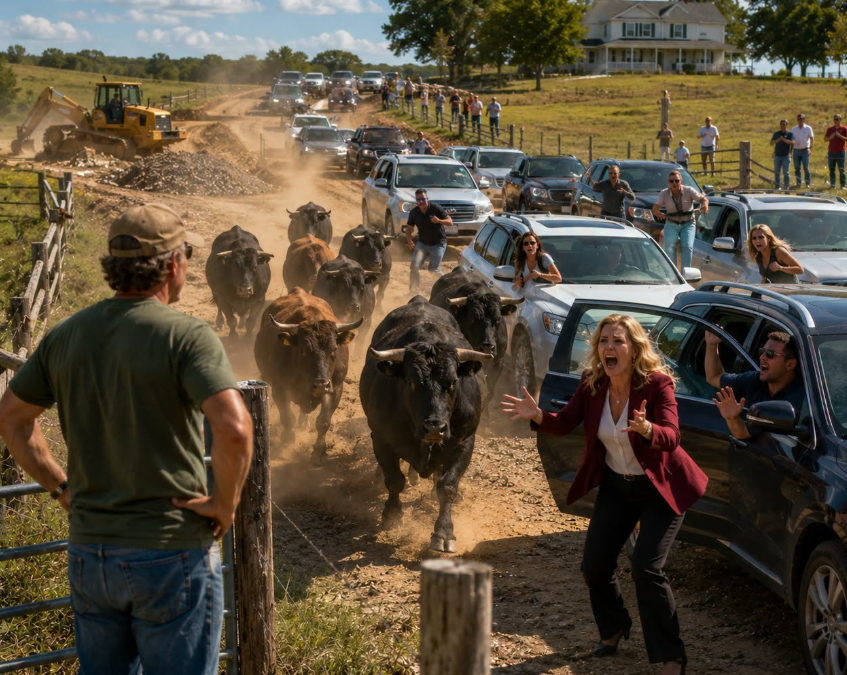
Then one vehicle accelerated, music loud, a door opened, people shouted, and Murphy began moving too.
Claymore followed.
Cattle respond to pressure, motion, unfamiliar objects.
Everything Karen had brought into that pasture was wrong.
The silver sedan tried to turn.
Jasper charged toward it.
I shouted from the truck.
“Jasper! Stand!”
He was already committed.
His shoulder struck the sedan’s side.
Metal crumpled.
The car rocked hard.
The driver scrambled out the opposite side.
No one was seriously injured.
Thank God.
Karen screamed.
Not her usual controlled voice.
Raw fear.
She ran toward her SUV.
Murphy moved toward the hood and blocked her path.
I jumped from the truck.
“Back! Move slow!”
People panicked.
That was dangerous.
Running triggers movement. Cars spinning tires make everything worse. A frightened human and a frightened bull are two bad ideas trying to occupy the same pasture.
Grant and Ben arrived in the side-by-side.
Grain buckets rattling.
Sorting sticks.
Familiar signals.
Ben shook the bucket hard.
“Come on!”
Jasper paused.
Breathing hard.
I approached sideways, careful not to get between horns and escape path.
“Easy, Jasper.”
Claymore hooked a bumper as one car tried to reverse. Plastic tore loose. The driver abandoned it.
I hated every second.
Not because the vehicles mattered.
Because frightened people and frightened livestock are an ugly combination.
I raised both arms.
“Stop running!”
One woman froze.
I pointed toward the fence.
“Walk. Stay together.”
Grant opened a portable panel route. Ben kept rattling grain. The familiar sound began winning over agitation.
Jasper turned first.
Followed the bucket.
Claymore hesitated.
Then moved.
Murphy backed away from Karen’s SUV.
The three bulls climbed toward the ridge.
The convoy fled.
Two damaged vehicles remained.
Karen got into her SUV and left. Her rear tires threw dirt.
No goodbye.
No final threat.
Dust.
Then silence.
Grant came beside me.
“You okay?”
“Yes.”
Ben looked at the damaged sedan.
“That could’ve been worse.”
Much worse.
That thought stayed in my head all day.
By noon, Summerhill’s private social media page was exploding.
Grant showed me screenshots.
DANGEROUS BULLS ATTACK PEACEFUL HOA VISITORS.
FARMER ALLOWS AGGRESSIVE LIVESTOCK TO ROAM.
PUBLIC SAFETY EMERGENCY.
Karen posted a photo of her torn sleeve and scraped elbow. Claimed she had survived an “unprovoked livestock assault.”
I read it.
Then put down the phone.
“You going to respond?” Ben asked.
“No.”
“She’s lying.”
“Yes.”
“So?”
“We have video.”
That was my response.
Ben’s phone footage showed the vehicles entering.
Trail cameras showed the fence breach.
Earlier photographs showed bulldozer damage.
My written notices existed.
Contractor statements existed.
No need for a social media argument.
I called Marcus Langford.
Marcus had served with me overseas. After retiring, he became a county agricultural-inspection supervisor.
He answered, “Malcolm.”
“Need a favor.”
“I heard something about bulls and SUVs.”
“That was fast.”
“Small county.”
I explained.
He stayed quiet.
Then said, “You still claiming I owe you for Kandahar?”
“I was hoping.”
He laughed.
“I’ll bring the county drone tomorrow.”
Marcus arrived in an official truck. We flew an aerial survey. Four-K footage. Exact tire routes. Bulldozer scar. Broken fence. Vehicle tracks. Pasture compaction. Before-and-after imagery from county GIS records.
He shook his head.
“This isn’t complicated.”
“Karen thinks it is.”
“It isn’t.”
He pointed to the screen.
“Your fence was intact.”
Next image.
“Contractors destroy it.”
Next.
“Vehicles cross.”
Next.
“Bulls remain inside agricultural property.”
He leaned back.
“She’s claiming livestock at large?”
“Yes.”
“Where?”
“In the pasture.”
Marcus laughed.
“That isn’t at large.”
Animal control came anyway.
I welcomed them.
They checked records.
Containment.
Veterinary records.
Fence condition.
Handling.
One officer stood near Jasper.
“He always this calm?”
“Usually.”
“Registered?”
I handed him paperwork.
“Vaccinations?”
More papers.
“Any prior aggression incidents?”
“No.”
“Escape incidents?”
“No.”
He looked toward the damaged fence.
“The problem seems obvious.”
“Yes.”
Their report reflected it.
The bulls were contained livestock on private agricultural land. Fence damage had been caused by outside activity. No basis to seize or euthanize.
Karen’s demand for removal died there.
Then her attorney sent a cease-and-desist.
Daniel Price.
He accused me of weaponizing dangerous animals. Demanded immediate removal of all bulls. Claimed emotional distress and vehicle damage.
Marcus read the municipal nuisance statute they cited.
Then laughed.
“Doesn’t apply.”
“Why?”
“Your ranch is rural agricultural.”
“Grandfathered?”
“Since dinosaurs.”
Good.
We filed formal complaints.
Criminal trespass.
Property destruction.
Agricultural interference.
Livestock endangerment.
Then I filed for a temporary restraining order.
Attorney Helen Granger handled it. Helen had known my late wife in college and had the useful personality of someone who treated nonsense like mold, something to be removed before it spread.
She reviewed everything.
“Why didn’t you call me when they put the first flags down?”
“Thought I could handle it.”
She stared.
“Army men are exhausting.”
“Retired Army.”
“Worse.”
We assembled everything.
Deed.
Survey.
Livestock records.
Fence photographs.
Contractor statements.
Bulldozer footage.
Ben’s phone recording.
Trail-camera images.
Marcus’s affidavit.
County drone data.
Karen’s emails.
The judge signed the restraining order three days later.
Summerhill Crossings HOA.
Karen Delaney.
Their agents.
Their contractors.
No entry onto Hayes property.
No survey.
No road work.
No vehicle access.
No exceptions without written permission or lawful emergency.
Karen was personally served.
I watched the process server hand it to her outside the clubhouse.
She read the first page and looked across the ridge toward my farm.
I was not close enough to see her expression.
Didn’t need to.
Grant brought beers to the porch that evening.
“Think this ends it?”
I took one.
“No.”
Ben looked at me.
“You’re really sure.”
“Yes.”
“Why?”
“Because somebody who respects a court order doesn’t need one to understand a fence.”
For several days, quiet.
No vehicles.
No flags.
No survey crews.
The bulls settled.
Jasper returned to his shade tree.
Murphy chased crows.
Claymore watched the ridge.
Then Ben noticed a banner near the clubhouse.
COMMUNITY CONNECTOR PREVIEW DAY.
FOOD • FAMILY • FUTURE.
Below that:
SCENIC ACCESS VIA HAZEL LANE.
Hazel Lane was the old name for our service track.
Our track.
Inside our property.
The preview was scheduled for Saturday.
After the restraining order.
I stared at the banner through binoculars.
“Surely not.”
Grant said, “She wouldn’t.”
I looked at him.
“You met her?”
He sighed.
The event started that afternoon.
Families gathered at the clubhouse.
Children.
Parents.
Lemonade.
Cookies.
Balloons.
That made me angry in a new way.
Karen was willing to bring families near an active livestock pasture during a dispute she had already watched become dangerous.
I called Sheriff Davis.
Told him about the event.
He sent deputies to the area. Not onto my land. Nearby.
We locked the main gate. Checked fencing. Moved the bulls deeper into the field. But one damaged southern access section was still awaiting permanent concrete posts. We had blocked it. Signed it. Marked it. Enough that nobody could claim confusion.
At five o’clock, four vehicles left the clubhouse.
Two Subarus.
A passenger van.
Karen’s SUV.
They approached the south pasture.
The first Subaru slowed at the signs.
Stopped.
I stood near the fence and raised both arms.
“Turn around!”
The driver looked toward Karen.
Karen waved them forward.
My stomach dropped.
The Subaru crossed.
Then the second.
The van.
Karen last.
They moved onto the ranch.
Past the NO TRESPASSING signs.
Past the temporary restraining order notice mounted near the gate.
Past the place where the earlier damage had happened.
Deliberately.
I called 911.
Again.
Then shouted, “You are violating a court order!”
The first driver stopped.
Karen drove around him.
Deeper.
She parked near the bulldozer trench, got out, lifted her phone, and began live-streaming.
“Welcome, neighbors, to the future of Summerhill Crossings.”
I could hear her from across the pasture.
“This beautiful open space—”
Murphy lifted his head.
Engines.
Music.
Movement.
Foreign people.
Same area.
Same disturbance.
I started toward him.
“Murphy!”
Karen continued talking.
The van doors opened.
I shouted, “Stay in your vehicles!”
People looked toward me.
Karen turned.
Murphy moved.
Fast.
I ran.
Not toward Karen.
Toward the bull’s line.
“Stand!”
Too late.
Murphy struck the rear passenger side of Karen’s SUV.
The impact crumpled the door.
Glass broke.
Airbags deployed.
Karen screamed and fell backward, cutting her forearm on broken glass near the vehicle.
Not life-threatening.
But enough to frighten everybody.
The other drivers panicked. One van clipped a Subaru while reversing. Parents grabbed children.
I shouted, “Walk to the fence! Do not run!”
Grant and Ben arrived in the side-by-side.
Grain buckets.
Portable panels.
Exactly like before.
Jasper and Claymore moved toward the commotion but did not charge. They positioned themselves across part of the pasture.
Large.
Watchful.
That was enough.
People froze.
Ben rattled grain.
“Come on!”
Murphy circled the damaged SUV.
I approached.
“Easy.”
He snorted.
Then looked toward Ben.
Bucket.
Routine.
Home.
He turned and moved uphill.
Jasper followed.
Claymore after him.
No child was injured.
No person was trampled.
That matters more than the wrecked SUV.
Much more.
Deputies arrived.
Paramedics.
Sheriff Davis walked into the field.
He looked at me.
Then Karen.
Then the NO TRESPASSING signs.
Then the court-order copy mounted at the access point.
“Malcolm.”
“Yes?”
“Please tell me they didn’t.”
“They did.”
He closed his eyes.
Karen was sitting near her SUV with a paramedic wrapping her arm.
She shouted, “He set those animals on us!”
I turned.
“No.”
“You knew!”
“Yes.”
“What?”
“I knew they were bulls.”
Her face twisted.
“You did this!”
“No.”
I pointed toward the boundary.
“You drove past a court order into a livestock pasture.”
The deputy beside Davis looked toward her.
“Ma’am, you should stop talking until counsel arrives.”
Karen stood.
“You’re arresting him?”
“No,” Davis said.
“He has dangerous animals!”
“On his pasture.”
“He almost killed us!”
“He called us before you entered.”
That silenced her.
Davis continued, “We have a recorded call from Mr. Hayes warning that your event appeared to involve unlawful entry.”
Karen’s face changed.
“We were conducting official HOA business.”
“Court order says you weren’t.”
Daniel Price arrived later.
His expression when he saw Karen’s SUV was priceless.
Not because I enjoyed the damage.
Because he looked like a man who had spent an entire week saying please do not do this and had just discovered his client did it anyway.
The vehicles were removed.
Families returned home.
News stations arrived.
I ignored them.
That evening, I walked the field with my sons.
Ben said, “Think it’s finally done?”
“No.”
Grant laughed.
“What now?”
“Court.”
And that was exactly what came.
Karen and Summerhill sued me.
Vehicle damage.
Medical expenses.
Emotional distress.
Dangerous livestock.
Intentional endangerment.
They asked the court to order removal of all bulls.
Helen read the complaint.
Then looked at me.
“I need a drink.”
“It’s ten in the morning.”
“Coffee counts.”
Their theory was simple.
I knew the bulls could react aggressively. I knew the fence had been damaged. I failed to remove the cattle. Therefore, I created the dangerous condition.
Our answer was simpler.
Who destroyed the fence?
Summerhill.
Who entered the pasture?
Summerhill.
Who ignored written warnings?
Summerhill.
Who violated a restraining order?
Summerhill.
Who directed the bulls?
Nobody.
Who tried to stop the incident?
Me and my sons.
The court hearing drew reporters.
Karen arrived wearing a neck support her doctor had apparently prescribed after the vehicle incident. She looked smaller. Tired. The red blazer was gone. Charcoal suit. Sunglasses.
Daniel Price stood first.
He described peaceful residents, community planning, terrifying livestock, shattered glass, and a ranch owner who allegedly knew catastrophe was likely.
Helen waited.
Then stood.
“Your Honor, the defense moves for dismissal and summary judgment.”
She connected the projector.
First image: 1952 deed.
Hayes property.
Boundary.
Next: modern survey.
Same boundary.
Next: orange flags.
Pink flags.
Contractor sign.
Fence cut.
Bulldozer.
Trench.
Karen’s SUV.
Date after date.
Then: written warning.
Certified letter.
Sheriff report.
County agricultural report.
Animal-control findings.
Restraining order.
Proof of service.
Finally: preview-day footage.
Karen waving vehicles through.
NO TRESPASSING signs visible.
Court-order warning visible.
Her own livestream.
“This beautiful open space will soon connect us all.”
Then Murphy.
Impact.
People retreating.
Me and my sons redirecting cattle.
No one opening gates.
No one encouraging a charge.
No evidence animals were deliberately placed near vehicles.
Price stood.
“Context—”
Judge Francis Leland looked at him.
“Counsel.”
“Yes, Your Honor?”
“Your clients destroyed the fence?”
“That is disputed.”
Helen displayed contractor testimony. The contractor had admitted Summerhill instructed them that the owner had consented.
Judge Leland looked at Price.
“Your clients’ contractor cut the fence.”
“Yes, but—”
“Then your client later entered through the damaged area.”
“It had become an access path.”
Helen almost laughed.
The judge did not.
“An access path created by trespass?”
Price changed direction.
“The animals were unreasonably dangerous.”
Judge Leland looked at the livestock report.
“They are registered cattle.”
“Yes.”
“Inside agricultural land.”
“Yes.”
“Were they loose on public roads?”
“No.”
“Were they outside Hayes property?”
“No.”
“Did Mr. Hayes direct them toward the vehicles?”
Price hesitated.
“No direct evidence.”
“Any indirect evidence?”
“He knew they were territorial.”
The judge leaned back.
“Counsel, I know boiling water burns. That does not authorize me to walk into someone’s kitchen, overturn the pot, and sue because I was burned.”
Silence.
Price tried again.
“The barrier was inadequate.”
Judge Leland looked at him.
“The barrier had been damaged by your clients.”
He sat.
Karen spoke suddenly.
“He wanted it to happen.”
Her attorney turned.
“Ms. Delaney—”
She ignored him.
“He knew.”
Judge Leland looked directly at her.
“Ms. Delaney, did Mr. Hayes invite you onto his property?”
“No.”
“Did he grant Summerhill an easement?”
“No.”
“Did he tell you the animals were present?”
“Yes.”
“Did he warn you against entry?”
“Yes.”
“Did this court issue an order prohibiting your entry?”
Karen swallowed.
“Yes.”
“Were you personally served?”
“Yes.”
“Did you understand it?”
Silence.
The judge waited.
“Yes.”
“Then why did you enter?”
Karen looked around the courtroom.
“Because the community needed to see the route.”
The room went completely still.
Judge Leland’s expression did not change.
“The community needed to see a route this court ordered you not to enter?”
Karen said nothing.
The judge turned toward Helen.
“Continue.”
Helen requested damages.
Fence replacement.
Soil restoration.
Lost grazing productivity.
Veterinary evaluations after the incidents.
Legal fees.
Agricultural remediation.
She also requested a finding that the lawsuit was frivolous in light of the documented restraining-order violation.
Judge Leland reviewed the evidence.
Then spoke.
“The plaintiffs’ claims are without merit.”
I felt Grant shift behind me.
“The evidence shows repeated deliberate entry onto private agricultural property, damage to livestock containment infrastructure, unauthorized grading, and a willful violation of this court’s prior order.”
She looked toward Karen.
“The animals did not leave their property to pursue the plaintiffs.”
Then toward me.
“Mr. Hayes repeatedly warned the plaintiffs of livestock risk and attempted to prevent entry.”
Back to Karen.
“Ms. Delaney elected to disregard those warnings.”
Daniel Price stood.
“Your Honor—”
“Sit down, counsel.”
He did.
“The court will not impose liability on an agricultural owner because trespassers knowingly entered an active bull pasture after destroying or bypassing the very barriers designed to separate them from livestock.”
Then came the ruling.
Motion to dismiss granted.
Karen’s claims gone.
Vehicle damages not mine.
Judgment entered for Malcolm Hayes on documented property claims.
Fence.
Soil.
Veterinary checks.
Legal costs.
Other proven damages.
The gavel struck.
That sound was quieter than a bull hitting an SUV.
It meant more.
The judge asked whether I wanted to speak.
Helen whispered, “Short.”
I stood.
“Your Honor, my family has raised cattle on this property since 1952. We maintain the fences. We follow agricultural rules. I never wanted anybody hurt.”
That mattered.
“But I cannot make private land safe for people who repeatedly insist on entering it against warnings, against livestock fencing, and finally against a court order. This is not vacant green space. It is a working ranch. No road was ever authorized. And I won’t apologize for refusing to surrender something simply because another community thought it would be convenient.”
I sat.
Helen nodded.
Short enough.
Outside, reporters waited.
I walked past.
One shouted, “Mr. Hayes, do you think the bulls delivered justice?”
I stopped.
That question irritated me.
“No.”
They pushed microphones closer.
“The court delivered justice.”
“What did the bulls deliver?”
“A reminder that livestock pastures have fences for a reason.”
Then I walked away.
That distinction mattered.
I never wanted Jasper, Murphy, or Claymore turned into symbols of revenge.
They were animals.
They did what animals sometimes do when strange vehicles invade disturbed ground.
I had spent weeks trying to prevent exactly that.
The satisfying part was not damaged cars.
It was the court acknowledging the obvious.
My land was mine.
Karen resigned the following week.
Official statement: health reasons, family priorities, community unity.
The usual language.
Her house hit the market ten days later. Professional photographs avoided showing my pasture.
I noticed that.
Grant did too.
“Smart photographer.”
“Probably attorney.”
The moving truck came on a Saturday. Karen sat in the passenger seat with her hair tied back and sunglasses covering half her face. She never looked toward us.
Jasper stood near the fence.
Massive.
Quiet.
He watched the truck disappear.
Then lowered his head and began grazing.
No victory lap.
No bellow.
Nothing.
Maybe animals understand endings better than people.
Summerhill changed leadership. Several board members resigned. Others apologized. One was Harold Benton. He had sat quietly during some of Karen’s early meetings.
After the verdict, he came to the ranch and stayed outside the gate until I invited him in.
Good start.
He carried bourbon.
Better start.
“I owe you an apology,” he said.
“For what?”
“Not stopping it.”
“You weren’t driving the bulldozer.”
“I voted for preliminary planning.”
“On my land?”
“I thought the lawyer had cleared it.”
“Did you ask?”
“No.”
There it was.
“I should have.”
“Yes.”
He looked embarrassed.
“I thought Karen knew what she was doing.”
“Everybody did.”
“She was confident.”
“That’s not the same.”
“I know now.”
I opened the gate.
“Come on.”
He looked toward Jasper.
“Bulls secure?”
I smiled.
“Very.”
We drank one glass on the porch.
Harold explained that Summerhill’s board had approved a full review. No more property-planning assumptions. No external easement representation without recorded documentation. No contractor entry without written landowner authorization. No project manager could interpret planning interest as access permission.
Basic things.
Things adults should not need a lawsuit to learn.
But adults often do.
The pasture healed.
Slowly.
Rain softened the ruts. We replaced topsoil. Reseeded. Wild rye came up where the bulldozer trench had been deepest. The first shoots looked almost silver in evening light.
Soil compaction took longer. Marcus helped us develop a recovery plan. We rotated cattle out of the damaged southeast section. Grant proposed opening part of the creek grove for spring calving. Ben redesigned paddock rotation.
A year later, the scar had mostly disappeared.
Not completely.
I could still find it because I knew where to look.
Land remembers disturbance longer than photographs do.
So do people.
For a while, the bulls reacted whenever unfamiliar vehicles stopped near the south fence. Jasper lifted his head. Murphy paced. Claymore watched.
It faded.
Routine returned.
Boomer stopped barking at every engine.
I stopped checking cameras ten times a day.
Quiet returned by degrees.
That was healing.
Not Karen leaving.
Not the verdict.
Not the money.
Quiet.
We held a cookout that autumn.
Family.
Old ranch neighbors.
A handful of Summerhill residents.
No speeches.
Mostly.
Ben smoked brisket. Grant grilled steaks. Children ran through the yard. Nobody crossed into the bull pasture.
Amazing what signs and common sense can accomplish together.
Later that evening, Grant brought out the old family land map. My grandfather’s pencil boundaries. My father’s handwritten pasture notes. My digital overlays printed beside them.
Three generations on one table.
Grant traced the southeast boundary.
“We give this section a full year.”
Ben nodded.
“Then new paddock.”
“Creek grove for calves.”
“Could add another trough.”
They argued quietly.
I watched.
That was what Karen never saw.
Her rendering showed open space.
Blank green.
Useful corridor.
My sons saw water flow, grazing rotation, shade, breeding, spring calving, winter mud, grass recovery.
Land is never empty to the people who know it.
A road planner sees a straight line.
A rancher sees twenty consequences crossing it.
Drainage changes.
Fence division.
Livestock movement.
Noise.
Traffic.
Emergency access actually becomes harder when cattle have to be moved across roads.
One “little shortcut” would have permanently divided the operation.
Karen called that resistance to progress.
Maybe.
Sometimes progress in one direction is damage in another.
That is why ownership requires consent.
The person paying the cost gets a say.
Especially when that person owns the ground.
Years passed.
The new fence weathered. Steel posts stayed straight. Wire stayed tight. Double gates closed with a satisfying metal clang. Trail cameras mostly recorded deer, coyotes, foxes, and once a teenager from Summerhill who tried taking a shortcut on a dirt bike, stopped at the sign, and turned around.
I almost applauded.
That was progress.
Jasper aged.
Gray around the muzzle.
Slower.
Still enormous.
One morning, I stood beside him near the water trough. He pushed his head toward my hand, and I scratched behind his ear.
“You caused me a lot of paperwork.”
He huffed.
“Don’t act innocent.”
Another huff.
Animals do not understand litigation.
Lucky them.
Murphy matured and lost some of the nervous energy. Claymore remained a monument with hooves. None became “dangerous livestock.” No pattern of aggression. No county concern. Exactly what the reports had said.
The incidents had context.
Repeated intrusion.
Broken fences.
Vehicles inside territory.
High stimulation.
That is why I still correct people who tell the story badly.
“Your bulls attacked Karen.”
No.
“Your bulls wrecked the HOA.”
No.
“They taught her a lesson.”
Maybe not.
Animals do not teach moral lessons.
People assign meaning afterward.
Karen taught herself the lesson by entering.
The court explained it.
The bulls were simply the physical reality she refused to respect.
That is the important point.
A fence is not a challenge.
A warning sign is not an invitation to test.
A court order is not a negotiation.
People who confuse boundaries with personal insults create their own danger.
Karen believed every no meant Malcolm Hayes was resisting her.
Maybe she never considered that no simply meant no.
There had been lawful options.
Make an offer.
Accept rejection.
Redesign.
Improve the existing road.
Work with the county.
Build elsewhere.
She chose pressure.
Why?
Because the shortest route crossed my land.
Convenience became entitlement.
Entitlement became trespass.
Trespass became destruction.
Destruction created danger.
Then danger became another excuse to blame me.
That cycle interests me more than the court case.
It happens everywhere.
A person breaks a boundary.
The boundary responds.
They claim the response was the original offense.
Karen tore down livestock fencing.
Then complained the livestock were dangerous.
That is like removing a guardrail and suing the mountain.
I eventually saw Karen one more time.
Not in court.
Not at the ranch.
At the hardware store.
Several years later.
I was buying fence staples.
Of course.
She stood at the end of an aisle.
No sunglasses.
No red blazer.
Casual clothes.
She saw me and stopped.
“Malcolm.”
“Karen.”
We stood there awkwardly.
She looked older.
So did I.
“How are your sons?”
“Good.”
“The ranch?”
“Still there.”
She gave a small smile.
“I assumed.”
Silence.
Then she looked at the staples.
“Still fixing fences?”
“Always.”
She looked down.
“I was wrong.”
That surprised me.
I didn’t answer immediately.
She continued.
“About the road.”
“Yes.”
“I thought it would help everyone.”
“Maybe it would have helped Summerhill.”
She nodded.
“I convinced myself that was everyone.”
That was the most self-aware thing I had ever heard her say.
I said, “That was the problem.”
She looked toward another aisle.
“I didn’t think the bulls would—”
“I know.”
She looked at me.
“You do?”
“Yes.”
“I didn’t expect anyone hurt.”
“I know.”
Her face tightened.
“I still think you knew the risk.”
“I told you the risk.”
She nodded slowly.
“That’s true.”
Another silence.
“I should have listened.”
“Yes.”
Not cruel.
Not triumphant.
Fact.
Then she asked, “Did Jasper survive long after?”
I smiled.
“Several years.”
“He was the big one?”
“Yes.”
“He scared me.”
“He scared smart people.”
She laughed softly.
“That day in the first convoy, I thought you had done it.”
“Sent them?”
“Yes. I was certain.”
“What changed?”
“Court.”
I shook my head.
“No.”
“What?”
“Time.”
She considered that.
“Maybe.”
We said goodbye.
That was it.
No dramatic apology.
No forgiveness scene.
No final argument.
Just two older people in a hardware store standing beside fence supplies.
I went home and did not think about her again for months.
That was how I knew it was really over.
The story kept circulating online, though.
Each version got more ridiculous.
Some said I released bulls intentionally.
False.
Some said Karen drove a bulldozer herself.
False.
Some said twenty bulls destroyed twelve cars.
Definitely false.
Others said I never used lawyers and let “country justice” handle everything.
Also false.
Lawyers were essential.
The court was essential.
County documentation was essential.
If anything, the bulls made the legal case more necessary, not less. We had to show responsible livestock management. Containment. Warnings. No deliberate provocation.
Had I opened a gate and sent animals toward people, I would have been wrong.
Legally.
Morally.
Practically.
I did not.
My goal throughout was keeping cattle and people separated.
Karen kept removing the separation.
That distinction is the whole story.
Fences protect both sides.
The fence was not there to keep me in or Karen out as a personal insult. It kept two-thousand-pound cattle from mixing with roads, pedestrians, and vehicles.
Destroying it endangered everybody.
The first convoy should have ended the experiment.
Instead, Karen interpreted the damage as proof my bulls were the problem.
Then she entered again.
Even after a judge told her not to.
That is what entitlement does to reasoning.
If reality contradicts the story, reality becomes unfair.
One night, years after Jasper died, I walked the fence at sunset. His replacement bull grazed near the high ridge. Not as big. Good temperament.
I stopped at the new cedar post where the old breach had been and put my hand on it.
My grandfather had once done the same.
My father too.
Maybe Grant would someday.
Fence posts are boring objects. No one writes songs about corner bracing. But they hold worlds apart.
Cattle and cars.
Private and public.
Permission and trespass.
Mine and yours.
Civilization depends on invisible versions of the same thing everywhere.
Property lines.
Rules.
Jurisdictions.
Promises.
Consent.
Most days, nobody notices because everyone agrees to respect them.
Trouble begins when someone decides a line matters only if they personally approve of it.
Karen looked at the southern fence and saw inconvenience.
I saw seventy years of agreement.
The deed agreed.
The county agreed.
My family agreed.
The cattle understood it physically.
Only Summerhill’s road plan objected.
That was not enough.
Grant eventually took over daily operations. Ben expanded the purebred program. I began stepping back, though farmers retire the way old dogs retire: they still follow the truck.
One morning, Grant found me studying a satellite map on a tablet.
“Thought technology was ruining ranching.”
“It is.”
“What are you doing?”
“Checking the south paddock.”
“From a tablet.”
“Temporary exception.”
He laughed.
On that map, Summerhill still appears beyond the fence. Roads. Houses. Clubhouse. Our pasture remains one uninterrupted green block.
No connector.
I zoom in sometimes.
The scar is gone.
There is something satisfying about satellite imagery proving that a plan failed.
Karen’s renderings showed pavement.
Reality shows grass.
That is enough.
Boomer grew old.
Slower.
Spent more time sleeping under the porch.
One day he stopped following me on perimeter walks. I came back and found him waiting at the gate.
“You getting lazy?”
Tail thump.
He died the following winter.
Good dog.
We buried him beneath an oak overlooking the pasture. Grant made a small marker. Nothing elaborate. Boomer had barked through most of the Summerhill conflict. He had stood with us while we repaired fences, growled at Karen’s SUV, and rode shotgun during the bulldozer confrontation.
He deserved the view.
A year later, Linda from Summerhill brought flowers for his grave. She had been one of the residents who opposed Karen late in the conflict.
“I remember him barking at every HOA vehicle,” she said.
“He had good judgment.”
She smiled.
“Better than ours.”
“That bar was low.”
She laughed.
Relationships healed.
That mattered.
I never wanted the ridge turned into enemy territory.
People live there. Most had nothing to do with Karen’s decisions. A community should not inherit permanent hatred from one board president.
Some ranchers disagreed.
“Wouldn’t trust any of them.”
That was their choice.
Mine was different.
Boundaries can remain firm without becoming walls between people.
That was something my grandfather understood.
He had neighbors cross our land all the time.
With permission.
That is the key people keep forgetting.
Permission is not weakness.
Sharing does not erase ownership.
Saying no sometimes does not mean saying no forever to everybody.
Summerhill wanted a road.
I said no.
Linda wanted to bring her grandson to see the calves.
I said yes.
Harold wanted to fish our pond.
Eventually, yes.
A county school wanted an agricultural tour.
Yes.
The line stayed.
Relationships crossed only where invited.
That is healthy.
The road would have made crossing permanent.
Compulsory.
That was different.
A few years ago, Summerhill held another community event near the ridge.
Different board.
Different banner.
FALL HARVEST WALK.
They contacted us first.
Asked whether residents could walk along the county-side fence and view cattle from a safe distance.
Grant asked me what I thought.
“They asked?”
“Yes.”
“Any entry onto ranch?”
“No.”
“Then fine.”
The event happened.
Families walked. Children pointed at cattle. Signs explained livestock safety.
One little boy asked Grant, “Do the bulls really attack cars?”
Grant looked toward me.
I shook my head.
He knelt.
“Bulls mostly want to be left alone.”
“Then why did one hit a car?”
“The car went where it wasn’t supposed to.”
The boy thought about that.
“Like walking into someone’s bedroom?”
Grant smiled.
“Something like that.”
The child nodded.
Simple.
Children often understand boundaries better than adults with committees.
The new Summerhill president introduced herself afterward.
Maya Thompson.
“Mr. Hayes.”
“Malcolm.”
“I’ve heard a lot.”
“I’m sorry.”
She laughed.
“We reviewed the entire road history after I joined the board.”
“Smart.”
“No future connector proposals.”
“Smarter.”
“We also updated our maps.”
“Best news I’ve heard.”
She showed me.
The boundary between Summerhill and Hayes land was thick and clearly marked.
PRIVATE AGRICULTURAL PROPERTY — NO HOA ACCESS.
I smiled.
“What?” she asked.
“Nothing.”
“You look pleased.”
“I spent a year trying to teach your board that sentence.”
She laughed.
“Some lessons need bold print.”
Maybe.
Some need judges.
Some, unfortunately, require crumpled SUVs before people finally read the sign.
I would have preferred bold print.
That is the truth.
I would trade every dramatic moment for Karen respecting the first no.
No damaged cars.
No injuries.
No frightened families.
No stressed bulls.
No legal bills.
No destroyed grass.
No months of anger.
People love stories where arrogant people face spectacular consequences.
Real life is better when the consequence never needs to happen.
That is why I do not celebrate the charge.
I celebrate the quiet that came after.
These days, I wake before sunrise.
Old habits.
Coffee.
Walk to the gate.
Grant sometimes beats me there. Ben arrives later. The bulls come toward the fence because they associate us with feed. New generations now. Jasper gone. Murphy gone. Claymore gone. But bloodlines continue.
The Hayes boys continue.
The pasture continues.
Summerhill lights glow beyond the ridge.
No bulldozers.
No flags.
No future-site signs.
Just neighbors.
Separate land.
Shared county.
That is enough.
One morning, I found an old orange survey flag in the barn. Must have fallen behind a cabinet years earlier. Bright plastic faded almost white.
I held it.
Remembered the first line across the grass.
At the time, it looked like a threat.
Now it looked ridiculous.
A thin wire and a piece of plastic.
No authority.
Only intention.
I almost framed it.
Then threw it away.
Not everything from a conflict deserves to become an heirloom.
The land is the heirloom.
The deed.
The fence.
The cattle.
My sons.
That is enough.
Karen Delaney once looked over my fence and saw what she called underutilized green space.
A road waiting to happen.
A shortcut.
A few hundred yards of inconvenience between one subdivision street and another.
I looked at the same ground and saw my grandfather digging posts. My father teaching me to repair wire. My sons learning how to move cattle. Calves born after midnight. Hay cut in July. Mud in February. Shade in August. A working system.
Neither vision was imaginary.
The difference was one of us owned the ground.
That fact should have ended the argument.
Eventually, it did.
Not before damage.
Not before court.
But it did.
There is an old country saying that good fences make good neighbors.
People repeat it like it means fences create friendship.
I don’t think that’s quite right.
Good fences create clarity.
Clarity makes good neighbors possible.
You know where you stand.
I know where I stand.
We can wave across the line. Help each other. Share tools. Drink bourbon. Invite each other over.
Because neither person is pretending the other’s property is available simply because it would be convenient.
Karen destroyed that clarity.
The court restored it.
The new fence physically restored it.
Time finished the work.
If you drive past our ranch now, you would never know a bulldozer once cut into the southeast pasture. You would not know two SUVs had been damaged there. You would not know reporters once stood outside the gate. You would not know a judge had to explain to an HOA president that a restraining order means stay out.
The grass does not tell you.
The cattle do not care.
That is another thing I love about land.
It can remember without remaining angry.
Scars become soil again.
Maybe people can too.
I know I did.
For months, every white SUV made me look twice. Every engine near the south fence made Jasper lift his head. Boomer barked at every vehicle. The boys checked cameras after dinner.
Quiet returned by degrees.
That was healing.
Not Karen leaving.
Not the verdict.
Not the money.
Quiet.
I had spent my military career around logistics because supplies keep operations alive.
But land taught me something logistics never did.
Peace has maintenance requirements too.
Fence it.
Respect it.
Repair damage quickly.
Do not confuse patience with surrender.
Do not let resentment become another trespasser that occupies your property after everyone else leaves.
That last one took me longest.
For a while, Karen lived in my thoughts rent-free. Every fence repair became about her. Every county letter. Every discussion.
Eventually, Grant said, “Dad.”
“What?”
“You realize she moved eight months ago.”
“I know.”
“You still talk about her every day.”
“I do not.”
Ben looked up from his coffee.
“You do.”
Traitors.
Grant said, “She doesn’t own this anymore.”
“I know.”
“Then stop giving her the mornings.”
That shut me up.
He was right.
The next day, I deliberately did not mention Summerhill. Or Karen. Or court.
I repaired a water trough.
Helped Ben.
Checked a calf.
Made lunch.
Normal.
Then another day.
Eventually, the ranch stopped being the place the HOA tried to pave.
It became the ranch again.
That is the final victory.
Not making someone else lose.
Recovering your own life from the conflict.
Today, the south gate opens smoothly. No temporary barriers. No bent panels. No hay bales. The latch closes with one heavy metallic sound.
I like that sound.
Final.
Clear.
Grant’s children are old enough to help now. My granddaughter Annie is nine. She asked me once why the NO TRESPASSING signs were so large.
“Because some grown-ups don’t read small letters.”
She considered that.
“Is that why they make stop signs big?”
“Exactly.”
“Did somebody drive into the bulls?”
I looked at Grant.
He had told her some version.
“Yes.”
“Why?”
“Because they ignored the sign.”
“That was dumb.”
“Yes.”
“What happened?”
“Cars got damaged.”
“People?”
“Scared. One got hurt a little.”
“Bulls?”
“Fine.”
She nodded.
“Then they should’ve read.”
Nine years old.
Case solved.
Maybe Judge Leland could have saved time by calling Annie.
One sunset, I stood at the same fence where I first spoke with Karen.
The subdivision beyond it had matured. Trees taller. Homes weathered. Not new anymore. Our pasture glowed gold. Cattle moved slowly.
I could almost see Karen’s SUV from years earlier.
Her asking, “Collaborative use of underutilized green space?”
I wish I had answered differently.
Not more aggressively.
Simpler.
This land is already being used for what I choose.
That is enough.
I did not owe her a more economically productive use.
I did not owe Summerhill a shortcut.
I did not owe property developers a justification.
Ownership is not a job application.
You do not need to prove you are using land efficiently enough to deserve keeping it.
That idea sat underneath so much of Karen’s argument.
You have only cattle.
We could have a road.
You have pasture.
We could improve connectivity.
You have thirty-eight acres.
Hundreds of residents could benefit.
All true perhaps.
Still irrelevant without lawful process and consent.
Rights are easy to defend when everybody agrees with how you use them.
They matter most when others think they could use what is yours better than you do.
My grandfather once told my father, “This dirt doesn’t belong to us. We belong to it.”
As a young man, I found that sentimental.
Legally, the dirt absolutely belonged to us.
But now I understand.
Ownership is temporary.
Responsibility continues through generations.
My grandfather guarded the land for my father.
My father for me.
I for Grant and Ben.
The point was not hoarding.
The point was stewardship.
If Grant sells someday, that will be his decision. If Ben wants a different life, his decision. What Karen wanted was to remove decision from the family entirely because her board had a plan.
That was the line I could not allow crossed.
The court judgment sits in a drawer now.
Used to be framed.
I took it down.
Grant asked why.
“Don’t need it.”
“It was important.”
“It still is.”
“Then why drawer?”
I looked toward the pasture.
“Because the fence is standing.”
That is proof enough.
The new fence catches morning light.
Straight line.
Steel posts.
Tight wire.
On one side: Summerhill.
On the other: Hayes cattle.
No argument.
No ambiguity.
Jasper’s descendants graze where Karen wanted asphalt. Sometimes they bed down directly on the old proposed road alignment.
I find that funny.
No grand meaning.
Just funny.
The road would have cut exactly through their favorite shade.
Karen once said the bulls would barely notice.
She was wrong.
Cattle notice disturbance.
Land notices disturbance.
Families notice disturbance.
Courts notice evidence.
And eventually even HOAs notice consequences.
The last thing I want people to believe is that I defeated Karen Delaney because my bulls were bigger than her SUVs.
That makes a good headline.
Bad lesson.
I prevailed because my deed was clear. My boundary was documented. My warnings were recorded. My cattle were lawfully contained. My sons filmed what happened. County inspectors did their jobs. Animal control looked at evidence. My attorney used the court. The judge enforced the order.
The bulls were simply part of the reality Karen repeatedly refused to account for.
A working bull pasture contains bulls.
Obvious.
Yet somehow the entire dispute became necessary to prove it.
Maybe that is why the story lasted.
Because arrogance makes obvious things complicated.
Then reality simplifies them again.
A pasture is not a road until the owner agrees or lawfully loses the right to refuse.
A planning map is not an easement.
A flag is not permission.
A variance is not ownership.
A bulldozer is not authority.
A community vote does not bind a neighboring ranch that never joined the community.
A court order is not a suggestion.
And a two-thousand-pound bull is not a landscaping feature.
Those are the facts.
Everything else was noise.
I still walk the perimeter at sunrise.
Coffee.
Boots.
Sometimes alone.
Sometimes with Grant.
Sometimes Annie comes if she wakes early.
We inspect wire.
Check posts.
Open gates.
Close gates.
Ordinary work.
She asked once, “Grandpa, why do we check a fence if it looks okay?”
“Because small problems become big ones.”
“How?”
“A loose staple becomes loose wire.”
“Then?”
“Bull pushes.”
“Then?”
“Fence breaks.”
“Then?”
“Somebody has a terrible day.”
She thought about that.
“So fix it when it’s little.”
“Yes.”
Maybe that is the real lesson in everything.
Problems.
Power.
Entitlement.
Fences.
Fix them when they are small.
The first orange flag was a small problem. The first unauthorized survey was small. The contractor sign. The first cut strand. Each was a warning.
I gave Karen too much time because I hoped reason would eventually arrive.
Sometimes patience is wise.
Sometimes it gives bad behavior room.
I know the difference better now.
If anyone ever marks Hayes land again without permission, there will be no pyramid of flags at a clubhouse. There will be a phone call to the sheriff. Then a lawyer. Then paperwork. Immediately.
Experience is expensive.
Might as well use it.
But I do not live expecting another fight.
That would mean Karen still changed the ranch.
No.
I expect mornings.
Rain.
Drought.
Calves.
Fence repairs.
Family.
The real problems.
The good ones.
The kind attached to a life you chose.
That afternoon, after Annie and I finished the perimeter, we sat on the porch. She drank lemonade. I had coffee. She looked toward the south pasture.
“Grandpa?”
“Yes?”
“Which bull hit the white car?”
I smiled.
“Murphy.”
“Was he bad?”
“No.”
“Was Karen bad?”
I thought.
“Karen made bad decisions.”
“That’s different?”
“Yes.”
“Why?”
“Because people aren’t one thing forever.”
She considered.
“Did she learn?”
“I think so.”
“Did Murphy?”
“Probably not.”
She laughed.
Then said, “Good.”
We watched cattle.
Wind moved grass.
No road.
No convoy.
No HOA president.
Quiet.
The same quiet that existed before the first SUV slowed beside the fence.
Only now, when I looked at that southern line, I understood it differently.
My grandfather saw future.
My father saw work.
I once saw maintenance.
Karen saw obstruction.
The court saw property.
My sons see inheritance.
Annie probably sees cattle.
All of us can look at one fence and see different things.
The important part is that nobody gets to erase everybody else’s meaning simply because they have the loudest plan.
The sun dropped behind the ridge.
Long shadows crossed the pasture.
A bull moved toward the water.
Another settled in the grass.
The fence stood exactly where it had always stood.
The world felt simple.
Summerhill Crossings got its homes, its clubhouse, its roads, its rules.
We kept our pasture, our cattle, our history.
Nobody needed to lose everything.
Karen lost her position because she refused to understand that until too late.
But the community survived.
So did we.
That is why I do not call what happened revenge.
Revenge would mean my goal was her suffering.
It never was.
My goal was a fence standing where the deed said it should stand.
A pasture remaining a pasture because its owner had never agreed otherwise.
Bulls safely contained.
Family land intact.
That is what I have now.
One day, long after I am gone, Grant or Ben may decide to tell their children about the road Summerhill tried to build.
Maybe the story will grow.
Stories do.
Maybe Jasper becomes three thousand pounds.
Maybe Murphy knocks over six SUVs.
Maybe I ride into court on horseback.
Families are terrible historians.
I hope somebody corrects them.
Not because accuracy makes the story less entertaining.
Because the real story is stronger.
A retired Army officer said no.
An HOA president refused to hear it.
She tested the fence.
Then the deed.
Then the law.
Then a judge.
Every time, she received the same answer.
The bulls were never the legal argument.
They were what happened when the physical boundary she kept destroying stopped protecting her from the consequences on the other side.
That is why fences matter.
Not as threats.
As agreements.
The wire says:
Your road ends here.
My pasture begins here.
Your cars belong there.
My bulls belong here.
Respect the line and everybody goes home safely.
Ignore it long enough, and eventually reality stops negotiating.
Karen found that out.
I found out patience needs limits.
My sons learned documentation matters as much as strength.
Summerhill learned community authority has edges.
The pasture learned nothing.
It simply healed.
Maybe that is the best part.
Today, the grass grows across the exact place where Karen’s glossy rendering once showed pavement.
No asphalt.
No center line.
No streetlights.
No community-connector sign.
Just grass.
Hoofprints.
Wild rye.
And in the evening, the low, contented sound of cattle exactly where they have always belonged.
I stand at the gate sometimes, hand on the top rail, and look across thirty-eight acres.
Then toward Summerhill beyond the fence.
Different worlds.
Good neighbors now.
Not because the fence disappeared.
Because everyone finally learned to respect it.
I close the gate.
The latch falls.
Heavy metal.
One clean sound.
And every time I hear it, I think the same thing.
My grandfather was right.
A fence does more than hold livestock.
It keeps understanding in place.