The HOA Hired a Crew to Cut My Power Lines—They Didn’t Know I Owned the Power Company Serving Them
PART2:
The one with the fifteen-year franchise agreement inside it.
The one granting Ridgecrest Power Services LLC the exclusive licensed authority to supply, inspect, maintain, repair, and control every inch of electrical utility infrastructure serving all ninety-six homes in Ridgecrest Meadows, including the meter panel FastCut Electrical had just touched without authorization.
I thought about the thirty years I had spent building that company.
I thought about the fact that Margaret Chen did not know that company existed, did not know its name, and had no idea who its owner was.
She had handed work order 2241 to the wrong man.
She had no idea the person she had just pressed that document against was the same person whose signature sat at the bottom of every utility franchise agreement this county had ever issued for Ridgecrest Meadows.
She just thought she was dealing with a homeowner who would fold.
A lot of people had made that mistake.
I went inside.
No power.
House warm and still.
I sat at the kitchen table, placed the work order flat in front of me, and called my attorney.
What Margaret Chen did not know, what not one person watching from their driveways that September morning understood, was that the power lines her crew had just cut ran through a company I had spent three decades building.
Every wire in Ridgecrest Meadows.
Every meter.
Every transformer.
Every underground feeder.
Every common-area circuit.
Mine.
Or more accurately, owned, operated, and maintained by Ridgecrest Power Services LLC under a county-approved private utility franchise that predated the HOA itself.
I moved to Ridgecrest Meadows four years ago because I knew the neighborhood better than anyone living in it.
That sounds like a strange thing to say about a suburb.
Let me explain.
Ridgecrest Power Services LLC, the company I founded in 1991 and spent thirty years building into a regional utility provider, had held the exclusive franchise agreement to supply electricity to this development since before the first family moved in.
Fifteen years of service contracts.
Fifteen years of maintenance logs.
Circuit maps.
Load calculations.
Transformer replacements.
Meter upgrades.
Underground feeder repairs.
Storm response.
Infrastructure filings.
I knew the layout of every power line in this development better than I knew the floor plan of my own house.
When I semi-retired, I wanted somewhere quiet. I chose a lot I already owned in a neighborhood I already served. I did not put my name on a sign. I did not announce myself at HOA meetings as the owner of the utility company. Nobody needed to know.
It never seemed like it would matter.
For the first two and a half years, it did not.
Ridgecrest Meadows sat twelve miles outside the city off Route 9. Ninety-six single-family homes curved around a man-made pond, a clubhouse, two tennis courts nobody used, a small pool, a private gate, and enough landscaped medians to keep a mowing crew employed most of the year.
The houses were comfortable without being mansions. Brick fronts. Wide driveways. Matching mailboxes. Carefully planted ornamental trees. Solar path lights. Wreaths that changed with the season. The kind of place where residents referred to trash cans as receptacles if they were upset enough.
My house sat near the back of the development on Lot 47, a one-story brick home with a deep porch and a maple tree in the front yard. I bought it after my wife, Helen, died.
That is the part I do not like telling, but it matters.
Helen and I had been married thirty-four years. She was a librarian, a gardener, and the only person I ever met who could make a room quieter by entering it. She liked storms. She liked old jazz. She liked sitting outside at dusk while I complained about mosquitoes and she pretended not to hear me.
When cancer came, it came like a debt collector.
No drama.
No mercy.
Just appointments, scans, treatments, side effects, and the slow theft of ordinary life.
After she died, the old house in the city became too large. Every room had a memory sitting in it. The dining room where she graded reading-club essays. The kitchen where she burned toast every Sunday and blamed the toaster. The hallway where I once found her sitting on the floor, laughing because she had dropped a basket of laundry and the cat had claimed it as a kingdom.
I sold the house eight months after the funeral.
Ridgecrest Meadows was supposed to be simple.
Quiet streets.
Smaller yard.
A porch.
A place where I could walk in the evenings without every corner remembering her before I did.
I did not hide who I was exactly.
My legal name was on the deed.
Thomas Mills.
But Ridgecrest Power Services had grown large enough by then that day-to-day operations ran through managers, dispatchers, line supervisors, compliance staff, and the general counsel. I remained majority owner and chairman. Semi-retired, not vanished. I still reviewed major filings, signed franchise renewals, approved capital upgrades, and answered emergency calls when something went seriously wrong.
But to Ridgecrest Meadows, I was just Tom Mills, the quiet widower on Lot 47 who trimmed his own hedges badly and gave out full-sized candy bars on Halloween.
Then Margaret Chen became HOA president.
Margaret was not the worst person I had ever dealt with.
That may sound generous.
It is not.
After thirty years in utilities, I had met enough developers, county commissioners, contractors, inspectors, lawyers, and angry customers to understand that truly bad people are often lazy with their cruelty. Margaret was not lazy. She was organized. That made her more dangerous.
She was a corporate compliance director at a medical-device company, according to the biography she posted on the HOA website. She had moved into Ridgecrest two years before becoming president. She campaigned on “restoring standards,” “protecting property values,” and “ending the culture of informal exceptions.”
At first, that meant aggressive emails about trash bins, basketball hoops, holiday lights, and boats parked too long in driveways.
Then it became inspections.
Then fines.
Then hearings.
Then language like enforcement posture and compliance culture.
I attended one HOA meeting during her first month as president. I sat in the back, listened for twenty minutes, and understood exactly what kind of board this was becoming.
Margaret did not want to govern a community.
She wanted to manage a defect list.
I left before new business.
My first notice arrived three months later.
It said my exterior meter panel and side-yard conduit did not match community aesthetic standards. The letter described them as “commercial-grade components inconsistent with residential visual guidelines.”
I laughed when I read that.
They were commercial-grade components because Ridgecrest’s utility infrastructure had been built to a higher standard than most subdivisions. The conduit on my side wall was original to the development. So was every similar conduit run in the neighborhood.
Mine was just more visible because I had refused to plant a shrub directly in front of electrical equipment.
Helen had taught me many things.
One of them was that plants and utility panels should not be forced into close friendships.
I wrote back politely:
The equipment identified in your notice is utility infrastructure installed and maintained under the Ridgecrest Meadows electrical franchise agreement. It is not subject to HOA modification or screening requirements. Please direct any utility-related questions to Ridgecrest Power Services LLC.
I thought that would end it.
It did not.
Margaret replied two days later:
The HOA has determined the cited items are homeowner-visible exterior components and therefore fall under architectural compliance authority. Please submit a correction plan within fourteen days.
I ignored it.
That was a mistake.
Not because she had authority.
Because people like Margaret treat silence as admission, disagreement, and insult all at once.
The fines began at $150.
Then $300.
Then $500.
Then a notice of hearing.
I did not attend.
Instead, I asked Ridgecrest Power’s general counsel, David Kline, to send the HOA a formal letter explaining that all utility infrastructure, including meter panels, service locks, utility seals, common-area feeders, and shared distribution equipment, was under exclusive company control and could not be modified, removed, screened, locked, or accessed by the HOA or any third-party contractor without company authorization and county utility commission approval.
The letter was clear.
Too clear, apparently.
Margaret sent me a personal email the next day.
Mr. Mills,
Attempting to hide behind a third-party vendor does not excuse noncompliance. Your property is within Ridgecrest Meadows and subject to all applicable architectural standards. The HOA will take necessary action to restore conformity if voluntary compliance is not achieved.
Regards,
Margaret Chen
President, Ridgecrest Meadows HOA
I forwarded it to David with one note:
She does not understand who the third party is.
David called me within five minutes.
“Tom,” he said, “do you want me to explain it to her slowly?”
“No.”
“Why not?”
“Because maybe she’ll stop.”
“She will not stop.”
David was right.
I had known David for eighteen years. He had a gift for pessimism that came across as legal wisdom because it was usually accurate.
Over the next month, Margaret escalated.
She sent notices to me and copied the board.
She claimed my “commercial utility modifications” created an unfair exception.
She told neighbors that some residents believed they were “above community standards.”
One afternoon, I found her standing on the sidewalk across from my house with two board members, pointing toward my side yard.
I walked out.
“Can I help you?”
She gave me the same bright smile people wear when they have already decided not to listen.
“We’re conducting visual compliance review.”
“Of my meter?”
“Of exterior components.”
“The utility company controls those.”
“Your vendor controls those.”
I stood there a moment.
“My vendor?”
She nodded. “Ridgecrest Power.”
Behind her, one of the board members, a retired school principal named Linda Price, looked uncomfortable.
The other, a man named Seth Barlow who owned three rental houses in the development, took notes like he was observing a crime scene.
I said, “Margaret, have you read the franchise agreement?”
She smiled.
“I don’t need to review every vendor document to enforce community standards.”
There it was.
The seed of the disaster.
Vendor document.
Community standards.
She thought the electrical franchise was the same kind of contract as landscaping or pool maintenance. Something the HOA hired. Something the HOA controlled. Something the HOA could order around if it used official enough language.
I could have told her then.
I could have said, Margaret, I own Ridgecrest Power Services. Your community gets electricity because my company built, owns, and operates the system under county authority. You are not dealing with a shrub.
But I was tired.
That is not a noble excuse.
It is just true.
Grief had left me with a limited appetite for unnecessary conversations. I had spent thirty years explaining infrastructure to people who only cared when lights failed. I did not want to spend retirement educating a woman who considered curiosity a form of weakness.
So I said only this:
“Do not touch utility equipment.”
She lifted her chin.
“Then comply voluntarily.”
“No.”
Her smile became smaller.
“We’ll proceed accordingly.”
I went back inside.
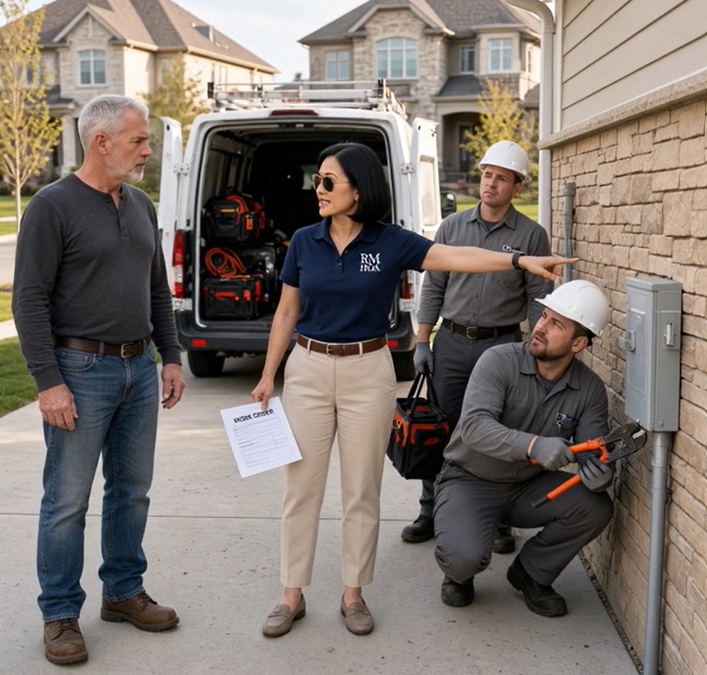
Three weeks later, FastCut Electrical appeared in my driveway with bolt cutters.
That is how we reached 7:14 a.m. on September 14th.
That is how Margaret Chen cut power to the owner of the power company.
My attorney, David Kline, answered on the second ring.
“Tom?”
“They cut my service.”
Silence.
Then: “Who is they?”
“FastCut Electrical, under HOA work order 2241, signed by Margaret Chen.”
“Please tell me you’re joking.”
“I’m sitting in a dark kitchen.”
“Anyone hurt?”
“Not that I know of.”
“Did they touch the meter seal?”
“Yes.”
“Did they cut company equipment?”
“Yes.”
“Did they have authorization?”
“No.”
“County permit?”
“Margaret says they don’t need one for internal HOA compliance work.”
David breathed in slowly.
I knew that breath.
That was the sound of an attorney discovering Christmas had arrived early but wrapped in liability.
“Tom,” he said, “do not repair anything yourself. Do not restore service. Do not speak to Margaret. Do not speak to FastCut. Call operations. Have a crew dispatched officially. I’m calling the utility commission.”
“I already photographed everything.”
“Of course you did.”
“I wrote down her statements.”
“Of course you did.”
“I have the work order.”
There was a pause.
Then David said, “I may frame it.”
By 8:05, Ridgecrest Power’s service truck arrived.
By 8:12, my line supervisor, Miguel Ortega, was standing beside my meter panel, staring at the cut with the expression of a man looking at a body.
Miguel had worked for me for twenty-two years. He had raised three daughters, survived two hurricanes, one ice storm, and a warehouse fire, and could identify a bad splice by smell.
He turned to me.
“Mr. Mills.”
I knew it was serious because Miguel only called me Mr. Mills when regulators, reporters, or danger were nearby.
“Tell me,” I said.
“They cut the service lock. Damaged the seal. Severed the lateral at the panel. They were lucky.”
“How lucky?”
“Lucky nobody died.”
A neighbor, Paul Esposito, walked over from three doors down, still wearing slippers.
“Tom, do you know why half my garage door quit?”
Miguel looked at him.
“Do not touch that door.”
Paul froze.
“Why?”
Miguel pointed toward the utility cabinet near the curb. “Because we don’t know what else they damaged yet.”
That was when the morning stopped being my problem alone.
Ridgecrest Meadows’ electrical system was designed with individual home feeds, common-area circuits, backup controls, and several shared service nodes for the older section of the development. My lot sat near one of those nodes because, during construction, the developer had used it as a temporary operations point. Later, when permanent routing changed, some infrastructure remained tied through easements along my side yard and the rear utility corridor.
It was legal.
It was documented.
It was safe.
As long as nobody with an HOA polo shirt and a bolt cutter decided aesthetics outranked electrical engineering.
Miguel opened the curbside cabinet.
His face changed.
“Tom,” he said quietly, “they opened this too.”
I walked closer but did not cross the safety line.
The FastCut crew had not only cut my service. They had also opened the shared utility cabinet serving part of the block and placed a red HOA compliance tag on it.
Unauthorized exterior utility modifications pending correction.
That tag became my favorite piece of evidence.
By 8:40, Ridgecrest Power had initiated a safety lockout on the affected node. Eleven homes lost partial or full power. Two common-area lighting circuits went offline. The gate system began running on battery backup. The clubhouse lost HVAC. The irrigation controls dropped. The pond aerator stopped.
By 9:15, the county utility commission inspector arrived.
His name was Frank Alvarez.
He was sixty, broad, calm, and had the kind of face that told you he had seen people do expensive things with cheap confidence.
He inspected my meter panel.
He inspected the curb cabinet.
He inspected the cut lock.
He inspected the HOA tag.
Then he looked at me.
“Who authorized this?”
I handed him work order 2241.
He read it.
His eyebrows lifted slightly.
“Internal HOA compliance work,” he said.
“Yes.”
He looked toward the darkened clubhouse in the distance.
“People do enjoy naming crimes.”
At 10:05, Margaret returned.
This time, she did not arrive with the FastCut crew.
She arrived with Seth Barlow, Linda Price, and a younger board member named Jeremy Vale, who looked like he had joined the HOA to approve pool furniture and had instead wandered into a utility violation.
Margaret walked up my driveway, still wearing sunglasses.
“Mr. Mills,” she said, “residents are reporting outages.”
Inspector Alvarez turned.
“And you are?”
“Margaret Chen. HOA president.”
“Good.”
He held up the work order.
“Is this your signature?”
She glanced at it.
“Yes.”
“You authorized FastCut Electrical to access and alter utility equipment at this address?”
“I authorized compliance correction.”
“That is not what I asked.”
Her face tightened.
“I authorized removal of non-compliant private connections.”
Miguel muttered something in Spanish under his breath.
Inspector Alvarez said, “Mrs. Chen, this equipment is part of a licensed private utility system regulated by the county. You do not have authority to access it, alter it, cut it, tag it, or direct contractors to perform work on it.”
Margaret’s smile did not move.
“With respect, the HOA owns common infrastructure serving this community.”
“No,” Alvarez said.
One word.
Flat.
Heavy.
The kind of no that makes a room out of open air.
Margaret blinked.
“I’m sorry?”
“No,” he repeated. “The HOA does not own this infrastructure.”
Seth Barlow shifted.
Linda Price looked at Margaret.
Jeremy Vale swallowed.
Margaret took off her sunglasses.
“The HOA pays for service.”
“That is not ownership.”
“We maintain community standards.”
“That is not utility authority.”
“The components are on residential lots.”
“They are still utility components.”
She turned toward me, irritation breaking through.
“This is exactly what I mean. Mr. Mills has used vague utility claims to avoid basic compliance.”
Inspector Alvarez looked from her to me.
“You don’t know who he is, do you?”
Margaret’s face sharpened.
“He’s the homeowner.”
Miguel looked away.
David Kline arrived at that exact moment, walking up the driveway with a leather folder in one hand and the expression of a man trying very hard not to smile.
“No,” David said. “He is Thomas Mills, majority owner and chairman of Ridgecrest Power Services LLC, the company that owns and operates the electrical infrastructure your contractor cut this morning.”
No one spoke.
Not Margaret.
Not Seth.
Not Linda.
Not Jeremy.
Even the dog across the street seemed to stop barking.
Margaret looked at me.
For the first time since I had known her, I saw uncertainty reach her eyes before pride could block it.
“That’s not true,” she said.
David opened his folder and handed Inspector Alvarez a copy of the franchise agreement.
Then he handed a second copy to Margaret.
“Fifteen-year exclusive franchise. County-approved. Renewed three years ago. Signed by Mr. Mills as chairman and by the county utility commission. Ridgecrest Meadows HOA is a service customer and easement beneficiary. It is not the owner, operator, regulator, or enforcement authority over the electrical system.”
Margaret stared at the document.
Her fingers tightened on the pages.
“This is a conflict of interest,” she said.
David almost laughed.
“It is a utility contract.”
“He lives here.”
“He does.”
“He should have disclosed—”
I finally spoke.
“Disclosed what?”
She looked at me.
“That you controlled the utility provider.”
“You never asked.”
“You let the board proceed under a misunderstanding.”
“I sent you letters. My company’s counsel sent you letters. You called us a vendor and ignored them.”
Her cheeks colored.
“You were intentionally obscure.”
“You cut power to my house at 7:21 in the morning and damaged regulated utility equipment because you refused to read a contract.”
Inspector Alvarez looked at Margaret.
“Mrs. Chen, I need the contact information for FastCut Electrical and every person involved in authorizing this work.”
Margaret’s mouth opened.
David said, “Before you answer, I recommend you call your attorney.”
For once, she listened.
The day got worse from there.
For Margaret.
For Ridgecrest Meadows.
For FastCut Electrical.
Not because I wanted revenge.
Because regulated systems do not care about intentions once you damage them.
Ridgecrest Power could not simply flip my power back on and pretend nothing had happened. Unauthorized access to utility equipment requires inspection, documentation, repair verification, safety testing, notification to the commission, and sometimes temporary isolation of related circuits.
By noon, twenty-three homes had experienced some form of outage or voltage irregularity. The front gate was locked open for emergency access. The clubhouse was closed. The pond aerator was offline. The irrigation system was disabled. Common-area cameras lost power. Two residents with medical equipment had to be checked by emergency services.
Every single one of those consequences traced back to work order 2241.
Margaret spent the afternoon trying to control the narrative.
At 1:12 p.m., she sent an email to the entire neighborhood.
Residents,
This morning’s power issues appear to be related to ongoing noncompliance by a homeowner whose unauthorized utility modifications required HOA intervention. We are working with vendors and officials to resolve the matter quickly. Please avoid speculation while the board protects community interests.
Margaret Chen
President, Ridgecrest Meadows HOA
At 1:19 p.m., David forwarded that email to me with the message:
May I?
I replied:
Please.
At 1:32 p.m., Ridgecrest Power Services sent an official notice to every customer in the development.
Ridgecrest Power Services LLC is responding to unauthorized third-party interference with regulated electrical utility infrastructure at Lot 47 and associated service nodes. The interference was performed without company authorization, without county utility commission approval, and under an HOA-issued work order. Service restoration will proceed only after safety inspection and required repairs are completed. Please direct questions regarding HOA authorization to the Ridgecrest Meadows HOA board.
The neighborhood forum exploded within minutes.
Who authorized this?
Why was the HOA touching power equipment?
My garage won’t open.
My mother’s oxygen concentrator alarm went off.
Did Margaret cut someone’s power?
What is Lot 47?
Isn’t that Tom Mills?
Who is Ridgecrest Power?
Wait, Tom owns Ridgecrest Power?
By 3:00 p.m., Margaret had stopped answering posts.
By 4:15, the HOA attorney called David.
By 5:30, the first local reporter was at the gate.
I did not talk to the reporter.
That was David’s advice, and also common sense.
Margaret did talk.
That was neither.
She stood near the clubhouse in a navy blazer, hair perfect, face tight, and told the reporter, “The HOA acted in good faith to enforce compliance standards after repeated homeowner refusal. We are still reviewing the legal status of certain infrastructure and believe no resident should use utility claims to avoid community rules.”
That clip aired at six.
At 6:07, Inspector Alvarez forwarded it to the county enforcement office.
At 6:12, David sent it to the HOA’s attorney.
At 6:18, I watched it on my phone at my kitchen table, which still had no power, and thought Helen would have hated every second of it.
Not because of Margaret.
Because Helen believed public embarrassment was a poor substitute for wisdom.
“You can win and still let it make you ugly,” she used to say.
I heard that sentence in my head every time someone texted me a joke about Margaret that week.
And there were many.
By 8:00 p.m., my power had been temporarily restored through a safe bypass. Full repair would take two more days. The affected common circuits remained under restricted operation pending inspection.
At 8:30, there was a knock at my door.
I opened it to find Linda Price standing on the porch.
The retired principal.
HOA board member.
She held a casserole dish covered in foil, which is how people in my part of the world say either sorry or someone died.
“Mr. Mills,” she said softly.
“Linda.”
“I didn’t know.”
I looked at the dish.
“About the company?”
“About any of it. Margaret told us the equipment was homeowner-installed. She said Ridgecrest Power had refused to respond because you were using them as cover.”
“She had the letters.”
“I know that now.”
She looked tired. Not frightened for herself. Ashamed.
“I voted to authorize compliance action,” she said. “But not cutting lines. We were told a contractor would inspect and prepare a correction estimate.”
“Did you read the work order?”
Her eyes dropped.
“No.”
That answer mattered.
Not because it excused her.
Because it was honest.
“I’m sorry,” she said.
I accepted the casserole.
Not because baked ziti fixed anything.
Because some apologies arrive carrying what people have.
The next morning, the county utility commission issued an emergency order.
FastCut Electrical’s license was suspended pending investigation. Ridgecrest Meadows HOA was prohibited from accessing, modifying, tagging, obstructing, screening, or directing work on any utility infrastructure. All HOA communications concerning utility compliance had to be preserved. Ridgecrest Power was authorized to perform safety inspections across the development and bill emergency response costs to responsible parties pending final determination.
At 10:00 a.m., Ridgecrest Power crews began inspecting every shared service point in the neighborhood.
That was when we found the second problem.
Margaret had not stopped at me.
Over the previous six months, the HOA had instructed landscapers to build decorative screening around three utility cabinets, install irrigation lines too close to underground feeders, and place stone planters over two access lids. None of that had caused an outage yet.
Yet.
Miguel took photographs of every violation.
Inspector Alvarez walked beside him, writing notes and muttering, “Of course,” every few minutes.
By noon, the HOA’s “beautification initiative” had become a utility obstruction case.
By evening, residents were furious for a different reason.
They had not just lost power because Margaret targeted me.
They had been living beside hidden hazards created by her obsession with appearances.
The emergency HOA meeting was scheduled for Friday night at the clubhouse.
I did not want to go.
David told me not to.
“You are the damaged party, the utility owner, the service provider, the witness, and likely the plaintiff,” he said. “Walking into a hostile room helps no one.”
Then Paul Esposito came by.
His garage door had finally been repaired. He stood on my porch holding a six-pack of root beer because he did not know whether I drank.
“Tom,” he said, “people need to hear it from you.”
“They have notices.”
“Not the same.”
“It may make things worse.”
He looked back toward the street.
“It’s already worse. Margaret is telling people you engineered this to embarrass her.”
I almost laughed.
“I engineered the electrical system. Not her choices.”
“Then say that.”
So I went.
The clubhouse was packed beyond what the fire marshal would have liked. Residents lined the walls, filled the hallway, and stood outside near open windows. The generator hum from the temporary outdoor unit gave the whole meeting the atmosphere of a trial held during a storm.
Margaret sat at the front table with Seth Barlow, Jeremy Vale, Linda Price, and the HOA attorney. Linda would not look at Margaret. Jeremy looked like he wanted to disappear into his chair. Seth looked angry, though at whom I could not tell.
Margaret struck the gavel.
“This emergency meeting has been called to address misinformation concerning recent electrical disruptions,” she began.
The room erupted.
“Why did my power go out?”
“Did you cut Tom’s line?”
“Who approved FastCut?”
“What about medical residents?”
“Are we paying for this?”
Margaret lifted both hands.
“I understand the frustration. I share it. But this board acted under its obligation to enforce standards consistently. No resident, regardless of personal business interests, should be exempt from community rules.”
That was when Linda Price stood.
Everyone quieted.
Linda had been a principal for thirty-two years. Her voice still carried the memory of assemblies, cafeterias, and children who knew when they were one syllable from detention.
“Margaret,” she said, “stop.”
Margaret turned slowly.
“Excuse me?”
Linda faced the room.
“I was on the board when enforcement action was discussed. I was not told the equipment belonged to a regulated utility. I was not told Ridgecrest Power had sent formal warnings. I was not told the work order authorized cutting or physical interference. I voted based on incomplete and misleading information.”
The room shifted.
Margaret’s face hardened.
“Linda, this is not productive.”
“No,” Linda said. “It is honest.”
Seth leaned into his microphone.
“For the record, I also did not understand FastCut would cut anything live.”
A resident shouted, “Then what did you think electrical correction meant?”
Seth had no good answer.
Then Inspector Alvarez walked in.
I had not known he would come.
Neither had Margaret.
He entered with two county staff members and stood along the side wall until the shouting settled.
Margaret’s attorney whispered something urgently.
Margaret ignored him.
“This is a private association meeting,” she said.
Inspector Alvarez walked to the front.
“Not when the subject is interference with regulated utility infrastructure.”
No one argued.
He placed a folder on the table.
“I’ll be brief. Ridgecrest Power Services owns and operates the electrical infrastructure serving this development under a valid county franchise agreement. The HOA does not own that infrastructure. It does not regulate that infrastructure. It cannot authorize contractors to access, cut, tag, screen, obstruct, or modify that infrastructure.”
He looked at Margaret.
“Work order 2241 was unauthorized.”
The room became very quiet.
Alvarez continued.
“FastCut Electrical performed work without required approval. The county has opened an enforcement action. Several HOA-installed or HOA-directed landscape features have also been identified as obstructing utility access. Those must be removed.”
A woman in the front row stood.
“My husband’s CPAP shut off.”
Margaret said, “We regret any inconvenience—”
“Inconvenience?” the woman said. “He woke up gasping.”
Margaret’s mouth closed.
A man in the back shouted, “How much is this going to cost us?”
The HOA attorney finally spoke.
“The board cannot comment on pending liability.”
That answer told the room enough.
Then Paul Esposito stood.
“I want to hear from Tom.”
Heads turned toward me.
David, seated beside me, whispered, “Keep it short.”
I stood.
The room looked different from that angle. People I had waved at for four years stared back with anger, embarrassment, fear, curiosity, and guilt. They had all lived under the power my company provided. Most had never thought about it. That was normal. Good utilities are invisible until something goes wrong.
“I’m not here to argue HOA rules,” I said. “I’m here to explain one thing. Electrical infrastructure is not decoration. It is not a mailbox color. It is not a hedge height. It is not something a board can dislike into nonexistence.”
Margaret stared at the table.
I continued.
“My company sent warnings. They were ignored. This morning, an HOA work order sent a contractor to my home, where they cut regulated equipment and created a safety event. The outages that followed were not caused by my refusal to comply. They were caused by unauthorized interference with a power system.”
Someone asked, “Why didn’t you tell us you owned the company?”
I looked toward him.
“Because I did not think I needed to introduce myself as the person keeping the lights on in order to be left alone.”
No one spoke.
I softened my voice.
“I moved here after my wife died because I wanted quiet. I did not want influence. I did not want special treatment. I did not want a fight with my HOA. I wanted to sit on my porch, trim my maple tree badly, and be another neighbor. That was all.”
Linda looked down.
I said, “I don’t want anyone unsafe. I don’t want anyone in the dark. Ridgecrest Power will restore everything properly. But I will not allow the HOA, or any contractor it hires, to touch our equipment again without authority. Not mine. Not yours. Not anywhere in this neighborhood.”
I sat down.
For a moment, the generator outside was the only sound.
Then Arthur Bell, an older resident from the lower loop, stood slowly with both hands on his cane.
“Well,” he said, “I’d like to thank the man who’s been keeping my freezer running.”
A few people laughed.
Then someone clapped.
Not many at first.
Then more.
It was awkward, uneven, and uncomfortable.
But it happened.
Margaret did not survive the week as president.
The recall petition began that night.
By Monday, it had enough signatures.
By Wednesday, FastCut Electrical’s supervisor had given a statement saying Margaret personally told them the HOA owned the infrastructure and that the homeowner had been “using fake utility claims” to resist compliance. He also turned over emails from Margaret containing marked photos of my meter panel and the instruction:
Cut service if necessary. He needs to understand the board’s authority.
There it was.
The sentence everyone had been waiting for.
He needs to understand.
She had wanted a lesson.
She got one.
The civil case that followed was not quick.
Nothing involving utilities, insurance carriers, HOAs, contractors, and county regulators is quick unless something is actively on fire.
Ridgecrest Power filed claims for equipment damage, emergency response costs, regulatory expenses, service disruption, and obstruction removal. I filed separately for trespass, property damage, harassment, and interference with utility service at my residence. Several residents filed complaints against the HOA for negligence related to medical equipment and outage damages.
FastCut’s insurance carrier tried to blame Margaret.
The HOA’s insurance carrier tried to blame FastCut.
Margaret tried to blame “unclear ownership documents.”
David enjoyed that phrase so much he used it in mediation.
“The ownership documents,” he said, placing the franchise agreement on the table, “are unclear only to those who refuse to read them.”
Margaret sat across the table, no sunglasses this time. Her attorney had advised her not to speak unless asked directly. That was the best advice she had received all year.
The settlement required the HOA to reimburse Ridgecrest Power for emergency costs, pay for removal of all unauthorized obstructions, fund a third-party infrastructure education notice to every homeowner, and adopt a rule permanently barring the HOA from asserting authority over utility equipment. FastCut paid through insurance and lost its county-approved contractor status for utility-adjacent work. Margaret personally contributed under a separate agreement tied to her written authorization and misrepresentations.
But money was not the part residents remembered.
They remembered the corrective notice.
Every home in Ridgecrest Meadows received one in the mail.
It said, in plain language, that the HOA did not own, control, or regulate electrical utility infrastructure; that homeowners and board members could not alter or obstruct such infrastructure; that any utility concerns must be directed to Ridgecrest Power Services; and that prior communications suggesting otherwise had been inaccurate.
At the bottom, in bold, was one sentence David insisted on adding:
Community standards do not supersede utility law.
I framed that notice.
Not in my office.
In my garage.
It looked better near tools.
Margaret sold her house the following spring.
Before she left, she came to my door.
I saw her through the window and almost did not answer.
But Helen would have.
So I did.
Margaret stood on my porch wearing a gray coat, no sunglasses, no clipboard.
“Mr. Mills,” she said.
“Margaret.”
“I came to apologize.”
I waited.
Silence has a way of separating real apologies from speeches.
She looked toward my side yard, where the repaired meter panel sat clean, inspected, and untouched.
“I thought I was protecting the neighborhood,” she said.
I said nothing.
Her face tightened slightly, but she continued.
“I was wrong about the infrastructure. I was wrong about your authority. I was wrong to authorize FastCut.”
“Yes.”
She swallowed.
“I am sorry.”
It was not enough to undo the morning.
It was not enough to erase the fear residents felt when medical equipment shut off, or the damage to my home, or the disrespect of having a document pressed against my chest like I was a problem to be corrected.
But it was the first sentence she had spoken to me without trying to win.
So I gave her the only answer I honestly had.
“I hope you read things more carefully now.”
She almost smiled.
Almost.
Then she nodded and left.
The new HOA president was Linda Price.
She did not want the job.
That was why people trusted her with it.
At her first meeting, she asked Ridgecrest Power to provide a basic utility briefing for residents. Miguel gave it. He explained meters, service panels, easements, access clearances, common circuits, emergency reporting, and why nobody should build decorative stone walls around equipment they did not understand.
He did a better job than I would have.
At the end, a child raised her hand and asked, “Can electricity get mad?”
Miguel looked at the room.
“No,” he said. “But it can make adults look very foolish.”
That line made him a legend in the neighborhood.
A month later, Linda came to my house with a proposal.
Not a violation notice.
A proposal.
“We want to plant screening near some utility areas,” she said quickly. “Proper distance. Approved species. Ridgecrest Power review first. Nothing touching access zones. Nothing decorative and stupid.”
I looked at her.
“Decorative and stupid is not a technical category.”
“It should be.”
I read the plan.
It was reasonable.
At the bottom, she had added a small sign for the common-area utility cabinet near the clubhouse.
AUTHORIZED UTILITY ACCESS ONLY.
Below that, in smaller letters:
Ask Before You Touch What Powers You.
I looked up.
“Too much?”
I shook my head.
“No. That’s about right.”
Ridgecrest Meadows changed after that.
Not completely.
No neighborhood becomes wise overnight.
People still complained about trash cans. Someone still got angry over holiday lights. A man on Briar Court tried to paint his garage door black and triggered a debate that lasted three meetings and shortened several lives.
But the tone changed.
A little.
The board asked more questions.
Residents read attachments.
Contractors had to provide permits.
The word compliance was used less like a weapon and more like a responsibility.
And people started waving at Ridgecrest Power trucks.
That was new.
One evening in late June, I sat on my porch with a glass of iced tea, watching the streetlights come on one by one.
The maple in my yard threw long shadows across the grass. Paul Esposito walked his dog past my house and lifted a hand. Linda’s grandchildren rode bikes in slow loops near the cul-de-sac. Somewhere near the clubhouse, the pond aerator hummed steadily.
Everything worked.
That is the thing about power people forget.
When it works, nobody notices.
When it fails, everyone looks for someone to blame.
I had spent thirty years building systems designed to disappear into reliability. My greatest professional achievement was that thousands of people could flip switches without knowing my name.
Then Margaret Chen tried to teach me a lesson and accidentally taught the entire neighborhood how much invisible work stood between comfort and chaos.
I thought about Helen.
I thought about how she would have sat beside me, one foot tucked under her, listening to me complain about the HOA while pretending to read.
She would have said, “Tom, you enjoyed that more than you should.”
And I would have said, “I did not.”
And she would have looked at me over her glasses until I confessed.
So I confessed to the empty chair beside me.
“I enjoyed parts of it.”
The evening stayed quiet.
No answer came.
But for once, the quiet did not feel like absence.
It felt like peace.
At dusk, the clubhouse lights clicked on across the pond.
Then the gate lamps.
Then the path lights.
Then the porch lights along Ridgecrest Meadows, house by house, soft and ordinary.
Ninety-six homes glowing under a system Margaret had mistaken for decoration.
I raised my glass slightly toward the street.
Not in triumph.
Not exactly.
More like acknowledgment.
Power is not just wires.
Authority is not just a title.
Ownership is not just what you claim in a meeting.
And a quiet man standing in his driveway with a work order pressed against his chest may know far more than the person holding the clipboard.
Margaret thought cutting my power would make me understand who ran the neighborhood.
She was right about one thing.
A lesson was coming.
She was just wrong about who needed it.