The HOA Had Me Handcuffed at My Own Gate—Then Their Security Chief Opened My U.S. Marshal Credentials and Everything Changed.
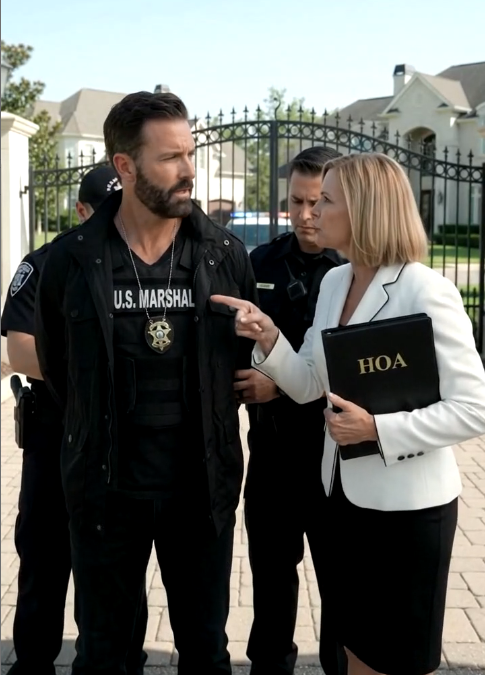
PART2:
But because every altered map, every suspicious date, every bogus fine, every planted sign, and every threat had been moving toward a moment when someone would finally cross a line that could not be explained away at the next board meeting.
Trevor reached for my free wrist.
I looked at him.
“Last chance.”
Calvin nodded.
Click.
The second cuff locked shut.
Diane’s smile returned.
“Maybe now,” she said, “you’ll understand how authority works.”
I looked down at the steel around my wrists.
Then I raised my eyes toward Calvin.
“Reach into my left jacket pocket.”
He hesitated.
“Why?”
“Because there’s a leather credential case inside.”
Diane laughed softly.
“Whatever deed or document you think you have isn’t going to change this.”
Calvin reached into my pocket anyway.
He pulled out the case.
Opened it.
And froze.
The first clean stripe of sunrise broke through the trees and caught the gold badge inside.
Calvin’s face changed before Diane could even see what he was holding.
His eyes moved from the badge to the identification card.
Then back to me.
“What is it?” Diane demanded.
Calvin swallowed.
When he finally spoke, the confidence had vanished from his voice.
“Deputy United States Marshal.”
Diane stared at him.
Then at me.
Then at the handcuffs around my wrists.
And for the first time in three months, nobody at my gate seemed interested in telling me how authority worked.
Three months earlier, that same gate had represented something much simpler.
Privacy.
My name is Ethan Cole. I was forty-one years old, and after spending most of my adult life carrying government-issued bags through airports, courthouses, temporary duty stations, and cities I barely had time to remember, I had finally reached the point where going home meant more to me than going anywhere else.
Home was 6.4 acres of hardwood trees, uneven pasture, red Virginia clay, and a two-story brick house built sometime in the 1980s.
Nothing luxurious.
Nothing impressive.
But it had belonged to my Uncle Raymond.
That made it worth more to me than any polished house behind Ashford Ridge’s stone entrance sign.
Raymond took me in when I was sixteen.
He was a surveyor by trade and one of those men who could look across a field, squint once, and tell you a boundary marker was wrong before anyone else had even unfolded the plat.
He kept sharpened pencils behind his ear.
He drank coffee so strong it could probably remove paint.
And he believed property records were only useful if the people reading them understood that lines on paper represented something real.
“Six inches matters,” he once told me while correcting a fence contractor who had planted three posts too far east.
I had laughed.
“To you.”
“To everybody,” he said. “They just don’t know it until they need those six inches.”
Raymond also had a strange relationship with fences.
He hated unnecessary ones.
But he loved gates.
“A fence tells people where your land ends,” he used to say. “A gate tells them they need permission.”
When he died, the property passed to me through his estate.
Developers had already turned most of the surrounding farmland into subdivisions with expensive names and nearly identical houses.
Ashford Ridge sat immediately east of Raymond’s acreage.
Two hundred-plus homes.
A clubhouse.
A pool.
Landscaped entrances.
Decorative streetlamps.
The kind of community where the word exclusive appeared in the marketing material more often than the word home.
I could have sold my property to another developer.
Instead, I kept it.
Most weekends, I repaired whatever age and weather had worn down.
I replaced rotting boards on the workshop.
Cleared storm-damaged branches.
Rewired exterior lights.
Repaired a leaning section of pasture fence.
And finally, that spring, I rebuilt Raymond’s old entrance gate.
The original frame was still solid.
I cut away the rusted lower sections, welded in new steel, installed stronger hinges, and added an electric motor. The grinder screamed against the metal while sparks bounced across the gravel. The smell of hot steel stayed in my clothes long after I shut the workshop at night.
I painted the finished frame matte black.
Added a keypad.
Mounted a camera above the western gatepost.
Nothing dramatic.
I traveled enough for work that being able to check my driveway from a phone made sense.
Inside Raymond’s workshop, I kept his property files locked inside an old gray metal drawer.
Deeds.
Tax maps.
Survey records.
Photographs.
Boundary notes.
Correspondence from developers.
One old plat had been folded so many times the creases felt soft as cloth.
Before accepting the property, I reviewed everything.
One fact was unmistakable.
Raymond’s acreage touched Ashford Ridge.
It was not part of Ashford Ridge.
There were no HOA covenants attached to the parcel.
No association membership.
No maintenance agreement.
No access easement giving Ashford Ridge rights over my driveway.
For the first few weeks after the gate was finished, nobody cared.
I would come home, park my charcoal Ford pickup beside the workshop, heat something for dinner, and sit on the back porch listening to cicadas while the gate closed at the end of the long driveway.
It was the kind of quiet I had wanted for years.
Then one Thursday afternoon in May, I heard tires moving slowly near the entrance.
A pearl-white Lexus stopped outside my gate.
A woman stepped out carrying a black clipboard.
She looked at the gate.
Then at the house.
Then directly into the camera.
She knocked twice against the steel.
That was the first time I met Diane Whitmore.
She did not introduce herself so much as issue a formal announcement.
“I am Diane Whitmore, president of the Ashford Ridge Homeowners Association.”
Each word sounded pre-approved.
I walked down from the workshop, wiping metal dust off my hands with an old towel.
“Ethan Cole.”
“I know.”
That was warning number one.
Diane looked to be in her late fifties. Ash-blonde bob. Pale blue eyes. Navy blazer. White slacks. Slim gold watch.
She looked as though dirt needed written permission to touch her.
Her Lexus remained idling behind her with the air-conditioning running.
She pointed toward the gate.
“We need this removed.”
I looked at the keypad.
“The keypad?”
“The gate.”
She said it as casually as someone asking a neighbor to roll a trash bin out of sight.
“This roadway historically provided emergency access for Ashford Ridge. Your gate interferes with community safety.”
I glanced toward the subdivision.
Ashford Ridge already had two paved entrances, both wide enough for emergency vehicles.
My driveway was gravel.
It ran four hundred feet to my house.
“This isn’t an HOA road.”
Diane gave me the patient smile people use when they believe the other person simply has not accepted their superiority yet.
“Mr. Cole, I understand you are new to the neighborhood.”
“I’m not in the neighborhood.”
The smile disappeared.
I went into the workshop and returned with a copy of the recorded survey.
I held it through the gate.
“My property line starts here. The driveway stays inside it all the way to the county road.”
Diane barely glanced at the map.
“Maps can be interpreted.”
“Property lines usually can’t.”
Her eyes lifted.
For a few seconds, the only sound was the cicadas and her Lexus engine.
Then she tapped the bottom of the clipboard against her palm.
“Ashford Ridge has maintained community standards for seventeen years. We are not going to compromise emergency safety because one owner suddenly decides he wants privacy.”
The word suddenly caught my attention.
Raymond had owned the property before Ashford Ridge existed.
“I’ll make this easy,” I said. “If the HOA has an easement, send me the recorded document.”
“We have procedures here.”
“Good. Use them.”
She stared at me another moment.
Then turned toward her Lexus.
Before getting inside, she looked up at the camera above the gate.
She noticed the red recording light.
Her expression changed slightly.
I remembered that later.
The following morning, a white envelope had been fastened to the middle of my gate.
ASHFORD RIDGE HOMEOWNERS ASSOCIATION appeared across the top.
Diane’s signature was printed at the bottom.
UNAUTHORIZED OBSTRUCTION OF COMMUNITY EMERGENCY ACCESS.
FINE: $250.
I stood there with coffee steaming in my hand and read the page twice.
Then I looked toward Ashford Ridge.
I had shown Diane a survey.
I had asked her to provide documentation.
Her response was a fine from an association with no authority over my property.
That was when I first understood the problem.
Diane was not confused about where my land began.
She believed her authority should continue even after the paperwork said it ended.
By Thursday, another envelope appeared.
CONTINUED OBSTRUCTION.
$500.
Saturday brought an email threatening to raise the total to $1,000.
I printed everything.
Saved the original emails.
Photographed the notices.
And started a file.
Then I sent Diane a certified letter requesting three things:
The recorded easement.
The county instrument number.
The legal description identifying where the supposed access route crossed my parcel.
I expected documents.
Instead, I got a security vehicle.
The following Monday, a dark gray SUV with ASHFORD RIDGE COMMUNITY SECURITY printed across both doors drove past my gate at 7:12 a.m.
It slowed almost to a stop.
Then continued.
Tuesday, same SUV.
7:16.
Wednesday, 7:09.
By Friday, I recognized the sound of its engine before it appeared through the trees.
Nobody entered my property.
So I documented.
Date.
Time.
Vehicle.
Camera file.
My work had taught me something years earlier.
People remember stories.
Records remember details.
Then one afternoon, I came home and found a man standing outside the gate, pushing his phone between the steel bars to photograph my driveway.
He was broad-shouldered, probably mid-thirties, wearing a charcoal uniform.
“Can I help you?”
He turned.
“Community Security.”
“I can read your shirt.”
He lowered the phone.
“We’re documenting the access obstruction.”
“From inside my property?”
“For the homeowners association.”
“That wasn’t my question.”
His eyes shifted toward the camera.
I pointed toward the survey pin beside the western post.
“The county shoulder is behind you. My property begins here. Photograph anything you want from public ground. Do not reach through the gate to photograph private areas after I’ve told your organization to stop.”
He pulled his hand back.
“We have HOA authorization.”
There it was again.
Not county authorization.
Not court authorization.
Not an easement.
HOA authorization.
“What’s your name?”
“Trevor Pike.”
“Thank you, Trevor.”
He looked almost disappointed that I had not started yelling.
I went inside and saved the footage.
That evening, another email arrived.
Diane informed me that security patrols would continue until I complied with Resolution 17B.
That was the first time I had heard of it.
The attachment was three pages.
Polished formatting.
Association seal.
Legal-sounding language.
Diane’s signature.
It declared my driveway an emergency access corridor for Ashford Ridge.
I read the entire thing twice.
There was no county recording number.
No deed reference.
No easement instrument.
Nothing showing Raymond had ever granted them access.
I leaned back at my kitchen table while rain tapped the windows.
That was when Diane’s strategy became clear.
She did not need legitimate authority if she could create the appearance of authority.
Print official-looking documents.
Hire uniforms.
Use words like enforcement, authorized, violation, compliance, and emergency.
Repeat them often enough and maybe the average homeowner would eventually surrender just to make the pressure stop.
Unfortunately for Diane, I had spent too many years dealing with real legal process to be impressed by decorative vocabulary.
A week later, I attended the HOA board meeting.
Not as a Deputy U.S. Marshal.
As Ethan Cole.
Property owner.
I left my federal credentials locked away.
The meeting room smelled like burnt coffee, carpet cleaner, and lemon polish.
Diane sat at the center of a long table beside a silver laptop.
Calvin Rusk stood near the rear wall.
He was forty-seven, heavy-set, with close-cropped gray hair and polished black shoes. Whenever someone disagreed with Diane, he rested both hands on his belt like he was preparing for a disturbance.
Five board members sat around her.
Roughly twenty residents filled folding chairs behind me.
Diane worked through landscaping expenses, pool repairs, and neighborhood complaints before finally reaching my name.
“Mr. Cole has repeatedly obstructed a designated emergency access route.”
I stood.
Placed the recorded plat on the table.
“Show me where.”
She barely looked at it.
“This matter has already been reviewed.”
“By the county?”
Silence.
“By a licensed surveyor?”
Another pause.
“By your attorney?”
Her mouth tightened.
“You’re being unnecessarily confrontational.”
“I’m asking who reviewed it.”
A board member at the far end of the table cleared his throat.
Diane raised one finger.
He stopped speaking.
Then she slid Resolution 17B toward me.
“The board adopted this measure to protect community access.”
“An HOA resolution cannot create an easement across property the HOA doesn’t own.”
A few residents shifted in their chairs.
Diane leaned back.
“You seem determined to misunderstand how communities function.”
“I understand how recorded property rights function.”
That was when she stopped arguing about documents.
She started arguing about me.
I was an outsider.
My gate was hostile.
My refusal to cooperate threatened emergency safety.
My attitude created division.
The legal question disappeared beneath a cloud of emotional language about community responsibility.
Diane was good at that.
If she could not beat the facts, she would turn the person presenting them into the problem.
Finally, she called for a vote.
Five board members supported enforcement.
One voted against it.
Diane folded her hands.
“There. The board has spoken.”
I almost smiled.
A room full of people could vote unanimously that my truck belonged to the HOA.
That would not change the title.
I gathered my paperwork.
As I picked up Resolution 17B, my eyes stopped on the notary section.
April 14.
I looked at the first page.
The resolution referenced a proposal presented during the May 2 board meeting.
I checked again.
Notarized April 14.
Introduced May 2.
Eighteen days later.
I closed the folder without saying anything.
Diane mistook my silence for defeat.
“I hope we can count on your cooperation now, Mr. Cole.”
“You’ll have my response in writing.”
Outside, I crossed the parking lot beneath a yellow security light.
At my pickup, I opened the folder again.
April 14.
May 2.
Same year.
Same resolution number.
Same title.
I stood there for nearly a minute.
For the first time, I stopped seeing Resolution 17B as merely ridiculous.
I started wondering whether it was fraudulent.
The next morning, another warning appeared at my gate.
FINAL COMPLIANCE NOTICE.
$1,000.
A second sheet was attached.
It stated that Ashford Ridge security personnel were authorized to enter the corridor during emergencies and could temporarily detain individuals who interfered with authorized community operations.
I read that sentence three times.
A homeowners association could type the word detain on stationery.
That did not give private guards arrest powers.
And the fact that Diane wanted residents to believe otherwise made the situation much more serious.
That afternoon, Calvin’s security SUV stopped outside the gate.
Trevor stepped out and photographed the notice.
“You received it?” he asked.
“I received paper.”
“Then you understand what happens next.”
“What happens next?”
Trevor glanced toward Calvin.
“Continued obstruction may require enforcement.”
“Define enforcement.”
“You should speak with Ms. Whitmore.”
“I’m speaking with the man using the word.”
Calvin lowered his window.
“Don’t make this harder than it needs to be, Mr. Cole.”
“Send me the recorded easement.”
His window went back up.
The SUV left.
That evening, while reviewing camera footage, I found something I had missed.
At 1:17 the previous morning, Calvin’s vehicle had stopped outside my property for nine minutes.
He photographed the keypad.
The hinges.
The gate motor.
The camera position.
The electrical control box.
I saved the footage in three locations.
The next afternoon, a green-and-white sign appeared beside the western gatepost.
AUTHORIZED COMMUNITY ACCESS.
It had been driven into the ground several feet inside my property line.
I photographed it.
Measured the distance from the survey marker.
Pulled it out.
Stored it in the workshop.
The following morning, another identical sign stood in the same place.
That was when anger became useful.
I stopped reacting emotionally.
I started cataloging everything.
Every envelope.
Every email.
Every patrol.
Every sign.
Every photo.
Every timestamp.
Every instruction.
By Friday evening, I had fourteen separate incidents documented.
Then Diane emailed again.
Failure to open the gate by Monday would result in “formal access enforcement by Ashford Ridge Security.”
I stood inside Raymond’s workshop reading the message on my phone.
The air smelled like sawdust and machine oil.
Outside, the gate stood four hundred feet away.
They were no longer pretending this was a misunderstanding.
Diane had decided that because real authority would not give her what she wanted, she would manufacture her own.
Saturday morning, I drove to the county records office.
Raymond’s plat rode in a protective folder on the passenger seat.
For almost two hours, I searched every recorded document connected to my parcel.
Deeds.
Transfers.
Surveys.
Drainage rights.
Utility easements.
Nothing gave Ashford Ridge access.
Nothing gave Diane authority over my driveway.
Then I pulled association records.
I found the May 2 meeting minutes.
Resolution 17B appeared as a newly proposed emergency access measure that evening.
I placed the certified minutes beside Diane’s version.
Her document had been notarized April 14.
Eighteen days before it supposedly existed.
That changed the temperature in my head.
Suspicion had become something measurable.
I ordered certified copies of the relevant records.
Then I requested every easement tied to Raymond’s parcel.
The clerk returned with a thin stack.
Utility access on the north boundary.
Drainage rights near the county road.
Nothing else.
No Ashford Ridge.
No community emergency corridor.
No western access route.
Back home, I opened Raymond’s gray metal drawer.
I spread his old documents across the workbench.
Late-afternoon sunlight cut through the dusty window.
After nearly an hour, I found an older plat beneath a tax map.
Raymond’s handwriting ran along the eastern edge.
Never granted Ashford access.
I stared at the words.
Then I kept searching.
A letter was clipped behind the plat.
Sixteen years earlier, the developer building what would become Ashford Ridge had asked Raymond to grant access across his driveway.
His handwritten response remained attached.
Declined.
Private drive to remain private.
I sat down on the old wooden stool beside the workbench.
Diane had repeatedly called my driveway a historic community route.
That was not true.
Ashford Ridge had asked for access before the neighborhood was finished.
Raymond had refused.
They knew.
Or at least someone involved in the association’s history knew.
I scanned everything.
Photographed the originals.
Returned them to the drawer.
Then I laid Resolution 17B beside the certified minutes.
April 14.
May 2.
For weeks, I had kept asking whether Diane had legitimate authority.
I finally realized I had been asking the wrong question.
The better question was why she needed everyone to believe she had authority so badly.
By Sunday night, my kitchen table had disappeared beneath paperwork.
I still kept my badge out of it.
That part mattered to me.
I was not going to use my occupation as a shortcut in a private property dispute.
If Diane challenged my deed, she could do it legally.
My job was to preserve facts.
So I built a complete timeline.
First fine.
Second fine.
Security patrols.
Trevor photographing through the gate.
Calvin inspecting the hardware.
Resolution 17B.
The board vote.
Detention language.
The planted signs.
The final enforcement warning.
Then something else caught my attention.
Inside older HOA financial reports was a line item labeled:
Emergency Access Improvement Assessment.
The charge had appeared on homeowner statements before I ever rebuilt the gate.
I kept reading.
More than two hundred homeowners had apparently paid money toward access planning, safety studies, signs, security patrols, and possible road improvements.
My driveway was repeatedly referenced indirectly as the western access corridor.
I leaned back in my chair.
Now I understood.
Diane did not simply want my gate open.
Ashford Ridge had already been spending homeowners’ money based on access it did not own.
The gate had exposed that.
The next morning, I reviewed additional financial records residents had made available through the HOA portal.
Survey invoices.
Planning fees.
Security charges.
Preliminary road work.
One contractor invoice was dated before Diane ever visited my property.
This had not started because I installed a gate.
The gate had revealed an existing problem.
The first resident to call me was Linda Mercer.
She was sixty-seven, recently widowed, and lived three streets inside Ashford Ridge.
“You’re the man with the gate,” she said.
“Apparently that’s my official title now.”
She laughed.
Then her voice became serious.
Diane had told residents that my refusal to cooperate was costing the association money.
Linda had personally paid an emergency access assessment.
She wanted to know why.
I told her only what I could prove.
Twenty minutes later, she sat at my kitchen table.
I showed her Raymond’s plat.
She read his handwritten sentence aloud.
“Never granted Ashford access.”
Then she looked at me.
“So what did we pay for?”
“That’s what I’m trying to understand.”
Linda knew someone who could help.
Noah Bennett arrived that evening.
He was thirty-eight, quiet, and worked as a civil engineer.
He brought subdivision planning documents rolled inside a cardboard tube.
We spread them across the table.
Noah compared the official county plat with an HOA emergency-routing map.
He pointed immediately.
“This line is wrong.”
The official subdivision boundary stopped before my driveway.
Diane’s map extended a thick green route across my acreage.
No easement number.
No legal reference.
No deed citation.
Just a green line drawn across somebody else’s property.
The following morning, I called Rachel Sloan, a property attorney whose office was about twenty minutes away.
Rachel reviewed everything silently.
The deed.
County records.
Raymond’s rejection letter.
Resolution 17B.
The contradictory dates.
The assessments.
When she finished, she removed her glasses.
“Do not give them anything they can later characterize as consent.”
“I haven’t.”
“Good.”
She tapped the financial records.
“And stop thinking of this as a gate dispute.”
“What is it?”
“If homeowners were charged money based on representations that the HOA controlled an access route it never possessed, the board may have much bigger problems.”
By Thursday, my kitchen looked like an evidence room.
Linda brought assessment notices from neighbors.
Noah brought maps.
Rachel gave me a preservation checklist.
Coffee went cold between stacks of papers.
Still, none of them knew what I did for a living.
I preferred it that way.
My profession did not make the deed valid.
The deed was valid because it was recorded.
Then Noah found the detail that explained Diane’s desperation.
A preliminary site plan showed a proposed Ashford Ridge clubhouse and recreation project on the western side of the subdivision.
Community building.
Parking lot.
Walking paths.
Landscaping.
But the engineering notes showed something expensive.
Without a western emergency route, the association would need to redesign access and construct an alternate connection through difficult terrain.
Noah traced the contour lines.
“This route saves them a lot of money.”
The route crossed my driveway.
Exactly where Diane claimed Resolution 17B gave them access.
Suddenly, the fines had a motive.
The patrols had a motive.
The fake signs had a motive.
Even the board vote had a motive.
Rachel prepared a cease-and-desist letter.
It was intentionally boring.
Recorded boundaries.
No documented easement.
No permission granted.
Demand that Ashford Ridge stop representing my property as community access.
We sent it by certified mail and email.
Diane answered forty-three minutes later.
The board would proceed with access enforcement regardless of my objections.
I printed her message.
Added it to the file.
Saturday morning, Noah and I walked the entire boundary.
We photographed every survey pin with measurements visible.
The Virginia humidity settled over us like a wet blanket.
Red clay stuck to our boots.
At the gate, I cleaned the camera lens.
Checked the cloud backup.
Tested the keypad.
I changed nothing else.
No traps.
No barricades.
No provocation.
I simply made sure the truth would have good video quality.
By Sunday evening, copies of the important evidence existed in multiple places.
Rachel had the deed and certified county documents.
Noah had the maps.
Linda had assessment records.
I had the recordings.
At 8:14 that night, my phone chimed.
FINAL ACCESS ENFORCEMENT.
Diane wrote that Ashford Ridge security would arrive Monday morning at 6:00.
Failure to cooperate could result in temporary detention until appropriate authorities arrived.
I forwarded it to Rachel.
Saved the original.
Then I checked the camera feed.
Recording.
Backup active.
I placed my phone beside Raymond’s old plat.
Never granted Ashford access.
For three months, I had given Diane opportunities to stop.
I had shown her the survey.
Requested evidence.
Attended the meeting.
Sent certified letters.
Every time facts had blocked her, she responded by pretending she had even more power.
Now she had chosen Monday morning.
All I needed to do was let her demonstrate what she believed that power allowed her to do.
At 5:54 a.m., I was already awake.
Coffee in hand.
Work boots on.
My federal credentials were inside my jacket because I would be leaving for work later that morning.
At 6:03, Calvin’s gray SUV arrived.
A second security vehicle followed.
Diane’s Lexus came last.
I watched from the porch before walking toward the gate.
Calvin stepped out first.
Trevor Pike and Mason Bell followed.
Diane approached with her clipboard.
“Open the gate.”
“No.”
She sighed.
“Ethan, we are beyond this.”
“No. You’re exactly where you’ve been for three months. Standing outside property you don’t own without an easement.”
Calvin stepped forward.
“We are here to enforce the board resolution.”
“Show me legal authority.”
“Resolution 17B.”
“That isn’t legal authority over my land.”
Diane looked at Trevor.
“Proceed.”
Trevor hesitated.
Then reached for my arm.
I moved half a step back.
“Trevor, I am telling you directly that you do not have permission to enter my property or physically detain me.”
“You’re interfering with community access.”
“I’m standing on my own driveway.”
Calvin came closer.
“Don’t resist.”
“I’m not resisting. I’m warning you.”
Trevor secured one cuff.
That was the moment the story returned to where it began.
“Before you put that second cuff on me,” I said, “you might want to ask your boss exactly what authority he thinks he has.”
Diane ordered him to continue.
The second cuff clicked shut.
Then she told me I was finally going to understand authority.
So I told Calvin to retrieve the leather case from my pocket.
He opened it.
Saw the badge.
And went silent.
“Deputy United States Marshal,” he finally whispered.
Diane blinked.
“That doesn’t change HOA jurisdiction.”
“No,” I said. “It doesn’t.”
Then I looked down at my wrists.
“But it changes how foolish this looks.”
Trevor stepped away from me.
Calvin closed the credential case.
“You’re a federal officer?”
“Yes.”
Diane lifted her chin.
“Then you should understand that we’re enforcing a lawful resolution.”
“I understand the difference between an HOA resolution and statutory arrest authority.”
She shook the clipboard.
“Our security personnel are authorized.”
“By you.”
“By the association.”
“Exactly.”
Calvin looked toward Diane.
“You said this route was legally established.”
“It is.”
“Where’s the easement?” I asked.
She ignored me.
I continued.
“This encounter is being recorded and backed up remotely.”
Mason glanced up at the camera.
Trevor’s face lost color.
Diane pointed at me.
“Are you threatening us?”
“No. I’m identifying evidence.”
That was when tires appeared on the road.
Before sunrise, I had contacted the county through normal channels and reported that private security personnel were expected to arrive at my property claiming authority to detain me.
I did not ask for a federal response.
I did not ask for special treatment.
I asked for the same thing any property owner should ask for.
Local law enforcement.
Two marked county vehicles came through the trees.
Diane turned.
“You called police?”
“You said you wanted appropriate authorities.”
The first cruiser stopped behind the security SUV.
Two uniformed officers stepped out.
Calvin moved toward me.
“We should probably take those off.”
“Leave them,” I said. “Until the officers document what happened.”
Diane stared at me.
“This is ridiculous.”
“No. This is documentation.”
The first officer reached us.
He looked directly at my cuffed wrists.
“Who restrained him?”
Trevor slowly raised his hand.
“I did.”
“Under what authority?”
Trevor looked at Calvin.
Calvin looked at Diane.
Diane immediately produced Resolution 17B.
“Ashford Ridge authorized temporary detention for obstruction of emergency community access.”
The officer did not even reach for the paper.
“I asked what legal authority permits your security officers to detain him.”
Silence.
The second officer moved toward the camera.
I told him the footage was stored locally and offsite.
Then I identified myself.
Not with drama.
Not by flashing the badge first.
I gave my name, my status as the property owner, and explained that I was also a Deputy United States Marshal.
The first officer looked at Calvin.
“Remove the handcuffs.”
This time, I did not object.
Calvin unlocked them.
The pressure disappeared from my wrists.
I flexed my hands once.
Then took my credential case back and put it away.
My badge had changed their behavior.
But it was not going to decide the property dispute.
The records would.
Rachel arrived twenty minutes later.
She carried a document case thick enough to make Diane’s clipboard look like a restaurant menu.
The deed.
Certified plat.
County easement search.
Raymond’s rejection letter.
The conflicting meeting minutes.
Assessment documents.
Copies of every HOA notice.
Rachel laid them across the hood of one cruiser.
One officer compared Resolution 17B to the certified meeting record.
“April 14,” he said.
Rachel nodded.
“Now look at the meeting date.”
“May 2.”
Diane interrupted.
“That’s an administrative issue.”
Rachel remained calm.
“Maybe. That’s why people investigate documents instead of guessing.”
Then Calvin began talking.
At first, cautiously.
He said Diane had told the security company Ashford Ridge possessed legal access rights.
He said she personally instructed them to monitor the gate.
Trevor confirmed the patrol schedule.
Mason confirmed the signs.
Calvin admitted the temporary detention language had been included in HOA enforcement instructions provided to his company.
Diane tried to stop him.
“Calvin, that’s enough.”
He looked at her.
“No, I don’t think it is.”
That was the first moment I knew her control over the situation was finished.
By eight o’clock, every piece Diane had tried to keep separate was sitting together.
No easement.
Questionable resolution.
Altered access map.
Financial assessments.
Private security instructions.
Physical detention.
A proposed development project that benefited from using my land.
Actual law enforcement did not shout.
Nobody dramatically slammed Diane against her Lexus.
Nobody needed to.
Statements were documented.
Records were copied.
The officers referred the questionable documents and financial issues for further review.
Then the investigations began.
County officials pulled property records.
Ashford Ridge’s own attorney demanded internal files.
Homeowners requested financial statements.
Linda organized copies of assessment notices.
Noah provided engineering maps.
Rachel handled the property filings.
The more records surfaced, the worse Resolution 17B looked.
Ashford Ridge possessed no recorded right across my land.
The supposed western emergency corridor had appeared in planning material before I ever rebuilt the gate.
Homeowners had paid assessments connected to a route the association did not control.
And Resolution 17B’s document history could not be explained by calling it a clerical mistake.
Calvin’s security company suspended all work for the HOA.
Trevor and Mason were removed from the property assignment immediately.
What happened to them was less dramatic than Diane deserved and more serious than she expected.
The investigation determined they had detained a property owner without lawful arrest authority while relying on instructions from people who could not produce the rights they claimed to possess.
During the formal process, both men were briefly placed in restraints before being escorted for questioning.
I was there when it happened.
Trevor looked embarrassed more than angry.
Mason said almost nothing.
Calvin stood nearby.
Diane stood beside her Lexus.
No clipboard.
No smile.
No instructions.
For months, she had treated handcuffs as another extension of HOA policy.
Watching real officers apply restraints under actual legal process made the difference painfully obvious.
Claimed authority and lawful authority were not the same thing.
The board began collapsing shortly afterward.
The association formally invalidated Resolution 17B.
The clubhouse project had to be redesigned around land Ashford Ridge genuinely controlled.
The western emergency route disappeared from every official plan.
That alternative design cost more.
Exactly as Noah had predicted.
Homeowners were furious.
Not because they suddenly loved my gate.
Because they discovered they had been charged money based on plans that relied on rights the association never had.
The financial audit expanded.
Emergency access assessments were traced.
Security expenses were reviewed.
Planning invoices were examined.
Under the eventual settlement and accounting process, portions of the unsupported access assessment were returned to residents.
Linda called me the morning her refund notice arrived.
“I never thought I’d say this,” she told me, “but this is the most beautiful boring letter I have ever received.”
I laughed.
“You should frame it.”
“I’m considering it.”
Noah helped the new board correct its boundary maps.
Rachel actually did frame a copy of Resolution 17B.
When I asked why, she said, “Bad paperwork is sometimes the most expensive teacher.”
Diane resigned before the next board election.
Several board members followed her.
The community security contract was terminated.
New HOA policy required outside legal review before the association could claim access, enforcement powers, or authority over property outside recorded association boundaries.
In other words, they finally created a procedure for confirming they owned something before threatening the person who actually did.
Three months after the morning at the gate, I stood beside that same entrance with a grinder in my hands.
It was a cool Saturday.
Sparks skipped across the gravel while I repaired a rusted section near the bottom of the frame.
Hot metal mixed with the smell of freshly cut grass.
The sound carried toward the oak trees.
Same gate.
Same driveway.
Very different neighborhood.
Linda drove past and waved through her open window.
No security SUV followed her.
Nobody stopped to photograph the keypad.
No violation notice waited on the bars.
No green-and-white community access sign had been planted beside the survey marker overnight.
Silence had returned.
The good kind.
When I finished grinding, I cleaned the metal and sprayed black primer across the exposed section.
The smell took me back to the afternoon I had rebuilt the gate before Diane ever appeared.
Back then, I thought I was fixing steel.
Hinges.
Motor.
Paint.
A boundary.
I understood it differently now.
Before cleaning up, I mounted one small sign beside the keypad.
PRIVATE PROPERTY
ACCESS BY PERMISSION ONLY
No threats.
No references to law enforcement.
No badge.
No HOA joke.
Just the truth.
I tightened the last bolt and stepped back.
Four hundred feet of gravel stretched behind me toward Raymond’s old house.
Red clay coated my work boots.
The camera above the gate still showed its tiny red recording light.
The pearl-white Lexus was gone.
Diane’s fake access signs were gone.
The fines were gone.
Resolution 17B was gone.
What remained was the deed.
The survey markers.
The driveway.
And Raymond’s old lesson.
A fence tells people where your land ends.
A gate tells them they need permission.
My career had taught me that legitimate authority comes with limits.
Procedures.
Jurisdiction.
Records.
Accountability.
Diane believed authority came from confidence.
From titles.
From uniforms.
From official-looking paper.
From repeating the word authorized until everyone became too exhausted to challenge her.
She learned otherwise.
The gate was never really about keeping people out.
It was about understanding where someone else’s power stops.
I carried the grinder toward the workshop.
Behind me, the gate motor started.
The steel frame moved slowly across the driveway.
Then it closed with one clean mechanical hum.
No applause.
No argument.
No clipboard.
Just a boundary returning to exactly where it had always been.
And after everything Diane Whitmore had tried to manufacture, that quiet sound carried more authority than anything she had ever printed.