The HOA Guards Slammed My Dinner Guest Onto My Driveway—Then Learned She Was the One Person They Should Never Have Touched
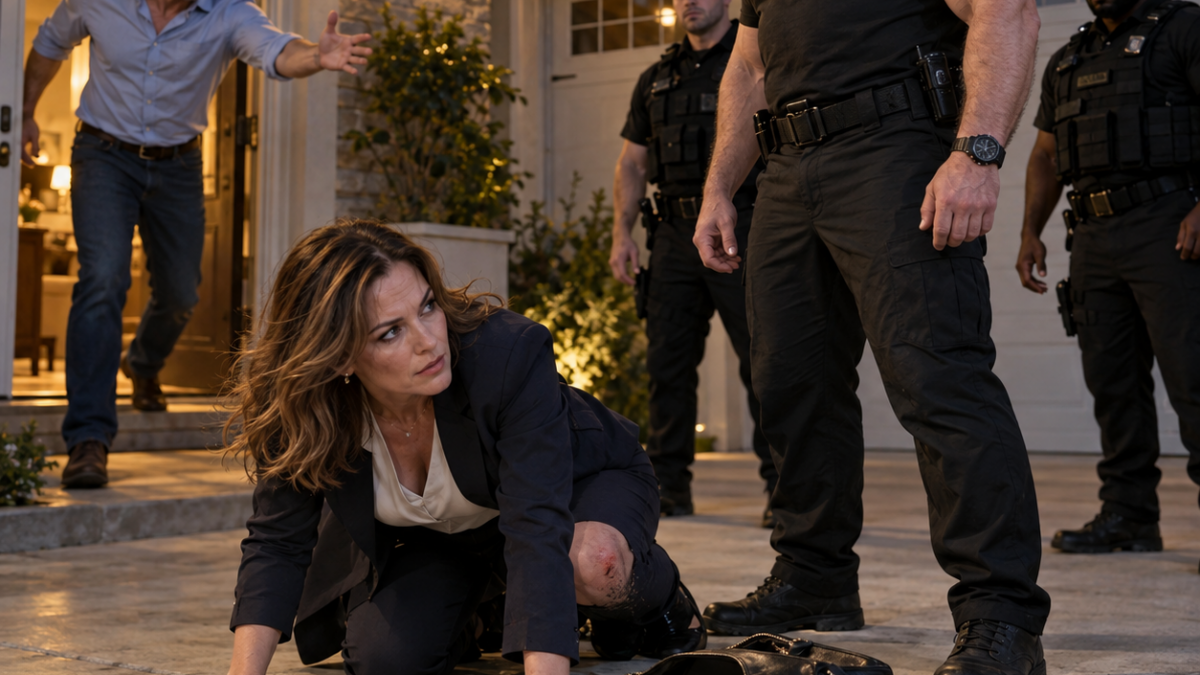
The HOA Guards Slammed My Dinner Guest Onto My Driveway—Then Learned She Was the One Person They Should Never Have Touched.
Jake Morrison thought his HOA security badge gave him the right to put hands on anyone who entered Maplewood after dark.
He slammed my dinner guest onto my driveway, called her an unregistered visitor, and smiled like the whole neighborhood belonged to him.
Then the deputies opened the leather credential case he had kicked across the concrete, and the man who loved saying “lawful order” finally learned what the law actually looked like.
“GET YOUR HANDS OFF ME!”
The scream tore through my backyard just as I was lifting a tray of steaks off the kitchen counter.
I knew the voice.
Tracy Williams.
My dinner guest.
I dropped the tray so hard one steak slid onto the floor.
By the time I reached the front hallway, another voice was booming outside.
“Stop resisting!”
Then came a sound I still hear sometimes when I think about that night.
A body hitting concrete.
Hard.
I yanked open the front door.
Three men in dark Maplewood Security uniforms stood in my driveway.
One of them had Tracy by the arm.
Or he had until a second earlier.
Now she was on the pavement.
Her purse had opened when she fell, scattering a phone, a leather credential case, lipstick, keys, and a small notebook across my driveway.
The largest guard stood over her.
Jake Morrison.
Head of HOA security.
Thick shoulders.
Shaved head.
Black tactical-style polo stretched tight across his chest.
He looked down at Tracy with an expression of disgust.
Then he said the sentence that eventually destroyed his entire little empire.
“Maybe crawling will teach you some respect.”
Something inside me exploded.
“What the hell are you doing?”
Morrison swung toward me.
His hand went to the radio on his vest.
“Stay back, Thompson.”
I kept coming.
“Get away from her.”
PART2:
“This is official HOA security business.”
“You just threw my guest onto my driveway.”
“She refused a lawful identity check.”
“She is invited to my house.”
“She isn’t on the approved registry.”
I stopped beside Tracy and knelt.
“Are you hurt?”
She looked up.
What struck me was how calm she was.
Not dazed.
Not crying.
Not panicked.
Her breathing was controlled.
Her eyes moved from Morrison to the other guards, then toward the security camera above my garage.
Assessing.
Remembering.
Recording.
She accepted my hand and stood.
One knee of her dark slacks was scraped.
Her palm was red where she had tried to break the fall.
Morrison puffed his chest.
“You should have registered her.”
I stared at him.
“What?”
“Unregistered guests arriving after dark are subject to enhanced screening.”
PART3:
“She got out of her car.”
“She refused instructions.”
Tracy brushed grit from her sleeve.
Then she looked directly at Morrison.
“What legal authority do you believe allowed you to detain me?”
Her voice was quiet.
That made Morrison louder.
“Maplewood Security has authority granted by the HOA board to enforce access protocols.”
“That is not legal authority.”
He laughed once.
“Lady, this is private property.”
Tracy glanced toward me.
“Mr. Thompson owns this driveway?”
“Yes,” I said.
“And you invited me?”
“Yes.”
Then she looked back at Morrison.
“So you followed an invited guest onto private property, grabbed her, forced her to the ground, and claimed it was lawful because she wasn’t on a registry created by a homeowners association?”
Morrison’s jaw tightened.
“You don’t get to talk your way out of this.”
“I’m not trying to.”
She looked toward the camera again.
“I want you to keep talking.”
One of the younger guards shifted uncomfortably.
His name tag read Keller.
The third guard, slimmer and older, had stepped back near one of the SUVs parked diagonally across my driveway.
Morrison did not step back.
Men like Morrison rarely recognize the moment when silence would save them.
He pointed at Tracy.
“You people come in here thinking rules don’t apply to you.”
That phrase landed heavy.
You people.
Tracy’s eyes sharpened.
“What people would that be?”
Morrison looked at me as if I was supposed to rescue him from his own mouth.
I did not.
He changed course.
“Unregistered visitors.”
“That is not what you meant.”
“You know what?” he snapped. “We’re done. Keller, secure her until deputies arrive.”
Keller’s face changed.
“Sir?”
“You heard me.”
I stepped between them.
“If any one of you touches her again, you’re going to regret it.”
Morrison smiled.
Not a normal smile.
The kind of smile small men wear when they think a uniform has made them large.
“You threatening security personnel, Thompson?”
“I’m warning trespassers on my property.”
“This neighborhood has rules.”
“This driveway has an owner.”
Morrison reached for his radio.
“Control, this is Morrison. We’ve got a hostile homeowner interfering with a security detention. Send deputies to 48 Briar Point Drive. Possible trespasser, noncompliant female, resisting screening.”
Tracy bent down and picked up her phone with her uninjured hand.
Morrison stepped forward.
“Do not touch anything.”
She straightened.
“You are not in charge of this scene.”
“Actually, I am.”
“No,” she said. “You just created one.”
He did not understand what she meant.
I did.
Or at least I began to.
I had known Tracy Williams for twenty-three years.
We met in graduate school, long before either of us understood how life would beat arrogance out of some people and polish it into armor on others.
Back then, she was the person professors feared because she asked the question nobody had prepared for. She was precise, composed, and absolutely allergic to inflated authority.
After school, our paths split.
I went into civil engineering, then consulting, then early retirement after a medical scare convinced me that money meant nothing if stress killed you before you spent it.
Tracy went into law enforcement.
Not patrol.
Not the kind with flashing lights and local calls.
She worked her way through state investigations, public corruption cases, private security licensing fraud, and eventually into a senior role with the Oregon Department of Justice Criminal Investigations Division.
Her official title was Special Agent Tracy Williams.
Deputy Director of Professional Standards and Security Compliance.
I had only learned the full title two years earlier because she hated saying it.
“What does that even mean?” I had asked.
She smiled.
“It means when people with badges they shouldn’t have start pretending they are police officers, I ruin their week.”
That night, in my driveway, Jake Morrison had no idea that the woman he had just thrown onto concrete was one of the few people in the state who could suspend the license of his entire company before breakfast.
He also had no idea why I had invited Tracy to dinner.
It was not only because she was an old friend.
It was because Maplewood had become unbearable.
I moved into Maplewood Ridge six years earlier.
Back then, it was a quiet lakeside neighborhood outside Portland, tucked between pine slopes, manicured lawns, and a private road that curled around a series of expensive homes facing Mirror Lake.
The HOA was annoying, but ordinary.
Mailboxes had to match.
Garbage cans had to disappear behind fences.
Paint colors required approval.
The usual suburban nonsense people tolerate because the roads get plowed and the entrance landscaping looks nice.
Then the board hired Maplewood Security.
The reason, officially, was “increased concern over unauthorized access.”
Unofficially, a board member’s golf clubs had gone missing from an unlocked garage, and the HOA president, Lydia Carrow, decided the neighborhood was under siege.
Lydia was seventy-one, wealthy, polished, and convinced that property values were a moral category.
She had the talent of making fear sound like responsibility.
At first, Maplewood Security just drove around in marked SUVs.
Then they started parking near the entrance.
Then they began recording license plates.
Then came the visitor registry.
Every guest entering after six p.m. had to be pre-approved through the HOA portal.
Delivery drivers were supposed to show company identification.
Contractors needed a temporary access pass.
Home health aides had to be listed by name.
Dog walkers needed vehicle information.
A sixteen-year-old babysitter was once held at the gate for twenty minutes because the family had typed “Maddie” in the registry and her license said “Madeline.”
That should have been the moment everyone understood we had lost our minds.
Instead, half the neighborhood applauded the “professionalism.”
Because the delays usually happened to other people.
Cleaners.
Drivers.
Nurses.
Landscapers.
Adult children arriving after work.
Friends who did not look like they belonged.
My problems with Morrison began when he stopped my sister.
She had come by to bring me groceries after knee surgery.
She was sixty-two, five feet tall, and carried soup in a floral tote bag.
Morrison blocked her car at the entrance and asked why she was entering the neighborhood.
She said she was visiting her brother.
He asked for my address.
She gave it.
He asked whether she was on the approved list.
She said she did not know.
He told her to pull aside.
She called me crying.
I called the gatehouse.
Morrison answered.
“This is Thompson at 48 Briar Point. Let my sister in.”
“She’s not registered.”
“She is my sister.”
“Registration is required.”
“No, it isn’t.”
He paused.
Then said, “You agreed to HOA rules when you purchased.”
“I did not agree to having my family interrogated by a mall cop.”
That was the first time he called me “noncompliant.”
The board fined me two hundred dollars for “abusive conduct toward security personnel.”
I appealed.
They denied it.
After that, things escalated.
A plumber was turned away.
A neighbor’s hospice nurse was delayed at the entrance until the patient’s daughter drove down in tears.
A food delivery driver had his driver’s license photographed by a guard.
A teenage grandson visiting from Seattle was told he could not walk through the neighborhood after dark without homeowner accompaniment.
Then came the “enhanced screening policy.”
The board emailed it under a subject line that made me want to throw my laptop into the lake.
PROTECTING THE MAPLEWOOD STANDARD.
Unregistered guests arriving after dark could be stopped, questioned, escorted, or denied entry.
“Escorted” became Morrison’s favorite word.
He escorted a piano tuner off the property.
He escorted a cousin from a holiday party because the host forgot to update the portal.
He escorted a Black real estate photographer all the way to her car while telling her she “did not need to be wandering around private homes.”
The photographer posted about it online.
Lydia called the post defamatory.
That was when I began collecting everything.
Emails.
Fines.
Security notices.
Videos from my cameras.
Statements from neighbors who were too afraid to fight openly.
I sent the packet to a local attorney, who sent it to someone else, who eventually told me, “You need to speak to Tracy Williams.”
I laughed when I heard the name.
I called Tracy that evening.
“You still ruining bad badges?” I asked.
She sighed.
“Hello to you too, Marcus.”
Yes, my name is Marcus Thompson.
Most people call me Mark.
Morrison never did.
He liked last names.
They made him feel official.
Tracy asked me to send the documents.
I did.
Two days later, she called back.
“This is worse than I expected.”
“Can the state do anything?”
“Maybe.”
“Maybe?”
“Private security oversight is complicated. HOAs can hire security. Security can observe, report, and sometimes ask questions. But they cannot impersonate law enforcement, unlawfully detain people, seize IDs, use force without lawful justification, or create the impression that HOA rules are criminal law.”
“That sounds like everything Morrison does before lunch.”
“I need more than your word.”
“I have video.”
“You have video of physical detention?”
“Not yet.”
She was silent.
Then she said, “I am not telling you to create one.”
“I know.”
“I mean that.”
“I know.”
Another silence.
Then her voice softened.
“Invite me to dinner.”
“What?”
“Not an official visit. Just dinner. I’ll come as your guest. If they stop me, I’ll observe. If they don’t, we eat steak and complain about aging.”
“You hate steak.”
“I don’t hate steak. I hate badly cooked steak.”
“I’m wounded.”
“You should be.”
That was why Tracy was there that night.
She was not conducting an undercover operation.
She was not trying to provoke anything.
She was simply coming to dinner as an invited guest, carrying the same rights any invited guest should have had.
Morrison did the rest himself.
The deputies arrived eleven minutes after his call.
By then, more neighbors had gathered near the street.
They always did.
Maplewood residents loved privacy until someone else’s drama became visible from the sidewalk.
Lydia Carrow arrived before the deputies.
Of course she did.
She came in a cream Lexus, parking behind Morrison’s SUV like a queen arriving at a battlefield she expected to own.
She stepped out wearing linen pants, pearls, and the expression of a woman already preparing a statement about community standards.
“Marcus,” she called. “What have you done now?”
I almost laughed.
Tracy looked at me.
“This is the president?”
“Yes.”
“Of course.”
Lydia reached us and glanced at Tracy’s scraped knee.
Then at the guards.
Then at the scattered items on my driveway.
Her eyes did not show concern.
They showed calculation.
“Jake,” she said, “what happened?”
Morrison straightened.
“Unregistered guest refused screening, became argumentative, physically resisted removal.”
Tracy said, “That is false.”
Lydia looked at her for the first time.
Really looked.
For a flicker of a second, something passed over her face.
Discomfort.
Not sympathy.
Recognition that Tracy did not look frightened enough.
Lydia turned back to me.
“Marcus, this is exactly why we have protocols. You cannot bring unknown individuals into the community after dark and then blame security when they perform their duties.”
I gestured toward Tracy.
“She was coming to my house for dinner.”
“Then you should have registered her.”
“This is not a prison.”
“No,” Lydia said coolly. “It is a private residential community with standards.”
Tracy bent down and picked up her leather credential case.
Morrison stepped forward.
“Leave that.”
Tracy’s eyes lifted slowly.
“Do not give me another unlawful order.”
He reached down faster than I expected and kicked the credential case away from her hand.
It slid across the driveway and stopped near the front tire of his SUV.
The younger guard, Keller, went pale.
Lydia actually whispered, “Jake.”
Morrison realized he had done something visible.
Then he doubled down, because his pride had no reverse gear.
“Possible fake identification,” he said loudly.
Tracy stood very still.
Then she said, “You just tampered with my property in front of witnesses and on camera.”
Morrison pointed at her.
“You’re done talking.”
That was when Deputy Ana Ruiz stepped out of the first sheriff’s cruiser.
Sergeant Calvin Boyd followed from the second.
I knew Boyd slightly. He had responded to a noise complaint at a board party the year before and looked like he had been regretting his career choices ever since.
Morrison moved toward them before they had closed their doors.
“Sergeant, Jake Morrison, Maplewood Security. We have an unregistered female subject refusing identity screening, resisting lawful security procedures, and creating a disturbance on private HOA property.”
Boyd looked past him at Tracy.
Then at me.
Then at the security camera.
Then at the blood on Tracy’s palm.
“Who called?”
“I did,” Morrison said.
“Who owns this house?”
“Thompson.”
Boyd turned to me.
“Mr. Thompson, is this woman your guest?”
“Yes.”
“Did you ask security to remove her?”
“No.”
“Did you ask them to come onto your driveway?”
“No.”
Morrison interrupted.
“Sergeant, HOA security authority extends to all common access routes and—”
Boyd held up one hand.
“Not now.”
Morrison’s face darkened.
He was used to being the person who interrupted.
Not the person being interrupted.
Deputy Ruiz approached Tracy.
“Ma’am, are you injured?”
“My knee and palm are scraped. My shoulder hurts. I would like medical evaluation after I provide a statement.”
Ruiz nodded.
“What happened?”
Before Tracy could answer, Morrison said, “She was noncompliant.”
Ruiz turned.
“Sir, I did not ask you.”
Tracy pointed toward the driveway.
“My credential case is under that SUV tire line.”
Ruiz walked over, picked it up, and opened it.
Her whole posture changed.
She looked at the identification.
Then looked at Tracy.
Then back at the ID.
“Sergeant.”
Boyd stepped over.
Ruiz showed him the credentials.
The night became very quiet.
Boyd looked at Tracy again.
“Special Agent Williams?”
Morrison’s eyes shifted.
Lydia’s hand moved toward her throat.
Tracy nodded once.
“Off duty, invited guest, not here in an official capacity when I arrived.”
Boyd looked at Morrison.
“But you detained her?”
Morrison swallowed.
“She refused screening.”
Boyd’s voice turned flat.
“You put hands on a state criminal investigator?”
“I didn’t know she was—”
Tracy cut in.
“That is not the issue.”
Boyd glanced at her.
She continued.
“The issue is that he put hands on an invited guest on private property without lawful authority.”
Ruiz looked at Morrison’s belt.
“You carrying weapons?”
“Security baton, OC spray, cuffs.”
“You have cuffs?” Boyd asked.
Morrison lifted his chin.
“Authorized by Maplewood Security policy.”
“Show me your DPSST certification.”
Morrison hesitated.
That hesitation mattered.
Tracy noticed.
So did Boyd.
“Now,” Boyd said.
Morrison pulled out a wallet card.
Boyd read it.
Then handed it to Ruiz.
Ruiz said, “Expired.”
Morrison’s face flushed.
“It’s pending renewal.”
Boyd looked at the other guards.
“You two. Certifications.”
Keller produced his immediately.
The older guard fumbled.
His was expired too.
Lydia said, “Surely this can be handled administratively.”
Tracy looked at her.
“Mrs. Carrow, did you authorize Maplewood Security to physically detain guests who were not on your registry?”
Lydia’s mouth tightened.
“I authorized enforcement of board-approved access procedures.”
“That is not what I asked.”
Lydia’s eyes went to Boyd.
“I think we should wait for counsel.”
Tracy nodded.
“That is the smartest thing anyone from your side has said tonight.”
Morrison snapped, “She’s trying to intimidate us with a badge.”
“No,” Boyd said. “She’s standing on a driveway where you allegedly assaulted her.”
“Allegedly?” I said.
Boyd looked at me.
“Mr. Thompson, do you have camera footage?”
“Yes.”
“Can you access it now?”
I pulled up the security app with shaking hands.
The camera above my garage had caught most of it.
Tracy’s car pulling in.
Morrison’s SUV following close behind.
Tracy stepping out with her purse.
Morrison blocking her path.
Tracy gesturing toward my house.
Morrison stepping closer.
Keller trying to stand back.
Morrison grabbing Tracy’s arm.
Tracy pulling away.
The older guard moving around her.
Morrison twisting her arm down and driving her toward the pavement.
Her body striking concrete.
Then Morrison standing over her.
The audio was clear enough.
“Maybe crawling will teach you some respect.”
No one spoke after the video ended.
Not at first.
The neighbors at the edge of the driveway had gone silent.
The kind of silence that means people are witnessing consequences arrive in real time.
Boyd exhaled through his nose.
“Mr. Morrison, turn around.”
Morrison stared.
“What?”
“Turn around. Hands behind your back.”
Lydia stepped forward.
“Sergeant, this is unnecessary.”
Boyd did not look at her.
“It is very necessary.”
Morrison’s voice rose.
“I was doing my job.”
“No,” Tracy said quietly. “You were pretending your job was law.”
Morrison looked at her with pure hate.
That was his last mistake of the night.
He stepped toward her.
Ruiz moved fast.
Boyd moved faster.
Within seconds, Jake Morrison, head of Maplewood Security, was bent over the hood of a sheriff’s cruiser while Deputy Ruiz fastened handcuffs around his wrists.
The same neighbors he had spent months intimidating watched from the road.
Nobody said a word.
Not until Keller spoke.
“Sergeant?”
Boyd turned.
Keller’s voice shook.
“I didn’t touch her.”
“I saw.”
“I told him we shouldn’t follow her onto the driveway.”
Morrison twisted.
“Shut up, Keller.”
Boyd pushed him back against the cruiser.
“Do not talk.”
Keller looked at Tracy.
“I’m sorry, ma’am.”
Tracy studied him.
“Then tell the truth.”
He nodded.
“I will.”
That was the first crack.
By sunrise, the whole wall came down.
Morrison was booked that night on assault, unlawful restraint, criminal trespass, harassment, and possession/use of security equipment without current certification. The final charges would change later, as charges often do, but the first booking mattered.
It told Maplewood something no board memo ever had.
Their security chief was not untouchable.
Tracy went to urgent care after giving an initial statement.
I drove her.
The steaks sat forgotten in my kitchen.
One was still on the floor.
I remembered it when we got back after midnight.
Tracy stood in the doorway, arm in a sling, knee bandaged, and looked at the ruined tray.
“You overcooked them anyway.”
“You were assaulted on my driveway, and you’re insulting dinner?”
“It’s important to maintain standards.”
I laughed because otherwise I might have started yelling again.
Then I ordered pizza.
We ate at my kitchen island while rain tapped against the windows.
Tracy used her left hand and complained about the crust.
“You can go home,” I told her.
“I know.”
“You should rest.”
“I will.”
“You’re still sitting here.”
She looked toward the front of the house.
“Because I’m thinking.”
“About Morrison?”
“About everyone who didn’t have a camera.”
That sentence stayed with me.
Because she was right.
What happened to Tracy was not new.
It was simply the first time Maplewood Security grabbed the wrong person in front of the right lens.
The investigation began officially two days later.
Tracy was not allowed to lead it because she was a victim and witness.
That frustrated her.
It comforted everyone else.
A separate team from the state came in, along with county investigators and licensing officials.
They requested records from Maplewood Security.
Then from the HOA.
Then from the gatehouse.
Then from Lydia.
The board sent residents an email the morning after Morrison’s arrest.
Dear Maplewood Residents,
An unfortunate incident occurred last evening involving security personnel and an unregistered visitor. The board is cooperating with authorities and asks residents to avoid speculation until the facts are fully reviewed.
Unfortunate incident.
Unregistered visitor.
Those phrases did not survive the day.
By noon, my camera footage had spread through the neighborhood.
Not because I posted it publicly.
I sent it to investigators and three board members who had previously dismissed my complaints.
One of those board members sent it to his wife.
His wife sent it to her book club.
By dinner, the entire neighborhood had seen Jake Morrison slam Tracy Williams onto my driveway.
By nine, someone had added captions.
By ten, Lydia’s “unfortunate incident” email looked like a confession of moral bankruptcy.
Then people began talking.
Quietly at first.
Then loudly.
A hospice nurse named Amelia Cruz gave a statement saying Maplewood Security blocked her at the entrance for eighteen minutes while her patient’s family begged by phone to let her through.
A delivery driver produced video of Morrison photographing his license despite the driver repeatedly saying he did not consent.
A contractor said a guard threatened to “ban him from the county” if he drove in without a contractor pass.
A college student visiting his grandparents said Morrison patted him down near the gate because he had arrived in an older Honda with out-of-state plates.
A woman named Mrs. Patel said her son stopped visiting after Maplewood Security questioned him three times in one month and asked if he was “really family.”
That one broke something in the neighborhood.
Mrs. Patel had lived there eighteen years.
Her late husband had served on the first HOA board.
Her son was a cardiologist.
But he drove a dented Subaru and had brown skin, so Morrison treated him like a delivery mistake.
The stories became a flood.
And in every story, the pattern was the same.
Morrison did not enforce rules equally.
He enforced belonging.
If you looked expensive enough, familiar enough, white enough, old enough, polished enough, you were waved through.
If not, Maplewood Security wanted ID, explanation, registry confirmation, vehicle plate, destination, purpose, and obedience.
Tracy had told me once that abuse of authority rarely begins with a dramatic crime.
It begins with people accepting small humiliations as normal.
She was right.
The state investigators found plenty.
Maplewood Security was licensed only for observation and reporting at the time its contract began.
Its later patrol expansion required updated licensing and training that had never been properly completed.
Two guards had expired certifications.
One had never completed required de-escalation training.
The company handbook used phrases like “detain,” “custodial hold,” and “compliance command” without legal foundation.
The HOA board had approved purchase of handcuffs, batons, and body cameras through a “security enhancement fund.”
Lydia Carrow had personally written an email saying:
Residents must understand that Maplewood Security has practical authority equal to law enforcement while operating within our community.
Practical authority.
Tracy printed that email and stared at it for a long time.
I asked what she was thinking.
She said, “That sentence should be taught in every civics class as what not to believe.”
There was more.
HOA counsel had warned the board three times that visitor registry rules could not be enforced through physical detention.
One email from counsel read:
Security may request identification and may contact the homeowner or law enforcement if a concern exists. Security personnel should not seize documents, physically block vehicles except in immediate safety emergencies, or represent HOA policy as legal compulsion.
Lydia forwarded that email to Morrison with a note.
Legal is nervous. Continue current practice but avoid putting rougher interactions in writing.
Rougher interactions.
That phrase became famous inside Maplewood.
Not in a good way.
Keller, the young guard, cooperated.
He gave investigators access to text messages from the security team.
The messages were ugly.
Photos of visitors.
Jokes about “gate peasants.”
Comments about delivery drivers.
A list Morrison kept on his phone titled PROBLEM RESIDENTS.
My name was number four.
Tracy’s name was not on the list, obviously.
She had not existed in his little world until the moment he decided she did not belong in mine.
The HOA called an emergency meeting five days after the incident.
Lydia tried to limit attendance to homeowners only.
The county fire marshal got involved because too many people showed up at the clubhouse.
Residents stood along the walls, sat on windowsills, and crowded into the hallway.
For the first time since I had moved to Maplewood, the people who usually whispered complaints in driveways were ready to speak publicly.
Lydia sat at the front table with two board members, HOA counsel, and the expression of someone who believed outrage was a scheduling inconvenience.
I sat near the back.
Tracy did not attend.
She said it would complicate things.
She also said she did not trust herself not to call Lydia “a cautionary tale with pearls.”
The meeting began badly.
Lydia tapped the microphone.
“We are here to address recent misinformation regarding our security program.”
A man near the front stood immediately.
“My daughter-in-law was held at the gate while my wife was having chest pains.”
Lydia said, “Please wait for public comment.”
He said, “No.”
That set the tone.
For two hours, residents spoke.
Mrs. Patel stood slowly, holding a folded paper in both hands.
Her voice was soft.
That made the room listen harder.
“My son stopped visiting me at night because your guards made him feel like a criminal. He did not tell me at first because he did not want me to worry. I am eighty years old. My husband died in this house. My son should not need permission from Jake Morrison to bring me soup.”
No one moved.
Then Amelia Cruz, the hospice nurse, stepped forward.
“I have worked end-of-life care for sixteen years. I have held hands with people taking their final breaths. Your security guards delayed me because my name was misspelled in a portal. While I sat at your gate, my patient’s daughter was screaming into the phone. Do you understand what kind of power you gave those men?”
Lydia looked down.
Not ashamed.
Cornered.
Different thing.
Then Keller walked in.
The room shifted.
He was not in uniform.
He looked younger without it.
He walked to the microphone with his hands shaking.
“My name is Andrew Keller. I worked for Maplewood Security.”
Lydia’s attorney leaned toward the board table.
Keller continued.
“I saw Mr. Morrison use force multiple times. I saw him threaten guests and delivery drivers. I heard him say certain people needed to be taught that Maplewood wasn’t public. I reported concerns to my supervisor. I was told the board liked results.”
Lydia said, “That is not accurate.”
Keller pulled out his phone.
“I have messages.”
Her face changed.
The room made a sound.
Not quite a gasp.
Not quite satisfaction.
Something between both.
The board went into executive session after that.
Residents refused to leave.
They waited in the parking lot.
At 11:40 p.m., Lydia Carrow resigned as HOA president.
By midnight, the Maplewood Security contract was suspended.
By Monday, it was terminated.
That should have felt like victory.
It did not.
Not yet.
Because the gates were still there.
The fines were still in resident accounts.
The people who had been humiliated had not been apologized to.
And Morrison had not acted alone.
He had acted with permission, funding, and applause.
The civil lawsuits began within three weeks.
Tracy did not sue immediately.
She waited.
Not out of indecision.
Out of strategy.
First came Mrs. Patel’s son.
Then Amelia Cruz.
Then the delivery driver.
Then three residents who had been fined for “security interference.”
Then me.
My attorney filed claims against the HOA, Maplewood Security, Morrison individually, and Lydia in her board capacity.
The complaint used phrases I had never imagined would apply to my neighborhood.
False imprisonment.
Battery.
Negligent hiring.
Negligent supervision.
Civil rights violations.
Abuse of process.
Intentional infliction of emotional distress.
Unlawful security practices.
Tracy eventually filed separately.
Her complaint was the shortest and the cleanest.
It did not need flourish.
The video did most of the talking.
Morrison’s criminal case moved faster than expected because he could not stop helping the prosecution.
At his first hearing, he insisted he had “law enforcement-equivalent duties.”
At the second, he claimed invited guests became “security subjects” once they entered Maplewood after dark.
At the third, his attorney finally persuaded him to stop speaking.
Too late.
The prosecutor played the driveway video.
Then the gate videos.
Then body camera footage from Maplewood Security showing Morrison telling a rideshare driver, “I am the authority here.”
The plea came before trial.
Morrison pleaded guilty to misdemeanor assault, unlawful restraint, and unlawful security practice charges. The more serious felony-level allegation was reduced as part of the agreement, which angered some people.
Tracy was not surprised.
“Accountability rarely looks as cinematic as people want,” she told me.
At sentencing, she spoke.
She stood in court with no visible bandage anymore, though her shoulder had taken weeks to heal.
Morrison stared at the table.
Tracy looked at the judge.
“Your Honor, Mr. Morrison did not make a single mistake in a moment of confusion. He acted from a belief system. He believed a private uniform gave him public authority. He believed HOA policy could override property rights, personal dignity, and state law. He believed compliance mattered more than legality. That belief injured me, but it also harmed people in Maplewood long before I arrived for dinner.”
The courtroom was silent.
She continued.
“I am not asking the court to punish him because of who I am. I am asking the court to recognize what he did to people who did not have my credentials, my training, or my ability to be believed.”
That was Tracy.
Even when she was the victim, she pointed toward everyone else.
Morrison received probation, fines, mandatory training, community service, and a ban from private security work during probation. His certification was revoked pending further review.
He looked stunned.
Not because the sentence was harsh.
Because consequences had finally found his address.
Lydia’s fall was quieter but deeper.
She avoided criminal charges, which made half the neighborhood furious.
But civil discovery did what criminal court did not.
Her emails came out.
Her notes.
Her statements.
Her repeated warnings from counsel.
Her approval of the security equipment purchase.
Her “rougher interactions” email.
Her comment in one board meeting that “certain visitors need firm handling before Maplewood becomes indistinguishable from the city.”
That sentence ended her public life in the neighborhood.
She sold her house six months later.
At a loss, according to three people who pretended not to know exact numbers.
The HOA settlement took nearly a year.
The terms were not confidential.
That was Tracy’s influence, even though she was not a party to every claim.
“No secrecy,” she said. “Secrecy is how organizations turn patterns into accidents.”
The settlement required:
Abolition of the guest registry as an enforcement tool.
Refund of improper fines.
Written apology to affected residents and guests.
Independent audit of security practices.
Mandatory board training on HOA authority limits.
New policy stating private security could observe and report but not detain, seize identification, block invited guests, or represent HOA policy as law.
A civil rights hotline for complaints.
Public posting of the HOA boundary and authority limits.
Termination of all Maplewood Security personnel from future HOA contracts.
Creation of a resident oversight committee.
Mrs. Patel chaired it.
That was my favorite part.
At the first meeting, she looked over her glasses and told the board, “I have lived here longer than any of you have been frightened.”
No one argued.
The gatehouse changed too.
The black SUVs disappeared.
The tactical uniforms vanished.
The new entrance staff wore plain blue jackets and mostly handled directions, deliveries, and actual emergencies.
No batons.
No cuffs.
No “lawful orders.”
Just people doing a job they understood.
One evening, almost a year after the driveway incident, Tracy came back for dinner.
This time I registered no one.
I left the gate instructions blank.
She drove through without being stopped.
She parked in my driveway, got out, and looked down at the concrete.
The scrape from her fall was gone.
I had pressure-washed the driveway months earlier.
Still, both of us knew exactly where she had landed.
“You okay?” I asked.
She looked at me.
“I’m fine.”
“You always say that.”
“And I’m usually right.”
“No, you’re usually convincing.”
She smiled.
“Fair.”
This time, I did not drop the steaks.
I cooked them carefully.
Medium rare.
Tracy cut into hers, inspected it like evidence, and nodded once.
“Acceptable.”
“That is the highest praise you have ever given me.”
“Don’t let it change you.”
We ate on the back patio overlooking the lake.
For the first time in months, Maplewood felt almost peaceful.
Not perfect.
Not innocent.
Never that.
But quieter.
More honest.
A neighborhood after humiliation either learns or hardens.
For a while, I had not known which way Maplewood would go.
It learned, mostly.
Because enough people finally admitted what they had tolerated.
Because a camera recorded what whispers could not prove.
Because the wrong man touched the wrong woman on the wrong driveway.
But I still think about the people Morrison stopped before Tracy.
The ones who apologized when they had done nothing wrong.
The ones who handed over IDs because the uniform made refusal feel dangerous.
The nurses.
The drivers.
The sons.
The daughters.
The guests.
The people who were told they did not look like they belonged and carried that humiliation home quietly.
That is the part that still angers me.
Not only that Morrison existed.
But that he had an audience.
That we all saw pieces of it and looked away because the inconvenience was not ours yet.
After dinner, Tracy and I walked to the front of the house.
The neighborhood road was dark except for porch lights and the soft glow from the entrance station far down the hill.
A car passed slowly.
No one stopped it.
No one chased it.
No one demanded papers from whoever was inside.
Tracy looked toward the camera above my garage.
“Still recording?”
“Always.”
“Good.”
“You think I’m paranoid?”
“I think you’re educated.”
We stood there for a while.
Then she said, “Do you know what bothered me most?”
“The fall?”
“No.”
“His comment?”
“No.”
“What?”
She looked down the driveway.
“How certain he was.”
I said nothing.
She continued.
“He was not confused. He was not scared. He was not reacting to danger. He was certain. That kind of certainty is dangerous when nobody checks it.”
I thought about Morrison’s smile.
Lydia’s emails.
The neighbors whispering stories only after someone else went first.
“You checked it,” I said.
“No,” Tracy replied. “He ran into a wall he didn’t know was there.”
“Same result.”
“Not quite.”
She looked at me.
“The point is to build the wall before someone gets hurt.”
That was the lesson Maplewood had almost learned too late.
Authority is not a costume.
It is not a polo shirt with SECURITY printed across the back.
It is not a radio clipped to a vest.
It is not a gatehouse, a clipboard, a board resolution, or a homeowner terrified of property values dropping.
Rules are not law because rich people vote on them in a clubhouse.
A private guard is not a deputy because an HOA president likes how he says “compliance.”
And a driveway does not stop belonging to a homeowner because a man with expired certification decides his ego needs room to stand.
Jake Morrison thought he was protecting Maplewood.
He was really protecting the fantasy that Maplewood could decide who deserved dignity at the gate.
Lydia Carrow thought she was preserving standards.
She was really teaching hired men to treat invited guests like suspects.
And Tracy Williams, who came to my house expecting steak and old stories, ended up showing an entire neighborhood the difference between order and control.
The scar on her palm faded.
The bruise on her shoulder healed.
The fines were refunded.
The policy was rewritten.
The gatehouse changed.
But every time I see a visitor drive freely up our road, I think about that night.
The scream.
The fall.
The credential case sliding across concrete.
Morrison saying, “Maybe crawling will teach you some respect.”
He was right about one thing.
Someone learned respect that night.
It just was not Tracy.