The HOA Dumped Thousands of Fish Into My Private Pond Without Permission—Then I Learned Their “Free Stocking” Was Worth Nearly $600,000.
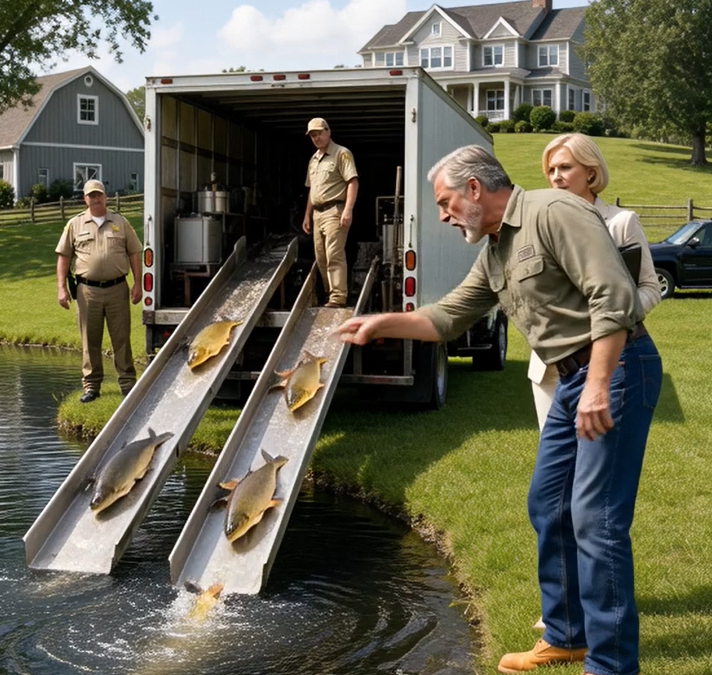
PART2:
She pointed toward the water like a person indicating a stain someone else had missed.
“Those.”
I stared at her.
“Those weren’t there yesterday.”
“I know.”
A cold feeling started in my stomach.
“Karen,” I said, “what did you do?”
She removed a packet from her folder and held it out like a receipt at a restaurant.
“Silver Ridge had an emergency aquatic-management issue. We retained a licensed contractor. The population had to be relocated quickly.”
I took the papers.
First page:
MOUNTAIN AQUATIC SERVICES.
EMERGENCY STOCK TRANSFER AND HABITAT RELOCATION.
$4,800.
BILL TO: ROBERT HAYES.
I read it twice.
Then I looked at Karen.
“You hired somebody to put these fish into my pond.”
“We relocated them.”
“To my property.”
“It was the nearest suitable habitat.”
“You did not ask me.”
“We attempted contact.”
“When?”
“Robert, that isn’t really the point.”
“It is exactly the point.”
I pointed toward my house.
“I live four hundred yards from here. You did not call. You did not knock. You put thousands of live animals into private water without permission.”
Karen’s smile disappeared.
“You weren’t immediately available when the contractor had to act.”
“Immediately available?” I repeated. “I was asleep.”
She tightened her grip on her handbag.
“The retention ponds were experiencing environmental stress. We had no choice.”
“You always have the choice not to trespass.”
Her face hardened.
“That language is unnecessary.”
“So is sending me a $4,800 bill for dumping fish in my pond.”
She lowered her voice.
“Don’t make this difficult.”
That sentence mattered.
Karen did not say she was sorry.
She did not say they had panicked.
She did not even say, Let’s figure this out.
She said, Don’t make this difficult.
Whenever someone creates a problem on your land and then warns you against making things difficult, start taking photographs.
So I did.
I photographed Karen. Her SUV. The invoice. The pond. The fish. The access road. The fresh truck tracks cutting through mud beside the gate. I photographed the tire ruts leading from the timber road down to the east bank where the grass was torn and slick.
Karen watched me with her lips pressed together.
Then something caught my attention.
A bass rolled near the bank.
There was a bright yellow tag attached near its dorsal fin.
Not natural coloration.
A plastic anchor tag.
I stepped closer.
Another fish surfaced.
Blue tag.
Another.
White.
Several of the larger fish had numbered markers.
Karen saw me looking.
Something changed in her face.
Very small.
Enough.
“What are these?” I asked.
“Fish.”
“That is not an answer.”
“Stock fish.”
“Whose?”
“Robert, I don’t have time to inventory individual fish.”
“Then why do some have serial numbers?”
She glanced toward the pond.
“I assume the contractor used identification tags.”
“You hired them. You should know.”
Karen turned toward the SUV.
“You have seven days to pay the invoice.”
I almost laughed.
“And if I don’t?”
“The association will pursue collection and any other remedies available.”
“You mean the association I do not belong to?”
She stopped.
Looked back.
“You are adjacent to Silver Ridge.”
“That is geography. Not membership.”
“You have benefited from our infrastructure for years.”
“No,” I said. “I have tolerated your infrastructure for years.”
Her jaw tightened again.
I pointed toward the water.
“Nobody touches those fish until I know what you put in there.”
Karen stared.
Then she said something I did not understand until much later.
“You have no idea what happens if they establish.”
Then she got into her SUV and drove away.
I watched until the road disappeared into trees.
Then I looked back at the pond.
Thousands of fish moved beneath the surface.
I remember thinking Karen’s final sentence had sounded like a threat.
It was not.
It was fear.
My first phone call went to Daniel Reed.
Daniel was my attorney. He had represented me in three previous property disputes involving Silver Ridge. The first was over an ornamental stone wall contractors accidentally extended six feet across my line. The second involved residents cutting through my timber to create an unofficial hiking path. The third concerned an attempt by the POA to claim I needed architectural approval to replace the roof on a barn built before Silver Ridge existed.
Daniel enjoyed dealing with Karen only because, in his words, “She puts arrogant things in writing.”
He answered on the fourth ring.
“Robert.”
“You busy?”
“Always.”
“Karen Whitmore just dumped several thousand fish into my pond and sent me the bill.”
There was a pause.
Then Daniel said, “I’m going to need you to repeat that, because I’m trying very hard not to enjoy it before understanding whether it’s illegal.”
I told him everything.
When I mentioned the tags, his tone changed.
“Photograph every tag you can see.”
“They’re moving too fast.”
“Video, then. Get close-ups. Do not catch anything. Do not release anything. Do not feed them. Do not let anyone from Silver Ridge back onto your property. I’m calling the state.”
“The state?”
“Fish are not mulch, Robert. You can’t just dump thousands of live animals into a private pond and call it landscaping.”
By eight o’clock, I had set up two trail cameras facing the pond. By eight-thirty, Daniel had emailed me a letter addressed to Karen, Silver Ridge POA, and Mountain Aquatic Services. It said the fish had been introduced without permission, that all parties were prohibited from entering my property, touching the pond, or attempting recovery without written agreement, and that the matter had been referred to state wildlife and environmental authorities.
At nine-ten, Mountain Aquatic Services called me.
The man on the phone introduced himself as Brent Malloy, operations manager. His voice had the strained politeness of someone reading from a script written by a lawyer who was not in the room.
“Mr. Hayes, we understand there’s been some confusion regarding last night’s emergency transfer.”
“There’s no confusion,” I said. “You trespassed.”
“We acted under authorization from Silver Ridge Property Owners Association.”
“Silver Ridge does not own my pond.”
“I understand that’s your position.”
“It is also the deed’s position.”
A longer silence.
Then Brent said, “Mr. Hayes, some of that stock is valuable.”
“I noticed the tags.”
“We would like to schedule retrieval of certain inventory before there are complications.”
I looked out my kitchen window toward the pond. The surface still moved like it had a pulse too large for its body.
“What kind of complications?”
“Mortality. Predation. Mixing. Establishment.”
“There’s that word again.”
“Sir?”
“Karen used it too.”
Brent exhaled.
“I can have a crew there by eleven.”
“No.”
“Mr. Hayes—”
“No one steps on my property until my attorney and the state inspector are present.”
His voice hardened.
“You may be exposing yourself to liability for loss of stock.”
That was when I understood the trap might be larger than Karen’s invoice.
“You put the stock in my pond without permission.”
“Again, we acted under authorization.”
“From someone who lied to you or someone you helped lie. Either way, that is between you, Karen, and whatever poor lawyer is about to regret breakfast.”
Then I hung up.
I am not a dramatic man by nature. I have spent most of my life believing the best arguments are made with documents, not volume. My wife, Ellen, used to tease me that if a tornado came through the house, I would first check whether it had filed the proper permit.
Ellen had been gone four years by then.
The pond had become quieter after she died.
Not actually, of course. Frogs still sang in spring. Geese still fought like drunk relatives. Wind still moved through willow branches near the dock. But grief changes the sound of places. A pond where two people used to sit becomes a pond where one person remembers sitting.
Ellen loved that water.
She named the coves. She fed bluegill from the dock even after I told her not to. She kept a notebook of birds and wildflowers and once spent an entire Saturday arguing that the old fallen sycamore should remain in the shallows because it gave the turtles character.
When cancer took her, I scattered some of her ashes beneath the willow by the western bank.
So when I looked at those thousands of foreign fish churning through that water, I did not see a lucky accident or unexpected profit.
I saw someone throwing their problem into the last place my wife still felt close.
That was the part Karen would never understand.
At noon, two state trucks came down my access road.
The first belonged to the Department of Natural Resources. The second had the county environmental office seal on the door.
A tall woman in a green jacket stepped out of the first truck, followed by a younger man carrying a net, a cooler, and a scanner.
She introduced herself as Dr. Amelia Price, regional fisheries biologist.
“I understand you received some unauthorized guests,” she said.
“That’s one way to put it.”
The county man introduced himself as Mark Ellison, environmental compliance inspector. He shook my hand, then looked past me at the pond.
His eyebrows lifted.
“That’s not a few fish.”
“No.”
Dr. Price walked to the edge, crouched, and watched the water for less than ten seconds before her expression sharpened.
“Those are tagged bass.”
“I saw.”
“Not standard farm stock either.”
She turned to her assistant.
“Get the reader.”
The young man unfolded a long-handled dip net and stepped carefully into the shallows with hip waders. It took him less than two minutes to net the first tagged fish, a thick largemouth bass with a yellow external tag and a small glass PIT tag beneath the skin.
He passed the scanner over it.
The device beeped.
Dr. Price read the number.
Then she read it again.
Her face changed.
She looked at me.
“Mr. Hayes, who told you these fish came from Silver Ridge retention ponds?”
“Karen Whitmore.”
She looked back at the bass.
“This fish did not come from a retention pond.”
Mark Ellison stepped closer.
“How do you know?”
Dr. Price lifted the fish carefully, supporting its belly.
“Because this is registered brood stock.”
The words meant almost nothing to me at first.
Then Daniel pulled into the drive in his black sedan, walked down to the bank with his tie already loosened, and heard enough to stop mid-step.
“Registered by whom?” he asked.
Dr. Price looked at him.
“Mountain Aquatic Services.”
Daniel smiled once, without humor.
“Of course.”
They scanned twelve more fish over the next hour.
Nine were tagged.
Every tag traced back to Mountain Aquatic’s premium trophy-bass program or its private hatchery brood line. Two trout had colored marks tied to a cold-water acclimation study. Several bluegill were hybrid forage stock used to support high-value bass growth. The catfish were sterile channel-blue crosses, expensive because they were large, disease-tested, and transport-certified.
“These are not trash fish,” Dr. Price said.
Karen arrived again at one-fifteen.
This time she brought two Silver Ridge board members and Brent Malloy from Mountain Aquatic.
She also brought a man with a clipboard who looked like he wanted to be anywhere else.
Daniel met them at the gate before I could.
“You can stop there,” he said.
Karen looked past him toward the pond.
“We’re here to cooperate.”
“No,” Daniel said. “You’re here because the fish turned out to be expensive.”
Brent’s eyes flicked toward the water.
Dr. Price came up the path holding her scanner.
“Mr. Malloy,” she said. “Good. I was about to call you.”
He swallowed.
“Dr. Price.”
She held up a printed list of tag numbers.
“Why are Mountain Aquatic registered brood and trophy stock in Mr. Hayes’s private pond?”
Brent said nothing.
Karen stepped in.
“As I explained to Mr. Hayes, Silver Ridge had an emergency aquatic-management issue.”
Dr. Price looked at her.
“With registered brood stock?”
Karen’s mouth tightened.
“They were part of our lake-improvement program.”
“You don’t have a permitted recreational lake.”
“We have retention ponds.”
Mark Ellison looked up from his notes.
“Retention ponds are stormwater infrastructure, Mrs. Whitmore. Not trophy fisheries.”
Karen did not like being corrected in front of people she considered beneath her.
“You’ll have to speak to our contractor about classification.”
Dr. Price looked at Brent.
“Fine. Mr. Malloy, show me the transfer manifest.”
He opened his folder with slow, reluctant hands and passed her a document.
Dr. Price read the first page.
Then the second.
Then she looked at Mark.
“Inspector Ellison, look at the receiving waterbody.”
He took the document.
A few seconds later, he looked toward me.
Then toward Karen.
“Mrs. Whitmore,” he said, “why is Mr. Hayes’s private pond listed here as Silver Ridge Lake Three?”
The air changed.
Even the pond seemed quieter.
Karen’s face did not collapse all at once. It happened in small pieces. The smile left first. Then the color. Then the arrogance around her eyes.
Daniel took one step closer.
“May I see that?”
Mark handed him a copy.
Daniel read it and made a soft sound that might have been a laugh if it had not carried so much danger.
The receiving location on the transfer manifest read:
SILVER RIDGE LAKE THREE / SOUTH HABITAT BASIN.
The GPS coordinates beneath it were my pond.
My private pond.
On my deed.
Inside my fence.
Beside my wife’s willow.
Daniel looked at Karen.
“You represented my client’s pond as POA property.”
Karen recovered enough to say, “That is an internal designation.”
“No,” Mark Ellison said. “It appears on a state transfer document.”
Brent spoke quickly. Too quickly.
“Mountain Aquatic relied on client-provided site information.”
Dr. Price turned on him.
“You transported high-value live stock into an unverified private waterbody in the middle of the night based on a client’s map?”
Brent’s jaw worked.
“We were told there was urgency.”
“What urgency?”
He glanced at Karen.
She stared back with the kind of look that tells a person to remember whose check cleared.
Daniel noticed.
So did everyone else.
Dr. Price folded the manifest.
“I am issuing a quarantine hold on this pond until species composition, health status, and transfer legality are determined. No fishing. No feeding. No removal. No additional stock. No chemical treatment. No one touches these fish without state authorization.”
Karen turned toward her.
“That is unnecessary.”
Dr. Price stared at her.
“Several thousand undocumented fish were placed in private water under a false location name. Unnecessary ended last night.”
Brent’s clipboard man shifted his weight.
Daniel pointed at him.
“And you are?”
The man hesitated.
“Paul Avery.”
I frowned.
“That’s my last name.”
He looked embarrassed.
“No relation. I’m the transport supervisor.”
Daniel looked at his badge, then at me, then at Karen.
“Convenient.”
Paul looked confused.
Daniel’s eyes narrowed.
“Robert, did you authorize any work verbally?”
“No.”
“Did anyone at Mountain Aquatic speak to you?”
“No.”
Paul opened his mouth, then closed it.
Daniel turned back to him.
“Mr. Avery, did someone tell you the property owner authorized the transfer?”
Paul looked at Brent.
Brent looked at Karen.
Karen looked toward the pond.
That was the first time I saw the outline of the whole thing.
Not the details.
Not yet.
But the shape.
Someone had wanted paperwork that made this look like I had agreed.
Someone had used my land, my pond, and maybe even the coincidence of a supervisor’s last name as cover.
By sunset, the state had taken water samples, netted and scanned twenty-seven fish, photographed the access tracks, copied the transfer manifest, and ordered Mountain Aquatic to preserve all related records. Daniel had sent a demand letter thicker than a church bulletin. Karen had left without speaking to me.
That night, I sat at my kitchen table with a pot of coffee I should not have made and a stack of documents spread before me.
The house felt too quiet.
Ellen’s chair sat across from me. I had never moved it. Her blue sweater still hung on the back, though I had washed it so many times after she died that it probably held more laundry soap than memory now.
I looked through the window toward the pond.
The moon was up. The water glimmered silver between the trees. Every so often, the surface broke.
A fish.
Another.
Another.
Too many lives in a place they had not chosen.
I understood that feeling better than I wanted to.
Daniel called at nine-thirty.
“You sitting down?”
“I’m sixty-eight. I’m usually sitting down by nine-thirty.”
“I found the contract.”
“What contract?”
“Silver Ridge entered into a five-year premium aquatic enhancement agreement with Mountain Aquatic Services. Not retention pond cleanup. Enhancement. Trophy bass, forage base, seasonal trout, habitat structures, management visits, branding rights, the whole country-club fantasy.”
“How much?”
“Initial stock valuation and service package: six hundred twelve thousand dollars.”
I said nothing.
Daniel continued, his voice tight with controlled satisfaction.
“Robert, they didn’t dump nuisance fish in your pond. They dumped a six-hundred-thousand-dollar private fishery.”
I looked toward the dark water.
“Why?”
“Because their lake wasn’t ready.”
“What lake?”
“The one they’ve been promising buyers in Phase Four.”
Silver Ridge Phase Four.
I had heard rumors for years.
The eastern side of my property bordered a drainage corridor that fed into a low bowl of land beyond Silver Ridge’s current boundary. Developers wanted it. Karen wanted it. The board wanted it. The only problem was water. Their planned amenity lake depended on controlling runoff and access near my land. I had refused every easement request because I did not trust them to stop at one road or one ditch.
Daniel kept talking.
“They advertised a future private fishing lake to buyers. Sold premium lots. Collected deposits. Mountain Aquatic delivered fish early because the contract had a spring stocking deadline. Then Silver Ridge’s permit got delayed.”
“So they put the fish in the retention ponds?”
“Temporarily. Without proper authorization, from what I can tell.”
“And then?”
“Then the retention ponds started failing. Low oxygen. Algae bloom. Too many fish in shallow stormwater basins. If the fish died there, they had a six-hundred-thousand-dollar loss, angry buyers, state violations, and a board election coming up.”
I closed my eyes.
“So Karen used my pond.”
“She used your pond because it’s spring-fed, deep, private, and already healthy. She also labeled it Silver Ridge Lake Three on the transfer manifest.”
“Why bill me?”
“To build a paper trail that you accepted the transfer or owed for emergency relocation. Maybe to intimidate you. Maybe both.”
I thought of Karen’s words.
You have no idea what happens if they establish.
Now I did.
If the fish established in my pond, then the stock survived.
If the stock survived, Silver Ridge could claim its investment still existed.
If they could claim its investment existed, they might try to force access, recovery, or even some kind of easement argument.
And if I paid that invoice, even by mistake, they could say I accepted service.
“Daniel,” I said, “what happens now?”
His voice softened.
“Now we make it difficult.”
For the next three weeks, my quiet property became a place where trucks came and went daily.
State biologists returned with nets, oxygen meters, sample jars, and tag scanners. Environmental officers walked the banks. Daniel visited twice with a surveyor. A private fisheries expert named Neal Benton came at Daniel’s request and spent six hours studying the pond before telling me the good news and bad news were the same.
“The pond can support a lot,” he said. “That’s why they chose it.”
He showed me a rough estimate.
Between trophy bass, brood stock, forage fish, trout, catfish, and transport survival, the living stock in my pond was valued somewhere between $540,000 and $620,000 depending on mortality, certification, and ownership status.
I laughed when he said it.
Not because it was funny.
Because my mind had no other place to put that number.
A $600,000 fishery had been thrown into the pond where my wife used to feed bluegill with stale crackers.
Neal did not laugh.
“Mr. Hayes, I need you to understand something. Money aside, this is an ecological shock. Your existing bass population may be displaced. Forage balance may collapse. Trout may not survive summer. If any of these fish carry disease, your pond could be damaged for years.”
I looked at the water.
“What would Ellen have done?” I asked.
He glanced at me, uncertain.
“My wife,” I said. “She would have wanted to know whether the fish were suffering.”
Neal’s expression softened.
“Some are stressed. But for now, most are alive.”
“Can they be moved?”
“Some. Not all. And moving them may be more harmful unless it’s done carefully. The state will decide what can leave.”
“Do I own them?”
He gave a short laugh.
“That is a lawyer question.”
So I asked Daniel.
His answer was longer.
Ownership of fish is a strange thing. In public water, they belong to the state until caught lawfully. In private ponds, stocked fish can be treated as property under certain circumstances. But when someone intentionally introduces valuable private stock onto another person’s land without consent, while falsifying location documents and sending that landowner a bill, the law becomes less a straight road and more a swamp with snakes.
Daniel liked swamps with snakes.
He filed suit against Silver Ridge POA, Karen Whitmore personally, Mountain Aquatic Services, and three related development entities I had never heard of but which turned out to be tied to Phase Four.
Claims included trespass, nuisance, conversion, negligence, fraud, environmental damage, slander of title, civil conspiracy, and unjust enrichment.
He also requested an emergency order prohibiting anyone from entering my property, attempting to retrieve fish, altering water levels, using my pond in marketing materials, or representing it as Silver Ridge property.
The judge granted the temporary order in less than forty-eight hours.
Karen did not take it well.
She called an emergency Silver Ridge meeting at the clubhouse and told residents I was holding the community’s investment hostage.
Someone leaked the recording.
In it, Karen stood before a room of angry homeowners and said, “Mr. Hayes has chosen to exploit an unfortunate emergency for personal gain. Those fish belong to Silver Ridge. His pond was used as temporary habitat because it was the only responsible option.”
Then a resident asked, “Why did the transfer form call his pond Silver Ridge Lake Three?”
Karen answered, “That was an administrative shorthand.”
Another asked, “Why did we spend over half a million dollars on fish before we had a lake?”
Karen said, “You cannot build premium community value without forward planning.”
Then a man in the back shouted, “My dues bought fish for an old man’s pond?”
Karen replied, “Temporarily.”
That one word caused more damage than anything Daniel had filed.
Temporarily meant she intended to come back.
Temporarily meant she had always known my pond was not theirs.
Temporarily meant every Silver Ridge resident now understood their board president had gambled their money on a plan that depended on taking control of someone else’s property after the fact.
The next morning, three residents appeared at my gate.
I recognized one of them, a retired school principal named Linda Carver. She had once called the sheriff because deer from my timber crossed “her” road at inconvenient hours, as if I had trained them.
Now she stood outside my fence holding a foil-covered plate.
“Mr. Hayes,” she said, “I brought banana bread.”
I looked at the plate.
Then at her.
“Is this an apology or a bribe?”
Her face reddened.
“An apology.”
“For the deer too?”
She blinked.
Then, to her credit, she smiled.
“Yes. For the deer too.”
I opened the gate.
Not because banana bread fixed anything.
Because some apologies arrive carrying what they know how to carry.
Linda, a younger man named Chris Dutton, and a woman from the Silver Ridge finance committee named Maribel Santos sat with me on the porch while I drank coffee and they explained what residents had been told.
Karen had promised Phase Four would include a private fishing lake that would raise all property values. She had claimed negotiations with me were “substantially resolved.” She had shown residents a site map with my pond shaded pale blue and labeled South Habitat Basin. Most residents assumed it was future POA land or a retention feature already under agreement.
I asked Maribel, “Did the board approve the fish contract?”
She looked miserable.
“We approved an aquatic enhancement budget. Karen said legal had cleared the site plan.”
“Did legal clear it?”
Chris snorted.
“We don’t know. Karen keeps saying attorney-client privilege.”
Daniel later described that phrase as “the last umbrella of people standing in a lightning storm.”
The pressure built.
Mountain Aquatic tried first to distance itself from Silver Ridge. Its owner, a compact man named Eric Voss, sent Daniel a letter saying his company had acted in good faith based on POA representations and intended to retrieve its stock.
Daniel responded with photographs of Mountain Aquatic trucks on my access road at 2:17 a.m., copies of the false manifest, and a question:
What part of good faith requires headlights off?
Eric Voss stopped writing letters and hired a criminal attorney.
The state moved next.
Dr. Price’s preliminary report concluded the transfer violated multiple regulations, including failure to verify receiving water ownership, mislabeling of a private pond, unauthorized introduction of fish species, and failure to obtain permission from the landowner. The report also noted that the transfer created risk to existing aquatic life and could affect downstream waters if flooding occurred.
Mark Ellison issued environmental notices.
The county opened a separate inquiry into the false mapping tied to Phase Four.
Then came the inspector’s public visit.
It happened on a Tuesday afternoon, cold and bright, with Silver Ridge board members, Mountain Aquatic representatives, state officials, attorneys, and a court-appointed special master all standing near my pond like mourners at a very expensive funeral.
Karen came too.
She wore a dark wool coat and sunglasses, though the sun was behind her. She looked thinner than she had that first morning, but not softer. People like Karen did not soften under pressure. They sharpened.
The special master, a retired judge named Evelyn Cross, had ordered an on-site inspection to determine fish condition, access issues, and whether emergency removal was necessary.
Dr. Price’s team netted several specimens. A tagged bass came up first, heavy and furious, water spraying from its tail.
She scanned it.
Beep.
She read the number aloud.
Mountain Aquatic’s attorney flinched slightly.
The next fish was another tagged bass.
Then a trout.
Then a catfish.
Judge Cross looked at Dr. Price.
“What is the estimated value of stock introduced?”
Dr. Price checked her notes.
“Based on contract pricing, tag registry, size class, genetic certification, and current survival estimates, approximately six hundred thousand dollars.”
No one spoke.
Wind moved across the pond.
Judge Cross turned to Karen.
“Mrs. Whitmore, why was roughly six hundred thousand dollars in private aquatic stock placed in Mr. Hayes’s pond without a signed agreement?”
Karen’s mouth opened.
Before she could answer, Mark Ellison held up the transfer manifest.
“And why,” he added, “did your filing identify this pond as Silver Ridge Lake Three?”
That was the question from the title of my life.
The question that made every polished sentence Karen had rehearsed useless.
She stood on my bank, in my cold pasture, beside my wife’s pond, with state officials holding her paperwork, and for once, her folder could not save her.
“Our intention,” she said slowly, “was to preserve valuable community assets during an emergency.”
Daniel stepped forward.
“An emergency created by spending resident funds on fish for a lake you did not own and had not permitted.”
Karen’s attorney said, “Objection.”
Judge Cross looked at him.
“This is not a trial, counsel. It is an inspection. But your objection is noted as emotionally supportive.”
I liked Judge Cross immediately.
Karen turned toward me.
“You could have resolved this quietly.”
That sentence told me she still did not understand what she had done.
I looked past her at the water.
“My wife used to sit under that willow,” I said. “You put trucks through the grass beside it at two in the morning. You dumped thousands of fish into water you don’t own, then billed me for the privilege. Quiet is what you were counting on.”
Her expression shifted.
Maybe she had not known about Ellen.
Maybe she had known and not cared.
Both possibilities hurt in different ways.
Judge Cross ordered a full accounting, continued the no-access order, and required Silver Ridge and Mountain Aquatic to fund immediate pond monitoring while ownership, damages, and removal options were litigated. Karen left before the officials were done packing up.
She did not look at the pond again.
By then, Silver Ridge was tearing itself apart.
The Phase Four buyers demanded refunds. Residents demanded to know why dues and reserve funds had been spent on fish before legal access was secured. The finance committee uncovered invoices routed through a development consulting company controlled by Karen’s brother-in-law. Mountain Aquatic had discounted part of the contract in exchange for promotional rights to advertise Silver Ridge as a “premier private trophy community,” even though no such lake existed.
Karen insisted every decision had been made for the good of the community.
That phrase can cover many sins until receipts arrive.
The receipts arrived.
Emails surfaced in discovery.
Karen to Eric Voss at Mountain Aquatic:
Hayes will never agree if approached directly. He believes the pond is sentimental because of his deceased wife. We need to create operational necessity.
Eric Voss replied:
Temporary relocation can be defended if framed as emergency preservation.
Karen:
Once stock is in place, removal access becomes non-negotiable. Establishment works in our favor.
There it was.
You have no idea what happens if they establish.
She had not feared ecological damage.
She had feared losing leverage.
Or rather, she had hoped establishment would create leverage.
If $600,000 worth of fish survived in my pond, Silver Ridge could claim access was necessary to protect its investment. If they could claim access, they could reopen easement talks. If they could reopen easement talks, they could pressure me into giving up the drainage corridor and possibly future control of the pond edge.
My land had not been chosen in an emergency.
It had been targeted.
When Daniel showed me those emails, I sat at my kitchen table and felt older than sixty-eight.
Not because I was surprised by greed.
Greed is not creative. It wears different suits, but it usually walks the same road.
What hurt was the casual way she had written about Ellen.
He believes the pond is sentimental.
As if love were a weakness in the title chain.
Daniel sat across from me.
“We can push for punitive damages,” he said.
I looked at Ellen’s empty chair.
“What would that do?”
“It would punish them.”
“Would it fix the pond?”
“No.”
“Would it stop Silver Ridge from trying again?”
“Possibly.”
“Would it make them say her name like she mattered?”
Daniel’s face softened.
“No court can order that.”
I nodded.
“Then let’s make them remember why she did.”
The settlement talks began after Karen was removed as POA president.
The recall meeting was held in the Silver Ridge clubhouse. I did not attend, but Daniel did. He said Karen arrived with three binders, two attorneys, and no understanding of the room she was entering.
Residents were angry about the money first.
Then the liability.
Then the embarrassment.
But when Linda Carver stood and read Karen’s email about my wife aloud, the room changed.
Daniel told me there are moments when anger becomes disgust, and disgust is harder to survive politically.
Karen tried to interrupt.
People shouted her down.
Maribel Santos stood next and read the finance report showing how much had been spent on fish, transport, consulting, legal fees, and Phase Four marketing before any final permits existed.
Chris Dutton asked the simplest question of the night.
“Why did you think you could use land we don’t own?”
Karen said, “Because Mr. Hayes has refused to be reasonable for years.”
Linda replied, “Reasonable people do not steal ponds.”
The recall passed by a margin so large Daniel wrote the number on a napkin and slid it across my kitchen table the next morning like a winning lottery ticket.
Karen was removed.
The new board immediately suspended Phase Four.
Mountain Aquatic’s license was placed under review.
The county referred the false filing to the district attorney.
Karen later faced charges for falsifying environmental documents, conspiracy to trespass, and fraudulent use of association funds. Eric Voss entered a cooperation agreement after his company’s insurance carrier realized the word “intentional” was about to become very expensive.
The civil settlement came in pieces.
Silver Ridge agreed to pay for a full ecological restoration and monitoring plan for my pond over five years. Mountain Aquatic agreed to fund removal of fish that could safely be relocated, under state supervision. The development entities paid damages related to trespass, fraud, and attempted interference with my property rights.
The tagged brood stock created the strangest part.
Because Silver Ridge had purchased the fish, Mountain Aquatic had delivered them, and the transfer paperwork identified me as the billed receiving party, all while no valid retrieval agreement existed, Judge Cross pushed the parties toward a practical solution rather than years of arguing over fish ownership while the fish kept growing.
Under the settlement, the valuable tagged fish would be divided into three categories.
Some would be removed and sold back into certified programs, with proceeds offsetting restoration costs and damages owed to me.
Some would remain temporarily for ecological balance under state management.
Some, once cleared and no longer needed for breeding certification, would legally become part of my private pond population, subject to limits and monitoring.
When all the numbers were done, the living stock originally dumped into my pond had been valued at just over $600,000.
I did not become rich from fish.
Stories on the internet like to pretend justice arrives as a giant check and a villain crying in a parking lot. Real justice arrives with legal fees, tax advice, wet paperwork, and months of people arguing over oxygen levels.
But I received enough to repair the damage, protect the pond, place a conservation restriction on the most sensitive banks, and create something Ellen would have loved.
The Ellen Hayes Youth Fishing Day.
I know that sounds sentimental.
It was.
I am no longer embarrassed by that word.
The first fishing day happened the following May, after the pond reopened under a limited plan. We did not fish for tagged brood bass or any stock still under restriction. We set up along the smaller cove with bluegill, sunfish, and a few common bass that had lived there long before Karen discovered my land existed.
I invited local kids from the county 4-H club, the church youth group, and, after some thought, Silver Ridge.
Dana’s grandson caught the first fish. Linda Carver brought lemonade. Maribel Santos volunteered at the sign-in table. Daniel showed up wearing a hat so ugly several children asked whether he had lost a bet. Dr. Price gave a short talk about private water, invasive species, and why moving live fish without permission is not “helping nature.”
Then one little girl asked if fish could be trespassers.
Dr. Price looked at me.
I said, “Only if they bring an invoice.”
People laughed.
I looked toward the willow.
For a moment, I could almost see Ellen there in her straw hat, pretending not to cry because children were catching fish too small to brag about.
That was the first day the pond felt like mine again.
Not because the damage was gone.
It wasn’t.
Not because Karen had apologized.
She hadn’t.
Not because money had balanced the scales.
Money rarely does.
It felt like mine because the story of what happened there no longer belonged to the people who tried to use it.
It belonged to truth.
And to children with worms in coffee cans.
And to an old man who finally understood that protecting land sometimes means opening the gate to the right people after locking it against the wrong ones.
Karen left Silver Ridge before the criminal case ended.
Her house sold below asking after three price cuts, which I admit I learned from Linda Carver, who had become alarmingly good at gossip for a retired principal. Karen’s final court appearance was small and gray. She accepted a plea agreement that included probation, restitution, fines, community service, and a ban from serving as an officer of any property association or development board.
At sentencing, she read from a statement.
She said she regretted the situation.
She said she regretted the division.
She said she regretted that decisions made under pressure had harmed public trust.
Then the judge stopped her.
“Mrs. Whitmore,” he said, “do you regret trespassing on Mr. Hayes’s property and falsifying documents?”
Karen stared down at the paper.
For a long time, she said nothing.
Then, quietly, she said, “Yes.”
The judge looked at me.
I had the right to speak.
Daniel had helped me prepare a statement. It was in my jacket pocket, folded twice.
I stood, but I did not take it out.
I looked at Karen.
“You treated my land like unused space because it did not look valuable to you,” I said. “You treated my wife’s memory like an obstacle because it did not fit your site plan. You treated living animals like bargaining chips. You treated your own neighbors like wallets. I don’t know if you’re sorry for that or just sorry it failed.”
Karen’s eyes shone, though whether with tears or anger, I could not tell.
I continued.
“My pond will recover. Silver Ridge will recover. The fish, most of them, will survive somewhere. But I hope every time you see water after this, you remember that a thing can be quiet and still belong to someone.”
That was all I said.
Outside the courthouse, reporters tried to ask me questions.
I walked past them.
Daniel caught up to me at the bottom of the steps.
“You ignored the statement we worked on for forty minutes.”
“I improved it.”
“You made it shorter.”
“That is usually improvement.”
He smiled.
“You know Ellen would have liked that line about quiet things.”
I looked toward the parking lot, where a cold wind moved fallen leaves along the curb.
“Yes,” I said. “She would have told me I should have said it sooner.”
The next year, Silver Ridge looked different from my side of the fence.
The Phase Four signs came down. The false maps disappeared from brochures. The new POA board recorded a permanent acknowledgment that my pond, access road, drainage corridor, timber buffer, and all related water rights belonged to me and were not subject to Silver Ridge control, use, entry, branding, or future amenity planning.
Daniel framed that acknowledgment and brought it to my house.
I hung it in the barn, where it could keep company with tools that had done more honest work.
The pond changed too.
Not all at once.
Nature does not care about legal schedules.
Some trout died in the summer heat despite the spring. Some bass adapted. Some tagged fish were carefully removed. The forage balance had to be corrected. Dr. Price’s team came every few months. Neal Benton helped rebuild habitat along the banks. We planted more native vegetation. We added aeration. We restored the western cove.
The willow remained.
So did the fallen sycamore Ellen loved.
I made sure of that.
One evening two years after the dumping, I walked down to the pond at sunset with a folding chair and a cup of coffee I did not intend to finish. The water was calm. Truly calm. The kind of calm that reflects trees without breaking them.
A bass rolled near the surface.
One fish.
Not thousands.
Just one.
I watched the circle spread until it disappeared.
Behind me, tires crunched on the access road.
I turned.
Linda Carver stood by the gate holding another foil-covered plate.
“Banana bread?” I asked.
“Zucchini this time.”
“That sounds like punishment.”
“It has chocolate chips.”
“Then it may enter.”
She smiled and walked down the path more carefully than she used to. She was older now. So was I. So was everyone who had survived the drama and learned that property lines are not just surveyor marks. Sometimes they are moral tests.
She stood beside me and looked over the pond.
“It’s peaceful again,” she said.
“Yes.”
“I’m sorry we didn’t see it before.”
“The pond?”
“You.”
I did not answer right away.
Compliments make me more uncomfortable than subpoenas.
Finally, I said, “You brought banana bread eventually.”
She laughed.
We stood there a while.
Then she pointed toward a small wooden sign near the dock. It had been installed the week before the second Ellen Hayes Youth Fishing Day.
Private Pond. Protected Habitat. Ask Before You Touch What You Do Not Understand.
“Did Daniel write that?” she asked.
“No.”
“Dr. Price?”
“No.”
She looked at me.
I shrugged.
“Ellen would have liked signs.”
Linda smiled softly.
“She sounds like she was wonderful.”
“She was bossy.”
“Wonderful women often are.”
I could not argue with that.
After Linda left, I stayed until the sky turned purple behind the trees.
The pond darkened.
Frogs began calling from the reeds. A heron lifted from the far bank, slow and prehistoric, and disappeared toward the drainage corridor Silver Ridge had once tried to fold into its future.
I thought about Karen Whitmore stepping from her SUV that first morning, smiling beside water she thought she had turned into leverage.
I thought about the invoice.
The tags.
The inspector asking why my pond had been renamed on paper by people who had never earned the right to name anything on my land.
I thought about the $600,000 worth of fish flashing beneath the surface like stolen silver.
And I thought about Ellen, who used to say people reveal themselves by what they assume is empty.
An empty field.
An old barn.
A quiet pond.
An old man’s patience.
Karen had looked at my water and seen storage.
Silver Ridge had looked at my land and seen opportunity.
Mountain Aquatic had looked at my gate and seen a detail someone else had handled.
But the pond had never been empty.
It held springs older than any subdivision. It held bass I had watched grow from fingerlings. It held turtles, cattails, mud, rain, ashes, memory, work, grief, love, and the kind of silence that does not mean surrender.
That was what they missed.
And that was why they lost.
I folded the chair, picked up my untouched coffee, and started back toward the house.
Behind me, the pond settled into the night.
Still mine.
Still alive.
And finally, once again, quiet.